







Abstract
This essay proposes an alternative approach to Latino student success through a “border-rooted” paradigm shift in post-secondary education. A “border-rooted” paradigm reflects the local socio-cultural and historical epistemologies that impact post-secondary education, and how space and place impacts educational settings that serve Latino students.
Introduction
This essay proposes an alternative approach to Latino student success through a “border-rooted” paradigm shift in post-secondary education. Traditional notions of outreach, recruitment, and retention used with Latino students often ignore the specificity of a place as having cultural or social relevance or capital for student academic success. A “border-rooted” paradigm reflects the importance of local socio-cultural and historical epistemologies that can impact institutions of higher education (IHEs). Learning how the role of space and place impacts educational settings like Hispanic Serving Institutions (HSIs), 1 and how Latino students experience these spaces and places, can offer a useful method for understanding Latino students’ post-secondary educational hindrances and attainments.
A “border-rooted” paradigm shift considers the realities Latino students face because of place-specific dynamics and how these experiences can impact educational settings. In the U.S. border region, and the Southwestern borderlands specifically, residents are impacted by the militarization of the U.S.–Mexico border, detention and deportations, mixed-status families, border violence, English Language Learner adjustments, and historical trauma associated with xenophobia, nativism, racism, and place. Border regionalisms, tight-knit Mexican enclaves, culturally oriented Mexican neighborhoods, Latino majority school districts, families’ citizenship and immigration status, and the routine transnational experiences of students traversing the U.S. border- collectively impacts the identities of students. Additionally, the historical relevance of the U.S. Southwest as first territorialized by Mexico is especially relevant. All in all, the border’s imprint shapes how IHEs respond to their students and the surrounding communities (Bejarano, 2010).
We argue that a “border-rooted” paradigm is applicable in post-secondary educational settings beyond the immediate border region. We acknowledge several major justifications for the efficacy of this paradigm throughout the U.S. First, Mexican origin students, Spanish speakers, and first generation citizens, permanent residents, undocumented and DACA students, and their families, have migrated to nearly every state in the nation, carrying with them their customs and traditions, kinship and social networks, concerns about belonging, and their dream of an education. Second, the state apparatus of surveilling non-citizens and most Latino citizens, along with the technologies of categorizing and tracking (im)migrant populations, has penetrated many municipalities and in turn, has become a point of contention for universities and colleges. Third, national legislation since the mid-1990s, ranging from border operations, to interior enforcement inter-agency cooperation between federal and local police departments and county sheriffs has evinced an unprecedented level of cooperation to criminalize, arrest, incarcerate, and deport undocumented immigrants (Bejarano, 2010; Dreby, 2015; Heyman, 2014; Menjívar and Kanstroom, 2014; Stuesse and Coleman, 2014). Last, anti-immigrant organizations and nativist sentiments have created a toxic political environment that blames undocumented immigrants for myriad social problems, ranging from spikes in crime to a loss of jobs and a nadir in the larger job market (Golash-Boza, 2015; Kanstroom, 2007).
Thus, states and municipalities across the country have passed laws, propositions and ordinances that make it difficult or impossible for the undocumented to obtain health care and housing, to establish legal accounts, to openly attend public schools, and to reside in certain parts of a city while remaining mobile without fear of apprehension (Dreby, 2015; Fernández-Kelly and Massey, 2007). In short, policies and practices found at the border have penetrated the interior of the U.S., and in doing so, they have “nationalized” the border technologies of surveillance, militarization, detention, and deportation. Although the scope and degree of this violence remains unparalleled at the border (Bejarano, 2010; Heyman, 2014), the interiorizing of the borderlands helps us grapple with the lived experiences of Mexican origin communities across the U.S. (Kanstroom, 2007).
Envisioning transformative education through a “border-rooted” paradigm
As anti-immigration policies, xenophobia, and the modern deportation regime blanket the country, universities have moved into volatile discussions about race, citizenship and belonging. Efforts across the U.S. to declare universities as sanctuary campuses in reaction to the election of Donald Trump to the Presidency reflect the heightened concerns about the status of undocumented students and their families. Beyond the U.S.–Mexico borderlands, Mexican origin students and their families face questions about their status, their rights to an education, access to scholarships and loans, and their place within the economy. Public schools and universities struggle with the tensions between their mission to provide open access and equal education to all that seek it, yet state legislatures and local governments have jumped on the nativist bandwagon by scapegoating non-violent undocumented immigrants (Najmabadi, 2016). This alignment of traditional concerns about boundary maintenance at the international border and the capacity of the state to police interior geographies and people, has placed immigrant youth in a precarious situation.
Racism and conflict on university campuses over status and citizenship necessitate the consideration of a “border-rooted” paradigm, derivative of the international boundary realities’ surfacing in varying degrees throughout the country (Owens and Lynch, 2012). As we conceptualize it, this paradigm has multiple components. First, it is a methodological framework that simultaneously stems from the lived experiences of vulnerable populations—their strengths and knowledge—and elements of participant observation, “action” scholarship, and critical pedagogy, that reflect an awareness of the socio-political context of both student and faculty member. A second component of this paradigm requires a respect for and understanding of the specific place in which Mexican-origin students and their families reside. Beyond the international boundary, what is the history of Spanish speaking populations in predominantly non-Mexican communities and non-border locales: what brought them to the interior of the U.S., and what are their historical experiences in that place? Third, the paradigm compels a sober analysis of students’ encounters with state-sponsored campaigns of surveillance and policing. Do they live “in the shadows,” fearful of living “normal lives” because they are undocumented, permanent residents, members of a family with mixed status or for simply being Latino? Finally, educators must create safe spaces, zones of open-ness and inclusion that embrace the strengths and cultural capital of students in mixed-status families. Through these multiple lenses we can utilize a “border-rooted” framework in spaces adjacent to and far away from the international boundary.
A “border-rooted” methodology
The methodology articulated in a “border-rooted” paradigm, derives from our experiences working closely with Latino College students in the U.S. Southwest borderlands, and as such, we employ elements of participant observation, participatory engagement, scholarly reflexivity, and critical pedagogy. We “collect data” from daily interactions with marginalized students over several years, taking note of their border experiences crossing the international boundary, confronting regimes of policing and surveillance, and listening to their experiences as individuals in mixed-status, documented, and undocumented families. We witness their struggles crossing the border from local high schools, where they are close to friends and relatives, to the competitive and contentious space of major research universities. We participate in their lives as mentors and advisors, attend family functions, graduation parties and other milestones, and we watch them grow into their professional careers. Indeed, we are inspired by the notion of “deep participation” which can “change the lives” of all who participate in acts of resistance to oppression, racism, threats of deportation and institutional marginalization (Tuck and Yang, 2014: 14). Deep participation necessitates the creation of new ways of thinking about—in this context—the nature of educational institutions, their treatment of Latino students, and the creation of safe spaces for learning and exchange of knowledge (Tuck and Yang, 2014).
We also argue that there is an inextricable connection between methodology and individual positionality within the contemporary political context of border enforcement, policing, detention and deportation in the U.S. Our responses to these realities blur the lines between university professor and educator, critical researcher, citizen, and human being. In some cases, we become advocates for them as they try to become citizens, confront institutional racism, or grapple with the deportation of a loved one. This methodology of interaction, participation, and critical engagement has provided us with a wealth of experiences bearing witness to the realities of our students, but it has also changed us as educators and members of a borderlands community.
This methodology for assessing students’ realities and for transforming institutional approaches to marginalized students, like our “border-rooted” paradigm is portable beyond the border. This portability is becoming increasingly useful as interior states and communities encounter heightened surveillance, echoing developments along the international boundary. Scholars and policy makers have long noted the diaspora of Mexican undocumented communities in interior regions distant from the border. Predominantly non-Mexican communities police themselves for undocumented immigrants, and universities far from the international boundary struggle with notions of legality, and the reactions of racists and cultural nationalists. Simultaneously, border patrol operations grow as part of the militarization of the border, and the rhetoric to build a wall becomes increasingly heated, while the trope of the “illegal immigrant” is ensconced in the American psyche. It serves the cultural work of fear-mongering and scapegoating as many Americans are anxious about perceived job loss and their “way of life” as the border itself penetrates Middle America (Heyman, 2014).
Accentuating approaches of participant observation and participation, a “border-rooted” paradigm and methodology requires an acknowledgment of one’s positionality. Our methodology acknowledges that we work and live within a matrix of research, advocacy, scholarship, and community involvement. As scholars and as members of the communities we write about, we find it difficult to disentangle questions of research methodology from activism and education. As teachers in universities where anti-immigrant sentiments have grown, and where undocumented, students of mixed status families, and majority Latinos attend, we see a borderland between the institutions of higher learning and the communities that are policed by regimes of deportation and intimidation. While we teach about racial profiling, the disproportionate arrest rates for youth of color, and the incarceration and deportation of undocumented immigrants, we witness these very same processes happening to our students and their families in our universities and throughout our community.
The first author has taught at an HSI, MSI since 2001, where Latinos comprise 51% of the student body and is active in local Latino community advocacy for migrants, immigrants, and border citizens. By using a “border-rooted” paradigm, she oversees a funded program to recruit, support, retain, and graduate students from agricultural backgrounds since 2002. She and her program colleagues are intimately involved with the students and their families, having visited their homes, high schools, the fields where they work, and have attended graduation and family celebrations. At her University, she has also advised three Latino based student groups’ on-campus. Our appreciation, respect, defense and love for students, and their academic struggles and accomplishments helped to create a “border-rooted” paradigm shift that focused on key tenets of social justice and advocacy in educational settings stemming from familiar socio-cultural spaces at the border.
The second author has participated in and overseen postsecondary training for high school history teachers in the borderlands area, has worked with indigenous groups in the U.S. Southwest since 1998, has directed a doctoral program that is majority Latino, and for five years has served as the faculty advisor for a student organization composed of Indigenous and Mexican students. Since 2002, he has worked at an HSI, MSI where over 75% of the university students are Latino, and more than 10% are Mexican citizens. The second author used the borderlands’ perspective to emphasis the cultural, social, and historical richness of the U.S. Southwest borderlands as a grounding experience for researching and collaborating with communities of color. At his home institution in Texas, where the majority of students are first generation college freshman, he has witnessed the struggles and achievements of students who have faced obstacles to their educational dreams. These characteristics make the student body truly transnational and rooted in the borderlands region.
Alongside an awareness of how one’s subjectivity influences relations with Mexican-origin students, educators need to remain knowledgeable about the geo-political context and contemporary educational setting of these youth. Although the educational landscape of the Southwest borderlands may seem unique, the U.S. more broadly is experiencing a major demographic shift that makes these universities illustrative of future realities. In 2012, Latinos comprised 17% of the total U.S. population, yet it is projected that by 2060, Latinos will represent 31% of the total U.S. population, approximately 129 million people (U.S. Census Bureau, Population Division, 2012 National Population Projections). According to Excelencia in Education, “the college enrollment rate for Latinos increased from 54% to 70% [since 2004], resulting in a higher rate of Hispanic students enrolling directly after their high school graduation [and more] than White or African American students (2015, p: 3). As of 2004, the numbers of HSIs increased from 238 to 379 (Excelencia in Education, 2015). Marcela Cuellar claims that “Latina/os now comprise the largest racial/ethnic minority group enrolled at four-year colleges and universities (Fry and López, 2012), with a significant proportion enrolling at Hispanic-Serving Institutions (HSIs). In fall 2008, approximately 35% of all Latina/o undergraduates at four-year institutions were enrolled at colleges or universities where at least 25% of the students were Latina/o” (National Center for Educational Statistics, 2009), a criterion of HSI eligibility” (2015: 101). With this growing rate of enrollment, HSIs are certain to increase as is the diversity of Latino students’ and their varied exposure to IHEs and preparedness for it.
As our methodology reflects the aforementioned principles, our conceptual paradigm acknowledges inequalities while it also offers pathways for racial equity and belonging. Located at the U.S.–Mexico borderlands and at HSIs, the authors believe that a “border-rooted” paradigm shift was a salient component to creating safe spaces for Latino students from rural and often tight-knit farmworker communities surrounded by border highway checkpoints, as well as for those students living in urban “barrios” marked by poverty, racism, and racial profiling, that oftentimes abutted the U.S.–Mexico border wall and its adjacent communities. A proposed “border-rooted” paradigm shift recognizes the interlocking of race, class, gender, immigration status, and exclusivity, and dismantles barriers to Latinos by invoking a “sense of belonging,” and a sense of permanence in a University setting (Bejarano, 2010). By permanence, we emphasize how Latino students are a permanent and necessary component to an institution’s success, and not a statistical category to meet institutional demands of “diversity.”
In addition, our methodology sees value in students’ experiences, backgrounds, and worldview. We seek a balance between the “information” and skills imparted by formal education in an institution, and the pre-existing knowledge of students. This “border-rooted” paradigm embraces the methodological claim that we cannot expect marginalized students to emulate their professors, if that forces them to shed their own ways of crafting social relationships and of navigating contentious landscapes. As McKenzie and Bieler note in Critical Education and Sociomaterial Practice, “While some scholars and educators have attempted to reinvigorate critical education through more nuanced and dynamic understandings of what it means to develop a critical view of society and social justice, this work remains largely theoretical and tends to lack substantive engagement with lived experience” (2016: xv). Building on this call to incorporate lived experience—particularly the experiences of marginalized groups—we agree that these experiences represent sites of knowledge production and identity formation that serve not only as a “focus of critique but also as constituting learning itself” (McKenzie and Bieler, 2016: xiii). This facet of our methodology dovetails with our emphasis on identity formation as reflected in history, space, and place because, in conjunction with the larger interrogation of state surveillance and omnipresent threats of deportation, they offer nuanced analytical tools for critical pedagogy in contested landscapes and volatile borderlands (McKenzie and Bieler, 2016).
The historical production of space, place, and identity
The history of a region is central to assessing students’ lives, as the context for “data” about their experiences, and for helping transform their experiences in a university. The history of the Southwestern borderlands, for instance, has imparted a legacy of race and class based colonialism and socio-political disenfranchisement that characterizes students’ experiences in institutions of higher learning. Moreover, the history of anti-immigrant policy-making, the technologies of surveillance, and the practices of deportation that are presently implemented throughout the U.S. have their origins in the Southwest borderlands. Understanding U.S. border states help us understand the realities of Mexican origin students in the interior states, as these systems expand their reach and scope.
At the end of the U.S. War with Mexico, the Treaty of Guadalupe Hidalgo in, 1848 severed the northern states from Mexico and brought them into the U.S. As the value of the Mesilla Valley and towns such as Tucson became clear to those interested in building a railroad to California, Congress negotiated the Gadsden Purchase in 1853. Also known as the Treaty of Mesilla, this agreement sliced off another section of the Mexican north and incorporated it into the U.S. (Mora, 2011). The Treaty of Mesilla is especially salient because it incorporated the lands upon which the University of Arizona (UofA), the University of Texas at El Paso and New Mexico State University (NMSU) are located. The Treaty of Guadalupe Hidalgo ended the War and among other things, allowed former Mexican citizens to choose U.S. citizenship, although Euro-Americans migrating to the Southwest quickly took the reins of governance, passed laws that imposed capitalist oriented economics, and assaulted the land grants of Hispanos. Longstanding elite Hispano families lost their lands, and as the railroads entered the territory they brought cheaper manufactured goods that undercut the locally made products. “Modern” industries displaced local landholders, and by the early twentieth century Mexicanos became migrant laborers working in fields they once owned, or in urban industries that eclipsed local economies (Mitchell, 2005).
As people of Mexican descent grappled with the new racial and economic systems, public schools and universities emerged throughout the Southwest. The policies of these institutions sought to “lift up” masses of immigrants and the poor, with the goal of creating an educated citizenry. Alternately, public education facilitated assimilation of immigrant groups through the erasing of their cultural heritages and languages, and their indoctrination into American institutions and ways of life (Nieto-Philips, 2004). Public schools segregated Mexican students and prepared them for menial work at the bottom of the socio-economic ladder. These schools sought to expunge cultural “liabilities” such as devotion to Catholicism; strong kinship ties, and the Spanish language and replace them with allegedly superior traits such as frugality, hard work, cleanliness, patriotism, and individuality (Nieto-Philips, 2004).
Although the public system differed from the universities, there were broad similarities regarding people of color. As the United States expanded, Congress passed the Morrill Land Act during the height of the Civil War. The Act mandated the federal government reserve land in the territories for the establishment of public universities. In New Mexico Territory, two universities moved to the forefront: The University of New Mexico (UNM), in Albuquerque; and NMSU, the Land Grant University, in Las Cruces. In Arizona, three main universities emerged: Arizona State University, established as a teaching school; the UofA, the land grant university; and Northern Arizona. The UofA and NMSU not only educated its citizens, but they served as research institutions focusing on agriculture, ranching, mining, and engineering. The University of Texas at El Paso, established in, 1914 as the College of Mines and Metallurgy, had a similar mandate to serve local communities and industries such as mining.
From their inception, these universities facilitated the growth of farming, mining, and ranching, all of which were dominated by Anglo-Americans. A few Mexican citizens held small plots of land, or they had migrated into “urban barrios” across the region. In rural villages such as Hatch and Deming, Mexicans labored for farms owned by Anglos. Very few of these youth during the mid-twentieth century attended these universities, while nearly all of the universities conducted research in conjunction with the large-scale agricultural industries within which the Mexican population worked. The universities, thus passively shunted Mexicans in manual industries, and the industries through their demands to maintain a pliable and permanent workforce, obstructed Mexicans from seeking higher education. This history of racial discrimination shapes the views of Latinos towards education systems, and establishes the foundations for institutional racism within universities. Although institutions are changing, the legacies of these historical relationships cast a long shadow over educational politics today.
By the late twentieth century, new labor and immigration policies, and transformations in the economy strained relations between Mexicans born in the U.S. and regional farmers. The Bracero Program notwithstanding, farmers in the Southwest relied on Mexican communities to provide seasonal labor. El Paso, Hatch, Deming, Silver City, Nogales, and Tucson, as well as Mexican enclaves along the border faced tensions associated with seasonal agricultural work, technological advances in machinery and pesticides, and the influence of the Civil Rights and Chicano Movements. A small number of protestors were college students seeking parity in the universities, and racial equity in other sectors of society, including labor reform in agricultural industries. Evidence of these tensions can be seen in the termination of the Bracero Program in 1964, the same year Congress passed a pivotal Civil Rights Bill. Simultaneously, Congress overhauled its immigration policy by closing loopholes for migration to the U.S. and implementing quotas for the Western Hemisphere (Kanstroom, 2007).
Although the reforms abolished blatant race-based prohibitions, the new regime proved detrimental to Mexicans seeking work. Combined with the Border Industrialization Program of the early 1960s—which provided labor opportunities in cities on the Mexican side of the border—the polices ironically helped to create undocumented migration into the U.S. The Industrialization Program undergirded the growth of maquiladoras in border cities such as Ciudad Juarez and Ambos Nogales, but due to low pay and inadequate infrastructure for a booming population, many migrants continued going north into the U.S. This undocumented “supply” of workers met the “demand” of farmers in the Southwest, because the U.S. failed to create a robust temporary worker program after it terminated the Bracero Program and closed loopholes for migrants in the Western Hemisphere. The failure of U.S. migration policies to meet the need of big agriculture created the “problem” of “illegal immigration” (Ngai, 2006: 15).
The Immigration Reform and Control Act of 1986, the North American Free Trade Act in 1994, and Operations Hold the Line, Safeguard, and others, set the stage for the broader contours of life for Mexicans in the borderlands region (Dunn, 2009). Suffice it to say that villages throughout the Southwest are populated by families that entered the U.S. before and after NAFTA, as well as after the Secure Fence Act of 2006, and the most recent regime of border militarization. Migrants entering the U.S. before NAFTA faced xenophobia and racism, but many obtained citizenship under the Reagan administration with the, 1986 legislation. Citizenship through naturalization became more difficult to achieve after NAFTA, but in the wake of the terrorist attacks of 11 September 2001, citizenship has become nearly impossible for people essentially trapped in the U.S. This regional history shapes the specific realities of Mexican-origin students in the borderlands, but it also shapes the histories and places throughout the interior U.S. (Fernández-Kelly and Massey, 2007).
Mexican students’ perspectives as trans-national and multi-national actors
Key to understanding the realities of students in universities throughout the U.S. includes a discussion of the racial, legal status, and educational borders that youth cross. Debates over public schools and universities questioning the citizenship status of youth has created a toxic educational environment. The student walkouts of 2006–7 in opposition to anti-immigration legislation, and the reaction to the election of Donald Trump as President reveals the powerful voices of youth in public education and universities from El Paso, Texas, to San Diego, California, and throughout the interior U.S. (Najmabadi, 2016).
Although debates about education for students of color—particularly Mexican students—has generated myriad reports and scholarly publications, at times the quotidian experiences of a single student can reveal the world in microcosm. Investigating one case can help us understand how Latino youth’s struggles around education are shaped by place-specific dynamics, such as the racial, regional, political, and class background of an instructor, or the cultural biases of students and support staff. Specific examples can also reveal tensions between, in the incident offered below, “academic free speech” and cultural and racial violence. To quote bell hooks, as much as “everyone likes to imagine that the college campus is a place without censorship, where free speech prevails and students are encouraged to engage in debate and dialectical exchange, the opposite is a more accurate portrait of what really takes place in college classrooms” (Hooks, 2010: 162).
Tagging of Lucio's work on the side of the University Art Building. Photograph of Lucio Sanchez, shared with Cynthia Bejarano. Written permission to use in possession of the author.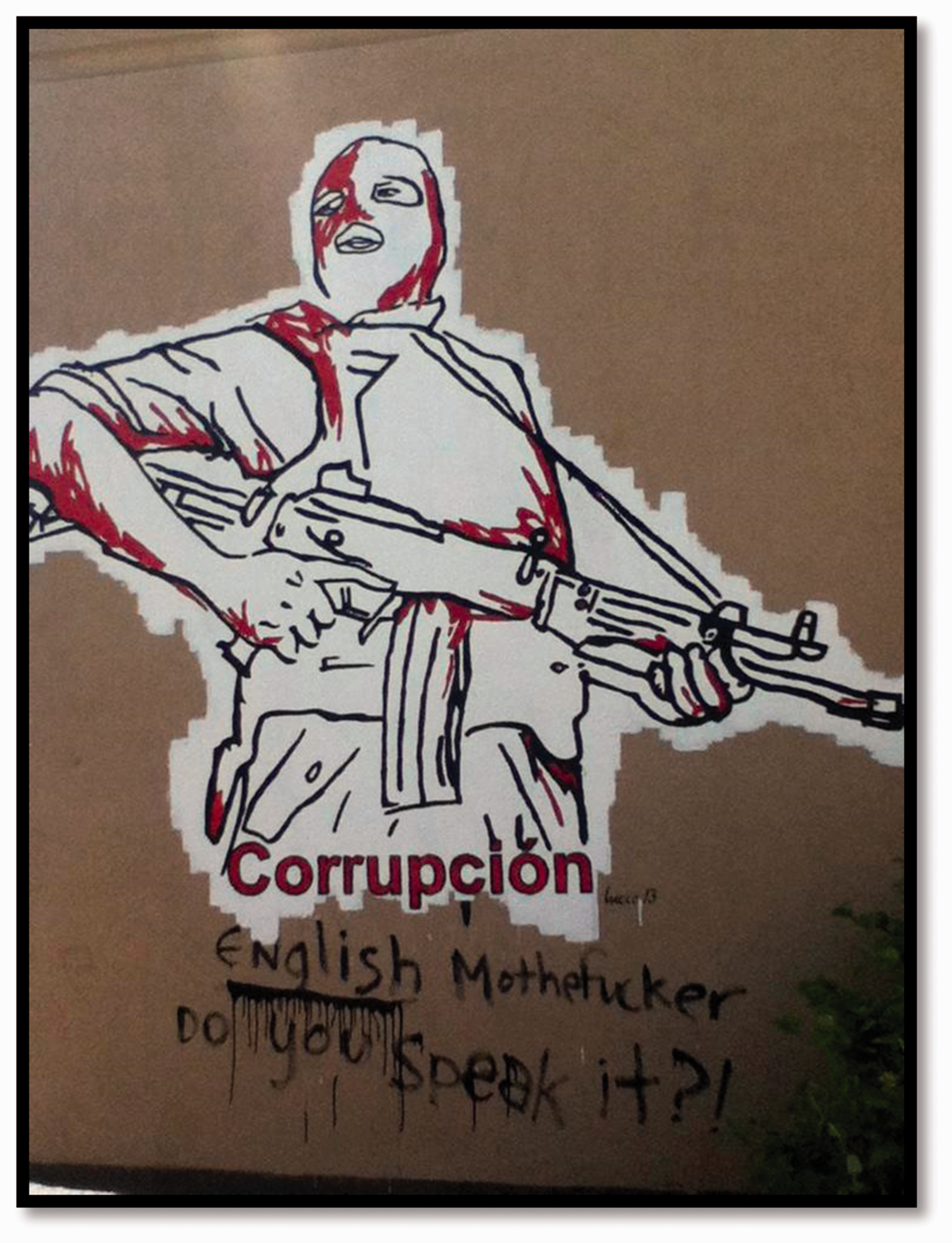
In 2013, an especially egregious example of racism and xenophobia unfolded at the first author’s institution (see figure 1). A student of ours was completing a senior mural project. He was partially raised in Chihuahua and traversed the border regularly with his family to visit relatives, to shop in Mexico, and to keep doctors’ appointments. He and his family worked in agriculture and experienced the violence during the War on Drugs in the U.S. and Northern Mexico between 2007 and 2012. The student, Lucio Sanchez, was transformed by this violence and his artwork served as testimonial to what hundreds witnessed or heard about across the Border region. For his senior project, Lucio created a mural on the side of the University art building that depicted a masked federale, a Mexican federal police officer, holding a cuerno de los chivos (AK-47), government issued weaponry for many Mexican state and federal police. The officer’s image was painted in white, with red and black paint that offered the mural its definition. Underneath the image was the Spanish word ‘Corrupción’ in block red letters. Only one day after Lucio finished the mural, it was tagged with the words, “English mothefucker do you speak it?” in black spray paint. The word ‘English’ was underscored. A colleague quickly texted a photograph to the first author, who then walked to the location and took several more photographs before immediately notifying campus administrators about the defacement on campus hoping for some action—a police report or a teach-in to defy the racist and contemptuous tagging. After only one day of e-mail exchanges, and with ardent efforts by only one administrator to address the issue, the decision was made NOT to do anything outside of a classroom discussion. The tagging occurred during finals week, when students and families were on the cusp of celebrating graduation, and people hoped that like the “tagger” the mural itself would be long gone.
Lucio’s work captured the devastation across the border that impacted places and people bi-nationally. His work had an unexpected affect in revealing the contempt that still exists in places like IHEs where enlightenment and knowledge are ostensibly sacred. The attack on Lucio as a “Mexican” who used Spanish to articulate his political statement, sent a clear message that the university was not an embodiment of his lived experiences, nor did it understand what students were experiencing back home, across the border. His work meant to bring attention to the countless lives lost in Mexico due to the drug trade that moves shipments north to the U.S. for consumption. Instead, the tagging revealed that hostile and racist acts still occur in the borderlands, even in educational settings. Moreover, although one is drawn to the irony that the perpetrator misspelled “motherfucker,” especially when condemning Lucio for writing in Spanish, the privilege of the perpetrator allowed s/he to ignore proper spelling because s/he “belongs,” in the U.S. For Lucio, the assault was on his identity, language, and “invasion” of the University, even though he was protesting corruption in another country. In sum, the tagging questioned his “belonging” in the U.S.
Although this example grew out of an anti-immigrant sentiment at a university in the borderlands, it could feasibly have taken place anywhere. The example also speaks to the multiple borders crossed by students, ranging from the international border, to the border between high school and college, as well as racialized borders between primarily Anglo universities and communities of color. As Faulstich Orellana notes, “Walls are erected along national borders. Identities get locked into boxes. Children are dichotomized from adults, schools from homes, researchers from teachers, theory from practice, our minds from our bodies” (2015: 3), so it is imperative to interrogate those walls and borders while we simultaneously create strategies to dismantle and undermine them. Further, as “border-rooted” paradigm advocates, we need to replace walls and borders with affirmative pathways across national, racial, class, and gender divisions in IHEs for more global and enlightened learning.
For instance, another of Lucio’s art pieces demonstrates this linking of local and global concerns in his depiction of the grisly murder of forty-three male normalista students from the Ayotzinapa Rural Teachers College in Guerrero, Mexico (see figure 2). In 2014, the students were commemorating the, 1968 student massacre in Tlalteloco, Mexico, and although the precise identities of the assailants remain unknown, evidence points to local officials, gangs, and possibly the military’s involvement. Lucio’s portrayal of this atrocity, and the resulting worldwide solidarity with the families, helped educate the university about global events and their impact on local communities. As a sign of solidarity, students at both universities hosted the parents of two of the disappeared students who were traveling through the U.S. as part of the Caravana 43 tour, raising awareness of these murders.
Lucio's political art on the 43 Normalista students murdered in Ayotzinapa. Photograph of Lucio Sanchez, shared with Cynthia Bejarano. Written permission to use in possession of the author.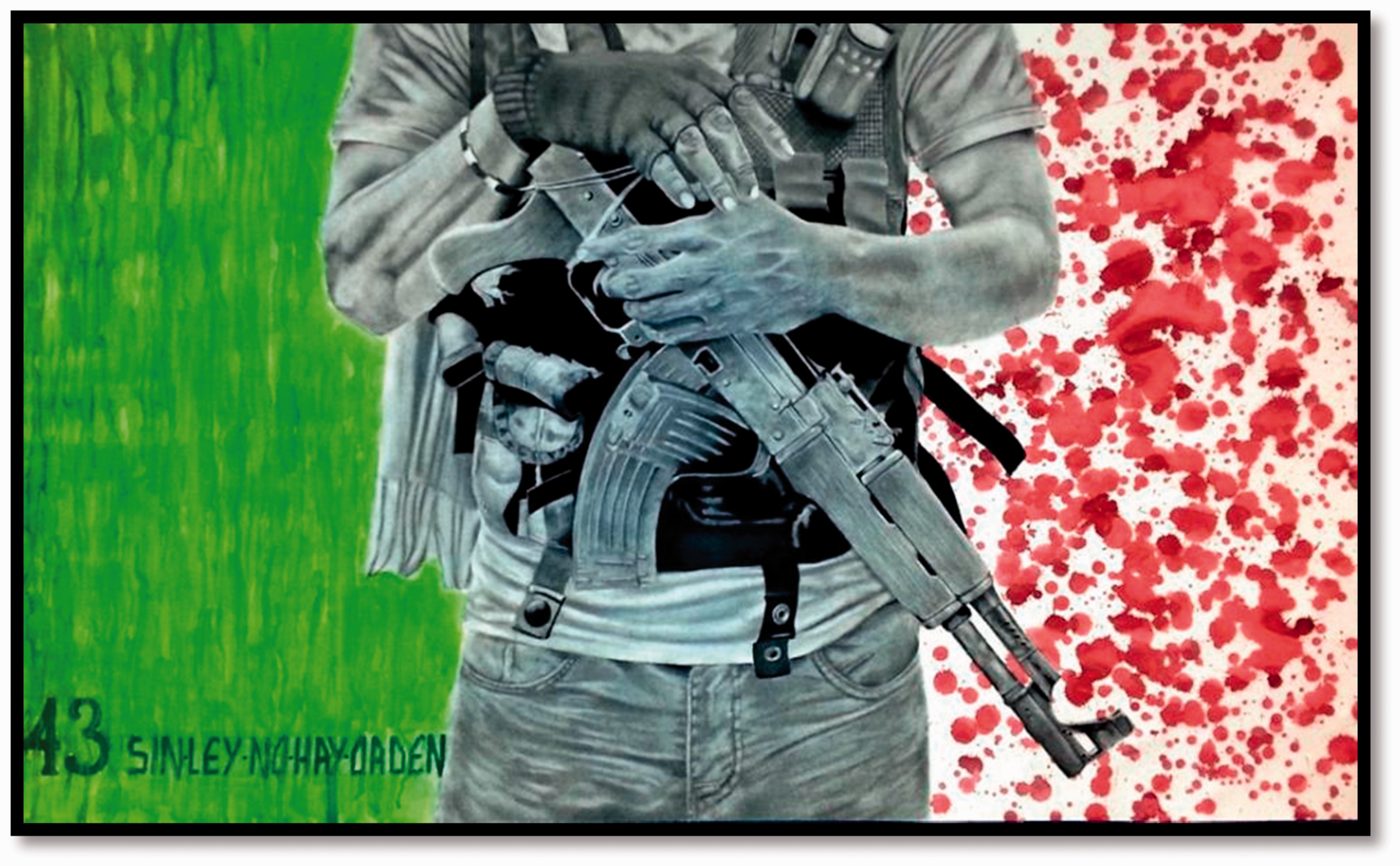
Student resilience and a “border-rooted” paradigm
Crossing borders is complex—whether between countries or educational institutions. For students from mixed status and undocumented families, a bi-national experience presents an existential challenge. Stories of crossing the border, fearing deportation, helping new arrivals to the community, and struggling to retain language and culture, has increasingly become a common set of experiences for Mexican communities far from the borderlands. These political realities and cultural pressures create an exceptional amount of stress upon Mexican students seeking a college degree. Worrying about the deportation of family members can distract students from their education. Obligations to relatives in Mexico—ranging from ceremonies, birthdays, deaths, and weddings—can pull students in multiple directions. All of these expectations and demands can strain student attendance and grades (Dreby, 2015).
Alternately, these realities can benefit the students themselves and the greater university. This transnational movement of families across international borders, as well as the borders between states and cultures has transformed Mexican youth and their families into cosmopolitan citizens. Their unfortunate yet vast experience negotiating passports, border inspection and security, and the myriad requirements for moving across nation-state boundaries has transformed them into resourceful individuals and excellent problem-solvers. In Falustich Orellana’s words, “the movement of people around the globe is reshaping social, cultural, and linguistic processes in profound and pervasive ways” (2016: 5). These border crossing experiences, coupled with the cultural ties to family and community cultivate resources upon which youth can draw while in the university setting.
A “border-rooted” paradigm embraces these transnational realities and speaks to the larger social movement and pedagogical shift towards transformative education. Thinking about the ruptures that have taken place in students’ lives, whether they are traumatic experiences crossing the border, or the racist practices of policing communities of color, helps explain the self-doubt and sense of “not belonging” in a university (Cuellar, 2016). Universities must respect the lifelong community ties and deep friendships that students formed before crossing the border from high school to college, because this rootedness can help them stay in college. Faculty and support staff need to allocate for students’ return to home communities—even in Mexico—for funerals, weddings, quinceaneras, and other culturally significant celebrations. Rather than liabilities prohibiting “success,” these cultural realities form a foundation of cultural capital and speak to the rich process of identity formation that can actually sustain student achievement and transform the university from within.
Indeed, students enter the university well-versed in a “border-rooted” paradigm, and their entrance into these IHEs represents a powerful form of cultural and racial transgression. They are, to some degree, blurring the lines between segregated spaces that have been monitored and policed by a wide array of laws, preconceptions, political injustices and racial prejudices. Their presence in the classroom, for instance, challenges the discourse of normalization and homogenization, and their linguistic contributions to formal “academic English” facilitates cognitive and cultural diversity. Faulstich Orellana demonstrates how “youth’s navigations across fields of cultural and linguistic variation helped to foster transculturality: a movement beyond all borders that limit and constrain, into new, unchartered territory” (2016: xi).
But more than their diversification of the classroom, Latino students and students from migrant and immigrant families in particular, are imparting to their Anglo peers a greater awareness of the global citizenry. By bringing the world to the classroom and destabilizing the middle-class suburban narrative as normative, these students are “gifting” to non-Latino students a valuable lesson in cultural literacy. They teach them not only new languages and cultural practices, but they introduce them to new identities, legal competencies, and new forms of learning and thinking about themselves and the world. As Comber states: [B]oth local diversity and global connectedness exist side by side, and literacy is connected with both of these…we now live in a world in which meaning is increasingly made not only with language, but in multiple modes and media…in order to learn and to appropriate academic discourses and design resources, students need to have a sense of belonging (Kalantzis and Cope, 2008) in their learning settings, and to the content and the ways of knowing being employed. Learner identity and place are irrevocably connected (2016: 14).
As Latino students and their families make their homes throughout the U.S., they create rich and resilient communities that provide cultural, financial, and social support while in college. A “border-rooted” paradigm embraces the contemporary community ties and historical relationships of the “vecindario network” as a transformative characteristic of the landscapes in the Southwest and in surrounding universities throughout the U.S. Whether in a new setting or in an old neighborhood, these cultural spaces may be known for the regions that their residents came from in Mexico, such as Chihuahuita or little Zacatecas, where Mexicanos create their own sense of place and transform their new neighborhoods. Even families that only recently migrated to the interior of the U.S. forge strong ties that serve new vecindario networks in spaces beyond the Southwest borderlands.
Understanding the history of Mexican-origin populations throughout the U.S. and the ways in which those communities create vecindario networks reveals an important resource for students and educators to draw upon. Migrations throughout the interior U.S. support our argument that a “border-rooted” framework remains applicable wherever Mexican origin populations reside, create home, and confront racism, xenophobia, and policing. Whether living in the borderlands or in the Midwest, there is a loose yet strong sense of compadrazco, and the related relationships of close family or friends entrusted with the financial, moral or cultural obligation to care for other younger members of the community that experience some rite of passage. For instance, godparents and family, including extended kin, support youth who attend school and seek greater economic opportunity. Both authors have witnessed students and families raise money through the sale of tamales, churros, enchilada plates or Indian tacos to assist with college expenses and to contribute toward scholarship fundraising. Many of these students come from families that are fearful of accumulating too much debt, so students work for friends and family members during the summer, or they return to the agricultural work that has sustained their families. Mexican regionalism, compadrazco practices, and a vecindario network bind people together in a support system for students in college.
Although parents who are farm workers and/or Mexican immigrants may express apprehension or fear for their adult children in college, they try to participate in their educational endeavors as best as they can. The numbers of parents joining in Hispanic Mother-Daughter and Father-Son programs evidences this commitment. Additionally, in the federal program overseen by Bejarano, parents attend an orientation and parent meetings throughout the academic year, to learn about the university and understand the expectations facing their children. At the University of Texas, where the second author works, the graduation ceremonies attracted so many extended family and friends that the university holds three different ceremonies to accommodate everyone. Thus, universities throughout the U.S. need to understand that Latino parents overwhelmingly support the educational dreams of their children and make great sacrifices for their children to attain those goals. Families want to remain in close proximity to their children while they are in college, cheering them on, and protecting them from racism. Latino students in our universities typically return home on week-ends to be with their families and to work.
Regardless of one’s geographical location, a “border-rooted” paradigm promotes institutional diversity, embraces community participation and student inclusivity, and recognizes the cultural capital of Latino youth. Wherever bilingual and mixed-status families reside and by extension, all Latino youth, there is the potential for cultural convergence and hybridity, as well as social conflict and upheaval stemming from the reaction of fearful populations. As noted by Orellana, “We are living in a time when all of the borders that were built…are being challenged and transgressed, whether we like it or not. As a nation, and a world, we can choose to try to shore up the borders, and resist the waves of change, or flow with the forces that are breaking them down” (Orellana, 2016: 134). This observation serves as a clarion call to education practitioners, policy-makers, community members, and students, that border experiences, not borders themselves, can help us address adversity and institutional struggle through lessons of student resiliency.
Conclusion
A “border-rooted” paradigm acknowledges the influence of history upon the institutions of higher learning and it embraces the cultural capital, kinship networks, and community identity of Latino students. The aggregation of historical oppression, marginalization, anti-immigrant xenophobia, state surveillance, and possible deportation has created an oppressive landscape for Mexicans. While recognizing the place specific realities of the U.S.–Mexico borderlands, we propose that a “border-rooted” paradigm is applicable in other regions, and the real and symbolic violence of the border is interiorized throughout the national space. Indeed, it is our argument that a “border-rooted” paradigm shift has the capacity to change an institution from the inside—out. Mexican students, with all their complex life experiences, can positively change higher education, instead of the institution unilaterally changing the student to conform to middle-class norms and mainstream culture. A “border-rooted” paradigm acknowledges the impact of space and place, and the role of the family, community and vecindario networks as integral to the experiences and successes of students at the university level anywhere in the US.
Creating approaches and epistemologies within IHE’s that value the lived experiences of students, and the place-specific regions where they reside, can facilitate institutional change. Recognizing the complexities of Latino students and highlighting what they bring to the table, as opposed to falling back on deficit models that perceive liabilities rooted in language barriers, impoverished communities, and a lack of access to resources, can challenge hegemonic assimilation and traditional approaches to gauging student preparedness. Focusing on the knowledge and navigation of living between cultures and negotiating educational, cultural, linguistic, and nation-state borders offers insight into outreach, recruitment and retention of Latino students, and the potential for enriching institutional systems serving Latino communities that conversely help improve quality of life issues locally and beyond.
Footnotes
Acknowledgements
We would like to thank the editors of this special journal for their thoughtful contributions to this piece, and to Lucio Sanchez for sharing his artwork and story with us. In addition, we want to acknowledge the students we work with, for whom we have great admiration and respect.
Declaration of conflicting interests
The author(s) declared no potential conflicts of interest with respect to the research, authorship, and/or publication of this article.
Funding
The author(s) received no financial support for the research, authorship, and/or publication of this article.