







Abstract
This article reassesses the classic corruption thesis—the claim that state involvement inevitably corrupts religion—by bringing empirical analysis into dialogue with political theory. Drawing on Locke, Jefferson, Madison, and contemporary theorists such as Nussbaum and Koppelman, it reconstructs the corruption argument and examines its empirical validity. Using comparative data from the World Values Survey and the Religion and State dataset across 52 Christian-majority countries (1990–2014), the study operationalizes “corruption” through public confidence in religious institutions. The findings qualify the traditional thesis: while exclusive state funding and institutional entanglement tend to reduce confidence among majority believers, general financial support does not, and minority believers display distinct patterns. The article thus refines a foundational argument in political theory and demonstrates how the empirical turn can enhance normative precision and conceptual clarity in debates about religion–state relations.
Keywords
Governmental involvement in religion is widely regarded as undesirable by many scholars and prominent political figures. Such involvement, according to the supporters of the separation model between religion and state, violates the equality of citizens who belong to different religious denominations—or none at all—entangles the state in spheres it does not properly understand, and generates conflict among competing religious groups. Moreover, it is unnecessary: religious life can flourish in the absence of governmental support or interference. These well-known arguments indeed form the backbone of the separation model between church and state.
In this article, however, we focus on a different argument: that governmental involvement corrupts religion itself. This idea was articulated by major figures in the history of political theory—John Locke, Thomas Jefferson, James Madison, and others. It remains a serious and influential justification for the separation of religion and state and for the autonomy of religious communities and associations. The corruption argument goes further than the claims mentioned above. It suggests not merely that governments are ill-equipped to manage the complexities of religious life or that state involvement is redundant. Rather, it makes a more radical claim: that when governments entangle themselves with religion, they damage, degrade, and ultimately undermine it.
If true, this is a powerful argument against state involvement in religion. Yet it raises important questions: What precisely is meant by ‘involvement’? How is ‘corruption’ to be understood in this context? How did key thinkers formulate this argument, and finally, can this claim be assessed empirically—if at all?
This final point is central to the present article and warrants closer attention. The corruption thesis has its roots in political theory—articulated by thinkers such as Locke and Madison and, more recently, by scholars like Nussbaum (2008: ch. 2) and Koppelman (2008). Yet at its core, this thesis makes an empirical claim about how religion actually fares under state involvement. As an empirical claim, it can, at least in principle, be tested, refined, or even disconfirmed. A central aim of this article is therefore to ‘convert’ or to ‘translate’ the corruption thesis into observable, measurable phenomena, and to assess its validity systematically. By pursuing this task, we contribute not only to a better understanding of religion-state relations and to the theory of religion state-relations in political theory, but also to a growing methodological shift in political theory: closer collaboration with political scientists to examine empirical claims—often based on intuition, common sense, or selective examples—through systematic analysis.
The article will be structured as follows: Section A presents the corruption thesis through quotes from some of its central formulations as articulated by key figures, and proposes a preliminary definition. Section B succinctly describes recent developments in the methodology of political theory towards the empirical exploration of central argumentation, and provides examples of scholarship that similarly adopts an approach aiming to convert arguments in political theory into observable phenomena. This section aims to situate the methodological structure of the current article within the context of a methodological turn in contemporary political theory. Section C presents the relevant data and analysis regarding the corruption thesis. The data is sourced from two different datasets: the World Values Survey and the Religion and State dataset. In this section, we present and explain the data, as well as the manner in which we use a proxy measurement (confidence/trust - we shall use both interchangeably) for corruption — and explain why, arguably, this proxy is a satisfactory substitute for the elusive concept of ‘corruption’. Section D, the final section, compares the main findings to the suggested definition of the corruption thesis. Briefly put, assuming that trust is an appropriate proxy for corruption, the validity of the corruption thesis depends on how exactly governmental involvement with religion is exercised — in some cases, such involvement leads to less trust in religious institutions, but not in others. Therefore, as a general claim, it is incorrect that governmental involvement with religion necessarily reduces levels of trust in the relevant religious institution, rendering the argument presented by major figures (Madison, Nussbaum) imprecise or partial at best. This point’s importance goes beyond correcting a flawed empirical and normative statement: it has implications for institutional design in the religion-state context. Succinctly put, it means that evenhanded or multiple establishment religion-state arrangements, will not always lead to the corruption of religion.
The corruption thesis: Definition, sources and key insights
The question of how to structure relations between religion and the state has long preoccupied political theorists, from Locke (2010 [1689]) to Rawls (1993). This enduring concern reflects the destructive potential of religious conflict—often bitter, protracted, and violent. Sound institutional design can help mitigate these dangers by fostering peaceful coexistence among diverse religious communities within a single polity, making the topic a perennial focus of serious theoretical inquiry.
Given the variety of approaches to religion-state relations, we must narrow our focus. We shall focus our attention on the corruption thesis, which stands out as a specific and compelling argument, often as a central justification for the separation of religion and state. 1 The reason this argument stands out in such a way is that if true, it reinforces other arguments for the autonomy of religious associations 2 and the separation model, as it implies that any involvement of the government in religion is damaging to the given religion; ruling out even pluralist frameworks suggested by Carens (2000), Bader (1999), and more recently by Thompson and Modood (2025). It is hence a strongly worded argument with far reaching implications, which justifies our interest in it.
For the purposes of this article, we define the corruption argument as follows: The corruption thesis posits that state funding, support, endorsement, or legal privileging of religion inevitably distorts, compromises, or undermines the integrity and independence of religious life. Far from bolstering religion, state involvement risks transforming religious institutions into entities driven by economic or political incentives, eroding their autonomous decision-making, spiritual authority, and moral credibility.
In formulating this definition, we sought to elucidate what we take to be recurring themes in well-known formulations of the corruption thesis found in various classical sources.
Two clarifications are required. First, this definition of the corruption thesis differs from widely used definitions of political corruption, such as that offered by Ceva and Ferretti (2021: 32; “a form of unaccountable use of entrusted power”). In the religious corruption thesis, no such unaccountable use of power—nor wrongdoing or violation of norms or rules—is necessary for corruption to occur. Such features may be present, but they are not constitutive of corruption in this sense. Rather, the institutional connection between government and religious institutions is itself sufficient to corrupt the religious institutions. In this context, “corruption” also refers to the ways in which such connections distort, compromise, or undermine the integrity of religion. More specifically, the claim is that a religious institution comes to conduct itself on the basis of reasons that are foreign to the core principles of the relevant religion. This interpretation of the corruption thesis is faithful to the sources cited below.
Second, the proposed definition of the corruption thesis is intentionally broad, both with respect to the kinds of connections between government and religion it encompasses and the forms of corruption it includes. This breadth reflects our aim of remaining faithful to the range of concerns articulated in the sources from which these characteristics are drawn. Furthermore, this definitional choice is methodologically deliberate. Since the article’s contribution is to test whether the empirical expectations commonly associated with the corruption thesis are borne out in practice, imposing a tighter stipulative definition would risk testing a reconstructed version of the thesis rather than the one that has actually informed arguments against state involvement in religion. 3
Having made the two noted clarifications, we turn to several major examples, all of which include the argument or opinion that entanglement with state power leads religions to pride, dependency, hypocrisy, or political co-optation, undermining the very religious values the state claims to support. Notably, these quotes are the sources from which we formulate our definition of the corruption of the religion thesis.
We shall start with Locke, who explains that connecting clergy with the power of the government will bring about, or reveal ambition for power:
“Let them not supply their want of Reasons with the Instruments of Force, which belong to another Jurisdiction, and do ill become a Church man’s Hands. Let them not call in the Magistrate’s Authority to the aid of their Eloquence or Learning; lest, perhaps, whilst they pretend only Love for the Truth, this their intemperate Zeal, breathing nothing but Fire and Sword, betray their Ambition; and shew that what they desire is Temporal Dominion” (Locke, 2010: 1689: 46).
Thomas Jefferson argues that allowing religion to enjoy funding from forced taxation will corrupt the principles of said religion: “to compel a man to furnish contributions of money for the propagation of opinions which he disbelieves, is sinful and tyrannical… that it tends only to corrupt the principles of that religion it is meant to encourage, by bribing with a monopoly of worldly honours and emoluments, those who will externally profess and conform to it…” (1786 [1823]).
James Madison, makes a similar claim but adds a historical edge: “During almost fifteen centuries has the legal establishment of Christianity been on trial. What have been its fruits? More or less in all places, pride and indolence in the Clergy, ignorance and servility in the laity, in both, superstition, bigotry and persecution.” (1785, section 7).
An earlier version was made by Roger Williams (c. 1603 – March 1683), and the following describes his view: “When the imagination of Roger Williams built the wall of separation, it was not because he was fearful that without such a barrier the arm of the church would extend its reach. It was, rather, the dread of the worldly corruption which might consume the churches if sturdy fences against the wilderness were not maintained.” (Howe, 1965, 6) 4
Moving to recent times, we can mention the view of David Souter (Associate Justice, U.S. Supreme Court, dissenting): “When government aid goes up, so does reliance on it; the only thing likely to go down is independence.” Justice Souter discusses the dangers of governmental funding of religious schools via vouchers provided to parents. Souter argued that the funding causes such religious schools to replace their decision making with that of the regulatory framework of the funding agency (the state). 5
Interestingly, from the Jewish Context, S. Stone well summarizes a view of a notable Jewish scholar and religious leader, Hayyim Ozer Grodzinsky, who “wished to protect the garden of religious halakha from any state but especially a Jewish state, by separating the two at the outset.” (Stone, 2008: 640–641).
These and other sources highlight the dangers of governmental involvement in religion. What is striking about such sources is the force of their claim: any governmental involvement—whether through funding or other forms of support—will inevitably corrupt religious belief and religious life, community or association. To a modern reader, familiar with the many and varied forms of religion–state relations, including established churches, state-endorsed churches, multiple establishments, and tax exemptions or deductions for religious associations or institutions in some countries, the near-absolute terms of the corruption argument may seem overly strong. This, in turn, calls for a more precise examination. We therefore turn to Section B, which succinctly explains the methodological structure of the present article.
The methodological shift in political theory and the operationalization of political theory arguments
The methodological turn of political theory, succinctly described, is a recent change that can be identified in the published work of various political theorists, from a direct critical analysis of normative or evaluative claims, to a growing interest in the techniques, tasks, and research design of political theory. That is, exploring what is it that political theorists do when theorizing, and suggesting various improvements and further analysis of research techniques (Baderin, 2023; Blau, 2017; Floyd, 2022).
Within this more general shift, our interest here will be on the empirical turn in political theory that marks a shift from idealized models and hypothetical scenarios to the study of real-world political institutions and behavior (Dowding, 2020; Hamlin, 2017; Waldron, 2016). Though scholars differ in methods and normative aims, they share a commitment to theory informed by empirical reality. This involves a range of techniques—interviews, ethnography, case studies, comparative research, process tracing, data analysis, and more. The central idea is that proper understanding and evaluation of political institutions, rules and behavior require methodologically sound empirical investigation (Perez, 2025; Laegaard, 2025; de-Shalit, 2009; Cabrera and Ackerly, 2025).
Despite differences in terminology and methodology, scholars engaged in this empirical turn generally agree on two points: (1) abandoning exclusive reliance on abstract or idealized scenarios and thought experiments; and (2) focusing on a plurality of actual political phenomena. For instance, Floyd (2017) emphasizes “normative behaviorism” to justify principles based on behavioral patterns. Carens (2013) situates political theory in real-world contexts shaped by history, institutions, and power dynamics. Herzog and Zacka (2019) advocate for ethnographic methods to observe how people navigate moral and institutional challenges. Anderson (2010) integrates social science research to address real injustices rather than idealized justice, and many other variations can be suggested.
While earlier works hinted at this direction (e.g., Mansbridge, 1980; Walzer, 1983), the current empirical turn is broader and more developed. One major area of overlap is deliberative democracy, where empirical research both challenges and enriches normative theories—highlighting issues like measurement difficulties (“yardstick problem”) and tensions among deliberative standards. Scholars such as Chambers (2005) and Thompson (2008) argue that empirical insights can help refine arguments within political theory.
Crucially, data in empirical political theory must be constitutive—central to the argument, not merely illustrative. Perez (2020, 2025) introduces the “alteration criterion,” which holds that without the data, the theoretical argument would be fundamentally different. This distinguishes empirical political theory from illustrative uses of examples or anecdotes.
The empirical approach is methodologically pluralistic, embracing qualitative, quantitative, or mixed methods. The choice depends on the nature of the political phenomenon under study, and, crucially, on the research question that is the focus of a given study. Motivations may require ethnographic work or interviews, while causality may need statistical analysis or process tracing. Whatever the method, empirical work must be rigorous to yield accurate, reliable input for normative reflection.
Building on this foundation, a central methodological issue arises: how empirical political theory operationalizes 6 its various claims. The process of operationalization—translating abstract theoretical concepts into measurable variables—is familiar in the natural and social sciences. Political theorists, however, face difficult challenges in this regard. While empirical political theory shares with other disciplines the task of making complex concepts empirically accessible—descriptive or causal—it differs significantly in its aims and structure.
In scientific disciplines, operationalization is often tied to hypothesis testing and the production of predictions. Political theory, by contrast, seldom engages in prediction in a strict sense. Even when political theorists make causal claims, they typically do not present these as falsifiable conjectures. A partial exception may be found in deliberative democratic theory, where scholars like Steiner (2012) and Mutz (2008) explore causal mechanisms more explicitly. Still, such cases are rare and do not represent the norm across the field.
Therefore, operationalization within political theory is less about testing predictions and more about clarifying, grounding, and potentially falsifying empirical claims that are constitutive to normative arguments. This links directly back to the “alteration criterion” described earlier: if empirical claims at the core of a political theory are shown to be imprecise, partial or even false, through rigorous operationalization and measurement, then the theory itself may require revision or re-evaluation.
In this context, the focus of empirical political theory is not only on descriptive accuracy or causal inference but also on the implications of empirical examination for normative frameworks. By treating core empirical assumptions as open to interrogation, political theorists can strengthen the internal coherence and external applicability of their work—making empirical political theory not just reflective and sensitive to empirical data (both highly important aspects of political theory research!), but also more accurate in its prescriptive aspects – a central aspect of many political theory studies.
Importantly, the methodological framework proposed here is not entirely unique. Other political theorists have also sought to empirically examine claims of an empirical nature within political theory. Notable examples include Klosko’s analysis of Rawls’ concept of overlapping consensus Klosko (1993); Baderin and Barnes’ (2020) investigation into libertarian perspectives on self-respect; Spinner-Halev and Theiss-Morse’s (2003) exploration of national dignity within liberal-nationalist theories; the work of Perez et al. (2017) on how inegalitarian religion–state policies affect the perceptions of unsupported religious groups toward government institutions; Banting and Kymlicka’s (2003) study of the relationship between welfare systems and multicultural policies - and further examples can be indicated. These cases, among others, illustrate the growing interest in empirically informed normative political arguments.
Operationalizing ‘corruption via trust’ - presenting the data
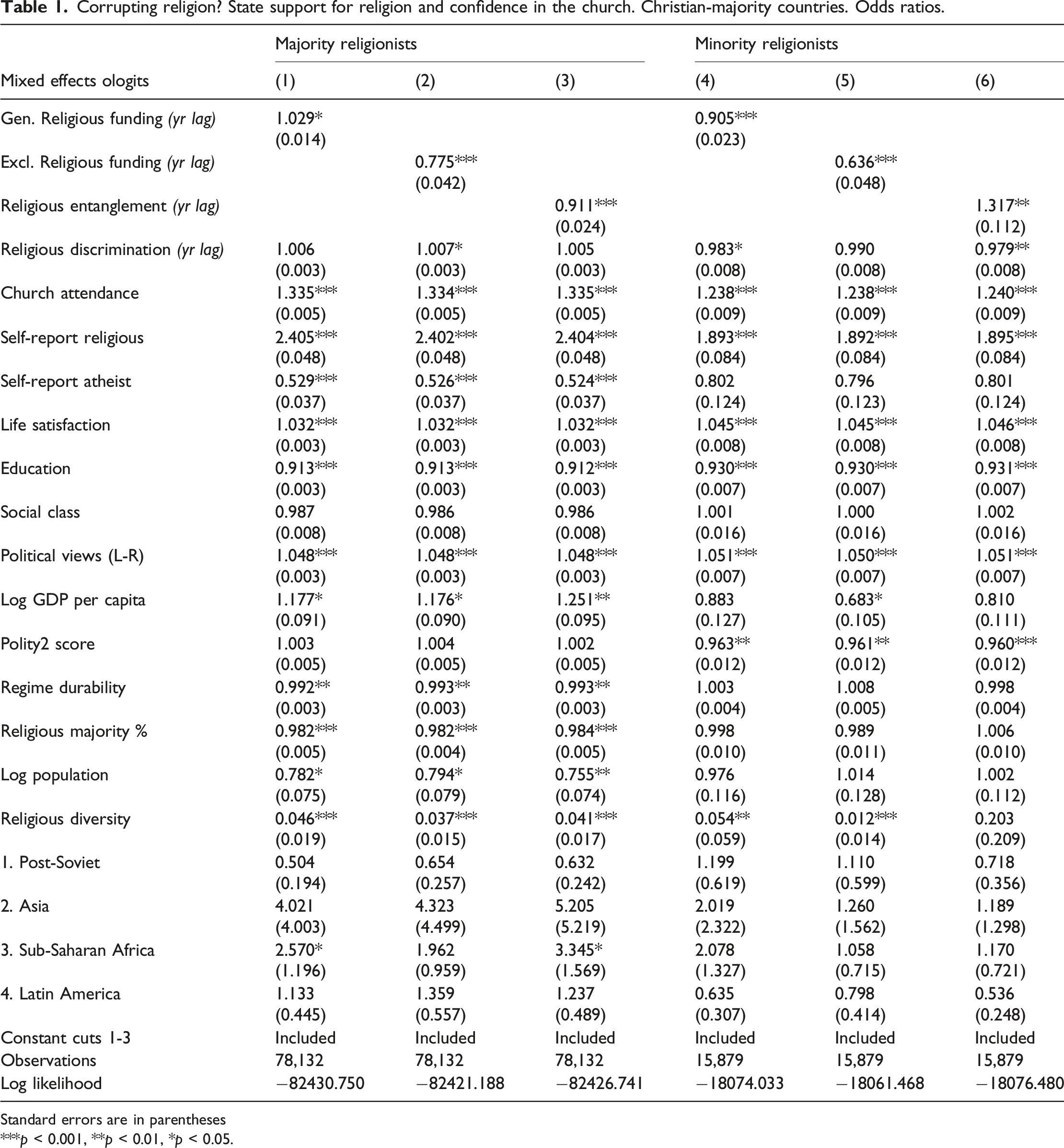
Corrupting religion? State support for religion and confidence in the church. Christian-majority countries. Odds ratios.
Standard errors are in parentheses
***p < 0.001, **p < 0.01, *p < 0.05.
Altogether, from survey responses captured by our models, we include 109,969 WVS participants across 52 distinct countries over 5 survey waves. 18 include Christian majority countries located in the former Soviet bloc or otherwise former Yugoslavia, 13 are Western Democracies, 12 in Latin America, and 8 in Sub-Saharan Africa as well as the Philippines. 20 are majority Catholic, 12 majority Orthodox, 5 majority Protestant, and the remaining 15 are Christian-majority states in which no particular denomination is predominant. Of the participants, approximately 80% were identified as belonging to each country’s majority religion and 20% as belonging to a minority religious group as classified by RAS3. Of these, about 82.4% could be actively identified with each country’s majority religion and about 16.7% with minority religions directly measured by RAS3. More specific data on the countries and years covered by the matching of RAS and WVS data, as well as the majority/minority profile of participants in these surveys, is provided in the Supplemental Appendix.
Before presenting the models and findings, two clarifications are necessary: (1) why we chose Christian-majority countries as our population, and (2) why we consider confidence in religious institutions a reasonable proxy for the corruption of religious associations.
First, the focus on Christian-majority countries follows from the sources discussed in Section 1. The majority of scholars referenced all lived in Christian-majority contexts, and their writings were shaped—directly or indirectly—by that historical/cultural context. 10 At the same time, because their work was not confined to democratic regimes (see, for example, Madison’s quotation above), we did not restrict our population to democracies alone.
Second, the choice of confidence in religious institutions as a proxy is more complex. To our knowledge, no direct measure of corruption in religious institutions or associations exists on the scale of the WVS and RAS3. Combining these two datasets, however, enables us to link religion–state policies with levels of confidence in religious institutions in a large-scale, comparative manner. We do so via the WVS variable, E069_01, examining confidence in the Church, measured on a scale of 1 to 4, wherein 1 indicates “no confidence” and 4 “a great deal of confidence”.
This raises the central issue: can trust serve as a proxy for corruption? Our reasoning is as follows. If the corruption thesis holds, its effects should be observable in how religious institutions are perceived. As the scholars cited in Section 1 suggest, what appears to be a religious institution may, through state involvement, in fact function as something else—political, economic, or otherwise—rather than according to its declared religious principles. In such circumstances, it is reasonable to expect diminished trust in these institutions. The alternative view—that believers in close and regular contact with such institutions consistently misperceive their nature—seems unlikely. 11
On this basis, we treat trust as an indirect yet meaningful indicator of institutional corruption. Indeed, if the corruption thesis is correct, it would be surprising if it left no trace in the degree of trust that members of the relevant religious community place in their institutions. We do note however, that confidence is a proxy measurement, and it might be the case that a more direct observation of corruption, or more than one proxy will further advance our knowledge regarding the corruption thesis; as such data does not exist (to the best of our knowledge), we merely acknowledge the limits of our proxy measurement, and ask that our readers keep this caveat in mind.
Having clarified this point, we move on to describe the statistical models, effects, and findings.
The models test the effects of three specific types of state support for religion, each theoretically linked to concerns about the “corruption” or perceived legitimacy of religious institutions. This point merits a succinct explanation. The corruption thesis mentions many forms of governmental-religion connections. Furthermore, the corruption thesis was formulated by political theorists and practicing politicians, and was not intended to function as a research design in modern political science. The following breakdown is therefore an operationalization of the various, indicated connections between the government and religion. This will assist us in clarifying the complexity of the notion of corruption in its institutional ‘side’, that is, the kinds of government-religion connections that are measured in our study. These include: (a) The degree of general financial support provided by the state to religious institutions; (b) The extent of exclusive financial support granted to the majority religion; and (c) The level of institutional entanglement between the state and religious organizations.
These indicators are measured by RAS3 as follows: General financial support is an index variable noting the sum of up to 11 distinct forms of financial support which may be provided by the state to support the majority religion including support for religious educational institutions, collection of religious taxes, maintenance and repair of religious sites, provision of clergy salaries, and support for religious broadcasts, charities, institutions, initiatives, and pilgrimages. Observed scores for the sample in our study range from 0 to 9, with an average score of 3.1 and standard deviation of 2.3. Funding exclusivity is measured on a 6-point ordinal scale, wherein 0 indicates no funding provided by the state to any religion, 1 equal funding for all religions, 2–4 increasingly disproportionate funding for fewer religions, and 5 exclusive funding for a single religion, with all values present in the sample. Institutional entanglement is an index variable noting the sum of up to 6 distinct forms of state-religion entanglement including diplomatic immunity for religious officials, presence of an official department or ministry for religion, certain officials having religious status by virtue of their political office (e.g. English monarch as head of the Church of England), religious officials having political authority, government officials needing to meet some religious requirement to hold office, and at least some seats in parliament and/or cabinet being granted along religious lines. Observed scores vary between 0 and 3, with a mean of 0.7 and a standard deviation of 0.8, with the most common forms of entanglement being the presence of a dedicated government ministry for religious affairs or similar structures, and, in some cases, governmental privileges afforded to religious figures. To address endogeneity concerns, all three independent variables are lagged by 1 year for their respective models.
The statistical models include standard individual- and country-level controls. At the individual-level, we include WVS measures for regularity of church attendance, whether participants self-report as religious or atheist, level of life-satisfaction, formal education, social class, and political orientation from left to right (Inglehart et al., 2022). At the country-level, we include the RAS3 year-lagged index measure for governmental religious discrimination experienced by religious minorities (Fox 2020), log GDP per capita and log country population from the World Bank (2022), the Polity2 democracy score and regime durability score from the PolityV project (Marshall and Jaggers 2009), percentage of the state population belonging to the religious majority from the Religious Characteristics of States-Demographics dataset (Brown and James 2018) as well as a religious diversity score based upon the demographics of all religious groups observed by this dataset for each country-year, and geopolitical region, with Western democracies serving as the reference category.
We provide two sets of models, separately repeated for sub-samples identified as belonging to each state’s religious majority (models 1-3) or a religious minority (models 4–6). Our statistical models rely upon multilevel ordered logits, as our data is structured at the level of individual survey responses nested within country-years; because coefficients from logistical regressions are not directly interpretable, we use odds ratios to examine substantive significance of our results. More technical exploration of the average marginal effects of each form of governmental religious support we consider on popular attitudes toward the Church are provided in the Supplemental Appendix. The findings are followed by a brief country based example for each category, clarifying and contextualizing our findings.
Findings
General financial support
When the state offers broad financial support to religious programs and institutions, majority religionists tend to express greater confidence in the Church. Per odds ratios, the expected levels of such confidence increases by a probability of 2.9% for each increasing degree of general financial support offered by the state for the majority religion. In contrast, religious minorities exhibit reduced confidence in the Church under the same conditions, with odds ratios demonstrating a decrease in the probability of confidence in the church by 9.5% for each increasing degree of general financial support.
Spain offers a clear example of these dynamics, which until 2008 directly funded the Catholic Church out of the state’s general budget (US Department of State, 2007, 2008). Continued sources of funding unrelated to this policy shift included a voluntary option in tax returns to donate a small portion of one’s taxes to the Church as well as funding of some Catholic schools and hospitals (Donadio 2009). This reduction in support is substantively important as it shifted the state away from broad statutory funding of the Catholic Church to only (a) discretionary funding for specific services and (b) voluntary funding directly selected by taxpayers themselves. This drop took place between two WVS survey years, where Spain had a general funding score of 5 in 2007 which dropped to 4 in 2008 with the noted policy shift remaining stable into the next WVS round in 2011. This shift also coincided, as expected, with a drop in majority confidence in the Church from a country-level average of 2.33 to 2.19 (out of 4) and an increase in minority confidence in the Church over the same period from an average of 2 to 2.49. We argue that while such reductions in funding corresponded with reduced majority public confidence in the Church, this also had the effect of increasing minorities’ esteem, as a less well-funded Church was less likely to interfere with minority religious freedoms.
Exclusive financial support to the majority religion
When the state allocates funding exclusively to the majority religion, both majority and minority religionists report
This is well-illustrated by the United States during the years captured by our study. Until 2001, the US government did not fund religion. Beginning in 2001, however, it began providing funding available to all religions on an equal basis. In 2001 President George W. Bush introduced “faith-based initiatives” which allowed religious organizations to become funded vendors for social services. While the money is for non-religious services, it can free up funding within an organization for religious activities (Gaylor 2010). In 2002, a landmark ruling (Zelman vs Simmons-Harris, 2002) granted religious schools in Cleveland, Ohio the right to receive financial aid in the form of government vouchers. Finally, Since 2002, “parsonage allowances” permit clergy to deduct housing costs from their taxes (Winston 2012). As a result, the RAS tracks a shift of funding exclusivity scores from 0 in 1999 to 1 in 2006, the years in which the WVS conducted its US-based surveys. This corresponded with a country-level average decrease in confidence in the church by majority religionists from 3.34 to 3.12 and by minority religionists from 3.17 to 2.96. This policy shift was highly contentious in American politics and is clearly reflected in American attitudes by both the Protestant majority and religious minorities toward the Church as an institution.
Institutional entanglement
Greater institutional entanglement between religion and state is associated with lower confidence in the Church among majority religionists. Per odds ratios, this is expressed as a probability of 8.9% decreased confidence in the Church by increasing levels of institutional entanglement. Conversely, minority religionists report higher confidence in the Church under these conditions, or a probability of 31.7% increased confidence in the Church under the same conditions. This counterintuitive finding may indicate that minorities view the institutional incorporation of religion into the state as a form of constraint or oversight—preferring religious institutions that are subject to state control rather than independent.
Sweden provides an excellent example of how publics respond to shifts in government-religion entanglements. During the WVS survey conducted in 1999, Sweden had an entanglement score of 3, which dropped to 1 by the time of the next WVS survey in 2006. This was due to a range of changes in government-state relations, most importantly involving Sweden’s formal disestablishment of the Lutheran Church of Sweden in 2000. This corresponded with an increase in average majority confidence in the Church from 2.5 to 2.69, and a decrease in average minority confidence in the Church from 2.83 to 2.39. We argue that these dynamics illustrate how when states disentangle themselves from religious institutions, they allow them to cleanse themselves from the stain of political corruption in the eyes of the majority public. Yet for minorities, this signals an empowered majority Church that is likely to be less restrained in attempting to influence religious societal conformity.
The corruption thesis meets empirical findings – correcting and qualifying an argument in political theory
The goal of this section is to use the quantitative findings presented in Section C to re-examine the corruption argument discussed in Section A above. This move is consistent with—and indeed continues—the methodological development in political theory outlined in Section B. Accordingly, the aim of this study is not only to deepen our understanding of a central argument in political theory, in the specific context of religion–state relations, but also to advance our understanding of the role and function of empirical data within political theory argumentation.
To achieve these aims, the section proceeds as follows. We begin by restating the corruption thesis. We then return to the data presented in Section C, highlighting its implications for that thesis. Next, we reintroduce the corruption thesis in an amended form that takes the empirical findings into account. Finally, we offer some broader reflections on the usefulness of empirical data for political theory argumentation.
Our understanding of the corruption thesis, based on an elucidation of the sources discussed in Section A, is as follows: The corruption thesis posits that state funding, support, endorsement, or legal privileging of religion inevitably distorts, compromises, or undermines the integrity and independence of religious life. Far from bolstering religion, state involvement risks transforming religious institutions into entities driven by economic or political incentives, eroding their autonomous decision-making, spiritual authority, and moral credibility.
What is striking about this thesis is its comprehensive and categorical character. It encompasses a wide range of forms of government–religion involvement and asserts, in decisive terms, that such involvement will have damaging effects on religious associations. The reasons Madison, Jefferson, and other figures articulated the argument in such strong terms may lie in historical circumstances, contextual reasoning, slippery-slope concerns, or intuitive judgments. Regardless of its origins, the thesis as stated appears to be formulated in terms that are too strong.
As we demonstrate below, it is possible to identify at least one policy—general financial support—that violates the corruption thesis in its current strong form, yet does not result in a reduction of trust in religious institutions from the perspective of the majority religion. The more interesting question, therefore, is how the thesis might be corrected, qualified, or nuanced in light of the available data. It may be that while the strong form of the thesis (as captured in our definition) is incorrect, a weaker version—one in which “tends to” replaces “inevitably”—is defensible. If so, the empirical findings can be used to bring greater precision to this weaker formulation.
With this in mind, we now turn to the data and consider its implications for the corruption thesis. The aim here is not merely to report the findings, but to explore what they reveal about the structure and plausibility of the corruption thesis itself. The results can be summarized in the following table:
Empirical patterns relevant to the corruption thesis: Confidence in religious institutions under different forms of state involvement with religion.
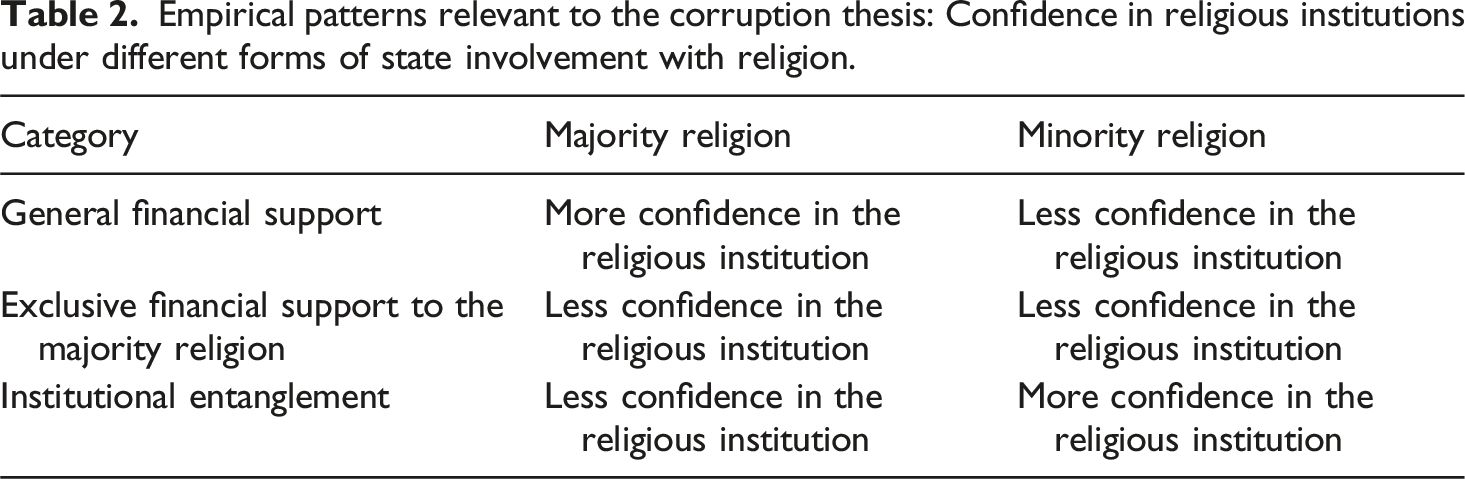
Second, exclusive financial support to the majority religion and institutional entanglement (from the perspectives of believers of the majority religion) both reduce confidence in religious institutions. This finding is consistent with the corruption thesis: a close relationship with the government introduces incentives foreign to religious principles, leading believers of majority religions to exhibit less trust in their religious institutions. Lastly, and somewhat intriguingly, institutional entanglement increases confidence in religious institutions among minority religious groups. This can be explained by a consideration that overrides the corruption thesis: minorities may not be primarily concerned about whether religious institutions are “corrupt.” Instead, they may welcome government constraint or control of those institutions, preferring the mitigating function of the state over the unchecked autonomy of a majority religious institution.
This final point introduces an important complicating factor for any consideration of institutional design in religion–state relations: for some citizens, especially minorities, interests other than the avoidance of corruption may take precedence. This observation highlights that in pluralist contexts, the corruption thesis alone cannot fully capture the dynamics at play.
How, then, should all of this affect our definition of the corruption thesis? Here we meet a complicated challenge. The empirics presented here demonstrated that the corruption thesis in its strong form is simply incorrect. However, using the empirics to suggest a new interpretation of the corruption thesis will encounter the following challenge: the corruption thesis is broad, and includes many factors, and furthermore, confidence in religion or religious institutions is influenced by many factors. What we have to help us explore this complexity, simply put, is the connection between three kinds of policies: General Financial Support, Exclusive Financial Support to the Majority Religion and Institutional Entanglement, and levels of confidence towards religious institutions among minority and minority religions. This operationalization of the corruption thesis is specific and clarifying, but it does not encompass all of the relevant dimensions.
We argue, however, that even given the limited operationalization available in the present study, it is still possible—and methodologically appropriate—to offer a more qualified formulation of the corruption thesis. Our aim is not to introduce a new definition of corruption or to advance speculative claims beyond the evidence, but rather to refine an existing, often implicitly treated, absolute interpretation of the thesis in light of the data we do have. The proposed reformulation is therefore explicitly constrained by our operationalization and should be understood as conditional and provisional. Future studies may employ richer or alternative measures of corruption beyond the proxy of confidence and thereby allow for further refinement. Within these limits, we contend that our contribution improves upon an imprecise and overly categorical understanding of the corruption thesis by introducing a data-grounded nuance rather than an unwarranted expansion. 12
The corruption thesis should hence be amended in the following manner: the corruption thesis will not apply in cases of general financial support, but will apply in cases of exclusive financial support and entanglement of religion and state. Furthermore we need two versions, one for the believers of the majority religion (where things are as just stated), and one for the believers of the minority religion, where the situation is different: the corruption thesis holds in cases of general and exclusive financial support, but not in cases of entanglement.
Here are the two suggested re-definitions:
Corruption thesis redefined for believers of the majority religion: The corruption thesis posits that exclusive state funding or entanglement of religion and statist institutions inevitably distorts, compromises, or undermines the integrity and independence of religious life. Far from bolstering religion, these kinds of state involvement risk transforming religious institutions into entities driven by economic or political incentives, eroding their autonomous decision-making, spiritual authority, and moral credibility.
Corruption thesis redefined for believers of a minority religion: The corruption thesis posits that general and exclusive state funding of religion inevitably distorts, compromises, or undermines the integrity and independence of religious life. Far from bolstering religion, these kinds of state involvement risks transforming religious institutions into entities driven by economic or political incentives, eroding their autonomous decision-making, spiritual authority, and moral credibility.
The major changes introduced here for both new redefinitions are as follows. First, for believers of the majority religion, general financial support granted to religious institutions does not reduce confidence in those institutions. This aligns with pluralist models of religion–state relations (sometimes called evenhanded or multiple establishments), as discussed in contemporary political theory by scholars such as Carens (2000), Bader (1999), Thompson and Modood (2025). Various explanations could be suggested, but the simplest is that when the government supports religion financially in the same way it supports other public institutions—such as libraries, theaters, or parks—within a general framework and without singling out one faith, believers are unlikely to view this as corrupting the funded religious institutions. A complex account of public policy mechanisms that prevent direct government interference is unnecessary here. It is enough to note that believers likely recognize general financial support as a familiar framework, and this recognition alone is sufficient to distinguish it from other religion–state policies that might be perceived as corrupting religious institutions.
Second, for believers of minority religions, two puzzles arise. First, why do they perceive a general financial support framework as reducing confidence in religious institutions? A plausible explanation is that mistrust of the majority religion—likely extending to perceived ties between the government and its institutions—colors their view of even broadly framed support. Second, why does institutional entanglement between religion and state increase confidence in religious institutions? This is a surprising outcome. Our best explanation is that while entanglement may carry an element of corruption, minority believers see it as preferable to the alternative of an unchecked majority religion. In other words, they worry more about powerful, independent religious institutions than about institutions constrained by government involvement, which they interpret as a mitigating force.
Moving to the last part of this section, what can we learn from the methodological step of bringing empirics in order to reflect on the preciseness of political theory arguments?
In order to understand this point, we can use the typology developed by Perez of data usages in political theory. Perez (2020) introduced six ways in which political theorists use data or descriptive/causal statements within political theorizing: Spotlighting – Using data to show the severity/importance of a social or political problem, thereby justifying it as a focus for normative theorizing. Definition – Using data to clarify and fill in the content of contested concepts. Conversion – Turning moral or normative claims with empirical content into testable, evidence-based claims. Institutional clarity – Using data to understand how political institutions actually function, so they can be properly evaluated. Theoretical clarity – Using data (often via case studies) to clarify what a theory means or demands in specific real-world contexts. Theory improvement – Using data to strengthen or refine a theory, either by exposing blind spots or by supporting one side in a theoretical debate.
Using this typology in order to reflect of the usage done here, we can see that we can classify the usage of data in various ways, conversion - as the corruption thesis was converted to an empirical statement, operationalized and measured; institutional clarity - as the data was used to clarify how religion-state institutions function as perceived by believers of both majority and minority religions;
however the most important category in our context is theory improvement. The most important service the empirics brought to the corruption thesis is that they enabled a more nuanced and more precise understanding of an important argument serving as a crucial justification for a set of policies in the framework of religion-state relations. We now know that general financial support does not cause lack of confidence among believers of majority religions; and we now know that among members of minority religions, the entanglement of religion and state, while probably causing lack of confidence in religious institutions, is overridden by the worry from non-mitigated, autonomous religious institutions of the majority.
These insights are important, as they enable a re-definition of the corruption thesis. The redefinitions, in turn, are important to the prescriptive task of political theory. While the corruption thesis is not the only consideration favouring protecting the autonomy of religious institutions and separation between religion and state, it is certainly an important consideration. A better understanding of the corruption thesis will enable a more favourable presentation of non-separation models, such as an evenhanded/multiple establishments/pluralist arrangement (these different terms were used by different scholars to refer to something like general financial support). This more nuanced, precise understanding would not have been possible absent the empirics presented.
Conclusion
This article has sought to reassess one of the most forceful arguments for the separation of church and state: the corruption thesis. Drawing on the long tradition from Locke, Jefferson, and Madison to contemporary theorists such as Nussbaum and Koppelman, we reconstructed the thesis in its strongest form, according to which any form of state involvement inevitably corrupts religion. We then translated this normative claim into an empirically testable framework by operationalizing “corruption” through the proxy of confidence in religious institutions and examining large-scale comparative data from the World Values Survey and the Religion and State dataset.
The findings complicate the categorical form of the corruption thesis. While some forms of state involvement—particularly exclusive financial support and institutional entanglement—are indeed associated with diminished trust among majority believers, general financial support appears not to undermine religious confidence. Moreover, the perception of minority believers diverges in important respects: general financial support and exclusive support tend to reduce their confidence, whereas entanglement does not decrease trust. These results suggest that the effects of religion–state arrangements are contingent not only on the type of involvement but also on the positionality of religious communities within the broader political order.
Theoretically, this analysis underscores two points. First, the corruption thesis cannot be sustained in its original universal form. It must be refined to acknowledge both the type of state involvement and the majority/minority status of religious communities. Second, bringing empirics to bear on the arguments of political theory demonstrates the value of the empirical turn in political theory. By systematically confronting normative claims with empirical evidence, we achieve greater conceptual clarity, expose oversimplifications, and generate more nuanced prescriptions for institutional design.
Normatively, these findings imply that pluralist or evenhanded arrangements, in which general financial support is extended without privileging a single, specific religious tradition, may avoid the pitfalls feared by Locke, Madison, and their successors. At the same time, attention must be paid to minority perspectives, for whom trust dynamics may differ in ways that complicate straightforward applications of the corruption thesis. Ultimately, the project illustrates that political theory benefits when its empirical assumptions are made explicit and tested: not by abandoning normative argumentation, but by grounding it in the lived realities of religious and political life.
Supplemental material
Supplemental Material - Re-assessing governmental corruption of religion: Where political theory meets empirical evidence
Supplemental Material for Re-assessing governmental corruption of religion: Where political theory meets empirical evidence by Nahshon Perez, Ariel Zellman and Jonathan Fox Brunetti in Ethnicities.
Footnotes
Funding
The authors disclosed receipt of the following financial support for the research, authorship, and/or publication of this article: Nahshon Perez: Funding for this research was received from the Israel Science Foundation grant number 1814/23. Jonathan Fox: This research was funded by the Israel Science Foundation (Grant 23/14), The German-Israel Foundation (Grant 1291-119.4/2015) and the John Templeton Foundation.
Declaration of conflicting interests
The authors declared no potential conflicts of interest with respect to the research, authorship, and/or publication of this article.
Data Availability Statement
The dataset, do-files, and online supplemental appendix for the empirical analysis of this article can be found at the authors’ Dataverse at https://doi.org/10.7910/DVN/HWQAOF,  .
.
Supplemental material
Supplemental material for this article is available online.