






Abstract
This article examines how linguistic racism shapes the emotional and institutional experiences of international students at a predominantly white university in the United States. Drawing on semi-structured interviews with 24 students from Asia, Latin America, and Europe, the study reveals how accent policing, patronizing speech, and exclusionary listening practices reinforce whiteness as the unmarked norm of linguistic legitimacy. These encounters compel students to engage in racialized emotional labor—continuous self-monitoring, self-talk, and affective regulation to navigate racialized academic spaces. While students develop coping strategies such as selective disclosure, reframing, and community building, these efforts often intensify exhaustion and isolation. Integrating raciolinguistic and affective frameworks, this article conceptualizes linguistic racism as both a structural inequity and an affective regime that governs whose voices are recognized and whose emotions are silenced. The findings underscore the emotional costs of linguistic inequity and call for institutional reforms that confront white supremacy embedded in language norms and academic culture.
Introduction
In the current U.S. sociopolitical climate, debates over race, language, and belonging have become increasingly polarized. Immigration policies, geopolitical tensions, and public rhetoric surrounding linguistic differences have intensified scrutiny toward individuals who speak languages other than English or speak English with a perceived “foreign” accent (Dovchin, 2020; Ramjattan, 2023). Language has become a key site of racialization, where judgments about speech are tied to assumptions about ethnicity, national origin, and cultural legitimacy. These dynamics extend into U.S. higher education, shaping not only how students are perceived but also how they experience campus life, access opportunities, and negotiate their identities.
Universities in the United States enroll large numbers of international students from diverse racial, linguistic, and cultural backgrounds. Upon arrival, many experience racialization, a process through which their identities are reshaped by the racial and linguistic norms of the host society (Yao et al., 2023). This process unfolds through everyday interactions with peers, faculty, staff, and the broader campus environment, often heightening awareness of perceived difference. For some, this awareness becomes a resource for navigating academic and social life; for others, it constrains their sense of belonging, emotional well-being, and participation.
Linguistic racism, a form of language-based discrimination deeply intertwined with racial hierarchies, helps explain these experiences (Dovchin, 2020). For international students, linguistic racism can manifest through accent discrimination, language-based stereotyping, or the policing of linguistic practices in both academic and social spaces. Yet the impact of such experiences is not purely cognitive or behavioral—it is also deeply emotional. The concept of racialized emotional labor is especially useful, capturing the often-invisible effort that racialized individuals expend to monitor, regulate, and strategically display emotions in racially charged contexts (Evans and Moore, 2015; Humphrey, 2022). For international students who face linguistic racism, this labor can involve suppressing frustration to avoid confirming stereotypes, amplifying warmth to counter perceptions of unapproachability, or strategically withdrawing to preserve emotional energy (Foste and Johnson, 2021; Hernandez Rivera, 2025). In other words, linguistic racism does not merely alter how international students are perceived, but it also reshapes the emotional work they must perform to survive and succeed in U.S. higher education.
Despite emerging research on international students’ experiences of linguistic racism (e.g., Dobinson and Mercieca, 2020; Page, 2022), less attention has been paid to the affective dimensions of these experiences, particularly how linguistic marginalization shapes students’ racialized emotional labor within predominantly white institutions (PWIs) in the United States. Moreover, while prior studies have documented experiences such as accent discrimination, language policing, and exclusionary listening practices, fewer studies have examined how international students emotionally navigate, internalize, and respond to these experiences in their everyday academic and social lives. Addressing this gap, this study examines international students’ experiences with linguistic racism at a PWI in the United States and explores how these experiences shape their racialized emotional labor. In doing so, this study contributes to scholarship on linguistic racism by foregrounding its affective dimensions and by bringing raciolinguistic and affective perspectives into closer dialogue to better understand how language, race, and emotion become intertwined in higher education contexts. This study addresses these concerns through the following research questions: (1) What experiences with linguistic racism, if any, have international students encountered at a predominantly white institution? (2) How do these experiences shape their racialized emotional labor?
Linguistic racism
Linguistic Racism refers to the discrimination or marginalization of individuals based on their language, accent, or way of speaking, particularly when these practices are associated with racialized identities, producing unequal access to rights, resources, and recognition in both institutional and interpersonal contexts (Dovchin, 2019). Although linguistic racism has been examined through multiple traditions, including language ideology research, discourse analysis, linguistic variationism, and social psychological approaches to prejudice and discrimination (Lippi-Green, 2012; May, 2023a; Sue, 2010), contemporary scholarship increasingly draws on raciolinguistic perspectives to examine how language and marginalized identities become co-naturalized within systems of power (Rosa and Flores, 2017). In this study, we primarily adopt a raciolinguistic perspective because it offers a useful lens for understanding how institutional listening practices shape perceptions of linguistic legitimacy and belonging in higher education. Rooted in this perspective, linguistic racism operates at the intersection of language and race, whereby linguistic features—such as accent, vocabulary, grammar, or pragmatic style—are imbued with racial meaning and used to justify social hierarchies. Indeed, the privileging of a “national” language (often English) over minority languages is rooted in colonial histories that continue to shape contemporary linguistic hierarchies (May, 2023a). Recent political developments, including the executive order establishing English as the official language of the United States, illustrate how these hierarchies continue to be institutionalized through policies that link English proficiency with national belonging and legitimacy (Executive Order No. 14224, 2025). From a raciolinguistic perspective, such policies are significant because they help naturalize connections between language, citizenship, belonging, and broader systems of social stratification. Raciolinguistic perspectives move beyond U.S.-specific definitions of race to examine how language is co-naturalized with other colonial and locally specific axes of marginalization (Xiao et al., 2026; Yu and Xiao, 2026).
Within U.S. higher education, these raciolinguistic ideologies are often embedded in predominantly white institutional norms that position white, monolingual English speakers as the unmarked standard of linguistic legitimacy and belonging (Flores and Rosa, 2015; Shuck, 2006). International students, particularly Asian international students, are frequently racialized as perpetual foreigners whose accents and communicative practices become markers of presumed deficiency, foreignness, or limited competence regardless of their actual linguistic abilities (Yao et al., 2023). These dynamics have become increasingly salient amid broader anti-Asian rhetoric, immigration debates, and geopolitical tensions that intensify scrutiny toward racialized speakers in the United States (Xiao and Yu, 2026).
For international students, linguistic racism often appears in both subtle and overt forms. Dovchin (2020) identifies two common expressions: ethnic accent bullying, which involves mocking or ridiculing a person’s speech shaped by their linguistic and cultural history, and linguistic stereotyping, where individuals are presumed to lack competence solely based on perceived race or ethnicity, regardless of their actual language proficiency. These experiences often operate through what social psychologists term microaggressions—subtle, everyday verbal or behavioral indignities that communicate derogatory or exclusionary messages toward marginalized groups, often in normalized or indirect ways (Sue, 2010). Within higher education contexts, such linguistic microaggressions may include seemingly complimentary remarks about speaking “good English,” assumptions about communicative incompetence, or heightened scrutiny toward accented speech. These practices frame accented English as a marker of foreignness, which can result in exclusion from professional and academic opportunities (Ramjattan, 2023; Subtirelu, 2015). In turn, the psychological toll of such bias is substantial: repeated ridicule and marginalization can engender anxiety, erode self-esteem, and lead students to internalize a sense of linguistic inferiority (Dovchin, 2020). More insidiously, linguistic racism operates through language policing, such as correcting grammar publicly, dismissing contributions because of accent, or questioning a speaker’s legitimacy in academic settings (Lee and Rice, 2007; Lippi-Green, 2012). Such bias is often masked as a concern for “intelligibility” rather than overt prejudice, allowing dominant-group members to frame the exclusion of accented speakers as a matter of communication difficulty instead of bias (McDonough et al., 2024). These institutionalized practices reinforce dominant discourses in which “good English” is implicitly aligned with whiteness, positioning white, monolingual norms as the default standard of linguistic legitimacy and belonging (Shuck, 2006). Scholars further note that linguistic racism often operates as symbolic violence under a “white gaze,” wherein English-only norms exert subtle but pervasive control over minority speakers (Wang and Dovchin, 2023).
Racialized emotional labor within institutional contexts
Racialized emotions refer to feelings that are not simply private internal states but also feelings that are socially produced and organized through structures of racial hierarchy (Bonilla-Silva, 2019). In higher education, international students experience racialized emotions that arise from both harmful encounters, such as microaggressions, linguistic discrimination, and racial stereotyping, and affirming moments that validate one’s racial identity (Rolón-Dow and De Novais, 2024; Tichavakunda, 2022). To situate these experiences interpersonally and institutionally, we drew on Hurtado et al.’s (1998) multidimensional model of campus racial climate, which emphasizes four interrelated dimensions: an institution’s historical legacy of racial exclusion or inclusion, structural policies and practices, compositional diversity, and the psychological perceptions of students’ belonging and safety. Rather than viewing racialized emotions as isolated reactions, this framework helps conceptualize them as relational and contextually embedded—shaped by everyday interactions within broader institutional logics.
Within this context, racialized emotional labor refers to the affective work that racially and linguistically minoritized individuals undertake to regulate their emotional expressions in ways that conform to dominant institutional norms (Evans and Moore, 2015; Humphrey, 2022). Often invisible to dominant-group members, this labor is essential for navigating environments where racial hierarchies dictate acceptable emotional expression. Broader scholarship on language and emotion further suggests that language itself plays an important role in shaping how emotions are constructed, interpreted, and experienced rather than merely serving as a vehicle for expressing preexisting feelings (Lindquist et al., 2015). From this perspective, linguistic interactions are deeply implicated in the social production and negotiation of emotional meanings. In the context of linguistic racism, repeated exposure to accent policing, communicative marginalization, and raciolinguistic microaggressions may therefore shape not only how international students regulate emotions, but also how they come to interpret and internalize their emotional experiences within higher education spaces. For example, in PWIs, people of color often suppress anger or frustration to avoid stereotype threat while projecting composure and reassurance to maintain white comfort (Evans and Moore, 2015). Carrying the emotional weight of their own racialized experiences, students of color are disproportionately expected to educate peers about diversity and manage racial tensions (Foste and Johnson, 2021). They may have to strategically “preserve their energy,” deciding when to engage or withdraw to protect themselves from emotional burnout in racially taxing spaces (Hernandez Rivera, 2025). This labor can be both reactive—mitigating harm from racist encounters, and proactive—sustaining positive racialized emotions such as joy and pride in spaces where they are constantly undermined. Altogether, we frame racialized emotional labor not merely as an interpersonal coping mechanism, but as a structurally embedded demand arising from the racialized organization of campus life. It highlights how international students’ emotional responses are not only shaped by—but also actively negotiate—the institutional logics and power structures that define belonging, legitimacy, and expressive norms in higher education.
In sum, linguistic racism and racialized emotional labor are deeply intertwined, with the former often catalyzing the latter; experiences of accent mockery or language policing can elicit feelings of shame, anxiety, or anger and prompt minoritized students to closely regulate their emotional expressions in PWIs (Dovchin, 2020; Wang and Dovchin, 2023). Over time, the ongoing need to suppress, modify, or perform emotions in response to linguistic bias becomes a chronic race-related stressor that compounds their burden (Clark et al., 1999). This synthesis of scholarship highlights that the emotional burden of navigating language-based marginalization is not peripheral but central to racially minoritized students’ lived realities. At the same time, while raciolinguistic scholarship has been highly influential in revealing how language and marginalized identities become co-naturalized through dominant listening practices and institutional norms (Flores and Rosa, 2015; Rosa and Flores, 2017), comparatively less attention has been paid to the affective dimensions of these experiences, particularly how racialized speakers emotionally navigate the cumulative pressures of linguistic marginalization in everyday institutional life. Similarly, scholarship on racialized emotional labor has illuminated how marginalized individuals regulate emotions within racialized institutions (Evans and Moore, 2015; Humphrey, 2022), yet this work has not always foregrounded language as a central mechanism through which racialized emotional burdens are produced and maintained.
For this reason, our study brings raciolinguistic and affective frameworks into dialogue to better understand how linguistic racism operates not only as a structural and ideological phenomenon but also as an affective regime that shapes whose voices are recognized, valued, and emotionally validated within higher education spaces. Specifically, we draw on raciolinguistic perspectives to examine how institutional listening practices position international students as linguistically deficient or perpetually foreign, while affective frameworks help illuminate the emotional labor required to navigate these racialized linguistic hierarchies. By integrating these perspectives, this study foregrounds the emotional and affective dimensions of raciolinguistic marginalization that have often remained less visible in prior scholarship and offers a more nuanced understanding of how language, race, and emotion become intertwined within U.S. higher education contexts.
Data and methods
Participants and data collection
This study was conducted at a large research university in the Midwestern United States, where approximately 70% of enrolled students identify as white and about 15% are classified as international students, reflecting the demographic profile of a typical PWI. This context shapes the racialized and linguistic dynamics of campus life, influencing how international students navigate academic and social spaces. The data for this study originate from a broader investigation of international students’ experiences with race, language, and belonging at a large Midwestern research university. The larger project explored how students navigated racialized and linguistic dynamics across academic and social contexts (Xiao et al., under review). The present analysis focuses specifically on experiences of linguistic racism and the forms of racialized emotional labor that emerged as students responded to these encounters. Participants included 24 international students enrolled across undergraduate, graduate, and professional programs.
Demographic information.
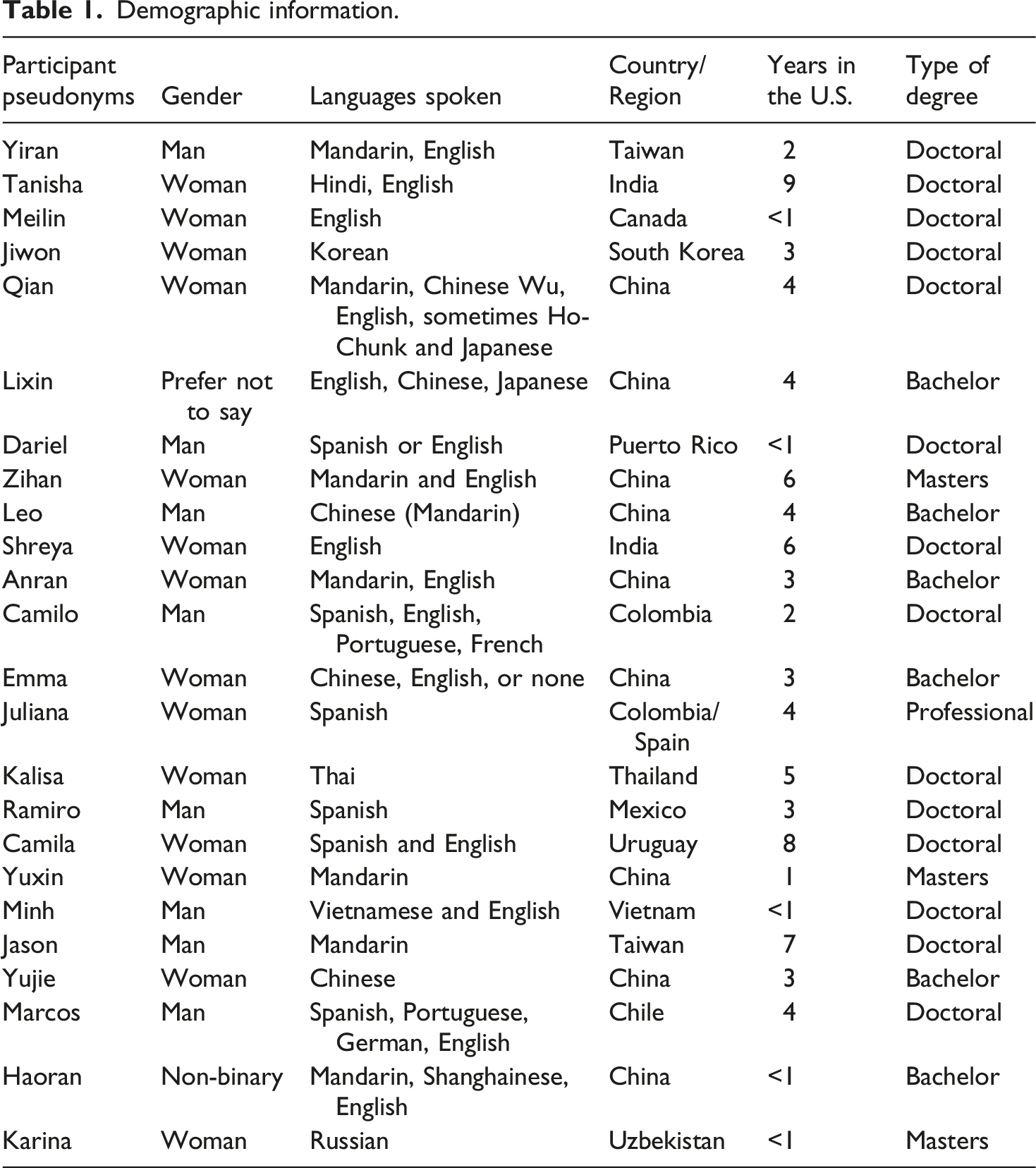
We generated data through semi-structured interviews conducted remotely during the 2024–25 academic year. Interviews encouraged participants to reflect on their experiences with race, language, and belonging in university settings. Depending on participants’ preferences, interviews were conducted in English, Mandarin Chinese, or Spanish by members of the research team. Recordings were transcribed verbatim, and excerpts originally produced in Chinese or Spanish were translated into English for analysis. Questions invited participants to discuss moments when language became salient in their interactions with peers, instructors, or university personnel, as well as how these encounters affected their participation, relationships, and sense of belonging on campus.
Data analysis
This study employed reflexive thematic analysis (Braun and Clarke, 2022) to examine participants’ experiences with linguistic racism and racialized emotional labor. This approach allowed for a systematic yet flexible process of identifying and interpreting patterns in the data, while remaining grounded in participants’ own words and meanings. Thematic analysis allowed us to explore the nuanced ways in which international students narrated, interpreted, and responded to racialized and language-based encounters within a PWI context.
The analysis began with repeated readings of all interview transcripts to develop a thorough understanding of the data. During this process, analytic memos were recorded to capture emerging insights, possible connections between accounts, and preliminary reflections on how participants described their experiences. Consistent with Braun and Clarke’s reflexive thematic analysis, our analytic process emphasized interpretation, reflexivity, and researcher subjectivity as resources for knowledge production rather than sources of bias to be eliminated (Braun and Clarke, 2022). Rather than treating themes as objectively “emerging” from the data, we approached themes as interpretive constructions developed through ongoing engagement with participants’ narratives, the broader theoretical frameworks, and our own positionalities as researchers. Drawing on both the literature on linguistic racism and racialized emotional labor and our iterative engagement with the transcripts, we developed preliminary analytic categories to help organize patterns across the dataset. These categories included perceptions of race in the U.S. context, perceptions of language and accent, experiences of linguistic racism such as accent discrimination or language-based stereotyping, emotional responses to these experiences, strategies for managing racialized emotions, and the institutional or interpersonal contexts in which these dynamics occurred. These categories remained flexible and were continuously revised throughout the analytic process as we moved between the data, analytic memos, and theoretical interpretations.
All transcripts were coded in NVivo 15, which facilitated the systematic organization and retrieval of data for deeper interpretive work. Coding was iterative and reflexive rather than linear, with ongoing discussions among the research team shaping how we interpreted participants’ accounts and conceptualized relationships across the dataset. Instead of seeking coding consensus or reliability in a positivist sense, our discussions focused on deepening interpretive engagement with the data and reflecting on how our own experiences and assumptions informed the analytic process. As coding progressed, we moved from descriptive labels to more interpretive categories that captured the relationships between linguistic racism and racialized emotional labor. This process led to the development of broader themes that illuminate how linguistic racism shapes the emotional experiences of international students, the labor involved in managing those emotions, and the ways these intertwined processes influence their academic and social navigation within the university.
Researcher positionality
Given our use of reflexive thematic analysis, we view researcher subjectivity not as a limitation to be minimized but as an integral part of the interpretive process (Braun and Clarke, 2022). Throughout the study, we engaged in ongoing reflexive discussions regarding how our social positions, migration histories, linguistic backgrounds, and institutional experiences shaped both our interactions with participants and our interpretations of the data. The first author is a Chinese international doctoral student at the same university where this study was conducted. As someone who has personally navigated the challenges of living and studying in a PWI, including experiences with linguistic stereotyping and the emotional labor of managing racialized encounters, the first author brings an insider perspective to the research. The second author is a faculty member who was formerly a Chinese international student. Her lived experiences with race and racism, along with observations of fellow international students’ encounters with linguistic racism, have informed a sustained scholarly commitment to this topic. The third author, a Chinese international doctoral student herself with more than 7 years of navigating PWIs in the U.S., uses her training in developmental and psychological frameworks to inform her interpretation of how structural forces and interpersonal dynamics intersect in students’ everyday lives.
At the same time, we recognize that insider and outsider positionalities are neither fixed nor absolute. While we shared certain experiences of internationalization, racialization, and navigating U.S. higher education with many participants, we did not uniformly share their national, linguistic, racial, gendered, or disciplinary identities. Participants also occupied diverse social positions and migration trajectories that differed from our own. Thus, we approached insiderhood and outsiderhood as fluid and relational rather than binary categories.
To support reflexivity throughout the research process, we maintained analytic memos, engaged in ongoing discussions about our assumptions and emotional responses to participants’ narratives, and critically reflected on how our own experiences with language, race, and academia shaped the questions we asked, the interactions we noticed, and the interpretations we foregrounded in the analysis. These reflexive conversations were particularly important given our personal proximity to the topic and helped us remain attentive to both resonances and tensions between our own experiences and those of participants.
Findings
Through the lenses of linguistic racism and racialized emotional labor, our findings reveal that international students at the PWI encounter both subtle and overt forms of linguistic marginalization that permeate their academic and social lives. Disparaging evaluations of their accents, patronizing speech, and constant scrutiny position them as less competent, compelling them to invest significant emotional energy in proving their worth. These experiences not only erode confidence but also intensify the affective burden of navigating spaces where their legitimacy as speakers is questioned. Rather than treating these encounters as isolated interpersonal incidents, our analysis conceptualizes them as manifestations of broader raciolinguistic ideologies that position white, monolingual English norms as the unmarked standard of legitimacy and belonging within U.S. higher education (Flores and Rosa, 2015). Across participants’ narratives, linguistic racism operated not merely through overt exclusion but through everyday interactional practices that subtly disciplined how students spoke, participated, and emotionally navigated institutional life. The findings unfold in three interrelated themes that trace how such linguistic marginalization operates, its emotional and institutional consequences, and the strategies students employ to cope and resist.
“Good English” tests, accent policing, and the everyday performance of linguistic racism
Linguistic racism often takes shape through subtle yet persistent interactional practices, including but not limited to the patronizing comment, the unsolicited “correction,” and the heightened scrutiny of one’s accent. These moments rarely erupt into overt conflict; instead, they quietly position international students as deficient speakers who must constantly prove their worth. Consistent with raciolinguistic perspectives (Rosa and Flores, 2017), participants’ narratives suggest that these encounters were not simply about intelligibility or communication, but about how institutional listening practices racialized accented English as deficient, foreign, or less authoritative. The stories in this theme reveal how such everyday encounters operate as gatekeeping mechanisms, enforcing a hierarchy in which proximity to standardized white English is rewarded and deviation is sanctioned. Participants described an ecology of patronizing speech that began with simplified explanations and culminated in overt judgments about who speaks “proper” English. The narratives presented below illustrate different manifestations of linguistic racism, ranging from patronizing accommodations and assumptions about communicative competence to more explicit evaluations of accents and language practices.
We start with Lixin, an undergraduate student from China. Their story introduces one manifestation of linguistic racism, where seemingly considerate accommodations can nevertheless reinforce assumptions about linguistic deficiency. During office hours, they observed that their professor slowed his speech and avoided humor: I think when I go to an office hour … when I’m asking the question, the professor tends to expand things in a much slower and, just in general, easier terms to understand. And I don’t really think the professor tells jokes with me that much … he knows that we both don’t want that to happen. That’s considerate, but, like, again, that’s a difference …sometimes, based on my accent, they would just conclude that I’m not good at English … they will just be less playful because they might think I won’t get the joke.
Lixin interprets the professor’s adjustments as well-intentioned yet limiting. Although they appreciate his desire to avoid misunderstandings, they note the loss of camaraderie and humor that native speakers enjoy. This dynamic mirrors Sender Dovchin’s (2020) observation that even well-intentioned corrections can constitute symbolic violence that reduces multilingual speakers to linguistic novices. Their experience reveals the double bind of accommodation that to be included, they must accept a reduced, simplified version of academic discourse. Their account suggests the emotional labor of suppressing irritation while remaining appreciative of institutional support. Their story illustrates a common experience with linguistic racism at the PWI and hints at how such experiences shape their emotional labor.
Camilo, a doctoral student from Colombia, offers a related yet distinct example of how linguistic racism can operate through seemingly well-intentioned accommodations. As an instructor, he observed his American students speaking naturally among themselves, but slowing down and overenunciating when addressing him: Well, I guess you can think about it in a kind way. They are trying to be kind to you and try to make themselves understood and all that. But …I cannot help but feel that it’s kind of patronizing, like assuming that I don’t speak English fluently enough to understand you. I feel like I am fluent enough to understand the majority of your speech, regardless of your accent and how fast you’re pronouncing things. Having my students speak slower to me is kind of patronizing. It doesn’t feel nice … they are making decisions for me based on assumptions that are probably just racially motivated because there’s very little information they have about me. They just have my brown skin.
Camilo’s narrative resonates with Lixin’s yet adds a racial dimension. He explicitly links students’ speech adjustments to his “brown skin,” showing that what appears as linguistic accommodation can also be read as racial profiling. His description of the interaction as “patronizing” echoes Kubota and colleagues’ (2023) argument that compliments and accommodations often function as microaggressions that reinforce white linguistic norms. The emotional labor here is heightened because he must balance his gratitude for his students’ efforts with the irritation of being infantilized, all while maintaining his authority in the classroom. Camilo’s story highlights how race intersects with language to produce patronizing behavior.
While Camilo’s account highlights the patronizing effects of linguistic accommodation, Marcos, a doctoral student from Chile, describes how accented speech can become a basis for heightened scrutiny and evaluations of competence. I can see how just because I speak with an accent, I am subjected to a higher standard of what’s correct or not. … If you have a graph there’s kind of a proportional relationship between how thick your accent is and how bad they will try to make the first interpretation of what you’re saying. … Students try to test me a little bit like ‘Oh, this person speaks weird; we will see if it’s good enough to be here.’ It’s super subtle … trying to double check if I do know what I’m supposed to teach and stuff like that.
Marcos’s metaphor of a “proportional relationship” between accent thickness and scrutiny reveals a shift from benevolent accommodation to evaluative surveillance. His narrative exemplifies how accent hierarchy functions as a raciolinguistic measuring stick: the thicker the accent, the more students feel licensed to challenge competence, a pattern consistent with Dovchin’s (2020) analysis of accent-based stereotyping. This interaction demands continuous emotional labor: he must anticipate microaggressions, repeatedly prove his knowledge, and suppress his annoyance. The mere fact of sounding different appears sufficient to trigger doubts about his legitimacy as an academic authority. Marcos’s experience thus deepens our understanding of how linguistic racism manifests in academic hierarchies.
Shreya, a doctoral student from India, illuminates another dimension of linguistic racism by drawing attention to the explicit accent hierarchies that underpin many seemingly innocuous interactions. She received a backhanded compliment from a classmate who praised her “posh” British accent: I remember once one of my classmates saying, ‘Oh, my gosh! Your accent is so posh … you always speak with a British accent.’ I said my country was colonized; it’s not a point of pride. … I get that a lot like people sound surprised that my English is good … and I see there’s more of a hierarchy in accents of English that are associated with different Englishes being spoken.
Shreya’s story makes explicit the colonial logic behind accent hierarchies. Her “posh” accent elicits admiration precisely because it is associated with British colonization, whereas speakers from Asia or Africa are told their English is “hard to understand.” As Kubota and colleagues (2023) argue, comments that appear complimentary on the surface, such as praising someone’s English proficiency or accent, often function as raciolinguistic microaggressions that reinforce assumptions that racialized speakers are not expected to possess linguistic competence. This praise is double-edged: it reinforces the superiority of European English while positioning other accents as inferior, illustrating what May (2023a) describes as the ongoing devaluation of non-dominant linguistic repertoires. For Shreya, the emotional labor involves responding to raciolinguistic microaggressions while simultaneously challenging the colonial assumptions that underpin them. By reminding her classmate that India’s association with British English is rooted in a history of colonization, she resisted the framing of her accent as an uncomplicated marker of prestige, even as she continued to navigate the emotional burden of such encounters. Her account demonstrates how seemingly innocuous comments reproduce global hierarchies of race and language.
In summary, these narratives illustrate multiple manifestations of raciolinguistic marginalization within everyday university interactions. Participants described experiences ranging from patronizing accommodations and assumptions about communicative competence to heightened scrutiny of accented speech, challenges to professional authority, and explicit accent hierarchies rooted in colonial histories. Rather than representing a fixed progression of experiences, these accounts are presented together to highlight the varied ways linguistic racism operates across academic and social contexts. Across these experiences, international students expended considerable emotional labor to navigate assumptions about their competence, legitimacy, and belonging while asserting their linguistic knowledge and expertise. Together, these findings demonstrate that linguistic racism extends beyond interpersonal discomfort to shape how international students are heard, evaluated, and recognized within a PWI. They also lay the foundation for understanding how these experiences shape racialized emotional labor in subsequent themes.
Racialized emotions and the institutional cost of linguistic racism
The interpersonal slights of the first theme carry consequences that ripple far beyond individual interactions. For many participants, the accumulated weight of these experiences produces racialized emotions such as anxiety, self-doubt, and exhaustion that are inseparable from the institutional contexts in which they unfold. In this theme, participants describe how linguistic racism shapes their academic opportunities, participation patterns, and relationships with instructors and peers. These accounts highlight how emotions are not merely private responses but are themselves shaped by institutional inequities.
We first turn to Qian, a doctoral student from China whose stories illustrate the everyday pain of being unseen and unheard. She recounted how older white men nodded when she told them her name, but never learned to say it correctly. When she asked a question in class, a professor replied, “You are very good,” instead of answering her inquiry. These dismissals left her feeling “exhausted” and “humiliated.” Misnaming and empty praise are common forms of symbolic violence (Wang and Dovchin, 2023), signaling that a person’s language and identity do not warrant the same effort as those of dominant groups. Qian’s sense of exhaustion thus reflects more than personal sensitivity—it highlights how institutional norms condone the erasure of non-English names and the trivialization of multilingual contributions.
Yujie, an undergraduate student from China, described a more acute moment when classroom participation spiraled into public humiliation. In her program, she is often the only non-white student in the classroom. Speaking in front of white peers made her “timid” and self-conscious about her “terrible” English. She recounted an icebreaker in which students stood in a circle, each repeating the names of those before them. As the last person, Yujie struggled to remember and pronounce English names. The teacher noticed her discomfort and moved her closer, but in a later round, the task grew harder: students had to recall both names and hobbies. Again, placed last, Yujie felt the weight of expectation and burst into tears, running out of the room. You could say it was also because there was no one of the same race around me – everyone else was white – and our cultures are different. Sometimes when they speak English, I honestly can’t understand them, because their language is so colloquial. I’ll admit, that really overwhelmed me. I remember one class at the very beginning, the teacher had us play a game. Here’s what happened: everyone stood in a circle, and, for example, I’d say my name first, then the person next to me would repeat my name and say their own, and so on. I was unlucky – I ended up being the very last person. The first time, I tried my best; I just had to say everyone’s names, and the person next to me quietly reminded me of them. Then we played a second time. After the second round, the teacher probably realized I wasn’t very comfortable, so he put me next to him so I only needed to say his name. Then he played the game a third time, and he increased the difficulty: you had to say the previous person’s name plus what they liked to do, and repeat both. Again, I was the last person in the circle. At that point, I completely broke down. I couldn’t take it anymore and told the teacher I didn’t want to play. The teacher said it was fine, but I started crying and ran out of the room. The thing is, what triggered my crying wasn’t just that activity – I’d already been under a lot of stress, and that game pushed me over the edge and made all my emotions explode.
Yujie’s story exposes how linguistic racism does not always manifest in overt exclusion; it can also surface in the form of well-intentioned icebreaker activities that disregard the racialized and linguistic pressures already shaping a student’s day-to-day reality. What might be a lighthearted memory game for native-English-speaking students becomes, for Yujie, an arena where language anxiety, isolation, and performance pressure converge, culminating in a public emotional rupture.
These narratives demonstrate how emotional labor involves constant vigilance—reading ambiguous cues, monitoring self-presentation, and pre-empting possible embarrassment. This labor is racialized, rooted in the unequal positioning of accented English and racialized bodies in academic spaces. The stories show how linguistic racism infiltrates casual settings and routine classroom practices, steadily undermining students’ sense of belonging and exhausting their emotional reserves.
Moving beyond individual interactions, Kalisa, a doctoral student from Thailand, reveals how linguistic racism structures social networks and classroom dynamics. She described entering classes where “White people just say hi to White people and Asian people just say hi to Asian.” She observed that a Chinese classmate with a strong accent was ridiculed behind her back, and students more readily respected native speakers. She also noted a hierarchy among professors: those with European accents received more respect than those from Indonesia, even when teaching the same material. Such narratives demonstrate that authority is not attached solely to knowledge but to the racialized sound of knowledge. The institutional cost of linguistic racism here includes lost credibility, diminished authority, and the emotional burden of constantly anticipating doubt. I don't know. It's just like, sometimes, like in a room, there's one class that's like, I'm the only Asian and all the other people are white. And I feel like the way people start to form friendships over the course of [a] semester. You know, I feel like at first it's just like normal that nobody talks to each other, but then people will start to have small talk, and I always feel like white people talking to white people and not to me, kind of stuff. Or like, in my other class, there's like a couple other Asian people and a couple others, like, white students. And I feel like when people come in, like, white people just say hi to white people and Asian people just say hi to Asian. In my class, there's like one Chinese girl who, like. I think it's her first year in the US. So her it's not just light, it's not just her accent that is still very strong, but I feel like she still struggles with speaking and listening English in general. And I definitely feel like people in the class treat her differently. Like one time I heard people, like, talk behind her back, like, I think she doesn't understand English kind of stuff. Yeah, so, yes. Or like, I don't know that, but like, when a native speaker corrects your English. Like in the other situation, my Thai friend is like, reading something, and she mispronounced the word. And the other person, who's like native English speakers kind of like correcting how it's supposed to be pronounced. And I don't know, I just feel like in that situation, it's like in, like, casual setting. I feel like you don't have to do that. If you are a native English speaker, it's kind of easier to gain respect from your students sometimes. I feel like, yeah, because like you have an accent sometimes, students kind of like not taking you seriously. I TA for different professors. And they're in a class where the professors, like native English speakers, are white. I feel like students respect the professor a lot more than in the semester that the professor is from Indonesia, and she did speak like English with an Indonesian accent. And I definitely feel the difference how like how students like perceive them differently. … When I need to teach my undergrads feel like I always worry that my racial background would be something that make like my student doesn't trust me or like, doesn't look at me as, like, credible or like, don't take me seriously.
Kalisa’s account demonstrates that linguistic racism is not only interpersonal but also collective. The emotional labor here involves navigating an environment where friendships and respect are stratified by accent. Kalisa must decide whether to challenge these dynamics or accept them as part of campus life, all while worrying that her own accent might undermine her authority as a TA.
Institutional barriers became most visible in Jiwon’s story. Jiwon is a Korean doctoral student. Hoping to improve her English for teaching, she enrolled in a training course for international TAs. Instead of gaining confidence, she experienced interruption, feigned incomprehension, and shouting from the instructor. Her account underscores that “support” programs can perpetuate deficit ideologies when they frame international students as problems to be corrected rather than multilingual assets. So I attended that TA class from the second language department. I don't know the program's name. That was not mandatory for me, but I just took it because I thought my English is not [good] enough to teach students, and I was very afraid of meeting them. So I enrolled that course, and then the very 1st week when I visit there the instructor he was speaking very slowly and clearly, and I really respect and appreciate that, how he tried to like understand me, however, participating that class for like second week and 3rd week, I feel like he starts ignoring me because of I'm not saying like English, fluently. Although I consider myself, I'm not a fluent English speaker. I thought I still can communicate with others using English. However, he was trying to interrupt what I'm saying, and he pretend I'm not sure he pretended where he just not don't didn't understand my English. But he kept asking, and he just behaved like he didn't understand me at all, so I was very offended, and I ended up dropping that class cause you know. I mean, you see how I speak English right now. And I even though I don't speak like perfectly like grammatically. Communicate and deliver my feelings or my experience to others, and from my experience in the U., People like easily understand, especially when the one that I was talking to is American, because they use their mother tongue language, and I use ( ) language, and they understand it. It was very surprising moment when I said something very shitty. But they understand very well. Yeah. So I thought that was the natural thing here in the US. And maybe I expected some kind of hospitality from [the] second language teacher, because they are teaching like international students. But it turns out that the instructor reacted, conversely, [in the] very opposite way. So I felt very offended, and actually, his behavior was like saying words very loudly, and almost like shouting at me. It kinda discourages me, speaking in English.
Jiwon’s experience shows how linguistic racism can directly curtail professional development. The emotional labor here is that she had to reconcile her appreciation for the instructor’s initial kindness with the injury of being treated as incompetent. Her decision to drop the course underscores the tangible costs of linguistic racism.
Shreya’s testimony deepens the picture by linking linguistic racism to restricted academic opportunities and mental health. So I've had to really talk to myself a lot and say, to try and separate it out, and to focus on just continuing to do the work and to try and get published. But it is very challenging. It's very challenging to see sunshine, and to be optimistic, and to see yourself as how you really are, as against somebody else, really shaping you because of these racialized experiences, because it's everywhere. It's in everything. It's inescapable. I would say the opportunities to collaborate for research are definitely limited because of my language and writing. I'll say that. Yeah, in terms of being invited to co-write or co-study, or being on a project. And you know, I see several other students who are being invited by people who are not liked by teachers who are not their primary advisor or somebody whom they just took a class with or from other departments. And you know things like that. So I see that a lot more with white students compared to domestic, yeah, either domestic students of color, or certainly international students of color. I'll be honest with you, because I feel I spent so much time thinking about it, so much time feeling. You know, that my self-worth was being beaten down because of all of these aspects, race and language. That I'm like I'm here to do something, and the only person who at this point is accountable and responsible for that is me. So I look at it as saying I need to get the job done in whatever in a professional setting, right? So that's how I rationalize it. Or I say, Okay, it just needs to happen. And just take it day by day.
She observed that collaboration offers and co-authorships go disproportionately to white students, while her own language and writing were deemed inadequate. This exclusion battered her self-worth. To survive, she said she must separate her sense of self from external judgments and “just take it day by day”. The emotional labor here is relentless: she must constantly reaffirm her value while watching peers with no greater qualifications advance. Her story underscores how linguistic racism shapes career trajectories and mental health.
Finally, Tanisha, a doctoral student from India, highlights the cultural and linguistic erasure that occurs within departments. Tanisha: But then I'm also like always struggling with like. Oh, am I losing as if I'm mostly speaking in English throughout the day, like, am I losing the part of my brain that is fluent in Hindi, or all of these things? When I'm at work, I don't have opportunities to sort of bring it up. I guess the bigger thing lies in if I don't have people in my department that I can celebrate, you know, whatever ethnic festival with, for example. Then, like, how many times am I gonna… then it like feels weird to like, still organize some sort of celebration, and then be like the only person that's sort of performing it for the rest of the group. So I think it's just like that, there are these like really important things that are valuable to me, that I can't share with people that I spend a lot of time with. Interviewer: How do you feel about this kind of erasure, even though it's not like conducted intentionally? Tanisha: Yeah, I mean, it's just kinda rough cause like, I do have community. And I do like traveling home frequently, etc. And so it's not like I'm totally missing out on these experiences. But then again, like in the workplace, it's you know, to not be able to like, speak, speak my language, or like, yeah, they I don't know. Not great, but it's also like, what am I gonna do? And I guess it's just hard, because in our department, and like in my lab, like, there's a lot of like, Oh, like we're friends here and like, we'll do things together and like we'll socialize together, and we have each other's backs. But also, yeah, there's like this part that's missing. Interviewer: I see. Do you have any Indian friends on campus here? Tanisha: Yeah, yeah, I have a roommate that's Indian, and my boyfriend's Indian, and some other friends. So like again, like that exists. But then I think it's like sort of the culture in our department, in our lab, to be able to like, bring like, for example, like we, you know, had multiple holiday parties together. And we have a volleyball league, like an intramural thing. And so I feel like everybody else is able to be their full selves at work, but not me. And right like, because for me this is like a salient part of my identity. But I can't share it. If I do, then like I'm the one putting in all the effort.
She worried that speaking English all day eroded her fluency in Hindi and lamented that departmental social events never included her cultural festivals. Although she had a community outside of work, she felt she could not be her “full self” at the university. The emotional labor for Tanisha involves grieving the loss of cultural expression, negotiating when and how to share her heritage, and carrying the burden of being the sole organizer when she does. While Tanisha herself framed these experiences primarily in terms of loss and absence, these narratives also point toward broader institutional processes that can contribute to cultural and linguistic erasure. Her story illustrates how linguistic racism intersects with institutional norms to marginalize non-white cultures.
In sum, these narratives show that linguistic racism inflicts multifaceted harm. It renders students invisible, isolates them from networks, blocks access to training, erodes self-worth, and suppresses linguistic and cultural expression. The emotional labor required to endure these harms is immense: participants must constantly interpret ambiguous behaviors, manage humiliation, affirm their worth, and find ways to preserve their identities. This theme thus elucidates how the experiences of linguistic racism accumulate to shape the racialized emotional labor of international students.
Coping and resisting through racialized emotional labor
Having explored the emotional and structural impacts of linguistic racism, we now turn to the strategies students use to navigate and resist these oppressive dynamics. Rather than treating coping and resistance as separate categories, we understand them as intertwined forms of racialized emotional labor (Evans and Moore, 2015). These strategies illustrate both the agency of international students and the profound burden of continually negotiating a raciolinguistic landscape that questions their legitimacy. In this theme, we trace how participants transform their painful experiences into coping and resistance strategies. Students first shield themselves from further injury by withholding aspects of their identity and passing as native; then, they reframe interactions to reduce emotional damage, build supportive communities, and finally repurpose their hurt into practices of care and self-affirmation.
The most immediate response to patronizing and exclusionary encounters is to conceal one’s real identity. Camilo, drawing on his experiences of being spoken to slowly and having his linguistic competence questioned, said he would prefer that strangers assume he grew up in the United States: I don’t feel like it would be nice to have to explain my entire background, how I learned English, how I achieved fluency, and how many languages I speak. I would rather have their random person on campus assume that I’m a native English speaker … that I’m just a Hispanic person who grew up in the US, maybe. That’s all I need them to know about me, so I don’t get treated differently.
Camilo described feeling patronized when students slowed their speech. His strategy here is to pass as a native to avoid further condescension, which directly responds to those experiences. Concealing his linguistic history shields him from microaggressions but requires constant emotional calculation, meaning he must constantly decide if and when to reveal his background while managing the discomfort of hiding part of himself. Such identity concealment reflects the broader emotional and interpersonal work that racially minoritized individuals undertake to navigate institutional spaces where they anticipate stereotyping, exclusion, or differential treatment (Foste and Johnson, 2021). Rather than freely expressing their linguistic and cultural identities, participants strategically managed what aspects of themselves became visible in particular interactions.
Anran adopts a similar tactic, albeit for safety reasons. She explained why she sometimes hesitates to disclose her nationality: Interviewer: Do you sometimes feel that you have to hide your identity because you wanna make sure you are safe? Anran: I’ll say sometimes yes … I have the feeling like I don’t need to tell someone my identity, like what is my nationality … because sometimes I just feel like there are people who have [a] mental bias against Chinese, and also Asian. … I would feel uneasy to appeal my nationality … I would be considered twice before telling where I’m from.
For Anran, non-disclosure functions as a protective shield against anti-Asian violence and discrimination. Her strategy underscores the intersection of linguistic racism with geopolitical tensions and personal safety. Both Camilo and Anran exemplify how students adapt to the harms by controlling access to their identities, thereby reducing the opportunities for patronizing speech or exclusion.
A second set of strategies involves reinterpretation and selective focus. Lixin chooses to reframe their professor’s slowed speech as a sign of kindness. They focus on his intentions rather than the loss of humor. This cognitive reframing allows her to maintain engagement in class without internalizing the message of inferiority. I think [it] kind of makes sense. Like, because, you know, it would be really awkward if he tried to be funny and I didn't get the joke. And the whole environment is just awkward. And I think, actually, I think he knows that we both don't want that to happen. That's considerate.
Similarly, Kalisa, despite witnessing widespread segregation and accent hierarchies, emphasized that within her own department, she does not feel discriminated against. By concentrating on positive interactions with mentors, she creates a psychological buffer against the microaggressions she knows exist. These reinterpretations are not naïve optimism; they are deliberate strategies to preserve motivation and self-esteem in the face of pervasive linguistic racism. Yet they demand emotional labor: Lixin must suppress irritation, and Kalisa must compartmentalize conflicting realities.
Other students seek solace and strength in the community. For Tanisha, maintaining ties with people from her region is a lifeline. She explains how she responds to the erasure of her culture at work: She travels home frequently and keeps a roommate and partner from the same country. These relationships offer spaces where she can speak Hindi and celebrate cultural events without needing to translate herself. Building community allows Tanisha to replenish emotional reserves and affirm her linguistic identity. It is a form of resistance against the white norms that silence her culture. The emotional labor lies in cultivating and sustaining these relationships amid academic demands and physical distance.
Qian converts her pain into an ethic of care. After repeated experiences of misnaming and dismissal, she responded by learning other people’s names and their meanings. So if someone’s name isn’t English, I make an effort to pronounce it and ask its meaning. Some people have done this for me and made me feel good, so I want to reciprocate.
This practice extends beyond adaptation; it is a micro-resistance that challenges the implicit message that only English names are worthy of attention. By investing time in pronunciation, she models the inclusive linguistic practices she wishes to receive. This strategy requires emotional work in which she must transform humiliation into empathy and persist even when her efforts are not reciprocated.
Finally, some participants protect themselves through compartmentalization. Shreya, who described her self-worth being eroded by accent hierarchies, chooses not to confront microaggressions directly. Instead, she focuses on her research and reminds herself she is “not less than”: It's very hard to acknowledge that how you thought about a country is very different from how it actually is, and to keep telling yourself, giving yourself the message of that. You're not less than you know. And to not give in to how other people think of you, and I will never openly fight. I'm not a confrontational person, like I said, but to acknowledge the fact that we put in so much effort, because we need to all the time, it's constant. and to just give myself a little more grace and not be so self-defeating. So it's a lot of work. It's a lot of work outside of being a student or anything, as you know, professionally, all the things that you're supposed to do that you're contracted to do. It's all of these underlying aspects that are exhausting. It is exhausting.
By separating her sense of identity from others’ judgments, she creates an internal boundary that insulates her from harm. However, this boundary maintenance demands constant self-talk and vigilance. Shreya’s strategy illustrates the emotional regulation often required of racially minoritized individuals in PWI (Evans and Moore, 2015). Rather than openly confronting microaggressions, she described engaging in continuous self-talk, restraint, and emotional management in order to protect herself academically and psychologically within unequal power relations.
From their narratives, students draw on a repertoire of coping and resistance strategies that directly respond to the harms detailed in earlier themes. Passing, selective disclosure, and compartmentalization help them avoid patronizing interactions; reinterpretation and selective focus mitigate psychological harm; community building nurtures their linguistic and cultural identities; learning names and cultural practices transforms personal pain into advocacy. These strategies are not isolated behaviors but part of a holistic navigation of the PWI’s linguistic terrain. Nevertheless, they come with significant emotional labor that requires them to continually assess risks, modulate their self-presentation, invest time and energy in community, and sustain self-affirmation. The theme thus illustrates how experiences of linguistic racism not only inflict harm but also shape the forms of agency available to international students.
Discussion
This study examined how international students at a PWI experienced linguistic racism and how these experiences shaped their racialized emotional labor. Our findings illustrate the pervasive and insidious nature of linguistic racism as experienced by international students at a PWI. These experiences are not isolated incidents but rather part of broader processes of marginalization that shape students’ academic trajectories, social integration, and emotional well-being. While prior studies have documented accent discrimination and linguistic marginalization across diverse migrant and international student contexts (e.g., Clements and Petray, 2021; Dovchin, 2020; Ramjattan, 2023), our study contributes to this literature by foregrounding the affective dimensions of these experiences and examining how linguistic racism becomes emotionally lived, managed, and negotiated within a U.S. PWI. Rather than treating linguistic racism solely as interpersonal discrimination, our findings demonstrate how raciolinguistic ideologies become embedded within institutional listening practices that shape whose speech is recognized as competent, legitimate, and academically authoritative. In this sense, we use a raciolinguistic perspective not as a replacement for linguistic racism, but as a theoretical lens for understanding how language and marginalized identities become co-naturalized through everyday institutional interactions (Rosa and Flores, 2017).
The first theme highlights the varied ways linguistic racism manifested in participants’ experiences, including slowed speech, unsolicited corrections, accent policing, and explicit accent hierarchies. This reflects what Lippi-Green (2012) terms the enforcement of “standard language” ideology, and aligns with studies showing how higher education spaces normalize white linguistic norms through everyday talk (Dovchin, 2020; McDonough et al., 2024). Similar to Wang and Dovchin’s (2023) findings on symbolic violence against Chinese international students in the U.S., our data reveal how these norms are embedded in routine academic exchanges, creating colonially inherited linguistic hierarchies through which certain language practices come to be recognized as legitimate while others are devalued (May, 2023a). Participants encountered microaggressions across academic and social spaces, including classrooms, office hours, research collaborations, and even language training programs designed to support them. This echoes Lee and Rice’s (2007) and Shin’s (2015) observations that institutional spaces intended for support can reproduce deficit views of accented speakers, but our findings further illustrate how these institutional listening practices generate ongoing emotional vigilance and self-monitoring even in interactions framed as supportive or well-intentioned. In this sense, our findings extend the broader body of scholarship represented in Clements and Petray (2021) by demonstrating how linguistic discrimination in higher education operates not only through overt exclusion or deficit perceptions, but also through subtle institutional listening practices that produce racialized emotional labor and affective strain. These daily interactions reflect broader raciolinguistic ideologies (Rosa and Flores, 2017) that privilege whiteness and proximity to “standard” English while positioning accented speakers as deficient. Importantly, many of these dynamics were particularly salient for Asian international students, who constituted the majority of our participants. Their narratives reflect broader racialized constructions of Asians as perpetual foreigners within U.S. society, where accented English and non-white bodies become intertwined markers of unbelonging. While some participants received praise for speaking “good English,” these comments simultaneously reinforced assumptions that linguistic competence was unexpected from Asian speakers, echoing Kubota et al.’s (2023) findings on raciolinguistic Othering in higher education. The emotional consequences of these encounters extended beyond momentary discomfort, contributing to chronic vigilance, self-monitoring, and feelings of conditional belonging. By foregrounding these experiences, our study demonstrates how linguistic racism in U.S. higher education is deeply entangled with broader anti-Asian racialization and geopolitical discourses.
The second theme highlights how repeated encounters with marginalization accumulate into emotional labor, producing feelings of invisibility, isolation, and self-doubt while reinforcing structural exclusion. This labor is racialized, arising from the unequal positioning of non-white, non-native speakers within academic spaces. Consistent with Kang’s (2010) discussion of racialized emotional management within unequal social relations and Evans and Moore’s (2015) framing of racialized emotional labor, our participants described sustained affective regulation and self-monitoring in order to navigate exclusion within PWIs. Dovchin (2019, 2020, 2025) similarly shows how linguistic racism creates psychological distress for racialized speakers, especially when compounded by gendered and intersectional discrimination, while McDonough et al. (2024) demonstrate how stereotyping in Canadian universities produces parallel burdens. Our study extends prior scholarship on linguistic racism by demonstrating that racialized emotional labor is not merely a response to isolated interpersonal prejudice but is continually produced through institutional listening norms that regulate whose speech, emotions, and participation are perceived as legitimate within higher education spaces. While prior studies have documented the psychological distress associated with accent discrimination (e.g., Dovchin, 2020), our findings further show how these affective burdens accumulate through routine institutional practices—including classroom participation structures, professional training spaces, and everyday academic interactions—that subtly but persistently position international students as linguistically deficient or perpetually foreign. Unlike the emotional labor of native speakers (e.g., code-switching for professionalism), international students’ labor is tied to systemic marginalization and exclusion. Their experiences reflect the cumulative emotional burden associated with navigating raciolinguistic marginalization while simultaneously striving for academic and social legitimacy within the university.
The third theme shows how students respond through strategies such as passing as native, selective disclosure, reframing, community building, and micro-resistance. These strategies parallel those documented by Ramjattan (2023) in workplace contexts, Wang and Dovchin (2023) in U.S. universities, and Humphrey (2022) in higher education more broadly, where racialized speakers adopt selective self-presentation to navigate accent hierarchies. Similar dynamics have also been documented beyond the U.S. and in non-English dominant contexts. For example, Park and May’s (2025) study of North Korean students in South Korean higher education demonstrates how linguistically marginalized students strategically conceal their linguistic backgrounds, avoid revealing their identities, and modify their speech to mitigate discrimination and social exclusion. Similar to our participants, students in their study experienced accent as a marker of difference and developed coping strategies shaped by broader institutional and sociopolitical hierarchies. Our participants’ community building and micro-resistance resonate with Wang and Dovchin’s (2023) discussion of resistance to linguistic racism and symbolic violence. However, our findings also complicate existing discussions of resistance by showing that many coping and resistance strategies emerge not primarily through overt political mobilization, but through ongoing affective negotiation within unequal institutional conditions. Participants’ passing practices, selective disclosure, reframing, and community-building efforts were often less about empowerment alone and more about preserving psychological safety, maintaining academic participation, and minimizing emotional exhaustion. In this sense, resistance itself became emotionally laborious. May’s (2023b) analysis of resistance in Indigenous language revitalization further highlights how such strategies challenge colonial language orders, a parallel to our participants’ efforts to contest white linguistic norms in academic spaces. The themes demonstrate how experiences of linguistic racism generate emotional and institutional consequences that shape the coping and resistance strategies available to international students. Students are persistently reminded that their accents position them as Other, prompting slowed speech, unsolicited corrections, and doubts about their competence. These moments limit collaboration and erode belonging, yet also drive students to develop adaptive strategies—strategies that, while enabling survival and occasional empowerment, demand sustained emotional labor. In this way, our study corroborates prior work on resistance within raciolinguistic ideologies (Flores and Rosa, 2015) while adding an emotional labor dimension that has been less visible in the literature.
In sum, our findings suggest that linguistic racism in higher education operates not only through explicit discrimination but through everyday institutional listening practices that normalize white linguistic authority and render racialized speakers perpetually vulnerable to scrutiny. By bringing raciolinguistic and affective frameworks into dialogue, this study contributes a more nuanced understanding of how language, race, and emotion become intertwined within the lived experiences of international students. Specifically, our findings extend prior work on linguistic racism by foregrounding its emotional and affective dimensions, demonstrating how students must continuously regulate emotions, anticipate judgment, and manage belonging within predominantly white institutional spaces. This contribution is particularly important in the current U.S. sociopolitical climate, where anti-Asian racialization, immigration discourse, and geopolitical tensions increasingly shape how international students are heard, interpreted, and emotionally positioned within higher education. Thus, linguistic racism should be understood not only as a question of communication or access, but also as an affective and institutional process that shapes whose voices are emotionally validated, academically recognized, and socially legitimized.
Conclusion and implications
Drawing on linguistic racism as the primary analytic focus while informed by a raciolinguistic perspective and frameworks of racialized emotional labor, this study identified three interrelated findings: (1) the institutionalization of linguistic racism through everyday interactions and academic structures, (2) the profound affective toll of racialized emotional labor on international students, and (3) the possibilities for coping, resistance, and institutional transformation. While prior scholarship has documented accent discrimination and linguistic marginalization across migrant and international student contexts, this study contributes by foregrounding the emotional and affective dimensions of these experiences within a U.S. PWI. Specifically, our findings demonstrate how linguistic racism is rooted in broader raciolinguistic ideologies and institutional listening practices that shape whose speech is perceived as legitimate, whose emotions are validated, and whose participation is recognized within higher education spaces. By bringing scholarship on linguistic racism and racialized emotional labor into closer dialogue through a raciolinguistic perspective, this study conceptualizes linguistic racism not only as an interpersonal or structural inequity but also as an affective process that continuously produces emotional vigilance, self-monitoring, and racialized emotional labor. While participants develop resilient strategies to reclaim agency, these adaptive practices should not absolve institutions of their shared responsibility. Instead, this study underscores the urgent need for systemic intervention to dismantle linguistic racism in higher education.
To foster equitable academic environments, we propose three key recommendations. First, we recommend professional training for faculty and staff. Mandatory training should address implicit biases in pedagogical practices, particularly the assumption that accented speakers require “simplified” language or a slower pace of instruction. Importantly, such training should move beyond generalized diversity initiatives and explicitly address raciolinguistic ideologies, white listening norms, and the ways seemingly benevolent accommodations may reproduce linguistic deficit perspectives. Educators must recognize how such accommodations, though sometimes well-intentioned, perpetuate deficit ideologies and erode students’ intellectual legitimacy. Second, institutions must allocate dedicated funding to expand mental health services for international students. These services should specifically address the psychological impacts of linguistic marginalization, including accent discrimination and language-related anxiety. Institutions should also create culturally and linguistically responsive counseling spaces where multilingual students can discuss experiences of racialized linguistic exclusion without needing to justify or translate those experiences into dominant institutional norms. Lastly, faculty and instructors must actively center non-white Englishes in curricula through inclusive readings, assessments, and classroom discourse to challenge the hegemony of “standard” English and reframe linguistic diversity as an intellectual asset rather than a deficiency. This may include incorporating scholarship produced in diverse Englishes, critically discussing accent hierarchies and colonial language ideologies in coursework, and rethinking participation norms that disproportionately privilege native-like fluency and rapid verbal performance.
Linguistic racism at PWIs operates as a multifaceted oppression, where interpersonal microaggressions intersect with institutional exclusion. The emotional and professional costs of these inequities demand urgent action. Rather than viewing linguistic racism solely as a communication issue, this study highlights how it is rooted in broader raciolinguistic ideologies that shape whose voices are heard, emotionally validated, and institutionally recognized within higher education. By interrogating how language ideologies uphold white supremacy and how students resist, this study calls for a reimagining of academic spaces as sites of linguistic justice. The study urges applied linguists, educators, and policymakers to confront linguistic racism as both a structural inequity and a catalyst for racialized emotional labor, proposing institutional reforms that center multilingual epistemologies and actively dismantle raciolinguistic hierarchies.
Footnotes
Acknowledgements
We thank all the participants who generously shared their experiences with us. We are also grateful to the members of the Language Ideologies and Linguistic Discrimination (LILD) Working Group at the University of Wisconsin–Madison for their support throughout this study, and to Professor Cathy Stafford for her invaluable feedback on an earlier version of this manuscript. Finally, we thank the Editors and anonymous reviewers for their insightful comments and suggestions, which helped strengthen this article.

Ethical considerations
This research has been approved by the IRB (ID: 2024-1598).
Consent to participate
Informed consent was obtained from participants.
Funding
The authors received no financial support for the research, authorship, and/or publication of this article.
Declaration of conflicting interests
The authors declared no potential conflicts of interest with respect to the research, authorship, and/or publication of this article.
Data Availability Statement
The data that support the findings of this study are not publicly available due to ethical and confidentiality considerations related to participant privacy. Data may be available from the corresponding author upon reasonable request and with appropriate ethical approval.