






Abstract
Belonging in eastern Democratic Republic of Congo is negotiated through everyday practices that link land, ancestry, displacement, and local authority. This article examines how ethnicized categories are produced in routine encounters and dispute arenas rather than only through elite politics or episodes of violence. Drawing on comparative ethnography in a periurban setting near Bukavu and a rural setting in Kalehe, based on 72 interviews, observation of 18 dispute and community forums, and a bounded discourse corpus of radio, public speech, and WhatsApp materials, it analyses how people assemble and contest claims to local membership. The study shows that local citizenship is produced through practical regimes of proof in which people must demonstrate credibility via relational anchors, witnesses, documents, and moral narratives about stewardship and suffering. Belonging emerges as graded and situational rather than binary: the same person may be recognized as a church member, tenant, in-law, displaced person, or stranger depending on the arena and resource at stake. Dispute resolution forums institutionalize these claims, while rumor and media infrastructures accelerate boundary hardening or enable restraint. The article contributes to scholarship on boundary making, autochthony, and everyday bordering by showing how local citizenship is assembled through ordinary evidentiary demands and partial forms of recognition.
Introduction
In eastern Democratic Republic of Congo (DRC), disputes about land and authority are rarely only about material resources. The language used in everyday encounters makes this visible. People locate themselves and others through categories such as autochthon, newcomer, returnee, displaced person, and stranger. Scholarship on the Kivu provinces has long shown how territory, authority, and identity become mutually constitutive in contexts of armed mobilization and contested governance, yet the daily work through which ethnicized categories harden or loosen remains less systematically foregrounded (Hoffmann, 2021; Verweijen and Vlassenroot, 2015). A focus on everyday boundary making matters because “ethnicity” in this setting is not only a mobilizing label activated during elections or armed confrontation. Nor is belonging simply a binary distinction between insiders and outsiders. It is often graded, relational, and situational: some origins are read as more locally proximate, others as more politically suspect or socially distant, and the same person may be treated as more or less belonging depending on the arena in which claims are made. Land reform and tenure registration initiatives illustrate how attempts at formalization can become new arenas for dispute, elite capture, and gendered exclusion, particularly where institutional competition and state absence shape outcomes (Huggins and Mastaki, 2020; van Leeuwen et al., 2023). Research on internally displaced persons in the DRC has demonstrated how “informal citizenship” emerges through everyday negotiations of membership that sit alongside, and sometimes override, formal legal status (Jacobs and Sonneveld, 2021).
A growing body of work argues that ethnic and national categories are reproduced through ordinary practices, micro interactions, and routine judgments that make boundaries consequential in the lives of non elites (Antonsich, 2020; Goode and Stroup, 2015). Boundary making is not simply the expression of pre existing difference. It is a set of strategies, claims, and counterclaims through which actors seek recognition, resources, or security by reshaping the line between insiders and outsiders (Serdar, 2019). In Bukavu and Kalehe, these strategies include not only explicit ethnic labeling, but also the use of residence histories, kinship ties, marriage links, church participation, ethnic or hometown associations, and reputations for respectability as evidence of social anchoring. In African contexts, idioms of autochthony have gained renewed traction under decentralization reforms and competitive local politics, often tying belonging to first settlement, soil, and moral entitlement (Côte, 2020). Gender and generation complicate these idioms because claims to “origin” are frequently authorized through patriarchal lineages and elder controlled narratives, producing distinct constraints for women and youth even when they are considered members of the same community (Ryan, 2025). These debates resonate with scholarship on everyday bordering, which emphasizes that belonging is enforced through dispersed practices of checking, categorizing, and “placing” people in everyday settings, not only at the territorial border of the state (Yuval-Davis et al., 2018). The eastern DRC case adds a specific twist: bordering work is conducted inside local polities through land institutions and moral genealogies, often in conditions of displacement and violence.
This study asks how local communities define belonging through everyday talk and institutional practice, how land disputes and local governance produce ethnicized categories, how youth, women, and displaced persons negotiate identity under pressure, and what practices help prevent escalation or support coexistence in moments of heightened suspicion. The argument is developed through a comparative ethnography across two neighboring settings in eastern DRC that are linked by mobility, conflict histories, and administrative ties, yet differ in land regimes, authority configurations, and displacement profiles. By tracing how claims of origin and membership move between customary mediation, administrative offices, family negotiations, and local media circuits, the article shows how local citizenship is assembled through practices of proof. It also shows how boundary making is rarely a single act of exclusion; it often involves negotiation, partial recognition, strategic silence, and selective incorporation, especially for people whose life histories do not fit cleanly into binary categories. The analysis therefore follows how people mobilize different identities at different moments—as students, tenants, church members, in-laws, returnees, displaced persons, youth leaders, or members of origin-based networks—to cross, soften, or temporarily suspend boundaries of belonging. It also examines how those already treated as “inside” may alternately include and exclude the same people depending on whether the issue is worship, housing, land, security, or political voice. The remainder of the article first situates the cases and research design, then presents ethnographic findings on boundary talk and institutional translation, and finally develops the theoretical implications for scholarship on boundary making, autochthony, and everyday bordering in contexts of displacement and contested land governance.
Theory
Boundary making is approached as simultaneously interactional and institutional. Conceptually, I distinguish ethnicity, belonging, and local citizenship. Ethnicity refers here to socially named categories of collective origin and descent; belonging refers to practical judgments about whether a person is treated as anchored, trustworthy, and entitled in a place; local citizenship refers to the bundle of recognitions that make claims to land, protection, services, and voice locally enforceable. Belonging is therefore treated as graded and situational rather than binary. Interactional boundary making refers to how people produce distinctions through narratives of ancestry, first occupancy, suffering, and contribution, and how those distinctions are affirmed or challenged in face to face encounters. Institutional boundary making refers to how dispute forums and governance practices translate those distinctions into decisions, documents, and routinized forms of recognition. These two dimensions are mutually reinforcing in eastern Congo because the authority to decide land access often rests in hybrid arrangements that combine customary repertoires, state law, and militarized governance. Work on ethnogovernmentality in eastern DR Congo is particularly useful here because it shows how local governance can fabricate ethnic territories and subjects by stabilizing certain narratives of collective origin and entitlement as administratively legible facts (Hoffmann, 2021).
Autochthony provides the most salient idiom through which local citizenship is argued in many eastern Congolese settings. Autochthony claims do not simply assert cultural difference; they assert a moral priority grounded in settlement history and a presumed original relationship to land. Research on community based citizenship shows how such claims can collide with national citizenship frameworks, especially under decentralization reforms that empower local arenas where first occupancy narratives can be treated as the basis for political voice and land entitlement (Côte, 2020). In periurban Bukavu, autochthony has been shown to operate through spatialized and ethnicized imaginaries of who belongs in expanding urban margins, while land tenure insecurity intensifies struggles over recognition and the conversion of residence into rights (van Overbeek and Tamás, 2018). Yet autochthony does not produce a single line between those who belong and those who do not. It can also create rankings of proximity, in which some origins, kin ties, residence histories, and reputations are read as closer to the local community than others. Building on these insights, I treat autochthony narratives as a repertoire that actors use to connect land to ancestry and to turn historical memory into a practical claim.
Land dispute arenas are analysed as sites where boundary making becomes authoritative because they compel actors to articulate and defend membership claims in front of audiences that matter. Customary mediation forums and local councils are not neutral spaces that merely settle disagreements; they are political arenas where moral and historical accounts are tested, reshaped, and sometimes reclassified. Scholarship on customary authority in eastern DR Congo documents how struggles over chieftaincy and customary positions involve contests over what counts as legitimate belonging and who may speak for the community, with authority operating as a form of capital accumulated through networks, recognition, and control over dispute settlement (Hoffmann et al., 2020). These dynamics are central for my analysis because the same actors who arbitrate land and residence can also police categories of membership, deciding when a claimant is treated as a neighbor, a stranger with conditional rights, or an outsider. The same claimant may move across these positions depending on the forum, the resource at stake, and the identity being foregrounded: tenant, in-law, church member, returnee, displaced person, youth representative, or member of an origin-based association. Land governance interventions can further sharpen these distinctions. Comparative work on localized land tenure registration in Burundi and eastern DR Congo shows how formalization projects can produce new exclusions by translating complex claims into simplified registrable rights, often privileging those with stronger connections to local authority and documentation channels (van Leeuwen et al., 2023).
Mediated discourse is treated as a crucial infrastructure of boundary making because it accelerates how categories travel, harden, and become emotionally charged. Local radio and digital platforms do not merely reflect existing divides; they can frame violent incidents in ways that equate whole communities with armed actors, obscure victimhood, and reproduce ethnicized interpretations of conflict (Ntanyoma, 2026). Peace journalism research on Radio Okapi further indicates how professional routines and institutional mandates shape what can be said, how uncertainty is handled, and how conflict narratives are stabilized for broad audiences (Ortiz dos Santos, 2021). Social media intensifies these dynamics through rapid circulation of conspiratorial narratives and hate speech. Research on anti Banyamulenge and anti Tutsi discourse online highlights how mediated rhetoric links belonging claims to threats of foreign occupation and eliminationist imaginaries, amplifying boundary violence beyond local arenas (Ndahinda and Mugabe, 2024). Because rumors and WhatsApp messages can operate as evidence in everyday argumentation, I analyse them as part of the communicative ecology through which people anticipate danger, justify preemptive exclusion, or build coalitions for mediation.
Operationally, the framework links three analytical objects across sites: category talk, institutional translation, and mediated amplification. Category talk includes how people describe origin, residence, and deservingness in ordinary conversation and in dispute settings, with attention to the narrative forms through which speakers claim credibility. It also includes how people shift between ethnic, religious, occupational, generational, marital, and associational identities to soften or cross boundaries of belonging. Institutional translation tracks how those narratives are reformulated into authoritative statements within mediation and governance forums, including which kinds of proof are requested and which voices are treated as legitimate. Mediated amplification examines how radio segments and digital messages circulate and reshape local claims, including how framing turns ambiguity into certainty. This analytic strategy is compatible with approaches that treat narrative as practice, highlighting how identity is constructed through emotionally charged storytelling under conditions of uncertainty (Toumaras, 2025a). In the analysis, I code episodes where boundaries are asserted, contested, or repaired, then compare across the two field sites to identify mechanisms that predict escalation or coexistence, such as the credibility of mediators, the availability of compensation norms, the salience of recent violence, the presence of intermediary networks such as churches, guarantors, and ethnic or hometown associations, and the degree to which media frames collectivize blame.
Case selection
Eastern DR Congo offers a dense institutional ecology where ethnic categories are continuously produced through struggles over territory, authority, and population. In North and South Kivu, the administrative ordering of “customary” space has historically linked ethnicity to land and political representation, while contemporary politics keeps reactivating these links in local contests over who can speak for a community and who can claim rights in a place (Hoffmann, 2021; Verweijen and Vlassenroot, 2015). This matters for a study of everyday boundary making because belonging is not only argued through explicit ethnic labels, but also through locally intelligible registers such as lineage, settlement history, place names, and claims to ancestral graves, all of which become legible in disputes over land, taxation, and local jurisdiction (Hoffmann, 2021; Verweijen and Vlassenroot, 2015). The region is also marked by uneven hierarchies of perceived proximity: some origins are treated as more socially or historically compatible with particular localities, while others are more easily read as external, politically ambiguous, or only conditionally present. The Kivu region also remains shaped by repeated displacement, militarized rule, and uneven state presence, conditions that push residents to rely on plural authorities and to translate belonging into practical entitlements such as access to plots, rental housing, and mediation outcomes (Suarez, 2017; Verweijen, 2018).
The first case is located in the periurban periphery of Bukavu, South Kivu’s provincial capital. Bukavu’s rapid spatial expansion has intensified land commodification and multiplied conflicts over plot boundaries, sales, inheritance, and eviction, while administrative overlaps between municipal institutions and neighboring customary jurisdictions create persistent uncertainty about which authority can legitimately allocate or validate land claims (Hoffmann et al., 2025; van Overbeek and Tamás, 2018). In this periurban context, residents and brokers often mobilize associations and perform belonging through public narratives of respectability, community service, and recognized origins in order to strengthen claims to land and protection from dispossession (Hoffmann et al., 2025; van Overbeek and Tamás, 2018). Bukavu is therefore not a neutral urban receiving space. Hometown and ethnic associations, church networks, savings groups, and neighborhood committees help newcomers become socially legible, but they also rank claims to belonging. Some residents can convert regional or linguistic proximity into recognition more easily, while others must rely more heavily on guarantors, marriage ties, religious participation, or long residence to avoid being read as strangers. Bukavu is also a major destination for internally displaced persons who settle in host neighborhoods rather than formal camps, making everyday disputes over rent, labor, and neighborhood authority a key arena where displaced people must negotiate membership and confront stigmatizing labels that can be reframed as ethnic difference or stranger status (Jacobs and Kyamusugulwa, 2018; Jacobs and Sonneveld, 2021).
The second case is a neighboring rural setting in Kalehe territory, selected to capture how boundary making operates where customary authority and land allocation remain central to everyday governance, and where displacement and return repeatedly disrupt local moral economies of land. Kalehe is connected to Bukavu through mobility corridors, marriage ties, trading networks, and patterns of urban settlement, making it analytically useful to follow how categories such as returnee, long term resident, and newcomer travel between rural origin areas and the city (Hoffmann et al., 2020; Jacobs and Sonneveld, 2021). Within Kalehe, the study focuses on a rural cluster around Kalima, where struggles over customary authority have been shown to reorganize access to land, recognition, and local legitimacy, with factional competition inside chiefly lineages producing competing narratives of rightful rule and rightful membership (Hoffmann et al., 2020). Compared with Bukavu, belonging in rural Kalehe is less often mediated through urban associational infrastructures and more directly through land histories, elder recognition, marriage alliances, cultivation, burial claims, and proximity to customary authority. This makes absence through displacement especially consequential, because interrupted residence can be reinterpreted as weakened membership even when departure was forced. Rural Kalehe also foregrounds the security dimension of everyday governance, since civilians often navigate armed actors and shifting protection markets through strategies that include negotiation, avoidance, and selective collaboration, all of which can reshape who is treated as an insider worth protecting and who is treated as suspect or expendable (Suarez, 2017; Verweijen, 2018).
This two site design compares periurban Bukavu and rural Kalehe within a shared provincial and historical frame while holding constant key macro conditions such as long running displacement, plural authority, and contested land governance. The comparison is structured around variation in institutional density and social proximity: periurban Bukavu concentrates municipal offices, property markets, and associational politics, whereas rural Kalehe foregrounds customary mediation, lineage politics, and land as the primary medium of citizenship claims (Hoffmann et al., 2020; van Overbeek and Tamás, 2018). This contrast allows the analysis to show how the same person may be classified differently across sites and arenas: as a displaced person in an aid setting, a church member in a moral community, a tenant in a neighborhood committee, an in-law in a family negotiation, or a stranger in a land dispute. The sites are selected because each displays frequent, observable disputes and routine forums where belonging is negotiated in practice, including mediation sessions, neighborhood meetings, and interactions with local radio or message based rumor circuits that can amplify boundary talk. The empirical strategy is designed to trace escalation and coexistence by examining when disputes remain containable through mediation and compensation and when they harden into categorical exclusions, especially for youth, women, and displaced residents whose claims to land and recognition are often conditional and vulnerable to reinterpretation (Jacobs and Kyamusugulwa, 2018; van Leeuwen et al., 2022).
Research design
This study uses comparative ethnography conducted between February and July 2025 to explain how everyday boundary making works through land, ancestry, displacement, and local institutions in eastern DR Congo. Comparative ethnography is appropriate here because claims about belonging are rarely stable across settings that are close in distance but different in political economy, patterns of displacement, and authority structures. The design therefore treats “place” as an analytic lever rather than a background container, using deliberate comparison to identify which boundary making practices travel across sites and which are produced by site specific configurations of land governance, customary authority, and armed actors (Simmons and Smith, 2019). The approach is multi sited but not dispersed. Fieldwork was anchored in two neighboring settings within the same conflict affected region so that comparison did not become an abstract exercise detached from the dense relational worlds that ethnography requires (Carney, 2017). It also kept the research manageable in a context where access fluctuates and “following” people, disputes, and narratives across many trajectories can dilute immersion and compromise safety (Van Duijn, 2020).
Data collection combined semistructured interviews, participant observation, and a bounded discourse corpus. The study draws on 72 semistructured interviews: 39 in the periurban Bukavu site and 33 in rural Kalehe. Participants included displaced residents and returnees, youth, women involved in marriage or inheritance related claims, customary authorities, neighborhood leaders, land brokers, clergy, teachers, local councilors, and radio journalists. Sampling followed a maximum variation strategy that deliberately recruited people who occupy contrasting positions in local citizenship debates, including people described as autochthons and newcomers, long settled “strangers,” returnees, internally displaced persons in protracted displacement, youth navigating schooling and employment, women negotiating marriage and inheritance claims, customary authorities and their rivals, local councilors, land brokers, clergy, teachers, and radio journalists. This approach was designed to reveal how categories are argued and recalibrated across social fields rather than to map attitudes in the aggregate. Recruitment began with multiple entry points to reduce the risk that a single gatekeeper shaped the sample, which is a documented ethical and epistemic hazard in insecure zones where research brokers can filter access, translate conflict lines, and create obligations that participants cannot easily refuse (Eriksson Baaz and Utas, 2019). Two local research assistants supported introductions, translation, transcription checks, and security assessment; they did not conduct unsupervised interviews on politically sensitive disputes. Interviews were conducted mainly in Swahili and French, with selected exchanges in local languages translated with assistance and checked during transcription.
Participant observation centered on the routine scenes where boundary making becomes practical. The study prioritized direct observation of dispute resolution forums, including customary mediations, neighborhood councils, and administrative hearings where land claims and belonging claims intersect. In total, the analysis draws on fieldnotes from 18 observed forums and public meetings: seven land related mediations, four neighborhood council meetings, three administrative encounters, and four church, market, or youth gatherings where belonging and security were discussed. Observations also covered community meetings, church or mosque gatherings, market interactions, school related encounters, and everyday talk in households and youth spaces. This was crucial in eastern DR Congo because people often narrate belonging differently when addressing an institution that can allocate land, certify residence, or authorize return than when speaking in private, and because institutional settings can force ambiguous identities into rigid categories (Jacobs and Kyamusugulwa, 2018). Interview quotations used in the findings are therefore identified by site, speaker position, and interactional context where this can be done without increasing risk.
Everyday tests of belonging and how they shape practical local citizenship in periurban Bukavu and rural Kalehe.
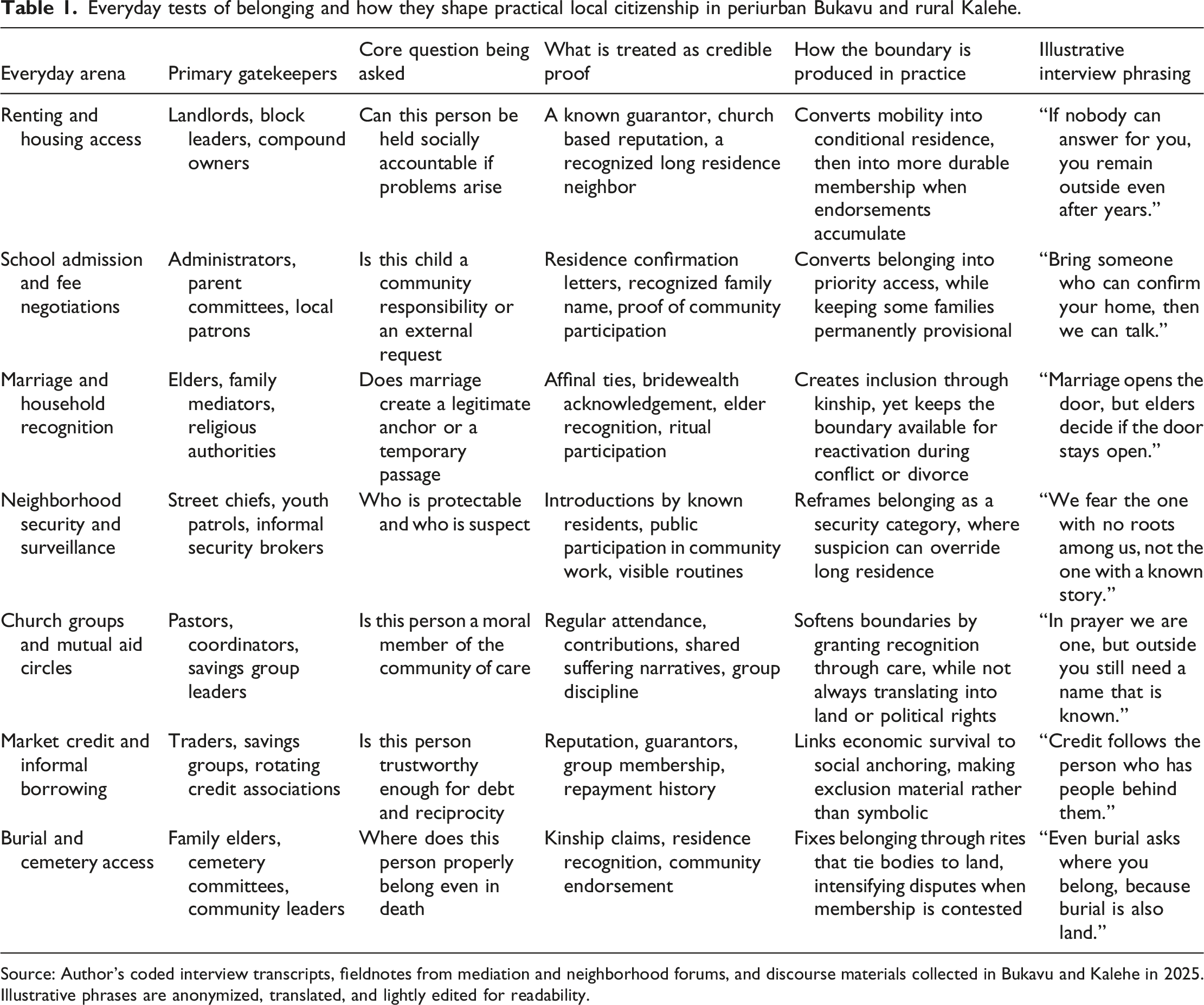
Source: Author’s coded interview transcripts, fieldnotes from mediation and neighborhood forums, and discourse materials collected in Bukavu and Kalehe in 2025. Illustrative phrases are anonymized, translated, and lightly edited for readability.
The study adopted a harm reduction orientation that treated risk as relational and evolving rather than solved once through consent forms. Consent was iterative, revisited as topics shifted from general life histories to specific disputes and as participants decided whether they wanted parts of their accounts to remain off record. The design followed conflict research arguments that ethics is not only about formal approval but also about managing fear, empathy, and partiality in ways that shape who speaks and what can be asked without escalating risk (Krause, 2021; Shesterinina, 2019). Interview locations were chosen with participants, with attention to surveillance, factional control of space, and the possibility that being seen with a researcher was itself consequential. Data security included encrypted storage, pseudonymization at the point of transcription, separation of identity keys from analytic files, and conservative practices for handling screenshots and voice notes. In reporting, the study avoided naming villages, chiefs, or dispute cases when that specificity could enable identification. The ethical orientation also extended to research labor. Development research has documented that assistants and local collaborators can carry disproportionate risk and receive insufficient recognition, so the project used explicit agreements on roles, credit, and safety protocols, including the right to pause fieldwork when conditions deteriorated (Kaplan et al., 2020).
Analysis proceeded through iterative thematic coding of interview transcripts, observation notes, and discourse materials. I first coded for category talk, forms of proof, gatekeeping arenas, institutional translation, and mediated amplification. I then compared episodes in which boundaries were asserted, contested, softened, or repaired across Bukavu and Kalehe. This made it possible to identify mechanisms associated with escalation or coexistence, including mediator credibility, compensation norms, recent violence, the availability of guarantors, and the speed with which media frames collectivized blame.
Findings
Belonging as practical classification in everyday life
In both sites, belonging operated as a practical classification that people used to manage access, risk, and recognition. Many interviewees described the key question not as identity in the abstract but as whether one could be treated as socially fixed in the place. A youth in Bukavu who had arrived during earlier displacement explained that everyday talk about origin functions as a quiet test of permanence: “If you answer with the village only, they hear that you can leave. If you answer with people who know you here, they hear that you are staying.” Another resident, a tenant who had moved multiple times across Bukavu’s expanding periphery, framed belonging as a problem of witnesses rather than geography: “In town you survive by being seen. If nobody can say, I know her family, you remain outside even after years.” These formulations show how the category work begins in ordinary interactions, before any explicit dispute, through small demands for anchoring that sort residents into more or less credible members.
In the periurban setting, the most common tests of belonging appeared at everyday gateways such as renting, neighborhood committees, and school administration. A landlord described how he evaluates applicants using a language that mixes security and morality: “I do not refuse people by tribe. I refuse people with no one behind them. If there is trouble, who will come to speak for you.” The logic of “someone behind you” was repeated across interviews, including by street level leaders who issue residence confirmations. In one Bukavu neighborhood committee meeting observed during a rental dispute, the question shifted quickly from unpaid rent to whether the tenant had a locally recognized guarantor. A committee member asked, “If tomorrow he disappears, who here will stand for him?” The tenant responded by naming a church elder and a savings group coordinator rather than an ethnic origin. This exchange shows how people try to foreground safer identities when ethnic or regional origin may weaken their claim. A neighborhood representative described the same practice as protection of social order: “When you write a letter for someone, you put your name on them. If I do not know your story, why should I carry it.” In these accounts, belonging becomes a transferable credit, issued through endorsement, and the endorsement system creates unequal burdens for those whose histories are fractured by mobility or war.
In rural Kalehe, belonging was narrated less through urban endorsements and more through land histories and kinship chains. People often described the question of membership as a question of continuity, especially continuity of cultivation and continuity of recognition by elders. A man who had served as a witness in several mediations described what mediators listen for: “They want to hear the road of your family. Who cleared the field, who planted the first bananas, who married where. If your road breaks, they say you are not from here.” A returnee woman described how absence becomes reinterpreted as moral failure: “They told me, you left and you forgot us. I said, we ran to survive. They answered, survival is not a title.” This was not only a metaphor. In a Kalehe discussion about a returnee household’s claim to an inherited field, older men asked who had cultivated the plot during the family’s absence and who had attended funerals and bridewealth negotiations while they were away. The returnee’s displacement was acknowledged as suffering, but it was also treated as a break in social presence. These statements capture how displacement is converted into a weakness in the local proof regime, even when flight was forced, and how the proof regime treats presence and continuity as moral achievements.
Interviewees also showed how displacement status is read differently depending on the resource and the institution at stake. Several displaced residents described being welcomed through church groups and savings circles, while being treated as conditional in land and housing discussions. A displaced man in Bukavu said, “In the church they call you brother. In the plot discussions they call you visitor.” A community committee member made the same shift explicit while discussing aid distribution and land conflict in the same week: “When it is assistance, everyone has suffering. When it is land, suffering becomes secondary, the first question becomes origin.” Ethnic and hometown associations occupied a similar intermediate position. Participants described them as places where newcomers found advice, introductions, and sometimes housing or work, but also as institutions that made origin more visible. As one Bukavu resident put it, “The association helps you enter, but it also tells people where you come from.” This reveals a recurring pattern: vulnerability narratives can grant moral recognition in humanitarian and religious arenas, but land arenas often prioritize rootedness and ancestry, which makes displacement a category that can be simultaneously sympathetic and suspect.
Youth encountered belonging classifications through a double expectation. They were expected to demonstrate discipline and respectability, yet they were also treated as potential accelerators of conflict. Young men often spoke of learning to manage how they are seen. One youth in Kalehe described the tension between dignity and risk: “If you stay quiet, they say you accept humiliation. If you speak strong, they say you want trouble.” Another youth in Bukavu described choosing institutional identities as a protective strategy: “I introduce myself as a student, as choir member. If I start with origin, people already choose a side.” These identity shifts were not superficial. They were practical tactics for moving through arenas where the same person could be treated as a neighbor, a stranger, a student, a church member, or a security risk. These accounts illustrate how youth negotiate boundary making as a reputational field where the same act can be read as civic responsibility or as mobilization, depending on the current mood and on who is evaluating. Table 1 summarizes how these everyday tests of belonging appeared across sites.
Land dispute forums and the production of local citizenship
Land disputes were among the most reliable moments when belonging shifted from talk into an enforceable classification. In both sites, the immediate issue might be a boundary line, an inheritance claim, a contested sale, or a return to a field after displacement. The dispute rarely stayed technical for long. Parties quickly moved to a deeper question of who could legitimately claim rights in the place, and that legitimacy was argued through membership narratives rather than through measurements alone. Land became a medium through which local citizenship was allocated, because to decide who could cultivate, sell, or inherit also meant deciding who counted as part of the moral and political community entitled to land based protection.
Dispute resolution forums transformed social memory into a decision making technology. Mediators asked for proof, but proof was not limited to documents. Proof could be a lineage story narrated with confidence, an elder who could “recognize” a family history, a neighbor who could testify who first cleared the land, or a network leader who could vouch for someone’s character. In Kalehe, claimants often treated elders as living archives. In one observed mediation over an inherited field, a returnee claimant presented a family account of prior cultivation, while the opposing side emphasized continuous presence and recent care for the land. The mediator did not ask first for a cadastral map. He asked who could confirm the claimant’s family “road” through the locality. One elder’s recognition carried more weight than the claimant’s written note from a relative outside the area. A frequent move in hearings was to shift the dispute from the plot to the person, then from the person to the person’s relational roots. One mediator summarized this logic while dismissing a claimant’s sale paper: “Paper can be bought. People cannot be invented.” That statement shows how institutions generate a hierarchy of evidence that privileges certain forms of belonging. When ancestry and recognition outrank documentation, those who lack elders nearby or whose family ties were disrupted by flight enter the forum at a disadvantage that is framed as a deficit of legitimacy, not as a consequence of war.
In Bukavu’s periurban periphery, the proof regime often looked more administrative, yet it produced similar boundary effects. Claimants assembled letters from street leaders, signatures from local authorities, and sale agreements witnessed by respected figures. These documents did not replace belonging narratives. They condensed them into forms that could circulate across offices and be presented as objective. A land broker described the conversion openly: “If you have the right people sign, your story becomes true.” A Bukavu plot dispute showed this clearly. One buyer arrived with a signed sale agreement, while the opposing claimant challenged not only the document but the witnesses behind it, asking whether they were “people of here” or merely people who had accepted a fee. The disagreement therefore became less about the paper itself than about whether the social network behind the paper was locally credible. The key analytical point is that documents here were not simply evidence of a transaction. They were certificates of recognition, and recognition was distributed through networks that were themselves structured by local belonging politics. When a neighborhood leader refused to sign, the refusal was experienced as exclusion from local citizenship, even if the person held national identity papers.
The coexistence of customary, municipal, religious, and informal authorities created a system where people sought the forum most likely to validate their claim. This forum shopping was not only strategic. It also moved boundary categories across institutions, where each translation changed their force. A dispute could begin as an argument between neighbors, then become a customary matter about ancestry, then become an administrative matter about residence, then become a security matter about who threatens peace. Each step widened the audience and raised the stakes, making compromise harder. In Kalehe, rival authorities sometimes issued conflicting decisions, each anchored in a different version of community history. In Bukavu, multiple offices might accept fees and produce papers that compete with each other. Instead of resolving uncertainty, this multiplication of authorities often intensified it, since each decision prompted counter claims about illegitimate outsiders capturing institutions. Yet exclusion was not the only possible outcome. In several cases, partial recognition was built through compensation, guarantorship, marriage ties, or religious mediation. These settlements did not erase ethnicized suspicion, but they allowed people to remain locally present without forcing a final decision on whether they fully belonged.
Rumor and local media as infrastructures of boundary making
Rumor and local media did not operate as background noise to land disputes and everyday classification. They provided the channels through which boundary talk travelled beyond the immediate participants, gained emotional force, and became actionable as collective common sense. In both sites, people described rumor as something they distrusted, yet they also treated it as a practical signal of danger and an invitation to align with one side before facts were clear. This ambiguity made rumor powerful. It allowed speakers to circulate accusations without full accountability, while allowing listeners to justify precautionary exclusion as responsible community protection rather than hostility.
Rumors often followed recognizable templates that connected everyday events to existential narratives of threat. A minor land quarrel could be retold as evidence of a coordinated plan to seize territory. A school admission dispute could be reframed as proof that outsiders were capturing opportunities meant for “children of the soil.” A return movement of displaced households could be described as a demographic project backed by political patrons. One forwarded voice note discussed by participants after a local land quarrel warned that “people are being brought in slowly” and urged residents to “watch the houses that fill at night.” Even participants who doubted the message said it made them avoid certain paths and ask youth to remain close to home. The rumor therefore mattered less as verified information than as a prompt for precautionary behavior. These stories did boundary work by converting uncertainty into moral clarity. They named a “we” that deserved protection and a “they” whose intentions were presumed hostile. The same rumor could travel with small modifications across neighborhoods and villages, adapting to local histories while retaining its basic structure of danger, betrayal, and urgency.
Local radio played a distinct role because it translated rumor into public discourse with an aura of legitimacy. Call in programs and community news segments created spaces where ordinary residents could perform knowledge and grievance, and where hosts could either reinforce or discipline boundary talk. In Bukavu, listeners described radio as the place where “the community speaks,” which made it a site where belonging narratives became publicly countable. During one call in discussion of land pressure and displacement, a caller described newcomers as “people without roots here,” while the presenter redirected the conversation by asking for evidence and inviting a local authority to distinguish between displaced families, tenants, and armed actors. This moment illustrates that media could harden boundaries, but could also slow escalation when uncertainty was publicly named. A caller could frame a land dispute in the language of community rights, prompting sympathetic responses from others who had never met the parties. The effect was to widen the audience and to shift disputes from interpersonal conflicts into symbols of collective status. When a host repeated a phrase or invited a particular authority to comment, that repetition stabilized an interpretation and circulated it as shared truth.
WhatsApp and similar messaging practices intensified these dynamics through speed and intimacy. Voice notes and screenshots allowed boundary claims to move quickly across social networks and to arrive with the force of personal testimony. People treated forwarded messages as evidence even when they acknowledged they might be fabricated. The persuasive power came from the format. A voice note sounded like an eyewitness. A screenshot looked like documentation. A short message framed as a warning created pressure to act quickly, discouraging deliberation. In Kalehe, residents described receiving warnings late at night about impending attacks or secret meetings. Whether or not the warning was true, it produced immediate behavioral effects, such as keeping youth at home, discouraging travel, or prompting people to gather with kin. These behaviors then became visible signs that “something is happening,” which fed the rumor cycle and gave it retrospective credibility.
Rumor interacted with dispute forums in a feedback loop. Disputes generated stories that circulated outside the forum, and circulating stories returned to the forum as pressure on mediators. Parties arrived at hearings already surrounded by narratives about what the decision should mean for the community. Mediators, in turn, were evaluated not only on the fairness of their settlement but on whether they protected the community from the threat described in rumor. This dynamic was especially visible when decisions were interpreted as precedents. A compromise settlement could be reframed outside the forum as a dangerous opening for outsiders, making mediators reluctant to accept negotiated solutions. In Bukavu, some mediators described their fear of being labeled traitors if they appeared to favor a claimant categorized as an outsider. In Kalehe, mediators feared that a decision against a locally powerful family could trigger accusations that they were undermining the community’s rights. The result was that rumor did not merely shape perceptions. It altered the incentives of decision makers. This helps explain why coexistence depended not only on fair mediation, but also on whether public talk allowed compromise to remain morally defensible.
Discussion
This study clarifies how ethnic belonging in eastern DR Congo becomes socially consequential through a practical politics of proof. Across the two neighboring settings, people did not simply describe themselves as autochthon, newcomer, returnee, displaced person, or long settled stranger. They worked to make these categories credible to specific audiences by assembling recognisable evidence, narrating settlement histories, invoking kinship and ancestry, and demonstrating conformity with local moral expectations around land, marriage, and participation in community life. The findings therefore refine a binary view of belonging. Inclusion and exclusion appeared as graded, situational, and reversible outcomes: the same person could be treated as a church member, tenant, in-law, displaced person, stranger, or legitimate claimant depending on the arena and the resource at stake. Recent boundary scholarship emphasises that ethnic boundaries harden when classifications travel across multiple arenas and become reiterated in everyday interaction, organisational routines, and public discourse (Serdar, 2019; Wahlbeck, 2022). The findings refine this claim by showing that the durability of boundaries depends on translation practices that connect everyday talk to institutional formats. Boundary making intensified when narratives of belonging could be converted into documents, endorsements, minutes of mediation sessions, school admission decisions, or administrative letters that circulate beyond the immediate dispute.
The findings also extend scholarship on autochthony as a politics of local citizenship. Autochthony arguments gained traction when framed as guardianship of community welfare and stewardship of land, rather than as a raw claim to exclude. This aligns with work showing that autochthony narratives are repeatedly reworked through agrarian change and local institutional struggles, making “who belongs” contingent on shifting regimes of access and authority rather than on a fixed past (Torvikey, 2022). In the sites examined here, autochthony also operated through rankings of proximity. Some origins, marriage ties, linguistic affinities, reputations, and histories of residence were treated as closer to the local community, while others required stronger proof through guarantors, elders, associations, or documents. A central implication concerns authority and legal pluralism in land governance. The study demonstrates that dispute resolution forums do more than settle competing claims. They manufacture local citizenship by defining the evidentiary thresholds that distinguish insiders from outsiders and by producing authoritative recognitions that can be mobilised later. This supports analyses of ethnogovernmentality in eastern Congo that trace how historically layered administrative practices have sedimented ethnicised territorial imaginaries and made them available for contemporary claim making (Hoffmann, 2021).
The comparative element further suggests that the politics of proof is shaped by institutional competition and by the degree of coherence among local authorities. Where customary mediation retained relatively stable legitimacy, boundary claims could be contained through settlements that restored relationships without requiring categorical expulsion. Scholarship on plantation crisis and land conflict in eastern Congo similarly shows how dispute handling can shift from narrow resolution toward broader struggles over agrarian justice, as competing institutions and elites attempt to steer outcomes (van Leeuwen et al., 2022). The analysis adds that coexistence often depended on partial recognition rather than full inclusion. Compensation, guarantorship, marriage ties, church mediation, and association-based introductions could allow people to remain present without resolving all disputes over origin or entitlement. The displacement findings sharpen debates on citizenship beyond formal status by foregrounding graded membership. Internally displaced persons and returnees were often treated as neither fully included nor fully excluded, but as conditionally recognised depending on their ability to demonstrate embeddedness in local social relations and to secure endorsement from gatekeepers. This parallels research on informal citizenship among IDPs in the DRC, where access to rights and recognition is mediated through everyday relations to authority and through social networks that substitute for weak formal guarantees (Jacobs and Sonneveld, 2021).
The study also advances everyday nationalism and everyday bordering approaches by showing how borders of belonging are enforced within the polity through routine gatekeeping. Everyday nationalism scholarship emphasises how nationhood is reproduced through mundane practices and common sense understandings rather than only through elite projects (Antonsich, 2020; Goode and Stroup, 2015). In the Congolese sites, the relevant “nation” was frequently scaled down to the territory, chefferie, or village, but the logic was similar: belonging was policed through everyday expectations and through practical tests. The findings resonate with work on everyday bordering, which shows how citizenship is reshaped through ordinary demands for proof and through intersectional gatekeeping that disproportionately burdens those already positioned as suspect (Yuval-Davis et al., 2018). Ethnic and hometown associations, church groups, savings circles, and neighborhood committees operated as intermediary infrastructures in this process. They could soften exclusion by providing introductions, housing information, employment links, or moral recognition, but they could also make origin more visible and therefore more available for classification.
Media infrastructures emerged as a decisive condition for whether boundary work remained negotiable or became rigid. Social media critical discourse studies underline that meaning is produced across content and practice, with circulation patterns shaping credibility and impact (KhosraviNik, 2022). The study sites show how voice notes, screenshots, and recycled audio clips acquired authority when tied to recognisable intermediaries and when they echoed existing moral stories about land loss and betrayal. The concept of meso news spaces usefully captures how group chats and community pages enable news like content to circulate between intimate networks and wider publics, blurring private talk and public mobilisation (Kligler-Vilenchik and Tenenboim, 2024). The findings also speak to broader African debates about encrypted messaging and political contestation, where WhatsApp can amplify both inclusion and polarisation by lowering the costs of dissemination and by enabling rapid narrative alignment within identity based networks (Cheeseman et al., 2020). The empirical cases show that rumors mattered not only because people believed them, but because they changed behavior before verification: they shaped movement, youth monitoring, pressure on mediators, and expectations about what counted as a legitimate compromise.
The study’s media findings also align with analyses of Congolese conflict communication that highlight how particular outlets can frame violence and peacebuilding in ways that shape local expectations about compromise and legitimacy (Ntanyoma, 2026). The contribution is to show how local radio discourse and WhatsApp circulation interact, with radio segments providing publicly legible anchors and WhatsApp enabling rapid reinterpretation and moral escalation. Work on networked hyperlocal activists in sub Saharan Africa similarly emphasises how local digital actors operate across technological, social, and discursive layers, shaping community debates and governance conversations in ways that can empower marginalised voices while also reproducing inequalities in visibility and influence (Toumaras, 2025b). At the same time, the findings show that communicative infrastructures can also slow escalation when hosts, elders, or trusted intermediaries publicly distinguish displaced families, tenants, returnees, and armed actors rather than allowing these categories to collapse into one threatening outsider figure.
Escalation and coexistence can therefore be theorised as outcomes of how proof regimes and communication infrastructures interact with authority configurations. Escalation became more plausible when proof regimes collapsed into binary classifications, when rumours portrayed compromise as betrayal, and when security actors treated identity categories as operational shortcuts. Coexistence was more likely when institutions provided credible pathways for recognition that did not require total exclusion, and when communicative channels enabled correction of false claims without destroying the dignity of disputants. This means that boundary making is not only a movement toward hardening. It also includes everyday practices of delay, reframing, guarantorship, selective silence, and partial incorporation that keep people inside social relations even when their belonging remains contested. This emphasis on everyday processes complements work on everyday peace and nationalism below formal agreements, which highlights how identity is dynamically reproduced in post conflict settings through ordinary practices rather than through settlement texts alone (Kostovicova et al., 2020). It also resonates with warnings about mediatized hate in the Great Lakes region, where online circulation can normalise dehumanising frames and intensify perceived threats even when the causal link to violence is contingent and mediated (Ndahinda and Mugabe, 2024).
Conclusion
This article has argued that ethnic belonging in eastern DR Congo is produced through everyday boundary making that links narrative, institutional decision making, and communication infrastructures. By tracing how people assemble proof of belonging across routine sites, especially land dispute forums and local media environments, the analysis shifts attention from ethnicity as a background explanation to the practical processes through which membership becomes enforceable. The central contribution is to show that belonging is not simply granted or denied. It is graded, situational, and repeatedly tested through witnesses, guarantors, residence letters, lineage stories, marriage ties, religious participation, and association-based networks.
This perspective also complicates a simple insider/outsider model of autochthony. People may be included in one arena and treated as conditional or suspect in another: welcomed as church members, recognized as tenants, supported through hometown or ethnic associations, but challenged as land claimants or political outsiders. Coexistence therefore often depends on partial recognition rather than complete agreement over origin or entitlement. Practices such as guarantorship, compensation, mediation, strategic silence, and careful public correction of rumors can keep contested residents inside local social relations without erasing the tensions around belonging.
The study has limitations that shape what can be claimed. The research is anchored in two neighbouring settings and does not represent the full diversity of boundary making across the Kivu provinces or other regions of the DRC. Access constraints in insecure periods may also have reduced observation of the most politically sensitive mediations, and the discourse corpus cannot capture the full range of digital circulation because ethical practice requires avoiding covert entry into private messaging spaces. Future research can extend the design longitudinally to examine how proof regimes and belonging narratives shift across return waves, election cycles, and land policy interventions. It can also compare additional sites with different mixes of customary legitimacy, urbanisation, and displacement governance to test how institutional competition shapes the hardening of categories.
Footnotes

Funding
The author received no financial support for the research, authorship, and/or publication of this article.
Declaration of conflicting interests
The author declared no potential conflicts of interest with respect to the research, authorship, and/or publication of this article.
Data Availability Statement
Data sharing not applicable to this article as no datasets were generated or analyzed during the current study.