






Abstract
Citizenship-by-investment programs have spread to a number of countries over the past four decades, though several have since been suspended or shut down amid international pressure. How native-born citizens perceive this commodification of national identity, however, remains poorly understood. The purpose of this study was to explore how native-born St. Lucians perceive their country’s citizenship by investment program regarding national identity and international reputation. Four focus groups were conducted with 40 participants between January and September 2025. Critical realist thematic analysis revealed three interconnected themes: commodification and identity erosion, governance deficits and representational issues, and reputational damage threatening international standing. Participants described citizenship by investment as transforming belonging from meaningful cultural inheritance into a purchasable commodity that undermines St. Lucian identity. While acknowledging economic necessity and infrastructural improvements, participants emphasized lack of transparency, inadequate security vetting, unequal treatment favoring investors, and international stigmatization. Findings suggest commodification imposes significant social, cultural, and psychological costs that remain invisible in economic policy discourse. Development policies must account for cultural and social sustainability alongside economic outcomes, recognizing that wellbeing encompasses identity and belonging beyond what markets can provide.
Introduction
Citizenship by Investment (CBI) programs have spread to a number of countries over the past four decades, offering expedited pathways to citizenship in exchange for significant financial contributions, though the global picture is one of uneven growth rather than uninterrupted expansion: some programs have grown substantially while others have been suspended or shut down amid international pressure. Small Island Developing States (SIDS) in the Caribbean have emerged as leading destinations for such programs, a position substantiated by their rapid and sustained growth in passport sales: the five Eastern Caribbean states operating CBI programs have collectively issued an estimated 107,000 passports since 2014, with application volumes remaining high in recent years (European Commission, 2025). Caribbean governments have leveraged this CBI revenue to fund infrastructure, social services, and economic development. St. Lucia launched its CBI program in 2015, joining regional neighbors like Dominica, Antigua and Barbuda, and St. Kitts and Nevis in what has become a lucrative but controversial industry. While proponents emphasize the economic benefits, particularly for countries with limited natural resources and vulnerable to external shocks, critics raise concerns about security risks, reputational damage, and the commodification of national identity. Yet despite growing academic and policy attention to CBI programs, less is known, from a narrow empirical perspective, about how native-born citizens in host countries perceive these programs, particularly regarding questions of identity, belonging, and national reputation. This study explores the perspectives of native-born St. Lucians toward their country’s citizenship by investment program.
Literature review
Citizenship by investment: A global context
Citizenship by investment (CBI) refers to formal legal pathways through which a state grants citizenship to individuals in exchange for a qualifying financial contribution, typically a payment to a national development fund, a real estate purchase, or an equivalent investment, rather than through birth, descent, marriage, or years of residence (Ganty, 2026; McNeill and Walton, 2025). Its emergence as a codified policy instrument reflects a broader trend in the commodification of sovereign prerogatives, in which functions and statuses once treated as inalienable attributes of statehood become available for purchase on a defined schedule of fees (Surak, 2021; Tanasoca, 2020). Informal economic citizenship has existed for far longer in the form of preferential or expedited naturalization for wealthy investors, but the shift to formal, advertised, transactional CBI programs marks a qualitatively different relationship between states and the membership they confer (EnthusiastMavelli, 2018).
States adopt CBI programs primarily for fiscal reasons. Small states with limited natural resources, narrow tax bases, or constrained access to international capital markets can use CBI revenue as an alternative, comparatively rapid source of public financing, one that does not require borrowing or raising domestic taxes (Bexell, 2025; EnthusiastMavelli, 2018; Kalm, 2022). Programs typically offer applicants a choice among several qualifying investment routes, most commonly a non-refundable contribution to a national development fund, a real estate purchase in a government-approved project, or an enterprise investment, with some programs also accepting government bonds (Bexell, 2025; Kalm, 2022). Proponents frame these programs as pragmatic responses to genuine structural constraints; critics counter that they convert a core attribute of political membership into a financial product, with the social and psychological consequences of that conversion, particularly for native-born populations who never consented to it, remaining comparatively unexamined in empirical research.
The modern CBI industry took shape when St. Kitts and Nevis launched the first formally codified program in 1984, establishing a template, a menu of investment options exchanged for an expedited grant of citizenship, that other states would later adapt (Young, 2022). By the early twenty-first century this model had spread well beyond its origin, with states across multiple regions competing for high-net-worth applicants through streamlined processing, favorable investment thresholds, and the promise of visa-free travel (Bexell, 2025; Young, 2022). That growth has not run in one direction. A number of programs launched in this period have since been suspended, restricted, or shut down entirely in response to international pressure: Malta operated the only CBI program within the European Union, generating reported revenues of over €1.4 billion since 2015, until the Court of Justice of the European Union ruled the scheme incompatible with EU law in its April 2025 judgment in Commission v Malta, finding that nationality, and by extension Union citizenship, cannot be granted in exchange for predetermined payments or investments (Court of Justice of the European Union, 2025). Several smaller residency and citizenship investment routes elsewhere, including programs in Eastern Europe and the Pacific, have faced comparable suspension or closure. The global CBI market, in other words, is not simply an expanding industry; it is one defined by a recurring cycle of rapid growth, international scrutiny, and subsequent curtailment or reform, a pattern that forms an important backdrop for understanding any single program still in active operation today.
Contested citizenship: Identity, belonging, and reputational risk
The rise of CBI programs has reinvigorated scholarly debates about the meaning and value of citizenship in contemporary society (Ganty, 2026; McNeill and Walton, 2025). Traditional citizenship theory has long distinguished between citizenship as legal status (membership in a political community with attendant rights and obligations) and citizenship as practice (active participation in civic and political life). CBI programs complicate these frameworks by introducing a third dimension: citizenship as commodity, something that can be purchased, sold, and traded in a global marketplace (Stern and Valchars, 2023; Surak, 2021).
Scholars have theorized citizenship commodification as part of broader processes of neoliberalization, wherein market logics increasingly penetrate domains previously governed by non-market principles (Harpaz, 2022). When citizenship becomes available through financial transaction rather than birth, descent, or prolonged residence, it fundamentally transforms the psychological relationship between individuals and the state. Critics argue this shift reduces citizenship from a meaningful form of belonging to an instrumental tool for securing mobility rights and tax advantages, hollowing out the civic and cultural dimensions that give citizenship its substantive value (Bexell, 2025; Parker, 2023). This transformation raises important questions about how native-born citizens make sense of their own citizenship status when it becomes available for purchase to others.
The concept of belonging has become central to understanding these tensions. Belonging encompasses both objective membership in a political community and subjective feelings of attachment, identification, and recognition (Miller, 2021; Wood and Landry, 2024). Research on immigrant integration consistently finds that formal citizenship status alone does not guarantee feelings of national belonging. Rather, belonging emerges from complex interactions between individual identification, community acceptance, shared cultural practices, and legal recognition (Bloemraad et al., 2020; De Coninck, 2020).
For native-born citizens in CBI host countries, these psychological dynamics may be experienced differently. While immigrants negotiate belonging through the acquisition of citizenship, native-born citizens may find their existing sense of belonging challenged or diluted when citizenship becomes widely available through purchase. Questions arise about what criteria should define legitimate membership. Is citizenship fundamentally about birthplace and cultural socialization, or can it be validly acquired through economic contribution? Do CBI passport holders dilute the meaning of national identity, or do they represent a pragmatic adaptation to global realities? These questions remain largely unanswered in the empirical literature, which has focused predominantly on the perspectives of migrants rather than native-born populations.
Theoretical frameworks for understanding citizenship increasingly emphasize its relational and performative dimensions (Isin and Nyers, 2022; Simonsen, 2020). Citizenship is not simply a fixed legal status but an ongoing negotiation of belonging, recognition, and membership. From this perspective, native-born citizens’ perceptions of CBI programs may reveal how individuals psychologically construct and defend boundaries around national identity in contexts of rapid change and globalization. Understanding these perceptions requires attending to the subjective meanings that individuals attach to citizenship and how these meanings are shaped by policy contexts.
The same boundary-policing that shapes how native-born citizens experience CBI from within also shapes how outsiders scrutinize it from without. A membership that can be purchased invites the question of who has actually been let in, and CBI programs as a category have attracted significant international scrutiny on precisely this point, focused on security risks and reputational damage. These concerns cluster around several recurring issues: inadequate vetting procedures, potential abuse by criminals and money launderers, exploitation of visa-free access arrangements, and erosion of passport integrity more broadly (Kälin & Kochenov, 2019; Sumption and Hooper, 2021). International organizations including the Organisation for Economic Co-operation and Development (OECD), the European Union, and the Financial Action Task Force have repeatedly highlighted these vulnerabilities at the level of the industry as a whole. The OECD has warned that CBI schemes facilitate tax evasion and aggressive tax planning by enabling wealthy individuals to acquire citizenship in low-tax jurisdictions while maintaining economic ties elsewhere, and the European Commission has separately raised concerns that CBI programs can provide indirect access to visa-free travel zones through weak due diligence, a structural vulnerability rather than one confined to any single program or region.
These reputational and security concerns are not merely external or diplomatic matters; they may carry direct psychological and social consequences for native-born citizens of host countries. When a country’s international reputation becomes associated with the sale of citizenship, this may affect how its citizens perceive themselves and how they believe others perceive them, potentially influencing their social identity and sense of national pride (Ellemers et al., 2002; Smith et al., 2021). A population that had no say in the design or marketing of its country’s CBI program may nonetheless bear the reputational consequences of that program internationally, a dynamic that creates a potential disconnect between formal citizenship status and lived experience of national belonging, one whose particular shape depends heavily on the scale, history, and governance of the program in question.
St. Lucia and Caribbean citizenship by investment
St. Lucia brings the dynamics of citizenship commodification into unusually sharp relief. Its national identity is not generic; it is anchored in a specific, contested colonial history and a living Creole language that most CBI applicants do not share, so the abstract question of what commodification does to belonging has a concrete case to test it against. Its program is also young enough, having operated for barely a decade, that commodified citizenship has not yet had time to settle into the unremarkable background of national life the way it may have elsewhere in the region. And despite the program’s rapid growth and the international scrutiny it has attracted, less is known, from a narrow empirical perspective, about how native-born St. Lucians perceive and make sense of this process.
That colonial history and that language are not passing details. St. Lucia, a small island in the Windward Islands group of the Lesser Antilles with a population of roughly 180,000, changed hands between France and Britain 14 times over more than a century and a half before Britain secured permanent control in 1814, a history of contestation that earned the island the nickname “Helen of the West Indies” (Britannica, 2026a, 2026b; Naipaul and Kouyaté, 2026; Naipaul and Kyriakou, 2026; Worldatlas, 2021). It remained a British colony until full independence in 1979 (Jerry, 2016; Marsland, 2025; Orr and Harasymiw, 2022). This dual colonial inheritance remains evident in St. Lucian society today, particularly in language: English is the official language, but Kwéyòl, the French-lexified Creole that developed among enslaved Africans under French colonial rule, remains widely spoken and continues to function as a marker of cultural authenticity and ancestral belonging distinct from formal legal status (Garrett, 2007; Listwa Collective, 2024; Naipaul and Kouyaté, 2026; Naipaul and Kyriakou, 2026; WACC, 2026). The population is predominantly of African and mixed African descent, with smaller Indo-Caribbean and European minorities, and is overwhelmingly Roman Catholic (Central Intelligence Agency, 2023; Dalphinis, 2019; Greaves, 2025; Naipaul and Kouyaté, 2026; Naipaul and Kyriakou, 2026). These features of language, religion, and ancestry are not incidental background; they constitute much of what St. Lucian people might invoke, implicitly and explicitly, when distinguishing authentic St. Lucian belonging from citizenship acquired through investment.
St. Lucia’s CBI program is also comparatively recent, launched in 2015, three decades after St. Kitts and Nevis pioneered the regional model in 1984. The other three Eastern Caribbean Currency Union states with active programs, Antigua and Barbuda, Dominica, and Grenada, occupy an intermediate position, each typically combining a non-refundable contribution to a national development fund with a real estate investment route or similar (Bexell, 2025; Kalm, 2022). St. Lucia’s program has grown rapidly relative to regional norms: applications rose 424% in a single fiscal year, FY 2023/24, to 5,642, generating approximately EC$240 million in revenue, nearly four times the prior year’s total (Abbas, 2026). Commodified citizenship has therefore had considerably less time to become a normalized feature of St. Lucian society than it has in some neighbouring jurisdictions, and the tensions this study documents are unfolding within living memory rather than as settled history.
This growth has not been accompanied by international goodwill, and the pressure has intensified in ways St. Lucia had reason to anticipate. The EU warned in 2022 that it would suspend visa-free travel for Caribbean CBI countries that did not tighten due diligence (European Commission, 2022), and the Trump administration issued a comparable threat against four Caribbean countries in 2025, with St. Lucia’s own former CIP chief executive separately acknowledging Western objections to the way such programs can be exploited for tax evasion, money laundering, or, in more serious accounts, terrorism financing (Elliott and Khatoon, 2022; Trump, 2025). The United Kingdom had already moved beyond warnings once before: in July 2023 it imposed an immediate visa requirement on Dominican nationals, including CBI recipients, with then Home Secretary Suella Braverman citing “clear and evident abuse” of Dominica’s scheme (UK Parliament, 2023). St. Lucia faced a comparable outcome less than 3 years later: in March 2026 the UK removed it from its Electronic Travel Authorisation scheme, and in June 2026 Ireland suspended visa-free entry for St. Lucian nationals altogether, both citing concerns connected to the CBI program (Government of Saint Lucia, 2026; UK Home Office, 2026). For St. Lucians who had observed a neighbouring state lose the same access under the same justification several years earlier, this development represented confirmation of an already-evident risk rather than an abstract possibility; the reputational consequences participants feared had already materialized for a comparable population before they materialized for St. Lucia itself. Regional vetting now draws on the Joint Regional Communications Centre, a CARICOM body whose remit only later expanded to include CBI-related information sharing; it was originally established, together with the Regional Intelligence Fusion Centre, to support security for the 2007 ICC Cricket World Cup (CARICOM IMPACS, 2026).
St. Lucia’s own program, established under the Citizenship by Investment Act No. 14 of 2015, requires a minimum investment of $240,000 USD for a National Economic Fund contribution or $300,000 USD for real estate, with citizenship typically granted within 6 to 12 months (Citizenship by Investment Unit, Saint Lucia, 2025). Tens of thousands of passports have been issued since the program’s inception; recent commentary suggests that over 60,000 individuals now hold St. Lucian citizenship through CBI, close to one-third of the native-born population (Hukka, 2025; St. Lucia Times, 2025), while the International Monetary Fund has separately raised concerns that CBI revenue has not always flowed through the Consolidated Fund as intended (International Monetary Fund, 2025). The Act was passed under a Saint Lucia Labour Party (SLP) government, and the SLP, governing again under Prime Minister Philip J. Pierre since 2021, has continued to defend and expand the program amid its recent surge in applications. The opposition United Workers Party (UWP) has been its most consistent public critic, staging demonstrations over what it characterizes as the government’s “deceitful” handling of CBI finances and warning that the volume of citizenships granted could be sufficient to influence election outcomes (St. Lucia Times, 2024a; 2024b). National media coverage accordingly tends to frame the program as a partisan dispute between the two parties, rather than as a matter on which native-born citizens themselves might largely agree.
Continental region of origin, Saint Lucia CIP applicants and citizenship recipients, all reports combined.
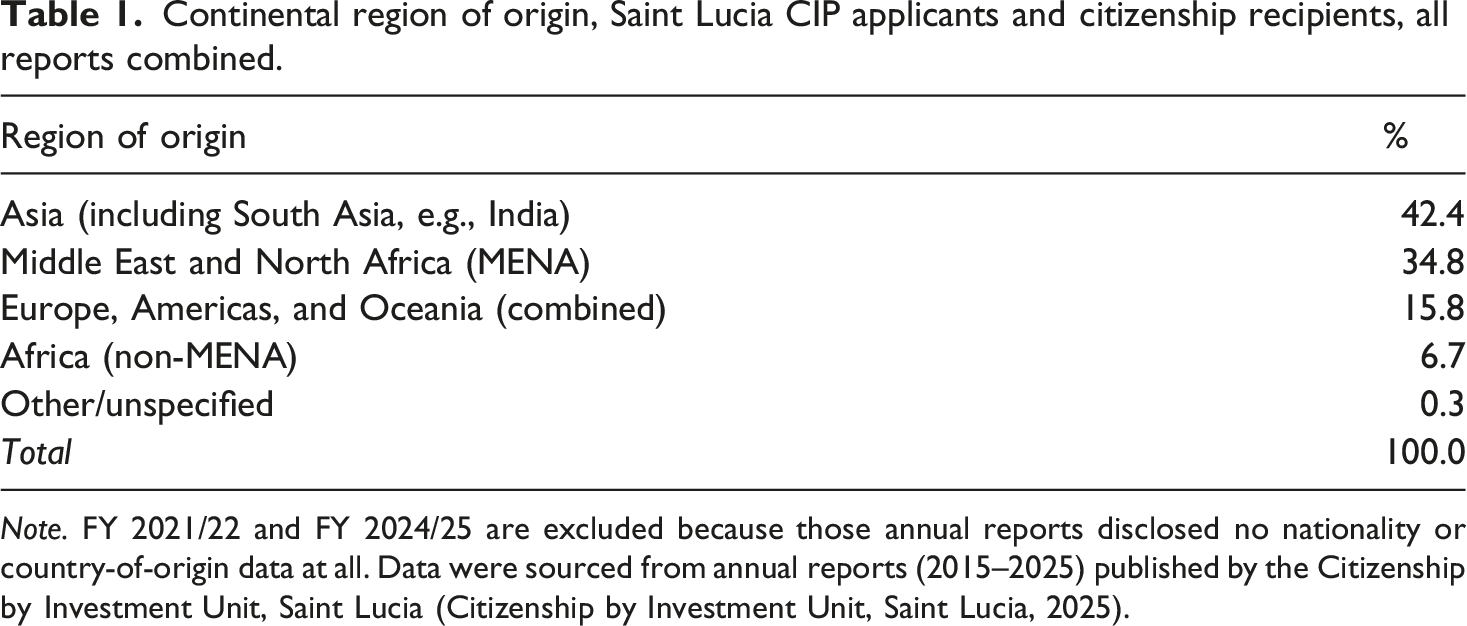
Note. FY 2021/22 and FY 2024/25 are excluded because those annual reports disclosed no nationality or country-of-origin data at all. Data were sourced from annual reports (2015–2025) published by the Citizenship by Investment Unit, Saint Lucia (Citizenship by Investment Unit, Saint Lucia, 2025).
The purpose of this study
How native-born citizens perceive and make sense of their own citizenship becoming commodified represents an underexplored area of empirical inquiry with significant implications for understanding national identity, social identity processes, and belonging. St. Lucia’s CBI program continues to operate and has issued tens of thousands of passports through investment since 2015, even as other CBI programs internationally have been curtailed or shut down under similar scrutiny. Questions emerge about how native-born citizens psychologically process and emotionally respond to these fundamental transformations in the meaning of citizenship.
While existing scholarship has documented the economic, legal, and political dimensions of CBI programs, the subjective experiences and perceptions of native-born populations remain conspicuously absent from psychological research. This gap is particularly significant given that native-born citizens represent individuals whose social identity, sense of national belonging, and perceptions of in-group boundaries may be directly influenced by policies that redefine who qualifies as a member of their national community.
The present study adopts an exploratory qualitative approach to examine how native-born St. Lucians perceive and make sense of their country’s citizenship by investment program. Consistent with a critical realist approach to thematic analysis, this study prioritizes participants’ own accounts of national identity and belonging while also attending to the broader structural conditions those accounts reveal, treating perceptions as meaningful in their own right and as evidence of the social and institutional realities that shape them. The focus on perceptions related to national identity and international reputation emerges from social identity theory (Tajfel and Turner, 1979), which posits that individuals derive part of their self-concept from group memberships and are motivated to maintain positive social identities. When the boundaries and prestige of one’s national group are perceived as threatened or diluted, this may have consequences for individual identity processes and emotional well-being. Given the absence of prior empirical work examining these psychological phenomena in CBI contexts, an inductive qualitative methodology is appropriate to allow themes to emerge organically from participants’ accounts rather than imposing predetermined theoretical frameworks.
Methods
Participants
Participant sociodemographic characteristics (N = 40).
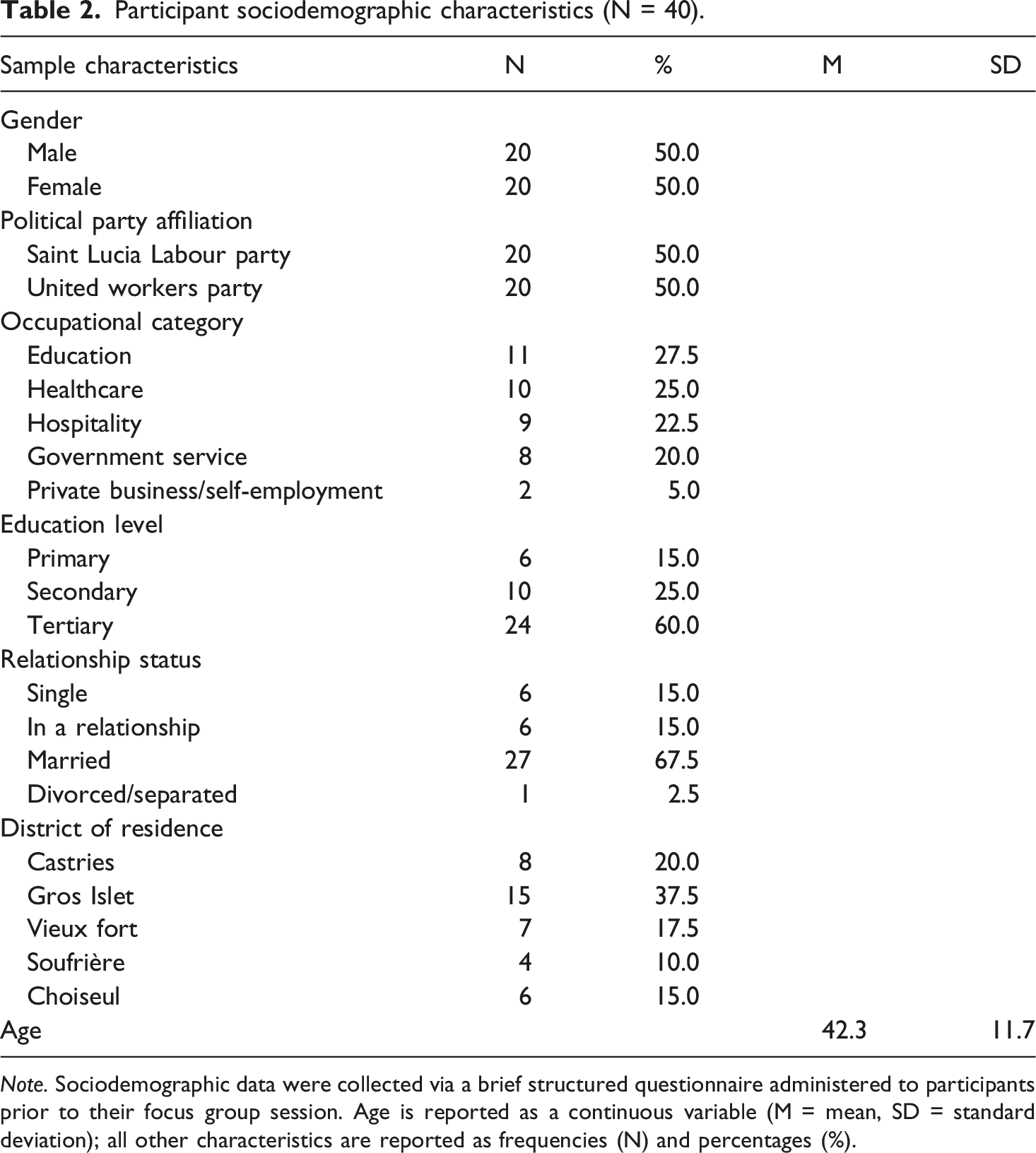
Note. Sociodemographic data were collected via a brief structured questionnaire administered to participants prior to their focus group session. Age is reported as a continuous variable (M = mean, SD = standard deviation); all other characteristics are reported as frequencies (N) and percentages (%).
Data collection
Data were collected through four focus groups conducted between January 2025 and September 2025 at community centers in different regions of St. Lucia. Each focus group comprised 10 participants (5 women, 5 men) to facilitate balanced gender representation and ensure all participants had adequate opportunity to contribute to the discussion. Focus groups lasted between 90 and 120 minutes and were conducted in English, the official language of St. Lucia. The first author served as the moderator for all focus groups, following a semi-structured interview guide designed to elicit participants’ perceptions of the CBI program in relation to national identity and international reputation. The interview guide included open-ended prompts such as “Tell me a bit about what comes to mind when you think about St. Lucia’s citizenship by investment program” and “Can you share your thoughts on how, if at all, the CBI program has affected what it means to be St. Lucian?” Follow-up probes encouraged participants to elaborate on their responses and engage with each other’s perspectives.
All focus groups were audio-recorded with participants’ informed consent and subsequently transcribed verbatim by the first author. Transcripts were anonymized to protect participant confidentiality, with pseudonyms assigned to all participants.
Analytical strategy
Data were analyzed using critical realist thematic analysis following the work of Fryer (2022) and Jenssen and Solem (2024). Critical realism is an ontological and epistemological position that acknowledges both the reality of participants’ perceptions and the role of broader social, economic, and political structures in shaping how individuals interpret and make sense of phenomena (Fryer, 2022). From this perspective, participants’ accounts provide access to their genuine perceptions and subjective meanings while also being understood as situated within larger contextual forces such as global economic pressures, international relations, and historical patterns of colonialism and development in the Caribbean. This approach aligns with the study’s aim to understand not only what participants think about CBI but also how their perceptions reflect underlying tensions between economic imperatives and socio-cultural values.
The analytic process followed a systematic approach beginning with familiarization. Transcripts were read and re-read multiple times to develop deep engagement with the data and identify preliminary patterns of meaning. Initial codes were then generated systematically across the entire dataset, capturing both semantic content (what participants explicitly stated) and latent meanings (underlying assumptions, ideologies, and interpretive frameworks embedded within their accounts). These codes were subsequently collated into preliminary themes that represented coherent patterns of meaning related to participants’ perceptions of CBI, national identity, and international reputation.
The preliminary themes were then reviewed and refined through an iterative process. This involved returning repeatedly to the coded data and original transcripts to ensure that themes accurately reflected participants’ accounts and that distinctions between themes were clear and meaningful. Throughout this process, the research team engaged in regular discussions about emerging themes, coding decisions, and interpretive choices, bringing multiple perspectives to bear on the data and enhancing the rigor and credibility of the analysis. Themes were ultimately defined and named to capture distinct dimensions of how participants perceive and make sense of St. Lucia’s citizenship by investment program.
Following Fryer (2022) approach to critical realist thematic analysis, the presentation of findings distinguishes between semantic and latent levels of interpretation. The Findings section presents the semantic analysis, foregrounding what participants explicitly said about their perceptions with minimal interpretive commentary from the research team. This approach prioritizes participants’ own voices and allows readers to engage directly with their perspectives. The latent analysis, which interprets underlying assumptions, ideological frameworks, and implicit meanings within participants’ accounts, is presented in the Discussion section. This organizational strategy clearly separates participants’ expressed viewpoints from the research team’s theoretical interpretations regarding the deeper structural and psychological significance of these perceptions. The critical realist lens thus guided both the analytic process and the presentation of results, attending to how participants’ expressed perceptions simultaneously reflect individual meaning-making processes and reveal broader structural conditions that shape citizenship meanings in contemporary St. Lucia.
Horizons of understanding
In qualitative psychological research, researcher positionality fundamentally shapes interpretive processes (Naipaul et al., 2026). Drawing on hermeneutic philosophy (Gadamer, 1975), we adopt the concept of “horizons of understanding” to acknowledge that interpretation necessarily occurs from particular standpoints shaped by researchers’ backgrounds, experiences, and theoretical commitments. This transparency enables readers to evaluate the trustworthiness and transferability of our interpretations (Kyriakou et al., 2025; Naipaul et al., 2026). Our research team’s geographic, cultural, and disciplinary diversity constituted a methodological strength that enhanced interpretive rigor through systematic triangulation of perspectives.
The five-member team comprises researchers with distinct positionalities. Three members (JN, IBP, and RP) have ethnic ancestry in the Caribbean region. JN, the first author, is a chartered psychologist with specialization in cultural psychology, and training in qualitative methodologies and cultural identity processes. IBP is a political scientist specializing in Caribbean governance and policy analysis. RP is an organizational behaviour and culture expert. The remaining two members of the team, AK and KG, bring expertise in business administration, economic policy, migration studies, and comparative policy analysis.
This configuration generated productive insider-outsider tensions that strengthened analysis. Caribbean members possessed cultural competence enabling interpretation of participants’ linguistic patterns, historical references, and culturally-embedded meanings, while maintaining reflexive awareness of how their own Caribbean socialization might influence interpretive choices. Non-Caribbean members provided epistemological distance that enabled defamiliarization of taken-for-granted assumptions and identification of patterns potentially invisible to cultural insiders. Throughout the analytic process, the team engaged in iterative reflexive dialogue examining how our respective identities, disciplinary frameworks, and theoretical orientations shaped coding decisions and thematic construction. Regular analytic meetings systematically interrogated emerging themes, evaluated alternative interpretations, and ensured multiple epistemological perspectives informed final thematic structure. This collaborative reflexivity enhances methodological rigor while explicitly acknowledging the perspectival nature of qualitative psychological inquiry.
Ethics
The study received ethical approval from the International Executive School, Strasbourg, France. Participants were provided with information sheets detailing the study’s purpose, procedures, and their rights, and all provided written informed consent prior to participation. Participants were informed of their right to withdraw at any time without penalty and were assured of the confidentiality of their responses.
Findings
Summary of findings.
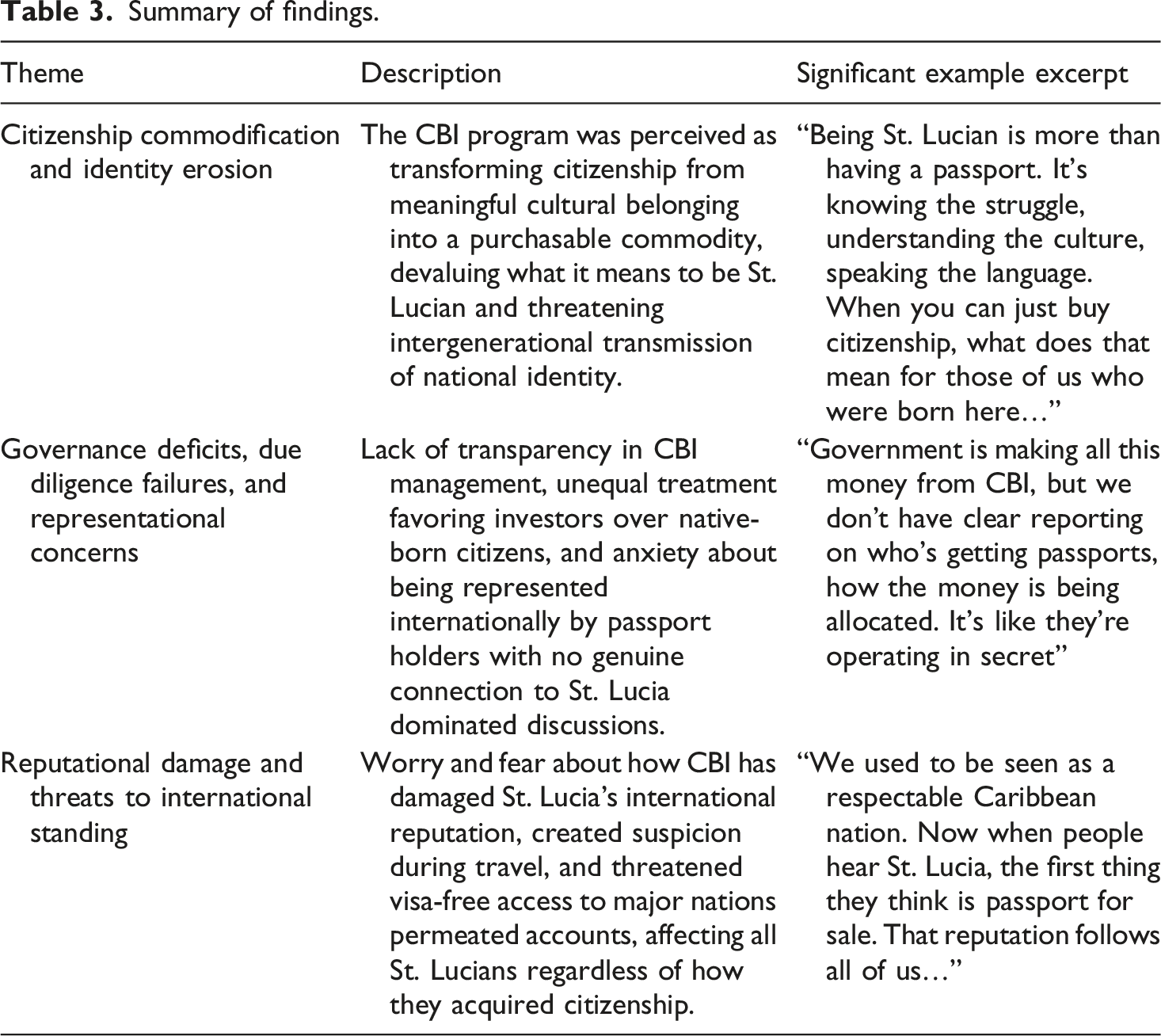
Theme 1: Citizenship commodification and identity erosion
The CBI program was consistently described as fundamentally transforming what St. Lucian citizenship means. What was once understood as an identity rooted in birth, cultural socialization, and shared history has become, in the perception of those interviewed, a commodity available for purchase. This commodification was experienced as a personal assault on individual and collective identity.
This sense of large-scale, depersonalized transaction was captured most directly by one participant, who stated, “It’s like we’ve become a passport factory. They’re just churning out citizenship like it’s a product, and nobody who actually lives this culture had any say in it.” This framing, of citizenship issued at industrial scale and stripped of the relationships and history that once defined it, recurred across all four focus groups and captures the central tension this theme describes: a shift from citizenship as inherited belonging to citizenship as manufactured output.
The tension between economic pragmatism and cultural preservation emerged clearly across all focus groups. Many acknowledged understanding the financial pressures that drove CBI adoption. One person explained, “Look, I understand why we have CBI. We’re a small island, we need money for development, like, tourism alone can’t sustain us.” However, this pragmatic understanding coexisted with deep emotional distress about the cultural cost. “Yes, we need the money. But at what cost? They’re selling what makes us St. Lucian. Everything our grandparents fought for, now anybody with money can just buy it.”
The emotional intensity surrounding these perceptions was striking. One participant stated, “They selling we out, you know. Everything we grandparents fight for, everything that make we St. Lucian, now anybody with money could just buy it. That’s not right.” Another added, “Being St. Lucian is more than having a passport. It’s knowing the struggle, understanding the culture, speaking the language. When you could just buy citizenship, what that mean for those of we who born here?”
This distinction between legal status and authentic belonging was emphasized repeatedly throughout discussions. As one person explained, “How can someone call themselves St. Lucian when they don’t know our history, can’t speak a word of Kwéyòl, never even set foot on the island? It’s not just about a passport in your hand. It’s about who you are inside, what you carry in your heart.” This reflects the theoretical tension between instrumental and substantive citizenship, with participants clearly privileging cultural belonging over legal formality.
The sense of devaluation was palpable. One participant reflected, “My grandmother was a proud St. Lucian woman. She raised us with that pride, taught us about our heritage. Now somebody can wake up tomorrow morning with money and get the same citizenship she was born with. That hurts.” The pain expressed here speaks to how commodification personally affects those whose citizenship is tied to family legacy and lived experience.
The generational dimension of this concern was also evident. Participants expressed feelings of worry about what citizenship would mean for future generations. “What we go tell we children about what it mean to be St. Lucian?” one participant asked. “That it mean your parents born here and you grow up here? Or that it mean you had enough money to invest? Those two things not the same at all.” The sense that something fundamental about St. Lucian identity was being lost or diluted permeated discussions across all focus groups. Participants consistently framed this as a tension between citizenship as meaningful belonging versus citizenship as an instrumental transaction that hollows out its cultural and civic significance.
Theme 2: Governance deficits, due diligence failures, and representational concerns
Frustration with how the CBI program is governed dominated discussions, with concerns clustering around transparency, accountability, and the problematic nature of national representation by individuals with no genuine connection to St. Lucia. While some infrastructural improvements were acknowledged (“You can see some improvements, to be fair. Some roads got fixed, we have new government buildings”), these benefits were overshadowed by demands for greater transparency.
The call for financial transparency was explicit: “The problem is we don’t really know where all the money is going. We see some roads get paved, okay, but how much CBI money came in total? Nobody is telling us.” Another added, “Government needs to be more transparent about the finances. Show us exactly how much money the program brings in and exactly where every dollar is being spent. Right now it feels like they’re hiding something.”
Skepticism about due diligence and security vetting was evident and acute. One participant stated, “They say they’re doing background checks, but then you hear stories about criminals getting our passports, people with criminal backgrounds, people involved in shady business, somehow getting St. Lucian passports. How is that possible if the system is working?” Another emphasized the scale of the problem: “We’re talking about 60,000 people with our passport. Even if just 1% weren’t properly vetted, that’s 600 potentially dangerous people representing St. Lucia globally. And we have no idea who they are or what they’re doing with our citizenship.” Disparities in treatment generated particular resentment: “When you’re a regular citizen trying to get help from government offices, you can wait forever and nobody responds. But when it’s a CBI investor, suddenly everything moves quickly. That tells you something.”
Economic impacts on ordinary St. Lucians also generated frustration. “These CBI people come in buying up property, driving up real estate prices. Now young St. Lucians can’t afford to buy land or build a house in their own country. We’re being priced out.” Another added, “The cost of living has gone up since this program started. But our salaries haven’t gone up. So who benefits? Not regular St. Lucians.”
Deep anxiety emerged about how St. Lucia is represented internationally by CBI passport holders who lack cultural knowledge. “You have people walking around the world with St. Lucian passports who couldn’t tell you when we got independence from the British, the name of our Prime Minister, don’t know where Castries is, never heard of Jounen Kwéyòl. But when they’re traveling, when they’re doing business, they’re representing St. Lucia. How does that make sense?” This disconnect raised accountability concerns: “If somebody with a CBI passport gets in trouble overseas, that reflects on all of us. But they don’t have any real stake in St. Lucia. They’re just using the passport for convenience.”
The scale of CBI passport issuance amplified these anxieties. “They say over 50,000 people I think have gotten St. Lucian citizenship through this program. I think that’s almost a third of our actual population. You have thousands out there with our passport that we know absolutely nothing about. That worries me.”
Theme 3: Reputational damage and threats to international standing
Considerable anxiety and fear about how the CBI program has affected St. Lucia’s international reputation permeated discussions. These concerns were grounded in lived experiences of increased scrutiny during travel, embarrassment about how St. Lucia is perceived abroad, and worry about potential diplomatic consequences.
The threat of losing visa-free travel access was a primary source of distress. “The UK, France, the US, they’re watching us closely now. They’re saying they might stop letting St. Lucians travel visa-free because they can’t trust who we’re giving passports to. That’s going to affect all of us, not just the people who bought citizenship.” The psychological burden was described: “I worry every time I’m traveling now. It’s like they’re looking at you differently at immigration, asking more questions. You can feel the suspicion.”
A fundamental shift in how St. Lucia is perceived internationally was described. “We used to be seen as a respectable Caribbean nation. Now when people hear St. Lucia, the first thing they think is passport for sale. You know, that reputation follows all of us when we’re traveling or working abroad.” The personal impact was evident: “When I’m overseas and people find out I’m from St. Lucia, they make little comments about buying citizenship. Sometimes it’s jokes, but you can hear the judgment behind it… it hurts.”
The emotional weight of these reputational changes was striking. “It’s embarrassing, honestly. You feel like you have to explain yourself, like you have to prove your citizenship is legitimate and you didn’t just buy it. I was born in St. Lucia, why do we have to go through that?” Another stated, “My passport used to be something I was proud of. Now I feel shame when I’m showing it.”
Concerns extended beyond immediate travel to longer-term consequences. “It’s not just about travel. If the US or EU decide to impose sanctions or restrictions on St. Lucia because of this program, that’s going to affect business relationships, educational opportunities, everything. We’re risking our whole future for this quick money.” The sense of powerlessness was striking: “We’re just regular citizens. We can’t control what the government is doing with this program. But we’re the ones who have to deal with the consequences when we’re traveling, when we’re trying to represent St. Lucia positively in the world.”
Despite these concerns, national pride remained strong, creating painful tension. “I love my country, I’m a proud Lucian. But this this scheme thing is making it hard to hold your head high sometimes when you see how other countries are looking at us now, calling us a passport mill… its painful we deserve better we’re good people.”
Discussion
This study is among the first to explore the perceptions of native-born citizens whose national citizenship has been subjected to commodification through investment programs. By centering the subjective accounts of St. Lucians, this research illuminates how individuals in this particular context make sense of policies transforming citizenship from an ascribed status into a market commodity. The findings reveal three interconnected dimensions of concern (identity devaluation, governance deficits, and reputational stigmatization) that operate not as discrete issues but as mutually reinforcing processes through which commodification undermines the foundations of citizenship as meaningful belonging.
Participants’ accounts suggest that CBI fundamentally challenges what social identity theory describes as the distinctiveness and value of group membership (Tajfel and Turner, 1979). When citizenship that once required birth, cultural socialization, and generational connection becomes available through financial transaction, participants perceive it as losing its capacity to confer unique identity. This reflects more than policy disagreement; it represents what participants experience as a threat to the very basis of national belonging. The distinction participants drew between legal citizenship and authentic belonging reveals implicit theories privileging embodied knowledge, shared history, and cultural competence over formal legal status. This aligns with communitarian conceptions emphasizing citizenship as cultural membership rather than contractual relationship (Miller, 2021; Parker, 2023).
Participants did not reject the economic logic of CBI outright. Many acknowledged understanding the fiscal pressures facing small island developing states and recognized some infrastructural benefits. This pragmatic recognition, however, coexisted with concerns about cultural costs, suggesting genuine value conflicts rather than simple opposition. The economic rationality underpinning CBI prioritizes instrumental values related to wealth accumulation, while participants’ concerns reflect terminal values related to identity, belonging, and dignity (Stern and Valchars, 2023). These value systems appear difficult to reconcile in participants’ accounts, raising questions about what forms of development may ultimately undermine the cultural foundations of the communities they purport to benefit. Critically, this is not merely a matter of balancing competing interests but reveals how neoliberal policies that subject previously non-market domains to market logic create fundamental incompatibilities between economic development and social cohesion.
The governance concerns participants articulated are intimately linked to these identity threats. When participants perceive that government prioritizes investors over native-born citizens, this is not simply a procedural complaint but compounds the sense that their citizenship has been devalued. The perception of being treated as “second-class citizens” represents what justice theorists recognize as both distributive and procedural injustice (Tyler, 2006), but more fundamentally, it signals whose belonging matters and whose interests the state serves. These perceptions may reflect relative deprivation processes, wherein individuals evaluate outcomes relative to comparison groups (Smith et al., 2012), but they also reveal power asymmetries in how citizenship commodification redistributes recognition, resources, and voice within the polity.
The lack of transparency surrounding CBI management that participants described represents what might be understood as epistemic injustice (Fricker, 2007), wherein certain forms of knowledge (particularly the lived perceptions of those most affected) are systematically excluded from policy deliberation. This exclusion is not incidental but structural: economic analyses that dominate CBI discourse are designed to render invisible precisely the kinds of costs participants describe. Importantly, participants’ concerns about inadequate due diligence were not mere speculation but aligned with documented criticisms from international bodies including the OECD, EU, and the Trump administration’s 2025 threats. Yet even when native-born citizens’ perceptions converge with international expert assessments, their voices remain marginalized in policy processes that prioritize economic considerations over security and social cohesion. This means participants could not dismiss international scrutiny as prejudice; rather, the reputational damage they experienced was grounded in governance failures they themselves had identified but were powerless to address. The exclusion from decision-making about who belongs to the national community constitutes a democratic deficit that raises fundamental questions about sovereignty. If small states exercise sovereignty by commodifying citizenship, but this process alienates their own populations and erodes democratic legitimacy, whose sovereignty is actually being exercised? The answer may be less about state autonomy than about the interests of global capital seeking favorable mobility and tax regimes.
The concerns about representation that participants expressed illuminate how identity devaluation, governance deficits, and reputational stigmatization converge. When significant numbers of St. Lucian passport holders have no connection to St. Lucian culture, values, or history, this creates what participants perceive as a disjuncture between the national identity they wish to project and how St. Lucia may actually be represented internationally. This perception is not merely a matter of unfamiliarity; it is grounded in a genuine cultural distance. The available applicant data indicate that the large majority of CBI passport holders originate from South and East Asia and from the Middle East and North Africa, regions whose dominant languages, religions, and cultural histories differ substantially from the Afro-Caribbean, English- and Kwéyòl-speaking, predominantly Catholic society that participants describe as authentically St. Lucian. Participants’ complaints that passport holders “couldn’t tell you when we got independence” or “never heard of Jounen Kwéyòl” are therefore not exaggerations born of xenophobia but accurate descriptions of a demographic reality: most CBI recipients come from cultural worlds with little overlap with the one citizenship is meant to signify membership in. This loss of control over collective representation constitutes symbolic dispossession with material consequences: it feeds into the international stigmatization that participants experience, which in turn intensifies their sense that citizenship has been devalued, which reinforces perceptions that government has betrayed native-born citizens’ interests. The scale of this dispossession is striking: with approximately 60,000 CBI passports issued representing roughly one-third of the native-born population, participants interpret this not as incremental change but as transformation of the citizenship landscape itself.
The reputational concerns participants expressed reveal how citizenship commodification operates through international circuits of perception in ways that create feedback loops reinforcing other costs. Native-born St. Lucians describe bearing what Goffman (1963) termed “courtesy stigma,” inheriting negative associations despite having no personal connection to CBI. This stigmatization requires ongoing identity management work (Major and O'Brien, 2005), which compounds the sense of injustice participants already feel about being treated as secondary to investors. The uncertainty about visa restrictions and diplomatic consequences creates anticipatory concern that participants experience as largely uncontrollable. Recent developments including the European Union’s 2022 threats to suspend visa-free travel for Caribbean CBI countries suggest that participants’ anxieties are grounded in concrete international pressures (European Commission, 2022). These anxieties have since been borne out directly: in March 2026, the United Kingdom removed St. Lucia from its Electronic Travel Authorisation scheme, citing concerns about asylum claims and the integrity of the CBI program, and in June 2026, Ireland followed suit in suspending visa-free entry for St. Lucian nationals altogether (Government of Saint Lucia, 2026; UK Home Office, 2026). That these losses of visa-free access materialized during the preparation of this article underscores that participants’ fears were not speculative but anticipatory accuracy about a trajectory already underway. For small states already facing vulnerabilities related to climate change, economic dependence, and limited political power, reputational damage through CBI may add another layer of precariousness (Baldacchino, 2006; Connell, 2013), one that is particularly insidious because it is experienced by citizens who had no voice in creating these vulnerabilities.
It is worth stating plainly what the findings, taken together, reveal about the domestic political standing of the CBI program: native-born sentiment in this sample was overwhelmingly unfavorable. Although participants acknowledged the program’s fiscal rationale and pointed to specific infrastructural gains, this acknowledgment was consistently subordinate to sustained criticism of identity erosion, governance opacity, unequal treatment, and reputational risk, and no participant articulated unqualified support for the program as currently administered. This pattern constitutes a form of internal resistance, expressed not through organized political opposition but through the cumulative, cross-cutting discontent documented across all three themes. That this resistance has not (to our knowledge) translated into formal political mobilization or policy reversal is itself worth noting: it suggests either that economic dependence on CBI revenue forecloses viable alternatives in participants’ own assessments, that channels for translating public sentiment into policy change are themselves limited (consistent with the governance deficits described in Theme 2), or both. The events of 2026 may sharpen this tension further. As the reputational and travel consequences participants feared become realized, the gap between domestic discontent and the absence of policy change may itself become a focus of future inquiry, including research examining how, or whether, sustained citizen disapproval shapes CBI policy in small states whose fiscal options remain constrained.
This unfavorable sentiment is also notable for what it was not: it was not partisan in the way national media coverage of the program might suggest. Public debate over CBI in St. Lucia is conventionally reported as a dispute between the governing Saint Lucia Labour Party, which has defended and expanded the program, and the opposition United Workers Party, which has staged demonstrations and accused the government of concealing CBI revenue. The sample for this study was deliberately recruited to include equal numbers of Labour and UWP supporters so that this apparent partisan divide could be examined directly. No theme in this study, however, was the preserve of one party’s supporters. Concerns about identity erosion, governance opacity, and reputational risk were raised with comparable frequency and intensity by participants across both political affiliations, and no participant defended the program on partisan grounds alone. This suggests that the SLP-versus-UWP framing that dominates press coverage describes a contest between political elites over how to manage and message the program, rather than a genuine division in how native-born citizens, as a public, actually experience it. Whatever their party, participants converged on the same underlying assessment, which is itself a striking finding: a policy area routinely treated as politically contested may instead be one of the few issues on which native-born St. Lucians broadly agree.
Synthesizing across themes reveals that CBI imposes multiple, compounding costs that operate through interconnected mechanisms. Identity devaluation intensifies perceptions of procedural injustice, which amplifies concerns about stigmatization, which feeds back into identity threat, creating a reinforcing cycle of alienation and distrust. These are not simply additive costs but synergistic processes through which commodification undermines citizenship across multiple dimensions simultaneously. Understanding these dynamics requires attending to how different dimensions of concern interact and compound one another, revealing citizenship commodification as a totalizing transformation of the relationship between citizens and state rather than a narrow economic policy with limited side effects.
This research contributes to growing literature on citizenship commodification by providing empirical evidence of how transformations theorized by scholars (Surak, 2021; Tanasoca, 2020) are perceived and interpreted by those whose citizenship is being commodified rather than those doing the commodifying. The intensity of reactions documented here suggests that commodification penetrates deeply into how people understand themselves and their place in national and international communities. This goes beyond the legal and economic dimensions typically emphasized in policy discourse to encompass the psychological and social dimensions of what citizenship means to those who hold it. Existing scholarship has theorized commodification primarily as a legal or economic phenomenon; this study demonstrates that it is also, and perhaps more fundamentally, a transformation with consequences for identity, belonging, and collective self-understanding that quantitative analyses cannot fully capture.
These patterns also illuminate how globalization and neoliberalism reshape citizenship in small island contexts in ways that may reproduce colonial patterns of extraction and subordination. CBI programs represent what Sassen (2006) describes as denationalization of citizenship, wherein citizenship becomes increasingly detached from territoriality, cultural membership, and democratic participation. However, this denationalization is perceived very differently by those who can purchase citizenship than by those whose citizenship is being commodified without consent, revealing power asymmetries embedded in global citizenship markets. These asymmetries raise critical questions about who benefits from citizenship commodification and whose interests are served when sovereignty itself becomes an economic resource. Participants answered this question unambiguously from their own vantage point: in their accounts, individuals seeking mobility and tax advantages benefit, while native-born St. Lucians bear the social, cultural, and reputational costs. Whether this asymmetry holds at the scale participants perceive is a question this study cannot settle, since no CBI purchasers were interviewed, but the perception itself, that sovereignty is being leveraged to serve outside interests at native-born citizens’ expense, is a significant finding in its own right and one consistent with broader theorizing about neocolonial patterns of extraction in small island states.
Implications
The findings carry implications for theory, policy, and practice that challenge conventional wisdom about citizenship by investment. Theoretically, existing frameworks distinguishing between citizenship as status and citizenship as practice are insufficient for capturing what participants describe. This study suggests that citizenship functions as a constitutive element of social identity rather than simply a legal classification: when commodified, it destabilizes individual and collective identity in ways that cannot be compensated through economic benefits. This represents a significant theoretical contribution, as citizenship scholarship has largely neglected the psychological centrality that citizenship holds for the populations whose membership is being redefined. Future theoretical work must grapple with how market logics operate not merely on legal status or civic participation but on the deeper sense of belonging and selfhood that citizenship is understood to anchor.
For policy, the findings challenge the entire framing of CBI as a development success. The economic discourse dominating CBI policy treats social and cultural costs as externalities or acceptable trade-offs, but participants’ accounts suggest these costs may be fundamental rather than peripheral. This represents epistemic injustice that policy processes must address not through minor reforms but through fundamental reconceptualization of what counts as cost and benefit. The findings suggest that inclusive consultation mechanisms and transparency reforms, while important, may be insufficient if they operate within the same economic framing that renders non-economic costs invisible. What may be required instead are difficult conversations about whether citizenship should be commodifiable at all, and if so, under what conditions and with what safeguards that actually address the concerns native-born populations express rather than merely managing optics.
The findings reveal that small state development strategies leveraging sovereignty as economic resource create paradoxes wherein economic gains come at costs to the cultural and social foundations that make communities viable. This raises questions about sustainability that development discourse has largely ignored. If policies that generate revenue in the short term undermine identity, trust, and cohesion in the long term, they may be self-defeating even in economic terms. The tensions documented here between economic pragmatism and cultural preservation are not technical problems requiring better policy design but fundamental contradictions requiring honest acknowledgment about whose interests are served by citizenship commodification.
For research, the findings demonstrate the indispensability of centering affected communities’ perspectives in research on citizenship transformations. Much scholarship on CBI has focused on legal frameworks, economic impacts, and investor motivations while ignoring those whose citizenship is being commodified. This is not merely an empirical gap but reflects how knowledge production itself can reproduce power asymmetries, treating native-born populations as objects of policy rather than subjects whose perspectives matter. Qualitative approaches exploring meaning-making and subjective interpretation do not simply complement quantitative analyses but reveal costs that other approaches are structurally designed to miss. This suggests that ethical research on citizenship commodification must begin from the standpoint of those most affected and most marginalized in existing policy discourse.
Limitations and future research
A primary limitation concerns whose voices this study could include. The design centered native-born citizens by design, and CBI applicants and passport recipients were not interviewed. This was not solely a methodological choice but also a practical constraint: the St. Lucian government does not publish the identities of applicants or recipients, and in recent years has disclosed progressively less information about who they are even in aggregate form, while the large majority of passport recipients do not reside in St. Lucia and are accordingly difficult to reach through standard recruitment channels. We recognize that this means the present account, while centering perspectives largely absent from the literature, remains one-sided, and that CBI passport holders’ own understandings of citizenship, belonging, and their relationship (if any) to St. Lucia would substantially enrich this area of inquiry. Future research that can secure access to this population, whether through partnership with government authorities, licensed agents, or diaspora and investor networks, would provide an important counterpoint to the findings reported here and a fuller picture of how citizenship commodification is experienced from both sides of the transaction.
This study examined native-born perceptions in St. Lucia, one of five Eastern Caribbean nations operating citizenship by investment programs alongside St. Kitts and Nevis, Antigua and Barbuda, Dominica, and Grenada. The findings illuminate how St. Lucians make sense of their CBI program but may not generalize to how citizens in neighboring jurisdictions experience similar policies. Each nation operates within distinct cultural, historical, and political contexts that shape how populations interpret and respond to citizenship commodification. Comparative research examining native-born perspectives across Caribbean CBI jurisdictions would clarify whether the patterns documented here reflect broader regional dynamics or context-specific responses rooted in St. Lucia’s particular circumstances.
Such comparative work would be valuable given substantive differences across these programs. St. Kitts and Nevis established the region’s first CBI program in 1984, potentially allowing greater normalization of commodified citizenship over four decades, whereas St. Lucia’s program launched in 2015, representing a more recent transformation that may be experienced differently by native-born populations. Variations in governance structures, transparency mechanisms, democratic institutions, program revenues relative to national economies, and historical relationships between citizens and the state may fundamentally shape how commodification is perceived and what psychological costs it imposes. Understanding these cross-national variations would advance theoretical frameworks for how cultural values, political legitimacy, and economic dependency interact to shape citizen responses when sovereignty itself becomes a commodity.
Conclusion
This study explored native-born St. Lucians’ perceptions of their citizenship by investment program, centering voices largely absent from citizenship commodification scholarship. The findings reveal that citizenship commodification imposes profound social and psychological costs invisible in economic discourse. Identity threat, perceived injustice, and stigmatization affect wellbeing, trust, and community in ways economic gains cannot compensate. When citizenship transforms from cultural inheritance to market commodity, harm extends beyond cost-benefit analyses to fundamentally reshape the relationship between citizens and state. Development policies must account for cultural and social sustainability alongside economic outcomes, recognizing that wellbeing encompasses identity, belonging, and dignity markets cannot provide. For small island states navigating economic vulnerability, these findings suggest that sovereignty-as-commodity strategies carry hidden costs that may ultimately undermine the social foundations they seek to strengthen.
Footnotes

Ethical considerations
Ethical approval was granted by the Institutional Review Board at the International Executive School, Strasbourg, France. Written informed consent was obtained from all participants prior to data collection. Participants were informed of their right to withdraw at any time without penalty. All data were anonymized and pseudonyms assigned to protect confidentiality.
Author contributions
The authors’ contributions are outlined below using the CRediT (Contributor Roles Taxonomy) framework:
Conceptualization: JN, IBP, RP, AK, KG
Methodology: JN, IBP, RP, AK, KG, Formal analysis: JN, IBP, RP, AK, KG, Investigation: JN, IBP, RP, AK, KG
Data curation: JN, RP
Writing – original draft: JN, IBP, RP, AK, KG
Writing – review and editing: JN, IBP, RP, AK, KG
Visualization: JN, IBP, RP, AK, KG, Supervision: JN, IBP, RP, AK, KG, Project administration: JN, IBP, RP, AK, KG
Funding acquisition: N/A
All authors have read and agreed to the published version of the manuscript.
Funding
The authors received no financial support for the research, authorship, and/or publication of this article.
Declaration of conflicting interests
The authors declared no potential conflicts of interest with respect to the research, authorship, and/or publication of this article.
Data Availability Statement
The data consist of qualitative focus group transcripts. In accordance with the ethical approval and to protect participant confidentiality, raw data are not publicly available. Requests for further information may be directed to the corresponding author.
Additional identifying information
Institutional affiliations: International Executive School, Strasbourg, France (JN); University of the West Indies, Trinidad and Tobago (IPB); Wilfrid Laurier University, Ontario, Canada (RP); Sharda University, Delhi, India (AJ, KG).
Ethics approval body
Institutional Review Board, International Executive School, Strasbourg, France.
Data collection sites
Community centers in multiple regions of St. Lucia.