







Abstract
This article investigates the Museum of Old and New Art in Hobart, Tasmania focussing on the relationship between the residents of a place and their principal tourist attraction. Called the ‘Getty of the Antipodes’, the museum mounts a permanent collection, special exhibitions and music/art festivals intended to shock conventional moral sensibilities. Yet, the conservative people of the community embrace their purposefully provocative attraction for having put them on the world map. This article raises a number of questions. Does creating an attraction and the arrival of tourists change local thought and practice in any fundamental ways? Or is it all a masquerade for the golden horde? Is understanding one’s own locality as an attraction-for-others changing the locals’ perception of where and how they live? And of one another? Ultimately, how sustainable are these new cultural ventures in boosting economies, maintaining new cultural identities and engaging visitor interest in the long term?
Harbour town becomes hip … the recent arrival of the world-class MONA museum has the waters rippling, hip tourists flocking and Hobart rousing from its slumber … now is the time to discover what’s going on down there before the rest of the world catches on.
Through a case study of the Museum of Old and New Art (MONA) in Tasmania, this article addresses the identity crisis contemporary museums are confronting as they compete with other tourism economies in promoting ‘experience, immediacy and what the industry calls adventure’ (Kirshenblatt-Gimblett, 1998: 7). Further, major museums and art galleries are frequently being considered by governments as significant to the nation’s strategic plans, their ‘role crucial in capturing a larger slice of the world’s tourist dollar’ (Malsen, cited in Witcomb, 2003). However, as Macdonald (2003) suggests, some museums are seeking ‘new’ (p. 3) and innovative identities outside of national identities, especially cutting-edge institutions such as MONA.
‘MONA effect’ and cultural tourism
The rise of cultural tourism in Australia is evident. Statistics from a 2009 International and National Visitor Survey found: 51% of overseas visitors attended at least one cultural attraction while in Australia with 57% visiting an art gallery or museum; domestically, 23% of visitors attended concerts, theatre or performing arts events with 43% visiting an art gallery or museum. What is interesting for this case study is that while the most popular destinations for both international and domestic cultural/heritage visitors were New South Wales, Victoria and Queensland, participation in heritage or cultural activities was greater in the Australian Capital Territory, Northern Territory and Tasmania (Australian Bureau of Statistics, 2011). This is supported by research into Australian leisure activities in the 1990s suggesting there was a growing interest in cultural events: ‘a visit to a cultural institution is as popular to the average Australian as attending a football game’ (Hall and Zeppel, 1990: 91).
MONA is the largest privately owned museum in the southern hemisphere and it has become commonplace for the museum to be referred to as the ‘Getty of the Antipodes … Bilbao of the South’. The term, the ‘MONA Effect’, has been coined, as similar to the ‘Bilbao Effect’ of Frank Gehry’s Guggenheim Museum that revitalised and transformed the city of Bilbao into a cultural Mecca (Lohrey, 2011). Winning three major awards in 2012 (Tasmanian Tourism Award, National Architecture Award and Australia’s Best Tourism Initiative), there is no disputing that MONA is crucial to Hobart’s ‘cultural renaissance’ and the State’s economic upturn (ABC News, 2013). MONA is ranked Tasmania’s second biggest tourist destination, attracting 280, 700 or 28% of all visitors to the state in 2013, with 6% of visitors indicating they visited Tasmania because of MONA. This is a 33% increase from 2011–2012 figures and an average of 800 people a day (Tourism Australia, 2014). By its second birthday in January 2012, 3.5 million people had visited MONA; an extraordinary figure considering the population of Hobart is 216, 276 and the whole of Tasmania, 511,700 (ABC News, 2013). Recent research statistics reveal that in the financial year 2011–2012, MONA contributed nearly $54 million to the Tasmanian economy – directly $9.5 million, indirectly $9 million through suppliers and $34.9 million to tourism (Cica, 2013).
Breaking with tradition
MONA contradicts nearly every established institutional practice: an artificially and dimly lit underground museum with no resident curators, devoid of white walls and labelling to encourage ‘getting lost’; is often noisy and sometimes smelly and removes artworks that visitors like (Cica, 2012; Lohrey, 2011). Along with naturalist or nudist tours, ritual burnings and musical performances inside the museum walls, this is not your regular gallery space (Figures 1 and 2).
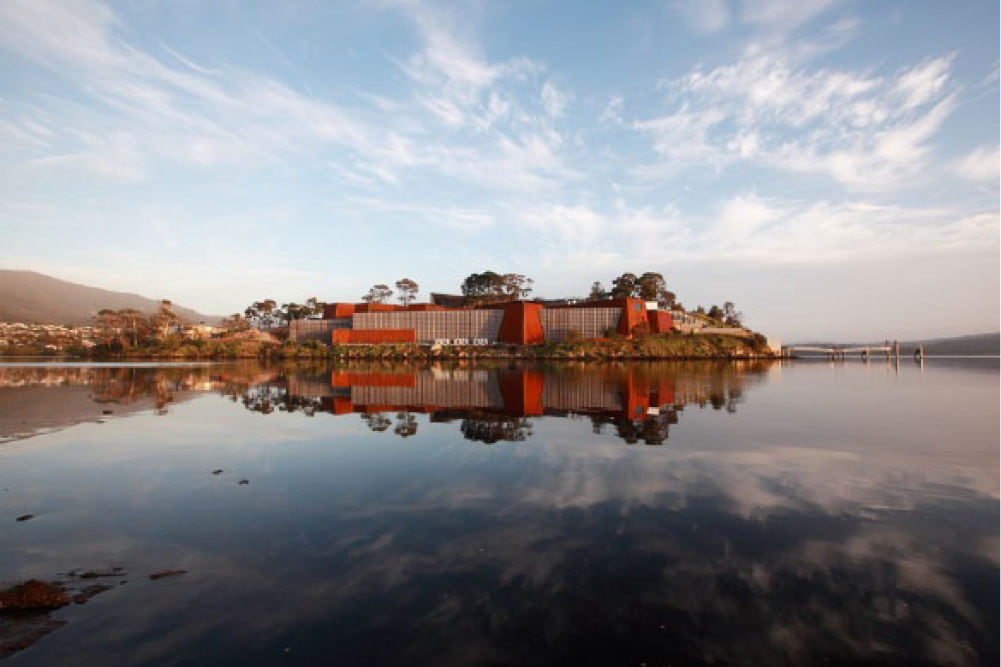
MONA.
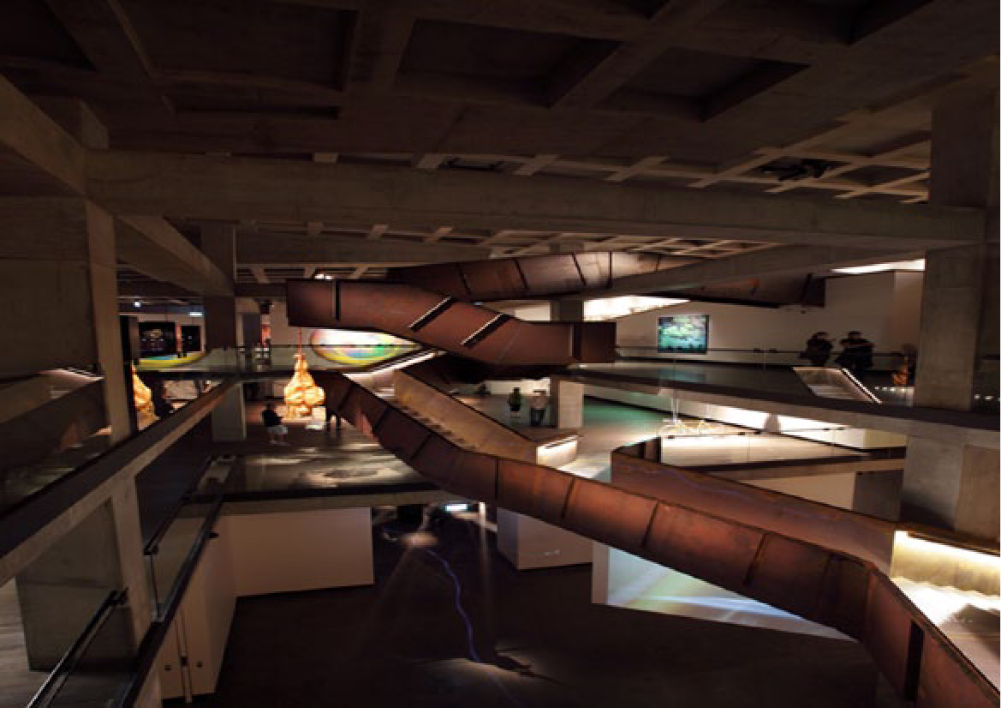
Corten Stairwell & surrounding artworks.
Walsh’s approach to his museum is eclectic and highly personal, reminiscent of the tradition of Wunderkammer, or Cabinets of Wonders: ‘In the Wunderkammer, they wanted the mystery to be maintained … their unicorn horns didn’t have labels. They were just objects of wonder’ (Perrottet, 2012). Walsh has created his own self-curated twenty-first century cabinet of curiosity: a metallic, concrete and glass box rises from the courtyard garden containing Egyptian and pre-Columbian figurines, an ancient stone money wheel, coins from the Doge palace in Venice and a television set blinking an expressionist film installation. One commentator described it as having ‘a magical quality, like some hi-tech garden shrine or grotto’ (Lohrey, 2011); a mini-museum or precursor to the vast and eclectic underground museum yet to be encountered (Figure 3).
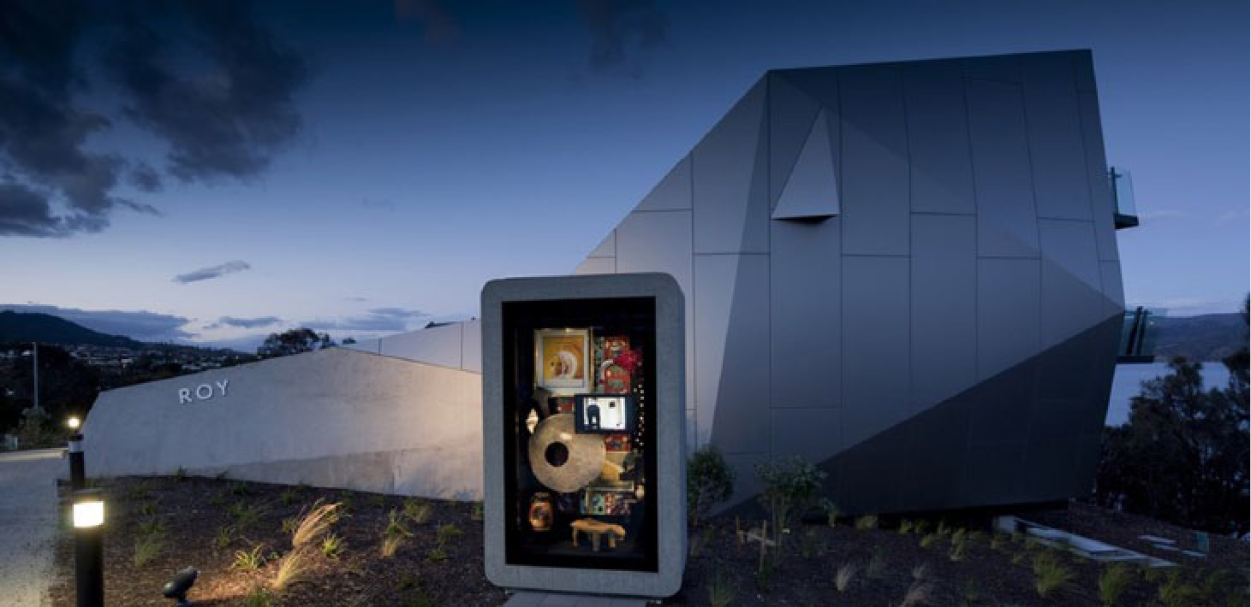
Cabinet of Curiosities, MONA forecourt.
MONA’s collection consists of three diverse areas: antiquities (Mesopotamian cuneiform tablets, Egyptian sarcophagus, Roman mosaics, Greek coins); an ‘extraordinary’ collection of Australian artworks by modernists Charles Blackman, Sidney Nolan, Arthur Boyd and John Perceval; and contemporary cutting-edge international art (Ruiz, 2013). Many of his artworks are considered aesthetically beautiful and sublime such as: Sidney Nolan’s 1970–1972 work Snake, an enormous rainbow serpent of 1620 individual panels depicting flowers, birds, animals, flowers and human heads covering a 45-metre curving wall (Figure 4); and Anslem Kiefer’s holocaust dedication SternenFall/Shevirath (falling stars/shattering of vessels), a poignant installation of steel shelves holding lead books and broken glass (Anderson, 2013).
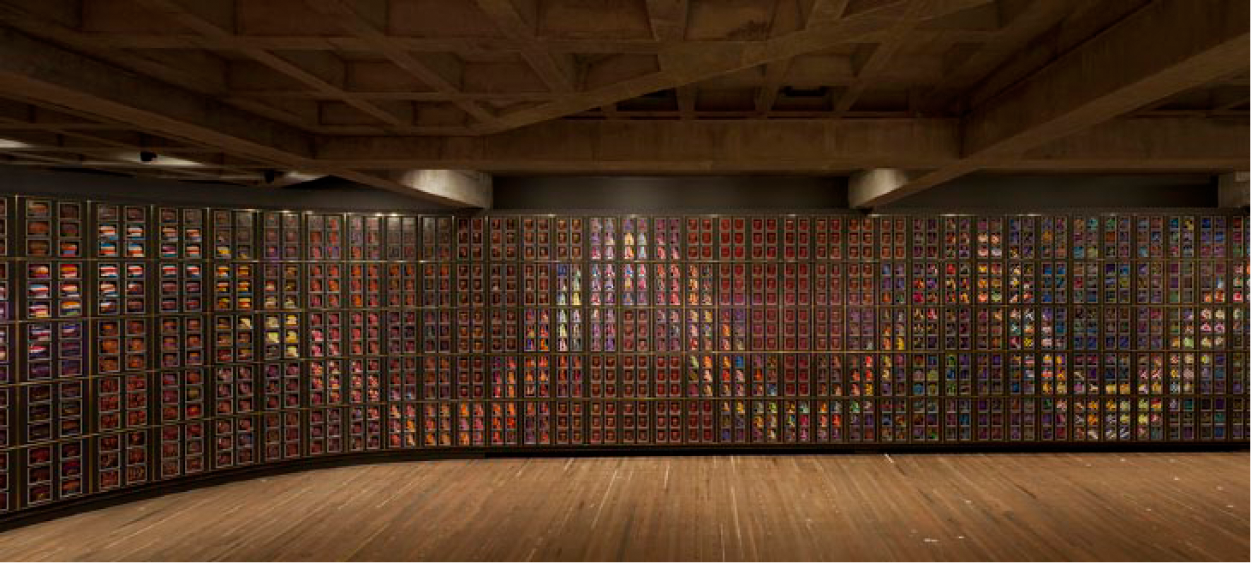
Snake, 1970–1972, Sir Sidney Nolan.
However, in keeping with its label as ‘a monument to reaction’ (Flanagan, 2013: 26), other artworks on display are more provocative and controversial. Prominent examples include the installation, My Beautiful Chair, by Australian Doctor Philip Nitschke (euthanasia advocate) which invites visitors to simulate their own suicide (Figure 5). There is Belgian artist Wim Delvoye’s Cloaca machine, a model of the human digestive system which is fed and excretes faeces (Figure 6). Locus Focus by Austrian artists’ collective, Gelitin, uses a binocular mirror concealed in a toilet providing visitors with an image of their anus (Figure 7), and nearby an untitled meat hook installation containing raw slabs of beef by artist Jannis Kounellis (Figure 8). Stephen Shanabrook’s sculpture, On the Road to Heaven the Highway to Hell, is a chocolate cast of a suicide bomber’s mutilated body (Figure 9); and Gregory Green’s mixed media ‘bomb’ in a Bible (Bible Bomb #185) (https://www.flickr.com/photos/tags/1854) (Figure 10) adds to the reactionary and transgressive elements of the display.
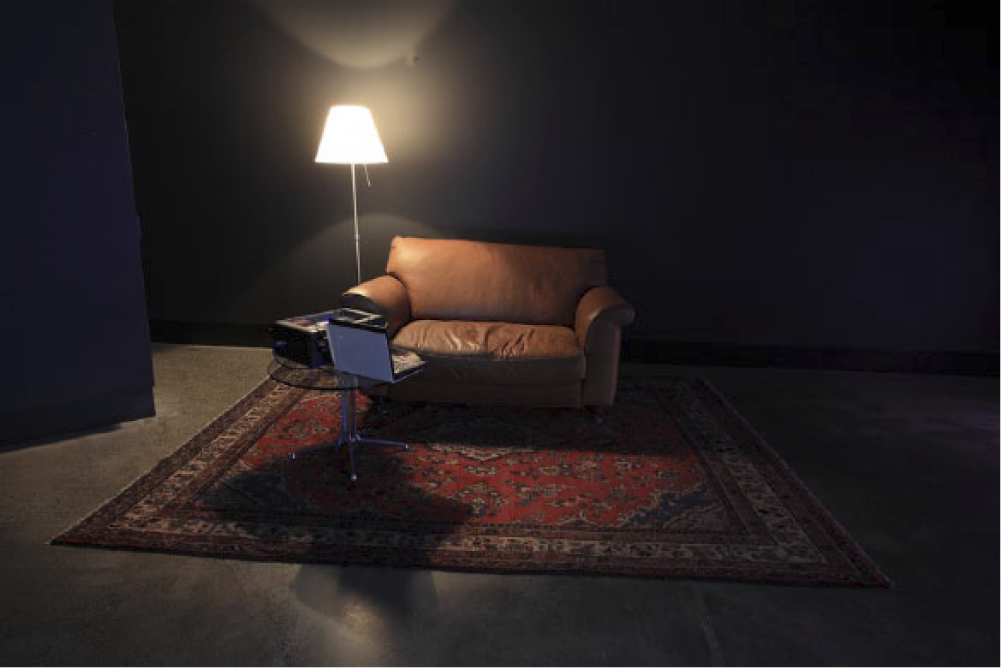
My Beautiful Chair, 2010. Greg Taylor & Dr. Philip Nitschke.
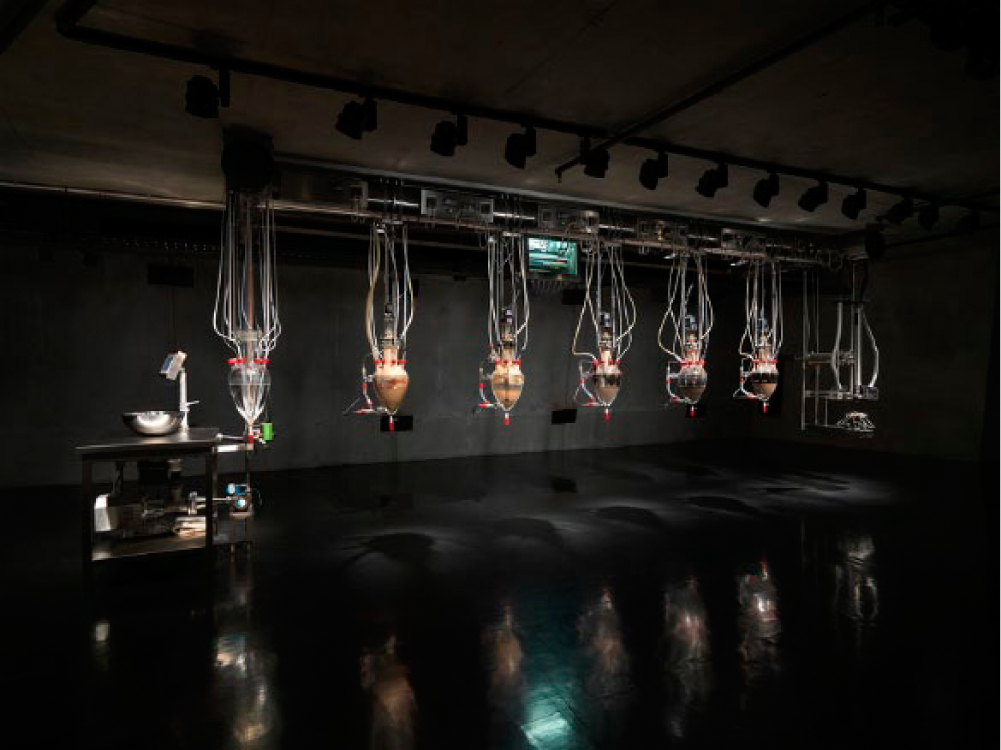
Cloaca Professional, 2010.Wim Delvoye.
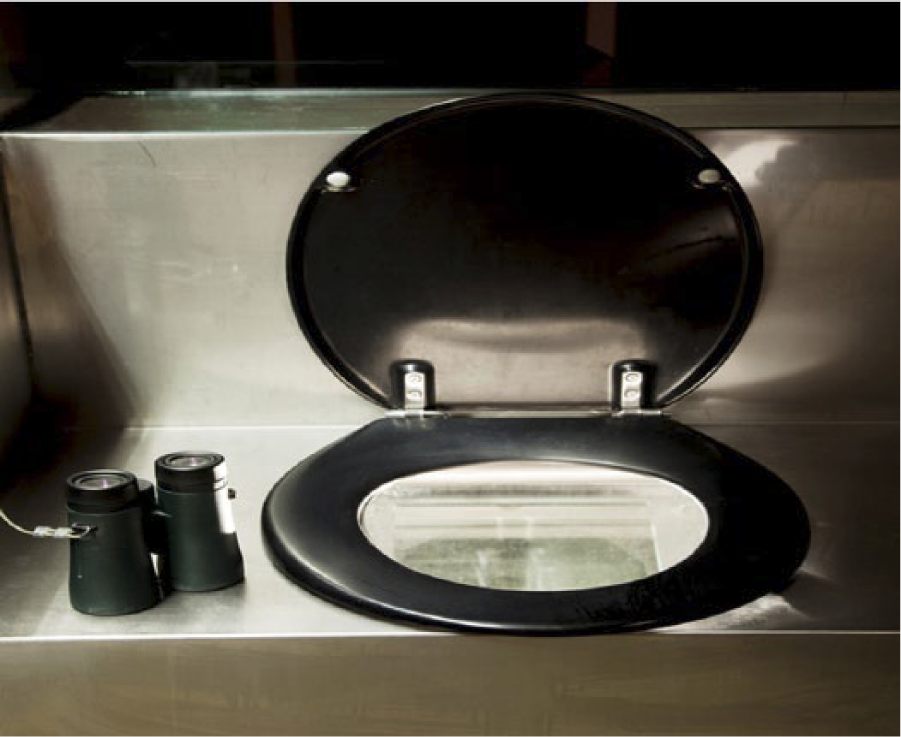
Locus Focus, 2010. Gelitin.
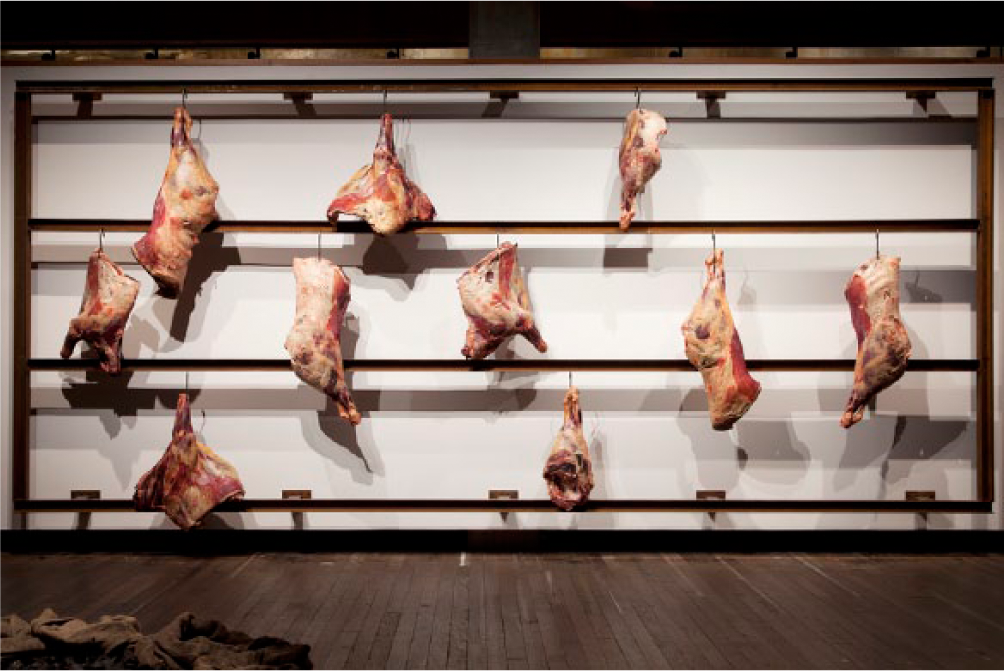
Untitled, 1998. Jannis Kounellis.
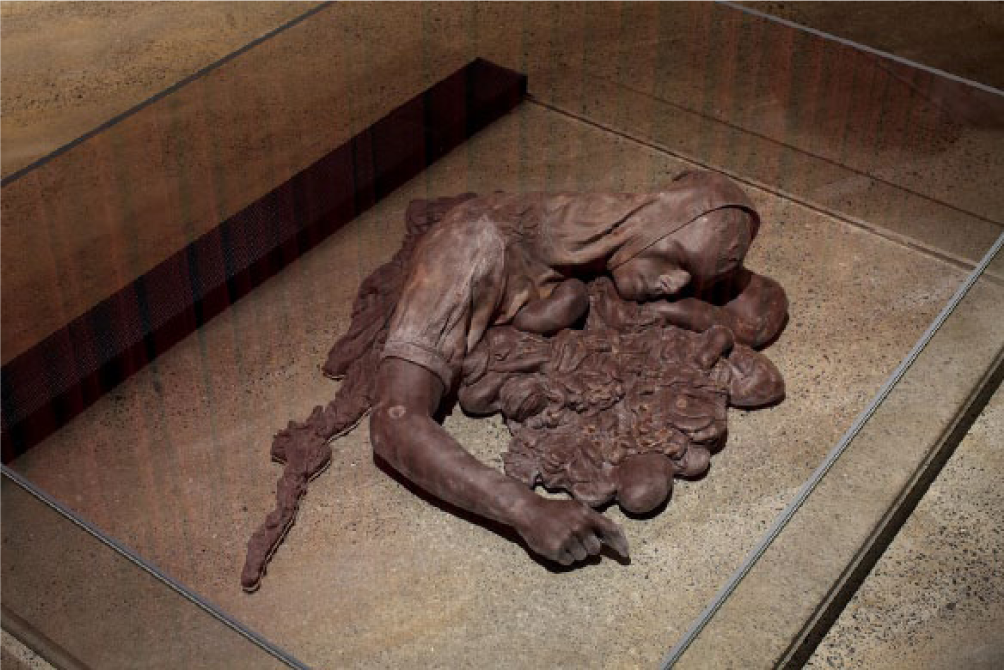
On the Road to Heaven the Highway to Hell, 2008. Stephen J Shanabrook.
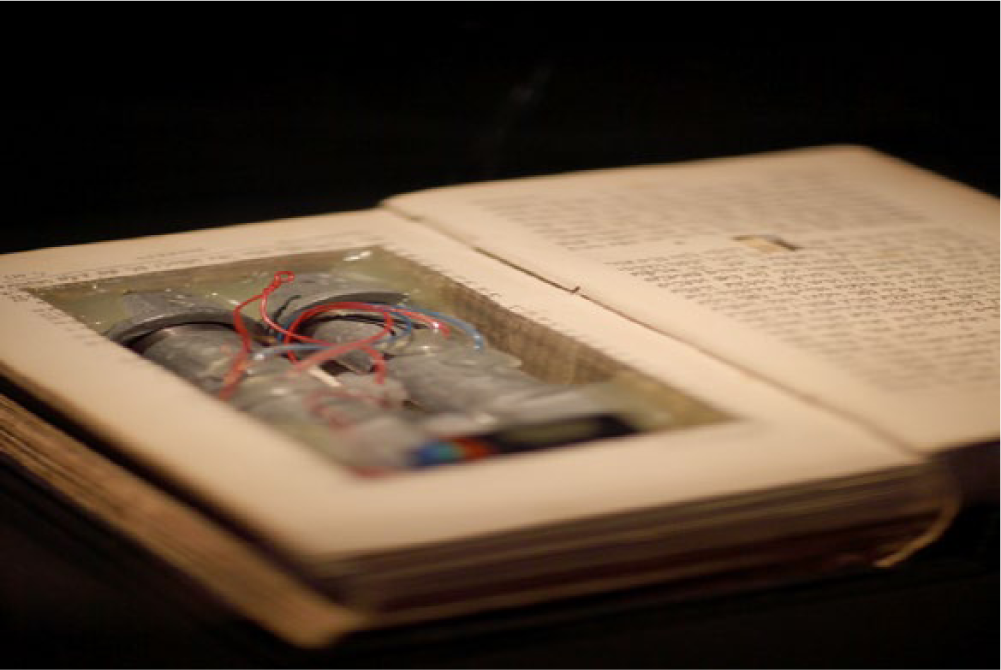
Bible Bomb #1854 (Russian style), 2005. Gregory Green.
Research indicates that many visitors believe museums have a crucial role in presenting controversial and challenging issues through exhibitions that provoke critical and reflective responses to local and global issues (Cameron, 2010: 55, 57). These contentious works displayed at MONA appear to stimulate the imagination of audiences, both fascinating and repulsing (Siegel, 2012). Many are impressed with the museum’s collection, describing the displays as ‘thought-provoking, beautifully displayed and truly world class’, ‘entirely appropriate’, ‘very confronting which is good’, ‘visionary … genuinely moving/shocking/different’. Others, however, comment the works are ‘second rate’, ‘disappointing’, ‘deeply troubling’, ‘thoroughly pretentious, demented and obnoxious’, ‘sick and twisted’, ‘standard nihilistic shock-fest material’ and ‘not the sort of art I really enjoy looking at’ (Ruiz, 2013; Tripadvisor, 2013; Young, 2011).
Walsh justifies his unusual thematic choices:
I hope to shock and offend … I care about sex and death … If I had Goya or Picasso or Caravaggio or Van Gogh, it would still seem like I was interested in sex and death. All galleries are, or should be. (Siegel, 2012)
Walsh, who maintains ‘most curation is bullshit’ (Anderson, 2013) and does not believe ‘the Louvre is the definition of culture …Wikipedia is …’ criticises museums for seeing their role as educators that enlighten the visitor, ‘instilling faith’ by considering them an ‘empty vessel that has to be filled’ (Lohrey, 2011). Instead, he regards MONA as reflecting a scientific paradigm: ‘gradualism would be a better metaphor, learning by increments through guesswork and experiment, but with constant attempts to falsify … a museum that you discover gradually … a un-temple, which means it has to be concealed’ (Lohrey, 2011). The behaviour that Walsh is promoting is reminiscent of Baudelaire’s (1964 [1863]) ‘passionate spectator … and lover of life’, the flâneur or wanderer, exploring the museum and its artworks in a continuous process of discovery.
Connected through technology
To promote the ‘visual thinking’ that these exhibitions advocate, the visitor engages in a multi-sensory discovery experience through becoming disorientated. MONA’s anti-establishment practice of dispensing with traditional labelling and visual explanations on walls is designed to avoid Walsh ‘imposing his views or interrupting the viewing experience’ (Siegel, 2012). Navigating your journey through the museum displays is difficult; however, the absence of labels and the facilitation of the visitors ‘getting lost’ in the experience is not as radical as the museum owner suggests. This desire has always been a fundamental component of the motivation of many, if not most, tourists since tourism began. Further, this option will only appeal to visitors who wish to wander off the ‘beaten track’ and make their own small discoveries during their museum visit; many audiences will expect and be content with standard museum approaches.
There are navigation aids, however, as the admission fee does include a ‘virtual guide’ (which doubles as a cataloguing system and provides the museum with information about visitor behaviour) called the ‘O’: a high-tech, multifunctional revolutionary device featuring a position-enabled navigator with an iPhone style interface, which locates your place in the museum and the surrounding artworks. In addition, there is access to social media sites (Twitter, Facebook) to encourage audience participation and stimulate conversation; but in an unusual twist, not all devices have the same content available. This approach is used to counteract the elitist nature of many museums that make many visitors feel inferior, ‘intimidated by art’ and reluctant to comment: ‘You’ll have something on your device your friend won’t have. You’ll have something to contribute to the discussion so you won’t feel foolish or out of your depth’. In a personal conversation with collegue Kate Jagodzinska in January 2015, curator Jane Clark maintains that Walsh believes that encouraging such behaviour will promote attitudes of tolerance and inclusiveness, characteristic of secular global communities.
However, this style of programming presumes a need for the visitor to have something to contribute when s/he may have little or nothing to add. For all its philosophy of freedom and discovery, this strategy may reinforce the visitors’ feeling of inferiority to the museum’s programme. In this sense, these imposed options may cause some visitors to become uncomfortable or feel restricted. For example, there have been some negative reactions to the ‘O’ with visitors feeling less ‘free’ to develop their own opinions, missing the organised tour and finding the device unreliable and difficult to use. Other complaints included communication with the museum management was not part of the social media options; the need for responses other than Love and Hate; feeling disorientated and felt ‘confused and unsure’, and ‘unsettled’; some textual information too long; approach to interpretation was not ‘revolutionary’ but distracting and did not encourage deeper engagement with works (Australia: MONA’s ‘the O’ mobile guide, 2012; FrannMarie, 2011; Tripadvisor, 2013; Young, 2011).
However, opinions are generally in favour of the ‘O’ as a replacement for conventional labelling systems with 70% of visitors preferring the device to signage and 80% felt it enhanced their experience, especially as it comes free with admission fee. Approximately 20% of visitors save their tour that allows for revisiting your trip, with most preferring the short textual descriptions offered and appreciating the diverse and personal views, poetry and music. The majority of visitors ‘love’ the Wi-Fi option and retractable cables on headsets and the choice to wander and discover or be guided/informed. Many consider the system ‘world class’ because it encouraged conversations with friends and family and the illuminated text was easier to see than traditional labels and reduced crowding around exhibits (Australia: MONA’s ‘the O’ mobile guide, 2012; FrannMarie, 2011; Tripadvisor, 2013; Young, 2011).
MONA’s contribution to regional identity/reputation
Interestingly, MONA visitors spend an average of 3 hours and 20 minutes at the museum (compared with the national average of 2 hours) according to Arts Council Victoria (2014), which Walsh puts down to its location: ‘If this was in Melbourne and you had to walk around the corner, you would probably pop in every now and again … Here they’ve made the effort so they make the effort’ (Frost, 2014).
Former Tasmanian Premier, Lara Giddings, agrees with Walsh’s viewpoints and strategies, describing him as a ‘remarkable and enigmatic man who has given a great gift to Tasmania and Australia … David’s vision … has captured imaginations and interest on both a national and international level’ (Richardson, 2013). This high level of cooperation between private, public and governmental agencies that is evolving in Tasmania is significant. Satisfying the expectations and outcomes for diverse groups is often problematic and such partnerships are not always successful, as cultural tourism developments in far western Queensland Australia have shown (Craik, 2011: 124). As Silberberg (1995) has observed: ‘ … why should tourism operators, most of whom are private sector, for-profit, hard-nosed bottom-line types, be interested in packaging and partnership opportunities with cultural facilities and organisations, most of which are not-for-profit?’ (p. 363).
MONA appears to be an exception. Touted as a ‘revelation … a cultural and economic game-changer’ (Paine, 2013), the influx of tourists to visit MONA has had a knock-on effect for smaller galleries and local artists. Gallery owner, Stephen Joyce, for example, happily states that 80% of his sales over $5000 now leave the State, as he no longer has to attract as many curators, collectors and artists through his own marketing. This is a business saving of $35,000–$40,000 returned to the gallery system. Another gallery owner, Emma Bett, has sold artworks directly to the Parliament House in Canberra and the National Gallery of Australia curators while they were attending events at MONA and her stall at a 2012 Melbourne art fairs reported that most visitors have either been to MONA or were on their way there (Shannon, 2012). More recently in January 2014, MONA’s Theatre of the World exhibition travelled to Paris and was on show for 3 months at the La Maison Rouge art gallery. Gallery Director, Paula Aisemebrg, considered the exhibition ‘a huge success … received very well by the French’, describing the collection as ‘one of the most original we have ever seen’. Giddens has signalled the possibility of further travelling MONA exhibitions (as part of an international media-hosting programme funded from State and Federal governments), believing they are influencing and increasing interest in international arts and tourism for Tasmania and providing an ‘opportunity for Tasmania to shine on the global stage’ (Shine, 2014).
What is clear, however, is that cultural capital is of ‘real … material’ value and not just of ‘symbolic importance’, playing a crucial role in circulating financial capital through both cultural and economic circuits in Tasmania (Craik, 2011). The establishment of cooperative partnerships between MONA and tourism operators has brought benefits to the state’s broader industry in what was ‘otherwise a flat domestic tourism market … changing Tasmanian tourism forever and for the better’, making Tasmania a ‘highly desirable destination … to a whole new market of art and culture travellers’ (Martin, 2012). For example, a recent partnership links MONA with former Gunn’s woodchip mill site to host a joint Festival of Music and Art (FOMA) event (Atkin, 2013). MONA itself is the venue for a variety of music festivals such as MOFO (acronym combing MONA and FOMA) in summer and Dark FOMA/MOFO (backed by $3.5 million of government support) to encourage winter tourism and alternative Saturday art, craft, food and wine markets/workshops (Cica, 2013; Cuthbertson, 2014).
There is no disputing that MONA’s eclectic programme has increased Hobart’s cultural prowess, especially when compared with Sydney and Melbourne. With free admission to Tasmanian residents, locals have visited the museum in droves, embracing ‘our MONA’ as an integral component of their economic and cultural make-up (Richardson, 2013). Surprisingly, this appears a commonly held attitude, as traditionally conservative Tasmanians rated MONA 100% positive in 2010 according to media surveys (Anderson, 2011). This is supported by MONA surveys that confirm approximately 50% of visitors are Tasmanian residents, 20% are from the mainland and 10% are international visitors (Clark and Jagodzinska, 2015). Additionally, domestic flights have been increasing to and from Tasmania to meet demand from mainland and international travellers. This is a remarkable turn-around and a remaking of Tasmania’s identity considering the state’s traditional allure, according to Lonely Planet, has been its ‘natural beauty’ and sites such as Port Arthur and colonial history generally, describing Tasmanian’s as an ‘outdoorsy set dressed in the obligatory fleece and boat shoes’ (Brand Tasmania, 2012).
Pilgrims and spectators: a question of identity
In the world of the modern tourist, pilgrimage has become a secular activity. Like many who have praised the Guggenheim in Bilbao as ‘a life transforming experience – a pilgrimage and epiphany’, MONA is heralded as a ‘rallying point for secular humanism’ (Lohrey, 2011; Rectanus, 2002: 182). Walsh has described his museum as a ‘visual temple of shock’ with a local Tasmanian newspaper reporting: ‘thousands of pilgrims have worshipped at the MONA altar over the Easter weekend … at the ground-breaking shrine to sex and death’ (Richardson, 2013; Young, 2011). This notion is reinforced by recommending arrival by ferry at this $200 million, 6000 square metre, three level, subterranean art museum so visitors experience a feeling similar to travellers disembarking from a dangerous sea voyage and ascending a hill to give thanks to temple Gods for their safe arrival (Siegel, 2012) (Figure 11).
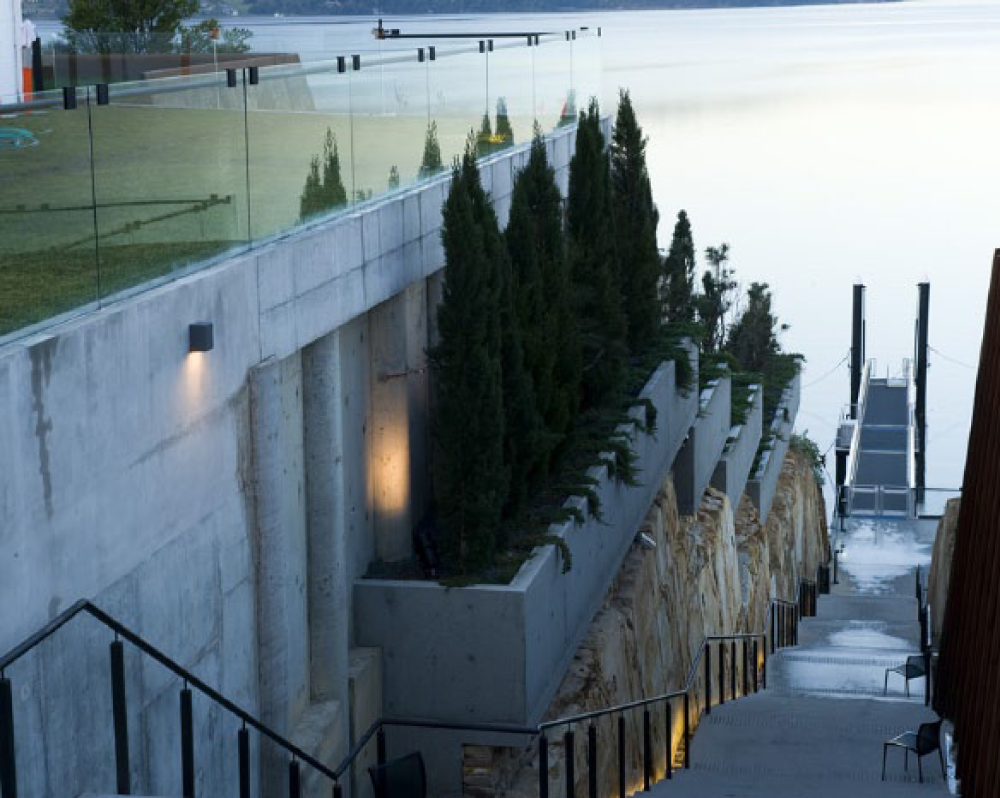
Steps from the MONA jetty.
However an array of societal questions arise that requires consideration. What are the motivations for the nearly 1000 tourists who flock to MONA daily? Is it solely ‘shock value’ that attracts the crowds? Alternately, is MONA tapping into a deeper need – the journey in search of individual, or in the case of Tasmanians, community identity? Does creating an attraction-for-others and the arrival of tourists alter perceptions, attitudes and behaviours of local populations and how they view themselves and others in any profound or permanent way? On the other hand, is it simply a masquerade for the golden horde?
Tourism is often portrayed as ‘a journey to and in places, identities and experiences, however, contemporary theorists posit that identity itself has become elusive in modern times (Crouch and Lubben, 2003: 6). The ‘real problem’ with modern identity formation, according to Bauman (1996) ‘ … is not how to build identity but how to preserve it … ’ (p. 23). This conservation of identity has become difficult because the tourist is always moving, forever seeking the ‘new’, the ‘different’, the ‘novel’, the ‘strange and bizarre’ in a world that is
… pleasingly pliable, kneaded by the tourist’s desire, made and remade with one purpose in mind: to excite, please and amuse … an ‘aestheticized’ world … When tourism becomes a mode of life, when the experiences ingested thus far whet the appetite for further excitement. When the threshold of excitement climbs relentlessly upwards and when each new shock must be more shocking than the last one … (Bauman, 1996: 29–31)
In a similar vein, Lasch (1932) believes identity ‘refers both to persons and to things. Both have lost their solidity in modern society, their definiteness and continuity, as in a world of disposable objects ‘identities can be adopted and discarded like a change of costume’ (pp. 32, 34, 38). Macdonald (2003) supports this premise, claiming that identity, which is not ‘universal’ but ‘historically and culturally specific’, is being ‘transformed’ as individuals seek to construct their own identities (pp. 1, 3). She maintains individuals and communities have become ‘disembedded’, ‘fragmented’ and ‘displaced’ from a former ‘model of identity’ which was ‘relatively coherent and bounded’; a world where museums were often ‘appropriated’ as symbols of ‘national identity’ (pp. 5–6).
In terms of Tasmanian identity, many believe the most significant effect of MONA may be psychological: ‘I think it is changing how Tasmanians see themselves and their world … it is liberating’. According to Timms, ‘Tasmanians had a self-image problem. They had assumed, right from the beginning of their history, that important things happened elsewhere. MONA makes people realize that what they do matters, and is admired by others’ (Flanagan, Timms, cited in Perrottet, 2012).
The museum has become a central topic in debates over the island’s future management, according to environmentalist Varuni Kulasekera. She believes MONA is evidence that there are other more environmentally friendly, creative and viable ways to promote Tasmania in the future: ‘David is employing 200-plus people, and bringing thousands of tourists to Tasmania, who then fill hotels and restaurants, creating even more jobs … There’s not a lot of spinoff activity from a wood-chipping plant’ (Kulasekera, cited in Perrottet, 2012).
A divided public
Naturally, MONA has its critics. Even Walsh admits he has personally benefited from the ‘MONA Effect’ conceding: ‘If the state had somehow built the exact same institution, in the same place and run it the same way, I would think they would justly receive a great deal of criticism’ (Frost, 2014). One well-known New York expert declined to be quoted in the media in case it ‘validated’ MONA’s tactics, arguing that ‘the unqualified combining of different period pieces is little more than an expression of a collector’s rampant ego’ (Perrottet, 2012).
Response to the MONA phenomenon from academic circles is also mixed. Philosopher John Armstrong, University of Melbourne, believes the museum will be a ‘heroic failure’ because
It fails to rise beyond provocation into meaninglessness … it does not seek to instil in us, the beholders, the qualities of mind and character, and the relevant insights and convictions, that would help make our lives, and the lives of others, good. (Coslovich, 2011)
Walsh replied that the museum is, in fact, an outstanding success and that ‘Almost all responses I get, except from academics, who, I guess, have to justify their existence, is that [MONA] is life-affirming’ (Coslovich, 2011).
However, many academics and curators hail MONA for ‘reinventing the gallery experience and bringing new audiences to art, in Australia and beyond’, suggesting a ‘shakeup’ of the museum world has its benefits (Frost, 2014). There are pros and cons to such approaches according to Timms:
Much of contemporary art is not serious … At MONA, art is entertainment, it is cabaret, it is theater. MONA is the world’s first no-bull art museum that says to people, ‘Don’t worry, have fun’. I’m not sure that’s a good thing, or the sign of a healthy culture, but it’s honest! … Of course, a concern is that the more serious artworks there could be trivialized. (Timms, cited in Perrottet, 2012)
As Walsh ponders: ‘there is a sense where I’m trying to build an anti-museum … because I’m anti-certainty. I’m anti-the definitive history of the West. MONA is experiential. It is not a product. It is not a showcase. It’s a fairground’ (Perrottet, 2012). This focus is apparent from the moment you walk through the distorted mirrored entrance to MONA and its unambiguous reference to leaving behind the everyday world and entering the liminal zone of the carnival ‘fun house’ (Figure 12).
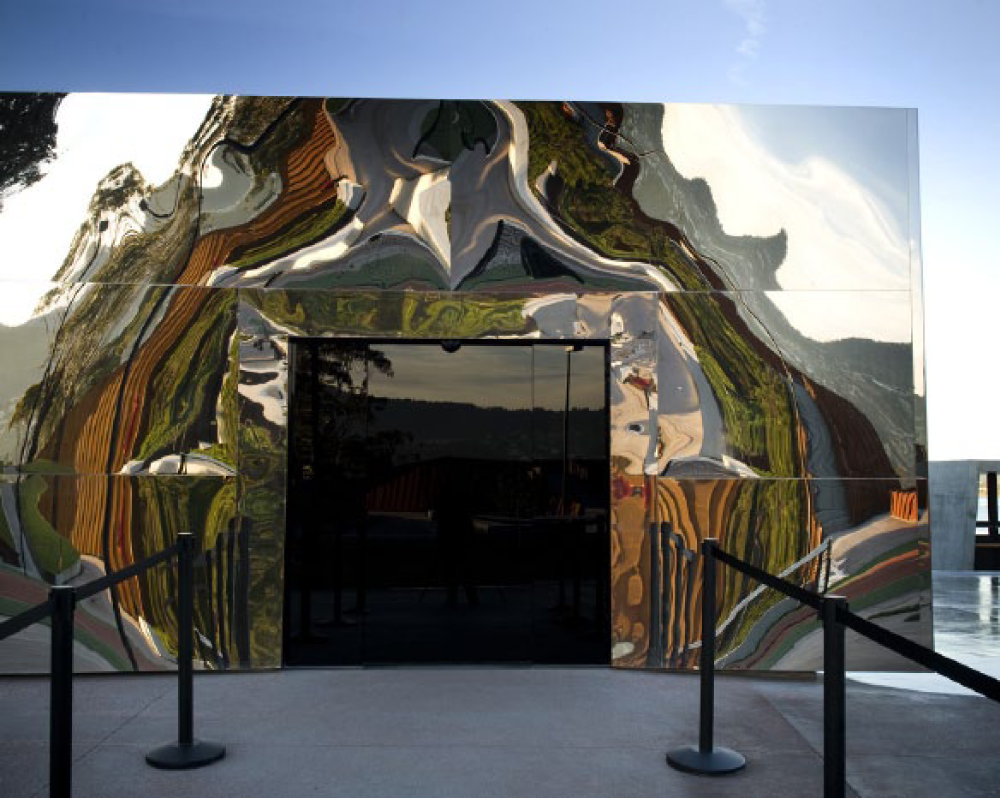
Mirrored Wall on Courtyard House. The entrance to the Museum of Old and New Art.
But controversy lingers on the ‘real’ impact of MONA on local communities. Along with longitudinal visitor research studies, Melbourne’s Monash University is offering a PhD scholarship in conjunction with the University of Tasmania on the Australian Research Council (ARC) Linkage Project, ‘Creating the Bilbao Effect: MONA and the Social and Cultural Coordinates of Urban Regeneration Through Arts Tourism’ in an attempt to provide comprehensive empirical data to inform discussions surrounding polemical issues. For example, despite previous discussions highlighting some gallery owners as having benefited from the success of MONA, academic Lucy Hawthorne (2013), questions this ‘cultural renaissance’, ‘renewal’ and ‘regeneration’ as local artists have seen a reduction of creative opportunities with the recent closure of eight Hobart artist spaces. These are Carnegie Gallery, 6a, Criterion Gallery, Fine Arts Gallery, The Salamanca Collection, Goulbourn Street Gallery, Plimsoll Gallery and Constance Artist Run Initiative (ARI). Hawthorne fears the ‘Mona Effect’ will follow its predecessor, the ‘Bilbao Effect’, in its entirety as 10 years on museum visitor numbers are dropping and its initial cultural and economic boom has faded.
Further, Hawthorne questions the reliance on economic or industrial indicators, rather than any ‘intangible’ or societal benefits, as the criteria of success of cultural enterprises in Tasmania. The measurement of economic outcomes of tourism and revenue from larger entities such as MONA overshadows and reduces the perceived need to fund less quantifiable creative areas such as theatre, music, arts and crafts development at the local community level (Hawthorne, 2013). While praising funding of predominantly free public festivals such as MONA FOMA and Dark FOMA, Hawthorne finds the proposal by the Greens political party to build a satellite Guggenheim museum in Hobart as ‘unbelievable’. Particularly, the rationale that ‘a Guggenheim would be a sister museum to MONA, and make Hobart one of the must-visit cultural destinations on the planet’. This is a feat that MONA is already viewed as achieving alone. Money would be better spent, the writer adds, on local museums such as the Tasmanian Museum and Art Gallery (TMAG) that represent the State’s culture and history and are more embedded in local community life than global institutions built by corporations such as the Guggenheim Foundation. This is a real concern for those desiring to maintain a sense of local identity especially since Guggenheim Foundation Director, Thomas Kren, predicts in the future:
… Will there be a culture on a local level? Probably not. Will it be recognizable in terms of traditional characteristics? Probably not either. There will be a world culture out there; there is already a world culture out there. (Suau, 1999)
Adding to this debate, writer Hannah Martin (2014) argues ‘signature’ events such as Dark FOMA attract visitors during the winter months, especially from the lucrative and rapidly growing Chinese tourist market. It is clear these festivals appeal to international audiences. However, what affect do these MONA-related events have on the Tasmanian sense of individual and group identity? A closer investigation into Dark FOMA is illustrative of how divisive an issue this can be.
The festival and identity formation
The notion of the museum and the festival promoting both a sense of pilgrimage and the ‘carnivalesque’ is not restricted to late modernity. It is embedded in medieval times. The museum’s association with the theatre, festival and fairground is akin to Bakhin’s ‘carnival’, a world turned upside down, an inversion of more than behaviour and commonplace rules, but of the ‘dominant symbolic order’ (Bennett, 1995: 243). Carnival is always a ‘licensed affair in every sense, a permissible rupture of a hegemony, a contained popular blow-off … ’ (Eagleton, 1981: 148–150). Similarly, Franklin maintains: ‘ … Tourism is consumerism in a globalizing modernity … Consumption, identity, belonging and social order, work on and through the body, as do their opposites, freedom, transgression and disorder’ (Franklin, 2003: 26). Turner (1969) outlined the concept of ‘liminal space’ as an ambiguous, marginal and transitional state; where transformation is possible through a process of separation from one world and reincorporation into another. Tourism, like the museum and the carnival, operates in such liminal spaces where everyday behaviours are transcended, inverted or suspended, replaced by diverse and novel activities that inspire ‘awe, wonder, exhilaration, fatigue, humility and excitement’ (p. 113).
Many agree with Franklin (2003) who believes that tourism has provided both the capacity and desire to follow the never-ending creation of the new and has enabled us to cope more successfully with the rapid and changeable nature of modernity. The world exhibitions of the nineteenth and twentieth centuries were the forerunners to current ‘crowd-pullers’ and novel temples to modern art with their focus on progress, new technologies and the future. Franklin argues this is a ‘particular form of consumerism, a curiosity endemic to modern cultures born in a constant state of change, novelty, progress and universal, overarching concerns’. MONA’s eclectic and diverse collection, with associated music festivals, nude swimming, ritual burnings and naturalist tours, are outside the ‘every day’, therefore challenging traditional museological concepts by catering to the needs and desires of their disparate contemporary audiences (pp. 272–275).
Visual culture and tourism, in this sense, can both be seen as knowledge-making processes that provide experiences and create identities, exemplifying the process of the ‘individual becoming rather than being … as the self and the object are refigured in the process of encounter and performance’ (Crouch and Lubben, 2003: 12). The festival in particular is considered as a space providing temporal opportunities where ‘alternative and liminal forms of identity’ can be articulated and performed. Some commentators suggest a certain ‘openness’ to cultural difference can encourage ‘otherwise socially and culturally marginalized people’ to experience ‘community, locality and belonging’ as well as ‘cosmopolitan exchange and encounter’ (Bennett and Woodward, 2014: 12–25). However, can temporal events have permanent effects on a local population’s way of thinking, acting and behaving? In this instance, do carnivalesque atmospheres and liminal spaces created by the music and art performances break down barriers and galvanise a sense of individual and communal identity uniquely Tasmanian?
A provisional answer from research gathered following the 2013 Dark FOMA festival indicates that this event might provide a catalyst for such cultural transformation. Evidence suggests that the majority of festival participants were Tasmanian (72%), with 27% from the mainland and only 1% international tourists (Conroy, 2013). The age of participants was typically 25 to 34 which likely reflects the online nature of events: 55% of audiences learnt about the events online with 28% residing outside Tasmania, thus relying on the Internet for ticketing and event details; 77% of partakers regarded Dark FOMA’s association with MONA as the reason for their decision to attend the festival; and 96% intended to return to Tasmania due to their positive experience with the museum and festival (Conroy, 2013). One commentator felt a larger number of locals attended the festival when compared with visits to MONA because of the location of festival activities in the city centre and the effectiveness of ‘word-of-mouth’ for many of the events (Clark and Jagodzinska, 2015). These activities arguably generated a groundswell of excitement, communal goodwill and positive feelings towards the festival and Hobart community.
It is clear partnerships between MONA, Government and businesses are important as the State of Tasmania has committed one million dollars for 3 years to stage Dark FOMA involving other museums, gallery spaces, the State Cinema, Tasmanian Symphony Orchestra and University of Tasmania, with over 30 unofficial venues linking themselves to the festival (Conroy, 2013). As data confirm, the economic benefits are significant. During the 10-day duration of the winter festival, daily revenue rose from 18% to 44 % with hotel occupancy increasing by over 55 % from the 2012 levels to a record high of 64% in 2013 (STR Global, cited by Conroy, 2013). More significantly, some commentators believe both the summer and winter music festivals coupled with Creative Hobart (the City of Hobart’s strategic initiative for arts and culture) are providing a ‘platform for cultural expression and creative participation’ and are transforming Hobart into a ‘place of vibrant life, bolstering tourism while providing a fantastic series of cultural events for the locals’ (Norrie, 2014). Creative director, Leigh Carmichael, agrees the inversion of everyday rules and behaviour that Dark FOMA promotes: ‘Rather than moaning about the darkness, we are celebrating it … [aiming] to challenge, disturb, excite and hopefully enlighten … [through] a late-night “Ceremonial death dance” and a five-day Bacchanalian winter feast’ culminating in the annual Solstice nude swim encouraging participants to ‘throw caution (and your clothes) to the wind’ (Keen, 2015).
Research such as Conroy’s suggests that Dark FOMA not only creates a ‘pagan style ritual space’ that is a less exclusive environment for locals and tourists alike, it also offers residents the opportunity to have ‘greater ownership and accessibility … in a free, world-class event’ inspiring community responses including themed cooking, hairstyles, clothing and student artworks. Further, in 2013, Spectra (a lighting performance artwork by Japanese artists) was supplemented by contributors carrying torches and held at the site of the Hobart Cenotaph, a suggestion endorsed by returned WWII veterans who had fought Japanese forces during campaigns at home and abroad (Conroy, 2013). Additionally, the adoption of the colour red and the slogan, ‘painting the town red’, including projections of political figure’s faces on buildings near the Hobart waterfront added to the atmosphere of awe and wonder of the ‘topsy-turvy’ carnival world while providing an array of multisensory experiences (Conroy, 2013). This focus on embodied encounters continues with the newly built Dark Park precinct in 2015 offering ‘full-body sonic massage immersion’ with public installations such as Bass Bath and Fire Organ, a flame-throwing steel tube construction (Keen, 2015).
Importantly, empirical data reveals that 79% of Tasmanians interviewed who attended the winter festival felt ‘pride and ownership’, particularly to these Dark FOMA activities and events. This is based on data suggesting that the festival created a sense of community, both real and symbolic, through the promotion of physical and social engagements in intimate venues, encouraging face-to-face encounters with strangers. These unfamiliar locations and liminal spaces are seen as signifying transgression and freedom from everyday life, its rules and modes of behaviour (Figures 13–17). Responses included,
This event helped me unwind from my routine (77%, 68%); it was inspiring to be part of this event (86%, 72 %); I talked to people who I had not planned to attend with (48 %, 75%). Also, had this event not been on, I would have stayed home instead (58%, 53%) … 81% of survey respondents agreed or strongly agreed, Dark MOFO made the winter solstice a more significant occasion … 92% of respondents wanted Dark MOFO to become a long-term event and 67% percent planned to be in Hobart next year specifically to attend … (Conroy, 2013)
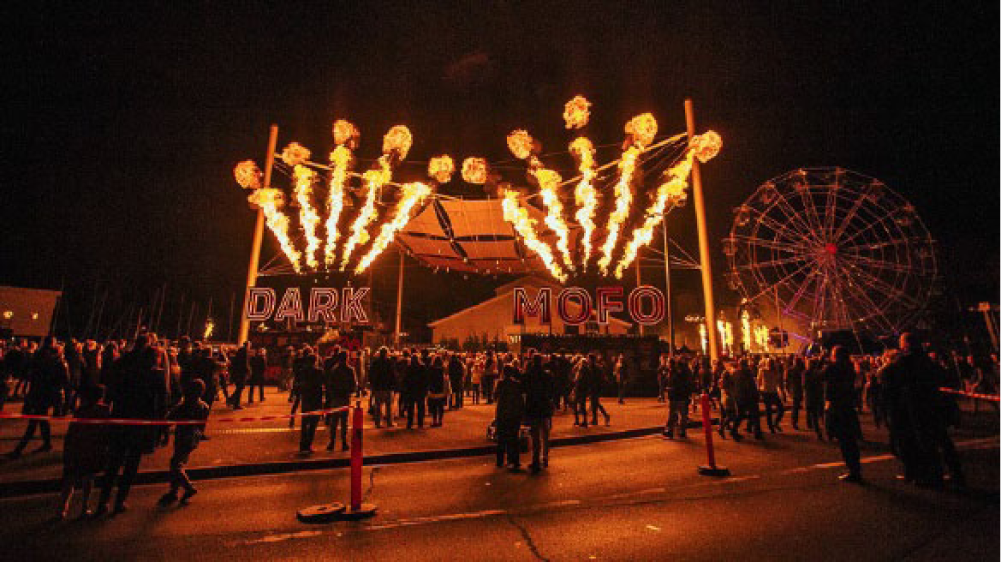
Ferris Wheel of Death.
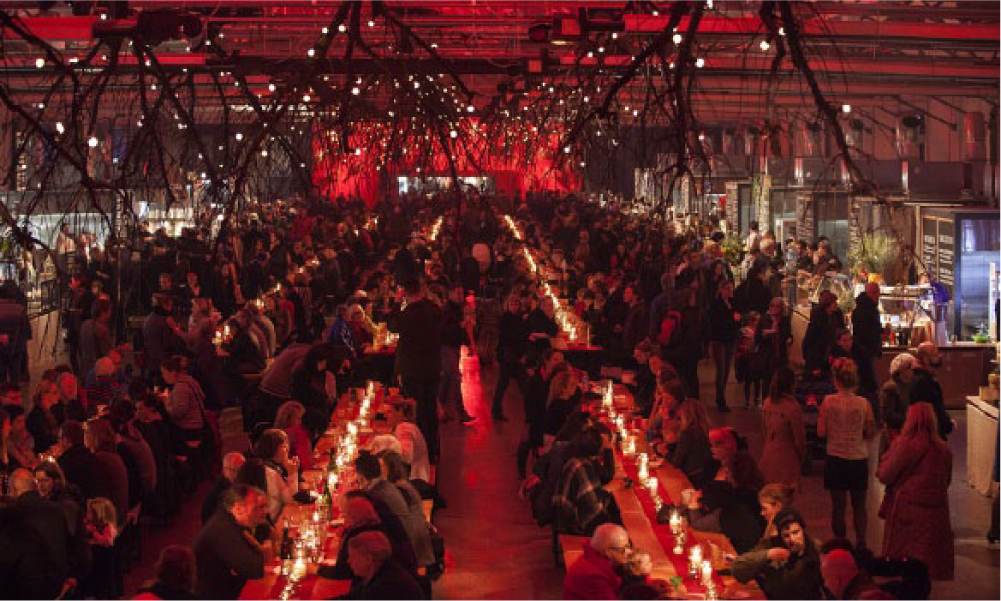
The Dark Mofo Winter Feast.
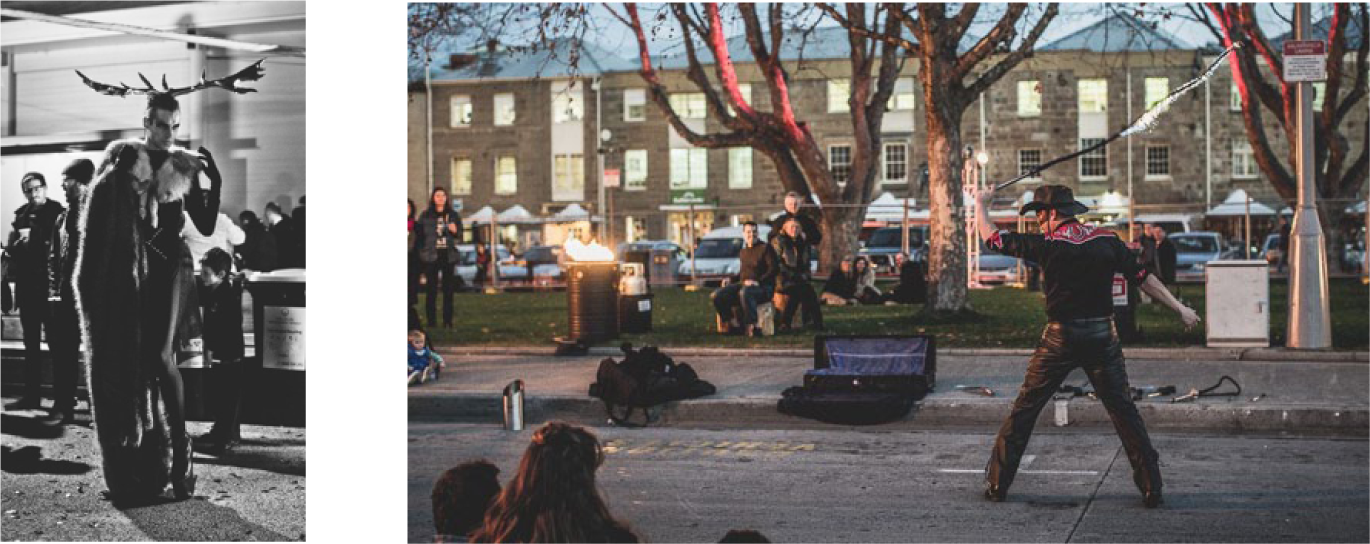
Festival performers.
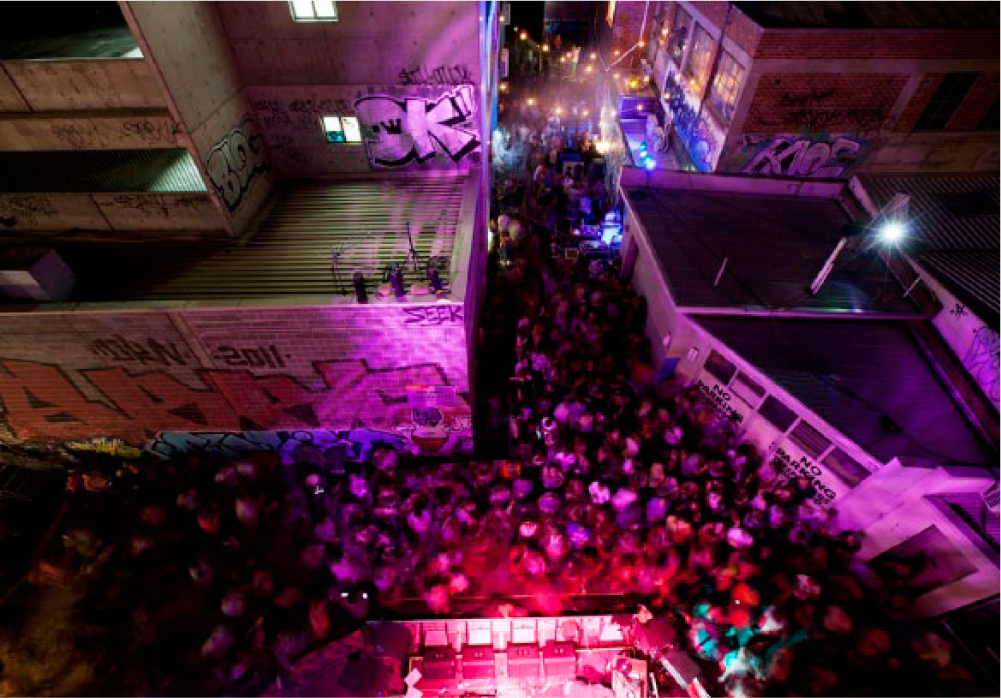
Central Hobart during Dark FOMA 2014.
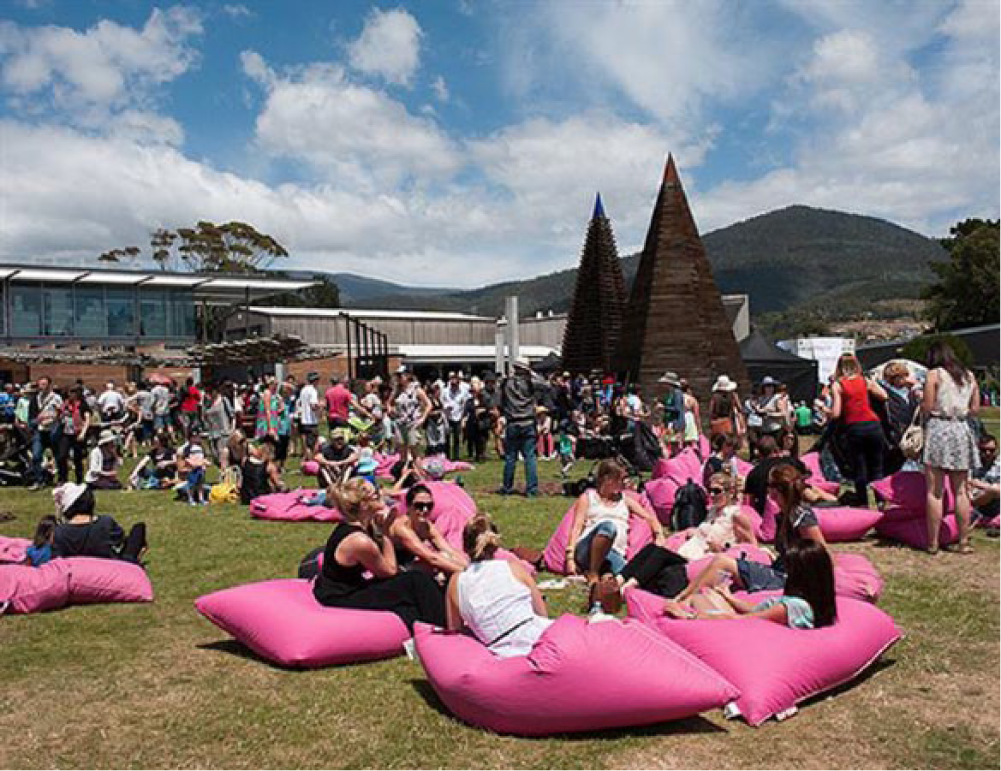
MONA.
With Dark MOFO participant numbers annually over 128,000 in 2013 and 130,000 by 2014, this winter festival appears to have surprised both promoters and organisers by overtaking the summer festival in popularity and is reinforcing the notion that a combination of temporal and annual cultural events can produce powerful, and perhaps permanent, changes to local and national concepts of identity (Conroy, 2013).
A new museum paradigm but a question of ongoing viability
While many museums worldwide are downsizing exhibitions and shedding staff due to funding cuts and falling visitor numbers, MONA is an enigma; its success, an undeniable phenomenon. Despite MONA being considered as ‘a privately owned cabinet of curiosities, an updated Soane’ (Eltham, 2012) for its unorthodox and innovative museological and curatorial practices, has it a sustainable future? Can MONA continue to boost the region’s tourist economy, maintain its new cultural identity and engage visitor interest beyond its ‘shock’ value and hi-tech avant-garde devices? Will festivals such as Dark FOMA that depend on the continued success of MONA itself be able to sustain their attraction, particularly for local Tasmanians and transform cultural and community identity?
Clearly, MONA will not appeal to every taste and spectacles may lose their novelty quickly. Crucially, the precarious nature of MONA as an institution and its viability as a long-term project was questioned recently when the Australian Tax Office (ATO) sought to recover $37 million worth of back-taxes the ATO claim was owed to them because Walsh was running his gambling enterprise as a business. Though Walsh had support everywhere to fight this claim (including the Tasmanian Government itself) and it was eventually resolved through an undisclosed settlement with the Commissioner, uncertainty remains (Darby, 2012). Complex situations such as those at MONA (heavily reliant on gambling dividends) raise issues about its sustainability as a long-term project and individuals such as David Walsh, who are prepared to take risks to create new visions of museums, are not easy to find. Walsh admits: ‘to operate effectively in my world-which means to be strongly motivated all the time-I have to be on the edge’ (Frost, 2014).
The ‘MONA affect’ like that in Bilbao, will require continued private and public cooperation across industries and effective governance structures that can adapt to particular environments to ensure symbiotic relationships and a vibrant and viable cultural tourism sector. Many questions will continue to be raised in terms of continued government assistance to private enterprises such as MONA. What will happen to funding arrangements if MONA becomes a non-marketable entity and is tourism or culture the priority if the museum’s tourist function threatens the integrity of the museum? This may be the case if Walsh relinquishes his godlike control and establishes an independent board of trustees to cover escalating costs. Despite the planned on-site hotel, further commercial sales of the ‘O’ (Melbourne Zoo has already purchased the system), possible MONA shop outlets and expansions into China (Frost, 2014), the museum is in a precarious position in terms of replicability and sustainability. These fears may be justified as contemporary cultural tourism swings between the varied impulses of exploration and escape, redefinition and reassertion of identity and the often risky and shifting requirements and dynamics of a tourist industry.
In these multi-sensual experiences that museums like MONA propose, festivals such as Dark FOMA, the boundaries between spectacles, and visual culture become blurred. According to Debord (1994), for example, modern life is also the world of the spectacle where all life has become an ‘accumulation of spectacles … ’ (p. 22) where tourism plays an important role, as it is a ‘by-product’ of commodities circulating. Debord argues tourism is essentially: ‘the chance to go see what has been made trite’ (p. 120). Unquestionably, many tourists today are attracted by the new, novel and often bizarre multisensory experiences that MONA and its accompanying events offer. However, appealing to the curious and thrill-seeking tourist is difficult to maintain on a permanent basis and runs the risk of becoming clichéd and banal in the long term. The opportunity to promote a new ‘openness’ to cultural diversity and engender a ‘cosmopolitan’ outlook for local residents may be difficult to maintain without ongoing local government creative projects that reinforce the social, cultural and global aspects of the occasional encounter with the museum and annual music and art festivals.
Concluding thoughts
Is MONA truly ‘the Bilbao of the South’ and a ‘subversive Disneyland’? (Ruiz, 2013). By contesting the very concept of the museum, ‘democratising’ and privileging no specific viewpoint, MONA is an example of a new museum paradigm and tourist destination that is redefining the cultural tourism experience. Like Gehry’s Guggenheim, MONA is a ‘symbolic structure’ rather than a ‘fantasy’ world, creating spaces where reflection and dialogue that is ‘not necessarily reassuring’ is possible (MacCannell, 2011: 164–165). Pilgrims and spectators alike are travelling to the ‘end of the world’ to experience ‘cutting-edge’ displays and immersive technologies in complex and thought-provoking environments where mind-sets are challenged and opinions questioned; where individual and community identities can be dismantled, formed and reformed. MONA and its annual music and art festivals are cultural experiments, part of a wider joint touristic and museological trend that favours experience, theatricality and affect over didactic practices to meet the desires of diverse modern audiences. MONA’s effect is summed up in this visitor comment: ‘I was intrigued, amazed, delighted, shocked, disgusted, felt sick and insulted … but made me think too … ’ (‘Maureen of Glenorchy’ cited in Young, 2011). Whether MONA sinks or swims long before the tides of the Derwent River rises to claim this subterranean temple dedicated to art, is hard to predict. One thing is guaranteed for the present: whether you love it or hate them, MONA and its events are highly unique and stimulating experiences.
Footnotes
Declaration of conflicting interests
The author(s) declared no potential conflicts of interest with respect to the research, authorship, and/or publication of this article.
Funding
The author(s) received no financial support for the research, authorship, and/or publication of this article.