







Abstract
Tourists experience a range of everyday practices that are subtle, momentary and mundane, which can be difficult to document. Finding documentation techniques that encourage hands-on and collaborative experiences can assist in gathering and producing a variety of perspectives from researchers and tourists. Using the Deleuzian concept of the ‘diagram’, this article examines how creative documentation methods can be used to explore everyday practices of tourists. From a creative arts and philosophical perspective, a diagram is a methodological tool that allows the tracing of relations through a range of techniques. Tracing the development of participatory artwork that uses a diagrammatic approach demonstrates how the experiences of both tourists and researchers can be fused. This encourages a wider perspective of how tourist practices are generated through interactive and affective registers. Diagramming is a creative methodological approach that can assist in tracing experiences and relationships that emerge in tourist studies.
Introduction
Everyday tourist practices such as packing a bag, cooking, walking, photographing, waiting, transiting and so on are often so subtle, momentary and ordinary, yet form a significant part of a tourist’s daily routine. They demand a considerable amount of time, attention and practiced negotiation, but can be difficult for tourists to articulate and reflect on and for researchers to document. The process of documentation needs to be fluid, mobile and adaptive in order to study and reflect on the many momentary interactions that occur.
New opportunities to access and trace everyday, mundane tourist practices can arise through creative and collaborative approaches to documentation. Building on the Deleuzian concept of the ‘diagram’, I introduce diagramming as a creative methodological approach that can assist in tracing experiences and relationships that emerge in everyday tourist practices. A diagram is a tool that allows the tracing of relations through a range of techniques and can be used to present ‘relations between forces unique to the particular formation’ (Deleuze, 1988: 72). It is not necessarily a visual re-presentation, such as a graph or chart that presents information, but can take many forms and is not static or fixed to a particular visual depiction or media. A diagrammatic approach is useful for studying tourist practices due to its ability to highlight the affects of particular relationships (Eisenman, 2010; Manning, 2013; O’Sullivan, 2012) and can be used to find the best way to ‘present’ different media, data or experiences. Diagramming draws connections across a range of registers of meaning and scales of an event. In this way, diagramming is valuable in highlighting how ‘different configurations’ of tourist experiences and meanings (Bissell, 2010: 272) are generated through affective and distributed registers.
This article examines diagramming as a creative methodology that is applied to the activity of packing a bag, offering a new approach to studying everyday tourist practices. Packing a bag becomes an everyday experience while travelling, as tourists unpack, rearrange, search for items and re-pack to fit everything back in. The task can be meticulous, especially when planning a trip; or at times it consumes our attention when unexpected events unfold. Yet, it is one of the many tourist practices that is perhaps so mundane, everyday or fleeting that it is difficult to articulate or document in order for tourism scholars to reflect on. Packing contributes to the way that tourists present and perform their identity and their position within global tourist cultures (Barry, 2016; Hyde and Olesen, 2012; Small and Harris, 2012; Walsh and Tucker, 2009) and it matters because it is emblematic of one of the many daily, embodied material practices that tourists undertake. It can be teased out to reveal relational networks that tourists experience and participate in (Barry, 2016; Jensen et al., 2015; Van der Duim et al., 2012).
It is important to acknowledge that the materials and media used for documentation enable researchers to ‘do’ mobile research (Larsen, 2008; Van der Duim et al., 2012) and permit access to specific aspects of a situation. Combining and experimenting with documentation techniques in a diagrammatic approach permit a collaborative and creative examination of momentary or indiscernible relationships in tourism situations. Creativity, in this broad usage, can encompass many forms of performative, collaborative or interactive engagement. My focus is on finding new techniques that are useful for studying everyday practices in tourism, rather than surveying the concrete findings or insights that the packing process may reveal. The emphasis is on offering an alternative, creative methodology that allows us to reflect on our understanding of everyday tourist practices and experiential modes of knowledge and research.
I propose the following questions to interrogate the value of diagramming as a new methodological approach and how it can open an engagement with packing and other everyday tourist practices. How might a diagrammatic approach to documentation assist in finding the relationships that emerge in everyday, mundane or fleeting tourist practices? And how might diagramming, as a creative methodology, offer new modes for studying, experiencing and collaborating with tourists? In order to address these questions, and to demonstrate how a diagrammatic method might be deployed, I analyse my artwork ‘Diagramming the packing process’, which is a hands-on interactive installation. 1 Visitors to the gallery are invited to pack a bag with an assortment of objects provided. The task is to sketch and draw the position of objects within the bag while you pack. Due to the participatory nature of the artwork, it results in visitors to the gallery, researchers and tourists alike having the opportunity to contemplate the process of packing a bag as well as experience a hands-on approach to research documentation. Positioning the packing process as an artwork accentuates the many movements, interactions and meanings that tourists attach to this everyday practice and as a result alter the way we perceive and understand our own tourist practices, whether in the gallery or at a later stage during travel. It is a prime example of how creative and collaborative techniques offer alternative methodological approaches for tourism research.
In the following sections, this article will demonstrate the value of diagramming as a creative methodology for tourist studies. First, I discuss the concept of the diagram as a methodological tool, which is informed by perspectives from philosophy and creative arts. I propose that positioning documentation as a series of diagrammatic techniques results in creative practices that parallel some existing fieldwork practices of tourism researchers. Next, I use examples from my own documentation methods to explore how the intersection of fieldwork experiences and documentation can result in creative techniques that bring alternative perspectives on subtle and everyday tourist practices. In the final section, I analyse my artwork ‘Diagramming the packing process’, suggesting that diagramming opens a conversation between creative practice and tourist studies, and between tourists and researchers. It offers alternative ways of knowing and experiencing that move beyond, or work in addition to, more traditional insights or analysis techniques. The diagrammatic approach interweaves theoretical and practical analysis by the way it connects different modes of understanding and inflects relationships through the use of a range of media and experiential modes. This is of course a suggestion that will benefit some forms of fieldwork and documentation, but not necessarily all tourism research endeavours. It can be seen as a supplement to current non-representational, actor–network theory and mobile ethnographic approaches and indeed as a contribution of creative practices to doing tourism research.
Diagrams trace relations and experiences
There has been considerable research that demonstrates the value and knowledge that tourists gain from embodied and material practices (Crouch, 2004; Franklin, 2014; Haldrup and Larsen, 2010; Urry and Larsen, 2011; Van der Duim et al., 2012). Tourist practices may be conceived as ‘a fusion of fluid and dynamic mobilities and materialities, embodied and affectual encounters’ (Scarles, 2010: 905), in which everyday processes contribute to the tangible interactions and ephemeral experiences. It is within this flux of movement that everyday routines develop to help tourists situate themselves. However, there has been little critique of the methods for researching and learning ‘how to move with a range of research subjects and objects in new or established ways’ (Merriman, 2014: 174). In tourism and geography, there have been several notable studies that embark on alternative methods to address affective and bodily experiences in the field. For instance, exploring the co-constitution of experiences and the ways that we perform with material objects (Franklin, 2014; Walsh and Tucker, 2009), being attentive and listening to the everyday movements that our bodies undertake (Duffy, 2013) and the sensations that our bodies register (Longhurst et al., 2008), or the way that we can mobilise ethnographic practices that trace the relationships and affordances as we move through the world (Jensen et al., 2015; Larsen, 2008). Although these studies are exemplar in their attention to the techniques and materials that researchers and their bodies can use, there is room for additional inquiries into other potential ways to ‘move with’ our research (Merriman, 2014: 174). This involves finding a harmony between a range of theoretical propositions and practical experiences, and balance between the roles of tourists and researchers, to capture and examine such moments.
Researching mobile subjects or situations in tourism can require a variety of techniques to gather, correlate, interpret and produce insights. Often vastly different methodological practices are required, spanning ethnographic accounts, fieldwork journals, audio-visuals, interviews and so on. The assemblage of these techniques spans practical and theoretical knowledge and is not always easily discernible in one singular form. In this way, researching mobile situations in tourism can be considered diagrammatic – it is a crafting of techniques to best trace the movements of tourists and the meanings and relationships that form through their practices.
Through an artistic and philosophical lens, a diagram is not a static representation of information, but rather a set of relations that emerge through events and processes. My understanding of a diagram comes from the philosophical and creative propositions of Erin Manning (2009, 2013) and her critique of Giles Deleuze (1988) and his collaborations Félix Guattari (Deleuze and Guattari, 2004). Manning (2009) explains that Deleuze and Guattari’s concept of the diagram ‘is a technique or series of techniques for the open conjugation of intensities. The diagram is not content driven – it operates at the interstices of composition’ (p. 124). In Deleuze’s (1988) analysis of the work of Foucault, he uses the notion of the diagram to tease out relationships between power and knowledge. He states that the diagram can be ‘the distribution of the power to affect and be affected’ while having the capacity to be ‘a transmission or distribution of particular features’ (Deleuze, 1988: 72–3). Extending on Deleuze, Simon O’Sullivan (2016) suggests that diagramming calls for ‘other forms of interaction to be enacted’ that are beyond the expected discursive, pragmatic or figurative representations (pp. 14–6). Understood in this way, the diagram is an ever evolving, self-propagating distribution of affective relations, in which content, form and structure are never fixed or stationary but always fluid and in motion. I have chosen to draw from a Deleuzian definition of the diagram as it is alive to the affective resonances in a situation. I see this particularly applicable to tourism situations, where tourists are saturated by constantly moving assemblages of bodies, technologies and objects to which they form and re-form experiences and relationships to (Bissell, 2010; Van der Duim et al., 2012). Even though Deleuze’s discussion of diagrams centres on power relationships, my adaptation and interpretation align with Manning’s in that it can be used to investigate movement and transition, and embraces the concern in tourism research of tracing relations of affect and movement.
Although my definition of a diagram is conceptually driven, other examples of diagrams are more aligned with techniques of graphical presentation and cartographic practices. For instance, the instructional diagrams we encounter during transit, such as emergency exit instructions, informational signs or aircraft safety cards, ‘deploy common aesthetic elements’ that ‘maintain a universalised system of communication’ (Barry, 2015: 3). Transit diagrams assemble pictographic representations and processes that need to be carried out in order to show a ‘multiplicity of spatial relationships, movements and usages’ (Barry, 2015: 4). Transit spaces, such as airports, stations and so on, are ‘diagrammatically conceptualised space, which guides movement and behaviour’ (Fuller, 2002: 242). Signage, architecture, flows and movements of people are diverse elements that momentarily coalesce in a diagrammatic manner. There are many examples in tourism that could be listed under this broad definition, and the resulting visualisation may take on a particular figure or form, but the point is that a diagram has the ability to manifest connections and relationships between diverse media, individuals and processes.
The proposition of diagramming as a creative methodology implies a process of composing forces and intensities into a particular configuration – the diagram itself (in the final re-presentation mode) can take many forms and media. It is a ‘complex field that overlaps various paradigms of knowledge and enquiry’ (Garcia, 2010: 18) and at times a ‘short circuiting of the discursive’ (O’Sullivan, 2012: 9). The objects, experiences and ideas that emerge as research are not products or outcomes so much as they are notes that accentuate the affects of their movements and intersections. Hence, diagramming is a method that moves scholars away from codes and categories of media or data, and puts them right in the middle of things – moving across different forms and experiences as knowledge accumulates. Tourism research often requires researchers to move with the research subject, so it is precisely the tracing of constantly moving relationships in tourism for which diagramming becomes useful.
Diagramming is a creative and generative way of gathering data through a variety of media, applications, sensations and situations, that all intermingle to provide an enriched understanding. The intersection of creative techniques, art practice and documentation has recently grown in prominence across the fields of tourism, mobilities and geography research (for recent examples, see Barry, 2015; Jokela et al., 2015; Smith, 2014; Vigurs and Kara, 2016; Witzgall et al., 2013). It is about finding new or generative relationships ‘between the artist [or researcher], the complex of practical knowledges, the materials of practice and the novel situation’ (Bolt, 2004: 6). A creative approach to research necessitates reflexivity that treats ‘research knowledge as co-produced ways of knowing’ (Pink, 2012: 32) that are open to multi-sensory and collaborative encounters (Bolt, 2004; Pink, 2009; Smith, 2014). As Sarah Pink (2012) remarks, an ethnographic ‘approach that follows the flows of people and things does not need to see to “capture” or “arrest” the flow of everyday life, but to follow it, and to gain a sense of it’ (p. 33). Diagramming expands on ethnographic practices that harness generative and co-productive experiences of the research, collaboration with research participants and the ‘making sense’ of data.
A lot of existing fieldwork documentation techniques can be considered as diagrammatic, due to its ability to connect a range of media, experiences and events for the researcher. In situ documentation often holds the power to extend an event well beyond its spatio-temporal constraints and become a form of creative interaction with the event as it unfolds and afterwards. For instance, Michael Taussig (2011) reflects on his fieldwork drawings to emphasise the power of documentation. He describes witnessing two homeless people sleeping under an overpass from the window of his moving taxi and how he made a sketch of the scene (Taussig, 2011: 1–2). This becomes the basis for his analysis of fieldwork sketchbooks, as he examines his abilities to recall this situation with resonance and clarity. Taussig (2011) declares that his use of sketchbooks is not simply a matter of drawing, it ‘is more than the result of seeing’ (pp. 1–2). A documentation sketch that captures the experience (of seeing and recording) continues beyond the materiality of the sketch and then ‘surpasses the experience that gave rise to it’ (Taussig, 2011: 2).
Although Taussig is talking about sketching in fieldwork journals, I am suggesting that this is a form of diagramming in which the process of sketching, reflection, interpretation and interaction are brought together in this particular image. It is a way of tracing relationships that make Taussig’s example diagrammatic: it is a diagram that congeals relationships between the event and site, the temporarily of his first-hand witnessing and the documentation material – the resonance of the sketch itself. To be clear, it is not that I am trying to differentiate diagramming as a specific set of techniques to be applied in a formulaic manner to tourism research. Instead, I am using the example of Taussig’s sketches to emphasise that a diagrammatic approach can take many forms, including already existing and traditional methods such as sketching and drawing. The diagram does not have to look similar or different to a sketch or drawing (it is not about representation modes). Rather, diagramming is a methodological process that traces relations across media and contexts. In this instance, Taussig’s diagram is a composition of relationships: the experience of the event, the documentation process of sketching in the moving taxi as he witnessed and the final re-presentation as the sketch itself that Taussig reflects on at a later stage. Taussig’s diagrammatic sketch activates the event beyond the original context and opens up the experience for further research and speculation.
There are many other examples that can be considered to be diagrammatic because they harness a similar creativity, captivation and interaction between the researchers and situations of study. For instance, in Katrín Lund’s (2006) examination of the journals of Scottish mountaineers, she suggests that although the type of documentation varies greatly between individuals, the mixture of subjective reflections, sketches and scientific recordings contributes to the ongoing narratives and meaning that are attributed to their mountaineering experiences. Or, in Tim Ingold’s (2011) discussion of drawing in anthropology, he suggests that some drawing practices have the ability to bring ‘together the movements of making, observing and describing’ (p. 2). Although the examples I have selected here orient around drawing, diagramming is not limited to pencil and paper, or traditional ‘creative’ techniques for expression. It is less about turning ‘movement into a static line’ (Massey, 2007: 108) in the drawing process, but instead of finding techniques and potentials that harness memory, the fleeting in situ experience or the physicality of the media, which then becomes accessible again and available for analysis. It is at this point that a diagram begins to unfold, as these connections are formed and re-formed and the relationships between experience and data find clarity.
Diagramming the process of packing a bag
The foundations for diagramming as a creative methodological approach arose from my own fieldwork experiences. My doctoral research project was interested in daily tasks – such as packing a bag – that developed into collaborative experiences of travel. The following section describes the difficulty I had documenting the fleeting, momentary and subtle relationships encompassed in the process, which demonstrate how and why a diagrammatic method developed. My practice-oriented approach is informed by my background as an artist and researcher, in which practice and theory are inseparable (Barrett and Bolt, 2007; Carter, 2004; Smith and Dean, 2009). This is in line with the long history and growing enthusiasm for mergers of arts and social science research that produce new techniques and methods for generating affective and experiential research products (Barrett and Bolt, 2007; Chilton and Leavy, 2014; Leavy, 2015; Pink, 2009; Witzgall et al., 2013). Patricia Leavy observes that arts research brings together ‘researchers across the disciplines during all phases of social research, including data generation, analysis, interpretation, and representation’ (2015: 4). She suggests that often it is about finding the right ‘shape’ that can both produce and communicate knowledge to ‘diverse audiences’ successfully (Leavy, 2015: 3). The products of artistic and ethnographic intersections are often purposely left ‘open’ to sensation and affect, requiring ‘the viewer’s interpretation’ (Witzgall, 2013: 9) of their experience or participation. In the scope of this article, I am not so much concerned with what the ‘findings’ or definitive ‘insights’ into the packing process are. Instead, value is laid on the experience of the process, which is the driving force for new generative modes of research inquiry instead of quantifiable or descriptive results. It is a shift away from an analysis purely of past recorded events to an emphasis on new methods of inquiry that foster engagement and participation.
Whether simply locating one item in a suitcase or emptying the contents of the bag, packing a bag is indicative of an embodied, material and everyday tourist practice (Barry, 2016). It can be a subdued process in which we rummage through our belongings, searching for an item. Or it can be momentous and frantic, trying desperately to make things fit. These fleeting and momentary experiences reveal the complexities of tourists’ relationships with an array of materials, spaces and fellow tourists, and how they are encapsulated and enacted in everyday practices (Barry, 2016). Packing contributes to the way that tourists understand their identity in what kinds of things they bring with them (Hyde and Olesen, 2012; Small and Harris, 2012), or the way that they perform and are enabled by these things (Walsh and Tucker, 2009). Because packing is a hands-on engagement that forms and re-forms relationships, it is difficult to document the relations that are being mobilised.
The data collection for my project was devised around various ways to document packing, which included semi-structured interviews, photographs, fieldwork journals and sketches. From the 49 tourists interviewed, 2 many reflected on the process as being integral to their everyday routine and sense of themselves. Many of the tourists who were on longer trips spoke about packing as an ‘enjoyable’ or ‘grounding’ experience. One tourist suggested that ‘it’s quite therapeutic … kind of opens your mind, you allow yourself to drift while you do it’. Although packing is a mundane, daily routine, for many tourists, it is a practice that assembled meaning and purpose for their travel, even though almost all of the tourists I interviewed found it difficult to articulate in the verbal interview. In this way, there are perhaps no concrete or tangible findings as to what the practice means, or what specific packing strategy works best. Instead, it draws attention to the significance that can be extracted from these tourists’ attention to the process and the more banal aspects of being a tourist.
The challenge for myself as both a researcher and a tourist who was also experiencing the process was to find ways to articulate the relationships that form during packing. How does one document such momentary attunements, or the value of a tourist’s sense of contemplation or ‘drifting’ while undertaking a routine process? In line with established practice-led and ethnographic approaches that blur the researcher and participants through reflexive and multi-sensory means (Barrett and Bolt, 2007; Carter, 2004; Leavy, 2015; Pink, 2012; Scarles, 2010; Witzgall, 2013), and actor–network techniques for tracing networks and relationships (Beard et al., 2016; Van der Duim et al., 2012), I was attentive to locating the situated ‘relationships between actors in practice’ (Beard et al., 2016: 107). Throughout the research, I documented my own process of packing as well as interviewing and photographing fellow tourists in the hostels I was staying in (see Figure 1). It was integral to the practice-led research design that I take account and trace my own actions and experiences that influenced the networks and relationships that emerged between myself and participants.
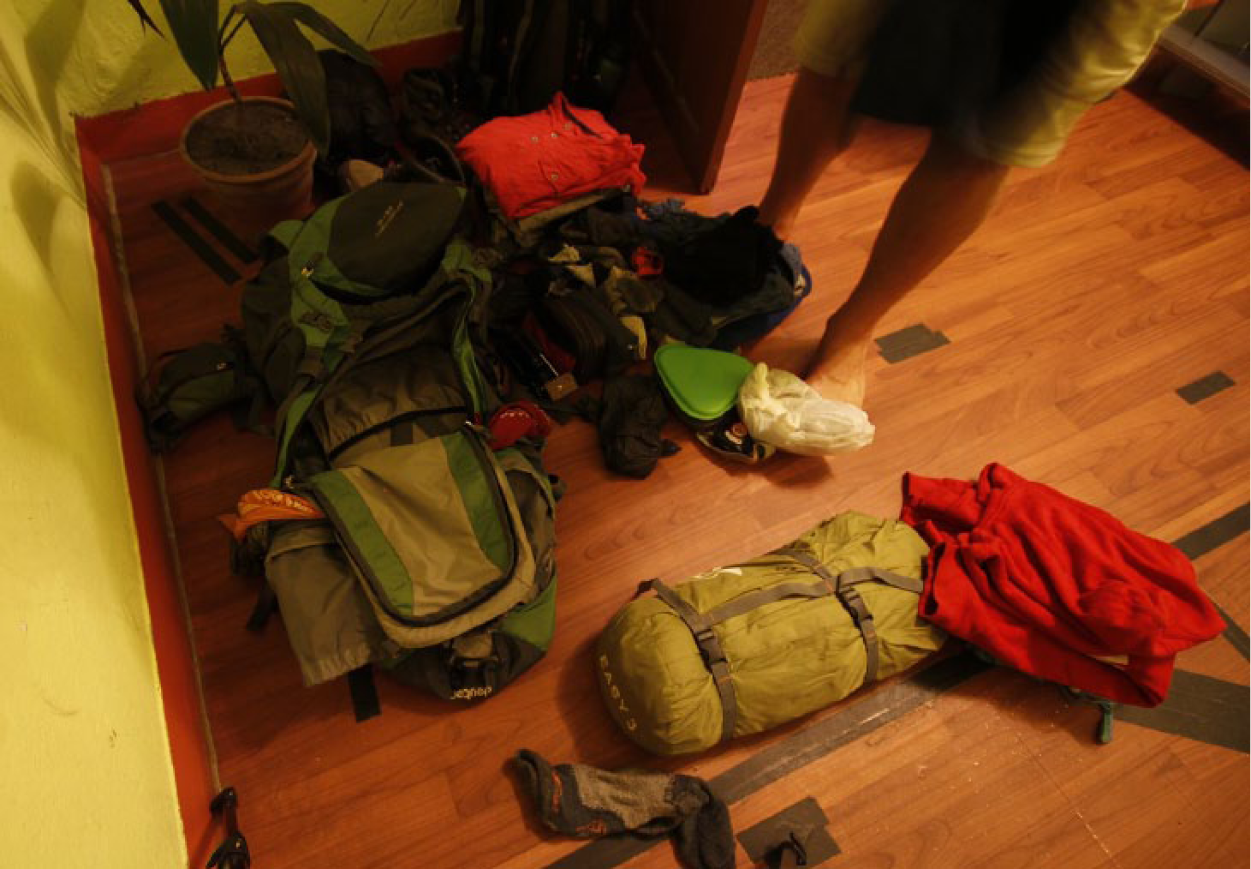
A tourist packing a bag in a hostel hallway, taken minutes before their departure.
Almost every time I packed and unpacked my bag during fieldwork, I documented the process. This consisted of a camera set up with a timer to take photographs while I packed. At the same time, I would take notes and sketch out the arrangement of objects within the bag (see Figures 2 and 3).
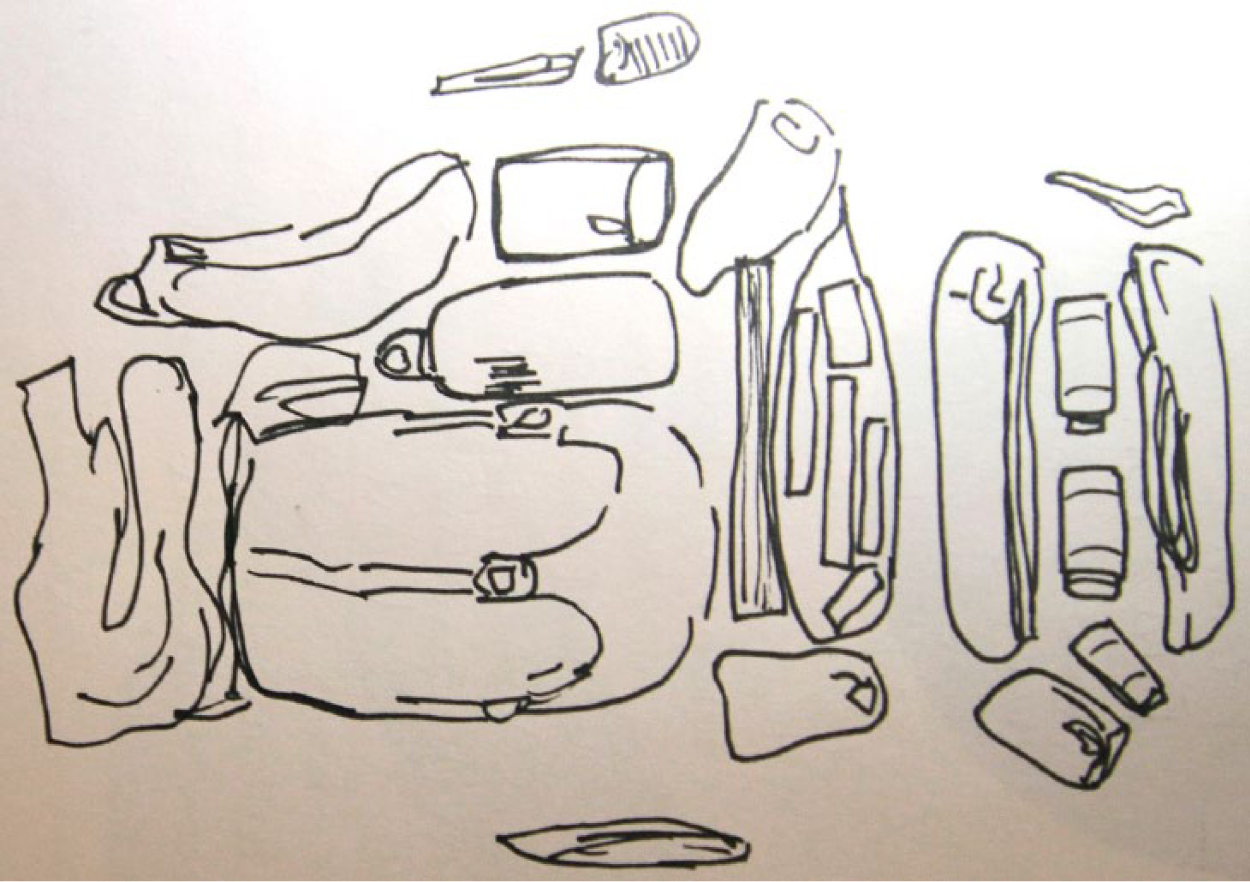
Diagrammatic sketch of my packed bag.

Diagrammatic sketch of my packed bag.
The sketches attempted to track the position of my belongings within the bag. I found that the sketches produced a viewpoint similar to an x-ray image, revealing where each object was positioned inside the bag, which the photographs alone were not able to capture. The sketched position of objects within the bag complemented the descriptions that tourists had given during interviews and my own experiences of the process. The sketches began to synthesise the documentation actions – the process, experience, observation, description – they alternate between verbal description and visual depiction. The media that I was using to document (interviews, photographs and sketches) and the first-hand experience of packing were intermingling in a diagrammatic manner: relationships were being traced and foregrounded in the process.
Using a diagrammatic approach to self-document my own packing process, as well as the tourists I interviewed and observed, became part of the experience that I had as a tourist and a researcher. The sketches that I made fit within a long tradition of tourist self-documentation. Tourists produce knowledge through experience (Crouch, 2004: 90), and documenting their own experiences plays an important role in the meaning making of their actions. There are a myriad of ways that tourists self-document, such as through social media, photographs, sending postcards, letters or email, buying souvenirs and so on. There is a large body of research on tourists documenting their own practices through writing and photography as evidence of their experiences (Bærenholdt et al., 2004; Larsen, 2008; Lean, 2012; Picken, 2014; Scarles, 2010; Urry and Larsen, 2011). These ‘mundane and taken for granted’ processes (Picken, 2014: 252) are generative practices of consumption and can be seen as a practice of ‘world making’ (Urry and Larsen, 2011: 167) that is more than simply reflecting or recording. Whether it is the process of taking photographs or writing a journal, tourists are consuming and documenting everyday experiences via an assemblage of practices.
The informal nature and participatory actions of tourist’s own self-documentation align with the potential of diagramming as methodological approach for tourism researchers. Regardless of the form or media of the diagram, the value lies in the creation of meaningful or affective relationships between experience, media and the potential for new modes of knowledge. It is within the intersection of fieldwork experiences, hands-on processes and documentation techniques of tourists and researchers that a diagrammatic methodology is warranted. This involves finding techniques that bring tourists and researchers together to examine everyday activities through collaborative and creative approaches.
Tracing relations through a participatory artwork
There is a long history and growing recognition that creative research methods generate co-productive benefits for researchers and their research subjects (Chilton and Leavy, 2014; Jokela et al., 2015; Kara, 2015; Leavy, 2015; Smith, 2014; Witzgall et al., 2013). Practice-led research is increasingly accepted in the social sciences throughout qualitative and quantitative approaches (Chilton and Leavy, 2014; Kara, 2015; Law and Singleton, 2013). Creative techniques provide alternative modes of expression, generate new ways to acquire research data and encourage participation, as well as increase the number of ways to distribute research findings to broader communities (Jokela et al., 2015; Leavy, 2015; Smith and Dean, 2009). In tourism research, there have been few explorations of creative arts practices as a research method. While creative practitioners (artists, writers, filmmakers and so on) have an extensive history of exploring travel experiences, tourist scholars have only just begun to explore the potential of creative modes of expression and interaction (Barry, 2016; Smith, 2014; Witzgall et al., 2013). Although there is a long tradition of first-hand accounts in ethnographic tourism research and the increasing importance of reflexive and affective, experiential modes of research (Jensen et al., 2015; Ren et al., 2010; Scarles, 2010; Walsh and Tucker, 2009), there is ample room for creative methods that offer alternative modes of engaging with tourists. In line with Caroline Scarles’ (2010) exploration of becoming a ‘researcher-as-tourist’ (p. 914), my own research practices sought to explore the entangled research experience.
Finding adequate ways of ‘illustrating the subtle negotiations … and the influence of inconspicuous material interventions’ can be challenging (Jensen et al., 2015: 2). The subtleties and ordinary aspects of packing proved difficult to articulate or re-present in the interviews. However, my sketched diagrams of packing make evident a different kind of knowledge register and information that enhanced the interview data on packing. At times ‘words are not enough. You need to practice’ (Law and Singleton, 2013: 485–6, original emphasis). ‘Doing research’ enables fresh insights into ‘the way tourism knowledge is ordered, performed and materialised in various contexts’ (Ren et al., 2010: 891). It was precisely this blending of practice and experience that captured my attention and highlighted the blurring role of the researcher-as-tourist. I decided to use my own processes of sketching the packing process to open up the research to invite further viewpoints and experiences through a participatory artwork.
The aim was to create an approach to documenting the packing process that emphasised ‘doing’ the research by facilitating hands-on participation. The artwork becomes an example of diagramming that relies on a blending of perspectives and collaborative processes. The purpose of the artwork in a gallery exhibition was to engage researchers and tourists in the research-creation process. Art practices have the potential to express knowledges through different sensations. As Brian Massumi (2008) states, ‘we always see relationally and processually … but art makes us see that we see in this way’ (p. 7). Presenting diagramming as an artwork in a gallery spatialises and intensifies our attention to the processes, experiences and modes of expression surrounding the subject of study, opening it up to new attentions and considerations as audiences interact with the work.
The artwork ‘Diagramming the packing process’ (see Figures 4 to 6) is a hands-on interactive installation where the task is to pack and unpack a bag and document the process. On the floor is an assortment of objects that are generally packed during travel, such as clothes, shoes and toiletries. While the clothing and objects are of course not one’s own personal items, the generic look, assortment of items and selection of ‘travel size’ toiletries speak to a general holiday tourist’s expected items for packing. While the participants pack, they are encouraged to sketch and diagram how they have arranged the objects within the bag. Large sheets of paper, plastic and marker pens are provided, with instructions for them to draw the positioning of objects as they pack. Participants pin their completed sketches to the adjoining walls (see Figure 5) where the layering of sketches collates the variations of packing approaches from the participants.
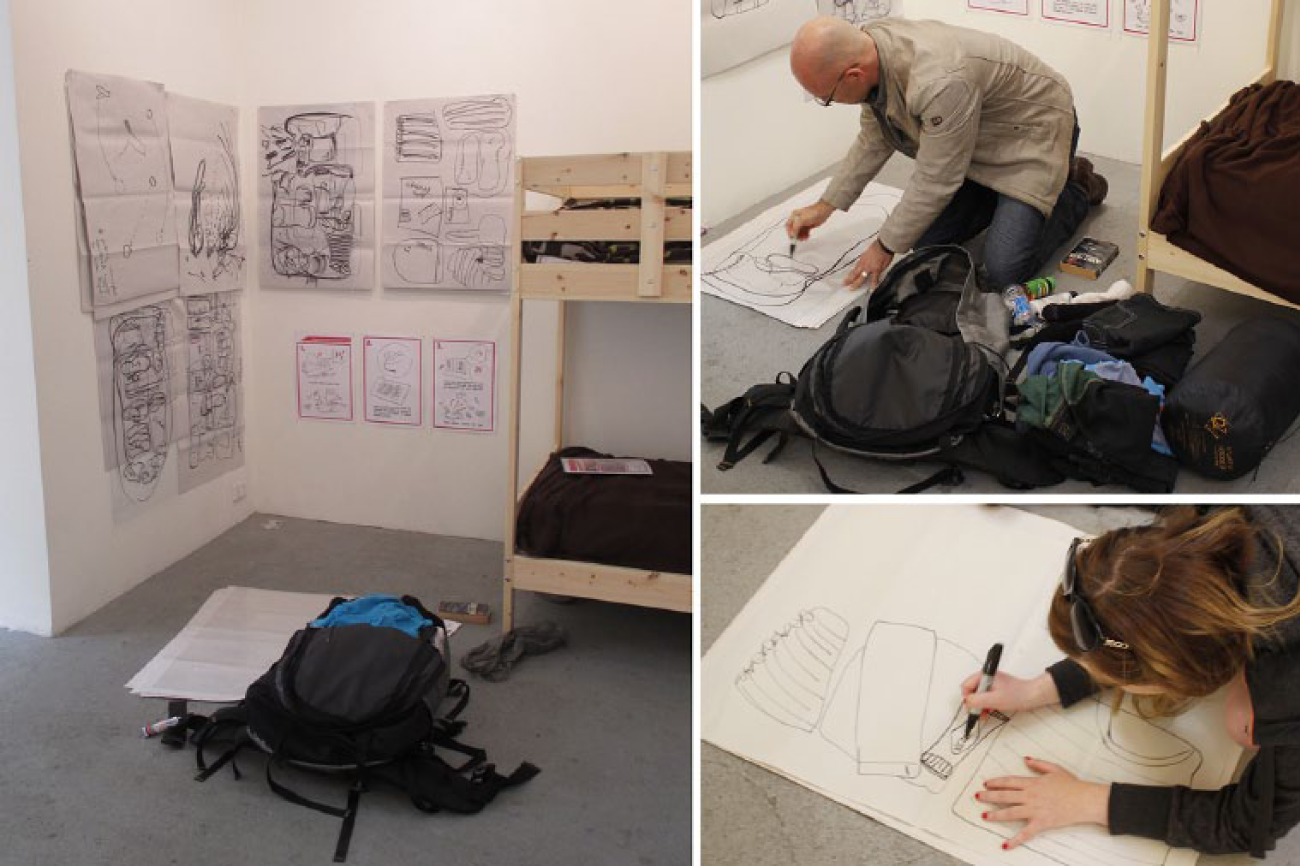
The artwork ‘Diagramming the packing process’.
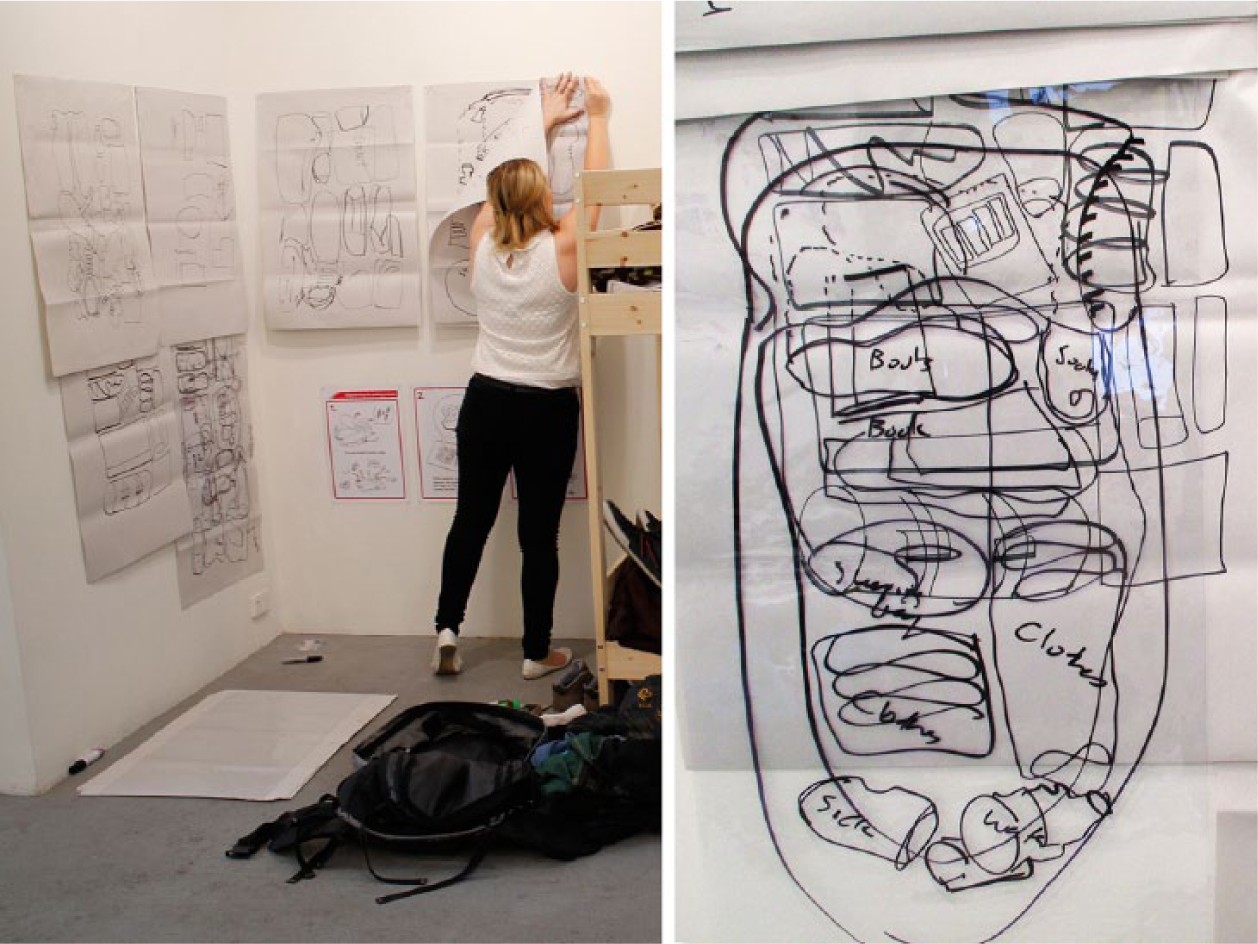
Participant diagramming their packing process in the exhibition (left); close up of layered diagrams pinned to the walls (right).
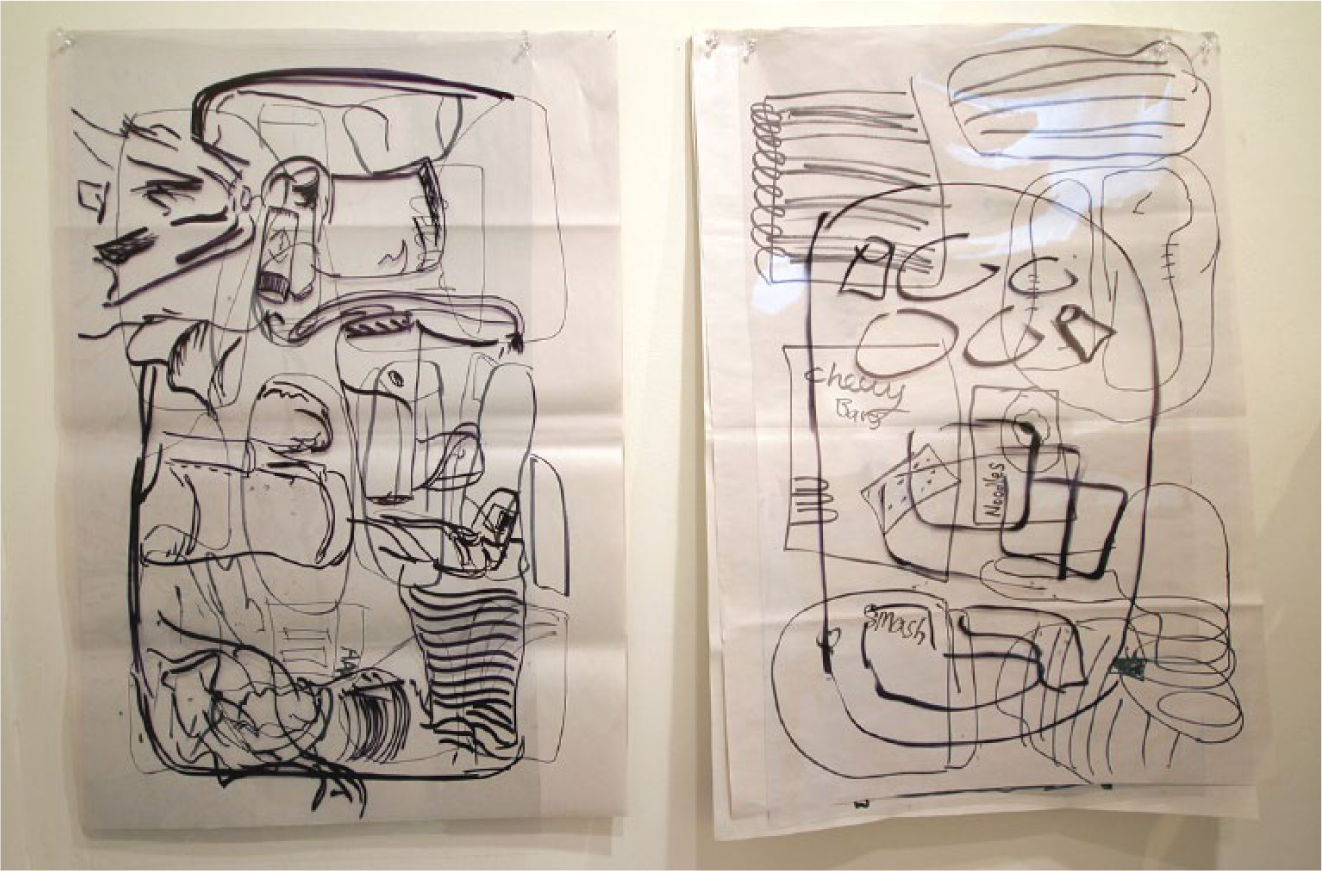
Sketches pinned to the gallery wall.
The artwork accumulates as more gallery visitors participate in the process – the sketches layered together assemble into a strong visual aesthetic on the white gallery walls, adding a certain value or point of interest to the packing process due to its representation as ‘art’. The artwork within the gallery is similar to other emerging practice-led approaches that span ethnography and creative arts, in particularly the technique of participatory drawing. This involves inviting research participants to draw their perspectives or experiences, often of a map or place, and to talk or narrate with the researcher while they draw. There is an emerging literature on the benefits and challenges of participatory drawing as data generation (Knight et al., 2016; Literat, 2013; Ng and Chan, 2015). However, much of the discussion on participatory drawing lays emphasis on the visual and verbal techniques, rather than the embodied and sensory interactions that are occurring while the drawings are being made. The social aspect of participatory research is often foregrounded, but the embodied and sensual nature of the collaboration between researchers and participants still remains fairly clouded. As Knight et al. (2016) explain, it often has ‘a tendency to regard drawing as a documentation item produced solely by the participant to provide a narrative to the researcher’ (p. 325). In addition, Iona Literat (2013) cautions that ‘a more significant concern is in regards to the interpretation of the findings’ (p. 93). What we see (as researchers, or as audiences viewing the drawings in a gallery) can easily be misinterpreted, or judged purely on its aesthetic and technical capacity to depict a situation or idea. Therefore, the established technique of participatory drawing differs to the diagramming methodology that I have used in my artwork. The creation of a participatory artwork that requires people to draw has a different goal – it gives emphasis on the collaboration, material processes and accumulation of perspectives. The process of drawing collaboratively ‘is a different way of drawing’ (Knight et al., 2016: 321) that emphasises the shared experiences that develop through process.
Drawing collaboratively is diagrammatic – it is an accumulation of experiences, sensations and responses, which contribute to an ongoing development rather than an individualised account or ‘truth’ in narrative. Relationships between individual participants are fused with the process, generating new connections, insights and affordances that enrich the data. Knight et al. (2016) maintain that ‘collaborative drawings are not considered illustrations of the research, they are the research’ (p. 328). In creative arts research, the ‘findings’ of an inquiry are emergent and require reflection that always puts the researcher back into the situation of study (Barrett and Bolt, 2007; Bolt, 2004; Carter, 2004). Therefore, by generating packing as an artwork that requires participants to draw inside the gallery, it changes the way that people perceive and understand their practices – whether in the gallery exhibition or later. While it could be said that the activity of packing, when staged within a gallery space, is removed from the kinds of personal pressures and restrictions of packing while on holiday, this artwork achieves the aim of drawing people’s attention to packing as an everyday tourist practice. It is less about the fact that these are not your belongings or bags, or finding a concrete realisation moment about one’s own packing process, but instead it instigates a subtle shift in the way that they might conceive of their past tourist experiences, present packing processes in the gallery or future tourist engagements.
The ‘findings’ that the artwork renders, like a present tense verb, is an ongoing process rather than a set of facts or information that have been accumulated and analysed in a formal sense. This difference between findings as an ongoing experience or a set of static data is important to note because creative arts ascribe to the notion that our experiences are always in co-production and it is through our collective interactions that artworks manifest alternative and affective registers of knowledge. It is about situating the researcher in the middle of things, which is precisely what Scarles’ proposition of the researcher-as-tourist recognises as an integral part of tourist studies (Scarles, 2010). Therefore, the activity that this artwork sets up in a gallery are not the findings or insights of my own fieldwork, but are an accumulation and enactment of diagramming that prompts new engagements between tourists, researchers and gallery visitors.
The layering of sketches on the gallery wall (Figure 6) moves the focus beyond the task of drawing, instead focusing on the assemblage of perspectives and experiences of the process. Because there is no one correct procedure for packing a bag, the accumulation of the sketches (some drawn on paper, some drawn on sheets of transparent plastic) draws attention to the different perspectives that inform the selection and arrangement of objects, emphasising the varied experiences of this mundane, everyday task. Together, the sketches form a diagrammatic re-presentation of a tourist practice. The creative process is alert to how ‘the interaction between co-artists, co-researchers and participants’ is manifested (in a representational form) and less on the ‘personal expression’ or artistic skills of individuals (Jokela et al., 2015: 445). It is a collective process of diagramming movements, processes and experiences.
When the participant is making a sketch, they are depicting their decisions of what to pack and how to arrange objects and also the assemblage of movements that are being undertaken. Perhaps it is these subtleties of the process, of how people arranged clothes, sketched objects or the non-verbal decisions witnessed in moments of pause or hesitation as someone packed that becomes most revealing of how we negotiate everyday practices as tourists. The combination of the two processes – packing (sensing, selecting and moving with materials) and drawing (a particular body-aesthetic process of depicting the world) – provides alternative speeds and sensitivities for exploring the packing process. O’Sullivan (2016) describes that when we draw, ‘[t]he speed of the hand (or intelligence of the body) can outrun the cogito’ (p. 21). Enthralled in the packing-sketching process, the task of ‘diagramming’ packing opens us up to thinking, feeling and moving in ways that might be beyond what we could verbally account for in an interview alone. It might be a way to allow oneself to ‘drift’ in the process, as one of my interview participants suggested, or to be ‘spontaneous’ (Vigurs and Kara, 2016: 8), or to have ‘time to reflect’ (Literat, 2013: 88). The diagramming methodology that the artwork instigates requires participants to ‘using their whole bodies and material environments’ to articulate through non-textual modes ‘the multisensoriality of their experiences through these performances’ (Pink, 2009: 109). The tangible, material and multisensual interactions were transformed through the sketching process, and contribute to the evolving diagramming practice. In this way, the ‘practicing’ of packing as an artwork, and the process of diagramming it in the gallery, invites reflection on the experiential, the multi-sensuous and the embodied engagements in tourism. It provides the opportunity to experience ‘the entanglements of the ‘personal’ and ‘science’ in tourism research (Ren et al., 2010: 892), where the shared experiences of the researcher, the subjects of study and the knowledge produced are integrally linked.
Conclusion
Diagramming provides a creative methodology for studying tourist practices in which collaborative and creative interactions between tourists, researchers and a broad public audience can develop. Finding an approach that can take account of the blurred lines of tourist and researcher experiences needs to be open to a variety of methods and modes of engagement. Diagramming – when understood as a procedure for tracing and tracking the myriad of relationships that are evident in tourism and mobilised by tourist researchers – contributes to evolving discussions on the intersection of artistic practice and tourism research methods, and the challenges of the researcher-as-tourist role. Considering my own research process as diagrammatic allowed me to take account of the overlapping experience of myself as researcher and tourist. In line with calls for new and innovative inquiries into tourism practices and experiences (Coles et al., 2009; Merriman, 2014; Ren et al., 2010), my proposition of diagramming as a creative methodology is a merger of practice and theory, creativity and experience.
Tourist studies needs to be alert to the relationships that are instilled in everyday practices. How tourists perceive, practice and reflect on the packing process sits within broader discussions of material interactions and everyday practices (Franklin, 2014; Jensen et al., 2015; Larsen, 2008; Van der Duim et al., 2012). The process of packing requires assembling objects, routines and memories, which are then unpacked and repacked, forming new relationships and adding further meaning to this everyday tourist practice. Diagramming is a perfect approach to examine how tourists negotiate and form relationships in both macro and micro movements and individual and collective tourism experiences.
Looking at everyday tourist practices through the lens of creative arts makes it possible to focus on the enactment of decisions that account for the many sensations, relationships and the complexity of the subject of inquiry. The artwork that I devised generated a diagram that draws attention to the overlaps of tourist activities and creative techniques for documenting and recording experiences. Creative and collaborative methods are well suited to comment upon these experiences and contribute to them by traversing media, situations and expressions. The ‘task’ that the artwork sets up is a re-presentation of the relationships and techniques that are already at work in tourism and used by both researchers and tourists. By extracting techniques and experiences of the researcher-as-tourist (Scarles, 2010) and offering these to a public audience in a gallery, multiple perspectives were assembled. This diagrammatic technique – of practising packing, documenting it and forming interactions between researchers and tourists – instigates new approaches to collecting data and observing the subtleties of everyday tourist practices. Diagramming becomes a methodological practice, or as O’Sullivan (2016) describes, ‘a strategy of experimentation that scrambles narrative, figuration … and allows for something else, at last, to step forward. This is the production of the unknown from within the known, the unseen from within the seen’ (p. 17). These insights are important in understanding how and why packing a bag and other daily mundane routines contribute to wider tourist experiences and how tourists perceive and comprehend their everyday actions.
The research examples I have discussed through the article are emblematic of how diagramming can provide alternative methods for exploring tourist practices that are sometimes indiscernible, fleeing or mundane. Moments where tourists and researchers alike can experience a process and use first-hand accounts can be a starting point for further research inquiries. Diagramming is a creative research method that includes a wider and more complex range of information sources and a mode of producing links and connections that occur within the site of knowledge acquisition and the activation of knowledge distribution. The creative notion of the diagram assists in attuning to the relationships that form between documentation, movements and experience. Whether the application is for fieldwork research, for tourists to contemplate or for everyday practices, a diagramming methodology encourages creative and collaborative practices.
Footnotes
Declaration of conflicting interests
The author(s) declared no potential conflicts of interest with respect to the research, authorship, and/or publication of this article.
Funding
The author(s) received no financial support for the research, authorship and/or publication of this article.