







Abstract
This article discusses the touristic production of authenticity in the context of algorithmic culture. It notes that the dominant sociological framework of authenticity has, in the last decades, shifted from an objectivist to a constructionist one, a central issue becoming “who has the right to authenticate.” I argue here that “who” needs to be supplemented with “what” due to the operations of mainstream algorithmic platforms for the production and reception of travel information. Review websites such as TripAdvisor construct and confirm the authenticity of places and people through a double orientation of highly subjective, “hot” authentication processes and quantified appeals to “cool,” objective authenticity (Selwyn). This double orientation is explored in the algorithmic affordances of and user interactions on TripAdvisor. In conclusion, the article considers the sociotechnical fusion of both quantitative and experiential appeals to be productive of an algorithmic authenticity.
Keywords
Introduction
Today’s travel takes place in a world that is comprehensively known and mapped. Over a few decades, the expanding middle classes of the First World have obtained increased access to air and sea travel around the world. Globalization and mobility, to them, have gone hand in hand. At the same time, (access to) visual and textual information about potential travel destinations has increased exponentially. Many more people than ever before live mobile lives, giving rise to a figurative cosmopolitan mobility class. To these citizens, online distributed knowledge of the traveled world is readily available: One can find available accommodations or restaurants, search out nearby points of interest, look up the route to take there, check the current weather conditions, or investigate the local or national sociopolitical climate. Accurate, high-resolution digital images of locations—from cities to streets and individual buildings—are available at the touch of a button. Even places that are remote and physically inaccessible are documented by services such as Google Streetview and Google Earth, if not by the more adventurous travel bloggers, reviewers, or reporters. This results in a remarkable profusion of vicarious travel possibilities that would have seemed miraculous even a few decades ago, let alone for those living in previous centuries.
I will argue that, in this context of online endorsement of touristic sites, we need to reevaluate the concept of authenticity. This article explores how touristic authentication, understood as a socially constructed practice, takes place through human–computational processes on online tourism platforms. Such processes are considered operationalizations of “algorithmic culture” (Galloway, 2006), a culture characterized by “the enfolding of human thought, conduct, organization and expression into the logic of big data and large-scale computation” (Striphas, 2015: 396). For tourists, computational systems leveraging big data are increasingly codetermining which sites or events are the most visible. They also allow for spontaneous and real-time information gathering and interaction. In times of such digitally aided, plugged-in travel, it is argued that authenticity is certified through a particular combination of “hot” and “cool” aspects (Cohen and Cohen, 2012; Wang, 1999) involving personal stories and evaluations in a quantified informational context. The argument unfolds as follows: First, an overview of literature on authenticity is offered, which is then connected to the current-day context of digital media and algorithmic culture. This leads to a conceptualization of “algorithmic authenticity,” produced by both algorithmic protocols and personal narratives. This concept is applied through an analysis of online review platform TripAdvisor.
Authenticity: objects and experiences
Authenticity is one of the keywords in tourism as a behavioral, performative, semiotic, and linguistic practice (Barthel-Bouchier, 2001; Butler et al., 2001; Cohen, 2004; Cohen and Cohen, 2012; Culler, 1990; Dann, 1996, 1999; Hillman, 2007; Kim and Jamal, 2007; Knudsen et al., 2007, 2016; Lau, 2010; MacCannell, 1999; Reisinger and Steiner, 2006; Selwyn, 1996; Shepherd, 2015; Steiner and Reisinger, 2005; Taylor, 2001; van Nuenen, 2015; Wang, 1999). Within tourism studies, it has been categorized from objectivist, constructionist, existentialist, psychoanalytical, and postmodern perspectives (Knudsen et al., 2016; Steiner and Reisinger, 2005; Wang, 1999). These are categories that do not stand in isolation, but are relational in touristic experience: Authenticity functions simultaneously as “a measurement, representation, experience, and feeling” (Rickly-Boyd, 2012: 274). Broadly speaking, the sociological study of authenticity has, in recent decades, supplemented questions about expertise and objective determinations with those of subjectivity, experience, and social power. According to Lionel Trilling (1972), the original use of authenticity in tourism was museum based, with experts wanting to determine “whether objects of art are what they appear to be or are claimed to be” (p. 93). Throughout the last decades, this question of “how can something be authentic?” turned into questions such as “who decides what is authentic?” (Bruner, 1994: 408) and “what does authenticity do?” (Rickly-Boyd, 2012). This means we have to think both about the object and the experience the concept refers to; authenticity acts both as a noun and a verb.
In the objectivist sense, authenticity refers to an intrinsic quality of objects, people, places, and events that enables an expert-led distinction between genuine and fake, production and reproduction, original and copy (Barthel, 1996; Rickly-Boyd, 2012; Wang, 1999). Critics have long argued against the essentialism apparent in framework (see for an early example, Handler, 1986). The dominant models that succeeded the objectivist strand were built on constructionist theories instead: Authenticity, with culture in general, is regarded as an emergent, performed, socially negotiated interpretation and judgment, which is first and foremost part of the “political economy of taste” (Bruner, 1994: 408; see also Edensor, 2001; Frisvoll, 2013; Lau, 2010; Olsen, 2002). The epistemological shift, here, runs from authenticity to authentication, defined by Cohen and Cohen (2012) as “the social process by which the authenticity of an attraction is confirmed.” The Cohens focus on the social and political forms of authentication, building on Selwyn’s distinction between “hot” and “cool” authenticity. Their associated forms of authentication consist of, respectively, informal and emotionally loaded performances, and positivistic, falsifiable declarations (Selwyn, 1996: 20–28). Cool authentication typically refers to “a single, explicit, often formal or even official, performative (speech) act, by which the authenticity of an object, site, event, custom, role or person is declared to be original, genuine or real, rather than a copy, fake or spurious” (Cohen and Cohen, 2012). It is deployed by an authenticating agent who is deemed entitled to perform the authentication and often takes the form of formal criteria or “proof” by means of certification or accreditation—even though this authenticity might be (and often is) contested. Hot authentication, by contrast, is a more informal and anonymous process, lacking a well-recognized expert. It is reiterative and informal: Hot authentication means that “the sacredness, sublimity, or genuineness of sites, objects or events is constantly perpetuated, confirmed (and augmented) by public practice, rather than by some declaration” (Cohen and Cohen, 2012). Typically, it is produced by performative practices such as paying obeisance and worshipping. As such, it is emotionally loaded and based on belief, rather than proof, rendering it more resistant to external criticism.
Hot authenticity is connected to the existentialist perspective of the term, which has received much attention in recent years. It considers authenticity as something residing in the subject instead of the object, 1 and refers to philosophical virtues such as self-knowledge, a sense of identity, and an attempt at living in accord with one’s sense of self (Belhassen et al., 2008; Buchmann et al., 2010; Kim and Jamal, 2007; Pons, 2003; Steiner and Reisinger, 2005). Lionel Trilling (1972) commented that existential authenticity involves the moral call of finding and expressing the true inner self and judging all relationships in terms of it; a primacy of the self over the social. It corresponds to “a profoundly individualistic ideal, understood as involving a personal quest or project that pushes self-fulfillment and self-discovery to the forefront of your concerns” (Potter, 2010: 21). The mark of the authentic, in this sense, is not that it reflects some objective truth in the world. It has no positivistic foundation, but is only true to how the individual feels at a given moment. This makes authenticity susceptible to marketing strategies, strategically targeting tourist fantasies (Hearn, 2008; Kane, 2012; Knudsen et al., 2016; MacCannell, 1973; Potter, 2010; van Nuenen, 2015; Week, 2012). Wang (1999), further, subdivided existential authenticity into intrapersonal and interpersonal forms. The first refers to bodily experiences and self-making, which in touristic contexts can take the form of adventuring and trials (e.g. mountaineering) and of the consumption of sensual pleasures (e.g. beach holidays). The interpersonal category indicates strong social ties to one’s communitas or family, but is also found in touristic interactions in which one’s social or occupational status “at home” is ignored, and intensive sociality and emotional interactions define the experience.
The existentialist framework illustrates that authenticity is related to the desire to “get in with the natives,” to see the life of the “other” as it is “really lived,” to witness “back region” singularities that other tourists have not seen—that is, to have an “authentic connection” to the places visited (Oakes, 2006). Such a connection, however, is hard-won: Daniel Boorstin famously decried the increasing disappearance of such authentic experiences and events, describing how “the lost art of travel” had been replaced by the prepackaged, insured, and tightly circumscribed trips offered by the tourism industry. Its consumers, passive spectators instead of their allegedly more serious predecessors, expect “that the exotic and the familiar can be made to order,” and as such seek and engage in artificial, inauthentic “pseudo-events” instead of authentic ones (Boorstin, 1961: 80). 2 Boorstin attributed one difference between his two types of journeying to the degree of preparation: travel required long planning, absent in modern tours. Promptness here becomes a signifier for what Boorstin considered the shallow touristic experience.
Taking up the idea of staged experiences, Dean MacCannell’s foundational work moved beyond Boorstin’s essentialist approach and toward a view of authenticity as a symbolic or imaginary construct (Cohen, 1979; Culler, 1990; MacCannell, 1973, 1976). In neo-Marxist fashion, MacCannell (2008) argued that tourists seek out authenticity as a counterforce to the alienation they experience in everyday life: It acts as “a quasi-fictional locus of fantasies of fulfilment” (p. 337). This dream is met by the sophisticated staging capacities of the tourism industry, producing fake back regions for touristic consumption. Authenticity, to MacCannell is never attainable. This idea of authenticity as an unrealizable fantasy has also been framed via Lacan, where authenticity is similarly placed in a dialectical relationship with psychological alienation (Kingsbury, 2010, 2011; Knudsen et al., 2016; Vidon, 2017). In this view, authenticity functions as a chimerical and unattainable object of desire, an objet a in Lacan’s famous terminology—which is precisely why it remains a perpetually motivating force to embark on tours. Taking one step further to postmodern readings of the concept, it has been argued that the chimeral nature of authenticity is not so much a psychological issue, but an effect of the significations and symbolism of culture and media. In this view, reality is mirrored and finally overtaken by simulations without an original referent (Baudrillard, 1994; Eco, 1986). Inspired by these philosophical claims, tourism scholars have noted that tourists may become ironically detached from the places they visit, or even that they start actively looking for simulations instead of authenticity markers (Feifer 1985; see also Rickly-Boyd, 2012; Wang, 1999). Conversely, the point that will be made here is that the phantasmagorical goal of authenticity is hardly obsolete—and moreover, that it is increasingly approached through a combination of highly personal opinions and claims to observer-independent, statistical precision.
The synergetic mixture of data and opinion as I will proceed to describe it below has been variously depicted in the social sciences. One well-known explanatory concept is that of “information cascade”: situations in which Internet users start passing on information they assume but cannot know to be true, based on information about what other users are doing (Easley and Kleinberg, 2010). This phenomenon is closely related to that of “context collapse,” which refers to situations on social media in which peoples’ behaviors and materials intended for a limited audience can suddenly clash with the wider groups interacting online (Marwick and Boyd, 2011). Both of these concepts underline the sociotechnological construction of reality, as opinions are unevenly accelerated and prioritized by ranking technologies and their tendency to return results relevant to a user’s previous interests. The latter is what The Guardian’s editor-in-chief Katharine Viner referred to as well when she argued that we currently live in a “post-truth age.” Viner’s claim was that the Internet has aided the disruption of journalistic principles of truthfulness and objectivity. Due in part to the many filtering and personalization algorithms on social media through which users interact in echo chambers or filter bubbles, “[i]ncreasingly, what counts as a fact is merely a view that someone feels to be true” (Viner, 2016; Pariser 2011). Taking up this view on veracity and truthfulness as effects of both information systems and emotionally charged experiences, I want to suggest that authentication, as a touristic process of constructing both the “really lived life” of others and that of the “real self”, requires rethinking as well.
Authentication in algorithmic culture
The different perspectives on authenticity discussed above are typically supported by studies of touristic encounters. MacCannell analyzed several European and American “tourist settings”—purposefully created touristic spaces—in which he located objectivist concerns of holidaymakers and service providers. Bruner (1994) based his argument about constructed authenticity on his anthropological research at the New Salem Historic Site. Butler et al. (2001) illustrate the subjective concern for object authenticity by referring to tourists visiting Route 66 who wish to know that they are driving on the road’s original pavement. And Lau (2010) explains his “social realist” conception of authenticity by examining tourists traveling along River Chua Phraya to see Bangkok or visiting Rio de Janeiro’s favelas, thus sharing “a slice of local life” (p. 481). Of course, the production of authenticity precedes the trip itself, as brochures, images, and other “markers” are distributed to convince tourists of the authenticity of the potential sites and encounters they might have (Cohen and Cohen, 2012). It is this notion of pre-trip authenticity that will be further elaborated on in this article.
Research in the field of mediatized tourism or “media tourism” emphasizes the “necessary interdependence between tourism and the media” (Crouch et al., 2005: 1) and the influence of fictional mediated narratives on destination choice (Reijnders, 2016). There is a particular focus on the relation between media usage and the sense of place in embodied tourist settings—whether viewed, for instance, with a Foucauldian focus on gaze (Urry and Larsen, 2011) or as a Goffmanian performance (Crouch et al., 2005; Edensor, 2001; Jacobsen, 2010; Månsson, 2015). Others have pointed out the convergence of online and offline practices in the identity project of the tourist. Online interactions have been taken into the fold to explain the construction of authenticity, such as those between bloggers or web platform users (e.g. Azariah, 2012; Bosangit et al., 2015; van Nuenen and van Varis, 2016; Volo, 2010; Wenger, 2008). Research into e-word of mouth (eWOM) marketing is also well-established. eWOM refers to online, informal consumer communications, related to the usage or characteristics of particular goods and services or their sellers (Litvin et al., 2008). Studies into eWOM emphasize the impact of user-generated data on web platforms, such as reviews and blogs, and investigate aspects such as the effect of eWOM on trustworthiness (Jeacle and Carter, 2011; Kim et al., 2009), (dis)satisfaction (Crotts et al., 2009; Sánchez-García and Currás-Pérez, 2011), and the decision-making processes of prospective tourists (Casaló et al., 2010; Fili and Krizaj, 2016; Litvin et al., 2008).
What remains underexposed in these studies, however, is a view on the co-constitutive role of computational mechanisms in determining how online informational practices—and the production of authenticity in particular—unfold. Both have been transformed considerably in the context of what has been called “algorithmic culture” (Galloway, 2006). Algorithmic culture is characterized by “the enfolding of human thought, conduct, organization and expression into the logic of big data and large-scale computation” (Striphas, 2015: 396). In his exploration of the term, Striphas lists a number of keywords, similar to those that Williams (1983) identified in Culture and Society, in order to chart the modern meaning and importance of the term algorithmic culture, including “the general body of the arts” as well as “a whole way of life, material, intellectual, and spiritual” (p. xvi). Algorithmic culture implies a particular logic of knowledge, “built on specific presumptions about what knowledge is and how one should identify its most relevant components” (Gillespie, 2012: 168). Striphas notes that cultural activities have become “data-driven,” subject to machine-based information processing. This also implies that simple errors in data management can lead to significant issues. Striphas’ example is that of Amazon, now the fourth most valuable public company in the world (Cheng, 2016). In 2009, Amazon temporarily excluded gay and lesbian-themed books from its sales rankings, searches and bestseller lists—all due to a simple algorithmic cataloging error. In the realm of tourism, a similar example can be seen clearly in online hospitality service Airbnb, which enables people to lease or rent short-term lodging. At the time of writing, Airbnb offers a total number of four million listing, which is higher than the top five major hotel brands combined (Gerdeman, 2018). Recently, a new law in Japan requiring Airbnb hosts to register their listing and display a license number on their listing page forced the platform to cancel existing bookings and remove about 80 percent of the listings (Airbnb, 2018; Deahl, 2018; Johnston, 2018). On this scale, database manipulations can significantly influence interpretation activities—that is, the view on “what is there” to begin with, and the valuation of the knowable.
Algorithms function within a broader epistemology of information, which Striphas, following Williams, expands on. Its modern definition, he notes, is object oriented: Information shifts from its legal history, in which it references the human imparting of an essential character or particular quality to something, to an empiricist raw material that exists apart from our cognitive faculties: a “counter-anthropological leveler” (Striphas, 2015: 400) allowing for real-time tracking and predictive analysis of social behavior. Datafication is increasingly used as a legitimate means to access, understand, and monitor human behavior (Aiden and Michel, 2013). Not only is the scale on which we can map and analyze phenomena larger than ever before, enthusiasts confidently state that big data help us get closer to reality (Mayer-Schönberger and Cukier, 2013). Big data advocates embrace a realist epistemology, claiming that through data (which in Latin means “given,” in the sense of “fact”) observer-independent facts can be transmitted (Aiden and Michel, 2013; Anderson, 2008; Drucker, 2011). The philosophy of datafication envisions data as transparent and instantaneous (Ernst, 2013; Hoskins, 2011), denying its mediated character as it encourages us to simply “let the numbers speak for themselves” (Anderson, 2008).
In this ideological context of transparency, Striphas reviews the semantic shift of “information” from a legal and religious meaning in the twelfth century to the object-oriented definition it carries today. It “inaugurates a process of abstracting information from the body; instead of being vested there, information becomes a separate raw material that must be given order vis-a-vis our cognitive faculties” (Striphas, 2015: 399; cf. Gleick, 2011). Information, as Striphas suggests, becomes a “thing” in the Kantian realm of unmediated sense data: raw material to be handled, managed, bought and sold. Algorithms, in this context, can be thought of as formal processes or set of step-by-step, calculative procedures, transforming input data into a desired output. They often act as procedures for problem solving, both describing the task at hand and the method by which it is to be accomplished (Gillespie, 2012; Goldschlager and Lister, 1988; Weizenbaum and Wendt, 2006). As such, they are pivotal in the prioritization and classification of data, the association between entities such as webpages, and the filtering of information according to specific criteria (Diakopoulos, 2015: 400).
It shouls also be noted that information in algorithmic online environments tends to circulate in particular media formats, which John Durham Peters has called “logistical media.” They are typified not by their narrative or representational content, but by their character of organization, segmentation, or categorization. Examples of such media are databases, filtering systems, and other “data processors” that “arrange people and property into time and space” (Peters, 2013: 40). These media forms are of interest not only to the handful of Silicon Valley tech giants leading users to share their data on some proprietary network (Lanier, 2013: 54) but also to the individuals who do the sharing. Culturally speaking, Peters argues, we find ourselves in a society fascinated by systems of sorting and classification: The interest here lies not only with the content of the data we interact with but also with the metadata labeling it: Who did the creating, where it was created, when it was created, and so on (Andrejevic et al., 2015: 379–394). In a similar vein, Manovich argues that the database has become a dominant culture form, which should be understood as paradigmatic, as opposed to syntagmatic: They are a collection or set of signs on a “vertical” axis. Many new media objects, he notes, do not tell stories; they do not have a beginning or an end; they are not sequentially organized (Manovich, 1999).
The cultural interest in the database form can be connected to a point Marshall McLuhan (1994) made when using, tellingly, the terms “hot” and “cool” in order to distinguish between different forms of media (p. 22). He defined hot media as an extension 4 of our physical senses in “high-definition,” leaving little room for interpretation and further thought on the part of the audience as it “spoon-feeds” content. Cool media, conversely, are “low-definition,” characterized by information sparseness and frequent gaps in content. They demand a greater deal of interaction, and knowledge of genre conventions, on part of the audience. McLuhan connected the intensity hot media to a necessity of specialism, as opposed to the inclusiveness of cold media. Describing the database in these terms, we realize it is both a hypermutable medium—in our online interactions, we are constantly appending to databases—and a notably opaque medium, seldom encountered in its original form, a back-end accessible only to its highly specialized creators. Fundamental to the organization of websites, services, and platforms, the database has the potential of being both “hot” and “cold” in McLuhans’ terms—and also, as we will shortly see, in those of the Cohens.
Toward algorithmic authenticity
The ubiquity of the abovementioned systems of computation, algorithms, and calculation in daily life—especially since the development of the World Wide Web (WWW)—and now their inclusion in mobile devices, has had a decisive influence on every aspect of contemporary travel. For instance, popular review platforms such as TripAdvisor allow users to add anecdotal material to databases, or to search through database materials by applying certain filters on their metadata, such as “place” or “rating.” These opportunities have considerably restructured the notion of expertise, traditionally reserved for the tour operator or guide in a field of relatively demarcated knowledge. Currently, extensive knowledge about the traveled world is available to regular Internet users through the aggregation and interpretation of crowdsourced data by various search algorithms. The process of authentication as depicted by the Cohens, thus, needs to be reformulated with these mechanics in mind, as its algorithmic outsourcing will increasingly influence which places are considered as destinations, while also impacting the identity of tourists themselves.
Larsen et al. (2007), in this context, refer to the “new mobilities paradigm”: the enabling of new links between an activity, place, and time due to mobile phone consumption. The plugged-in traveler can find available accommodations or restaurants, search out nearby points of interest, look up the route to take there, check the current weather conditions, investigate the local sociopolitical climate, and so on. This immediate and personalized pulling of real-time information influences all stages of one’s trip, and differs from times when the tourist would have recourse to physical guides and images. What was once a general familiarity with an image and idea of, for example, the Taj Mahal, in today’s travel culture translates as a possibly intimate knowledge of the site through premediation, including its layout, exterior and interior views, the effect of light on the marble, where to eat nearby, and how to get there. In this high-informational context, web platforms are making use of increasingly sophisticated algorithms to decide which places, sites, or objects in the database show up when it is queried by users. On algorithmically managed and logistical media, touristic information becomes unstable in its own ways, as it is continuously updated, reconfigured, and tailored to the individual. Consequently, the authentication of sites, people, and artifacts as objects—their purported “genuine” or “original” quality, which are pinpointed by “truth markers” (MacCannell, 1999)—is influenced by algorithmic culture. This has to do with both the organization and immediacy of personalized information in a Web 2.0 context. 5 Object authenticity, here, is not based on the opinions of a select group of experts (Bruner, 1994) but on the aggregate knowledge of the digital masses, and the algorithms connecting them to create user-friendly experiences characterized by “usability” and gamification. The unprecedented popularity of eWOM, mentioned above, is indicative of the same development.
Of course, tourists always give different interpretations to the information they receive about what their experiences are supposed to mean to them (see, for instance, ethnographic accounts of travel; e.g. Bruner, 1994; Gable and Handler, 2005). 6 There is always a multiplicity of competing truth claims, and a personal uptake, when it comes to touristic information seeking. The point here is not about the volume of information, but about the way in which this volume of information is arranged, its seriality, which forms a way to present an organized mass to a public. In this context, it is interesting to revisit MacCannell’s remarks about the sociocultural nature of truth constructions that are typical of the modern age. “Within this manifold, the individual is liberated to assemble and destroy realities by manipulating sociocultural elements according to the free play of his [sic] imagination” (MacCannell, 1976: 141). In algorithmic culture, black box algorithms have begun to codetermine what tip of the data iceberg is shown, and the imaginative capacities of those seeking information. We may use search functionalities to only search for negative reviews, for instance, but then we still do not know how or why certain entries in the database come up, and why others do not. The situation is compounded by the fact that we face an unprecedented privatization of the digital sphere, in which a significant part of the shared information flows through proprietary platforms and services, and algorithms are among the world’s most valuable corporate assets.
To further embed the notion of authenticity in algorithmic culture, it is necessary to look at the aspects of temporality and personalization. The constructionist reading sees authenticity as necessarily and obviously temporal in nature, as the social practices that construct authenticity evolve over time. 7 Object-oriented authenticity, it has been noted, is everything but a fixed, ahistorical phenomenon: Places that were once constructed as overt fakes can become authentic in the passing of time. Cohen (1988) already pointed to what he called “emergent authenticity” noting that “an apparently contrived, tourist-oriented festival (such as the Inti Raymi festival in Cuzco, a ‘revival’ of an ancient Incaic custom) may, in due time, become accepted as an [object] ‘authentic local custom’” (p. 379).
The point about temporality and individualism is salient in the context of big data, which, as Boellstorff (2013) notes, has a temporal dimension that needs addressing through what he calls dated theory: “data is always a temporal formation; ‘data’ always has a ‘date’ that shapes claims to truth made on its behalf.” Talking about data always means having to talk about when it was created, and about its expiration date. New data may become available at any time, subverting the truth claim of the previous data set. This poses problems for the researcher who simply cannot stay “up to date” when it comes to technological ecologies—as Karpf (2012) puts it, “in the time it takes to formulate, fund, conduct, revise, and publish a significant research question, we all are left to worry that changes in the media environment will render our work obsolete” (p. 642). This problem of relevance is just as much an issue for the end users of these technologies: They, too, need to perpetually readjust their view on what is “out there” based on continuously updated information. Jennie Germann Molz (2014) has in this context introduced the concept of “network hospitality,” which is understood as “a new paradigm of sociality for a mobile and networked society as hospitable encounters among friends and strangers become entangled with social media and networking technologies.” The concept of network hospitality places an emphasis on the sociotechnical relations that the WWW fosters; Molz refers to earlier observations by Wittel (2001) and Castells (1996) on the social relations that exist in what they call “networked society.” Here, “[s]ocial relations are not ‘narrational’ but ‘informational’; they are not based on mutual experience or common history, but primarily on an exchange of data and on ‘catching up’” (Wittel 2001: 51).
This informational accelertation has been accommodated by the usage of mobile phones, which has been steadily increasing over the past years. Mobile devices are an increasingly popular platform for travel research and booking (Berelowitz, 2018; Sheivachman, 2017; Chang, 2017). They allow individuals to engage in information exchanges while actually traveling (Burgess et al., 2012), creating “always on” connections (Westlund, 2008) and leading to increased connectivity, communication, content consumption, and content creation (Gretzel, 2010; Tussyadiah, 2013; Tussyadiah and Pesonen, 2015). Beyond that, they accommodate a microcoordination of everyday activities (Lamsfus et al., 2014), and act as a highly personal medium providing functional and emotional support to its user (Lalicic and Weismayer, 2016). Through the increasing penetration of the market with Internet-enabled smartphones, developers are challenged to deliver apps and services that are intuitive and accessible, even for nonexperienced users. An important aspect of this is usability, a qualitative attribute to measure the ease of use of system interfaces (Nielsen, 2012). Usability is connected to web interface concepts such as adaptive, responsive, or even material design, which improve accessibility and user experience (Groth and Haslwanter, 2016; Nayebi et al., 2012). Such adaptive and responsive systems are aimed at providing better viewing experiences of websites (such as easy reading and navigation with a minimum of resizing, panning, and scrolling) across a wide range of devices. In turn, they are better found by search engines, which have evolved to give higher precedence to these sites: Google Search, for instance, has incorporated a “mobile friendly” label in mobile search results for websites that are considered friendly for mobile devices (Imaizumi and Phan, 2014).
Within this consumer-oriented paradigm of usability, connections to information systems become increasingly effortless, deeply influencing mobile phone usage (Kellar et al., 2007). This usage now ranges from information seeking (fact finding, gathering, and browsing information), to in-the-moment planning, to information exchange (communication and interaction). In short, what we face is a synergy of easily uploaded and accessed user-generated content, and its computational processing. In the following, I will argue that this synergy can produce what algorithmic authenticity, influencing how sites, hosts, and experiences are considered to be real, original, or valuable to the user interacting with web platforms. At the same time, the practice of self-making, or the “authentication of the touristic self,” is increasingly an algorithmic matter as well, taking place through quantified processes. These forms of authentication manifest themselves as both more objective, as they make use of quantified information, and more personal, as this information consists of individual and affective experiences. Such a double construction is very reminiscent of the “hot” and “cool” framework of Cohen and Cohen (2012). To illustrate this, I will now turn to an overview of the features and affordances of what I consider an exemplary platform of algorithmic authenticity, TripAdvisor.
Algorithmic authenticity on TripAdvisor
American travel website company TripAdvisor offers listings of accommodations and travel-related services. The website claims to have amassed “over 600 million reviews and opinions covering the world’s largest selection of travel listings worldwide—covering approximately 7,5 million accommodations, airlines, attractions, and restaurants” (TripAdvisor, 2018a). It includes an extensive review system allowing users to rate their experience and write a report with pros and cons of the used service, which might be considered forms of travel writing in their own right (Arthur and Van Nuenen, 2019). These reviews can, in turn, be rated in terms of their helpfulness, resulting in a continuously changing set of evaluations and subsequent data sortation by the platform. Research suggests such platforms are considered relatively trustworthy (Munar and Jacobsen, 2013), and central to travel planning (Del Chiappa et al., 2018; Miguéns et al., 2008; Safaaa and El Housni, 2017). At the same time, it is important not to overstate this trustworthiness: Social technologies in the collaborative economy are not unproblematically transparent or emancipatory. In fact, they produce new types of power asymmetries, social hierarchies, and influential positions (Dredge and Gyimóthy, 2015; Labrecque et al., 2013). Moreover, as mentioned, the aggregate valuations on these platforms are everything except stable. They rather form a type of revisionary expertise, a statistically underpinned and mutable valuation of objects, places, and people. The “Top Things to Do” directory on TripAdvisor, for instance, fluctuates with some regularity (see Image 1).
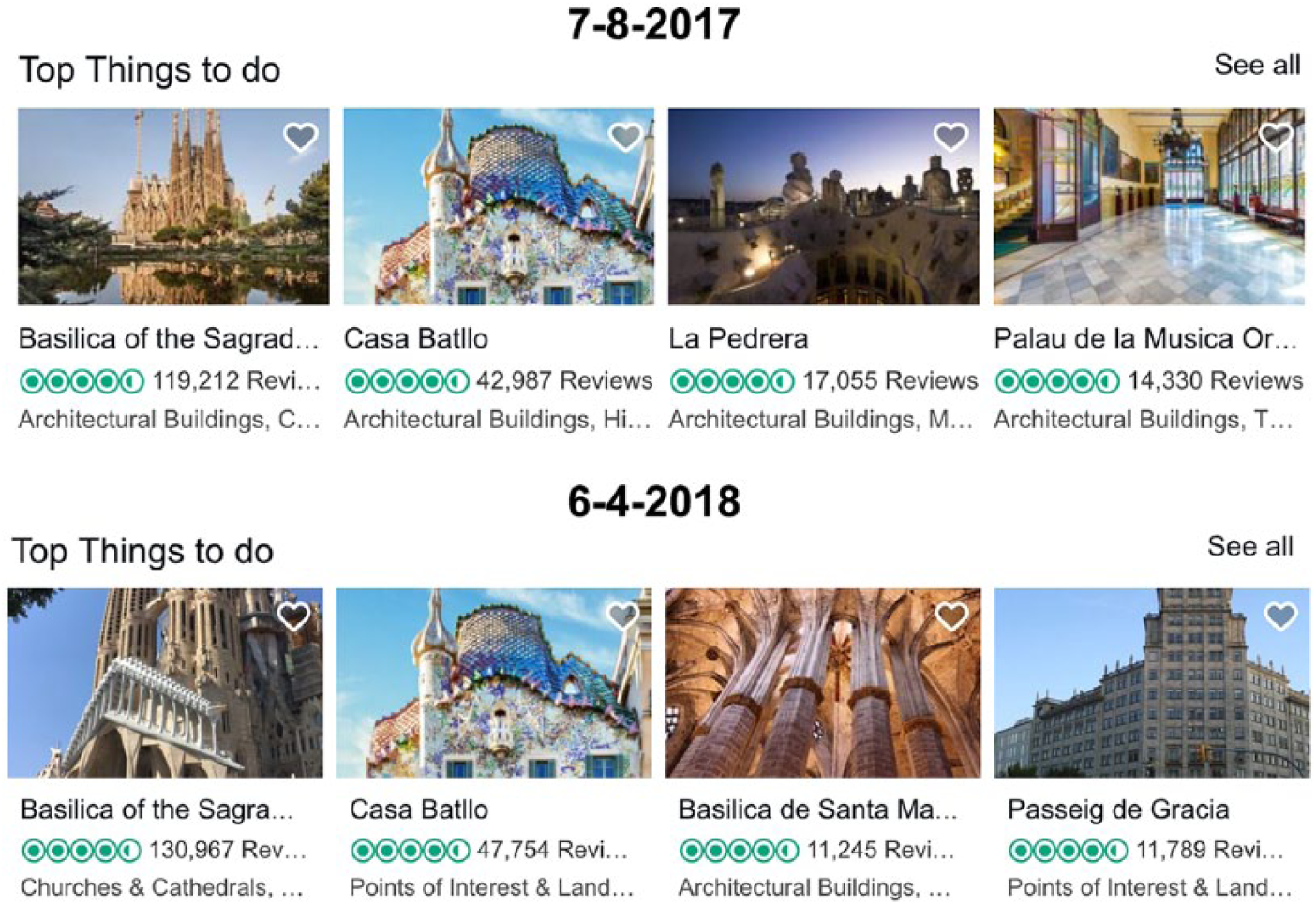
Comparison of TripAdvisor “Top Things to Do” in Barcelona, 7 August 2017 and 6 April 2018.
The above picture shows the “top things to do” in Barcelona, with the most famed tourist sites swapping places. La Pedrera has dropped from Number 3 to Number 8 in this list, even though the number of reviews for this site is still higher than that of the Basilica de Santa Maria. This is because of an algorithm called the Popularity Index, which incorporates traveler ratings to determine overall traveler satisfaction. Unlike sites that simply rank a hotel by price or hotel class, we use a proprietary algorithm to take into account what travelers like you think—quantity, quality and recency of TripAdvisor reviews. (TripAdvisor, 2018c)
This algorithm, like those used by most major web platforms, is a black box: Users cannot know why the ordering has changed, and can only make assumptions about it being a general reflection of the changing popularity of tourist sites, the time of year, and so on. TripAdvisor notes the algorithm takes into account “quality, quantity, and recency” of content, but the user has no insights into how these proxies for popularity, as a general category, are operationalized. The question visitors might have about what counts as “essentially Catalan” or “typically Barcelona,” a question about object authenticity, requires an outsourcing of expertise to both other people and opaque sorting systems.
The ranked organization of “top things to do” in the context of a country, city, or area, hints at a convergence (or perhaps a confusion) between popularity and authenticity, between quantification and valuation. A similar mechanism is in place on the level of individual tourist sites, such as the Barri de Gracia neighborhood in Barcelona (Image 2). TripAdvisor shows the user how many reviews have been left behind, what the distribution of points within its five-point ranking system is, and offers suggestions about words that often occur in these reviews, which new users might also be interested in.
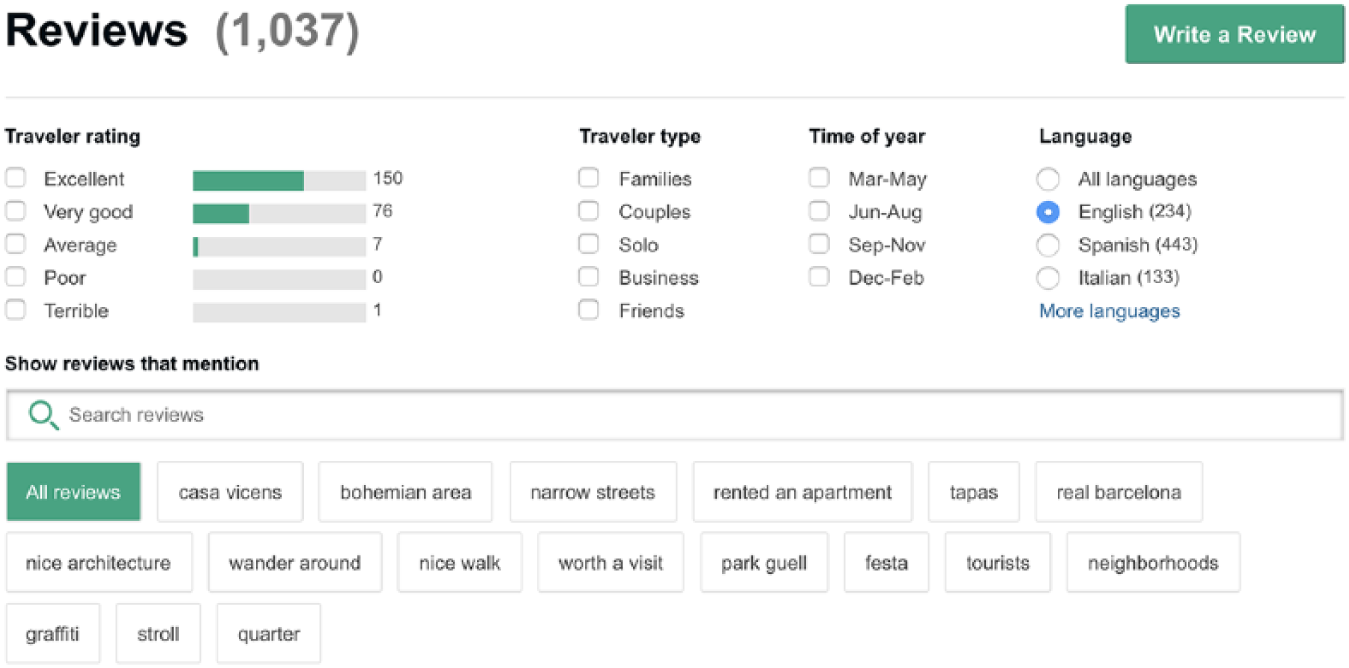
TripAdvisor statistics for Barri de Gracia, Barcelona (6 April 2018).
Again, the algorithm producing the output—in this case, that of a lexicometric analysis—cannot be known: What is seen are only the recommended terms, all of which frame the site of concern and connect it to a number of characteristics. Some of these refer to a sense of authenticity, such as the keyword “real Barcelona,” which users refer to in the context of sentences such as “For a taste of real Barcelona … and to truly embrace the Catalan culture of the city, you must visit and wander around Gracia.” In other words, TripAdvisor offers pre-trip authentication by post-trip encouragement. The algorithmic categorization of these tourist sites, after all, makes use of the reviews provided by users who have visited the sites on offer are asked for certain types of information which can be offered to potential visitors. Furthermore, when users do engage in reviews, the platform offers them reminders of this data-generating deed. For instance, it sends its active reviewer’s an email every few weeks, including subject lines such as “Guess how many people have read your review?” The email itself presents several statistics about the user’s reviews (see Image 3).
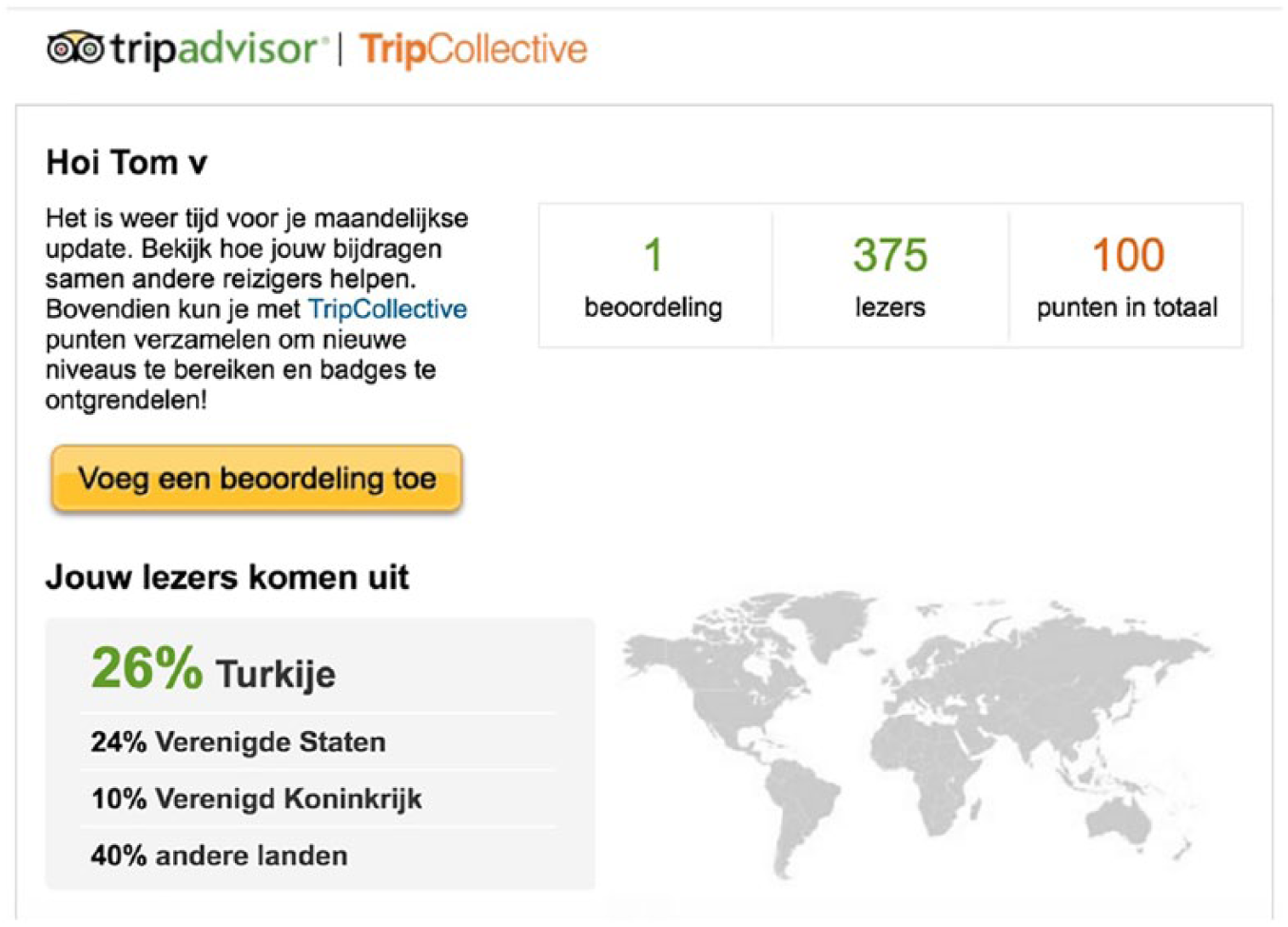
TripAdvisor email (15-12-2015).
The email above notes that “it is time again for your monthly update,” reminds the users that their contributions are helping other travelers, and shows information about the readership (i.e. the place they “come from”). The system is of course in place to maximize the amount of content being produced, which, in turn, leads to more users purchasing services through the platform. To this end, the “cool” authentication of the object converges with the “cool” authentication of the touristic self, as the user’s influence on other tourists is put front and center. The self is commoditized—expressed in terms of its quantifiable purchase on a tourist site’s popularity—as much as the site itself is reinforced as a tourist destination. In a similar vein, the platform’s algorithm, based on the user’s reviews, fills in another identity metric, namely, the user’s “travel style.” It is shown through one or more keywords that appear on the profile page: The current author, for instance, has been certified with terms such as “history buff,” “urban explorer” and “shopping fanatic.” What these keywords are based on, precisely, remains unclear. The traveler, in other words, is defined by algorithmic systems that make use of the ideology of precision and transparency, while remaining purposefully vague about the underlying system.
It should be added that the authentication of the self, here, also becomes a gamified matter, in which typical elements of game playing (e.g. point scoring, competition with others, rules of play) are introduced into other areas of activity (Morozov, 2012: 296–301). As Morozov argues, practices of gamification are related to the meteoric rise of utilitarian self-conception, perhaps most clearly found in the “Quantified Self” movement. The movement leverages technology to acquire data on all manner of aspects of a person’s daily life in order to discover correlations, and provide feedback to modify behavior (Whitson, 2013). It particularily focuses on the many systems of self-tracking found in apps and devices that help people to maximize potential, and work more efficiently. Such self-surveillance is seen as a form of intellectualism, shielding people from negatively perceived subjectivity and emotion: “Numbering things allows tests, comparisons, experiments. Numbers make problems less resonant emotionally but more tractable intellectually” (Wolf, 2010). As such, the movement is a fine example of algorithmic culture in action, through its incessant search for new biological variables to quantify.
In the realm of travel, TripAdvisor engages in a similar quantification of preferences. It provides its users with points, levels, and achievements related to their travel behavior. In a metonymic effort, the platform suggests that users should “[t]hink of it as your travel community’s way of saying thanks for helping us collectively travel better” (TripAdvisor, 2018b).
Distributing these points is of course not a task of the platform’s “community,” but of the so-called TripCollective system, the platform’s algorithmic rewards program for posting reviews, photos, videos, and so on. It constitutes an attempt to increase the dataflow to the platform in a manner characteristic of businesses in algorithmic culture. The user in the figure below received 100 “TripCollective points,” which can also be tracked on the user profile page (Image 4). Here, the user finds that these points lead to “levels,” another well-known metric from videogames. These points, however, have little use beyond their gamified creation of incentive, as “TripCollective points do not have monetary value and cannot be redeemed for anything.” 8

TripAdvisor points (6 April 2018).
As is well known, the propagators of the Quantified Self movement make use of gamified systems to engender a sense of intrapersonal authenticity: The goal, in the end, is self-making, “knowing yourself.” A similar process occurs on the platform we have been discussing: an enmeshing of hot and cool authenticity, achieved through quantified certification—pricing, distance, level, rating, and so on—and aiming to generate knowledge about one’s identity. The different forms of quantification we have been discussing, in other words, may produce specific forms of knowledge about the self-as-tourist. 9 The influence of material features of technology on identity has been investigated in Foucault’s work on “technologies of the self”: the procedures and practices through which individuals instantiate and maintain coherent identities. “There is a technology of the constitution of the self,” Foucault noted, “which cuts across symbolic systems while using them” (Foucault, 1984: 369, 1988). In our case, this technology includes the materiality of the sorting algorithms and gamified systems broadly captured under Manovich’s (1999) moniker of “the database as symbolic form.” Just as early blogging practices enabled specific identities for Internet users (Siles, 2012), and Quantified Self participants constitute new forms of knowledge about the “healthy body,” algorithmic tourists can express themselves in terms of a computational ontology that ascribes meaning to both the sites they visit and their identity as travelers.
Authenticating Abdul
Algorithmic authenticity, as we have noted, is not only characterized by the computational filtering of information. It also involves the social effects of effortlessly accessed user-generated content, most of which take the form of personal narratives about object authenticity. An example of this can be found when visiting the TripAdvisor page of “Authentic Berber Tours,” a Moroccan tour operator offering desert tours from Marrakech (Image 5). The reviews of the tour operator, counting 122 at the time of writing, consist for 99 percent of the five-star epithet “excellent.”
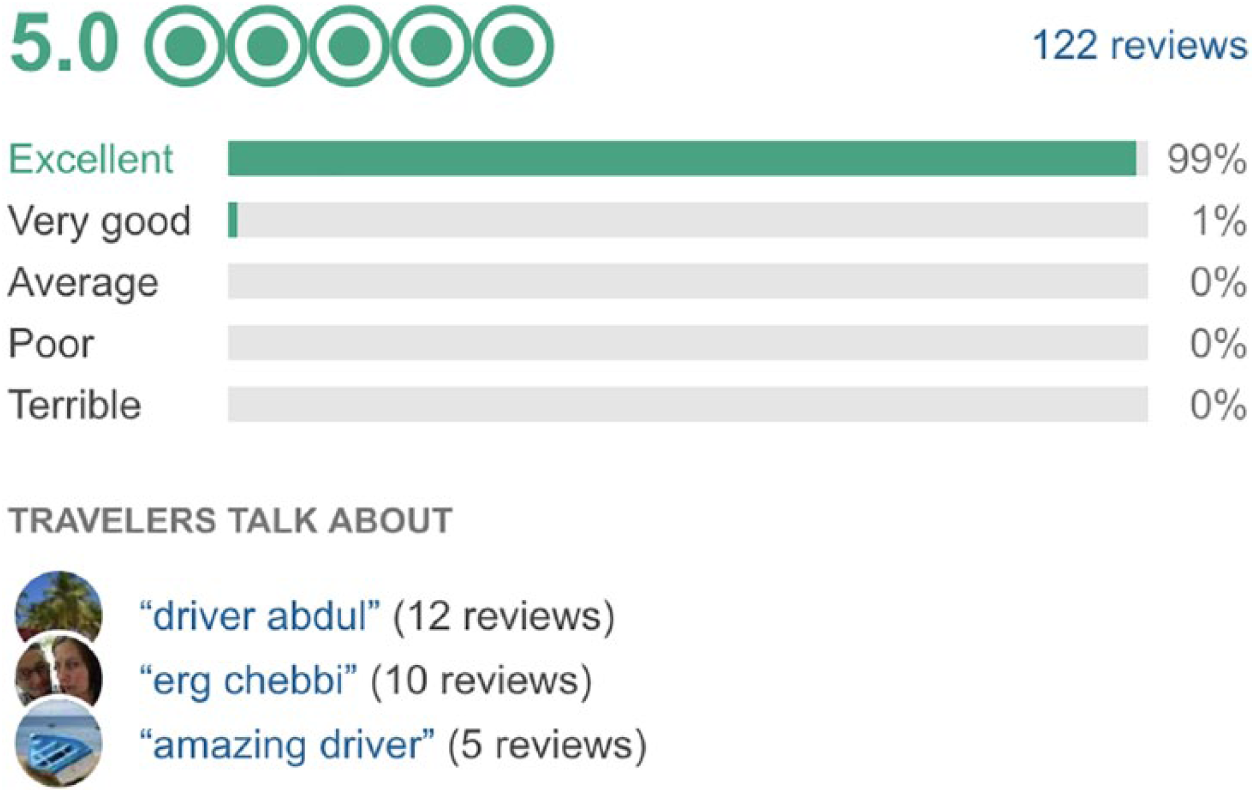
TripAdvisor statistics of “Authentic Berber Tours,” Marrakech (6 April 2018).
In the reviews, customers of the Moroccan tour operator express their post-purchase satisfaction through an extensive recounting of their trip. One reviewer, titling the contribution “Abdul, Abdul, Abdul!,” notes, My daughter and I traveled with Abdul for two days … I normally dislike long car rides (it was a total of 14 hours of actual driving), but with Abdul’s knowledge and sense of humor, we laughed and talked all the way to the kasbahs and tree goats! When our two days were up, we were both genuinely sad to tell him goodbye. He’s that good.
10
Other reviewers mention a similar interpersonal connection they feel toward the driver—which, in several instances, is directly coupled to a sense of object authenticity for the place they are visiting. Abdul is “real,” so Abdul can show what the “real” Morocco is like. One reviewer notes that “By the end he felt like a friend as much as a guide/driver, and he was very knowledgable [sic] in teaching us about Berber and Moroccan culture as well as taking us to authentic local restaurants for lunch.”
11
Another user writes that “[a]nother highlight, was to enjoy a fabulous lunch in an authentic Berber house. So nice to communicate with real people.” A third user recounts that [w]hen we arrived at the Berber village, we were greeted back with Abdul and the local berber family. They opened up their house to us and we were so grateful. The local tea along with the fresh Tajine, dessert and fruit made this experience very very authentic.
12
These are familiar motifs of authentication; as an othered host, the driver’s cultural capital is connected to his or her strong local identity and “roots” (Fabian, 1983; Salazar, 2012). Indeed, there seems to be a definition in play of what constitutes an appropriate, ritualized response to the tour, one that Jansson (2007) calls a form of “encapsulation.” In addition, from the perspective of the online visitor skimming the search results, these narratives arguably produce a quantified effect. The authenticity of the tour operator, here, is constructed through a succession of highly similar stories of “getting in with the natives” that the user scrolls through. The database may be paradigmatically structured, as Manovich argues, but the engagement with it is syntagmatic. 13 Or, to return to McLuhan’s terminology, the medium itself can be considered both hot and cold: It can be manipulated and sorted by the user, but its readable output consists of an abundance of linear information.
The expressions of identity we see here need to be connected to the constitutive performative aspect of hot authentication emphasized by the Cohens. Embodied practices such as paying obeisance and worshipping by visitors “help to generate, safeguard and amplify the authenticity of the visited site or event” (Cohen and Cohen, 2012: 1300). These algorithmically sorted narratives differ significantly, however, from physical, observable performances in tourism. The sense of “communitas” that the Cohens take to be a defining trait produced by the rituals of hot authentication is replicated outside of the physical touristic “zone” itself, as a wholly linguistic indexicality. The ritual, here, is one of recurrently recounted experience, acting both as identity marker and “informational certification” of the tour operator. Whereas the Cohens note that cool authenticity acts as proof, and hot authenticity as belief, the two functions are clearly in active tension here.
Furthermore, these touristic expressions on online platforms demonstrate that “hot” and existential authenticity arises unproblematically alongside the overtly scripted nature of the trip and the associated “cool” systems of probability calculation tourists engage in. It is algorithmic authenticity that allows one user to speak of taking a “leap of faith” even after extensive reviewing and comparison: After much research I took a Leap of Faith and went with the small company of Authentic Berber Tours … I am forever changed … he showed us remote and fascinating places no tourist would ever see … I cried as we parted as there are few people like [Abdul], and I was so moved by the entire experience.
14
Algorithmic authentication seems a touristic attempt at reconciling the scripted nature of the trip with the desire for unique access to touristic “back regions” (MacCannell, 1976). It is related to the user experience of scrolling through the enumerated expressions by tourists who talk about “unique” and “authentic” experiences without reference to the broader touristic framework within which their travels take place. One visitor talks about the paradoxical practice of taking advice from their tour guide as a means of preventing the inauthentic tourist mode, and achieving an object-related authenticity.
[Abdul] made a concentrated effort to take us to the “real” Morocco on the backroads and small villages to give us the full experience. He was also great at understanding that photography was a big part of our trip and made sure to stop and point out all the best locations to take photos—even if they weren’t the typical spots.
15
In general, what these opinions offer in order to generate a sense of authenticity is what Roland Barthes called a punctum: The personally touching detail that establishes a direct relationship with the object or person represented (Barthes, 1981). In the listing format, however, this punctum is shown in repetition, as shared by nearly all past visitors. What we find here is mimicry, a bidding war of similar significant authenticity experiences. This particular mode of representation—that of the database, the listing—is particularly effective at showing the serial production of one-of-a-kind experiences that the tourism industry amounts to. It is this repetition, in combination with the metrified authentication of their evaluative similarity, that constitutes algorithmic authenticity.
The listed appraisals for Abdul seem indicative of an echo chamber effect in which the driver’s inherent authenticity is reproduced, and no dissenting voices can be found. All visitors are having the same unique, “one-of-a-kind” experience. For the user scrolling through these pages, this might be explained by the “fact” of the authenticity of the driver Abdul. The careful reader, however, infers that the “Abdul” being referred to is not necessarily the same person each time: One user writes of their incidental discovery that “Abdul,” in Morocco, is fairly common name: “met 3 Abduls from A.B.T alone but they were all friendly and great.” 16 The object of this object authenticity, in the context-collapsed reviews on TripAdvisor, turns out to not be a singular object at all.
Conclusion
Rickly-Boyd (2012) has followed Walter Benjamin in noting that authenticity is relational—it can be simultaneously measured, experienced, and felt. This article has shown how authenticity as a goal propagates itself by involving both personal experience and object measurement—forms of “indexical authenticity” in which both the referential character of the place and the attitudes of the tourist are in play (Knudsen et al., 2007: 8). This double orientation is not a new finding: Cohen and Cohen (2012) already wrote that “the two processes of authentication are interlinked, as the dynamics of one intersects with that of the other, contributing to a fluid, and sometimes politically rife and unstable, relationship” (p. 1298). However, in algorithmic culture, this process arguably takes on a new form: that of certification by subjective views, which are computationally sorted and categorized. I have discussed several examples of this double bind, arguing that both information–architectural systems (e.g. responsive websites and mobile Internet connections) and procedural ones (e.g. systems of gamification that reify and quantify one’s tourist identity) play a role. Finally, these dynamics of digital technology are entwined with social behavior: Users on TripAdvisor were found to mimic each other’s stories of unicity and authenticity, together producing a metrified, “five-star ranking” valuation. Emphasizing the human–computational nature of these interactions, we might note that the first word in Bruner’s question “who decides what is authentic?” in algorithmic culture, should be supplemented with “what.”
The answer to this question, we have noted, has to take into account the usability aspects of algorithmic platforms. Tribe and Mkono (2017) have noted that engagement with technology might reduce the extent to which tourists are able to engage with, or immerse themselves in the destination, as mobile technology leads tourists to be concerned more with collecting “evidence” than with enjoying the experience itself. In passing, the authors refer to the psychological concept of “flow,” a total absorption or immersion in an activity (Csíkszentmihályi, 2009). As such experiences of psychological flow are disrupted, the authors note, so is the opportunity to realize authenticity. When it comes to the interaction with online review platforms, however, the findings of this article indicate that it is not a lack of flow that is produced in algorithmic culture, but rather the opposite: Review platforms such as TripAdvisor put the user in a state of immersion through playful systems of comparing, double checking, cross referencing, and point gathering. What is authenticated, here, is the informational self as much as the informational place.
Further, I have noted that the term “data” hints at an epistemological position carved out for the users of logistical media. Big data, as Chris Anderson wrote in a much-circulated Wired article in 2008, signals the “end of theory” as the why of human behavior becomes less important than the big data–enabled measurements of the what (Anderson, 2008). Similarly, Rouvroy and Stiegler, in reference to Foucault, discuss the “regime of digital truth” fostered by algorithmic culture that involves a search for absolute objectivity in which data “speaks for itself.” They note, “The concept of truth is increasingly wrapped up at the expense of pure reality or pure actuality, to the extent that eventually things seem to be speaking by themselves” (Rouvroy and Stiegler, 2016: 7). This, they argue, leads to a “crisis of representation,” as people begin to doubt the knowledge they create with our own human minds. The alleged “post-truth age” in which we live, as mentioned above, seems to refer to the same epistemological shift in which factual data is considered the primary legitimate truth-bearer. A corollary of this idea is that, in a touristic context, authenticity is outsourced to data processing. This has the potential to epitomize object authenticity in a way that resembles the certification that once was the domain of the academic (Redfoot, 1984). If the aggregate of thousands of reviews, often summarized by slick data visualizations, cannot confer the “typically Spanish,” or the “essentially Moroccan,” what can?
The paradox is of course that these aggregate determinations are normalized averages of serialized individual narratives and unique experiences. Algorithmic authenticity, in sum, is always the outcome of authentication, consisting of a peculiar understanding of authenticity as a deeply romanticized, personal experience, and the result of an objective, aggregate ascertaining, as well as an extensive checking and comparing of options, which Boorstin once saw as signifiers of the “lost art of travel.” It incorporates “flow” as a user-friendly experience, and is built around a drive toward completeness, a full understanding of all the parameters of one’s future trip. It is the combination of both practices that constitutes the business model of platforms such as TripAdvisor, and that increasingly influences the authentication of touristic places and peoples.
Footnotes
Declaration of conflicting interests
The author(s) declared no potential conflicts of interest with respect to the research, authorship, and/or publication of this article.
Funding
The author(s) received no financial support for the research, authorship, and/or publication of this article.