







Abstract
Purchasing souvenirs is an important travel shopping behaviour in the tourist industry. Multiple studies have explored dimensions related to a souvenir. However, the attributes of souvenirs are inconsistent and few studies have explored from tourists’ perspective the customer value of the souvenirs they purchased. Using food souvenirs as an example, this study adopted the means-end chains approach to explore the consumer value of food souvenirs purchased by tourists. Based on the attribute–consequence–value linkages, food souvenir attributes most important to tourists were identified, and subsequently, the product attributes for food souvenirs were determined. This study found that when choosing which food souvenirs to buy, tourists perceived the following nine major attributes as important: good taste, shareability, convenient, nostalgia and unique, human warmth, authenticity, local characteristics, famous and representative. The findings of this study can serve as reference for helping business industry to design products. This study recommends incorporating these nine attributes and local characteristics into destination tourism development to closely resonate with the needs of tourists and strengthen tourists’ perception and impression of the customs of destination tourism industry.
Introduction
Tourism is a necessary recreational activity for people in the contemporary era and represents the key characteristic of a person’s quality of life. The consumer behaviour of tourists during their travel greatly boosts local economic development. Local cultures promoted through tourism activities and popular tourist destinations create mesmerising experiences for people. local characteristics or products symbolic of a historical landmark facilitate the promotion and marketing of a destination’s image, attracting more foreign tourists to visit and shop in the destination. According to the 2019 Survey of Travel by R.O.C. Citizens, the total spending per citizen per tourism trip was US$ 75.02, of which US$ 35.8 was spent on shopping and food (Tourism Bureau of Taiwan, 2018), accounting for 47.7% of total spending. In 2019, the number of inbound tourists in Taiwan was 11.864 million, which has exceeded 10 million for six consecutive years. The income from the Taiwanese tourism industry in 2019 has reached US$ 11.41 billion. A survey of spending by tourists revealed that jewelleries and souvenirs accounted for a majority portion of spending by tourists visiting Taiwan, and up to 40% of the souvenirs purchased were edibles (cakes and biscuits, local products and tea). 50.39% of Japanese tourists purchased cakes and biscuits as souvenirs, 70.1% of Korean tourists purchased local food souvenirs, and 26.8% of mainland Chinese tourists purchased local products as souvenirs (Tourism Bureau of Taiwan, 2018).
Purchasing local products as souvenirs has been an indispensable component of Ethnic Chinese people’s travel experiences (Li and Cai, 2008). In addition to being of commemorative value, souvenirs also express love and thanks to family and friends and show an act of sharing (Park, 2000). Omiyage in Japan, Sunmul in South Korea, shǒu xìn in Hong Kong and děng lù in Taiwan all refer to gifts brought back from a trip that can be eaten and shared. Aiming at food souvenirs chosen by Chinese tourists from China and other regions to Taiwan, this research has discovered that overseas Chinese with similar cultural perception would select souvenirs of same attribute regardless of nationalities.
The tourists to Taiwan are mostly from China, followed by Hongkong and Macao, and then Japan, Korea and Southeast Asia. Even though the residents of China’s mainland, Hongkong and Macao are all Chinese, quite a few Chinese tourists live in the other areas. With considerable degrees of recognition and familiarity in both written and spoken languages, those people usually have the same habit and culture of purchasing food souvenirs. Food souvenirs are made using local ingredients and methods, which are a part of the culture indigenous to the area. To an extent, local food products embody the culture and identity of place (Bessiѐre, 1998). Food products and local traditions are closely related and form an integral part of tourist attraction. In practice, there are a variety of popular food souvenirs made using local products that appeal to tourists. Henderson (2009) and Tresidder (2015) identify primary relationships between food and tourism: food as tourism product, and marketing of food to tourists, as tool for local development and impact on locally practitioners. Local foods are a gateway to understanding the intangible cultural heritage and culinary culture of an area (Björk and Kauppinen-Rӓisӓnen, 2016) and also embody people’s perception of the authenticity of the place. Credible food images help to build perceptual images that distinguish a destination from other destinations, and some of them can inspires the tourists to actually visit the related destinations (Xu et al., 2020). Food is not only a substance for human consumption. Hence, when tourists indulge in local cuisines or purchase local food as souvenirs, they not only savour in the taste of food but also experience the local culture, enriching their travel experiences further.
Food souvenirs refer to meaningful and representative food products purchased as a gift from a trip to a certain place or portable food products that are well-packaged for sharing and gifting to family members, friends or colleagues (Park, 2000). A souvenir carries the meaning of a destination, which entails not only the souvenir’s background but also the carrier of tourists’ gift giving behaviour representing the metonymic of an individual’s travel experience and life experience (Swanson and Timothy, 2012). Souvenirs deliver powerful messages, maintain status symbol and forge strong and sustainable interpersonal ties (Shanka and Handley, 2011). The entire process associated with a souvenir, including the trip taken to purchase it, the intricate packaging, product quality and the greetings given when delivering the souvenir, is imbued with informative contents and meaning. Food souvenirs not only feature the functional and commemorative symbols of souvenirs; from packaging to connections with products and place, the sign-carrying content of food souvenirs often surpasses its inherent meaning (Parasecoli, 2011). Destination tourism marketing should aim to make people feel satisfied with a destination. Tourists with positive emotions and intention to revisit (a place) are target groups most likely to respond positively toward destination tourism marketing (Zenker and Rütter, 2014). The emotions people develop toward an environmental atmosphere influence their place identity or place dependence, which in turn affects spending behaviour at the place. However, previous studies mostly examined souvenirs rather than the connection among tourists, souvenirs and place. Few information is available in the existing literature regarding tourist souvenir-repurchasing intention studies (Lin and Wang, 2012). This study adopted the means-end chain approach to explore from consumers’ perspective the attribute, consequence and value of food souvenirs purchased by Ethnic Chinese people and to connect the attributes at the demand and supply ends. The objectives of this study were focused on (a) exploring the attribute, consequence and value of food souvenirs purchased by consumers and which attributes of food souvenirs resonate with tourists; and (b) providing the attributes of food souvenirs as product direction reference for tourism industry and souvenir industry.
Literature review
Customer value of souvenirs
The value of souvenirs
From tourists’ perspective, purchasing souvenirs is a key component of tourism shopping behaviour. Souvenirs as tourism products are utilities that must demonstrate use- and exchange-value to the satisfaction of consumers (Andriotis and Agiomirgianakis, 2014), and their utilities fulfil the needs of consumers (Paraskevaidis and Andriotis, 2015). The use-value of souvenirs has a dual functionality for tourists as reminders of the travel experience and as products for use in daily life (Thompson et al., 2012). About the assessment of the utility of a souvenir, the perception of its authenticity, and the happiness obtained from the shopping experience may be useful for the behaviour of purchasing souvenirs (Lin and Wang, 2012). Souvenirs are memory holders for tourists. Tourists purchase souvenirs to remind themselves and share with others the emotions and feelings they experienced during the trip. Food souvenirs made using local food products have greater variety than do ordinary souvenirs. Food souvenirs can evoke tourists’ sensory experiences (taste, sight and hearing) and create emotional value (Lin and Mao, 2015).
The symbolic value of souvenirs stems from tourists’ perception and opinions of a place. Their travel experience is translated into symbols that represent special meanings and which are taken back home (Swanson and Timothy, 2012) as gifts to serve as a symbolic reminder of the characteristics and attractions of the place visited. And we can also say the souvenirs are one of the symbols of destination (Veronika and Dana, 2020). Multiple studies have explored dimensions related to a souvenir, including the style of souvenir products, content quality, packaging method, symbolic designs and memory of the journey (Turner and Reisinger, 2001). These dimensions are determinants of tourists’ purchase intention. Few studies have explored from tourists’ perspective the customer value of the souvenirs they purchase during their trip. Souvenirs are closely associated with the place in which they are sold. East Asian tourists purchase souvenirs mainly as gifts for family and friends. Therefore, this study asserts that a customer value perspective is required to explore the value dimensions with which tourists resonate when choosing food souvenirs and to examine the customer value of the souvenirs they purchase. Whether for self-use or as a gift, the souvenir is a commodity after all. Tourists who are their purchasers will definitely have the cognition of being a ‘customer’ when buying. The customer value theory refers to the value that consumers rely on when buying goods. This research cites the customer value theory of Holbrook (2006).
Customer value
Different theoretical perspectives have been derived from customer value theory. Holbrook (1996) proposed three dimensions of customer value according to the relativistic perspective: (a) extrinsic/intrinsic, (b) active/reactive and (c) self-oriented/other-oriented. Extrinsic value pertains to explicit function, that is, instrumental value. Intrinsic value pertains to experiential value. A product has self-oriented value when it prompts consumers to develop intrinsic experience and perform introspection. A product has other-oriented value when it induces interaction and exchange between consumers and others or an event or object. These four types of values are combined to form the typology of customer value (Holbrook, 2006). This study adopted Holbrook’s customer value theory – economic value, hedonic value, social value and altruistic value – as the basis for defining the consumer value of food souvenirs purchased by tourists.
Souvenirs as gifts
Souvenirs played a major role in travelling since ancient time. Egyptian and Ancient Roman explorers had brought souvenirs from a trip back home as gifts to family members (Swanson and Timothy, 2012). Explorers and tourists travelling abroad also brought back objects to their homeland as a token of remembrance. To date, museums around the world still exhibit products or precious items that numerous travellers or sailors had brought back 100s of years ago to their homeland as souvenirs from the places they explored (Stanley, 2000). Souvenirs in general are universal reminders of a place and can include clothing decorated with images or icons of an area, postcards, handcrafts and items found in nature such as a piece of rock or leaf (Swanson, 2004). Souvenirs in the form of items indigenous to an area carry the memories of the journey and the impression of the destination (Gordon, 1986). Souvenirs also satisfy the needs of tourists’ potential social need, such as pride, prestige and connect with others, so souvenirs become important goods of tourism consumption, and even affect the satisfaction with the degree of tourists to visit the tourist sites (Suhartanto et al., 2018). Therefore, souvenirs not only function as reminders of the destination visited, but they also symbolise tourists’ travelling experience, represent a particular ‘gaze’ (Morgan and Pritchard, 2005; Paraskevaidis and Andriotis, 2015), and are delivered to specific people. The concept of ‘tourist gaze’ was first proposed by Urry (1990). During the tourism, tourists would gaze at features of the landscape which separate them off from everyday experience. Even if the gazing of tourists started from the vision, mostly the human senses would work together to form a general feeling toward current environment (Larsen and Urry, 2011). Those objects of gazing would gradually form into special symbols and the tourism can be called as the searching process of symbols (Urry, 1990). The souvenirs play the role of symbol appropriately. Tourists’ choice of souvenirs reveals the tourists’ perception of the meaning of this trip, the memories they take home with them and the feeling of missing that place (Swanson and Timothy, 2012). Souvenirs also function to express tourists’ personal traits, group conformity and aesthetic taste (Anderson and Littrell, 1996; Fairhurst et al., 2007; Swanson and Timothy, 2012). Tourism is physical and corporeal, not merely visual. Therefore, performing should precede Gazing. The two should not maintain a distance from each other, but ‘dance together’ (Larsen and Urry, 2011). Whether it is landscapes, local food or souvenirs, they are all important components of destinations.
Relationship between food souvenirs and destinations
Souvenirs are generally related to specific place. Tourists purchase souvenirs at a destination as memento or gift. Souvenirs link products to the characteristics of a destination, becoming a medium for recalling the uniqueness of the destination (Swanson and Timothy, 2012). Souvenirs can serve as active promotion of a destination. They can raise awareness of a destination’s attractiveness, history and maintain its image (Veronika and Dana, 2020). Tourists’ perception of the authenticity of a place influences their travelling experience and shopping behaviour at the destination (Anderson and Littrell, 1995; Chang et al., 2008; Hitchcock and Teague, 2000). By connecting to the environment in which they are situated, people form subjective evaluations of a destination, which in turn define their perception of authenticity (Reisinger and Steiner, 2006; Timothy and Boyd, 2003; Wang, 1999). Although the interest of the tourists in the quest for authenticity has been increased, the tourists were often exposed to staged authenticity (MacCannell, 1973). Even though sometimes it was still far from objective authenticity, it could be considered authentic by tourists if any element could enchant them. Tourists receive, mediate and transform encounters the functions and meanings of destinations – including local residents, material objects, taste, smell or some cultural norms (Bezzola and Lugosi, 2018). If a place has a culinary heritage or well-known food specialty, then food should be promoted in tourism. After all, this food is a part of its culture and also the daily life of local people (Karim and Chi, 2010). Destination authenticity has been found to positively influence perceived value and imagery at a destination. Through the evaluation of environment and activities at the destination that serve as image factors that in turn influence value perceptions of the destination (Lee et al., 2016). Although that can be based on a wide variety of factors, local food has been a core and important components (Xu et al., 2020). From a souvenir perspective, educating tourists on the characteristics and techniques unique to a place enables tourists to recognise the authenticity of souvenirs (Yu and Littrell, 2005). According to Littrell et al. (1993), attributes of authenticity were connected to an object itself and also tourists took into account the origin of a product, material, brand or manufacturer. Intricate handcraft techniques reveal the craftmanship of a place, which helps tourists to form sensuous appreciation of the destination, develop cultural linkage and engage in tourism shopping behaviour (Hu and Yu, 2007). Food can define both people and places; Food continues to be a significant factor in defining and shaping the tourism experience (Tresidder, 2015). The link between food products and place stems from the raw ingredients unique to the place and also from the cultural difference of the place and novel techniques, both of which are major features attracting tourists’ attention. Local food products rich in local features, and tourists’ gourmet experience in the journey will be travel incentives, rather than just eating to satisfy physiological needs (Buczkowska, 2014). Tourists are willing to take food souvenirs back to their homeland after tasting local food products. For centuries, Taiwan has been renowned for its rich sugar produce and subtropical fruits as well as its world-famous high-mountain teas, which provide a strong foundation and background for making souvenirs from local food products. Food plays a critical role as the symbol of a destination. From tourist perspective, food functions as reminders of a journey and a symbolic representation of the place they visited. Food serves as holders of people’s emotions toward their journey and the place visited (Paolacci et al., 2015), and these emotions are communicated and shared through food souvenirs.
Research methods
Means-end chain approach
This study explored the consumer values of food souvenirs purchased by tourists, and subsequently identified food souvenir attributes that match these values. The findings of this study provide a reference for product design. According to Gutman (1982) and Olson and Reynolds (1983), value ladder can be constructed through one-on-one qualitative interviews to obtain three levels of attributes, consequences and values. Level 1 is attribute, which refers to the characteristics of a product, event or object or surrounding environment and includes the attributes or experiences tourists perceive when choosing souvenirs. Level 2 is the consequence of an attribute, that is, the functional consequence of a souvenir which is more direct or specific to consumers (e.g. taste) or the psychological consequence of a souvenir (e.g. the emotions evoked by the souvenir such as nostalgia when seeing traditional food). Level 3 is value, which refers to consumers’ preference and behavioural cognition, a summary of consumers’ final decision and their expectation (Tseng et al., 2004). Values can be hedonic (e.g. enjoying cuisines), altruistic (e.g. acting for the interest of family members) and social (e.g. sustaining interpersonal relationships). The means-end chain approach emphasises the effect of personal value on behaviour and achieves specific value content through product attribute or consequence of that attribute. Different product features have different abstract meaning to consumers (Goldenberg et al., 2000); therefore, the means-end chain approach can be used to organise different product attributes, identify key attributes that match the perceived consumer value and ultimately establish a valid perspective regarding food souvenirs.
Ladder interview
When tourists purchase food souvenirs, the reasons behind their purchase are difficult to classify directly based on tourists’ behaviour. Therefore, using the laddering method is necessary to analyse the reasons for purchasing souvenirs. Reynolds and Gutman (1988) proposed the laddering method to effectively construct the attribute–consequence–value (A–C–V) framework. Laddering is a frequently-adopted interview technique we use in means-end chain to uncover product attributes and expected consequences by asking respondents a series of open questions in one-to-one in-depth interview. Laddering is divided into two types, namely as hard laddering and soft laddering. The former mainly employs structural survey formats and thus is more limited; and the latter utilises semi-structured interviews to obtain multi-dimensional information and learn more about internal values of the respondents. In this study, soft laddering was used in the interview to create an open environment where participants could freely express honest opinions. When people talk about personal emotions, the value they perceive influences their views. For instance, nostalgia affects customers’ tendency regarding product price. As for previous researches about souvenirs, only a few have focused on the consumption value of respondents. Therefore, the soft laddering was employed in this research. Targeting at tourists who have purchased souvenirs during this trip, this research started from the current experience of purchasing. Next, the respondents were asked to identify the most important attribute of products and gave corresponding explanations about ‘why it is important’ using interview techniques. By making respondents to explain abstract emotions and feelings until they end with ‘I don’t know’ or ‘just like this’, the ladders to their internal values could be established gradually. By revealing internal values of respondents truly, this ‘abstraction laddering’ can help provide more knowledge on attributes and influence of products. Each interview lasts about 20–30 minutes. Before the interview starts, the environment in which the interview takes place shall be comfortable and private for respondents to answer questions freely.
Based on Reynolds and Gutman (1988), the laddering interview includes the following techniques: (1) Evoking the situational context: Make the consumers recall the situation associated with the purchase, for example, ‘when did you buy the souvenir?’ (2) Postulating the absence of an object or a state of being: Make respondents answer questions based on a postulating situation, for instance, ‘what would you choose if this kind of product is sold out?’ (3) Negative Laddering: Ask respondents the reason why not to choose other souvenirs, for example, ‘why didn’t you buy other types of souvenir?’ (4) Age-regression contrast probe: Make respondents compare differences between the present and past, for example, ‘what’s the difference of souvenirs that you bought in the past and now?’ (5) Third-person probe: Using a third-person probe as the background, for instance, ‘did your friends buy this kind of souvenirs?’ (6) Redirecting Techniques: Silence communication check. For example, use the technique of silence to make respondents explain and clarify again. Since the topic of research was the tourists exploring the features of local culture by purchasing souvenirs, to avoid language barriers and ensure qualified interviews, overseas Chinese tourists were chosen as respondents with similar characters and culture to the Taiwanese. Firstly, invite respondents based on their appearances and languages. Then, ask whether the respondent was local and later his nationality. Finally, the interview would start. This study attempted to understand the reasons underlying this effect. The participants were asked to provide more abstract information until they were unable to offer more extensive opinions, which indicates a point of data saturation. Finally, the variable relationships were linked to form a hierarchical value map (HVM).
Participants and interview process
The interviewees in this study were foreign and domestic tourists and visitors who were visiting Kaohsiung or on a business trip in Kaohsiung. Judgemental sampling was adopted and snowball sampling was used to slowly increase the scope of participant recruitment. Foreign tourists were interviewed between September 2018 and February 2019 at the high speed rail station, airport and popular food souvenir stores in Kaohsiung City.
The interviewees included people from mainland China, Hong Kong, Macau, Taiwan, Singapore, Malaysia, United States, British and Germany. A total of 68 people were interviewed; roughly 70% were women. Food souvenirs were purchased as gifts (82.4%) and for personal use (17.6%). The interviewees were taking a 1-day trip (30.9%) and visiting Kaohsiung for 2–3 days (48.5%; mostly tourists from Hong Kong, Macau, Mainland China and northern Taiwan) or 5 days or longer (17.6%; mostly tourists from other countries).
Data analysis
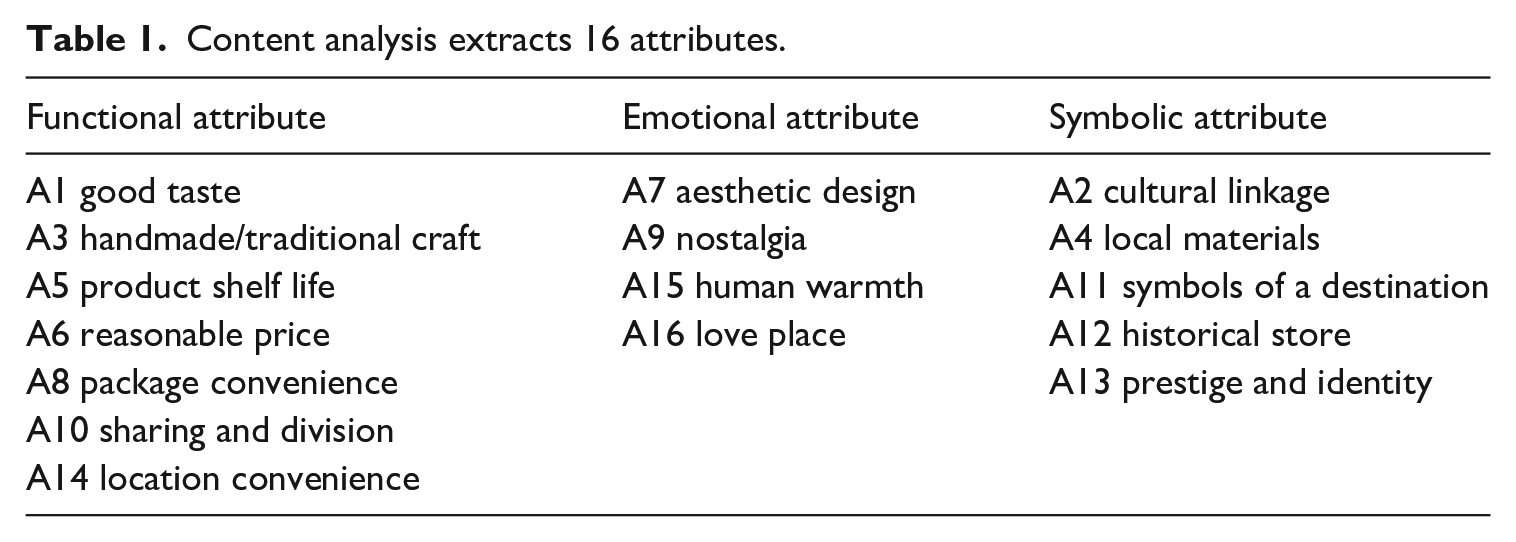
After completing all of the interviews, this study performed content analysis to calculate the number of times each variable was linked to another variable. The results then were incorporated in an implication matrix. Finally, this study identified 16 attributes (A), 13 consequences (C), 10 values (V) and constructed an HVM illustrating the relationships between all of the items. When purchasing food souvenirs, the tourists tend to choose products that are popular in the area, reflect the culture of the area, are appropriately packaged and are a signature product of a historical store or a store of privileged caste. Regarding consequences, the tourists felt that the food souvenirs they bought are representative of and indigenous to the area, give off feelings of nostalgia, are something worth remembering and reminiscing about, and are delicious. Tourists also depend on specific places to purchase food souvenirs. After reviewing all texts of interviewers, this study extracts the attributes of the souvenirs based on the souvenir literature. A total of 16 attributes were identified and categorised into three types of attributes: functional attributes with use and exchange value, emotional attributes that affect tourists’ emotions and symbolic attributes. The attributes identified in this are listed in Table 1.
Content analysis extracts 16 attributes.
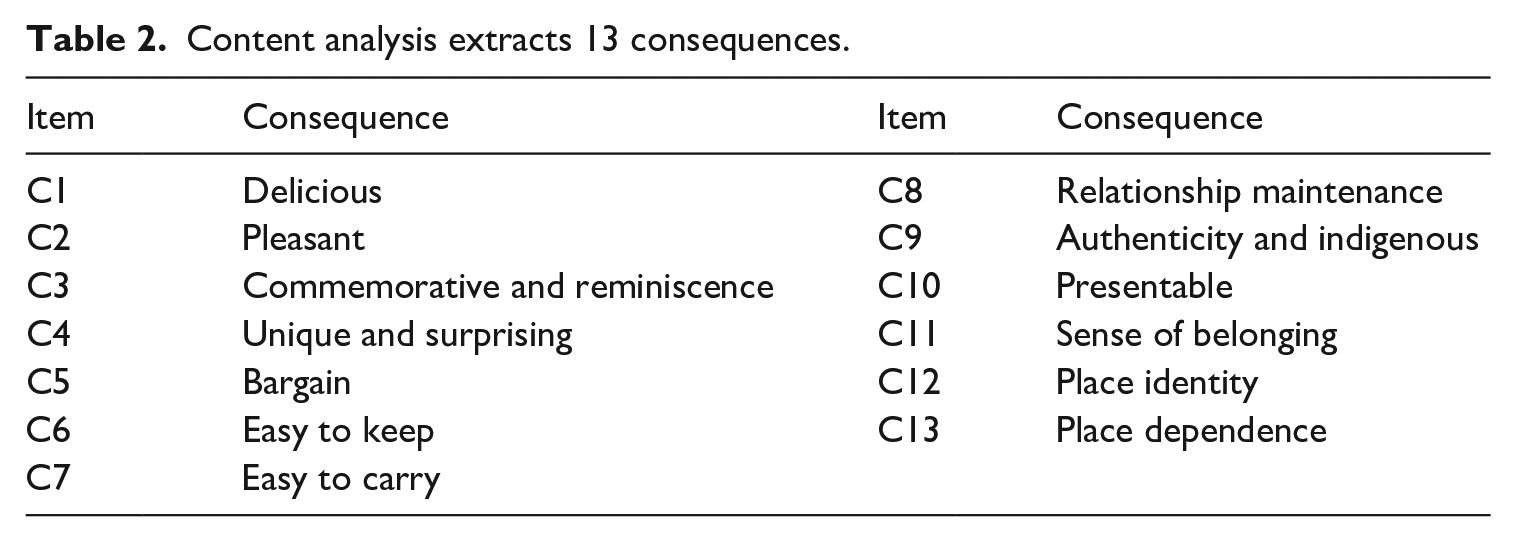
The interview results were analysed to collect tourists’ perceptions and opinions after purchasing or using a souvenir. Based on the results, 13 consequences and 10 values were obtained as shown in Table 2 and Table 3.
Content analysis extracts 13 consequences.
Content analysis extracts 10 values.
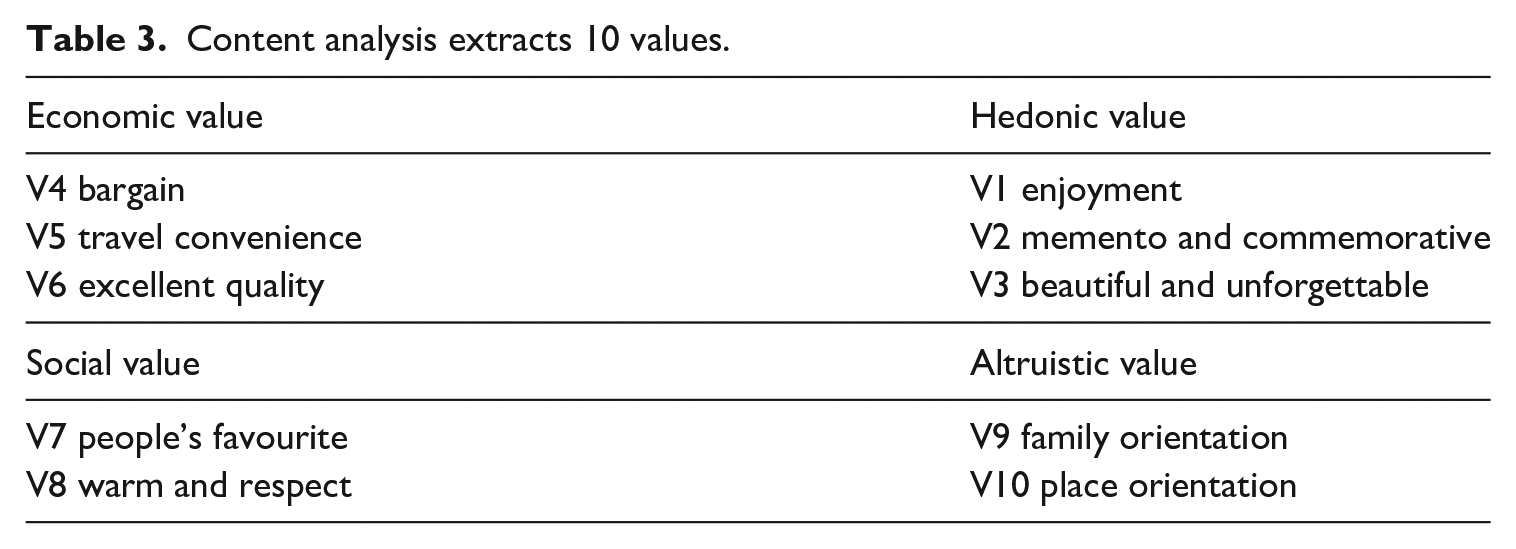
Subsequently, the following 10 consumer value attributes were identified from the interviewees’ perspectives of consumer value based on the four consumer value quadrants proposed by Holbrook (2006).
Consumer value differs for each individual. Nevertheless, food souvenirs are favoured and recognised by others, making them socially valuable for sustaining interpersonal relationships. Moreover, food souvenirs are easy to travel with, thus exhibiting significant economic value. Previously, Gengler and Reynolds (1995) adopted a cut-off value equalling 5% or more of total sample size. This value was used in this study to construct the HVM. According to the map, the interviewees generated 736 linkages, averaging 10.8 linkages for each interviewee. A cut-off of 4 with 553 linkages accounted for 75.1% of the total linkages, which is consistent with the previous result that a cut off of 4 can account for two-thirds or more of all relations (Reynolds and Gutman, 1988). The statistical results of cut-off are shown in Table 4.
The statistical table of cut-off.
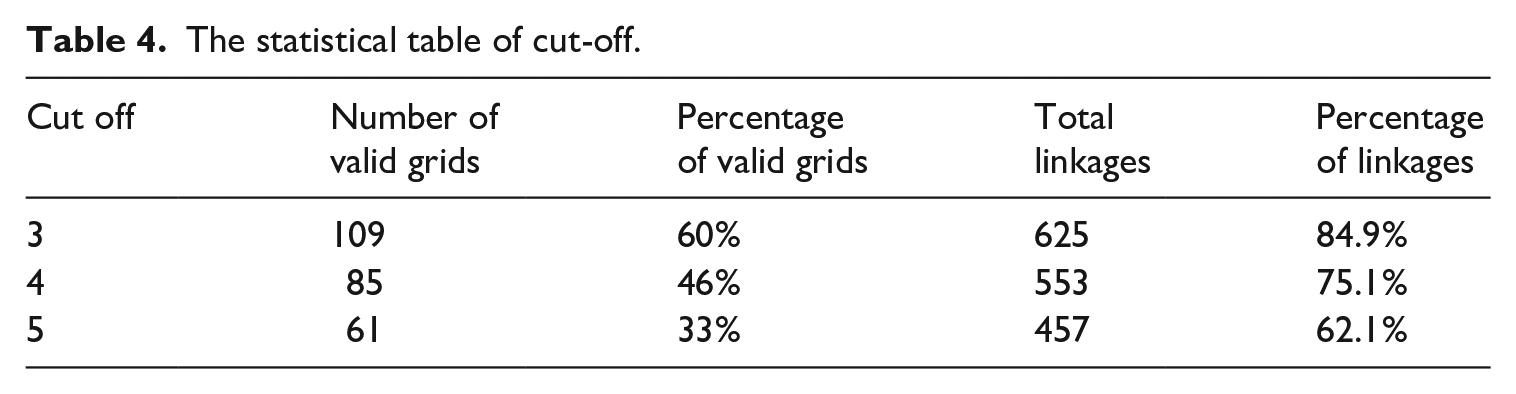
When a cut-off of 4 is selected, an interviewee must mention an item more than four times in order to confirm its linkage. A HVM was subsequently constructed (as shown in Figure 1). To clearly indicate the hierarchical relations, linkages exceeding multiple of four (i.e. 4/8/12) are thickened according to the multiple number in order to show the distribution trend.
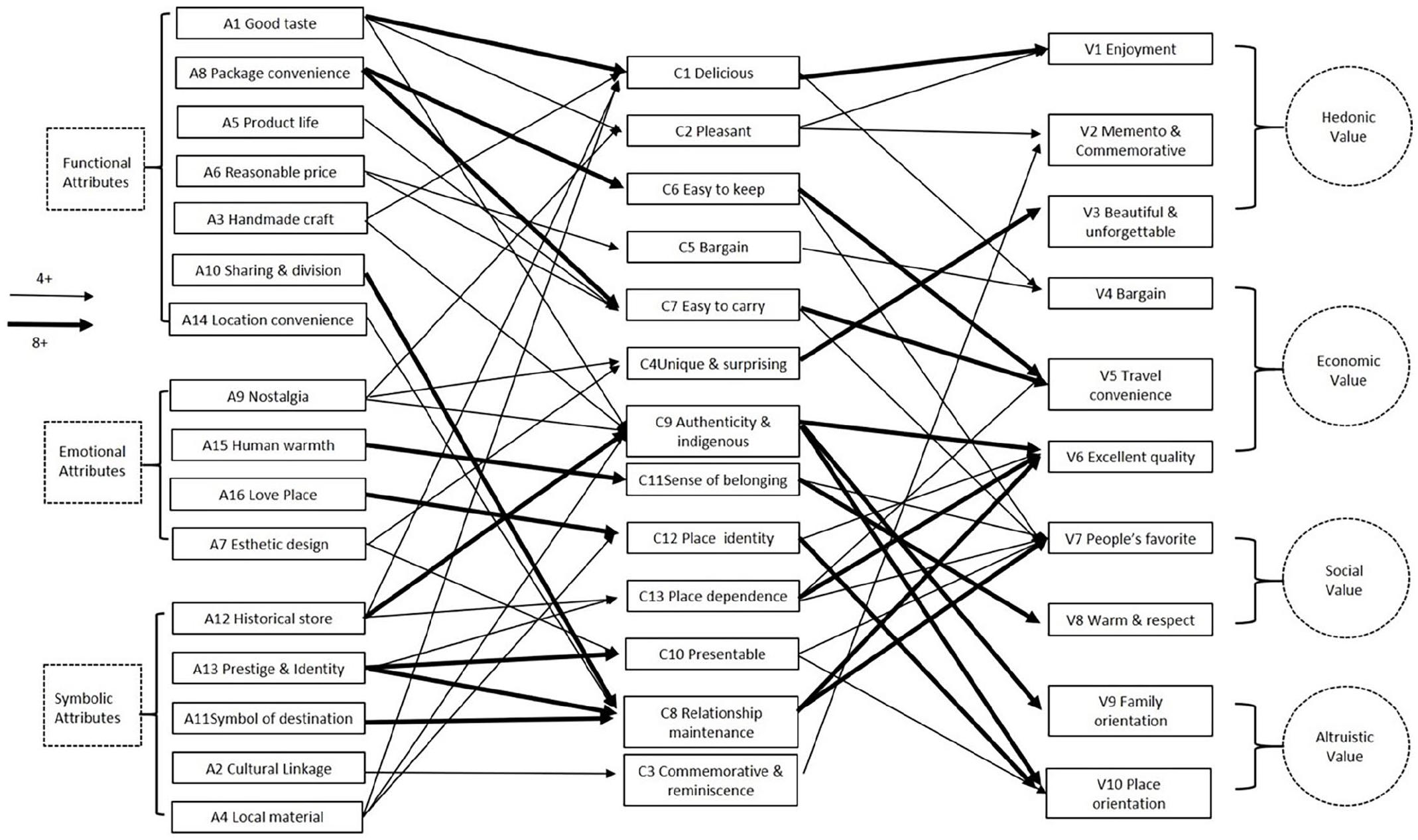
The HVM structure of food souvenirs.
Major attributes of food souvenirs
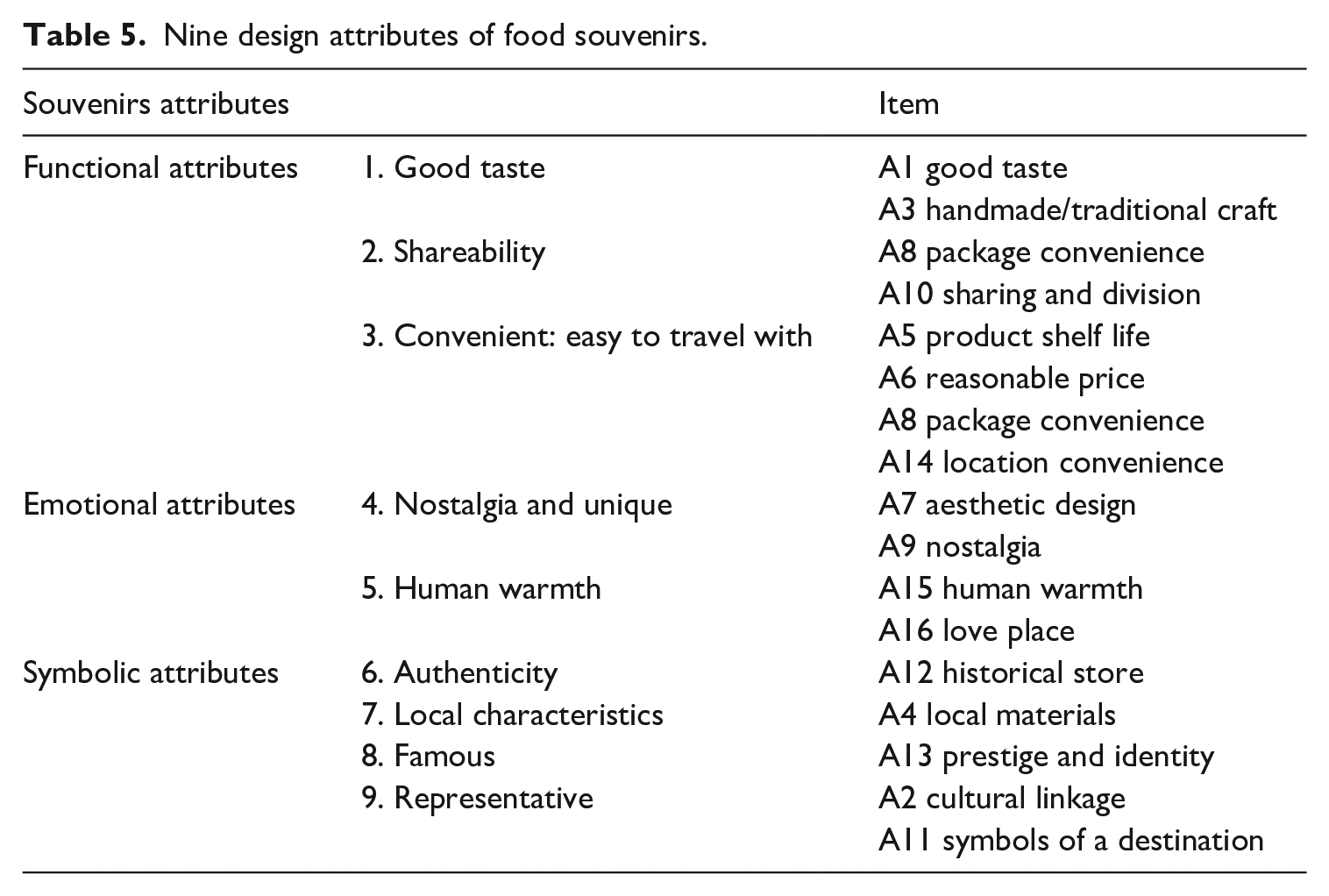
This study adopted the soft ladder interview method to determine the consumer value of the food souvenirs purchased by tourists and analyse why a product attribute is important to tourists when purchasing food souvenir. The results of the means-end chain approach revealed the main customer value of souvenirs purchased by tourists and important attributes of food souvenirs bought by tourists were figured out. As for the interviewed visitors, food souvenirs that they bought were mostly made by local ingredients, whose appearance and packaging could reveal the local culture and symbol. Moreover, for those products, the attributes aim to offer the convenience for travelling and the design is suitable for giving away. The core objective of this study was to determine the attributes suitable for the development of food souvenirs and to link the attributes with the customer values in the HVM. In this study, the attributes that resonated most with a value were categorised into functional, emotional and symbolic dimensions according to previous literature (Lin and Mao, 2015; Paraskevaidis and Andriotis, 2015). The results show as Table 5 indicated that food souvenirs require nine design attributes, providing practical and managerial implications for suppliers and producers to use the nine design attributes of food souvenirs to design food souvenir products that meet consumer needs.
Nine design attributes of food souvenirs.
Souvenirs should be good taste
In the field of tourism, the tourist does not only have the visual gaze, but also its various senses are interrelated, and these experiences will be condensed in the picture and scenery of his gaze. Tourists can taste local food through their senses, smell or special flavours and tactile sensations, which will be integrated into the moment and make them feel different from the usual (Larsen and Urry, 2011). Food souvenirs unique to an area are an incentive attracting tourists to visit the area. If a product is delicious, tourists perceive the product’s good taste and enjoy sensory pleasure. Delicious food souvenirs satisfy the taste buds of tourists. Food consumption as a peak experience for tourists and an important pull factor affecting destination choice (Bezzola and Lugosi, 2018; Björk and Kauppinen-Rӓisӓnen, 2016). They can be taken home as gifts for family and friends, hence demonstrating the hedonic value that consumers places on gourmet foods.
…Sharing information. If a food is good, we should let our colleagues know. This is what sharing means. (TS02) …I have been eating it since varsity. . .because it tastes good. Even now, it still tastes good. The taste of some food brand changes over time, but not this product. (TS05) …Ordinary food souvenirs taste very ordinary. I will especially look for products that are famous for their deliciousness and buy them as souvenirs. I feel very enjoyable when I eat them. (TS50)
The souvenirs shall be shared easily and individual packing: Shareability
Since most food souvenirs are given to relatives and friends, so their packaging shall be equipped with the shareability. Souvenirs shall be suitable for one person in size or be in individual packaging for sharing and distribution. The tourists could be immersed in the appreciation and pleasure from friends receiving food souvenirs, which facilitates sustaining interpersonal relationships. That is, the design and packaging of products shall embody the shareability for tourists to purchase and share.
…When you are on a business trip to visit, bring some souvenir as gifts to the people of the company, which is not only polite but also closer to each other. But it’s better to be shared and divided conveniently, so as not to be rude. (TS09) …Souvenirs must be individually packaged to be sincere, and sometimes I ’m not sure about the number and status of the other party. Because sometimes the other party may not respond, so the product must be easy to share. (TS22)
Souvenirs should be convenient: Easy to travel with
Travel convenience should be considered when designing the size and weight of food souvenirs. When purchasing souvenirs, tourists think purely from a convenience perspective – whether a product fits their luggage and is lightweight. Hence, food souvenirs that tourists can easily store and carry, do not add to the burden of travelling and are a factor that determines customer’s purchase intention and creates economic value for buyers.
…I buy souvenirs a day before my departure so that I could travel without worrying about my luggage and that the products stay fresh. (TS11) …Weight must be considered. . .because I am buying for a number of colleagues. This makes so much difference to the weight of my luggage. So the best option is buying lightweight souvenirs. (TS30) …I think what the local residents like is the good thing here, and they recommended me. . .so I bought a lot to go back to my family. (TS61)
Souvenirs should evoke feelings of nostalgia and unique
At the sight of beautiful heritage sites or destinations of historical significance, tourists develop feelings of nostalgia and reminisce about the beauty of the past. They believe that nostalgia symbolises the authenticity of a place and provides the most authentic reflection of the characteristics of everyday life in the area, and that these sites must be preserved for future generations. Buying traditional food souvenirs in a historical store that is filled with nostalgic feelings is one way for tourists to show their support for the maintenance and operation of historical stores and old streets and creates place-oriented altruistic value for buyers.
…The souvenir I remembered the most is the banana cake from Qishan District. My grandmother lived in Qishan. The cake reminds me of the time I spent planting bananas with my grandmother in the field.(TS022) …When I was a kid, I used to go to traditional grocery stores. Now when I come to Kaohsiung, I will buy some traditional pastry for my children and friends, and let them feel my former happiness and memories. (TS15)
Souvenirs should be reminders of human warmth
People travelling to a destination inevitably interact with local residents. The lifestyle and customs of local residents shape the environmental atmosphere of a place and influence the travel experience of tourists. In addition to interactions with the environment, interactions with local residents also influence tourists’ emotions and make they have better destination imagery. Destination imagery means tourists’ cognitive and affective associations relating to a destination (Xu et al., 2020). In a welcoming environment, tourists feel a sense of belonging, making them feel warm and respected, which strengthens their perception of the social value of a souvenir. Therefore, tourists are more willing to purchase products representative of the place and take home with them the warmth and emotions they felt during the trip to share with family and friends. They hoped to return someday to savour in this rich sense of human warmth again.
…I also enjoyed the kindness those grannies showed. . .it was like being back at home. . .although those aunties were rather ill-tempered, I felt happy whenever I took a bite of their food. It felt like I was back at home. (TS02) …The customers know I like them. I am very moved by the fact that the customers bought it especially for me. . .It was difficult to refuse such kindness because they kept it especially for you. . .it was their good intention. (TS33)
Souvenirs should be authentic
The notion of authenticity is usually used as an expression of tourist attractions’, experiences’ and souvenirs’ quality, in connection with tradition, originality, uniqueness or something locally specific (Veronika and Dana, 2020). MacCannell (1973) emphasised the key role authenticity plays in tourism. Tourists’ desire for the authenticity of a destination is satisfied by savouring local gourmet foods and searching for food souvenirs that are truly representative of the area. For inbound tourists, using the local food and beverage is well suited to make the souvenirs, so the specific destination of the development of tourist activities is essential with important (Buczkowska, 2014). Products made with local ingredients are considered to be indigenous to an area and authentic. Authenticity is constantly recognised as central to local food souvenirs. According to the study of Suhartanto et al. (2018), the three dimensions of the food representativeness: authenticity, uniqueness and taste/value are the key factors for the satisfaction of food souvenirs. Tourists often extend their searches for authenticity in the purchase of souvenirs (Xie et al., 2012). Tourists also perceive these products as of excellent quality and will most likely purchase them as gifts for family members or travel 1000s of miles all for the sake of buying them for their family. Locally made products are also popular among tourists who support local industries, thus demonstrating altruistic value for buyers.
…Its food still has the same taste as that period. It is a classic. . .I ate this when I was a kid. I am still eating it as an adult. I will choose this product as my gift to others. (TS03) …Buying local food specialty from the place as a souvenir for my family makes me feel closer to my family. Because the food souvenir is relatively unique, I hope to enjoy it with my family members. (TS17)
Souvenirs should have local characteristics
Souvenir stores and souvenirs have existed long enough to acquire characteristics that make them attractive to tourists, represent the authenticity of the place and allow tourists to experience the history, culture and traditions of the place. According to the tourists, a souvenir should have excellent quality and local characteristics in order to establish place dependence. Numerous food souvenirs are agricultural products unique to or well-known to the area. For example, red beans from Wandan Township in Pingtung and mangos from Yujin District in Tainan are popular local products symbolising the city. A growing number of destinations now include foods and drinks as key element in the marketing strategies to achieve competitive and impress tourism experience (Bezzola and Lugosi, 2018). Therefore, food souvenir packaging is often printed with symbols of famous landmarks and symbolic images of local products. The designed souvenirs are the objects of touristic consumption on the material-symbolic representation, and also show that the application of cultural elements, is a powerful approach to appreciate local culture (Xie et al., 2012).These symbols help tourists to form connections between the food souvenir and destination.
The more tourists favour an environment, the more likely they are to identify with the environment. As show of support for local livelihood and the local environment, some tourists were more than willing to purchase local products as souvenirs to not only demonstrate place identity but also contribute to helping the land on which this place is situated. For example, the tourists would buy more local products from local shops, sometimes in hopes of contributing to the shops economically or to support the maintenance and protection of the area. Thus, these products create place-oriented altruistic value for buyers.
…Although it was my first time visiting Kaohsiung, I really liked the place. . .I also bought fruit cakes from Kaohsiung as gifts for people of my hometown. . .I even hope they could cross the sea to see this beautiful city. (TS32) …My supervisor likes to eat lychee, and lychee is a food specialty of Kaohsiung, so I choose souvenir made with lychee as raw material, which has been welcomed several times. (TS27) …This is a local food specialty. Everyone knows that Kaohsiung is the largest producing area of lychees. I also like to eat this tropical fruit, so I always buy products made from local specialty products every time I come. (TS53)
Souvenirs should be famous
With strong brand awareness and brand image as well as specific factors such as history or geographical location, souvenirs should have features characteristics of a place to entice tourists to buy them. Strong brand awareness and characteristics can help a store to rise in popularity and become representative of an area that must be visited by tourists to buy local products. When a food souvenir accumulates adequate level of brand awareness, people become familiar with the product and can easily recognise and choose to buy that product. In addition, gift receivers tend to be happier with and more welcoming of Famous food souvenirs. If a souvenir store is extremely Famous, it becomes a desirable ‘check-in’ location on social media or a symbol that is easily recognisable and familiar with by gift receivers. Therefore, a well-known symbol can easily become a symbol representing a place and also the best souvenir option to purchase for sustaining interpersonal relations.
…This shop is very Famous. My mom said I have to buy products from that shop when I visit. I still had to wait in the queue for a bit, but I think it was worth it. (TS23) …I spent efforts preparing the souvenir. For example, I buy something that is very famous or difficult to buy. My clients do know that difficulty. They feel so happy when receiving it. (T11)
Souvenirs should be representative
Food souvenir unique is a link, has its own characteristics in places where food is often important symbol and image. According to the research of the Karim and Chi (2010), in the image of food and tourists visit will both exist obvious relationship. Food souvenirs from certain areas, such as ‘must-visit’ shops, are an aspect of local attraction and are integrated with elements that create place dependence. This type of landmark value is the bridge connecting place attachment (Brown and Raymond, 2007). When food souvenirs developed from local gourmet foods are made unique and irreplaceable, tourists become dependent on that place to purchase these souvenirs, believing that only this product is sufficiently representative of the place. Thus, place dependence and irreplaceability are created imperceptibly.
…I only realised after my visit to Kaohsiung that the 85-Sky Tower was really tall. . .seeing this tall building against the blue sky increased my impression of Kaohsiung. Half of the souvenirs that I plan on taking back home with me from Kaohsiung will probably be have pictures of the 85-Sky Tower. (TS19) …Dragon and Tiger Pagoda in Zuoying district is a very famous landmark of Kaohsiung, so when I return to Taipei from Kaohsiung, I will buy a souvenir with its image printed on it, which can be said to be a famous product representing Kaohsiung city. (TS26)
Theoretical implication and practical implication
In terms of theoretical implications, we emphasised the possibility of using the method-ends chain to verify product attributes. In this study, we use the MEC method to explore the customer value of souvenirs purchased by tourists, and use the hierarchical value map (HVM) of attributes, consequence and values linkages to find out the customer value of souvenirs purchased by tourists. This study analyses Ethnic Chinese tourists’ perception of souvenir’s customer value and uses Holbrook’s (2006) customer value theory as the basis for the study. Previous studies mostly focused on the value-level discussion, and rarely described the development direction of product attributes that are more common and can be followed. This study uses the Laddering Interview Technique to discover the product attributes of souvenir that Ethnic Chinese tourists recognise, and to provide a more precise product development criterion for the development and design of souvenir products. The study found that souvenir is an important product purchased by tourists during their travels, carrying the memory of the trips and the impression of the destination. A tourist’s perceived value of a souvenir will influence his or her willingness and preference to purchase it. Besides for remembrance and memory, souvenirs purchased by tourists can be given to family, friends and colleagues as a sign of blessing and sharing. This is consistent with Park’s (2000) finding that East Asian tourists prefer to buy and share souvenirs with family and friends. However, in Western tourists’ perception of the value of souvenir, most souvenirs are for personal use as souvenirs, although they can also be given as gifts (Swanson, 2004). If souvenirs are for personal use or as souvenirs, the symbols and product content are often unique, as they are related to the tourist’s own travel memories and experiences. However, if souvenir is primarily a gift to others, the ‘social value’ and ‘altruistic value’ exhibited by souvenir is even more pronounced. The souvenirs chosen by East Asian tourists must basically have shareability, and it is easy to pass on the authenticity and representative of the product to others.
In terms of practical implication, we have put more emphasis on the results of product attributes after use, which helps food souvenirs to consider specific attributes in the content of the product in the early stages of development. Ethnic Chinese tourists tend to buy souvenir products as gifts for friends and colleagues, so they are willing to purchase a larger quantity of souvenir products and pay more attention to the convenience of the packaging. But meantime, this study found that when tourists purchase souvenirs, they first consider how a souvenir will affect their trip. For instance, heavy souvenirs that take too much space can greatly reduce tourists’ purchase intention. Tourists also tend to avoid buying products that are difficult to store and carry around. In addition, the content and packaging of souvenir products need to place more emphasis on the characteristics and representativeness of the destination. It puts more emphasis on authenticity (e.g. by revealing the text or symbols of the local food). Therefore, the use of local ingredients, popularity and the visibility of symbols are all the more important in order to make souvenir products more clearly recognisable to receivers. Famous food souvenirs that are closely associated with a place can garner the interest and attention of tourists. Tourists are attracted to visit and buy souvenirs from decade-old stores or stores of privileged caste because these stores are famous in or representative of an area. For example, if you buy a well-known souvenir as a gift, you will be more likely to be recognised by others; for convenience of giving away the souvenirs, you are inclined to choose a small package.
Conclusion
Finally, souvenirs can link the product-locate-visitor relationship and can convey a clear sense of local authenticity (Swanson and Timothy, 2012). This study determined that food souvenirs must have the following attributes: an authentic representation of local culture or characteristics (human warmth, local characteristics, authenticity); excellent quality so as to win the recognition of consumers (good tastes, shareability, convenient); uniqueness and representativeness that enable tourists to make direct associations with a place (nostalgia, representative, famous). As food souvenirs use local foods as ingredients, to tourists, food souvenirs are not only products for consumption, but also convey memories of the trip and local cultural characteristics as souvenirs and food specialties. The product attributes of food souvenirs are also deeply linked to local food products (Lin and Mao, 2015). Food souvenirs not alone contribute to the apparent sales value, but likewise are also important products that stimulate the local primary and secondary industries. The product attributes of food souvenirs and the promotion of local tourism go hand in hand to make tourists interested in buying food souvenirs, which except for contributes to the development of local industries and economic improvement, it also helps to promote local characteristics, market and promote local tourism and prosper local tourism through the improvement and development of souvenir products.
Food souvenirs and local foods are closely related. Food souvenirs convey the message of local industry, traditional culture and local customs. As souvenirs, local foods not only transmit these messages more smoothly, but also make a place more unique or representative in its appeal. The purchase of souvenir by visitors may be influenced by emotional factors such as the connection to a place and the atmosphere of the place. Therefore, it is also important to explore local foods and souvenirs based on local theories, including place attachment, inheritance or nostalgic experiences. In addition, this study explores the consumption attributes and values of food souvenirs only among Ethnic Chinese tourists. Future research can also include the perspective of cultural differences, analysing the differences in gift-giving culture between Eastern and Western tourists, or exploring the similarities and differences in consumption attributes and values between Eastern and Western tourists. In the future, we would carry out more researches on food souvenirs by targeting at non-Chinese tourists in Asian or non-Asian tourists to investigate the effect of local features on all kinds of tourists. In addition, by comparing the differences in buying food souvenirs between domestic and international tourists, we would have a broader view on their differences in selecting products of tourism regions and thus make more contributions to the overall development of tourism industry.
This study was limited by the language and culture, all interview subjects of this study are all Ethnic Chinese individual tourists, but their nationality is different from where they come from. Although the nationalities of the tourists are different, they are all Ethnic Chinese tourists (can speak Chinese or understand Chinese characters). In the future, the subjects can be non-Chinese tourists from countries and regions that keen to buy food souvenirs, such as Japan, South Korea or Southeast Asian countries, to enrich this type of research.
Footnotes
Funding
The author(s) received no financial support for the research, authorship, and/or publication of this article.
