






Abstract
Power to influence is essential to encourage stakeholder involvement in tourism development, yet little is known about how power can affect stakeholder involvement in achieving sustainable tourism. This paper reports a qualitative case study to explore power relations between stakeholders concerning the sustainability of tourism destinations. The data collection involves document analysis and interviews with tourism stakeholders in Da Nang, a flagship tourist destination in central Vietnam. Our findings revealed the influence of the local community and public opinion on the change of government decisions related to a new tourism development plan. The combination of top-down influence (exercised by the central government) and bottom-up influence (manifested by the local community) forced the Da Nang government to consider the community’s voice. This research contributes to the tourism literature on community involvement in sustainable tourism by providing an understanding of reshaping power relations to increase the power balance between stakeholders. The finding recommends practical implications for destination governance in achieving environmental sustainability by involving the local community and mobilising public actions.
Introduction
Sustainable tourism cannot be achieved without involving stakeholders and considering their interests in policy, planning and decision-making (Byrd, 2007; Ioannides, 1995; Timur and Getz, 2008; Waligo et al., 2015). Tourism scholars recognise the role of power in encouraging the involvement of stakeholders in tourism development and sustainable tourism (Cornelisse, 2020; Wearing et al., 2010). Power can explain and structure the fields of action (Gohler, 2009; Hindess, 1996) and the actual ability to transform ideas into actions (Ryan, 2002). Power involves ‘a set of action upon other actions, force upon counter-force, and power upon resistance’ (Introna, 1997: 125). For sustainable tourism development, power should be approached as reciprocal effects between actors to enable the interest of various stakeholders to be heard and considered in decision-making processes (Wearing et al., 2010). From this perspective, power is a relation between forces that is the ‘capacity to act or to be acted upon, a capacity to affect and be affected’ (Patton, 1989: 274). Power-based tourism studies frequently focus on community involvement concerning economic aspects, such as revenue distributions and employment opportunities (Bowen et al., 2017; Xue and Kerstetter, 2018). Meanwhile, the community can play a fundamental role in protecting the natural environment of destinations, which is inadequately understood. Thus, this research sheds light on power relations between stakeholders to understand community involvement in achieving sustainability at local destinations.
Tourism scholars frequently found a power imbalance between the local community and other stakeholders (Ahmad, 2022; Cornelisse, 2020; Nunkoo, 2017; Nunkoo and Smith, 2015). The community has been found to have the least involvement in tourism policy- and decision-making processes in many destinations (Bornhorst et al., 2010; Farmaki, 2015; Partanen and Sarkki, 2021). Nunkoo (2017: 280) expresses that ‘power distribution among actors in tourism development is essential for the formulation and implementation of tourism policies’. However, little attention has been given to understanding how power is mobilised between stakeholders to increase the power balance and include less powerful stakeholders in tourism decision-making and planning. This paper focuses on how the stakeholders who were excluded from decision-making processes exerted their influence and forced the decision-makers to reconsider their interest in tourism development.
The remaining part of this paper is constructed around four sections. The literature review section critically outlines the role of stakeholders in sustainable tourism development. The concept of power, then, is conceptualised to assist in understanding stakeholder involvement. The methodology section explains a case study strategy adopted in Da Nang – a well-known tourist destination in central Vietnam, to explore how the collective action of stakeholders influenced a specific decision of governments about tourism planning. The finding section reveals the convergence of top-down and bottom-up pressure, leading to a change in government decisions. The change was made towards the interests and opinions of the local community and excluded stakeholders. These findings are then discussed in the final section focusing on the power balance and stakeholder involvement in sustainable tourism development.
Literature review
Stakeholder involvement in sustainable tourism development
Stakeholder involvement is essential for sustainable development of tourism destinations (Bramwell and Lane, 2011; Dredge and Jamal, 2013). Destination stakeholders are those affecting and/or are affected by tourism development of the destination, including government, destination management organisations (DMOs), tourism businesses, residents, tourists, NGOs and academics (Nguyen et al., 2019b). Stakeholders and their roles in sustainable tourism have widely been discussed in the literature (Bramwell, 2011; Erkuş-öztürk and Eraydın, 2010; Goeldener and Ritchie, 2009; Nguyen et al., 2022; Timur and Getz, 2008). Stakeholders may have a low level of participation in the tourism industry, yet they might strongly support sustainable tourism. Conversely, stakeholders may have low support for sustainable tourism even when highly involved in the tourism industry (Byrd and Gustke, 2004). Thus, diverse stakeholders can express their concerns and contribute to sustainable tourism regardless of their involvement in tourism and vice versa (Nguyen et al., 2019a).
There exists a range of barriers to involving stakeholders in sustainable tourism development. Wearing et al. (2010: 63) argue that ‘the benefits that the development of sustainable tourism may bring to local communities are easier to promote on paper than they are to put into practice, as the conflicting interests of local people, operators and other stakeholders have the potential to arise in the process’. The differences in opinions and perceptions, stakeholders’ narrow vision, conflict of interests between various stakeholders (Hatipoglu et al., 2016), economic benefits (Imran et al., 2014) and stakeholder relations (Farmaki, 2015) are some challenges to involving stakeholders. Lack of institutional structures for effective collaboration and leadership, lack of strategic orientation (Hatipoglu et al., 2016), top-down governance and resource use rights (Imran et al., 2014) may negatively impact stakeholder involvement. Differences in interest and expectation relating to sustainability goals often cause conflicts among stakeholders and challenge consensus-building (Getz and Timur, 2009).
Sustainable tourism research particularly recognises community involvement as an essential condition for sustainability (Carius and Job, 2019; Mowforth and Munt, 2016), which expresses the need to include and involve local people and small businesses in tourism and decision- and policy-making (Mowforth and Munt, 2016). Community participation implies public involvement in policy and decision-making of government bodies (Byrd, 2007). It is a development strategy that uses the community’s resources, expertise, needs and decisions (Tosun, 2000). This strategy is ‘an effort to put a representative group of the public in dialogue with public officials so that the officials get the reactions of the public themselves on a particular subject’ (Crosby et al., 1986: 171).
Tosun (1999) proposes a specific typology model of community participation in tourism with three levels: spontaneous, induced and coercive. At the highest level, spontaneous participation, the citizen has the power and authority to voice and influence tourism decision-making and planning (Tosun, 2006). On the induced participation level, citizens hold a voice in tourism development but do not have the power to achieve their interests and ideas (Arnstein, 1969). They might be involved in implementing and sharing benefits but not in policy and decision-making (Tosun, 2006). The lowest level is coercive participation, perceived as non-participation, passive and manipulative. The local community might participate by giving advice, but planners and power holders may not consider the interests and benefits of the community or may consider it for political purposes under the pressure of democratic requirements (Byrd, 2007). This participation typology indicates that power is crucial in stakeholder participation/involvement (Tosun, 2006). Although several tourism scholars have explored the role of community power in sustainable tourism development, there is a poor understanding of how the community exerts influence over other stakeholders to enable their interests and concerns to be considered. Therefore, this research explores how a more balanced power empowers the local community in tourism decision-making and planning.
Conceptualising power
Power, one of the complex and central concepts in social sciences, has been long contested (Clegg and Haugaard, 2009). In social science, power is widely understood as ‘exerting an influence over others’ (Gohler, 2009: 36). Clegg (1989) and Introna (1997) summarise two main streams of power in social science: one based on sovereign power, developed by Hobbes and the other based on strategic power, developed by Machiavelli. Sovereign power regards power as ‘something owned or possessed by a unitary entity’ (Introna, 1997: 119). This view means that power is manifested where it is located – in power holders and power is held over others. Hobbes’s perspective of power is viewed as an instrument of domination (Clegg and Haugaard, 2009), featured by unequal relations between those who use power to achieve their purposes and those who are subject to power’s effects (Hindess, 1996). Domination is a stable and hierarchical power with asymmetrical relationships between dominating people and subordinated people with a demarcated margin of liberty (Foucault, 1988). Power holders can impose their will over others’ will without resistance (Weber, 1978); hence, domination can be seen as a modality of exercising power (Hindess, 1996).
Strategic power refers to power relations that are shaped and reshaped through everyday practices and actions (Introna, 1997). This perspective understands power as the capacity to act and the right to act (Hindess, 1996). Power can be in the hand of everyone in everyday practice and actions, as everyone has the right to be empowered and to act autonomously (Clegg, 1989; Dean, 2000; Hindess, 1996). This view of power emphasises a degree of freedom and a position to choose in the exercise of power and the existence of resistance in every power relation that is ‘unstable, ambiguous and reversible’ (Hindess, 1996: 101). When people act or exert influence over others, they will have to respond to resistance (also called power) (Introna, 1997). The current research approaches power from the second perspective, as this perspective considers that power exists and comes from everywhere in all social relations and networks. Power is not only exercised by someone holding an economic or political significance but also by someone with none of these influences. Thus, this view of power can enable the exploration of both top-down and bottom-up influence in a social-political system.
In the past, little attention was paid to understanding power in tourism research (Hall, 2007), yet it has been increasingly adopted in tourism studies. Tourism scholars concerned with the concept of power suggest that power should not be approached as the one-way influence of powerful actors over less or non-powerful actors but as reciprocal influencing relationships between actors in the structure of actions that are from both top-down and bottom-up (Bramwell and Meyer, 2007; Cheong and Miller, 2000; Ford et al., 2012; Hazra et al., 2017; Marzano and Scott, 2009; Nunkoo and Ramkissoon, 2012; Nyaupane and Timothy, 2010; Ryan, 2002; Wearing et al., 2010). Wearing et al. (2010) suggest that a bottom-up approach to power relations could encourage more substantial participation of local and underprivileged actors. With this power approach, various stakeholders can be involved and contribute to the sustainable development of destinations, including governments, non-government organisations, tourism businesses, host communities, tourists, academia, and the media (Bramwell, 2011; Ellis and Sheridan, 2014; Swarbrooke, 1999). Tourism research has found sources and forms of stakeholder power based on the resources they own and connections in networks (Hazra et al., 2017; Marzano and Scott, 2009). Stakeholders such as governments and big firms are frequently claimed as powerful stakeholders in terms of resources and political positions, while the local community is regarded as a less-powerful stakeholder. The less-powerful stakeholders are commonly excluded from decision-making (Bornhorst et al., 2010). Little is known about how less-powerful stakeholders exert influence over the powerful stakeholders and force these powerful stakeholders to integrate the interest of the less-powerful stakeholders in tourism development. To understand the power relations between stakeholders which support community involvement, this paper considers both bottom-up and top-down influence exercised by governments, businesses, the public and the community.
Methodology
This research conducted a qualitative case study to intensively explore the interactions and influences between stakeholders (Yin, 2014). Case study is one of the most common methodology strategies used in power-based tourism research, which provides a rich and in-depth understanding of power relations between individuals and organisations in tourism development, management and governance (Cornelisse, 2020; Jordan et al., 2013; Saito and Ruhanen, 2017; Samarathunga et al., 2021). Da Nang city, a flagship destination attracting both domestic and international tourists in Vietnam, was selected as the case. The city experienced an environmental crisis caused by rapid tourism development with the massive construction of tourism facilities and infrastructure since 2012 (Nguyen et al., 2019a). Tourism development also resulted in social issues across the city, including conflicts between residents and hotels and the appearance of resident exclusion zones. In 2017, the government launched a new tourism development plan for the Son Tra peninsula – a nature-based tourist attraction in Da Nang. Three-fourths of the peninsula is the Son Tra nature reserve, the home of the endangered red-shanked doucs langur. Implementing the new plan will significantly decrease the doucs’ habitat area (Lippold et al., 2018). A group of individuals and organisations, including environmental organisations and tourism organisations, publicly opposed the plan as they were concerned with the potential environmental impact if the plan was implemented. The governments were prompted to stop the plan due to the rise of an intensive conflict between stakeholders in Da Nang. The plan had been ceased since the end of 2017. This situation provided a unique case in the social-political context of Vietnam as it was the first time when a government decision was changed under the pressure of the public and community opinion. This research explores how and why the government changed their decision to understand stakeholder power relations.
The qualitative methods involve document analysis and interviews to explore how the governments and businesses responded to the community actions and public opinion (Yin, 2014). Documents included meeting documents, administrative reports, annual reports, previous studies related to the case and articles published in local, national and international media and newspapers (Sekaran and Bougie, 2013; Wilson, 2014; Yin, 2014). Documents provide information on the actual relevant policies, decisions and actions that were implemented. The documents were collected from participants and through the government’s official website and online media from national and local journals and broadcasts. Additionally, during the interviews, participants often referred to Facebook pages of their organisations, non-profit organisations, groups and individuals; thus, relevant publicly available posts on these pages were collected. In Vietnam, Facebook is the most common online social network. Online social networks are a rich data source and research tool in tourism research (Janta, 2017). In total, over 200 documents and videos were collected.
Interviews were conducted with senior managers from government agencies, tourism businesses, environmental organisations and research institutes in Da Nang. Nine in-depth interviews taken in June and July 2018 were to gain a deep understanding of the public actions and how these actions influenced the decision change of the governments and businesses. These interviews were taken in the form of face-to-face conversations at the office of the participants. All interviews were conducted in Vietnamese and ranged around 1 hour in length. A snowball sampling strategy identified interview participants knowledgeable of tourism development in the destination, particularly in Son Tra. The first interview was conducted with the Da Nang Department of Tourism, a government agency responsible for tourism management and development in this city.
The qualitative data included secondary data in the form of documents and primary data in the form of interview transcripts. The data analysis process commenced with the data deduction. With interviews, the researchers started with the data in mind by reading and re-reading the text, listening to tape recordings, noting down impressions and transcribing interviews. With documents, this phase involved a literal reading that is ‘about articulating factual information about what is seen in the data’ (Brunt et al., 2017: 227), then an interpretive and reflexive reading of what the data means and represents. All data were imported into NVIVO and coding was processed in this software.
The coding included opening, axial and selective coding (Brunt et al., 2017). Open coding is the initial data analysis by identifying and organising raw data into broad categories of words, actions, events and perceptions (Price, 2012). Axial coding is the process of relating categories to their sub-categories to reassemble or disaggregate data to draw attention to the relationships between and within categories (Wicks, 2012). In this step, each category identified in open coding was broken down into sub-categories or sub-codes. Then, the selective coding of data was engaged in selecting core categories, exploring the inter-and intra-relationships of the categories, and generating theoretical insights. The final codes reflect the power relations between government, community, businesses and public opinions, which will be discussed in the next section.
Findings
Power relations are constantly changing in tourism destinations with ‘no one-sided, fixed flow of power from one individual to another’ (Cheong and Miller, 2000: 379). The local community in Da Nang, through their collective action and the support of the public opinion, succeeded in making the government cease the Son Tra tourism development master plan. The Son Tra biodiversity has been protected from the impacts of tourism development based on the massive construction of tourism facilities and infrastructure. Power relations between the governments, businesses and the community were changed so that the community’s voice was heard and considered in the government’s decision. This section reveals how the excluded stakeholders took a stand in tourism development planning.
Initial planning process excluding local stakeholders
In 2013, the Vietnamese Prime Minister assigned government agencies to develop the Son Tra tourism development master plan. In 2017, the plan was launched, including the construction of 23 tourism projects with 18 seaside resorts offering 1600 hotel rooms and infrastructure items. However, the proposed tourism development potentially makes Son Tra a private area for tourists, limiting, even excluding, the access of local people and destroying biodiversity.
The analysis of the plan-related documents revealed that all stakeholders involved in making this plan were from the local and national governmental bodies. The interviewee from an association also explained, ‘The citizen opinion was not obtained. Even the Da Nang City Tourism Association was not consulted. This plan was not widely consulted by experts and people’. The exclusion of residents from decision-making and planning has frequently been found in tourism literature (Bornhorst et al., 2010), yet, in this case, various local stakeholders were also excluded. The local stakeholders, such as the Da Nang City Tourism Association, environment organisations, tourism businesses, research institutes and residents, were not involved in the planning process. Thus, it is understandable that strong opposition occurred when the plan was launched.
Public action to challenge tourism development and protect the natural environment
When the plan was announced in early 2017, the Da Nang City Tourism Association and some environmental organisations raised concerns about the potential environmental impact of tourism development on the Son Tra biodiversity. After an initial petition of the Association to oppose the plan was rejected by the Da Nang government, the Association worked with Green Viet, an environmental conservation NGO and residents to advocate wider public involvement by commencing the Save Son Tra campaign. This campaign called the actions from tourism businesses, media, scientists and researchers, governmental staff, local people and tourists. The Association played a crucial role in the development of collaborative networking concerning environmental issues. The people who supported this campaign were known publicly as the ‘Son Tra guardians’ or ‘love Son Tra’ group. They practised non-violent actions through public speaking, voicing and participating in environmental activities.
The activities in this campaign included public speaking and press interviews to draw the attention of the wider public, particularly Da Nang residents. Nearly 1000 media reports about tourism development at Son Tra were published (between March and August 2017), drawing the significant concern of the public in Da Nang and across the country. Green Viet organised the Son Tra visits to view the doucs in their natural habitat. These activities provided knowledge and information for the local communities and the public about the natural environment and tourism development issues of Son Tra and across Da Nang. Having enough knowledge and information is crucial for stakeholders to exercise their influence (Wrong, 1979), assisting in achieving sustainability (Hatipoglu et al., 2016; Simmons, 1994; Tosun, 2000). These activities mobilised over 13,000 people who petitioned to stop the plan. The petition was resubmitted to the Prime Minister and National Assembly. The central government decided to cease the implementation of the plan.
The community opposition against the plan spread environmental messages across Da Nang, reminding government bodies, business sectors and the local community of the environmental impacts of tourism and calling the responsibility of stakeholders in the improvement of these problems. The NGO interviewees informed, ‘Suddenly, the whole city stirred up because of the Son Tra. Local people are more aware of their responsibility for the common problems of the city, particularly environmental issues’. The university interviewee explained, ‘The opposition gave a warning for the government leaders to be more responsible with their decisions’.
Residents contributed the most significant part to the success of the collective actions to protect Son Tra’s biodiversity. The university interviewee asserted, ‘It is about community’. The association interviewee expressed that a ‘strong voice of the community’ supported the Love Son Tra group. The group was ‘a part of this community’ and ‘raised a voice for the benefit of the community’. The community constructed a fundamental part of public opinion that influenced the Central Government, as the government interviewee informed, ‘With that public opinion, the Vice Prime Minister also went to Da Nang and visited Son Tra’. After realising the multi-opinions of the plan, ‘the Prime Minister requested to stop the plan, make more investigation and research to adjust the plan’ (the government interviewee).
It is predicted that if the dominant political force continues the imposition, the local community’s resistance might involve violent activities. The university interviewee used the term ‘manh động’ to express his concern about the potential appearance of spontaneous, emotional and violent community actions when the opposition was at its peak. However, these fears did not eventuate as public opinion was considered.
Over 1 year after the plan was ceased, in October 2018, the Da Nang government planned to move a residential area and fish village in Son Tra to construct an ocean park project. The Love Son Tra group organised workshops focusing on environmental and social impact assessments of this project. These actions resulted in a significant increase in media reportage and the voicing of public opinion, which prompted the Da Nang government and the investor not to construct that project. The findings in this section indicate the influence of community actions and public opinion on the government decision. The responses of the Da Nang and Central Government are further discussed in the next section.
Government responses
The government decision to cease the plan was a success of community action and public opinion. The plan has remained ceased until 2022. The Central Government recognised the extent of the public opposition against the plan. They quickly responded, considered the community voice and changed the decision. Contrasting to the prompt and open responses of the Central Government was the conservative and repressive reaction of the Da Nang government and planners. These reactions were evidenced through various formal and public administrative documents released by these government bodies.
The first government response is the rejection of the Da Nang People’s Committee (DNPCM) and the Ministry of Culture, Sport and Tourism (MCST) towards the initial petition of the Da Nang City Tourism Association. The Central Government had the first response by immediately requesting the MCST consider the petition and requesting the DNPCM a report on tourism projects in Son Tra.
Under this request, the DNPCM and MCST authorised their department (Da Nang Department of Tourism and National Administration of Tourism) to work with the Association. A meeting between these stakeholders was held in Da Nang, but neither the Da Nang Department of Tourism, the National Administration of Tourism, nor the Association changed their opinion. The National Administration of Tourism asserted that they would not adjust the plan, as it was made ‘đúng quy trình’ (legally, properly and thoughtfully). The tension between these two stakeholder groups was pushed up, drawing the great attention of media reportages and prompting the further intervention of the Central government.
A Vice Prime Minister requested the direct involvement of the MCST and the DNPCM. These government apparatuses were forced to consider the petition seriously. This Vice Prime Minister also had an independent field trip at Son Tra; then, he decided to stop implementing the plan. An extreme concern of residents with the development issues of Son Tra influenced his decision. As he stated in the National Assembly meeting: The tourism development planning issue at Son Tra is not only concerned by the government. As my reading on the Internet and my conversations with motorbike drivers and vendors at Son Tra, they talked a lot about Son Tra. . .The public is highly concerned (National Broadcast – VTV1 – 13/6/2017)
The Vice Prime Minister asked MCST and the DNPCM to consult opinions from experts, scientists, the local community and the public. The Central Government was willing to adjust the plan, as this Vice Prime Minister expressed in a press interview (Phạm and Hoài, 2017): Reporter: is there a scenario that it would not be adjusted because the plan was made, assessed and approved properly and legally? The Vice Prime Minister: “Of course, no. Many government documents published already were amended after feedback from government agencies and organisations”.
In response to the request of the Vice Prime Minister, the MCST and the DNPCM held a workshop on sustainable tourism development of Son Tra to obtain expert opinions. The President of the Da Nang City Tourism Association participated in this workshop and expressed his strong opposition to the plan. However, after the workshop, the DNPCM again expressed their disagreement with the Da Nang City Tourism Association. The MCST even formally decided to discipline the Association’s President due to his speech at the workshop. The MCST assumed a dominant position of governments that other stakeholders must comply with governmental decisions. They can impose their will over others’ will without resistance (Weber, 1978). The decision of the MCST increased the intensity of conflict between the planners and the people opposing the plan, although this government body then withdrew the decision.
Subsequently, the stakeholder conflict related to the tourism development plan of Son Tra was discussed at several sessions of the National Assembly meetings. The Vice Prime Minister, in his response to the National Assembly delegates’ enquiries about tourism development at Son Tra, explained: The Government (Central Government) agrees with reducing the scale of projects on Son Tra, which is unanimously proposed by the Da Nang People’s Committee after reviewing all projects and working with investors and the Da Nang City Tourism Association. If the Da Nang People’s Committee agrees with the Association to maintain the original status of Son Tra, the government also agrees (National Broadcast –13th June 2017)
As expressed by the government interviewee, with the Central Government’s request and the pressure of public opinion, the Da Nang government decided to alter the plan by reducing the number and scale of tourism accommodation projects and changing some hotel projects to eco-tourism sites.
The government responses emphasise the great influence of the Central Government on the Da Nang government and other government bodies. However, the nature of the involvement of the Central Government was conciliatory between stakeholders. Although being the highest level in the decision-making of the plan, the Central Government authorised the Da Nang government to determine Son Tra tourism development as the development primarily served local socio-economic development.
Reactions of business sectors
A significant interdependence between the government and business sectors, particularly large firms, was evident in Da Nang. This dependence reflects the economic influence that is usually in the hand of stakeholders with financial resources (Saito and Ruhanen, 2017; Wrong, 1979). The Da Nang government prioritised economic development and investment policies that encouraged firms to develop their businesses while improving public infrastructure. The business sectors significantly influenced the decisions of the Da Nang government regarding tourism development at Son Tra.
The community opposition towards the plan influenced the hotels across Da Nang and the investors of Son Tra seaside resorts. The DMO interviewee expressed, ‘When the majority of the public has opposite views, they [investors] might be afraid’. Other interviewees also informed a concern of the tourism businesses about the potential backlash against them if the development proceeded.
Because public opinion and the community are concerned about that, but they [investors and government] go against that, they would be boycotted by the community (the government interviewee) They [investors] might be afraid of public opinion. They invest in Son Tra, but the public and community do not support it. Indeed, without the community’s support, it is difficult for them to develop their business . . . When the public is highly concerned about Son Tra, the investors should collaborate with the Da Nang Government in problem-solving. If the investors concede the land to maintain the original status of Son Tra, they will receive the support of the public and citizens (the university interviewee)
The university interviewee also argued a benefit that the businesses could obtain from supporting the community, ‘When supporting the local community, the businesses have the community’s support and build their public reputation and image. Conversely, the more the businesses support, the more influential they have’. The fear of a backlash from residents and the public boycott drove the investors to withdraw or adjust their projects at Son Tra. It suggests that the hotel sector needs to realise the importance of local community support in operating their business in the destination.
Combination of bottom-up and top-down power
A simultaneous influence of the Central Government and public action in the reaction of the Da Nang government was revealed. Stakeholder opposition towards the Son Tra tourism development plan revealed the law infringement and warned the Da Nang governments about law enforcement. The Da Nang government was forced to respond to public opinion, ensure legal provisions and be more responsible with their decisions. The Da Nang government and investors were claimed to break four Vietnamese legalisation documents when licencing the tourism facility projects at Son Tra. These documents are Forest Protection and Development Law, Investment Law, Biodiversity Law and Law on marine and island environmental resources. With the community actions and great public concern, the Central Government decided to investigate all tourism projects in Son Tra and Da Nang and revealed various derogations related to land usage across the city. At that time, the later city government leaders blamed the previous city government board for the derogations.
In fact, the DNPCM acknowledged the problems with these projects, but they could not suddenly request the investors withdraw or adjust their project. Some projects in Son Tra were implemented partly and a great amount of money was spent on planning and developing these projects. Because the projects were approved and licenced by the DNPCM, if the DNPCM suspends these projects, they must be responsible to investors for the expenses spent.
The strong opposition from the community facilitated the DNPCM in dealing with this situation. The government interviewee expressed, ‘Because public opinion was loud like that, it was also easy to ask the investors to adjust or withdraw their projects’ and ‘in a range of the government meetings to consider the plan, many people (from the government bodies) also wanted to alter the plan, considering more about environmental aspects’. Thus, under the pressure of public opinion and the central government, the Da Nang government solved the problem instead of blaming the former government board.
Discussion
This research revealed the power relations between stakeholders and reflected the dynamics of power in tourism development of Da Nang, Vietnam. The dynamics of power are reflected through the transition of power relations between actors (Avelino and Rotmans, 2011). The central government exerted influence on the provincial government of Da Nang and other governmental organisations, urging them to respond to the petition of the local community and other stakeholders. The central government used its sovereignty and legitimacy to conciliate between stakeholders (Hindess, 1996), which indicates a situation that ‘one stakeholder has the power to force (coerce) other stakeholders to take certain actions’ (Saito and Ruhanen, 2017:192). This situation implies the legitimate position of authority to ‘prescribe the actions of other stakeholders’ (Saito and Ruhanen, 2017: 191).
The Da Nang community also exerted their influence through their collective action to oppose the new plan. The opposition was a peaceful/non-violent resistance of imposed actors reacting to the imposing actors. Their resistance was supported by a public sphere that is ‘a space for the communicative generation of public opinion’ and ‘a vehicle for marshalling public opinion as a political force’ (Fraser, 2009: 76). According to Jamal (2019), public spheres move across borders of the destination, enabling the participation of various social movements, civil society organisations (including NGOs) and other publics. Thus, the Da Nang community voice towards tourism development at Son Tra was collectively raised and supported by environment conservation organisations and business sectors. Community voice surpassed Da Nang’s border and was further strengthened by public opinion. This collective voice influenced the entire political system from local to national.
Power relations between stakeholders were expressed through their mutual interaction and independence that can enforce, resist or enable each other to achieve their goal (Avelino and Rotmans, 2011). There existed a simultaneous influence of both the Central Government and public opinion in the reaction of the Da Nang government. Public opinion was initiated from the concern of the local community and significantly influenced both the Central Government and Da Nang Government. The influential flow between the local community and the governments is illustrated in Figure 1.
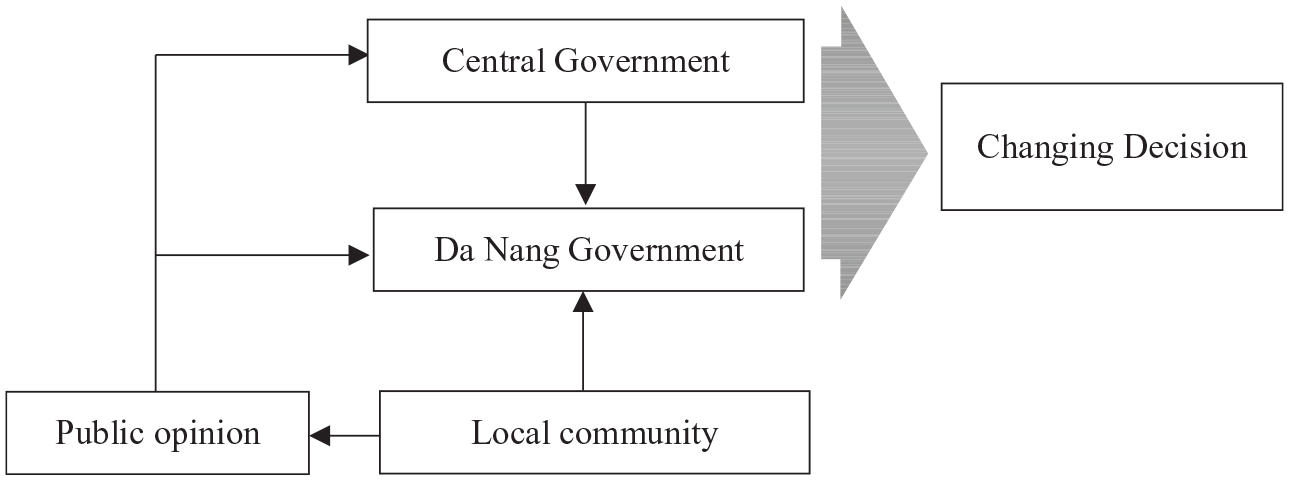
The influential flow between stakeholders.
The combination of bottom-up pressure (exercised by the community) and top-down pressure (exercised by the central government) forced the Da Nang government to address the public concern and satisfy the Central Government. This combination increased the Da Nang government’s consensus and legitimacy to amend tourism projects at Son Tra. The combination raised the balance between social forces to include the community in the decision-making process and foster the environmental sustainability of the destination. Government bodies, business sectors, local community and environmental organisations worked collectively towards the natural environment protection at Son Tra. This finding supports the statement arguing that ‘not all environmental problems can be solved through government regulation alone’ (Erkuş-öztürk and Eraydın, 2010:113). It should be noted that these outcomes can be changed if the Da Nang government continues to prioritise economic development with rapid urbanisation and construction.
Conclusion
This paper examined the power relations between stakeholders in tourism development at a local destination. The study revealed the transitions in the power relations between governments, businesses and the community, explaining a unique case where the government decision changed totally towards the community voice. Various stakeholders, including the local community and NGOs, were initially excluded from tourism decision-making and planning. The exclusion motivated stakeholders’ opposition towards government decisions and increased conflicts (Boluk et al., 2019). Local stakeholders commenced a campaign and mobilised collective public action that put pressure on decision-makers and enabled the involvement of previously excluded stakeholders. Through the campaign, the excluded stakeholders obtained detailed information and evidence about the situation, enabling them to influence tourism development directions (Moscardo, 2011). The collective action was supported by existing tourism businesses who, as mentioned above, usually have crucial influences on government decisions. The government officers were also aware of a potential violation of law thanks to the soar of public opinion that was spread rapidly across the country by the media. Additionally, violent actions tended to form at that time if the community voice continued to be ignored, posing a threat to the socio-political stability in Da Nang. Therefore, the collective action to protect the biodiversity system at the destination influenced the governments to stop the plan and investors to withdraw the projects from the plan.
This research contributes to tourism literature concerning stakeholder involvement in the sustainable development of tourism destinations. The empirical findings in this study provide a deeper understanding of how power relations were reshaped among stakeholders, enabling many stakeholders to exert influence regardless of their social/political/economic significance and achieve their goal. This suggests that for the success of a sustainability goal relevant to natural environment conservation in tourism development, there need collective actions implemented through the collaboration between the local community, tourism businesses, associations, media, and environmental conservation organisations and supported by public opinion at local, national and international levels. Although the actions emerged at a particular point in time, they influenced the long-term decision of the decision-maker and enabled the involvement of excluded stakeholders. Thus, this study sheds new light on the power relations between stakeholders, transformed by public actions, providing a comprehensive understanding of how the community has taken a stand in decision-making and policy-making. The power balance was increased among stakeholders, facilitating the excluded stakeholders involved in tourism development decision-making and planning.
The findings recommend a key aspect of destination governance relating to decision-making and planning. The government should coordinate diverse stakeholders in making and deciding the tourism development plan of destinations to avoid conflict and obtain the consensus of stakeholders, particularly local communities. In this way, local stakeholders can monitor government activities at the local level to ensure the rule of law of destination governance, which expresses the fairness of legal frameworks (Graham et al., 2003) and abidance by rules/laws (UNDP, 1997). Moreover, considering public opinion can improve the accountability of destination governance, as government agencies have to be accountable to public and/or institutional stakeholders (Bach, 2017; Laws et al., 2011) and take ownership and responsibility for tasks and the outcomes of decision-making (Rhodes, 1997).
This research is not without limitations. First, case study research has a common limitation involving a small sample size and one specific case. Despite this limitation, this case study provided a deep understanding of power relations between stakeholders in a tourism destination. Second, this research examined the influence of the collective action of community and public opinion in the actions of the governments and business sectors, yet, the research did not explain the process of how the local community were involved in the collective action. These limitations allow future research to be conducted in more cases and examine how communities involve in collective actions with diverse stakeholders. Finally, given the data collection in 2018, this research does not consider the effects of the COVID-19 pandemic. Notwithstanding this limitation, the research focuses on sustainability and community involvement, which are critical concerns of tourism scholars about post-pandemic tourism (Higgins-Desbiolles, 2021), focusing more on environmental sustainability and the inclusiveness of all stakeholders, particularly marginalised people.
Footnotes
Funding
The author(s) received no financial support for the research, authorship and/or publication of this article.
