







Abstract
The grad trip entails travelling overseas with one’s closest group of friends to commemorate the completion of tertiary and formal education and is bookended by the carefree freedom in one’s youth and the commencement of an adulthood defined by formal employment. This article conceptualises the grad trip as a phenomenon in youth tourism, based on empirical study of how it is experienced in Singapore. Our conceptualisation of the timing and duration that defines a grad trip demonstrates the dominance of time productivity reflective of Singapore’s work culture. Drawing on a precedence of studies based in the Western concept of the gap year, we reveal commonalities in employment society’s influence on time for youth tourism. While the gap year seeks to maximise the length of time offered by a ‘gap’, the grad trip contrarily minimises the culturally perceived wastefulness of a prolonged break.
Introduction
The grad trip (graduation trip 1 ) is a predictable event in the calendar of Singaporean youth. The grad trip entails travelling overseas with one’s closest group of friends to commemorate the completion of tertiary and formal education and is bookended by the romanticised carefree freedom in one’s youth and the commencement of an adulthood defined by formal employment.
At first glance, this bears some resemblance to the often-studied gap year, which is defined as a ‘period of time between 3 and 24 months which an individual takes “out” of formal education, training or the workplace, and where the time out sits in the context of a longer career trajectory’ (Jones, 2004: 8). Indeed, throughout this study, be it while seeking out literatures to frame our work, presenting this research to a broader academic audience at conferences, or speaking to our respondents during interviews, our directions were often pointed towards the popular understanding and numerous studies of the gap year. It is no surprise that the Western gap year takes precedence in studies of youth tourism, especially given that its colonial predecessor – the Grand Tour – had accounted for the historical development of young peoples’ travels.
However, what we observed in the unique proposition of Singaporean grad trips was obviously a different phenomenon despite bearing similarities in its nuances to what has been conceptualised as the gap year. Yet, we were struck by a lack of vocabulary to adequately describe this category of youth tourism. Thus, in seeking to offer an Asian perspective on youth travel, this article endeavours to identify and conceptualise the grad trip, and in doing so, differentiate scholarly interpretation of it from the pervasive Eurocentric understanding of the gap year. Our aim is not to reject existing theorisations on youth travel within the context of a gap year, but instead, to highlight what distinguishes the grad trip in its own right, and in doing so, illustrate how seemingly similar motivations behind these forms of youth tourism can in fact lead to rather different articulations and practices on the ground. This article highlights how the notion of time is understood in the context of the grad trip in Singapore and unveils employment society’s influence on time for youth tourism.
Time for the grad trip in Singapore
The grad trip is certainly not exclusive to Singapore. From senior class trips during Spring Break in America, to student trips (‘S-trips’) in Canada and ‘Schoolies Week’ in Australia, celebratory trips for graduating cohorts are gaining traction globally. In China, the months of June and July are widely known as the graduation travel season (‘毕业旅行季’) for each cohort of graduates. What youths do, where they go and who they go with vary widely across these cultural contexts and there is indeed no defining activity that all grad trips must involve. Instead, common activities taken on during grad trips range from adventure-seeking travel and volunteering stints, to purely hedonistic beach, sightseeing or shopping trips. Grad trippers’ choice of activities is rarely dictated by what is ‘right to do’ in a grad trip, but instead depends largely on personal interests and what their circle of friends want to do.
What is distinct about the grad trip then, is in when it happens. In Singapore, the grad trip occurs immediately after graduation from university, and is typically completed within a limited window of opportunity before starting full-time employment. This set out the scope for our article – by investigating the question of when the trip takes place, we identified that the timing and duration of the trip was of vital importance to Singaporean youth because of how it related to their implicit obligations to the ‘dominant cultural paradigm of the employment society’ (Bowers, 2007: 31) in Singapore’s Confucian work ethic driven hustle culture.
The focus on time or timing is not new in tourism studies. Tourism is often viewed as ‘temporary’ (Cohen et al., 2015), studied as a ‘one-off’ episodic event, with attention centred upon length of stay (Botti et al., 2008). This article focuses on the timing of one’s grad trip in relation to everyday life – time for tourism is necessarily carved out of leisure time (Brown et al., 2011) and it is within this temporal framing that tourism must be understood. The exceptionally specific timing of the grad trip elucidates a temporal understanding of tourism that is embedded in its contextual work-life paradigms.
Throughout this article, we question how the timing of the grad trip speaks back to what we understand about the gap year. In doing so, we unearthed unspoken perceptions that youth held of Singaporean work culture and how it related to their time for tourism. The everyday life perspective in tourism (Larsen, 2008) provided the theoretical framing to juxtapose the grad trip against the banal expectations of school and work, as it emplaced travel within the timeline continuum of everyday rhythms and routines. Rather than see leisure and work as unrelated entities existing in ‘separate and regulated spheres of social practice’ (Urry and Larsen, 2011: 4), the grad trip exposes their entwinement as two sides of the same coin – both compete for our limited time. The notion of time as a continuum places the grad trip not as an isolated event but embedded within the constraints of everyday work-life, foreshadowing the societal script of Singaporean work-life balance that encroaches into what makes the timing of the trip meaningful.
This article first reviews how the gap year has been studied and how it relates to youth tourism, with a focus on how it is framed as instrumental to one’s employability. Next, we introduce our theoretical application of the everyday life perspective, and its convergence with our research methodologies and field work. Discussed across two empirical sections, our findings explain how the grad trip embodies ‘vacation optimisation’ – a time-maximising strategy which exposes a culturally embedded stigma against long breaks. While the grad trip appears to escape the responsibilities of work, it is ultimately woven around culturally self-imposed (perceptions of) work obligations which conform to prevailing norms around accepted work ethics. Finally, we conclude that the dominance of productivity in employment society, made especially salient by the grad trip’s timing, is not only reflective of Singapore’s work culture, but also speak back to our understanding of the ‘gap’ in the gap year itself. While the gap year phenomenon desires the length of time offered by a ‘gap’ to build up one’s resume through meaningful activities, grad trip participants would contrarily see that same prolonged gap as something to shorten in order to be seen as a potential employee. Ultimately, our study revealed a common trait across the grad trip / gap year dialectic – the acceptance of the grad trip and gap year in their respective cultural contexts stem from a common motivation to be a productive employee. Both speak truth to the relationship of youth subjects to the priorities of the labour market, while manifesting in different forms.
It is hoped that in initiating this study, we can bring academic attention not just to this burgeoning grad trip phenomenon, but also, through our empirical example, to society’s existence as neoliberal subjects constrained by and finding workarounds to a persistent lack of time for travel. But for that to happen, we must first lay the groundwork by examining the gap year.
The gap year in youth tourism
The gap year, sometimes understood as a sabbatical year, signals a breakaway from standard and routine schedules in one’s lifecourse. The length of a gap year, and how one occupies it, is entirely up to the individual. While this gap is not always made up of only travel (or any travel at all), tourism during the gap year has been of significant attention in academic studies. We specifically hone in on its precedence in youth travel, as this allows us to bring the concept of the gap year into direct comparison with the grad trip that we are studying.
Travel as a rite of passage for young adults (Graburn, 1983) is certainly not a recent phenomenon. Since the sixteenth century, England’s elite upperclassmen were already sending their sons on prescribed educational trips, and Brodsky-Porges (1981) contended that this development of the Grand Tour eventually evolved to what we now know as mass tourism. It is thus unsurprising that the gap year practice as understood in academic studies also originated in the United Kingdom (Hulstrand, 2010) before spreading its influence in the United States from the 1980s. Since then, the modern gap year has undergone a major transformation from being a ‘radical activity’ to an ‘institutionally accepted’ one, where an entire commercial industry shapes new citizens for a global age (Simpson, 2005: 477). The gap year typically occurs during the transition between high school and university (Jones, 2004), and the volume of academic research on this specific time period mirrors its ubiquity (e.g. Blackburn et al., 2005; Vogt, 2018). However, Cremin (2007: 532) reminds us of multiple other gaps which exist – post-university, pre-baby, post-wedding, mid-career, and even, pre-retirement! This signals that individuals are afforded some agency in creating gaps for themselves throughout their lifecourse to take a ‘year out’ (another common expression according to Jones, 2004). Herein, we immediately see a contrast which differentiates it from the grad trip – unlike the gap year that can be taken ‘any time’, the grad trip’s existence is contingent on its expiry date. Once the opportunity is over, it is time that cannot be reclaimed or carved out again.
The gap year has been studied extensively within the field of youth tourism (Lyons et al., 2012; Snee, 2013). Framed as a means to acquire cultural capital in the pursuit of self-identity formation (Snee, 2016), existing literature addresses how youth aspire to narrate a cosmopolitan identity in a globalising world through the gap year (Grabowski et al., 2017). Desforges (1998: 190) theory that youth ‘collect places’ to narrate a story of themselves claiming ‘authoritative knowledge about the world’ while nurturing an ‘individualised version of planetary consciousness’ still holds valid today. Common gap year activities such as backpacking and voluntourism are widely studied as tourism phenomena in their own right. In the context of the gap year, youth seek cultural immersion (Cohen, 1979) as a means to relate more sensitively with the ‘local’ (Simpson, 2004; Sin, 2009). The mundane and everyday encounter with the cultural Other is seen as a ‘prize’ sought after by the ‘new global nomad’ (Richards, 2015: 349) of gap year tourists. However, the transactional nature of such cultural exchanges has not gone unnoticed and has since been critiqued as being exploitative (Guiney and Mostafanezhad, 2015), unsustainable (Luzecka, 2016), non-altruistic (Calkin, 2014), and creating all sorts of long-term dependency issues (Sin, 2010).
More critically, the gap year is also understood within the ‘economy of experience’ – as a pragmatic component of employment assessment regimes, where youth are ‘scrutinised and subject to the gaze of future employers or university admissions assessors’ (Heath, 2007: 95). Here, the gap year is no longer mere leisure but a credential – travel becomes a commodity to be exchanged, complicit in a middle-class strategy to outcompete and increase one’s social mobility (Yoon, 2014). Viewing the gap year as a ‘professionalisation’ of travel (Simpson, 2005), it represents an outlet where neoliberal subjectivity is internalised and naturalised. The responsibility then falls on youth to choose amongst taking part in commodified ‘constructive’ activities (Ansell, 2008: 221) to profile themselves as having done something worthwhile (Snee, 2014). The pursuit of leisure through the gap year is legitimised as a positive identity-shaping experience (King, 2011). Backpacking, for example, is repackaged as an avenue for learning soft skills (Pearce and Foster, 2007). As Cremin (2007: 526) describes, the gap year ‘(re)imagines the subject for the labour market’ through the instrumentalisation of authentic experiences to boost one’s employability. Wilde (2016: 65) has further criticised the gap year voluntourism industry for promoting ‘individual responsibilisation’, which is symptomatic of the humanitarian sector’s co-option of neoliberal political economy’s goals to perpetuate conditions that exacerbate global inequality, even as it is masked as a positive educational experience to develop active global citizens in its youth subjects. This mode of accruing cultural capital is problematic because the opportunity is largely influenced by one’s social class and financial status (Birch and Miller, 2007), widening the gap and disenfranchising youths without the privilege of taking a gap year, especially when such experiences are becoming essential components of one’s resume to impress prospective employers.
Avoiding insularities and assumed binaries
Given its colonial roots in European and American contexts, the widely accepted institutionalisation of the gap year and its burgeoning commercial industry is naturally observed and predominantly understood from a Western-centric lens, as revealed by literature reviewed in the preceding section. However, the gap year has not gone unscrutinised by scholars writing from elsewhere. Rabie and Naidoo (2016) found that the most common motivation for South African students to take a gap year is to postpone deciding on their future because of career uncertainty (Coetzee and Bester, 2009), which differs from Western gap year students whose travels are intentionally instrumental to planned career or academic goals. Observing the phenomena from China, Wu and Pearce (2018) find the Chinese gap year constrained by a culturally distinctive hierarchy of needs including social responsibility obligations, financial and safety concerns. Seen as a career break rather than a pre- or post-university gap, the motivations and demographics of Chinese gap year takers are more varied than their Western counterparts (Wu et al., 2015). Similarly, Luo et al.’s (2015) account of Chinese backpacking suggest important deviations from Western contexts – Chinese backpackers are focussed more on self-actualisation than cultural capital accumulation, and on intra-group bonding rather than solo travelling (Chen and Weiler, 2014).
While the concept of the gap year has spread internationally (both figuratively and literally through the warm bodies of gap year students on tour), its ubiquity or popularity has yet been established in non-Western contexts. Writing from Malaysia, Singapore’s geographically (and perhaps culturally) closest neighbour, Abdullah (2017) notes that the gap year has never been formally implemented in their education system. In order to incorporate the gap year into Malaysia’s undergraduate curriculum, she emphasises the importance of getting employers’ and parents’ buy-in in a society accustomed to the conventional pathway of employment after graduation, to incentivise students’ participation and convince them of its merits. Evidently, international consensus on the virtue of a gap year is more divided than the picture painted by dominant Western-centric discourses, and this article thus rides on the ‘Asian Wave’ (Leung et al., 2011) in tourism research to provide a counterview from Singapore.
As Asian scholars, we are cognisant of criticisms of Anglo-centric conceptualisations’ claims to universality (Chang, 2015; Winter et al., 2008). Tourism scholarship has since sought to address this through offering insights that are culturally grounded while asserting an Asian viewpoint (Chang, 2021a; Sin et al., 2021; Winter, 2008). However, that should not start from refusing existing conceptions of the gap year. We do not wish to perpetuate an insular Asia-centric view that celebrates the grad trip as an Asian-only phenomenon without any Western precedents or gap year inflexions (Chang, 2021b; Ooi, 2019). Instead, by examining the importance of timing one’s grad trip in the culturally embedded context of everyday life in Singapore, we can better engage with past studies of the significance of this ‘gap’ in time that served the instrumental purpose of the gap year to begin with.
Unpacking the grad trip using the everyday life perspective
Everyday life and tourism are often ‘silo-ed’ as ‘belonging to different ontological worlds’ (Larsen, 2008:21), where the latter entails an escape from the former. The social turn destabilised these binaries, encouraging us to see tourism as a ‘fundamentally material, embodied and social endeavour’ that is not separate from mundaneness (Molz, 2012:163). Tourism cannot be separated from the quotidian and is better understood as a ‘mundane mobility’ (Edensor, 2007) because we bring with us reflexive habits, embodied practices and familiar people into the tourist space. Travel is thus an extension of everyday aspirations and constraints. This understanding of the everyday life perspective couches our conceptualisation of what makes the grad trip distinct from the gap year phenomenon. As Molz (2012: 161) rightly describes, it is through ‘interactive travel’ that we can understand tourism as a performance of ‘mobile sociality’ – a lens through which ‘everydayness’ becomes more discernible, manifested in the unconscious performance of banal interactions with friends in planning a grad trip and the unspoken intuitive norms we live by which permeate such practices (Larsen et al., 2007). Rather than seeing everyday life as routine work schedules, and leisure as a temporary escape from the humdrum, there is more to everyday life than the habitual, pre-scripted and ordinary (Edensor, 2001).
We apply the everyday life perspective to frame the grad trip as a part of, not apart from, everyday life, and elucidate its critical distinguishing factors – timing and duration. In demonstrating how the grad trip exists in a unique time void, bounded between the start of formal employment and the end of formal education, we argue that the phenomenon is reflective of and structured by the time pressures of everyday life unique to the Singaporean work ethic. The grad trip illuminates how vacations are not episodic but weaved into work schedules. Its specific timing, threaded around a gap in time when not working, informs us that leisure is inserted into the very rhythms of work it is proclaimed to be escaping from. This provides a unique entry point to make sense of Singapore’s increasingly time-stretched workaholic culture where gaps are shunned. In deconstructing the leisure ethics that produce the Singaporean grad trip, we reveal that work is not antithesis to leisure nor an entity to escape from, but conditions the very existence of leisure time to begin with. In our penultimate section, we demonstrate how this alternate view of the ‘gap’ in which the grad trip exists allows us to speak back to the very conception of the gap year phenomena. While the gap year seeks to maximise the gap, the grad trip seeks to minimise it instead while still attaining the outcome of productive leisure and serving underlying motives of boosting employability.
Research methodology: ‘Intimate insider’ with respondent-friends
This article is methodologically based on a series of focus groups done with groups of friends who embarked on their grad trip together. We must first caveat that going on a grad trip involves a significant investment of time and money and recognise this as a privilege afforded only by youths of the upper-middle classes. Inherent in their ability to graduate from university, grad trippers are already set apart from their peers of lower education levels and disadvantaged family backgrounds. However, within the microcosm of the university campus, the grad trip is indeed experienced as something taken for granted and this research deconstructs it as it is understood from those privy to that vantage point. As seen in Table 1, the destinations (ranging from nearby cities in Southeast Asia to far-flung European countries) already send a strong signal as to the heterogeneity of each group’s purchasing power and the inequalities that exist even amongst those privileged enough to go on a grad trip.
Focus group discussion participant and grad trip details.
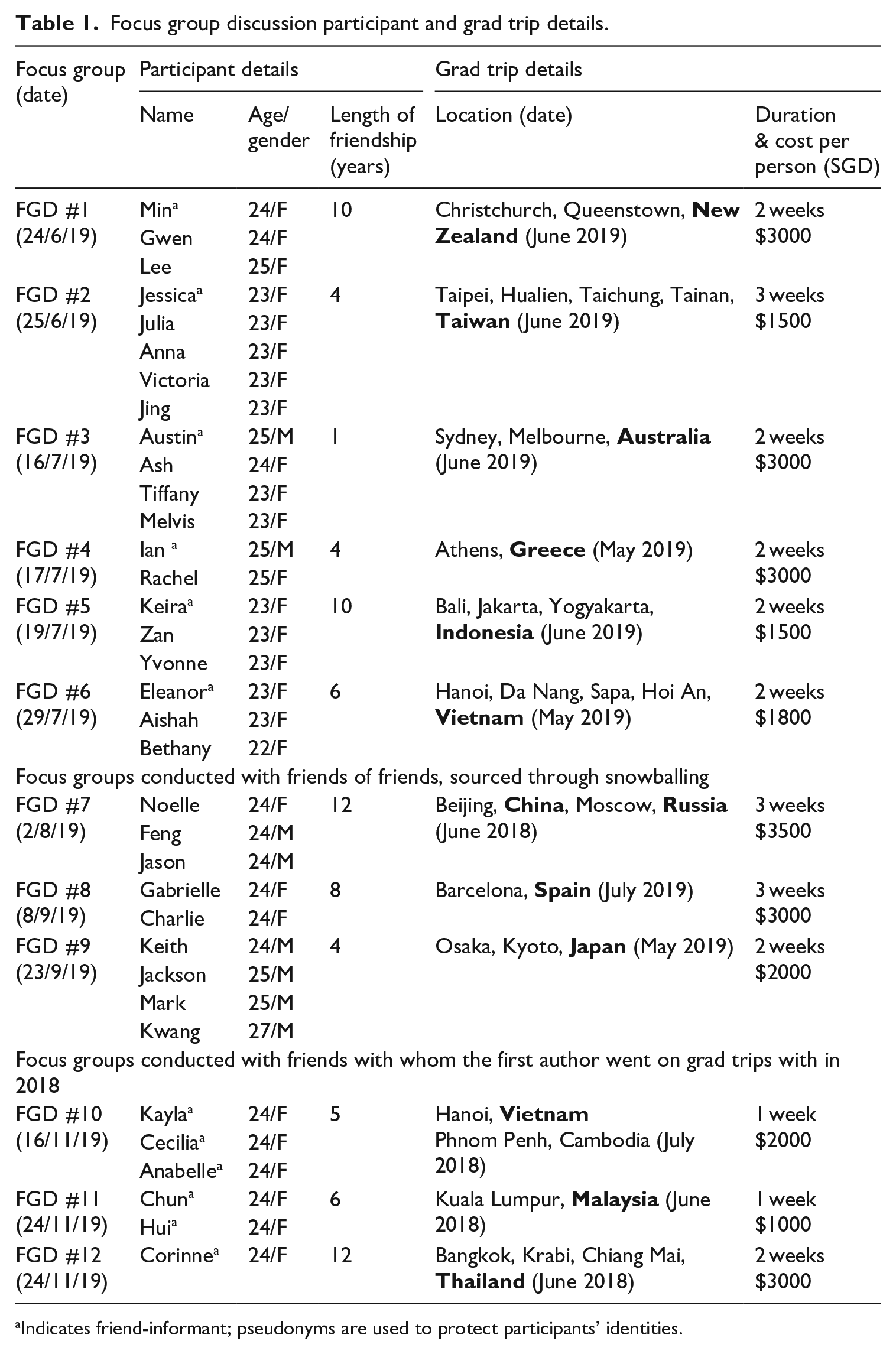
Indicates friend-informant; pseudonyms are used to protect participants’ identities.
Focus groups were chosen for their interactional quality, enabling respondents to discuss, confront and negotiate meanings openly (Morgan, 1998), thus presenting the dynamics of social discourse from multiple contrasting viewpoints. Additionally, respondents were given the space to develop a sense of ‘ownership’ of the project through focus group discussions (Kneale, 2001), as respondents were positioned as agents in the co-production of knowledge (Meunier, 2013). This research also deliberately allowed participants themselves to determine who was included, such that the focus group itself is constitutive of friendship as it occurs in everyday social life.
Focus groups are known to work better for participants with ‘well-developed routines for talking to each other’ (Macnagten and Myers, 2004: 69) and friendship circles embody the most ‘natural’ group (Conradson, 2005) conducive to constructive conversations. The intra-group homogeneity and familiarity (Morgan, 1996) allowed participants to speak freely in an atmosphere of mutual respect and comfort, and this was particularly pertinent as our research required participants to be vulnerable and introspective. Stories collectively generated through the focus group also reflect the social nature of knowledge more accurately than individual narratives assembled through interviews (Goss, 1996).
We conducted 12 focus group discussions – six sourced from the first author’s friends, three sourced from friends of friends via the snowball method, and the final three consisting of friends from the first author’s own grad trips (Table 1). Each focus group lasted between 1 and 2.5 hours and consisted of 2–6 respondents that had gone on a grad trip together. For our data analysis, we applied the tenets of grounded theory – a systematic method of qualitative research where researchers use inductive data to strengthen the explanatory power of theories derived from the field (Charmaz and Bryant, 2016). Analysis using grounded theory is useful for exposing tacit knowledge that would usually be taken for granted as ‘conventional wisdom’ (Riley, 1995: 636). This framework is thus complementary to our objective of deconstructing the unspoken everyday norms surrounding the grad trip. Data collection and analysis occurred simultaneously. As the research evolved with each new lead, the focus groups were analysed in sequence, rather than as a contemporaneous entity of data, in order to capture the development of ideas and concepts unfolding chronologically.
Approaching friends as research respondents was useful as we were able to utilise an autoethnographic sensibility to reflect on the first author’s relations with the respondents. Leeuw et al. (2012: 191) expound that friendship holds us deeply accountable to each other, more so than formalised relations, because of its unique ‘weaving of care, trust and vulnerability’. This is particularly important for the topic of study – as work pressures and leisure aspirations are often closely tied with respondents’ individual circumstances, having each focus group made up of respondents who were already friends created a safe space to share personal thoughts and struggles. Having the first author as a friend (or friend of friend) to at least one member within the focus group also enabled an open discussion and intimate sharing that might have been hard to access without such trust relationships.
It is recognised, however, that the researcher-researched relation is tricky to manage when personal history pre-dates the research engagement. For example, Yuan (2014: 96) reflected that friends’ motivations for research participation may be to ‘show support’ and data distortion could result from friends fabricating data to confirm researchers’ expectations. As such, we were careful to account for the performativity of friends as they approach the first author as a friend-researcher. To balance out such biases and avoid ‘insider myopia’ (Taylor, 2011: 15), we actively sought to reach out through snowballing friendship groups beyond the first authors’ own circle. Towards this end, we conducted three focus groups that consisted solely of friends of friends.
Vacation optimisation
The first distinctive feature that defines the grad trip is the urgency of its timing. It is not simply a matter of ‘when’ but of ‘why specifically now’. The timing of the trip reveals a convergence between time for work and tourism, reflective of how our increasingly ‘crowded’ time (Bowers, 2007) is painstakingly subdivided and managed in post-industrial society (Gershuny, 2003; Haworth and Veal, 2004). Exploring this through the everyday perspective, we reveal the perceptions that youth have of an impending work culture that factors into their haste of taking the grad trip. The timing of the trip is thus not separate from the quotidian but born out of its very constraints.
Our respondents’ unanimous agreement on the strategic timing of the grad trip made clear that their ability to go had a limited time frame. The grad trip could only take place straddled between the end of formal education and the start of formal employment. As Noelle describes below, the grad trip had a unique ‘expiry date’: “In this Singaporean life, where you don’t have a lot of time to travel after, like, when you start work? This is our only window of opportunity”.
Time for travel is often assumed as a pre-given, yet it does not exist in a vacuum. Instead, it is wedged between the responsibilities of everyday life. Within existing work-life literature, Bowers (2007) demonstrates that appropriation of the work/life balance discourse has constantly subjugated leisure life to the temporal demands of work. Tourism and work-life need to be understood in tandem, and the grad trip illuminates this contrast evidently, as seen in Mark’s attempt to rationalise the urgency of the grad trip: “I think it’s a conceived perception there’ll be less and less time to travel, when you get older and start working. It’s something that’s pushing even more millennials to take more trips than before. There is the feeling like in the future you won’t get this. So if there’s one last chance that I have, I will take it. It’s the only break you will ever really get before you really start adulthood. It’s like time you will never get back!”
Mark’s comment reinforces the grad trip as a once-in-a-lifetime opportunity to be seized, because of the perceived lack thereof of time upon the start of formal work. These sentiments aggravate the ‘fear of missing out’ even further. It is not just about missing out on making memories with friends, but also that one might miss out on the chance to travel given the looming spectre of work. The pragmatic motivations for the grad trip pit travel time against work time as opposing forces. The very notion of the grad trip would perhaps not have been conceived without it being idealised as a ‘window of opportunity’ (Noelle) between schooling and working lives – its very existence contingent on the rhythms of work and leisure in everyday life. Understanding the ubiquity of the grad trip phenomenon in context thus necessitates looking into the unspoken presumptions that grad trippers hold of the normative work culture they are emmeshed in.
‘Freedom’ within this unique time-bound ‘window’ was a recurring motif mentioned by respondents and Corinne’s comments illuminate this: “It is a release from 16 years of education? Since Primary 1, you know that you are going to work, you know you are going to be stuck in this education system all the way until university. Then suddenly I’m at the end of university. I finally have some free time to myself at the end of this race before I start the next one. . .. The reason why we want to go for grad trip, and the reason why we want to exploit this gap of time, is how we perceive work life to be. We really perceive that once we start work we have no autonomy over leisure time and we will never ever get scheduled breaks together”.
The grad trip represents the first time youth in Singapore are free from the education system that they are deemed to have successfully completed. Throughout their years of schooling, students rarely have a true respite from their studies – even end-of-term vacation periods are crammed with ‘meaningful’ extra-curricular activities, planned by parents or teachers, in a bid to maximise enrichment in that brief four-to-6-week span. Their newfound capacity for self-determination ‘at the end of this race’ (Corinne) gives meaning to the grad trip and represents an autonomy amongst respondents in deciding what to do with one’s time that is now truly ‘free’. Unlike the gap year where one’s cultural immersion through tourism is seen as a prerequisite to qualify for further studies or to stand out in job interviews (Heath, 2007), at first glance, the grad trip seemingly stands in complete opposite in that it is perceived as a last chance for a genuine break to be enjoyed with no ulterior motive related to one’s productivity or employability. Grad trippers desire presenting the grad trip as a form of unadulterated hedonism that does not need to be justified as the means to a more profound end, vis-à-vis the gap year that demands one to check the boxes of a ‘longer career trajectory’ (Jones, 2004: 8) beyond it.
However, when we further unpack the urgency of the trip, our participants also dismayed that this freedom is short-lived and hedged against a contempt and seeming dread against what they perceive to be a lifelong future of work-life ahead. Consider the following exchange between three friends who went on their grad trip together:
‘We have to go now before we start working, otherwise we won’t have anymore time!’
‘I heard from my internship colleagues that you won’t ever do a trip with friends anymore? It will mostly be just family. It’s already so hard getting leave, what more [for] travel with friends!’
‘Maybe when we’re older we will have time?’
‘You mean when we’re retired?’ *laughs*
Gwen jokes that her next travel opportunity with friends is likely upon retirement. This innocuous jab at workaholism illuminates the mindset that young people are inadvertently indoctrinated with amidst Singapore’s competitive education system. Embedded in their conversation lies the idea that as one enters adulthood, marked by entry into formal employment, work becomes an all-encompassing directive to be succumbed to. Work is imagined as a force that intrudes into all aspects of life, including and especially regarding time for tourism.
Within this worry conceals an anxiety over and lack of full understanding of what the next stage of life would look like. The grad trip becomes a prime time for youth to exercise their newfound ‘freedoms’, while the rules of the game remain in a state which they understand and control, against the eminent responsibilities of what is to come. The grad trip takes place in this unique transitory time boundary. This period represents a liminality preceding the unknown of ‘adulting’ – here, youth finally find themselves with autonomy over their time, albeit with the ominous next chapter of life threatening to take that newfound freedom away. The idea that time is a resource to be seized thus factors heavily in making the grad trip happen.
Also embedded in reservations about work-life is the perception that leisure travel is a frivolous indulgence consigned to youthhood. Jason’s remark reflects a widespread cultural mentality that casts leisure beyond the scope of ‘a regular life expected of an adult’: “If you want to enjoy the things that are outside the scope of the regular life to be expected of an adult like work, family, whatever, then having a job right after you graduate will be a turn off. Because I personally would want to enjoy these other things first. . . It’s kind of like vacation optimisation!”
His perception of how leisure is supposedly shunned in adulthood reflects the mentality youth hold that work trumps everything else, surpassing even the importance of rest – perhaps an unfortunate by-product of Singapore’s ‘examination culture’ (Wong et al., 2020) whose rigorous assessment regimes overly penalise those who put play before work. The grad trip, almost emblematic of the ‘final nail on the coffin’ in putting an end to the carefree lifestyles of youthhood, carries a sacred meaning connoting the finitude of a chapter of life. However, we must be cautious not to latch onto the notion of a ‘rite of passage’ (Graburn, 1983). The grad trip has never been perceived as a ritual precursor to adulthood, and cohorts of graduates amidst the Covid-19 pandemic have found themselves entering the workforce without any analogous substitute. This further accentuates the strategic timing at play when youth maximise their post-graduation ‘freedom’.
We are cognisant that the work-play divide does not necessarily map neatly onto a simplistic dichotomy of adulthood versus youthhood. Indeed, extensive literature in the geographies of young people have acknowledged playing and learning as ‘child’s work’, while still differentiating this from the labour and work of adulthood (Abebe and Waters, 2017). Using the everyday life perspective to understand the grad trip allows us to challenge this binary bifurcation which separates work and leisure (Bowers, 2007) – the former is not merely consigned to everyday life and the latter does not exist in an imaginary time void. Instead, the grad trip demonstrates that motivations for travel are embedded within everyday timelines.
Casting impending work schedules as a separate sphere existing outside the tourism space, as if it had no influence on tourism patterns, would dilute the richness of a holistic interpretation of the grad trip. The grad trip thus acts as an entry point to interrogate how time for tourism is implicated by the contextual work culture in which leisure is carved out from, as explored in the next section.
No time for a gap year: Keeping up with the ‘Singaporean script’
The second feature that markedly sets the grad trip apart from the gap year, is how short it is in its duration. As Aishah pointed out: “Because gap year is not really a thing here, that’s why we look forward to the grad trip as our gap month!”
Even the term ‘gap month’ may overstate the actual duration of a grad trip. Amongst our respondents, their travels never exceeded 3 weeks. The truncated duration of the grad trip should not go uninterrogated merely as a condensed gap year. Our participants shared the common perception that they had ‘no time for a gap year’, which signalled that the grad trip was favoured as a quicker substitute. In order to conceptualise the duration factor that constitutes the key essence of a grad trip, we need to understand not just the obvious fact that it is shorter, but more importantly why. Again, we employ the everyday life perspective to focus our attention on the banal mentions of pre-scripted and habitual routines that shape the perceived time available for tourism. This clues us into the dominant work culture that contextualises the grad trip in Singapore.
In the following exchange, we see how as opposed to the gap year, the grad trip minimises the opportunity cost of time which might be better spent accumulating work experience:
‘I think there’s a certain pragmatism in that, it’s a rat race, you want to keep up with the people at your age, it’s like a Singaporean script’.
‘Life is very planned’.
‘You can plan a gap year also, but if you’re on gap year and your friends are getting a job, or getting promoted, or studying for their masters, then you will feel like you are not keeping up with that race. You’re behind in a way. For me, that’s why I wouldn’t do a gap year. Grad trip is okay because it’s just two, three weeks. The opportunity cost is not just the money. It’s the experience. [In] that one year you can gain real job experience’.
‘Why is keeping up with the narrative of the Singaporean script so important?’
‘It’s not that I want to follow what everybody else does. But I would tend to use the average performance of other people as the benchmark of what I should be doing’.
The ‘Singaporean script’, as termed by Rachel, does not afford one the leeway of a longer break, lest it cost you to fall behind in the ‘rat race’. The Singaporean ‘script’ in question refers to attaining timely goals in the ‘ladder’ of social mobility (Tan, 2012). According to Tan, the Singaporean ‘good life’, like the ‘American dream’, is defined as a secure career trajectory and a comfortable lifestyle focussed on purchasing two ‘big ticket’ items of a property and a car, which is by no means an easy feat given Singapore’s high cost of living. The mentality of constant upgrading is framed as a necessity to move ahead towards attaining upper middle-class status (ibid). The career advancements or educational credentials that Rachel describes are checkboxes to tick in keeping on par with her peers – social mobility is thus not merely at one’s own pace but perceived as a competition with others.
Our respondents consistently echo the idea that their freedom to travel is constrained by what society would perceive of their behaviour, their choices conditioned by what they regard as the ideal benchmark. Keira’s comment is telling of this compliant mentality, demonstrating the role of the ‘Singaporean script’ in shaping the grad trip phenomenon: “I think it’s because we have this model Singaporean in mind. You know, the model Singaporean timetable and lifestyle. So whatever small pockets of time that you feel like you are free from the system right, that’s all the time you can have to play with. Whereas overseas they don’t have a model lifestyle to follow so there’s less structure to their timeline, so they feel more liberated and at ease to easily take six months [of ] holidays. Whereas for us we know it’s not socially acceptable. The limited time is a real thing for us. That’s why this trip is such a big thing in relation to our available time”.
While we are hesitant to agree with Keira’s romanticised imagination of the liberties of cultures and lifestyles overseas, implicit in her comment is the idea that ‘socially acceptable’ conventions and norms about leisure time are closely dictated by (Asian or Singaporean) cultural discourses about keeping up in with work. This means constantly attaining milestones in accordance with the ‘model Singaporean timetable’, and a gap year is not a part of this plan, nor can it easily be introduced without intense pressures from one’s parents and peers.
These examples are also revealing of the Singaporean ‘kiasu’ mentality, a colloquial Hokkien (dialect) term which translates directly to ‘scared to lose’. Because taking time off is perceived to be at the expense of falling behind one’s peers, having an extended ‘break’ is abhorred in Singaporean society. Time is of essence – you cannot afford to be ‘behind time’. As a result, many youth, like Charlie, avoid taking a gap year altogether: “Our cultures are very like chiong chiong chiong
2
, versus other countries [where] it’s more acceptable to take a gap year. Whereas in Singapore if someone takes a gap year, you must be thinking their life is being set back by a year!”
Emphasising the nuances between cultures, Charlie stresses that taking a gap year in Singapore would be met with scrutiny and disapproval because it sets one back in a culture that valorises moving forward, rushing ahead, and achieving certain targets by certain life stages. In deconstructing the ‘duration’ factor of the grad trip, such self-reinforcing everyday societal norms surrounding work are brought to light.
The term ‘vacation optimisation’, aptly coined by interviewee Jason, captures this desire by youth to maximise their free time within self-imposed limits, in order to reap the most benefits without falling behind. It is clear from our interviews that most respondents reflect on the lack of choice or freedom to set their paths on a different script, even if the limits on the length of a grad trip are entirely self-inflicted. Given the relatively comfortable wealth and income levels of most Singaporean grad trippers, the imperative need to begin one’s career and perception of having ‘no time’ for leisure is possibly less of a physical reality, but rather an entrenched and self-performed/reproduced myth – all of which validates the existence of the ‘Singaporean script’. This ‘Singaporean script’ propagates a ‘more work, less play’ mindset amongst young people, almost as a prerequisite for achieving prescribed ‘socially acceptable’ goals. Veering off this track can be met with disdain, and youth internalise this mindset through their education, often described as a ‘rat race’. With Singaporeans clocking one of the longest working hours globally (Tan, 2016), it is no wonder that burnout is on the rise in this workaholic culture.
When we begin to dissect the motivations for the grad trip, we unpack how everyday work cultures play a role in shaping cultural patterns in tourism. Regardless of whether we as researchers agree with viewing it so, our respondents’ comments highlight how work is often placed on a pedestal as the substance of everyday life, to the extent that travelling even can be perceived as a wrongful ‘gap in your resume’ (Feng) that one would need to explain and justify to employers. Ironically, this is in direct contradiction with how the gap year has been framed from a Western lens, where the gap itself is made productive because it is filled with activities that contribute to one’s professional resume (Cremin, 2007).
Understanding the grad trip through the everyday lens of banal and ordinary work ethics that are culturally pervasive unveils Singapore’s pragmatic society as one which stigmatises too much ‘play’ and deplores what is perceived as prolonged hedonism and ‘unproductive’ leisure – one is seen to be wasting time in the gap year. Taking a shorter grad trip instead of the longer gap year gives the impression that one is industrious – less time on play, more time on work. While we can confidently discuss the Singaporean cultural context in our study based on our respondents’ comments and our own first-hand experiences, it is important to realise that this stigmatisation of play is not entirely unique to Singapore. We see this materialising in China’s 996 work culture prevalent in the tech industry (Li, 2019) and the ‘cram school’ tuition industry popularised in Japan, South Korea and Taiwan. In identifying and conceptualising the grad trip, we seek to catalyse a new lexicon of terminology to consider whether similar impetuses also exist outside of Singapore. As such, in our final section, we draw out the parallels between how the framing of productivity in the gap year and grad trip are divergent outcomes of the same dominant work ethics of industrial society.
Time productivity in the gap year and grad trip
Thus far, we have demonstrated that the two defining factors of the grad trip – timing and duration – mirror the anxieties graduating cohorts have of impending work obligations that lie immediately ahead. The grad trip makes unambiguously explicit an ideology that already persists in Singapore’s work culture, which has a longevity which both precedes and exceeds the grad trip phenomena. While this article does not discuss the issue at length, our respondents also informed us that norms and practices surrounding taking vacation leave from work for leisure travel continue to be shaped by the same logic of time scarcity that permeates discourses of the grad trip. Indeed, the grad trip is symptomatic of a wider malaise, where leisure is viewed as ‘a by-product of work inextricably tied to delineations of time’ (Bowers, 2007: 31) in the institutionalisation of a society whose core function is labour and employment.
Viewed from the everyday life perspective, tourism becomes ‘a significant modality through which transnational modern life is organized’ (Franklin and Crang, 2001: 6–7) – no longer a separate utopia divorced from work but integrated instead. Indeed, if ‘work is like the spine which structures the way people live’ (Applebaum, 1992: ix), we need to understand how tourism is structured around work, and the grad trip offers us a case study to excavate the centrality of time for tourism amidst the dominant work regime in Singapore. With our nascent conceptualisation of the grad trip phenomena encompassing its timing and duration, giving a name and definition to this type of youth tourism, we now have a stronger framework to understand its dialectical relation to its gap year counterpart. The genesis of the grad trip parallels that of the gap year in that both originate from a disciplined view of time as ‘a currency and resource not to be wasted’ (Thompson, 1967: 95) – any time spent idle is spurned. Hence, the acceptance of both types of youth travel in their respective cultural contexts stem from a common motivation to be a productive employee in our neoliberal economy. From this perspective, we provide a key empirical contribution to the literature by identifying how youth subjects from Singapore adapt themselves to the same fundamental precursors that gave rise to the gap year phenomena.
Cremin (2007: 526) describes the gap year as an institutionalised way of living life to the fullest, where we can ‘fulfil our dreams, however structured, and sustain a relationship to the labour market back home’. According to Boltanski and Chiapello (2005), the perception of one’s productivity in liberal capitalism relates both to what they do within and outside of paid employment. This explains why the gap year has neatly folded itself into narratives of constructive ‘time out’, without being seen by employers as an unforgivable indulgence (Ehrenreich, 2006). In a Western context, the gap year increases one’s competitive advantage because of a productive use of time. Whereas in Singapore, the time-saving feature of the shorter grad trip becomes a selling point, for time is better spent in full-time employment as a priority instead. Each society pre-adapts itself to appropriate ways of being and doing through the internalisation of structured social circumstances (Bourdieu, 1990: 560). While the gap year stresses individual choice and responsibility to pursue ‘correct strategies’ for advancement, the extent of this choice is already predetermined to what is deemed socially acceptable (Snee, 2014). The grad trip from Singapore is thus the product of youths acting within the fields of opportunity available to them, optimising their vacation time to maximise the benefits accrued through the experience gained from stable employment instead of alternative gap year pursuits. Moreover, the understanding of a gap year as a space for youth transformation (Johan, 2009) applies less to Singapore’s context, where the ‘Singaporean script’ already sets the trajectory for what one should be doing. The need for a time and space to contemplate, reorientate and reconfigure their life choices matters less in a conformist society where straying too far from the beaten track is spurned. As such, the postponement of facing up to ‘career uncertainty’ (Rabie and Naidoo, 2016) would be met with more disapproval than sympathy.
Writing from Singapore, we find ourselves serendipitously straddled at the crossroads of the rigorous examinations-centred Asian education system and a society fairly exposed to Western liberal ideologies about freedom and the importance of serious leisure (Stebbins, 1992). Perhaps the grad trip is a marriage of these views, a sort of ‘glocalisation’ (Swyngedouw, 2004) of the gap year with uniquely Singaporean traits. As suggested by Wu and Pearce (2018), rather than trying to locate the gap year elsewhere, we should seek to better understand the many variations of ‘gap time tourism’ instead, and we hope that our study has achieved that through its conceptualisation of the grad trip.
Conclusion
In our endeavour to conceptualise the phenomenon of the grad trip from Singapore, we pave the way towards understanding new expressions of youth travel in their own terms, with a deeper appreciation of the cultural norms that produce them. The critical timing, referring to both period and duration, of the grad trip unveils how Singapore’s work culture constrains and conditions leisure time available for tourism. The grad trip is consciously born out of youths taking advantage of maximising even the tiniest fissure available in their regimented schedules, scripted by prevailing societal norms. As Franklin (2003: 43) aptly remarked: ‘It is nonsense to imagine tourism as an escape from modern ways of life when it is par excellence the way of modern life’. The grad trip signposts us towards an understanding of the significance of time for tourism vis-à-vis work, thus presenting a means to comprehend tourism as a thoroughly modern practice in organising the increasingly strained work-leisure divide. Tourism is indeed not an exceptional or special time but instead culturally informed by particular notions about what to do, and how and where to do it (Edensor, 2007). The everyday life perspective we apply demonstrates that tourism is not an escape apart from the everyday, but exists as a part of the same timeline of everyday life that obligates one to fulfil work priorities and duties first. The conception of the grad trip is thus nuanced in Singaporean peculiarities of time scarcity and work culture driven timelines. In our study, the role of work norms in the configuration of tourism tactics is illuminated as central to the temporally grounded practices of everyday life. Our research exemplifies how inserting the function of time allows us to paint a more complex, dynamic and contextual account of tourism, and ultimately, we hope that this article stimulates more conversations on whether the strategies of vacation-optimising and time-maximising amalgamations also apply in other forms of tourism.
Footnotes
Declaration of conflicting interests
The author(s) declared no potential conflicts of interest with respect to the research, authorship, and/or publication of this article.
Funding
The author(s) disclosed receipt of the following financial support for the research, authorship, and/or publication of this article: This research is supported by the National University of Singapore, Faculty of Arts & Social Sciences, Graduate Research Support Scheme.
