







Abstract
This paper advances a methodological argument for episodic tourism ethnography in multi-ethnic, politically sensitive field sites. Drawing from my fieldwork in Taman Negara, Malaysia, I explore how a tourism ethnographer moves across different communities and shifts between the tourist-facing and host-community arenas, all while managing insider-outsider roles. Within this broader reflection, the paper introduces “multi-layered shifting positionalities” as a heuristic for understanding how layered positionalities are organised through movement between two principal arenas in tourism ethnography, as well as the researcher’s shifting positionality across different communities. The paper shows how uneven immersion, boundary-conscious routeing, and retreat-and-return rhythms can become deliberate strategies for sustaining access, protecting relationships and interpreting inter-group tensions without being absorbed into any single group’s worldview. It also clarifies the ethical implications of such mobility, emphasising consent, role presentation, and long-term accountability. The paper advances tourism anthropology and critical qualitative methods by providing practical guidance for researchers in complex, plural and contested destinations.
Keywords
Introduction: Towards a reflexive tourism ethnography
Ethnography has long been a hallmark of immersive qualitative inquiry, especially within anthropology. Over recent decades, tourism scholars have increasingly used ethnographic approaches to examine host-guest encounters, community change, and the socio-cultural effects of mobility. Alongside this growth, the broader epistemological turn towards reflexivity has encouraged researchers to scrutinise how their positionalities, relationships, and field strategies shape what can be known. Yet there remains limited methodological discussion, within tourism specifically, of what reflexive ethnographic practice looks like in multi-ethnic field sites, particularly in Asian contexts where identities may not map neatly onto a simple “insider-outsider” binary, even as a substantial body of Asian and diasporic scholarship has long advanced reflexive ethnography (e.g. Bui, 2022; Narayan, 1993; Zhang, 2017).
In tourism studies, ethnographies of community-based development and everyday tourism economies often foreground the researcher’s negotiation with a focal group, a relatively bounded community setting, and the tourism “interface” with visitors. However, many destinations are constituted through multiple communities that are internally diverse and historically stratified, shaped by inter-group tensions, language hierarchies and uneven access to tourism benefits (Belsky, 1999; Yang et al., 2013). In such settings, ethnographic work is not only about participation and observation, but also about boundary work, which involves navigating across social worlds while managing shifting expectations, partial access and politically sensitive classifications. This raises methodological and ethical questions that are easily overlooked: What constitutes “immersion” when access is uneven across groups? How do ethnicised identities, of both researcher and interlocutors, shape trust, interpretation, and what can be asked? And how do power asymmetries operate when ethnic discourse is pervasive yet publicly constrained?
Drawing on my long-term fieldwork in Taman Negara, Malaysia, this paper reflects on the strategies and tensions involved in conducting tourism ethnography in a multi-ethnic context. Taman Negara is among Malaysia’s most visited ecotourism destinations. Its tourism economy involves Malaysian Chinese tourism entrepreneurs, Malay park officials and service providers often regarded as the “local majority,” and the Orang Asli Batek (an Aboriginal group) whose traditional territories lie within the national park and who remain socioeconomically marginalised (Tacey and Riboli, 2014). These groups occupy different positions within tourism and engage in ongoing negotiations, sometimes overt, sometimes latent, over land access, cultural representation, and economic opportunity. Here, inter-ethnic dynamics are not simply “context” for tourism; they are constitutive of everyday tourism interactions and the conditions under which ethnographic access is granted, withheld, or contested.
Although scholarship in anthropology and sociology, along with a growing body of tourism ethnography, has examined how plural settings complicate researcher positionality, tourism research still offers relatively few explicit methodological accounts of how ethnographers navigate multi-ethnic boundaries in practice, especially when fieldwork unfolds through uneven access, inter-community movement, and episodic return. Building on debates in tourism anthropology, critical ethnography, and postcolonial research, this paper contributes a grounded methodological reflection by proposing episodic tourism ethnography as a practical orientation and introducing “multi-layered shifting positionalities” as a heuristic for understanding how layered positionalities are repeatedly organised through movement between the two principal arenas of tourism ethnography: tourist-facing and host-community settings. As a foreign Asian researcher of ethnic Chinese background, and shaped by mobility across both Asian and Anglophone contexts, I entered the field in Malaysia with forms of regional familiarity that were neither fully local nor fully external. This ambiguous positioning shaped how I was read by different communities in Taman Negara and provides an important backdrop for the analysis that follows. The aim of this paper is to offer vocabulary and field strategies that may help tourism ethnographers work more carefully and more transparently in layered, plural, and politically charged destinations.
Tourism ethnography and the multi-ethnic field
Ethnography emerged as a foundational approach in anthropology for documenting social life through sustained engagement and long-term immersion (Boas, 1901; Malinowski, 1922). Rooted in the Greek term ethos (meaning “people” or “nation”), it privileges the iterative development of research questions through field-based interaction and participation (Hammersley and Atkinson, 2019; Philipsen, 1992), aiming to produce richly contextualised accounts of lived realities rather than abstracted representation (Geertz, 1973). Over the 20th century, ethnography also became a methodological and epistemological stance grounded in reflexivity and non-positivist inquiry (Agar, 2004; Potter and Desai, 2006), extending well beyond the idea of ethnography as simply an “illustrative case study” (Parker-Jenkins, 2018). At the same time, ethnography has also been critiqued as a historically colonial mode of knowledge production, raising questions about extraction, representation, and the need to locate both research and self more reflexively within unequal structures of power (Chambers and Buzinde, 2015; Wijesinghe, 2020). Within this tradition, ethnographers are expected to examine how positionalities, race, gender, nationality, and power relations are shaping access, trust, and interpretation (Chiseri-Strater, 1996; Frohlick and Harrison, 2008; Krause, 2021; Zhang, 2017). Importantly, reflexive ethnography is not limited to Western scholarship; influential work by Asian and other non-Western scholars has long contributed to reflexive debates (e.g. Bui, 2022; Narayan, 1993). The methodological challenge taken up here is therefore not whether reflexivity exists, but how reflexive strategies are operationalised when tourism fieldwork unfolds within intra-Asian, multi-ethnic settings where access and relationships are uneven and politically delicate.
Tourism studies have engaged ethnography since at least the 1960s to examine host-guest relations, cultural change, and tourism encounters, including those in Indigenous contexts (Graburn, 1983; MacCannell, 2013). As destinations and populations have become more mobile and heterogeneous, assumptions of a bounded “field” have been increasingly questioned (Adams, 2025) and tourism research often requires movement across multiple groups and spaces within a single study (Parker-Jenkins, 2018). Tourism ethnographies have addressed inter-ethnic dynamics and inequalities in tourism contexts (Adams, 2006; Bloch, 2021; Chio, 2014; Jamison, 1999; Yang et al., 2013). Yet, despite this empirical richness, the methodological implications of such plurality are not always made explicit: how researchers manage shifting identity attributions, partial access, and the ethical demands of navigating overlapping touristic and local arenas remains underarticulated. In this sense, the gap is not a lack of multi-ethnic tourism ethnography, but a relative lack of method-focused vocabulary and field strategies that speak directly to the practical conditions under which such ethnography is produced.
A long-standing debate in ethnographic methodology concerns how overlapping researcher roles shape fieldwork. Rather than treating “dual role” as an anomaly, Bell (2019) argues that role multiplicity, such as being a researcher, friend, collaborator, etc., at the same time, should be understood as ordinary and managed through reflexive boundary work and processual consent. Ponting and Dillette (2023) extend this conversation through “duo ethnography,” a dialogic approach through which two researchers examine positionality and emotional labour together. These interventions foreground role multiplicity within relationships. Tourism settings introduce an additional methodological layer because the ethnographer often moves not only across relationships but also across arenas: between touristic and community spaces that overlap yet operate through different norms, expectations, and power relations. At the outset of tourism fieldwork, researchers frequently occupy a liminal position, appearing as “insiders” among tourists while remaining “outsiders” in local social worlds; this position requires continual renegotiation as research progresses (Duijnhoven and Roessingh, 2006). Across time and relationships, positionality shifts can complicate strategies of engagement, disclosure, and interpretation (Saville, 2019). Recent tourism scholarship similarly highlights liminal and reflexive researcher positions in fieldwork, including through discussions of shifting field identities (Manfreda et al., 2023), deep reflexivity (Crossley, 2022), and positional challenges in ethically complex tourism contexts (Truong et al., 2024). What remains relatively limited is systematic theorisation of this arena-based switching as an everyday condition of tourism ethnography, particularly in multi-ethnic contexts where these shifts also intersect with ethnicised boundaries and historically sedimented inter-group relations.
Ethnicity is widely understood as socially constructed, and Barth’s (1969) key intervention is that what holds ethnic groups together is not a fixed cultural content but the maintenance of boundaries through interaction. Compared with the term “race,” “ethnicity” is more often understood as a socially negotiated form of group identification, although the two terms frequently overlap in everyday and political discourse. In Malaysia, this distinction is especially unsettled, since the local term to differentiate local groups that is, bangsa carry overlapping implications of race, ethnicity, culture, and nationhood, while “Malay” itself has long been defined through language, Islam, and adat as much as ancestry or phenotype (Gabriel, 2011; Nagata, 1974; also see Federal Constitution of Malaysia, Article 160). Ethnicity is thus a more accurate term for describing inter-group relations, which are often shaped by cultural norms and religious beliefs rather than by skin colour.
Analytically, this shifts attention towards how group lines are produced and reproduced in practice through categorisation, language choice, moral judgement, and the everyday organisation of work, even in settings marked by frequent contact (Barth, 1969; De Andrade, 2000). Such boundary-making is also shaped by institutions and national discourses. In Malaysia’s plural society, bangsa is embedded in policy and everyday talk, making ethnicity simultaneously common-sense and politically sensitive (Omi and Winant, 1994; Soong, 2008). The multi-ethnic field, therefore, sometimes poses distinctive methodological and ethical challenges, including multilingual interaction, uneven immersion, and researcher well-being (Krause, 2021; Renganathan, 2009). Building on these debates, this paper offers a field-based reflection from Taman Negara, Malaysia, focusing on how shifting positionalities, language choices, and inter-group histories shaped strategies for access, ethics, and analysis across tourist-facing and host-community arenas. In doing so, it advances episodic tourism ethnography as a practical orientation and introduces multi-layered shifting positionalities as a heuristic for understanding how role multiplicity and arena switching are negotiated in layered, plural, and politically charged tourism fields.
Findings: Critical reflections from Taman Negara, Malaysia
This section develops a set of methodological reflections drawn from my episodic ethnographic engagement in Taman Negara, Malaysia. The reflections are presented as interconnected narratives because the practical challenges of tourism ethnography in a multi-ethnic field are rarely encountered as discrete “method issues”; they emerge through moments of entry, shifting access and the management of relationships across overlapping touristic and local arenas. Rather than offering findings in a conventional thematic format, I foreground the fieldwork situations through which positionality, uneven immersion, and boundary work became visible and consequential. The episodes discussed below were selected not as representative moments in a statistical sense, but as analytically generative encounters through which questions of access, positionality, ethnicity, and ethical risk became especially legible across the longer arc of fieldwork.
Throughout the text, I trace how entry into the field was shaped by contingency and emotion; how immersion unfolded unevenly across ethnic communities and social spaces; and how ongoing negotiation around language, race and social boundaries has structured what could be observed, asked and interpreted. I also reflect on the roles of vulnerability, improvisation and strategic detachment as fieldwork resources rather than methodological deficiencies. The final part returns to what it means to “leave” the field in tourism contexts, where personal, ethical and analytic obligations can persist well beyond the formal end of research.
Entering the field: Accidental engagement and emerging ethnic complexity
Ethnographic research is often shaped as much by contingency as by design. While researchers enter the field with training, commitments, and preliminary interests, questions and concepts are frequently reworked through situated encounters and unexpected events (Van Donge, 2006; Li, 2008). Matteucci and Gnoth (2017) similarly emphasise that grounded ethnographic inquiry is not a matter of testing fixed hypotheses, but of allowing categories and priorities to evolve through observation, interaction, and reflexive recalibration. It is in this spirit that my engagement with Taman Negara began not as a carefully selected “site,” but as an accidental entry that later revealed a layered multi-ethnic tourism field.
During the early phase of my doctoral research, I explored several ecotourism sites across Malaysia in search of a site to examine the relationship between rainforest conservation and tourism development. Many options proved difficult to sustain due to gatekeeping, local politics, and uneven access across groups and institutions. These early experiences shaped a methodological lesson that became central to this paper: in tourism research, “the field” is not simply a place, but an uneven assemblage of relationships, permissions, and role expectations that can open or close depending on one’s position. Rather than a bounded site from which data are extracted, the field is better understood as a social world made up of obligations, gatekeepers and everyday lives that do not begin or end with the researcher’s presence. For those who live and work within it, it is not a methodological object, but part of the ordinary fabric of life.
My entry into Taman Negara occurred through an unplanned event. In December 2014, I visited the park as a tourist during a major flood that disrupted the main tourist village of Kuala Tahan (see the Reuters, 2014, 26 December). I was stranded with local Malay villagers in a temporary shelter for several days before evacuation. The shared routines of waiting, cooking, and coping created a form of social proximity that was not produced by the research strategy but by circumstance. In later visits, this initial encounter functioned as a practical entry point: it provided recognisability, a baseline of trust, and an initial set of relationships through which access could begin, while also reminding me that access is often grounded in everyday moral ties rather than academic credentials.
As my engagement continued, the site also became conceptually rich in ways I had not anticipated. The tourism economy around Taman Negara brings together at least three prominent communities: Malay residents of Kuala Tahan involved in guiding, boating, accommodation, and park-related work; Malaysian Chinese operators in tourism businesses and transport; and the Orang Asli Batek, whose territories lie within the rainforest and whose presence is often mediated through cultural-tour encounters. While many tourists may experience the destination as a unified “ecotourism village,” everyday tourism life is structured through ethnicised divisions of labour, uneven recognition, and long-standing inter-group boundaries. Malaysia’s ethnic division of labour has roots in its colonial past, with the British colonial government’s divide-and-rule policy assigning political power to the Malays, economic power to the Malaysian Chinese, and treating the Orang Asli groups as subjects for anthropological research (Goh, 2008). Visitor composition further shaped my own positionality: most international tourists were Caucasians, alongside domestic weekend visitors and occasional school groups, and I often became conspicuous as an Asian researcher of ethnic Chinese background moving between touristic and local spaces.
This constellation of experiences gradually shifted my research focus. What began as an interest in ecotourism as a conservation tool gave way to a more immediate methodological and substantive question: how do multi-ethnic communities negotiate tourism development, collaboration, and everyday relationships? How should tourism ethnographers adapt their field strategies when access, trust, and interpretation are uneven across groups? This question became the starting point for the reflections that follow.
Rethinking fieldwork’s tempo and uneven immersion
Krause (2021) reminds us that the conventional ideal of continuous, long-term immersion may be neither practical nor ethically straightforward in contexts shaped by social tension or instability. Drawing on fieldwork in conflict-prone central Nigeria, she suggests “uneven immersion”: sporadic visits with reflection periods that allow researchers to adjust to shifting dynamics while minimising risks for both researchers and interlocutors. Renganathan (2009), writing from multilingual Malaysian educational settings, similarly questions whether continuous immersion is always necessary, suggesting that deep familiarity can also emerge through repeated short stays, particularly when researchers maintain long-term engagement with the broader national and linguistic context.
In Taman Negara, the absence of overt violence did not mean that long-term immersion was unproblematic. Inter-ethnic tensions among Malay residents, Malaysian Chinese tourism operators, and Indigenous Orang Asli Batek communities were palpable, if often understated, and earlier scholarship has documented histories of marginalisation and uneven development around the park (Endicott, 1997; Lye, 2004; Tacey and Riboli, 2014). I encountered these boundaries early on when a Malay village leader declined to introduce me to Batek interlocutors, signalling that access is not merely logistical but embedded in inter-group relationships. Rather than attempting to secure immersion through one community as a stable field base, I adopted a mobile strategy across a 5-year main fieldwork period (2014–2019), approaching groups through separate entry points and returning in shorter episodes to manage trust, reduce cross-communal sensitivities, and avoid being read as aligned with any single group.
Over the course of the study, I made approximately 15 trips to the national park, including 10 trips during the main fieldwork period and follow-up visits after the COVID-19 pandemic (see Figure 1). Engagement with Orang Asli Batek communities involved several concentrated stays of roughly 6–10 days alongside shorter follow-up visits, while time in Kuala Tahan and interactions with Malaysian Chinese tourism actors occurred through repeated, shorter encounters distributed across trips. I rarely stayed with any one host or in any one location for more than 2 weeks at a time. Between visits, I frequently travelled between villages, nearby towns, and Kuala Lumpur, using these intervals for analytic reflection, relationship maintenance, and recalibrating field strategies in response to what could and could not be pursued ethically in situ.
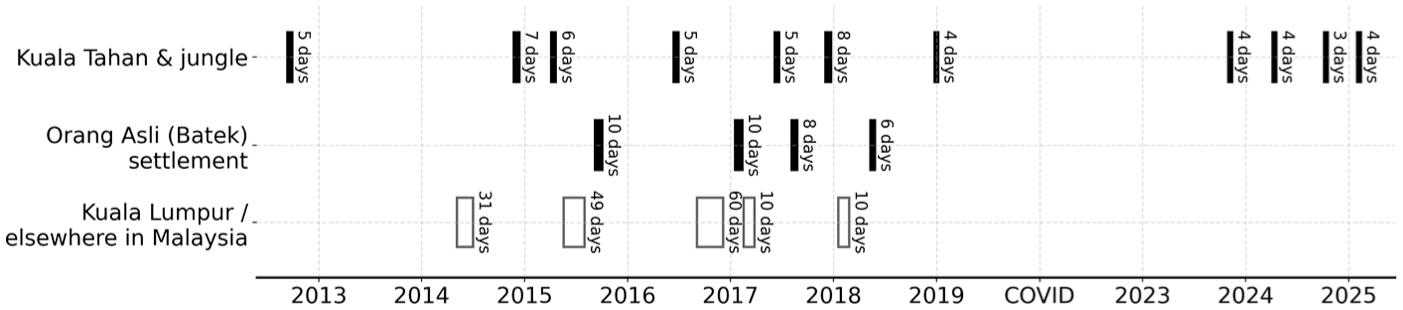
Fieldwork timeline showing episodic visit durations (days) and uneven immersion across the two key sites in Taman Negara and beyond.
In aggregate, I spent approximately 89 days at Taman Negara, a duration shorter than that typically associated with classic single-site ethnography. Yet the methodological value of this fieldwork did not rest solely on cumulative days on-site. Sustained engagement with Malaysia’s broader social and political context also shaped interpretation and ethical judgement. Inspired by Loftsdóttir’s (2002) argument that immersion in a country’s wider culture and politics can be as significant as engagement with a single community, I spent extended periods in Malaysia to understand local cultures and everyday ethnic politics beyond my main field site. These included 31 days exploring sites across the country, 49 days studying the language and 2 months as a visiting scholar at a local university, where I participated in field trips and research projects. I also made shorter personal trips to reconnect with friends and collaborators in Malaysia, although these are only briefly represented on the timeline. Taken together, these periods bring my total research engagement in Malaysia to nearly 250 days, particularly if the field is understood as unbounded, relational and continuously sustained rather than geographically fixed. During periods away from Malaysia, I maintained regular online communication with several key informants, usually every 2–3 months, to stay informed about major changes and events in Taman Negara. I also sustained these relationships through an annual student visiting programme to the national park, which I have organised since 2018, except during the COVID period. These experiences sharpened the research questions and clarified how local tensions around tourism in Taman Negara were connected to wider institutional structures and public discourse on a national level.
This pattern of mobility also revealed how certain accounts emerged more readily outside highly visible “frontstage” settings. Some interlocutors, particularly those whose livelihoods relied on tourism, were more open in neutral spaces outside the immediate destination, where concerns about reputation and community monitoring were less pressing. For instance, Malaysian Chinese interviewees discussed their frustrations with perceived ethnic favouritism in tourism licencing more openly when we met outside Taman Negara. A Malay guide shared informal stories about tourists socialising during trekking contexts, details he would be reluctant to share within the village due to religious norms. Such moments suggest that ethnographic insight in tourism may depend not only on geographical proximity, but on the researcher’s capacity to recognise when particular spaces enable or constrain what can be said.
In sum, this field experience supports a more distributed understanding of “immersion.” Following Adams’ call to rethink field engagement beyond a single, geographically bounded locale in discussions of multi-sited and netnographic work (Adams, 2025), I treat immersion as iterative and spatially dispersed across overlapping touristic and local arenas. In multi-ethnic settings characterised by power asymmetries and shifting boundaries, episodic and mobile fieldwork can be a methodological strength: it enables comparative insight across groups while sustaining a degree of strategic detachment that helps prevent the researcher from being absorbed into any one group’s moral universe. In Krause’s (2021) terms, uneven immersion is not merely a limitation to acknowledge but a field strategy that can be justified, ethically and analytically, when access and trust are necessarily uneven.
Becoming the ethnographer: Multi-layered shifting positionalities in a touristic field
In tourism ethnography, the researcher does not enter the field as a neutral observer. From the outset, one is embedded in a performative and commercialised environment where social roles are actively produced and read through tourism scripts (Bruner, 2005; Palmer, 2001; O’Gorman and Thompson, 2007). My early visits to Taman Negara made this immediately apparent. On arrival, I was indistinguishable from other visitors, and local actors approached me with tour packages and services, assuming I was a tourist. This “tourist identity” was therefore unavoidable. It also became methodologically consequential because tourism ethnographers are expected to attend not only to local communities, but also to tourists and their interactions with local environments (Bruner, 2005; Palmer, 2001). In the early stage, I joined tours as a paying participant, including jungle treks, night walks, and visits to Orang Asli Batek settlements, much like other visitors seeking a rainforest experience. These moments of participation provided an initial view of what tourists were shown, what guides emphasised, and how cultural difference was performed and interpreted.
Occupying a tourist identity also shaped the questions that later became central to the research. During one visit to an Orang Asli Batek settlement, several tourists on the same tour privately expressed discomfort at seeing Indigenous life presented as a display; one described it as “like a zoo.” Their reactions prompted me to reconsider my initial focus on ecotourism and conservation as a technical project. It sharpened attention to tourism as a multi-ethnic encounter shaped by unequal visibility and contested representation, and it later informed a separate publication focused on Indigenous perspectives and cultural commodification. At that stage, I was an “insider” among tourists but remained an “outsider” to local communities. This configuration differs from the dual role commonly discussed in ethnography, which is the co-presence of “researcher” and “friend” within a relationship (Bell, 2019). Here, the central issue was that my positioning was split across two linked arenas, the touristic arena and the host community arena, each with distinct expectations and constraints, while also being inflected by movement across different ethnic communities within the field.
Moving beyond the tourist role in a busy tourism village, however, required deliberate and sustained effort. Local residents were accustomed to transient visitors and had limited incentive to invest in relationships with those expected to leave quickly. For the Malay community, I returned repeatedly to the same guesthouse and participated in everyday activities, including informal sports and evening socialising. I also spent time speaking with the manager of a Malaysian Chinese tour agency after work, when the tourism tempo slowed, and the conversation became more reflective. Contemporary ethnography has increasingly emphasised engaged and collaborative approaches, rather than treating unobtrusiveness as a default stance (Bell, 2019). In tourism contexts, initiating conversation and offering a coherent account of one’s presence can be necessary for building trust. I sometimes described myself as an “academic tourist” to signal long-term interest while remaining legible within a tourism setting. Through repeated engagement, relationships were formed with several key individuals who later facilitated access through snowball processes (Parker et al., 2019), including a Malaysian Chinese tour manager, the Malay headman, and several Orang Asli Batek leaders. This shift towards a more “insider” role began in early 2017, when I started spending more time in Taman Negara as a researcher, though the transition unfolded gradually rather than all at once.
As community relationships deepened, new dilemmas emerged. Greater local familiarity reduced my ability to participate unobtrusively in tour settings, as my presence altered the social dynamics. Some tour guides became cautious, reading my presence as surveillance or evaluation. At the same time, tourists sometimes treated me as an authority or mediator and asked questions about Orang Asli life, authenticity, and marginalisation. This ambiguity became particularly visible during one visit to an Orang Asli Batek settlement. When tourists arrived unexpectedly, villagers asked me to remain out of sight because they were unsure how to explain my long-term presence to visitors expecting a “pristine” cultural encounter. In such moments, I felt pulled between competing obligations, including respecting community confidentiality while being aware of tourists’ curiosity and moral judgements about what they were consuming.
Over time, I learned that the ethnographer’s positioning in tourism settings is not a linear progression from outsider to insider. It is sometimes reversible and situational. There were occasions when I could again participate in tours in a visitor-like role, particularly during jungle trekking trips, where attention shifted towards physical activity and shared practical concerns, and cultural representation was less foregrounded. In these contexts, both guides and tourists were aware that I was a researcher, but my presence tended to attract less scrutiny and carry fewer social sensitivities. These moments allowed me to observe how guiding narratives and tourist questions changed over time, and how representations of Orang Asli life were adjusted in response to visitor expectations and recurring critiques. Rather than relying on covert elicitation through third parties, I treated these return visits as opportunities for ethically straightforward observation and participation. I listened to guide commentary as it was delivered to tourists, compared these narratives with what interlocutors shared in research conversations, and noted how the same topics were framed differently across settings. This comparative movement across arenas and across different community relationships within those arenas later became a deliberate field strategy.
I use the term “multi-layered shifting positionalities” to describe a single ethnographer’s patterned movement across two linked arenas in tourism sites, the tourist arena and the host community arena. Figure 2 summarises this heuristic by showing how the ethnographer may be read differently across tourist-facing and host-community arenas, and how these readings shift over time through repeated returns and changing community relationships.
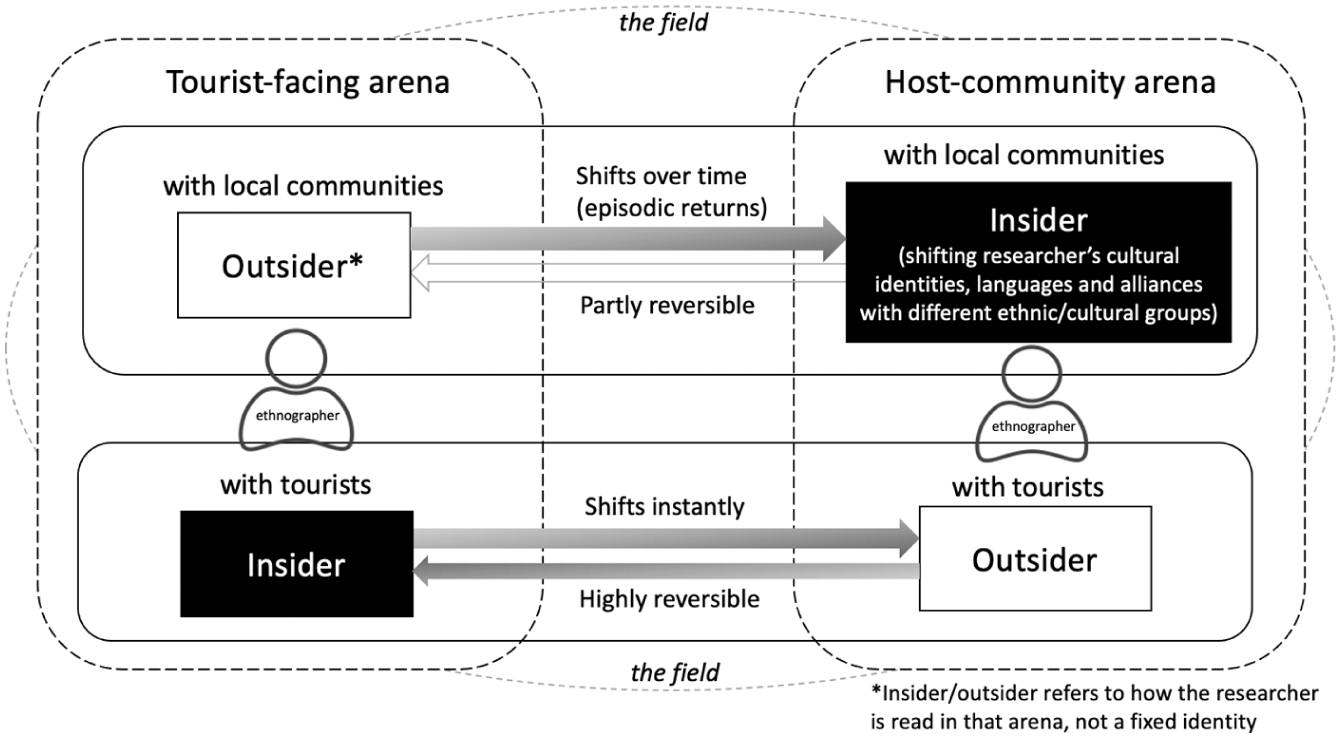
The “multi-layered shifting positionalities” in episodic tourism ethnography.
Importantly, the figure is not intended to reduce positionality to a fixed binary, but to illustrate how layered and shifting identities were repeatedly organised through movement between two principal arenas of tourism ethnography. At first, I was an insider among tourists and an outsider to hosts. As relationships deepened, that alignment often reversed. These shifts affected access, trust, what could be observed, and what could be asked without compromising relationships. The concept builds on Bell’s (2019) argument that role multiplicity is ordinary and can be treated as an analytic resource rather than a methodological failure. My emphasis, however, is on how multiplicity is organised through arena switching within a single site and how this switching is further complicated by movement across ethnically differentiated communities. Consistent with Duijnhoven and Roessingh (2006), positionality shifts in response to spatial arrangements, social encounters, and perceived intentions. The practical implication is that tourism ethnographers must continually assess how they are being read in each arena, and manage the ethical and analytic consequences of that reading. The success of both relationship building and interpretation depends on this capacity to move across roles without treating any single role as the authentic or stable basis of ethnographic authority.
Ethnicity and boundary-making: Who am I with who?
While reflexive ethnography has expanded, the question of how a researcher’s race and ethnicity shape field relations still warrants more explicit methodological treatment in tourism settings, particularly when the field involves multiple communities with unequal power and historically sedimented boundaries. Early reflexive writing often foregrounded Western researchers working in the Global South. In contrast, a growing body of work by Asian and diasporic scholars shows how positionality is negotiated within and across Asian contexts. Narayan’s (1993) “halfie” ethnographer highlights the situational nature of insider and outsider status. Bui (2022) reflects on returning to Vietnam as a diasporic “tourist-heritage” researcher, where proximity and distance are produced simultaneously. Studies such as De Andrade (2000) and Zhang (2017) likewise show how racially ambiguous and non-Western researchers may occupy fluid positions that disrupt simple binaries. Building on this literature, this section examines how ethnicity operates as a practical boundary-making force in a multi-ethnic tourism field in Malaysia, and how those ethnicised readings interact with the role shifts described earlier.
My experience in Malaysia as a foreign Asian researcher of ethnic Chinese background, raised in Macau with Chinese and Indonesian roots, and shaped by mobility across various Asian and English-speaking contexts, shows how positionality can stay unstable in multi-ethnic fieldwork. Although I could draw on regional familiarity and some cultural proximity, I was not socially embedded in the Malaysian context as local researchers might be, and this partial familiarity created both openings and constraints in the field. Across repeated visits to Taman Negara, I moved among the roles of tourist, researcher, and familiar figure in everyday village life. At the same time, my ethnic identity was interpreted differently across groups. This meant that access and rapport depended not only on what I said I was doing, but also on how my presence was categorised within local ethnic common sense and political sensitivities.
Among Malaysian Chinese interlocutors, establishing access was generally easier. Cantonese, my mother tongue, was widely used in the region, and the shared language created a basis for familiarity that reduced the distance typically associated with outsiders. Through these connections, a tour manager became a key facilitator, helping me navigate interviews and introducing me to stakeholders, including those in different positions within the tourism economy. These relationships also made visible how ethnic division of labour in Malaysia’s plural economy is reproduced through tourism (Din, 1982). At the same time, I was aware that becoming socially anchored in one ethnic enclave could narrow what I could see and what others would feel safe to say around me. Early in the research, I therefore also chose to stay with a Malay host family and to participate in settings where Malay social life was more central, including informal community activities and predominantly Malay academic networks. Following the 2014 flood, when I shared meals and shelter with Malay villagers, my relationship with this community deepened. Over time, I was no longer read as a transient tourist, but as a familiar presence associated with particular relationships and obligations.
Research engagement with the Orang Asli Batek required a different positioning. Outsiders were rarely able to stay in settlements without first establishing trust. In my case, a Malaysian Chinese contact helped negotiate access, reflecting both interpersonal ties and practical linkages within local tourism operations. More broadly, the history of state-led assimilation pressures and sensitivities around Islamisation shaped how the Batek evaluated outsiders and their perceived affiliations. In this context, positioning myself as a foreign ethnic Chinese researcher was often more workable than emphasising regional proximity. I also avoided invoking my Indonesian heritage in ways that might invite associations with Malay-Muslim identity or state institutional agendas, which could have intensified suspicion. Paradoxically, being read as “foreign” could sometimes enable trust more effectively than claims of cultural closeness.
These experiences underline an important distinction that is easy to blur. Role identities in tourism ethnography, such as being read as tourist, researcher, friend, or mediator, may shift across situations and arenas. Ethnic identity, by contrast, is not simply chosen by the researcher. It is an interpretive frame assigned by others, grounded in language, appearance, histories of inter-group relations, and institutional categories. In practice, the two dimensions intersect. Ethnicised readings shaped which role shifts were available to me, how quickly trust could form, and how my presence was interpreted as I moved between communities whose relations were not neutral. Following Chiseri-Strater’s (1996) call for ongoing reflexivity and Zhang’s (2017) critique of rigid insider and outsider binaries, I adjusted how I introduced myself depending on who I was with and what I was asking, while recognising that I could not control how I was ultimately classified.
In a multi-ethnic tourism context, the question “Who am I with who?” is not rhetorical. It captures a practical method problem: ethnic identity becomes a terrain of boundary work that shapes what can be asked, what is volunteered, and what remains unsaid. For episodic tourism ethnography, this matters because each return visit reactivates these classifications, sometimes in different ways, depending on shifting local relationships and public narratives. Understanding how ethnic boundaries condition access and interpretation is therefore not only an ethical concern but also central to producing credible reflexive analysis in plural and politically sensitive tourism fields.
The challenge of multiple languages
Language proficiency is widely recognised as a central resource in ethnographic research, often treated as a route to cultural understanding and to forms of access that are difficult to achieve through interpreters alone (Hammersley and Atkinson, 2019). In multi-ethnic field settings, however, language becomes not only a skill to acquire but also a strategic choice. Malaysia presents a particularly complex case. Due to its plural education system, many Malaysians are educated in mother tongue streams such as Mandarin, Tamil, or Indigenous languages, alongside national-language schooling (Renganathan, 2009). Although Bahasa Melayu is the national language, everyday proficiency and preferred language use vary across ethnic and generational lines, and language choice can carry political and social meaning. For a foreign researcher, the multilingual environment therefore raises a practical question with methodological consequences: which language provides the most workable point of entry, and what kinds of relationships and understandings does that choice enable or foreclose?
When I began fieldwork in Taman Negara, I was fluent in Cantonese and English, which made initial communication relatively straightforward with Malaysian Chinese interlocutors and with many Malay tourism workers. Cantonese, as my mother tongue, supported early rapport with Malaysian Chinese participants, while English facilitated interaction with younger Malay guides and locals accustomed to communicating with international tourists. Limitations became more visible, however, in engagement with two groups. First, the Orang Asli Batek community spoke an unwritten Indigenous language that I did not have the time or conditions to learn to a functional level. Second, some older Malay villagers preferred Bahasa Melayu and were less comfortable conversing in English. In the early phase, I relied on basic phrases shaped by prior regional exposure and occasional informal assistance from younger members of Malay families with whom I stayed. This was sufficient for everyday interaction, but not for sustained research conversations where nuance and trust matter.
Recognising this, I enrolled in a formal Bahasa Melayu course in Kuala Lumpur after my first year of fieldwork. This decision proved important for widening engagement with older Malay villagers and for communicating more consistently across the destination’s social worlds. While learning the Batek language to the level achieved by earlier anthropologists such as Lye and Endicott would have required a different research design and longer continuous immersion, my focus was not cultural documentation of a single group. It was a comparative understanding of tourism related relations across multiple communities. For this purpose, working across Bahasa Melayu, English, and Cantonese became a pragmatic and defensible strategy. It enabled communication across groups without committing the project to a single linguistic track that would have narrowed the scope of comparative engagement.
To navigate remaining language barriers, I also depended on trusted intermediaries in limited and transparent ways. One example was a Malaysian Chinese woman who had long standing relationships with Batek households and was regarded as a “godmother” by some children. Her perspectives helped contextualise community dynamics and interpret how tourism and inter-ethnic relations were being experienced. I treated such accounts as contextual guidance rather than substitutes for direct engagement, and I triangulated them through repeated visits and my own conversations with Batek individuals when opportunities for interaction and rapport emerged. Although Batek interlocutors were often cautious with strangers, moments of openness became more common through repeated encounters over time and through my increasing ability to communicate in Bahasa Melayu in everyday settings.
Ultimately, in a mobile, multi-ethnic field such as Taman Negara, linguistic decisions are inseparable from research design. Time, funding, and positional constraints often require researchers to prioritise communicative feasibility over linguistic completeness. My experience suggests that conversational Bahasa Melayu, despite not being the preferred mother tongue for all groups, functioned as a crucial bridge across community boundaries. It supported comparative understanding and facilitated movement across stakeholder groups. Full fluency in every relevant language may be ideal, but it is rarely achievable. In this context, language is not only a medium for accessing meaning, but also a means of navigating power, proximity, and the ethical dynamics of representation.
Navigating inter-ethnic tensions and sensitive discourses
For ethnographers, managing inter-group tension is not only an ethical concern but also a methodological one, because it shapes access, trust, and interpretation (Krause, 2021). In multi-ethnic settings such as Taman Negara, these challenges are intensified by overlapping cultural expectations, power asymmetries, and long-standing social divisions. Subtle yet persistent tensions existed among Malays, Malaysian Chinese, and Orang Asli Batek communities. While rarely voiced openly, these tensions were shaped by Malaysia’s colonial legacy and postcolonial development policies that institutionalised ethnic separation and produced enduring inequalities in political power, economic opportunity, and land access (Goh, 2008; Hirschman, 1986). Following Brubaker (2004), I treat these tensions as historically and politically produced rather than essential. This framing also underscores the importance of learning local histories before interpreting conflict in the present.
Ethnicity is a routine category of everyday discourse in Malaysia. During fieldwork, private conversations sometimes included racial remarks about other groups. Maintaining analytic distance, and avoiding alignment with such narratives, became a recurring field task. Knowledge of inter-ethnic history helped me read these conversations analytically rather than reactively. Colonial and postcolonial governance structured Malays as political subjects, Malaysian Chinese as economic actors, and Orang Asli communities as marginalised minorities often positioned as ethnographic objects (Andaya, 2002). Although these categories are reproduced in public discourse, they are also continuously constructed and contested through local politics, religious narratives, and state policy.
In Taman Negara, these dynamics were not immediately visible to most tourists. Ethnic identity was rarely legible through appearance, and much tourist interaction occurred in English. The main exception was the “Orang Asli Village,” where cultural tourism foregrounded difference and commodified indigeneity, making questions of marginalisation more visible. Malay-Chinese tensions, by contrast, became clearer only through repeated engagement and the gradual shift from outsider to partial insider. Conversations about land ownership, education quotas, and perceived inequities in tourism opportunities were often treated as sensitive. Because many of my early contacts were Malaysian Chinese operators, I had to maintain those relationships while also building trust with Malay villagers. Staying in a Malay homestay early on supported ongoing engagement with village leaders and local events. Participating in a bird-watching programme led by the Malay village chief also helped signal goodwill. Over time, I learned to cultivate forms of everyday sociability, such as shared hospitality and informal conversation, that reduced the risk of appearing aligned with one side.
Tensions between Malays and the Orang Asli Batek were particularly sensitive, and often crystallised around questions of indigeneity. These tensions were usually subtle rather than openly confrontational. The Batek term “gob,” used for non-Batek people, including Malays, marked a salient boundary (Lye, 2004). While Batek communities do not necessarily challenge Malay claims to indigeneity in direct political terms, their cosmology positions the Batek as a sovereign community with a distinctive language, values, and sense of belonging. Some Malay villagers interpreted “gob” as an insult that questioned Malay indigeneity and land ownership. Historical accounts also document episodes of Batek enslavement by Malay royals between the early 19th and early 20th centuries (Dentan, 1997; Endicott, 1997; Skeat and Blagden, 1906). These histories help explain why Batek individuals often expressed greater trust towards Malaysian Chinese than towards Malays. They also shaped the field conditions under which access could be negotiated.
Inter-ethnic tensions were also embedded in tourism livelihoods. Multiple interlocutors described a commission dispute that had occurred prior to my arrival. Malay boatmen reportedly demanded a substantial increase in their share, while Malaysian Chinese tour operators argued that margins were already constrained after accounting for administrative and operating costs. Accounts converge on a turning point in which a Malaysian Chinese operator purchased boats and temporarily hired Orang Asli Batek boatmen, disrupting Malay boat businesses. Several months later, parties renegotiated and resumed collaboration, and some Orang Asli Batek continued as boatmen. I did not directly observe this dispute, and I treat it as contextual history rather than as an event to adjudicate. Methodologically, however, it helped explain why access and trust were uneven across groups, and why I later staggered visits and avoided engaging specific parties on the same trip.
To manage these sensitivities, I relied on two general rules. First, I avoided working with Malays and Batek communities within the same visit when tensions were salient, and I did not relay criticism or sensitive claims between groups. Second, I treated conflict as a process rather than a fixed condition. This aligns with social identity theory, which explains how in-group and out-group distinctions are maintained through categorisation and symbolic boundaries (Tajfel, 2010). Practically, it meant separating settings and interlocutors, withholding interpretation in the moment, and returning later to triangulate contested narratives through additional conversations.
Temporary withdrawal from the field was sometimes necessary when boundaries became more visible. Early in the project, a Malay village leader declined to introduce me to Batek interlocutors, signalling that I should not attempt access through Malay channels at that time. I stepped back to Kuala Lumpur briefly and returned with a revised plan, approaching each community separately through shorter, repeated visits. This staggered strategy protected relationships on both sides and eventually stabilised access to Batek settlements through non-Malay channels. A second example occurred after the post-2015 flood tourism disruptions, when new Malay operators reportedly entered the industry with government backing, intensifying tensions with established Malaysian Chinese agents. Rather than remain embedded with one side, I left the site briefly, reflected off-site, and returned with a split itinerary that balanced Malay led activities for visibility and goodwill with continued engagement with Malaysian Chinese tour managers. Across several returns, uneven immersion made visible how supply-chain dependencies, licencing arrangements, and informal alliances could both aggravate conflict and eventually stabilise collaboration.
Maintaining workable relationships in a multi-ethnic setting requires sensitivity, flexibility, and continual assessment of shifting group dynamics. Questions about affiliation and loyalty are often unavoidable. At times, withdrawal is the safest option. At other times, identifying shared values or personal connections can reduce tension. More broadly, tourism ethnography in such contexts requires attention to symbolic identity politics and to the everyday pragmatics of tourism livelihoods. The challenge is not only to navigate social boundaries, but to do so while preserving analytic clarity and ethical balance.
Ethics, exit, and long-term accountability
In a politically sensitive, multi-ethnic setting, I adopted a situated approach to research ethics in which consent, disclosure, and role management were negotiated across the life of the project rather than treated as a one-off event at the point of entry. I consistently identified myself as a university researcher and did not misrepresent my affiliation. At the same time, the specificity of my analytic focus necessarily evolved by stage and setting. Declaring at the outset that I would analyse inter-group tensions could have foreclosed access, intensified local sensitivities, and increased risks for interlocutors. Following the idea of “ethics in practice,” I relied on progressive and proportional explanation as questions crystallised, avoided recording in situations where doing so could raise risk or inhibit participation, anonymised people and organisations, and refrained from carrying sensitive claims between groups (Hammersley and Atkinson, 2019). This stance does not normalise covert research. Rather, it treats staged clarification of research focus as both ethically defensible and methodologically necessary when topics emerge inductively and when harm minimisation is a primary concern.
Exiting the field was planned as a taper rather than a clean break. I have maintained relationships with the communities through organising an annual student visiting programme to the national park since 2018, except during the COVID period. I signalled to key contacts that intensive research was winding down, reduced visit frequency, and gradually shifted from research-centred visits to periodic educational engagements that created modest shared benefits without implying open-ended obligations. In a tourism setting where mobility is routine, this approach helped maintain rapport while clarifying boundaries around what I could and could not do. Following work that treats insider and outsider positions as relational and situational, exit became a reconfiguration of ties rather than their termination. Relationships persisted, but their cadence and purpose changed (Malkki, 2007; Narayan, 1993; Powdermaker, 1966). This taper helped preserve trust while limiting role confusion once intensive fieldwork had ended.
Managing contrasting narratives, staged explanation, and retreat-and-return rhythms required emotional labour that was integral to methodological practice. I used brief withdrawals for reflection, peer debriefing, and systematic memo-writing to maintain analytic distance and to separate advocacy from analysis. Making this explicit is not an attempt to centre the researcher’s feelings. It is an argument that care for participants, attention to one’s own shifting position, and disciplined documentation strengthen both analytic credibility and ethical integrity. Taken together, a situated ethics of proportional disclosure, a tapered exit, and bounded ongoing reciprocity support a more accountable tourism ethnography in multi-ethnic fields.
Discussions and conclusion: Rethinking tourism ethnography in a multi-ethnic field
This paper has examined the methodological demands of conducting ethnography in a multi-ethnic tourism setting through critical reflections from long-term field engagement in Taman Negara, Malaysia. It contributes to calls for tourism ethnography that is reflexive, situated, and attentive to power and difference in the production of field relations (Adams, 2025; Matteucci and Gnoth, 2017). Rather than treating positionality as a simple movement from outsider to insider, the paper shows how access, rapport and interpretation are shaped by shifting roles, shifting arenas, and movement across different communities within an ethnically stratified field.
A core contribution of this paper is to clarify how role multiplicity becomes organised through movement across two main arenas in tourism ethnography. Bell’s argument that role multiplicity should be treated as ordinary and managed through reflexive boundary work and processual consent is important here (Bell, 2019). Building on this insight, I suggest that tourism settings often make such multiplicity especially visible because the field is structured around a tourist-facing arena and a host-community arena, with different expectations, rhythms, and stakes. The same person may be read as a visitor, a researcher, a potential ally, or a potential risk, depending on where they are and who is present. The methodological task is therefore not to eliminate multiplicity, but to recognise how it conditions what can be observed and what can be asked. To capture this patterned movement, I propose the heuristic of a “multi-layered shifting positionalities” as illustrated in Figure 2. In a multi-ethnic tourism setting, the ethnographer moves between two principal arenas through which insider-outsider positionalities are episodically reorganised, while also adjusting how our own cultural identities are presented to build trust with communities of different cultural backgrounds.
A second contribution is to connect role switching to ethnicity and boundary-making in a multi-ethnic field. Using Barth’s (1969) work on boundaries and Brubaker’s (2004) critique of ethnicity as a fixed category, the paper shows that identity is not a stable attribute but a relational practice that is assigned, negotiated, and contested. In Taman Negara, symbolic boundaries among Malays, Malaysian Chinese, and Orang Asli Batek were maintained through discourse and institutional histories, yet also crossed through everyday tourism labour and exchange. My ethnic identity and broader regional background (i.e. a foreign Asian researcher of Chinese ethnicity with partial Indonesian family roots) did not serve as a neutral background variable. It shaped which relationships formed quickly, which required careful negotiation, and how my presence was interpreted as I moved between ethnic groups whose relations were not politically equal, including how I was read in various ways through ethnic, linguistic and regional affiliations. This distinction also clarifies a point that is often blurred in discussion. Role identities (tourist, researcher, friend, mediator) and ethnicised readings are not the same. They intersect, and in doing so, they condition what kinds of role shifts are possible and what those shifts cost.
Third, the paper reframes immersion as a matter of tempo and risk management rather than a single continuous stay, echoing Krause’s experience in Nigeria. In a multi-ethnic context where tensions are present, even when subtle, episodic engagement and brief withdrawals can function as methodological tools rather than weaknesses. Uneven immersion, in this sense, supports triangulation, reduces the pressure of over-identification, and enables reflection away from local intensities (Krause, 2021). This approach is consistent with the argument that ethnographic understanding is produced over time, through repeated returns, and through the comparative work of moving between settings and narratives.
Finally, the paper advances an ethics argument rooted in field practice. In politically sensitive settings, ethics is not simply a procedural hurdle addressed at the point of entry. It is a relational process in which consent, disclosure and role clarity are negotiated over time. I consistently identified myself as a university researcher and did not misrepresent affiliation. At the same time, the specificity of analytic focus required proportional clarification as questions emerged inductively. Following an “ethics in practice” orientation, I avoided recording in situations where doing so could increase risk, anonymised people and organisations, and refrained from relaying sensitive claims across groups (Hammersley and Atkinson, 2019). Exit likewise cannot be assumed to be clean. In the tourism field, where mobility and return visits are common, leaving is better understood as a tapering and reconfiguration of ties rather than their termination (Malkki, 2007; Narayan, 1993; Powdermaker, 1966). This is not a claim that fieldwork should become open-ended. It is a claim that accountability and boundary-setting extend beyond the moment when “data collection” ends.
Beyond its conceptual contribution, the paper also has practical implications for institutional and project-based tourism research. Researchers working for universities, funded projects, NGOs, heritage programmes, or park-related initiatives in multi-ethnic destinations may need to plan fieldwork not only in terms of access and methods, but also in terms of tempo, sequencing and relational risk. The findings suggest that attending to local ethnic tensions, allowing periods of reflection and strategic withdrawal between visits, avoiding over-identification with any single group, and treating disclosure and exit as ongoing rather than one-off processes can strengthen both research quality and ethical accountability. In this sense, episodic tourism ethnography is not only a conceptual orientation but also a practical strategy for designing research in socially layered and politically sensitive destinations.
To conclude, this paper advocates a pragmatic approach to tourism ethnography in a multi-ethnic context. Ethnography is not a rigid toolkit, but a relational practice shaped by positionality, movement, and responsibility. I propose a transferable framework, grounded in the field realities of uneven and shifting positionality, organised around three elements: tempo-sensitive immersion (including episodic returns and withdrawal when needed), arena-based and ethnic-sensitive positionality switching (tourist-facing and host-community relations) and processual ethics (proportional clarification, harm minimisation and tapered exit). Taken together, these strategies help make sense of how ethnographic work unfolds across multiple communities, uneven access conditions and shifting relational demands, while strengthening methodological clarity and ethical integrity for ethnographers working in politically sensitive, multi-ethnic tourism fields.
Footnotes
Acknowledgements
My sincere thanks go to the participants and communities in and around Taman Negara, as well as to friends and collaborators in Malaysia who supported me during fieldwork. I am especially grateful to those who offered hospitality, guidance and encouragement throughout this journey.

Ethical considerations
This research was conducted as part of doctoral fieldwork undertaken between 2014 and 2019. At the time of data collection, formal institutional ethics review procedures were not in place at the author’s institution. Ethical conduct was guided by disciplinary norms in ethnography, including voluntary participation, ongoing verbal informed consent, protection of anonymity, and careful management of sensitive information.
Consent to participate
All participants were informed of the researcher’s academic role, and consent was negotiated throughout the fieldwork process.
Funding
The author disclosed receipt of the following financial support for the research, authorship, and/or publication of this article: This research is supported by the Fundamental Research Funds for the Central Universities, Sun Yat-Sen University [Grant ID: 2025qntd66].
Declaration of conflicting interests
The author declared no potential conflicts of interest with respect to the research, authorship, and/or publication of this article.
Data availability statement
The data generated during this study consist of ethnographic fieldnotes, interview materials, and observational records collected in a politically sensitive, multi-ethnic context. Due to the nature of the research and the need to protect participant confidentiality and community relationships, these data are not publicly available.