







Abstract
Preschool students with disabilities engage in social interaction with peers less often than children developing typically in inclusive classrooms. This research explores how divergent theories of literacy learning, those inherent in the structure of special education and those promoted by scholars interested in emergent literacy learning, impact upon inclusive classrooms. This qualitative case study details how a writing community in an inclusive preschool classroom promoted social engagement and literacy learning of all students. The study highlights one preschooler with a disability to showcase one way in which these divergent theories of learning might be bridged.
I've been watching Ray for about a half-hour. He hasn't talked to one other student yet. He drifts from center to center not really engaging in any activity. Ray wanders over to the block area and a teacher asks, ‘Ray, we're pushing some rocks around. Would you like to help?’ Ray doesn't say anything and just walks away. (classroom observation field notes, 20 November 2006)
***
The preschool classroom is buzzing with activity. I arrive to the classroom and immediately Mila runs up to me. With a huge smile on her face, she begins to tell me what the topic of her book will be today. One of her classroom teachers stands behind her smiling. Her sentences run together as she talks about princesses and Halloween and her sister. I lug my basket of blank books, markers, whiteboards and stickers to the small table at the back of the classroom. Immediately, four- and five-year-old children fill the chairs, yelling out what color books they want and what they will write about today. The kids are busy drawing and talking. The following conversation unfolds:
Ray, what are you doing? I'm making Batman and Robin Oh I'm making Batman and Robin That's cool Bill Thanks Yeah, I can, I can make an uh, a superstar cow A cow can talk? Sure It can talk! That's the great thing about making books. You can make cows talk! You can make anything you want! (writing workshop field notes and transcription, 5 March 2008)
Introduction
In the USA, children who are identified as preschoolers with disabilities can be placed in a range of inclusive preschool settings and there are many differing definitions of what constitutes an inclusive classroom (Sapon-Shevin, 2007; Schwarz, 2006). At one end of the scale, some preschoolers with disabilities are placed in ‘true’ inclusive classrooms where all special education services are brought into the general education classroom, while at other times preschoolers with disabilities are removed from the general education classroom to receive special education services in other locations. While included in general education classrooms, the preschoolers with disabilities participate in the same activities as children developing ‘typically’ (Odom, 2000). In the vignettes that began this article, semi-structured centres required that Ray, identified as a preschooler with a disability, break into play that was already in progress. Ray's classroom teachers designed multiple centres, such as the block area, which children could join or leave at will. Even though his teacher explicitly invited Ray to join in the play, he chose not to engage but rather to wander from centre to centre in his preschool classroom. Breaking into play is the phrase Ray's special education team (this includes his mum, special education service providers, classroom teachers, and the school director) used to describe how one enters into a play situation where children are already engaged. It can require children having the verbal capacity to assert themselves in the play by asking, ‘Can I play too?’ or the social skills to know how to insert oneself into existing play in a socially acceptable manner, such as adding a block to the building rather than knocking it down. After spending a year watching Ray struggle with breaking into play in his preschool classroom, I became interested in rethinking inclusive settings, particularly whether the definition of inclusion should be solely about placement.
My participatory approach was central to this research design. My inquiry emanated from informant-expressed needs (Spradley, 1980), which were to build upon the strengths of Ray, his literacy knowledge, in order to create a space into which Ray would engage with his classmates. Furthermore, supporting the literacy learning of all students in this classroom was an important goal. In addition, this space would look to reconcile the learning goals provided by Ray's Individualized Education Programme (IEP), a legal document that states learning goals for children with disabilities, with theories of emergent literacy learning and the goals created for him by his special education team.
Divergent views of learning
Literacy
One of the biggest developments in early literacy learning has been the development of an emergent literacy perspective. This perspective, which gained popularity in the 1980s, suggests that children develop as literacy learners at birth and that development continues throughout their childhood, if not their lifetime (Pellegrini and Galda, 1994; Sulzby, 1985). This theoretical base underscores the importance of recognizing that not all children will be at the same place in their literacy learning at the same time, or even that literacy learning develops in a linear manner. It is largely acknowledged that young children ‘are already constructing understandings about what print looks like, how marks can be used to represent words, and how message content and writing forms are arranged for different social varieties of texts’ before they arrive at preschool (Rowe, 2008: 67).
Emergent literacy scholars contend that children learn about literacy through observing and interacting with others and through their own attempts at literacy (Sulzby and Teale, 1991). Literacy learning is intertwined with play as children experiment with drawings, signs and symbols (DeZutter, 2007). For early childhood educators, providing spaces for children to play and experiment with literacy is fundamental to how they design their classrooms (Morrow, 2001; Vukelich, Christie and Enz, 2002). However, for early childhood special educators, it is often the IEP that dictates what learning is to occur. Again, the IEP is a legal document that is the ‘… cornerstone of special education. The IEP outlines the services a student with disabilities will receive, where those services will be provided, and educational goals for the student’ (Council for Exceptional Children, 2009: n.p.). The development of early literacy learning through play and experiment can work in direct contrast to the educational goals detailed for the student in his/her IEP.
A sociocultural perspective, informed by Vygotsky (1978), stresses that there is ‘… the inextricable link between children's literacy learning and their participation in community activities’ (Dyson, 1997: 17). The idea that children are developing as literacy learners from birth and continue to develop indefinitely often conflicts with the structure of special education. In the name of individualization, annual goals are forecast for children who receive special education services, sometimes months before actual instruction is supposed to occur, in order to quantify and evaluate learning. This can lead to instruction that isolates learning into a distinct set of skills and leaves unacknowledged the social contexts in which learning occurs. For example, an annual goal in the Reading category in Ray's IEP for the 2007–08 academic year reads (see Appendix for a complete listing of goals):
When presented with 30 +letters in uppercase and lowercase, Ray will distinguish between the uppercase and lowercase letters and identify the ones that are the same letter and provide a word that begins with that letter. Evaluation Criteria: 85% success, over 10 weeks; Procedure to Evaluate Goal: Teacher devised tests or worksheets; Evaluation Schedule: By June; Primary Responsibility: Resource Room Teacher
Context
There are many different transitions that families go through within the structure of special education as students with disabilities age. Briefly, in the USA, states can design how certain federal guidelines are interpreted, such as at what age the Department of Health is responsible for the care of students with disabilities versus the local school district. In New York State, a major transition happens when, at age three, children who are entitled to receive special education services move from the Department of Health and an Individualized Family Service Plan (IFSP) to the local school district and an IEP. An IFSP is a document that revolves around the family and includes the natural environments in which children are learning, such as the home, parks, nursery schools, community activities, and the like. The philosophy behind an IFSP is much like the philosophy that guides emergent literacy learning. Both work from the starting point that learning is best supported through play that is highly appealing to young children. Professionals then work with children in these natural environments to support new learning. By contrast, when an IEP is created to detail the goals that describe the learning that a three-year-old child and older is to accomplish, learning becomes detached from the environment. The ways the IEP goals are structured in many ways contradicts literacy learning being a social practice (Barton and Hamilton, 2000; Gee, 2003).
An instructional objective for many preschool teachers is to foster the ability of their students to communicate and socialize in socially accepted ways. While these goals exist for all students, they are quantified for Ray. The act of quantifying these skills that all children are developing creates the space to view Ray as disabled, rather than developing. So, while many preschool children are working on sharing, Ray's IEP states:
Ray will verbally ask and wait for permission to use other children's toys. Evaluation Criteria: 85% success, over 3 months; Procedure to Evaluate Goal: Recorded observations; Evaluation Schedule: By June; Primary Responsibility: Special Education Teacher.
Disability as an instructional construction
As stated by Odom (2000), the most replicated finding in inclusion research at the preschool level is that children with disabilities engage in social interaction with peers less often than typically developing children in inclusive classrooms. As the first vignette that opens this article shows, my own observations of Ray certainly supported this finding.
Gindis's (1999: 334) review of Vygotsky's (1995) thinking about ‘defectology’ relates directly to contemporary special education and Vygotsky's beliefs that disability has multiple disabling venues. According to Gindis, Vygotsky believed that a person with a disability had not only an organic impairment (primary disability) but also a disability based on the social implications of that disability (secondary disability). And so Ray, a child who is classified as a preschooler with a disability (and later in his kindergarten year as a child with a speech and language impairment), has the physical barriers that prevent him from rapidly joining or breaking into conversation, but also the secondary disability that goes with the designation of being different. As stated by Gindis (1999: 335):
Vygotsky pointed out that from the psychoeducational perspectives the primary problem of a disability is not the organic impairment itself, but its social implications: An organic defect is recognized by society as a social abnormality in behavior. Expectations and attitudes of social milieu and conditions created by the society influence the access of a child with disability to sociocultural knowledge, experiences, and opportunity to acquire psychological tools.
Inclusive writing communities
Inclusive writing communities in preschool classrooms are but one way to support the learning and instruction of all children. I define inclusive writing communities as spaces where all children can sit around the table and create marks, drawings, words and stories while talking and listening to each other. An instructional goal for the teacher in facilitating this inclusive writing community is to recognize each child's strengths as a place from which to support further learning.
Implicit in the writing community are many of the skills that have been deemed necessary for Ray to improve, such as sharing the markers on the table. While the goals in Ray's IEP may detail important learning for Ray, the presentation of them, in terms of what Ray will do and how he will be evaluated, independent of instruction, can be problematic. An inclusive writing community addresses this problem, allowing individual children, all children, to create texts and talk about them. Participants in inclusive writing communities must share, talk and develop the fine motor skills necessary to hold a writing utensil, listen to others’ ideas, and so forth. These communities are rich instructional environments in which various special education support personnel can also engage with students.
This research and the formation of this inclusive preschool writing community are rooted in the work of those who interrogate inclusive environments, literacy development and a sociocultural approach to special education (e.g. Bernhard, Winsler, Bleiker, Ginieniewicz and Madigan, 2008; Brown, Odom and Conroy, 2001; Graham and Grieshaber, 2008; Kliewer and Biklen, 2007; Morrison, 1999; Mutua and Smith, 2007; Stonier, 2009; Vaughn, Hughes, Klingner and Schumm, 1998; Wiebe Berry, 2006; Wolfberg, Zercher, Lieber, J. et al., 1999). Rather than focusing on the ratio of students included when discussing inclusion, I contend that we need instead to focus on the instructional techniques that include students, all students, regardless of services received through special education (Sapon-Shevin, 2007). While approaches and research in emergent literacy are derived from an understanding that literacy learning at the preschool level must include ample opportunities to engage in authentic learning experiences where children can experiment with language (Dyson, 2008; Johnston, 1997; Morrow, 2001), there exists a need to find a nexus between this research and the practice of special education.
Ray
Ray attended Radcliffe Preschool, which is located in the northeast of the USA. Radcliffe offers a preschool programme for children aged two through a child's kindergarten year. The director of the preschool had been taking marked measures to include preschool students with disabilities at the school. Various therapists and service providers visited daily to work with the children. The director had been providing staff development opportunities to the classroom teachers so that they could be valuable participants in these children's special education programmes.
Ray's mother, his teachers and his special education service providers met at the beginning of the 2007–08 school year to discuss their goals for Ray. Ray was eligible to attend kindergarten that year in his local school district but his mother chose to have him stay at Radcliffe and enrol in one more year of preschool before his kindergarten year. Because Ray turned five, his classification was changed from a preschooler with a disability to a student with a speech and language impairment. He also had a medical diagnosis of verbal dyspraxia.
Ray had been receiving early intervention services since he was approximately 18 months old. He is the third child of his parents and they noticed early on that his development differed markedly from his siblings. He was evaluated and qualified for special education services and had been receiving them ever since. Ray attended Radcliffe for three hours a day, where he received occupational therapy, physical therapy, speech and language therapy, and academic support from a special education teacher. His therapy schedule comprised a mix of therapies provided both in and outside of the classroom. Ray's mother also took Ray for additional speech and language therapy twice a week away from Radcliffe Preschool. Ray's mother, Sherry, at the team meeting held on 29 November 2007, explained that Ray's classroom teachers commented at the previous parent/teacher conference that Ray was still engaging in a lot of parallel play. Sherry continued, ‘My big thing for this year is I want him to be socially engaged, comfortable, confident in the room.’ Sherry continued:
I had one of those mommy moments the other day. There are lots of good moments but this is one of those sad moments where he was trying to tell me what was happening [at school] and he said he wanted to play with Nick in the blocks [center] … So, he approached him and you know, he's organizing, he's trying to think of something to say so it was, ‘Nick, Nick, Nick, Nick I want to tell you something’ and Nick said, ‘Talk to me tomorrow’ ((teachers gasp)) so it just shot him, you know what I mean? He told me about it and his eyes looked, he was welling up a little, so he wants to break in, he wants to play but yet … I'm just saying, for him, this is all great effort for him.
Like many other children in this preschool class, Ray loved books. His teachers and special education service providers had noted at team meetings and parent/teacher conferences that during read-alouds, he became still and focused. I too had made this observation about Ray's interest in read-alouds. Ray's special education teacher during the 2006–07 school year noted:
He is unable to settle into any play, other than books, at free play for more than a few moments. He accepted my joining him at books though he pulled the book away if I tried to talk about a picture from the previous page or pointed out things when he wanted to turn the page (service provider notes, 6 September 2006).
Methodology
This article is based on a three-year dataset that followed a group of children through their two years prior to kindergarten and their kindergarten year. The children's ages ranged from three to six years throughout the course of this study. I followed one cohort of students through these three years. Ray remained in this preschool setting during all three years while other children left and joined. Approximately half of the students remained constant during the data collection years. The preschool these children attended is a private preschool that has been explicit in its mission to include students who receive special education services. During the three years of data collection, some students entered this school as preschool students with a disability while others received evaluations, with some being classified as entitled to receive special education services while in attendance.
Year one of this study was strictly observational. I took detailed field notes from an observation booth twice a week outside the classroom for at least an hour at a time. My focus during this year was to observe how his peers apprenticed Ray into the preschool community. I observed how Ray participated in this community and, based on these observations and the observations of Ray's special education team, I suggested the bookmaking activity for the following year. Other sources of data for this year were the parent/teacher conferences, special education meetings, and other school meetings that I audiotaped and transcribed. I also conducted interviews with Ray's mother (McCloskey, 2010).
In years two and three of this study, I went into the classroom and conducted the bookmaking groups with Ray and his classmates. My stance throughout these two years slid along the continuum of teacher-researcher (Loughran, Mitchell and Mitchell, 2002). I engaged in this research as a participant in discussions about classroom activities, sharing my observations during parent/teacher conferences and team meetings, and orchestrating the bookmaking centre. Through the transcription process, I was able to step back from the data I was collecting to notice patterns and themes.
The bookmaking groups had a very loose but reliable structure. Upon my entry to the class, after greeting the teachers and children, I would set up my materials at a small table in the room. The bookmaking activity was another centre in which students could choose to participate. The students were free to come and go as they pleased, although the classroom teachers would sometimes encourage children to come to the bookmaking table. The children could accept these invitations or decline them.
I had whiteboards that the students could draw/write on and books of different sizes and colours from which students could choose. I photocopied the books the students produced and they took the originals home. The students were encouraged to talk to each other as they worked. Each bookmaking session was audiotaped and transcribed and I took brief field notes during the session. I also reflected on the sessions in my journal, which became a source of data. I base this article on the data that were collected in the second year of this study, while the students were aged between three and five.
Data analysis
I categorized the transcripts from the bookmaking sessions using Ray's IEP goals as well as goals that his team had developed for him. I also developed subcategories that were based and cross-referenced on the content of the books Ray and his classmates wrote. For example, a larger category was entitled, ‘Engaging classmates’ and subcategories of this larger category were ‘Using popular culture’ and ‘Complimenting’. I cross-referenced the data when more than one category was addressed. For instance, if Ray complimented a classmate in order to engage him in conversation, and also used the appropriate verb tense, which was a goal on his IEP, the data were cross-referenced to note this. What follows is an analysis of the ways in which Ray forged relationships with his classmates through bookmaking and how the goals of both his IEP and team were met in this instructional approach to inclusion. Hence, the data for this article come from the categories that detail sections of the bookmaking groups in which his IEP goals were addressed and instances where the goals of the special education team were addressed.
Forging writing relationships
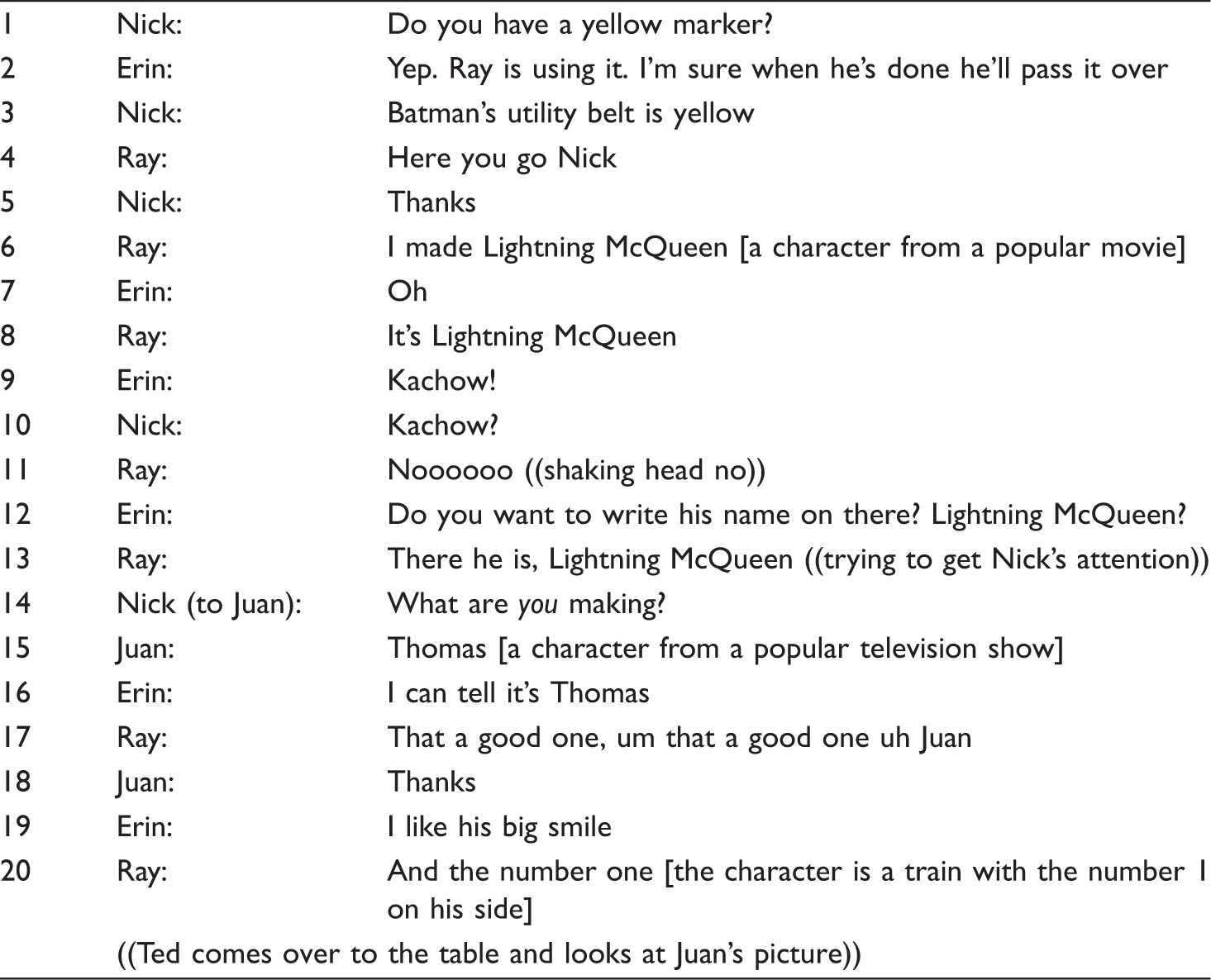
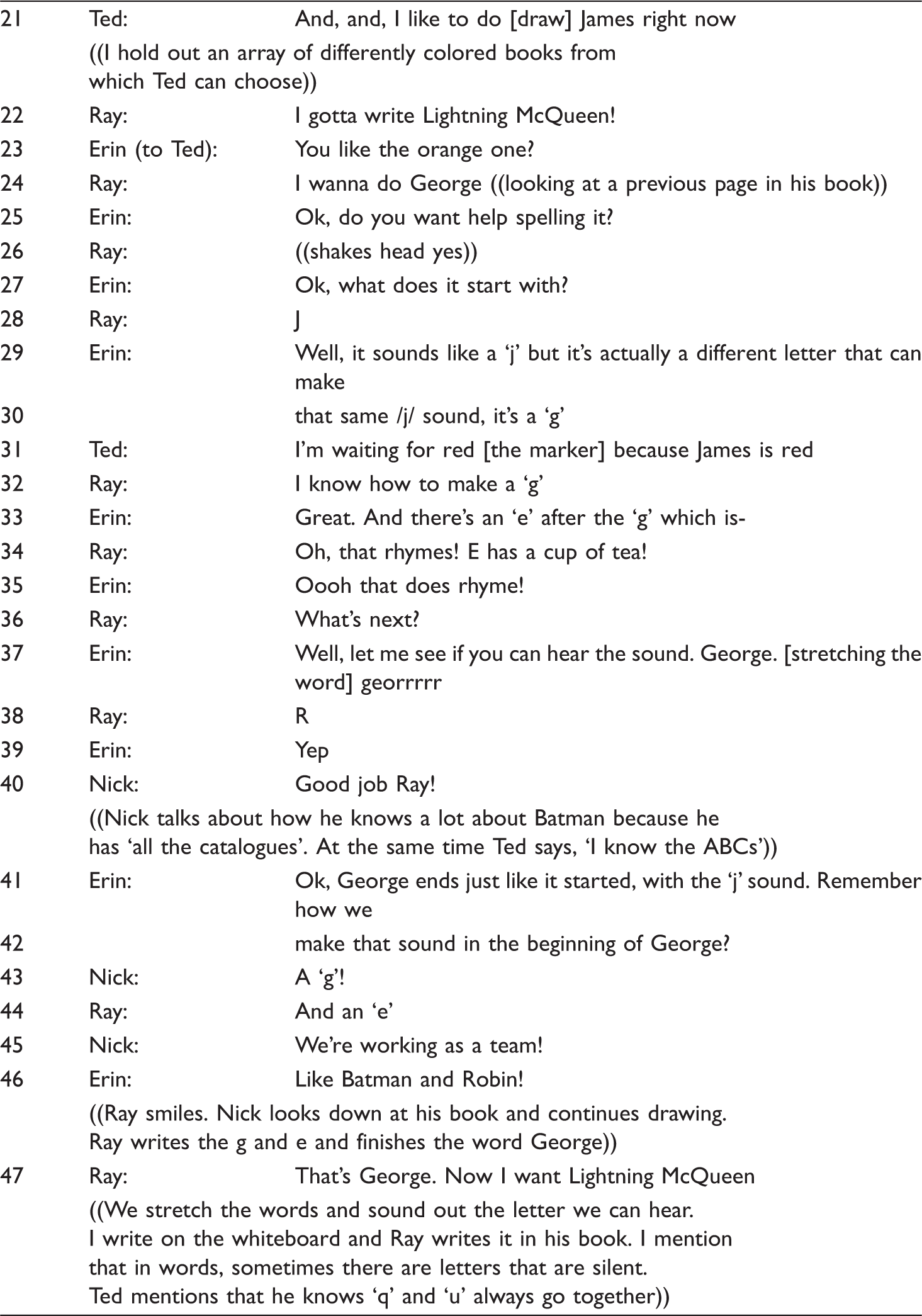
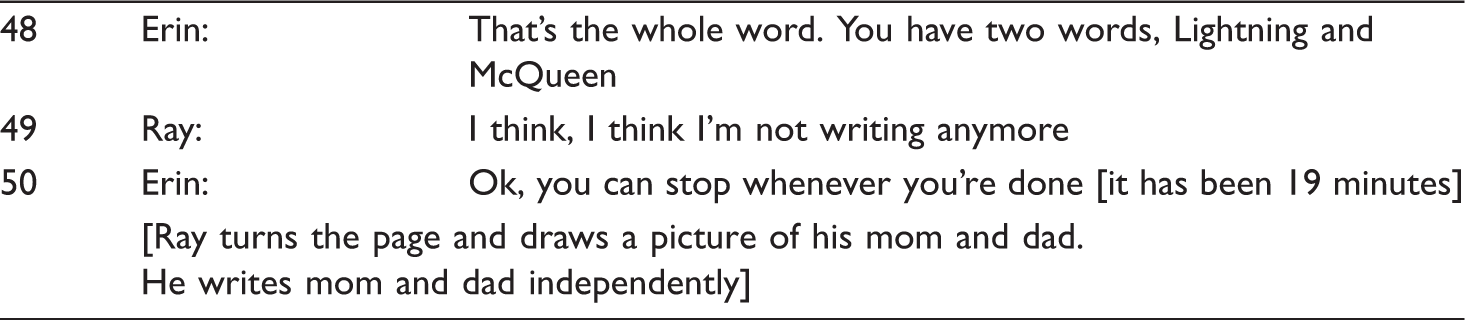
Although this transcript highlights only a few minutes of the bookmaking community, several of Ray's IEP goals were addressed. For example, Ray attends to the bookmaking task for more than 10 minutes, identifies letters that match beginning (medial and final) sounds (lines, 28, 38, 44), he mostly maintains the appropriate verb tense in his oral communication (lines 4, 6, 8), he uses his words to express his feelings (lines 11, 17, 20), he uses affective expressions (line 34), he displays an awareness of social cues and responds appropriately (lines 4, 13, 17), he imitates an adult role during play (lines 17 and 20), he continues to work in the presence of sound and visual stimulation, and he correctly reaches across his body to obtain objects. Of equal importance, Ray is socially engaged, comfortable and confident – the goals that Ray's mum had set as priorities for this school year.
The ability to create their own texts allowed the children to direct the topic of conversation. Rather than break into conversation, Ray could create the topic and provide a visual from which to structure his oral participation. He could use the visual information of other students’ drawings to join the conversation as he did in line 20. Interestingly, this writing community also provided Ray and the other children with autonomy in making decisions about their work. When I try to join in the conversation around Lightning McQueen by noting the catchphrase associated with this character (‘Kachow’, line 9), Ray responded to this in line 11 by saying ‘noooooo’. Ray tried to engage Nick in conversation around Lightning McQueen (line 13) but Nick decided not to take up Ray's topic and instead engaged Juan (line 14). Rather than walking away or remaining quiet, Ray joined that conversation (line 17) by complimenting Juan, and it was this exchange that motivated Ted to come over to the table and look at Juan's book and then request his own so he could join in. Although not oral participants, Juan and Ted are both privy to the conversations unfolding about what letters match what sounds in the stretching and spelling of the word George, rhyming, and the different sounds a ‘g’ can make. The children supported each other by complimenting each other's work, as Nick commends Ray in line 40 and, best yet, how Nick celebrates the teamwork involved with stretching and sounding out the word ‘George’ in line 45. This social interaction is not only crucial to the children's literacy development (Morrow, 2007), but it honours the range of learning that is taking place. All the children have the opportunity to be models for each other and to support each other in this very social yet academic learning environment.
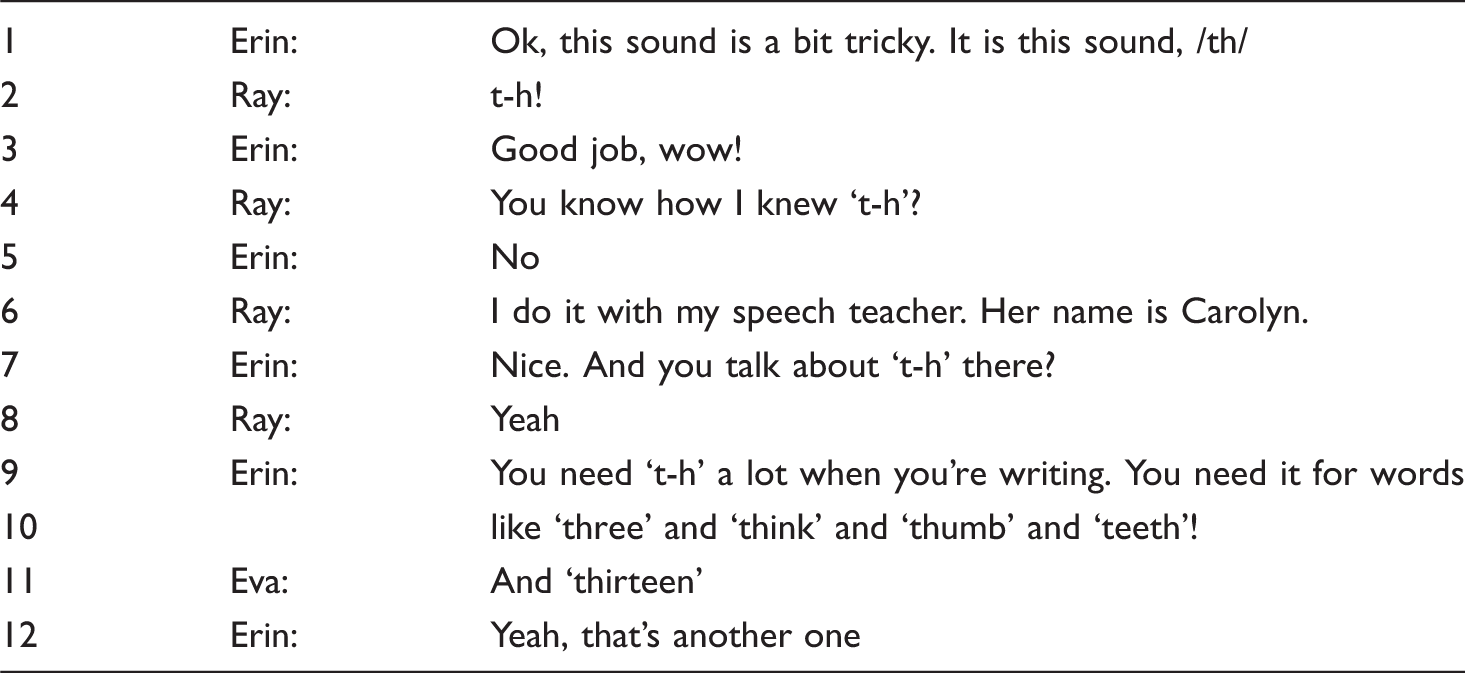
In this exchange, Ray is able to take a skill he has learned and apply it in a real meaningful way. In this case, Ray is the ‘more knowledgeable other’ (Vygotsky, 1978) as a result of receiving special education speech services. Ray furthers his literacy learning by connecting his previously learned skill, the sound /th/, and his writing. He also introduces this concept to Eva who joins in the conversation at the end. Some may think that the introduction of digraphs to preschool children is reaching beyond what is developmentally appropriate, but in this context, where children are engaging in conversations around their writing, children are genuinely interested in knowing about how letters combine to make these special sounds. This introduction to digraphs can serve as just that, an introduction to an advanced concept. My role in this exchange as well as the previous exchange is to support the children in their writing. I sporadically ask the children if any of them would like words for their marks/drawings. The children decide when they are ready and they make the decision whether or not to add words. Regardless, they are participants in conversations about literacy conventions. They hear their classmates stretching words and connecting letters with sounds. This context provides Ray with a foundation to work from his strengths, to gain confidence, and be comfortable as he participates in this very social environment. As in the previous excerpt, many of Ray's IEP goals are addressed. For example, Ray attends to a task for more than 10 minutes, he identifies letters that match beginning sounds (line 2), he comprehends and uses pronouns (line 6), he comprehends and asks questions (lines 4 and 7), and he performs correct wrist stability and intrinsic finger movements while writing.
It is the second to last session of the bookmaking group for the school year, 7 May 2008. I head back to the table where my bookmaking group is starting to form. I start the recorder and place it in the middle of the table, and start unpacking my basket of materials. The children start to sit down at the table before I can get myself organized. I am rattling off the materials I brought as I put them on the table. I tell the children that I remembered to bring two erasers for the whiteboards instead of just the one I had last time. Ray responds:
I have erasers You do? Yeah, in my office You have an office? Yeah, I got a computer and- I got one too Yeah, and no one can come to my office What kinds of things do you do in there? I'm an author I'm an author too. I'm really good at writing stories Awesome Ken. What do you think Nick? Awesome? Yeah, good job Ken Good job Ken
Ken smiles and continues to draw. A few seconds later he says:
Look at mine now!
Discussion and conclusion
Many preschool programmes in the USA are described as being inclusive settings and yet students are asked to leave the classroom to work with special education service providers. Rethinking inclusion with regard to instructional approach and contexts honours the learning of all the students in the classroom. While an IEP details the skills that students who are entitled to receive special education services are to develop, a better format might be to describe the instructional environment. A guiding question could be, ‘What learning environment would be best to foster the literacy development of all students while providing support for students who are working on social skills?’ If, as Gindis (1999) describes in his review of Vygotsky's thinking, that secondary disability is one that is a result of the social implications of disability, creating environments where difference is natural might be an enlightened approach. An emergent approach to literacy learning at the preschool level can provide that environment.
Instructional approaches that work from a child's strengths to foster growth provide a context for students to notice each other's strengths. Inclusive environments are classrooms in which ‘the attitude is that all students belong everywhere, with everyone else, in the school community’ (Schwarz, 2006: 34). Designing instructional contexts that thrive on diversity is a way to support teachers and students. Developing a preschool inclusive writing community can be one tangible way for teachers to do this.
In creating this inclusive writing community, it is important for teachers to attend to the social nature of writing. Often, writing is pursued as a solitary endeavour with children sitting at desks and teachers asking them to work silently. The data from this study show how children use conversations about popular culture and their experiences as topics for their writing. Given space to socialize while writing, children will support each other in their literacy learning by giving each other feedback, complimenting each other, helping each other stretch words and generating topics to write about. It is, however, the teacher who provides the model. The teacher, who can be the classroom teacher, a special education service provider or another person who has a clear understanding of emergent literacy learning, models how the diversity of ideas and abilities is of real value in an inclusive writing community. It is also this person's responsibility to find the places where students can be nudged along in their learning.
If children are taught in classrooms that celebrate the diversity of learning, beginning at the preschool level, it would then be a natural environment as they continue in their schooling. An IEP should, at its very core, be detailing how instruction ought be focused to maximize strengths and facilitate development, and yet using percentages to quantify literacy learning makes its impact as an instructional tool unproductive. When preschool teachers utilize an emergent perspective on literacy development, they can notice and support the progress in learning that all students are making. All students then have an individualized literacy plan, one that honours their strengths and promotes engaged learning.
Footnotes
Appendix
Code
Goal Ray will…
Evaluation criteria
Procedure to evaluate
Primary responsibility
SS1
Attend to a task without distraction for 10 minutes during individual seatwork
90% success over 9 weeks
Work samples
Resource room teacher
R2
Identify the letters that match the beginning sounds of pictures
90% success over 10 weeks
Teacher devised tests or worksheets
Resource room teacher
R3
Predict what will happen next in a sequence of events by verbally responding or arranging a sequence of pictures
80% success over 10 weeks
Teacher devised tests or worksheets
Resource room teacher
R4
Distinguish between the uppercase and lowercase letters and identify the ones that are the same letter and provide a word that begins with that letter
85% success over 10 weeks
Teacher devised tests or worksheets
Resource room teacher
SL5
Produce 5 target sounds in isolation, syllables, all position words and blends during the therapy session
80% success over 2 weeks
Recorded observations
Speech/language teacher
SL6
Produce 5 target sounds in phrases, sentences, and conversational speech during therapy session
80% success over 2 weeks
Recorded observations
Speech/language therapist
SL7
Establish and maintain all syllables in polysyllabic words and the sequence of consonant clusters
80% success over 2 weeks
Recorded observations
Speech/language therapist
SL8
Identify and use basic linguistic concepts (e.g. large/small) by pointing to or labeling pictures
80% success over 2 weeks
Recorded observations
Speech/language therapist
SL9
Comprehend and use pronouns
80% success over 2 weeks
Recorded observations
Speech/language therapist
SL10
Comprehend and use yes or no questions and ‘wh’ (e.g. who, what, where…)
80% success over 10 weeks
Observation checklist
Speech/language therapist
SL11
Formulate grammatically correct sentences and maintain appropriate verb tense in oral communication
80% success over 2 weeks
Recorded observations
Speech/language therapist
SL12
Use learned techniques and learned target vocabulary words to appropriately question, take turns, and end the conversation during a 1 minute conversational exchange
80% success over 2 weeks
Recorded observations
Speech/language therapist
SEB13
Display common components of pretend or imaginative play
90% success over 1 month
Recorded observations
Special education teacher
SEB14
Verbalize appropriately during play (e.g. providing voices of characters, narrating)
90% success over 1 month
Recorded observations
Special education teacher
SEB15
Use words, rather than physical behaviors, to express feelings and needs to adults and peers
80% success over 2 weeks
Recorded observations
Special education teacher
SEB16
Verbally ask and wait for permission to use other children's toys
90% success over 3 months
Recorded observations
Special education teacher
SEB17
Appropriately read non-verbal cues of other children in play
85% success over 1 month
Recorded observations
Special education teacher
SEB18
Facilitate negotiations or compromises with other children
90% success over 9 months
Recorded observations
Special education teacher
SEB19
Use affective expressions (e.g. smile, frown…) purposefully to influence another person's actions or decisions
75% success over 9 months
Recorded observations
Special education teacher
SEB20
Imitate adult roles outside the home during play (e.g. teacher, doctor…) during pretend play
90% success over 3 months
Recorded observations
Special education teacher
SEB21
Display an awareness of social cues (and respond appropriately (e.g. responding to a friendly smile) to these cues
90% success over 3 months
Recorded observations
Special education teacher
M22
Direct and maintain eye contact without head movement toward the therapist or object while moving a horizontal, vertical, and diagonal plane for 5 seconds
85% success over 2 weeks
Recorded observations
Occupational therapist
M23
Correctly reach across the body to obtain objects, complete tasks and write
85% success over 2 weeks
Recorded observations
Occupational therapist
M24
Color within a specified area for a minimum of 5 minutes
85% success over 10 weeks
Recorded observations
Occupational therapist
M25
Perform correct wrist stability and intrinsic finger movements while writing
85% success over 10 weeks
Recorded observations
Occupational therapist
M26
Continue to work in the presence of sound and visual stimulation in the classroom for an increased period of time for 15 minutes
85% success over 2 weeks
Recorded observations
Occupational therapist
M27
Independently and correctly rotate both wrists simultaneously to roll and unroll an object for 5 minutes
85% success over 10 weeks
Recorded observations
Occupational therapist
M28
Improve muscle strength in upper extremities by performing increased repetitions from 3 repetitions to 10 repetitions of upper body exercises without fatigue
85% success over 2 weeks
Recorded observations
Occupational therapist
M29
Maintain full body flexion for 5 seconds
80% success for 3 consecutive days
Structured observations of targeted behavior
Physical therapist
M30
Maintain full body extension for 5 seconds
80% success for 3 consecutive days
Structured observations of targeted behavior
Physical therapist
M31
Maintain balance in a half-kneeling position with decreasing support while successfully performing a dynamic activity for 1 minute
80% success for 3 consecutive days
Structured observations of targeted behavior
Physical therapist
M32
Maintain balance while standing on a therapeutic rocker board to 1 minute
80% success for 3 consecutive days
Structured observations of targeted behavior
Physical therapist