Abstract
Early fine motor writing skills are quickly becoming recognized as an important school readiness skill associated with later academic success (Dinehart and Manfra, 2013; Grissmer et al., 2010; Son and Meisels, 2006). Yet, little is known about the development of handwriting, the extent to which it is of value in the early childhood classroom and the best means by which to teach handwriting, or at least handwriting readiness, to young children. The current work reviews the literature on handwriting and its place in early childhood education. Overall, this article serves as a call for (a) researchers to continue examining the role of handwriting in the early education and development of young children and (b) practitioners to develop and implement programmes they know to be best practice in teaching early handwriting or handwriting ‘readiness’ skills.
Keywords
Introduction
Handwriting in the United States was once taught in schools as an individual lesson receiving a separate grade on a child's report card (Blazer, 2010). Yet, over the last decade, and more recently since the adoption of the Common Core State Standards (National Governors Association Center for Best Practices [NGA Center] and the Council of Chief State School Officers [CCSSO], 2012), the importance of handwriting in elementary education has diminished significantly (Carpenter, 2007; Pressler, 2006). This is not unlike policies in other nations, including England, where handwriting is perceived as having a low status in literacy education (Medwell and Wray, 2008). In the United States, schools are less likely to provide handwriting instruction than in previous years and few teachers today feel prepared to teach handwriting given their preservice coursework and training (Graham et al., 2008). Despite the shift away from handwriting and towards typing and standardized testing, having a wide range of writing skills – from the basic production of letters, shapes and numbers to quality handwriting – has been positively linked to academic performance (Carlton and Winsler, 1999; Dinehart and Manfra, 2013; Feder and Majnemer, 2007; Grissmer et al., 2010; Jackman and Stagniti, 2007; Kulp, 1999; Luo, Jose, Huntsinger and Pigott, 2007; Mayes and Calhoun, 2007; Rosenblum et al., 2003; Son and Meisels, 2006; Sortor and Kulp, 2003).
The current literature on handwriting primarily focuses on school-age children in both clinical and non-clinical populations, and less so on the writing skills of young children before they enter formal schooling. Yet, in early childhood, developing ‘handwriting readiness’ may be beneficial for two reasons: (1) recent evidence suggests that writing by hand in the early years supports the development of reading skills (James and Engelhardt, 2012; Longcamp et al., 2005) and (2) given the association between handwriting and academic achievement, the development of ‘handwriting readiness’ skills may increase the likelihood of academic success in later years. The current article discusses the development of handwriting, conducts a review of the current literature on handwriting and its application to young children, and notes the implications for future research and ongoing practice in the early education classroom.
The development of handwriting
Researchers have long used a variety of terms to describe the development of handwriting. The concepts that most strictly define quality handwriting are legibility and speed, and because young children rarely produce legible work quickly, research has focused on handwriting, particularly in older children in grades K–12. Yet, similar to other academic skills, such as reading and maths, the development of handwriting, and the extent to which children are eventually able to produce legible writing at speed, requires the development of foundational skills that probably begin well before a child enters kindergarten. Terms such as graphomotor skills, visual-motor integration and fine motor writing (Beery, 1997; Daly et al., 2003; Dinehart and Manfra, 2013) have all been used interchangeably in the literature as acceptable parameters for evaluating writing readiness (Ratzon et al., 2007). Orthographic processing, or the coding of visual symbols specific to symbols of letters, clusters of letters and words, is often considered qualitatively different from the visual-spatial processing measured by copying arbitrary patterns (Berninger, 1994; Berninger and Fuller, 1992; Jones and Christensen, 1999). However, it should be noted that in young children, performance on visual motor integration (VMI) (Beery, 1989) strongly correlates with their ability to copy letter forms (Daly et al., 2003).
Producing legible writing quickly may feel like an automatic process for most adults, but for young children, the development of handwriting is a complex task requiring the coordination of several cognitive, motoric and neuromotor processes (Smits-Engelsman et al., 2001). Children typically begin experimenting with writing by the age of 2. Although early scribbles lack the characteristics of conventional writing, Gombert and Fayol (1992) found that more intentional scribbles contain some of the universal features of writing including directionality and linearity. Eventually, children begin to learn to write by copying geometric shapes including vertical strokes, horizontal strokes, circles and perhaps most important to ‘writing readiness’ – the oblique cross (Feder and Majnemer, 2007). Weil and Amundson (1994) found that children who could copy the oblique cross – among other less complex symbols on the Developmental test of VMI (Beery, 1989) – were able to copy significantly more letters than children who were not successful in copying those items.
As children age and their fine motor skills develop, they become more able adequately to manipulate objects in their hands. Fine motor skills are a key variable in handwriting development, as fine motor control has been implicated in the writing errors commonly made by first graders (Feder and Majnemer, 2007). Preschoolers have expectedly immature grasp compared to their older counterparts which, in turn, impedes their ability to produce letters accurately. As children gain greater exposure to and experience of writing, letter forms, pseudo-letters or even actual letters – particularly those in their name – begin to appear in their writing (Gombert and Fayol, 1992). Schickedanz (1999) argues that writing letters requires that children have (1) a complete visual representation of each letter, (2) recognition of the line segments that form the letter and (3) the ability to reproduce the sequence and the direction with which the segments form the letter. In a recent study of children's early writing skills, Puranik and Lonigan (2011) found that approximately 77% of the three-year-olds sampled in their study were able to produce some letters of the alphabet, and by age four and age five, approximately 93% and 95%, respectively, were able to produce letters accurately.
Children's improved ability to write letters and complete more complex writing tasks – such as spelling and the production of complete and meaningful sentences – requires a more integrated knowledge system including the symbolic nature of letters, letter-sound correspondences and knowledge of writing conventions (Puranik and Lonigan, 2011). In elementary school, children's ability to produce automatically the letters of the alphabet, rapidly code orthographic information and execute sequential finger movements significantly influenced the handwriting of first, second and third graders completing a copying task (Berninger et al., 1992). As children's skills continue to develop over time, writing is used with increased frequency in the early childhood classroom.
In 2003, Marr et al. reported that children in a preschool setting spent approximately 37% of their day engaged in fine motor activities and only 10% of those activities involved paper and pencil tasks. In kindergarten, the shift to utilizing handwriting in the classroom was significant. Kindergartners spent nearly half their day engaged in fine motor activities, of which 42% was spent on paper and pencil tasks (Marr et al., 2003). Two years later, children in second grade were found to spend as much as 30–60% of their day participating in an activity that required fine motor skills, of which 85% involved paper and pencil tasks (McHale and Cermak, 1992). Although the increase in time spent writing as children age is developmentally appropriate, the extent to which preschoolers enter formal schooling prepared for the demands of writing remains unclear (Marr et al., 2001).
Berninger and Fuller (1992) suggest that handwriting instruction may be particularly challenging for students who lack foundational skills in writing. Estimates suggest that handwriting difficulties range from 5% to 33% of school-age children (Hamstra-Bletz and Blote, 1993; Karlsdottir and Stefansson, 2002; Rubin and Henderson, 1982; Smits-Engelsman et al., 2001), many of whom are eventually referred for special education services (Baker et al., 2003).
The link between handwriting and achievement
Writing skills have long been associated with various aspects of academic achievement (Carlton and Winsler, 1999; Dinehart and Manfra, 2013; Grissmer et al., 2010; Keogh and Smith, 1967; Kulp, 1999; Luo et al., 2007; Mayes and Calhoun, 2007; Son and Meisels, 2006; Sortor and Kulp, 2003). Given there is some evidence of an association between VMI and handwriting in young children, it is worth noting a few studies that have found associations between visual-motor performance and academic achievement. In kindergartners, Keogh and Smith (1967) found that VMI performance on the Bender Gestalt (Koppitz, 1964) was significantly associated with performance on standardized testing instruments of achievement several years later. Kulp (1999) obtained similar results, in which kindergartner's performance on the VMI significantly predicted achievement in reading, maths, writing and spelling. In older children, scores on the VMI were no longer significantly associated with reading achievement in second, third and fourth graders but continued to be a significant predictor of maths achievement (Sortor and Kulp, 2003).
Associations between academic achievement and graphomotor skills have also been revealed in secondary data analyses. Both Luo et al. (2007) and Son and Meisels (2006) found that fine motor skills, as measured by the Early Screening Inventory-Revised (ESI-R; Meisels et al., 1997) in the Early Childhood Longitudinal Study (ECLS-K), was a significant predictor of maths and reading achievement in kindergarten and first grade, respectively. It should be noted that the ESI-R includes a fine motor manipulation task (building a gate with blocks) and several fine motor writing tasks (drawing a person and copying five basic figures). Grissmer et al. (2010) also found a significant association between kindergartners' fine motor skills and their academic achievement utilizing data from the British Cohort Study, but noted that copying an image involving various shapes, and utilizing a writing utensil, appeared to be a stronger predictor of academic success in middle school than other types of fine motor tasks.
Handwriting, defined more specifically as the ability to produce writing legibly and quickly, has been consistently linked to composition skill throughout development (Berninger et al, 1997; Connelly et al., 2005; Graham, 1999; Medwell and Wray, 2008). Puranik and Al Otaiba (2012) found that handwriting and spelling were significant contributors to written expression in kindergartners. The same was not true of oral language and reading ability. In a group of 114 first graders, Jones and Christensen (1999) reported that nearly 53% of the variance in children's story-writing ability was accounted for by the speed and legibility of the letters produced, and Berninger et al. (1997) found that providing handwriting instruction significantly improved the compositional fluency of 144 first graders. In a similar experimental design, Graham et al. (2000) found that improvements in handwriting were directly associated with higher quality written text.
Although the link between handwriting and achievement does not always appear logical, the mechanisms by which handwriting influences achievement are substantial (Jones and Christensen, 1999). Once children enter formal schooling, good handwriting is thought to influence academic performance in three major ways. First, from an aesthetic level, research suggests that teachers give higher grades to assignments produced with more attractive writing than those produced with less attractive writing (Briggs, 1980; Graham et al., 2000; Hughes et al., 1983; Klein and Taub, 2005). However, in a recent study of college students, Greifeneder et al. (2010) found that more positive evaluations of nicely handwritten essays were not associated with the attractiveness of the writing per se, but rather the fluency associated with processing legible versus illegible material. In other words, teachers are more likely to give higher grades to work they find ‘easy’ to read. Second, researchers argue that difficulties with handwriting burden the writer's attention, requiring them to focus more on the writing and less on the content of their composition. Children who are too slow when writing may not be able to put their thoughts and ideas down on paper, while the coherence and complexity of the product may be affected by competing attention demands (Jones and Christensen, 1999). Finally, children with handwriting difficulties are said to develop negative experiences of writing, including frustration, decreased self-efficacy and poor motivation (Berninger and Graham, 1998; Berninger et al., 1991; Graham, 1992, 1999). From a social-emotional perspective, students who experience frustration in their writing are less likely to want to write, more likely to feel bad about their writing and generally be less likely to produce detailed, comprehensive material (Berninger and Graham, 1998). The extent to which these factors are applicable to children before they enter formal schooling is unclear, but recent work suggests that the influence of handwriting on later academic performance may have some of its roots in the years before children enter school.
Where is the research on handwriting in early childhood?
An understanding of the development of handwriting and the skills that promote ‘handwriting readiness’ before children enter formal schooling has been generally neglected in the early childhood literature. This is probably for two reasons. First, when handwriting was an important subject in the elementary curriculum, few children were receiving the formal preschool education that expanded in response to the welfare reform legislation (Personal Responsibility and Work Opportunity Reconciliation Act, 1996) of the 1990s and the No Child Left Behind (NCLB) legislation of 2001. Before these pieces of legislation, few educators or researchers were focusing on ‘school readiness’ and the skills that provide a foundation for learning in kindergarten and beyond. But then, as the pre-k education system expanded and early education became a focus for educators and researchers alike, a growing emphasis on Clay's Emergent Literacy perspective (Clay, 1975; Teale and Sulzby, 1986) and the increasing use of technology put handwriting on the backburner.
Emergent literacy
First introduced in the late 1970s, Clay's (1975) definition of emergent literacy focuses primarily on the environment and social context in which children gain literacy knowledge prior to practising conventional reading and writing. Literacy skills taught primarily through explicit instruction, including handwriting, are discouraged in this approach. In this definition, emergent writing focuses on the social context in which writing occurs (Dennis and Votteler, 2012) and the development of writing skills primarily from a content perspective (Medwell and Wray, 2008). Writing skills, it is believed, can, as well stated by Graham (1999), be ‘caught by immersing children in a literacy-rich environment…’. From an emergent writing perspective, teachers and parents are encouraged to make writing materials easily accessible to children, allow children to write freely and focus primarily on the message of the writing, rather than the formation of the letters (Dennis and Votteler, 2012). Schickedanz (1999) suggests: The wise teacher is reluctant to provide formal instruction in handwriting to groups of preschool and kindergarten children. Instead, she provides paper and marking tools for children to explore writing. Teachers are concerned – with good reason – that if they regularly provide formal and direct instruction to preschool and kindergarten classes, children's interest in writing may be undermined. (p.109)
Similarly, a position paper published in 1998 by the National Association for the Education of Young Children (NAEYC), in partnership with the International Reading Association (IRA), and entitled ‘Learning to Read and Write: Developmentally Appropriate Practices for Young Children’ stated: ‘Classrooms that provide children with regular opportunities to express themselves on paper, without feeling too constrained for correct spelling and proper handwriting, also help children understand that writing has real purpose’ (p.5).
Despite the notion that the purpose of handwriting instruction is to allow children eventually to develop legible writing that requires limited conscious attention in the years that follow (Graham, 1999), the emergent literacy perspective created inevitable tension between allowing children to express themselves freely and teaching letter formation (Medwell and Wray, 2008). This is not to suggest that early childhood educators should replace instruction that focuses on meaning and process with form, but rather they should regard handwriting instruction as an equally important means by which to improve early literacy skills (Berninger et al., 1992). There is little evidence to support the notion that children will ‘catch’ writing skills (Graham, 1999), and the ability to produce high-quality text is only expected to develop once transcription skills are fully developed (Alamargot and Fayol, 2009). In fact, writing skills are said to develop in a sequential process in which basic skills are mastered for use in the development of more complex skills (Puranik and Lonigan, 2011). If handwriting – a skill best taught through explicit instruction (Ste-Marie et al., 2004) – is only emphasized when the students have failed to ‘catch’ the skill, students are likely to fall behind early and develop poor habits that require remediation (Graham, 1999).
Technology in early childhood education
The early 1990s saw a significant increase in the use of computers and word processing. As Marilyn Cochran-Smith (1991) stated in her review of word processing for elementary school students: During this time period, legions of adults who wrote professionally – staff and freelance writers, researchers, journalists, educators, publicists – made the conversion from pencil and typewriter to computerized word processing. For the most part, professional writers found that word processing was a highly effective writing tool, and some were eager to describe their experiences and speculate about the benefits of word processing for others. (p.110)
Given adults' excitement over the new technology, educators and researchers began to ask how technology could be used in education and for writing in the classroom (Cochran-Smith, 1991). Keyboarding could certainly be viewed as a means by which children would be better able to focus on the content and meaning of their work (MacArthur, 2000), and less so on their form. Yet, despite the growth in technology, Cutler and Graham (2008) report that most elementary teachers still use computers less than once per month to support their students' writing. Preschool teachers report even less use of technology, indicating they experience limited access to technological tools (Wartella et al., 2010) and believe that many available tools are developmentally inappropriate (Public Broadcasting Service and Grunwald Associates, 2009).
Overall, technology is thought to provide scaffolding for novice learners until they form habits (Espinosa et al., 2010). An increasingly technological society affords children the opportunity to engage with new exciting digital devices that can extend their learning in the home, the classroom and the community. The International Society for Technology in Education (2007) suggests that children should acquire a certain technology ‘readiness’ – demonstrating basic skills in technology operations by age 5, and the National Association for the Education of Young Children and the Fred Rogers Center (2012) suggest that while technology can afford a source for exploration and mastery, teachers should provide a balance of activities that allow children to engage in authentic interactions in their surrounding environment. Once children enter formal schooling, current US education standards propose that teachers consider using digital tools for producing writing as early as in first grade (NGA Center and CCSSO, 2012).
Research suggests that young children who have access to and use technology at home show stronger academic achievement years later (Clements and Sarama, 2003; Espinosa et al., 2010); and with computers, tablets, touchscreens, smartboards and e-readers, pencils, pens, markers and paper seem outdated and slow. Arrowood and Overall (2004) found that computers motivated young elementary children in the writing process. This does not suggest that technology cannot be used to ‘write’ in a traditional manner. Couse and Chen (2010), for instance, found that preschool children were able to acclimate to using pentop and table technology to produce self-portraits that were comparable to self-portraits created with traditional writing media. Although the extent to which pentop and tablet technology could enhance the learning of handwriting remains unexamined, ‘writing’ in a traditional manner (as opposed to keyboarding) may still have its benefits.
Christensen (2004) reported a significant correlation between handwriting speed and keyboarding speed in a sample of nearly 300 secondary education students. Similarly, Rogers and Case-Smith (2002) reported a significant correlation between handwriting and keyboarding in 40 participating sixth-grade students. More recently, Connelly et al. (2007) also found a significant correlation between the handwriting and keyboarding speeds of 300 children in elementary school, but more notably that typed essays were up to two years behind, developmentally, than handwritten essays. Although it is important to note that Connelly et al. (2007) indicate that explicit instruction in keyboarding would improve the fluency of typing, and as a result probably improve the quality of a typed essay, James and Engelhardt (2012) suggest that keyboarding instruction, particularly at early ages, can have a significant impact on the development of reading.
What we know about handwriting in early childhood
Recent work with young children suggests that writing may support foundational skills that are necessary for later academic functioning. Using functional magnetic resonance imaging technology with four- and five-year-old children, James and Engelhardt (2012) found that writing letters by hand activated areas of a child's brain identified as the ‘reading circuit’. More specifically, writing letters activated those areas more so than other forms of sensorimotor training, including the tracing and typing of letters. The extent to which this activation influences development is unclear, but the authors concluded that handwriting certainly appears to lend support to the development of reading in young children (James and Engelhardt, 2012).
Writing skill developed before children enter formal schooling has also been shown significantly to predict academic achievement years later. Dinehart and Manfra (2013) examined whether the fine motor skills of over 3,000 preschoolers predicted their academic achievement in second grade. The study aimed to disentangle the effects of fine motor manipulation tasks, requiring preschoolers to build with blocks, weave string, lace beads and cut with scissors (among other tasks), from fine motor writing tasks, requiring them to imitate strokes, copy letters, numbers and shapes, and draw simple objects such as people and houses. The results indicated that although all fine motor skills in preschool predicted later achievement, fine motor writing skills in preschool were consistently stronger predictors of reading and maths achievement than fine motor manipulation tasks (Dinehart and Manfra, 2013). The authors argue that there may be several reasons for these findings, even in early childhood.
The first, in line with Graham et al.'s (2000) notion that children's cognitive load is lifted when handwriting is fluent and accurate, is supported by the findings of Longcamp et al. (2005). Participants in their study were randomly assigned to one of two intervention groups. In the first group, preschoolers were asked to practise writing words using a writing utensil. Preschoolers in a second group were asked to practise typing the same words using keys on a keyboard. The authors predicted that performance on a posttest letter recognition task would be equal between the two groups if the preschoolers were able to identify the letters in the words simply by seeing them repeatedly, but better for children in the writing intervention group if the act of writing helped children develop an internal model of the alphabetic characters. The results indicated that children in the writing group significantly outperformed the children in the typing group, suggesting that writing may have helped the preschoolers develop a stronger internal model of the letters (Longcamp et al., 2005).
As such, at least in the early years, writing may provide children with support in learning the skills necessary to become efficient readers and writers by strengthening internal models of regularly used characters, decreasing the cognitive load associated with producing symbols and increasing the attention necessary for producing quality written text as they get older. In other words, early handwriting instruction may be beneficial in much as it automatizes basic skills that allow for ‘higher order’ composition skills in later years (Graham and Weintraub, 1996). Of course these findings may also be applicable to maths skills, as recognizing and producing numbers and mathematical symbols with ease in the early years may enhance the speed at which maths operations are performed later. Further research is necessary to support this hypothesis.
Beyond providing a system of support for young children, handwriting in the early years may be also be linked to achievement because of its association with other cognitive factors that have been associated with academic achievement. In its most basic form, handwriting is the exercise of fine motor control, and fine motor activities are said to stimulate the prefrontal cortex, an area of the brain that houses elements of self-regulation and executive function (EF; Diamond, 2000). The association between EF and academic achievement has been well documented in the literature (Blair, 2003; Blair and Diamond, 2008; Blair and Razza, 2007; Bodrova and Leong, 2007, 2008; Davidson et al., 2006; Diamond et al., 2007; Diamond and Lee, 2011; McClelland et al., 2000; Ponitz et al., 2009), and writing, particularly copying letters and symbols, may require that children either possess or exercise the components of self-regulation, including attentional flexibility, impulse control and working memory (McClelland and Cameron, 2012). Although a direct link between early writing skills and EF in early childhood has been poorly examined, research with children, adolescents and adults with attention deficit hyperactivity disorder (ADHD) appears to provide correlational evidence of a link.
Just as many individuals with ADHD demonstrate dysfunctions of the EF system (Brown, 2006), many individuals with ADHD also exhibit impairments in motor functioning, including handwriting (Adi-Japha et al., 2007; Langmaid et al., 2012; Racine et al., 2008; Rosenblum et al., 2008). In fact, ADHD and developmental coordination disorder (DCD) are often comorbid disorders (Racine et al., 2008), and although poor handwriting in this population may be the result of multiple factors, attention may be a particularly significant modifying factor (Flapper et al., 2006). Although preliminary work by Cameron et al. (2012) reports no significant correlation between EF and fine motor ability, more recent findings suggest that visuomotor skills in preschool children may compensate for poor inhibitory control in predicting school readiness (Cameron et al., 2013). Future research should continue to explore this association, including the individual components of EF skills (i.e. attention, impulse control and working memory) and their link to handwriting readiness and handwriting performance (Chu, 1997). This work is important for two reasons. First, early writing difficulties – if associated with EF skills – can serve as an early indicator of more global cognitive concerns in young children. Second, and perhaps more importantly, an association between early writing and EF skills may point to handwriting or ‘handwriting readiness’ as a means by which to improve EF skills.
Teaching handwriting to young children
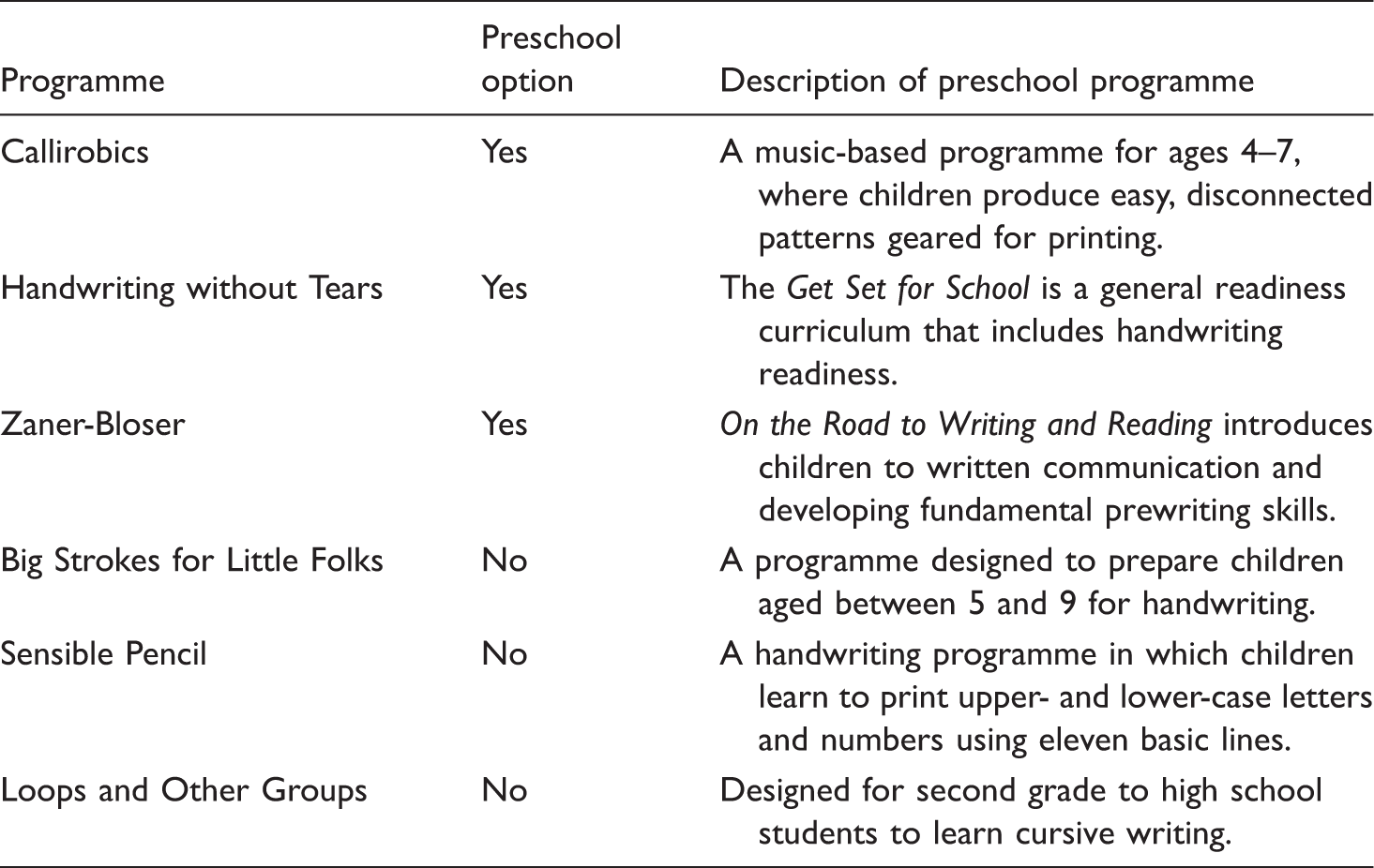
Handwriting focuses directly on letter formation and the perceptual-motor skills that are required for the mastery of writing. Despite the literature supporting the link between handwriting and academic achievement, there is little research to support the use of any one specific handwriting curriculum (Asher, 2006). D'Nealian and Zaner-Blosser are currently the most commonly used handwriting programmes for children in elementary school (Cahill, 2009), although Asher (2006) states that teachers report using a variety of programmes and techniques with little consistency even within school districts. Cahill (2009) also provides a brief summary of other supplemental programmes available for use, including Callirobics, Handwriting without Tears, Big Strokes for Little Folks, Sensible Pencil and Loops and other Groups.
Similar to the principles that guided instruction across other subject areas, the teaching of formal handwriting was once only recommended for children when they entered kindergarten (Zaner-Bloser, 1994). This notion complements the ‘reading readiness’ approach established in the 1920s, suggesting that formal reading instruction is not appropriate until children are sufficiently mature, or 6 and a half years of age (Durkin, 1970). More current research has established that children provided with a balanced approach to reading instruction – explicit instruction used in conjunction with constructivist activities for the strengthening and generalization of skills – engage in literacy practices and develop strong foundational skills well before they enter school (Pressley, 2006). Similarly, handwriting programmes, once designed for kindergarten, now offer opportunities for young children to engage in activities that lay the foundation for good handwriting once children enter school. Table 1 provides a summary of the opportunities afforded preschoolers, if any, from the programmes listed in Cahill (2009). Although the International Reading Association and the National Association for the Education of Young Children (1998) recommend the utilization of evidence-based practices and curricula in early childhood classrooms, there is no evidence to support the labelling of the available curricula and supplemental curricula as evidence-based (Asher, 2006).
Current research on handwriting in the preschool years is limited with regard to handwriting readiness skills but should address issues of posture, grip and position (Rosenblum et al., 2006), a focus on learning simple vertical letters (Berninger and Graham, 1998), as well as the spatial and temporal vocabulary typically used in handwriting instruction, including ‘top’ or ‘up to’ (Marr et al., 2001). The extent to which these foundational skills can prevent bad habits will influence how teachers provide quality handwriting instruction that does not require remediation.
There is limited evidence of effective handwriting practices in elementary school (Asher, 2006) and almost no evidence of the effectiveness of handwriting programmes implemented at the preschool level. Only the Handwriting Without Tears (HWT) – Get Set for School multisensory programme was found to be beneficial in improving the fine motor and prewriting skills of 17 preschoolers enrolled in Head Start (Lust and Donica, 2011). Overall, their research suggests that children in the treatment group made significantly greater improvements in prewriting skills than a non-treatment control group. Although promising, the relatively small sample size, rural community implementation and fact that the programme was implemented by occupational therapists – a luxury not often made available to all preschools – suggests that future research is needed to develop a programme that can be used in any early childhood classroom and implemented by the classroom teacher. There is currently no research examining how or if teachers in preschool teach handwriting to their children. In fact, given the emphasis on an emergent literacy perspective, it may be that early childhood educators feel it would be inappropriate to provide any instruction on handwriting readiness. Nonetheless, we may draw conclusions based on research gathered on elementary school teachers, although it should be noted that early care and education teachers are typically less educated than teachers in the state school system (Whitebook et al., 2009), and the extent of knowledge they have concerning handwriting may be significantly less than that of their elementary school counterparts.
In a national survey, teachers in elementary school reported using commercially available programmes to teach handwriting (Graham et al., 2008). Yet, teachers using these curricula still fail to implement effective, research-approved handwriting instruction strategies (Vander Hart et al., 2010). Teachers fail to devote an adequate amount of time, as recommended, to teaching handwriting, and they limit the extent to which they provide explicit instruction (Vander Hart et al., 2010). In fact, most teachers report failing to receive adequate instruction in their college courses prior to entering the field (Graham et al., 2008). Ninety-three percent of teachers reported that they teach handwriting in whole class lessons, and yet most teachers feel that handwriting should be taught as a separate subject and that direct instruction is more important to learning handwriting than incidental learning (Graham et al., 2008). Although the use of district-wide programmes may be necessary for ensuring high-quality handwriting instruction (Vander Hart et al., 2010), a limit on the number of evidence-based practices makes it difficult to select a programme for implementation. Future research should examine the effect of handwriting programmes, their applicability in the early childhood education classroom and the extent to which these methods have long-term effects on composition and other academic skills.
Conclusions and implications for practice
Preschool options of supplemental handwriting programmes.