







Abstract
This case study examines the co-authoring of unboxing videos by one six-year-old, second-generation Brazilian immigrant child and her mother in the United States. These videos were created in response to boxes filled with gifts they received yearly from relatives in Brazil. To understand this mother-daughter dyad and their video production, this study draws on metaphors of mobility, the logics of reciprocity and obligation in gift-exchange, and the concept of care constellations. The analysis of interviews, field notes, and unboxing videos identified specific routes, rhythms, and frictions that fueled this family digital literacy practice. It also suggested that participants were implicated in a pattern of caregiving through a transnational cycle of gift-exchange. These findings disrupt typical framings of the unboxing genre as a manifestation of U.S. capitalist ethos and foreground the material and discursive production of care in a transnational family’s digital literacy practice.
The camera captures Arco-íris 1 sitting behind a large cardboard box playing with a yellow blouse lying on the floor. Maria’s voice can suddenly be heard from behind the camera: “Ok, agradece aqui que agora a gente vai abrir porque cê tá super ansiosa!” [Ok, say thanks here cause now we’re gonna open (remaining gifts) cause you’re super excited!]. Arco-íris raises her head and looks straight into the camera. Still holding the yellow blouse, she says, “Eu gostei, tia Milly, obrigado” [I liked it, aunt Milly, thanks]. She then smiles and raises her arms, shaking them as if celebrating. Maria’s voice emerges again: “Como é que cê fala pra ela?” [How do you say it to her?]. Arco-íris, still looking into the camera, says, “Obrigado. Eu AMEI” [Thank you. I LOVED it]. She places her right hand on her lips, smacks a kiss, and extends her right hand toward the camera: “Beijo. Tchau” [Kiss. Bye].
(Excerpt from video received in November 2019)
Every year, Arco-íris and her mother, Maria, get together in their small one-bedroom apartment in the Northeastern United States to make “unboxing” videos to send to their family members in Brazil in response to gifts that had just arrived through the mail. As illustrated in the excerpt above, this mother and daughter engaged in a family digital literacy practice, the co-authoring of a video, infused with care, love, and gratitude. Family digital literacy practices refer to individuals’ engagement with multimodal, multimedia texts and practices in the home that are part of family life and involve the participation of family members (Marsh et al., 2017). In the 21st century, widespread availability and affordability of digital technologies compounded by the emergence of new media have significantly shaped the daily communicative realities of children and their families (Anderson et al., 2010; Compton-Lilly et al., 2019; Terras and Ramsay, 2016). On one hand, this has sparked concerns that young people’s digital media usage may be a distraction from civic engagement and academic learning and exacerbate educational inequalities (Ito et al., 2013), or lead to more individualized screen engagement and therefore solitary screen-based relationships (Sefton-Green et al., 2016). On the other hand, other studies have documented that individuals are taking on digital literacy practices for pleasure and closeness within families, mobilizing a range of digital tools to create intergenerational spaces for affinity, collaboration, and to develop agency (Aarsand, 2007; Lewis, 2013, 2014; Lewis Ellison and Wang, 2018).
This article examines a mother-daughter dyad and their production of unboxing videos in the United States. Created in response to large boxes filled with material gifts sent once or twice a year from relatives in Brazil, these unboxing videos were co-authored by one first-generation Brazilian immigrant mother (Maria) and her second-generation, six-year-old daughter (Arco-íris). Here, these videos are understood as an integral part of a specific pattern of caregiving through the exchange of gifts (Mauss, 1990). This exchange of gift boxes and unboxing videos has taken place for over a decade and traveled along the axis of constellated relationships that span and transcend members of this transnational family distributed between Brazil and the U.S. Drawing on Creswell’s (2008, 2010) metaphors of mobility, this article examines the routes, rhythms, and frictions embedded in this mother-daughter digital literacy practice. Attending to these metaphors elucidates the transnational circulation of care, since entanglements of mobility forged avenues for participants to reciprocate for the material gifts that they received and reaffirm familial commitments and emotional attachments from afar.
Scholarship on unboxing videos to date has primarily investigated the YouTube toy unboxing genre (Craig and Cunningham, 2017; Marsh, 2015; Nicoll and Nansen, 2018), stressing children’s roles vis-à-vis the branding and/or consumption of purchasable goods. This article adds to this literature by foregrounding how a transnational family’s engagement with unboxing videos disrupts typical framings of the genre as a manifestation of U.S. capitalist ethos. For the family in this study, “unboxing care” videos were spaces for reciprocity and the maintenance of kinship ties across geopolitical boundaries. Moreover, this study contributes to literacy research by exploring a particular family digital literacy practice while also situating it as a transnational literacy (Kell, 2017; Lam and Warriner, 2012; Vieira, 2011; Warriner, 2007). Finally, this article focuses on a Portuguese-speaking Latinx family in the U.S., a population that is remarkably understudied in the literacy scholarship.
Research questions
As I learned more about Maria and Arco-íris’ co-authoring of unboxing videos and their ties with relatives in Brazil, two main questions guided my work:
What mobilities of digital literacy practice (i.e., routes, rhythms, frictions) map a mother-daughter co-authored production of ‘unboxing care’?
How is care circulated, enacted, and refracted through the yearly exchange of gifts that occurs between members of Maria and Arco-íris’ family situated in Brazil and the U.S.?
This article begins with a brief review of prior research on family digital literacies and how it intersects with recent scholarship about immigrant children and families’ literacies. Then, the conceptual framework is introduced, articulating how gift-exchange, care, and mobility fuel and contextualize the mother-daughter video production. Next, the methods of data generation and analysis are detailed, along with descriptions of the study participants. After, I report the specific ways in which unboxing videos were animated by mobilities of family digital literacy practice that conveyed happiness, gratitude, and affection for individuals in a distant physical terrain. In the discussion, I close the article by situating the unboxing videos in the broader circulation of commodities and videos. The article posits that literacy studies may be better equipped to understand the digital literacy practices of transnational families who endure long periods of physical separation by attending to how care is discursively and materially produced.
Literature review
Research in the field of family digital literacies and studies focused on the literacy practices of immigrant children and families inform this article and are explored in this section. The potential of digital literacies to generate closeness within families (Lewis Ellison and Wang, 2018) has become more complex and elusive in light of the diverse patterns and living arrangements of transnational families (Shih, 2016). Transnational families refer to family groups that include members who are physically distant, distributed between two or more nation-states, but who sustain ties and relationships (Shih, 2016). Few literacy-oriented studies honed in on how transnational families’ digital literacy practices intersect with their efforts to construct closeness and care for family members from afar. This article addresses this gap by examining a mother-daughter co-authoring of unboxing videos that connects relatives in Brazil and the U.S.
The digital in family literacy research
In the 21st century, families and communities live in a context of intensified globalization and rapid technological diffusion. Such context has potentially extended their use of digital technology and created spaces for new literacies to emerge (Anderson et al., 2010; Berry et al., 2012). For example, Murphy and Headley (2020) showed that widespread accessibility and affordability of mobile digital devices affected how teen mothers used digital tools. The mothers transcended the typical purposes of digital tools for education or entertainment from when they were growing up, using these tools to support their daily routines and enculturate their children into specific literacies. Engagement with digital tools has also allowed mothers to position themselves as digital literacy users, gaining status with their children, and construct agentic identities (Lewis, 2013; Lewis Ellison and Kirkland, 2014). Studies have also documented how children mobilized technological tools such as the computer (Davidson, 2012) and video games (Lewis Ellison, 2014) in home environments to socially accomplish a range of activities. In light of the myriad ways in which the digital enable engagement in multimedia and multimodal practices for children and their family members, some scholars have called for a change in focus from ‘family literacy’ to ‘family digital literacy’ (Marsh et al., 2017). Digital literacies refer to “multiple and interactive practices, mediated by technological tools such as the computer, cell phones, and video games that involve reading, writing, language, and exchanging information in online environments” (Lewis, 2013: 1).
Digital literacy practices within households often establish parent-child dyads and shape familial relationships, since these practices open spaces where family members can collaborate, negotiate, and learn with each other (Lewis, 2013, 2014; Lewis Ellison and Wang, 2018). For example, in a study about the agency of an African American mother and her son in a digital storytelling project, Lewis Ellison and Wang (2018) showed that the child expressed resistance in composing digital texts with his mother when he received instructions that he already knew or felt that his skills were not considered. The mother, in turn, responded to his resistance by redirecting his practices through techniques such as compromise and negotiation. Lewis Ellison and Wang’s study highlighted that family members were able to negotiate and forge avenues to learn, communicate, and collaborate around digital tools, despite tensions and disagreements. The present article contributes to the literature on family digital literacies by exploring how one parent-child dyad, an immigrant mother and her daughter, engaged in the digital literacy practice of co-authoring unboxing videos.
Transnational family literacies
Large-scale global processes such as the increase in international migration in the 21st century have impacted the arena of language learning and literacy research (Warriner, 2007). Transmigrants’ experiences challenge scholars to account for the affordances and constraints provided by the access to and practice of literacy and raise questions regarding how to theorize literacy when it takes the form of texts that travel with people as they move (Kell, 2017). The growing numbers of transnational children and youth in schools around the world also challenge educators to reimagine approaches to literacy teaching and learning that are responsive to these students’ lives, knowledge, and capabilities (Skerrett, 2015). Responding to this reality, literacy research has explored, for example, how friends and/or family members engage in diverse social fields that span national borders and tap into multiple literacy practices to construct and sustain connections in these social fields (Compton-Lilly et al., 2019; Lam, 2009; Orellana et al., 2001). Studies with transmigrant families have also focused on how parents use their native languages and/or organize literacy activities to support their children’s bilingualism and biliteracy within their households (Chao and Ma, 2019; Kibler et al., 2020; Song, 2016). Others transcended the focus on parental facilitation of language and literacy development to explore the everyday experiences and language and literacy practices of transnational children in their homes and communities (García-Sánchez, 2014; Ghiso, 2016; Orellana, 2009; Orellana et al., 2003).
However, few studies with immigrant children and their families explored the complex interplay among transnational lifeworlds, literacy, and care as an amalgam that sustains familial bonds. An important exception, Ghiso’s (2016) study of Latina/o children’s participation in the community space of the Laundromat showed that the children engaged in transnational literacies of interdependence fueled by an ethics of care. For example, children’s photographs and written narratives in Ghiso’s project demonstrated their involvement in helping their families with the material work of caretaking (e.g., folding the laundry). Here, rather than dichotomous, “work” and “play” were represented as inextricable aspects of children’s lived experiences, indicating that play and care work were fused within the same literacy event (Ghiso, 2016). Despite this important contribution, family literacy research has yet to significantly explore the centrality of care in the digital literacy practices of transnational families who endure prolonged physical separation.
Other scholarly fields, such as sociology and anthropology, have investigated migrant families’ practices of transnational networking communication as permeated by the logics of care and intimacy (Cuban, 2014; Francisco, 2015; King‐O’Riain, 2015; Parreñas, 2014; Wilding, 2006). For example, Parreñas (2005) argued that migrant Filipino mothers achieved semblances of intimacy with their children who remained in their home country by sending SMS texts daily as well as letters and boxes filled with gifts (e.g., clothes, toiletries). Along these lines, Coe’s (2011) study of Ghanaian migrant parents and their children showed that they understood love to be expressed through the distribution of material resources and the provision of necessities. Children in Ghana saw the materiality of care, manifested in consumer goods and remittances, as a signal of emotional depth and closeness to their migrant parents. I argue that this literature challenges literacy scholars to look into the “virtual intimacies” (Wilding, 2006) that go on within transnational households as harboring important family digital literacy practices and events.
Conceptual framework: Care, gift-exchange, and mobility
This article brings together as a conceptual framework the notion of transnational care constellations (Oliveira, 2018), the logic of reciprocity and obligation embedded in gift-exchange (Mauss, 1990), and metaphors of mobility (Creswell, 2008, 2010). Although from seemingly divergent areas—such as anthropology and geography—these constructs are complementary and generate insights for the study of transnational family digital literacies.
Care and gift exchange
In a study of transnational families, Oliveira (2018) posited that care holds constellations of relationships together as individuals live their everyday lives across geographic and imagined spaces. From this perspective, new practices and patterns of care are created and negotiated as individuals migrate and sustain relationships with people in different physical terrains, forming “transnational care constellations” (p. 20). This concept stresses that care and caregiving are not static, dependent on physical proximity, or restricted in possibilities of expression. Instead, care and familial bonds travel. In this article, gift-exchange is seen as a specific pattern of caregiving that travels along the axis of a transnational constellation. This stance expands prior research that argued that the circulation of writing remittances in Brazilian transnational families unleashed a bidirectional transactional circuit of economic and emotional exchange (Vieira, 2016). Precisely, the cycle of gift-exchange and reciprocity explored here transcends the linearity implied in the pattern of a bidirectional circuit. Care constellations as a spatial construct allow transnational cycles of networking communication and gift-exchange to take on various shapes and encompass multiple practices, including literacy-based ones.
Gifts and gift-exchange can be a tool or medium for ensuring the circulation of care and the strength of transnational care constellations. Mauss’s (1990) study of exchange and contracts in ancient and present-day societies suggested that our daily lives still reflect an early orientation to gifts and gift-exchange based upon the obligation to reciprocate. From this perspective, the passing on of a thing enables relationships to arise, commitments to be made, solidarity to be enhanced, and communities to be delineated. This occurs because the act of gift-giving creates a cycle of reciprocity that is never wholly altruistic nor is it inherently exploitative, as individuals are not necessarily interested in extracting just what is useful for them from these exchanges. While these remarks were discussed by Mauss mainly in connection to societal systems of economy and law, the author posited that gift exchange “has always been a principle of action and will always be so: to emerge from self, to give, freely and obligatorily” (p. 71).
Care and mobility
Unboxing care videos are mobile not only in that they travel across geopolitical borders. They also encompass mobilities of digital literacy practice. This study draws on the metaphors of routes, rhythms, and frictions of mobility (Creswell, 2008, 2010) to examine a mother-daughter co-authoring of unboxing videos. First, mobility is seen as moving along routes typically provided by conduits in space (Creswell, 2010). Routes provide connectivity, which in turn shapes the spaces where routes are located, engendering a process that emphasizes connection and relations as opposed to distance. Second, rhythms refer to routinized movements that are simultaneously organic and imposed. As individuals produce their everyday lives, they perform rhythms that seem natural, but all rhythms are also regimented by expectations or obligations. Creswell (2008) described rhythm as involved in the continuity or subversion of social order, as bodies are often scrutinized for moving with ‘curious’ rhythms or praised for following ‘correct’ movements. Finally, frictions in mobility refer to when and how movement stops. In a rapidly-changing world, it has become increasingly important to account for the process of stopping, including if stopping was a choice or forced (Creswell, 2010).
Creswell’s metaphors of mobility guided the analysis of unboxing videos presented in this article, serving as a priori codes. They allowed interpretations that foregrounded the co-authors’ movements, including embodiments, enactments, verbal expressions, and impulses. Mobility metaphors also invited reflection on how the movements that animated the video-making activity engendered connection–between the mother and the daughter and between the two co-authors and their family members in Brazil who received the videos. Thus, the lens of mobility and connectivity helped to trace how care was enacted and refracted through the family digital literacy practice of co-authoring unboxing videos.
Methods
Designed as a case study (Stake, 1995, 2004), this project explored how mobile media technologies mediated family literacy practices and shaped kinship ties across geopolitical borders. This case, more specifically, focused on the experiences of one Brazilian immigrant family in the U.S., Arco-íris and her mother Maria. However, to grasp their transnational family literacy practices in greater depth, connections to relatives were traced and interactions with three relatives in Brazil also informed this study. Ethnographic procedures (Fusch et al., 2017) were adopted, including prolonged engagement with participants in person and via phone, triangulation across methods, and member checking. These procedures facilitated the establishment of a stronger rapport with the participants and promoted a greater emphasis on understanding the feelings, beliefs, and meanings that Maria and Arco-íris co-constructed around digital tools.
Focal participants
Arco-íris
Arco-íris is a six-year-old first-grader who was born and raised in the United States. Although she has, physically, never been to Brazil, many aspects of her daily life are connected to life there. For example, family members from her mother’s side, who live in Brazil, are regularly mentioned in conversations and make themselves visible through the many gifts they sent her over the years. Arco-íris watches YouTube videos every day on her small, pink-cased tablet, following closely the children’s channel Ryan’s World, which features several unboxing videos, toy reviews, cartoons, and science experiments created by nine-year-old Ryan and his family. She also loves playing Roblox, a free online entertainment platform that allows users to create and play together in 3D worlds through smartphones, tablets, or computers. Arco-íris also uses the “voice memos” application and the built-in camera on her tablet to film performances alone or with her mother.
Maria
Maria is in her late 30 s, was born in Brazil, and migrated to the United States over 16 years ago. She works six days a week at a supermarket and coffee shop, averaging between 8–14 hours a day. She lives alone with her only daughter, Arco-íris, in a one-bedroom apartment in a downtown area of a U.S. northeastern city. Maria communicates daily with family members in Brazil through the messaging and calling application WhatsApp. She shared, “Eu vivo aqui mas ligando todo tempo pro povo no Brasil. Eu vivo aqui, mas sei de tudo que tá acontecendo lá” (I live here but calling the people in Brazil all the time. I live here but I know everything that’s happening there). Apart from her mother, Monique, who visited once when Arco-íris was 4 years old, no other Brazilian relative has been to the U.S. Thus, at the time of this study, Maria had not seen most of her relatives for over a decade and Arco-íris had never met them (except for Monique) in person. This is important since, despite this prolonged physical separation, Maria and Arco-íris were able to sustain ties with family members in Brazil by engaging in practices that reaffirm commitments and attachments from afar, such as co-authoring unboxing videos.
Data generation
For 10 months (November 2019 – August 2020), I made 10 in-person visits to Maria and Arco-íris’ home (November 2019 through March 2020) that lasted between 2–4 hours per visit. I took handwritten field notes and audio-recorded informal conversations and everyday activities that unfolded in their household (e.g., child playing online games, mother making a meal) during eight visits (∼18hrs. total). During these in-person visits, I also accompanied Maria and Arco-íris to several places, such as a dentist appointment, a birthday party, and the grocery store. In April 2020, phone calls replaced in-person home visits due to the COVD-19 pandemic. As such, I took field notes during 10 phone calls (ranging 16–47 min.) that were structured as regular informal check-ins with Maria about, for example, hers and Arco-íris’ recent mobile media usage, their communication and relationship with family members in Brazil, their expectations for upcoming boxes from Brazil, and Arco-íris’ education. Arco-íris often joined these phone conversations briefly to say hello or to add to Maria’s comments, only once staying for the duration of an entire call. All field notes were transcribed within 24 hours of each in-person visit or phone call. Field notes and audio files were originally recorded in Portuguese, with English translations being generated by the researcher for this report.
Secondary sources of data were also generated. They include artifacts such as drawings and photographs (e.g., mobile media technology available in the household). I also obtained five unboxing videos (∼16mins.) co-authored by the two participants and sent to relatives in Brazil. These five unboxing videos, ranging in length from 10 seconds to ∼7 minutes each, were filmed in response to boxes or envelopes with gifts meant to celebrate one Christmas holiday, Arco-íris’ fifth birthday, and Maria’s birthday, and two videos responded to boxes that were not associated to a specific holiday or celebration. These unboxing videos were drawn from a larger collection of 39 videos created by Maria and/or Arco-íris (∼82mins.) that included a variety of genres and styles (e.g., tutorials, dance videos) and that were selected and shared with me by Maria for the purposes of the larger research project. This article focuses on the unboxing videos from this collection because they uniquely entangled the ubiquity of digital technology, the materiality of gifts (e.g., consumer goods, cash), and allusions to love and commitment to kin from afar.
Additionally, I conducted semi-structured individual interviews with the two participants in the U.S. (∼1 hr. each) that focused on their mobile digital media usage, video-making practices, and impressions of relatives in Brazil and their gifts. Semi-structured online individual interviews (∼30 min. each) with three family members in Brazil were also conducted, involving Maria’s mother (Monique), sister (Micaela), and aunt (Milly). These individuals were selected because their names were repeatedly mentioned in unboxing videos. Interview questions for participants in Brazil focused on the process of assembling boxes, the reception of unboxing videos, and rationales for sending gifts.
Data analysis
Once data collection was completed, data analysis began by processing each dataset individually. This included: 1) Expanding transcribed fieldnotes into more comprehensive write-ups; 2) Listening to audio recordings collected during home visits and selectively transcribing excerpts based on their connection to the research questions; 3) Listening and transcribing all audio-recorded interviews; and 4) Representing the five unboxing videos on matrices on Excel to depict a diversity of modalities used by participants (Flewitt et al., 2014). The layout of these matrices included columns for: time length of a segment of interaction, visual frame (screenshot representing a segment), kinesics action, and language/soundtrack. These categories are adapted from Flewitt et al. (2014) and prior work in the area of digital literacies (Lewis Ellison, 2014).
During this analytic processing, I engaged in pre-coding (Saldaña, 2009) by highlighting passages for their connection to the research questions and guiding theories. I also wrote jottings (Saldaña, 2009), registering comments on field notes and transcripts, and developed analytical memos. The process of transduction of unboxing videos, or the conversion of observed action into another mode (e.g., still photographs, written descriptions) also generated insights into the data (Flewitt et al., 2014). These reflections were registered as memos and constituted an initial level of multimodal analysis. After processing, all materials underwent a first cycle of coding in which I read each dataset and coded them using inductive (e.g., descriptive and in-vivo) and deductive or a priori codes based on the theories/concepts that guide this study (Miles et al., 2014). Examples of deductive codes include: ‘routinized movement’ and ‘movement halted’ (Creswell, 2008, 2010); ‘obligation to reciprocate’ and ‘purpose of boxes’ (Mauss, 1990); and ‘kinship titles’ and ‘communication Brazil/US’ (Oliveira, 2018).
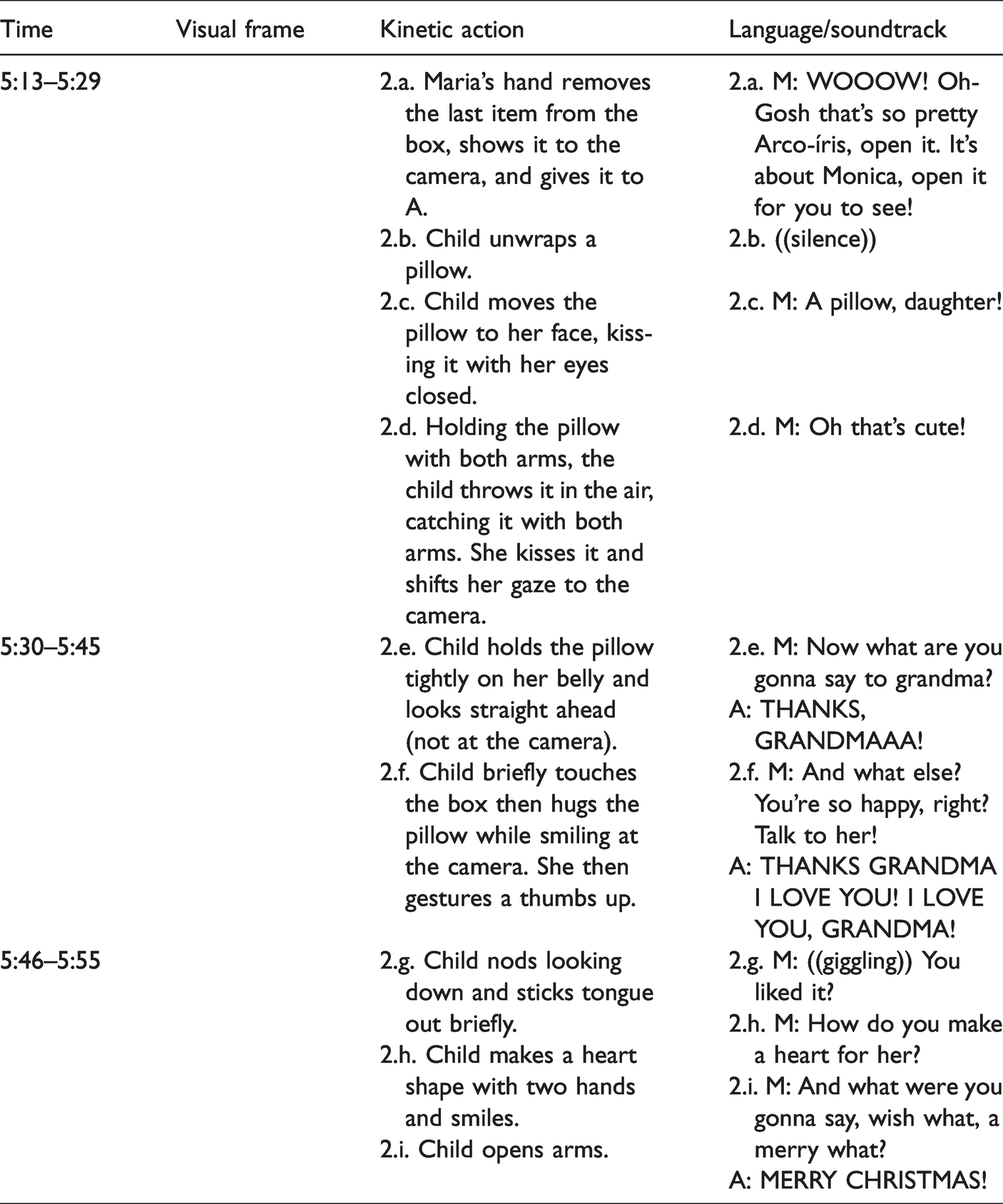
Importantly, when coding unboxing videos represented in matrices, each row—which brought a timestamp, visual frame, kinesics action, and language/soundtrack (see Tables 1 to 3)—was coded as a cohesive unit, since different modes interconnected to make meaning (Flewitt et al., 2014). Co-authoring unboxing videos was a social activity and thus transcripts of mother-daughter interactions were inextricably connected to how participants manipulated objects (e.g., gifts), used body language (e.g., hugging gifts, physically distancing themselves from the box), etc. In addition to deductive coding based on theories, unboxing video matrices were also coded inductively, according to the functions of certain gestures, proxemics, utterances, or uses of vocal quality (e.g., excitement, surprise, gratitude) (Erickson, 2006).
Aunt Milly.
Unfolding clothes.
Next, all transcripts and matrices went through a second cycle of pattern coding (Miles et al., 2014) in which different data sources were integrated through the process of creating overarching categories. Here, 10 categories were created that tied together 38 codes from interviews with individuals in Brazil, and 6 categories organized 42 codes linked to interviews with U.S. participants and unboxing video data. A third cycle of analysis led me to edit the coding scheme (e.g., codes were deleted, collapsed, broken down) and organize these 16 categories into 6 themes. I developed narrative descriptions that explained the connections within and across categories and their themes, and included assertions of summative synthesis that were supported by evidence from the data. The findings below draw from narrative descriptions of three themes: routes, rhythms, and frictions.
Findings
As my analyses suggest, the findings that follow foreground the dynamics in a mother-daughter dyad and the entanglements of mobility that animated their co-authoring of unboxing videos. I begin by exploring identified routes, such as routinized roles and courses of action, that were established by the participants over time. Then, I turn to identified rhythms of care and love—spontaneous and orchestrated by familial expectations—that mapped this digital literacy practice. Finally, I discuss observed frictions or moments when movement was halted, as the mother and her daughter co-authored their videos.
Along routes of family digital literacy practice
This section explores the designation of routes that mapped unboxing videos, creating correct mobilities (Creswell, 2008) or channeling participants’ mobility into conduits that prevent turbulence and constrain movement. Family members in Brazil had high expectations for displays of happiness and gratitude in unboxing videos. For example, Maria’s aunt, Milly, who often added gifts to the traveling boxes, shared during an interview, “I think that [the videos] are MORE than a thank-you message, you know? We see her happiness, the girl’s happiness when receiving something from Brazil.” 2 Based on these expectations, Maria and Arco-íris established conduits through which their performance unfolded in unboxing videos. Over time, these routes became routinized and worked to connect not only family members in Brazil and the U.S., but also shaped mother-daughter relations during their co-authored video production. Examining the routes through which this video production moved elucidates how care was produced through the assemblage of unboxing videos.
Arco-íris’ narratives during informal conversations suggested that the child and her mother designated routes of predefined roles that mapped their unboxing videos. For example, when talking about the dynamics of these videos, Arco-íris explained, “eu faço com a minha mãe” (I do it with my mother), adding “So… she has to tell me what I have to do and she tells me when I begin the video, so I have to say what she said. […] I do it alone, with no one else appearing, only my Elfie if I want. And my mom has to speak and has to hold my tablet. Or her phone.” When asked if she sent the videos to Brazil, the child interjected: “minha mãe que tem que mandar!” (my mom [is the one] who has to send!). Thus, the dynamics between co-authors in unboxing videos did not flow through a smooth space without conduits or channels (Creswell, 2008). Instead, the participants established routes through which the mobility of their digital literacy practice could flow, facilitating the accomplishment of the task. Routes shaped their performance and roles: Arco-íris was to appear alone (or with her teddy bear) as the protagonist of the video and follow her mother’s directions. Maria, in turn, held the tablet/phone, acted as an off-camera director, and sent the video to Brazil through social media. These routes reflected arrangements typically found in YouTube toy unboxing videos (Nicoll and Nansen, 2018).
Moreover, Maria and Arco-íris co-authored other routes that provided a repertoire of procedures and participation schemes that guided their mobility. For example, acting as the protagonist in the five unboxing videos analyzed here, Arco-íris consistently moved along the route of grabbing gifts from inside a box one by one, showing each gift to the camera before unboxing the next. In four videos, Arco-íris began by greeting the viewers (e.g., “oi pessoal” [hi guys]) and identifying the sender (e.g., “eu recebi uma caixa da tia Milly” [I received a box from aunt Milly]). All videos ended with a closing message of the child saying “tchau” (bye) accompanied by a final “obrigada” (thanks) and/or a kiss to the camera. Additionally, all videos were also coded for “building suspense,” a route in which the mother and/or daughter wondered aloud about the gifts inside boxes/envelopes before opening them. For example, for Arco-íris’ sixth birthday, she found four envelopes from family members in Brazil in the mailbox. She first opened one envelope, which contained cash. When getting ready to open the second one, the child said, “Eu tô vendo um negoço verde! O que será aqui dentro?” (I’m seeing something green… what could it be in here?). Before opening the next envelope from “vovó (grandma) Monique,” Arco-íris again pondered aloud, “O que será o que ela mandou pra mim ESta vez?” (What could it be that she sent to me THIS time?).
In multiple conversations with Maria and Arco-íris, they affirmed that the idea of making unboxing videos was their own and that their actions during these videos resulted entirely from the practice of collaborating and negotiating what to do over the years. However, this family often watched YouTube toy unboxing videos, including those from Ryan’s World. Importantly, these YouTube toy unboxing videos included routes such as mystery and suspense in a context of safe and predictable outcomes (Marsh, 2015), initial greetings, and a closing message that included expressions of gratitude (e.g., Thank you for watching our video, bye). Therefore, at one level, the routes that mapped this family digital literacy practice seemed to be typical courses of action in the unboxing genre more broadly. However, rather than simply mimicking the videos that they watched, this mother and daughter reconfigured traditional routes in unique ways that allowed them to perform happiness and affection for relatives in Brazil (e.g., send kisses to the camera, identify sender through kinship titles), and thus produce expressions of transnational care.
Maria also moved along routes that seemed routinized over time. For example, in the three videos where she participated by talking to Arco-íris, her performance followed similar trajectories. Maria consistently reiterated who sent the box (stressing kinship titles) or where it came from (Brazil), shared positive feelings and expressed amazement for the gifts, and prompted the child to perform various moves (e.g., share feelings, identify a familial connection to the sender, say ‘thanks’). For example, the excerpt in Table 1 shows that Maria interjected at the beginning of a video to reiterate Arco-íris’ kin connection to the box sender.
Also in Table 1, Maria responded to Arco-íris’ initial greetings by reinforcing that the box was sent from Brazil by the child’s aunt and godmother (1.c.). Soon after, Maria asked Arco-íris for her aunt’s name (1.d.), even though the child had already said it. Therefore, Maria moved along routes that corroborated and amplified Arco-íris’ message of happiness and emphasized familial ties. In sum, Maria and Arco-íris negotiated and established multiple routes from their joint practice of co-authoring videos over the years and possibly from watching YouTube toy unboxing videos. These routes provided the architecture through which rhythms of care and love could flow.
Rhythms of care and love
In their unboxing videos, Maria and Arco-íris moved to rhythms of care and love that were simultaneously organic and imposed (Creswell, 2008). On one hand, for each gift that the child unboxed, the participants performed rhythms that seemed spontaneous, such as suddenly gasping and saying that they loved the gift. However, these rhythms were also regimented by obligations and expectations for displays of happiness and gratitude that derived from Brazilian relatives and that were often enforced by Maria. Arco-íris demonstrated awareness of these obligations when explaining what she did in unboxing videos: “I thank the family from Brazil who lives there, I thank them like making a video ‘
In the analysis of five unboxing videos, specific verbal and embodied moves (rhythms) were identified that constructed care for/about relatives in Brazil. While these rhythms were inextricably linked and mutually reinforcing, in the process of coding these videos it seemed relevant to highlight the specific ways in which the child embodied care. For example, in light of the significant physical distance between the child and her Brazilian relatives, it is striking that she moved along the rhythms of kissing, hugging, caressing, or suddenly wearing the gifts that she found inside boxes or envelopes. Here, gifts seemed to act as a material proxy for absent gift senders. In the videos, the child also sent kisses to the camera, displaying affection and physical proximity directly to the audience. Care was also embodied by the child through smiles, gestures (e.g., thumbs up), and ‘cute’ poses (e.g., shrugging her head to the right side, clenching both hands together under her chin) throughout the unboxing process.
When we watched unboxing videos together, Maria shared that she did not direct several of Arco-íris’ embodied rhythms, claiming that they emerged spontaneously. However, Arco-íris’ embodied gestures reflected those of other young children in YouTube toy unboxing videos. For example, revisiting the YouTube videos that this family watched during my visits, I found that the child protagonist (e.g., Ryan from Ryan’s World) embodied facial expressions (e.g., smile) and gestures (e.g., thumbs up) that denoted happiness. Thus, on one level, this may suggest the existence of tropes of embodied authoring that are specific to the genre of the video. On the other hand, other rhythms in Arco-íris’ performance transcended those commonly found in YouTube toy unboxing videos and were unique to this family digital literacy practice. For instance, kissing and hugging gifts were not commonly found in the video performances of their favorite YouTube “unboxers,” and thus seem to be unique to Arco-íris’ embodied authoring of a message of care and love for members of her transnational family.
Arco-íris’ verbal expressions also juxtaposed organic and imposed rhythms. Here, care was refracted through the child’s words and sounds that conveyed excitement, surprise, and gratitude. The five unboxing videos contained elements coded as “excitement,” including singing while opening gifts, paralinguistic features (e.g., raised tone of voice), laughter, screams (e.g., oêêê), and overt positive comments about the gifts (e.g., muito legal [so cool]). Similarly, all videos presented features coded as “surprise,” like gasps, interjections (e.g., OHH), and overt expressions (e.g., SÉRIO?; [REALLY?]). These videos also presented expressions of gratitude, child-initiated, or prompted by Maria. The excerpt in Table 2 demonstrates how Arco-íris moved along organic and imposed rhythms of digital literacy practice.
Thanks, grandma.
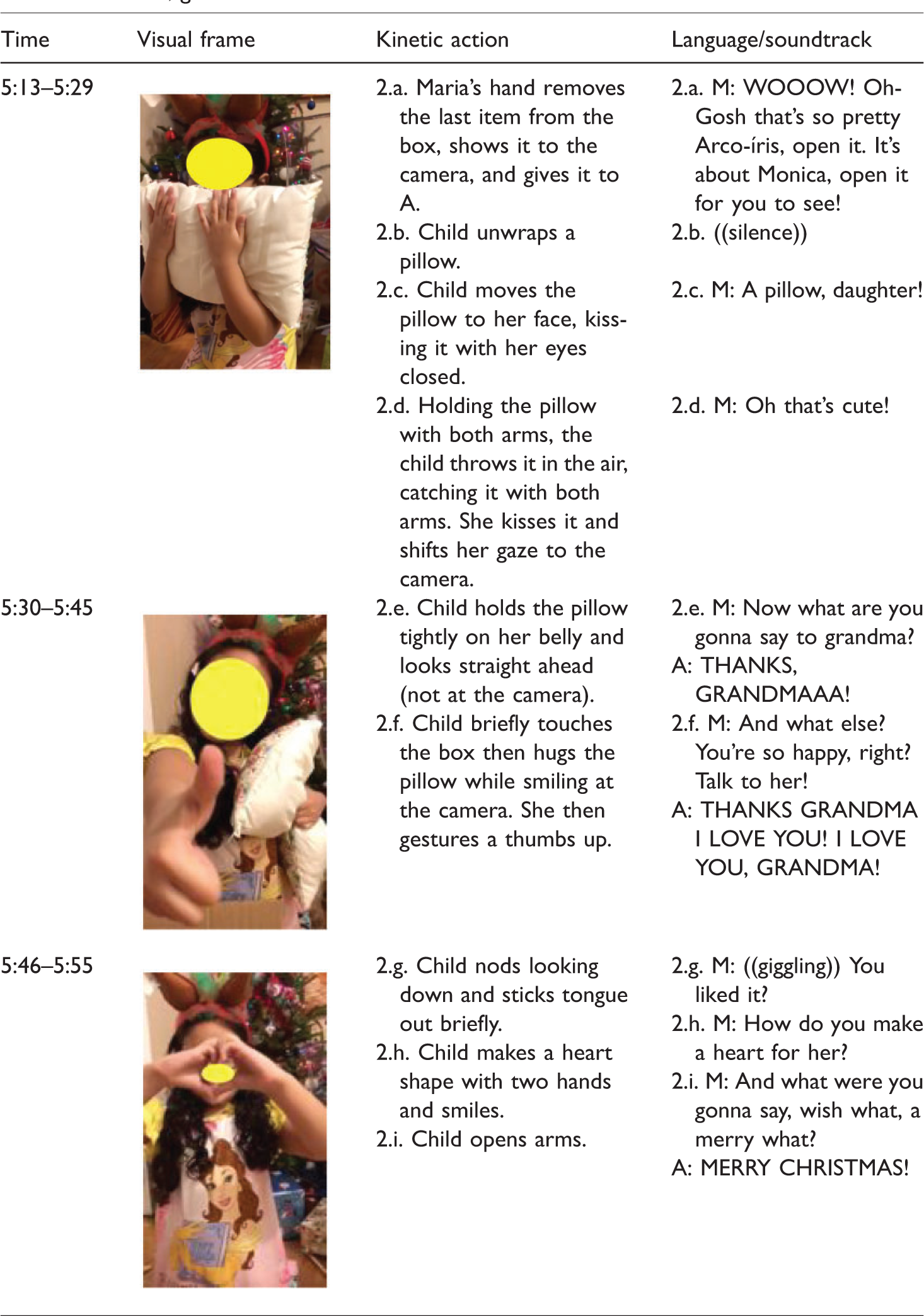
In this example, after unwrapping the last gift in the box, Arco-íris engaged in a sequence of organic rhythms infused with care, such as kissing the gift twice, throwing it in the air and catching it, and hugging it tightly against her body (2.c.; 2.d; 2.e). Maria seemed surprised by these moves, saying “Oh that’s cute” (2.d). Maria then engaged in a series of questions (2.e, 2.f, 2.g, 2.h, 2.i) prompting Arco-íris to verbally express gratitude and other positive feelings. On one level, the child followed the rhythms imposed by Maria’s questions, expressing gratitude and feelings of love. However, she also moved along organic rhythms that were not premeditated by the mother, such as smiling, hugging the pillow, and gesturing thumbs up to the camera (2.f). These embodied rhythms suggested the child’s active role in the maintenance of transnational networks formed along kinship ties (Orellana et al., 2001). In sum, the analysis of unboxing videos showed that participants moved along rhythms of care and love that flowed through an architecture of routes and facilitated the enactment and circulation of care back to loved ones in Brazil.
When movement stopped: Frictions of family digital literacy practice
Maria and Arco-íris’ movements along routes and rhythms as they co-authored unboxing videos were not always continuous. From the five videos analyzed, three had moments of friction, or occasions when participants’ movement was halted. Here, Maria was typically the one who stopped Arco-íris’ unfolding movements and the overall unboxing task. This occurred when the child: displayed physical carelessness toward a gift (e.g., let it fall), unwrapped gifts too fast, seemed disengaged from the unboxing activity, or embodied expressions of dislike toward a gift. When any of these instances occurred in unboxing videos, Maria stopped Arco-íris from opening more gifts and engaged in a series of actions to redirect the child’s movement toward showing happiness, gratitude, and affection.
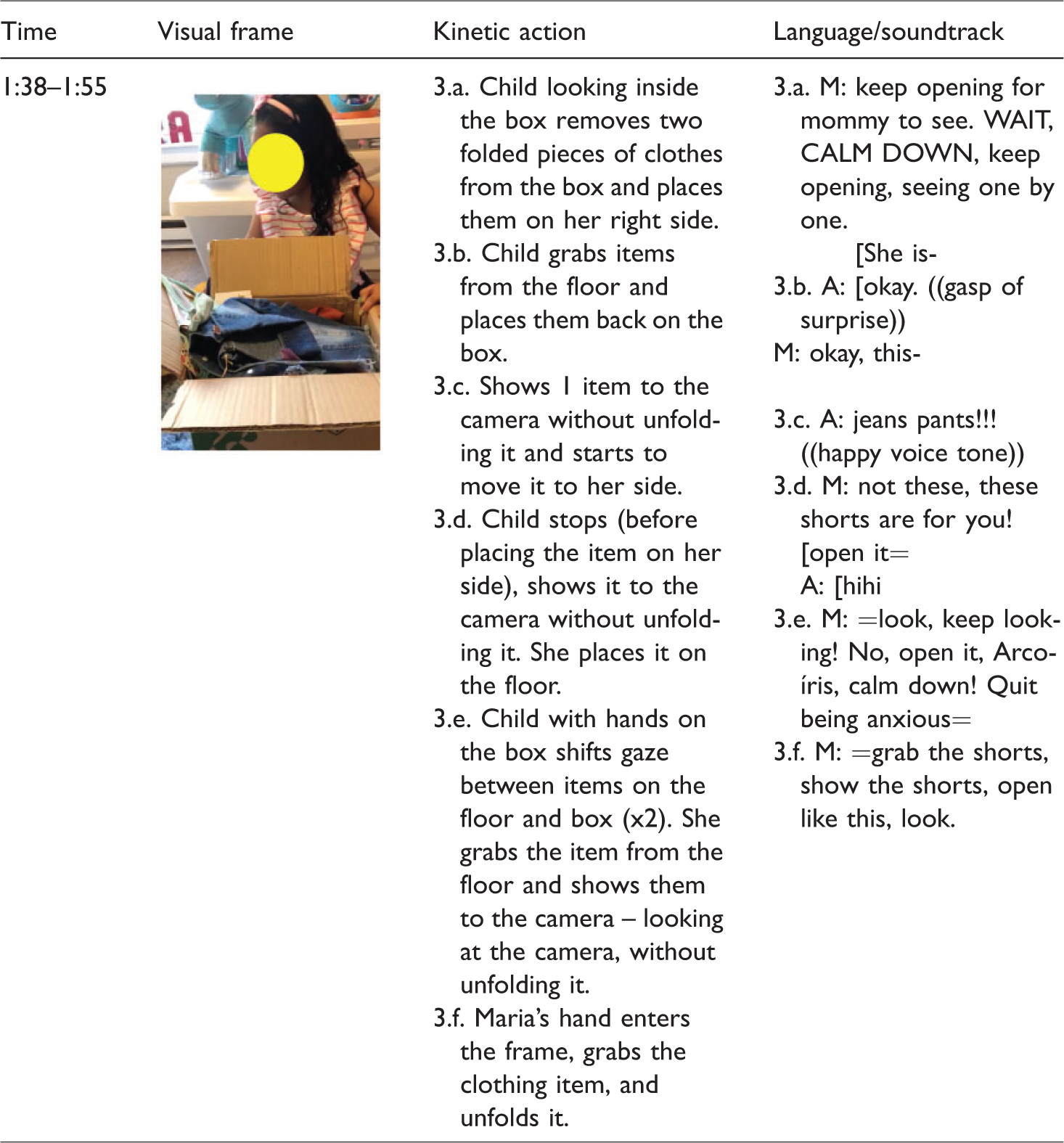
As mentioned above, while there were consolidated routes and expected rhythms that shaped Arco-íris’ performance, the child also moved along organic rhythms based on the gift at hand. This turned unboxing videos into highly dynamic productions where sudden shifts from excitement to discontent/frustration could occur at any moment. For example, Arco-íris specified during an interview what she (dis)liked to find inside boxes: “eu amo brinquedos. Eu não gosto de receber é roupa” (I love toys. What I don’t like to receive is clothes). However, once she received a box that only contained clothes from Milly. The excerpt in Table 3 shows the opening of this box.
This example in Table 3 showed that Arco-íris placed two clothing items from the box on the floor to continue unboxing items. However, this generated a moment of friction. Maria interrupted the child four times to tell her to slow down and show each item (unfolded) to the camera. After each of Maria’s interruptions, Arco-íris used her typical moves to express excitement and surprise (e.g., gasp), but movement was not restored until the clothing items were unfolded, ultimately by Maria. Towards the end of this video–when the child seemed to realize that there were not any toys inside the box–she positioned her body slightly away from the box, became increasingly quiet, and had a facial expression that resembled discontent. In response, Maria raised her tone of voice, frantically asking Arco-íris to continue unboxing gifts, and made positive comments about the items, such as in: “dear Lord! KEEP GRABBING THE LITTLE CLOTHES. She’s crazy to see the dresses. Open it one by one. Wow. LOOK ARCO-ÍRIS THE LITTLE DRESS IS A SKIRT WITH A BLOUSE.”
Thus, movement was halted by Maria when Arco-íris’ performance threatened to obstruct routes (e.g., not properly showing gifts to the camera) or discord rhythms (e.g., facial expressions that resemble frustration). Furthermore, when Arco-íris failed to move according to Brazilian relatives’ expectations, the mother at times took it upon herself to recover and amplify the video’s underlying message of care. That is, moments of friction often prompted Maria to express amazement, excitement, and happiness, and justify Arco-íris’ actions. While frictions mapped this unboxing video production, they were not detrimental to its message of happiness and gratitude, despite leading to brief rearrangements of who delivered such feelings (from daughter to mother). This aligns with prior research findings that suggested that tensions during co-joint family digital literacy practice did not prevent family members from negotiating and forging avenues to learn, communicate, and collaborate around digital tools (Lewis Ellison and Wang, 2018).
Discussion
This article examined the co-authoring of unboxing videos by a Brazilian immigrant child and her mother using metaphors of mobility (Creswell, 2008, 2010). This framework allowed for the exploration of routes, rhythms, and frictions that fueled a family digital literacy practice that maintained familial bonds and reconfigured caregiving from afar. First, my analyses showed that Maria and Arco-íris co-authored routes, such as pre-established roles and courses of action, that channeled their movements in unboxing videos. Routes were established over time, mirrored conduits typically found in YouTube toy unboxing videos, and provided the architecture through which rhythms of family digital literacy practice could flow. Secondly, Maria and Arco-íris coordinated rhythms of care and love that emerged organically in response to each gift while tending to conform to Brazilian relatives’ expectations for displays of happiness and gratitude. Finally, frictions between this mother and daughter occasionally halted their mobility, emerging when the child’s actions threatened to obstruct routes or discord rhythms.
Importantly, this family-based co-authoring of unboxing videos was situated in a yearly, uninterrupted circulation of boxes filled with material gifts from Brazil and videos from the U.S. This circulation points to several individuals’ commitment to a transnational care configuration based upon reciprocity and interdependence. Relatives in the homeland sent boxes of objects to symbolically and literally “care for” Maria and Arco-íris. For instance, Maria’s aunt, Milly, who owned a clothing business in Brazil, sent clothes from her store as gifts to provide Maria with a reliable source of clothing and thus eliminate expenses for her niece. Here, commodities, and their accompanying narratives of love and kinship, replaced money-based transactions that many perceive to be a threatening form of economic rationalization (Zelizer, 2005). The entanglement of intimate relations, transaction, and media (Zelizer, 2005) was highly valued by those involved in this transnational cycle of gift-exchange (Mauss, 1990). This was evident in the words of Monique, Maria’s mother: “when [a box] arrives, she [Maria] feels that we LOVE her, that we uh try to please, it’s a way that we also feel good because she calls, she thanks everyone who sent and… people feel happy and already begin to gather [gifts] again.” Western cultural notions that isolate love from material resources fail to capture that, among several translational families, closeness and care can be expressed through the distribution of material resources (Coe, 2011). Rather than an absolute commoditization of intimacy, it is crucial to recognize that “economic exchanges and global inequality are tightly intertwined with love and care within all families directly affected by migration, even among families who consider economic exchanges to contaminate or defile intimate relations” (Coe, 2011, p. 25).
In turn, Maria and Arco-íris reciprocated by engaging in a form of emotional labor (Vieira, 2016) through video performances that conveyed “feeling cared for” and “caring about” those in Brazil. Importantly, the digital literacy practice of co-authoring unboxing videos created a parent-child dyad that distributed the emotional labor load enticed by the receipt of boxes. This distribution of labor shaped the relationship between the two participants and opened spaces for collaboration, communication, and negotiation around digital tools, despite occasional frictions (Lewis, 2013, 2014; Lewis Ellison and Wang, 2018). Mediated by the digital camera on Maria’s iPhone or Arco-íris’ tablet, this mother and daughter collaborated around important values in their transnational family (e.g., gratitude). They also negotiated and expanded the meaning of family to encompass an ‘imagined community’ in transnational spaces (Dreby and Adkins, 2012). These social and affective dimensions of unboxing videos in transnational families are ignored in studies about YouTube toy unboxing videos that stressed children’s branding behavior and self-promotion as key aspects of the genre (McRoberts et al., 2016).
Conclusion
The findings in this study suggest the potential of adopting interdisciplinary approaches to understand the discursive and material instantiations of care embedded in the digital literacy practices of families who endure long-term physical separation. Attention to these instantiations can generate insights into the link between transnational networking and literacy development (Compton-Lilly et al., 2019; Lam, 2009). This study also provides a methodological contribution to transnational family literacy research by taking on a multimodal approach to the analysis of co-authored unboxing videos. It is known that families have used videos to sustain transnational communication, tapping into their potential to generate strong feelings among family members and cross geopolitical borders even when people cannot (Orellana et al., 2001). However, there is limited scholarship that hones in on transnational family members’ coordinated actions as they create these digital compositions. The multimodal examination of a transnational family’s co-authored videos allowed me to identify specific practices that animated unboxing videos, understand how these practices were organized, and contemplate what was accomplished from participating in them, namely the co-authoring of unboxing care.
This study reiterates calls for leveraging (im)migrant children and families’ experiences and closely analyzing the complex social, cultural, cognitive, and linguistic skills embedded in their literacy practices (García-Sanchez and Orellana, 2019). Mobilities and competencies found in Maria and Arco-íris’ unboxing videos map onto the skills that schools want students to learn and thus can be productively expanded on by educators. As schools straddle between wholesale rejection or superficial inclusion of the digital in the classroom, transnational families show the potential of collaboration around digital tools to foster new ways of learning and relating.
