







Abstract
This article explores a 4-year-old recent immigrant and emergent bilingual child’s encounter with voice search technology to understand how assemblages among a young immigrant child, his voice, his family, digital technology, and materials create new possibilities for the understanding of ethnolinguistically marginalized children and families' literacies and digital literacies practices. Data in this article is taken from a larger ethnographic case study and drawn from the child’s home and the preschool classroom. Situated in critical posthumanist scholarship and vital materialism, I show that a child’s unbounded digital and media access and unpredictable encounters through his voice and crossing over languages take part in redistributing the hierarchy of bodies, performances, and productions. Finally, I suggest that understanding children’s use of voice search as one of their key ways of doing literacies and making meaning and noticing the unpredictable, intimate, and playful literacies can help us disrupt the traditional, assimilatory conceptualization of digital literacies.
Keywords
Introduction
In this article, I investigate a 4-year-old recent immigrant and emergent bilingual Koryo-saram child from Kazakhstan living in South Korea named Andrei (all names are pseudonyms) and his encounters with a voice search function of search engines. This article, excerpted from the author’s doctoral dissertation research about young immigrant and emergent bilingual children’s literacies, aims to understand how the unexpected and spontaneous encounters with digital technology expand the conceptualization of young immigrant and emergent bilingual children’s literacy practices.
On 11 March 2020, the World Health Organization (WHO) declared the outbreak of coronavirus (COVID-19) a global pandemic (WHO, 2020). This health crisis has significantly affected the field of education across countries. Schools in which more than 168 million children are enrolled globally have been closed partially or entirely for almost 2 years due to COVID-19-related lockdowns (UNICEF, 2021). South Korean preschools, like many other educational institutions around the world, responded to the governmental lockdown orders by shuttering their buildings, but for children of essential workers and other workers who were not able to work remotely, classrooms remained partially open (Ministry of Education, South Korea, 2020, 2022). Many Koryo-saram parents, including Andrei’s parents, had to send their children to the Growing Tree preschool during the pandemic due to their work. Most Koryo-saram immigrants are identified as labor immigrants with low-paid manual jobs (Song and Yoo, 2020).
Koryo-saram literally means “ancestral Korea-person” and refers to a specific group of diasporic return immigrants who migrated from countries that are part of the former Soviet Union back to South Korea, their ethnic homeland (Lee, 2019). While they have similar ethnic lineages and phenotypical features to Koreans, their cultural and linguistic backgrounds are deeply rooted in their home countries. In South Korea, a country that emphasizes strong national identity and racial and cultural homogeneity (Ahn, 2013; Seol, 2005), the Koryo-saram immigrant group has been underrepresented and underserved, and their languages, as well as ways of learning, knowing, and living have been consistently disregarded and devalued (Kim, 2016; Song and Yoo, 2020). In this context, Koryo-saram children’s multiple ways of engaging with language and doing literacy are not recognized as resources for knowing and learning languages and literacy in the context of formal schooling.
During the pandemic, scholars have documented that children’s ways of interacting with the world have changed. Given the altered context of their education, they engage in virtual learning and communicate with teachers and peers through online platforms. While various education-driven media, online programs, and digital devices have successfully leveraged technology to allow children to adjust to distance learning, the unexpectedly long period of school closures and parents’ indispensable need to work from home without receiving support for childcare have caused increased time and opportunities for children to engage with digital devices and media culture. With respect to the changing nature of young children’s digital practices across spaces and domains, greater scholarly attention has been paid to digital literacies as new knowledge that children need to obtain (e.g. Butarbutar et al., 2021).
Digital literacy is typically defined as a range of skills employed while using digital devices, including knowledge of hardware and software and ways to communicate effectively using digital tools, including the ability to interpret media content from critical perspectives (Buckingham, 2010). While there are notable exceptions (Erstad et al., 2019; Marsh, 2016; 2000; Wohlwend, 2020), employing the narrow, skill-based conception of literacy and technology, digital literacy tends to be understood in a rather reductive way (Buckingham, 2008, 2010; Pangrazio et al., 2020). In particular, skill-focused and safety-based approaches to digital literacy rarely consider the various multimodal ways of knowing and doing literacies. Moreover, there is a body of research that only focuses on learning outcomes stemming from digital divides in linguistically, racially, and culturally marginalized families (e.g. Azubuike et al., 2021; Cherewka, 2020; Drane et al., 2020). While they are helpful in addressing educational inequality in some ways, they still exacerbate deficit perspectives and render the dynamic relationships among children, families, digital technology, and literacy invisible.
In this article, my central concern is to demonstrate how an immigrant and emergent bilingual child’s encounters with digital technology, particularly the voice search feature, provide possibilities for literacy equity. Voice search is a technology that provides users with information following a spoken query, which is usually activated by a small microphone icon near the search window or via voice-enabled devices. In search engines, such as Google, social media platforms like YouTube, text messages, and navigation applications, there are options to input search keywords through either voice search or keyboard search. Previous studies on voice search (with a variation of voice assistants, voice-controlled search, and speech recognition) technology have mainly focused on users’ responses, language development, and sound perception through technological functions (e.g. Gossen et al., 2013; Yu and Deng, 2016). While young children, language learners, and others who are in the process of developing foundational literacy skills (Barnard et al., 2010) often use the function in their everyday lives (Festerling and Siraj, 2020; Jo et al., 2020), research on how immigrant and emergent bilingual children, who are often labeled as deficient learners, and their families engage with voice search, as well as what is being produced when they navigate literacy, media culture, and assimilation discourse remains scant.
Borrowing from critical posthumanist approaches and Bennett’s (2010) vital materialism, this study considers the voice search function, bodies, voices, and material objects as having agentic capacity. Through this revisioned ontology, I trace the moments of encountering human and more-than-human bodies to reconsider the monolithic and predetermined meanings of young immigrant and emergent bilingual children’s literacy and explore their previously unthought-of potentials. Mainly, drawing on the notion of “more-than-human semiotics” (Gallagher et al., 2019), I focus on the materiality of voice and the ways in which voice encountering the voice search function produce new possibilities that extend beyond the discursive boundaries between the linguistic/prelinguistic, online/offline, educational/non-educational, and literate/illiterate. Beyond these binary distinctions, I argue, young children’s uses of voice search technology to access digital media needs to be valued as a vital force in their forging of relationships with the world around them rather than merely an alternative way of writing and reading or a precursor to the capacity for literacy.
Context
Koryo-saram children in South Korea
Since South Korea experienced rapid economic growth in the 1970s and 1980s, there have been cross-national mobilities and an increasing influx of immigrants to South Korea (Kim, 2018). Following the rapid industrial development, labor shortage in low-paid manual jobs, increasingly unbalanced woman-man ratio, and the decreasing fertility rate, the South Korean government has invited labor and marriage immigrants through multiple paths since the 2000s (Kim-Bossard, 2017). Given the increasing number of immigrant families and children, who are referred to “damunwha (multicultural)” families and children, the South Korean government has purposefully promoted multiculturalism in an effort to control these new populations who have racially and culturally different backgrounds from the local population. However, multiculturalism driven by the South Korean government is distinct from Western conceptions of multiculturalism. Koreanized multiculturalism is deeply involved in ethnic homogeneity (Watson, 2012) and racial hierarchy (Kim, 2020; Song and Yoo, 2020), which is evident in distinctions between “sunhyel (pure blood)” and “honhyeol (mixed blood)” individuals. This ideology has reinforced assumptions of South Korea as a racially, ethnically, and culturally homogeneous country. The long-held discourse around Koreanness produces the idea that immigrant families and children are “others” whose existence challenges the racial and cultural homogeneity of the country (Seol, 2005).
Koryo-saram children are identified as “jungdoikguk (migration in the middle of their lives)” children, a subcategory of refugee children, children from marriage-immigrant children, and other foreign-born foreign children, within a larger group of multicultural children in the South Korean education system (Chae, 2019). The term Koryo-saram describes a group of ethnic return migrants who, generations before, left Korea during the Japanese colonial periods (1910–1945), but have recently returned to their ancestral homeland in order to pursue more secure jobs and better education. While occupying similar social arenas as many other recent immigrant children, they are phenotypically similar to many children in Korea. This social liminality (Turner, 1977) means that they are unique in many ways compared to other populations. Although they are similar in ethnic lineage, the Koryo-saram children’s languages and cultures are quite different from those of mainstream South Korean children. Like many Koryo-saram children living in South Korea, the participants of this study were born before they immigrated to South Korea. Particularly, Andrei moved to South Korea when he was two, and his parents only spoke Russian at home, which means his linguistic and cultural resources stem primarily from his home country, Kazakhstan. Research on recent immigrant Koryo-saram children notes (Kim, 2016, 2018; Song and Yoo, 2020) that those children struggle with Korean language acquisition, schooling, cultural adaptation, and academic achievement. While the perspectives from which these children are approached tend to be based on a deficit approach, this research still helps us better understand the meaning of living in South Korea as an immigrant Koryo-saram.
Acknowledging the significant influx of immigrant children, the South Korean government’s immigration policy (Ministry of Justice, South Korea, 2018) contains educational policies for immigrant and emergent bilingual children. As the policies address early childhood education, the discourse of readiness for school by teaching the Korean language and literacy gets stronger. In 2015, the Ministry of Education initiated a policy for “multicultural kindergartens” to provide “early intervention for closing the gap in school readiness” (Ministry of Education, 2020:.10). Scholars have criticized that the Korean multicultural education policy serves as a vehicle for assimilation and acculturation. Their particular concern with the policy is that it inherently conceptualizes children as having deficits needing to be fixed in terms of the children’s differences and “lack” of Korean language capabilities (Ahn, 2013, 2015; Kim, 2021; Watson, 2012). Also, teachers and education professionals who serve these children are typically people of Korean heritage who often disregard and misread their various linguistic practices (Lee, 2014).
In this article, I focus on data generated during an ethnographic study of young immigrant and emergent bilingual Koryo-saram children’s literacy practices, which took place in a private preschool located in the middle of the Koryo-saram town, located within a provincial city in South Korea. Based on the geographical and institutional context, the number of Koryo-saram children enrolled in the preschool increased every year. However, they remain a minority.
Early childhood digital literacies
Over the past 20 years, there have been increasing efforts to expand the notion of literacy by addressing new media beyond traditional literacy, consisting of writing and reading (Buckingham, 2010). Kress (1997) notes that literacy is not a singular term but instead has a plural identity with multiple modes of semiotics. Much of the movement toward the understanding of multimodal literacy has encouraged educators to engage with children’s various forms of meaning-making, such as drawing, bodily movements, and play. As such, New Literacy Studies (Gee, 1991; Street, 1995) have documented the multimodal ways of doing literacy, reflecting a changing landscape of media and digital culture. In the field of education in particular, there is a growing body of scholarship that regards young children’s engagement with digital technology and media culture as new ways of everyday literacy practices (e.g. Kuby, 2019; Marsh et al., 2016; Wohlwend, 2009, 2010). Based on the notion of literacy as a social practice (Street, 1995), digital literacy refers not just to the functional definition of basic skills to operate digital devices but also to broader cultural uses of the Internet with a critical understanding of information from new media (Buckingham, 2010). Flewitt and Clark (2020: 448) define digital literacy as: developing the skills and knowledge to communicate effectively and find information when using digital technologies; understanding, producing and sharing texts in diverse formats; being creative, collaborative and critical; showing cultural and social understanding of how texts are used, and being aware of e-safety.
For nuancing cultural and social practices surrounding digital media, scholars have offered issues, tensions, and possibilities with popular culture, race, social class, linguistic diversity, identity, and affordances of particular digital devices (Lemieux and Rowsell, 2019).
When discussions of children and digital practices arise, however, scholarly attention overwhelmingly focuses on the negative impacts on children, such as physical and mental health (i.e. body posture, eye strain, obesity, sleep problems, etc.), digital addiction, behavioral problems, and loss of social and communication skills (e.g. Sultana et al., 2021). Yet, these concerns often frame children as innocent, passive receivers and mere victims of capitalism and consumerism (Jenkins, 1998; Tobin, 2000). Moreover, the victimized children are often represented as those from economically, linguistically, and culturally deprived families. In a similar vein, there is a well-known tension involving digital literacy in South Korea. Particularly in early education settings, technology and multiliteracy tools do not hold the same importance as traditional play and literacy activities. They are often met with suspicion, concern, and distrust. While a global concern, this is exacerbated in South Korea, which has raised concern about the physical and mental health implications (Woo et al., 2021) of young children’s digitally mediated literacy practices. Moreover, with the “education fever” in South Korea (Seth et al., 2003), which reflects a strong zeal for education in order for children to be accepted into elite universities and find better jobs as a result, digital literacy education draws a narrow and skill-based focus along with educational purposes to advance skills with the aim of raising a globalized human resource in the future (Dong, 2018). Yet, within a monolithic and assimilatory context, like formal literacy education in South Korea, children’s diverse meaning-making processes, specifically those that are registered to digital technology, are rarely captured. When the discourse of early literacy education and experience with digital devices focuses on the community of immigrant and emergent bilingual children in South Korea, it is filled with deficit views of the children’s lack of capability or motivation to use digital technology in appropriate and educational ways (Kim, 2021) and suggestions for early interventions aimed at guiding them to be students who are treated just like dominant South Korean children.
Alongside the scholarly attention paid to young children’s digital practices, home environments have been considered spaces for digitally mediated literacy practices using digital devices, such as smartphones, tablets, and artificial intelligence (AI) machines (e.g. Festerling and Siraj, 2020; Marsh et al., 2020; Poveda et al., 2020). Dynamic media and digital technologies used inside and outside of school, such as tablets (Marsh et al., 2020), emails (Aarsand and Bowden, 2019), photography (Clark, 2005), social media (Burnett and Merchant, 2011), online games (Gee, 2008), and digital toys (Wohlwend, 2009), have been garnering scholarly interest as means to represent, interact, make meaning beyond the traditional ways of communication, and bridge the home-school digital divide. Further, researchers have documented the potential of digital practices of racially, culturally, and linguistically marginalized families, promoting literacy learning (Lam, 2009) and academic content acquisition (Levinson and Barron, 2018), as well as reinforcing diverse digital media experiences (Siibak and Nevski, 2019), bridging intergenerational gaps (Elias and Lemish, 2008), and providing partnership opportunities between home and school (Machado-Casas et al., 2014; Noguerón-Liu, 2017).
Despite a well-established body of literature on children’s digital experiences at home (Erstad et al., 2019; Marsh et al., 2017), how linguistically marginalized children’s digital practices across spaces (i.e. home and school) and domains (i.e. online and offline) produce previously unthought-of meanings through an expanded notion of literacies, including human and more-than-human, remains under-explored. In this article, I understand children’s digital practices as literacies attending to interconnected and mutually engaged relationships, which extend beyond individual skill sets.
Ontological approaches to studying digital literacies
During the last two decades, the humanistic notion of a child as an independent subject who is always detached from their surroundings has been problematized (Lenz Taguchi, 2010; Murris, 2016; Pacini-Ketchabaw et al., 2016). Following the Deleuzian critique, scholars contend that Western philosophy has privileged certain optics in which the notion of human centrism is the foundational point of view (Colebook, 2002; Hultman and Taguchi, 2010). Through these often taken-for-granted optics, humans are regarded as the only subject that produces meanings through language. As Barad (2007: 120) states, “language has been granted too much power… there is an important sense in which the only thing that does not seem to matter anymore is matter,” indicating that language and literacy, particularly those that have been granted power as official and sanctioned, are privileged. Power creates knowledge and meaning (Kuby and Rucker, 2016).
In accordance with posthumanists’ paradigmatic stance on literacy, literacy does not solely perform and is also not confined to static representation. Rather, literacy is rhizomatic in nature when it comes to the entanglement of humans and materials, also including more-than-humans, time, and space (Kuby and Rucker, 2016). Despite the pluralistic notion of “literacies,” which has been documented by literacy scholars (e.g., Flewitt, 2012; New London Group, 1996), the findings remain focused on humans as the only bodies that possess the power to make meanings. In the same vein, texts that are associated with the traditional understanding of literacy remain bounded by limited, print-centered representations. Yet, as Leander and Boldt (2013: 25) point out, borrowing from Deleuze’s and Guattari’s perspectives, “texts are not ‘about’ the world; rather, they are participants in the world.” Beyond the human-centric distinctions between text/reader, material/user or consumer, and object/subject, all bodies are consistently configuring and reconfiguring their entanglements as onto-epistemological considerations (Barad, 2007). In this sense, children’s digital practices also have ontological aspects as not separated from other bodies, including human bodies, digital devices, digitized and animated texts, sounds, and multimodal artifacts.
To highlight the ontological context of children’s digital practices in the home, I turn to Jane Bennett’s (2010) vital materialism through her interconnected concepts of thing-power and assemblage. In Vibrant Matter, Bennett (2010: vii) conceptualizes actants, including human and nonhuman, as “vibrant matter” and “a source of things” that have “efficacy, can do things, have sufficient coherence to make a difference, produce effects, (and) alter the course of events.'' Through the multiple modes and degrees of effectivity, things are understood as having a distributive agency. A shared or distributive agency, thus, enables “objects (to) become things when they become energetic and make things happen” (Jackson and Mazzei, 2016: 95). When things have agency and capacity, there are moments in the relationships among things where “the us and the it slip-slide into each other” (Bennett, 2010: 4) and create “powerful affects that can boost or dwindle the power of others” (Thiel, 2015: 115).
In this way, rather than focusing on the Cartesian dualism of objects and subjects, Bennett’s notion of vitality affords us to think of the relational and emergent forces that are not categorized, sharply divided, pre-existing, expected, and previously known. Within this logic, things, children’s bodies, and the assemblages affect and are affected by each other. For Bennett, the shared or distributed agency is always found in the confederation of human and more-than-human bodies. Bennett (2010) understands assemblages as “ad hoc groupings of diverse elements, of vibrant materials of all sorts” (Bennett, 2010: 23). That is, a sort of unplanned coming-together of diverse and affective elements that produce certain actions and affordances (Yoon and Henward, 2020). When I think of young immigrant children’s bodies, materials, and the confederation of all things in certain moments, each element functions as a catalyst itself, such as drawing voice upon literacy practices or play; however, at the same time, an assemblage itself produces actions and affordances. I argue that, as other posthumanist and new materialist scholars have insisted (Lenz Taguchi, 2010; Murris, 2016), the idea(l) of the human and the child needs to be decentered to move away from the objectified and normalized image of the human and the child.
However, I also want to note here that as posthumanism does not aim to produce a binary of humanism/posthumanism or human/more-than-human (Kuby et al., 2019), my approach to voice search technology does not deny children in the analysis. Rather, I theorize a more sophisticated understanding of how intertwined engagement among the human and the more-than-human produce specific possibilities in doing/being/knowing literacies. This reworking allows a conception of agency that is not tied to human action, thus shifting the focus toward relational networks or assemblages (Yoon and Henward, 2020). Understanding the vitality intrinsic to materiality (Bennett, 2010) in young immigrant children’s voices with diverse ways of doing/being/knowing literacies instead draws attention to ontology. Considering the entanglement with onto-epistemological change (Barad, 2003) produces possibilities to create space for children’s voices to be heard and generates opportunities to experiment with existing authority that appears to remain in perpetual time and space. With this approach, children’s various forms of literacy practices can be considered assemblages as “ad hoc groupings” (Bennett, 2010: 23) that happen to be present.
Considering critical posthumanism
Although the paradigmatic shift of posthumanism in terms of early literacy broadens the understanding of the possibilities of children’s literacy practices, scholars have criticized that this approach does not address the potentialities of reproducing social inequality (Hackett et al., 2020). The posthumanist perspective argues that there is an uneven distribution of agency between humans and more-than-humans, but if there is still an ongoing ‘humanizing’ process for certain people who “have never been treated as humans - as a result of ongoing colonial practices” (Zembylas, 2018: 255), posthuman approaches are possibly fading out their voices further. In the monolingual context, “illiteracy is grouped with poverty, malnutrition, lack of education and health care” (Pattanayak, 1991: 105), and literacy is ascribed a decisive role in the development of the modernity discourse. In this argument, literacy acts as a strategy for excellence, evidence of qualification, and an instrument for the oppression of particular bodies (Pattanayak, 1991). When young children lack proficiency in language and literacy, their bodies are, thus, often perceived as not-literate-enough. Further, since “language and literacy explicitly position language as what makes (children) both human and civilized” (MacRae, 2020: 95), those children often do not achieve the positions of human and civilized in the social and institutional systems ascribing linguistic hierarchy. In this context, young immigrant and emergent bilingual children are easily moved to the margins of meaning-making processes. Disapproval of the material ramifications of meaning-making in political, social, and economic realms further leads to policies and practices of language and literacy that function under the approach of “how can we fix a body rather than what can bodies do” (Thiel, 2020: 80, cited from Zapata et al., 2018). Since there have been an aversion to and disapproval of the materiality of language toward the marginalized groups’ linguistic and cultural practices (Hackett et al., 2020), the marginalized children’s embodied and sensible languages are merely caught up as recognizable, meaningful, and officially-accepted ones. Thus, without careful and critical engagement with the conceptualization of literacy, the possibilities of meaning-making from more-than-human bodies may produce a chronic issue of disapproval and aversion toward the language and literacy of marginalized groups.
Methods
Ethnographic case study
I consider this study an ethnographic case study and have overlapped my approach with classroom ethnographies (Dyson, 2007, 2018, 2020) due to their focus on social, cultural, and material practices surrounding literacy. Since this study aims to better understand young immigrant children’s lives and experiences across literacy, materials, spaces, and times, I endeavor, through fieldwork, to account for what the participants “in some particular place or status ordinarily do, and the meanings they ascribe to what they do, under ordinary or particular circumstances” (Wolcott, 1999: 68), both in a preschool classroom and at home. However, unlike traditional humanist ethnographies and ethnographic case studies, my data generation and analysis are not bound by the human-centric notion of literacy. While my positionality as a researcher of children follows child-centered methods (Henward, 2015; Kehily, 2008), my fieldwork was open to considering more-than-humans as key elements of events. That is, I consider the intra-connected and productive relationships between the human and the more-than-human. In this vein, looking into the constant and emergent relations between children and more-than-human bodies offered me an opportunity to see specific arrangements while moving away from the predetermined ideas of the child, young immigrant children, emergent bilingual children, and literacy practices in a preschool classroom and in children’s homes.
Research inquiries
Under the notion of cultural and linguistic inferiority and deficiency, the participants, Koryo-saram children, are historically underrepresented and underserved in the dominant society. However, as I engaged in “being with” (Myers, 2019) Andrei and his family at home and in the preschool classroom, I have witnessed multiple, relational, and emergent senses of literacy within assemblages of children’s bodies, materials, spaces, and times. During that time, I noticed that media culture and digital technology snuck into the children’s official and unofficial spaces and times and, thus, created unexpected moments for the children, the families, the teacher, and myself. Through the improvisational and spontaneous moments that occurred while the children engaged with materials, popular cultural plays, and their own bodies, I inquired about ‘what counts as literacy/language,’ ‘what counts as meaningful things,’ and ‘who/what counts as human or affective or effective bodies.’ Further, I also inquired about ‘how the things invite and force to move each other’ and ‘what is produced through the assemblages which are also constantly moving and changing.’ Based on these inquiries, this article addresses the following research questions: (1) What does voice search technology do in young immigrant and emergent bilingual children’s literacy experiences? and (2) What does the assemblage among a recent immigrant child, their voice, voice search technology, media culture, toys, and family engagement produce?
Entangled data
The selected vignettes around Andrei illustrated in this paper are taken from a larger ethnographic case study that considered recent immigrant and emergent bilingual children’s literacy practices in preschools and homes in the Koryo-saram community in South Korea. In data generation and later in the analysis, I found the moments when the data “glow” (MacLure, 2013) as they pertained to multiple ways of doing literacies and an immigrant child’s literacy practices at home that are different from his limited literacy experiences. Since this study was conducted in the middle of the COVID-19 pandemic, during the 7-month data generation period, from August 2020 to February 2021, the preschool repeatedly closed and reopened its building in response to governmental shutdown orders in South Korea (Ministry of Education, South Korea, 2020, 2022). Before starting this research, I obtained a ‘special in-person research permission’ from the International Review Board (IRB) based on the scrutinized review of COVID-19 testing protocols and practices in the institution and participants’ homes. While the pandemic presented significant and unprecedented challenges to my fieldwork plan to study children’s literacy in formal schooling, it also invited me into Andrei’s home on the basis of community-practiced literacy. Consent forms were distributed by the preschool, and 18 families gave their consent to participate in this study. While I had consent from the children’s parents/legal guardians, I also attempted to afford the children the position to communicate about the research and share their own ideas whenever they wanted. I tried to provide both the children and their families with the research context and practices as transparently as possible.
When the schools were open, I spent 4 to 5 hours per visit during 2 to 3 days per week in the Sunshine classroom in the Growing Tree preschool, located in the middle of a Koryo-saram town in South Korea. Of my total of 58 visits, I was able to film the children in the classroom during 40 of those visits. I also visited Andrei’s home two times and spent three to 4 hours there per visit. Overall, these observations provided approximately 30 h of video data, 7 h of audio data, nearly 1500 photographs, and detailed fieldnotes. I collected data through observation, interviews with children, the teacher, the director, and the parents of Koryo-saram children, as well as through videotaping, audio recording, taking photographs, and writing fieldnotes. During the fieldwork, I carried a hand-sized digital camera, small notebooks, pens, and my cellphone. In the Sunshine classroom, as a participant observer, I focused on observing any events surrounding Koryo-saram children, literacy practices, and material objects and artifacts that interacted with the children. In Andrei’s home, I set up a stationary camera to film Andrei and his parents’ conversations, movements, and activities. As the camera was recording, I talked with the parents, asked them questions, and moved the camera angle to follow and zoom in on any occasions that, I thought, needed to be filmed close-up. For example, I moved the camera closer to two bodies holding smartphones to capture Andrei and his father’s gaming together.
The languages featured in the data were Russian and Korean. Andrei and his family’s home language is Russian, as is also the case for the other Koryo-saram children and families in this study. While Andrei rarely spoke Russian in the classroom, he used his home language whenever he talked with the other two Koryo-saram children in the classroom. As I describe in the following section, his primary language is Russian, which is not the researcher’s language; the two individual semi-structured interviews with Andrei used Russian with the help of an interpreter. The interpreter, who is a Koryo-saram who immigrated to South Korea with her family, translated the participants’ Russian conversations, songs, and plays and provided social and cultural knowledge that helped me to better understand this community.
I aim to focus less on identifying and representing what facts are already known about young immigrant and emergent bilingual children and their literacy. Instead, I am more intent on mapping what emerges from the assemblages of children, materials, how these assemblages are affected in the transformation of understandings of immigrant children’s vitality, capability, and humanity, thus producing new potentialities for being, belonging, and becoming (Sherbine, 2018) across spaces. Instead of focusing on what literacy means for young immigrant children, I ask what is being produced in the process of encountering bodies, materials, popular culture, discourses, and literacy events. In so doing, I focus on the agentic assemblages of children-voice-digital technology-literacy-official/unofficial space and time-discourses of young immigrant children as they encounter things in particular moments, which does not necessarily have to be for a future end product (Kuby and Rucker, 2020). For this, during the data generation and analysis, I made an effort to engage in challenging the binary divisions of adult/child, researcher/participants, subject/object, verbal/non-verbal languages, literacy/non-literacy practice, and researching subject/researched objects to avoid identifying predetermined meanings of immigrant children’s literacies and meaning-making processes, and a body being readied for school.
I consider research data from my fieldnotes, photos, and videos taken at Andrei’s home and in the classroom, as well as interviews with children, teachers, and parents, children’s drawings and artifacts, belongings, and classroom materials. The data presented in this article were produced through Andrei’s engagement with voice search technology and the assemblage of voice, language, materials, and discourses. During the data generation period, I followed human and more-than-human bodies as they actively engaged with the children. Specifically, I closely observed moments when Andrei’s body, his voice, voice search technology, smartphone, magnetic blocks, and other children’s bodies come into relation. In this article, Andrei’s digital practices were one of the key moments I interpreted as his meaning-making process.
Rhizoanalysis
To analyze the data, I borrowed the concept of the rhizome through the Deleuzoguatarrian lens. Since this study draws on multiple theoretical frameworks to understand children’s various ways and modes of doing literacies, my lens moved back and forth, zooming in and out, repeatedly moving across space and time. Deleuze and Guattari (1987: 7) describe a rhizome as a lateral logic that can be connected to anything other and “ceaselessly establishes connections between semiotic chains, organizations of power, and circumstances relative to the arts, sciences, and social struggles.” Through understanding the “dynamic, ever-changing, and always ‘becoming’ in a never-ending process” (MacNaughton, 2004: 93), the rhizomatic lens of analysis challenges a linear causality that is based on the universal logic of developmental theories. I aim to move away from the traditional, already-existing concept of literacy, voice, and immigrant children’s literacy practices. Instead, I strive to capture the unexpected, spontaneous, random, and unknown moments of assemblages and focus on the emergent, entangled, and immanent nature of doing, being, and knowing in the process of following the relationships between children, materials, sounds, and other bodies.
In analyzing the data, including photographs, video clips, audio recordings, drawings, transcribed interviews, and fieldnotes, I try not to follow representative forms of data, which can be typically fixed, coded, and categorized through an analytic lens. In the process of thinking, working, and doing with the rhizomatic lens, I, thus, try to disrupt myself to resist “a reductive process of coding” (Jackson, 2013: 746). This allows me to stay away from the predicted assumptions, which have been producing an inherent chronicle of conflicts of underrepresented populations. For example, when Andrei used his voice that is representative of an unsophisticated pronunciation of words, such as ‘어몽어스 (Among Us)’ in a Koreanized word, I did not analyze this through the conventional definition of ‘Korean,’ ‘second language,’ or ‘literacy.’ Instead, I considered the voice coming out of his body with its agentic capacity “having an effect on” (Washick et al., 2015: 64) the others, and tried to follow its trajectory in encountering other human and more-than-human bodies.
I understand that the partial version of interpretations of the participants’ lives I have written about in this study are not the end nor the only answer or the only possible description of their experiences. Thus, I consider the temporal potentials that have emerged from the moments of assemblage. Rhizoanalysis allows me to attend to what emerges from the interconnections, patterns, relations, and differences by shifting the attention away from fixed, settled, and concluded meanings with the participants’ stories. As such, I focus on what emerges from Andrei’s encounter with the world through voice search practices and the ways in which what has additively been produced rather than applying a reductive perspective.
Participants
In this article, I mainly focused on Andrei and his family. Andrei is one of the three Koryo-saram children in the Sunshine classroom. Like other Koryo-saram children, his home language is Russian. According to the teacher, Ms Sue, while he spoke Russian fluently and had limited oral language skills in Korean, he did not speak at all during his time spent in the preschool, with the few exceptions of “네 (yes),” “아니요 (no),” and “쉬 마려워요 (I have to pee)” when he interacted with Ms Sue. When he spoke Korean, his unsophisticated pronunciation and limited lexicon were evident. When the teacher was prompted to converse with or ask questions of Andrei, his answers were mostly nods, shaking his head, not answering but gazing into her eyes, or silently doing what she asked him to do. For these reasons, Ms Sue assessed him as a child who “does not talk at all” or “is silent” in the preschool, as I learned in the interviews with her. However, I also witnessed that he sometimes answered questions (e.g. “그래. 좋아. (Okay. I like it.)”), asked questions (e.g. “왜? (Why?)” or “이거? (This one?)”), and expressed his feelings (e.g. “아니, 싫어. (No, I don’t want to.)”) in Korean when he played with peers in the classroom. He used Russian when he talked with the other two Koryo-saram children, who also spoke Russian. Primarily, he used embodied languages, including movement, gestures, gaze, hand-pointing, bringing materials/toys, and drawings on paper. He liked to watch YouTube videos and TV shows at home, such as Among Us, Hello, Carbot, Animal Force: Power Ranger, etc. He also played videogames, such as Among Us, Minecraft, and Brawl Stars, by himself or together with his father. When Andrei comes home from preschool, which is just before dinner time, he spends some time doing Korean workbooks and assignments. After finishing what he is requested to do, he is able to spend time watching animations on TV or YouTube or playing games before going to bed.
When Andrei was 2 years old, he immigrated to South Korea with his parents. His father, Sergei, is the fourth generation of Koryo-saram, and his mother, Natasha, is Kazakhstani. Both parents did not speak Korean before they came to South Korea. They learned Korean through multiple sources, such as personal tutoring, TV shows, and friends speaking Korean with them after they had settled in the country. While there were some moments when Natasha needed to pause to find words and search for the words in the dictionary during our conversations, she spoke Korean fluently. Sergei’s Korean language skills, however, remain very limited.
Since Sergei is regarded as Koryo-saram according to the Korean government, he has an Overseas Korean (F-4) visa, which can be repeatedly reissued. However, Natasha is considered a visiting worker, holding a Visiting Worker (H-2) visa, which is no longer reissued after 3 years have passed. Andrei also holds an Overseas Korean (F-4) visa based on a recently revised Korean immigrant policy. While Andrei’s and his father’s visas can be reissued, it is conditional on them keeping their jobs and receiving a regular income. Given this insecure residential status, the parents want Andrei to learn the Korean language and improve his literacy while also maintaining his Russian language skills. The family primarily uses Russian at home, but the parents recently bought a series of Korean workbooks to enhance their son’s Korean literacy skills. As I learned in interviews with Natasha, they believe that watching animations or game review videos on YouTube and TV in Korean also helps their son’s literacy skills. Andrei typically spent one to 2 hours finishing literacy and numeracy assignments that Ms Sue gave him as individualized assignments, and after that, he was allowed to watch videos or play games with his or his parents’ smartphones.
Ms Sue is the sole teacher in the Sunshine classroom, which is a mixed-age classroom of 4-and 5-year-old children. In the classroom, there were three Koryo-saram children, five South Korean children from marriage-immigrant families, and 10 South Korean children. Overall, around 35% of the children in the preschool were from Koryo-saram families.
(Un)recognizable and (un)transferable voice
“A-mong, gus.” Beep. “A, Mong, Gu, Ss.” Beep. “A-mong, u, ss.” Ding-dong. Andrei’s voice and machinic beeps reverberate in the dining room. Andrei’s lips and the holes for receiving external sounds in the smartphone are almost attached to each other Figure 1. While he tries to convey his words to the microphone or the search window on YouTube, the tone, intonation, places to pause, and pronunciation are constantly changed. When he taps a magnifying glass icon and then taps a tiny microphone icon in the search window, it is activated, allowing him to talk to YouTube. As the beeping sounds indicate that the sounds are not adequately recognized by the function, whenever Andrei’s voice fails to be recognized, it makes beeping sounds and returns to the first status. After encountering several recognition failures, the voice is finally recognized and converted to text: “Among Us” in Russian appears in the small search window on the YouTube application. Andrei finally pulls his mouth away from the holes. Following the “ding-dong” sounds from the YouTube application, Among Us-related video clips with thumbnails are listed on the screen. He unfalteringly chooses one of the video clips with a Russian title. I note that this excerpt is transcribed into written text in English, but Andrei’s voice input into YouTube was not translated into English. Since it was beyond my capability to recognize whether the words he tried to search for were Korean, Russian, or English, I transcribed the voice in English to represent the variations of syllables and accents for readers. Andrei’s parents are sitting around a square table on a faded wooden floor in the dining room, which is typically used for meals and snack time, Andrei’s screen time, and doing Andrei’s assignments in a Korean language workbook. Natasha, Andrei’s mother, and Sergei, Andrei’s father, are looking at what their son is doing. While the parents have some Russian cookies that they kindly offer me, Andrei keeps engaging in search actions. Natasha helps me to understand the context. “안드레이가 항상 휴대폰에 대고 저렇게 말해요. 한글도, 러시아어도 쓰거나 읽기를 못하니까 말로, 목소리로 저이렇게 해요 (Andrei always talks to the phone like that. Since he can’t write and read, neither in Korean nor in Russian, he uses his voice).” To search for videos on YouTube, Andrei needs to type the exact words into the search bar in either Korean or Russian. Since he is not able to type particular words correctly, instead of using the keyboard, he uses the voice search function to generate the keywords he wants to search for. After Andrei watches the review video of Among Us in Russian, he asks his dad to play the Among Us game via smartphone. Sergei generously accepts his son’s request, as he usually does, and lets him bring his smartphone. “Хорошо, давайте откроем приложение (Okay, let’s open the app).” Their conversation is in Russian. “Какую часть вы выбрали? (Which part did you choose?)” asks Andrei. Andrei and Sergei sit next to each other, their bodies are almost sticking together. Sergei seems to be familiar with playing the game as he knows the set, characters, and how to play. Their conversation about the game is seamless. After a few minutes, the dad wins, but Andrei does not seem to be disappointed. He just turns his body toward his room, which is opened so that I can see the inside, and points to his closet. On the door of the closet, several Among Us stickers have been placed. Natasha explains, “아, 그거 어린이집에서 받아온 스티커에요. (Yes. Those are the stickers that he got from the preschool.)” Andrei looks excited to have them and to show them to me Andrei speaking “Among Us” on his mother’s smartphone.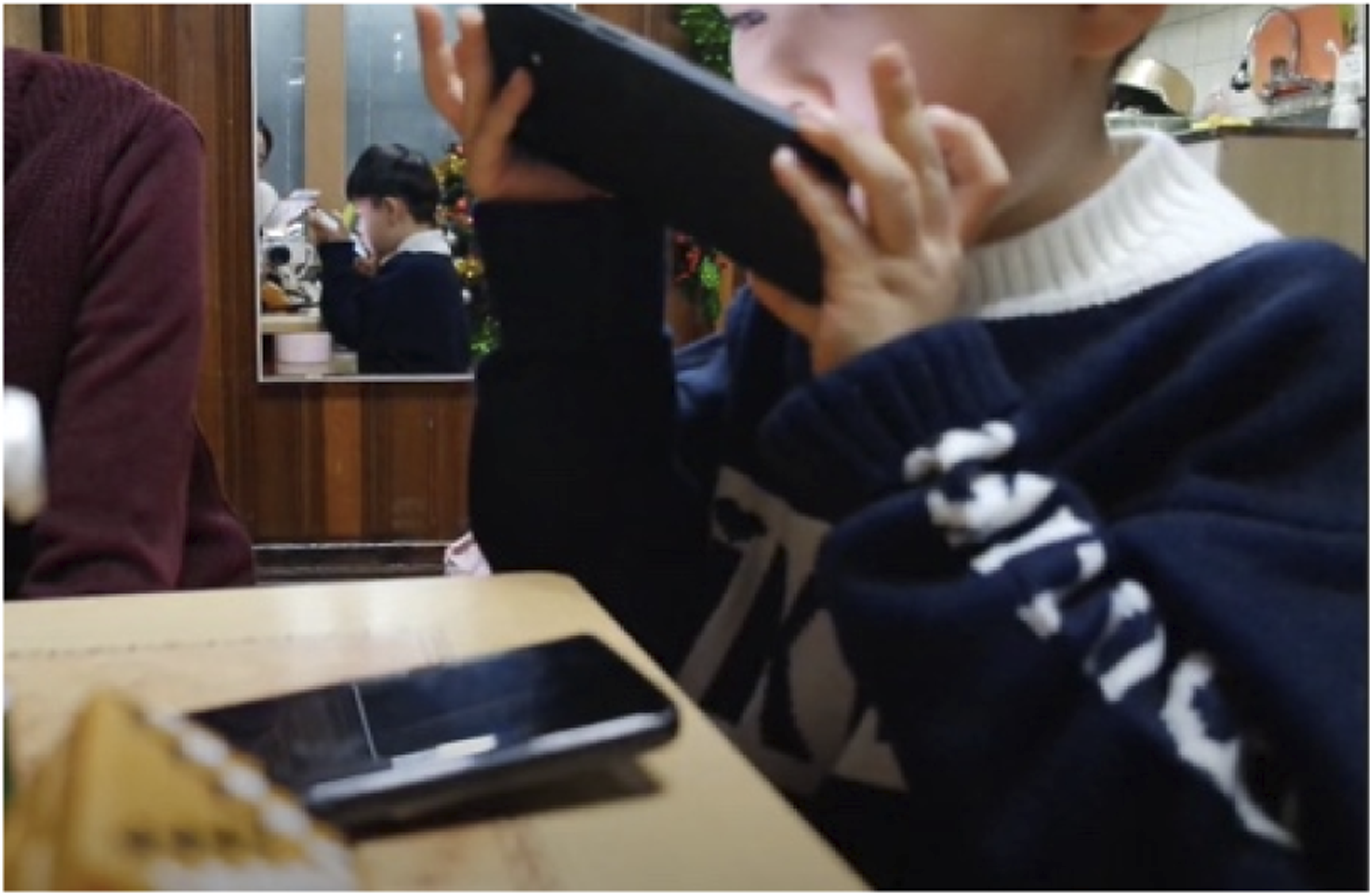
When Andrei spoke to the smartphone holes to input his voice, there was no hesitance. The movement of his body–tapping the application, tapping the microphone icon, moving the holes closer to his mouth, voicing, retrying to voice, leaning toward the smartphone during the process, etc.–represented that he was aware of how it works and what he needs to do, and he was fully engaged in the process. The voice generated from his body, such as “a-mong, gus” Or “A, Mong, Gu, Ss,” can be analyzed as the less proficient linguistic skills of an immigrant child. As his teacher, Ms Sue assessed his language practices as “not-talking” or “being silent” based on his oral language practices showing limited linguistic skills, such as unsophisticated pronunciation and limited lexicon, which have put him into the category of deficiency and inferiority.
When we focus on the more-than-human worlds, however, the movements, motivations, and activations allied with Andrei’s body become more visible. Barad (2003: 819) writes that “meaning is not ideational but rather specific material (re)configurings of the world.” Meaning, thus, does not have fixed stability or universal relationships between a signifier and a signified. Rather, meaning is only resolvable through specific assemblages of materials, including humans and more-than-human entities. For Andrei and his family, meanings are not just about the words they speak, read, or write, but meanings also emerge through the assemblages of material (re)configurings. In this sense, focusing on Andrei’s voice, which is semiotic and transcends the logic of causality, opens up and liberates our attention to the finite and bounded definition of meaning-making toward infinite and unbounded meanings in children’s everyday lives, particularly those of raciolinguistically and ethnolinguistically marginalized children.
When Andrei spoke to the small hole of the smartphone or the tiny microphone icon, specific assemblages emerged and produced new meanings of immigrant children’s voices, language practices, uses of digital technology, familial engagement with media culture, and digital literacy. In those moments, Andrei’s bodily movements of speaking to search for a particular word, the ensemble of his voice and the machinic sounds, and his parents’ engagement in Andrei’s digital and media access were assembled. When the voice of “Among Us” with multiple variances is enacted through the voice search function, it does not converge with the traditional categorization of “voice.” Voice is neither a collective term nor a passive material object. Rather, it processes and is processed with agentic force to produce effects and animate inanimate things (Bennett, 2010).
The materiality of Andrei’s voice holds vitality, which, in turn, has the “capacity of things” that “act as quasi agents or forces with trajectories, propensities, or tendencies of their own” (Bennett, 2010: i). The vitality of voice enacts Andrei’s body to speak words that are not typically heard in the dominant South Korean context. The vital force of his voice put his desire to engage with popular culture, digital practices, and divergent connections with other materials together. Following Gallagher et al.’s (2019: 467) conceptualization of sound as “multiplicious, working in different ways across different bodies, materials, and environments,” voice is multiplicious and exceeds its traditional, universal definition. It is beyond the boundary work of oral language or fluency in speaking. Instead, it “arises from the movements of material bodies, but it also escapes those bodies, leaving them behind” (Gallagher et al., 2019: 468). Andrei’s voice is generated from his body, involving the social and cultural meaning of an immigrant child’s body, but at the same time, it transcends the physical body and the spaces in which it is located. The moments in which his voice encounters voice search technology, the microphone icon on YouTube, and his desire to watch Among Us videos, all afford the voice to transcend the liminal meaning of the body.
Dominant developmental discourses in literacy education give permission to fully human bodies to become literate through skill-based and progress-oriented approaches, which put materials and children—those who are “illiterate”—to the margin. However, the in-the-moment entanglements draw Andrei’s body into the realm of literacies that are not bounded and predetermined. He was well-versed in searching for the information he wanted to access, had knowledge of the device and its applications, had the ability to access languages depending on his desire to do so and the situational context, used multimodal and multisensory communication, and moved his interests across materials and domains unboundedly. In those moments, the literacies are material and embodied. Specifically, the literacies are embedded in his body, his voice, and the intertwined relationships he has with his parents, material objects, spaces, and languages.
When Sergei played Among Us with his son, they engaged with literacies in intimate and indeterminate ways. Their bodies were attached by leaning toward each other as they were almost sticking. In those moments, the bodies were intimately entangled and co-experienced doing literacies. Being involved in the game together and being within close distance led to the Russian language arising immediately, which was opposed to their previous unwillingness to join the verbal exchange in Korean between Natasha and me. Here, the assemblage among languages, digital devices, gaming, human bodies, emotions, and multimodal texts emerged instantly and generated collaboration. As Bennett (2010: 22) writes, parts with vibrant forces instantly collaborate and are intimately interconnected. The parts of bodies that “enhance their power in or as a heterogeneous assemblage” and are mutually dependent on their coexistence. When Andrei’s voice was converted to the Russian words for “Among Us,” unanticipated family digital literacy emerged.
At Andrei’s home, there was no distinction between literate and illiterate features of language and appropriate and inappropriate ways of digital access. Instead, there was unbounded access to literacies and cultural worlds that was enabled through voice as more-than-human semiotics. The voice working as the more-than-human semiotics affords questioning the taken-for-granted notions around children’s digital practices at home, such as supervision, guidance, surveillance, mediation, consumerism, safety, and literacy learning. It, instead, highlights intimate literacies that are always intertwined with other bodies, including human bodies, materials, spaces, and semiotics. In this sense, encountering voice search through his voice was indisputably both productive and affective. Andrei and his father’s playful embodiments elicited productive and affective meaning-making (Sherbine, 2019).
Focusing on unpredictable encounters as a productive and affective meaning-making is particularly helpful in approaching immigrant families’ digital literacies without a deficiency framing. Immigrant families’ digital practices at home, indeed, tend to be framed as lacking access and experiences in digital technology, which is also linked to the discourse of inferiority and support models for the families (e.g. Azubuike et al., 2021). Yet, the assemblages that emerged at Andrei’s home created their meanings in relation to gaming culture and blurred the boundaries between languages and discourses of proficiency that rarely occurred outside of their home, such as the dominant South Korean context. The temporarily moving interests and in-the-moments exploration of media culture and digital technology allowed the parents, who are also marginalized in the dominant culture, to explore different ways of doing digital literacies in and beyond the official and unofficial realm of literacy.
Playful literacies and encounter-prone bodies
Andrei explored various children’s popular cultures through multiple platforms and modes. Power Ranger: Animal Force is one of the animations he liked to watch and play. The Japan-oriented animation series that is popularized across countries is available in many languages, including Russian and Korean. There are nine different animal characters that can be combined and transformed into the 10th character, Animal King. When the media text, Power Ranger: Animal Force, came into the classroom, where popular culture is typically not considered official curricular content or educational material, it produced previously unthought-of possibilities of a sense of belonging, inclusion, response-ability, and various forms of literacies with playful bodies. On the round table that is typically used for sensory-motor materials in the Sunshine classroom, colorful magnetic blocks are spread all over the table. The blocks, named Macformers, have different sizes of squares and triangles with magnets on their borderlines. Most of the shapes can be made into cubes or triangular pyramids, resembling pieces appearing in Power Ranger: Animal Force. Andrei, standing in front of the table, makes multiple cubes and assembles them. Su-Ho, a four-year-old Korean boy, usually spends most of his free-play time with Andrei, making shapes with the Macformers blocks and sitting by Andrei (Figure 2). “라이노! (Rhino!)” Andrei almost yells with an unsophisticated pronunciation in Korean. “응. 나는 타이거 만들었어. (Yes. I am making the Tiger),” Su-Ho says. Andrei turns his body toward me and shows his Rhino. “오! 너 이거 만들었어? 멋지다! (Oh, did you make it? I like it!),” I respond to Andrei’s excitement. Andrei nods and shows me both of his hands. He displayed nine fingers to indicate the number nine. Based on my knowledge of his current interest in Animal Force, I assume it is the toy corresponding to number nine. “숫자 9? 아홉 번째 애니멀인가? (Is it number nine? The ninth Animal?),” I ask. Andrei nods and points to my smartphone in my pocket with his finger. I hand my phone to him after checking with Ms. Sue. Andrei and Su-Ho move their bodies close together to see the screen together. They immediately open the Naver application, the most popular search engine in South Korea. Andrei taps the search window on the application and then taps the microphone without any hesitation. When another microphone icon is created to represent its activation status, he says to the bottom of the phone, “Ah-ni-mul-po-ss.” Beep. The application does not recognize Andrei’s words. He tries again. “Ae-ni-maul, poh-ss.” He changes his voice, particularly the intonation, pronunciation, and spacing. The second trial succeeds. Animal Force in Korean is typed in the search window and shows combinations of information related to the keywords. The two boys explore the images of Animal Force toys by scrolling. “이게 니가 만든 거야? (Is this the one you made?),” Su-Ho asks. Andrei does not answer but continues searching for an image of what he has made. “아, 다섯 글자라고? (Ah, is it five syllables?),” Su-Ho asks with his five fingers that are opened. Andrei nods. “이거! (This!),” Andrei almost shouts out. He shows a piece of the toy robot, which is the ninth Animal Force character, the rhino. They excitedly look at each other and keep looking at the images of toys. “야, 나 이거 유튜브에서 봤어. 이거 합체돼 (Hey, I saw this on YouTube. They can be combined),” Su-Ho adds. “합체! (Combination!),” Andrei repeats. Accidentally, they find a picture that is not related to Animal Force. The two boys laugh out loud at the picture. “이거 봐! 이거 치킨 게임인가? (Look at this! Is it a chicken game?)” Andrei laughs with his body. They revisit the picture two more times while they search for other images of toys. Su-Ho moves like a chicken while he playfully asks Andrei why the image is placed there. Andrei also laughs through many parts of his body (Figure 3). Ms. Sue, sitting on a teacher’s chair placed across the table, looks at the two boys and asks them to “stop making noise” and “clean up the messy table and floor.” ‘Animal King’ made with Macformers. Andrei and Su-Ho doing a chicken dance.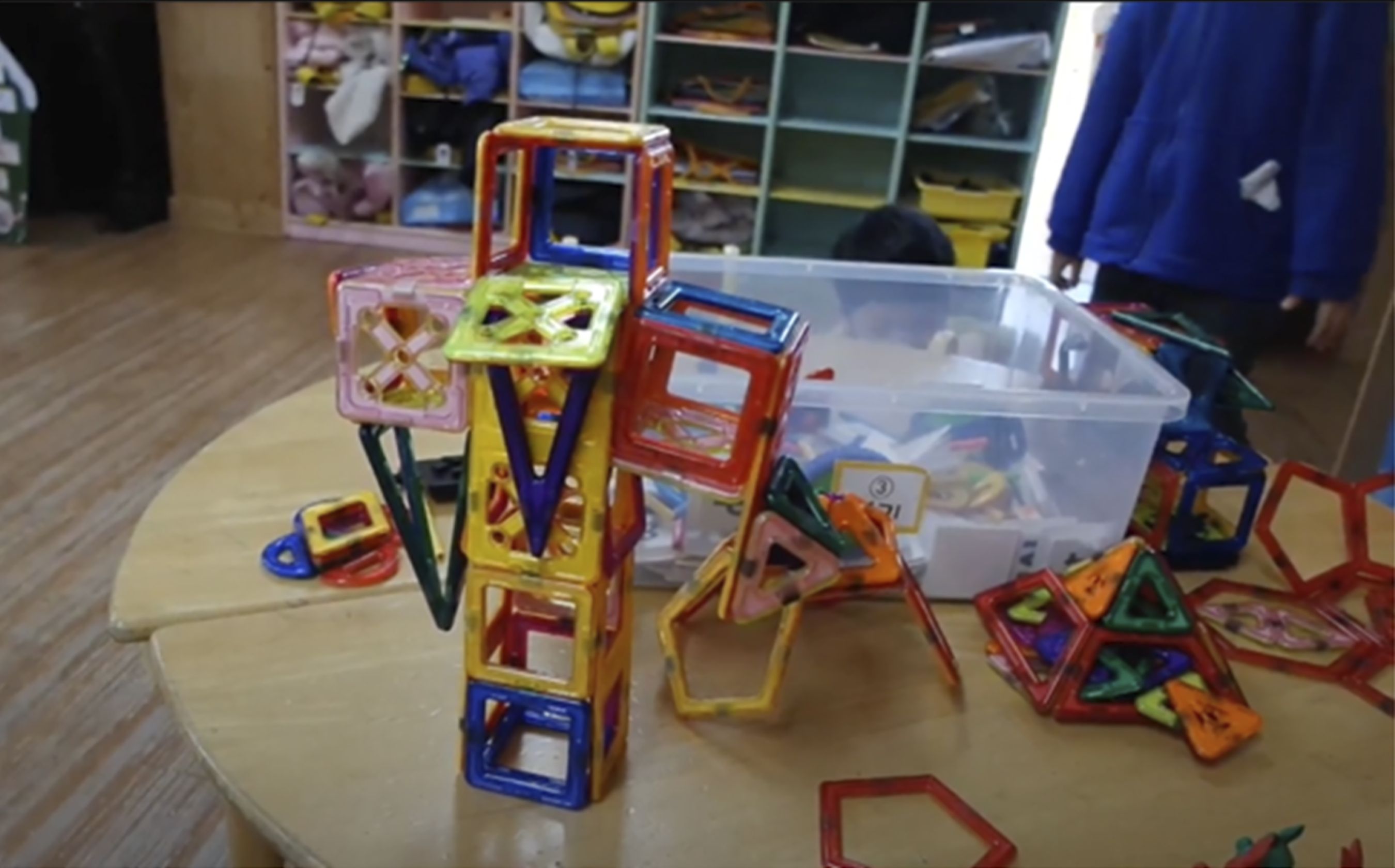
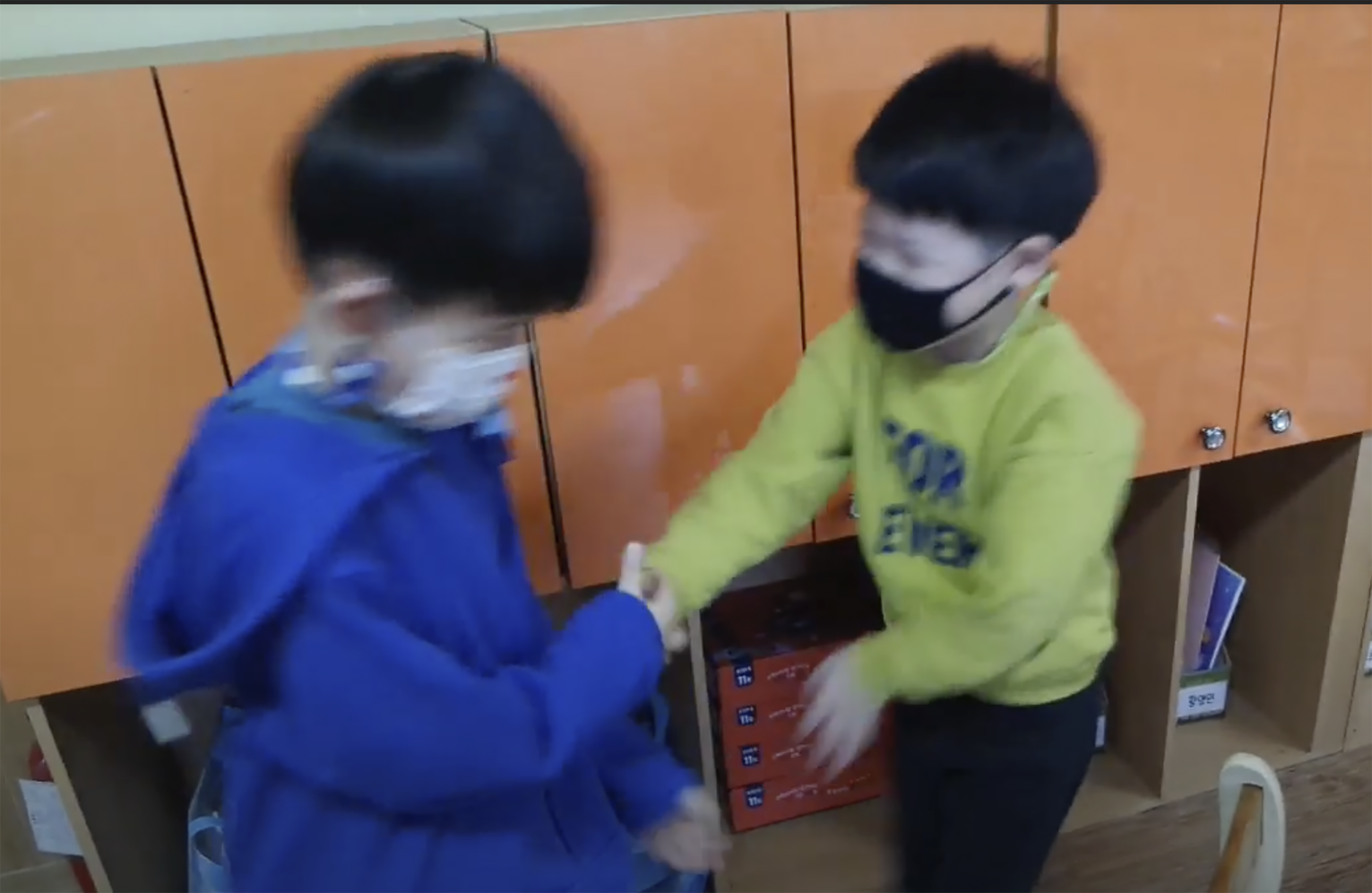
Andrei and Su-Ho, a 4-year-old South Korean child, engaged in many social interactions together through various materials, such as magnet blocks and toys, available in the dramatic play corner. Like other progressive early childhood classrooms in South Korea, the Sunshine classroom has themes in each corner that ideally cover five developmental domains: language, math and science, social development, physical development, and art. In each corner, materials have been purposefully curated based on the official curriculum and the teachers’ particular curricular plans. Magnetic blocks were placed in the block play area, which carries the implicit and explicit expectation of children’s intellectual and physical development through playing with these materials. Andrei and Su-Ho often used these blocks to make animation characters, like Animal King (Figure 2). While Su-Ho’s parents tended not to allow him to access media culture, even including children’s animation shows, Su-Ho was still familiar with children’s popular culture, such as Animal Force, Among Us, and Pokémon, just as Andrei was. Although he did not know much about the plot or all of the characters in these games or animations, he knew some details about them, such as what to combinate to make the finalist, multiple colors of Among Us characters that are supposed to kill the opponent, and the existence of good or bad counterparts in Pokémon. His friendship with Andrei led to his increased interest in popular cultural stories and toys. When he played with Andrei to make Animal King, the finalist of Animal Force, he enjoyed not only combining each piece to create this finalist, but also interacting with Andrei.
Suppose the scene was viewed from the traditional concepts of language and literacy education in formal settings, Andrei’s lack of capability to fluently use the Korean language, the two children’s noise-making and their inappropriate or different use of the materials that did not conform to the original educational purposes needed to be intervened in or fixed. Their bodily movements and engagement with popular culture and digital technology in the classroom were regarded as disruptive. While the teacher approved my use of a cellphone in the classroom when I asked, it still led to unexpected and unforeseen activities. Although formal literacy events that occurred in the classroom, such as dictation tests, had been marking the two boys’ literacy skills in different categories, in those moments, as seen in the vignette above, their bodies were engaged in unsanctioned ways and forms of play and literacy, and both of the bodies were, thus, labeled as disruptive.
In early childhood education, materials are traditionally regarded as the “bones” of the curriculum (Curtis and Carter, 2007; Pacini-Ketchabaw et al., 2016: 2) that have been used for children to achieve developmental progression and represent their ideas. Mundane materials, such as blocks, papers, markers, toys, tapes, scissors, boards, tables, chairs, and lines, have particular meanings with disciplinary rules to use and learn from them. Just like the magnet blocks, a round, child-sized table and chairs were purposefully placed within space and time such that then children’s ways of engagement with these materials were also guided to progress and represent. Dichotomous analysis based on the developmental logic validates only one model of appropriateness and one end-point of the use, and if the children deviate from this, they are seen as failing in the path.
However, when the focus was shifted from the notion of appropriateness to what emerges from spontaneous encounters in space and time, I was able to revisit the scene with an expanded conception of literacy through the ramification of bodies and materials in their doing of literacies. This challenged the hegemonic, homogenous discourse of what literacy is and who is considered literate. As Bennett (2010) writes, material bodies, including humans and more-than-humans, are neither parts nor a whole in themselves. They always confederate with other materials, possess agency through “thing-power,” and make “objects become things when they become energetic and make things happen” (Jackson and Mazzei, 2016: 95). As such, the spontaneous encounters with the bodies and materials, including the boys themselves, my cellphone, and my presence, offered the emergence of unanticipated, vibrant moments. The children’s bodies, the blocks, the storyline of Animal Force, the cellphone, wherein the spaces for the movements blurred the boundaries inherent in the “dualisms of object/subject, knower/known, nature/culture, and word/world” (Barad, 2003: 820).
Following Leander and Boldt’s (2013) understanding of the body, Andrei and Su-Ho’s bodies can be regarded as a starting point for doing literacies and their encounters with the world. As they suggest, if the analysis begins with Andrei-as-body, rather than Andrei-as-text, Su-Ho-as-text, or Animal Force-as-text, the embodiment of literacies is noticed. These bodies are co-experienced with the environments in which they are present, which include the cellphone, each other’s bodies, the storyline of Animal Force, the blocks, classroom spaces, eye contact with others, movements, and emotions. In other words, their bodies do not play a role as recipients of the experiences, but instead, their bodies are actively engaged with, move around, and attend to each other. Through co-experience and co-existence, new possibilities for literacies emerge. They count, search, and use multimodal ways of communication and contain embodied knowledge.
Further, their exchanges and bodily engagements were playful and full of pleasure. The two children’s bodies were responsive to each other and the emergent environments, including voices, movements, an unexpected encounter with a chicken image, and the building blocks. The assemblage produced intimacy in their being/doing/knowing of literacies through pleasurable and affective meaning-making. In the chicken dance moments, the bodies attended to pleasurable and rather intimate encounters. The improvised movements sparked by the unexpected chicken image encounter led the boys to become engaged in each other’s bodies, gestures, facial expressions, and giggles. It blended the two human bodies, which had different categorizations in terms of race, culture, and language.
The pleasurable encounters and agentic assemblage negated the chronic discourses surrounding Andrei’s body, such as an immigrant child, lacking the capability to learn, the illiterate, and a profound sense of non-belonging (Braidotti, 2019), such as the otherness and not-enough-ness registered with their identity categorizations. The temporal and improvised confederations were unpredictable as they usually go “where we send it, and sometimes it chooses its path on the spot, in response to the other bodies it encounters and the surprising opportunities for actions and interactions that they afford” (Bennett, 2010: 28). The bodies were in continual response to each other and any surrounding confederations. The bodies were, thus, affective bodies, which were also social bodies, and encounter-prone bodies, working as “modes” of materials (Bennett, 2010: 21). Andrei’s body belongs to his pleasure, emotions, development, and being/knowing/doing of literacies. In this way, his body was given a full of sense of belonging. They were also encounter-prone human bodies, encounter-prone more-than-human bodies, encounter-prone voices, and encounter-prone technologies. Through their encounters, Andrei and Su-Ho stepped into the boundaries of language, culture, and race categories. The distinctions between literate body/illiterate body, literacy/non-literacy, online/offline, and educational/non-educational were blurred in those moments.
Conclusion: moving forward to literacy equity
During the COVID-19 pandemic, young children’s literacy learning and experiences faced a rapid change from in-person to remote learning and online communication facilitated by using digital devices at home. One of the greater concerns that arose during and after the pandemic is the increasing time spent using and the unbounded access to digital devices and media culture. While the ramifications of digital technology on children’s literacy is still one of the contested issues in the field, as I have shown throughout this paper, children’s digital practices cannot always be assessed through a simple equation, such as good/bad, appropriate/inappropriate, or educational/time-consuming experiences. Rather, the indeterminate encounters among children, digital technology, and materials can teach us how the improvised and temporal confederations create new possibilities to conceptualize children’s literacy practices and digital literacies.
I found this revisioning significant as the ways in which the spontaneous encounters with digital technology and media culture generate new possibilities of literacy for immigrant and emergent bilingual children. Andrei’s voice transcended the boundaries of “appropriate” or “official” language and literacy at the moments when it encountered the voice search technology, digital devices, Among Us and Power Ranger video clips, the parents’ and friend’s bodies, and their desires to spent time with each other. These encountering moments of the human and the more-than-human bodies were not limited to the discussion of the impacts of digital technology and media culture on young children. Rather, the vital voice is lived intensely while making meanings (Bennett, 2010). Further, in Andrei’s family, the ontological desire to access voice search, gaming, and doing literacies is embedded in a web of relations with human and more-than-human bodies. In this vein, the family’s socially, culturally, and linguistically categorized identities are, indeed, floating over the intertwined ontological relationships.
Before concluding this article, I revisit the inquiries that have led me throughout the research process, inquiries into what counts as literacy, whose language is counted as language, and who/what counts as human or an affective or effective body. As Barad (2003) writes, there is always a distribution of bodies, which makes some people visible as political actors while pushing others below the surface of awareness. Andrei’s unbounded access through his voice, crossing over languages, domains, and embrained and embodied actions and knowledge (Braidotti, 2019) take part in redistributing the hierarchy of (fully) human bodies and not-enough-human bodies and their performances and productions. Attuning to voice as material allowed me to hear the unheard voice and see the invisible bodies. The emergent and relational encounters illuminated the body’s loud, productive, and affective meaning-making processes, which also gave voice to Andrei’s and his family’s experiences. Thus, I suggest, as pedagogical considerations, educators should value a wider range of digital practices inside and outside of school contexts instead of taking part in perceiving children’s digital practices only through measurable and representable end-products. Additionally, recognizing immigrant and emergent bilingual children’s multiple ways of engagement in social and cultural relationships and valuing them as critical resources for their learning and knowing processes would help educators to become more involved in the children’s lives. This reworking also opens up more equitable ways for diverse learners to practice their own ways of doing/becoming/knowing literacies.
Footnotes
Declaration of conflicting interests
The author(s) declared no potential conflicts of interest with respect to the research, authorship, and/or publication of this article.
Funding
The author(s) received no financial support for the research, authorship, and/or publication of this article.
