







Abstract
How willing to participate in supplemental reading intervention programs are young dual language learners (DLLs)? Here we employ a qualitative case study design to consider two kindergarten and one first-grade DLLs’ motivation for doing reading tasks within a school-based, pull-out, English-only, reading intervention. Focal children’s motivation-related perceptions were elicited with two participatory interviews. Responses were compared with adults’ evaluations of the children’s behavioral engagement specific to the intervention. All DLLs shared their perceived benefits and costs of intervention involvement and made recommendations for improvement. Exercising autonomy within the intervention was found to be motivating for all children. The degree to which the intervention supported DLLs in sustaining valued connections with friends, family, and teachers also appeared to have a significant influence on motivation. The findings align with and extend existing literature that explores the reading motivation of older DLLs and young monolingual English speakers' motivations for reading within intervention programs. Collectively, findings imply that motivation theory and research, along with DLLs' own program-specific feedback, should inform intervention design and delivery.
Keywords
In this article we consider three young dual language learners’ motivation for doing reading and related tasks in a reading intervention programme based in the United States, where dual language learners (DLLs) account for approximately a third of all young children (López and Páez, 2021). Park and colleagues (2017) define dual language learners as children (8 years of age or younger) who have at least one guardian who speaks a language other than English inside the home. The present study involved three children between the ages of five and seven (two kindergarten DLLs and one first-grade DLL) all of whom were enrolled in an English reading intervention programme that required them to leave their general classroom (pull-out intervention delivery model). Being in the primary grades and residing in the United States, the children were learning foundational reading skills while simultaneously developing their capacities for using English. Research suggests DLLs’ English code-based skills are best supported when students are explicitly taught decoding, afforded time to practice, and receive regular feedback in both English and their home languages (López and Páez, 2021).
The sociopolitical landscape has long played a key role in influencing reading instruction—including reading intervention—in the United States. Anti-immigration sentiment, for example, has historically been reflected in federal (e.g., No Child Left Behind, 2001) and state literacy policies (e.g., English-only immersion mandate) (Baez, 1996; Education Week, 2017). Though some states have effectively nullified English-only immersion mandates (e.g., California, Massachusetts), mono-literacy instruction remains the dominant mode in U.S. public schools. Most recently, the Science of Reading (SoR) movement which advocates for a near exclusive reliance on evidence-based 1 curriculum and pedagogy is shaping instruction across the country and arguably continues to fuel the privileging of English forms of communication. As of the writing of this article 40 states have mandated that kindergarten and/or children in grades 1 and 2 be screened for English reading difficulties (EdSource, 2022). 29 states and the District of Columbia have passed laws requiring evidence-based reading instruction (Education Week, 2022). The SoR movement places additional pressure on schools to advance students’ English reading proficiency.
Though potentially supportive of many children’s developing foundational reading skills, the SoR movement and associated legislation can also be interpreted as grounds for promoting students’ reading, writing, and speaking development in English only—in a country where communicating solely in English and receiving literacy support solely in English have long been norms regardless of one’s cultural and linguistic backgrounds (Phillips Galloway and Lesaux, 2017). Many U.S. schools dedicate a block of time each day (typically 60–90 minutes) to English-only, SoR-aligned reading and writing instruction (support for reading in additional languages is not offered). Students who are identified as needing additional assistance reading in English are referred for a more targeted intervention (typically 15–30 minutes) which may occur during the literacy block or at another point in the school day. Monoglossic ideology (Wardhaugh and Fuller, 2015) appears to continue to influence literacy instruction in the U.S. and elsewhere despite ample evidence suggesting bilingual education is preferable (López and Páez, 2021); students can further their English language skills and vocabulary by making connections to known language features and vocabulary in their other language(s) (Guzman-Orth et al., 2019).
Another key component of the sociopolitical context of the United States relevant to this project is the country’s dominant view of children and their rights, which can be inferred from the adoption of policies. Like other countries (e.g., England), the majority of U.S. schools adhere to a set of national academic standards (Common Core State Standards [CCSS]). By making no mention of cultivating children’s enjoyment of and interest in reading (Shanahan, 2015), the CCSS position the development of foundational reading skills above the cultivation of motivation. Therefore, they communicate to teachers that time spent building children’s capacities for reading is more important than surveying and supporting their willingness to engage in reading and related tasks. Unlike other countries, the United States is the sole member nation not to formally ratify the international children’s rights agreement, the United Nations Convention on the Rights of the Child (UNCRC, Convention on the rights of the child, 1989). As such, U.S. schools are not bound by international law to elicit or sincerely consider children’s views of schooling. Typically, U.S. children placed in reading intervention programmes including DLLs are not afforded a say in their reading intervention enrollment nor are they invited to offer feedback; children’s opinions are rarely formally requested and/or seriously considered to improve schooling, including reading intervention programmes. This apathy for children’s views carries over into the empirical literature. Kindergarten and grade 1 children’s motivation-related perceptions of reading intervention programmes have rarely been explored in the reading motivation literature (for exceptions, see Erickson, 2019b, 2022a; Erickson et al., 2020), and no examples of young U.S. DLLs’ views of reading intervention programs surfaced in a review of the literature. This gap persists despite international research indicating that children are willing and able to share their views on school programming and that their views can improve programming (e.g., Forde et al., 2018; OECD, 2020).
Given these sociopolitical considerations, the researchers’ positionality is important to consider when interpreting this study: we view children as agentic citizens who can and should play an active role in shaping their education (Harris and Manatakis, 2013). Put differently, we believe children have a fundamental right to express their views of schooling and have them taken seriously by those in power. Therefore, though there are numerous worthy rationales for eliciting and examining young DLLs’ perceptions and specifically their motivation-related ones of school reading programmes (e.g., nurturing DLLs identity development), here we highlight the possible insights young DLLs’ opinions of reading interventions can offer specific to their individual motivations for doing reading and related tasks within these programmes. And we emphasize the connection between motivation and becoming a competent reader–motivation drives engagement in reading and related tasks and, in turn, can support foundational skill development and achievement. Research has consistently shown that children with high reading motivation typically do better on measures of reading achievement than those with low motivation (for reviews see Guthrie and Wigfield, 2017; Howard, 2012; Taboada Barber et al., 2016; Taboada Barber and Klauda, 2020; Wigfield et al., 2015). Additionally, a recent research synthesis (McBreen and Savage, 2020b) suggests that intentionally nurturing students’ motivation within reading intervention programmes (e.g., through the integration of autonomy-supportive practices) can positively impact reading motivation and achievement. It therefore stands to reason that the more motivated a child is to actively participate in an evidence-based reading intervention, the more likely they are to push through challenging tasks, and in turn, advance the foundational skills targeted by the programme (Schiefele, 1999). Given that the children in this study, like many DLLs in schools across the United States and elsewhere, are being taught to read in English only, it seems imperative that their motivation specific to these programmes be carefully examined and appropriately supported. As Protacio (2012) and others (e.g., Proctor et al., 2014; Taboada et al., 2010) underscore, the reading motivation of DLLs is “an area on which we need to focus” (p.70). The way forward includes coming to “know [DLLs’] individual experiences deeply” (Klauda et al., 2020: 612).
Grounded in a critical realist epistemology and framed by situated expectancy-value theory, this qualitative case study honors these calls to action by examining three young DLLs’ motivation to read and do related tasks within their pull-out reading intervention. Three main questions guided the inquiry: (1)Would each child participate in the reading intervention programme if given the choice? Why or why not? (2)What does each child perceive to be the benefits and/or costs of involvement in the reading intervention program? (3)In what ways, if at all, do the children’s views converge?
Theoretical frameworks
Situated expectancy-value theory is the primary theoretical lens through which data from this study were examined. However, the concept of behavioral engagement is also discussed to clarify how adults’ (e.g., researcher, reading specialist/interventionist) observations of children’s intervention behaviors can be suggestive of their underlying motivation for doing reading and related tasks there.
Situated expectancy-value theory: A contextualized view of motivation
Situated expectancy-value theory (SEVT) is a social cognitive theory of motivation that has been successfully employed to examine young children’s motivation to read. The word “situated” was recently added to the theory’s name to emphasize the ways in which the theory recognizes the impact sociocultural factors can have on one’s motivation to read at any given time (Eccles and Wigfield, 2020). SEVT acknowledges that the specific context—including all participants—may influence one’s motivation for any given task. For example, children involved in a specific reading intervention and children left behind in the classroom (assuming a pull-out model) may both influence one or more DLLs’ motivation for doing reading within the intervention. Another example: materials and/or other aspects of the environment might influence one’s motivation for reading in a given program. A final example: aspects of children’s home cultures and environments might influence their willingness to engage in reading and related tasks within an intervention. SEVT has been used to inform the first author’s previous studies (Erickson, 2019b, 2022a; Erickson et al., 2020) primarily involving monolingual English-speaking U.S. Kindergarten, grade 1 and grade 2 children—many of the context-specific factors just described surfaced in the children’s rationales for wanting or not wanting to participate in their reading interventions. However, Protacio (2017) argues that SEVT is also useful for exploring the reading motivation of DLLs because DLLs’ “instrumental motivation (or the value they place on reading)” is likely to influence their engagement in reading tasks (p.3). This study looks specifically at the views of DLLs for the overarching rationale previously mentioned: cultivating high motivation for English reading intervention programs is important for their development as readers, since many DLLs in U.S. schools are being taught to read primarily in English.
SEVT posits that one’s choices, amount of persistence, and overall performance can be explained by an individual’s beliefs about 1) how well they will do on a given task and 2) the value they place on completing it (Wigfield et al., 2015). In line with past studies of children’s motivation, this one mainly focuses on the task value component of SEVT due to findings indicating task value is a strong predictor of students’ choices (e.g., Durik et al., 2006; Wigfield et al., 2015). However, DLLs’ perceptions of their abilities to complete reading intervention tasks emerged during participatory interviews. Additionally, children were asked directly about their perceived reading confidence on the Me and My Reading Profile (Marinak et al., 2015) which was integrated into the second participatory interview, permitting a window into their efficacy beliefs. Making up the task value component of SEVT are three positive subcomponents and one negative subcomponent. The positive contributors include intrinsic value (enjoyment and/or interest expected from completing a task), utility value (expected usefulness of the task in relation to other goals), and attainment value (the extent to which a task is expected to confirm an important aspect of one’s identity). The negative subcomponent, namely cost, can be described as what an individual believes they must sacrifice to engage in a task (Flake et al., 2015; Wigfield and Eccles, 1992). In theory, if DLLs understand their English reading intervention programmes to be too costly they may engage minimally or altogether avoid engaging in one or more aspects of them, potentially impeding the advancement of the foundational skills targeted as well as their general motivation to read (Barron and Hulleman, 2014; Eccles et al., 1983; Luttrell et al., 2010). Several studies lend support to this possibility in relation to children. Salonen et al. (1998) found that first-grade students with low motivation to read avoided reading tasks more consistently than children with higher motivation. More recently, Eckert et al. (2017) found that grade 3 students who valued their literacy intervention made more progress specific to targeted skills than students who were less motivated to participate.
Studies involving elementary-aged monolingual English speakers support the position that children stand to gain more motivationally and academically by participating in programmes that adequately support their motivation. Nevo and Vaknin-Nusbaum (2020) found that grade 1 students who participated in a traditional school reading programme and received a reading intervention that intentionally built in ample opportunities to make choices specific to materials and to collaborate with peers (two factors found to positively influence motivation), outperformed students who only participated in the traditional reading programme on measures of general reading motivation and reading achievement. Similarly, McBreen and Savage (2020a) found that grade 3 students who participated in a cognitive reading intervention programme with intentionally integrated moves to support motivation made larger gains in both reading comprehension and phonological awareness than children who received an entirely cognitive reading intervention. However, many if not most U.S. reading intervention programmes, though increasingly rooted in the SoR, are not rooted in motivation theory. Because motivational supports are not intentionally built into these programmes, it is crucial that children’s motivation-related perceptions of them (perceived benefits and costs of involvement) be elicited and carefully considered so that changes can be made as needed. In sum, SEVT offers a viable framework for examining children’s views of individual reading programmes including those not tethered to motivation theory.
Behavioral engagement
Engaged and disengaged behaviors can be considered manifestations of one’s underlying motivation (Unrau and Quirk, 2014). Among other indicators of positive behavioral engagement, engaged behaviors might include promptly completing reading tasks, asking and answering questions about reading tasks, and expressing enthusiasm about reading tasks. Among other indicators of negative behavioral engagement, disengaged behaviors might include avoiding reading tasks, failing to complete reading tasks, and expressing frustration with reading tasks. Behavioral engagement is relevant to the current study because it is at least partially observable; in this study researcher and reading specialist/interventionist evaluations of children’s behavioral engagement were compared to children’s self-reported motivation for the primary purpose of triangulating findings and drawing conclusions.
Previous research focuses on older DLLs (Children in grades 2 and up)
The first author’s previous works (Erickson, 2019b, 2022a; Erickson et al., 2020) informed by SEVT have mainly examined monolingual English-speaking kindergarten, grade 1 and grade 2 U.S. students' perceptions of reading intervention programmes. Findings suggest that many children would opt not to attend their intervention programmes if permitted to choose for a variety of reasons—many of which have been identified in the larger body of literature examining students’ general motivation to read as factors capable of eroding motivation (e.g., lack of choice, lack of autonomy, inappropriate level of task difficulty [too challenging/not challenging enough]). In the only study in the set involving a DLL (Erickson, 2019b), the grade 2 Spanish-speaking child reported that she would not participate in the programme if afforded the choice. A perceived lack of autonomy appeared to result in her not wanting to participate. Specifically, she reported not having enough time to complete tasks, not being permitted to read what she wanted, and not having enough time to finish her snack. This finding prompted the authors to contribute to the gap in the reading motivation literature by intentionally exploring the motivation-related perceptions of kindergarten and grade 1 U.S. DLLs. Before doing so, the researchers thoroughly examined the limited existing body of literature, which afforded some insights about older U.S. DLLs' motivations to read in English. Perceived competence, autonomy, and a variety of sociocultural factors (e.g., parents' valuing of literacy) surfaced as potential influencers of DLLs' motivation to participate in school reading programs.
Perceived competence
Multiple studies involving upper elementary students suggested that students’ perceived competence, or confidence in their ability to read what they were being asked to read within school programmes can influence their willingness to participate. For example, Protracio’s 2012 study of six upper elementary DLLs representing a range of cultural and linguistic backgrounds, found that students with higher confidence in their abilities to read in English were more motivated to read in English. Klauda et al. (2020) similarly found that most students in their mixed-methods study of grades 3–5 DLLs’ reading motivation indicated that they were likely to be nervous about reading the words in more challenging English books. The researchers echoed the conclusion Protracio reached—namely that DLLs should be offered books of appropriate challenge to support their motivation.
Autonomy
In a case study of three grade 4 DLLs, Taboada et al. (2010) found that intentionally selected, Spanish-speaking, DLLs (strong reader, middle reader, weak reader) appreciated having opportunities to make choices and having enough time to finish assigned tasks within their literacy intervention program. Similarly, in a formative experiment, also involving grade 4 DLLs, Taboada and Rutherford, 2011 relatedly concluded that affording students ample opportunities to make choices and making clear the relevance of reading assignments fostered positive feelings about schooling. In another qualitative study involving six, grade 4, Spanish-speaking DLLs, Cho et al. (2010) found that students were motivated to participate in reading programs when they were offered appropriately challenging and high-interest reading materials. Together these studies suggest that much like their monolingual English-speaking peers, many DLLs desire some control over their reading experiences.
Sociocultural factors
Reuda and colleagues (2001) concluded that sociocultural factors including relationships at home influenced a group of grade 3 Spanish-speakers’ motivation to read in English. Children in the study whose families regularly engaged in English and Spanish literacy activities valued reading more than children whose families did not. Additionally, in their qualitative study of grade 4 Spanish-speaking DLLs, Cho et al. (2010) concluded that the educators’ positive attitudes about reading within the programme and expectations for students supported their engagement. Peers’ views may also play a role in supporting or undermining DLLs’ motivation for reading programmes: Howard (2012) found that though a sample of “struggling” grade 4 dual language readers (two Spanish-Speaking and one Hindi-Speaking) reported low motivation for school reading programmes in general, peers’ book recommendations were identified as supporting the students’ willingness to read. Protacio (2012) similarly found upper elementary DLLs to be influenced by family and friends in their immediate surroundings. Students whose parents emphasized reading in English appeared to value time spent reading in English more than those whose parents did not, and DLLs used reading as a way to connect with their native English-speaking peers.
Contributions of the present study
The current study builds on past studies in several ways. First, it explores the motivation-related perceptions of young (K-1) DLLs specific to their reading intervention programmes. Second, this study examines the views of young DLLs raised in homes speaking three different languages: Spanish, Portuguese, and German. Much of the existing literature examining the motivation of older DLLs primarily involves Spanish-speaking students. Finally, it demonstrates that young DLLs are capable and willing to offer valuable feedback about what they perceive to be working and/or not working for them within their English reading interventions when participatory interview techniques are utilized.
Methodology
Design
A qualitative case study design (Merriam, 1998) consisting of three subcases was employed to examine children’s motivation for doing reading and related tasks within their intervention programmes. A case study approach was selected due to the design’s flexibility: it allows for the collection of multiple types of data (e.g., field notes, questionnaires, interviews) from multiple perspectives (e.g., students, teachers, researchers). A case study approach aligns well with the researchers’ critical realist epistemological position. Critical realism is grounded in an ontological realism maintaining that while an actual world exists independent of our interpretations, we cannot know it comprehensively through our individually constructed perceptions and theories (Maxwell, 2012). In order to grasp a more objective understanding of phenomena, a critical realist epistemology encourages the inclusion of multiple perspectives and the triangulation of findings.
Participants
The study took place during the 2020–2021 school year at a public school in a small city in the North Eastern United States. At the time of the study, 25% of students at the school identified as non-white and 10% spoke a first language other than English. Three students, one state-certified reading specialist—a person with a teaching license/state certification to teach reading specifically and is trained in the reading intervention—and one reading interventionist—a person who holds a college degree and has been trained in the reading intervention but does not hold an official teaching license—participated in the study. The reading specialist and interventionist were middle-age white women who had been teaching reading for over a decade. All Seaside Elementary (pseudonym) students who were not receiving a language-based individualized education programme (IEP), were in kindergarten or grade 1, were assigned a district designation of English learner (EL) and were enrolled in an English reading intervention programme were invited to participate in the study. The final sample consisted of three children—one grade 1 male and two kindergarten females.
Participant demographic data.
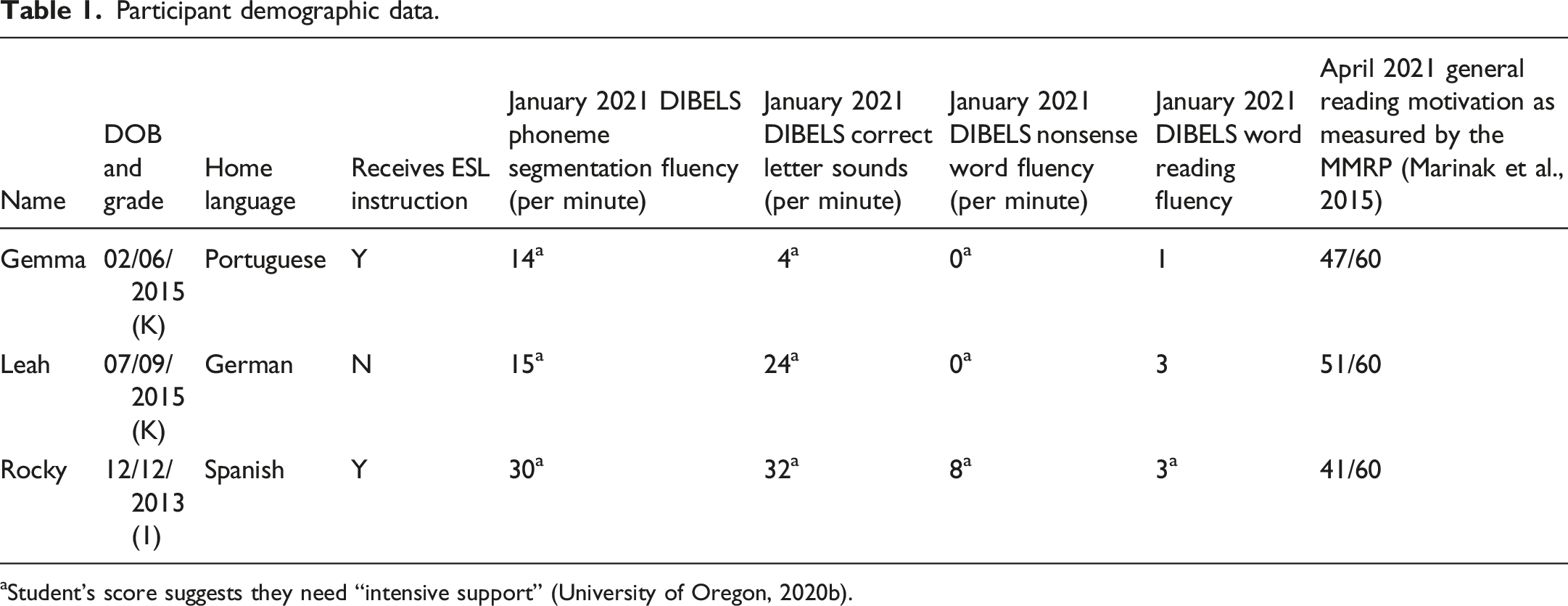
aStudent’s score suggests they need “intensive support” (University of Oregon, 2020b).
Table 1 summarizes basic demographic information for each child including relevant DIBELS benchmark scores. Students’ scores specific to phoneme segmentation fluency (the ability to segment short words into their discrete sounds); letter sound identification (the ability to pronounce a correct sound associated with a specific letter); nonsense word reading (the ability to read short phonetically regular nonsense words); and real word reading (the ability to read short real words out of context) are included. Notice that all students were found to be “at-risk” and in need of intensive intervention according to benchmark scores (University of Oregon, 2020b).
Gemma was 6 years old and in kindergarten at the time of the study. Her parents immigrated from Brazil; however, Gemma was born in the United States. She was conversationally fluent in English and Portuguese and was receiving ESL services at school. Several months younger than Gemma, Leah was also 6 years old at the time of the study and in kindergarten. Leah was born in the United States to parents whose first language was German. Leah was conversationally fluent in both English and German; she did not qualify for ESL services. Rocky was the oldest participant of the three, being nearly 2 years older than the girls and in the first grade. Rocky too was born in the United States. Though his parents spoke Spanish fluently, Rocky’s Spanish was limited. He was receiving ESL services at the time of the study due to struggling to speak both English and Spanish.
Instructional context
All three children received Scott Foresman Early Reading Intervention (ERI) four times per week for 25 minutes a session alongside monolingual English-speaking peers who also were not meeting DIBELS benchmarks. ERI was designed and has been found to be an effective way to support the reading development of kindergarten and grade 1 students who are not meeting DIBELS benchmarks (for a review of research related to the effectiveness of ERI see Samanich, 2003). The first half of ERI sessions focus on developing students’ phonemic awareness, letter identification, and letter-sound mapping. Students name letters and their associated sounds as quickly as possible via drills known as letter and sound “dashes.” Additionally, they practice segmenting and blending CVC (consonant-vowel-consonant) words, recognizing irregular high frequency words (e.g., said), and reading connected text controlled for the phonics pattern(s) taught. The second half of the lesson reviews skills and words taught in previous lessons primarily through handwriting and spelling/word building activities. Gemma and Leah received instruction from a trained reading interventionist. Rocky’s intervention was delivered by the school’s reading specialist. The interventionist or specialist met the children outside their respective classrooms and brought them to the reading intervention space during their daily literacy block to participate in the intervention.
Data collection
Data were collected from January through June of 2021. To soundly address the research questions, the study made use of data from two forms of participatory student interviews, field notes, and researcher and reading specialist/interventionist evaluations of children’s behavioral engagement.
Participant observer
The first author functioned as a virtual participant observer for the first month of the study during which she took detailed field notes. Because the study took place during an uptick of COVID-19 cases, she was not able to enter the classroom until she was fully vaccinated. During this time, she Zoomed into intervention sessions. Once vaccinated, the researcher participated in person and continued to take field notes for another 4 weeks. 60 pages of double-spaced field notes were taken during the observation period.
Student interviews
Two forms of participatory interviews—both of which encouraged children’s agency in the research process—were selected over more traditional forms of interviewing for several reasons. First, participatory approaches can increase the trustworthiness of findings because they make use of children’s own ways of knowing and being (Clark and Moss, 2011). Second, they acknowledge children’s fundamental right to actively participate in research intended to inform practice and policy (Kleine et al., 2016). In the third month of the study, the first author invited the children individually to participate in a conversational drawing interview (e.g., Erickson, 2019b, 2022a; Erickson et al., 2020; Einarsdottir, 2007; Einarsdottir et al., 2009). This mainly unstructured interview began with the researcher inviting each child to draw how they did reading in the intervention setting. During and after drawing, the researcher asked the child clarifying questions about their drawing (e.g., “Is that you at the table?” and “What is it you’re working on there?”). Oftentimes, in the process of answering a question, the children remarked about aspects of the intervention they liked and disliked as well as the reasoning for their views. The drawings themselves were not analyzed; the conversations that occurred during and after them were recorded and transcribed for analysis.
A week or so later, the children were invited to participate in individual, semi-structured, walking-tour interviews (e.g., Erickson, 2019b, 2022a; Erickson, 2020; Clark and Moss, 2011), during which they gave the researcher a tour of the intervention space. The researcher began the walking-tour interview outside of the children’s general education classrooms; she asked each child whether they would go to their reading intervention or stay in their classroom to read if afforded the choice. Each child’s rationale was explored on the spot, and they were then prompted to give the researcher a tour of the preferred space before touring the unselected space. All children were asked several additional questions to probe their perceived benefits and costs of doing reading and related tasks in each space. Questions included: • “Is there anything you like about doing reading here?” • “Is there anything you don’t like about doing reading here?” • “Is there anything we could do to make reading better for you here?”
At the end of the walking-tour interview children were invited to complete Marinak and colleagues’ (2015) Me and My Reading Profile (MMRP) survey. This survey, which was created with situated expectancy-value theory in mind and has been validated for use with kindergarten and first-grade children, provided information on students’ overall valuing of reading and beliefs about their general reading competence. The researcher guided each child individually through the survey by reading each question aloud.
Reading specialist behavioral engagement questionnaire
The reading specialist and reading interventionist completed a behavioral engagement questionnaire adapted from Clarke and colleagues’ (2004) Kindergarten Engagement Questionnaire for each of the children they served. The questionnaire included seven questions that asked the educator to rate (1–4; 4 being the highest rating of behavioral engagement compared to peers in the intervention) and reflect on the child’s reading intervention engagement across multiple indicators. The reading specialist/interventionist was asked to compare the child to peers in relation to their effort, ability to work independently, active participation, disruptive behaviors, and demonstrated enthusiasm.
Video logs
In the first 3 months of the study the children’s intervention sessions were video recorded eight times. Two intervention sessions per child were randomly selected and logged using a procedure detailed by Flewitt (2006). Children’s behaviors and utterances were noted; logs were then used by the first author to complete the same behavioral engagement questionnaire that the reading specialist and interventionist completed. This generated two researcher-completed questionnaires per child participant.
Analysis
All interviews were transcribed by an outside service. Video logs and associated researcher behavioral engagement questionnaires were completed by the first author. In vivo codes (Saldaña, 2016) were applied to the data set first to remain true to the participants’ own words. Reduced datasets (child views, adult views) were then created in relation to the research questions.
Basic categorical codes were applied to the child views dataset first (Miles et al., 2014). Categorical codes applied to children’s responses include “perceived benefit of intervention participation” (PB) and “perceived cost of intervention participation” (PC). Any aspect of the intervention children reported appreciating in interviews and field notes (e.g., “I like the quiet there because it helps me read,” “The Diz books are good”) was coded with PB. Any aspect of the intervention the children reported to be problematic (e.g., “I don’t like leaving my friend [in the classroom],” “the sound dash [task] is too long”) was coded with PC. A third round of coding was then applied to the same excerpts; specifically, SEVT theoretical codes of perceived benefits were applied as they fit. For example, “I like the quiet there because it helps me read” was coded as pertaining to the intervention’s utility value (UV) because the quiet appeared to support the student in completing the personally meaningful task of reading. A second example: “The Diz books are good” was coded as pertaining to the intervention’s intrinsic value (IV) because the student found the Diz books to be enjoyable. A research assistant (the third author) applied categorical codes to the anonymized set of walking-tour interviews to support the trustworthiness of findings. The first and third authors together resolved the two discrepancies that surfaced.
Similarly, basic categorical codes specific to behavioral engagement were applied to questionnaire responses and logged video data. These basic codes included “example of positive behavioral engagement” coded PBE, and “example of negative behavioral engagement” coded NBE. All behaviors perceived by adults as suggesting that the child was positively engaged in the intervention were coded with PBE, and all behaviors perceived by adults as suggesting that the child was not engaged were coded as NBE. Examples of positive behaviors included children asking and answering questions within the intervention, completing various tasks promptly, maintaining attention/staying on task, and verbal (e.g., a child saying “Oh, I love this book”) or nonverbal expressions of enthusiasm for the intervention (e.g., a child eagerly raising her hand in anticipation of answering a question). Examples of negative behaviors included children not following along and needing to be redirected during round-robin reading and verbal and nonverbal expressions of dissatisfaction with aspects of the intervention (e.g., a child verbalizing her disappointment with having to leave her classroom upon entering the intervention, a child putting his head in his hands during a writing task). These codes were applied to assist the authors in confirming and questioning children’s self-reports.
Codes applied to both children’s views and adults’ views were entered into a master matrix (Miles et al., 2014). An extended description (Boeije, 2010; Merriam, 1998) of each individual child was written in relation to the research questions.
Findings
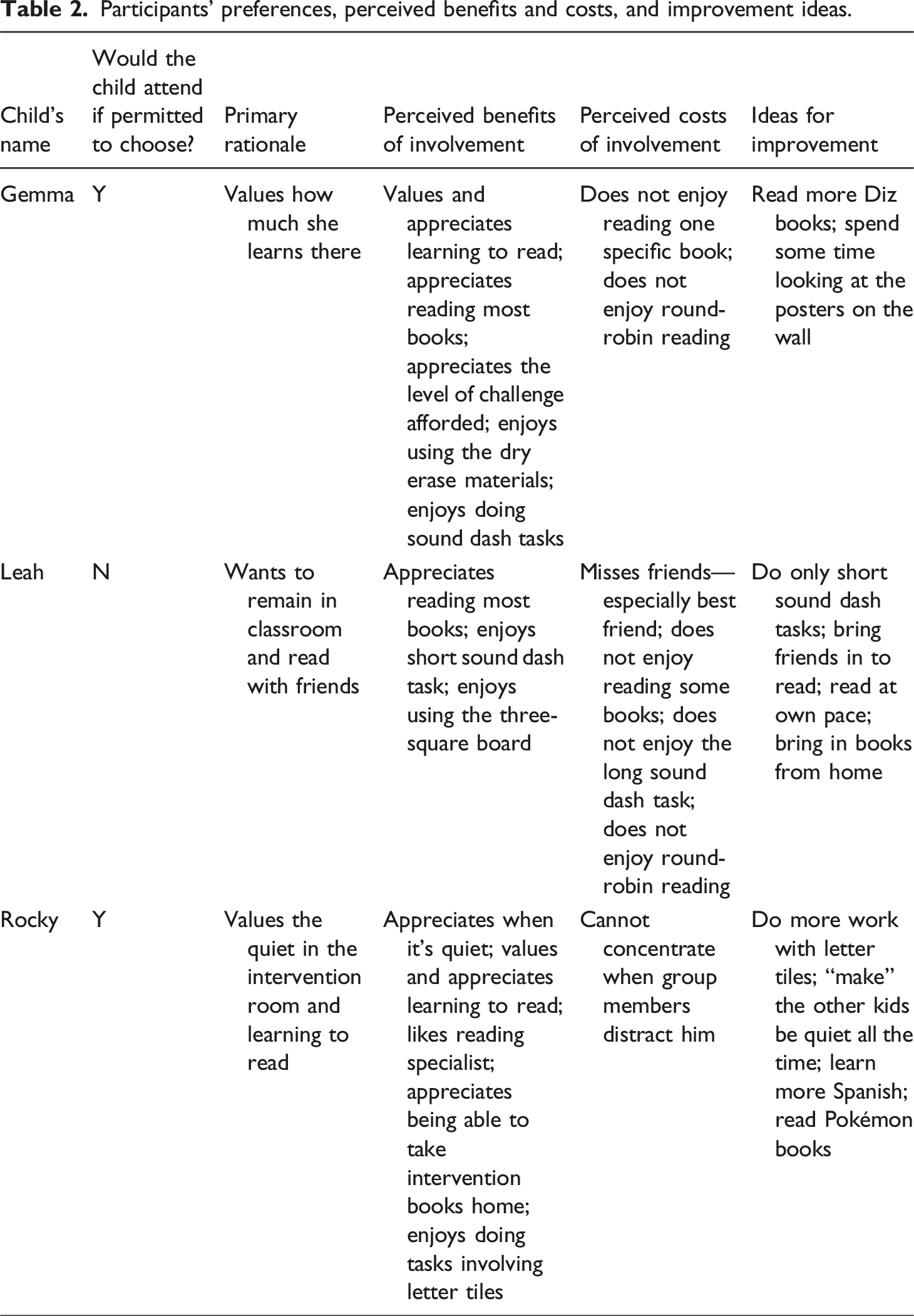
Participants’ preferences, perceived benefits and costs, and improvement ideas.
Within case findings
Gemma
Overall, Gemma presented as an enthusiastic intervention participant. Field notes and logged video data captured her eagerness to enter the intervention space and work on her reading. Interview data further suggested that she was highly motivated to participate in the intervention. Gemma reported that if given the choice, she would attend the program: “I learn to read here, and that’s really important.” Gemma also indicated on her MMRP that reading was “very important” to her. She shared that her parents, who immigrated to the United States from Brazil, convinced her of the importance of the reading intervention program: “My mom says I need to practice to get better, and I get to practice a lot here.” Gemma reported enjoying nearly all aspects of the intervention. “Most of the books are really good,” she stated enthusiastically before pulling her favorite from a red intervention folder and reading it aloud during her walking tour interview. Gemma stated that the book was “super funny” and laughed often as she read and pointed to her favorite pictures.
In addition to speaking two languages, Gemma indicated during her walking tour interview that another one of her “superpowers” was that she could “learn fast.” She proceeded to pull a sound dash drill paper out of her intervention folder and say the sound associated with each letter as quickly as she could. Gemma’s confidence in her reading ability was also evident on the MMRP, where she indicated that learning to read was “easy” for her. Though Gemma reported that she was a “very good” reader on the MMRP, she also shared a preference for reading with other people “because sometimes there are words [she doesn’t] know.” She went on to explain that she read books with her mother’s help in both English and Portuguese at home. Field notes, logged video data, and her reading interventionist’s responses to the engagement questionnaire all indicated that she did often struggle to decode words during the intervention. However, the main costs Gemma associated with the programme were having to read one particular book that she did not like and “having to wait [her turn] to read” during round-robin style reading time. The interventionist often led the students in round-robin style reading of decodable text where one child read aloud and the other children listened and tracked the print. During this task, Gemma was repeatedly observed struggling to maintain attention. She was given many redirections by the interventionist and did appear to get frustrated at times. Despite her spotty attention during this task, Gemma appeared highly motivated to participate in the reading intervention; in her view, it was mainly working well for her, she appreciated it, and she enjoyed it.
Leah
Leah was enrolled in the same intervention group as Gemma; however, she rarely required redirection to stay on task. Leah’s compliance with all requests made her appear highly motivated to her interventionist. The interventionist described Leah as “the most motivated” student in the group. However, Leah maintained that if given the choice to participate, she would not attend the intervention. When asked why she replied, “I just like being in my classroom better.” During her walking tour interview Leah disclosed that the main reason she did not want to leave her classroom was that her best friend, Julia (monolingual English-speaking peer), remained in the classroom for the literacy block: “Julia is a better reader than me. She doesn’t need help, so she gets to stay in the classroom. I need help with my reading so I come here…I wish I could be there and read with her.” On the MMRP, Leah rated herself as a “very good” reader; however, her words indicate her awareness of needing help that Julia does not need–a reasonable interpretation being that she perceives herself not to be a good enough reader to remain in the classroom.
When asked how the intervention might be improved, Leah suggested that Julia be able to attend the intervention: “I just want [Julia] to come and read with me.” The more time the researcher spent with Leah, the more she opened up. It was within the second (walking tour) interview that Leah disclosed why she was hesitant to share aspects of the intervention she did not like: “My teacher says, if you don’t like some things, you should keep them in your heart of hearts.” Though she likely interpreted her teacher’s advice differently than what was intended, Leah was hesitant to share her feelings about the intervention with the researcher for fear of hurting others’ feelings. The researcher explained to Leah that in order to improve the intervention she needed to know what Leah thought about it, after which Leah began sharing her critiques and offering ideas for improvement. Specifically, she reported being bored during longer sound dash drills and round-robin style reading: “I don’t like that I have to wait for other people to read. I just want to read my book.” Observations confirmed that though Leah rarely required redirection, when she did, it was during round-robin reading. While waiting for her turn to read she was observed to occasionally fidget with her hair and clothes. In terms of the aspects of the intervention that Leah appreciated, she reported liking most books–she described them as “silly.” She also reported enjoying some tasks including the shorter sound dash drills.
Specific to the MMRP, Leah reported that she believed reading to be “very important”. Her overall MMRP score (See Table 1) indicated that her motivation to read in general was high despite her low motivation for the reading intervention. Leah reported enjoying reading at home, where she read with her parents in English and in German and where she read “longer silly books” compared to the intervention. Upon being asked if she would enjoy reading books in both English and German at school, Leah nodded and suggested some titles she could bring in from home. Despite enjoying many of the intervention books, she made it clear that 1) she would prefer to read with her friend in her classroom and at home with her parents, and 2) that she did not believe the reading intervention was working well for her. Leah believed that the intervention could be improved “if [she] didn’t have to always wait [for other people to finish reading] and could just read.” It can be reasonably inferred from the collective corpus of data that Leah desires time and space to practice her reading how she wants, where she wants, and with whom she wants. Adjustments to the programme should be considered to ensure that her reluctance to participate does not influence her overall motivation to read.
Rocky
Like Gemma, Rocky appeared enthusiastic to attend reading intervention sessions. He smiled upon entering and seemed genuinely appreciative to be leaving his classroom and entering the intervention space. However, his rationale for wanting to attend was different: Rocky described his classroom as “very loud” and insisted that it was “too loud to read.” Noise seemed to affect Rocky more than the other students in his intervention group. Field notes and logged video data offered multiple instances of him covering his ears when he perceived his peers to be too loud. Rocky struggled with other classroom disruptions as well: when his intervention peers acted out, Rocky would become visibly upset—often yelling at them to stop.
Rocky remarked on this perceived drawback of intervention: “Sam is loud. She always calls out. I can’t read when she is loud.” He also explained that he was hesitant to share his ideas about the books they read in intervention because “they yell when I talk.” Despite these issues with the intervention, Rocky maintained that the space was quieter than his classroom and therefore preferable to it. Rocky also valued his relationship with the reading specialist. Due to his more severe needs, Rocky’s ERI intervention was led by a certified reading specialist. He liked the reading specialist very much, and remarked during his drawing interview that, “Mrs Parks is nice. She helps me read.” Rocky appreciated receiving help learning to read—he appeared to have a special bond with the reading specialist. He also enjoyed bringing intervention books home. He shared that even though they were not always interesting, he liked being able to practice them with his siblings.
During his walking tour interview Rocky shared another aspect of intervention he appreciated, namely building words with letter tiles: “I’ll show you the tiles” he said enthusiastically to the researcher shortly after entering the intervention room. He proceeded to build nonsense words with the tiles and ask the researcher to read them. When the researcher asked if she could build a short CVC word for him to read he asked, “Can you help me?” It was clear that Rocky valued time spent in the intervention space.
On his MMRP (See Table 2 for his overall score) Rocky indicated that becoming a good reader was “very important” to him and his family, that he liked reading “a lot,” and that he considered himself a “good” reader. However, he described the process of learning to read as “just ok.” When asked why he felt this way, Rocky admitted that reading was difficult at times, and shared that he would rather draw and create his own books than read ones written by other people. Specifically, he expressed interest in Pokémon. The researcher shared that there were books about Pokémon and asked if he might want to read them. He excitedly responded “Yes!” and suggested that he be permitted to read them within the intervention. Rocky’s overall MMRP score was considerably lower than the girls’ scores; this did not come as a surprise given that he had struggled to learn to read for a longer period of time.
During his drawing interview, Rocky revealed another reading-related struggle that was weighing on him—trying to communicate with his Spanish-speaking mother: “Mom doesn’t understand me. She doesn’t know English. She has to learn.” He went on to share that she did not read with him at night because he spoke English more proficiently than Spanish and she spoke Spanish but not English. Rocky reported that his siblings spoke both languages well and would serve as translators between him and his parents. They would also read with him at night; however, he emphasized that he wished he could read with his mother: “I want to learn more Spanish so I can read with her.” This perceived failure to connect via books seemed particularly upsetting for him.
Rocky’s dual language identity is particularly complex in part because he struggled significantly in two languages. His limited Spanish interfered with him being able to connect with his mother, while his lack of English reading proficiency (among other issues) made reading in the classroom and in the intervention space challenging at times. Because the school believed Rocky to be struggling significantly in both languages, he was referred for testing for a language-based learning disability. Despite his language struggles, his aversions to the periodic noise and chaos of the intervention setting, and him wanting to read more books of interest, Rocky appeared to genuinely appreciate time spent in the intervention.
Across case findings
Most children enthusiastically participated in the reading intervention
All three children quickly offered an answer and rationale when asked whether they would choose to participate in their reading intervention program. This suggests these young DLLs not only held programme-specific views of reading but were also able to express them within a participatory interview format. Two out of the three children (Gemma and Rocky) maintained that they would attend the intervention programme if given the choice. Both understood the programme to contribute to their reading proficiency—it made them “better” readers—which they valued. This suggests the intervention has utility value for these children in that they view it as assisting them in reaching their English reading proficiency goals.
There is some overlap in children’s reported benefits and costs
All children offered perceived benefits and costs of intervention participation (See Table 2); they were aware and able to report what they believed to be working or not working for them within the programme. Though their profiles are distinct, there is some overlap in their responses. All children enjoyed at least one intervention task—different tasks were intrinsically valuable for different children. The girls both reported enjoying most provided decodable texts while Rocky liked using letter tiles to build and read words. Though there was not a cost that was common to all three children, their responses suggest that they would all like more control over their intervention. For example, the girls would prefer not to participate in round-robin style reading—they wanted to read on their own– while Rocky wanted to read Pokémon books. It is also important to note that at least one child, Leah, was unsure of whether she should share her criticisms of the intervention with the researcher; she had been taught to keep critical comments to herself by her classroom teacher. This finding adds support to the claim that power dynamics between adults and children may influence children’s responses. It is crucial that researchers work with children to establish a trusting relationship, so that children’s honest feedback can be elicited.
Connections to others matter
All three children indicated that books were a way to connect with important people in their lives. They all mentioned reading with loved ones at home; Gemma and Leah reported reading in multiple languages with their parents while Rocky reported reading in English with his siblings. Gemma also embraced her parents’ advocacy for learning to read well which included active participation in the intervention programme. For Leah and Rocky, a desire to connect with others via reading seemed particularly pronounced. Leah suggested swapping reading intervention time for reading with her close friend in the classroom, and Rocky relayed desperately wanting to be able to read with his Spanish-speaking mother. In sum, reading to sustain relationships with people that matter most seemed to be a powerful motivator for this group of students.
Limitations
We acknowledge the limitations of this study which include the small sample size and the contextualized nature of the project. Readers are encouraged to advocate for regularly monitoring and supporting young DLLs’ contextualized motivation to read but are discouraged from hastily making assumptions about the motivation of others based on the profiles of the children described here.
Discussion
As Duke and Cartwright (2021) explain, component models of reading—often embraced for their simplicity—(e.g., The Simple View of Reading, Gough and Tunmer, 1986) omit contributors that play “a substantial role in reading” (p.S25). Motivation is one such contributor neglected in popular component models. Because these more limited models are often embraced within educational policy, teacher education programs, professional development, and national academic standards (e.g., CCSS), motivation is less likely to be prioritized and supported in schools in the United States and elsewhere. The failure of the United States to formally ratify the UNCRC and particularly Article 12 which recognizes children’s right to provide feedback on schooling and have that feedback taken seriously may also be dissuading educational leaders and teachers from monitoring and supporting children’s motivation within school reading programmes. Regardless of the cause(s), the motivation of all young readers, but especially the motivation of DLLs who are being taught to read in English-only programmes, should be nurtured. The cultivation of motivation within reading intervention programmes is a promising way to foster a love of reading while supporting the development of foundational skills (McBreen and Savage, 2020a).
Two of the three young DLLs featured in this study reported willingly attending their intervention while the third did not. All three children had a strong sense of the aspects of the intervention that were supporting their motivation (and should continue) and those that adults should consider changing. Given that reading motivation in the U.S. generally erodes across the elementary school years (Wigfield et al., 2015) and that studies examining elementary-aged non-native speakers motivation for learning English have found significant declines over time (e.g., Fenyvesi, 2020; Henry and Apelgren, 2008), concern for the DLLs’ motivation specific to the ERI program is warranted.
The children’s motivation-related perceptions including their perceived costs, perceived benefits, and ideas for improvement are discussed below in relation to the organizational categories employed in the review of relevant literature—competence, autonomy, sociocultural factors–introduced earlier in this article.
Perceived competence
The children’s self-reports relayed during the two forms of participatory interviews suggest that they mainly feel efficacious about completing tasks within the reading intervention programme and also efficacious about reading in general. The three children’s overall confidence in their reading abilities is not uncommon given their ages; in a review of the literature, Wigfield and colleagues (2015) explained that young children in Western societies often have an inflated sense of their reading abilities. As they get older and begin to compare themselves to others—which Leah is clearly beginning to do with her friend who remains in the classroom—their self-confidence can shift. We suspect the three children will become more critical of themselves as they get older and that their perceptions of their reading abilities will impact their motivation as has been the case in studies involving older DLLs (e.g., Klauda et al., 2020; Protacio, 2012). For now, the ways in which they value and/or do not value particular aspects of their reading intervention may be more helpful to adults striving to make programmatic adjustments to better support their motivation.
Autonomy
Like previous studies involving older DLLs (e.g., Taboada et al., 2010; Cho et al., 2010), and the first author’s studies involving young monolingual English speakers (Erickson, 2019b, 2022a; Erickson et al., 2020) the three focal children all expressed desires for increased autonomy within their reading intervention programmes. While most books supplied by the packaged programme were intrinsically valued by the girls, Rocky wished he was offered a greater selection that interested him. Gemma and Leah wanted to do away with round-robin style reading altogether because they wanted control over the pace of their reading. Additionally, Leah, whose motivation for reading within the programme was the lowest, desired more control over whom she read with. Leah and Rocky alluded to being permitted to read and/or being taught to read at school in their home languages. Rocky, in particular, expressed a sincere desire to be able to read with his mother in English and/or in Spanish. Similar to findings stemming from the work of Cho and colleagues (2010), the children also desired an appropriate level of challenge within the intervention. Leah and Gemma described themselves as becoming bored during round-robin reading where they had to wait for others to finish before they could begin reading. Leah also reported being bored during longer sound dash drills. The three focal children like older DLLs and young monolingual English-speaking children find many of the autonomy-related factors previously identified in the scholarly literature—including choice and challenge—to influence their willingness to read and engage in related tasks. In addition to documenting the views of younger U.S. DLLs, the present study extends previous findings by offering evidence that young DLLs can pinpoint where their autonomy might be increased to support their motivation within reading intervention programmes.
Sociocultural factors
As has been true of studies involving older DLLs (e.g., Protacio, 2012; Rueda et al., 2001) relationships with family members, teachers, and peers appeared to influence focal children’s motivation to read within their reading intervention programmes. Rocky and Gemma reported being motivated to attend the intervention because they valued learning to read there; reading they explained, was a skill valued at home. All three children reported reading books at home with their families, some in English and some in their home languages. Leah reported that she would like to share and engage with some of the German titles she read at home at school. Rocky strongly desired to connect with his mother through reading in English and/or in Spanish. Rocky’s relationship with his reading specialist was also quite important to him. Finally, Leah’s close relationship with her monolingual English-speaking peer was extremely important to her. Leah’s desire to read with her peer relates to Protracio’s (2012) findings specific to older DLLs: Protracio concluded that many DLLs use reading as a way to connect to monolingual English-speaking peers. The degree to which the focal DLLs believed the intervention programme to support their relationships with valued others seemed to have a particularly salient influence on their willingness to participate.
Conclusion and implications
Findings from this study indicate that the focal DLLs were motivated to read and participate in reading-related tasks by many of the same factors that motivate young monolingual English speakers and older DLLs. Specifically, opportunities to exercise autonomy and build and sustain relationships with others appear to support the motivation of many children (Guthrie and Wigfield, 2017) including young DLLs. That stated, a one-size-fits-all approach to supporting motivation within intervention programmes is unlikely to be sufficient. Though the three focal children all desired more control over their intervention reading and activities, the ways in which each preferred to exercise control differed. An obvious divergence is the types of books each child preferred to read. The focal children also expressed individual preferences for intervention activities (e.g., short sound dashes, word building) and conditions (e.g., noise level). In light of these findings, we recommend that young DLLs’ motivation for specific reading programmes be regularly monitored and changes be made in accordance with each child’s unique motivation profile.
Connectedness to others (Ryan and Deci, 2000; Guthrie and Wigfield, 2017) and parental encouragement (e.g.,Xia et al., 2019) and valuing of literacy (e.g., Protacio, 2012; Rueda et al., 2001) have long been believed—and to some extent shown—to positively influence older learners’ motivation for tasks including reading. These factors also appeared to play an important role in shaping the programme-specific reading motivation of the young focal DLLs. Specifically, the focal children’s motivation was influenced by their perceptions of its utility value or lack thereof with respect to the degree to which they believed the intervention to be helpful in sustaining bonds with those closest to them (e.g., providing or not providing opportunities to read with important others) and/or aligning with familial values and goals related to reading.
This conclusion is significant because only once in the first author’s previous studies (Erickson, 2019a) did a young child express concern for maintaining a specific bond with an individual: his father. Gemma remarked that reading was important to her parents, Leah wanted to read with a good friend in the classroom, and Rocky appreciated reading with his reading specialist and held tight to his goal of someday reading with his mother. In sum, the ways in which reading supports the connections of young DLLs to important others may be particularly influential in supporting their motivation; more research is needed to better understand this potentially powerful motivator. In the meantime, we recommend that educators intentionally probe young DLLs’ values and goals specific to reading and connecting with personally important others and make programmatic changes that support these connections as they make sense.
In closing, findings collectively imply that educators would be wise to make intentional use of motivation theory and research alongside DLLs’ programme-specific feedback to support their motivation, and, in turn, their developing reading proficiencies. In line with past scholarship (Forde et al., 2018; OECD, 2020) this study’s findings demonstrate that kindergarten and grade 1 DLLs can offer valuable feedback about school programmes. The participatory interview techniques detailed in this article permitted the research team to elicit the focal children’s motivation for their reading intervention and offer a trustworthy way forward for others interested in probing young DLLs’ programme-specific motivation. For additional information on theory and methods appropriate for examining young children’s context-specific reading motivation see Reading Motivation: A Guide to Understanding and Supporting Children’s Willingness to Read (Erickson, 2022b).
Footnotes
Acknowledgements
The authors would like to thank C. Patrick Proctor for his excellent feedback on an earlier version of this manuscript.
Declaration of conflicting interests
The author(s) declared no potential conflicts of interest with respect to the research, authorship, and/or publication of this article.
Funding
The author(s) received no financial support for the research, authorship, and/or publication of this article.
