







Abstract
Liquid chromatography–tandem mass spectrometry is one of the most sensitive tools for determination of trace amounts of analytes in metabolomics and proteomics. The highest sensitivity is achieved in selected reaction monitoring detection, which involves fragmentation of the molecular ion between two levels of mass selection. However, fragmentation of some compounds is complicated. Detection sensitivity of such analytes may be increased by derivatizing them with a specific moiety fragmentation of which results in product ion of high abundance. In this work, we reveal the influence of iminium ions' structures on their stability by comparing six nitrogen-containing cyclic compounds as derivatization reagents for tandem mass spectrometric analysis of amino group-containing analyte. Commercially available starting materials (piperidine, 2,6-dimethylpiperidine, 1-methylpiperazine, morpholine, pyrrolidine and 1-cyanomethyl-3-methylimidazolium ionic liquid) were used for the synthesis of corresponding carboxylic acids which were further used for derivatization of the model analyte tryptamine. Liquid chromatographic–mass spectrometric analysis of differently derivatized tryptamine was performed for the evaluation of release and stability of corresponding iminium ions under collision-induced dissociation conditions. As a result, morpholine moiety was shown being the most promising iminium ion source among tested compounds. Possible sub-fragmentation pathways of investigated iminium ions were discussed, and the structures of secondary product ions were proposed.
Keywords
Introduction
Liquid chromatography with selected reaction monitoring (SRM) detection is a method of choice for determination of trace amounts of analytes in complex samples because of high sensitivity and selectivity. SRM is a non-scanning mass spectrometric technique performed on triple quadrupole mass spectrometers and it shows a linear response over a wide dynamic range up to five orders of magnitude. 1 Moreover, a very high signal to noise ratio is achieved with SRM detection compared to scanning mass spectrometric measurements because the two levels of mass selection with narrow mass windows result in a very effective reduction in chemical noise.1,2 As a result, an increase in sensitivity of one to two orders of magnitude is achieved. 3 While the first and the third quadrupoles act as mass filters to select a molecular ion and a specific fragment ion of analyte, the second quadrupole acts as collision cell where fragmentation occurs over the chromatographic elution time.1,4 However, fragmentation of some compounds is complicated because of their specific structure or the desired dissociation pathway giving the product ion of interest is only one of many active dissociation pathways and thus the abundance of product ion is limited. 2 Fortunately, a specific derivatization of such analytes may be employed in order to make fragmentation of the resulting molecular ions effective, thus increasing the sensitivity of SRM detection.
Ross et al. described a multiplexed protein quantitation strategy based on a set of isobaric reagents. 5 These reagents form amide bonds to primary amino groups of the peptides, and fragmentation of amide bond during collision-induced dissociation (CID) results in the neutral carbonyl moiety loss, while the charge is retained by the reporter fragment based on 1-methylpiperazine.5,6 Later, 2,6-dimethylpiperidine moiety was used in tandem mass tagging strategy for reporter ion generation after amide bond cleavage in the same way. 7 Although these two strategies did not employ SRM detection, the intense peaks of cyclic product ions originated from derivatized peptides dominated the mass spectra, while a simple trimethylamine-based quaternary ammonium ionization tag used by Che and Fricker was reported undergoing significant neutral loss of trimethylamine from labeled peptides during CID. 8 It was also reported that Hofmann elimination is the reason for low stability of the linear trialkyl quaternary ammonium salts under CID conditions. 9 Taking this into account, we expect that the charge retention on basic nitrogen atom after neutral carbonyl moiety loss could be an attractive pathway to produce product ions of high abundance for SRM detection.
In this work, we reveal the influence of iminium ions' structures on their stability by comparing six nitrogen-containing cyclic compounds as derivatization reagents for SRM detection of amino group-containing analyte. Piperidine, 2,6-dimethylpiperidine, 1-methylpiperazine, morpholine, pyrrolidine and 1-cyanomethyl-3-methylimidazolium ionic liquid were chosen as starting materials because of basic nitrogen atoms in cyclic structures and commercial availability. Corresponding carboxylic acids were synthesized and further used for derivatization of the model analyte tryptamine which was chosen because of UV absorbance, retention on a reversed phase liquid chromatography column and the presence of primary amino group. Liquid chromatographic–mass spectrometric analysis of differently derivatized tryptamine was performed in SRM mode at different collision energies in order to compare the release and stability of different iminium ions during CID. Positive electrospray ionization (+ESI) efficiencies of tryptamine derivatized with 1-methylpiperazine and morpholine moieties were compared using selected ion monitoring (SIM) mode, while product ion scan mode at relatively high collision energies was used to reveal possible sub-fragmentation pathways of different iminium ions.
Experimental
Chemical reagents were used as received without an additional purification: piperidine (≥99%, Carl Roth); 2,6-dimethylpiperidine (≥97%, Acros Organics); 1-methylpiperazine (99%, Acros Organics); morpholine (≥99%, Carl Roth); pyrrolidine (≥99%, Acros Organics); diethylamine (≥99%, Alfa Aesar); di-n-propylamine (99%, Alfa Aesar); tetrahydrofuran (≥99.8%, Fisher Chemical); triethylamine (≥99.5%, Sigma-Aldrich); bromoacetic acid (99%, Acros Organics); ethanol (≥99.5%, Carl Roth); acetonitrile (LC-MS grade, Carl Roth); N,N-dimethylformamide (>99%, Fluka); thionyl chloride (≥98%, Carl Roth); N-hydroxysuccinimide (NHS, ≥98%, Acros Organics); tryptamine hydrochloride (99%, Sigma-Aldrich); 1-cyanomethyl-3-methylimidazolium bis(trifluoromethylsulfonyl)imide (for synthesis, Merck); sodium peroxide (96%, Acros Organics); hydrochloric acid (32%, Fisher Chemical); sodium hydroxide (≥98%, Sigma-Aldrich); 2-(4-morpholino)-ethane sulfonic acid (MES, ≥98%, Fisher BioReagents); phosphoric acid (≥85%, Acros Organics); 1-(3-dimethylaminopropyl)-3-ethylcarbodiimide hydrochloride (EDC, ≥98%, Acros Organics); tris-(hydroxymethyl)-aminomethane (TRIS, ≥99.9%, Carl Roth); formic acid (FA, LC-MS grade, Sigma-Aldrich). All solutions were prepared by dissolving required amounts of reagents in bi-distilled water unless otherwise noted. MES buffer solution (0.1 mol/l, pH 6) was prepared by dissolving 1.066 g of 2-(4-morpholino)-ethane sulfonic acid in ≈40 ml of water, adjusting pH to 6 with a saturated sodium hydroxide solution and adding water up to 50 ml final volume. Sodium phosphate buffer solution (0.1 mol/l, pH 7.5) was prepared by dissolving 0.5765 g of phosphoric acid (85%) in ≈40 ml of water, adjusting pH to 7.5 with a saturated sodium hydroxide solution and adding water up to 50 ml final volume.
Synthesis of carboxylic acids of piperidine, 2,6-dimethylpiperidine, 1-methylpiperazine, morpholine, pyrrolidine, diethylamine and di-n-propylamine was performed as described elsewhere. 10 Briefly, 0.00864 mol of each base was dissolved in 4 ml of tetrahydrofuran. In the cases of 2,6-dimethylpiperidine, diethylamine and di-n-propylamine, 20 µl of triethylamine was added. Bromoacetic acid (0.4 g, 0.00288 mol) was dissolved in 10 ml of tetrahydrofuran and added dropwise to a stirred solution of a base. The reaction mixture was stirred at room temperature for three days. The white solids were filtered, washed with tetrahydrofuran, recrystallized from hot ethanol and dried under a nitrogen atmosphere. In the cases of diethylamine and di-n-propylamine, the white solids were collected after washing them twice with tetrahydrofuran and dried under a nitrogen atmosphere. In the case of pyrrolidine, the oily liquid was collected after washing it twice with tetrahydrofuran and dried under a nitrogen atmosphere. 1-carboxymethyl-3-methylimidazolium bis(trifluoromethylsulfonyl)imide was synthesized by the mild hydrolysis of a cyano group of 1-cyanomethyl-3-methylimidazolium bis(trifluoromethylsulfonyl)imide using sodium peroxide. 11 Briefly, 1-cyanomethyl-3-methylimidazolium bis(trifluoromethylsulfonyl)imide (0.003 mol, 1.2069 g) was mixed with water (10 ml) at 40℃. Sodium peroxide (0.0045 mol, 0.3509 g) was added very slowly to a stirred mixture and the resulting solution was heated at 40℃ for 2 h. After that, the solution was acidified to pH ≈1 with concentrated hydrochloric acid. The oily liquid (bottom layer) was collected after a few minutes using a pipette, washed with water twice, suspended in 2 ml of water and neutralized with a saturated sodium hydroxide solution. The resulting solution was used as 1-carboxymethyl-3-methylimidazolium source. The yields of the synthesis varied between 18 and 83% (the yield of 1-carboxymethyl-3-methylimidazolium synthesis was not estimated). The presence of the desired compounds in the final products was confirmed by direct infusion mass spectrometry: a small amount of each synthesized product was dissolved in the mixture of water and acetonitrile (50:50, v/v) and injected directly to the ESI source of Agilent Technologies 6410 Triple Quad mass spectrometer operating in +ESI scan mode.
Synthesis of active NHS esters of (4-methyl-1-piperazinyl)acetic acid and 4-morpholinylacetic acid was performed as described elsewhere. 10 Briefly, 0.7 g (0.0096 mol) of dimethylformamide and 1.14 g (0.0096 mol) of thionyl chloride were dissolved in 12 ml and 8 ml of tetrahydrofuran, respectively. Thionyl chloride solution was cooled in an ice bath and dimethylformamide solution was added dropwise. The reaction mixture was left in an ice bath for 30 min. After that, the ice bath was removed and 0.8 g (0.0068 mol) of pre-powdered NHS was added to a stirred solution, followed by the addition of (4-methyl-1-piperazinyl)acetic acid (1.004 g, 0.0064 mol) or 4-morpholinylacetic acid (0.93 g, 0.0064 g). The reaction mixture was stirred overnight at room temperature. The solids were filtered and washed with tetrahydrofuran. The presence of active NHS esters was confirmed by the reactions of synthesized products with tryptamine.
Derivatization of tryptamine was performed in two ways. For a comparison of release and stability of iminium ions during CID, EDC/NHS strategy was employed. Briefly, 0.5 mol/l solutions of investigated carboxylic acids were prepared by dissolving required amounts of previously synthesized carboxylic acids in MES buffer. In the case of 1-carboxymethyl-3-methylimidazolium bis(trifluoromethylsulfonyl)imide, 50 µl of previously prepared neutral solution of carboxylic acid was diluted twice with MES buffer. Hundred microliters of each carboxylic acid solution were mixed with 100 µl of freshly prepared 0.5 mol/l EDC solution, and 10 µl of 0.25 mol/l NHS solution (prepared in acetonitrile) was added. Hundred microliters of 0.0001 mol/l tryptamine solution (prepared in sodium phosphate buffer) were added and the reaction mixture was left at room temperature for 1 h. The reaction was quenched by adding 100 µl of 2 mol/l TRIS solution. The efficiencies of tryptamine derivatization using EDC/NHS strategy were not estimated. For a comparison of differently derivatized tryptamine's ionization efficiencies, active NHS esters of (4-methyl-1-piperazinyl)acetic acid and 4-morpholinylacetic acid were used. Briefly, 30 µl of 0.0005 mol/l tryptamine solution (prepared in sodium phosphate buffer) was mixed with 70 µl of freshly prepared 0.0214 mol/l active NHS ester solution (prepared in ethanol). The reaction mixture was left at room temperature for 2 h. The reaction was quenched by adding 200 µl of sodium phosphate buffer. The efficiencies of tryptamine derivatization using active NHS esters of (4-methyl-1-piperazinyl)acetic acid and 4-morpholinylacetic acid were 63.1% and 77.4%, respectively, and derivatization conditions were not further optimized.
Liquid chromatographic–mass spectrometric analysis was performed on Agilent Technologies 1290 Infinity liquid chromatography system coupled to Agilent Technologies 6410 Triple Quad mass spectrometer. For a comparison of release and stability of iminium ions during CID, the products of tryptamine derivatization were separated on reversed phase Waters Acquity UPLC BEH Phenyl column (1.7 µm, 2.1 × 100 mm). Solvent A (0.1% FA in water) and solvent B (0.1% FA in acetonitrile) were used for gradient elution (0 min – 10% B, 6 min – 50% B, 8 min – 80% B). The column was equilibrated with starting mobile phase for 6 min before an injection. For a comparison of +ESI efficiencies of differently derivatized tryptamine, reversed phase Waters Acquity UPLC BEH C18 column (1.7 µm, 2.1 × 100 mm) was used with isocratic elution mode (15% B). In both cases, mobile phase flow rate was 0.25 ml/min, column temperature was 25℃ and detection wavelength was 280 nm. +ESI parameters were as follows: nebulizer gas temperature 200℃, gas flow rate 8 l/min and capillary voltage 4000 V.
Results and discussion
Derivatization of analytes prior quantitation by liquid chromatography with SRM detection should be fast, the desired products should be obtained in high yields and without side-products, the derivatives should not require additional purification and the added chemical derivative group should be released effectively during CID. In this work, six cyclic carboxylic acids were used as derivatization reagents (see Figure 1(a)), and fragmentation of amide bond with the neutral loss of carbonyl moiety was employed as the product ion generation pathway (see Figure 1(b)). Several different strategies could be utilized for amide bond formation.
12
Despite the fact that EDC/NHS strategy could result in various side-products,
13
this strategy was chosen for a comparison of release and stability of iminium ions during CID because of simplicity: the carboxyl groups of synthesized derivatization reagents were activated with EDC/NHS followed by covalent attachment of tryptamine by its primary amino group, thus forming amide bonds.
14
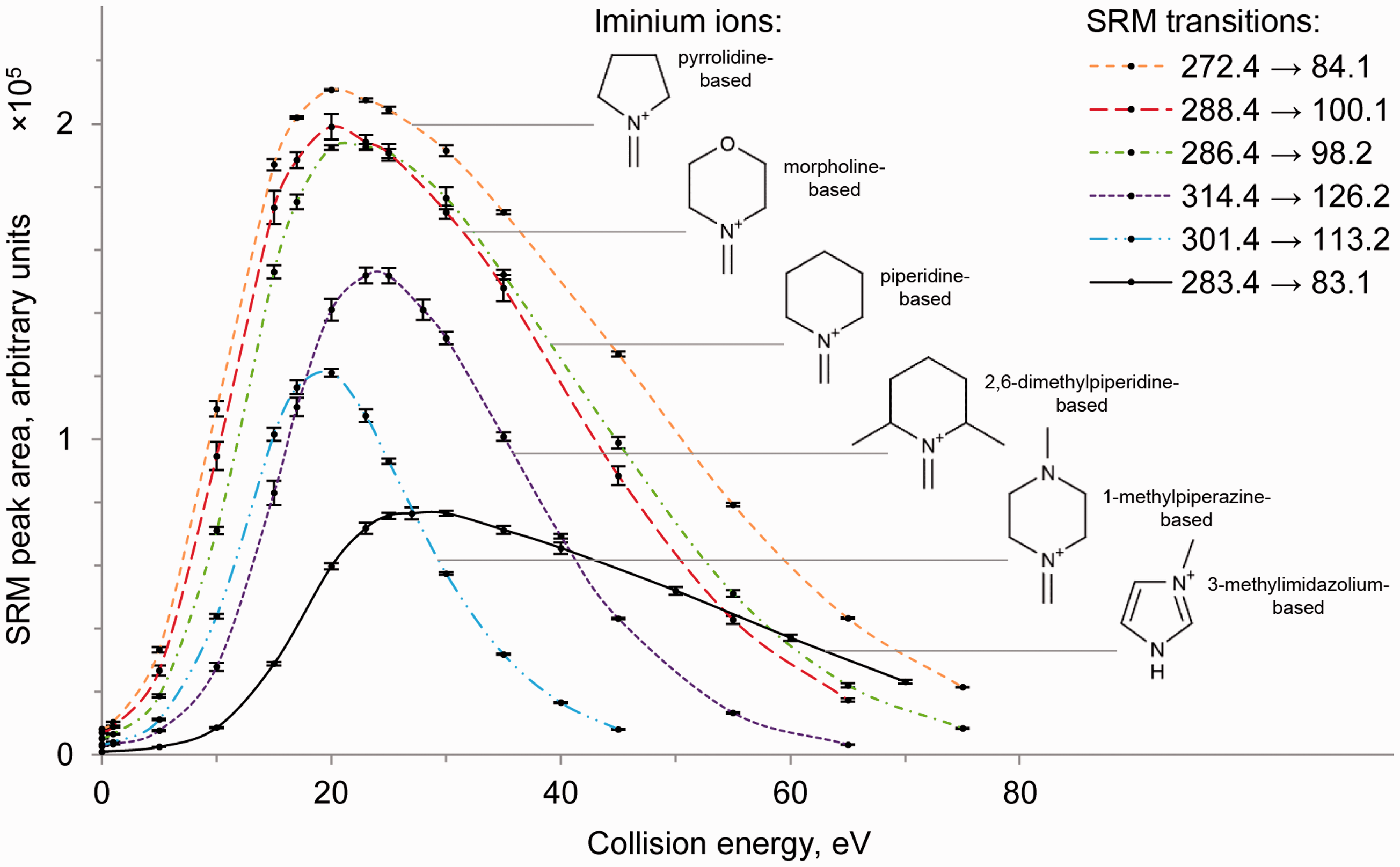
Differently derivatized tryptamine was separated on a reversed phase chromatography column, and mass spectrometric detection was applied in both SRM and SIM modes. During SRM, an amide bond cleaves and a proton remains associated with a basic nitrogen atom of derivatization reagent moiety, thus generating the iminium ion (1-carboxymethyl-3-methylimidazolium moiety is an exception). The release and stability of these product ions during CID are of critical importance for detection sensitivity and were investigated by increasing collision energies and measuring the peak areas of corresponding product ions in SRM mode, while SIM mode was required for normalization of SRM data of all six different product ions originated from six different molecular ions. It is worth noting that dilution and injection volume of each EDC/NHS reaction sample were adjusted so that the areas of SIM peaks were similar (normalization coefficients varied between 0.904 and 1.090). Taking this into account, we assume that similar amounts of molecular ions physically passed the third quadrupole during SIM measurements and that normalized SRM data are acceptable for tentative comparison of the yields of various iminium ions. The initial analysis of each derivative was performed in product ion scan mode using collision energy of 10 eV in order to select the product ions for SRM detection (collision energy of 20 eV was used in the case of 1-carboxymethyl-3-methylimidazolium moiety; see Supplemental material S1). The structures of these product ions and normalized areas of corresponding SRM peaks obtained at various collision energies are illustrated in Figure 2.
The structures of synthesized carboxylic acids (a) and the scheme of tryptamine derivatization and fragmentation (b) (note that methylimidazolium moiety is an exception, and CID of correspondingly derivatized tryptamine is not illustrated by scheme b). The structures of iminium ions for SRM detection and SRM peak area dependence on CID energy. The standard deviation is indicated by error bars, n = 3.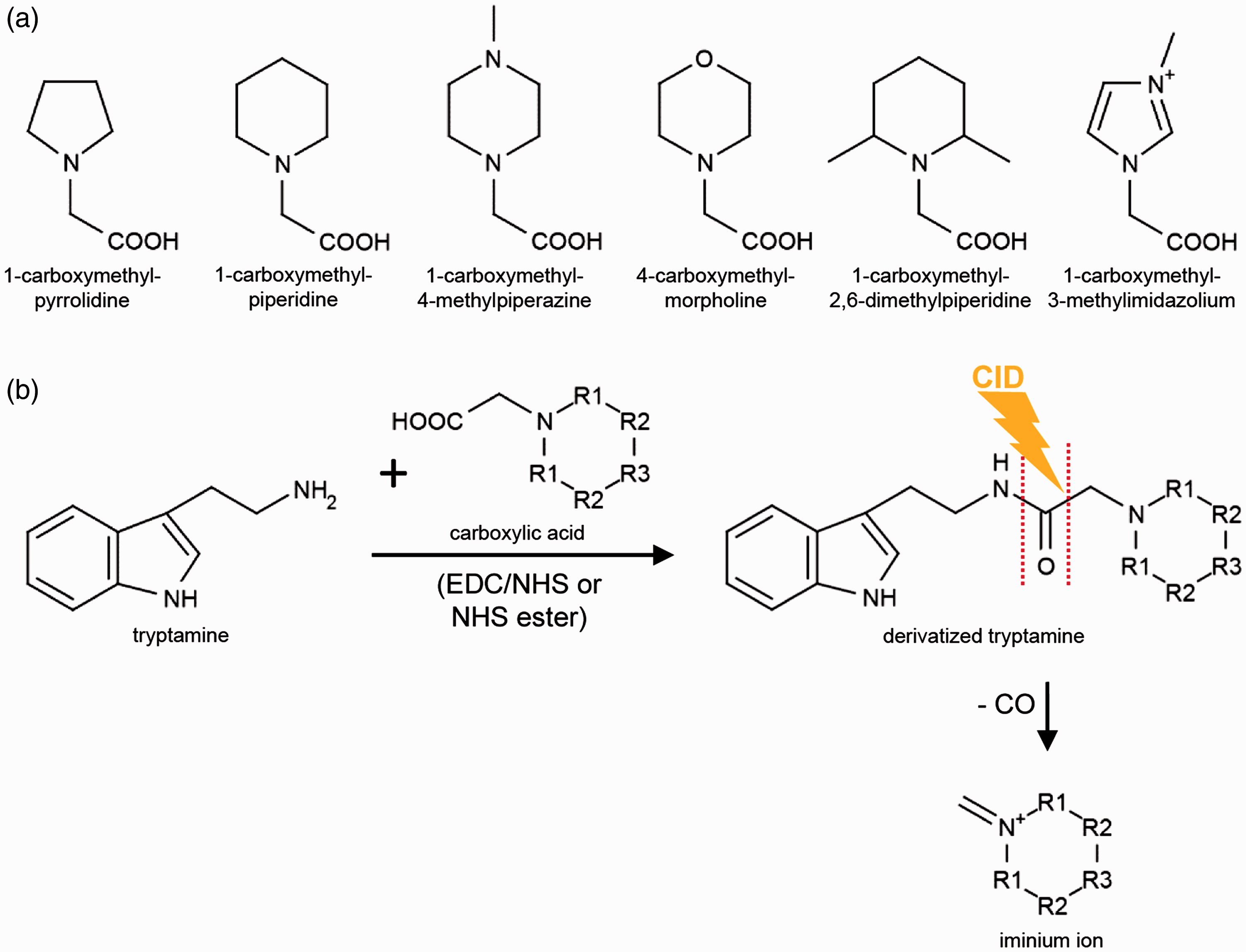
Release of different cyclic iminium ions during CID of derivatized tryptamine
Fragmentation of tryptamine derivatized with any investigated saturated nitrogen-containing compound resulted in corresponding iminium ion of high abundance at optimal collision energy (see Supplemental material S2; optimal collision energies were determined using SRM data from Figure 2). Nevertheless, the complete release of the added chemical derivative group without any sub-fragmentation of the resulting ion is necessary for the maximum yield of corresponding product ion. Such fragmentation is possible when the unwanted secondary fragmentation occurs at significantly higher collision energy compared to the formation of desired product ion. As a result, the resistance of iminium ions to sub-fragmentation is of great importance in our experiments.
Normalized SRM data demonstrate that the maximum yields of iminium ions generated from pyrrolidine, morpholine and piperidine moieties are similar and they are significantly higher in comparison with the maximum yields of iminium ions generated from 2,6-dimethylpiperidine, 1-methylpiperazine and 1-carboxymethyl-3-methylimidazolium moieties (see Figure 2; note that CID of the latter moiety resulted in different fragmentation which will be discussed separately). Dissociation of tryptamine derivatized with any pyrrolidine, piperidine, 2,6-dimethylpiperidine or morpholine moiety resulted in “clean” release of single product ion at collision energy of 10 eV. In the case of 1-methylpiperazine moiety, corresponding iminium ion demonstrated the highest abundance, but an additional low-abundance ion of m/z 70 was also observed. The maximum yield of 1-methylpiperazine-based iminium ion was obtained at collision energy of 20 eV, and fragmentation using this energy resulted in significantly increased abundance of an additional ion of m/z 70. Moreover, the peak of m/z 301 shows that dissociation of molecular ions was not complete at optimal collision energy (see Supplemental material S2). These data confirm that the secondary low-energy fragmentation pathway was active. Since the yield of product ion was limited by sub-fragmentation to some extent even at low collision energy, it is not surprising that 1-methylpiperazine moiety experimentally demonstrated the lowest maximum yield of desired iminium ion among investigated saturated compounds.
The second lowest maximum yield of saturated iminium ion was obtained during CID of tryptamine derivatized with 2,6-dimethylpiperidine moiety (see Figure 2). Interestingly, slightly higher collision energy (24 eV) was required for the maximum yield of 2,6-dimethylpiperidine-based iminium ion in comparison with the energies optimal for the rest iminium ions, and this could be explained by some steric hindrance at the nitrogen provided by the two methyl groups which resulted in lower availability of the electrons on nitrogen for donation. Fragmentation of tryptamine derivatized with 2,6-dimethylpiperidine moiety yielded no additional product ion at collision energy of 10 eV, and only low-abundance additional product ion of m/z 58 was observed during fragmentation using optimal collision energy of 24 eV (see Supplemental material S2). These data suggest that the maximum yield of 2,6-dimethylpiperidine-based iminium ion was a bit limited by sub-fragmentation, and the extent of this limitation was experimentally shown being clearly lower compared to 1-methylpiperazine-based iminium ion.
The highest maximum product ion yields were obtained during fragmentation of tryptamine derivatized with pyrrolidine, piperidine or morpholine moieties, and these moieties demonstrated “clean” release of corresponding iminium ions at optimal collision energies (20, 22 and 20 eV, respectively; see Supplemental material S2). Moreover, the peaks of molecular ions were insignificant at these energies, thus confirming that nearly-complete release of iminium product ions occurred. It is worth noting that tentative comparison of the yields of various iminium ions became possible due to normalization of SRM data using SIM data. Since the accuracy of SIM measurements of differently derivatized tryptamine was impossible to evaluate, the accurate comparison of similar normalized SRM values would be questionable (note that the error bars indicate standard deviation of SRM peak areas in Figure 2). Taking into account that the model analyte containing any of the latter three moieties demonstrated a preferred fragmentation behavior, we conclude that the highest yields of product ions could be expected using these moieties and our experimental data support this conclusion.
Stability of iminium ions originated from pyrrolidine and piperidine moieties
In general, iminium ions are capable of further fragmentation reactions: McLafferty-type rearrangement requires a γ-H and thus is possible in the cases of at least one C3 alkyl substituent, while onium reaction requires at least one C2 alkyl substituent.15,16 The latter reaction was reported being a multistage process that involves ion-neutral complex intermediate and H-transfer between the partners in this complex.17,18 It was also reported that H-transfer occurs after rotation of the partners in the complex relative to each other to some degree. 17 Since cyclic structure is more rigid compared to linear substituents, we hypothesize that the formation of a specific ion-neutral complex and H-transfer could be restricted during low-energy CID of cyclic iminium ion. In addition, these ions should be more resistant to sub-fragmentation via McLafferty-type rearrangement because the carbon groups attached to a nitrogen atom are “tied back”. Taking this into account, we expect cyclic iminium ions being more stable under CID conditions compared to linear iminium ions.
The maximum yields of iminium ions originated from pyrrolidine and piperidine moieties were among three the highest cyclic ion yields obtained in our experiments. In order to evaluate the influence of cyclic structure of iminium ion on its stability under CID conditions, pyrrolidine- and piperidine-based iminium ions were compared to diethylamine- and di-n-propylamine-based iminium ions, respectively. Diethylamine was chosen as linear analog of pyrrolidine lacking γ-H (see Figure 3(a)), and di-n-propylamine was chosen as linear analog of piperidine containing flexible alkyl substituents with γ-H (see Figure 3(b)). Our results demonstrate that the maximum yield of cyclic iminium ion was similar to the maximum yield of corresponding linear iminium ion in both cases. On the other hand, the yields of pyrrolidine- and piperidine-based iminium ions were much higher than the yields of corresponding linear iminium ions at higher collision energies (roughly at ≥35 and ≥23 eV, respectively). These results show that cyclic iminium ions were more resistant to sub-fragmentation under CID conditions than their linear analogs.
Comparison of stabilities of cyclic and linear iminium ions under CID conditions: (a) comparison of pyrrolidine- and diethylamine-based iminium ions; (b) comparison of piperidine- and di-n-propylamine-based iminium ions. The standard deviation is indicated by error bars, n = 3.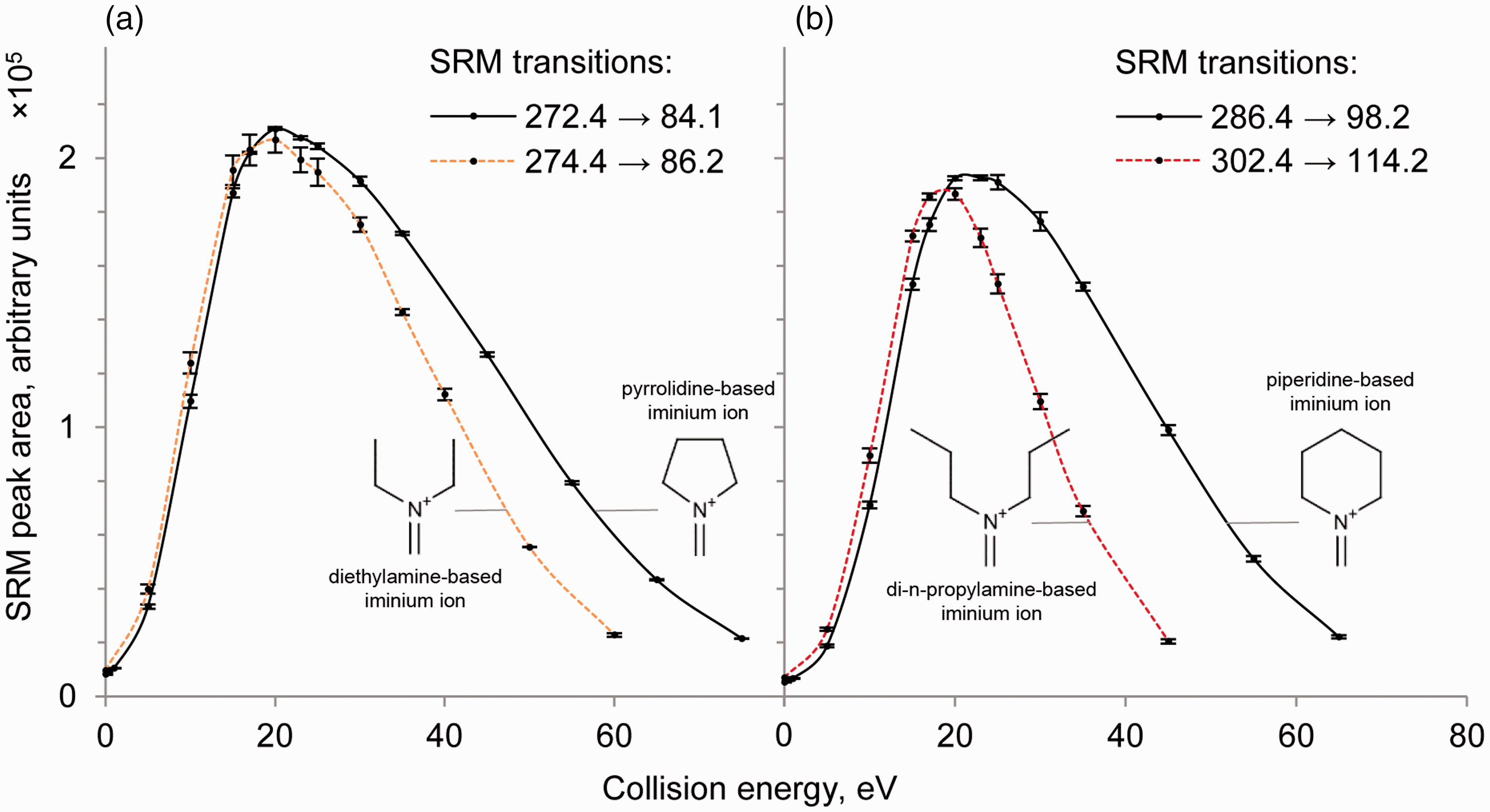
In order to reveal likely sub-fragmentation pathways of different iminium ions, mass spectrometric analysis of differently derivatized tryptamine was performed in product ion scan mode using relatively high collision energies which previously resulted in SRM peak areas similar to those what were obtained using collision energy of 10 eV (see Figure 4(a) to (e)). Diethylamine-based iminium ion lacks γ-H, so the only possible low-energy sub-fragmentation pathway of this iminium ion is onium reaction – the occurrence of which was confirmed by CID of correspondingly derivatized tryptamine at collision energy of 40 eV (the losses of one and two ethene molecules yielded ions of m/z 58 and 30, data not shown). Onium reaction also resulted in ring opening of cyclic iminium ion during CID of tryptamine derivatized with pyrrolidine moiety at collision energy of 49 eV. McLafferty-type rearrangement (via C=C bond) and imine elimination were enabled by disruption of cyclic structure and yielded product ions of m/z 42 and 55, respectively (see Figure 4(a)). Proposed sub-fragmentation pathways of pyrrolidine-based iminium ions are illustrated in Supplemental material S3. It is noteworthy that the product ion of the second onium reaction (ion of m/z 30) was not observed, suggesting that onium reaction requires higher collision energy compared to McLafferty-type rearrangement or imine elimination in this case. Since opened ring of pyrrolidine-based iminium ion is necessary for the latter two processes, onium reaction could be considered as a “bottle neck”. Taking into account that cyclic iminium ions were shown being more resistant to sub-fragmentation under CID conditions compared to their linear analogs and that onium reaction was a necessary step for sub-fragmentation of both pyrrolidine- and diethylamine-based iminium ions, we conclude that onium reaction of cyclic pyrrolidine-based iminium ion requires higher collision energy compared to diethylamine-based iminium ion, and this supports the hypothesis we previously made.
Product ion mass spectra of derivatized tryptamine obtained at relatively high collision energies and the proposed structures of secondary product ions originated from pyrrolidine (a, 49 eV), piperidine (b, 51 eV), 1-methylpiperazine (c, 33 eV), morpholine (d, 43 eV), 2,6-dimethylpiperidine (e, 49 eV) and methylimidazolium (f, 40 eV) moieties.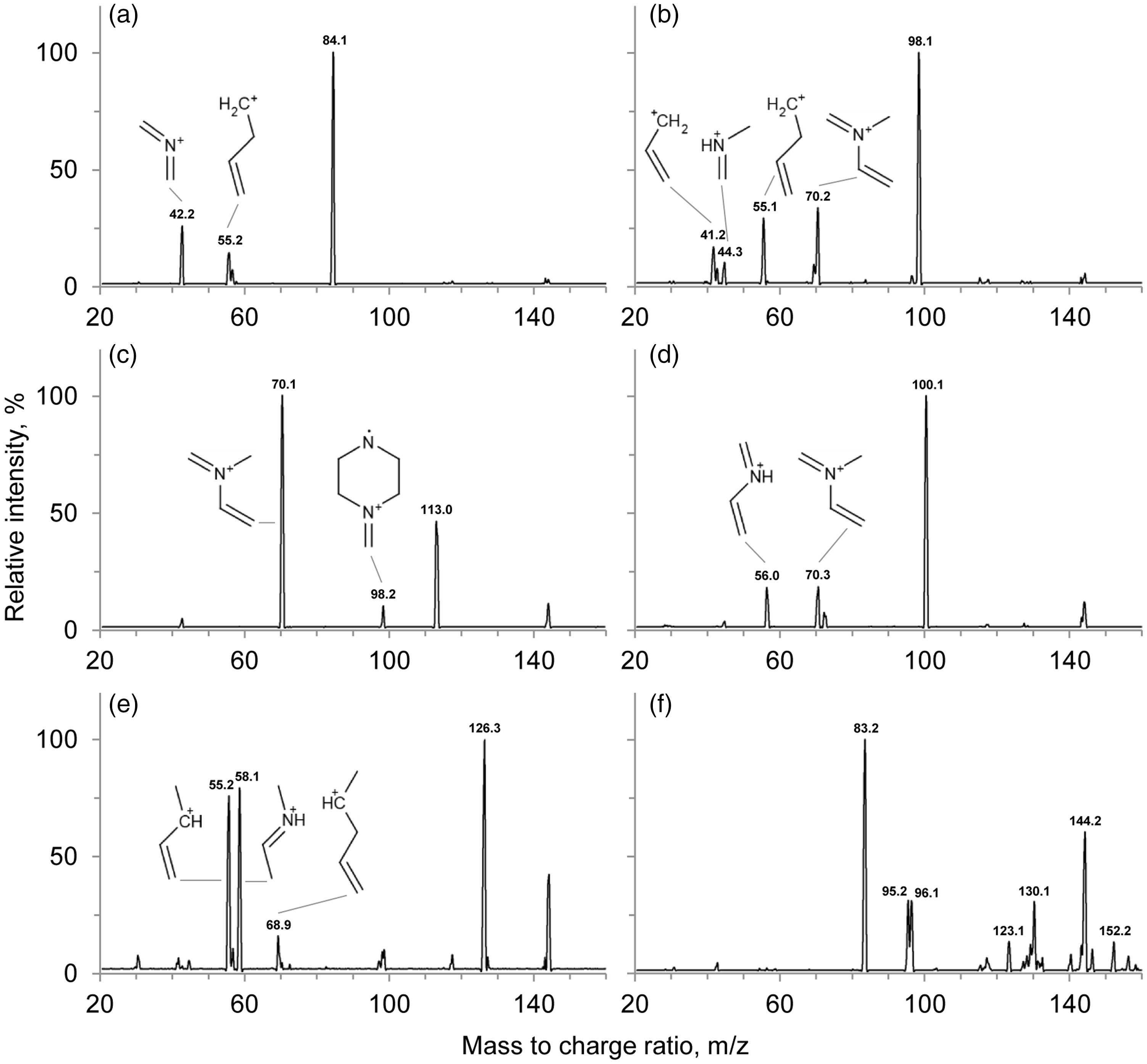
Di-n-propylamine-based iminium ion contains γ-H and thus is capable of McLafferty-type rearrangement and onium reaction. The occurrence of both these reactions was confirmed by CID of correspondingly derivatized tryptamine at collision energy of 30 eV (the losses of ethene and propene molecules yielded ions of m/z 86 and 72, data not shown). McLafferty-type rearrangement was shown being more favorable fragmentation pathway of di-n-propylamine-based iminium ion at several different collision energies (10–40 eV, data not shown) strongly suggesting that this rearrangement requires lower energy compared to onium reaction in the case of flexible alkyl substituents containing γ-H. Fragmentation of tryptamine derivatized with piperidine moiety at collision energy of 51 eV yielded various product ions and the assumption that 6-membered cyclic iminium ion undergoes double-bond migration with subsequent retro Diels-Alder (RDA) reaction or McLafferty-type rearrangement was necessary for explanation of the origin of these ions (the proposed structures are illustrated in Figure 4(b)). We speculate that the most intense product ion of m/z 70 was obtained during RDA reaction of cyclic iminium ion after double-bond migration, and two different structures were possible depending on the exact position of double-bond prior to RDA reaction. Moreover, RDA reaction after double-bond migration could also yield the product ion of m/z 44. On the other hand, this product ion could be obtained during ring opening of iminium ion via onium reaction with subsequent McLafferty-type rearrangement (via C=N bond), while additional double-bond migration with subsequent McLafferty-type rearrangement (via C=C bond) could yield the ion of m/z 70. The latter ion could undergo imine elimination yielding the ion of m/z 41. We also speculate that McLafferty-type rearrangement (via C=N bond after double-bond migration) with subsequent imine elimination yielded the second most intense product ion of m/z 55. Despite the fact that H-transfer via internal 6-membered ring forms an additional internal 4-membered ring and thus is expected being spatially restricted, this unlikely McLafferty-type rearrangement was considered being the reason for ring opening in this case because we were not able to explain the ion of m/z 55 in any other way. Proposed sub-fragmentation pathways of piperidine-based iminium ions are illustrated in Supplemental material S4. Although these fragmentation pathways were not proved and the proposed structures of the secondary product ions were not confirmed, our results in Figure 3(b) clearly demonstrate that piperidine-based cyclic iminium ion requires higher energy for the primary sub-fragmentation step (or competing steps) compared to fragmentation of linear di-n-propylamine-based iminium ion via conventional McLafferty-type rearrangement and onium reaction.
Stability of iminium ions originated from 1-methylpiperazine, morpholine and 2,6-dimethylpiperidine moieties
It was reported that sub-fragmentation of iminium ions containing the piperazine ring could result in secondary product ions of m/z 70 (C4H8N+) and 98 (C5H10N2+). 19 We have shown 1-methylpiperazine-based iminium ion being of low stability under CID conditions and sub-fragmentation of this ion yielded relatively intense product ion of m/z 70 at collision energy of 20 eV (see Supplemental material S2). This loss of 43 Da is one of the typical losses from a methyl-substituted piperazine ring, and the lost molecule was reported being N-methylmethanimine. 19 Taking this into account, we conclude that RDA reaction occurred after the double-bond migration. Another reported secondary product ion of m/z 98 was also observed using collision energy of 33 eV (see Figure 4(c)), and the origin of this ion could be explained by the neutral loss of methyl radical. Proposed sub-fragmentation pathways of 1-methylpiperazine-based iminium ions are illustrated in Supplemental material S5.
Morpholine-based iminium ion was shown to be among three the most stable iminium ions, and the stability of the rest two ions (piperidine- and pyrrolidine-based) has been discussed above. Two intense secondary product ions of m/z 56 and 70 were observed during CID of tryptamine derivatized with morpholine moiety at collision energy of 43 eV (see Figure 4(d)). The ion of m/z 56 is expected being yielded by McLafferty-type rearrangement (via C=C bond) after ring opening via onium reaction, while the ion of m/z 70 was likely obtained during RDA reaction after double-bond migration. Interestingly, the latter pathway yielding product ion of m/z 70 was also active during sub-fragmentation of piperidine- and 1-methylpiperazine-based iminium ions, but morpholine- and piperidine-based iminium ions were shown being significantly more resistant to sub-fragmentation under CID conditions in comparison with 1-methylpiperazine-based iminium ion. Since RDA reaction can be regarded as a double α-cleavage, lower resistance of 1-methylpiperazine-based iminium ion to RDA reaction could be explained by lower energy of C-N bond in comparison with either C–C or C–O bond. Proposed sub-fragmentation pathways of morpholine-based iminium ions are illustrated in Supplemental material S6.
CID of tryptamine derivatized with 2,6-dimethylpiperidine moiety resulted in low-abundance secondary product ion of m/z 58 at collision energy of 24 eV, and secondary product ions of m/z 55, 58 and 69 were obtained using collision energy of 49 eV (see Figure 4(e)). The ion of m/z 58 was likely obtained during McLafferty-type rearrangement (via C=N bond) after ring opening via onium reaction. However, we speculate that cyclic structure was also disrupted during McLafferty-type rearrangement (via C=N and C=C bonds) after double-bond migration, and the ions of m/z 69 and 55 were yielded during subsequent elimination of the neutral imine. Although the second fragmentation pathway is questionable (see discussion of piperidine-based iminium ion fragmentation), we were not able to explain the origin of the latter two ions in any other way. Proposed sub-fragmentation pathways of 2,6-dimethylpiperidine-based iminium ions are illustrated in Supplemental material S7.
Fragmentation of 1-carboxymethyl- 3-methylimidazolium moiety
The lowest maximum yield of product ion for SRM detection was obtained during fragmentation of tryptamine derivatized with 1-carboxymethyl-3-methylimidazolium moiety (see Figure 2). While fragmentation of other investigated derivatives resulted in the formation of expected iminium ions at collision energy of 10 eV, CID of derivatized model analyte did not yield a double-charged iminium ion in this case because of imidazolium π-electron system involving a pair of electrons from N1 atom. Moreover, only negligible product ions were observed using collision energy of 10 eV (data not shown). Since this cationic ring system was reported to undergo multiple stages of CID, 20 mass spectrometric analysis of tryptamine derivatized with 1-carboxymethyl-3-methylimidazolium moiety was repeated in product ion scan mode at higher collision energies (20, 30 and 40 eV). Although various additional product ions were observed using any collision energy, the product ion of m/z 83 was the most intense in all cases (see Figure 4(f) and Supplemental material S1). This ion was reported being 1-methyl-3H-imidazolium (C4H7N2+), and fragmentation pathway yielding this ion was reported being similar to the cleavage of the alkyl C–N bond of N-alkyl pyrroles with hydrogen transfer from the leaving alkyl moiety to the nitrogen. 20 At least three additional product ions of m/z 95, 96 and 123 were originated from 1-carboxymethyl-3-methylimidazolium moiety using collision energy of 40 eV, while the second most intense product ion of m/z 144 was originated from tryptamine moiety (see Figure 4(f); an excellent scheme of sub-fragmentation pathways of 1-carboxymethyl-3-methylimidazolium was reported in Lesimple et al. 20 ). Several active dissociation pathways yielding different product ions clearly lowered the abundance of the main product ion, thus limiting the application of 1-carboxymethyl-3-methylimidazolium moiety as derivatization reagent for SRM detection.
Differences in ionization efficiencies of derivatized tryptamine
The total amount of product ion depends not only on the dissociation of molecular ion but also on the yield of molecular ion in electrospray ionization source. All investigated saturated compounds are tertiary amines containing basic nitrogen atom which could be protonated during +ESI. Despite the fact that 1-methylpiperazine moiety demonstrated the lowest iminium ion yield during CID of corresponding molecular ion, this moiety contains an additional nitrogen atom possibly increasing ionization efficiency. As a result, the total yield of 1-methylpiperazine-based iminium ion is not necessarily the lowest. Morpholine moiety also contains an additional charge-localizing oxygen heteroatom. Moreover, the latter moiety demonstrated one of the highest iminium ion yields during CID of corresponding molecular ion. Whereas pyrrolidine, piperidine and 2,6-dimethylpiperidine moieties do not contain any additional basic atom, morpholine moiety was considered being easier to ionize than these moieties. With this in mind, we compared the effects of 1-methylpiperazine and morpholine moieties on +ESI of derivatized tryptamine.
An additional UV detection was necessary for normalization of SIM data in order to compare ESI yields. Model analyte tryptamine absorbs UV light at 280 nm. Since derivatization reagents do not absorb UV light at this wavelength and the effect of an additional peptide bond on UV absorbance is insignificant at 280 nm, derivatization of tryptamine was considered causing negligible changes in absorbance. EDC/NHS strategy was simple to perform, but it resulted in UV-absorbing side-products which were not completely separated from the products of interest. Although co-eluting compounds do not interfere with normalization of SRM data using SIM peaks, the overlapped UV peaks are not acceptable for normalization of SIM data. Detailed mass spectrometric analysis showed that co-eluting side-products were tryptamine coupled to one or several β-alanine molecules (data not shown). As β-alanine is a side-product of EDC reaction with NHS,
13
the coupling was performed using a variety of concentrations and ratios of the reagents in order to minimize side-products from the reaction. Unfortunately, significant amounts of UV-absorbing side-products were obtained in all cases. Taking this into account, EDC/NHS strategy was replaced by the active NHS esters. Such esters of (4-methyl-1-piperazinyl)acetic acid and 4-morpholinylacetic acid were synthesized, reacted with tryptamine and the products of interest were the same as synthesized using EDC/NHS strategy because NHS esters are selective reagents for modification of primary amino groups.3,21 The injection volumes were adjusted, so that the areas of UV peaks of differently derivatized tryptamine were approximately the same for both different reaction mixtures (see Figure 5(a)) and we assume that very similar amounts of analytes were physically infused into ESI source. RP-UPLC analysis with isocratic elution was chosen in order to maintain the same ionization conditions for differently derivatized tryptamine.
The chromatograms of tryptamine derivatized with 1-methylpiperazine and morpholine moieties: (a) UV chromatograms; (b) SIM chromatograms; (c) SRM chromatograms. The relative standard deviation was <1.7% in all cases, n = 3.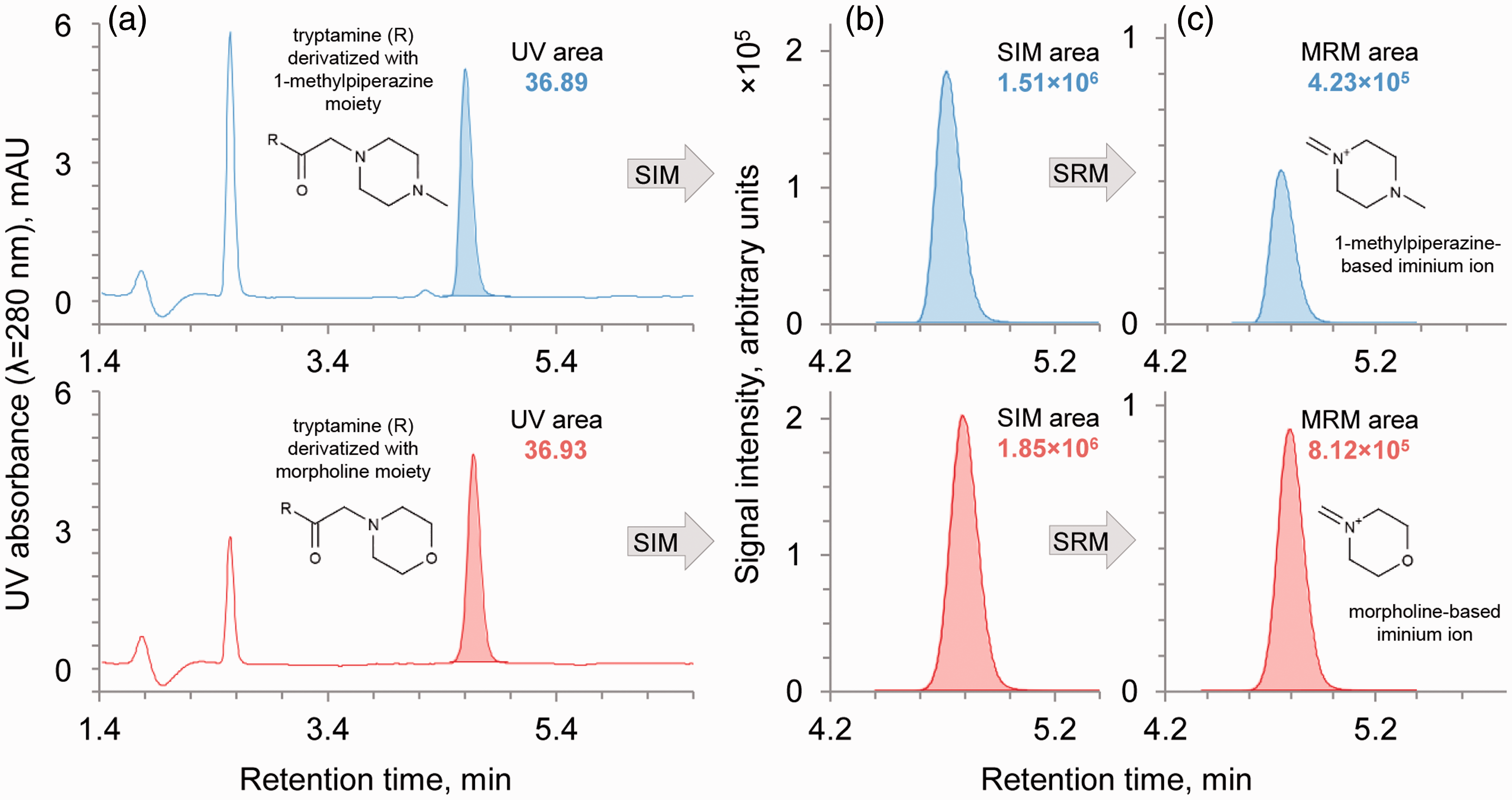
Tryptamine derivatized with morpholine moiety demonstrated significantly higher +ESI efficiency than tryptamine derivatized with 1-methylpiperazine moiety (2+ ions were not obtained and +ESI yields of 1+ ions differed ≈1.2 times, see Figure 5(b)). Taking into account that in general oxygen is somewhat less charge-stabilizing heteroatom than nitrogen, lower +ESI efficiency of tryptamine derivatized with 1-methylpiperazine moiety could be explained by some steric hindrance at the nitrogen atom provided by the methyl group, which makes it more difficult for nitrogen atom to approach a proton during ionization. The same RP-UPLC analysis with SRM detection and UV normalization was performed for a comparison of the total product ion yields and ≈1.9 times higher product ion yield was obtained using morpholine moiety in comparison with 1-methylpiperazine moiety (see Figure 5(c)). It is noteworthy that 1-carboxymethyl-3-methylimidazolium moiety contains a permanent charge and thus additionally acts as an ionization enhancer of derivatized analyte resulting in possibly the highest yield of molecular ion among investigated compounds. Unfortunately, we were not able to synthesize corresponding active NHS ester for a “clean” derivatization of the model analyte. Since fully resolved UV peak was not obtained in this case, +ESI yield was not evaluated.
Conclusions
In this study, six nitrogen-containing cyclic compounds were examined as product ion sources for selected reaction monitoring detection of derivatized tryptamine. Nearly-complete release of the added chemical derivative group without any sub-fragmentation of the resulting product ion was observed during dissociation of the model analyte derivatized with pyrrolidine, piperidine or morpholine moiety, and the highest fragmentation yields were confirmed experimentally. Cyclic iminium ions were shown being more resistant to sub-fragmentation under CID conditions in comparison with their linear analogs likely due to spacial restrictions limiting onium reaction and McLafferty-type rearrangement. Although cyclic structures were shown being additionally capable of RDA reaction, primary sub-fragmentation processes of cyclic iminium ions required higher collision energy compared to conventional McLafferty-type rearrangement and onium reaction of linear iminium ions. Expected sub-fragmentation pathways of various iminium ions were discussed, and the structures of experimentally obtained secondary product ions were proposed. Considering both ionization of derivatized tryptamine and fragmentation of molecular ions processes, morpholine moiety was shown being a promising product ion source for SRM detection of derivatized analytes. However, further investigation of permanent charge-containing moieties is required.
Supplemental Material
Supplemental material for Nitrogen-containing cyclic compounds as iminium ion sources for selected reaction monitoring detection of derivatized analytes
Supplemental Material for Nitrogen-containing cyclic compounds as iminium ion sources for selected reaction monitoring detection of derivatized analytes by Andrius Žilionis in European Journal of Mass Spectrometry
Footnotes
Declaration of conflicting interests
The author(s) declared no potential conflicts of interest with respect to the research, authorship, and/or publication of this article.
Funding
The author(s) received no financial support for the research, authorship, and/or publication of this article.
Supplemental material
Supplemental material for this article is available online.
References
Supplementary Material
Please find the following supplemental material available below.
For Open Access articles published under a Creative Commons License, all supplemental material carries the same license as the article it is associated with.
For non-Open Access articles published, all supplemental material carries a non-exclusive license, and permission requests for re-use of supplemental material or any part of supplemental material shall be sent directly to the copyright owner as specified in the copyright notice associated with the article.
