







Abstract
Joseph John Thomson is best known for detecting two isotopes of neon within cathode ray tubes that lay the foundation of the field of mass spectrometry. He was awarded the 1906 Nobel Prize in Physics for the discovery of the electron and for his work on the conduction of electricity in gases in the same devices. He is less known for his strong religious beliefs and his interest in psychical research and the paranormal. Thomson served as a member of the Society for Psychical Research for over 50 years and even became its Vice President. During this time, he attended a number of séances and demonstrations by professed psychics and mediums. This article traces those who influenced his interest in the paranormal, from Balfour Stewart to Lord Rayleigh and William Crookes. It reports and illustrates his beliefs and experiences investigating the paranormal in his own words.
Introduction
Most of us have had life experiences we have been unable to explain by reasoned thought or the application of scientific principles. These include premonitions about future events, from predicting we would meet someone we have not seen or heard from in years just before we actually do, to sensing that a loved one has died at the time of their passing even though it occurred many miles away from us. Scientists typically dismiss such experiences as a result of selective memory; the tendency to recall or interpret events that reaffirms one's beliefs or hypotheses. Such biases lead us to remember these specific coincidences and yet forget the many events that occur day-to-day which have no such association. Still, others have given credible accounts, and in some cases photographic evidence, of seeing or experiencing unexplained events ranging from objects moving without being acted upon by any apparent force, unexplained electrical activity such as lights being turned on and off, objects appearing or noises occurring where no logical source to them can be found.
Scientific discovery involves the constant evolution of ideas and re-evaluation of what is real and tangible in the natural world and what forces are at play. This is defined within our own terms, perspective and conditions by applying what is generally regarded as the scientific method with evidence acquired by empirical observations and experimental data. Studies in science require the practitioner to maintain an open mind at all times. This includes accepting that science is currently challenged by many phenomena ranging from what ‘dark matter’ is or is not, to explaining the intricacies, mechanisms and capabilities of the human brain, or how life came to emerge on this planet from a ‘primordial soup’ of small organic compounds or by means of extra terrestrial materials.
Paranormal experiences are most broadly defined as phenomena that are beyond the scope of normal scientific understanding. The word itself derives from the Greek ‘para’, a prefix meaning beside or distinct from, the latter often in combinations used to define amiss or irregular. Many eminent scientists in the past have had no reticence in believing the existence of so-called paranormal phenomena according to this definition.
Albert Einstein was open to the idea of other forces outside of scientific understanding of the time playing a role in the universe and struggled with the principles of quantum mechanics. He described the way in which two objects remain connected (or ‘entangled’) through time and space, even if they were separated at a great distance, as ‘spooky action at a distance’. 1 British mathematician and code-breaker Alan Turing believed in telepathy or ‘thought transference’. 2 Alfred Russel Wallace, who independently devised the theory of evolution at the time of Darwin, argued in an 1876 essay 3 that ‘a theory or belief may be supported by very bad arguments, and yet be true; while it may be supported by some good arguments, and yet be false. … the evidence in favour of miracles must be fairly met and judged on its own merits, not ruled out of court as it is now’.
In late-Victorian Britain, the discoveries of X-rays, radioactive emanations, and cathode rays, among others, led many scientists to at least consider the possible existence of other hitherto undiscovered forces. Joseph John (J.J.) Thomson's interest in the paranormal may have first been stirred by his physics lecturer at Owens College Manchester. Professor Balfour Stewart held a strong religious faith and an interest in the paranormal. 4 He co-authored a book entitled Paradoxical Philosophy in 1878 5 about which he wrote ‘it calls attention to the simple fact, ignored by too many professed instructors of the public that human science has its limits; and that there are realities with which it is altogether incompetent to deal’. An impressionable young Thomson recalled in later life: ‘my first introduction to physics was the lectures of Balfour Stewart. These were so clear that, child that I was, I could easily understand them’. 6 Thomson even spent time working in Stewart's laboratory where he nearly lost his vision when, in 1874, an explosion of a glass vessel injured his eyes. Fortunately, the accident resulted in no long-lasting damage. 6
Stewart's strong beliefs led him to come to the defence of another believer in the paranormal, William Crookes. Crookes was to be important to J.J. Thompson's future scientific pursuits. In 1871, he penned an article to Nature in 1871 7 stating if ‘a man comes before us as a witness of some strange and unprecedented occurrence … it is evident that we are not entitled to reject his testimony on the ground that we cannot explain what he has seen in accordance with our preconceived views of the universe, even though these views are the result of a long experience; for by this means we should never arrive at anything new’. Stewart recognised the difficulties with performing investigations into the paranormal and meeting a scientific standard that could preclude all doubters about what Crookes referred to as ‘psychic forces’. ‘Mr Crookes will, we are sure, not object to a few critical remarks honestly made with the sole view of finding out the truth, and we would therefore express a wish that, in order to facilitate operations, the experiments should in future be conducted only by such men as Mr. Crookes himself’.
William Crookes and the Crookes tube
William Crookes was enrolled at the Royal College of Chemistry at the age of 15. After four years at the college, he accepted a position in the meteorological department of the Radcliffe Observatory at Oxford. Later in 1855, Crookes briefly began teaching chemistry at the College of Science in Chester, but the next year, having received a sizable inheritance upon the death of his father, established his own private laboratory (Figure 1). Built at the rear of his North London home, he carried out a number of investigations primarily in chemistry and physics that led to the discovery of thallium and its chemical properties. This achievement established him as one of the most promising chemists of the Victorian era and resulted in his election to the Royal Society in 1863 at the age of 31. 8

William Crookes in his London laboratory. Source: Wikipedia.
But four years later, after the death of his youngest brother, Crookes developed depression and attempted to overcome it by attending a session with a medium to try to communicate with his lost sibling. The experience prompted Crookes to investigate the paranormal, applying the same scientific methods he applied to his other research. To create controlled conditions, he constructed a purpose-built room, to enable reliable measurements to be made and sought the presence of witnesses from the field of science to lend credibility to the observations. He invited alleged clairvoyants or mediums to his rooms to either lend them credibility or unmask their deception. Regrettably, the subject had attracted many who deliberately set out to stage or fake paranormal events.
Crookes investigations drew some ire from the established scientific community. He therefore set about designing more sophisticated experiments to silence his critics. He also returned to some scientific orthodoxy and, in 1875, invented a radiometer 9 ; a light mill whose vanes rotate in the presence of rays emanating from the cathode in one of his ‘Crookes tubes’.
In 1878, he began to focus his attention on the newly discovered cathode rays and concluded that cathode rays were actually a jet of particles and were also negatively charged. J.J. Thomson used such tubes to discover the electron,10,11 or what he called the corpuscle; sub-atomic particles that were some one hundred thousand times smaller than the size of a hydrogen atom (Figure 2). His investigations led him to study the nature of the atom and report on its construct.12,13
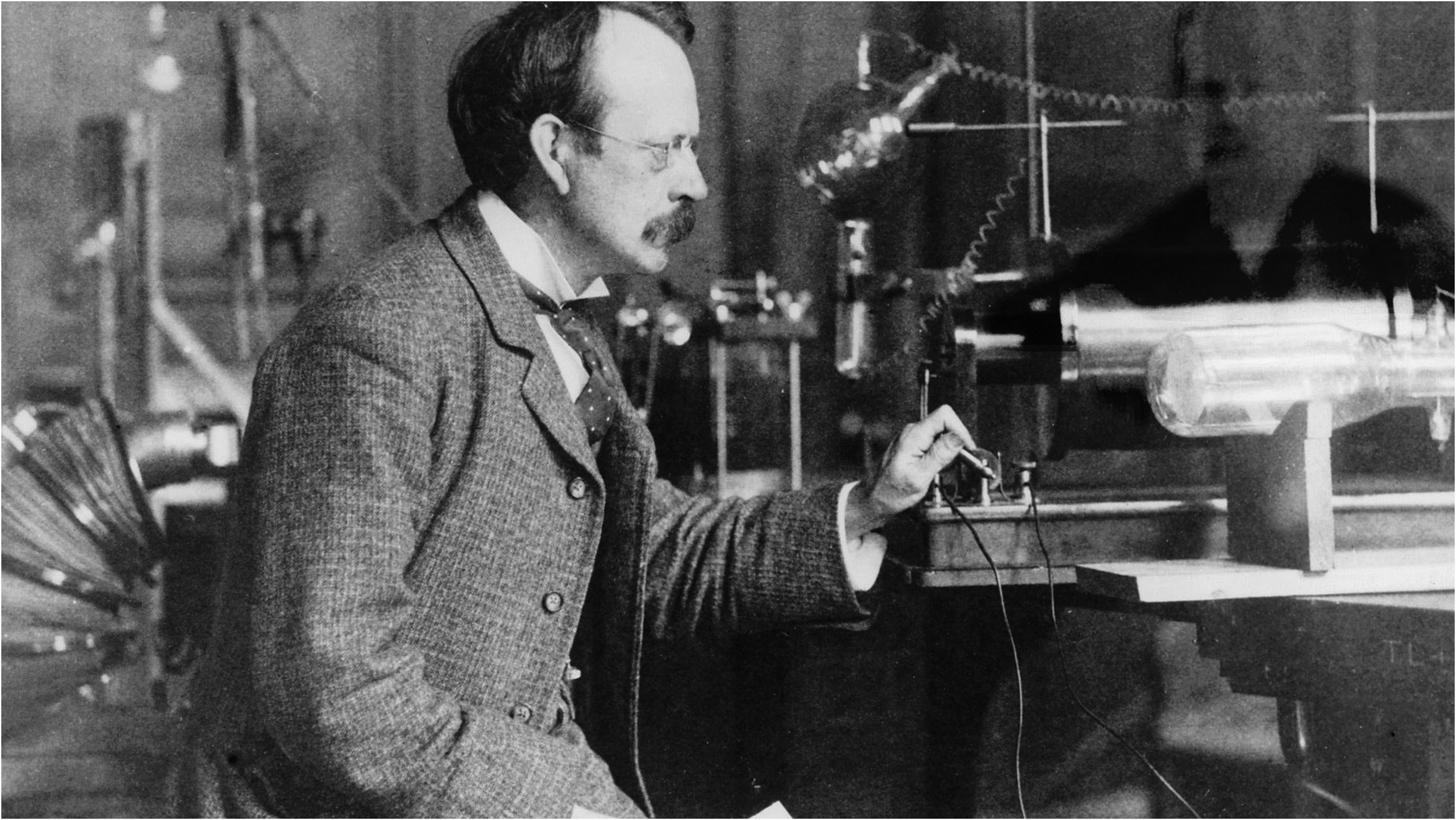
J.J. Thomson in his laboratory operating a cathode ray tube in the ghostly presence of William Crookes. Digitally altered by the author from source: American Institute of Physics.
J.J. Thomson the believer
J.J. Thomson was a reserved yet devout Anglican who regularly attended church and practiced prayed. While a professor at the Cavendish, he attended the Sunday evening chapel service at Trinity College, and as Master of Trinity, its morning service. He was devoted to the Trinity Mission and read his Bible before retiring each night. 14
Thomson preferred experimental physics to theory and liked to demonstrate a visual phenomenon in his lectures and research. But he also recognised the frailty of such experiments writing in his recollections ‘the delicate instruments used in physical laboratories may, until their technique has been mastered, give one result one day and a contradictory one the next, and illustrate the truth of (physicist) Coutts Trotter’s saying that the law of the constancy of Nature was never learned in a physical laboratory’. 15 Indeed, with their strong electromagnetic fields, exotic ionisation processes, and vacuum pumps and chambers, early mass spectrometers were known for their fickleness. Aston's early mass spectrographs were often inoperative, 16 while Australian practitioner James Morrison has even recalled that early instrument manuals recommended placing a coin on the magnet as an offering to the gods to ensure successful operation. 17
Well aware of Crookes interests in the paranormal, and emboldened by his former supervisor (Lord Rayleigh, John William Strutt) and mentor's curiosity in the subject, Thomson, at least politically, maintained an open mind about the paranormal. Rayleigh expressed doubts about the exclusivity of matter in the universe and that all phenomena are the result of it. 18
Membership of the Society for Psychical Research and attendance at séances
To provide a forum for a discussion of these views, Stewart, Rayleigh and Thomson became members of the Society for Psychical Research (SPR). Established in 1882, with Stewart as a co-founder, the SPR exists to this day and aims ‘to examine without prejudice or prepossession and in a scientific spirit those faculties of man, real or supposed, which appear to be inexplicable on any generally recognised hypothesis’. Another founder was a British poet and linguist Frederic Henry William Myers who had proposed a theory of ‘subliminal self’ whereby part of one's personality exists beneath a threshold that separates the conscious state from the unconscious. The first president was British philosopher Henry Sidgwick. Thomson joined in 1883 and served as a member of the Governing Council of the SPR, and then its Vice President for 57 years from 1883 to 1940. 19
A large proportion of the SPR investigations was undertaken by those with the financial independence and time to conduct them so that although the SPR was based in London, a Cambridge-based contingent was responsible for many of the society's early experiments. Thomson devotes an entire chapter in his recollections to the subject of psychical research. 15 He writes ‘In the nineties (1890s), at the insistence of F.H.W. Myers, I attended a considerable number of séances at which abnormal physical effects were supposed to be produced. … The results were very disappointing at all but two of those I attended’.
One case where Thomson suspected a strong case of fraud was with slate-writer William Eglinton. ‘I went with Myers and Mr H.J. Hood who at the time, took a prominent part in psychical research, to his room, near, I think, to the Marble Arch. Eglinton took a slate which we were allowed to examine, and we found no reason to suspect that it was anything but an ordinary school slate. He then broke a small piece off a slate pencil and placed the fragment on the top of the slate. We then sat down at a trestle table; he sat at one end, I held his right hand with my left, and with his left hand he held the slate under the table. The piece of slate pencil was between the bottom of the table and the top of the slate. The room was not darkened in any way and all the proceedings took place in broad daylight. He then asked each of us a question which we should like the spirits to answer. Myers and Hood asked questions concerning spiritualism, I preferred a question to which I knew the answer, so I asked what county Manchester was in.
We then sat for, I should think, a quarter of an hour without anything happening. Then he seemed to be seized with convulsions and it was all I could do to hold him up and prevent him from falling off the chair. He recovered in a short time, brought the slate from under the table, and on it was written in a sprawling hand with large ill-formed letters: Manchester. My view is that Eglinton thought there must be some catch in my very simple question and that he knew that some English towns were counties in themselves and supposed, because I had asked the question, that Manchester was one of them’. The city is in fact mostly in the county of Lancashire.
Having caught out Eglinton with his question, Thomson also conveyed how he thought the illusion had been performed; ‘if he had managed to jam the piece of slate pencil in a crevice or depression on the lower part of the table, he might have been able to write without any considerable movement of the arm supporting the slate’. In 1886, Eleanor Sidgwick, Rayleigh's sister-in-law who had married Henry Sidgwick a decade earlier, accused William Eglinton of fraud on behalf of the SPR as its president.
A much more exciting and interesting experience to Thomson featured Italian Eusapia Palladino. She was famed for demonstrating a range of abnormal physical effects involving the moving of objects via psychokinesis in a series of séances across Europe and the UK. One reported feat involved levitating a table upon which she and others present rested their hands. In others, she reportedly moved objects across a room.
Thomson writes 15 ‘Eusapia came to Cambridge in the Long Vacation of 1895, and stayed with the Myers. She held some séances and I was present at two of them. At the first, which began about 6 o’clock in the evening, Lord Rayleigh, Professor Richet, Myers, Richard Hodgson, Mrs (Elenanor) Sidgwick, Mrs Verrall and myself were present, along with a few others whose names I have forgotten. We sat at a long table. Eusapia was at one end, Lord Rayleigh on her right, I on her left; and Mrs Verrall was under the table holding her feet’ (Figure 3 20 ).
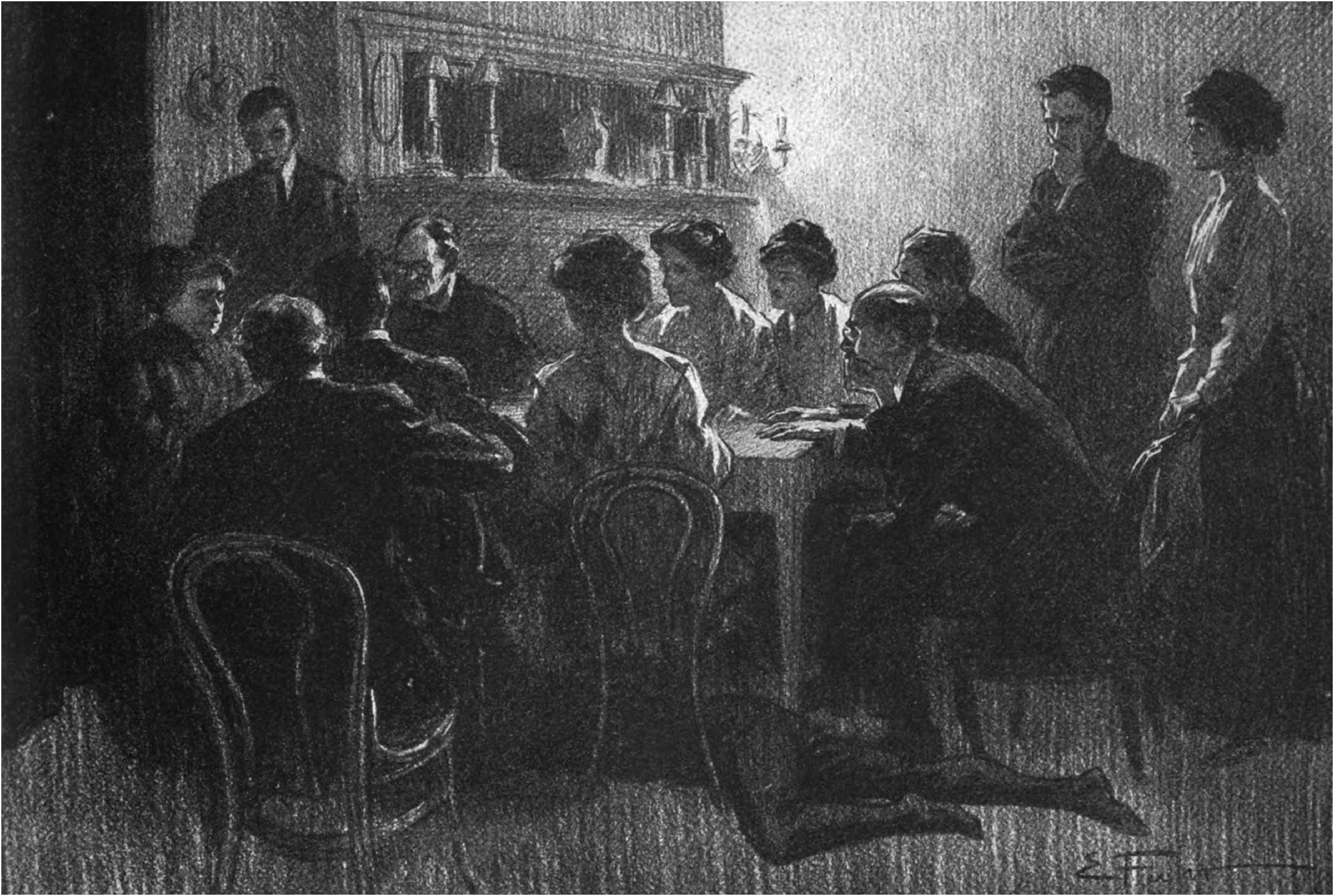
Real life sketch of a séance held with Italian Eusapia Palladino seated at the table, far left. 20
There was a melon on a small table at some little distance from that at which we sat, and it was part of the programme that the melon should be precipitated onto the table. There were heavy velvet curtains over the windows, and when the lights were all put out it was pitch dark. We formed the circuit by clasping hands in the usual way and sat like this for a considerable time without anything happening. Then Myers, who thought it good policy to encourage mediums at the commencement of a séance, jumped up and said he had been hit in the ribs. The circuit was thus broken and it was perhaps a minute before it was re-formed. Hardly had we got seated when Mrs Verrall called out ‘She's pulled her foot back’, and then, without an interval, ‘Why, here's the melon on my head!’.
He continues, ‘What had happened was quite obvious: while the circuit had been broken and Eusapia was free she had reached out, got the melon, sat down and put it on her lap, intending to kick it from her knee onto the table. Now if you want to kick from the knee you begin by drawing the foot back. Eusapia had done this, but had been disconcerted by Mrs Verrall calling out, and had not got her kick in in time, and the melon had rolled off her lap onto Mrs Verrall's head’.
Palladino was not amused as Thomson conveys. 15 ‘Very soon after we had sat down again she began abusing me in a language which I did not understand one word, but Richet, who understood her, said she was accusing me of squeezing her hand and that she would not allow this. Instead of holding her hand, all she would permit was that I might put the tips of my fingers on the back of her hand; this was done. After a short interval she began to abuse Lord Rayleigh, and Richet said she was accusing him of squeezing her hand and that, instead of holding hands, she would put the tips of her fingers on the back of his hand. This change, as was found out later by Mr Hodgson, was the essence of her trick. … (Eusapia) would get both hands free, for I should think that I was pressing Eusapia's hand when as a matter of fact I was pressing Rayleigh's, and he would think he was still being pressed by Eusapia while in fact he was pressed by me’.
Demonstrating telepathy
An event that Thomson attended that he found more convincing featured Danish-born Americans Julius and Agnes Zancig, a husband and wife team, who performed a mind reading act during the late 19th and early 20th centuries. The thought-reading, telepathy craze had swept through late-Victorian Britain with the popular pastime appearing to show the ability of some people to correctly read words and images in the minds of others, even when blindfolds and absolute silence seemed to deprive them of sensory clues. Obtaining an object or drawn design from an audience member, including complex geometric shapes (Figure 4), Julius was able to convey the image to his wife that had been handed to him. With much continual practice, the act was so good as to confound sceptics and convince many scientists that the couple was truly telepathic. In 1907, Julius authored a book entitled ‘Two Minds With But a Single Thought’ that described his psychic relationship with his wife and the pair placed large advertisements in London newspapers (Figure 4) promoting their events.
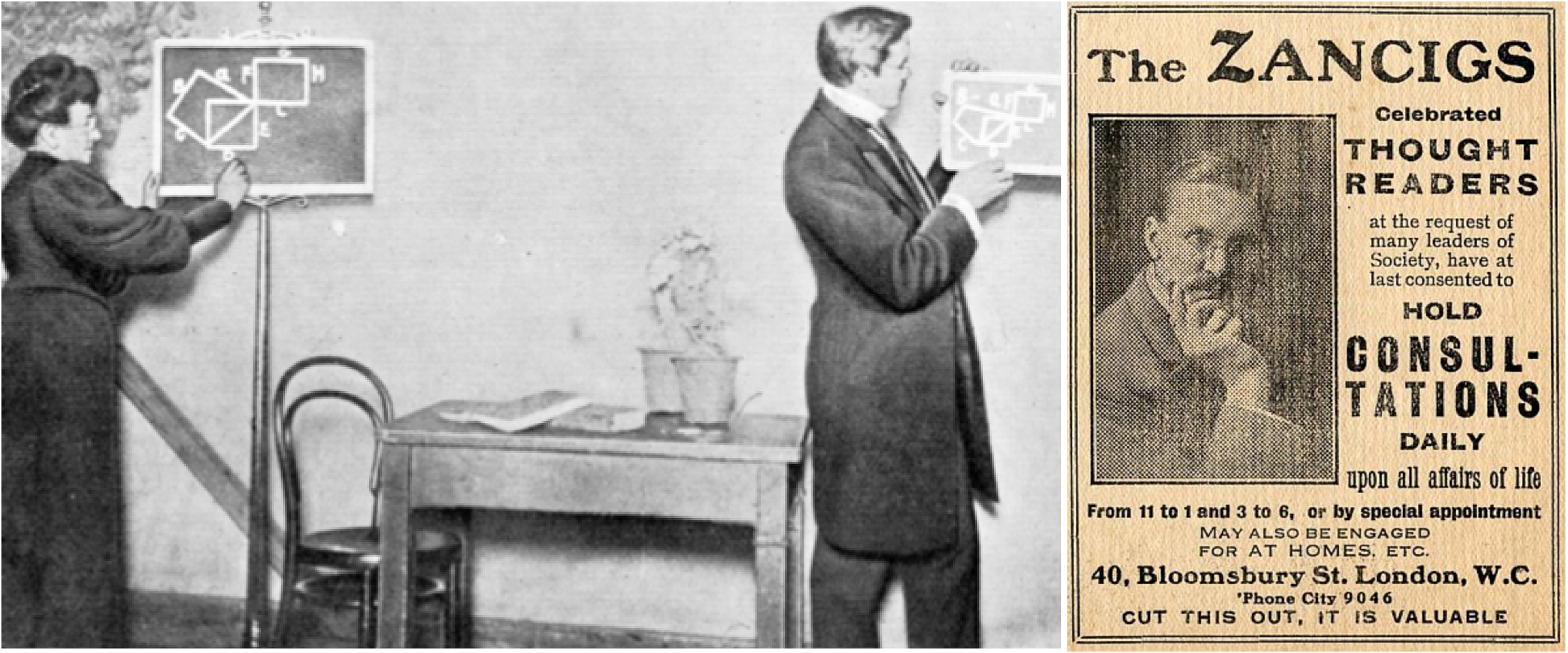
The Zancigs performing their mind reading act, aside their London newspaper advertisement. Source: Wikipedia.
Thomson writes of his audience with the pair: 15 ‘the Zancigs, who were performing in London some years ago, did not, I believe, profess to possess any psychic power. Yet I saw them at a private house give, under most stringent conditions imposed on them by the present Lord Rayleigh (conditions which I expect were even more stringent than those imposed in the experiment of fifty years ago), an exhibition which, if they had professed to be thought readers, might have been held to establish the claim’.
But Thomson knew only too well there are other ways of communication between two people beyond sight or audible sounds. Employing his knowledge of physics and music, he relates that the pitch at which a person detects a musical note varies from one person to another. He recalled a boy who came to the Cavendish Laboratory who could detect a whistle not detected by others and was thus deemed inaudible. The power of detecting high notes is much stronger in youth than in old age. 15 Before his death, Julius Zancig eventually confessed that he and his wife had memorised a very complex code of visual and audible cues that they utilized in their acts. 21 Using these signals, and by framing questions in a certain manner, Julius was able to convey to his wife detailed information about an object or design.
But on telepathy in general, Thomson writes 15 ‘It is often asserted that telepathy has been conclusively proved. I cannot agree with this for the case of short-range telepathy … This does not mean that it has been shown not to exist … Compared with other branches of psychical research, little has been done on this short-range thought transference between living people, though it was this which first suggested the idea. One reason for this is that this power of thought-reading is exceedingly rare, very much rarer than was at first supposed. Another reason is that attention was at first directed to thought transference between the living and the dead, which raises much deeper and more important questions. In my opinion, the investigation of short-range thought transference is of the highest importance. It is quite possible, indeed very probable, that it may turn out to be of an entirely different character from the kind of thought transference that is supposed to occur in dreams or premonitions’.
Thomson's predictions on mind reading are beginning to become a scientific reality. Our present ability to non-invasively detect electrical activity in the brain through the scalp, and pioneering discoveries that enable us to control it for a range of purposes, including moving artificial limbs or controlling autonomous vehicles, will shortly transform medicine and society in profound ways. The selective manipulation of electrical activity in regions of the brain to stimulate neurons help to learn and enhance cognitive performance is also being explored. Studies are being undertaken today to understand the complex patterns of activity in a person's brain when they think of an object, learn new information, or experience a particular emotion. If these experiments prove to be successful, scientists will truly be able to read a person's mind and the next step of thought transference may be on the horizon.
Final thoughts
After the death of their father, Thomson's son and daughter wrote that he had a suppleness of mind that enabled him to speculate on new theories in physics, and contemplate on many other subjects of interest 22 (Figure 5). He was also known for his bias for visual phenomena and preferred experiments where the result was some kind of picture, on a plate or a fluorescent screen. In so doing, he could effectively see ‘what is not there as well as what is’. Furthermore, the beauty in these effects, such as those that gases make when they conduct electricity, fascinated him. He was open to new ideas and highly valued originality. What mattered to him most in research was the right approach; what he called ‘getting hold of the right end of the stick’.22 These traits no doubt led to his curiosity in psychical research and investigations of the paranormal.
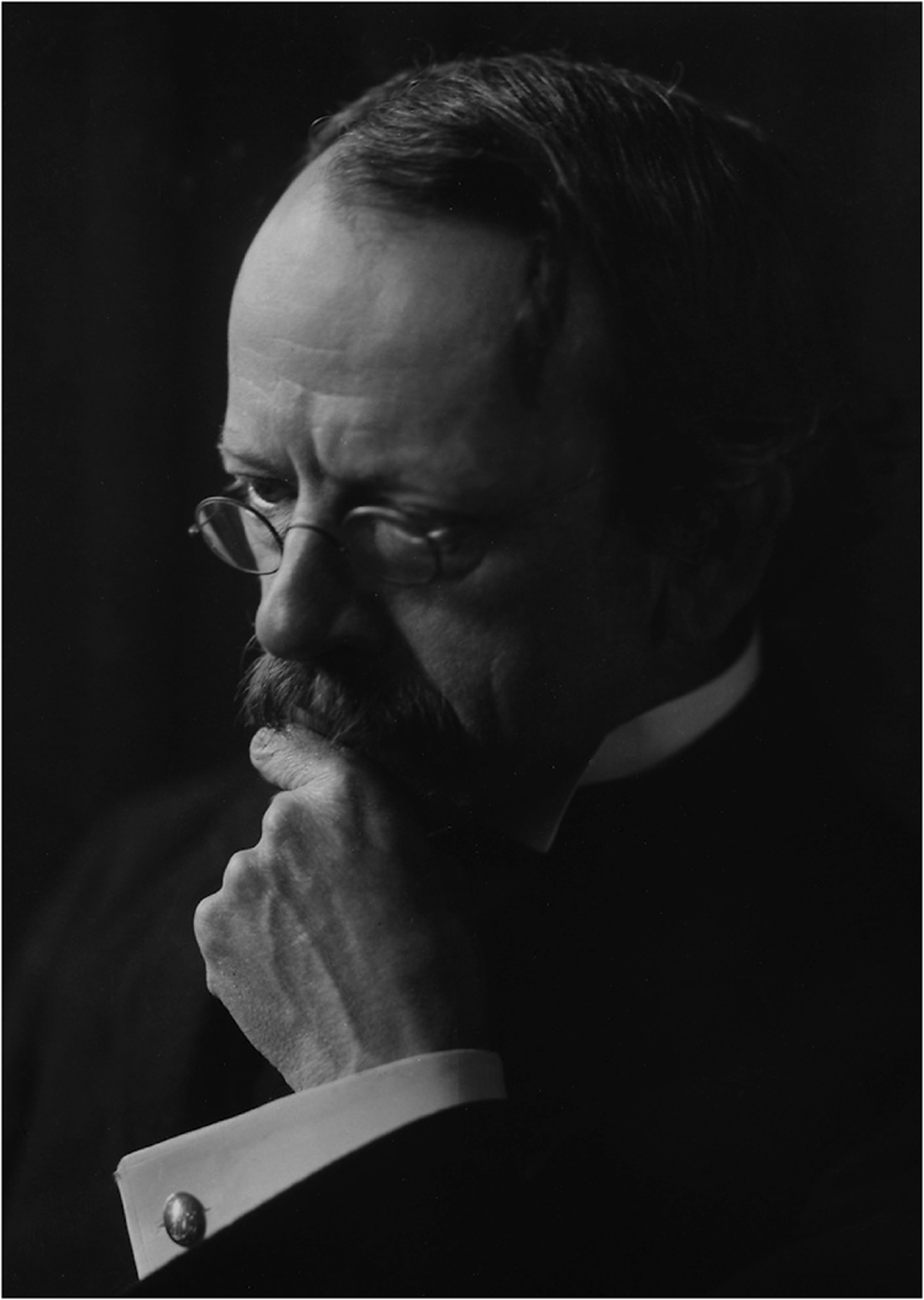
J.J. Thomson in contemplation, ca. 1895. Source: Emil Otto Hoppé Estate Collection.
Rayleigh has written that Thomson was fond of talking about psychical research, and was by no means out of sympathy with those who pursued it. His general tone on the subject was non-committal rather than ultra-sceptical. 6 He was also aware though that those demonstrating paranormal activity to men of science was a tall order, writing ‘the people who claim to produce them are very psychic and impressionable, and it may be as unreasonable to expect them to produce their effects when surrounded by men of science armed with delicate instruments, as it would for a poet to be expected to produce a poem while in the presence of a Committee of the British Academy’. 15
Footnotes
Declaration of conflicting interests
The author declares no potential conflicts of interest with respect to the research, authorship and/or publication of this article.
Funding
The author received no financial support for the research, authorship and/or publication of this article.
