






Abstract
Diabetes mellitus (DM) is an onset metabolic illness in which hyperglycemia occurs due to acquired or inherited impaired insulin production and ineffective action. Diabetes is frequently managed with the use of drugs, which may have adverse consequences even though they are good at regulating blood glucose levels. Herbal remedies are therefore being investigated as a substitute because of their reduced toxicity and fewer adverse effects. Using alloxan-induced diabetic rats, this work intends to investigate the possible anti-diabetic and anti-hyperlipidemic effects of ethanolic and aqueous leaf extracts of Celtis tetrandra Roxb. The antidiabetic activity was tested in 35 rats with diabetes induced by a single alloxan injection (140 mg·kg−1). Diabetic rats with blood glucose level (BGL >180 mg/100 mL) were treated with extracts (100 and 200 mg·kg−1) and glibenclamide (5 mg·kg−1) as a standard drug, and fasting BGL, lipid profiles, body weight, and pancreatic histopathology were assessed. The result was analyzed using SPSS software by one-way ANOVA, followed by Tukey's post hoc test, with p < 0.05 being a statistically reliable result. The ethanolic and aqueous leaf extracts of C. tetrandra (100 and 200 mg·kg−1) significantly reduced BGL, with the 200 mg·kg−1 ethanolic extract showing the most notable effect at day 21st. Lipid profiles improved, and pancreatic histopathology revealed increased β-cell regeneration. The preliminary study supported the use of leaf extracts from C. tetrandra as an herbal remedy for hyperglycemia and maintaining a normal level of lipids.
Introduction
Diabetes mellitus (DM) is an onset metabolic illness in which hyperglycemia occurs due to acquired or inherited impaired insulin production and ineffective action. Because insulin's activity is diminished, it impacts the metabolic control of biomolecules like lipids, carbohydrates, and proteins in the target organs (liver, skeletal muscles, and adipose tissue). 1 Thiazolidinedione, α-glucosidase inhibitors, sodium-glucose co-transporter 2 inhibitors, pioglitazone, sulphonylureas, biguanides, DPP-4 inhibitors, glibenclamide, and glipizide are among the various drugs used to treat diabetes; all but insulin are administered orally. 2 These drugs show severe side effects on human health, such as gastrointestinal problems including nausea, dyspepsia, diarrhea and vomiting, weight gain, risk of heart attack, bladder cancer, fluid retention, which cause peripheral edema as well, and hepatic problems. 3 Therefore, there is a need to overcome the issues associated with conventional drug usage. Several studies have indicated that herbal medicines are an alternative source to cope with diabetes with fewer adverse effects and low toxicity. As herbal plants possess many bioactive constituents such as alkaloids, flavonoids, saponins, terpenoids, polyphenols, and quinines, these bioactive compounds are found in fruits, vegetables, leaves, and bark. So, due to the presence of bioactive constituents, medicinal plants showed various properties, that as antidiabetic, antioxidant, anti-inflammatory, antitumor, antifungal, antibacterial, and antioxidant. 4 Plant-based products became a central player of all existing therapeutic approaches due to low cost and ease of availability, and are recommended to treat diseases, particularly DM. It also reduces the burden of charges for commercially available medicines to the population. 5 Ethnobotanical data from around the world have documented the application of ∼800 plants in managing DM. However, only 410 of these have been scientifically validated for their anti-diabetic properties, with a comprehensive understanding of the mechanism of action limited to just 109 plants. 6 Several medicinal plants showcased by Tran et al. 3 are effective in managing the complications of diabetes. For example, Momordica charantia (bitter melon) enhances glucose uptake and insulin sensitivity, while Gymnema sylvestre aids in regenerating pancreatic β-cells and lowering blood glucose. Additionally, Pterocarpus marsupium supports β-cell protection and insulin secretion, and Aloe vera improves insulin sensitivity while reducing lipid levels.
The Celtis genus, commonly referred to as hackberries, belongs to the family Cannabaceae, which has over 70 species that are found all over the world. These trees flourish in warm temperate areas across the Northern Hemisphere, Africa, Asia, the Americas, and spanning Europe. Celtis tetrandra Roxb. is identified as “Coh tar” in the Lawa village of Chiang Mai province and grows up to 20 m in height. Notably, there is a lack of information on the traditional medicinal uses of C. tetrandra, and there has been no research available on its phytochemical constituents. 7 In Turkey, four distinct types exist, namely Celtis planchoniana, Celtis austral, Celtis tournefortii Lam., and Celtis caucasica wild. Various parts of the Celtis plant, including its fruit, leaves, seeds, and gum, find applications in medicinal practices. Notably rich in vitamins E and B, as well as essential minerals like zinc, sodium, manganese, phosphorus, calcium, and potassium, this plant offers numerous health benefits. Its medicinal properties encompass reducing foot perspiration, facilitating wound healing, and aiding in the dissolution of kidney stones. Moreover, it serves as a cough suppressant, diuretic, salivation inhibitor, and stomach pain reliever. 8 Other Celtis species, like C. occidentalis, C. australis, and C. africana, are recognized for containing plant compounds with diverse and valuable pharmacological effects, including antioxidative, hypoglycemic, and cytotoxic properties. Whereas, C. integrifolia (African hackberry) is linked to addressing various health concerns, such as mental disorders, weakness, epilepsy, acting as a pain reliever, and providing treatment for conditions like chickenpox, measles, gout, and diarrhea. 9 This study's goal is to investigate the potential anti-diabetic and anti-hyperlipidemic effects of ethanolic and aqueous leaf extracts of Celtis tetrandra Roxb. This research involves in-depth in-vivo examinations to evaluate how these extracts normalize glucose levels in blood and various associated metabolic factors. Unlike our earlier research that emphasized on the cytotoxic, anti-inflammatory, and antimicrobial properties of Celtis tetrandra, the present research uniquely explores its antidiabetic and antihyperlipidemic potential, consequently exploring this medicinal plant's pharmacological profile.
Methodology
Plant sample collection and extraction
Leaves of Celtis tetrandra Roxb. were collected from the Botanical Garden of the Punjab University, Lahore. After being washed and allowed to air dry, the leaves were ground into a powder. A total of 30 g of dry powder were combined with 300 mL of distilled water, and the same amount was extracted using 300 mL of ethanol over the course of 72 h at 37 °C while being constantly shaken. Whatman filter paper No. 1 was then used to filter the extracts. Then, in a rotary evaporator set at 45 °C, the ethanolic and aqueous samples were evaporated under lower pressure. For later use, the concentrated extract was kept at 4 °C.10,11
Phytochemical analysis
Both of the extracts were exposed to different qualitative tests to identify the occurrence of bioactive components like flavonoids, saponins, tannins, terpenoids, alkaloids, phenolics, and steroids. 12
Experimental animals
The research was performed on healthy male Albino rats (n = 35) ranging from 150 to 200 g and 10–12 weeks old at the animal house, University of Veterinary and Animal Sciences’ Institute of Biochemistry and Biotechnology. Water and a standard pellet diet were given to the rats during the course of the study.
Diabetes induction
For the diabetes induction, the rats were first starved for 16 h. Then, physiological saline, which was used to dissolve alloxan monohydrate (140 mg·kg−1), was injected intraperitoneally. Blood glucose levels were examined following 72 h post-injection; rats having fasting blood sugar levels over 180 mg/100 mL were chosen for subsequent investigation. 13
Experimental cohorts
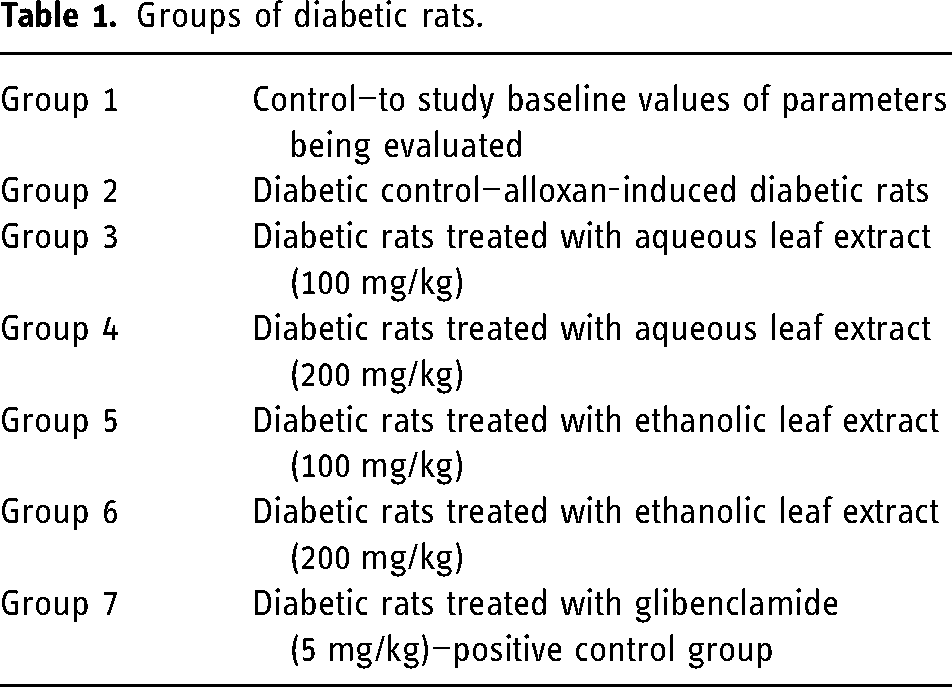
Rats having diabetes were categorized into seven cohorts, each containing five rats as stated in Table 1. 14
Groups of diabetic rats.
Hypoglycemic activity
The hypoglycemic activity was assessed through the measurement of fasting blood sugar levels on the first, seventh, 14th, and 21st days. Approximately 0.2 mL of blood was extracted from the tails of overnight fasted rats, and blood glucose concentrations were assessed with a glucometer. The rats’ body weight was recorded prior to and following the experiment.
Biochemical parameters
On the 21st day of the experimental period, anesthesia was administered using either a blend of xylazine (5–10 mg·kg−1) and ketamine (50–100 mg·kg−1) or isoflurane gas anesthesia (2%–3% in oxygen), with the amount adjusted according to the rat's weight, and blood samples were obtained from the heart vein via a venous puncher. The samples of blood were subsequently centrifuged at 3500 r/min for 10 min to acquire the serum. Biochemical parameters of lipid profile were measured by analyzing the serum for triacyl glycerides (TAGs), low-density lipoprotein (LDL), very low-density lipoprotein (VLDL), high-density lipoprotein (HDL), and total cholesterol. 15
Histopathological analysis
Histopathology of the pancreas was performed to examine the changes in the architecture of pancreatic cells after treatment. Initially, the rats were anesthetized with ketamine and xylazine combination as mentioned above, and then the peritoneum was broken down, and the pancreas was extracted and preserved in a 10% formalin solution for subsequent processing. 16
Gas chromatography-mass spectrometry (GC/MS)
GC/MS was performed to detect the presence of bioactives from C. tetrandra leaf extract. A small volume of the extract was injected into the column, using only few microliters. Helium gas served as the carrier gas, flowing at a range of 1 mL/min. To show the name, structure, and peak area for each component determined by its retention time, the generated data was arranged in a table which is already published. 17
Statistical evaluation
The findings were evaluated employing SPSS software (version 20) as mean standard error (mean ± SEM) by one-way ANOVA, with a significant p-value of <0.05.
Results and discussion
Analysis of phytochemicals
The existence of alkaloid compounds, tannins, saponins, flavonoids, terpenoids, steroids, phenolics, and glycosides was observed in the ethanolic extract of C. tetrandra, according to phytochemical profiling. In contrast, there were no steroids, flavonoids, terpenoids, or glycosides in the aqueous extract, but there were saponins, phenolics, tannins, and alkaloids.
Hypoglycemic effect of the C. tetrandra leaf extract
The hypoglycemic impacts for both aqueous and ethanolic leaf extracts of C. tetrandra were assessed, with the resultant decrease in blood glucose levels illustrated in Figure 1. The glucose levels in blood were assessed on the first, seventh, 14th, and 21st days. The results indicated a substantial decrease in blood sugar levels after the use of aqueous and ethanolic extracts at a dosage of 200 mg·kg−1 in comparison to the usual medication (glibenclamide). The ethanolic extract at a dosage of 100 mg·kg−1 showed a decrease in blood glucose levels of 290.25, 196.5, 139, and 92 mg/100 mL on the first, seventh, 14th, and 21st days, respectively, (p < 0.05) (Table 2).
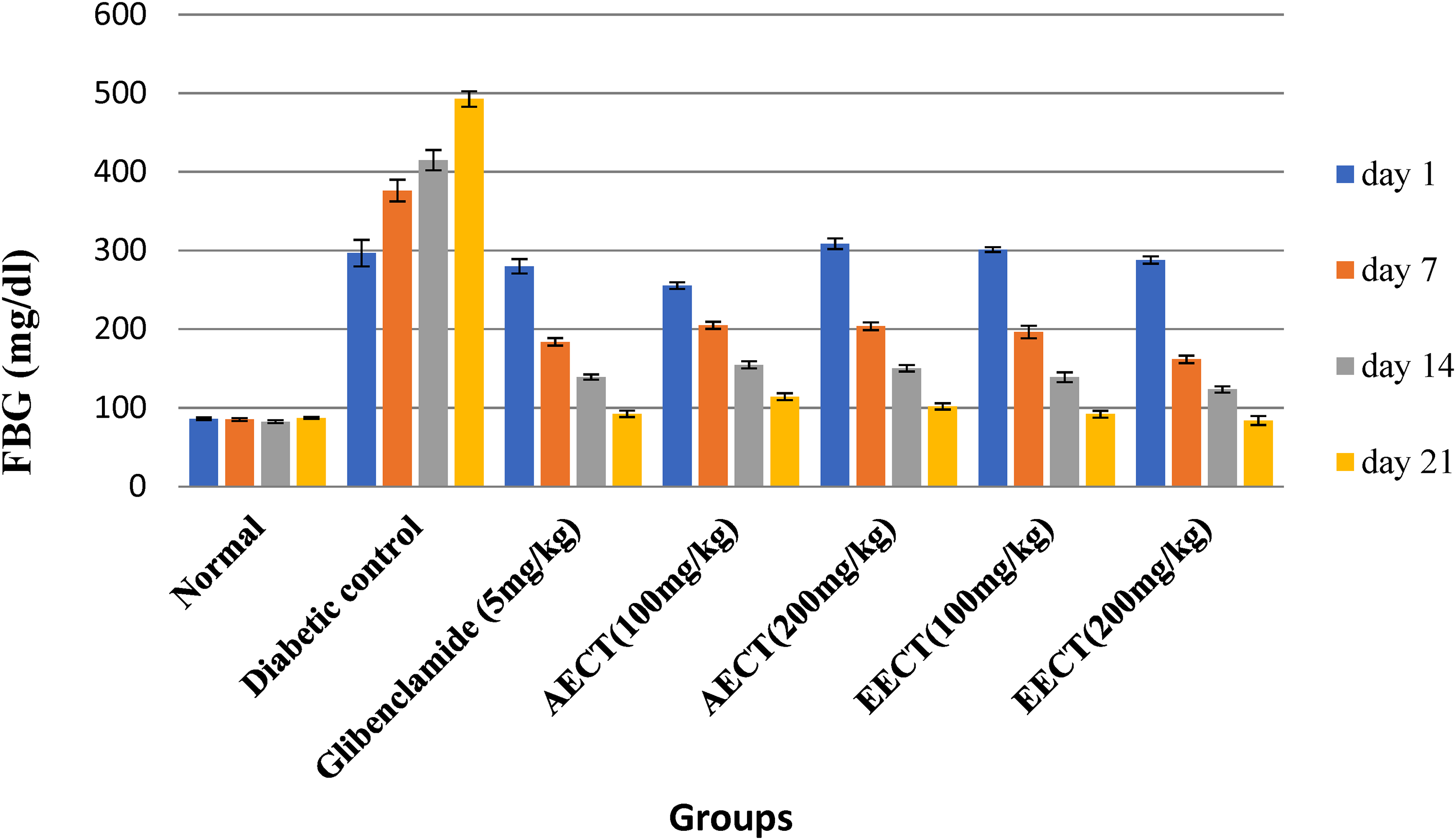
Fasting blood glucose concentrations at first, seventh, 14th, and 21st days (AECT: aqueous extract of C. tetrandra; EECT: ethanolic extract of C. tetrandra).
Effect of C. tetrandra leaf extracts on blood sugar level in diabetes induced rats.

Data display the means ± SEM, n = 5, blood glucose level at different time intervals relative to diabetic control (p < 0.05). AECT: aqueous leaf extract of C. tetrandra; EECT: ethanolic leaf extract of C. tetrandra.
Results highly comparable to the control group.
Results significantly different from the control group.
Conversely, administration of the aqueous extract at 100 mg/kg failed to produce significant effects, that is, 114.25 mg/100 mL. Glibenclamide demonstrated a remarkable decline in blood glucose level by 280–92.5 mg/100 mL. Similar activity has been reported for Celtis philippensis Blanco and Celtis zenkeri Engl, and a decline in blood sugar levels was observed at 200 mg·kg−1 on days 11th and 14th, respectively.11,14
Impact of leaf extracts on biochemical parameters
Table 3 shows significant improvements in lipid profile parameters, including total cholesterol, triglycerides, LDL, HDL, and VLDL, compared to normal rats. The ethanolic extract at dosages of 100 and 200 mg·kg−1 effectively reduced total cholesterol (123.75 and 106.75 mg/100 mL), triglycerides (109.7 and 78.75 mg/100 mL), LDL (46.5 and 34.5 mg/100 mL), and VLDL (22.5 and 19 mg/100 mL) to within normal ranges. Additionally, the ethanolic extract increased HDL levels toward normal ranges (38.75 and 48.5 mg/100 mL) at the end of the treatment. The aqueous extract at a dosage of 200 mg·kg−1 increased HDL levels near the normal range (33 mg/100 mL), while the 100 mg·kg−1 dose did not show noteworthy effects. Both concentrations of the aqueous extract (100 and 200 mg·kg−1) resulted in slight reductions in total cholesterol, triglycerides, LDL, and VLDL levels. Overall, the ethanolic extract demonstrated superior efficacy compared to the aqueous extract in improving the lipid profile. Celtis philippensis Blanco extracts had similarly been reported to reduce triglycerides, total cholesterol, LDL, VLDL, and increase HDL levels at 200 mg·kg−1. 11 In addition to, Kong et al. 18 reported on the hypolipidemic effects of Exocarpium Citri Grandis, evaluating its impact on the lipid profile. Their findings indicated that flavonoid extracts from Exocarpium Citri Grandis increased HDL levels and reduced total cholesterol, triglycerides, and LDL levels in diabetic mice.
Effect of leaf extracts of C. tetrandra on lipid profile in diabetic rats.

Data display the means ± SEM, n = 5, lipid profile relative to diabetic control (p < 0.05). AECT: aqueous leaf extract of C. tetrandra; EECT: ethanolic leaf extract of C. tetrandra; TC: total cholesterol; TG: triglyceride; HDL: high-density lipoprotein; LDL: low-density lipoprotein; VLDL: very low-density lipoprotein.
Results highly comparable to the control group.
Results significantly different from the control group.
Effect of the Celtis tetrandra extracts on histopathological analysis
Figure 2 presents the histological photomicrographs of the pancreas from all groups. The histopathological examination of the pancreas in the normal group (Figure 2(A)) revealed islet cells with a typical oval morphology in the center (arrow), situated within the exocrine region of the pancreas. The pancreas of the diabetic group (Figure 2(B)) exhibited congestion in both the islets at the center (arrow) and the acini. In contrast, the pancreas of rats treated with glibenclamide (Figure 2(C)) showed normal Islets of Langerhans in the center (arrow). The pancreas of rats treated with the aqueous extract dose of 100 mg·kg−1 (Figure 2(D)) demonstrated congestion of the Islets of Langerhans and acini (arrow). Rats given the aqueous extract at a dose of 200 mg·kg−1 (Figure 2(E)) showed mild atrophy of islet cells (arrow) in their pancreas. However, as illustrated in Figure 2(F) and (G), the ethanolic extract at dosages of 100 mg·kg−1 and 200 mg·kg−1 caused the pancreatic Islets of Langerhans (arrow) to function normally and the β-cells to regenerate. A histological analysis of the pancreas by Satyanarayana et al. 19 showed that rats given ethanolic extract of Solanum torvum fruit at doses of 120, 160, and 200 mg·kg−1 had an increase in the size, number, and regeneration of β-cells in the islets of Langerhans. Histopathology was done on pancreas treated with methanolic extract of Celtis zenkeri at doses of 250, 500, and 1000 mg·kg−1. 14
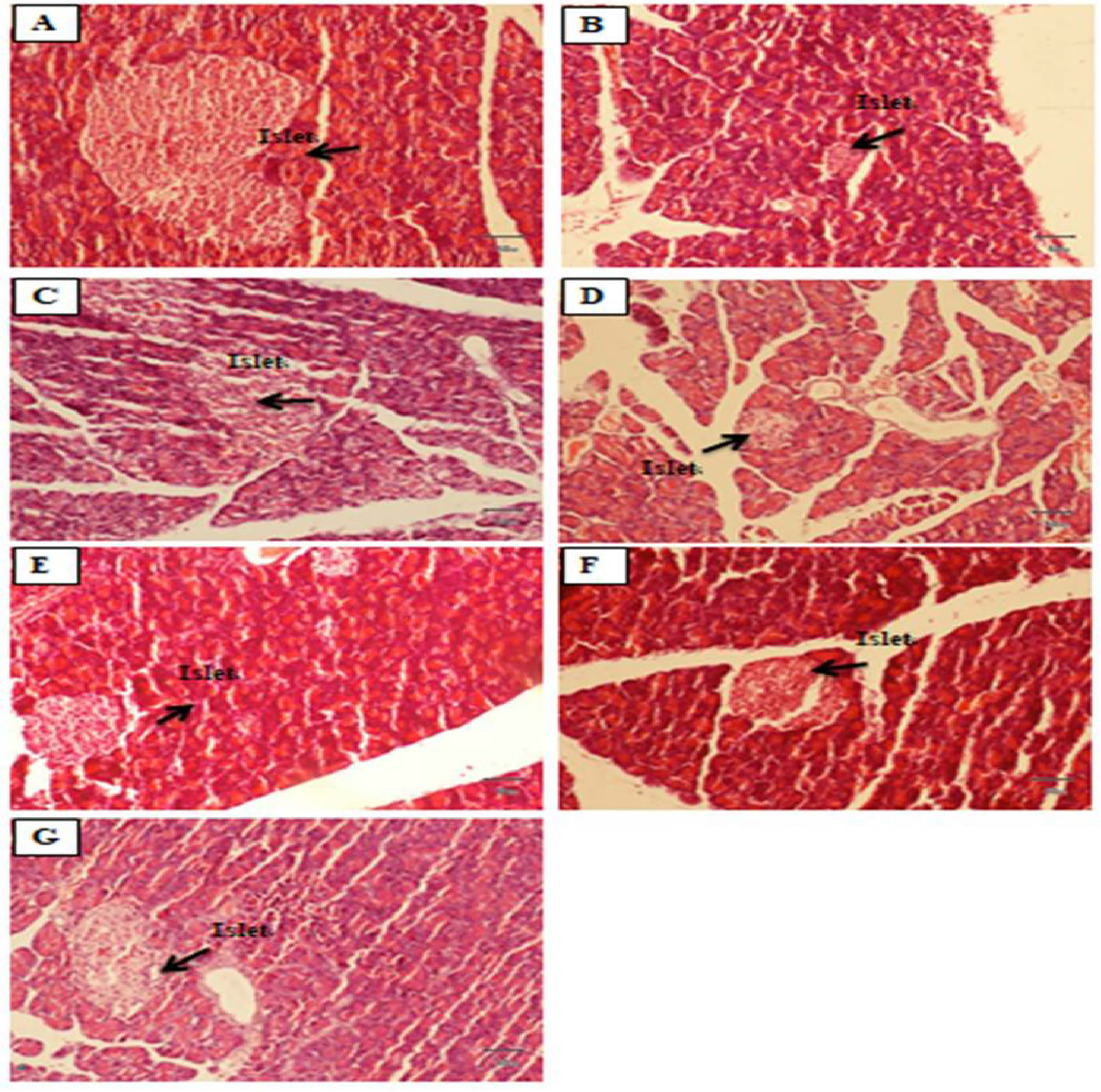
Histopathological microscopy images of the pancreas (magnification 40 ×) H&E stained: (A) normal, (B) diabetic rats, (C) diabetes induced rats + glibenclamide 5 mg·kg−1, (D) diabetes induced rats + 100 mg·kg−1 aqueous extract, (E) diabetes induced rats + 200 mg·kg−1 aqueous extract, (F) diabetes induced rats + 100 mg·kg−1 ethanolic extract, and (G) diabetes induced rats + 200 mg·kg−1 ethanolic extract.
The results demonstrated the regular Langerhans Islands and regeneration of β-cells at dosages of 250 and 500 mg·kg−1.
Impact of leaf extracts from C. tetrandra on body weight
Body weight was measured prior to and following treatment. When EECT was administered at 200 mg·kg−1, EECT at 100 mg·kg−1 and AECT at 200 mg·kg−1, and AECT at 100 mg·kg−1, respectively, the improvements in body weight were noted at day 21 (30.26%, 16.67%, 14.05%, and 9.16%; Table 4). Consequently, the ethanolic extract showed efficacy equivalent to that of the reference medication (glibenclamide) at a dosage of 200 mg·kg−1. In contrast, diabetic control rats lose 20.63% of their body weight at the conclusion of treatment, whereas normal rats gain 9.86%. Celtis philippensis Blanco chloroform, ethyl acetate, ethanolic, and aqueous extracts had similarly been reported to increase in body weight by 16.57%, 17.14%, 18.86%, and 14.29% on the 11th day at a dose of 200 mg·kg−1, respectively. 11
Effect of C. tetrandra extracts on body weight in alloxan-induced diabetic rats.

Data display the means ± SEM, n = 5, body weight before and after treatment relative to diabetic control (p < 0.05). AECT: aqueous leaf extract of C. tetrandra, EECT: ethanolic leaf extract of C. tetrandra.
Results highly similar to the control group.
Results significantly different from the control group.
GC/MS of ethanolic leaf extract
In GC/MS results, six compounds were detected, and these compounds are n-hexadecanoic acid, phytol (polyphenol), 9,12-Octadecadienoic acid, catechins (flavanol), squalene (triterpene), and γ-sitosterol (sterol). 17 Similarly, another study performed GC/MS of Celtis zenkeri leaf extract and found 14 compounds, that is, 2-pyrrolidinone, 1-methyl-, trans-3-Cyclopropyl-7-(2-methoxyethyl) norcarane, benzoic acid, undec-10-ynoic acid, octacosyl heptafluorobutyrate, hexacosyl heptafluorobutyrate, 3-hexadecyne, hexadecanoic acid, 9,12,15-octadecatrienoic acid, and hexadecane. 14 Another study of Cho et al. 20 reported that catechins extracted from Dioscorea bulbifera tubers exhibited hypoglycemic activity, resulting in a 41.62% reduction in blood glucose level. Widyawati et al. 21 demonstrated the antihyperglycemic activity and pancreatic protective effects of squalene in rats with diabetes induced by streptozotocin.
The results revealed a considerable decrease in blood glucose levels by 85.2 mg/100 mL on day 14, along with the restoration of damaged pancreatic islet cells.
Conclusion
The findings indicated that the examined plant contains bioactive compounds with medicinal properties. At higher doses, both extracts of C. tetrandra and the standard drug (glibenclamide) showed hypoglycemic effects and improvements in lipid profiles. Additionally, bioactive demonstrated tissue protection capabilities. These findings suggest that these extracts could potentially safeguard against biochemical and histological changes in pancreatic β-cells in alloxan-induced diabetic rats. The plant-derived extracts hold potential as a valuable source for developing therapeutic drugs. Further studies are needed to establish the optimal dosage of Celtis tetrandra Roxb. required for effective treatment. Additionally, it is recommended to conduct more research to better understand the extracts’ mechanism of action.
Footnotes
Funding
The authors received no financial support for the research, authorship, and/or publication of this article.
Declaration of conflicting interests
The authors declared no potential conflicts of interest with respect to the research, authorship, and/or publication of this article.
