







Abstract
Electron-induced ionisation cross-sections and corresponding ionisation rate coefficients have been evaluated for the C₂F₆ molecule. Evaluated results by using the Jain–Khare semi-empirical approach of the total ionisation cross-section showing good agreement with presently available theoretical and experimental data sets. Single differential cross-sections have also been calculated for the first time at fixed incident electron energies of 100 and 200 eV. Double differential cross-sections (DDCS) have also been calculated for the first time at fixed incident electron energies of 100 and 200 eV with fixed incident angles of 30° and 60°. Three-dimensional profiles of DDCS, varying with angle and secondary electron energy, have also been generated.
Keywords
Introduction
Electron-impact ionisation of the C₂F₆ molecule (hexafluoroethane) is significant across various scientific and industrial fields due to its unique chemical properties and its response to electron bombardment. Understanding plasma and atmospheric chemistry, investigating molecular fragmentation dynamics, and developing semi-conductor technology all depend on electron-impact ionisation of C₂F₆. It contributes to understanding the behaviour of this fluorinated molecule under energetic conditions, with implications for both basic science and industrial applications. C₂F₆ is widely used in semi-conductor manufacturing for plasma etching and cleaning. Controlling plasma chemistry, minimising residue, and improving etching precision are all made easier by knowing how it ionises when struck by electrons. C₂F₆ is a greenhouse gas. It interacts with upper-atmosphere electrons, which can alter chemical degradation pathways and the radiative balance. In atmospheric investigations, ionisation data aid in modelling its lifetime and breakdown mechanisms. A standard procedure for investigating energy transfer, molecular dissociation, and the kinetics of C–F versus C–C bond cleavage is electron-impact ionisation. Understanding ionisation processes helps one better comprehend radiative damage in biological tissues, particularly when fluorinated substances are involved.1,2
Ionisation processes of C₂F₆ are essential in various fields, such as plasma physics, and have been studied by multiple researchers, including H. Poll and R. Meischner, 1 who use a semi-empirical model to determine partial cross-sections for dissociative ionisation. Specifically, they apply a method based on experimental total ionisation cross-sections (TICS) and branching ratios derived from mass spectrometric data. L.G. Christophorou and J.K. Olthoff 2 focus on electron attachment and ionisation in perfluoroalkanes, including C₂F₆, using pulsed Townsend techniques. Nishimura et al. 3 present both experimental (a parallel-plate condenser-type apparatus) and theoretical (Binary-Encounter-Bethe (BEB) model) TICS for C₂F₆ over an incident electron energy range from threshold to 3 kev. Jiao et al. 4 report partial ionisation cross-sections (fragment-resolved), which help construct a sum-of-partials total and check fragment branching ratios. The paper by Yong-Ki Kim and Karl K. Irikura 5 presents calculated ionisation cross-sections for the C2F6 molecule using the BEB model. The Deutsch–Märk (DM) formalism 6 (semi-empirical) provided a database of ionisation cross-sections for the C₂F₆ molecule. Bart et al. 7 measured absolute TICS for C₂F₆ over an electron energy range of 20 to 200 eV. Basner et al. 8 measured absolute partial ionisation cross-sections for several fragment ions of C₂F₆ from threshold to 900 eV using a time-of-flight technique. Iga et al. 9 employed an experimental model in their research on electron–hexafluoroethane (C₂F₆) collisions, utilising a crossed electron–molecular beam technique combined with the relative flow method. Antony et al. 10 presented calculated TICS for electron impact on various fluorocarbon molecules and radicals using the spherical complex potential formalism. Flaherty et al. 11 reported absolute TICS for electron impact on C₂F₆ over the energy range of 13 to 300 eV. Gupta et al.12,13 presented both experimental measurements and theoretical calculations for the TICS of C₂F₆, using advanced models. Patrick A. Robertson et al. 14 employed advanced imaging techniques to investigate the dynamics of electron-ionisation of C₂F₆. They identified various fragment ions (e.g. CF₃+, CF₂+, C+, F+) and mapped dissociation pathways, revealing differences in the energetics of C–C versus C–F bond cleavage.
The electron-induced ionisation cross-sections and associated ionisation rate coefficients of the C₂F₆ molecule have been evaluated in this study. The results from the Jain–Khare semi-empirical technique15–19 for TICS showed good agreement with existing experimental and theoretical datasets.1–13 For the first time, single-differential cross-sections (SDCS) at fixed incident electron energies of 100 and 200 eV have been computed. Additionally, double-differential cross-sections (DDCS) were calculated at incident angles of 30° and 60°, and at fixed incident electron energies of 100 and 200 eV. Moreover, three-dimensional (3D) profiles of DDCS have been generated, illustrating variation with secondary-electron energy and angle. These results are highly significant in atmospheric and plasma sciences.
Theoretical and input data
The total SDCS by using the modified Jain–Khare semi-empirical approach15,16 are given by
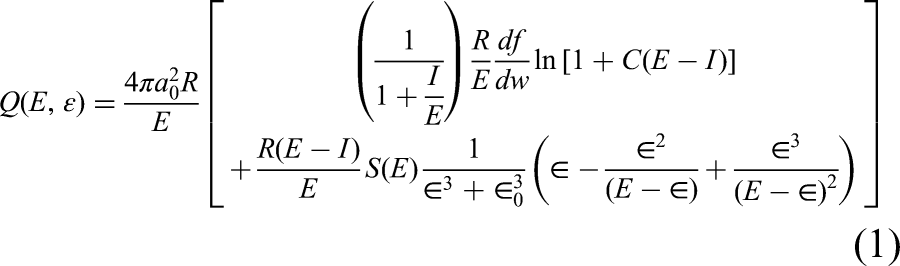
The total integral ionisation cross-sections have been evaluated integration of equation (1) with respect to secondary electron energies or energy loss, that is
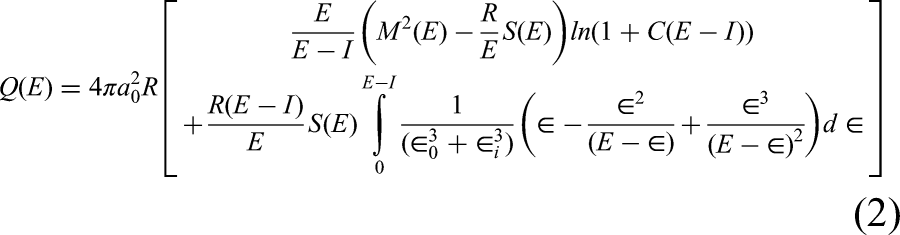
Ionisation rate coefficients of the TICS using the Maxwell–Boltzmann distribution law
20
have also been provided by, that is,

For the evaluation of DDCS as a function of energy loss suffered by secondary electrons and angle of incidence, we have used a formula derived by Kumar et al.
17
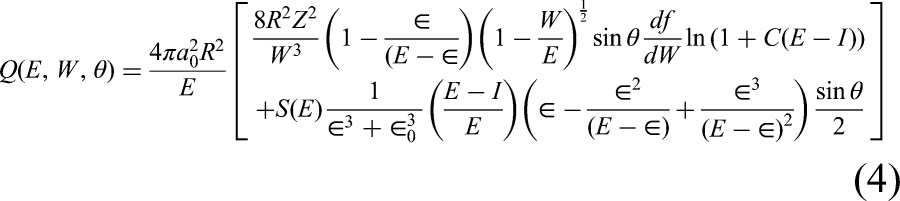
In all the above equations, W (=
To extend the present calculation of TICS at high energies up to 5 keV, we used the Born–Bethe formulation,
21
where the following relation can approximate the cross-sections

In equation (5), quantities A and B are the fitting parameters. In the present theoretical approach, the ionisation potential I and the oscillator strength

For photon energies from the ionisation threshold (I = 15.4 eV) to 60 eV, the oscillator strengths are generated by the addition rule, and for higher energies, extrapolation has been extended up to 5 keV using the Thomas–Reike–Kuhn (TRK) model 19 with a 5% experimental uncertainty. However, its evaluation is possible quantum mechanically using appropriate wave functions and transition probabilities for cation production. The collision parameter C (=0.065/eV) and energy parameter ε0 (=45 eV) are evaluated as for other polyatomic molecules.15–19 In current evaluations of cross-sections, the estimated uncertainty is approximately the same as that for photo-ionisation cross-section measurements.
Results and discussion
The ionisation processes of hexafluoroethane (C₂F₆) have been extensively studied due to their relevance in plasma processing, atmospheric chemistry and radiation physics. Here is a synthesis of how various researchers and models have contributed to our understanding of C₂F₆ ionisation.
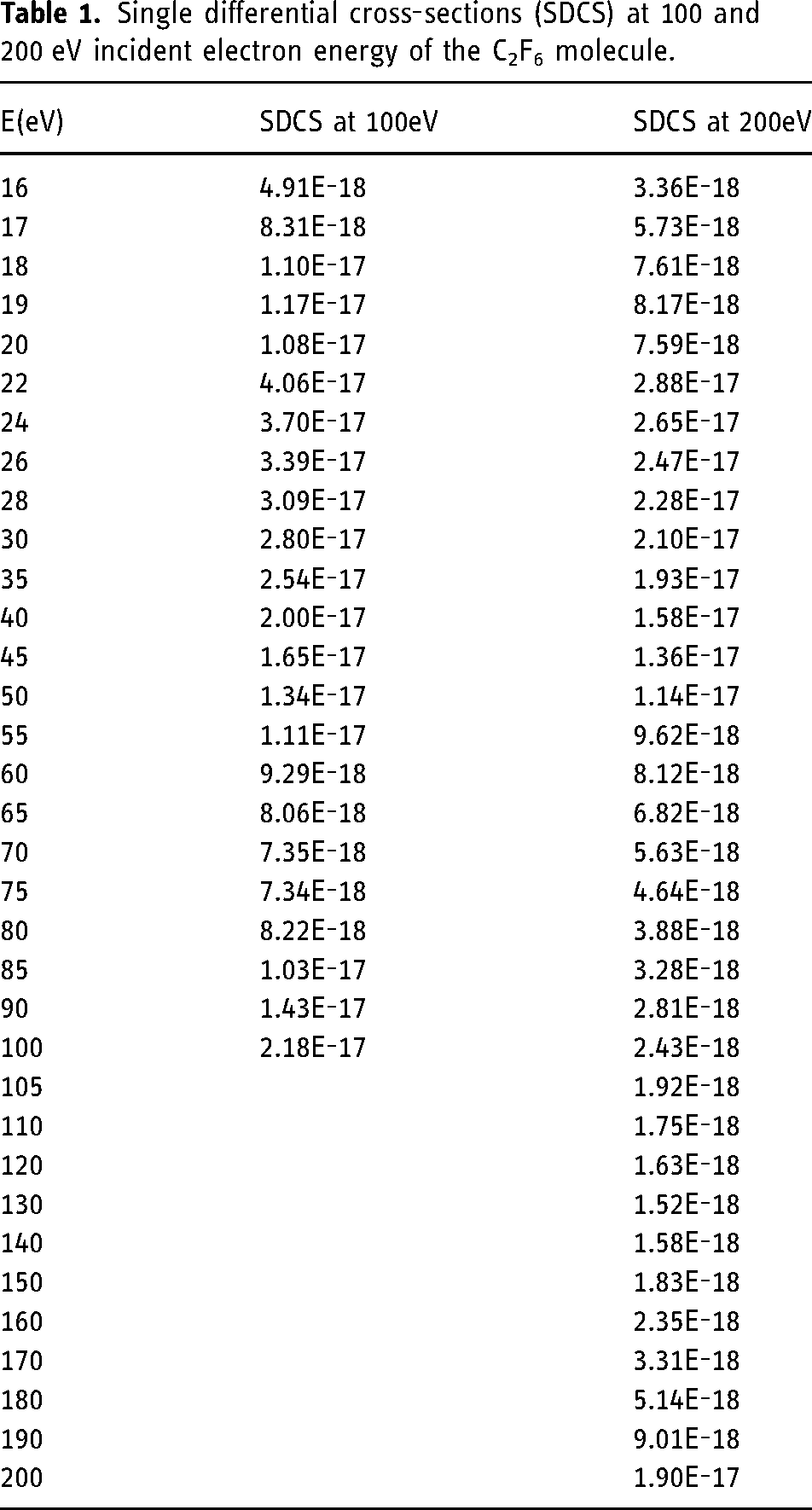
The total SDCS have been evaluated by differentiating equation (1) for the C2F6 molecule with respect to the secondary electron energy or the energy loss of the primary electron. The graph in Figure 1 and numerical data in Table 1 show the results of SDCS for incident energies of 100 and 200 eV. Two curves correspond to incident electron energies of 100 (blue) and 200 eV (orange), respectively. Both curves start high, indicating that low-energy secondary electrons are produced most frequently. The SDCS is at a maximum here because energy transfer is more likely at low secondary energies. As W increases, SDCS decreases sharply, reaching a minimum in the mid-range of W values. This indicates that medium-energy secondary electrons are less likely to be emitted. Both curves show a slight rise again at higher W, due to binary collision events, where the incident electron transfers most of its energy to a secondary one. The 200 eV curve generally shows higher SDCS values than the 100 eV curve, especially at higher W, indicating that higher incident energy increases the probability of producing energetic secondary electrons.
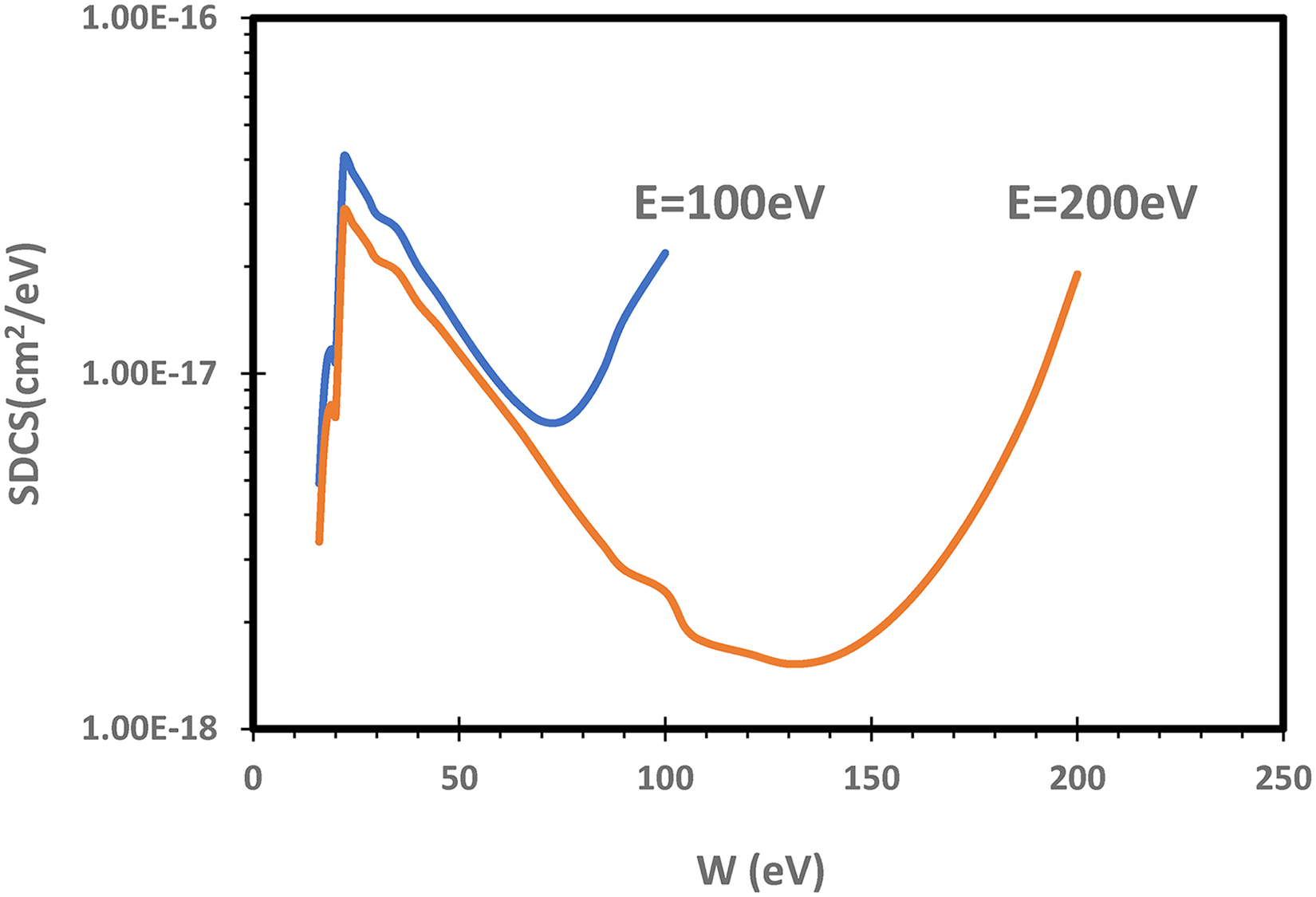
Total single differential cross-sections (SDCS) for incident energies of 100 and 200 eV.
Single differential cross-sections (SDCS) at 100 and 200 eV incident electron energy of the C2F6 molecule.
H. Poll and R. Meischner 1 laid the innovative approach, which was rooted in experimental TICS and branching ratios derived from mass spectrometric data. L.G. Christophorou and J.K. Olthoff 2 further advanced our understanding by investigating electron attachment and ionisation in perfluoroalkanes, including C₂F₆, using pulsed Townsend techniques. Their work provided essential data on ionisation coefficients and dissociation pathways. Meanwhile, H. Nishimura et al. 3 made a significant contribution to their study by presenting theoretical TICS for C₂F₆ across a range of electron energies from threshold to 3 keV, using the BEB model. Their theoretical cross-sections were calculated using correlated molecular wave functions—demonstrating a thoughtful integration of theory and practice. Jiao et al. 4 reported partial ionisation cross-sections (fragment-resolved), which help construct a sum-of-partials total and for checking fragment branching ratios. TICS of the C₂F₆ molecule are evaluated at 70 eV; the maximum value is 8.9 × 10⁻¹⁶ cm2. Yong-Ki Kim and Karl K. Irikura 5 presented calculated ionisation cross-sections for the C₂F₆ molecule using the BEB model. The semi-empirical DM model 6 provides a reliable analytical description of TICS for C₂F₆. Bart et al. 7 measured absolute TICS for various perfluorinated hydrocarbons, including C₂F₆, using time-of-flight mass spectrometry within a well-calibrated electron-beam framework, highlighting the strengths of precision measurement techniques. Moreover, Basner et al. 8 achieved remarkable success in measuring absolute partial and TICS for several fragment ions of C₂F₆ and itself over an impressive energy range of up to 900 eV using a time-of-flight method. Iga et al. 9 advanced the field further by employing a crossed electron-molecular beam technique combined with the relative flow method in their study of electron–hexafluoroethane (C₂F₆) collisions, showcasing innovation in experimental design. The theoretical TICS were calculated by B. K. Antony et al. 10 using the complex optical potential and additivity rule methods. The Flaherty et al. 11 report absolute TICS for electron impact on C₂F₆ over the energy range 13 to 300 eV by a system that comprises an electron beam, a sealed and calibrated gas cell, continuous pressure monitoring, and fragment adsorption to ensure unbiased and quantitative dissociation measurements for electron induced dissociation processes. Recently, D. Gupta et al.12,13 provided insights using groundbreaking models, including the BEB model. BEB model using various orbital parameters calculated from restricted/unrestricted Hartree-Fock and Density Functional Theory. All the targets were optimised to their minimal structures and energies using several ab initio methods with the aug-cc-pVTZ basis set. Some data from the BEB model, as calculated by D. Gupta et al., do not agree with available datasets, except for the Hartree-Fock method; therefore, we include the Hartree-Fock method in our comparison.
Patrick A. Robertson et al. 14 took a fascinating approach by using advanced imaging techniques to delve into the dynamics of electron-ionisation of C₂F₆, successfully identifying various fragment ions such as CF₃+, CF₂+, C+ and F+, and illuminating the differences in energetics between C–C and C–F bond cleavages. This collective body of work not only advances our understanding of C₂F₆ but also highlights the vibrant community dedicated to this field of research.
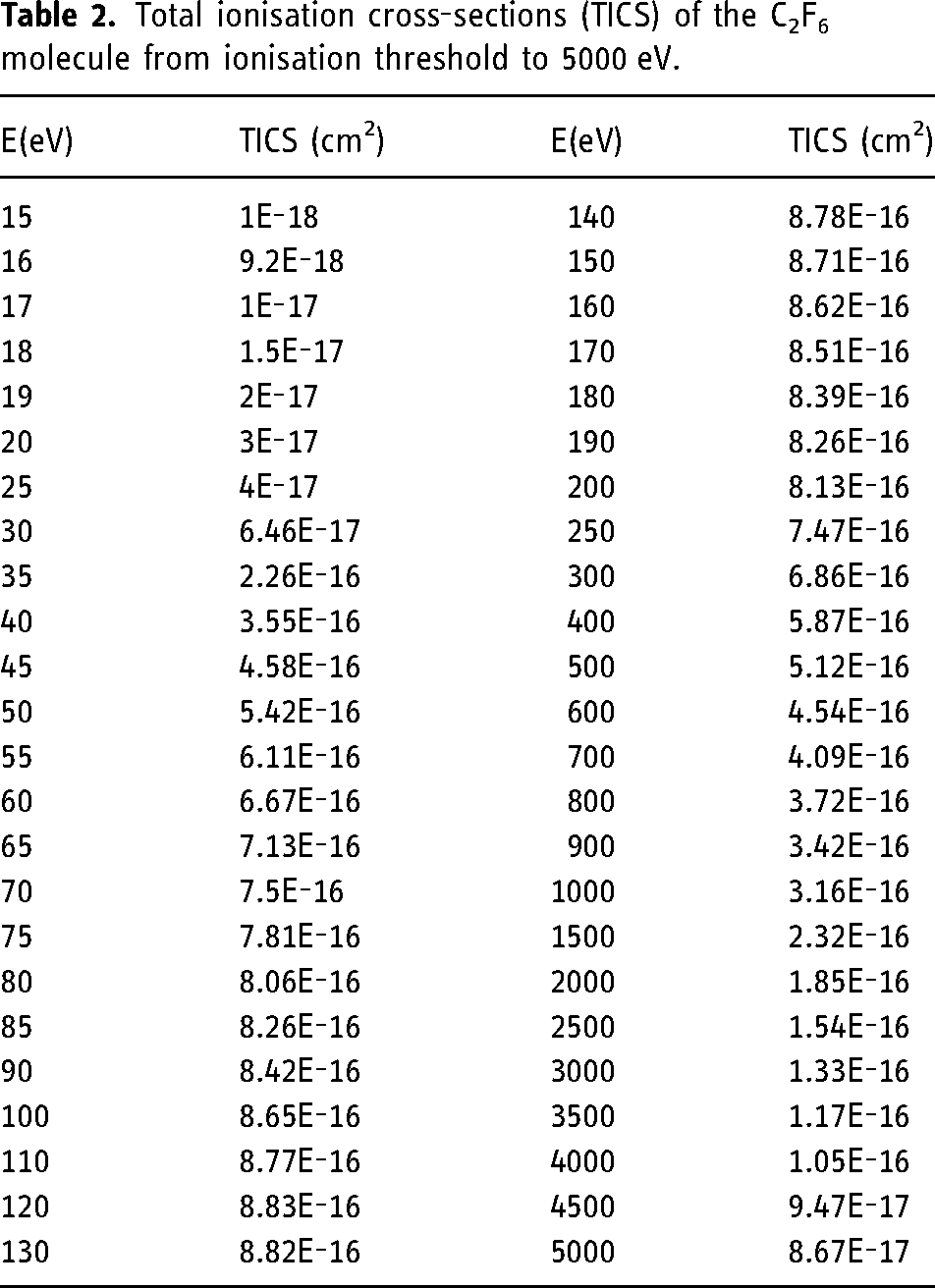
The total electron-induced ionisation cross-sections of the C₂F₆ molecule have been evaluated using the modified Jain–Khare semi-empirical approach15–20 and compared with available theoretical and experimental datasets.1–13 The Jain–Khare model is a theoretical, semi-empirical method for calculating ionisation cross-sections. It typically combines with the Bethe theory for low-energy behaviour and the Mott approximation for high-energy limits. Empirical fitting parameter used to match experimental data. In Figure 2(a), the black line shows the Jain–Khare prediction over a broad energy range, up to 5000 eV. The numerical results of TICS are also given in Table 2. In the sub-threshold and threshold regions, the present Jain–Khare formulation exhibits a smooth onset, consistent with the findings of Iga et al. 9 and the threshold recommended by Christophorou and Olthoff. 2 The sharp rise reflects the opening of ionisation channels as electrons gain enough energy to eject bound electrons. Some older semi-empirical curves5,6 (DM and BEB) may exhibit slightly sharper or less smooth onsets; the current Jain–Khare approach aligns with Iga's 9 measured smooth rise, making it preferable for near-threshold modelling. In low-to-intermediate energies (20–50 eV), there is early growth towards the peak, with sensitivity to orbital binding energies and post-collision corrections. The present Jain–Khare approach closely matches the experimental datasets1,7,8 and the theoretical BEB/DM curves5,6 in this region. Minor scatter among experiments is expected; this approach remains within the experimental scatter band. In the peak region (50–200 eV; peaking around 70–140 eV), the current results show a maximum near 120 eV with a magnitude of approximately 8.8 × 10⁻¹⁶ cm2, consistent with datasets2,5–8,11,12 within this range. At these energies, electrons efficiently penetrate molecular orbitals, maximising ionisation yield. Physically, this is where the balance between available energy and collision probability is optimal. Differences from individual datasets are minor—generally within ±5–10%—and fall well within experimental uncertainties, demonstrating excellent quantitative agreement. In the high-energy region (>200 eV), the Jain–Khare model accurately reflects the expected Bethe-like decline and aligns with both theoretical and experimental trends up to 5 keV. The cross-section decreases gradually, following an approximate 1/E dependence. At very high energies, electrons pass through too quickly, reducing their probability of interaction.
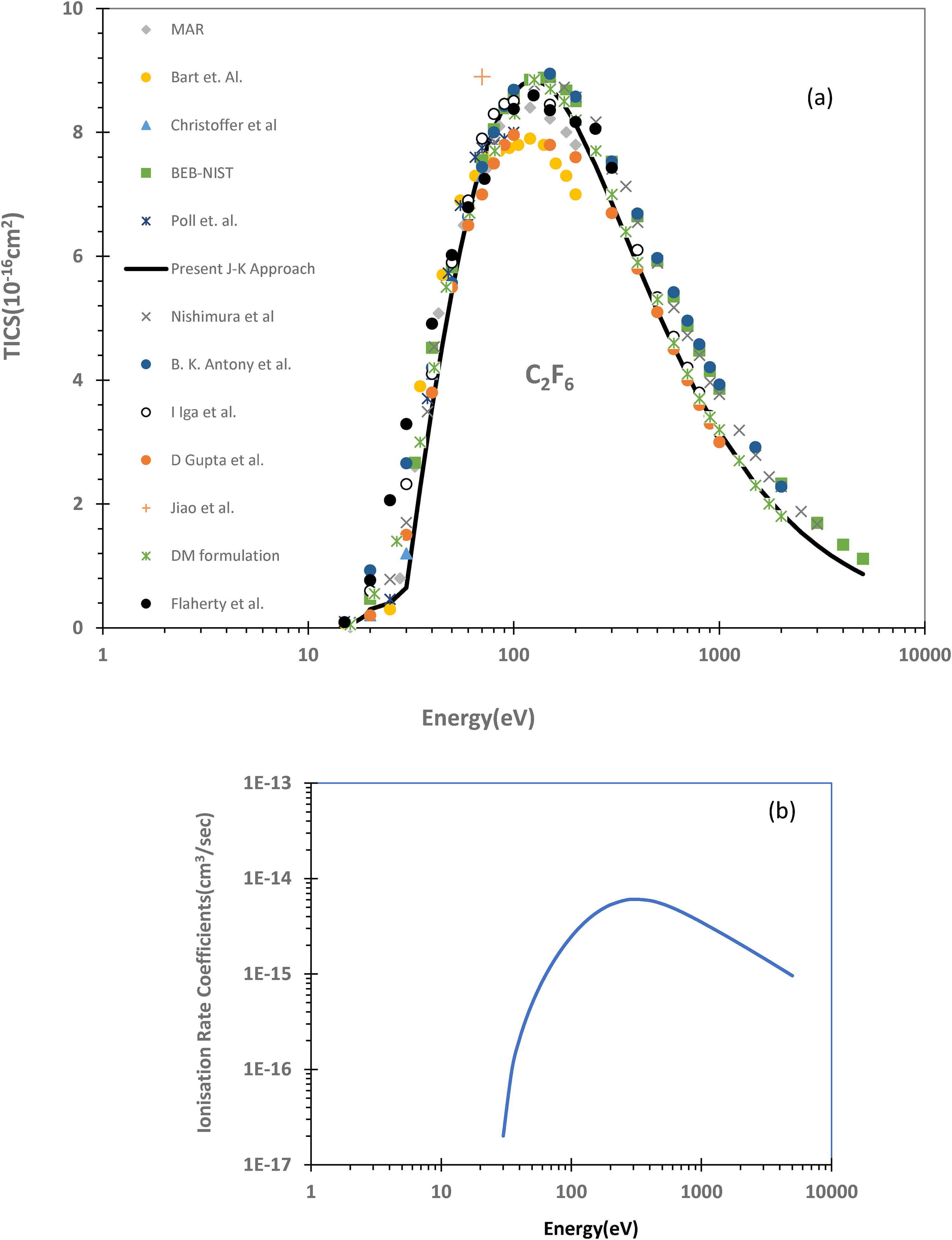
Total ionisation cross-sections (TICS) of the C2F6 molecule from ionisation threshold to 5000 eV.
The results align with most experimental datasets within the error bars, suggesting that it is a reliable predictive model. We have also studied the variation of Qmax with
The total DDCS at fixed angles of 30° and 60° and incident energies of 100 and 200 eV have been evaluated. The results are shown in Figure 3. At θ = 60°, the DDCS values are consistently higher than at θ = 30°, indicating that electrons are more likely to scatter with either lower or higher energy loss at larger angles. As W increases, DDCS decreases sharply, reaching a minimum around mid-range W values, suggesting that inelastic scattering is less likely in this range. The graph likely reflects how electrons interact with atoms or molecules, losing energy through ionisation or excitation. Larger scattering angles correspond to greater momentum transfer, which aligns with higher DDCS values. Such graphs help characterise the electronic structure and response of materials to electron bombardment, which is crucial in plasma physics, surface analysis and radiation chemistry.
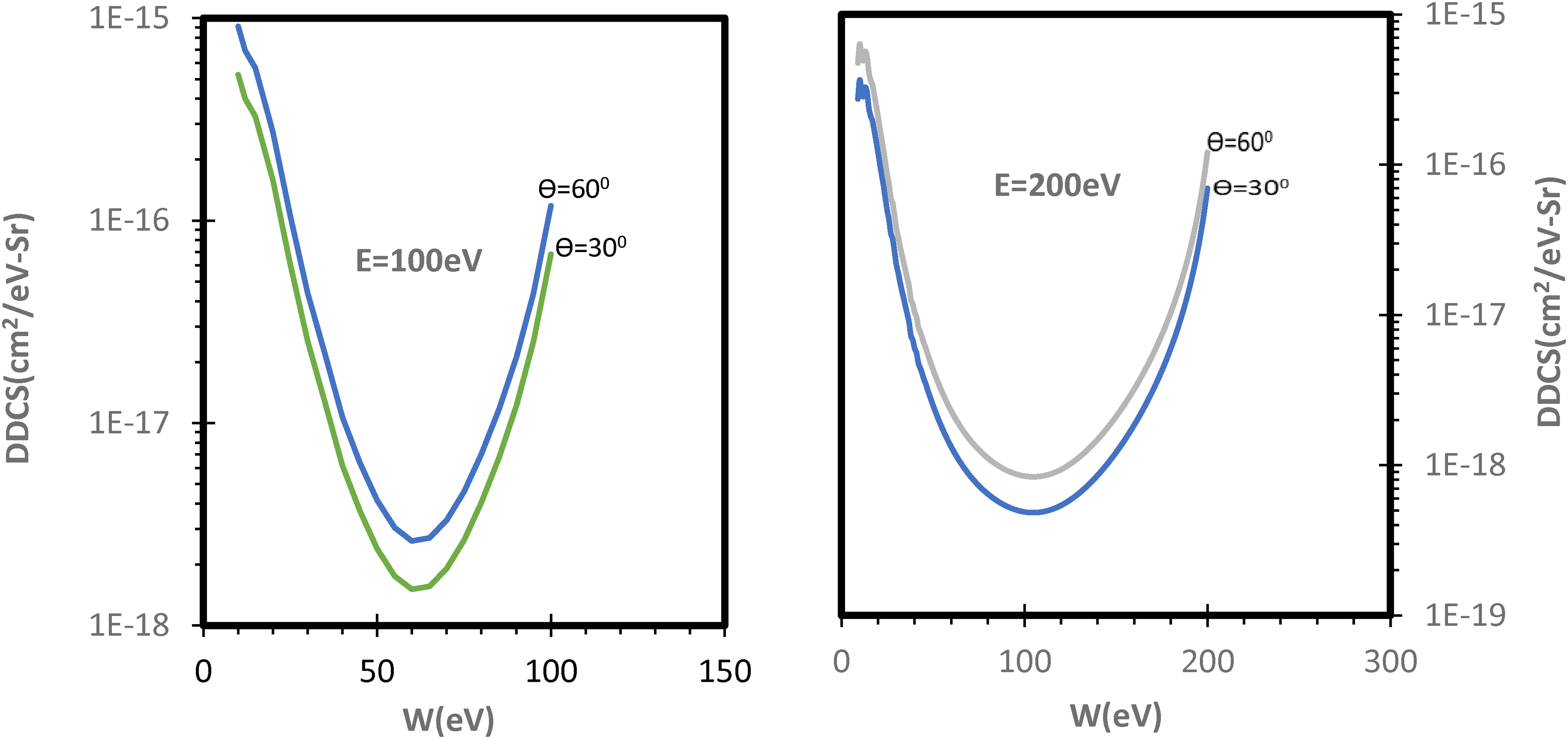
Total double differential cross-sections (DDCS) at fixed angles of 30° and 60° for incident energies of 100 and 200 eV.
The 3D profile of the DDCS, with variations in angle (0°–180°) and secondary-electron energies up to half the maximum electron energy (Emax/2), for constant incident electron energies of 100 and 200 eV, is shown in Figure 4. The DDCS for electron scattering at incident energies of 100 and 200 eV shows that DDCS values are highest in the central portion of the plot—typically at intermediate angles (around 60°–120°) and moderate energies. This suggests that electrons are most likely to scatter with partial energy loss at these angles. At very small or very large angles (near 10° or 170°) and at very low or very high ε values, the DDCS drops off. These regions correspond to either forward scattering with minimal interaction or backward scattering with significant energy loss; both are less probable. 24
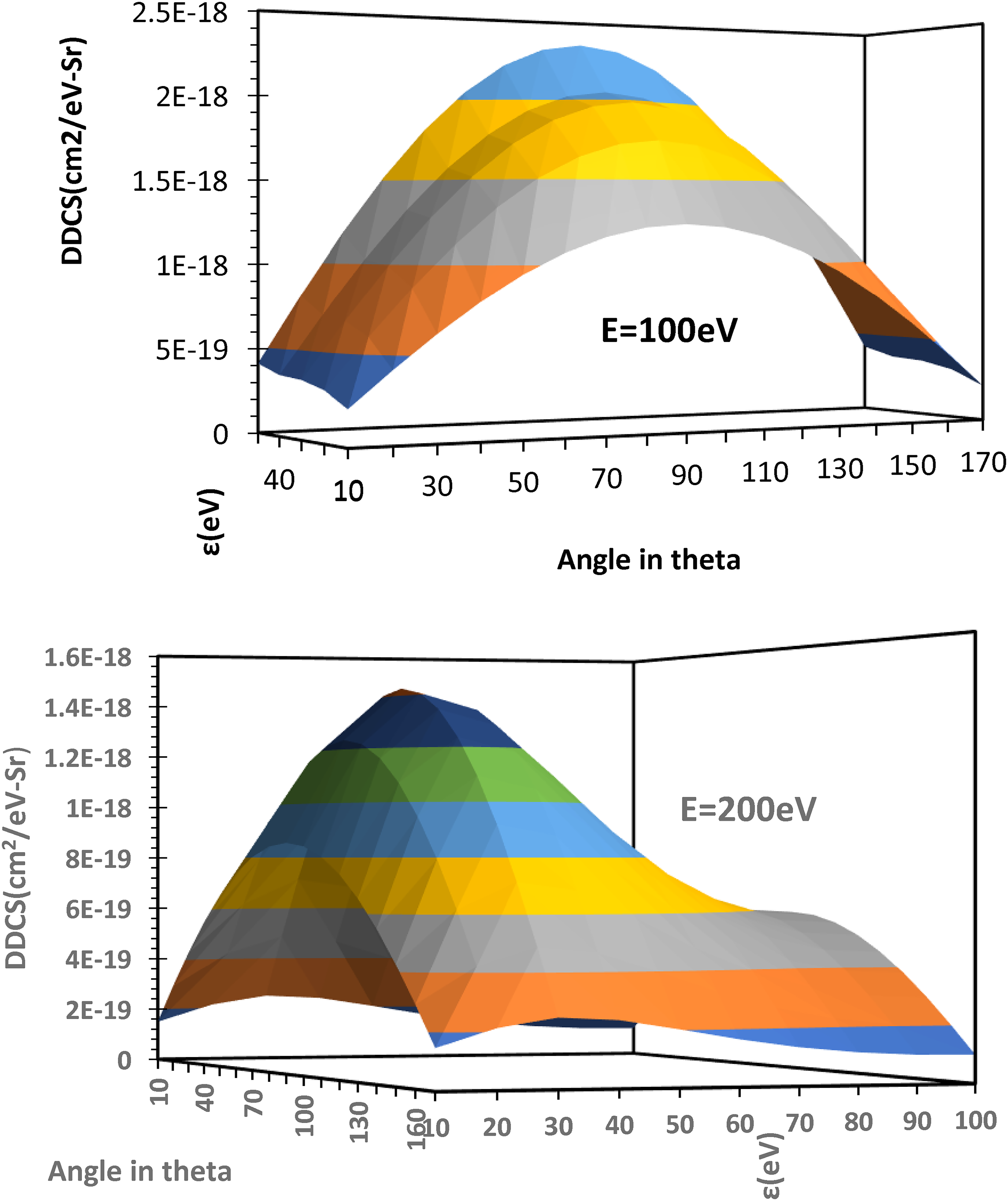
Three-dimensional profile of double differential cross-sections (DDCS) with variations in angles (0°–180°) and secondary electron energies up to half of the maximum energy of the electron (Emax/2) for constant incident electron energies 100 and 200 eV.
SDCS and DDCS results for the C₂F₆ molecule are evaluated for the first time. These results are therefore beneficial to experimentalists as a predictive tool. Our TICS results align with available datasets and are reliable; thus, the SDCS and DDCS results are also trustworthy. Using the Jain–Khare semi-empirical approach, SDCS and DDCS exhibit energy-dependent behaviour that reflects both direct and dissociative ionisation processes, with the angular and energy distributions of secondary electrons as key characteristics.
Conclusion
In this article, the Jain–Khare approach is used to calculate the TICS of the C2F6 molecule from the ionisation threshold to 5 keV. These results align with most experimental and theoretical datasets within the 5% to 10% error bars, suggesting that it is a reliable predictive model. Although the Jain–Khare semi-empirical approach sometimes yields good results for the major channels, it underestimates minor ions. Total SDCS have also been calculated for the first time at fixed incident electron energies of 100 and 200 eV. DDCS have also been calculated for the first time at fixed incident electron energies of 100 and 200 eV and at fixed incident angles of 30° and 60°. Three-dimensional profiles of DDCS, varying with angle and secondary electron energy, have also been generated. For plasma physics, these exact ionisation probabilities help optimise etching processes in semi-conductor manufacturing. For atmospheric/space studies, the breakdown of fluorocarbons under electron impact is key to modelling radiation chemistry.
Footnotes
Acknowledgements
Rajeev Kumar and Manoj Kumar are grateful to the Department of Higher Education, U.P. Government, for its grant under the Research and Development Scheme, No. 81/2024/1042/seventy-4-2024-002-4(33)/2023, dated 25 September 2024.
Declaration of conflicting interests
The authors declared no potential conflicts of interest with respect to the research, authorship, and/or publication of this article.
Funding
The authors received no financial support for the research, authorship, and/or publication of this article.
