







Abstract
The emergence of grassroots social movements variously preoccupied with a range of external threats, such as diminishing supplies of fossil energy or climate change, has led to increased interest in the production of local food. Drawing upon the notion of cognitive praxis, this article utilises transition as a trajectory guided by an overarching cosmology that brings together a broad social movement seeking a more resilient future. This ‘grand narrative’ is reinforced by ‘transition movement intellectuals’ who serve to shape an agenda of local preparedness in the face of uncertainty, rather than structural analysis of the global system. In this context, growing and producing food offers important multi-functional synergies by reconnecting people to place and its ecological endowments and serves to provide a vital element in civic mobilisation. Yet, local food could also become a means to build international solidarity in defence of food sovereignty and establish a global coalition opposed to the corporate agri-food agenda of biotechnologies, land grabbing and nutritional impoverishment.
Introduction
Diverse initiatives over recent years have encouraged the view that food in developed countries provides an important axis for latent social change (Starr, 2010). Whether initiated as grassroots struggles for greater social justice in the face of hunger and food poverty or as ‘middle-class’ campaigns for better quality and more ethical consumption, both have placed importance on the relocalisation of food. This process has embraced efforts to promote food growing in communities as well as initiatives to (re-)connect primary producers with final consumers. Taken together, these very diverse practices have been extensively examined and the findings make up a fairly voluminous literature generally labelled as alternative food networks. 1
A more recent source of motivation for relocalising food has emerged from a growing sense that we are living through an age of asymmetric threats best represented by concerns for climate change, peak oil and financial turmoil. While mainstream scientific and economic analysis might regard each of these issues as tractable problems requiring effective governmental attention, the emergence of a spectrum of more heterodox perspectives increasingly regard them as interlocking and profoundly existential predicaments demanding entirely different behavioural responses. Indeed, given the apparent failure of conventional multi-level governance arrangements to offer little more than dismal responses to these challenges (Pretty, 2013), many individuals have turned towards more localised initiatives, developing communities of practice within which to pursue sustainability principles.
This development reflects a clear shift of emphasis from the long-standing, altruistic belief of the environmental movement to ‘think global and act local’, to one where communities are focussing upon a pragmatic self-interest in preparing for a transition towards a more self-contained and resilient future (Barr and Devine-Wright, 2012). The terms transition and resilience have become key concepts within a discourse preoccupied with the urgency of preparedness for future uncertainty. Resilience is used here to refer to a desired state to which communities aspire, representing the capacity to absorb disturbance while undergoing changes to retain essentially the same functionality, structure and identity, while transition can be regarded as a gradual, continuous, even evolutionary process of societal change (Wilson, 2012). Taken together, both terms serve as guiding principles by which to navigate a course through anticipated disruption towards a state of improved quality of life, one less cluttered by material accumulations though offering the prospect of greater human flourishing (Barry, 2012; Jackson, 2011).
The diversity of endeavours and initiatives that have been cognitively shaped by the predicaments of climate change and peak oil – an array of self-assembling dynamic networks that have spread in rhizomic fashion in unpredictable and hybrid ways (Bailey et al., 2010) – may co-exist under different labels: degrowth, eco-villages, solidarity economies or transition towns (Assadourian, 2012). For the purposes of this article, all are regarded as part of a transition movement working to establish a sustainable place-based eco-economy that is an alternative and diverse arena for the development of new production and consumption networks (Marsden, 2010). Moreover, these various expressions of transition generally share a high level of commitment to relocalising food and often production practices are developed according to permaculture design principles (Bates and Hemenway, 2010). While there is much to admire in efforts to increase community self-provisioning of food in pursuit of resilience, questions arise as to the exclusivity of such initiatives and their engagement with wider struggles for greater social justice, the elimination of hunger and the fight against corporate agri-food.
Recent work has begun to identify a matrix of ideological approaches to the food system (Holt-Giménez and Patel, 2009; Holt-Giménez and Shattuck, 2011a, 2011b; Holt-Giménez and Wang, 2011). Taking global food movements in their entirety, Holt-Giménez and Shattuck (2011a) identify two trends which they label Progressive and Radical. The Progressive trend is most closely associated with a food justice discourse ‘grounded in an empowerment orientation in which the poor, oppressed and underserved assert their rights through the power of self-respect and community organization’ (Holt-Giménez and Shattuck, 2011a: 124). Besides the US food justice movement, this Progressive category includes such initiatives as food policy councils, Slow Food and local growing schemes. While this heterogeneous array of decentralised, locally focused initiatives remains a creative and important part of a solution, ‘their disconnected nature risks leaving little structural impact on hunger’ (Holt-Giménez and Shattuck, 2011a: 126). In contrast, while the Radical approach embraces many of the practices found within the Progressive model (including community-based food systems), it advocates a complete transformation of the prevailing corporate-led agri-food system. And if food justice might be regarded as a synonym for a Progressive view, then the Radical approach is served by the notion of food sovereignty which focuses squarely upon power and the rights of people to determine their own food futures.
At a time of considerable turmoil in global food markets marked by volatile rises in food prices (McMichael, 2011; Sage, 2013) and exacerbated by global land and water grabbing (Rulli et al., 2013), efforts are underway to strengthen and deepen the corporate food regime utilising such rhetorical devices as a ‘new Green Revolution’. On the other hand, a radical alternative, expressed in the form of the food sovereignty approach, is gaining traction (McMichael and Schneider, 2011). Under such circumstances, how will different parts of the global food movements respond? Will Progressive elements that lack a clear vision of the structural causes of hunger help to shore up a crumbling system by ameliorating the chronic symptoms of exploitation? Or will they, rather, build radical alliances that will strengthen the global food movement, lead to substantive change of the corporate food system and bring forth a sustainable, socially just and food-secure future?
Where, then, does this place the transition movement in developed countries, the primary focus of this article? While some attention has been given to evaluating the success of the Transition Town (TT) network in the United Kingdom (see below), to date, there has been little analysis of how a wider transition movement might engage or seek common cause with those transnational food sovereignty networks. It is recognised that the transition movement comprises a diverse constituency but one which is primarily motivated by efforts to construct alternative lifestyles. Evidence shows that executing a degree of disengagement from the market is best achieved through food self-provisioning, hence the focus here on its role as a means for social mobilisation, community resilience, civic engagement and, potentially, transnational solidarity. The objective of this analysis, then, is to establish whether this transition movement – especially given its involvement in food relocalisation initiatives – also has the capacity to fulfil a potentially pivotal position in those societies where it is present, moving beyond a concern for strengthening local resilience and extend towards building transnational alliances in which to challenge the corporate food regime.
The article is organised as follows. First, it is necessary to better explain the key terms resilience and transition and to elaborate on the motivations and characteristics that underlie this heterogeneous transition movement. The article then draws upon Eyerman and Jamison’s cognitive approach to the study of social movements in order to understand how such groups construct a world view – a cosmology – a process that is strongly shaped by movement intellectuals. Drawing upon participation in meetings addressed by such actors, the third section of the article begins to define a cosmology for the transition movement which, it will be demonstrated, is at some variance with the perspective of food sovereignty movements. The next section deals specifically with food as a site for social mobilisation and civic engagement and represents the central focus of the article. Here, the task is to reveal the power of food to draw people together to engage in collective action, while also connecting them to the ecological endowments of their locality. The final substantive section of the article returns to the food sovereignty movement and explores the potential for finding areas of shared concern with the transition movement. Ultimately, the article seeks to ask the following: can the transition movement play its part, become an effective ally, in building a radical alternative to the prevailing corporate-led global food system? Or will it choose a primarily inward-looking defensive localism preoccupied with the goal of community resilience and unwittingly sustain the status quo?
The article is primarily a conceptual reflection but is strongly underpinned by more than a decade of close attention to alternative food initiatives, including TT projects, throughout Ireland and beyond. Living close to Kinsale, I witnessed the earliest stages of the TT model where its creator (Rob Hopkins) developed, with students at the Community College, the prototype Energy Descent Action Plan, a key ‘step’ of the TT process. My experience of attending a variety of meetings around transition and local food (as audience member, invited speaker or chairperson) over this period has also informed this analysis.
Resilience, transition and the transition movement
The concept of resilience serves as a cornerstone aspiration of the transition movement. Imported from ecological science – where it formed part of a repertoire of dynamic system properties derived from non-equilibrium thinking (Folke, 2006; Leach et al., 2010) – resilience has developed beyond its earlier definition as the capacity to absorb shocks and maintain function. Today, the notion of social–ecological resilience has become an important tool for policymaking (Wilson, 2012) which encourages thinking around adaptation and change. Managing for resilience facilitates the identification of sustainable ‘pathways for development in changing environments where the future is unpredictable and surprise is likely’ (Folke, 2006: 254). However, the enthusiastic adoption of resilience as the desired state for communities to work towards can lead to the serious neglect of spatial hierarchies, temporal scales and means of measurement (Franklin et al., 2011).
Nevertheless, disturbance creates the potential for doing new things, and innovation might occur along particular pathways of transition. Socio-technical transition studies construct complex assemblages of actors, institutions, rules, scales and technologies within a multi-level framework comprising niche, regime and landscape that shape path-dependent trajectories (Grin et al., 2010; Smith and Stirling, 2010). While the entire system can be regarded as dynamically stable and locked into a particular socio-technical trajectory, disruptions and misalignments can destabilise the system, such that opportunities arise for new paths of innovation to emerge from socio-technical niches (Lawhon and Murphy, 2011). Niches might be regarded as protected spaces where experiments, usually involving technological innovations, can develop. Seyfang and Smith (2007) regard grassroots activities as fully amenable to analysis within the framework of ‘niches’ with the potential to offer policy innovation for sustainable development. Indeed, Seyfang and Haxeltine (2012) examine the TT network within the context of niche formation, while Brunori et al. (2011) adopt a similar approach to the analysis of solidarity-based purchasing groups (Gruppi di Acquisto Solidale (GAS)) in Italy (see also Grasseni, 2013).
While recognising the importance of the socio-technical transitions approach and the
value of niches through which to explore micro-level initiatives, this article
adopts a more loosely defined sense of transition as a heuristic device to indicate
degrees of alterity, autonomy and futurity. For example, many of the initiatives
associated with eco-localisation, the social economy and solidarity economy that
stand apart from a private-profit-oriented system can be included here guided by
principles of self-help, mutuality and social purpose. Moreover, we understand many
of these diverse groups to share different conceptualisations in their approach to
work, consumption, well-being and lifestyle. Concrete examples include alternative
currencies and time banking, community-managed housing, transport and energy
enterprises (including eco-villages) and other co-operatively managed ventures such
as collective purchasing of food needs. While many initiatives share elements of a
relocalisation agenda (Bailey
et al., 2010; North
2010), others may place greater store on carving out spaces of contextual
autonomy within which to formulate trajectories of resistance and creation in
performing the economy otherwise (DiVito Wilson, 2012). As Gibson–Graham (2003)
reminds us, … when building sustainable, socially equitable and culturally distinctive
community economies there are no pre-given pathways to follow … (p.
128)
Social movements and cognitive praxis
Following Eyerman and Jamison
(1991), one of the important functions of social movements is their role
in the mediation, transformation and construction of knowledge. Social movements
provide a context for the re-interpretation of professional scientific knowledge but
also a means to formulate and articulate new ideas that ultimately serve to define
that movement in society. It is this knowledge dimension that is central to Eyerman
and Jamison’s cognitive approach to the study of social movements. They use the term
‘cognitive praxis’ to draw together the creation of ideas and an emerging world view
(a cosmological dimension) with activities and forms of action, including the
dissemination of information and practical demonstrations of alternatives (a
technological dimension). As Jamison explains elsewhere, The movement is seen as providing an organizational dimension and a public
space for integrating the cosmology and the technology in processes of
collective learning, and their cognitive praxis makes social movements
particularly important in the constitution and reconstitution of science and
technology. (Jamison,
2010: 813)
Over the past decade, a series of mainstream reports have drawn to international public attention a number of profound environmental problems. For example, rising atmospheric concentrations of carbon dioxide and other greenhouse gases are having a discernible influence on the world’s climate (Inter-governmental Panel on Climate Change (IPCC), 2007); the world faces growing scarcity of freshwater (Jägerskog and Jønch Clausen, 2012); and the loss of biodiversity and degradation of ecological services is a principal factor causing poverty and social conflict (Millennium Ecosystem Assessment (MA), 2005). These issues are also contributing to a deterioration of global food and livelihood security (UK Government Office for Science, 2011), a process that is also being exacerbated by tightening energy markets associated with the phenomenon of peak oil (Murray and King, 2012).
Peak oil refers to an irreversible decline in the supply of conventional oil that is the light crude that has dominated production to date. The key architect of the term is a retired petroleum geologist, Colin Campbell, who argues that the timing of peak is less important than the realisation that the age of easy energy is coming to an end (Campbell 2003). Campbell has been a major influence in shaping the thinking of Rob Hopkins. 4
Anthropogenic climate change may be a more widely recognised challenge, given its
greater coverage in the popular media; however, it, too, remains a problem in search
of a solution. As Friedrichs
(2011) notes, it is not just an intractable problem but an existential
predicament that brings forth denial and self-deception. These are understandable as
psychological coping mechanisms, yet as Doyle (2011) observes, If we are to avoid becoming ‘voyeurs’ of our own impending peril, through the
news spectacle of increasing climate catastrophe, then we need to feel
engaged in the present, and embodied as active citizens … How climate change
is … given meaning shapes how individuals and groups are called upon to take
action. (p. 9)
Shaping cosmologies: The role of movement intellectuals
As sociologists, Eyerman and Jamison (1991) are especially interested in examining the emergence of individuals who come to ‘articulate the knowledge interests and cognitive identity of social movements’ (p. 98). They outline a co-constitutive process at work here, as individual and movement roles and identities emerge and are shaped through interaction. Eyerman and Jamison are clear that intellectuals play a critical role in representing the concerns of emergent movements, giving them a deeper meaning and significance. Yet, as social movements grow, relations with intellectuals may change and give way to a process of professionalisation. How might the ideas of cognitive praxis and the roles of intellectuals help us to better understand the transition movement?
In this discussion, I want to place to one side the role played by the clearly identifiable organisational leaders of the movement, such as Rob Hopkins of Transition Towns. Rather, I wish to focus on a number of dissonant, dissident voices that have emerged on both sides of the Atlantic in recent years and who, I assert, have become quite influential through their books, blogs, DVDs and speaking tours. I would argue that these individuals represent the intellectual cadre of the transition movement, as it is from this movement that their audience is drawn. Some have built their reputations around single issues such as peak oil and energy (e.g. Richard Heinberg (2003, 2004, 2007)), while others offer a clearly catastrophic interpretation of the coming collapse (James Howard Kunstler (2005) and Dmitry Orlove (2011)). 5
A more intellectually convincing narrative is offered by Nicole Foss, who blogs at The Automatic Earth under the pseudonym of Stoneleigh and who is frequently on international speaking tours. Her background in energy analysis (particularly nuclear safety), science and law and acquired expertise in the behaviour of financial markets have served to provide her with an authoritative edge that few others can match. That she has been able to bring the peak oil/climate change narrative together with analysis of the unfolding financial crisis has made her a much-sought-after speaker and a regular contributor to the Keiser Report, an investigative financial programme hosted by RT.
In a talk that she gave in Cork in 2010, 6 her plausible and convincing explanation of the collapse of what she calls ‘global Ponzi finance’ involving pension funds and the property bubble made clear that, in her opinion, there was unlikely to be a near-term economic recovery. Indeed, she warned that we can expect to see significant changes in the affordability of goods and services in the years to come as purchasing power will continue to decline. The crux of her talk, however, was to ask what we can do about it and to give some pointers on actions that she called ‘lifeboat building’. Her check list included the following: eliminating debt as far as possible and turn to liquidity so that cash can buy hard goods as required; gain control over essentials (food, water, energy); and work with others to build social capital, resilience and community security. 7
It may be that Foss’ suggestions actually offer a grounded reality check for most of
us in modern society swept up in the cycle of work and spend and struggling to make
ends meet in the current crisis. However, her speaking tour of Ireland was later
described as ‘terrifying a lot of people’ and … she left a void in her wake. Telling her audience with clinical certainty
that we’re going back to 30’s style depression, sell all you’ve got and go
live in the country (‘like I’ve done’), is remarkably simplistic given the
complexity of her analysis. (O’Rourke,
2010) A social collapse means living in the same conditions as the people who grow
your coffee. It’s time to sober up and get real about the peak oil narrative
where we go from 80 percent of humans being too poor to buy energy to 95
percent … It’s not the end of the world: its rejoining the rest of the human
race. (Gupta, Notes from lecture, Clarion Hotel, Cork, 26 September
2010)
Food as a site for civic mobilisation
The single most important focus of practical activity across the transition movement is the growing and supply of local food. Food is widely used as a vehicle to engage communities in promoting resilience (Franklin et al., 2011). The proliferation of alternative food initiatives including community and school gardens, allotments, community-supported agriculture schemes and backyard food growing arguably demonstrates that there is more going on than an ephemeral collection of local projects. At one level, it might simply reflect a sense of generalised disenchantment with the globalised food system; on the other hand, it might represent the beginning of an antidote to the dominance of the carbon-based and corporate-controlled biofood economy (Marsden and Franklin, 2013).
It should be noted that there exists a closely argued critique of the ‘local food is good’ case, one that asks searching questions of those who place ‘the local’ on a pedestal (Born and Purcell, 2006). Issues of power, exclusion (on grounds of class, ethnicity, education, income) and equity often remain unanswered questions: local food systems do not automatically move us in the direction of greater social justice (Allen, 2010). Nevertheless, the evidence suggests that food growing has the capacity to trigger a degree of social mobilisation and civic engagement if important conditions are present.
The relocalisation and revitalisation of new food production and consumption networks may, for example, help to recover, reveal and revalorise those ecological endowments of each region – its soils, landscapes, water catchments, plant and animal ecologies, and so on – that have been long hidden by successive phases of technological modernisation (Marsden, 2010). Building an understanding of, and appreciation for, those physical territorial attributes helps connect local inhabitants to their vernacular ecology and seasonality and re-establishes the basis of what is appropriate (and good) to eat. Moving beyond individual reflexive consumption and into more collective deliberation also opens a cascading range of possibilities, depending upon local circumstances. In the presence of a grand narrative that can galvanise individual motivation into community action, local food growing generally becomes the most feasible, practicable and frequently successful first step.
Growing plants presents a low entry threshold; it does not require pre-existing knowledge, only motivation and some helpful advice. Food serves as a social lubricant aiding connectivity: events around food are invariably convivial gatherings with opportunities for sharing seeds, dishes, recipes, techniques, knowledge and experience. Bringing people together, either to work side by side in individually controlled plots, or collectively in community gardens, creates opportunities to engage in reflection on the injustices of the contemporary agri-food system and perhaps to partly rectify our alienation from nature. Growing food has the potential to help re-establish a relationship between humans and the biophysical environment by re-integrating intellectual and human labour (McClintock, 2010). If we can recover a sense of the link between ecological and human health, we might not only improve our dietary health but cease to be so complacent about the environmental costs of producing our cheap food (Carolan, 2011). Growing food, in short, opens a space to challenge the mainstream food system by offering a more equitable, ecologically sustainable and potentially socially empowering alternative.
Marsden (2010, 2013a) develops the notion of the regional ecological economy as an alternative spatial arena for the development of new production and consumption networks that utilise combinations of natural, social, economic and territorial capital in creating new ecologically based products and services. Being context dependent, building upon specific resource endowments, and with a clear sense of fostering the autonomy of the region and its local communities, the notion of an eco-economy aims to maximise endogenous potential and encourage new possibilities. The inherent multi-functionality of food presents opportunities for the emergence of small business and social enterprise that can contribute to building the local eco-economy. This encourages involvement by public agencies that witness the positive synergies that food can create, including jobs, urban greening and dietary improvements. How might such developments be framed within a notion of transition?
Figures 1 and 2 offer a schematic
representation of how transition might trigger a process of social mobilisation
around food. Figure 1
represents the default position, where there is little sense of civic engagement and
market norms prevail in providing peoples’ food needs. For example, planning policy
permits the domination of urban landscapes by corporate food interests and
consequently an obesogenic foodscape prevails. A general state of disenfranchisement
is reflected in the challenge of climate change or peak oil remaining largely remote
from people’s lives. Successive layers of modernity have largely hidden regional
ecological endowments such that there is limited engagement beyond consumption
pursuits. Although highly generalised, this scenario reflects the status quo of
large swathes of modern society. Default position: generalised civic
disengagement where global challenges and local resource endowments are
remote from people's lives. How a coherent ‘grand narrative’ and associated
technologies can mobilise civic engagement, building human and social
capital and restoring connections to local
resources.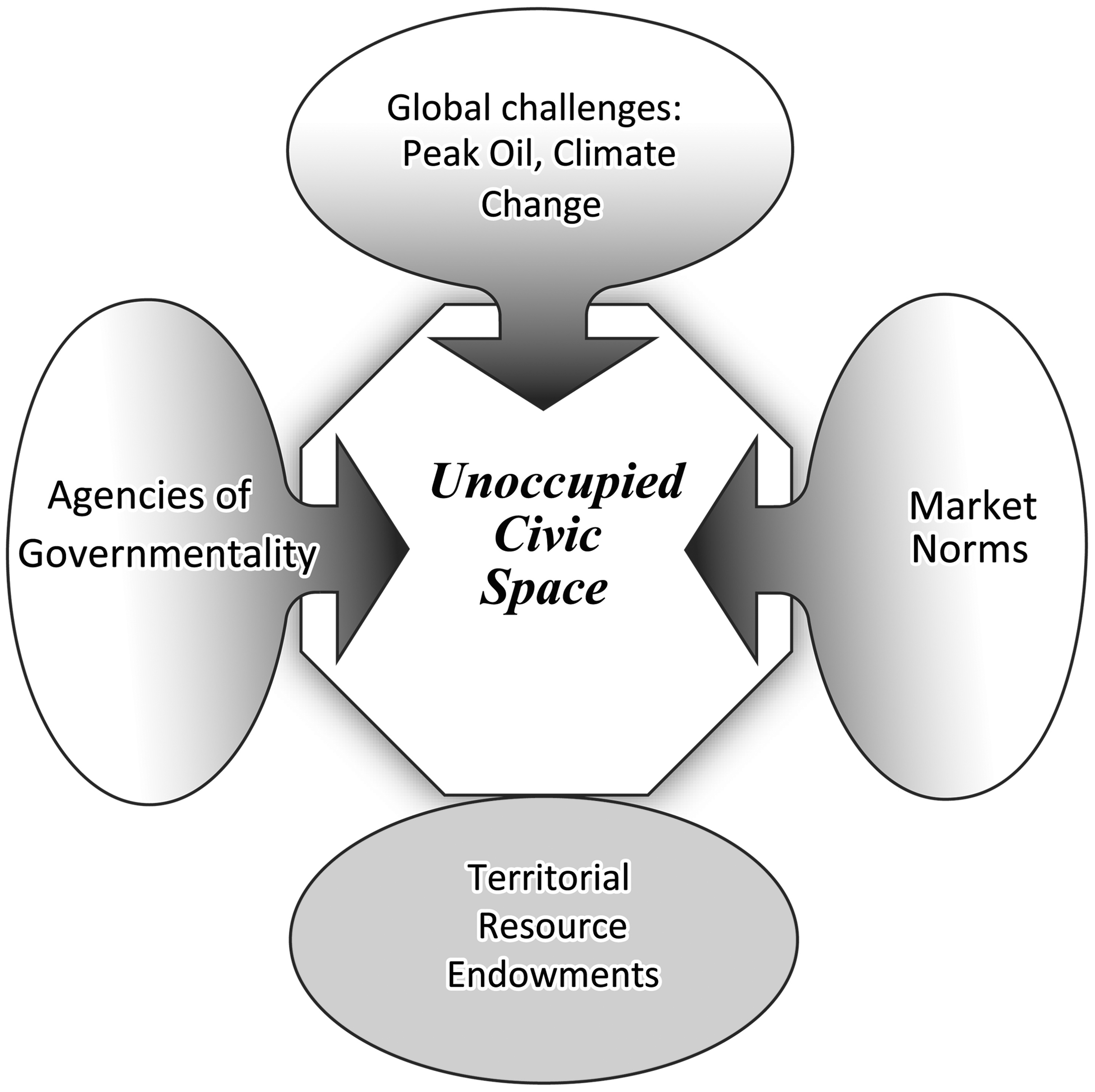
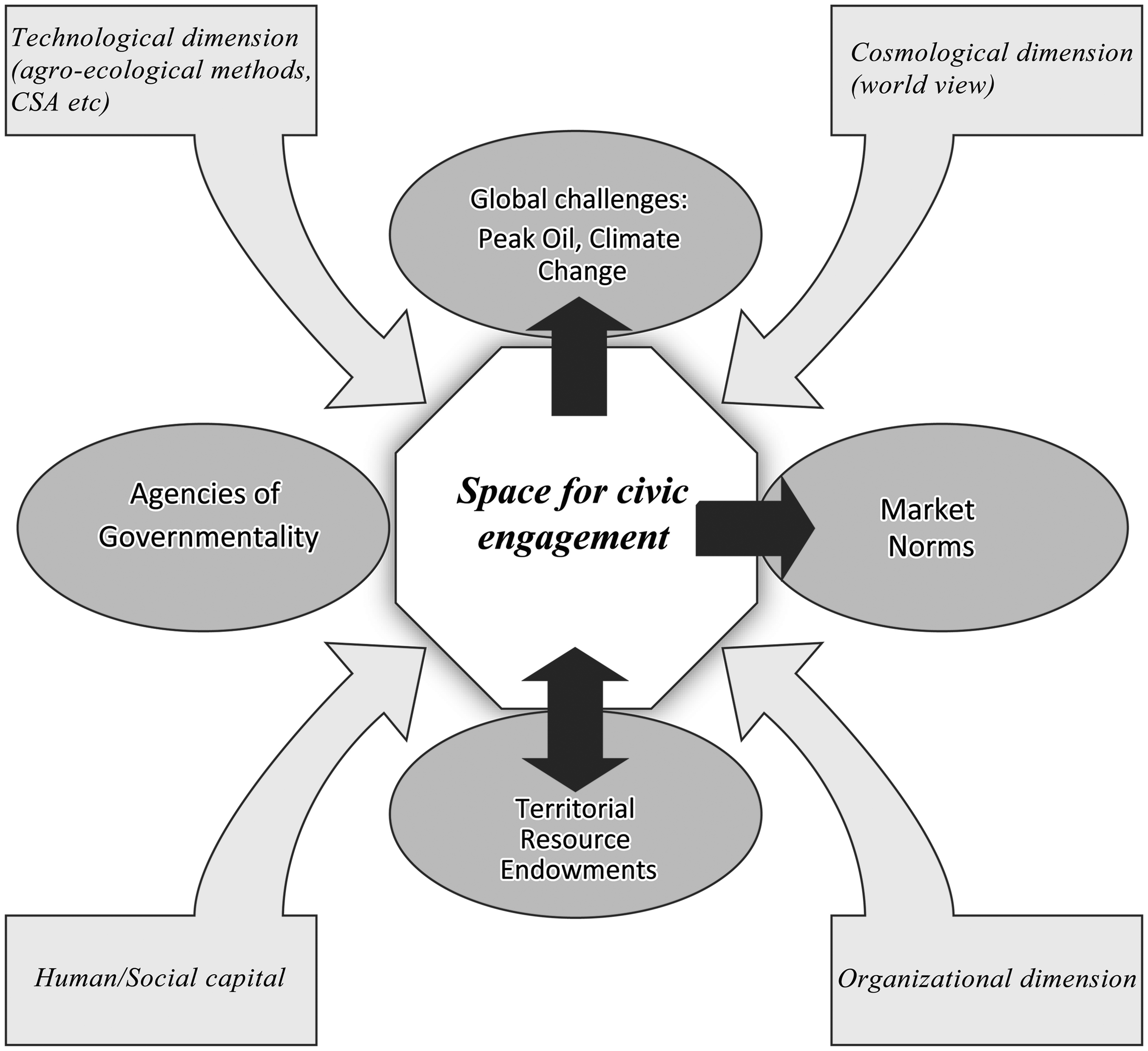
Figure 2 is configured with reference to the intervention of a ‘grand narrative’ with a coherent cosmological vision, one that begins to knit together a sense of future threat with a response comprising possible technologies (e.g. agroecological methods for food, solar panels for energy), and organisation. Together, these begin to reveal and release local resources: human and social capital and territorial resource endowments. As members of the community begin to reconnect with the resource base through food growing, this gives space to reduce the psychological dependence on large retailers to provide all of the household’s needs. And while local government might initially express scepticism, the evidence is that local politicians are quick to associate themselves with positive efforts to clean up, re-green and improve neighbourhoods with the potential for new institutional synergies.
Extending this scenario-building exercise further, it is possible to imagine a high degree of social mobilisation around food, with growing taking place in community gardens, allotments and backyards, and where community-supported agriculture on the peri-urban fringe or in the rural hinterland provide box schemes and produce for local markets. The extent of local food growing, including the planting of fruit trees in public spaces, can transform urban areas from corporate foodscapes into edible landscapes. Public institutions (schools, day-care centres, hospitals) requiring the provision of meals would procure supplies from local growers and small producers. Despite significant bureaucratic difficulties, persistent and innovative leadership have brought some successful schemes to fruition in the United Kingdom (Morgan, 2008; Sonnino 2010). This is one way in which local government can collaborate with communities to help and support transition initiatives, for example, as urban and regional planners embark upon land zoning designed to facilitate urban and peri-urban food growing, and create opportunities for local markets rather than suburban mega-stores (American Planning Association (APA), 2007; Morgan, 2009). Clearly, such initiatives will incorporate low-carbon and ‘climate neutral’ pathways for local development. However, what is missing here is a mechanism to extend the vision beyond the boundaries of the region and to connect with other initiatives, nationally and internationally.
Lessons for transition: Food sovereignty and agroecology
The transition movement has been presented as largely preoccupied with efforts to encourage individual behavioural change in pursuit of community resilience in a manner that is non-contentious and which avoids conflict and negativity. It is largely redemptive in its aspirations, rather than transformative of society at large, and remains largely silent on matters of social justice and disadvantage.
Elsewhere, there are other emergent social movements that are strongly committed to critical analyses of the corporate agri-food system and which offer signposts towards a radically different path than that taken by the transition movement. Foremost amongst these are those social movements engaged in efforts to improve food security at local level but whose modus operandi is to build international solidarity in support of food justice for all. Food sovereignty first came to international attention at the World Food Summit in 1996 where it was presented by the global small-farmer movement, La Via Campesina (Lawrence and McMichael, 2012; Wittman, 2009). Since then, it has become something of a rallying call for diverse social movements ranging from peasant farmers in countries of the South to activists working for food justice in poor urban neighbourhoods of North America (Alkon and Mares, 2012; Anderson and Bellows, 2012; Ayres and Bosia, 2011). Food sovereignty presents a powerful counter-hegemonic perspective that not only insists upon food being treated as a basic human right but proclaims the right of peoples to define their own agriculture.
It is in this context that agroecology is regarded by food sovereignty activists as a powerful tool for food system change as it is more than a way to practice agriculture, such as organic farming. Rather, ‘agroecology is also a social movement with a strong ecological grounding that fosters justice, relationship, access, resilience, resistance, and sustainability’ (Gliessman, 2013: 19). The importance of the multi-functional services provided by small-farmer agriculture practicing agroecological methods are indeed becoming more widely recognised: for example, the UN Special Rapporteur on the Right to Food believes agroecology has a proven potential to significantly improve yields, to increase the incomes of small-farm households and, ultimately, to improve nutrition (De Schutter, 2011).
Thus, agroecology, embedded within and increasingly inseparable from the international movement for food sovereignty, has the potential to bring together food activists from around the world. Indeed, the food sovereignty movement is now spreading quickly, not only across the developing world where peasants and small farmers face the expansion of corporate agriculture through the dissemination of its new patented technologies and proprietary scientific knowledge, but throughout the global North. Since the Nyéléni Forum, held in Mali in 2007, the struggle for food sovereignty has been extended across the world. In 2010, the US Food Sovereignty Alliance was formed (Shawki, 2012), while the Nyéléni Europe Forum was established in Krems, Austria, in August 2011. Critically, this is encouraging interconnections with other social movements such as the global solidarity economy movement, Réseau Intercontinental de l’Économie Sociale et Solidaire (RIPESS) (Hitchman, 2012).
Within this process, food citizenship becomes a fluid but aspirational goal, useful
as a heuristic tool to replace the ‘consumer’, but also one capable of reclaiming
civic rights and expressing international solidarity. Figure 3 presents a schematic visual
representation of the way in which we might conceive of the shared ground between
the transition movement in the North and the food sovereignty movement worldwide.
Clearly, a first-order alliance could easily be created around opposition to new and
potentially harmful agri-technologies (genetic engineering and nanotechnology) and
unjust practices of industrial and corporate agriculture (e.g. land grabbing).
Second-order alliances might feature knowledge exchange through farmer-to-farmer
methods. Successive levels of collaboration will depend upon the evolving
circumstances and motivations. But it is clear that such an approach promises an
utterly different trajectory of transition towards a world capable of transforming
the corporate food system, ensuring food justice and livelihood security for all and
within the limits of an equitably and sustainably managed biosphere. Potential shared ground for the transition and
food sovereignty movements in building common cause and creating a more
sustainable future.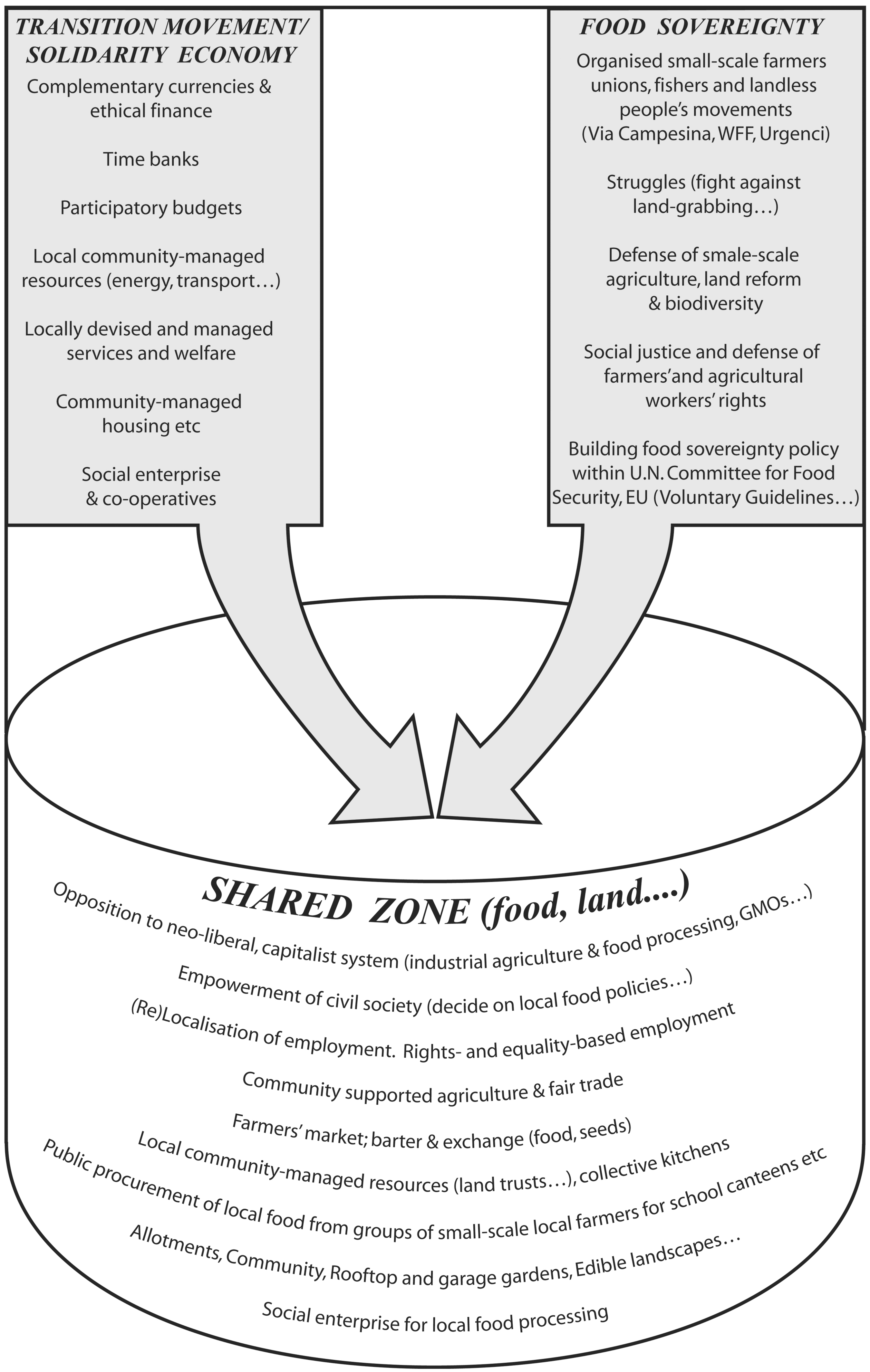
Conclusion
At a time of ecological and economic uncertainty, with the apparent inability of liberal democratic politics to formulate convincing long-term and socially inclusive strategic responses, it is not surprising to see a multitude of different grassroots initiatives emerge possessing widely divergent forms of cognitive praxis. Constructing a cosmology that can bring together perceived external threats with a set of responsive activities and technologies designed to move communities through a process of transition towards a more sustainable and resilient future possesses considerable narrative power. Within this process, the article has suggested that food growing has the capacity to play an important role in social mobilisation enabling individuals to become engaged, with others, in a non-controversial manner within a civic arena. This aggregation serves to enhance human and social capital and can also recover a re-connection with the biophysical environment. Further speculation offers a vision where food growing for direct consumption might contribute to a process of decommodification of nourishment and the creation of more autonomous spaces where food becomes a means for building worlds beyond capitalism (DiVito Wilson, 2012).
In this regard, both the transition and food sovereignty movements offer insights into the ways that communities are reworking and extending notions of political consumerism into the realm of direct production. Such practices might well serve to provide further evidence of the growth of prosumption (Ritzer, 2013).
Yet, the article also highlighted grounds for political caution with regard to the transition movement. It noted the dangers of this movement becoming locked into an inward-looking, defensive, even autarkic, trajectory under the influence of ‘movement intellectuals’ who preach a message of preparedness for an impending crash. It matters little, ultimately, what factors are responsible for this crash if the only solution is a detached endeavour to secure familial and community resilience. We might conclude that the transition movement, as it has been sketched here, is not mobilised in the sense that it has no tactics to express resistance to the status quo (boycotts, squatting, rent strikes, lobbying and the formation of alliances with organised labour). As Tovey (2006) observes within an Irish context, the movement opts for ‘exit’ rather than ‘voice’ (á la Hirschman), a retreat from market relations by way of barter and self-provisioning, and disengagement from participation in the wider society as it pursues its concern with practice over critique. As Trainer (2009) notes, TTs trying to insulate themselves from the coming scarcities and troubles is a very different goal to working to replace consumer–capitalist society. How might a transition movement, then, be encouraged to engage with a wider process of social, economic and political transformation?
First, there is a need for clear(er) analysis of the structural drivers of environmental and economic change, particularly as they affect food supply. A re-appraisal of agriculture as an ecologically embedded activity requiring the replenishment of ecosystem services with low-carbon food production (McMichael, 2011) must be accompanied by the need to develop more reflexively meaningful and sustainable practices around food consumption (De Tavernier, 2012; Sage, 2012b). In this respect, transition movements should be capable of addressing the twin and neo-liberalised crises of production and consumption as it affects the food sector (Marsden and Franklin, 2013).
Second, the food crisis of recent years has led to the emergence of not only local ‘citizen’ groups but the engagement of town, city and regional governments. This development of variable-scaled, place-based reflexive governance (Marsden, 2013b) has seen a diversity of initiatives such as food planning schemes that seek to engage local stakeholders and connect up different policy vectors, including healthy eating, public-sector procurement, zoning controls and community gardens. While they may appear as little more than ‘archipelagoes’ of a more sustainable agri-food economy, they have the potential to initiate a wider range of public, private and civic engagements and address questions of social inclusion.
Third, and finally, local food initiatives offer a means to reshape the discourse around the food system, challenging the implied powerlessness of the term consumer and replacing it with notions of civic solidarity and citizenship. While food citizenship remains an under-theorised concept, it has the potential to recast and reposition the role of individuals as more than corporate customers and ‘eaters’ (Wilkins, 2005). Indeed, better reflecting their growing involvement as producers perhaps agroecological citizenship is becoming a more appropriate label (Smaje, 2013)? Yet, irrespective of prefix, citizens everywhere are beginning to heed the call to build common cause with farmers and food producers worldwide in creating a global social movement capable of transforming the existing food system and achieving a secure and sustainable way of ensuring local food for all.
Footnotes
Acknowledgements
The author gratefully acknowledges the contribution of the following people: Paolo Parigi for the invitation to participate in the Stanford workshop at which the first version of this article was presented and to the other participants for their comments; Judith Hitchman of Urgenci for sharing with me her article and, in particular, her diagram; Mike Murphy for his creative execution of the figures; Mike Goodman for his willingness to read and comment on my work; to the anonymous reviewers whose critical comments were very helpful; and, finally, to Francesca Forno and Paolo Graziano for their patience and support. All, of course, are absolved of any responsibility whatsoever for the content herein.
Funding
The author(s) received no financial support for the research and/or authorship of this article.