







Abstract
This article compares consumer protection policy and consumer activism in Japan, China, and Taiwan to understand state–consumer relationships in East Asia. It employs Maclachlan’s case study of Japan to develop an explanatory model of how political change and state–business relationships influence interaction between state and consumers, and how state–consumer relationships institute consumer protection. The article then compares the three countries, all of which have experienced rapid growth and consumerism, by utilizing their different political developments in the exploration of the interaction between state policy and consumer activism. This comparison highlights the different dynamics that institute consumer protection in the political, economic, and social spheres. The argument is made that transformations in the state–consumer relationship are required to allow civil society to take part in the instituting of consumer markets as East Asian capitalism turns to domestic consumption for growth.
Introduction
In 2008, a food scandal involving infant formula erupted in China effecting purchasing habits in subsequent years especially as media sources revealed further cases of producers adding illegal supplements. Today, many consumers only buy imported formula 1 and rely on information supplied by the mass media to avoid problematic products. There are a number of reasons behind the problem, perhaps among the more prominent the fact that food processing firms are generally small-scale and unlicensed, and the distinctive nature of regulatory fragmentation and competition between different government units (Mol, 2014; Tam and Yang, 2005; Xiu and Klein, 2010). This article aims to highlight another significant aspect yet to be discussed but which is arguably crucial: state–consumer relationships.
Researches on consumer movements in advanced as well as in developing consumer societies reveal that independent consumer organizations act as important intermediaries between the state and markets (Chatriot, 2006; Glickman, 2009; Hilton, 2009; Hilton and Dounton, 2001). However, there is no independent consumer organization in China – the Chinese Consumer Association exists as a government organized NGO (GONGO) – and the lack of trust between the state and consumers is widely observed (Wang et al., 2015; Xu, 2012).Studies also highlight the difficulties to defend consumer rights in the context of authoritarian polity (Cai, 2005; Yang, 2013). Therefore, a particular relationship exists between the state and consumers making it difficult for consumers to deal with market problems.
The article places China firmly within the East Asian context to ask how the relationships between state and consumers are formed and how they influence the way market problems are raised and addressed. The research makes the assumption that East Asian countries share a productionist orientation, reflected in the discussion of developmental states in Japan, Taiwan (William, 2014), and China (Fligstein and Zhang, 2009; So, 2007) and the suppression of labor unions (Kim, 2010; Peng and Wong, 2005); consequently, it is interesting to explore the extent to which citizens as consumers gain influence over marketization and regulations.
Japan, China, and Taiwan are selected as suitable case studies for a comparison of the state–consumer relationship for several reasons. Although consumer society may have developed earlier in history (Bosco, 2014; Francks, 2009), these countries have witnessed the rise of modern consumerism amidst rapid economic growth (Davis, 2005; Gerth, 2008; McCreery, 2000; Pei, 2004). Moreover, the state initially encouraged saving in the industrialization period (Garon, 2006; Horioka, 2006) and then encouraged spending once the economy had taken off (Haghirian, 2011; Wong, 2009). This experience of rapid growth and state shaping consumption set East Asian consumer societies apart from those in the West and presents interesting cases to examine how consumers can influence market governance.
Besides these similarities, important political differences distinguish the three countries revealing diverse opportunities for consumers to influence state policy. Japan is a stable democracy but dominated by the Liberal Democratic Party (LDP), China is an authoritarian regime, and Taiwan has undergone a process of democratization which allows this article to explore how consumers take advantage of the transition from authoritarianism to democracy.
Variations in the national modes of economic governance (Walter and Zhang, 2012: 15).
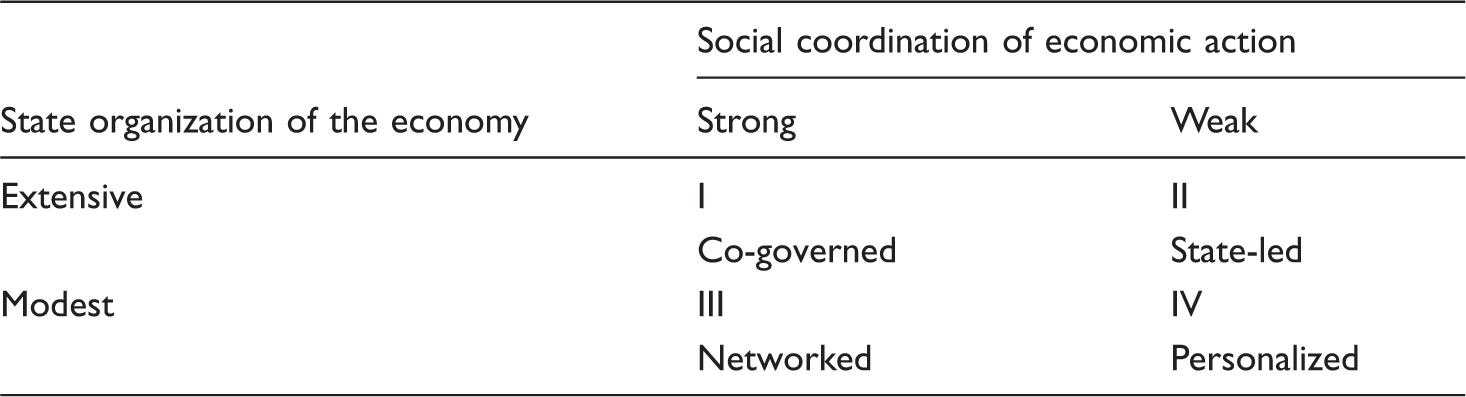
Differences in state–business relationships in these countries can result in a range of constraints being placed on states when it comes to balancing business and consumer interests in consumer markets.
This article devises a “most similar system design” (MSSD; Landman, 2008) to utilize the comparable productionist states and the similar rapid growth in consumerism as a controlled background. The system then uses different political changes and state–business relationships to compare dissimilar state–consumer relationships. The Japanese case will be based on Maclachlan’s (2002) study. Data on China are drawn from the Chinese Consumer Association with three waves of consumer activism identified through extensive Internet searches, news reports, and literature. Data on Taiwan are drawn from the Consumer Protection Commission, archives and consumer organizations’ publications (such as the Consumer Foundation, The Snails Without a Shell League, The Homemaker Cooperatives, and Oko Green), and news reports concerning consumer actions and market problems.
The research analyzes the establishment of consumer protection policy and emergence of consumer activism alongside their transformation in political economic turning points to reveal the general pattern of state–consumer relationships. The subsequent section uses a case study of consumer politics in Japan to develop a framework for the analysis of the state–consumer relationship. This is contrasted to China and Taiwan in the following two sections. The section “Comparing the relationships in the instituting of consumer protection” compares the cases and discusses how different relationships generate distinctive dynamics in addressing market problems. The article concludes by arguing that the particular mode of political economic change in East Asia limited the development of consumer citizens in civil society.
Japan’s consumer politics and the triangular relations
The Polanyian concept of “economy as instituted process” (Polanyi et al., 1957) proves a useful tool for the analysis of the influence of state–consumer relationships on consumer markets. The concept highlights how the economy comprises processes of production, exchange, and consumption and how these processes are instituted. The instituting of economic process makes it important to consider the political and social relationships among actors and processes for regulation and institutionalization.
Through this concept, the article examines the instituting of the consumer market via the regulatory and organizational processes involving the relationship between consumer and state (Harvey and Randles, 2010). The concept of instituted economic process enables this article to highlight how consumers organize themselves, educate the public, or place pressure on the state or businesses. Moreover, it explores how this affiliation is shaped by state–business relationships (the degree to which strong states attend to business interests) and state–citizen relationships (political changes).
Thus, the article analyzes how the state–consumer relationship is shaped by the political context and other political economic relationships and how this relationship institutes the consumer market through consumer protection. This can be simplified as follows: political context→state–consumer relationship→the dynamics of instituting the consumer market. The article does not address all regulations placed on consumer markets but will specifically explore consumer protection policies. The specific area of food safety can be very different from housing safety and service disputes, just as the process of establishing one particular regulation can be very different from another. Instead, this article adopts a broader focus on how people with rising spending power interact with developmental states to institute rapidly developing consumer markets, examining general developments in consumer protection law and waves of consumer activism across sectors and over time.
Maclachlan’s (2002) study is reinterpreted here to explain this framework. The consumer movement in Japan emerged when housewives protested against the ineffective ration system and poor food quality during the Second World War. After the war, a democratization initiative to encourage the formation of citizen organizations led to the establishing of Shufuren (Japanese Federation of Housewives Association) in 1948 to combat black market practices that were wreaking havoc on the operation of markets.
Shufuren claimed that black markets were the result of the state’s indifference as it directed its energy toward industrial development harming not only consumers but also small businesses, farmers, and workers. In the 1950s, Shufuren organized these different socioeconomic groups to protest against the state. This strategy increased Shufuren’s influence in local elections and, in the early 1960s, successfully pressured municipal governments to enact consumer protection measures. Shufuren subsequently built a national network of local consumer groups, the Shodanren (National Liaison Committee of Consumer Organizations), in 1956 to coordinate campaigns and conduct market research. When the student movement surged alongside environmental activism in the mid-1960s, this pressure forced the pro-business LDP to pass a Consumer Protection Basic Law in 1968.
Yet, the law failed to acknowledge consumer rights. The major success was ensuring that the law granted regular policy advisory roles for consumer groups, thus, Shufuren and Shodanren became members of the Shingikai, a deliberative council that facilitated consultation between policy makers and social organizations. Perhaps, due to the inadequacy of the Consumer Basic Law and also because new problems arose, consumer groups focused on seeking additional legal protection. In the 1970s, consumers faced rising utility prices as the result of two oil shocks and Shufuren and Shodanren utilized their role in the Shingikai to demand more consumer protection legislation. Again, the state made concessions to these public demands during competitive national elections in the 1970s and passed the Consumer Product Safety Law in 1973, the Act on Specified Commercial Transaction in 1976, and the Anti-Monopoly Law in 1977. This is not to suggest that consumer organizations are powerful, but these developments reveal that their input became an unneglectable contribution to market governance.
When the conditions that underpin political opportunity were unfavorable, such as the established conservative political power in the 1980s, it became difficult for consumer groups to demand market regulation. A political opportunity came when the LDP lost power for the first time in 1993. Shufuren helped the subsequent administration to enact the Product Liability Law in 1995, the Information Disclosure Law in 1999, and the Consumer Contract Law in 2000. When conservatives regained political control in the early 2000s, Shufuren shifted its strategy to overseeing businesses’ compliance with regulations (Nakata, 2009).
Figure 1 depicts the relationships between the state, consumers, and businesses. The extensive organizing of consumers is shown by the arrow “networking” with their counterweight to state–business relations in the political system marked by the thickest arrow, “Shingikai input.” The arrow “concessionary legislation” represents how the state balanced this pressure by enacting measures to regulate consumer market exchange. The figure illustrates a change in the relationships between the state and consumers in which the latter were able to challenge the state through building national and local networks, in the form of Shudoren, in the 1960s. When the state reduced its role in the market in the 1990s, consumer organizations collaborated with the state to place pressure on producers and sellers to force them to comply with existing laws as shown by the arrow of “oversee.”
Triangular relations in Japan.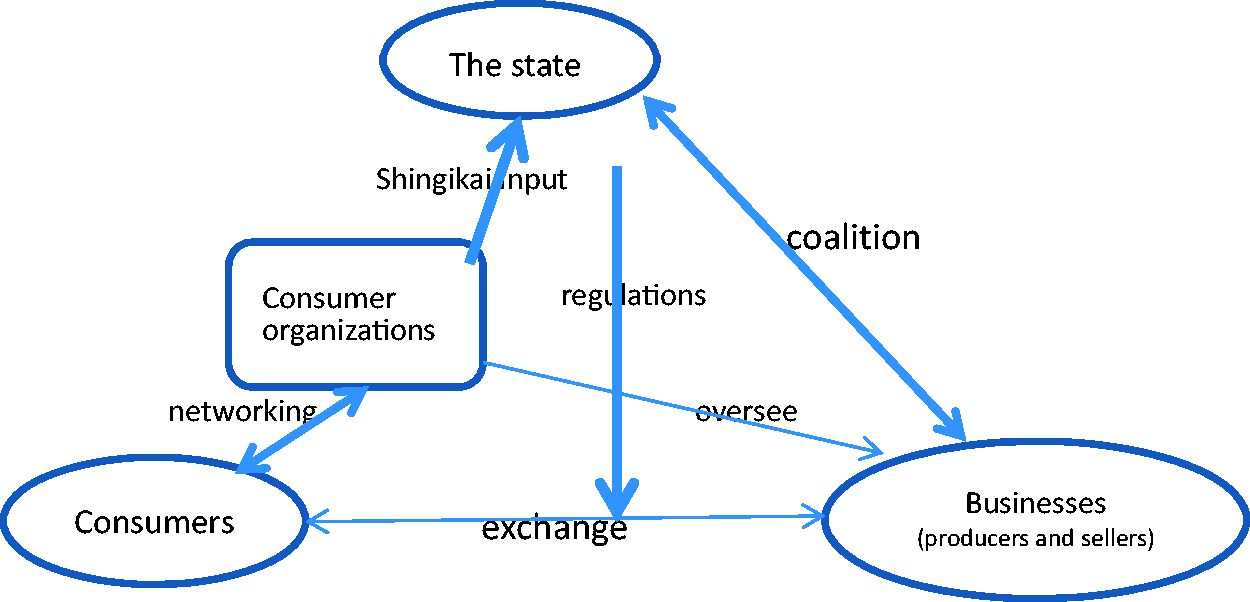
What this configuration reveals is the way the state–consumer relationship is configured with the state–business relationship and shaped by the political context. Moreover, the figure shows more than a combination of relationships especially the dynamics underlying the instituting of consumer markets in Japan. The exchange processes between consumers and businesses are instituted through interactions in the political sphere.
With this framework, this article attempts to understand whether consumers and the state interact, as in the Japanese case, in the political sphere or whether consumers and the state focus their interaction on the economic sphere, where the state focuses on information provision and consumers use market choices to “govern markets.” A further aim is to establish whether consumer protection can be addressed in the social sphere where the state plays a very limited role and consumer organizations collaborate with other social movements to change consumer ethics and practices.
State campaigns and consumers’ individualistic activism in China
In this section, the framework developed in the previous section is applied to the case of China to illustrate how the state actively organizes campaigns to promote honest and fair market exchange. Moreover, it demonstrates how political constraints and lack of organization forced consumers to undertake only certain types of individual actions and instead of demanding policy change can merely challenge businesses practices. It is argued that the state–consumer relationship facilitated a specific dynamic, in which the state and consumers focus on market ethics in the economic sphere rather than regulation and actions in social and political spheres.
In contrast to Japan, the Chinese state took the lead in consumer protection. With the ending of the ration system in the early 1980s, individuals were allowed to buy directly on the market; however, the transition resulted in frequent disputes. To deal with these escalating market disputes, local government commerce departments created consumer associations and, in 1984, the national China Consumer Association (CCA) was established to manage and coordinate local associations. 2 The CCA was supported by government funding and aimed to educate people in becoming consumers. It organized annual exhibitions of common consumer disputes across major cities and has held nationwide competitions relating to the best journalistic reporting of market problems. It also launched the China Consumer News in 1985 to report on this work and to issue product warnings. 3
Consumers also endeavored to take collective action to advance their concerns. In 1989, participants in the pro-democracy student rally in Tiananmen Square attributed the high inflation of the late 1980s to widespread corruption and state enterprises’ exploitation of market shortage. 4 They argued that democratic reform was needed to balance the interests of state enterprises and public interests. The events surrounding the Tiananmen Square protest not only presented the most serious challenge to the party state politically but also gained ground in terms of consumer interest. In the following year, as part of the annual report to the National People’ Congress, then Premier Li Peng required the CCA to be “the bridge between the state and the people.” 5 A TV program, The 3.15 Evening Show, 6 began broadcasting on China Central TV in 1991, featuring investigations into common product problems. In addition, a magazine, China Consumers, was launched in 1994 and a CCA website set up in 1998, with both aimed at teaching consumers effective strategies to avoid problematic products, also showing how the state was making efforts to help consumers.
In 1993, the state passed a Consumer Rights and Interest Protection Law without pressure from the public. According to the CCA, officials debated whether such a law was necessary or if the existing laws and local commerce departments were sufficient to address rising consumer concerns. Tam and Yang (2005) described similar departmental conflicts on food safety regulations in the early 2000s. The CCA claimed that in the end top party leaders decided that a consumer law was necessary to provide institutional support for consumers – which is in line with the agenda to build a socialist market economy as declared in 1992 (Perry, 1993). Note that the law recognizes several consumer rights, yet no policy advice role was granted to consumer groups.
Three waves of consumer activism can be identified as, in various ways, revealing the ineffectiveness of the law, how the state continues to use policy campaigns and the changing relationships between the state and consumers. The first wave was a group of consumers that used the law to sue counterfeiters. These consumers intentionally bought large amounts of products knowing in advance that they were fakes and then profited from claiming considerable amounts of compensation. The mass media subsequently labeled these consumers as “fake fighters” with the more celebrated examples being Wang Hai, 7 who targeted brand name counterfeits, and Yeh Goung, 8 a former official wine inspector who became a famous fake wine fighter.
It is important to note how fake fighting became an industry that drew on public opinion to restrain businesses. Since the mid-1990s, the considerable profits derived from fake fighting drove those engaged in the practice to create firms that would investigate market wrongdoings and undertake legal action on the behalf of business clients. In addition, fake fighters also garnered official support as the CCA created fake fighter awards with the state also organizing conferences inviting legal experts to discuss how to “fight fakes.” The work of fake fighters demonstrates a relationship of cooperation between consumers and the state: the state supported and encouraged fake fighters to show people that market problems could be addressed and there was no need to organize protests; meanwhile, the fake fighters relied on the state to promote their works and provide legal assistance. The fake fighters also utilized the mass media to achieve their goals. Mass media commercialization began in the 1990s (Hu, 2011; Li and Liu, 2009) and, while politics remained a sensitive topic, fake fighting was a popular and safe topic (Di, 2011; Liebman, 2011).
The educational initiative and backing of certain consumer actions designed to punish bad business were centered on the belief that market ethics and choices were crucial for consumer protection. The emphasis on market ethics can also be observed in CCA’s work in the early to mid-2000s. China became a World Trade Organization (WTO) member in 2002 and the CCA claimed that it needed to re-educate consumers to cope with more imports and the increasing sophistication of commodities (Overby, 2006). In the early 2000s, the CCA organized campaigns to promote “scientific consumption,” urging consumers to apply a scientific attitude to their buying habits; there were also campaigns promoting green consumption. Moreover, in 2002, the CCA invited consumers to report unfair service contracts with the reports then published. In 2003, the CCA also invited consumers to express their views on setting rail ticket prices. Thus, in a new economic context, the state–consumer collaboration focused on the economic to pressurize businesses rather than the regulatory sphere of action such as that in Japan.
Prominent product scandals in China in the 2000s.
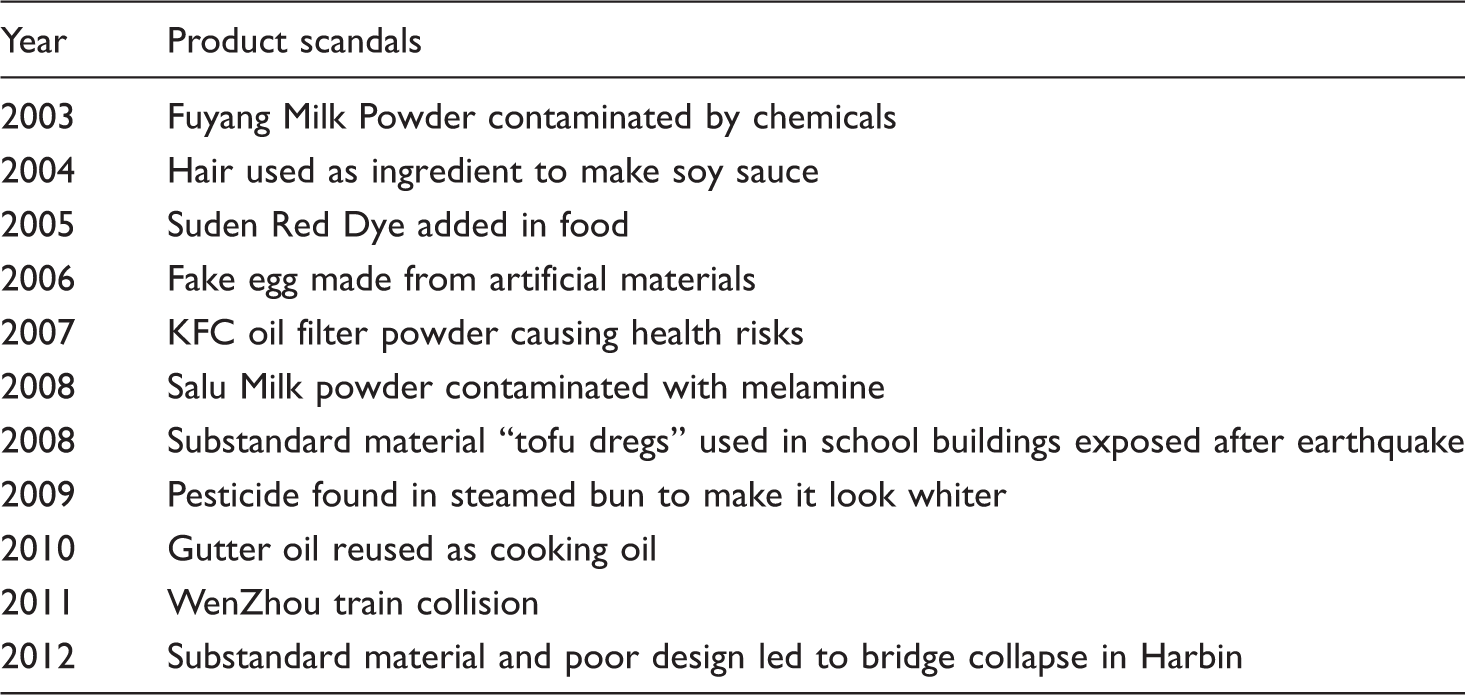
In this context, a second wave of consumer activism emerged. The emergence of social media from the mid-2000s has stimulated the rise of what the mass media named “Netizens”: citizens on the Internet (Yang, 2009). Every time food scandals were exposed, the mass media also reported heated discussion on social media sites in which Netizens blamed scandals on institutional failure and corruption between officials and businesses with the intention of shaming producers and sellers into changing their practices.
Some consumers were dissatisfied with online complaining and actively called for an independent investigation into the causes of the scandals. This is the third wave of consumer activism, often labeled by the Chinese public as consumer rights’ defenders. Examples include Zhao LianHai, 9 a father of victims of the baby formula scandal, who established an alliance of parents of babies suffering the resulting kidney problems. Similarly, Tan Zuoren, a famous dissident, 10 organized victims of school collapses following the Sichuan Earthquake. Both used blogs and established websites to publicize unreported facts and invited Netizens to help them collect and reveal more evidence. Both cases attracted extensive public attention eventually causing problems with the authorities. Their websites were shut down and both Zhao and Tan were imprisoned for “subverting social order” and “leaking state secrets.” Unlike the fake fighters who were supported by the state, Zhao and Tan’s actions were not tolerated as they were not only fighting bad businesses but also questioning the extent of corrupt relationships between state officials and business.
The complaints of Netizens and the struggles of consumer rights defenders suggest that a conflictual relationship had gradually formed between the state and consumers. In the 1980s, the state–consumer relationship was mainly concerned with enabling consumers to learn about good consumption practices. That relationship became collaborative in the 1990s as fake fighters helped the state to fight counterfeits and in the early 2000s when consumers were encouraged to report market problems. In the late 2000s, some consumers attempted to demand consumer rights, who were ignored or suppressed by the state.
Figure 2 shows the triangular configuration in China. Here, the focus of the triangle is the downward rather than upward thick arrow of “funding” from the state to the CCA. This was complemented by the arrow “system campaign” showing that the state uses mass media to encourage consumers to fight counterfeits and report firms’ wrongdoings. With the popularization of social media, the arrow of “Netizen complaints” suggests the only way consumers can shape the exchange relationships.
Triangular relations in China.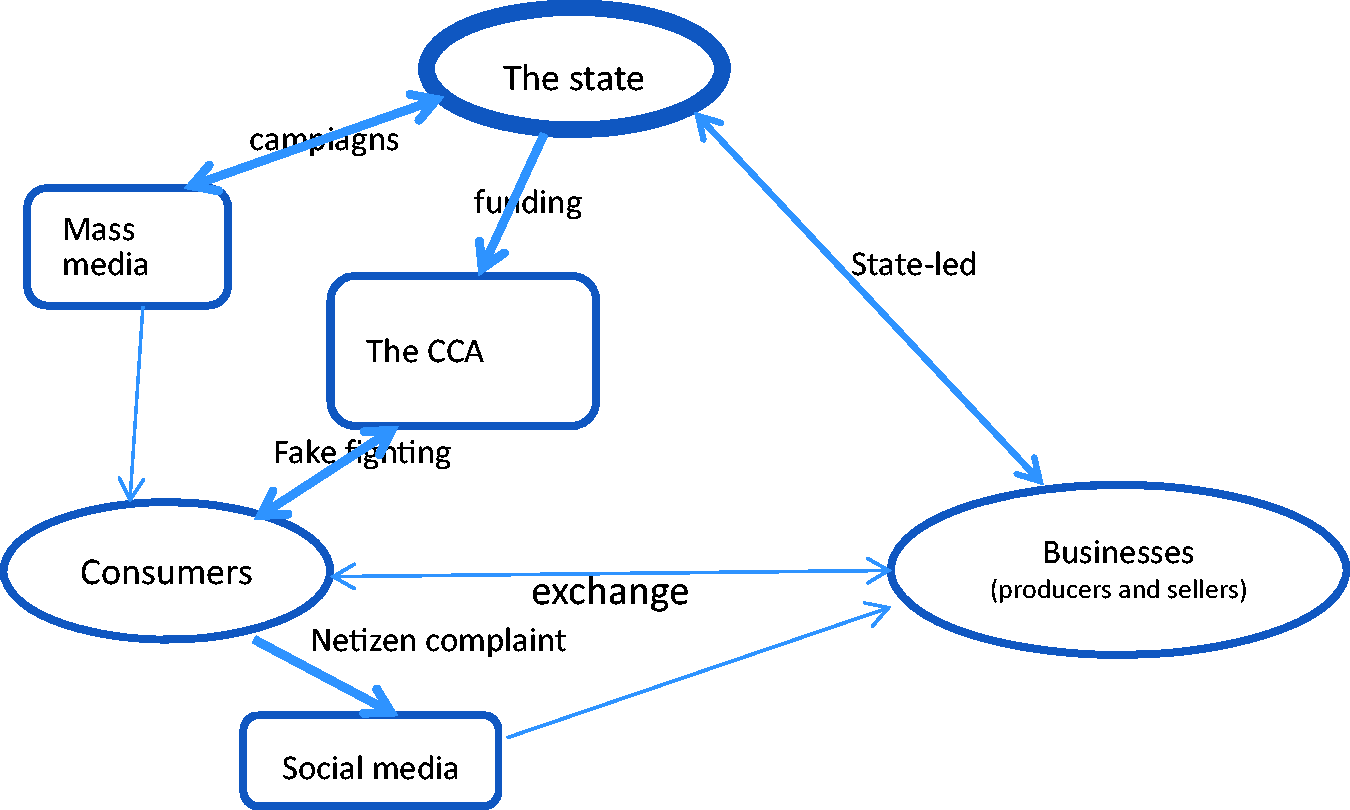
Consequently, consumer protection in China is the product of an active state and consumers who are either cooperative with the state or critical of state policy, but who are suppressed in their attempt to take collective action. The state–consumer interaction is driven mainly by the state’s fear that consumers question the political institution behind market problems and take political action. This interpretation is based on a reading of the CCA’s expanding campaign in the early 1990s as reaching out to consumers after citizens demanded political reform as a solution to market problems. Moreover, the state supported fake fighters when they targeted dishonest businesses but did not tolerate consumer rights defenders when they questioned corruption between officials and businesses. Clearly, there is a political boundary between what the state encourages consumers to do and how it creates limits to what they can actually achieve. The state–consumer relationship is also shaped by corruption among officials and businesses causing the state to become reluctant toward regulating markets yet feel the pressure from the public to protect consumers. The strategy it devised was designed to encourage individual consumer to report and punished businesses without calling political reforms.
As a result, the dynamic of instituting consumer markets was mainly confined to the economic sphere where the state stresses businesses’ market ethics and encourages consumers to make market choices so as to avoid problematic products or to punish specific businesses. This focus on market ethics and choice ascribed responsibility to individuals, and it limited civil society influence on market governance. Certainly, the state has continuously introduced stricter regulations and different labeling schemes in food markets (Xiu and Klein, 2010), for example, but these are inadequately enforced and the public lacks trust in such regulations (Liu et al., 2013). As consumer rights defenders have struggled to point out, the prerequisite of consumer rights is citizen rights to be able to debate publicly about consumer protection policies, to access critical information regarding products and firms, and hold officials accountable. The limited ways in which consumers can shape consumer market governance under authoritarianism can be contrasted with the case of Taiwan, as is the focus of the following section.
State inspection and consumer education in Taiwan
If a stable democracy enabled Japanese consumers to use political action to advance consumer protection and authoritarianism forced Chinese consumers to resort to economic actions, did the state–consumer relationship in Taiwan began in the same manner as the Chinese example and then moved toward the situation found in Japan? The article finds that the state and consumers interacted in the political sphere during the early stages of democratization with the dynamics later shifting to the social sphere. In a very different approach to consumer protection, consumers sought collaboration with other social movements (Wahn, 2015).
Consumer organizations in Taiwan emerged in an authoritarian context giving it a specific orientation in dealing with the state. Like Japan, oil shocks in the late 1970s increased production costs and led some Taiwanese producers to cheat on product ingredients. In response to a series of food scandals, the state passed a product labeling law in 1982 but refused the public’s demand for a consumer protection law. The state argued that regulations would increase costs for the small businesses on which the Taiwanese economy relied. As a result, several intellectuals formed a Consumer Foundation in 1980 (Hsiao, 1984). In the authoritarian context, however, the Foundation carefully avoided questioning why the state neglected consumer market regulations in the first place. Instead, it recruited experts from across different fields and organized educational programs in schools and workshops to teach consumers, especially children, how to choose wisely.
High inflation in the late 1980s and early 1990s prompted the emergence of the “Snail without Shells League” that protested against unaffordable housing prices and high living costs. The League was formed by a group of young professionals and academics who argued that rising housing prices were driven by real estate businesses exploiting tax and land policies. The League emerged in the context of the lifting of martial law in 1987 and as social organization was permitted, it organized mass protests that would occupy the most expensive street in the capital city, Taipei, and demand policy changes.
As the League attempts to link consumers’ problems to bad policies, a relationship based on confrontation was formed between the state and consumers. The state allowed free elections in the early 1990s with the housing issue becoming a focus of the parliamentary election in 1991 (Lu, 1992). The League and the Consumer Foundation actively endorsed those candidates who supported their causes while politicians found that supporting consumer protection increased their popularity (Hsiao, 1984). The reluctance of the state to legalize consumer protection was attributed to the fact that many politicians had investments in businesses (Hsieh and Scammon, 1993). But as reform-minded politicians gained popularity, so the state passed the Consumer Protection Law in 1994.
As with the Consumer Basic Law in Japan, the Consumer Protection Law in Taiwan does not recognize consumer rights. The enactment of Consumer Protection Law in Taiwan is similarly a product of consumer organizations utilizing specific political opportunity with the state making concessions under political pressure. As it was a compromise, both business groups and consumer organizations complained about the inadequacy and vagueness of the Law (Juang, 1997). In Japan, the Consumer Basic Law was passed once democracy had become well-established with a close state–businesses relationship. In Taiwan, the law was passed when social movements began to demand more citizen rights and protection, both politically and in consumer markets, so the law explicitly acknowledges the role of consumer organizations in helping and educating consumers.
Cases of consumer problems the Consumer Protection Commission addressed.

During this period, the state–consumer relationship became collaborative. For example, the Foundation utilized consumer protection law to assist consumers in dealing with market disputes and drew on dispute cases they had helped in previously for its educational programs. Cross referencing the works of the Commission and the Foundation, this research found a collaboration pattern in which the Foundation helps publicize market problems and then the Commission conducts investigations of reported problems and provides information regarding problematic products. The Commission will set new product standards, exemplify correct practices, devise new product inspection work, and provide funding for consumer organizations to promote new regulations. In this collaborative relationship, media commercialization provided critical assistance. The press ban was lifted in 1988 and media commercialization began in the mid-1990s (Hung, 2006). As consumer organizations did not form networks as had been the case in Japan, therefore, the mass media became critical for the state and consumers alike in articulating problems and new markets rules.
In 2000, the opposition party won the presidential election for the first time, but the new administration adopted neoliberal policies and developed a closer relationship with big businesses (Ho, 2010). In this context, two new consumer organizations emerged. This article will not explore the details of their work, but rather focus on the general approach they developed in trying to adjust markets.
The first of the new consumer groups to emerge was the Homemaker Cooperative, 12 created in 2001 by members of a women’s group, the Homemaker Union. The Coop signs contracts with local organic farmers and with suppliers of environmentally friendly goods to cut out the middleman as a means of protecting small and local producers’ livelihoods. In addition, it organizes annual meetings between members, farmers and suppliers during which they can exchange experiences of how to properly use the products to improve the health of family members. The Coop also stresses that these meetings allow consumers to understand the production processes and that buying and consuming differently can help producers and the environment while protecting consumers themselves.
The second consumer organization is Oko Green, which sells fair trade coffee. It was established in 2007 by two environmentalists, 13 who also give regular lectures in schools, organize fairs in universities, and use the shop to stage a variety of campaigns to publicize fair trade and explain how consumers can help farmers in impoverished countries. During these activities Oko Green also encourages consumers to support social movements in Taiwan involving students, workers, indigenous people, and environmental activists. Similar to the Homemaker Cooperatives, Oko Green attempts to build a relationship between consumers and other socioeconomic groups that promote better market options for consumers. A Taiwanese Fair Trade Association was then established in 2011 with other fair trade shops selling a variety of products.
Social media became an important tool for new consumer organization in the 2000s. The Homemaker Cooperatives and fair trade groups utilized websites, blogs, newsletters, and Facebook fan pages that became popular at this time (Cheng and Lin, 2001) to encourage consumers to share their consumption practices and also to post stories and news reports of consumer cooperatives in Japan and fair trade movements around the world. Instead of learning from experts as encouraged by the Consumer Foundation in the 1990s, consumers have been encouraged by these new groups to learn from each other about alternative consumption practice and how consumption patterns affect other socioeconomic groups. Thus, the Homemaker Cooperatives and fair trade groups aim to change consumer–producer relationships and stress how consumer practices improve the livelihood of farmers and workers, while protecting the environment.
This is contrasted to the use of social media by Chinese Netizens which brings out the function of an independent consumer organization as much as the effect of political context. The use of social media by organizations enables consumers to learn more systematic and critical strategies from devoted activists and also allows the organization to use stories to cultivate different values and nurture new consumption practices rather than solely providing information. The gradual growth of social movements involving farmers, trade justice, and the environment after democratization inspired consumers to act in more innovative ways and develop a broader understanding of consumer interests.
The state–consumer relationship in Taiwan in the democratic era looks like that in Japan in some aspects but not in others. The similarity lies in the Consumer Foundation in Taiwan becoming more like an interest group and a market watchdog that collaborated with the state to establish and implement market regulations. The different aspect is that the new consumer groups turned away from the political sphere in the 2000s and started to build networks with farmers and other social movements: the Japanese consumer groups had these from the outset. The perceived lack of political opportunity led them to rely on social collaboration rather than attempting to pursue policy change. This social reorganization of the relationships between consumers and producers represents the development of a new approach to institute consumer markets in the social sphere. A similar strategy was developed in Japan whereby consumers sourced organic and quality foods directly from trusted farmers in the 1970s and 1980s when there was little political opportunity for policy change (Hisano, 2015; Kondoh, 2015; Parker, 2005).
Figure 3 demonstrates state–consumer relationships in Taiwan. The focus of this triangle is the thicker box of “consumer organizations” with the arrow of “teaching” showing the main efforts of consumer organizations. The authoritarian context has limited consumer organizations’ actions but subsequent democratization has allowed them to use mass media to interact with the state as indicated by the arrow of “reporting problems.” The state then responded to these reports using mass media for “information provision” and introducing regulations or carrying out inspections in specific markets, as indicated by the arrow of “firefighting.” In recent years, consumers have used social media, as shown by the arrow “sharing,” to build connections with other social movements and attempted to change the consumer–business relationship.
Triangular relations in Taiwan.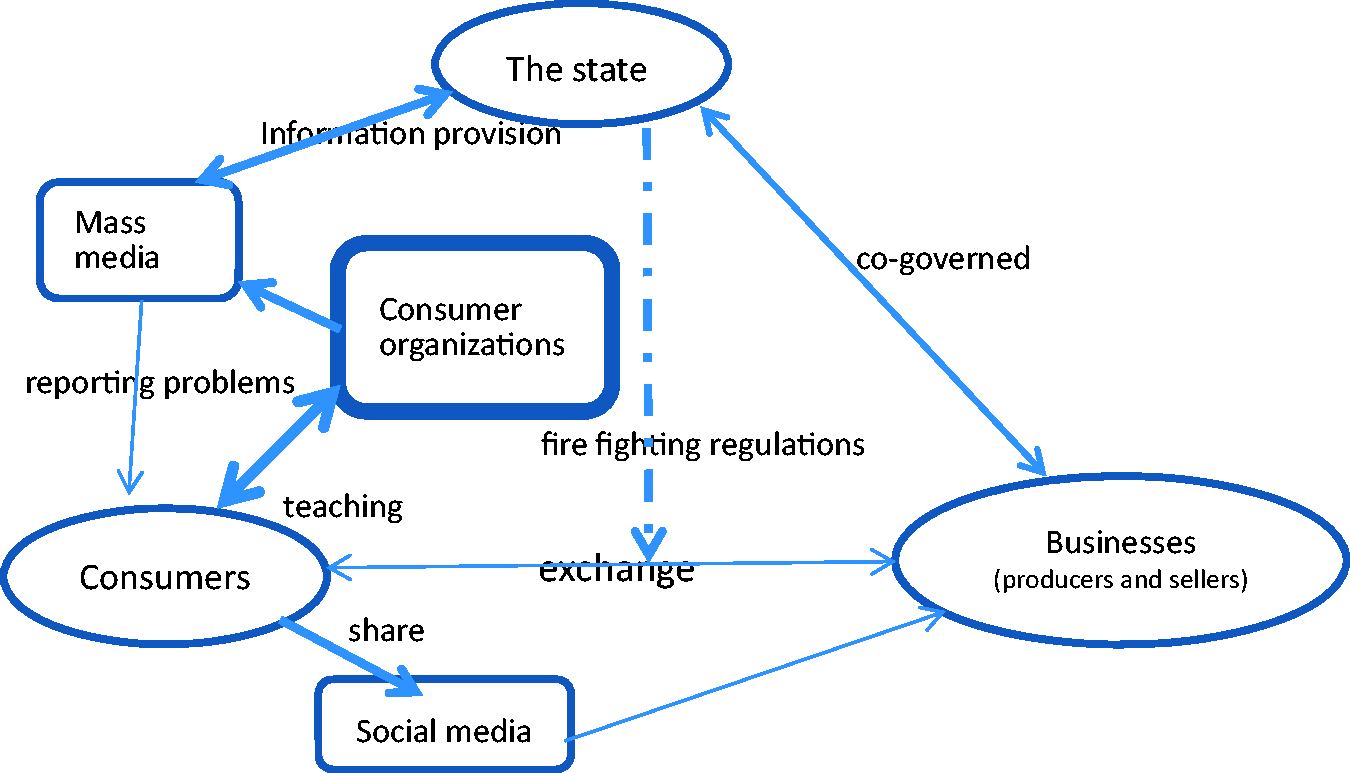
What the configuration also reveals is changes in the dynamics of instituting Taiwanese consumer markets. During the authoritarian period, consumer organizations emphasized consumer education and information provision, an approach that instituted consumer protection in the economic sphere as had been the case in China. Consumers became more confrontational in the wake of a democratization process that incorporated an attempt to institute markets in the political sphere. The political regime change that paradoxically increased business elites’ influence on state policy then drove new consumer groups to re-connect consumers and producers and to institute consumer markets in the social sphere.
Comparing the relationships in the instituting of consumer protection
The configuration of relationships helps us capture the dynamics of instituting consumer markets through consumer protection in political, economic, and social spheres. This section argues that the analysis also allows us to recognize that despite differences, civil society plays a limited role in these processes.
The Japanese case indicates how consumers organized networks to compete with the networks between the state and large corporations, a feature that reflects the network capitalism Walter and Zhang (2012) describe. In addition, with the rise and fall of political opportunities, consumers first tried to challenge the state and later collaborated with it to oversee the practices of firms. The patterned interactions between the state and consumers have consistently centered on the political sphere as it is the attempt to use political power to shape state regulations that is the most important process in addressing consumer market problems.
The absence of an independent consumer organization in China and the active Chinese Consumer Association also correspond to the feature of state-led capitalism. The authoritarian political context only tolerated consumers’ individualistic actions in markets, with collective actions linking consumer rights to citizen rights suppressed and punished. Therefore, political constraint and less competitive relationships between consumers and business with the state shaped how consumers collaborated with the state to fight fake products or complain online about unethical companies emphasizing market choices as the way to protect consumers.
Political change and the state–business relationship also generated a distinctive dynamic of consumer protection in Taiwan that shifted from political to social spheres. The fact that consumer organizations emerged prior to democratization made them strategically conservative and failed to successfully take advantage of political change as had Japanese consumers. It was when the relationship between the state and business became closer, consumers tried to change practices and collaborate with other socioeconomic groups with a different understanding of consumer protection.
Comparing the rights, representation, and enactment of consumer protection laws.
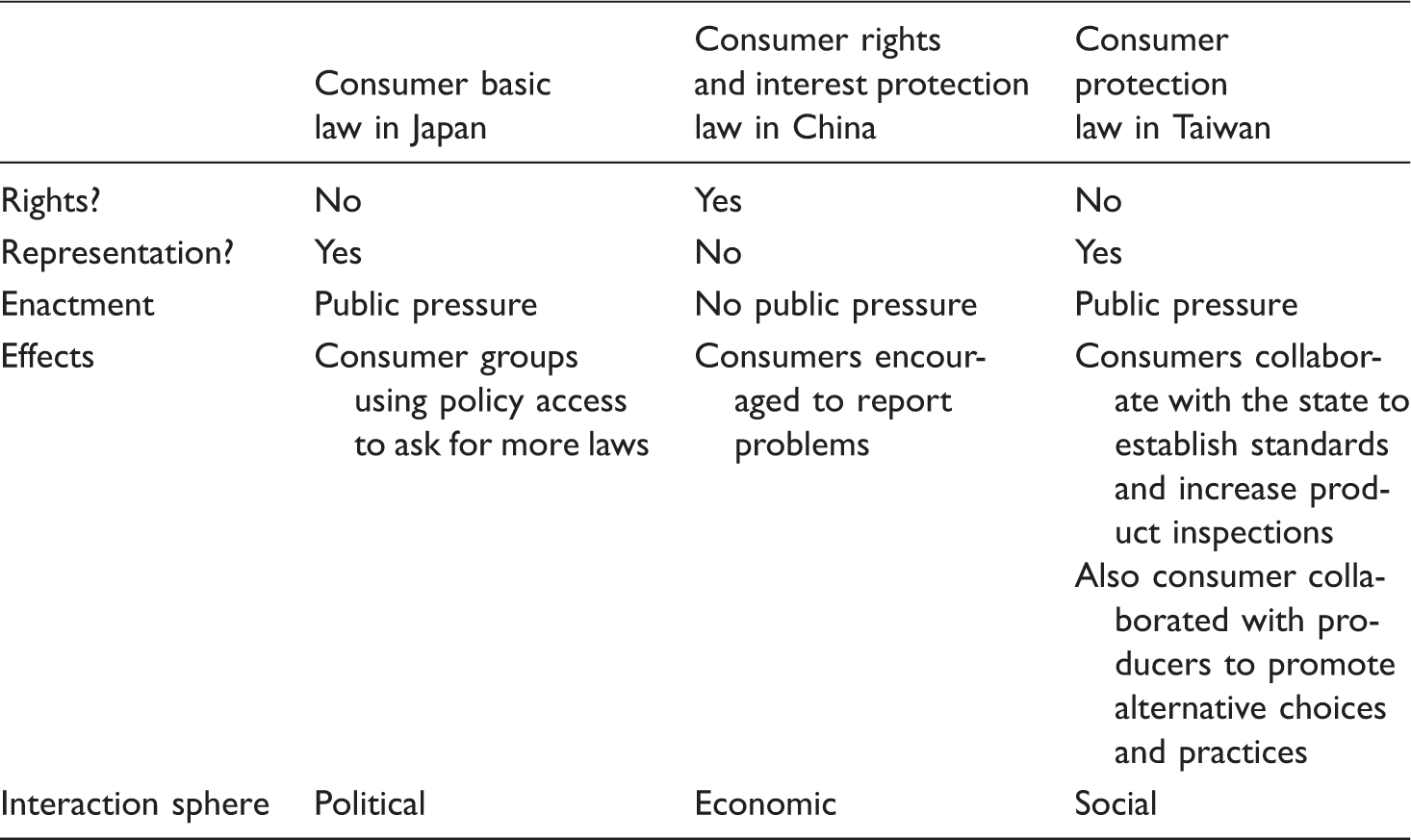
The differences among the cases illustrate, first, that authoritarian rule, stable democracy, and democratization present different political opportunities for consumers to organize; yet, this is not simply a question of whether consumers can organize and influence state policy. Second, the different state–business relationships Walter and Zhang (2012) describe posed varied constraints on what kind of strategy consumers deploy. Where the state–business relationship is strong, as in Japan, consumer organizations needed to build a stronger coalition with other socioeconomic groups in the political sphere or, as in democratized Taiwan, consumer groups use social media to cooperate with other social movements in the social sphere. When the state–business relationship is weaker and lacks political opportunity, such as in China and authoritarian period Taiwan, consumers use the mass media to raise issues and focus on individual strategies to avoid problematic products.
Therefore, the analysis stresses how state–consumer relationships were configured with the state–business relationships and as a whole facilitate patterned interactions among the state, citizens, and businesses. The configuration illustrates not just the coming together of sets of relations but the processes built on these relationships to institute consumer markets. In each case, there are distinctive dynamics in which one process feeds into another or where one process limits the development of another, showing that market governance is conditioned by the political and societal relational processes. This article concludes by reflecting on the implication of the comparison for the consumer societies in the region.
The challenges for East Asian consumer capitalism
Putting the three cases together presents us with a different picture than merely looking at a single case, and it is argued here that to understand East Asian consumer societies we need to comprehend the relationships in marketization. Consumerism reflects the idea of “self-regulating” markets and the notion of the sovereign consumer (Wolfgang and Spash, 2014) that shift the responsibility to consumers for protection in consumer markets and for social welfare in general. While consumer movement resist such ideas by demonstrating the sociopolitical agency of consumers, in East Asia this challenge is made harder due to the lack of political opportunity and when businesses enjoy better policy access with their interest tied to the development of the economy.
Walter and Zhang (2012) stressed that in East Asia economic activities are coordinated in specific ways by specific state–business relationships. These political economic relationships can also help us understand how consumer markets, an economic area that is seemingly coordinated by the mechanism of competition and free choice, are in fact instituted through consumer protection and actions. The analysis points out that there are indeed patterned state–consumer interactions and that consumer protection can be instituted in political, economic, and social spheres depending on the political opportunity and the state–business relationships.
Understanding the influence of state–consumer relationships in the sociopolitical processes surrounding the consumer market raises the question of how the particular political economic relationships centered on industrial development in East Asia can make a transition toward societies that emphasize market choices built on freedom and rights. Policy makers in China, for example, have noted the limits of export-oriented industries for economic development and have recently started to promote domestic consumption to achieve sustainable growth. However, such a consumer society requires some social and political foundation. The sovereign consumer requires their being able to organize collective action and form a public mind to shape state policy making, to hold the state accountable, as the citizen rights and social organization are the social and political foundation of market institutions.
A change in the state–consumer relationship along with the state–business relationship is therefore needed in East Asia to transform not just the consumer–business relationship in consumer markets but also the dynamics between economy and society. This is a question that an emerging consumer society needs to take up alongside how to protect its consumers. This presence of civil society in the actions and strategies of consumers highlights the empowerment of citizens in society and in politics to design the rules for consumer markets for improving consumers’ life quality as well as for enhancing the democratic governance of marketization.
Footnotes
Authors Note
I-Liang Wahn is now affiliated to Feng Chia University.
Declaration of Conflicting Interests
The author(s) declared no potential conflicts of interest with respect to the research, authorship, and/or publication of this article.
Funding
The author(s) disclosed receipt of the following financial support for the research, authorship, and/or publication of this article: The research is funded by Dissertation Fellowship, Chiang Ching Kuo Foundation (2012-2013). The author also gratefully acknowledge the support by Center for China Studies, National Chengchi University, Taiwan, in the writing of this paper.