






Abstract
In the existing literature, the relatively stable period of the 1970s, in Russia, is characterised by the rise of ‘socialist consumer modernity’, while the affluent 2000s were the time when a new phenomenon, ‘the culture of glamour’, emerged. Both periods parallel some cultural developments in the western world: the 1970s–1980s supposedly saw the rise of late modernity whereby individuals, freed from constraints of social structures, engage in ongoing process of self-reflexivity and self-fashioning, through consumption. In this article, drawing on the interviews with 20 middle-aged women from Moscow, I examine the limitations on self-fashioning as a means of achieving and maintaining a position of privilege. I particularly focus on the women’s concerns about failing to engage in normative practices of self-care, including anti-ageing cosmetic procedures, and hence failing to embody feminine dispositions that had value in their middle-class milieu. The analysis of such concerns helps discern the ways different markers of identity (gender, class and age) interplay and act as enablers or constraints in the mundane struggle for power at the interpersonal level.
Introduction
In the 2000s, when Russian society was enjoying the benefits of high oil prices (Treisman, 2011), the material abundance that Soviet governments promised but failed to deliver seemed to have become a reality. In this period, beauty salons and stands selling cosmetics in shopping malls became a regular sight in large cities such as Moscow. As the country entered the global market and the state gradually lost its monopoly on the official definition of what it meant to be a woman or a man (Zdravomyslova and Temkina, 2003: 320), private businesses such as cosmetic companies, beauty clinics and the media brought their own idealised images of femininity and masculinity into the public sphere (Rosenholm et al., 2010). The growth of the beauty industry in post-Soviet Russia was part of a wider development, namely the emergence of a new cultural phenomenon that has been termed ‘the culture of glamour’ (Klingseis, 2011; Mesropova, 2009; Ratilainen, 2012). It is characterised by the significance individuals attach to ‘self-marketing’ or the explicit decoration of the body with status accessories (Klingseis, 2011: 100–101).
Considered from the perspective of class/gender intersection, glamorous consumerism appears to be both enabling and constraining. On one hand, it provides some women with the discursive and material means to invest in feminine constructions available in the marketplace (e.g. the health benefits of beauty care). On the other hand, it reinforces cultural representations whereby women are encouraged to cultivate their most highly valued asset – a cared-for appearance – that can allow them access to other types of capital, such as a marriage to a rich businessman, but nonetheless bares them from achieving a position of power in the public sphere (see Mesropova, 2009: 98; Ratilainen, 2012: 46–47).
Despite such valuable insights into the interplay of gender and class, literature on the culture of glamour rarely acknowledges that it is also shaped by age relations. Describing glamour as one of the cultural mechanisms that allows working-class women to display heterosexual femininity without losing respect, Beverly Skeggs (1997: 110–111) links glamour to agency and strength and notes that ‘it is not restricted to age’. However, literature that explores femininity and glamour is commonly centred on young women or ‘girls’, for instance, in studies of modelling (Coy and Garner, 2010; Soley-Beltran, 2004), flight attendants in the United States (Barry, 2007) and depictions of women in popular films (Gough-Yates, 2001: 94).
In this article, I explore how urban middle-class Russian women, who came of age in the 1970s, participate in the post-Soviet consumer culture. In doing so, I seek to reveal some of the limits on practices of self-reflexivity and self-fashioning, as a means of achieving and maintaining a position of privilege. I particularly focus on the women’s concerns about failing to engage in normative practices of self-care and hence failing to embody feminine dispositions that had value in their middle-class milieu. The analysis of such concerns helps discern the ways different markers of identity (gender, class and age) interplay and act as enablers or constraints in the mundane struggle for power at the interpersonal level.
Soviet consumer culture: A historical background
Drawing on the interviews with men and women of various ages and from various class backgrounds living in urban Russia, Katherine Klingseis (2011: 90) documents how in her interviewees’ grooming practices the appropriation of Soviet ideals of gender, taste and modesty was mixed with the need to adjust to the post-Soviet cultural environment with its greater emphasis on competition and glamour. In light of such continuity, it is relevant to explore the extent to which this preoccupation with appearances and status existed in the Soviet times. Of particular interest is the relatively stable period of the mid-1960s–1970s when the women interviewed for this study came of age.
Scholars, concerned with ‘everyday life’ in Soviet Russia, present a wealth of material on the internal contradictions of official rhetoric about individual consumption, fashion and aesthetics that located these matters along a West/Soviet binary (Gurova, 2006; Tikhomirova, 2010; Zakharova, 2010). Volkov (2000) argues that in the mid-late 1930s, individual attendance to the body (grooming, fashion) went from being used by Soviet government officials as a mechanism for turning former peasants into cultured citizens of a modern state to being scorned as a bourgeois practice and alien to a communist society. In the post-Stalinist period (1950s–1980s), individual consumption was an indicator of improving living standards, however ideologically an overt preoccupation with fashion and beauty was tied to the decadent, individualistic West (Gurova, 2006; Zakharova, 2010). Under Brezhnev, the government continued sending mixed messages about the desire for good quality consumer goods (not merely without defects but well-designed, hi-tech) as both a sign of high culture and a vice leading to moral denigration, alcoholism and even crime (Chernyshova, 2013; Evans, 1986: 7–8).
In official speeches and texts, obsession with material comfort was commonly construed as a specific characteristic of certain social groups. Based on the analysis of archival documents from the Khrushchev era, Reid (2007) argues that officials viewed young people and women as lacking an ideological self-defence from the petit bourgeois vice of consumerism. According to Reid (2002: 220), Khrushchev’s cabinet used different messages to legitimise the regime depending on the gender of citizens. While men were promised socialist democracy, women’s support was to be ensured through pledges for a greater satisfaction of consumption needs and desires. Chernyshova (2013: 64–65) notes that in fiction of the 1970s women were commonly portrayed as dragging their husbands and families into the darkness of consumerism. Assumptions about women’s political inferiority and, as a result, vulnerability to the seduction of materialism point to a specific way an ideal Soviet femininity was, to a degree, shaped by an ideological antagonism between the supposedly non-materialist Soviet Union and the consumerist West.
Bringing a lost femininity back
Given the significant role played by the Soviet state in the regulation of individual consumer practices and the gendered nature of the official discourse concerning ‘consumerism’, it is important to account for what has been termed the ‘gender contract’ of female citizens with the state. According to such a ‘contract’, as women were given an opportunity to perform paid labour outside of the home and hence contribute to the national economic production, the state was to provide working mothers with free childcare and other social entitlements (Aivazova, 2001; Gradskova, 1999; Temkina and Rotkirch, 2002). However, the state’s struggle to fulfil its part of the contract was evident, for instance, in an inadequate provision of high-quality, free childcare services (Bridger, 2007: 105–122; Issoupova, 2000: 39). This problem exacerbated during the period of economic reforms in the early 1990s when, due to the lack of funding, the state nursery system collapsed and many childcare centres closed down (Avdeyeva, 2011: 370). Akin to the Soviet state’s solutions to low birth rates, the demographic policy of Putin’s government during his first and second terms focused on support for working mothers but with no attention to shared parenthood or flexible employment schemes. Such approach was bound to reinforce the existing gender inequalities at work and in the home (Rosenholm and Savkina, 2010; Rotkirch et al., 2007: 355).
Despite the similarities in the conditions of the Soviet and post-Soviet ‘gender contract’ of the state with female citizens, it is the former that is associated in the popular discourse with ‘equality of the sexes’ that had increased the load of women’s social responsibilities. This idea was reinforced in the early 1990s by liberal-inclined politicians who ‘rejected everything associated with the Communist past [and] emphasized individual rights by assigning women back to their homes (a right which women were deprived of during the Soviet period)’ (Teplova, 2007: 300, emphasis original). The notion that women lost their right to be stay-at-home mothers echoes some women’s own narratives concerning a loss of femininity due to the state’s policies. Analysing the interviews with Russian women immigrants in Israel, Fran Markowitz (1995) concludes that ‘angered by what they consider to be the disastrous effects of political programs for women’s equality, (former) Soviet women, as a rule, rejected the feminist movement and strove instead to regain their “natural” femininity’ (p. 40).
The possibility for Russian women to regain their ‘natural’ femininity, and hence to break with the obligatory gender equality, has been linked to the availability of means for self-beautification. Azhgikhina and Goscilo (1996: 107–108), for instance, note that for a long time ‘a preoccupation with enhancing their looks was virtually Russian women’s sole means of self-expression’. In the early 1990s, for some young women, beauty care signified a break from what they perceived as austerity of the Soviet years (Kay, 1997). Yulia Zelikova (2002: 419–420) has argued that massage, exercising and other bodily practices can provide women who grew up in the Soviet time and internalised what the author calls ‘prohibition on pleasure’ (e.g. satisfaction of sexual desires) with the means to develop a more positive attitude to their own bodies.
Ageing and consumer culture
While practices of care for the body can provide younger and older women with a sensual pleasure and serve as a means of escape from social duties, these positive effects might be undermined by the commercialisation of such practices by the beauty industry whose profits are dependent on the constant invention of bodily defects (Bordo, 1993; Elliott, 2013; Howson, 2004). The promotion of so-called anti-ageing products, for instance, might perpetuate the existing negative imagery of ageing, which has been described as a ‘narrative of decline’ (Chernyshkova, 2011: 291; Coupland, 2007: 39). 1
Attention to age as one of the axes of identity and a factor that shapes people’s lived experiences is pertinent since, in the time of the so-called late modernity, 2 the life-course no longer follows a linear progression (Biggs, 2004: 47; Schwaiger, 2009: 275). This has been reflected in the literature focused on older women’s attitudes to ageing, where the latter is generally viewed as an ongoing process of negotiation of social norms, identity construction and consumer practices, as opposed to a pathway through predetermined stages of a lifecycle (Ballard et al., 2005: 170; Twigg, 2007). Despite these changes, some authors observe that age relations remain on the margins of feminist and cultural gerontology analyses, and there is a need to investigate why and how age relations gain significance in specific contexts (Krekula, 2007; Utrata, 2011). Calasanti and King (2007: 358) define ‘age relations [as] [a] system of inequality’, whereby behaviour, appearances and practices that are coded as characteristic of youth can give some advantage in accessing resources such as employment and wealth. Middle-aged and older people, who invest in their appearances and consume ‘anti-ageing’ commodities, can possibly avert a loss of status and authority associated with mature age (Calasanti et al., 2006). Utrata (2011: 619) also notes that ‘youth privilege’ that is generated by ‘particular configurations of age relations, or ways of doing age’ often remains invisible to the women who have it.
Drawing on the existing research, I seek to investigate how the generation of women, who figure in Utrata’s (2011) analysis as babushki (grandmothers), makes sense of the requirements to work on their bodies dictated by the youth-centric culture of glamour. In doing so, I engage with and contribute to theoretical debates concerning identity construction in late modernity, which have centred around the question of social agents’ ability to fashion themselves in a desirable manner with little pressures from social structures such as gender and class.
Embodied practices and identity
To tease out the intersection of markers of gender, class and age as they emerge in women’s discursive practices, I use Pierre Bourdieu’s concept of habitus as well as the ideas of other scholars who have engaged with his work. Bourdieu (2010: 163) defines habitus as a system of durable and transposable dispositions – or inclinations that individuals embody and enact in different areas of social life – that create a particular way of perceiving the world and one’s operation in it. The habitus is a system that is generated by structures such as material conditions characteristic of a social class, but habitus is also a generating system that produces practices (Bourdieu, 1977: 72–73). Such practices reflect the choices that people make within constraints of their current situation, such as access to material resources or symbolic power, commonly predetermined by individuals’ class position (Skeggs, 1997).
In application to the interview data analysed in this article, habitus can be complimented with a related concept that Bourdieu’s (1990) referred to as a ‘feel for the game’. This ‘feel’ is a kind of unconscious knowledge of the rules guiding social behaviour in a given milieu. As this intuitive knowledge or feeling is generated over time by the experience of objective structures within which the game is played out, it (the ‘feel’) provides all the ‘players’ with some sense of a probable final outcome (Bourdieu, 1990: 66), and it is this sense of meaning and shared prediction of the future that legitimise social norms. The concept of the ‘feel for the game’ is useful for the analysis of the participants’ own emphasis on the lasting (embodied, unconsciously reproduced) Soviet legacy of what they referred to as lost femininity. As will be discussed later, a recurring theme in many interviews was a supposed lack of femininity in Russian women of the participants’ generation; despite such a realisation, the interviewees felt that it was impossible for them to alter this situation because over time unfeminine traits have become part of their bodily selves. In other words, due to their emphasis on tacit and mundane influences of social structures on one’s conduct, the notions of habitus and feel for the game are useful tools to explore ‘pre-reflective aspects’ of identity (Bottero, 2010: 4). Bourdieu’s focus on embodied dispositions and their relationship with ‘objective’ structures, therefore, enables insight into the limitations on reflectivity and conscious alternations of aspects of identity, such as gender (Adkins, 2003: 28; Bottero, 2010: 4; McNay, 2000).
Habitus versus reflexivity
Bourdieu’s writing on habitus suggests that shifts in objective structures can result in a mismatch between a ‘feel for the game’ and the ‘game’, which, in turn, leads to moments of reflexivity when individuals begin questioning the meaning of their actions and the game itself (Bourdieu, 1990: 66–67). Some scholars have raised questions about this so-called crisis model of reflexivity, arguing that such a model has become ‘endemic’ in post-traditional societies, where a misfit between habitus and objective structures is the new norm (Adams, 2006: 517–518; Bottero, 2010: 9–10; Sweetman, 2003: 529).
As Adkins (2003: 33) notes in relation to a workplace setting, men’s and women’s reflexivity concerning their gendered practices is not necessarily associated with changing gender norms. On the contrary, in contemporary white-collar workplaces female (and male) employees might be encouraged to master different feminine (and masculine) performances depending on the situation and interaction – practices that gradually become routinised (Adkins, 2003: 33; Sweetman, 2003: 541). In other words, ‘reflexivity does not concern a liberal freedom from gender’; rather, it can be linked to ‘new arrangements of gender’ in late modernity (Adkins, 2003: 34).
While the debate regarding reflexivity has gained popularity in academic circles, there is still no agreement on what exactly the term means, and some analyses drawing on secondary accounts arrive at contradictory conclusions (Adams, 2006). One of the ways out of such a theoretical impasse is suggested in the work of Lisa Adkins (2002: 123, 130) who has argued that a self-reflexive subject is an ideal in late modernity; however, reflexivity is a valuable resource that is only available to certain social groups, through specific techniques of self-knowledge. As such, reflexivity is interconnected with habit and becomes part and parcel of the reproduction of social inequalities – the view that both complements and extends Bourdieu’s theorising.
Drawing on these insights, I ask whether self-reflexivity, achieved via techniques of self-knowledge, is by default an indicator of a privileged position (see Adams, 2006: 519). More in line with Bourdieu’s sceptical perspective on reflexivity, I will explore how the localised interplay of gender, class and age can impose limitations on reflexivity as a tool of self-fashioning and a means of maintaining privilege.
The participants and method
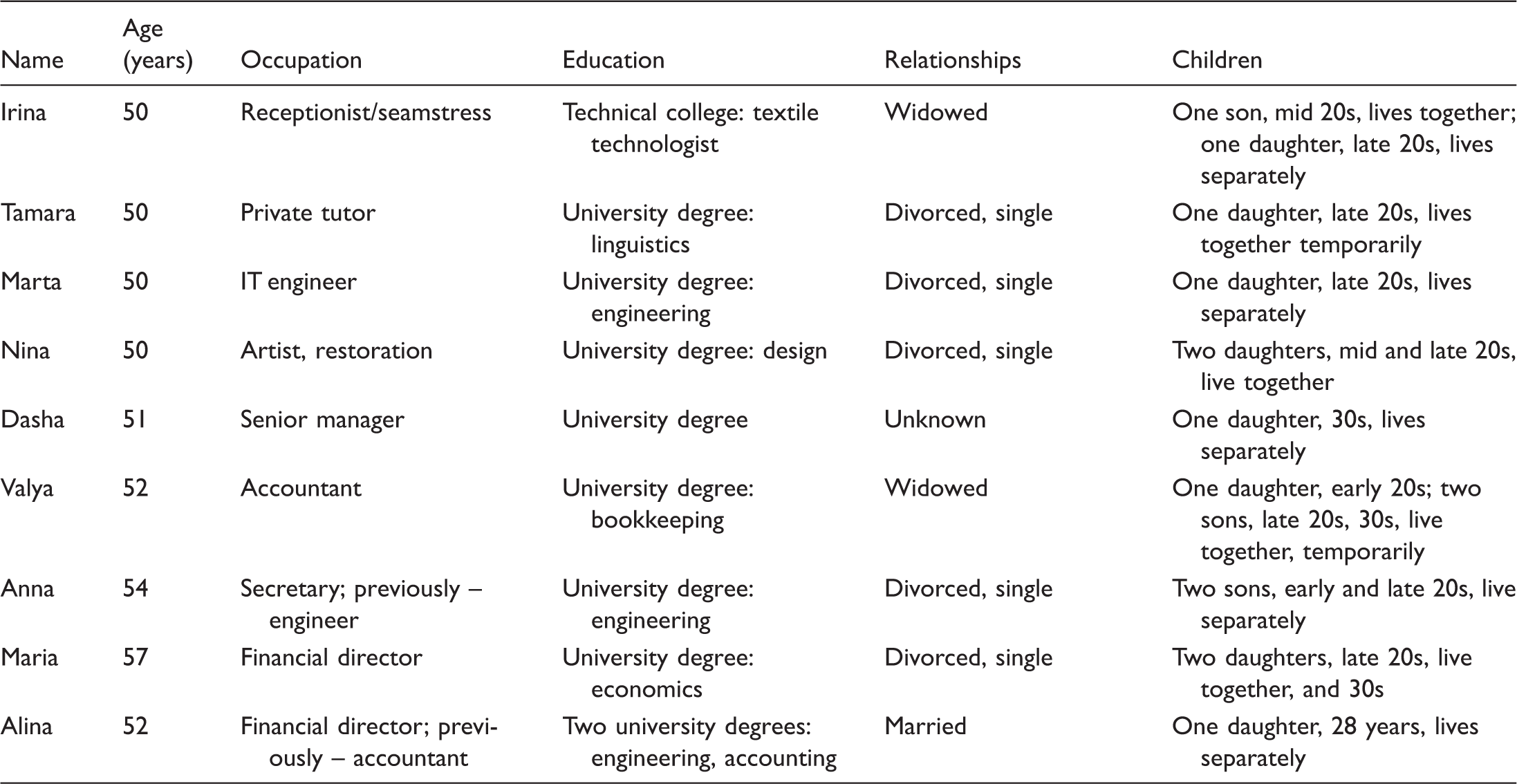
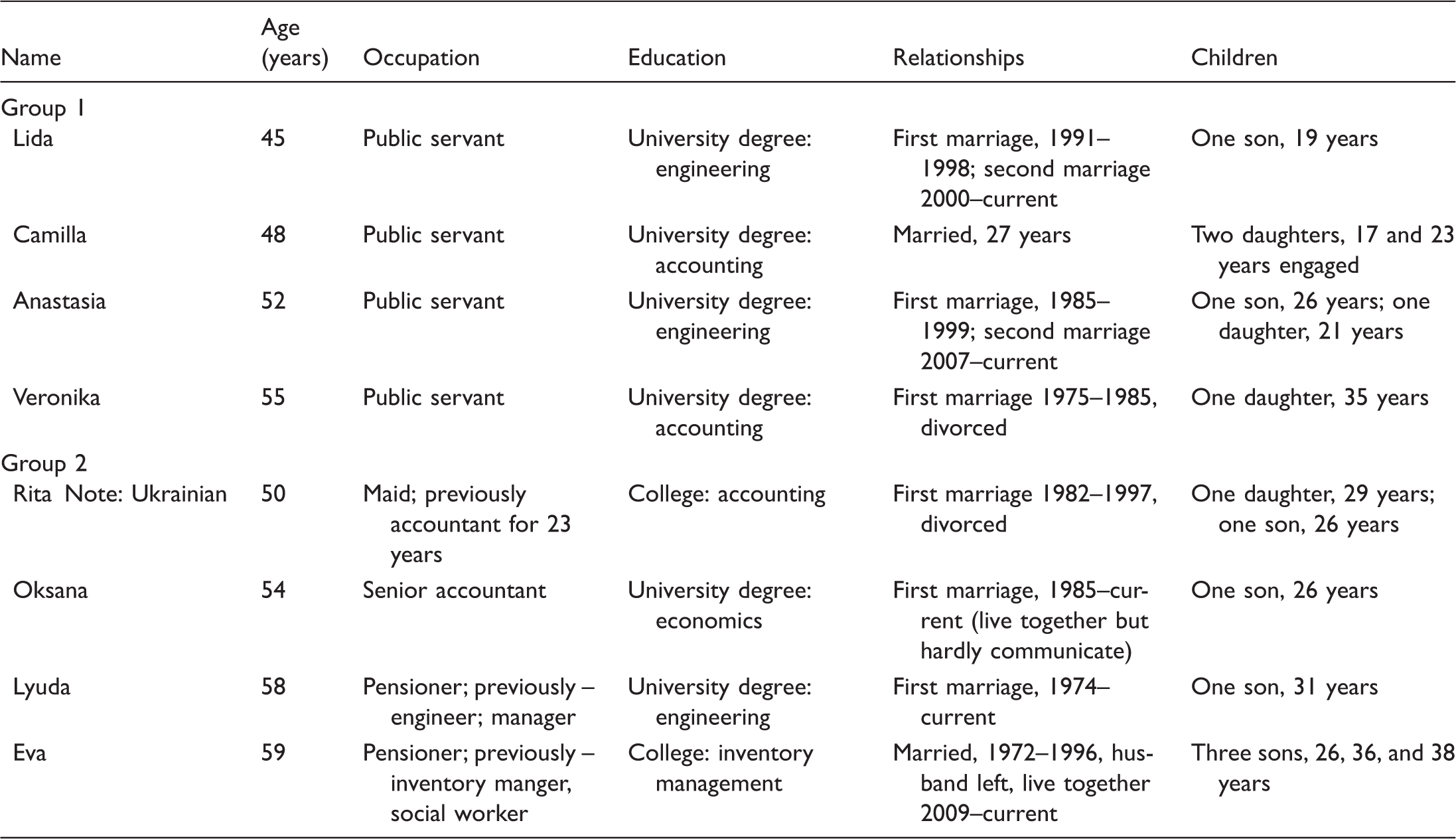
The analysis in this article is based on the data collected during two research trips to my hometown of Moscow in 2010 and 2012. During the two field trips, I conducted 12 individual and 5 group interviews. Overall, there were 31 women age 33–59 years and 11 women age 26–28 years interviewed, including 4 mother–daughter pairs. All individual interviews took place in September–November 2010, while the rest of the interview data were gathered 1.5 years later, in April–June 2012.
The socio-demographic attributes of the participants – individual interviews.
The socio-demographic attributes of the participants – group interviews.
The data were analysed using a combination of inductive and deductive thematic analyses (Fereday and Muir-Cochrane, 2006; Horrocks and King, 2010). The two sets of interview data were transcribed verbatim (in Russian). 4 The combination of inductive and deductive thematic analyses presupposes that the researcher derives codes from the data as well as draws on the existing theories to conceptualise the links between core themes (Braun and Clarke, 2012: 60). After several close readings of the interview transcripts, I generated codes and subsequently arranged parts of each transcript under these codes, such as self-presentation at work, sources of advice on beauty care and taste/lack of taste (Horrocks and King, 2010: 152–153). In the large project, parts of transcripts were eventually grouped into five overarching ‘first-order’ themes: consumption, work, intimate relations, mother–daughter relations and bodily ageing (Fereday and Muir-Cochrane, 2006: 90). The analysis presented in this article is a revision of parts of the original data, with a particular focus on the notion of ‘lost femininity’ that originally figured within the overarching theme of bodily ageing. In the rest of the article, I will examine the three selected themes that emerged in the process of data analysis: barriers to restoring a ‘lost’ femininity; barriers to maintaining a middle-class feminine appearance and resisting anti-ageing beautification.
Barriers to restoring a ‘lost’ femininity
Some interviewees reproduced almost verbatim the discourse from the late 1970s–1980s that Zdravomyslova and Temkina (2003: 316) term ‘the imbalance of female social roles’ of a paid employee and a primary child carer. The interviewees believed that over the years Russian women’s femininity had diminished due to the need to take on a role of a breadwinner: When you load an unbearable burden on yourself, feminine traits go away and masculine traits come instead. So if there’s a person who can help you share this load you can afford to be feminine. You can straighten your back, put on a smile [laughs], because the majority of women who carry this burden have got to take up masculine traits simply to keep going with the load and survive. (Camilla, 48 years, public servant, group interview) You need to explain to men that sometimes a woman needs to be weak […]. [To be a woman] means that you can lean against someone. But our men have got used to us being independent […]. In the past [during the Soviet years], a man was considered to be a breadwinner […]. Women always used to get [paid] less, but now it’s probably different. We’re independent and take on too much [responsibility]. (Alina, 52 years, financial director, individual interview) If she’s single […] she’s in an unsuccessful marriage […], and she performs both male and female functions, she earns money … masculine features begin to appear. I can take myself as an example, I’ve got no skirts, only pants because […] in my life I’ve had to be in charge of everything (nesti vsyo na sebe). And maybe I’ve gained some sharpness, and my gait is not feminine anymore. (Oksana, 55 years, senior economist, group interview)
What the above comments from Camilla, Alina and Oksana suggest is the questioning of meaning, combined with frustration, akin to those that Bourdieu (1990: 66–67) linked to individuals’ ‘suspension’ of their commitment to the ‘game’. On one hand, like individuals described by the authors of the ‘extended reflexivity’ thesis (Adams, 2006; Sweetman, 2003), the interviewees appeared to be caught in the state of acute awareness that there was a disjuncture between their habitus and objective structures. On the other hand, the above quotes imply that (Soviet Russian) women’s collective ‘unfeminine’ habitus was actually in sync with the social settings that encouraged them to be resilient and financially independent (where men had lost their ability to be providers and hence become ‘weak’). Thus, their frustration seems to have arisen out of the combination of their ability to critically evaluate the gender order and their inability to alter it because it had become part of their embodied dispositions (Adkins, 2003; McNay, 2000).
The emphasis on women’s financial independence (‘she earns money’, ‘we’re independent’), central to the interviewees’ reflections, alludes to the time of improved living standards and a social and cultural milieu where it was possible for women to achieve such freedom, for instance, during the late Soviet period. 5 In this sense, Camilla’s quote stands out because it makes a reference to the need to survive, presumably economically. As such, two distinct figures emerge from these three comments: a middle-class woman capable of achieving economic independence, which causes her to acquire undesirable ‘masculine’ dispositions, and a working-class woman who needs ‘simply to keep going with the load’ and for whom the acquisition of ‘un-feminine’ traits is a means of survival. The embodied dispositions that the interviewees reflected on but seemed unable to alter can be coded as ‘working-class’ – dispositions that fell short of what the interviewees aspired for. Symptomatic of the ongoing myth of Soviet women’s loss of femininity to gender equality, their aspiration was material comfort that was provided mainly by the man in the family and that would allow women to maintain feminine dispositions marked by a distance from material hardships and a need to survive (e.g. a smile, a straight back).
Maintaining youthful, middle-class femininity
Appearances that the interviewed women aspired to fashion were not only ‘middle-class’, but also ‘youthful’. In the context of a white-collar workplace, for instance, such appearances could constitute a resource, especially valuable for women who are nearing the official retirement age of 55 years. The conversion of this ‘asset’ into material or symbolic benefits, such as professional authority or pay rise, can be far from straightforward, for both younger and older employees. This was exemplified by comments from Dasha and Alina: I think that if you work in the field of [finance], when you are always visible to people, you should take [grooming] very seriously. It’s a very big plus when you always look cared-for [uhozhennui] […]. It’s a very heavy burden [to be a woman], but nevertheless you’ve got always to be attractive, to look after yourself, [apply] a bit of makeup […]; to be face-less, plain, I think it’s unacceptable. (Dasha, 51 years, senior manager, individual interview) Unfortunately, [beauty care] requires time and money and nerves, because I don’t feel like spending time on it. But I [do get] the whole course of 10 [facial] procedures. [I have to do it] every week: if you miss one week, the effect from the previous week is wasted […]. [I do it] for myself and people around me, so it’s not disgusting for them to look at me … and plus work […]. I’m almost the oldest at work. (Alina, 52 years, financial director, individual interview)
As noted above, Lisa Adkins (2002: 8) has argued that self-reflexivity has become a valuable resource that allows an achievement of a privileged social position. The quotes from both Dasha and Alina would fit into this perspective on self-reflexivity and its link to privilege. Attention to the intersections of multiple aspects of identity, however, would allow for a more detailed reflection on how a position of power is maintained through routine interactions and practices. For instance, Dasha’s comment in particular points to the instability of the position of (professional) authority that was conditioned by her being a woman. It is possible to simply add ‘age’ as a factor contributing to the so-called double jeopardy of ageism and sexism (Krekula, 2007). But Dasha’s and Alina’s reflections problematise such ‘adding-on’ of age; being older and established professionally provided them with monetary resources necessary for the maintenance of an upper middle-class appearance which, along with their accumulated work experience, was instrumental in their everyday struggle for professional authority and status among colleagues.
As discussed in the next section, the significance of professional beauty care to feminine ‘self-governance’ as well as to the negotiation of a class position encouraged the women interviewed to ponder whether they should try beauty technologies such as anti-ageing aesthetic surgeries. The pressure to participate in the youth-centric culture of glamour was amplified by the women’s own internalisation of the rhetoric of ‘free choice’. How did these women negotiate these pressures? How did their position of relative privilege influence this negotiation?
Resisting anti-ageing practices
With regard to their grooming practices in the 2000s, the interviewees tended to speak more about the ways they worked on their physical bodies, as opposed to the memories of difficulties associated with trying to procure clothes or find a good hairdresser. As particularly evident from the discussion in this section, the femininity that these women might be seeking to embody is inevitably shaped by social norms regarding age and bodily ageing (Calasanti and King, 2007). While a youthful appearance might be highly desirable, the interviewees were hesitant when it came to the use of more radical forms of re-making the body.
Most interviewees saw a turn to surgical interventions as a matter of personal choice that deserved more respect and understanding. Women, whose bodies and faces looked too young for their age, were pitied more than judged, especially as the participants were aware of a possible ‘addiction’ to bodily perfection and health risks in the case of botched procedures. Oksana gloomily commented on another woman’s story: How much physical health has she lost [due to the procedure]?! She might appear some years younger now, but she’ll die earlier […]. [But] everyone chooses for herself, it’s up to her whether she uses it or not. (Oksana, 55 years, senior economist, group interview) Who said that every woman needs a man to be happy? Maybe for me personally … it’s not necessary. I’ve got a good son, my job and a circle of friends and I’m happy at the moment. I don’t need [a man] […]. If now I need to look good it is because it is me who wants to and not because I want to be fancied by [some man]. (Oksana, 55 years, senior economist)
However, not everyone was as decided as Oksana on the use of plastic surgery. When asked about their attitude to cosmetic and non-cosmetic procedures such as Botox injections, Oksana’s fellow participant, Eva, replied, You look [in the mirror and] don’t like your appearance. It got swollen somewhere. I […] don’t want to age. But I have no thoughts to go and get something lifted, to get some Botox or something. Maybe there’s some fear […]. I wouldn’t mind rejuvenating but it’s only for 2–3 years and then what? (Eva, 59 years, pensioner, group interview) I go to the hairdresser, of course, but don’t do any manipulations with the face, no [face] lift. I don’t want it as a matter of principle, and there’s no need yet. But my sister’s daughter tells me: You already need it [face lifting]. I say: I don’t want it, don’t need it yet … [I] will be looking at myself [to see if it’s necessary], you just need to start with it, as they say. (Maria, 57 years, senior economist, individual interview)
Despite such a significance of professional beauty care to the ‘achievement’ of gender – or to the constitution of gendered subjects through practices guided by dominant discourses – such formation is never absolute (Butler, 1993). These women have an opportunity to doubt the value of some of the beauty techniques offered by various experts. Their privileged position in terms of education and occupation can be seen as enabling of such negotiation or resistance. They might have to weigh up benefits and losses that can arise from this decision, but some degree of resistance (even if only temporary) would not pose an immediate threat to their social status (Dworkin and Wachs, 2009). Yet, their ambivalence about more radical anti-ageing interventions indicates that their age (close to retirement or have retired) undermined their negotiating power and encouraged them to re-consider whether they could afford to reject new anti-ageing technologies.
Conclusion
The scholarship on consumer culture characterises the relatively stable period of the 1970s, in Russia, as marking the rise of ‘socialist consumer modernity’, while the affluent 2000s are described as the time when a new phenomenon, ‘the culture of glamour’, emerged. Both periods parallel cultural developments in the western world where the 1970s–1980s supposedly saw the rise of late modernity – the time when individuals, presumably freed from the constraints of social structures, engage in an ongoing process of fashioning the self, mainly through consumption. Despite such similarities, the role of the Soviet state in shaping the discourse on individual consumption makes Russian ‘consumer modernity’ somewhat unique. Moreover, the state’s policies, aiming to assist ‘working mothers’ in both late Soviet and post-Soviet years, have produced a peculiar and persistent narrative of a lost femininity. This narrative, which was a recurring theme in the interviewed women’s accounts, forms an important element of Russian middle-aged, middle-class women’s participation in the culture of glamour that celebrates youthful femininity.
The participants were concerned about displaying un-feminine traits, but these were in part required of them as some Russian men were, in their eyes, weak or unable to financially provide for their families. The interviewees’ own use of language suggests that such traits resulted from financial hardship and the daily need to survive. Thus, while the women themselves consistently made a reference to ‘masculine’ bodily features, I argued that a ‘lost’ femininity was about a fear of transgressing gender boundaries as much as class boundaries. Although the women valued beautification as a means of caring for the self and maintaining their position of privilege, many of them did not simply accept the need to radically re-shape their bodies. The interviewees could afford to question the value of beauty techniques that appeared unhealthy and damaging. However, some participants suggested that they could potentially succumb to anti-ageing interventions sometime in the future, for instance, if they felt that their appearances were falling far behind the acceptable, youthful standard.
Thus, the notion of lost femininity might make beauty care one of the main practices through performing which these women can know and fashion the self as gendered subjects; however, an intersectional approach to the reproduction of social status questions assumptions that in this process a middle-class position acts necessarily as an enabler and a mature age as a constraint. This is not simply because women might aspire to middle-class ideals of femininity but lack necessary resources such as time, or because they need to find a balance between being in a position of authority at work and having to present themselves as ‘feminine’. In the same context of work, despite their professional experience and position of authority, they also might use their accumulated resources to draw a fine line between emulating youthful looks and appearing ungroomed. In social settings beyond work, their younger female peers might remind them that their mature age and ‘femininity’ are incompatible unless this relation is mediated by cosmetic interventions. But as they get older and reflect on their lives, middle-aged women might also turn to ‘techniques of the self’ other than beauty care (e.g. psychology), which can result in them questioning the very idea that women need to constantly work on their bodies and receive validation of their sexual desirability from men, as a way of being feminine.
Footnotes
Acknowledgements
I would like to thank the two anonymous reviewers for their insightful comments. I am also grateful to Victor Albert, Andrea Waling, Lana Chung, Wendy Mee and Ramon Mendez Domingo who provided constructive feedback on earlier drafts of this paper.
Declaration of Conflicting Interests
The author(s) declared no potential conflicts of interest with respect to the research, authorship and/or publication of this article.
Funding
The author(s) received no financial support for the research, authorship and/or publication of this article.