







Abstract
Unlike product invention, product innovation has been overlooked as an issue relevant to the study of the economic, social, and cultural change. It is only in recent times that historians started to explore product innovation in order to understand the origins of consumer society. This article deals with fashion as a kind of product innovation and aims to explain how 19th-century fashion transformed clothing into a product designed and desired primarily for its ever-changing expressive and decorative qualities. The research is based on the mail order catalogs delivered by the Italian department store Alle Città d’Italia in the 1880s. Analysis of this valuable and largely unexplored historical source allowed us to conclude that (1) the innovative nature of 19th-century fashion had mainly to do with the services – ready-to-wear dress and novelty – provided to consumers rather than with the product’s physical components; (2) department stores and haute couture – the sole internationally acknowledged agency of fashioning at the time – both contributed to transform novelty and continuous change into distinctive characteristics of fashion; (3) fashion played a major role in modernizing consumer culture, shifting the focus from material elements to the services inherent in consumer goods.
Introduction
Consumer society and consumer culture have become research areas of interest to historians since the 1970s. The first studies in the field were conducted under the impulse of The Unbound Prometheus, the groundbreaking work on the economic history of industrialization in Western Europe in which the author, David Landes (1969), questioned the dogma that production determined consumption by arguing that in 18th-century Britain technological innovations resulted by the pressure exerted by increases in demand. Scholars’ attention to the history of consumer society and consumer culture became fully apparent at the beginning of the 1980s with the publication of a collection of essays by McKendrick et al. (1982). The three scholars agree that in the 18th century, Britain experienced a consumer revolution which gave birth to the first consumer society and triggered the industrial revolution. In line with some authoritative economic and business historians (Robinson, 1960, 1963; Thirsk, 1973), McKendrick in particular argued that fashion was crucial to the development of such a process. Developing the insightful analysis proposed by Georg Simmel (1904) in his seminal work, he warned that changes in fashion deserve serious attention as both a sign and a cause of economic and social change.
This article is part of the stream of research derived from the intuition that fashion matters to economic history and economic history matters to the understanding of consumer culture. With this work, we aim to understand how fashion transformed clothing into a product designed and desired primarily for its ever-changing expressive and decorative qualities.
The idea that change is entrenched in fashion is not new. The Anglo-Dutch philosopher and economist Bernard Mandeville (1670–1733) was fully aware that continuous change is the main characteristic of fashion and the one that makes it the epitome of consumer goods. The author of the poem The Fable of the Bees interpreted this process, which was rapidly developing at the time, as the result of the combination of consumers’ aspirations and novelties offered by the market. The interaction between demand and supply, which Mandeville observed in 18th-century fashion, has been investigated by scholars such as MacLeod (1988), Styles (2000) and, above all, Berg (1998, 2001, 2002), all of whom, with different approaches, analyzed the sources of economic change by shifting the focus from invention to innovation.
In 1976, Nathan Rosenberg invited historians to get free from the “Schumpeterian heritage of radical innovation” by focusing also on trivial product differentiation activities which may be important from a marketing point of view – altering lipstick shades or redesigning the rear ends of automobiles so that they more closely resemble the insides of pinball machines – but which do not pose serious technological problems. It may involve solutions to problems which, from a technological point of view, may be neither difficult nor interesting, but economically very important. (Rosenberg, 1976: 76)
Griffiths et al. (1992) have proposed an interesting classification of product innovation with regard to the textile sector which includes three main categories. The first one, that of “product differentiation,” concerns changes in the finished product in absence of innovation in the production process. The “product development” comprises the sub-categories “import substitution” – that is, the imitation of imported products – and “material saving product” concerning the case in which the output of innovation is a substitute for imported goods. The final category is “product improvement,” which includes innovations concerning both the production process and the product itself. However, fashion does not fully comply with the requirements necessary to be categorized as product differentiation, development, or improvement. Rather, fashion calls for new criteria to evaluate product innovation (De Munck and Lyna, 2015), based on the evidence that “design” – namely, a distinctive attribute of fashion – “appears to have gradually replaced intrinsic value (i.e. the value of the raw material used) as the basis of quality” (De Munck, 2011: 112, 2012: 1065).
Once again, historical sources are key to understand fashion, and specifically fashion as a particular kind of product innovation. The Italian chemist Marsilio Landriani (1751–1815), who traveled throughout Europe in the second half of the 18th century in order to visit the most advanced manufacturers and compare them to their Italian counterpart, had fully understood that fickleness alone was not enough to allow fashion to dictate the canons of elegance and taste. In Landriani’s view, fashion does not demand correction of the design but rather calls for an infinite and capricious variety, a happy invention, similar to the chance and the circumstances of the moment. However, it also demands an apparent solidity. For, indeed, what would be the use of a real solidity if the instability of fashion condemns as absurd today what it hailed as excellent yesterday? (Belfanti, 2004: 589)
This article aims to offer new insights in the study of fashion as an issue of interest both to economic history and consumer culture. We will deal with fashion as a product whose innovative nature relies upon services provided to consumer rather than innovations concerning raw materials, fabrics and weaving techniques, dyeing and colors, and so on. In this perspective, fashion will be treated as a matter of modern consumption, which according to consumer culture’s scholars “is largely based on the acquisition of goods through market exchange and occurs in societies where individual and groups shape their identities in relation to goods” (Stillerman, 2015: 6–7).
In the second half of the 19th century, the main innovations in services in the clothing industry concerned the introduction of standardized sizes and the advent of haute couture. Scholars have extensively dealt with the first innovation, the ready-to-wear dress, from different perspectives. Some of them offered a valuable contribution to the study of the role played by department stores in prompting the diffusion of sized clothing (Godley, 1997; Green, 1997; Kidwell and Christman, 1974; Perrot, 1981; Porter Benson, 1986), but this innovation has been investigated without considering the contemporary emergence of haute couture as the sole authoritative agency of fashioning at international level. Besides, the existing studies tend to overlook the impact of the novelties introduced by the French maisons on the production, distribution, and consumption of clothing addressed to an increasingly large market. Our aim is to fill this gap by exploring how 19th-century fashion transformed female ready-to-wear clothing into a “heterogeneous and multi-characteristic consumer good,” that is, into “a good whose demand is not for the good in itself but for the services it supplies, which can be represented by its characteristics” (Fontana et al., 2009).
To understand this process, we will analyze the strategies adopted by Alle Città d’Italia, the most important Italian department store, focusing in particular on the study of the mail order catalogs delivered in the 1880s. Mail order catalogs have not been fully exploited as a historical source. The chief histories of department stores mainly refer to them as an instrument to spread the bourgeoisie culture and fashionable styles. Certainly, catalogs were essentially an advertising tool. Their primary aim was to convey the message that the department store was strongly committed to keep its customers up with the times, and the latest trends in fashion were of paramount importance in such an effort. Thus, the reader who leafed through the pages of the catalogs found the fashion novelties accurately described and meticulously depicted.
Catalogs are also a valuable source of information about the physical characteristics, variety, and prices of the merchandise traded by early department stores. This kind of information makes catalogs a historical source different from those – such as fashion plates and fashion journals – that have been analyzed by historians as the means for the spread of fashion in 19th-century society and the most suitable one to investigate the impact of fashion on consumer culture and the productive and commercial strategies pursued by the firms involved in fashion business.
Department stores were crucial to women’s participation in consumer culture as main actors of modern consumption. At department stores, “shopping and consumption, as domains that were not coded as ‘masculine’ in the modern era, became the domain of women, and women gained status, satisfaction, and a degree of freedom by becoming skillful consumers” (Stillerman, 2015: 31–32; see also Fiske, 2000; Nava, 1997; Rappaport, 2001). Display was a key defining feature of the popularity of department stores. Here “what mattered was not the abundance of goods as such, but the ever present vision of such abundance” (Williams, 1982: 58) and mail order catalogs were crucial to this purpose. In catalogs, “private dreams and longings [were] commodified and used to inform visual images which can be translated into consumer goods” (Casey, 2015: 393). Furthermore, “one of the particular features of catalogs which makes them a unique and particular form of consumption is that they represent an individual, private and, crucially, domestic form of consumption” (Casey, 2015: 393). Therefore, catalogs are an extremely valuable historical source to answer our research question, as they allow us to shed light on how haute couture made ready-to-wear clothing fashionable.
The article is structured as follows. The first section describes haute couture as the new agency of fashioning that emerged in the 19th century and explores how its interaction with department stores fostered product innovation. The second section focuses on the structure and content of the mail order catalogs and analyzes the ways through which haute couture made ready-to-wear clothing fashionable. The third section summarizes the main findings of the research and explains their importance to trace the origins of modern consumer culture.
Haute couture: The 19th-century “agency of fashioning”
At the time Bernard Mandeville and Marsilio Landriani wrote about the meaning of change and product innovation in fashion, fashion had already become a well-established social institution disciplining clothing as a means of construction and representation of individual and collective identity (Belfanti, 2009). A part and parcel of that process, fashion press (Jones, 2004: 181–194; McKendrick, 1982: 47–49; Roche, 1989: 447–476) and, above all, specialist retailers – mercers, mantua-makers, silver and goldsmiths and, in France, the marchandes des modes (Jones, 2004; Sapori, 2003) – had emerged as the most influential “agencies of fashioning” endowed with the power to dictate what was fashionable and what was outdated. Also by virtue of its direct interaction with the decisive judge of fashionable clothing, that is, the final consumer, the retail sector had a major role in fostering product innovation, both through the creative combination of materials and colors which gave fashion articles the plus of being up-to-date, and through the control and coordination of the productive process of textiles, clothing, and accessories (Berg, 2001: 533–534, 2005: 254–255).
In the central decades of the 19th century, a new organizational form (Scott, 1995), haute couture, emerged as the sole, authoritative agency of fashioning recognized at international level for female fashion. Parisian haute couture developed in the particular social, cultural, and economic climate arising from the restoration of the royal house. With the proclamation of Napoleon III (1808–1873) as the new emperor of the French, Paris became a primary stage for political and mundane events. The imperial court acted as an irresistible magnet for the Western elite. Women belonging to the European high society showed their social status and flaunted their husband’s or father’s wealth by wearing luxury dresses created by Charles Frederick Worth (1825–1895), considered the originator of haute couture (Coleman, 1989; De Marly, 1980). Worth radically subverted the traditional way of producing fashion. While traditional tailors and dressmakers complied with women’s requests concerning style and fabrics, Worth was a couturier who acted as a trendsetter. He introduced novelties in styling that changed the course of fashion such as the demi-crinoline, which relegated draperies and padding to the rear of the outfit, and the princesse, a dress stitched without cuts in the waist in contrast with the usual women’s clothing of the time composed of a separate skirt and corset. The House of Worth provides the first example of haute couture’s operative unit – the Maison – established by a charismatic couturier who combined the status of artist with that of maison’s manager. In this capacity, Worth introduced innovations that still are cardinal in the fashion business. For example, he invented the concept of fashion collection and established the calendar for fashion shows, scheduling them in January for the exhibition of the summer collection and in August for the winter one and inviting both private clients and international buyers to take part in the event to be informed about the fashion trends in advance (Grau, 2000; Lipovetsky, 1987: 80–124; Steele, 1999).
In synthesis, at the end of the 19th century, French leadership in fashion relied on taste and novelty in style and depended on a wide array of innovations in fashion design, production, commercialization, and advertising. According to Breward (1995), “mail order initiatives and magazine publicity stunts […] typified the fashion scene from the 1850s onwards” (p. 147). The newcomers among the fashion media, mail order catalogs were probably the means of fashion diffusion distinctive of department stores’ advertising. Established on the model of the magasins de nouveautés opened in Paris in the first half of the 19th century, department stores soon spread in the European capitals and the main cities of North America. The commercial techniques used by the department stores made this new retail format completely different from traditional shops (Perrot, 1981; Walsh, 1999: 46–71) and the main responsible for the mass consumption of fashion (Faraut, 1992; Miller, 1987; Perrot, 1981: 93–141; Trentmann, 2016: 191–210). The symbol of the 19th-century retail revolution, department stores developed a new business formula: instead of making profits by imposing high prices on a limited amount of individual sales (as did traditional shops), they lowered unitary prices and made profits by increasing the amount of transactions. To attract the greatest possible amount of consumers, department stores introduced an array of innovations in customer services which were totally unfamiliar to the traditional commercial culture. Captivating window displays enticed customers to visit the interior of the shop, where, for the first time in the history of retailing, a wide variety of products was displayed in departments arranged in a sole location. Customers could enjoy amenities on their choice among concert halls, fashion shows, libraries, restaurants, and tea-rooms. Prices were marked and fixed, and sale promotions made periodically available markdowns of specific merchandise. Mail order catalogs were themselves an innovation and the possibility of making mail order purchases entailed novel remote services such as home delivery, return of purchased goods, and refund to dissatisfied customers.
Although haute couture and department stores targeted distinct segments of the consumer society, the interaction between them in the course of the 19th century prompted the product innovation in the fashion sector that led to the diversification of consumer goods into “heterogeneous and multi-characteristic goods” (Fontana et al., 2009), that is, into consumer goods endowed with a dual nature: a physical nature, which includes those attributes that are strictly related to materials and production techniques; and an intangible nature, which consists in the services provided by the consumer good itself. In the late 19th century, the services provided by fashionable consumer goods included first and foremost the intangible attribution of incorporating the latest trends. The ready-to-wear items of clothing sold by the department stores represented a product innovation as they were accurately sized and, at the same time, they fully complied with the novelties in style that haute couture as agency of fashioning dictated to be the latest trend in fashion. Not surprisingly, the department stores were the paradise of any devoted follower of fashion and the same applied to the first department store established in Milan, whose name itself – Aux Villes d’Italie – evoked French style in shopping.
Alle Città d’Italia mail order catalogs
In the years following the political unification (1861), Italy experienced a growth in major economic indicators, primarily industrial output and exports, that accelerated in the 1880s and even more in the very last years of the century. The textile industry was the first manufacturing activity to be deeply affected by the modernization process that was concentrated in the north-western regions, and specifically in the major cities (Ciccarelli and Fenoaltea, 2013; Fenoaltea, 2004). The city of Milan, one of the chief beneficiaries of modernization, was almost completely transformed into an industrial center at the beginning of the 20th century. At the forefront of the economic transformation, Milan was the first recipient of innovations that more advanced countries introduced in many fields, fashion and retail included. As for retail, the beginnings of the first Italian department store date back to the mid-1860s, when two brothers – Ferdinando and Luigi Bocconi – opened a clothing shop in the city center. The huge success led them to move to larger premises in 1870 and widen the variety of merchandise by including linens, hats, shoes, and furniture. In 1877, the Bocconis transformed a former hotel into the first Italian department store – Aux Villes d’Italie – with branches in Genoa, Rome, Palermo, Trieste, and Turin. In 1879, Aux Villes d’Italie boasted 13 departments, two factories (in Milan and in Turin), 900 workers employed in the production of ready-to-wear clothing for men and women (while made-to-measure clothing was produced by using domestic workers), and a buying office in Paris. By the early 20th century, the department store, renamed Alle Città d’Italia, was by far the largest one in the country. The flagship store, inaugurated in 1889, was located in the heart of Milan, in front of the Gothic cathedral, the “Duomo.” The building, designed by the leading architect Giovanni Giachi, was the first edifice in Italy to be constructed with the specific purpose of hosting a department store (Amatori, 1989; Morris, 2003).
According to the scanty available information, the Bocconis’ department store had a prosperous mail order business. Illustrated sales catalogs started to be released in 1878 and from June 1880 the Bocconis issued a total of 40,000 yearly copies. In 1890, the mail-order office received 38,000 coupons and the shipping department sent 100,000 packages (Amatori, 1989: 31). The most important issues appeared in April and October, showing fashion novelties for spring and summer and for autumn and winter, respectively. The other issues focused on specific lines such as underclothing and household linen, or publicized sales special events such as Christmas shopping and end of season sales.
This section is dedicated to the analysis of the structure and the content of the mail order catalogs delivered by the department store Alle Città d’Italia in the last decades of the 20th century. Starting from the structure, they are similar in the number of pages (100–120 for each issue), illustrations (approximately 300), and products advertised (about 700). Similarities concern also the kind and array of information provided to the reader, and the arrangement and sequence of the different sections in which they were divided. The colored front cover provided a glamorous foretaste of the novelties to be discovered inside the catalog. First section was used to explain shipping, packing, and payment procedures. In this section, the reader could also find instructions on how to take body measurements and about returning unsatisfactory goods. After this practical information, the catalog featured a large section devoted to textiles, with several pages dedicated to different kinds of fabrics: silks, satins, velvets, cottons, and wool. The following section showed clothing for women and, to a lesser extent, for girls, which included the entire range of apparel both for the everyday life – outwear, suits, underwear – and for specific needs such as wedding, mourning, and sport. Another section was devoted to accessories both for women and men. Household linen introduced a further section of miscellaneous articles.
Merchandise comprised mainly textiles, clothing, and accessories for women. Focusing on textiles, the large variety of fabrics and draperies announced in the first pages could not go unnoticed to the reader. Alluring pictures advertised them as the latest trends in fashionable textiles. Appealing descriptions assured that they were genuinely French, bought in Paris expressly for the Italian distinguished clientele, sold at the best price on the market, and stored in large quantities, so that the customer would not have any doubt about their availability, affordability, and fast delivery. Furthermore, fabrics were often associated to a number recalled in the pages where the dress was advertised, so that those interested in buying textiles visualized at a glance how clothing could be draped, shaped, and styled by using a specific fabric. The custom of selling and advertising cuts of fabric, at times along with the paper pattern and the assembly instructions for the making of a specific kind of dress (taglio d’abito), is a common feature of all the Alle Città d’Italia catalogs.
Finally, customers were provided with suggestions about how to create a total look by matching dresses with ribbons, trimmings, and accessories that were merchandised by the catalog itself.
The pictures resembled the glossy illustrations of the most authoritative fashion journals. Images and descriptions of the sewing machine that was sold along with a sewing kit spurred the clientele to experiment with the newest technological devices. The pages of catalogs were framed with the sinuous curves typical of the Art Nouveau movement and the pictures were captioned by short texts that focused almost obsessively on the description of the bustled silhouette, the latest Parisian trend. Quite unexpectedly, in the Italian catalogs Gallicisms are only occasional. Accurate lexical analyses carried out on the captions of the 1886 Album delle novità have shown that only 20 out of 200 words are borrowed from the French lexicon of fashion (Catricalà, 2004: 153). This evidence suggests that catalogs delivered by Bocconi’s department store not only prompted the spread of fashion, but also paved the way for the creation of a genuine consumer’s culture. Moreover, acting as a means of linguistic unification and cultural emancipation, they remind us that the consumer is not a mere social entity that results automatically from participation in market exchange but a political and moral category that varies across time and space depending on distinct political, cultural, and institutional traditions (Trentmann, 2016).
Although mail order catalogs are a useful historical source to understand how 19th-century fashion transformed female ready-to-wear clothing into a good whose demand is not for the good in itself but for the services it supplies, they are not exempt from limitations. First, it is difficult to assess to what extent catalogs can be considered as a truthful replica of the brick-and-mortar store. Second, available data do not allow us to quantify the exact diffusion of such publications or to detail the channels through which they circulated and estimate the weight of the mail order business in the overall volume of sales of department stores. Third, researches carried out so far have allowed us to collect just a small number of Alle Città d’Italia catalogs from different repositories. Most of them date back to the 1880s, thus limiting our investigation to a very short – though crucial to the history of fashion – period of time. However, since we are not interested in mail order catalogs as a means to trace a comprehensive history of the first Italian department store or to deal with the impact of fashion on consumers’ expenditure, these limitations affect our analysis only partially. The next section focuses on what catalogs can reveal about the ways in which haute couture made ready-to-wear clothing fashionable.
Fashioning Italian women
A 1874 fashion plate – a lithography that, presumably, was attached to a fashion journal addressed to a wealthy audience (see Figure 1) – recommended no less than 12.5 meters of plain cloth, plus 5.5 meters of striped cloth and 12 meters of embroideries to be used in tailoring a dress (Todros, 1989: 29). At the time, voluminous skirts, along with tightly fitted bodices, were deemed as the latest trend in fashion launched by French couturiers who had become increasingly influential in shaping the course of fashion thanks to innovations that did not concern merely taste and design. The main innovation concerned a method for producing fashion that strongly differentiated tailors from couturiers. While the tailor created one-of-a-kind pieces for his most important clients, couturiers prepared a variety of designs – a fashion collection – that were shown on live models in their ateliers, so that clients could make their selections and have tailor-made garments. In this way, French couturiers eventually gained the status of trendsetters. Couturier Charles Frederick Worth was neither the first nor the only designer in the French hub of fashion to adopt this new method. His aggressive and effective self-promotion, however, earned him the title of father of haute couture, along with an increasing popularity in the European and American affluent society. According to Troy (2003), “Worth gowns, particularly those intended to be worn at formal court appearances and masquerade balls, typically incorporated extremely expensive materials such as silk, brocade, or handmade lace” (p. 21). He used to sign his creations by labeling them with the trademark “House of Worth.” This allowed him to claim the status of originator and to secure the lucrative legal right to authorize others to reproduce his exclusive creations. French couturiers soon followed him, thus making novelty and exclusiveness the distinctive features of haute couture. Fashion plate, 1874 (Todros et al., 1989: Tav. 29).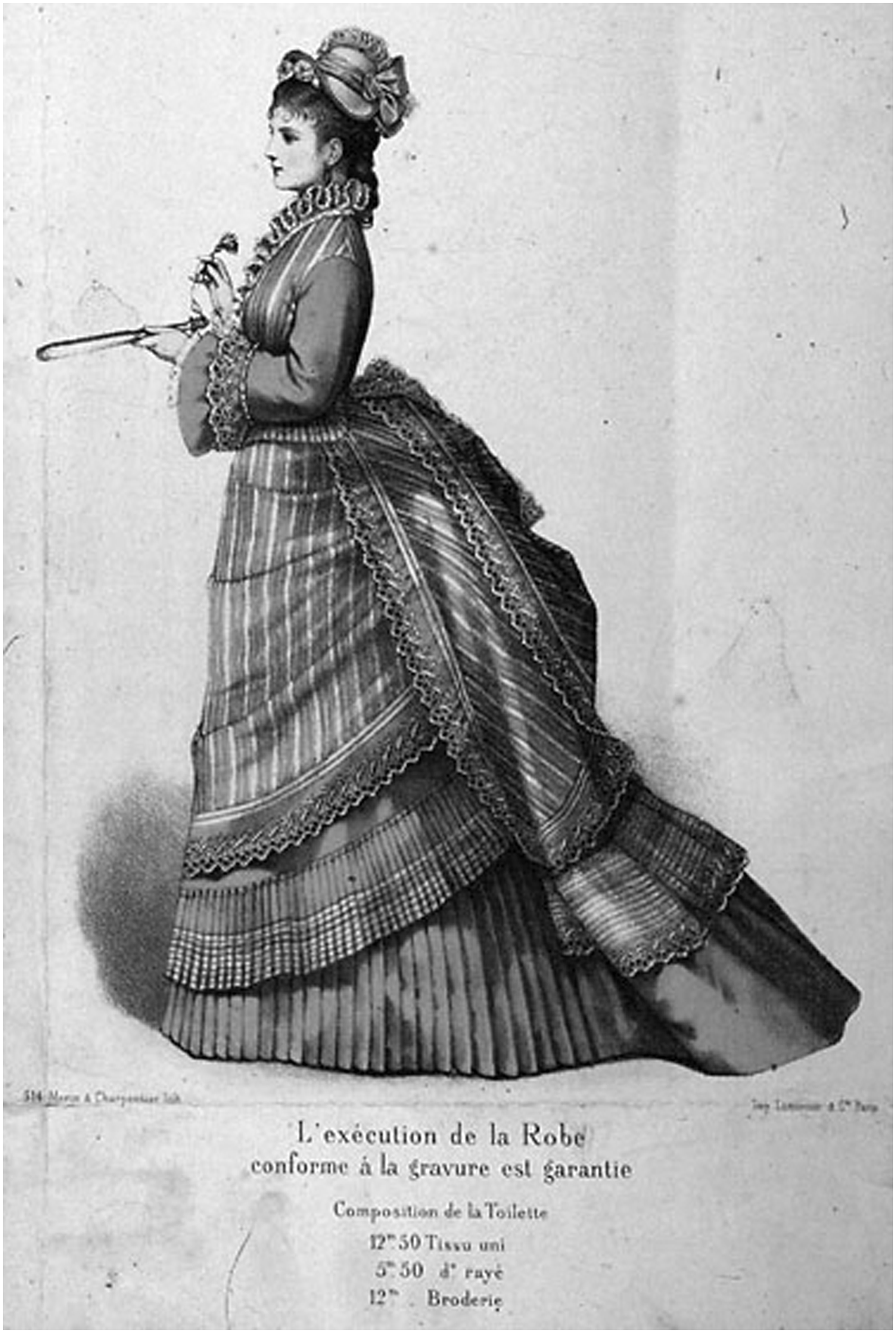
Alle Città d’Italia mail order catalogs allow us to ascertain the strategies that the department store adopted to benefit from the advent of haute couture as the only agency of fashioning, that is, the strategies that were implemented to create a consumer culture sensitive to the fashionable ready-to-wear garment. The first strategy, and perhaps the most obvious one, was imitation. To a large extent, modernity at department store coincided with providing consumers with attractive ready-to-wear clothing. As for female customers, it meant keeping those garments updated to the prescriptions dictated by Paris in matter of fashion design. As Lipovetsky (1987) put it, “La haute couture monopolise l’innovation, lance la tendance de l’année, la confection et les autres industries suivent, s’en inspirant de plus ou moins près, avec plus ou moins de rétard, de toute façon à des prix incomparables” (pp. 81–82). Not surprisingly, the models advertised by the catalogs (Figure 2) and those publicized by the French fashion press as the latest novelties (Figure 3) feature apparent similarities, but imitation went well beyond copying the design. Besides keeping updated to the latest novelties in styling, department stores also conformed the methods of producing and displaying ready-to-wear clothing to those proper to haute couture. They offered their customers a selection of dresses available in a certain number of variants. There were up to six versions for each item of clothing, different in terms of cloth type and design, trimmings, finish, and price. One of the most long-lasting innovations brought by haute couture in the fashion business – the idea of fashion collection – entered the retail business. Each variant of clothing displayed by catalogs, indeed, was unique although the parts of the dress and the way in which it was assembled were relatively standardized. In this way, the department store implemented a strategy of supply diversification. As a result, the assortment advertised by the catalogs incorporated clothing resembling the latest novelties in French fashion in terms of both product design and differentiation. Furthermore, diversification coupled with personalization. Customers could order their favorite ready-to-wear dress according to their own specifications concerning fabrics, trimmings, and finish, but clothing could also be personalized on request. Personalization could concern the use of a different cloth – normally more expensive from the one presented in the catalog – the addition of decorations and precious accessories, or an extra care in finishing the garment. The cost of personalization varied considerably depending on the type of outfit – for men or women – and the type of variation. Customizing an article of female clothing could imply an additional cost of 25% or 33% more than the average model. This depended on whether the personalization involved the use of a cloth of higher quality or more refined trimmings. Starting from an average base model, personalizing the article could result in a finished article that was more expensive than the most expensive base model. Fashion plate, 1874 (Todros et al., 1989: Tav. 28). Album illustrato delle novità. Grandi magazzini Alle città d’Italia, A/I 1882/1883: 7.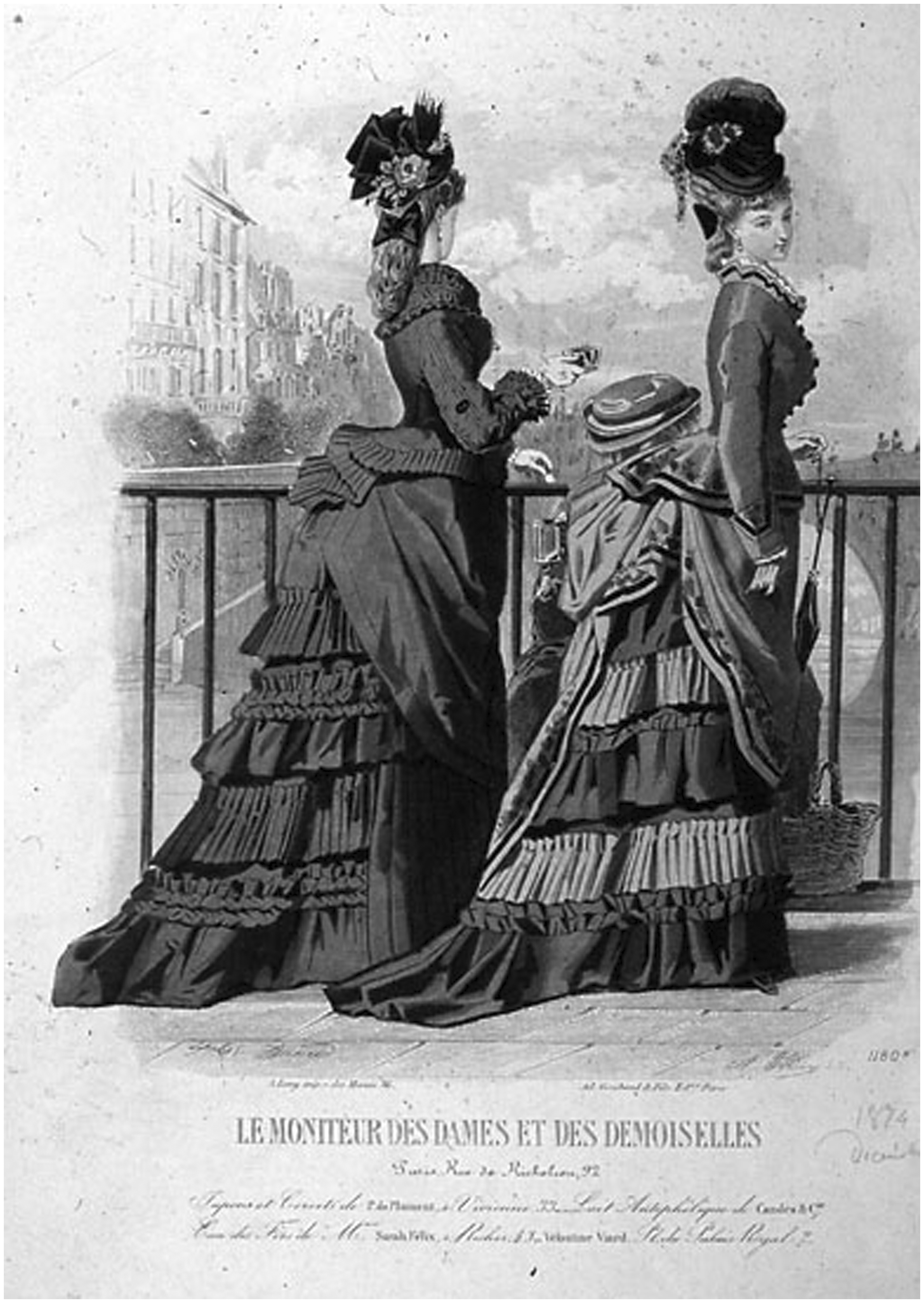
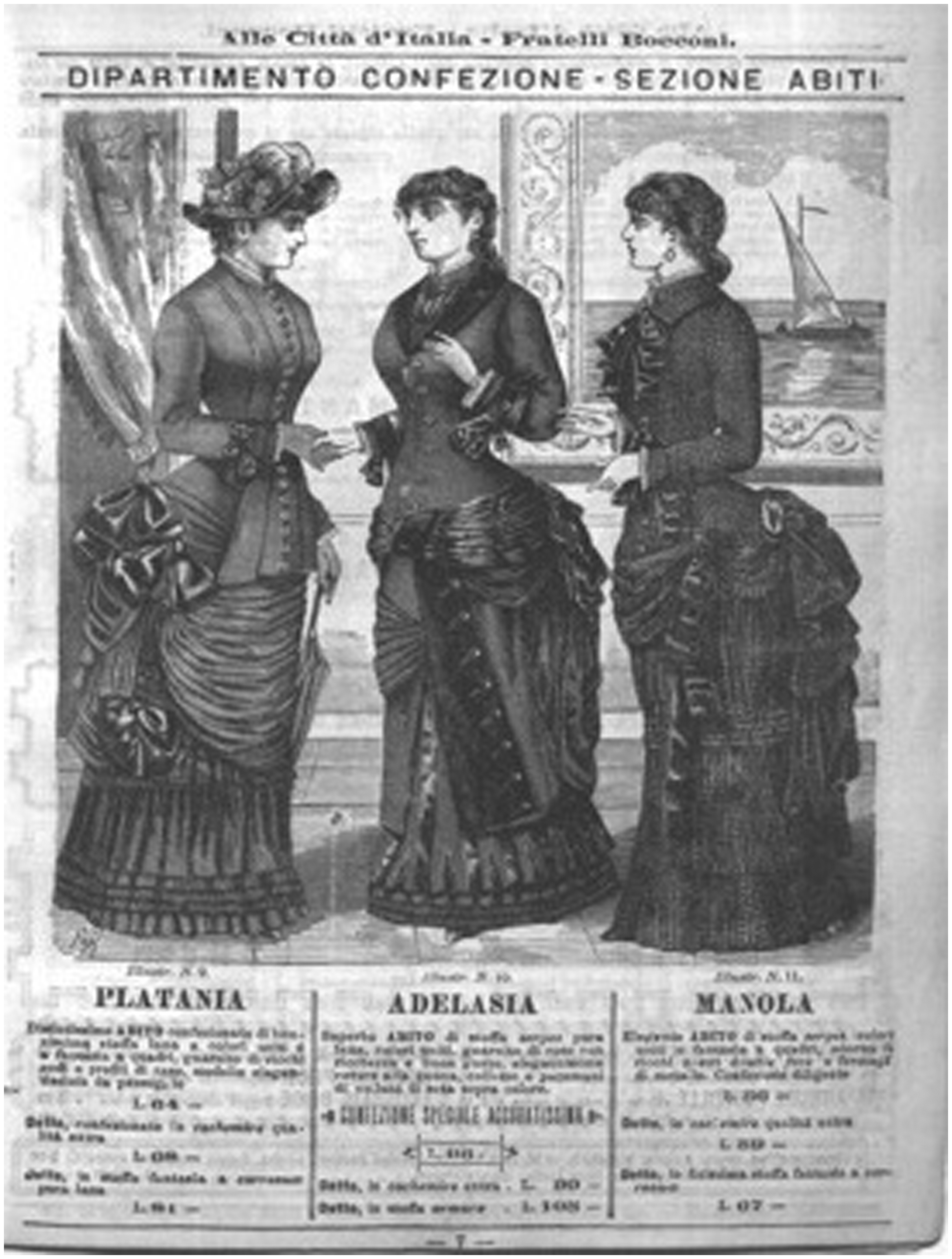
The different versions of the princesse (Figure 3), the latest novelty in matter of female clothing for the 1882–1983 autumn/winter collection, provide an example both of diversification strategy and personalization options. The first version – Platania – could be tailored by using three different kinds of cloths: plain or check-patterned wool, cachemire, and pure check-patterned wool, which were sold at 64, 68, and 81 lire, respectively. The second version, Adelasia, was instead available in serges (synonym for twill, according to Tortora and Johnson, 2013: ad vocem), cachemire, or armure (fabric with pebbled surface simulating chain armor, according to Tortora and Johnson, 2013: ad vocem), at the price of 96, 99, and 105 lire, respectively. The most expensive of the three versions, Adelasia was made by fancy clothes and was embellished by details– satin trimmings, turned-back edges of the skirt (revers), and silk velvet collars – that all required great diligence in tailoring. The third version, Manola, was less pretentious in terms of tailoring and finishing. Bows, double-face ribbons, and metal clips beautified the dress that, again, was available in serges (both plain and check patterned), cachemire, and high-quality wool cloth with a geometric decoration at a cost of 56, 59, and 67 lire, respectively.
Finally, the department store’s strategy relied upon the large assortment of textiles. Haute couture prescribed the use of large amounts of textiles as indispensable to any stylish dress. In the words of an article published by The New York Times in 1888, The exhibition of fresh importations of French costumes, wraps, and millinery at the establishment of B. Altman and Co., Sixth-avenue, contains many exclusive and beautiful novelties (…). Among the new dresses are gowns made of printed silks, soft and clinging and draped in the inimitable style of the French modiste (…). The looms of Manchester, Lyons, Zurich, Italy and Germany have been brought into requisition in making the fabrics used in the tea gowns and house robes, which exceed in richness of material and elaborate garniture any ever before displayed. Pour le moment nothing very new, it must be confessed. But a grain of patience wrapped up in thirty days of preparation may work wonders and disclose such gala, such bravery in shining silks, shimmering satins, stuffs Oriental, weavings of looms from France, Italy, England and Germany turned into such skirts and bodices as never strutted before. Album illustrato delle novità. Grandi magazzini Alle città d’Italia, A/I 1882/1883: 6.
The wide range, availability, and affordability of the cloths merchandised by catalogs suggest that department stores bought these items in bulk. Literary sources – precisely, the famous novel Au Bonheur des Dames by Emile Zola which is set in a department store – confirm this suggestion. In the first pages of the novel, the author dwells on the launch of Paris-Bonheur, the latest novelty in matter of silk fabrics. Paris-Bonheur was a “faille” (a soft fabric having a characteristic ribbed texture) made of a “really good blue and silver selvage [that] produces an effect better than its real quality” (Zola, 1886: 37). On the eve of its launch, the founder Mouret and his partner in business – the “celebrity in the trade” (Zola, 1886: 37) Bouthemont – had still strongly divergent opinions about the price to which the cloth had to be sold: So, it’s decided we mark it five francs twelve sous? It’s barely the cost price, you know. […] Yes, yes, five francs twelve sous, said Mouret. […] The manufacturers are not exactly pleased, said Bouthemont. At Lyons they are all furious with you, they pretend that your cheap trading is ruining them. […] Mouret shrugged his shoulders. What do they complain of? We pay ready money and we take all they can make; it’s strange if they can’t work cheaper at that rate. (Zola, 1886: 38)
Imitation, diversification, personalization, and focus on textiles were complementary strategies all aimed at making the ready-to-wear clothing fashionable, that is, produced according to the haute couture’s prescriptions. In addition, the strategy of focusing on textiles allowed department store to fully apply the business formula it heralded, lowering unitary prices to make profits by maximizing the amount of transactions. As a result, the ready-to-wear clothing sold by the department store was both fashionable and affordable. If we consider the autumn/winter collection, which exhibited overall higher prices than the spring/summer one, the garment that record the highest price is a fur dress (259 lire). The most expensive clothing of the spring/summer collection was an “abito” sold at 177.5 lire. If we look at the average price, the most expensive group in both collections is that of the light-weight cape or short cloak termed as visites (average price of 147.6 lire in autumn/winter collection and 88 lire in the spring/summer selection). The annual salary of a public manager was between 3,000 and 10,000 lire (Istituto Centrale di Statistica, 1958, p. 204), which means that the middle class could certainly afford shopping at department store.
In synthesis, catalogs provide evidence that through haute couture fashion paved the way for the emergence of a new consumer culture, which was more sensitive to the services provided by the consumer good rather than to the product itself. As the sole agency of fashioning, haute couture codified fashion as a social institution, provided department stores with models of taste and elegance for large-scale reproduction, and turned far-reaching innovations in fashion business – such as the seasonal cycle of change and the fashion shows – into standardized operational procedures. The outcome was product innovation in fashion manufacturing, a result that went well beyond the mere production of cheap and shoddy goods. Standardization co-existed with a wide range of customization options; customers could order at their choice traditional tailor-made clothing, modern ready-to-wear dress, and even satisfy their fancies with ready-to-make dresses; fashion became seasonal in order to constantly renew what customers had to regard as an exclusive novelty; not least, ready-to-wear clothing, which was hitherto prevalently reserved to men (Chapman, 1993; Kidwell and Christman, 1974: 111–133; Scranton, 1994; Sharpe, 1995), was offered also to female customers (Faraut, 1992; Kershen, 1997; Kidwell and Christman, 1974: 133–153), thus hugely enlarging the audience for the services – novelty and sizes – provided by the fashionable ready-to-wear clothing.
As it had happened in 18th-century Britain, the advent of a new consumer culture had a major impact on both the manufacturing and the retail sector. Fashion was responsible for unbalancing the distribution of economic power between retailers – namely, department stores – and textile producers. Department stores bought clothes in bulk from textile manufacturers imposing almost unacceptable economic conditions on them. Department stores also benefited from being closer to the market, where fashion turned patterned textiles into enticing symbols of modernity. Thus, retailers gained an unprecedented power over producers, who in turn took firmly in their hand the small shops by granting them larger credit at a longer term. The mainstay of retailing, yet traditional small shops were far from competing with the new retail format, which offered a much more reliable distribution channel and a symbol of modernity itself. Department stores thus became the chief players in the textile-clothing sector and the only ones capable of transforming the fashion trends dictated by haute couture into a product intended for a wide audience of consumers. By the end of the 19th century, retailers progressively increased their influence in the fashion sector both in terms of control over the entire productive and distribution processes and in matter of product innovation. This innovation stimulated, and still prompts, haute couture to reinvent fashion itself at an increasingly fast pace.
Conclusion
The impact of 18th- and 19th-century fashion on consumer culture, on the one hand, and on the production and commercial strategies, on the other, is documented by both contemporary testimonies and historians. Novelty and change became distinctive attributes of fashion at least from the beginning of the 18th century. However, this change took the form of product innovation rather than that of invention. From the mid-19th century, the advent of haute couture and department stores was a major breakthrough in the history of fashion as they turned novelty and change into an institutionalized process and activated the interplay between imitation and distinction described by Georg Simmel (1904). Haute couture became the sole, undisputed agency of fashioning in Western society, while department stores translated the luxury of haute couture creations into products addressed to a wider market, thus making clothing a heterogeneous and multi-characteristic product. Female clothing sold by the department store catalogs Alle città d’Italia was both ready-to-wear and fashionable and therefore incorporated features that went beyond the mere textile material. According to some scholars, haute couture and department stores started to interact in the period between the two World Wars (Brachet Champsaur, 2012; De la Haye, 1993) but, as we have explained in the previous section, the catalogs of the Italian department store show that the influence of the taste of the Parisian fashion Maisons was already pre-eminent in the last two decades of the 19th century: in these years, Alle città d’Italia was ready to turn female fashion into a “fashion industry” (Kidwell, 1991: 223). Imitation, diversification, personalization, and focus on textiles allowed the department store to emerge as the vehicle for the advent of mass consumption of fashion: Like any artisanal based enterprise, the couture industry was capable of creating only a limited quantity of its high-quality, work intensive product; once demand exceeded that limit, rationalized and standardized methods of quantity production, for which couturiers were ill-adapted, were inevitably set into motion. (Troy, 2003: 333)
The case study examined allows us to state that the two phenomena – interaction between haute couture and department stores, and participation of the latter in the processes of product innovation – had taken root also in Italy, despite the gap that separated it from the more advanced countries and the economic development limited to its most dynamic areas. The backward conditions of Italy at the end of the 19th century allow us to even better recognize the contribution given by fashion to the modernization of consumer culture. Fashion induced consumers to become increasingly sensitive to the services incorporated in the goods, thus playing a major role in prompting the development of new consumption needs and in shifting the fulcrum of innovation from the material components of the product to its immaterial characteristics.
Current patterns of consumption are rooted in the period when department stores and their catalogs accustomed individuals to modern consumption. In the same years, catalogs made consumers familiar with modern shopping, which not only entails the practice of buying products but also involves dreaming of the unaffordable ones, thus making both possession and desire constituent parts of the consumer’s individual identity (Campbell, 1987; Wilson, 2003).
A distinctive dimension of modernity, “reflexivity” (Giddens, 1991), is the anxiety pushing modern consumers to find reference points that guide them through the endless change of fashion (Appadurai, 1996; Wilson, 2005). Mail order catalogs were essential tools to achieve this purpose. If Haute Couture became established as the institution of the modern fashion (Lipovetsky, 1987), mail order catalogs were the means through which modern fashion eventually consolidated and spread out.
Footnotes
Acknowledgement
The authors wish to thank Catia Brilli for translation revision.
Declaration of Conflicting Interests
The author(s) declared no potential conflicts of interest with respect to the research, authorship, and/or publication of this article.
Funding
The author(s) received no financial support for the research, authorship, and/or publication of this article.