






Abstract
Fandom communities adopt diverse consumption practices to cope with an overwhelmingly commodified football. Drawing upon literature on consumer communities, this paper examines a local football fandom community in multifarious relations with its broader fandom through divergent consumption practices, which create tensions and ambivalences in terms of the former’s autonomy from and loyalty to the latter. Based on observations and interviews with community members, the paper describes how the community’s production and consumption of its own products are experienced as matters of autonomy within and difference from broader communities, whilst the consumption of merchandise is regulated and performed as expression of loyalty to broader fandom. Findings demonstrate how a community can use multiple consumption practices to manage, mitigate and sustain its community-within-community tensions.
Introduction
As football has become commodified and commercialized, fans are increasingly viewed as consumers of products that clubs and sponsors offer (Giulianotti and Numerato 2018; Hewer et al., 2017). Literature demonstrates consumer behaviour by fans and fandom communities (Davis, 2015; Giulianotti, 2002), as well as the significance of official products for fans (Apostolopoulou and Papadimitriou, 2018; Derbaix and Decrop, 2011). There also exist fandom practices by communities who openly resist the dominant consumerist trend (Hewer et al., 2017; Totten, 2015). Turkish football fandom provides an instance of highly commodified football (Irak, 2019; Yıldırım, 2017), and anti-consumerist or socially engaged practices by fan groups (Erhart, 2013, 2014; Mcmanus, 2013). Such views of football fandom mirror the attention in consumer culture literature into communities of consumers (Moufahim et al., 2018), and their consumption practices toward diverse social, cultural and economic ends, either in compliance with or in defiance of the mainstream (Dolbec and Fischer, 2015; Goulding and Saren, 2007; Muñiz and O’Guinn, 2001).
In dialogue with the insights in these literatures, in this paper we examine a Turkish campus-based football fandom community that (1) produces, markets and consumes its own fandom products to build and maintain their identity and autonomy as a community of fans, whilst (2) actively encouraging its members to purchase official club merchandise as a form of support and display of loyalty. We investigate these practices in terms of the singularly ambivalent relationship of this local community to the broader fandom community and to the club. We are particularly interested in how the local community’s consumer practices mediate the tensions between their desire for autonomy and their loyalty to the club.
Answering these questions, our paper contributes to the literature on consumer communities by providing a case of “community within community.” Literature indicates that consumer communities can be heterogeneous (Martin et al., 2006; Thomas et al., 2013), fragmented (Goulding and Saren, 2007; Schiele and Venkatesh, 2016), or organized into subgroups (Cova et al., 2007); and so develop plural attitudes toward markets. Yet there is still need for descriptions of the concrete strategies through which sub-communities maintain separate identities and degrees of autonomy, and navigate the emergent contradictions.
Indicating the constitutive role of heterogeneity, multiplicity and fragmentation in consumer communities, our case study also contributes an example of sustained contradiction and ambivalence. In relation to the existing literature on football fandom, too, we highlight that the community’s fandom practices are autonomous and competitive, yet not posed counter to the commercialization of either the club (cf. Hewer et al., 2017) or football at large (cf. Totten, 2015). Instead we propose that such ambivalence and multiplicities in consumer practices can be essential components of a local community’s relation to its parent community. Lastly, to the literature on Turkish football fandom, we contribute a study of football fandom practices through the consumer theory lens.
The paper starts with a literature review that discusses co-production and heterogeneity in communities of consumption and fandom. Following a section on methodology, we present our findings, which reveal the ways in which a community maintains its place within, and autonomy with regard to broader communities and market structures by engaging in multiple practices of both production and consumption, each with divergent aims and outcomes. We discuss that the resultant tensions crystallize, firstly, in the products themselves through the design- and marketing-related decision making for the community’s own products, and secondly, in the different practices through which the community consumes their own products and club merchandise.
Communities of consumption
An expansive research tradition on consumer communities have been interested in consumer groups building social relationships and cultural identifications, developing common meanings and values around rituals of consumption, as well as specific relationships to parent markets and brands (Arnould and Thompson 2005). Brand communities (Muñiz and O’Guinn, 2001; Schau et al., 2009) were noted for their active role as value co-producers, whilst work on anti-brand (Hollenbeck and Zinkhan, 2010) and anti-consumerist communities (Kozinets, 2002; Thompson and Coskuner-Balli, 2007) considered consumption as resistance. Subcultures (Goulding and Saren, 2007; Schouten and McAlexander, 1995) and tribes (Cova and Cova, 2002; Goulding et al., 2013) were analysed for their various relationships with mainstream consumer practices. Research has further reported on how these communities act on markets and create value (Choi and Burnes, 2016; Dolbec and Fischer, 2015).
Consumption communities are also sites of co-production. Subcultural contexts encourage their members’ skill development and overall learning (Leigh et al., 2006; Ulusoy and Schembri, 2018). Brand communities can customize and co-produce brand offerings (Cova et al., 2015; Schau et al., 2009). Consumers can make substantial innovations if their expectations are unsatisfied by existing products (Martin and Schouten, 2014), even provide competitors to corporate actors (Cova and White, 2010).
Alternatively, the concept of “prosumer” has been used to cover consumer practices that involve meaningful labour, as in do-it-yourself and volunteering (Toffler, 1980; see Dusi, 2018). Communities may engage in prosumption for their social ideals (Moraes et al., 2010). The concept has also been used critically, as unpaid labour and commodification of experience (Ritzer and Jurgenson, 2010; Zwick et al., 2008); and it was argued that consumers’ work as co-producers may not challenge existing distinctions between companies and consumers (Humphreys and Grayson, 2008).
Football fandom as consumer communities
Such consumer practices are also found in contemporary football, which is today a global industry of services and goods, including club merchandise (Giulianotti and Robertson, 2004). Literature on football merchandise indicates various consumer motivations, such as identifying with and relating to the club, feelings of nostalgia, social confirmation, and escape (Apostolopoulou and Papadimitriou, 2018; Merkel, 1999). Derbaix and Decrop (2011: 276) categorize these into four: “identification, socialization, expression and sacralisation.”
There also exist other, market-resistant practices and associations. Pongsakornrungsilp and Schroeder (2011) adopt the concept of “double exploitation” (after Cova and Dalli, 2009; Zwick et al., 2008) to recognize how football fans’ efforts as co-creating consumers can be exploited by the clubs. Displeased fans may then boycott their club’s products to express their frustrations and influence the club management (see also Healy and McDonagh, 2013). Such tensions can turn into a prolonged struggle between fans and the club, for instance over the latter’s commodification of fan iconography (Totten, 2015). Another example is Hewer et al.’s (2017) study of the Green Brigade fan group of the Celtic Football Club, who contested the over-commercialization of the club, positioning itself as a “counter-brand community” (after Cova and White, 2010) by offering its own merchandise in deliberate competition to club merchandise. Such merchandise by local fandom groups is shown to become carriers of political sentiments (McManus, 2013).
The case of the Green Brigade is comparable to our study for it involves the production and consumption of merchandise to counter club offerings as well as to foster belonging amongst local members in contradistinction to the broader fan base. It is, as such, a case of “community within community” – even though, as our discussions will show, it is characterized by a strong counter stance, rather than ambivalence and enduring tension as in our own case.
Football fandom in Turkey
Turkish context provides an example for the global commercialization and commodification of football through promotion revenues, merchandise sales, and stock markets (Talimciler, 2008; Yıldırım, 2017). The most controversial development has been the Passolig system, implemented in 2014 to replace regular tickets with e-ticket cards associated with fans’ bank accounts. The system met extensive resistance by fans with boycotts and lawsuits on the grounds that it commodified fandom, rendered individual fans trackable, and made disciplinary action possible, not least in cases of anti-government protest (Erturan-Ogut, 2020; Irak, 2019). Masculinity of football fandom (Jones, 2008) also remains an issue in Turkish football, as women fans struggle with the male-dominated environment (Erhart, 2013; Nuhrat, 2017).
Fandom groups are at the forefront of such developments. Fandom communities in Turkey vary in size, location, and political view (see Dikici, 2014). Research has noted how these groups fashion local identities and histories (Hacısoftaoğlu et al., 2012), and engage in social, political and environmental activism (Erhart, 2014; Irak, 2019). Whilst commentators lament the depoliticization of fan groups (Yıldırım, 2017), some communities specifically confront issues of commodification. An example is the popular left-leaning Beşiktaş JK fan group, Çarşı – stylized as “çArşı” with a red circled “A” of anarchism, and its motto, “against everything” – whose merchandise is used to express an anti-commercial ideology (McManus, 2013).
Heterogeneities and fragmentation in communities
Consumer culture research has often characterized communities as less than homogeneous – as assemblages of people, institutions and resources (Kozinets, 2001; McAlexander et al., 2002; Thomas et al., 2013). Some research further emphasized multiplicity and conflict over functional unity. Beverland et al. (2010: 713) found that “subcultures are complex domains where multiple values both coexist and are contested” (see also Leigh et al., 2006). Studying the Harley Davidson subculture, Martin et al. (2006: 176) argued that subcultures are made up of “multiple homogeneities.” The women bikers they examine reinterpret the hypermasculine culture of the group, so that they constitute a “microculture” of their own. Brand communities also support various forms of engagement with the brand and the community, allowing for heterogeneity at different localities (Cova et al., 2007) or amongst individual members (Schau et al., 2009).
Multiplicities can signify struggles over core meanings and values within communities. This parallels the early work on subcultures, where subcultures’ relationships to mainstream were studied as a hegemonic struggle over the meanings of shared symbols. Subcultural identities are constituted through “bricolage,” i.e. appropriating diverse mainstream symbols (Hebdige, 1979). Recent studies on consumer culture has shown that symbolic struggles and maintenance work also takes place within communities, and neatly bounded categories such as brand communities may reify a more dynamic reality (Moufahim et al., 2018).
Multiplicities can lead to expansion and diversification (Martin et al., 2006). Fragmentation into microcultures is considered in literature to be a feature of contemporary consumption (Thompson and Troester, 2002). Similarly, the process via which a subculture enters mainstream culture is described by a model of four stages: “rebellion,” “fragmentation,” “commodification,” “reclamation.” Without the last step, where members struggle for cohesion, subcultures can disband (Goulding and Saren, 2007; Schiele and Venkatesh, 2016).
In other cases, tensions can be enduring, even constitutive. For instance, consumers may struggle with the contradicting demands of two identities (Weinberger, 2015), or affiliations (Scaraboto and Fischer, 2015). The concept of “ambivalence” has been used to describe conflicted consumer behaviour due to, for instance, misalignment of expectations and experiences, or conflicting social roles and associated values (Otnes et al., 1997) related to concerns such as the environment (Halkier, 2001) or motherhood (The VOICE Group, 2010). In these, the research focus has been on individual experience, especially on emotional tensions in consumer decision making. Throughout this paper, we use the term to study value- and identity-based conflicts at the collective level.
To summarize, literature has documented consumer communities in assorted relationships with markets. These range from counter-brand and anti-market positions, to constituting competition and alternative markets, on to acting as co-producers. Literature on football fandom echoes these observations, as fan groups are viewed variously as merchandise consumers, co-producers of club identity, and producers of counter-brands. Furthermore, motivated by divergent objectives and values even inside one community, consumers can form differing relationships with brands and markets. These can lead to the emergence of subgroups, with symbolic struggles amongst those. Or inner tensions may rise due to demands of plural affiliations or practices. Our case study is placed in relation to those recent studies that underline heterogeneity and internal struggle within communities, with ambivalence towards parent markets or communities. We contribute an example of a local community with a distinct identity project in relation to its parent community, the resultant tensions, and its strategies for maintaining its multiple affiliations.
Research design
Our case study involves an investigation of the consumer practices of a university-based football fandom group as a “community within community.” Data collection comprised two phases. All fieldwork was undertaken by the first author.
The first phase involved four months of participant observation with the fandom group (September 2016 to January 2017). We followed the examples of consumption studies into consumer-market interactions (Arnould and Wallendorf, 1994; Peñaloza, 1998, 2001), as well as ethnographic approaches to football fandom (Derbaix and Decrop, 2011; Giulianotti, 1995). The researcher took the “observer-as-participant” stance and situated himself as a non-member who participates in the community’s events to gather data (Angrosino, 2007: 54). He participated in 15 different meetings or activities of the group including two introductory meetings for new students, ten match showings at a café on campus, including pre- and post-game events such as gatherings or scheduled meetings, and three group exhibits. He took notes and photographs and made informal interviews. Each observation session, except the exhibit visits, took 2–3 hours. In introductory meetings and match showings there were up to 80 people, whilst scheduled meetings were organized with 10–15 core members. Field notes were used in analysis, and insights from the first phase helped design the second phase.
Sampling.

In data analysis, we conducted thematic analysis. While coding the field notes and interview transcripts, three coding styles were combined: simultaneous, descriptive and process coding (Saldaña, 2009). The following themes emerged from analysis: (1) members’ perspectives of fandom, (2) internal dynamics of the group, (3) product-related processes and perceptions, and (4) external relationships of the group, i.e. with other communities and the official store.
The community and its products
Eagles of METU (ODTÜlü Kartallar in original Turkish) were founded in 2001 as a student club at Middle East Technical University (METU) by fans of Beşiktaş JK (BJK), a Turkish Super League football team. The group’s name refers to the BJK mascot, black eagle. It has around 20 core members, and events can attract up to 80 participants, while the group by definition represents all BJK fans on campus. BJK is one of the three Istanbul clubs that are widely supported around Turkey, with fans from all backgrounds. Our observations suggest that the group members are predominantly Turkish middle-class men from big cities, but the group is proud of its woman membership, especially its former woman president.
The group maintains a formal identity with a logo, webpage and social media accounts. There is an elected president, a customary division of responsibilities and rules of conduct, together with regular meetings, ritualized practices and special events, football-related or otherwise. The group designs, produces, markets and consumes Eagles of METU products, including clothing items such as hoodies, t-shirts and scarves, and stationery products. They also make their own banners (see Figure 1). Eagles of METU products.
As we note in the introduction, the Eagles present an outstanding case for the study of heterogeneity and ambivalence in consumer communities because of the contradictions manifest in their fandom practices. These are based on three distinct affiliations: BJK fandom, METU studentship, and membership to the Eagles itself. The unique community-within-community tensions that we highlight in this study result from the interplay of these affiliations, especially between broader BJK fandom and local community membership. Being a small local community makes their identity projects especially precarious, and incidentally, easier to observe for us, researchers.
Our participants, too, underlined their community as a unique fandom group in the following three respects: First is the non-hooligan and non-sexist attitude the Eagles promote by both their events and mixed-gender composition. In contrast, participants characterized off-campus BJK fans with sexism, excessive drinking and vandalism (see Erhart, 2013; Nuhrat, 2017). Identification with, and pressure from, progressive student groups in campus seem to be influential in the Eagles’ adopting such an identity, too. Second is their participatory culture and democratic processes of decision making. These include taking responsibilities in designing and making the group’s products and banners, which we discuss below. Thirdly, the Eagles differentiate themselves through their autonomy from ÜniBJK, the nationwide union of university fan groups for BJK, while other fan groups on campus are affiliated with their respective unions. Ali put it as follows: “We’re Eagles of METU. We have our own culture. […] Why merge [with ÜniBJK]? We don’t want to be dependent on others.” Being incorporated into a union is assimilation, and contradicts with the way they collaboratively make and use their own products and banners. Mustafa noted: “We decide on [our] products together, what they’ll look like. In affiliated groups, everyone needs to wear the same thing. And these [clothes] come from the top. Only the names on the [clothing] identify your university. I don’t think that’s nice.”
These indicate the significance the Eagles attribute to their distinct identity and autonomy as a fandom community, as well as the important role played by Eagles products as expressive of that identity and autonomy, and as manifestations of its participatory culture. In observations, we saw members wear Eagles clothing in everyday lives and not only during group events; in the interviews, they reported doing so outside the campus as well. Group members are aware that the products make the group visible, and therefore instrumental for recruiting members. In fact, around half of the interviewees told us that they had first learned about the group after seeing an Eagles product.
A related aspect of consuming Eagles products becomes evident during the group’s activities, for which, Kemal told us, they do not have a specific location: “Wherever we go, we hang our banners, then that place becomes ours.” Using their attire, banners and stickers, Eagles mark the café where they watch games. In addition to advertising the group to potential members, such occasions help foster individual members’ feelings of attachment. Volkan remarked: “When we show up wearing our own products, even without talking about it or taking a decision, it’s seen that we’re there as a group without uttering a word.”
As such, we observe three outcomes of the Eagles’ consumption of their own products. The first regards increased visibility to and differentiation from others, particularly from the broader BJK fandom. The second is about the members’ sense of belonging. Both identity-related outcomes are reinforced by the fact that the products on display are made by the Eagles themselves. Leyla noted as follows: “After all, wearing a t-shirt, hanging a banner that you made yourself or contributed to, it makes you feel different; you want to show it.” Accordingly, a first tension that surrounds the group’s products concern the group’s identity: Are they Eagles members or BJK fans first? We discuss the ways the Eagles mitigate this tension in the next section on the group’s design practices.
A third outcome, which follows from visibility, is that public consumption is utilized for marketing the products to non-members – which typically consist of METU staff, students and BJK fans. Swapping scarves with other BJK fans, or simply displaying them during a chant at the stadium, are ways for distributing their products beyond members. This fact that their products create a “consumer-produced market” (Karababa and Scaraboto, 2018), and possibly a “counter-brand” (Cova and White, 2010) to official BJK products is the source of a second tension that results from the group’s consumer activities. We discuss this later in our analysis.
Product-related decision making: Different but dependent
As noted above, a first, identity-related tension regarding the group’s autonomy versus loyalty, can be observed in their design- and marketing-related decision making. The overall process is well-established since the group introduces a new product every year, and handle it like a tradition: Eagles make their decisions collectively during regular meetings and partially on the group’s online forum page. After key product requirements are set, the process is turned over to “designers” – members who are responsible for realizing the ideas using graphics editing software. The necessary knowhow, as well as the group’s outstanding considerations, are transferred from one generation of designers to the other. Ahmet, a designer, comments: “Thanks to that, [our] culture is also transferred so that you know which kind of design is suitable, what is preferred by our members.” The alternatives created by designers are then discussed and voted on by members.
Manufacturing processes differ for various Eagles products. For wearable products, volunteering members collect bids from manufacturers, make a deal, then oversee manufacturing. For hands-on making, volunteers gather at a campus building to paint banners in an all-night event. Through these undertakings, members become proficient with manufacturing processes, and transfer their knowhow to new members, thus fostering a culture of manufacture – as with the design tradition above. These two processes are amongst key mechanisms for the continued existence of the community (on learning, see Ulusoy and Schembri, 2018). Such practices as making banners are also memorable occasions, as Leyla described: “It was very tiring, but I owe to that day. We put our efforts together, we played games, we learned, and we got even closer.” As a materialization of collective efforts, the product becomes a symbol and reminder of the efforts put into it.
During decision making, members deliberate over the new product, its potential users and market. They make sure that the product is differentiated from earlier products, for instance in terms of style – incorporating newer images and slogans – or seasonal use. Products are introduced for events such as championships, anniversaries, or in honour of football figures. Diversification of the product line is considered crucial for improving both sales and visibility. Therefore, Eagles make sure their name and logo are placed on their products.
Looking at the Eagles logo, one can discern its role in building and differentiating an identity for the “community within community.” The logo is composed of a black eagle holding the university’s logo – a combined expression of the group’s three affiliations (Figure 2). Our interviewees emphasized the logo as a sign of their autonomy from other BJK fandom groups, including the aforementioned fandom union, ÜniBJK, or for instance Çarşı (see McManus, 2013). Emre, a former president, described their approach: “We never use the ‘A’ symbol of Çarşı. Other supporter groups may give priority to the union they are affiliated with, so that their city or university may come second. It’s [not] like that with us.” Similarly, the group avoids using popular symbols, phrases and slogans on their products and banners. The logo of the group.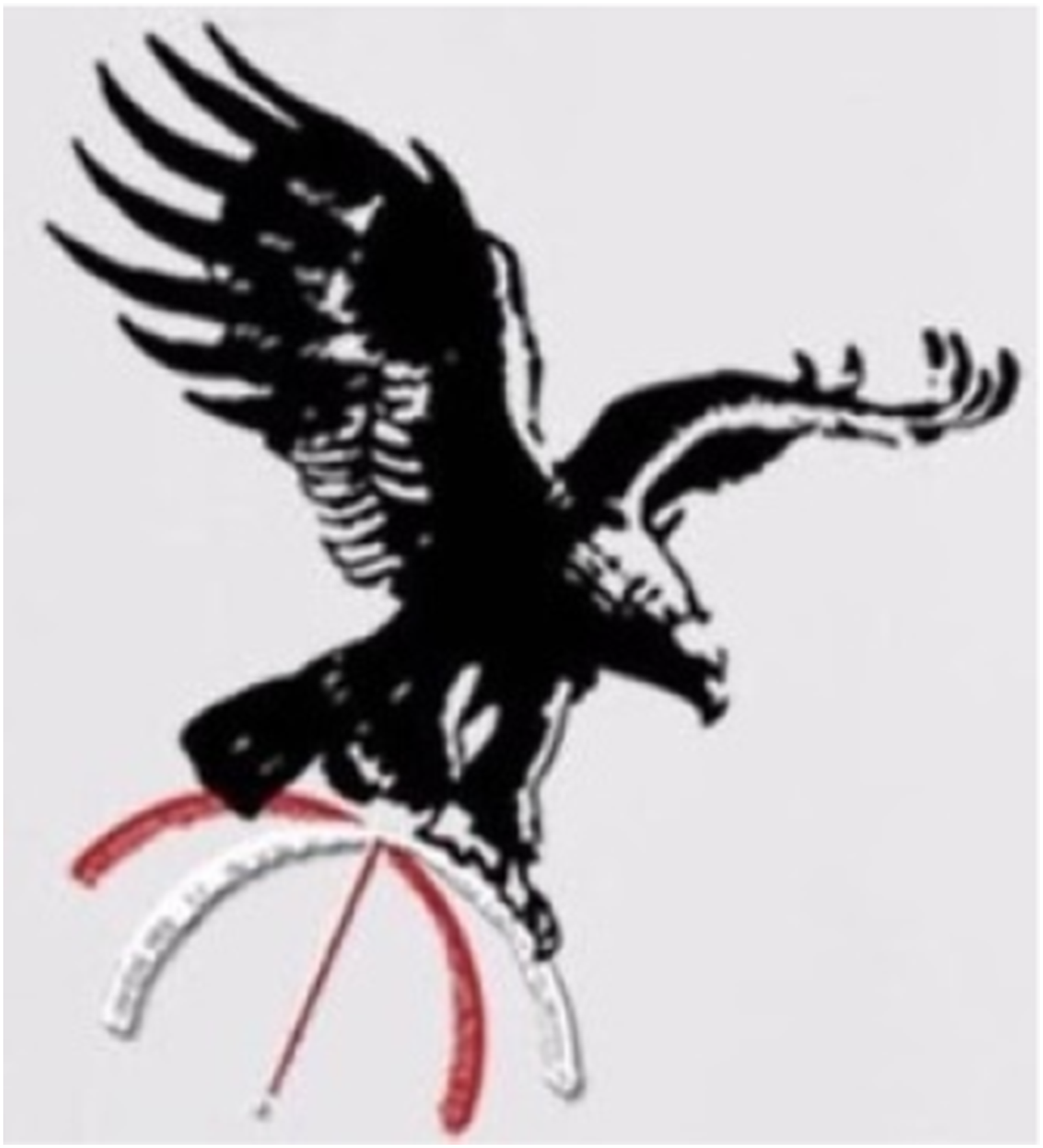
Another consideration regards colour. Eagles follow the BJK colour palette: black and white as main colours, grey and red claret as complementary. According to interviews, whilst the earliest products were dominated by black, later products incorporated white, grey and claret under pressure to diversify (see Figure 1). Still, the group has never considered introducing a colour outside the palette. Even within the palette, they avoid certain colour-product combinations not to be confused with other campus communities – such as claret hoodies which were deemed too similar to the red hoodies adopted by both Galatasaray fans in campus and the university shop.
One last focal point is BJK’s and the group’s histories, as in the product series for the 10th and 15th anniversaries of the Eagles. Similarly, when Süleyman Seba, the iconic former president of the club, died, the group offered a new hoodie on which Seba’s name was printed. References to events and personas in collective history are instrumental in materializing memories in products and ultimately creating a unique sense of history for the group. This might be considered similar to the way in which participation in the design and making of products transforms those products into mementoes for the participants.
Through its logo, graphic and textual elements, colour and historical references, Eagles build up a group identity that is derivative of BJK’s iconography. The decision making, on the other hand, underlines concerns for autonomy and difference from others, not least from the very BJK fandom that they borrow from. As such, bricolage is not used to contrast the community’s values with those of the mainstream (cf. Hebdige, 1979), but to micromanage the symbolic relationship. This provides a strong example of what we call the community’s “ambivalence” toward the broader community, and indicates how selectivity in borrowings help manage the tensions inherent to the relationship of the group to broader BJK fandom. The strategies followed for this purpose ranges from displaying independence with one’s logo at one extreme, to selective practices of appropriation in memory making, on to strict compliance with the colour scheme at the other extreme. Just as the autonomous and persistent design, production and consumption practices of the group help develop engagement and sense of community amongst members, they also enable the group to become deliberately different but dependent via its products.
Consumption of official merchandise: Regulating loyalty
As noted above, Eagles sell extensively to on- and off-campus BJK fans, thus creating a consumer-produced market. The members are aware of this, and apprehensive about the implication that their products provide substitutes for official merchandise. Emre says: “We do not make [products] to earn money. We do sell them, but the income is only used for covering costs. We cannot go beyond that.” Speaking against profits is just one way of ameliorating this contradiction between their autonomy and loyalty (cf. Hodkinson, 2002, 127ff.). In this and the next section we indicate practices of consumption through which the tension is highlighted or resolved.
All interviewees without exception introduced themselves as “fanatics” [fanatik] and not merely “fans” [taraftar]. For them, fanaticism means going to matches at home and away, following the club at all sports branches, and shopping at the brand’s official stores, called Eagle’s Nest [Kartal Yuvası]. Ege commented on the latter:
The products sold in the stores are like, you go there and buy it, so that you’ve supported your club. You never perceive this as buying a regular t-shirt. You don’t look at it like, if I wash it, it’ll fade away. You buy it to support [the club].
Official products are not for mere use; as donations, they represent the fanatic’s devotion: Exchange is ritualized as the product is sacralized (Belk et al., 1989). Aslı stated that they try to purchase at least one official product each football season, although prices can stretch a university student’s budget:
OK, the official jersey costs 150₺, but in Eagle’s Nest there are t-shirts for 20₺ as well. So, don’t buy the jersey; buy the t-shirt. Not everyone can ride a Mercedes; you ride a [cheaper car]. That’s why I don’t like counterfeits, because then Beşiktaş can’t earn money. Why do we even buy [merchandise], then?
Eagles adopt a collective stance against counterfeit merchandise, and consider buying those as being unfaithful to BJK. Some members argue that fake versions of official products are easily discerned with their design and quality, and that no self-respecting fan would wear those. In contrast, wearing official products demonstrates the wearer’s devotion to the club, and through that, one can feel proud.
Other than the moral incentive, Eagles have a formalized practice in place to encourage official merchandise consumption: Gifts for all occasions such as tournaments and gift draws are required to be from the official store. As Kemal put it, even if one does not shop for BJK products regularly, the gift draw makes them “visit the store at least once a year.”
In relation to BJK fandom as a market, such practices can be considered as cases of “resource integration,” (Choi and Burnes, 2016) to the extent that the Eagles create the incentives and rituals for continued engagement with, even outright demand for Eagle’s Nest offerings. From the perspective of community-within-community interactions, the Eagles do not depend exclusively on their own products to perform their fandom (cf. Hewer et al., 2017). Instead the Eagles conform to mainstream fandom practices to the point of enforcing it. This can be understood as a mechanism to compensate for the tension: The group relies heavily on the consumer practices and processes around the products of their own making for asserting their identity, coherence and autonomy, whilst at the same time pursuing a separate logic of loyalty, devotion and support in their consumption of the offerings within the broader community of fandom consumption. This contradiction surfaced most strongly in our participants’ criticisms of the official merchandise, which we present in the next section.
Criticisms of official merchandise: Discontent and alienation
Having two distinct consumption practices in their arsenal, Eagles cannot but compare. Careful not to diverge from the group’s line, they still express their dissatisfaction with BJK products, citing low durability and tactile quality. References are made to BJK’s extensive resources, which are in stark contrast with their own limited capabilities. In Semih’s words, “…with so many fans, a good stadium, the official products should be much better” (cf. Pongsakornrungsilp and Schroeder, 2011).
Despite the discrepancy in resources, many Eagles argued that they are better qualified for merchandise design and production. Building on their in-group expertise, they criticized the stores’ design decisions, materials, and even offered solutions. Mustafa expressed why as follows:
At the official stores, the designer earns money, because that’s his job to design. Since we don’t have that obligation, when we make a product, we think, let’s make what we love. That’s why our products are so different for us. You can’t find that much variety or that level [of quality] in Eagle’s Nest.
The community is more authentic and less tainted with commercial motives: They know and feel what BJK fans want, and being fans themselves, they can deliver better designs. Our use of “authentic” here echoes the discussions on football fandom (e.g. Davis, 2015; Gibbons and Nuttall, 2016) and consumer communities (e.g. Beverland et al., 2010; Leigh et al., 2006), where authentic membership is defined as a function of identity, commitment and participation. While there are diverse ways in which authenticity can be assigned to objects and brands by consumers (e.g. Grayson and Martinec, 2004; Leigh et al., 2006); in line with the view of authenticity in fandom, objects can derive authenticity from the extent to which they help consumers feel “in control”, “connected” and “virtuous” (Beverland and Farrelly, 2010). From both perspectives, professional practice is easily contrasted with the democratic and participatory process of design and production that the Eagles so value. In that sense, and that sense only, we see the Eagles position themselves as critical of the alienating pressures of the market environment, which they see as detrimental to their relationship with the official products, and through that, the football club they support. For them, this is the reason why BJK merchandise cannot be made part of their identity as readily as their own products.
Recent literature has shown how dissatisfied consumer groups can devote their resources to producing alternatives to existing offerings without necessarily being averse to market relations (e.g. Cova and White, 2010; Scaraboto and Fischer, 2013). Considering BJK fandom as a market, we see similarly that whilst the group is critical of the official merchandise and their alienating conditions of design, they nevertheless consider it viable to engage with the market through a logic of support. Ali told us: “We know that the club turns our emotions into money, but this is how we can support it.” Considering BJK fandom as the parent community to the Eagles, the question becomes that of a sustained contradiction between the demands of the two incongruous affiliations for disparate consumer practices (see also Scaraboto and Fischer, 2015).
One way to bridge these two demands was mentioned during the interviews: The group once had contacted the official store and proposed them to manufacture Eagles’ designs, but their offer had been rejected. The objective was to turn their designs into club merchandise so that they can keep supporting the club while designing their own products. Mustafa, as a former designer, remarked: “Sometimes we come across designs […] that are similar to what we’d previously thought. I think it means that if there’s a chance, we can do it better.” It is no surprise that in an environment where the “free consumer” is pursued by both corporate and consumer actors as an ideal (Zwick et al., 2008), the Eagles open themselves willingly to opportunities of co-production. Whilst such corporate practices have been rightfully criticized as exploitative (Cova and Dalli, 2009; Ritzer and Jurgenson, 2010), for the Eagles, it promises the resolution of a key tension. On the other hand, we can only speculate what such an agreement with the official store, if realized, would actually bring to a local fandom group such as Eagles, who treasure their own identity, autonomy and social relations as embodied in merchandise of their own design and making.
Concluding discussion
In this study, we described a consumer community, specifically a “community within community,” with a constitutive contradiction: On one hand is a logic of autonomy that governs their consumption of the products they themselves design, produce, market and sell via communal processes. On the other is an ideal of fandom and an entailing logic of loyalty and devotion, which dictate the members to consume products that they criticize – the criticisms themselves being based on their collective experiences and knowhow of design and manufacture. In these, we identified two tensions: One is identity-related, which the Eagles try to mitigate by offering products that are different from but dependent on the meanings and values in broader BJK fandom. The second is market-related, as the Eagles products may present competition for BJK merchandise. The group strives to ameliorate this latter tension primarily by sacralising and encouraging merchandise consumption, and secondarily by opening themselves to potentially exploitative co-production.
These findings provide insights regarding heterogeneity and fragmentation in consumer communities. Literature indicates that communities can be multi-layered, with individuals and subgroups taking on various roles (Moufahim et al., 2018). There is, we observe, less interest in mechanisms for mitigating the tensions that arise from unequivocal belonging to more than one community. One exception is Scaraboto and Fischer’s (2013) account of Fat Acceptance bloggers, which however remains at the individual level. The Eagles resort collectively to selective appropriation, sacralisation and regulation as mitigating mechanisms. As such, our study contributes that local communities can engage in consumer practices with incongruous logics in order to manage – sometimes express, sometimes moderate – their conflicts with its parent market or community. We add that ambivalence and sustained tension need not be fault lines (cf. Goulding and Saren, 2007; Schiele and Venkatesh, 2016), but constitutive of a consumer community’s identity and practices.
Our findings also respond to the literature on exploitation and symbolic struggle in fandom merchandise. Literature on working consumers (Cova and Dalli, 2009; Zwick et al., 2008) and prosumption (Ritzer and Jurgenson, 2010) noted the exploitative conditions of consumer co-production. In fandom literature, too, we find accounts of consumer groups who feel exploited, or alienated by the club’s commodification of shared symbols (Pongsakornrungsilp and Schroeder, 2011; Totten, 2015), even develop counter-brands in response (Hewer et al., 2017). Unlike Hewer et al.’s case, however, the Eagles’ merchandise production is not based on a conflict over what fandom means. The Eagles is a production-engaged community with motivations such as expressing their creativity, fostering their community, seeking recognition, and having control over their fandom consumption. This parallels research on new consumer communities: Communities can engage in prosumption to escape the alienating relationships of the market and to enact what they perceive to be ideal alternatives, without necessarily being anti-market or anti-brand (Moraes et al., 2010; Scaraboto and Fischer, 2013; Szmigin et al., 2007). Our study brings together these two insights and demonstrates that fandom consumption can be motivated by communal ends, even when in implicit opposition to broader markets. Our case further indicates that consumer co-production of club merchandise, which could otherwise be considered double exploitation, can be desirable for its capacity to resolve identity conflicts.
Finally, from the perspective of fandom studies, the Eagles’ experiences provide one, albeit unique response (in addition to those reported by, for example, McManus, 2013; Totten, 2015; Hewer et al., 2017) to the market-related tensions and paradoxes that fandom groups deal with today: the authentic definition of fandom they pursue in their specific cultural contexts on one hand, and the impact of exhaustive commoditization of football on the other. Turkish football is a case in point: In a football context that is rife with market-based, political and gendered conflicts, it is as much fandom groups as individual fans that develop survival strategies.
Footnotes
Acknowledgements
The authors would like to thank all ODTÜlü Kartallar for sharing their thoughts and experiences, and Eminegül Karababa for her support and encouragement in the publication process.
Declaration of Conflicting Interests
The author(s) declared no potential conflicts of interest with respect to the research, authorship, and/or publication of this article.
Funding
The author(s) received no financial support for the research, authorship, and/or publication of this article.
