






Abstract
Street food markets are increasingly popular in cities around the world. While their size, formality and success differ, each market offers an affective atmosphere consisting of material and immaterial elements including the food, traders, consumers, aesthetics, sights, smells, sounds and connections to places and heritage. Studies assert that affective atmospheres are staged, yet the actors and activities involved in these processes remain poorly understood. Drawing on 9 months of ethnographic fieldwork, this paper applies the concept of curation to affective atmospheres and examines the curatorial practices of street food market organisers in London. Rather than promoting ‘good’ food, it demonstrates that these commercially motivated curators match demand with ‘appropriate’ (1) spaces, (2) food and (3) people. The paper argues that affective atmospheres are partially staged, in advance, by market organisers but also co-produced by the performances and interactions of traders, consumers, food and other non-human elements during market events. It also asserts that spaces contain and shape affective atmospheres and highlights how specific motivations shape the nature of curation and affective atmospheres.
Introduction
Lunchtime on a cold winter’s day at a street food market in London. We walk with Nick and Toby, who are market organisers for EAT-LONDON, 1 one of the city’s major food market organising businesses. They are looking for a vegetarian trader who was recommended on Twitter to try their food and evaluate their suitability for one of their markets. As we enter the market from a side street the atmosphere instantly changes. The noises from chatting and aromas from the food fill the space. Two lines of stalls on each side sell different products, from hot meals, fruits and vegetables to clothes, bags, and electronics. We find the vegetarian stall and order everything on the menu to share; a round bun filled with roasted potato, mozzarella, nachos, and coriander; a drowned sub bun filled with black beans, avocado, and coriander and completely covered with a very spicy chilli sauce, and a salad box, consisting of bulgur wheat, avocado, tomato, cucumber, and jalapeños.
As we wait Nick improvises an undercover job interview. ‘How long have you been in this market?’ ‘What’s inside the bread?’ ‘Where did you get the inspiration to do this?’ ‘Have you got a Twitter account?’ As we eat Nick and Toby critique the menu. The drowned sandwich is especially tricky, chilli sauce runs through our fingers; Toby thinks it’s too spicy. Nick says that the buns are not toasted, minus one point. However, the potato sandwich and the fresh and creamy salad ease the heat of the other dishes. Nick says this trader is perfect for EAT-LONDON: “very clever, original, stall looks tidy and clean and he’s not using a meat replacement (such as soy burgers) to fill the vegetarian buns but creative fillings, which is a game changer in vegetarian street food.” Ultimately, they want him to join their collective for a trial run.
From airports and apartments to public spaces and the commercial food market described above, affective atmospheres pervade the spaces we inhabit and encounter. They are fundamental aspects of daily life, central to how humans experience the world but also difficult to study, conceptualise and understand (Bille et al., 2015; Coffin and Chatzidakis, 2021).
Put simply, affective atmospheres consist of objects, bodies, and spaces (Anderson, 2009; Shaw, 2014). Yet, the street food market example above reveals complex interactions between a range of material and immaterial elements including the food, traders, consumers, aesthetics, sights, smells, sounds and connections to places and heritage (Pike, 2015; Wijngaarden and Hracs, 2024). Acknowledging this complexity, scholars point to the challenge of explaining affective atmospheres, which are “keenly felt but difficult to identify or describe,” from any one disciplinary tradition (Anderson, 2009; Coffin and Chatzidakis, 2021: 50). They also debate the merits of attempting to break down an affective atmosphere into its component parts or maintaining the vagueness and conceptualising affective atmospheres holistically as a whole greater than the sum of its parts (Bille et al., 2015; Coffin and Chatzidakis, 2021). Thus, there is a need to further develop our understanding of affective atmospheres and to consider and address several questions and existing knowledge gaps.
To what extent can affective atmospheres be staged? While some affective atmospheres can be organic or naturally occurring, such as the experience of walking through a forest, scholars agree that most are actively staged (Bennett, 2004; Bille et al., 2015; Concha, 2019; Kolehmainen and Mäkinen, 2021; Koren and Hracs, 2024; Shaw, 2014; Wijngaarden and Hracs, 2024). But as Bille et al. (2015) argue, the notion that something so fleeting, ambiguous, and vague can be staged is paradoxical. Therefore, it is important to learn more about the process of staging affective atmospheres and to consider whether all the elements are staged and controlled or if there is a mix of structure and dynamic interplay between elements.
Who does this staging, how and for what purpose? In commercial contexts, such as malls and retail shops, designers and curators create aesthetics, assemble objects and content, encourage interactions and direct movement within spatial settings (Bille et al., 2015; Shi et al., 2021). But more research is needed on these practices, the actors involved and how practices related to staging affective atmospheres are shaped by different values and motivations.
When and where does this staging take place? While some studies suggest that affective atmospheres, such as pop-up retail events and dance music club nights are staged in advance (Koren and Hracs, 2024; Shi et al., 2021), Bille et al. (2015) describe practices carried out during fleeting encounters and interactions. Moreover, building on Goffman’s (1959) seminal conceptualisation of stages, presentations, and performances, work that contributes to affective atmospheres may be carried out behind the scenes ‘backstage’ or ‘front stage’ by actors who operate in full view of consumers. But scholars assert that there is a need for more research on the planning stages and the temporal and spatial dynamics of affective atmospheres in commercial settings (Coffin and Chatzidakis, 2021; Richards, 2024; Shi et al., 2021).
Beyond exploring the “synchronisation of different elements” (Shi et al., 2021: 370), we must also consider the nature of different elements, from lights to consumers, the roles they play, how, when and where they ‘perform’ those roles and crucially the ways in which elements relate to and interact with each other through time and space (Smith-Maguire et al., 2023). Indeed, Bille et al. (2015) call for a stronger emphasis on the immaterial dimensions of affective atmospheres, including lighting, sounds and smells, while Bennett (2004) argues forcefully for greater recognition of the agential power of ‘things’ (objects) and how they interact with human bodies to form compositions that shift over time. Coffin and Chatzidakis encourage us to look ‘between’ elements and include a broader range of phenomena when thinking about market spaces such as “conscious and unconscious, human and nonhuman, static and mobile” (2021: 46). Narrowing the focus to specific objects, literature within the field of ‘visceral food geographies’ asserts the need to explore the ways that food is ‘more-than-food’ in relation to bodies, affects and practices in different temporal, social and spatial settings (Goodman, 2016).
This paper addresses these questions and contributes to existing bodies of literature in geography, sociology, and the field of consumer culture through a case study of street food markets in London. Although eating on the street has long been a feature of urban life, street food markets have become increasingly popular in cities around the world (Davies and Evans, 2019). Moreover, street food markets, which exist in-between permanent indoor commercial spaces (malls) and temporary outdoor spaces (pop-up shops, farmers markets) represent a novel and understudied commercial space.
Drawing on 9 months of ethnographic fieldwork involving participant observation and interviews, the paper focuses on the work of street food market organisers. We introduce these new and poorly understood curators as reflexive and strategic actors who endeavour to produce attractive affective atmospheres and valuable consumption experiences. The paper engages with the concept of curation (Adler, 2021), which is reviewed in section “Curation”, to demonstrate how market organisers attune their curatorial practices to consumer preferences and the commercial imperatives of running for-profit businesses. Rather than promoting ‘good’ food, fair hiring practices or inclusive spaces, these curators match demand with ‘appropriate’ food, people, and spaces to attract and engage their audiences to maximise satisfaction, spending and profits.
The paper develops four arguments which contribute to existing studies and knowledge related to affective atmospheres and curation. First, affective atmospheres are partially staged. Market organisers stage affective atmospheres by curating elements in advance with high levels of control. But when the event goes ‘live’ these elements, including food and consumers, interact with each other, through relational performances, to co-produce the affective atmosphere and consumption experience. Despite exerting lower levels of control during the live event, however, a set of rules, routines, expectations, and values, established in advance by the market organisers, still provide some structure and boundaries. Second, the curatorial work associated with staging affective atmospheres occurs within two distinct time periods and two spatial settings. Before events, market organisers and food traders plan and prepare ‘backstage’ (Goffman, 1959). During events, market organisers continue to operate ‘backstage’ to monitor and enhance the affective atmosphere, where possible, but food traders move ‘front stage’ to perform for and with other bodies (consumers), objects (food) and spaces to co-produce affective atmospheres and consumption experiences. Third, spaces contain and shape affective atmospheres. On one hand, spaces such as street food markets provide physical and psychological perimeters which bound and separate certain affective atmospheres and activities. On the other hand, such consumption spaces are much more than mere containers of economic and social activity as they shape the interactions between bodies and objects to co-produce affective atmospheres. Finally, specific motivations shape the nature of curation and affective atmospheres. In our study the commercial imperatives of street food markets, which are for-profit businesses, motivates market organisers to produce attractive affective atmospheres and valuable consumer experiences by combining appropriate spaces, food, and people. Importantly, the motivation to make money produces and perpetuates inequality, exclusion and precarity for food traders, support staff and consumers.
Affective atmospheres and consumption experiences
Affective atmospheres reflect the ‘feel’ of spaces, or the ‘sense of place’ they convey (Bille et al., 2015; Sumartojo and Pink, 2019). Individuals perceive and experience physical qualities such as size, materials, and objects but spaces also envelop individuals with affective effects (Wijngaarden and Hracs, 2024). Affect refers to “a transpersonal capacity which a body has to be affected (through an affection) and to affect (as the result of modifications)” (Anderson, 2009: 735). Building upon this scholarship of affect, affective atmospheres are described as assemblages of shared feelings developed from the interactions of people and their cultural and material surroundings (Anderson, 2009). Therefore, affective atmospheres consist of bodies, objects and spatial dynamics affecting each other and leading to a form of ‘envelopment’ (i.e., being surrounded or completely enclosed by it) (Anderson, 2009).
Affective atmospheres are always geographical, confined to a particular place for a set period, and most are actively staged (Bille et al., 2015; Concha, 2019; Kolehmainen and Mäkinen, 2021; Koren and Hracs, 2024; Shaw, 2014; Wijngaarden and Hracs, 2024). In private homes or public spaces, affecting and guiding people’s experiences may be done for aesthetic, artistic or utilitarian purposes but in spaces of consumption this work is driven by commercial imperatives to attract, engage, and satisfy consumers. Yet, while global chains including McDonalds and H&M aim to produce familiarity and accessibility by replicating layouts, signage, and products across space, less is known about the staging of commercial affective atmospheres that are meant to be unique and authentic (Castigliano, 2023). Moreover, as existing studies of experiential retail privilege large capital-intensive physical spaces such as flagship and luxury stores (Castigliano, 2023), there is a need for more research on small or independent businesses, brands and commercial spaces that attempt to stage affective atmospheres and create valuable experiences with fewer resources (Hracs et al., 2013; Hracs and Jansson, 2020).
Such research also needs to consider a wider range of elements and how they relate to and interact with each other to co-produce affective atmospheres. There is great value in studies which look at specific elements or processes in greater depth. For example, Shi et al. (2021) focusing on the role of design in pop-up retail spaces, Wijngaarden and Hracs (2024) looking at the interplay between material and immaterial elements in post-industrial spaces and Leslie et al. (2015) and Hracs and Jansson (2020) exploring the interactions between clerks (as curators) and consumers in fashion boutiques and record shops respectively. Yet, studies which consider how all three components – objects, bodies, and spaces – perform, interact, and are staged in relation can also contribute to our understanding of affective atmospheres. There is also an opportunity to bring together and advance scholarship on affective atmospheres and curation. Indeed, despite working with atmospheric elements such as objects, content, audiences, aesthetics, experiences and spaces few studies explicitly link curators and curatorial practices to the staging or co-production of affective atmospheres (Concha, 2019; Koren and Hracs, 2024; Wijngaarden and Hracs, 2024).
Curation
In the marketplace for cultural products the value of goods, services and experiences often rests on their symbolic rather than material properties (Hracs et al., 2013). As a result, the values of cultural products are socially embedded, constructed and constantly negotiated. Because it is difficult to fully understand product ‘qualities’ (Callon et al., 2002) or predict consumer tastes and preferences, the marketplace also features a high degree of uncertainty. These conditions have long necessitated the involvement of cultural intermediaries, who Pierre Bourdieu (Bourdieu, 1984), defined as market actors existing in-between producers and consumers, involved in the framing, qualification and circulation of symbolic goods, services and experiences.
Curation is a distinct subfield of intermediation traditionally associated with art and museum collections (Balzer, 2015; Jansson and Hracs, 2018; Joosse and Hracs, 2015). Over time the role of curators has shifted from preserving and archiving art to selecting, evaluating, displaying, and framing pieces. Recently, the concept has been extended and applied to curators who perform a broad range of activities in other fields such as music, fashion, food and craft (Adler, 2021; Balzer, 2015; Concha, 2019; Goodman and Jaworska, 2020; Jansson and Hracs, 2018; Joosse and Hracs, 2015; Leslie et al., 2015). The focus on curatorial practices has also extended beyond objects to include services, interactions, and experiences such as music streaming services (Hracs and Webster, 2021). In the contemporary economy curation is spreading in scope and importance (Adler, 2021; Richards, 2024). It pervades our daily lives and provides an answer to the pressing problem of choosing between the growing abundance of products (Richards, 2024). However, only a few recent studies explicitly consider curation in relation to affective atmospheres so there is a need and opportunity to further develop our understanding (Koren and Hracs, 2024; Wijngaarden and Hracs, 2024).
In exploring who performs curation scholars have identified a growing range of actors including individuals, communities, businesses, spaces, such as record shops and farmers markets, and socio-technical actors such as Spotify, Netflix and other streaming platforms (Adler, 2021; Hracs and Webster, 2021; Jansson and Hracs, 2018; Joosse and Hracs, 2015). Importantly, traditional, trained or professional curators, such as museum staff, magazines and cultural institutions, are being challenged and complemented by new or less formal actors (Ashton and Couzins, 2015; Visconti et al., 2010). But there remains scope for more studies on poorly understood actors, including street food market organisers, who not only perform curation but engage in the staging of affective atmospheres. Moreover, while most studies focus on curators, including stores clerks and online influencers, who interact directly with content or consumers, in intentionally visible ‘front stage’ ways (Goffman, 1959; Hracs and Jansson, 2020; Leslie et al., 2015), more attention should be paid to curators who work behind the scenes ‘backstage’ (Goffman, 1959; Koren and Hracs, 2024). By extension, the question of when curation is performed in different contexts, for example in advance of events or during encounters, has received little attention (Adler, 2021; Koren and Hracs, 2024).
Although few studies have explicitly considered why curation is performed, nascent work highlights that curators are motivated by a range of economic and non-economic imperatives (Jansson and Hracs, 2018; Joosse and Hracs, 2015; Koren and Hracs, 2024). These include maximising pay, profit and market share as well as exerting influence by shaping tastes, choices, and consumption practices. Other curators seek to establish or reinforce their positions and value within local scenes while also enhancing their own brands and social and cultural capital. Given the range of contexts that curators operate within there remains scope for more research on how specific contexts, from businesses to public institutions, shape the motivations of curators and in turn how those motivations shape the nature and outcomes of curatorial practices.
Spatially, curation is performed in a range of physical, temporary, and virtual spaces including record shops, fashion boutiques, farmers markets, social media channels and streaming platforms (Concha, 2019; Goodman and Jaworska, 2020; Hracs and Webster, 2021; Jansson and Hracs, 2018; Joosse and Hracs, 2015; Leslie et al., 2015). Existing studies have begun to demonstrate the ways in which the unique dynamics of different spaces shape the nature, qualities, and outcomes of curation (Jansson and Hracs, 2018; Joosse and Hracs, 2015; Koren and Hracs, 2024). But again, there remains scope for studies on a wider range of commercial spaces which consider how spatial dynamics shape and are shaped by curatorial practices. Therefore, accounts of understudied spaces and actors such as street food markets and market organisers can contribute to our understanding of curation.
Methods
Fieldwork description.
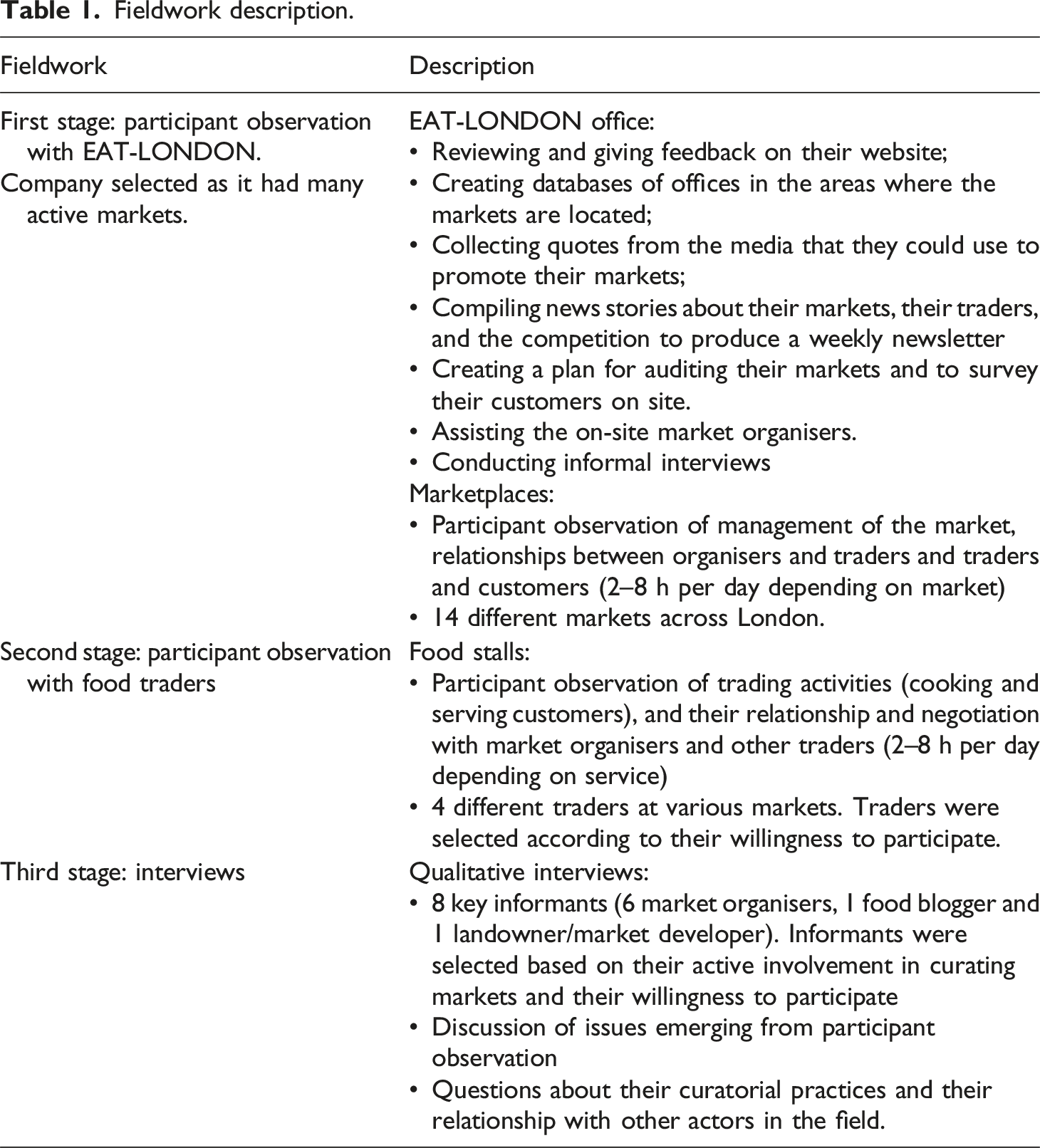
The process of analysing the qualitative data involved a systematic process of coding and re-coding (Crang, 2005). Each field note and transcript was analysed phrase by phrase while thematic codes, annotations and reflective notes were added. After this ‘open coding’ (Crang, 2005) the data was organised into categories which corresponded to the themes and questions from the interview guides, literature, annotations, and reflective notes. A process of axial coding followed, through which connections between and within categories and subcategories were made. At this stage some codes and subcategories ‘broke down’ while others emerged as more pervasive or poignant across the sample (Crang, 2005). We moved toward identifying preliminary theories and collapsing categories into overarching themes through an iterative process of moving back and forth between the data and the research questions, interview guides, observation criteria and literature. We selected the three empirical themes of appropriate spaces, food, and people because the logic of appropriateness emerged as a central theme across the research and the three elements correspond to the conceptualisation of affective atmospheres as including spaces, objects, and bodies (Anderson, 2009).
The case of street food markets in London
Although eating on the street has long been a feature of urban life, street food markets have exploded across many cities over the past two decades (Davies and Evans, 2019). Once perceived as affordable food for the working classes, market stalls and food trucks have been transformed into a modern, hip, and valuable phenomena (Goodman and Jaworska, 2020). By offering experiences and an alternative to imported foods and global food chains, street food markets are also associated with economic development, tourism, community cohesion, urban revitalisation and gentrification (Newman and Burnett, 2013).
With over 100 street food markets in London the competition for consumer attention and spending between markets and traders is intensifying. While many traditional markets consist of traders who work independently, we focus on commercial spaces that are organised more holistically. Here market organisers, who work for landowners, full-time or freelance, function as key intermediaries who curate a range of elements to stage attractive affective atmospheres and valuable consumption experiences. In these markets selected food traders pay organisers a flat rate or percentage fee of their daily trading revenues. The profession of market organiser is fairly new, and most individuals have university degrees and experience in the food/catering industry, or event planning, marketing, or public relations more broadly. Crucially, the market organisers in this study are driven by the economic imperatives of running a profitable business and as we demonstrate this motivation shapes the curatorial practices of market organisers and the nature of the affective atmospheres and experiences within their food markets.
Appropriate spaces as containers and shapers of affective atmospheres
Spaces contain affective atmospheres associated with street food markets by providing physical and psychological boundaries. But spaces also shape these affective atmospheres by facilitating interactions between bodies and objects as well as contributing a range of material and immaterial elements (Goodman, 2016; Smith-Maguire et al., 2023; Wijngaarden and Hracs, 2024). Market organisers perform practices associated with ‘emplacement’ by choosing sites, gathering bodies and objects within their food markets, and designing aesthetics, activities and interactions which co-produce affective atmospheres and consumption experiences (Coffin and Chatzidakis, 2021). The bulk of this staging is done before events by market organisers who operate ‘backstage’ and exercise high levels of control (Goffman, 1959; Koren and Hracs, 2024).
At the macro scale (location of the market within the city), market organisers evaluate a range of options before ‘placing’ their market in a particular neighbourhood. Practical, economic, and psychological aspects are considered including the area’s charisma, accessibility, proximity to clusters of other relevant activities, local council regulations, such as noise by-laws, the demographics and attitudes of local communities and the local and migratory consumer base (Koren and Hracs, 2024). Finding unique settings, such as former factories or petrol stations, which add aesthetic elements such as brick walls, wood floors and exposed pipes as well as heritage elements including narrative histories about the former uses, is also crucial (Timan, 2021; Wijngaarden and Hracs, 2024).
At the meso scale (of the actual market), after ensuring basic requirements such as square footage, water, power and wi-fi infrastructure, organisers plan the layout and overall aesthetic. Each individual food cart is located strategically in relation to entrances, seating areas and other carts. Traders are distributed across the market, in advance, to avoid competition and to create a sense of variety, discovery and surprise (Castigliano, 2023; Hracs and Jansson, 2020; Shi et al., 2021).
Market organisers prefer to work with pre-existing materials and character such as exposed pipes, old phone units, sea containers and graffiti. Attention is also paid to immaterial or sensorial elements such as sound (music or silence), light (colour, intensity, using candles) and smells and fumes (from the food) which can affect consumer’s moods, activities, and willingness to spend (Castigliano, 2023; Coffin and Chatzidakis, 2021; Goodman, 2016). Organisers place speakers in different areas and curate the music, through DJs or playlists. The heating is also controlled depending on the weather and nature of the space (open or closed). Oil drums with fires and other improvised heating are used and consumers usually gather around them to chat. The customised micro-areas, including rum bars and wine bars, within the market are also used as separate spaces where people can either share with strangers or sit as couples or groups. Thus, spatial elements are staged to facilitate and encourage social interactions which contribute to their affective atmospheres.
However, not all bodies are welcome in these consumption spaces and even ideal consumers are not free to explore and use the spaces as they may want to. Like pubs, coffee shops and shopping malls, street food markets can be conceptualised as third spaces, distinct from home and work, where citizens can relax and socialise (Castigliano, 2023; Oldenburg, 1999). Yet, unlike permanent shops with concrete walls and front doors, food markets are temporary and permeable spaces existing alongside other sites and activities. Most have multiple entry points and consumers are encouraged to freely flow into the markets from surrounding areas, often attracted by smells, sounds and aesthetics.
This contrasts with nightclubs which often have tightly controlled central entry points with visible gatekeepers, in the form of security staff, who exercise strict ‘door policies’ which commonly exclude audiences based on a combination of class, race and gender (Koren and Hracs, 2024). Instead of physical barriers or door policies, market organisers use a set of subtle symbolic barriers to exclude or remove individuals who do not align with the commercial imperatives and intended affective atmospheres of their markets. For example, while individuals are free to enter and explore the market, relatively high prices, the food offerings, and the affective atmospheres can exclude consumers who do not feel they belong and who simply pass through without staying. Moreover, organisers seek to educate and condition consumers on the ‘correct’ use of space by hanging signs containing rules about behaviour and how to share tables or seating areas (Coffin and Chatzidakis, 2021; Concha, 2019; Santaoja and Jallinoja, 2021). These findings, support existing studies on forms of inequality, exclusion, and territorial control within commercial spaces (Coffin and Chatzidakis, 2021; Smith-Maguire et al., 2023).
Appropriate food as active ingredients that co-produce affective atmospheres
Like other objects, food possesses an agentic capacity (Bennett, 2004; Goodman, 2016). Rather than a passive resource at the disposal of market organisers, food traders or consumers, food relates to and interacts with bodies and spaces to co-produce affective atmospheres and consumption experiences. Moreover, like human actors who perform in different ways based on spatial, temporal, and contextual setting, such as backstage and front stage (Goffman 1959), food shifts between different states (Bennett, 2004).
Our findings highlight the ways in which food is planned and prepped backstage before the event and how it shifts from a ‘resting’ to ‘animated’ state as it moves front stage during the event to contribute sites, smells and tastes and become the focal point of the interactions between bodies and spaces. They also demonstrate how market organisers and food traders work with foods, which have specific properties and connotations, to co-produce affective atmospheres and consumption experiences. As a result, we argue that the commercial imperatives of the food markets, which are for-profit businesses, shape the curatorial practices of market organisers and the nature of the affective atmospheres which need to be attractive and valuable for consumers.
While many other food-related curators, such as celebrity chefs, online influencers and farmers markets are motivated by promoting sustainable food consumption practices (Goodman and Jaworska, 2020; Jansson and Hracs, 2018; Joosse and Hracs, 2015), the market organisers in our study are motivated by maximising profits. As a result, instead of trying to educate consumers about the contested concept of ‘good food,’ which entails a range of qualities including ‘local,’ ‘organic,’ ‘ethical’ (Callon et al., 2002; Goodman and Jaworska, 2020; Joosse and Hracs, 2015) or encouraging specific practices such as veganism (Santaoja and Jallinoja, 2021), market organisers endeavour to provide appropriate food which matches the expectations and preferences of consumers. For example, the food needs to be attractive (flavour and look), authentic, affordable (matching consumer spending habits), practical (easy to eat on the street) and consistent (same quality every time).
Taste is an essential consideration. Quality flavour results in a satisfying meal and return visits so organisers, who personally taste everything the traders offer, will not include food that is not tasty and visually appealing in their markets.
Uniqueness is also important. Organisers include traders who offer original products that are different from dishes that consumers might find in chain restaurants. Uniqueness can be produced by combining ingredients, seasoning or display.
Additional layers of value can also be added by combining other elements such as authenticity (Hracs and Jansson, 2020; Montefrio and Sin, 2021). For Jones et al. (2005) authenticity can mean the perpetuation of tradition or an original and distinctive product or approach. Authenticity is not inherent to an object or person but rather a claim or narrative that is accepted (Jones et al., 2005). Authenticity, and thus distinction and value, can be produced through spatial associations (where something is from or made) or production processes and techniques (how something is made) (Pike, 2015).
Marcy, a trader who sells Malaysian burgers, provides an example of combining originality with authenticity. She positions her business as creative and authentic based on her ethnic background and upbringing in Malaysia. She used her knowledge about Malay cuisine to develop her business idea and create “KL burgers.” Marcy replicates and enhances her mother’s recipes, cooking techniques and seasoning knowledge to produce a new version of Malaysian food. Marcy also does research and development trips to Malaysia to try new preparations and to bring in creative ideas for her business. Her signature menu features Malaysian burgers, which use the burger format but with traditional Malaysian recipes as fillings. When interacting with customers Marcy speaks Malay and discusses the food’s origin (Pike, 2015). Thus, the attractiveness, uniqueness, and authenticity of the food stems from combining material and immaterial elements and effective value-creation strategies such as place-branding, providing education and inspiration and ‘playing up’ cultural narratives and traditional or artisanal methods of preparation (Hubbard, 2017; Joosse and Hracs, 2015; Montefrio and Sin, 2021; Pike, 2015; Wijngaarden and Hracs, 2024).
Market organisers must also ensure that a range of functional requirements are met. The food must be safe, consistent, quick to produce and relatively affordable. They also curate portion size and display to ensure that the food is easy to eat (no utensils) and conducive for sharing and tasting. The aim is to enhance the social aspects of food consumption while encouraging consumers to taste and try a range of different items to keep people in the market longer and purchasing more portions (Timan, 2021). As Alan explains: “It’s not just about the food, it’s a form of entertainment. It’s sharing a lot of different small portions of things with your friends.” (Market Organiser: Vibes Feast).
Appropriate people as co-producers of affective atmospheres
Within street food markets organisers partially stage affective atmospheres and add value by curating three groups of people; traders, support staff and consumers, who co-promote and co-produce the experience through their presence, practices, performances, and interactions (Hracs et al., 2013; Kolehmainen and Mäkinen, 2021; Shaw, 2014; Timan, 2021).
With respect to traders, the Vibes Feast’s website lists a set of characteristics which market organisers are looking for. Beyond ‘quality food’ that is cooked with ‘character,’ ‘originality’ and ‘consistency,’ the list includes ‘professionalism’ and ‘magic’ which entails delivering food to customers with ‘energy and charisma.’ This reflects wider literature on aesthetic labour, affective labour and the role that retail workers play in creating valuable consumption experiences (Hracs and Jansson, 2020; Kolehmainen and Mäkinen, 2021; Leslie et al., 2015). Employers cultivate and exploit the embodied capacities and attributes of their workers while expecting them to connect with consumers through their personalities, emotions and bodily performances (Williams and Connell, 2010).
Typically, selected traders are young entrepreneurs who not only make great food but ‘look good and sound right’ (Williams and Connell, 2010) by performing aesthetic labour through their personality, clothes, interactions and performances about the inspiration, preparation, and cultural significance of the food. But the selection process is not meritocratic or unbiased and we were told that companies pursue traders within their social networks and create a closed community that is “almost impossible to penetrate” by outsiders. Indeed, our fieldwork confirmed that accepted traders are usually young, white, male, well-educated and well-off with ‘posh accents’ to match.
These curatorial practices produce and perpetuate exclusion and inequality within food markets. Moreover, the conscious and deliberate choice by market organisers to exclude certain bodies and objects demonstrates how the nature of curation and affective atmospheres are shaped by motivations and values. Unlike museums for example, which as public institutions aim to be welcoming and inclusive, the food markets in our study are for-profit businesses and market organisers do not make decisions based on what is fair, right, just, or good but rather what will attract, engage, and extract value from consumers (Joosse and Hracs, 2015).
Much like other entrepreneurs, including musicians, fashion designers and online influencers, who add value through storytelling and personal branding, the trader’s personal narratives provide another source of value (Duffy, 2016; Wijngaarden and Hracs, 2024). Market organisers evaluate how well a trader’s narrative is communicated to consumers in person and online through websites and social media channels. Website sections and social media posts often document the food preparation at home and at the market using personal stories and photos of the process and finished dishes.
Market organisers also ensure that the narrative and aesthetic features of a trader’s brand match their expectations and those of consumers at the market. Alice, a market organiser, emphasises the importance of a trader’s ‘look’ which needs to have an ‘edge’ or something attractive. In the scene, there is a valorisation of cultural forms which reject or provide an alternative to the mainstream (chain restaurants and mass-produced food). Returning to the theme of partial staging, backstage and before an event curation is strategic and meticulous with high levels of control. But during events street food markets need to feel unique, creative and exciting rather than too polished, corporate or boring (Koren and Hracs, 2024). Such affective atmospheres are co-produced by the staging of market organisers and the dynamic performances and interactions of bodies, objects, and spaces in real time.
Ultimately, market organisers configure their collectives by selecting traders who can deliver appropriate food and appropriate performances. Traders must embody and display a range of desirable characteristics during the interactive service encounter, such as being charismatic and fun. They must also make customers feel welcome so that they spend more time at the market. The performance requires not only the ability to engage consumers but also to deliver orders quickly and consistently for intense service periods that last between two and three hours. But this raises another critical issue. While market organisers use rigid and demanding selection criteria to exclude many traders from having the opportunity to work in their markets, they also continuously monitor, manage and discipline traders who are included. Those who cannot meet the desired criteria are not hired and those who cannot successfully and consistently deliver ‘magic’ and effective performances are removed and replaced. Therefore, the nature of work in street food markets is precarious and temporally fragmented (Duffy, 2016; Shi et al., 2021).
Market organisers also curate support staff who contribute to the smooth running of the market and the affective atmosphere. Roles include general managers, hostesses, on-site managers, bar staff, photographers, PR staff, DJs, and performers as well as cleaning and security staff. While some team members are intentionally visible and perform front stage, such as DJs on platforms or security staff at front entrances, most move around the back and front stages of the market performing their work without identification or uniforms in a hidden manner. They mix in with consumers and traders to help create and maintain the desired affective atmosphere (Kolehmainen and Mäkinen, 2021). Cleaners are particularly invisible even as they constantly circulate to manage and contain the flows of material produced from the affective atmosphere, clearing tables, emptying bins, and repositioning seats (Shaw, 2014; Timan, 2021).
As Visconti et al. assert “the variety of roles consumers play in the marketplace has long captivated the imagination of researchers” (2010: 511). Here, we demonstrate that consumers actively co-produce affective atmospheres and consumption experiences in street food markets. But once again, bodies are included or excluded to maximise profits and consumers in our street food markets were typically white, young, and middle class.
With cheaper food options always available in large cities, street food market consumers also share a willingness to invest more time and money in their food-related consumption experiences (Joosse and Hracs, 2015). This desire may be driven by range of personal motivations including performing distinction, communicating class status, enhancing and displaying cultural capital or obtaining food-related inspiration and knowledge (Bourdieu, 1984; Coffin and Chatzidakis, 2021; Hracs et al., 2013; Hubbard, 2017; Joosse and Hracs, 2015). Indeed, food practices are not just about eating and nutrition but forming a community through a recognised experience of sociality and connections with like-minded people (Hubbard, 2017; Joosse and Hracs, 2015).
Beyond sitting, eating, and socialising with other consumers in the physical space of the market, interactions also occur in virtual spaces through social media platforms. Consumers post photos, videos, and comments about the dishes they are trying as well as feelings, atmospheric elements, and the broader market experience (Goodman and Jaworska, 2020; Kolehmainen and Mäkinen, 2021; Smith-Maguire et al., 2023). Before events, consumers generate ‘buzz,’ through social media and word of mouth, to co-promote the market and attract more consumers (Hracs et al., 2013; Koren and Hracs, 2024; Warnaby and Shi, 2018). During events, their presence helps to co-produce affective atmospheres and enhance the attractiveness and value of the consumption experience. Although unpaid, like traders, consumers play a vital role front stage by performing and interacting for and with bodies, objects, and spaces. But posts and comments from consumers also co-produce the market and value over time as they are used as valuable feedback by market organisers (Shi et al., 2021).
Therefore, bodies are not passive or merely ‘caught’ in affective atmospheres (Kolehmainen and Mäkinen, 2021). Rather, through their presence, practices, performances, and interactions with a range of other atmospheric elements – whether intentional, noticed or rewarded – traders, support staff and consumers play important roles in co-promoting and co-producing affective atmospheres within street food markets. Here we see how market organisers strategically curate, enrol, direct, and leverage appropriate people while excluding, hiding, disciplining, and removing bodies that do not contribute to their commercial objectives.
Conclusion
Affective atmospheres are fundamental aspects of consumption spaces and daily life. Yet, their conceptualisation is ongoing and several questions related to how affective atmospheres are staged and co-produced remain underexplored (Anderson, 2009; Bille et al., 2015; Coffin and Chatzidakis, 2021; Koren and Hracs, 2024). More specifically, to what extent can affective atmospheres be staged? When, where and how does this staging take place? And, who does this staging and for what purpose? In thinking about the objects, bodies and spaces which constitute affective atmospheres, what is the range and nature of the different elements involved? What roles do they play and how, where and when do they ‘perform’ those roles? Finally, how do different elements, from food to consumers, relate to and interact with each other through time and space to actively co-produce affective atmospheres and consumption experiences?
This paper addressed these questions through a case study of street food markets in London. It engaged with the concept of curation and introduced market organisers as new and understudied actors who stage affective atmospheres by attuning their curatorial practices to consumer preferences and the commercial imperatives of running for-profit businesses. The three empirical sections focused on how market organisers stage and combine appropriate (1) spaces, (2) food and (3) people in advance of events but also how these elements perform and interact in real time to co-produce affective atmospheres.
The paper demonstrated how street food markets contain affective atmospheres by providing physical and psychological boundaries (Coffin and Chatzidakis, 2021; Goffman, 1959). But also, how spaces shape these affective atmospheres and consumption experiences by facilitating interactions between bodies and objects as well as contributing a range of material and immaterial elements (Wijngaarden and Hracs, 2024). Yet, the paper also highlighted how organisers subtly exclude inappropriate bodies from their markets and control the conduct of appropriate consumers with symbolic barriers and rules.
With respect to food, the paper discussed the important qualities (Callon et al., 2002) that make specific dishes appropriate including attractiveness (flavour and look), authenticity, affordability, functionality, and consistency. It also highlighted how uniqueness and value are generated by combining material and immaterial elements and effective value-creation strategies such as place-branding, providing education and inspiration and ‘playing up’ cultural narratives and traditional or artisanal methods of preparation (Hubbard, 2017; Joosse and Hracs, 2015; Montefrio and Sin, 2021; Pike, 2015; Wijngaarden and Hracs, 2024). Yet, rather than being a passive resource at the disposal of market organisers, food traders or consumers, the paper asserted that food possess an agentic capacity (Bennett, 2004; Goodman, 2016). Here, food is shown to shift from a resting to animated state as it moves from backstage before events to front stage during events (Bennett, 2004; Goffman, 1959). In so doing, the food performs by contributing sites, smells, tastes and a focal point for interactions between bodies and spaces making food active ingredients that co-produce affective atmospheres.
Finally, the paper demonstrated that bodies are not merely caught in affective atmospheres but active participants who co-promote and co-produce market experiences (Kolehmainen and Mäkinen, 2021; Koren and Hracs, 2024). Market organisers curate three groups of people – traders, support staff and consumers aiming for appropriateness based on identities, aesthetics, performances, and interactions (Duffy, 2016; Williams and Connell, 2010). For example, food traders need to be caring and charismatic, cleaning staff need to be silent and stealthy, and consumers need to be curious and cool. Crucially, the paper also highlighted how the commercial imperatives of street food markets shape the curatorial practices of market organisers who produce and perpetuate exclusion, inequality and precarity for food traders, support staff and consumers.
Ultimately, the paper argued that affective atmospheres are partially staged, in advance, by market organisers but also co-produced by the performances and interactions of traders, consumers, food and other non-human elements during market events. It also asserted that spaces contain and shape atmospheres and highlighted the ways in which commercial motivations shape the nature of curation and affective atmospheres.
The paper builds on and contributes to existing studies and knowledge of affective atmospheres and curation. It advances our understanding of what affective atmospheres consist of by adding empirical detail about the range of diverse elements involved, beyond objects, bodies, and spaces (Anderson, 2009; Shaw, 2014; Wijngaarden and Hracs, 2024). By demonstrating how these elements are assembled in advance but also how they perform and interact during market events, the paper also develops existing understandings of the process of staging affective atmospheres (Bennett, 2004; Bille et al., 2015; Concha, 2019; Kolehmainen and Mäkinen 2021; Koren and Hracs, 2024; Shaw, 2014; Wijngaarden and Hracs, 2024). It expands our understanding of the actors and actants, from market organisers and consumers to food dishes and seating arrangements, involved in the staging and co-production of affective atmospheres, including their roles and interplay (Bennett, 2004; Bille et al., 2015; Shi et al., 2021; Smith-Maguire et al., 2023). This focus also contributes to studies on the social dynamics of affective atmospheres (Koren and Hracs, 2024; Smith-Maguire et al., 2023), the agentic role of objects and the power of ‘things’ (Bennett, 2004; Shi et al., 2021; Visconti et al., 2010), how food in particular is ‘more than food’ (Goodman, 2016) and the ways in which spaces not only contain but shape economic activities, affective atmospheres, consumption experiences and curation (Castigliano, 2023; Coffin and Chatzidakis, 2021; Jansson and Hracs, 2018; Wijngaarden and Hracs, 2024). Finally, by applying the concept of curation to affective atmospheres in a novel way the paper contributes to conceptualisations of curation in general (Adler, 2021; Jansson and Hracs, 2018; Richards, 2024) and understudied phenomena, sectors, actors and spaces such as the curation of food (Joosse and Hracs, 2015), how new actors, including market organisers, perform curation (Hracs and Webster, 2021; Koren and Hracs, 2024), the spatial dynamics of curation in street food markets (Jansson and Hracs, 2018) and the ways in which specific values and motivations, such as making money, shape the nature and outcomes of curation and affective atmospheres (Adler, 2021; Joosse and Hracs, 2015).
Footnotes
Declaration of conflicting interests
The author(s) declared no potential conflicts of interest with respect to the research, authorship, and/or publication of this article.
Funding
The author(s) disclosed receipt of the following financial support for the research, authorship, and/or publication of this article: Comisión Nacional de Investigación Científica y Tecnológica.
