







Abstract
In recent years, the internet and digitalization have propelled a phenomenon of ‘gamblification’ across various sectors. This event extends beyond traditional areas like sports betting, introducing gambling elements into new domains such as video games and streaming platforms. The rise of loot boxes in online games exemplifies this trend, merging gambling mechanics with gaming. Not only does this process spread activities that may lead to problematic behaviors, but also normalizes gambling in contexts not typically associated with it, exposing individuals to a broader range of potential harms. Our study explores the ‘gamblification’ and normalization of gambling in digital leisure by examining the correlation between online and land-based gambling, electronic device-based leisure activities, and online sports betting with other kinds of online gambling. Utilizing data from a 2022 survey of the Spanish population (n = 1429), we identify a segmentation and introduction of gambling to new audiences who do not engage in traditional gambling ways. These findings, which address the evolving landscape of gambling in the digital age, have significant implications for the development of public prevention and intervention policies.
Introduction
In recent years, the internet and the digitalisation which has taken over much of our lives, have driven a ‘gamblification’ of various sectors, including those previously unrelated to gambling (Brock and Johnson, 2021; Lopez-Gonzalez and Griffiths, 2018b). While this term has been used to refer to the increased prominence of gambling in sectors traditionally associated with it, such as sports and sports betting (Lopez-Gonzalez and Griffiths, 2018a), it can also be argued that in cyberspace, this process has resulted in the introduction of gambling into new areas (Abarbanel and Johnson, 2020; Johnson and Brock, 2020). Perhaps the most significant example of this second dimension of the process is the popularisation of loot boxes in video games, particularly in online games (Adam et al., 2021). However, this process is not limited to the world of video games; it can also be found in other areas, such as streaming platforms (Abarbanel and Johnson, 2020), or in the rise of trading — or at least some of its mechanisms — (Delfabbro et al., 2021; Dixon et al., 2018). The convergence of gambling with new sectors, as well as the reinforcement and magnification of these relationships, allows us to speak of a process of ‘gamblification’ (Lopez-Gonzalez and Griffiths, 2018b) While some expressions of this process involve the introduction of gambling mechanics into leisure practices historically unrelated to gambling—most notably video games—other domains, such as sports betting, represent long-standing gambling activities that have been fundamentally reconfigured through their integration into digital and mobile leisure environments (McGee, 2020).
Gamblification is particularly noteworthy not only because it involves the expansion of activities that can lead to problematic or even pathological behaviours, but also because of the introduction of gambling elements into contexts traditionally not associated with gambling can lead individuals to engage in these activities without perceiving them as gambling, thereby exposing themselves to a wide range of harms that extend beyond potential addiction (Langham et al., 2016). Gambling is not merely an activity where the participant’s reward is subject to chance and requires payment; it also involves certain persuasive design elements that ‘encourage’ player participation and engagement (Benner et al., 2021; Philippette, 2014), such as offering short-term rewards or using strategies that favour certain biases. Additionally, with the rise of these sectors, new criminal opportunities have emerged, among which, a wide range of frauds have been identified, arising in the wake of the popularisation of trading or sports betting: fraudulent courses, pyramid schemes, various types of fraud, etc. (Bartoletti et al., 2020; Lewis, 2015; Sane, 2019). Whether we are talking about excessive spending and the development of certain disorders or a potential victimisation, it is important to note that certain groups, such as children, adolescents, and young adults are particularly vulnerable to these practices, since their leisure activities are closely linked to the most ‘gamblified’ sectors.
Consequently, this article approaches the ‘gamblification’ and normalisation of gambling in the context of digital leisure by observing the relationship between online and offline gambling, the connection between online gambling and types of leisure involving electronic devices, and the links between online sports betting and gambling tied to video games with other kinds of online gambling. To achieve these objectives, the article first develops a theoretical review of the expansion of gambling into digital leisure environments and the debate on gambling normalisation. It then analyses data from a survey conducted in 2022 with a representative sample of the Spanish population (n = 1429). The results show that online gambling has not resulted in a generalised normalisation of gambling across formats. Instead, the results point to a process of segmentation, in which gambling is expanding toward new publics—particularly younger and predominantly male users—who are weakly connected to traditional, offline gambling practices. Online sports betting emerges as a key bridging activity within the online gambling ecosystem, whereas video-game-related gambling remains comparatively isolated from other forms. Of course, the article has certain limitations, stemming both from its cross-sectional nature and the low prevalence of video game–related gambling, which compromises the statistical power of some analyses. However, as will be discussed in the final section, the results obtained represent solid contributions to current debates on the gamblification of digital leisure.
From the corner to cyberspace: The new environment is everywhere
The democratisation of access to the internet and the popularisation of smartphones have created a new ecosystem to which many economic sectors have had to adapt, and gambling has been no exception to that. In fact, this new context –coupled with more permissive regulatory changes– has allowed gambling to break free from the physical spaces that once limited it, offering access to both its traditional services and new proposals from anywhere, at any time. In the sports betting sector, this process has led to the shift to websites and apps, which offer new services such as in-play betting—placing bets during the course of a sporting event on milestones or issues beyond the final outcome—and implement new strategies, such as offering ‘free’ and ‘combined’ bets during the event, which induce the player to focus solely on potential winnings (McGee, 2020). At the same time, cyberspace removes spatial and temporal barriers to accessing these services, allowing gambling to potentially occupy any aspect of a person’s life (McGee, 2020).
The shift of gambling to the internet, particularly to mobile device apps, introduces gambling into a new context in which gambling is encouraged through new environmental stimuli. This dynamic is not exclusive to sports betting or traditional gambling, as the use of random reward systems and elements designed to increase player engagement and spending (Johnson and Woodcock, 2019) have proliferated all across cyberspace (Adam et al., 2021). ‘Gamblification’ has been the strategy adopted by many companies to open new avenues for monetising their digital services, a dynamic that has become particularly evident in the world of video games (Brock and Johnson, 2021).
For over a decade, smartphones have grown to be one of the primary platforms for playing video games, and today they are the main medium, surpassing computers and consoles in both the number of players and revenue (Syvertsen et al., 2022; Yamaguchi et al., 2017). The origins of this surge in popularity are due to a variety of factors, primarily the omnipresence of smartphones and their dominance as devices through which we access the internet, but also other factors such as the increased technical capabilities of mobile devices and the high profitability of these games’ monetisation models. Not only do Smartphones provide excellent physical support for video games, but their constant internet connection and the significant presence of integrated app stores in modern mobile phones, along with their respective payment systems, offer video games a platform that facilitates game downloads and in-game transactions (Lehtonen et al., 2023). App stores (App Store, Google Play, and their corresponding iPay and Google Pay systems) act as intermediaries that facilitate transactions between the game and the user. This context has significantly contributed to the popularisation of monetisation systems that use mechanisms akin to gambling, such as loot boxes, among others (Brock and Johnson, 2021).
As a result, the consumer has a wide range of options for gambling, as gambling has spread to various sectors related to digital entertainment. Additionally, the availability of gambling has increased since it can be accessed permanently through our computers and smartphones, devices that occupy a significant portion of our leisure time. In this context, it is worth questioning not only whether the increased use of certain electronic devices encourages participation in ways of online gambling by increasing opportunities but also if a normalisation of gambling is developing.
The normalization of gambling? New and old ways of gambling
The shift of gambling into cyberspace and its introduction into new leisure-related sectors seem to have blurred the boundaries of what constitutes gambling. Some studies suggest that online sports betting is perceived as more socially acceptable than traditional betting (McGee, 2020). Furthermore, there is not yet a political consensus on whether loot boxes should be considered gambling and thus be regulated as such. The emergence of services based on gambling mechanics that allow participation without spending money, such as certain social-trading applications or social-gaming video games, has further blurred this line, while also helping users become more familiar with gambling (Langham et al., 2016). When individuals encounter gambling logic in contexts not usually associated with it, there is a risk that they may become used to these gratification and reward mechanisms. Additionally, linking these mechanisms with forms of entertainment not considered risky makes it easier for individuals to ‘destigmatise’ these mechanisms and perceive them as safe. These two processes could be contributing to a normalization of gambling, exposing individuals to a wide range of risks and harms associated with gambling as a consequence.
The introduction of gambling into new contexts has fostered its integration as just another leisure activity within certain peer groups (Deans et al., 2017; McGee, 2020), allowing it to become embedded in certain lifestyles (Raymen and Smith, 2020) and potentially causing harm that goes beyond the possible development of a behavioural pathology in clinical terms (Wardle et al., 2018). The goal of introducing gambling mechanics is to maximize the money spent by the user, often by exploiting certain psychological biases (Cerulli-Harms et al., 2020). Groups such as minors or young adults, due to their current stage of development, are particularly vulnerable to these mechanisms. Furthermore, during these developmental stages, individuals are especially dependent on the admission of their peer group, making the acceptance of gambling as a shared leisure activity particularly problematic (Setterstrom and Pearson, 2019; Yang et al., 2011).
The introduction of gambling dynamics into new sectors and their parallel acceptance as a way of leisure within certain peer groups are elements that are part of the ‘gamblification’ process of digital leisure (Brock and Johnson, 2021; Lopez-Gonzalez and Griffiths, 2018b). Given the relatively recent nature of this process, we do not yet have empirical evidence on its long-term consequences. However, we can hypothesize that one of its outcomes might be a certain normalization of gambling, understood as the building of bridges between ‘gamblified’ leisure and more traditional forms of gambling, both online and offline. The adaptation of individuals to intermittent reward systems and the ‘destigmatisation’ of betting could be creating a more receptive audience for engaging in various forms of gambling, both online and offline. While this is a hypothetical consequence, we do have available literature on the immediate consequences of the ‘gamblification’ in certain areas.
Accordingly, the next sections examine two analytically distinct domains within digital leisure: video games, as a paradigmatic case of gambling mechanics being introduced into previously non-gambling leisure practices, and online sports betting, not as a novel form of gamblification, but as an established gambling activity that has been reshaped by digitalisation (Lopez-Gonzalez and Griffiths, 2018a). Sports betting is not a novel manifestation of gamblification; however, its embedding within digital leisure has led some authors to consider online sports betting as an integral component of gamblification processes. In this study, sports betting is not examined as an emerging form of gamblified leisure, but is instead employed as a reference point against which newer, video-game-related gambling practices can be analytically situated.
‘Gamblification’ of video games
The ‘gamblification’ of video games has various facets, but the one that has received the most attention from academics and authorities is the popularisation of loot boxes as a monetisation system in video games (Brock and Johnson, 2021). Through loot boxes, players pay a certain amount to receive a random reward, which can range from a cosmetic modification to new characters or elements that enhance gameplay or player performance (Cerulli-Harms et al., 2020).
The widespread use of this system and its presence in games deemed suitable for children—such as the video game EA Sports FC (previously known as FIFA Football), recommended for ages 3 and up (Brady and Prentice, 2021)—have sparked controversy and concern among authorities in various countries, including the UK, Belgium, China, South Korea, and the US (Brock and Johnson, 2021). Recent studies conducted with representative samples in Tokyo (Ide et al., 2021), Delaware (DeCamp, 2021), and Denmark (Kristiansen and Severin, 2020) have established that the prevalence of loot box purchases among gamers ranges from 20% to 33.9% (Gonzalez-Cabrera et al., 2022). Zendle (2020) estimates this prevalence at 7.8% among the general adult population, and Von Meduna et al. (2020) at 9.8% among German adults. In Spain, González Cabrera and his collaborators (2022) reported that 30.4% of adolescents and young adults (aged 11 to 30) had purchased at least one loot box in the past 12 months.
Although this field of study is relatively young, research has established similarities between gambling and loot boxes (Drummond and Sauer, 2018; Von Meduna et al., 2020; Xiao, 2020), and there is empirical evidence linking gambling problems and symptomatology with loot box spending (Garea et al., 2021; Gonzalez-Cabrera et al., 2022; Zendle and Cairns, 2018). A positive relationship has been found between the frequency and money spent on loot boxes and Problematic Gambling Disorder (Drummond et al., 2020a; Macey and Hamari, 2019). A clear similarity has been identified between the reward system characteristics of loot boxes and the variable reinforcement schedules present in gambling (Drummond et al., 2020b). Zendle et al. (2020) observed that higher spending on loot boxes was associated with greater gambling problems, and after exploring the relationship between problematic gambling and different types of loot boxes –whether they offer only cosmetic modifications or in-game advantages– they concluded that no format was harmless.
In addition to these randomised reward systems, third-party platforms have emerged as highly speculative markets (Zanescu et al., 2021) where players can buy or sell in-game items or even bet them, thus converting in-game rewards into real money (Greer et al., 2019). This dynamic has even extended to live streaming platforms, which have grown in popularity thanks to the rise of Twitch, owned by Amazon. Twitch has introduced mechanisms that allow streamers to monetise their broadcasts by offering viewers random rewards (in exchange for payment) or by organising bets on the content of the stream (Johnson and Woodcock, 2019).
Online sports betting
Online sports betting now accounts for 50.62% of the total gross gambling revenue 1 from online gambling in Spain, a sector that has been steadily growing since 2013 and reached 1,481,727 active players in 2020 2 . While sports betting is not a modern phenomenon, its migration to the online environment appears to have caused certain changes (McGee, 2020). Internet gamblers seem to have greater difficulties recognizing their gambling problems compared to offline gamblers (Gainsbury et al., 2013; Petry, 2006). Additionally, Estevez et al. (2017) found that online sports betting gamblers exhibited ‘riskier betting behaviour and higher gambling-related debts’ (p. 642) compared to those who bet offline in sports competitions.
Studies suggest that, compared to those who bet on sports competitions through offline means, those who bet online believe that their outcomes are less determined by chance and depend more on their own skills and knowledge (Gordon et al., 2015). These characteristics reinforce observations by other authors who have identified these players as especially vulnerable and more exposed to severe gambling problems (Moragas et al., 2015). In this regard, López-González et al. (2019) found a gambling problem rate of 17% among participants in their sample who reported engaging in online sports betting, which, given the prevalence of online gambling in Spain, would translate to ‘about 105,000 experiencing problems with online gambling’ (p. 1368). Furthermore, these authors also observed that mobile phone use for betting was particularly common among problematic gamblers.
Method
This article aims to explore the gamblification of digital leisure and the potential normalisation of gambling that it may have carried. To this end, the study utilises data from a nationwide sample of 1429 adults residing in Spain, aged between 18 and 65 years, who completed a web-based survey administered from 24 March to 22 April 2022. Participants were recruited through an online panel managed by an independent Spanish research agency. A quota-based sampling strategy was applied, ensuring representativeness across key sociodemographic variables, including age, gender, geographic area and municipality size. At a 95.5% confidence level, the estimated maximum sampling error was 3.2% (Z = 1.96) for this sample of Spanish adults. The study procedures were in accordance with the ethical standards of the Declaration of Helsinki and were approved by the Committee of Research and Ethics of the University Miguel Hernández de Elche (Reference: DPP.ACC.01.21). This data and its analyses have been employed to achieve the objectives set by this research, which are as follows: • To observe the relationship between online gambling and offline gambling.
With the aim of determining whether we can speak of a normalisation of gambling related to la diffusion of gambling in digital leisure contexts, we will attempt to observe whether there are connections between online gambling and offline gambling. This would allow us to discuss the existence of connections between different forms of gambling. We approach this objective in two ways. First, we will examine if there is a correlation between online gambling and offline gambling, hypothesising a positive connection between the two activities (Hypothesis 1). Second, we will observe differences in terms of gender and age among individuals who engage in each way of gambling; in this regard, we hypothesise that men will tend to gamble more online (Hypothesis 2) and that younger individuals will gamble online in greater proportions, while older individuals will predominantly engage in offline gambling (Hypothesis 3). • To observe the relationship between online gambling and different forms of leisure that require the use of electronic devices.
As noted, the gamblification of online leisure is associated with the popularisation of certain electronic devices. Therefore, it is pertinent to question whether involvement in online gambling is a matter of opportunity or if other factors are also at play. Thus, we aim to observe whether there is indeed a connection between spending more time on certain leisure activities and a higher likelihood of engaging in online gambling. To achieve this objective, four logistic regression models have been constructed, with the dependent variable being whether the subject has reported online gambling –in any kind of online game– over the past year, and predictors including gender, age, number of daily hours spent using a computer, watching television, consuming content on streaming platforms, and using a video game console.
Two of the models account for the number of hours spent on these leisure activities during the week, while the other two consider the number of hours spent on weekends. Additionally, in two of the models, these leisure activities are treated as continuous variables, whereas in the other two, they are treated as categorical variables (the original question addressed the variable as categorical). These models allow us to test our hypotheses 4 and 5, which propose that the probability of a subject engaging in online gambling is related to a higher number of hours spent using a computer (H4) and a higher number of hours spent using a smartphone (H5). • To observe the relationship between online sports betting and video game-related forms of gambling with other forms of gambling.
Finally, the article delves into two specific but significant areas within the gamblification of digital leisure: online sports betting and several disciplines of video games. Specifically, we will examine the prevalence of these betting strategies and analyse how participating in them correlates with other types of gambling, in both online and offline spaces. In this context, we hypothesise a correlation between gambling within the world of video games and other types of gambling (H6), and a correlation between sports betting and other forms of gambling (H7). The kinds of video game-related gambling considered by the survey include betting on e-Sports, in-game betting for skins or equipment upgrades, loot boxes or loot crates in video games, and betting on players/characters during online game streams on platforms such as Twitch. Given their low prevalence and the high correlation between these ways of gambling, they have been combined into a single variable, which will be used to examine the correlation between video game-related gambling and other methods of gambling.
Results
Offline Gambling and online gambling
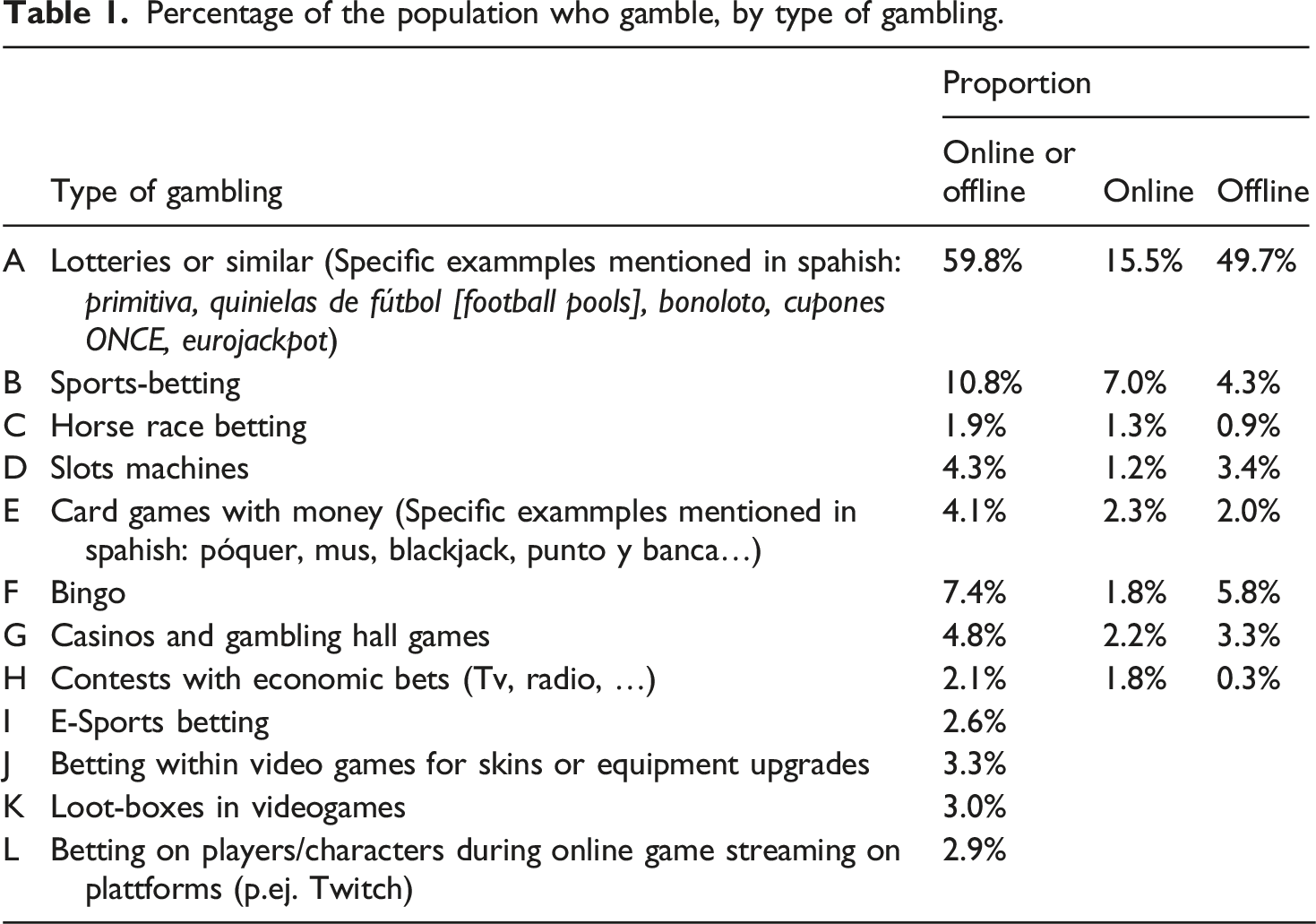
Percentage of the population who gamble, by type of gambling.
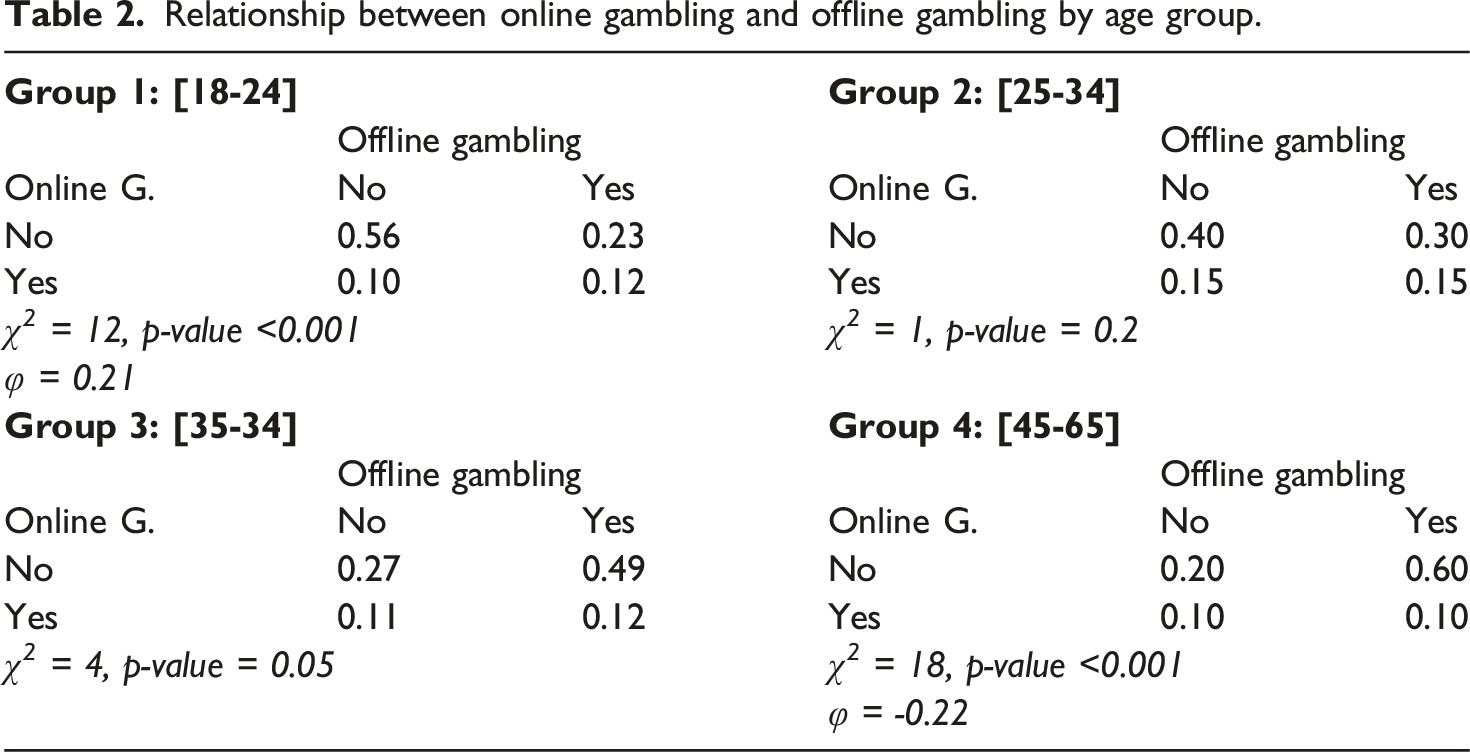
Relationship between online gambling and offline gambling by age group.
Differences in online and offline gambling
As previously observed, we lack statistical evidence to assert that gender influences the relationship between offline and online gambling. However, we do observe gender differences concerning the domain of gambling as a whole. Only 16.1% of women report having played online in the past year, compared to 30.8% of men. This correlation between gender and online gambling is weak (φ = 0.173) but statistically significant (χ2 = 41.802, p < 0.01). In terms of offline gambling, 56.7% of women report being involved in this activity, compared to 51.5% of men, but this difference is not statistically significant (χ2 = 3.769, df = 1, p = 0.052). Consequently, we can confirm Hypothesis 2, affirming that a greater proportion of men engage in online gambling.
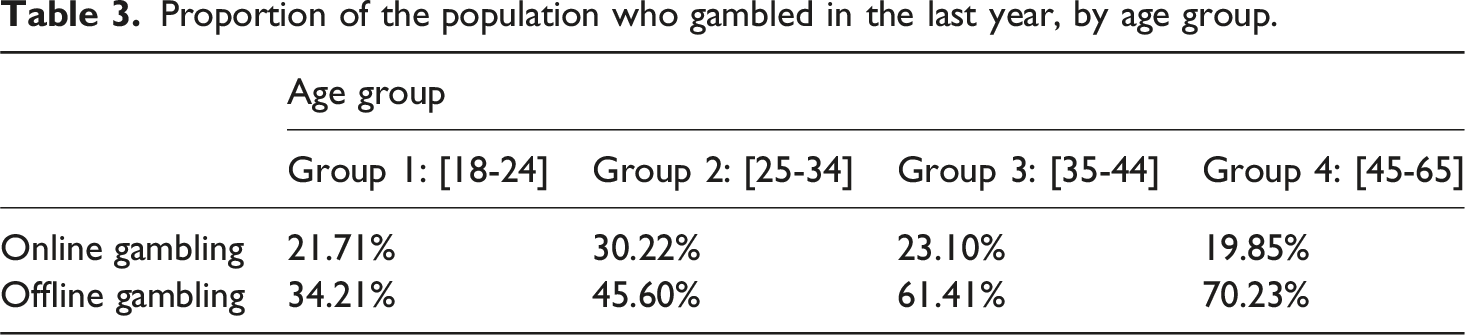
Proportion of the population who gambled in the last year, by age group.
Gambling online and leisure activities
Regression models linking online gambling and leisure activities.
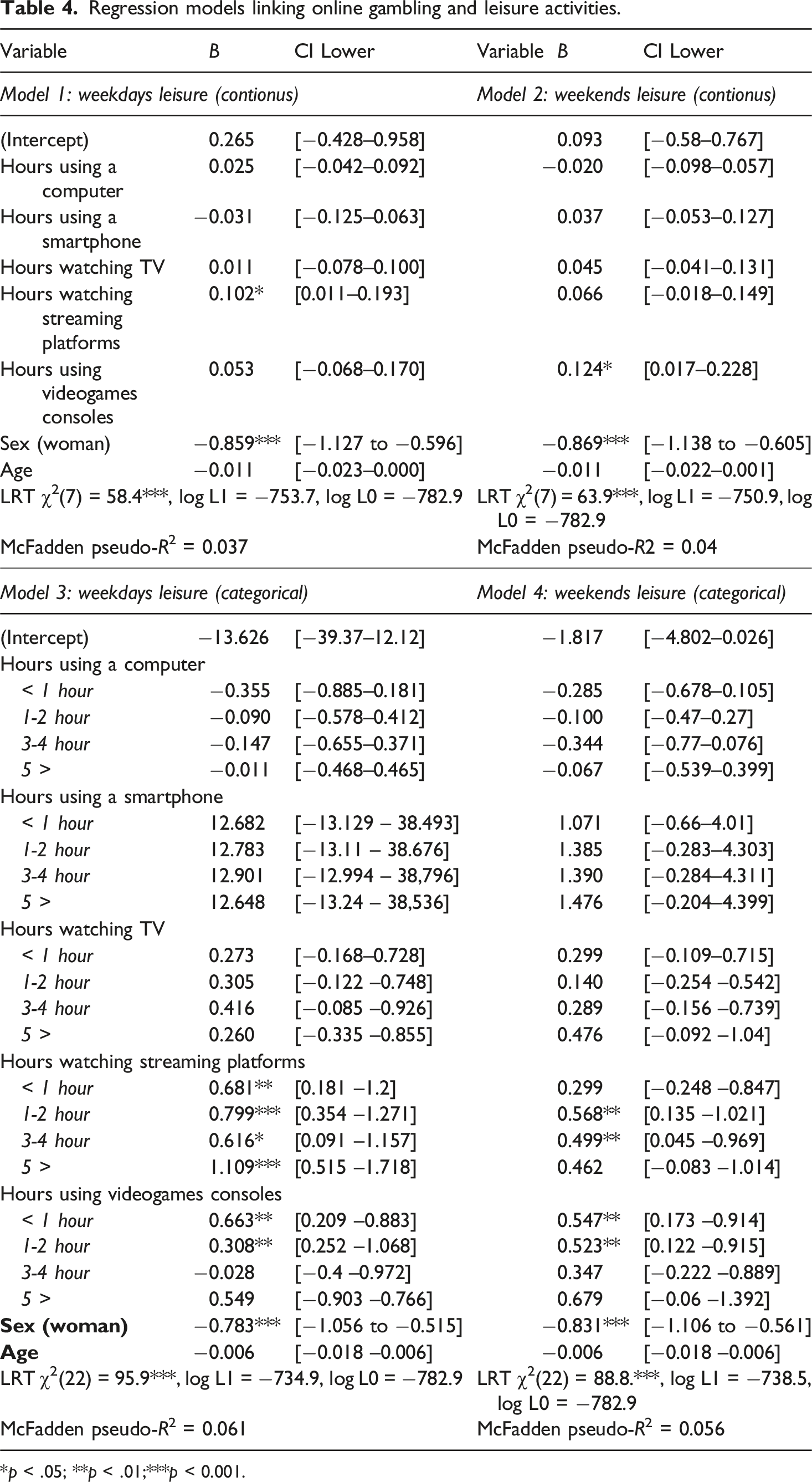
*p < .05; **p < .01;***p < 0.001.
Regarding specific variables with statistically significant associations with online gambling, we must first note that we do not have statistical evidence to support the claim that the amount of hours spent using a computer or smartphone are related to a higher probability of online gambling, thus rejecting both Hypotheses 6 and 7. When examining leisure activities during the week, the only significant variable related to online gambling, beyond gender, is the number of hours spent watching content on streaming platforms. This correlation is evident whether the variable is treated as continuous or categorical –in the latter case, the effect seems to increase with more hours, although not in a completely linear manner. We can, therefore, affirm that a greater number of hours spent on streaming platforms during the week is associated with a higher probability of engaging in online gambling. Conversely, the only statistically significant variable in the two models examining weekend leisure activities is the number of hours spent playing video games.
Gamblification of video games and sports
Regarding the various ways of gambling associated with video games (L: e-Sports betting; M: in-game betting for skins or equipment upgrades; K: loot boxes in video games; I: betting on players/characters during online game streams on platforms), it is notable that, in addition to having a limited prevalence, they exhibit a correlation with each other. Only 6.3% of the population engaged in any of these types of gambling in the past year. The correlation, measured by the phi coefficient, between video game-related means of gambling and other evaluated forms of gambling is generally weak, with none exceeding 0.3 or being statistically significant. Although we find correlations between participation in some kind of video game-related gambling and other forms of gambling greater than 0.2 (with p-values less than 0.05), the weak nature of this association, the essence of the relationship, and the low number of cases resulting from cross-variable analysis, prevent us from asserting a robust relationship between video game-related gambling and other forms of gambling. For example, the strongest correlation of this variable with any other kind of gambling is with online sports betting (φ = 0.295, p-value < 0.005). Indeed, 60% of those who bet online on sports also bet on video games. However, 83% of those who bet on video games do not report participating in online sports betting. Consequently, we must reject Hypothesis 4, as we did not find a strong or moderate association between video game-related forms of gambling and other forms of gambling.
In the case of online sports betting, we do find moderate correlations with other forms of gambling, specifically with online casino or gambling hall games (φ = 0.32, p-value < 0.005) and online monetary betting contests (φ = 0.38, p-value < 0.005). Additionally, online sports betting shows a weak correlation with other forms of online gambling (0.2 < φ < 0.3, p-value < 0.005), specifically with online participation in: lotteries; horse races; slot machines; and card games with money. Therefore, we can assert that participation in online sports betting does correlate with other forms of gambling, particularly with other forms of online gambling. Hence, we can confirm, at least partially, Hypothesis 5.
Discussion
The gamblification of digital leisure has raised concerns for various reasons, with one of the main concerns being the potential normalisation of gambling. However, based on the results obtained, we can assert that online gambling remains a minority activity compared to its offline counterpart, which engages more than half of the Spanish population. Furthermore, we did not find statistical evidence to support a correlation between online gambling and offline gambling. In fact, our data suggests that distinct profiles of gamblers exist depending on the context in which they gamble. Online gamblers appear to be younger and predominantly male. These findings contradict our hypothesis of a correlation between online and offline gambling, which would indicate a normalisation of gambling as a leisure activity. It is particularly noteworthy that we did not find evidence of a strong relationship when dividing the sample by age groups; however, in the 18 to 24 age group, there is a significant but very weak association between the two forms of gambling. Consequently, while we might anticipate a potential future normalisation of gambling in the sense suggested, our data indicates that currently we are primarily observing separate gambler profiles. This has significant implications for designing prevention and intervention plans, since those who gamble online do not appear to be the same as those who participate in offline gambling, public awareness and prevention policies for gambling-related disorders, as well as resources available to assist individuals with gambling-related problems, should be tailored specifically to be more effective.
We did observe that younger individuals are more likely to gamble online compared to older individuals who prefer offline gambling. Age thus seems to be an important factor in the preference for one format over another. However, this should not be confused with a direct association between age and a higher probability of online gambling, as the logistic regression models controlling for age and hours dedicated to different forms of leisure did not reveal a statistically significant relationship between age and a higher likelihood of online gambling. These models did confirm the correlation between gender and the probability of online gambling, a connection that appears to persist even when controlling for age and forms of leisure related to electronic device usage. Notably, we found no link between a higher probability of online gambling and increased hours of use of devices that facilitate online betting, such as smartphones and computers. Therefore, we cannot attribute online gambling to greater availability. However, a connection does exist with hours spent watching streaming content during the week and playing video games on weekends. Unravelling the nature of this relationship will require further research, and we can only hypothesise that there might be a variable influencing both. Perhaps greater free time influences both online gambling and the availability of more hours for streaming content and video gaming during the week.
Finally, this article explored the relationship between two forms of online gambling—video-game-related gambling and sports-related gambling—and other gambling practices, thereby engaging with the process of gambling normalisation discussed above. Online sports betting is not examined here as an emergent form of gamblified leisure, but as a consolidated and socially recognised gambling activity that has been fully integrated into digital environments. Its role in the analysis is to serve as a reference point against which the position of newer, video-game-related gambling practices within the broader gambling ecosystem can be assessed. From this perspective, the moderate correlations observed between online sports betting and other forms of online gambling are consistent with its function as a gateway within an established gambling domain.
By contrast, the weak and largely non-significant associations between video-game-related gambling and other gambling practices indicate that these activities remain largely confined to distinct leisure contexts. Rather than supporting a process of generalised gambling normalisation, this pattern points to a segmentation of gambling practices across differentiated publics. Gamblified video-game practices appear to introduce gambling logics to new users without necessarily integrating them into traditional or online gambling circuits, at least at this stage of their development. While online sports betting connects individuals to other forms of online gambling, video-game-related gambling remains comparatively isolated.
Conclusion
This study contributes empirical evidence to the emerging scholarship on the “gamblification” of digital leisure by examining how gambling practices are being reconfigured across online and offline contexts. Our analysis shows that the expansion of gambling into digital environments has not produced a generalized normalization of gambling across formats. Instead, we identify a process of segmentation, whereby distinct gambling publics are emerging, characterized by different demographic profiles, leisure practices, and relationships to traditional gambling.
Three key contributions emerge from this research. First, we observe that online and offline gambling constitute largely separate, rather than overlapping, behaviours. The absence of a significant correlation between these modalities—except for a weak association among young adults—challenges assumptions that digital gambling necessarily serves as a gateway to traditional gambling forms. Second, our findings reveal that video game–related gambling practices remain comparatively isolated from broader gambling circuits, whereas online sports betting functions as a bridging activity connecting to other online gambling forms. This distinction is crucial for understanding how gamblification operates differentially across digital leisure sectors. Third, we show that engagement with online gambling cannot be reduced to mere opportunity or device availability; instead, specific leisure patterns—particularly streaming platform use during weekdays and video gaming on weekends—exhibit stronger associations with online gambling than time spent on computers or smartphones per se.
Although further research is needed, our findings carry significant implications for public health policy and regulatory frameworks. The segmentation we observe suggests that “one-size-fits-all” prevention strategies may be inadequate. Video game–related gambling, in particular, appears to introduce gambling logics to new demographics—predominantly younger, male users—who may not identify with traditional gambling discourses or fall within the scope of conventional gambling regulation. This isolation poses unique challenges for harm reduction, as these individuals may experience gambling-related harms without recognizing them as such or engaging with established support services. These findings carry significant implications both for public health policy, regulatory frameworks and consumer studies. The segmentation we observe suggests that “one-size-fits-all” prevention strategies may be inadequate. Videogames related gambling, in particular, appears to introduce gambling logics to new demographics—predominantly younger, male users—who may not identify with traditional gambling discourses or fall within the scope of conventional gambling regulation. This isolation poses unique challenges for harm reduction, as these individuals may experience gambling-related harms without recognizing them as such or engaging with established support services. More broadly, these findings suggest that gamblification may operate through a differentiating mechanism within digital leisure rather than as a homogenising force — producing distinct consumer publics with divergent relationships to gambling. Understanding how these publics are shaped, and how gambling influences the formation of leisure identities, remains an important task for consumer culture research.
Footnotes
Funding
The authors disclosed receipt of the following financial support for the research, authorship, and/or publication of this article: This project has been funded by the Social Observatory of the “La Caixa” Foundation [Ref. No. LCF/PR/FS21/60000002]. ACC, JLC, FML and JCA are part of the GamerVictim research network funded by the PROMETEO Program 2023 [CIPROM/2022/332].
Declaration of conflicting interests
The authors declared no potential conflicts of interest with respect to the research, authorship, and/or publication of this article.