







Abstract
Everyday lives of young people are made difficult by high costs of living, housing and environmental crises but there is sparse academic literature that examines the ways in which this group navigates financial pressures and environmental concerns. This article revisits the concept of thrift in the context of contemporary challenges and reveals its place and significance in daily practices of young Australians. Drawing on visits at participants’ homes in Melbourne, Australia (including interviews and home tours), the article discusses different ‘thrifty’ approaches and negotiations for saving money and resources that are pursued to maintain a fulfilling life. The findings suggest a conceptualisation of thrift as a present strategy and future orientation – a practice that is geared towards accomplishing pro-environmental, pleasurable and hopeful outcomes through consumption and sharing, but also one that can be experienced as discomfort and hardship. Issues concerning the access and affordability of housing and domestic energy use expose negative experiences of thriftiness. Building on the scholarship that connects the organisation of the everyday and thrift with the ideas of a ‘good (enough) life’, we argue that such articulation provides a productive lens to understand the intersecting and seemingly contradictory dynamics of thrift by young people. As compounding challenges mark societies and economies around the world, we reiterate the call for empirically-nuanced accounts of lived experiences and practices such as thrift.
Introduction
Young people have consistently been identified as a demographic both ‘particularly vulnerable’ and resilient to negative external conditions, such as economic recessions (Kim, 2022; Mendick et al., 2018: 2). In Australia, ‘the pandemic, inflation and low rental vacancies’ are reported to have ‘created a perfect storm that is affecting young people negatively’ (Walsh in McManagan, 2023; National Youth Commission, 2020). Contrary to popular misconceptions, young people are seen as a civically engaged group (Fu et al., 2021; Jenkins et al., 2016), strongly invested in climate change action (Leung et al., 2022; McHale et al., 2024). They are concerned and distressed about climate change (Teo et al., 2024), sceptical about the availability of ‘basic support’, and ‘increasingly anxious and uncertain about their future’ (Kurmelovs, 2021; Pennington, 2023; Walsh et al., 2024).
This article explores how young adults living in Australia navigate these intersecting pressures of high cost-of-living and the housing and climate crises, by engaging in thrifty everyday practices. We critically reflect on what thrift means for them, and how it is understood and experienced. We argue that young Australians’ thriftiness is not just about mundane practicalities of ‘making do’ in the everyday. Instead, their thrifty practices derive from a set of socio-economic conditions, personal histories and collective (consumer) politics; they are positioned as a mode of tentative futureproofing, and point to expectations and possibilities of a ‘good (enough) life’ (Miller, 2024) that are being revised for and by this cohort.
Our study contributes to a better understanding of the ‘thrifty lives’ of young Australians in relation to an ability to lead a quality life. Following commonly-held aspirations towards a ‘middle-class, suburban and settled life’ (Miller, 2024: 4), we ask how thrift enables young people to constitute a ‘good (enough) life’ alongside the erosion of many of the conditions thought to make that possible. As we demonstrate, thrift provides a pathway for young people to navigate issues of insecurity, hardship and environmental anxiety — alongside desires for agency, fulfilment and hope. Drawing on conceptions of thrift that emphasise the values of social justice and a good life within neo-liberal capitalist societies (Berlant, 2007; Yates and Hunter, 2011), we reveal how young adults’ thriftiness is an everyday intervention into compounding crises that seeks to practically manage these circumstances and search for pathways towards ‘thriving’.
Understanding thrift in contemporary society
Complex, multifaceted thrift
Thrift refers to mending or repairing things, secondhand or discount shopping — and generally budgeting efforts oriented towards reducing household expenditure. Interdisciplinary research has sought to systematise diverse practices and meanings of thrift, distinguishing, for example, between ‘thrift’ and ‘frugality’, with the former ascribed to ‘the art of doing more (consumption) with less (money)’ (e.g., through bargain shopping); and the latter to a (moral) ‘restraint on consumption’ (not expenditure), waste reduction and environmental sustainability (Evans, 2011: 551; 553). Research emphasises the contingent and evolving meanings of thrift, linked to ‘the changing pictures of human thriving’ across history (Yates and Hunter, 2011: 572 on thrift in US) and individual and collective values and circumstances (Podkalicka and Potts, 2014 for a synthesis).
The literature discusses ambiguities, negotiations, trade-offs or sacrifices that can constitute thrift practices in everyday contexts (Evans, 2011; Holmes, 2019; Lindsay et al., 2020), along with different social meanings and outcomes of thrift. For example, Miller (1998: 48; 33) demonstrated how thrift is ‘the normative ethos of shopping’, reliant on ‘ingenuity’, and predominantly underpinned by care for others. Cappellini et al. (2019: 469) showed how low-income mothers manage their household, sacrificing personal needs for the benefit of family members, which produces ‘contradictory emotional effects’ between ‘pride and self-worth’ and ‘stress and anxiety’.
The literature has addressed both thrift’s symbolic and cultural significance, as a form of ‘disposition and set of practices’ related to ethical values (McDonald and Dan, 2022: 403), and thrift’s connection to the necessity to save money and ‘make do’. The moral and cultural understanding of thrift dovetails with the notions of ‘affection’, responsibility, and ‘concern for others’ (Evans, 2011; Miller, 1998: 33), and with ‘choice’ and ‘distinction’ as part of one’s lifestyle. Steward (2020) shows how forms of thrifty consumption (e.g., secondhand clothes purchases in thrift stores) serve as a type of cultural capital. While ‘finding bargains’ is one of the identified motivations to shop in thrift stores for some, this motivation co-exists with the ‘creativist’ desire to circumvent mainstream retail for other groups. Bargain-Darrigues (2023) similarly asserts that thrift can be practised by ‘high cultural capital consumers’ as a form of ethical or anti-consumption.
A substantial body of work re-affirms thrift as a reaction to material scarcity and limitation – or outright ‘necessity’ and need or survival (Berlant, 2007). Williams (2016: 1897), for example, restates the importance of income and ‘socio-spatial variations’ for making sense of thrift-related shopping practices in the study of ‘alternative retail channels’ in the UK. While thrift as a desirable lifestyle choice is practised by high-income customers, ‘economic necessity’, argues Williams, ‘remains the principal reason amongst lower-income urban populations who view their reliance on such channels when the majority does not as a sign of their exclusion from mainstream consumption practices’ (Ibid.).
However, amongst both high and low-income households, the ‘sacrifices’ that thrift prioritises in the present are also about enabling a better quality of life in the future. Miller’s (2024) concept of a ‘good enough life’ is particularly relevant here. Miller explores and challenges notions of the good life through ethnographic research with an Irish community, but his approach can also be extended more broadly to other communities and groups who are redefining the meaning of fulfilment through practices such as thrift. Thrifty consumption is framed within a long historical aspiration towards a middle-class lifestyle in secure housing, where key values are pursued. For instance, Cappellini et al. (2019) show how low/reduced-income mothers’ pursuit of ‘good mothering’ and a ‘good life’ is actualised through self-sacrifice and self-surveillance. Drawing on Berlant’s work, Cappellini et al. argue that the experience of material hardship does not nullify the attachment to the ideal of a good life – despite this ideal being tethered to ‘unattainable’ capitalist fantasies (2019: 486). Thrift, thus, is a set of practices that are inseparable from ‘normative dimensions of economic life’ and anchored in its etymology of ‘thriving’ (Yates and Hunter, 2011: 570).
Young people and thrift
While there is limited scholarship on young people and thrift, academic studies have focused on youth identity construction through popular media discourses (Mendick et al., 2018), noting gender, national, and class responses to thrift education (Kim, 2022). Referring to a ‘new thrift culture’ in an austerity Britain, when individuals were impelled to ‘tighten belts’ following the Global Financial Crisis, Mendick et al. (2018: 2) recognise ‘the pivotal tension between the incitement of young people to aspire and invest in the idea of meritocracy and the dramatic erosion of opportunities for upward social mobility’. Focused on celebrity cultures and grounded in the imaginaries and socio-political realities of austerity Britain, Mendick et al.’s work is still relevant here. Similarly indebted to Berlant’s ideas around attachments to the good life, it foregrounds impacts of structural conditions, rather than individual aspirations, on ‘young people’s sense of desirable and achievable aspirations, and their opportunities for realising them’, urging the attention to how ‘how young people are imagining and materialising their futures’ (Mendick et al., 2018: 5).
Recent studies include mentions of young people as a sub-group of thrift practitioners, through documenting discrete (thrifty/secondhand) purchasing activities (Johnson et al., 2023; Mazanec and Harantová, 2024; Steward, 2020), especially clothing/fashion (e.g., Toebast-Wensink et al., 2026). However, there is little known about how thrift – as expressive of the tensions between material necessity/scarcity and aspiration, and practised across different everyday activities – is understood and experienced by young people under current conditions of high living costs and environmental concerns. This gap extends to accounts of sustainability, with Peng et al. (2024) describing the ‘gaping’ absence of detailed scholarship on young people and sustainable living practices. Likewise, young people have been identified as an understudied group who are particularly vulnerable to energy poverty in the Global North (Middlemiss, 2022). Energy poverty (or hardship) is an alternative narrative to thrift that emphasises a person’s inability or precarity to meet their basic needs for comfort and sustenance because they cannot afford or access fuel or power (Petrova, 2018). Far less research has focused on young adults compared to other socio-demographic groups, such as older people (Bouzarovski et al., 2013; O’Sullivan et al., 2017). This is despite the fact that younger adults may be more at risk of energy poverty than other vulnerable groups, due to their access to poorer quality or ‘non-traditional’ social and housing arrangements, and higher dependency on rental properties (Hearn et al., 2022; Petrova, 2018).
Taking cues from these studies, this article explores how young adults living in Melbourne, Australia, understand, engage and make sense of thrift; and what these young adults’ economic or ‘thrifty lives’ reveal about expectations, norms and possibilities for a future good (enough) life.
Methods
A study of thrifty youth: Precarity in the Australian context
Young adults in Australia experience precarity because of deepening challenges of housing and rental crises and environmental anxieties (e.g., McHale et al., 2024; National Youth Commission, 2020; Teo et al., 2024). Housing studies, for example, posit consistently that ‘rising house prices are pushing home ownership out of reach for many younger Australians’ (Coates et al., 2025). Young people, especially those starting out, with low-paid or insecure employment (AHURI, 2023; Pennington, 2023; Whelan et al., 2023), young women and gender diverse people with full time or multiple jobs, ‘struggle to secure and afford housing’ (Stone et al., 2024: viii). In the state of Victoria, and its capital Melbourne, where this study is located, unaffordable rental costs, tenure insecurity, sub-standard conditions of rental properties are amongst key factors cited as making young people ‘vulnerable’ (Youth Affairs Council Victoria, 2023). Other representative surveys attest to this vulnerability and limited hope for the future. For example, according to Australian Youth Barometer (2024: 2): 86% of young Australians experienced financial difficulties in the last year; 62% think they will be financially worse off than their parents; just under 1 in 3 young people believe that it’s likely they’ll be able to afford a comfortable place to live in the next year.
The scarce attention to young adults in the thrift literature, combined with the complex issues and sense of hopelessness impacting this cohort of Australians, led us to our study of thrifty youth. The Australian Bureau of Statistics defines ‘youth’ as 15–24-year-olds. We use the terms ‘young Australians’, ‘young people’ and ‘young adults’, with reference to the life stage marked by the transition into adult life, when referring to participants in our study (aged 25–28).
Home visits
Our home visit approach was guided by short-term ethnography techniques (Pink and Morgan, 2013), now common in household research on technology and consumption (Pink et al., 2017). The research was ethnographic in the sense that visits were open-ended and exploratory, observational, directed by participants’ responses, and informed by design ethnographic materials (e.g., student-led films discussed below), attuned to people’s experiences and aspirations.
Visits to young people’s homes lasted between one to 2 hours and were carried out by one or two members of the research team, two of whom are older tenured academics, and one a young adult/early career academic. The visits consisted of semi-structured interviews, open-ended demonstrations of everyday practices related to thrift, home tours, and an activity that involved showing participants a two-minute student-created video (from a selection of four options), described below. Between 2023 and 2024, we visited eight households, with 12 participants. Participants were recruited via an online registration form, with an advertisement about the project distributed through diverse channels, including the research team’s networks, social media, and through a snowball method (via word of mouth from previous participants). All participants resided in Melbourne, Victoria, to ensure accessibility for the research team. After registration, participants were contacted to organise a time for the visit.
Each visit began with researchers asking participants to introduce themselves, their current living arrangements, and interpretation of the term ‘thrift/y’. Interviews followed, loosely, five sections corresponding to common everyday practices: ‘Cooking and Eating’, ‘Shopping’, ‘Transport’, ‘Leisure’, and ‘Domestic Energy Consumption’ (including heating, cooling and home comfort). At the end of each interview, the researchers selected one of four videos to play for the participants to prompt a short open-ended discussion. The videos were produced by undergraduate media students at Monash University in response to a ‘Thrifty Youth’ brief prepared by the research team for an assignment in a video production class. The brief asked students to create a short 2–3-min video that ‘explores how young people in your generation use digital technologies to negotiate cost of living challenges, and/or minimise their environmental impact’. Each video depicted an aspect of thrift related to one the above-mentioned practices. Students were informed that their videos may be used as part of a research project examining thriftiness by young adults. The research team selected four diverse student videos exploring gardening, cooking, shopping and entertainment to include in the home research. During each home visit, a video was selected by researchers based on its relevance to the participant(s) and household to invite reflection on the themes raised. The videos were a methodological approach designed to generate dialogue between young people: from those making the videos in their undergraduate unit to those viewing and commenting on them as our research participants. While video discussions are not directly included in this article, some of our insights about young people’s definitions of and reflections on thrift are derived from these conversations.
Household and participant characteristics
Household and participant characteristics.
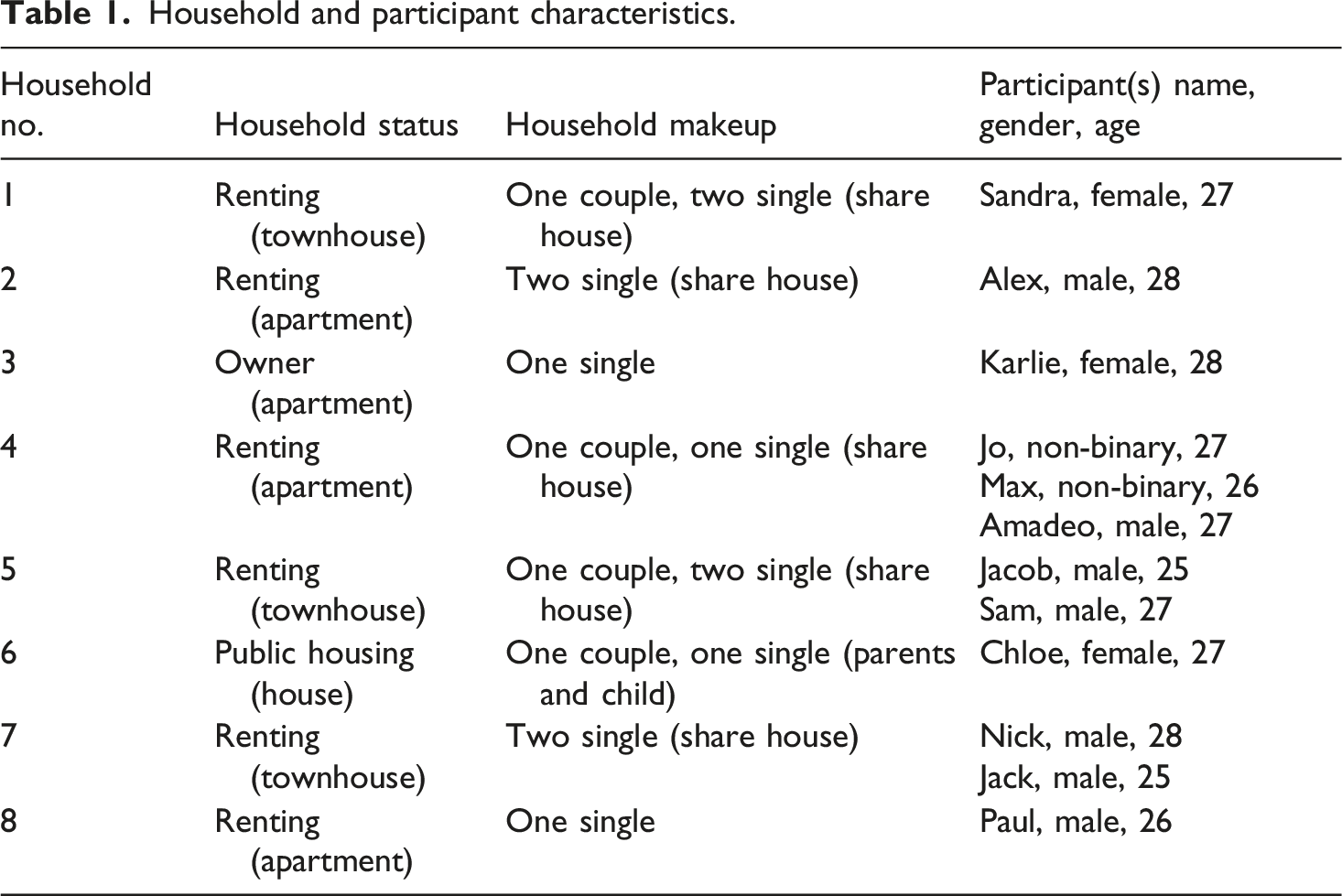
Our study is exploratory and small scale, which, while common in qualitative and ethnographic work, cannot reflect all young adults’ perspectives or experiences. For example, while most participants earned lower wages than the average Australian, we did not capture people who were in severe hardship or homeless – or those just-entering ‘official’ adulthood (see above). Instead, inspired by collaborative, participatory and ethnographic approaches in critical youth media studies (Soep, 2014), including, for example, video reflections produced by young people and observations, we seek to advance conceptual understandings of thrifty youth and emerging orientations towards the good life – key to the growing academic and public debate on the challenges facing young people in Australia and other advanced economies.
Analysis
Recordings from each visit were professionally transcribed and uploaded into NVivo qualitative software for coding and analysis. The research team followed an inductive coding approach, identifying patterns and themes in the data (Braun and Clarke, 2006: 83). In this article, we distil our analysis into three important, overlapping themes to extend understandings of thrifty youth and grounded conceptions of the good life at the current juncture. First, we explore how thrift is practised by young adults as a complex set of negotiations tied to cost of living, environmental concerns and future aspirations; second, we discuss the significant role of shared living as a thrifty strategy; and third, we explore the importance of saving energy in the home, particularly in relation to home comfort.
Practising thrift
Balancing economic, ethical and environmental imperatives
The young people we interviewed perceived themselves as thrifty in various and complex ways. Some saw themselves living and breathing thrift, often conjuring the family circumstances and upbringing that had shaped — and continues to shape — them personally. Others framed thrift as referring to various strategies and techniques of saving money, while others described the material conditions they (and their housemates or peers) experienced growing up (for example, in government/social housing), which made them ‘used to thrift’ as an integral feature of their lives. Some participants appeared comparatively less or only selectively committed to thrift, with several participants unsure about adopting the ‘thrift’ label to describe their practices. However, as it transpired during home visits, they were clearly resourceful in the way they handled money and available material resources, which corresponds with contemporary definitions of thrift.
Consistent with thrift literature, participants emphasised a set of negotiations, ‘trade-offs’ and compromises that they made regarding how they spend and save money to make their life as fulfilling as possible, including for living arrangements. This entailed saving to buy specific things such as books or to enjoy cultural experiences such as ‘going to the movies’ or music concerts. The quote below illustrates this desire to be thrifty in order to afford small luxuries: We make sacrifices so we can buy dumb shit, but also [make] the sacrifices, just so you can buy that one minor luxury good. And I don't mean a $4,000 Louis Vuitton bag. I mean an $80 object of desire is pretty ridiculous (Alex, Household 2)
This formulation implies that the expectations to afford an occasional pleasurable purchase or experience can be substantially lowered for many young people. A few participants talked about consciously budgeting for or limiting social activities (e.g., going out or having a drink in a pub); others talked about hunting down low-cost or free social or cultural activities (e.g., free cultural events or going for a walk or a bike-ride with friends). The finding resonates with a UK-based study into saving: namely that when economising, ‘people would reduce spending on their social life first, suggesting that the need to economise reduces participation in social life’ (Lunt and Livingstone, 1992: 32). The 2024 Australian Youth Barometer makes a related observation about financial constraints and civic participation. Walsh et al. (2024: 3) note that ‘when cost of living is a key pressure, one way [young people] move is in how [they] spend our money’ – connecting to consumer politics (i.e., ‘voting with your money’) and extending to ‘civic participation’. Examples of young people’s civic and community participation go beyond individual development or ‘making change in our immediate setting’ to include ‘working towards a collective future that looks after the planet and its future generations’ (Ibid., 3).
The participants also revealed everyday living pressures and uncertainties. Several expressed anxieties about housing affordability at the present and into the near future – communicating tempered expectations and perceptions of (class/generational) wealth inequalities that are entrenched in Australian society (Coates et al., 2025; Richardson and Stilwell, 2024). There were frequent mentions of reduced buying capacity over recent years, with noted examples of rental increases in Australia over that time, and high costs of ‘basic necessities’ such as groceries or petrol and energy. Consequently, thrift for many was discussed as a pragmatic daily strategy for managing economic resources, for day-to-day survival. Forms of ethical good-for-the-environment consumption, although present amongst the participants, were often necessarily secondary to economic decisions. For instance, buying ecological products such as eco-foods was deemed aspirational but beyond young people’s budgets. At the same time, secondhand shopping for clothes, furniture, electronics, and other goods through opportunity (thrift) shops or online platforms such as Facebook Marketplace was widespread. In these examples it was difficult to differentiate between money-saving and environment-saving imperatives — for instance, in relation to clothes, both the affordability of secondhand clothes and the ‘despicability’ of fast-fashion were mentioned.
The notion of ethics as an integral part of thrift came up in relation to various practices, revealing, more broadly, the intertwined aspects and values attached to thrift captured in the existing literature (Bargain-Darrigues, 2023; Evans, 2011; Holmes, 2019). The connection between a sense of family-related nostalgia and personal ‘spiritual’ rewards achieved through gardening was articulated by one participant (see also Lindsay et al., 2020 on enjoyment through growing food), although they also recognised that shopping at a market (preferred over shopping at large supermarket chains) would be more economical than growing their own vegetables: I just grew up in a family where my mom had a garden and whatever would have a salad with dinner, it all came out of her garden. […] And I really missed that. I felt a lot more of, I suppose maybe a spiritual connection to what I was eating by picking the food and eating it (Jacob, Household 5).
Despite affordability concerns regarding ethical consumer markets, participants were vehemently aware of the politics and impacts of their everyday lives on the environment. They were insightfully cognisant and critical of the structures and conditions that shape the economy and their capacity to make meaningful changes that can lead to ‘large-scale change’, which corresponds to representative survey findings by Walsh et al. about young people’s attitudes to ‘achieving change’ broadly (2024: 70–72). One participant used the following example: … what's the point in throwing out your green rubbish or, I don't know, [that] we don't have any glad wrap or plastic. We always use containers. What's the point in that when there's big corp dirtying, most of the planet and stuff like that. So that can be quite challenging (Sandra, Household 1).
However, while supermarket shopping may be considered ethically problematic, it was still practised, often because of supermarkets’ geographic proximity and availability of (seasonal) discounted products. For some, proximity to shops meant an ability to cut costs through doing without car ownership.
In summary, our participants practised thrift as a complex set of negotiations between their economic means, ethical and moral considerations, and environmental concerns. This was not only seen as a set of sacrifices or rejections of particular modes of consumption, but rather as a balancing act of different values weighed up against participants’ aspirations for a fulfilling lifestyle.
Being thrifty in a shared environment
Most of our participants had a shared living arrangement, either with other young people (five households) or with their family (one household; see Table 1). Non-traditional shared living arrangements for young adults are common reactions to the changing economic conditions of the early 21st century (Heath and Cleaver, 2003; Maalsen, 2020, 2022). Changes in household sizes carry an inherent environmental element as smaller households have a greater impact on the environment than larger ones (Bradbury et al., 2014); as such the choice to enter into any one type of non-traditional housing arrangement shouldn’t only be seen as a reaction to diminished access to secure housing, but the choice to form a household in a particular way may also reflect one’s environmental as well as well as economic principles of thrift.
Young people often expressed their thriftiness as part of these shared living arrangements, which they had chosen as a way to ameliorate the rising costs of living, the precarity of rental housing, and resource consumption. Shared living enabled significant economies compared to more conventional living arrangements: Pretty much everything is cheaper in a share house (…) The next step of me and my partner's relationship would definitely be moving out, but I almost feel like I might just stay at a share house, just save because all the bills are cheaper, the rent's cheaper, you get a nice house, which is good and we can do activities together, which is cheaper (Sandra, Household 1).
Sandra’s experience demonstrates the social benefit of living communally that all participants living in share houses expressed during our home visits. Financial decisions related to shared living, such as being able to afford a nicer house or apartment for the same or similar price, or benefiting from economies of scale and resource sharing, were treated either as so obvious that they sometimes went without significant elaboration – or were subordinate to the social benefits brought about by living with others. This suggests that the decision to live communally is not one entirely borne from economic desperation but rather reflects participants’ values and understanding of a functional and sociable home. Sandra mentioned her relationship with her partner as a key reason for leaving the share house at some point, considering transitioning not from shared living to single living, but from one form of communal living to another. Jacob and Jo also expressed an interest in the social and economic benefits of shared living, with the latter saying that the decision to live communally was motivated by ‘friendship’ and a desire for ‘all of us to [live together], and it saves money’ and the former stating ‘I really like living with other people’. The transition from shared houses to other forms of living is also not unidirectional, with people moving in and out of them. For instance, Nick had moved from a share house to a two-bedroom unit on his own but invited his friend to live with him, recognising ensuing adjustments: I was getting a little bit lonely after over a year of being in the place… it was such a good opportunity to get someone in at the time that I knew needed help … [I] wanted to help out a mate but I wonder[ed] what difference it’s been now having been a year without having a housemate, whether I could slowly integrate it again or if I’d just be like, nah, no, don’t enjoy this (Nick, Household 7).
One participant, Chloe, continued living in their family home, citing similar reasons to participants living in shared housing as incentives to stay at home. Chloe discussed many of the same strategies for managing bills, groceries, and living spaces that participants living in shared houses reported in their home visits, such as designating some groceries as communal and some as personal, and transforming living spaces to accommodate the needs of different household members. As another form of communal living, staying at home allowed Chloe to be resourceful with their living costs and provided some companionship and additional support.
How participants chose to structure their living arrangements was therefore one that went beyond economic considerations; it involved participants’ own feelings on the benefits or drawbacks of communal living. For instance, Karlie’s decision to live alone was motivated by their preferences against communal living coupled with the financial capacity to purchase their own apartment and not ‘be subject to a landlord’. Paul, another participant living by themselves, framed this as a product of their past ‘problematic’ sharing experience as well as having the ‘means and the money’ to live alone. Our participants frequently expressed a feeling of sadness for having to trade the beneficial experiences of communal living for the security that more conventional housing situations would provide, as the Australian housing system provides little stability for tenants on short-term leases. Flexibility in where one is living, being able to help friends, and social benefits were all broadly of comparable importance to economic concerns. This led to some participants consciously exchanging their economic thriftiness either for the opportunity to move out with a partner, or to give their usually hard-won personal space up to live with others.
Saving energy and staying comfortable at home
An area where thrift as a strategy for saving money and resources came up prominently was domestic energy usage. Recent energy price increases in Australian homes were considered ‘the biggest changes in budgeting’ (Sandra, Household 1), and a backdrop for implementing specific spatial arrangements in the house. For example, some participants discussed how they only heated one section of the house in winter, often a communal area such as the kitchen or living room. With bedrooms remaining unheated, participants talked about having to rug up to stay warm during cold Melbourne winter nights. Heating was a site of a constant negotiation - or, when the weather was especially cold, a welcome treat. Alex explained: … we are keeping that thing [heating] off as a rule [...] If we get home and we feel particularly cold, particularly lazy or spoil ourselves, we will turn it on. Otherwise it's 'wear pyjamas, wear thermals, put your Oodie on' (i.e. hooded blanket) and get over it (Household 2).
Generally, the decision-making, including around the need to toughen unfavourable house temperatures out, was connected to participants' previous and nornalised experiences of thrift and energy use (or energy hardship) grounded in lived experiences. Such restraint in using appliances to regulate temperature for comfort was also salient in relation to air-conditioned cooling, with many participants choosing ‘not to use the air conditioner long’ during summer (Jacob, Household 5). In few households, however, economising gave way to the desires of comfort, with some participants admitting that they are more inclined to use air conditioning during hot Melbourne summer than in the past, suggesting further a break from family habits: We'll just use the aircon usually. Oh, okay. Yeah, we have one. So growing up, my parents never used the aircon. We just weren't allowed to. If it was like 45°, we'd all just lie down and put ice cubes on ourselves. That was wild. I just feel like I value my comfort more now (Jo, Household 4).
What was striking about the energy use was the extent to which living in a shared house was seen as helpful for saving money on energy bills but also contingent on the living situation. Utilities were sometimes built into the rent or when flatmates were absent from the house a lot, the bills were difficult to work out. Tracking of amenities usage was not common, and its desirability or benefits occasionally questioned. Participants considered their current usage of water and energy fairly fixed, accepted as an area with limited wiggle room for change given routine, everyday practices (e.g., around showering; working from home; or the pursuit of hobbies) – while noting the price increases of utilities (mentioned above).
The bills were generally split and conflicts rare, but several participants framed their individual situation of not having to worry about the cost of utilities as a ‘privilege’, invoking the awareness of energy affordability and hardship that many other Australians experience. Mostly though, participants did not perceive themselves as being in energy hardship, even when they were clearly limiting heating and other energy ‘luxuries’ to economise. In this regard, participants’ practices did not indicate strong signs of poverty, although we note that other young people with less means are certainly experiencing poverty in Australia (Davidson et al., 2020), and some of our participants’ reported conditions and practices reflect situations that could be classified as such.
Thriftiness was not always about saving money or energy; indeed sometimes being thrifty led to increased consumption (see also Evans, 2011). Yates (2016), in his study of frugality and sustainability, discussed how potential environmental benefits achieved through economies of scale and sharing in communal households are not realised equally – and that social trends towards personalisation, for example, around the use of technologies such as home entertainment systems or spatial preferences (e.g., private bathrooms) complicate these relations. In our research, this complicated relationship was visible in the way some participants hung onto energy-inefficient objects, including large-size appliances such as refrigerators. In a few cases, two or even three fridges were simultaneously in use (to enable other thrifty practices such as bulk buying or cooking). Their utility was justified by the ability to provide more storage, such as for food cooked in batches or ‘fun’ and economical side projects such as home beer brewing. However, they were also kept ‘in case’ their owners (or those looking after them) had to break away from the current share house and move somewhere else. In this application, thriftiness is connected to (informal) circular economies by reusing functional objects rather than buying new ones. But their upkeep also adds to ongoing energy costs that could be reduced through the acquisition of more energy-efficient options.
Discussion
McDonald and Dan (2022: 413) argue that considering thrift’s ‘multivalent dimensions’ shapes an understanding of consumer cultures, ‘illuminating thrift as a recurrent experience that is an increasingly prominent feature of contemporary social life’. Our study documents how thriftiness, in different forms, permeates the everyday lives of young adults living in Australia. Importantly, thrift is not only seen as a method of conserving resources or ‘making do’, but also a means of orienting oneself towards a more hopeful and positive future. In this sense, the findings reaffirm some of the rewarding or empowering aspects of thrift. For example, thrifting can become a way of connecting to others through various practices of house-sharing, or through saving money on some things that can be redirected for ‘small pleasures’, in similar ways as those described by McDonald and Dan in their study of Chinese factory workers (2022: 413). Echoing Miller’s (2024) analysis of the good (enough) life in a small Irish town, thrift promised connection and community for our participants, framing it as desirable social project achieved through diverse practices of secondhand reuse (e.g., obtaining things for free/cheap on online marketplaces or salvaging items from nature strips) and home cooking or brewing. More individual or socially-shared pleasures also framed thrift’s pursuit of a better life in our study, including saving for future-focused activities, such as travel and cultural experiences (e.g., attending concerts).
Conversely, and disconcertingly, uncovering the thrift practices of young Australians also reveals the layers of vulnerability and uncertainty that young people experience. This finding echoes the international literature, which has recognised the tough economic circumstances faced by young adults, including the ‘downwardly mobile millennials for whom cost-effectiveness had become one of the central principles of daily life’ (Kim, 2022: 258). In the context of our study, such layered precarity is illustrated by the complex issues of housing and domestic energy consumption as related to fundamental values and experiences of comfort and wellbeing. We have captured the sometimes-oppressive impacts of unaffordable and poor energy performing (rental) housing on young people. To find a suitable house is a challenging task for many, while living in a house means committing to various thrift/economising strategies — sometimes clearly experienced as sacrifices — especially where heating is concerned. Thriftiness can lead to discomfort and experiences aligned with experiences of energy hardship, and it can also result in the further escalation of energy consumption, as households hold onto energy-inefficient appliances or use them to enable other thrifty practices (like bulk shopping and cooking). While this does not suggest that thrifty young people should automatically be considered in poverty, it does caution against the romanticisation of thrifty practices (‘cool thrift’ or ‘experimental/creative’ thrift) amongst this demographic. Further, it warns against assumptions that thriftiness is always aligned with environmental improvements, since sometimes economising in one area (such as food storage, production and wastage) can escalate consumption in another (such as refrigeration). This reinforces the arguments made in past research that thriftiness is a process of negotiation and trade-offs with both mixed outcomes for affordability, ethics and the environment.
Placing these two perspectives together, thrift is both a response to enduring hardship as well as a mechanism for hope and aspiration towards a good (enough) life. This meaning of thrift resonates with academic writing on the relationship between agency and struggle and survival — as Lauren Berlant posits in her work on media representations of precarious lives (see also Färber and Podkalicka, 2019). Berlant’s close reading of two films, La Promesse and Rosetta, centres on ‘lived struggle on the bottom of class society’ by two adolescent protagonists in search of ‘a normal life’ (2007: 278; 283). While the lived experiences of our participants were different — and indeed financial circumstances were experienced differently across our sample — Berlant offers a productive analytical vocabulary of a liminal, ‘transitional’ space that encapsulates the tension between necessity and aspiration as manifest in the human effort to fashion a good life regardless of material circumstances (Cappellini et al., 2019; Mendick et al., 2018). Berlant’s observation about ‘the world [with] the kind of room for us that enables us to endure’ under capitalist conditions (2007: 288) can be extended to our research. Insightfully, Berlant considers the questions of ethics and ‘normative attachments’ to particular versions of the good life, deriving from family histories and socio-economic structures, that the film protagonists must confront and work with (2007: 295). Likewise, our participants were engaged in a set of negotiations and circumstances through which they sought to navigate a good (enough) life within limited parameters (see also Walsh et al., 2024).
For instance, while various daily economising strategies in response to immediate financial concerns have been identified in our study, thriftiness has a deeper connection to the values of justice for others and the environment, as a general social critique of the capitalist system (Yates and Hunter, 2011), set against the routines and ‘practice memories’ (Maller and Strengers, 2013; Strengers and Maller, 2017) acquired through upbringing, which are a source of normalised thriftiness. The declaration that one is ‘used to thrift’ conveys both the familiarity and acceptance of the past as well as a point of rupture from it — as expressed when participants spoke of keeping up certain childhood routines or breaking from them to pursue new pleasures and comforts.
The pursuit of a good (enough) life occurs within the changing norms and expectations of what is achievable for young adults. Studies find that young people adopt ‘mundane everyday tactics’ to temporarily deal with deprivation but are unable to systematically challenge the underlying situation (Petrova, 2018: 27). Secure housing—one of the key tenants of a good life—presents such a systematic challenge and becomes a site of intensified negotiation, often struggle, with home ownership increasingly out of reach for younger generations (Australian Institute of Health and Welfare, 2025; Coates et al., 2025). Young Australians have to navigate housing access and negotiate alternative housing arrangements (Maalsen, 2020, 2022). In rental properties, they are likely to have limited agency to make structural changes to the building or major appliances (Petrova, 2018); and regardless of their situation, they may also need to sacrifice personal comfort for the sake of household thrift. However, their openness to experimentation and unconventional approaches means that young people may develop ‘mundane everyday tactics’ that enhance their resilience and give them some hope for a future good (enough) life.
In summary, the young adults in our study were neither fully ascribing to the thrift identity as a positive reflection of themselves and their environmental values, nor were they experiencing unbearable negative impacts of poverty or hardship that necessitated thrifty living. Rather, our participants demand a nuanced definition of thrift that encapsulates a fundamental pursuit of a good (enough) life under systemic challenges of cost-of-living and housing pressures and in an alignment with lived experiences, values and evolving expectations of social belonging, joy and pleasure.
Conclusion
In this article we have sought to interrogate and add depth to our understanding of how young Australians experience and practise thrift in the context of rising costs of living, housing crises, and climate change concerns. Our study provides insight into the complex negotiations young people make in the face of these contemporary challenges, and the ways in which they practise thrift with constant reference to economic, ethical and environmental concerns through their everyday consumption. We have identified how norms and expectations of a good (enough) life are being redefined for and by young adults under these circumstances – for everyday socialising (e.g., hanging out in pubs), life experiences (e.g., travel) or cultural participation (e.g., music events), as well as future-oriented prospects such as, notably, home ownership. In line with the existing thrift scholarship, we have documented thrift as being experienced as both a way to achieve and attain pleasurable outcomes such as access to ‘small luxuries’ or stronger social connections, and as a potentially uncomfortable and detrimental set of circumstances that can limit young people’s opportunities, comfort and experiences.
Our article makes two related contributions to the consumption scholarship. First, we have elaborated, further, on thrift’s connection to ideas of a good (enough) life and ‘thriving’ (Barlant, 2007; Miller, 2024; Yates and Hunter, 2011) manifested in young adults’ everyday compromises and interventions into compounding crises of housing, costs of living and environmental concerns, as well as their search for ways to realise a better future for themselves. Thrift is thus best described as an ongoing management of everyday pressures and future-oriented aspirations. Second, we have established stronger connections between disparate bodies of work on thrift, energy consumption and housing. Unlike scholarship on thrift, which emphasises both challenging and rewarding aspects of frugality, energy poverty is framed as an unwanted or harmful impact that people have to cope with or suffer through (Butler and Sherriff, 2017; O’Sullivan et al., 2017). Where these two narratives overlap is in relation to the strategies, practices and lived experiences that young people report in attempting to economise resource use out of necessity and sometimes also concern for the environment (Butler and Sheriff, 2017).
In conclusion, we recommend caution in romanticised expressions of thrift in relation to young people that emphasise its pleasurable, rewarding and trendy aspects, or which frame thrift as a desirable lifestyle choice. Instead, we call for greater alignment of positive and hopeful thrift narratives with those concerning precarity, hardship and environmental despair. We propose that the conceptualisation of young people’s thrifty practices as the pursuit of a good (enough) life provides a lens to entwine these intersecting and seemingly contradictory dynamics. In this way, thrifty youth demonstrate a practical response to the present and a powerful orientation towards the future; one which includes ‘mundane tactics’, access to ‘small luxuries’ and a hopeful vision for better times ahead.
Footnotes
Acknowledgments
We would like to express our gratitude to all participants for sharing their insights with us. Many thanks also to our colleagues Mr Billy Head and Dr Rex Martin for their collaboration on the project, and to anonymous reviewers for their generous and valuable comments on the article.

Ethical considerations
The project received ethics approval from the Monash University Human Research Ethics Committee (MUHREC ID 39142), with written informed consent from participants.
Funding
The authors disclosed receipt of the following financial support for the research, authorship, and/or publication of this article: This project was supported by internal funding from the Faculty of Arts, Monash University.
Declaration of conflicting interests
The authors declared no potential conflicts of interest with respect to the research, authorship, and/or publication of this article.