







Abstract
Researchers and marketing practitioners have long been intrigued by the impact that famous individuals can wield over consumer behavior and cultural trends. This paper focuses on the “socialite” – an individual who is extremely well-known in the public eye, yet typically not on the basis of outstanding talent or professional achievement. Unlike celebrities admired for athletic, artistic, or other skills, socialites epitomize being famous for being famous. The role of socialites in contemporary consumer culture remains under-examined, despite parallel research on influencers and celebrities. Through an updated literature analysis, we clarify the definition of the socialite and distinguish this figure from related personas such as traditional celebrities, it-girls, trendsetters, and social media influencers. We trace the historical evolution of the socialite, analyze its symbolic power, and explore its strategic use in branding, consumer aspiration, and public culture. The paper proposes a conceptual framework for understanding socialites as cultural intermediaries and market catalysts, and discusses implications for consumer culture theory and marketing practice.
Keywords
“Many a man owes his success to his first wife, and his second wife to his success.” — Jim Backus (1913–1989), American actor and humorist
Introduction
The term “socialite” has long been part of Western popular lexicon, referring broadly to a person of high social status who achieves prominence in the media primarily due to their lifestyle and networking activities rather than any singular talent or profession. In essence, a socialite is a celebrity by virtue of social standing – a person “known for their well-knownness,” to recall Boorstin’s (1961) classic definition of celebrity culture. Historically, socialites often hailed from elite backgrounds (e.g. aristocratic families or economic dynasties) and regularly appeared in society pages and gossip columns. Unlike conventional entertainers or athletes whose fame is tied to specific performances or accomplishments, the socialite’s fame has been characterized as unmoored from any particular merit or product, instead rooted in public fascination with their personal life and privileges.
Despite the ubiquity of socialites in tabloids and reality television, academic research on this figure remains surprisingly sparse. Consumer culture and marketing scholarship have extensively studied traditional celebrities and, more recently, social media influencers – examining, for instance, how star endorsers transfer meaning to brands (Fleck et al., 2012), or how influencers build trust and shape audiences’ attitudes via social media (Harrigan et al., 2021). Public relations research has similarly analyzed the strategic use of famous people in campaigns (Lou and Yuan, 2019) and the rise of new digital opinion leaders. Yet the classic socialite as a distinct phenomenon – often considered a precursor to the modern influencer (Enke and Borchers, 2021) – has not been rigorously examined in marketing and consumer culture literature. This gap is notable given that socialites command significant media attention, often out of proportion to any tangible “achievement,” and can shape consumer preferences through their lifestyle displays. Their prominence grants them a form of soft power: the ability to set or sway tastes, norms, and aspirational consumer behavior, boosting brands and sparking conversations that ripple through consumer culture.
Given the evolving media landscape and the rise of influencer culture, a fresh look at socialites is both timely and important. Today’s socialites are often hot topics across mainstream media and social media alike, commanding large followings on platforms like Instagram, TikTok, X, while still being featured by traditional outlets. They straddle old and new modes of fame, occupying a hybrid and transitional position between elite-based and platform-based visibility regimes. On one hand, they continue the legacy of high-society figures who were staples of 20th-century tabloids; on the other, they overlap with digital content creators in cultivating a personal brand. This intersection raises questions about how socialites differ from – or perhaps have merged with – contemporary influencers and celebrities. The purpose of this paper is to provide a socio-marketing analysis of the socialite figure within consumer culture, drawing on interdisciplinary literature and updated examples. Additionally, understanding the socialite phenomenon can shed light on broader issues in consumer culture: the nature of aspirational consumption, the commodification of personas, and the reproduction of class-based prestige in the age of interactive media.
Origins and evolution of the socialite
The concept of the “socialite” can be traced back to the late 19th century United States, when societal elites began to be catalogued and celebrated in print media for their status and lifestyles. A key historical moment was the creation of the Social Register in 1886 by Louis Keller, listing prominent high-society families and formalizing elite membership. Its popularity reflected public fascination with the wealthy and well-connected. By 1918, it had expanded to 18 volumes covering aristocratic families across 26 U.S. cities (Preston, 2000). Inclusion in such registers, or presence at exclusive events, conferred a form of celebrity. As the term gained traction, a socialite referred to someone, typically from a privileged background, renowned for an active, noteworthy social life. Upper-class status was a necessary but not sufficient condition; one’s lifestyle also had to be highly visible or dramatic to attract attention (McNamee and Miller, 2009), feeding an emerging media appetite for glamour and scandal.
From the outset, socialites personified what Veblen famously analyzed as the leisure class and its conspicuous consumption (Sundie et al., 2011). They engaged in highly visible displays of luxury, fashion, and socializing, thereby turning private wealth into public spectacle. Early socialites in the Gilded Age and Progressive Era (late 19th and early 20th centuries) were often women from prominent families who hosted lavish parties, attended charity galas, and set fashion trends simply by virtue of what they wore and where they went. Their appearances in newspapers offered the wider public a vicarious glimpse of aristocratic life. This dynamic has led scholars to characterize the socialite as “a celebrity of the consumption world, well-known for their well-knownness”, to borrow Boorstin’s (1961, p. 59) phrasing. Decades before reality television or Instagram, socialites established the template of being famous primarily for who one is and how one lives, rather than what one does.
Over the 20th century, the figure of the socialite continued to evolve alongside media technologies. In the mid-century, socialites populated the pages of popular magazines and gossip columns (e.g., columnists like Elsa Maxwell or Hedda Hopper frequently reported on high-society antics). Many early Hollywood stars were themselves from socialite ranks or interacted with them at exclusive gatherings, blurring the lines between aristocratic fame and entertainment fame. By the latter 20th century, the growth of mass media and television created new opportunities for socialites to gain visibility. For instance, members of royal families or business dynasties – such as Edie Sedgwick (an Andy Warhol era It-girl) or Zsa Zsa Gabor – became celebrities in their own right, often without a singular artistic career. These personalities were invited to talk shows and became staples of public discourse, again largely due to their extravagant lifestyles and personalities.
A major shift occurred in the early 2000s with the rise of reality television and Web 2.0 social media. Reality TV shows such as Lifestyles of the Rich and Famous (1980s), The Simple Life (2003), and Keeping Up with the Kardashians (2007) centered on socialites, turning their daily lives into entertainment. Figures like Paris Hilton and Kim Kardashian – respectively an heiress and a friend of Hilton from a prominent family – became household names through these formats, effectively performing their socialite lifestyles for mass audiences. The transition to Web 2.0 further amplified their reach: platforms such as MySpace, Facebook, and Instagram enabled socialites to curate their image and broadcast directly to audiences, bypassing traditional media intermediaries (Constantinides and Fountain, 2008). This shift allowed broader dissemination of their lavish activities, fashion choices, and personal dramas. Each post or paparazzi image could rapidly generate attention, sparking immediate conversation and emulation among millions of followers.
One might assume that the democratization of content production in the social media era – where anyone can attempt to become an influencer – would reduce the influence of traditional socialites. The mass-media model that once granted exclusive fame has shifted to a distributed network where each user is both producer and consumer (Kulshrestha et al., 2015), eroding the gatekeeping power of media organizations and allowing audiences to follow niche micro-celebrities. However, socialites have maintained and even expanded their influence. Global platforms enable them to reach audiences far beyond local high-society circles. Mukhongo (2014) found that young women in Kenya avidly follow Western socialites and curate their online personas to emulate the same aura of glamour and success. Indeed, comparable forms of lifestyle-based visibility are documented beyond Western contexts, including Asia (e.g., Indian “Page 3” culture and East Asian “tai tais”), where elite visibility reflects the interplay of global and local influences (Martin et al., 2013). Such cases illustrate that the symbolic appeal of socialites – wealth, beauty, fame, and perceived freedom – has a powerful cross-cultural reach that social media connectivity has only heightened.
The endurance of the socialite’s renown points to a crucial insight: while the mechanisms of fame production have diversified, the underlying fascination with elite lifestyles persists. In consumer culture terms, socialites continue to embody an aspirational ideal – a living tableau of luxury consumption and privileged leisure that many consumers find alluring (or at least intriguing). They function as what marketing scholar Grant McCracken (1986) would call “meaning makers” or “repositories of meaning,” personifying the desirable traits that luxury brands and aspirants might covet (such as refinement, exclusivity, and glamour). It is precisely because socialites exist at the nexus of status and media that they are an important subject for socio-marketing analysis (Hartley, 2021). They raise questions about how class-based prestige is translated into mass-mediated celebrity, and how that translation in turn impacts consumer attitudes toward products, brands, and lifestyles.
Distinguishing related figures and defining the socialite
Comparative characteristics of socialites and related social Figures.
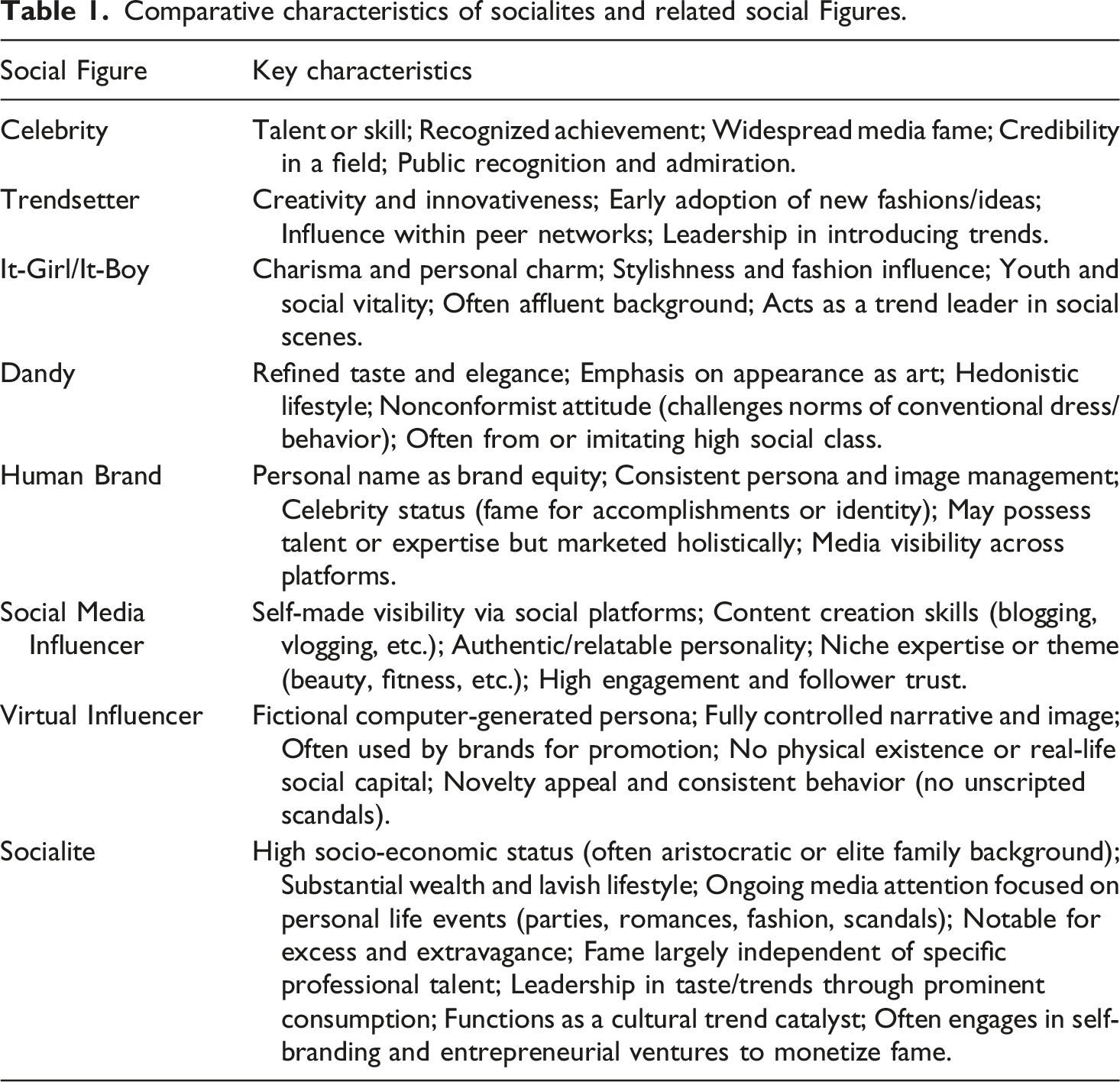
Celebrity
A celebrity, in the traditional sense, is someone widely recognized by the public, usually due to talent and accomplishments in a particular domain – for example, acting, music, sports, or politics (Rojek, 2001). The classic celebrity’s key attributes include some form of exceptional ability or creative talent, media fame, and often public esteem or credibility stemming from their achievements (Gergaud et al., 2012). Celebrities are admired (or at least acknowledged) for what they do (e.g. winning awards, starring in films), whereas socialites are known for what they are (wealthy, well-connected) or what they have done in their personal lives. Celebrities also cultivate media coverage, but their fame is generally considered merited by an audience (e.g., fans of their work). Nevertheless, the line between celebrity and socialite can blur – many socialites eventually leverage their notoriety into business endeavors or media projects, effectively becoming celebrities as socialites. In sum, celebrities are associated with traits like talent, intelligence, and skill, alongside media fame and public recognition; personal charisma or attractiveness may add to their appeal, but the cornerstone remains an underlying achievement or role.
Trendsetter
A trendsetter is an individual who influences others’ preferences – particularly in fashion, style, or other consumption domains – by being among the first to adopt or champion new trends (Saez-Trumper et al., 2012). In consumer research, trendsetters (or opinion leaders) are noted for their innovativeness, creativity, competence, and leadership in taste (Goldsmith and Clark, 2008). They may not be widely famous, sometimes operating in subcultures or niche circles, though when visible in mainstream culture they often overlap with other roles – a famous designer or pop star, for instance, may simultaneously be a trendsetter. Socialites often function as trendsetters in fashion and lifestyle by showcasing novel styles or experiences before others do. The key difference is that a dedicated trendsetter is respected for expertise or foresight in trends, whereas a socialite’s trendsetting is a byproduct of their constant pursuit of the new and lavish. Their exposure to high-fashion and exclusive events positions them among the first adopters, thereby inadvertently setting trends for followers – not through creative competence, but through privileged access and visibility.
It-Girl/It-Boy
The term “It-girl” (and less commonly “It-boy”) refers to a young woman (or man) who gains intense media spotlight by personifying a moment’s ideal of chic and charisma. The term originates from early twentieth-century usage (inspired by Clara Bow’s 1927 film It), implying an ineffable charm or magnetism. It-girls are typically socialites or emerging celebrities who capture public fascination for a period of time, combining charm, attractiveness, youthful energy, fashionable style, and usually wealth or association with privilege. Unlike a conventional celebrity, the it-girl is famous largely for being herself at the right place and time – making her essentially a subset of socialite, usually younger and more fashion-focused. Like trendsetters, they influence style, but with a stronger emphasis on charisma and visibility, sometimes engaging in humanitarian causes (Hopkins, 2018). Contemporary it-girls have evolved into influential arbiters of style, mediating luxury through daily exposure of their tastes and preferences (Abélès, 2022) – a role once dominated by fashion media. Early 2000s figures such as Chloë Sevigny or Olivia Palermo exemplify this profile.
Dandy
Historically, the dandy represents a male analogue to the socialite (Irvin and Brewer, 2013): a man who emphasizes refined appearance, sophisticated language, and leisurely pursuits as forms of self-expression. The archetype dates to figures such as Beau Brummell in the 19th century, who gained prominence in British high society for his impeccable style and wit despite lacking aristocratic status. Dandyism celebrates refinement, hedonism, and nonconformity. A dandy is not simply well-dressed; he transforms personal style into a statement, often challenging conventions while maintaining elegance. Cicolini (2005) identifies contemporary dandies across distinct archetypes, from classic gentlemen to modern bohemians. Today, the figure may include flamboyant style icons or male socialites known for eccentric fashion and pleasure-seeking – such as Lapo Elkann, of the Agnelli family, whose bold aesthetic and extravagant lifestyle exemplify a contemporary dandy-socialite. Although the term is somewhat dated, it highlights that the socialite phenomenon is not gender-specific and has both male and female antecedents. Such figures challenge traditional norms while often indulging in luxury and cultivating a refined personal brand.
Human brand
The concept of human brand refers to individuals – celebrities, business leaders, or even fictional characters – whose identities are strategically managed and marketed as brands (Thomson, 2006). Human brands embody specific traits strongly appealing to target consumers, prompting companies to leverage these desirable attributes for their products or services. Athletes and entertainment celebrities frequently exemplify this concept, but socialites, too, are effective human brands (e.g., Carlson and Donavan, 2013). Indeed, many successful socialites monetize their fame through branded products (fragrances, fashion collections) and brand ambassadorships, carefully cultivating public personas to attract commercial opportunities. A key differentiating factor is the deliberate management of consistency and core values, similar to traditional corporate branding practices. Contemporary socialites, such as the Kardashian family members, illustrate this trend clearly: each has constructed distinct personal brand identities (e.g., trendsetter, entrepreneur, supermodel), building lucrative business empires around them. Thus, while not all human brands are socialites, prominent socialites nearly always operate as effective human brands.
Social media influencer
The rise of social media influencers has added a new category of public persona that overlaps with the socialite but comes from a different origin. Influencers are typically “regular” people turned internet micro-celebrities, gaining fame by creating content on topics like beauty, travel, fitness, or gaming. Enke and Borchers (2021) define them as independent third-party endorsers who shape audience attitudes through blogs, social media, and other channels. Unlike socialites, influencers possess a specific raison d’être for their fame – expertise, entertainment, or inspiration – and their influence is quantified in follower counts and engagement metrics. A key difference is democratization: influencers rarely start with social advantage or elite status, building followings instead through accessible personas and regular content output (Khamis et al., 2017). As influencer culture matures, however, some convergence is observable: many socialites have become influencers, and some influencers begin living in ways similar to socialites. Yet, while both rely on lifestyle exposure, they differ in the origin of their social capital – pre-existing elite status versus content-driven audience building.
Virtual influencer
A virtual influencer is a recent phenomenon made possible by CGI and AI: not a real human, but a digitally created character with a social media presence designed to behave like an influencer. Virtual influencers such as Lil Miquela or Imma have realistic human-like appearances and amass millions of followers despite audiences knowing they are fictional. These virtual personas serve similar marketing roles – endorsing brands, modeling clothes, posting lifestyle updates – but are artificial/fictional personas fully controlled by their creators (often marketing agencies or brands), meaning their image can be perfectly curated with no real scandals or unpredictable behavior. In the context of socialites, virtual influencers present an interesting counterpoint: they attempt to manufacture the same cultural presence that socialites have, but without the vulnerabilities of real humans. Yet part of the socialite’s allure is precisely that they are real people occupying exclusive social spaces – something a virtual character cannot fully replicate (a virtual influencer cannot actually attend an aristocratic gala). Thus, while the virtual influencer market is growing (Huang et al., 2022), the socialite’s unique cachet as a symbol of real high society remains distinct.
Socialite
As Table 1 illustrates, the socialite shares some attributes with each of the figures reviewed, yet their combination makes it a unique construct. Two aspects are especially distinctive: “aristocracy” (elite social standing) and “excessiveness” (a propensity to indulge in and publicize extravagant, sometimes transgressive behavior combined with high media visibility). These set socialites apart from a hard-working content creator (who may lack elite status) or a traditional celebrity (who may have status but is expected to uphold a disciplined public image tied to their profession). We therefore define a socialite as a person from a highly privileged background who becomes well-known through ongoing media exposure of their excessive lifestyle. “Excessiveness” emerges not simply as conspicuous consumption, but as an intensified and continuous performance marked by overflow, hyper-visibility, and the expansion of consumption beyond ordinary limits (Löfgren, 2007). Crucially, a socialite’s renown is driven by their social connections, wealth, and personal life events (often sensational or extravagant), rather than by singular talents or professional achievements. Unlike celebrities, influencers, or trendsetters – whose influence is anchored in specific domains of achievement, expertise, or content production – socialites derive their influence from the continuous performative visibility of their lifestyle as such, where “lifestyle” denotes a structured configuration of social activities (Sobel, 2013). Classic examples include Paris Hilton and Kim Kardashian in their early careers: individuals born into wealth or connected to prominent families, who rose to fame through media coverage of parties, relationships, and fashion choices. Notably, their public image is frequently carefully maintained (sometimes even strategically managed) to maximize media interest – implying a degree of self-branding savvy or entrepreneurial skill in managing their own fame.
Socialites as symbolic intermediaries and market catalysts
Socialites occupy a fascinating role as “symbolic intermediaries” between elite luxury and the mass consumer audience. In Bourdieu’s (1984) terms, they hold substantial social and cultural capital and convert it into symbolic capital through media visibility – i.e., widespread recognition and a sort of “imagined intimacy” with the public. They act as conduits through which the ideals of the upper echelon (fashion, etiquette, lifestyle norms) enter popular culture. In CCT, such individuals can be seen as cultural intermediaries (Arnould and Thompson, 2005; McCracken, 1986), akin to magazine editors or stylists, who help shape the meanings consumers attach to goods and practices. Unlike professional intermediaries, however, socialites lack a formal “job” – their life is their “work,” as routine activities (attending events, vacationing in exclusive locales, wearing couture) become content for public consumption, blurring the lines between the promotional and the personal.
One way to conceptualize the socialite’s effect on consumption is through a catalytic metaphor. We can compare the socialite’s influence to a kind of “enzymatic catalysis” in the market. In chemistry, a catalyst speeds up a reaction without being consumed in the process (Lienhard, 1973). Similarly, a socialite can dramatically accelerate the popularity of a product or trend simply by being associated with it, without “using up” their influence. As social catalysts, their visibility and aspirational status lower the “activation energy” required for trends to spread among consumers who admire them. To extend the metaphor, market catalysts exhibit three key properties: efficiency, specificity, and adaptability. Socialites demonstrate catalytic efficiency through the disproportionate impact each action can have: a single social media post can reach millions and influence purchasing behavior nearly instantly (Lou and Yuan, 2019). In terms of specificity, enzymes catalyze specific reactions on specific substrates; analogously, socialites tend to influence certain domains – most notably fashion, beauty, hospitality, and luxury services – and “bind” particularly well to audiences drawn to those domains. The socialite’s influence is strongest on consumers who identify with or aspire to their lifestyle, and on product categories that symbolically fit it (Berger and Heath, 2007). In terms of adaptability, as enzymes switch from inactivity to activity given the right environment, socialites may extend influence into new domains when circumstances align. For instance, a fashion-oriented socialite might launch a makeup line and quickly become a key player in cosmetics (Yfantidou and Grncarov, 2021). Adaptability also refers to media navigation: socialites may shift from print-media darling to reality TV star to Instagram influencer, maintaining or growing their audience through each transition. This flexibility ensures they remain culturally relevant and continue to catalyze consumer interest across domains.
It is important to emphasize that the power of socialites is primarily symbolic and mediated, not based on technical expertise or formal authority. Socialites are able to influence not because they offer rational arguments or proven product quality, but because they embody a desirable image or narrative that consumers respond to emotionally or aspirationally. This power is contingent on media systems that amplify the socialite’s every move. As Louw (2005) notes, in the modern era, becoming a celebrity requires ongoing media exposure – continuous publicity is the lifeblood of fame. Socialites are perhaps the purest example of this dictum: their celebrity is their media presence. They must remain in the public eye to retain influence, which is why so many socialites actively court media attention (through PR agents, strategic public appearances, or self-exhibition on social platforms). Marshall’s (2010) concept of the “specular economy” – where individuals continuously construct and project images of themselves for consumption by others – applies strongly to socialites. They are engaged in an endless loop of image creation and dissemination, effectively marketing an idealized lifestyle as their product.
The flipside of this mediated power is that it often takes a sensational event to elevate a socialite into the highest tier of fame. Many socialites remain niche figures known only in certain circles until a scandalous incident thrusts them into global consciousness. The cases of Paris Hilton and Kim Kardashian are instructive: both had famous last names, but it was the leak of Hilton’s private videotape in 2003 and Kardashian’s similar scandal in 2007 that turbocharged their celebrity status worldwide (Rowlands, 2014). These controversies, however unwelcome, legitimized their fame by giving mass media a hook to continually cover them (Gamson, 2011; Redmalm, 2014). Such origin stories – a publicized scandal, a reality TV debut, a high-profile feud or romance – serve as a “big bang” moment for a socialite’s stardom, after which their every move can become news. Socialite fame thus rides on the boundary between the acceptable and the transgressive: by defying conventions of privacy or decorum, socialites capture public interest and convert it into an ongoing celebrity career. In sociological terms, they invert the typical status order, turning an initial burst of infamy into a platform for more traditional success.
Researchers have observed that once a socialite’s name is established in the public arena, their endorsements carry significant weight (Agrawal and Kamakura, 1995). When a socialite openly favors a brand or service, it can imbue it with added symbolic meaning, reflecting what McCracken (1986) describes as “meaning transfer” in celebrity endorsement. In the case of socialites, these meanings typically involve luxury, exclusivity, or edgy glamour. Redmalm’s (2014) study of Paris Hilton showed how her actions could render even non-fashion items fashionable, such as the trend of carrying small dogs as accessories. A socialite’s approval can make something “cool,” while their rejection can render it outdated. This aligns with Escalas and Bettman’s (2009) findings on reference groups: consumers often appropriate meanings from admired figures into their identity projects. Those who aspire to a given socialite are likely to consume associated brands to internalize their mystique, whereas those who reject what a socialite represents may actively avoid those brands. In either case, the socialite’s stance creates a symbolic polarization that marketers must carefully manage.
An interesting emerging insight is the role of entrepreneurialism in the socialite’s identity. While earlier generations lived off inherited wealth and made headlines through parties and romances, many 21st-century socialites actively cultivate business endeavors, capitalizing on their own fame (Lam-Lam et al., 2018). Turning oneself into a brand manager is a natural extension of the socialite ethos in a market-driven society. Kim Kardashian exemplifies this trend: she leveraged her following to launch beauty, fragrance, and fashion businesses (e.g., KKW Beauty, SKIMS), reinforcing her image as a savvy businesswoman while remaining a socialite. Others have followed, creating product lines or lending their names to ventures (e.g., Paris Hilton’s fragrance empire). In doing so, they blur the line between consumer icon and market actor, embodying what Hearn (2008) calls entrepreneurial self-commodification. This shift also sustains relevance by creating an institutional footprint beyond personal life, since traditional socialites’ fame fades as media cycles move on. Yet, it can alter public perception, as individuals may increasingly be seen as celebrity entrepreneurs rather than “merely” socialites. The boundary between the two roles remains debatable, underscoring how fluid these identity categories are.
Despite these evolutions, two qualities remain fairly constant for socialites: media attention and public curiosity. Their power is contingent on being in the spotlight – a socialite out of the public eye is essentially retired from influence. The public’s curiosity, while sometimes derided as voyeuristic or frivolous, is a real social force that propels the engine of consumer culture (Turner, 2014). People look to glamorous figures to live out fantasies vicariously or get cues for upward social emulation. Socialites, by living ostensibly enviable lives, tap into aspirations of wealth, beauty, and social freedom, while their occasional missteps provide fodder for schadenfreude, which also drives engagement. This ambivalent relationship – part admiration, part critique – means socialites wield what cultural sociologists call “soft power”: the ability to attract and shape preferences through appeal rather than coercion (Nye, 2006). In sum, socialites serve as potent cultural symbols, encapsulating ideals of luxury and trendiness and acting as “catalysts” for consumption patterns. They differ from other influencers by virtue of their deep roots in social class hierarchies and the extent to which their entire – sometimes sensational – lifestyle, not just curated content, is on media display.
Consumer culture and aspirational consumption
The enduring public fascination with socialites has important implications for consumer culture, beginning with aspirational consumption and continuing through identity construction via status-driven goods. One key manifestation of these dynamics is the reinforcement and evolution of the aspirational gap – the distance between consumers’ real lives and the lavish ideals displayed by socialites. Through extravagant lifestyles, socialites define a desirable life in material terms, including designer goods, exotic travel, exclusive events, and idealized beauty. This fuels consumer aspiration, encouraging individuals to pursue products and experiences that promise a taste of that high life. From a CCT perspective, socialites function as a reference group (Escalas and Bettman, 2009): consumers internalize the symbolic meanings they embody and attempt to bridge the gap through consumption. For instance, purchasing a luxury handbag may reflect not only product quality but the desire to emulate the sophistication and prestige associated with socialites. In this way, socialites help mythologize brands, transforming luxury goods into symbols of a glamorous lifestyle.
This dynamic has a double-edged nature. On one hand, it drives demand for luxury and fashion industries; on the other, it can exacerbate feelings of inadequacy among consumers (Smart, 2018). Socialites contribute to a culture where identity is heavily constructed and signaled through consumption of visible status goods – a process well-documented in consumer culture research (Belk, 1988). Their imagery on social media, often sponsored or strategically staged, blurs advertising and reality, intensifying social comparison. Marketers exploit this deliberately: a perfume ad featuring a socialite implicitly promises the allure of her lifestyle in a bottle. At a broader cultural level, the celebration of socialites suggests that visibility and luxury are prized societal values above merit or contribution, drawing criticism from those concerned with the valorization of “famous for nothing” personas. Yet socialites also exemplify postmodern identity fluidity and entrepreneurial selfhood (Khamis et al., 2017), and public culture oscillates between fascination and moral critique – a tension that itself fuels media narratives and enhances their salience.
The physical attractiveness of many socialites creates a subtle yet influential “halo effect” in consumer settings, elevating the aesthetic atmosphere and positively shaping consumer perceptions (Batres and Shiramizu, 2023). Attractive socialites effectively embody an ideal lifestyle, and their mere presence generates uplifting emotional responses, fostering relaxed and aspirational mindsets among observers. Empirical evidence supports this effect, showing that exposure to attractive individuals – e.g., salespeople or influencers – heightens positive affect and increases consumer openness to premium or status-oriented offerings (Argo et al., 2008). Surrounded by such ambient beauty, consumers become more receptive to aspirational consumption cues; the fashionable attire, luxury brands, and sophisticated behaviors of socialites establish an inviting atmosphere of exclusivity, prompting audiences to indulge in upscale tastes. Further reinforcing this dynamic is the so-called “cheerleader effect,” which suggests that individuals perceive themselves – and are perceived by others – as more appealing when seen within groups of attractive people, thereby strengthening aspirational feelings and encouraging status-oriented consumption (Ying et al., 2019).
Physical attractiveness also endows socialites with implicit authority – often termed “erotic” or “aesthetic capital” (Hakim, 2010) – granting them considerable social leverage. Attractive socialites command subtle deference through the desirability their looks project rather than by explicit demand. Psychological research confirms that attractive individuals receive greater credibility and influence in social groups (Anderson et al., 2001), meaning a glamorous socialite’s preferences can disproportionately shape consumer decisions. Consumers often manage their impressions in response to this aesthetic authority: for instance, shoppers may avoid lower-status items to project sophistication in the presence of an attractive salesperson (Wan & Wyer, 2016). Similar to the “trophy partner” effect, where beauty enhances a partner’s social standing, a socialite’s erotic capital elevates the appeal of associated events and brands, subtly influencing standards of choice. Men, for example, increase conspicuous consumption to impress attractive women (Sundie et al., 2011), illustrating desirability’s power to drive spending.
A final implication is the globalization of taste and norms. Socialites from one country can influence consumers in another, contributing to a homogenized global consumer culture where a wealthy person in Beijing, Dubai, or Lagos may follow the same Instagram-famous socialites from Los Angeles or London. Such diffusion can clash with local cultural or moral norms (Gondola, 1999), sparking debates about tradition versus modernity or modesty versus display. Marketers expanding into emerging markets often leverage globally recognized socialite figures to position luxury products, participating in what CCT theorists might call the symbolic hegemony of Western lifestyle ideals (Askegaard and Linnet, 2011), raising questions about cultural authenticity worldwide. Socialites also deepen understanding of how mythic narratives form in the marketplace: their story arcs – the rebellious heiress, the reinvented entrepreneur, the socialite turned philanthropist – resonate with themes of transformation, excess, and redemption, attaching to brands. Thus, socialites become potent meaning generators that continually refresh the symbolic universe consumers navigate.
Strategic use in branding and marketing communications
From a marketing management and public relations perspective, socialites offer both opportunities and challenges. Brands, especially in luxury, fashion, hospitality, and beauty sectors, often seek association with socialites as a form of image transfer. Unlike formal celebrity endorsements, socialite associations can be subtler and organic – gifting a product hoping they will be photographed with it, or inviting them to high-profile events so that media coverage doubles as brand exposure. Fashion houses have long provided gowns to socialites for galas covered by Vogue and society magazines, effectively turning them into walking endorsements. In the age of social media, these strategies have become more direct: brands engage socialites in influencer marketing campaigns; for instance, luxury resorts may offer complimentary stays in exchange for posts reaching large audiences. Compared to unknown influencers, socialites bring cross-channel visibility and an established aura of luxury, often generating additional press coverage that reinforces a brand’s high-status positioning.
However, the strategic use of socialites is not without risks. One risk is the volatility of their public image. Socialites are, by their nature, sometimes involved in scandals or controversies (indeed it fuels their fame). If a brand becomes too closely tied to a socialite who then faces a public relations crisis, the brand can experience negative spillover. A notorious example was the brand endorsements of certain hotel or alcohol brands by socialites who later had very public incidents (like arrests or outrageous behavior) – companies had to distance themselves to avoid tarnishing their image. Unlike scripted celebrities who often have media training and a team of handlers, socialites might be more unpredictable. Marketers thus must weigh the authentic glamour a socialite can provide against the reputational risks of their unpredictability.
Another consideration is fit and authenticity. As with any endorsement, the socialite’s image should align with the brand’s identity for the partnership to feel authentic (Fleck et al., 2012). A heritage luxury brand centered on understated elegance may be harmed by association with a flamboyant, controversial socialite, potentially alienating core customers, whereas an edgy designer or nightlife-oriented brand may benefit from a rule-breaking figure. Marketers often segment socialites: some embody “classy,” traditional refinement, while others are more “rock-n-roll” or edgy, each suited to different brand messages. Despite the rise of virtual influencers – controlled and risk-free personas (Huang et al., 2022) – the real-life presence and genuine social cachet of human socialites remain particularly valuable, especially in experiential marketing and luxury PR activities.
From a public relations angle, socialites can be powerful allies in publicity campaigns beyond pure product promotion. Charities invite them to fundraisers counting on their presence in public causes to attract media coverage and wealthy donors – though this is often symbiotic, as philanthropic activities also polish the socialite’s own image. This underscores that socialites are a form of “social capital in motion”: their attendance or endorsement is a currency organizations actively seek. Celebrity endorsement literature shows that congruence between endorser and brand, and consumer identification with the endorser, are critical factors (Till and Busler, 2000). For socialites, congruence tends to be high for luxury and fashion brands, but direct consumer identification may be lower given their limited relatability. Yet aspirational identification – wanting to be like them – compensates, helping marketers determine when a socialite is the right fit.
Finally, for consumer well-being and ethics, marketers should be aware of the messages being reinforced. The strategic use of socialites undeniably glorifies extreme wealth – and sometimes frivolity – may contribute to materialistic value orientations. Marketers should navigate this carefully by highlighting the more positive sides of socialites – their creativity, philanthropy, or entrepreneurship – rather than only glamorizing unattainable lifestyles (Nickel and Eikenberry, 2009). In recent years, some brands have shifted toward more diverse and inclusive representations in response to societal calls for authenticity and social responsibility. The era of exclusively valorizing the jet-setting socialite stereotype is giving way to figures who champion social causes. This doesn’t render socialites obsolete, but means they too are adapting – many now brand themselves as multi-faceted founders or activists. The key implication is that socialite partnerships must feel authentic, not merely transactional.
Conclusions and future research
A socio-marketing analysis of the concept of socialites and its consumer culture implications.
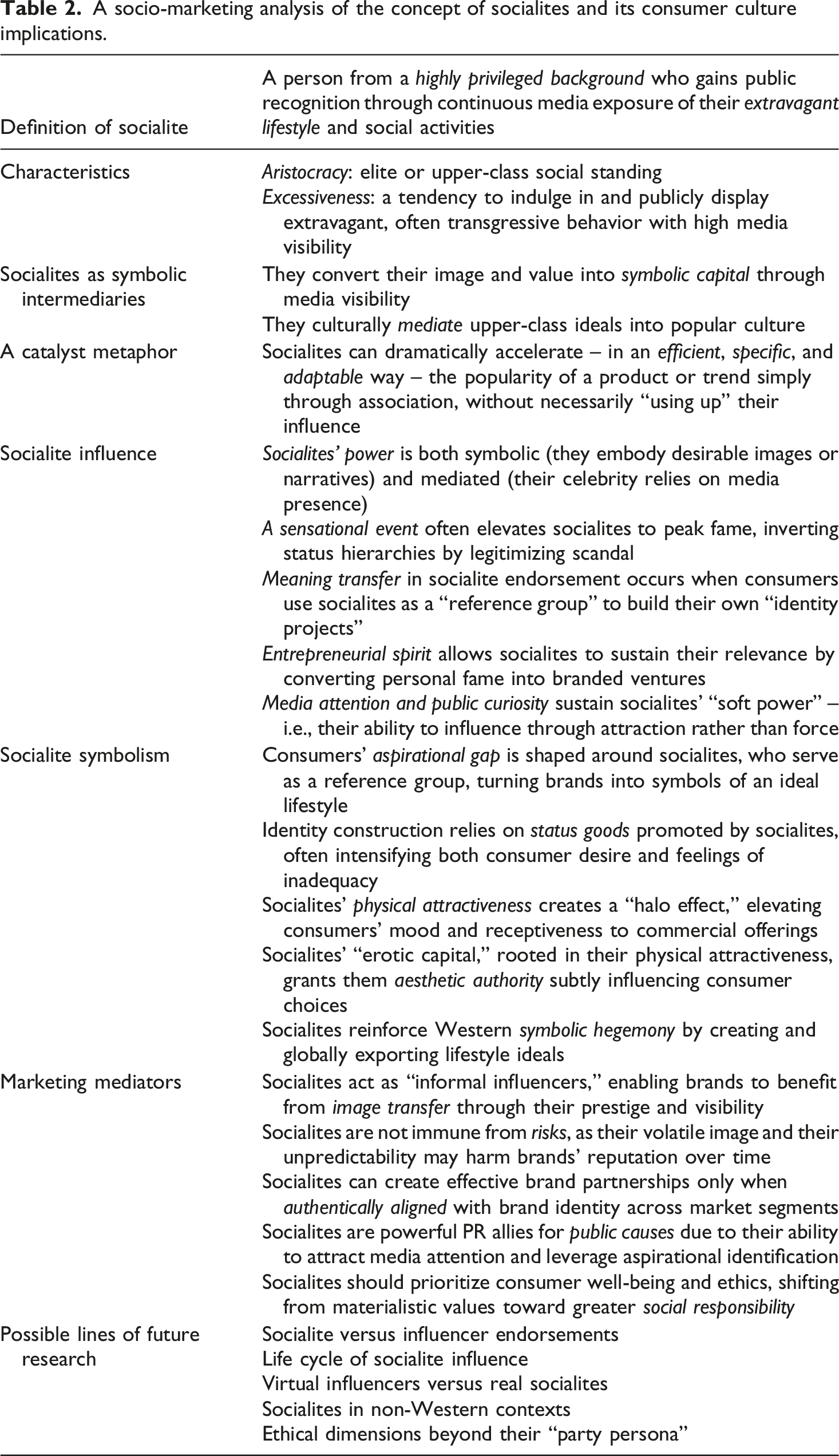
Several avenues for future research emerge from this work. First, empirical research can further explore consumer perceptions of socialite versus influencer endorsements. Do audiences trust socialites as opinion leaders, or do they simply admire them from afar? Qualitative studies might investigate how different consumer segments (e.g., young women vs older women, or consumers in different cultures) internalize or reject the influence of socialites on their consumption choices and lifestyle expectations. Ethnographic work could shed light on how fans follow and mimic socialites in their daily consumption (from fashion choices to leisure activities), illuminating the micro-processes of aspirational imitation. Second, there is room to study the life cycle of socialite influence. Do socialites have a shorter “peak relevance” period than traditional celebrities or influencers? With media being so fast-paced, perhaps socialites must constantly reinvent themselves to avoid fatigue in the public eye. A longitudinal analysis of media mentions and public sentiment for prominent socialites could map how their influence waxes and wanes, and what factors (scandals, marriage, new ventures) trigger those changes. Third, as the digital environment evolves, research could examine the interplay between virtual influencers and real socialites. Could virtual avatars eventually replace the need for human socialites in some aspirational marketing contexts, or will the human element remain indispensable for relatability and true prestige? A comparative study on engagement metrics and brand impact of campaigns featuring socialites versus virtual influencers would be instructive.
Fourth, future research could analyze socialites in non-Western contexts. While our discussion included a global view, literature and examples remain largely Western-centric. Many emerging markets have local socialites – Bollywood star kids in India, K-pop figures in Korea, aristocrats or “princelings” in various countries – who play similar roles. Investigating how they operate within their cultural norms, and how global and local socialite images intersect or conflict, would extend understanding in a multicultural perspective. It could also address whether the socialite construct is universal or takes on different nuances across societies, where status may derive from lineage, political connections, or other culturally specific sources. Fifth, future research could delve deeper into the ethical dimensions of the socialite phenomenon, integrating sociological and feminist perspectives. On one hand, critical scholarship could examine how socialites contribute to the reproduction of class privilege, the promotion of wasteful consumption, the perpetuation of unrealistic beauty and lifestyle standards, and broader processes of neoliberal self-branding, the commodification of private life, and the reproduction of social inequality. On the other hand, empirical work – through interviews or memoir analyses – could explore how socialites themselves navigate the tension between self-indulgence and societal expectation, including public backlash and authenticity challenges in the era of digital transparency, the reinforcement of materialistic values, and the commodification of personal identity.
In closing, socialites reveal something telling about consumer culture: that visibility itself has become a form of capital, and that the line between living and marketing has all but dissolved. Examining this figure seriously is looking into the mirror that consumer society holds up to itself.
Footnotes

Funding
The authors received no financial support for the research, authorship, and/or publication of this article.
Declaration of conflicting interests
The authors declared no potential conflicts of interest with respect to the research, authorship, and/or publication of this article.
Data Availability Statement
Available upon request.