






Abstract
This study explores the history of the Red Gate Student Consumer Cooperative at Tokyo Imperial University, an elite university in Japan, to consider its accomplishment and limitation as redistribution machine. While its elite founders successfully provided commodities inexpensively to its members, its staff were exposed to the potential exploitation for its competitive edge in prices and small-sized shops in the neighborhood were endangered as they could not compete with it. Based on this case study, I seek to explore the social basis for elite consumers’ challenges to the market and the inherent limitation of a market-based institution for economic redistribution.
Keywords
Introduction
In 1926, a student of Tokyo Imperial University (Tōdai) noted “It’s the era of money, money, and money. Unless we attend university, we cannot earn high status or salary. But if we do not have money, we cannot attend university.” (Teikoku daigaku shinbunsha, 1926:59) Since the late nineteenth century when higher education became a part of elite formation process, beneficiaries of higher education were exposed to economic pressure. Students at Tōdai, Japan’s oldest and the most privileged university which admitted only men until 1945, were not exceptions. They had to pay tuition fees; purchase books, suits, hats, and shoes; go to hairdressers; and fit themselves for glasses, if necessary. Additionally, they had to settle in the city where their schools were located and take photographs to apply for jobs. Metaphorically speaking, they were consumers of expensive campus life.
But, elite students at Tōdai were not docile consumers who easily opened their wallets for university authorities and merchants in the neighborhood. Students at interwar Tōdai created welfare programs for themselves, which, according to Welfare Facilities for Students edited in 1935 by officials of the Thought Bureau (shisōkyoku) of the Ministry of Education, included a Red Gate Student Consumer Cooperative (akamon gakusei shōhi kumiai, RSC), which sold students their necessities cheaply. (Monbushō shisōkyoku, 1935: 13)
Consumer cooperatives, including the RSC, were organizations that sought to buy necessities cheaply through collective purchases. Collective purchase existed in Tokugawa Japan (1600-1868), but it was usually farmers and merchants who organized it for their business (Najita, 2009). In contrast, consumer cooperatives were organized by consumers, who sought to bypass retailers. The first of this kind, the Rochdale Society of Equitable Pioneers, appeared in Britain in 1844, and in the ensuing ten years, one thousand cooperatives emerged in Britain alone and swiftly spread worldwide. Members of the cooperative invest a small amount of money in the cooperative and shop for their necessities at the cooperative’s stores cheaply or receive dividends. In other words, RSC reveals that elite students at Tōdai challenged merchants in the neighborhood to save expenses by uniting with fellow students, rather than simply submitting to the market.
How did these elite students jump into the market for their welfare, and how effective was the enterprise for economic redistribution? This study seeks to answer this question through the lens of the RSC. Tōdai students established the RSC in 1928 as the Tōdai branch of the Tokyo Student Consumer Cooperative (tōkyō gakusei shōhi kumiai, 1926-1940, TSCC), a consortium of consumer cooperatives at higher educational institutions in Tokyo. The RSC was advantaged in attracting members, as it was based at Tōdai, whose students were usually from wealthy families, and had more than 1000 members in most of the time it operated. The enthusiasm of RSC staff, who were mostly student radicals at Tōdai, was enough to have them work without payment. In addition, the RSC could benefit from consumer cooperative activists and scholars whose networks allow RSC managers to run factories that produce suits and receive subsidies from the state. This study seeks to address how this enterprise was effective in checking the absolute overpricing of merchants in its initial stage and in saving students’ costs based on its competitive edge. However, at the same time, I will show the limits of their welfare enterprise that operated in the market—their enterprise was the product of the privileged networks and the sacrifice of elite students, and their challenge drove small-sized merchants in the neighborhood to danger.
Liberal activists of consumer cooperatives led research on consumer cooperatives in pre-1945 Japan, and they understood consumer cooperatives as part of radical or civil social movements against the suppressive state or exploitative business leaders. The main stories are the suppression of the state on heroic consumer cooperative activists and their struggle to check the profits of large businesses through civic or leftwing consumer cooperatives. (Gendai Nihon seikyō undōshi. Nihon seikatsu kyōdōkumiai rengōkai, 2002; Kurimoto, 2017; Okutani, 1948; Saitō, 2023; Yamamoto, 1982). The only research on the TSCC so far conducted by Mukōyama Hiroo, an erstwhile student participant of the RSC, follows this suit. In this book, Mukōyama analyzed how the TSCC operated as a wing of the “biggest student radical movements in pre-1945 Japan,” despite the hostility of police and university authorities, which suppressed and eventually dissolved the RSC in 1940 for the radicalism of its members (Mukōyama, 1984: 525). These researchers-cum-activists envisioned a consumer cooperative distinguished from the charity-type cooperatives for the employees created by their employers, namely, the government or businessmen, and considered how to contribute to the ascent of the social standing of citizens and workers. This is undoubtedly a meaningful concern, but this line of research has hardly thoroughly considered how effective consumer cooperatives were for economic redistribution (Yamamoto, 1982: 343-9; Hayashi, 2023). This article tackles this question through the lens of a radical consumer cooperative at an elite higher educational institution in pre-1945 Japan.
Consumers who challenge the market have rarely been the topic of consumer culture historians in modern Japan. This topic allowed researchers to consider the cultural integration of Japanese society beyond the Marxist framework assuming a confrontation between labor and business. During the postwar economic prosperity (1955-1991) and after the bubble burst (1991), historians of Japanese consumers explored how an absolute majority of the Japanese population came to share lifestyles through the dissemination of commodities and services despite lingering inequalities (Culver, 2024; Franks, 2009; Garon, 2012; Gordon, 2013; Jones, 2010; Minami, 1987; Murakami, 1987; Partner, 2000; Sand, 2003; Young, 1999). By so doing, they explained the birth and diffusion of cultural practices linked to the category of a middle class, and in turn, the middle-class category came to incorporate virtually everyone in Japan. However, most researchers have focused on Japanese entrepreneurs who sought to fabricate consumers, and largely failed to address consumers as challengers to the market. Consumers did not always submit to the market, but sometimes created businesses themselves to save expenses. And the number of consumer-businessmen is not small. In 2025, 897 consumer cooperatives in Japan embraced more than 69 million members, and their sales reached 3 trillion yen. (Kōseirōdōshō, 2025: 1-3). In other words, this scholarly lacuna fails to address not only an important part of Japanese consumer culture, but also the accomplishment and limitations of these consumers.
The RSC is a useful prism to fill this gap. First, it was a consumer cooperative of elite students, revealing how elite status helped them organize a cooperative to challenge the market. Second, among the elite consumer cooperatives of the TSCC, the RSC was the largest branch and survived relatively long despite ideological confrontations with university authorities. This difference allows the historian to consider the accomplishments and side effects of elite consumer cooperatives beneath the ideological confrontation with the state. The abundance of primary sources also merits this study. Radical activists at the RSC worked anonymously, probably to avoid the antipathy of police authorities against the left, and hardly left written documents to trace their individual activities. Nonetheless, Imperial University News, Tōdai’s newspaper, contains a sizable amount of information about RSC activities. Also, after 1945, some RSC activists published individual memoirs. Using these materials, I seek to explore elite consumers’ challenges to the market and the social basis for their challenges, as well as the inherent limit of their enterprise as a redistribution machine in the market, without transferring income.
Elite networks and the making of the RSC
The RSC represents three trends in the history of Japanese consumer cooperatives. First, the elites found it easier to create and lead consumer cooperatives. As consumer cooperatives are business enterprises, and elites with wealth and networks find it easier to create and manage them. Many members of Japan’s first consumer cooperative were the business elite who sought to purchase expensive commodities. For instance, Hayashi Yuteki, a leading member of Kyōritsu Shōsha (Business corporation established collectively) established in 1879, would be an entrepreneur founding Maruzen later, sought to purchase then-expensive rice by investing a significant money. Members of Kyōritsu Shōsha invested 25 yen in 1879, when a bowl of noodle soap was 0.01 yen. In other words, joining consumer cooperatives without sizable disposable assets was difficult (Yamamoto, 1982: 6-17). Also, because of the foreign origin of consumer cooperatives, intellectuals with access to information about overseas development could better emulate these enterprises. Many Tōdai students were from wealthy families, and, in the interwar period, some Tōdai professors conducted research on consumer cooperatives or participated in consumer cooperatives. In this sense, the RSC is no exception to Japanese consumer cooperatives, usually led by elites with wealth and information.
Second, the cooperative gradually expanded its membership to include non-elite members and functioned as a welfare enterprise for their members. The first consumer cooperative functioned as a welfare enterprise was the Kyōdōkai (Cooperative Society) established in 1901. Its founder Tokuta Tomezō, who was a staff member of the House of Representative, organized 20 fellow workers to save the cost of living, became a sizable organization having more than 500 members by 1903 (Okutani, 1948: 92-104; Yamamoto, 1982: 99-103). And the Japanese government patronized these consumer cooperatives. Ministry of Agriculture and Commerce officials created the Industrial Cooperative Law in 1900 to promote cooperative organization for farmers’ finance, but urban consumer cooperatives were also the beneficiaries of this law, by being acknowledged and subsidized by the national organization of the industrial cooperatives, the Industrial Cooperative Central Association (sangyō kumiai chūōkai). The Kyōdōkai was acknowledged by the Industrial Cooperative Central Association in 1904 as the consumer cooperative “of those working at state agencies.” (Yamamoto, 1982: 95-7) Inspired by Kyōdōkai, Japanese citizens of government officials, teachers, soldiers organized many consumer cooperatives. Also, some government agencies, such as the Railroad Institute, ran stores for their employees, selling necessities cheaply after charging 3% of their wages. In other words, consumer cooperatives have become a part of the workers’ welfare system. By 1925, employers in Japan established 18 cooperative stores for workers in mines and factories. (Sangyōkumiai chūōkai, 1925: 2) The RSC was also a welfare enterprise for its members, that is the elite students who wanted save costs while at Tōdai.
Alongside the two aforementioned trends, the RSC represented another trend of consumer cooperative history in modern Japan, that is, consumer cooperatives surfaced as radical social activism. As consumer cooperatives were a type of business in which many small investors gathered to create an enterprise and check other businesses for excessive profits, radical activists found this business type useful when they sought to fight big businesses and the state. In the interwar period, Tōdai surfaced as a foothold of student radicals challenging the state, who, in their eyes, did not seem trying to solve the widening economic gap. Student radicals led the establishment of the RSC, which created an intersection between student radicalism and elite consumer cooperative activism.
The Shinjinkai, a radical student organization established in 1918, assumed a leading role in the creation of the RSC. According to Kikukawa Tadao, Shinjinkai members sought to build a student welfare institution to imbricate “proletarian class consciousness within the minds of petit-bourgeois students.” (Kikukawa, 1947: 249) In short, these radicals imported the goals of labor activism to the Tōdai campus. As non-radical students and professors supported the establishment of student welfare after the Great Kantō Earthquake in 1923, Shinjinkai leaders who were student representatives of the Student Association (gakuyūkai) at Tōdai started to run a student dining hall and stores (Smith, 1972). Shinjinkai radicals also envisioned opening a consumer cooperative and pledged the establishment of a consumer cooperative during the student representative election campaign at Tōdai in 1926.
However, Shinjinkai members were not the only ones to envision a consumer cooperative. In the 1920s, professor of law at Tōdai Yoshino Sakuzō was the president of the Home Purchase Cooperative, one of the biggest consumer cooperatives in modern Japan. And Yoshino helped Tōdai radicals’ welfare projects. When Student Association leaders such as Kikukawa Tadao ran a student dining hall, they could rely on the managers of “a consumer cooperative located at the Oiwake Youth Center,” that is the Home Purchase Cooperative located at the building of the Tōdai YMCA led by Yoshino, to procure food ingredients cheaply. (“Shuho mo dekiru shinshokudō,” 1923) Hon’iden Yoshio, Faculty of Economics professor at Tōdai, was a researcher on consumer cooperatives, publishing Consumer Cooperative Activism as his PhD dissertation, invited students interested in consumer cooperatives and had some of his students leading the organization of the RSC (Hon’iden, 1931; “Shōhi kumiai wo gakuyūkai no ichibu ni”, 1928).
In addition, other university students in Tokyo were interested in consumer cooperatives, and by April 1926, Waseda University had already shaped the Tokyo Student Consumer Cooperative (TSCC). The origin of the TSCC can be traced to a small cooperative organized by Social Enterprise Research Group members at Waseda. One of its founders proposed developing the organization into a Waseda consumer cooperative, and Dean of Waseda’s Faculty of Politics and Economics, Abe Isoo, and Christian social activist and bestseller writer Kagawa Toyohiko responded by actualizing his vision. Kagawa became the president of the TSCC and donated 1000 yen to the fledgling TSCC (Mukōyama, 1984:76). Kagawa distanced himself from radicalism but devoted himself to social enterprises to fill the gap between the poor and the rich, and enjoyed a favorable reputation among government officials. (Monbushō gakuseibu, 1931:29-31) His TSCC created the articles (teikan) and was acknowledged by the Ministry of Agriculture and Commerce in November 1926. Kagawa’s reputation helped TSCC managers because his networks enabled the TSCC to receive a low-interest loans from the Industrial Cooperative Central Association. By November 1932, the TSCC received a loan of 4500 loan from the Industrial Cooperative Central Association. (Sangyōkumiai chūōkai, 1932:153)
Leaders of this cooperative defined the purpose of the TSCC as “selling its members necessary commodities for studying and livelihood.” (Article #1). (Yūgensekinin kōbaikumiai Tōkyō gakusei shōhi kumiai, 1934) The commodities they sold included clothes, books, stationery, haberdashery (komamono), umbrella, furniture, shoes, and patent medicines. (Article #43) They defined their membership as students in secondary schools or higher in Tokyo (Article #5-6). Members were supposed to invest one yen in the TSCC when they joined at once (Article #12-13). The TSCC challenged adjacent merchants with lower prices. The author of the articles articulated that the prices of the commodities the TSCC sold “were determined by the TSCC directors below the level of the market prices” (Article #45), and the profit was allotted to its members in proportion of the purchases they made at the store. (Article #49) In other words, Tōdai radicals were surrounded by many consumer cooperative activists and their organizations challenging the merchants in the neighborhood.
In February 1928, which was after the radicals’ victory in the Student Representative Election at Tōdai, newly elected student representatives initiated to establish a consumer cooperative as a department of the Student Association, by putting together a preliminary committee to organize what would be the RSC. In this committee, Honiden’s students Kaku Kōichirō and Yamaguchi Susumu joined Shinjinkai radical Kuniya Yōzō, and managed to create a preliminary store at the Student Association Room in 1928. (“Shōhi kumiai wo gakuyūkai no ichibu ni”, 1928)
But, the consumer cooperative of the Student Association at Tōdai did not come fruition due to the ideological conflicts among Tōdai students. Conservative students from sports clubs were not happy with the Shinjinkai radicals’ ascent, and after the Student Representative election campaign in 1928, sports clubs dissociated from the Student Association at Tōdai. Following the Sports Clubs’ departure, students at the Faculties of Medicine, Engineering, and Agriculture decided not to join the Student Association, and the Student Association at Tōdai ceased to exist. After the fall of the Student Association, the Student Office approved the Sports Clubs as the financially subsidized students’ organizations at Tōdai, but did not do so for the consumer cooperative in order to limit the activities of student radicals within it (Smith, 1972).
However, Tōdai students could still launch their consumer cooperative by embracing Kagawa Toyohiko’s network. In November 7, 1928, Kaku Kōichirō and Kuniya Yōzō created the Red Gate Student Consumer Cooperative (RSC) and joined the Tokyo Student Consumer Cooperative as its Tōdai branch. The inauguration coincided with the eleventh anniversary of the Russian Revolution, though the RSC’s leaders did not explain the choice of date. The RSC’s store was in the backstreet across the main gate at Tōdai. Hon’iden Yoshio published an article in Imperial University News with the hope for the prosperity of the cooperative. He emphasized the cooperative’s expected role in protecting impoverished students and hoped that the cooperative would not lose its sincerity in management under the influence of radicals (Hon’iden, 1928:2). Shinjinkai radicals, such as Kuniya, did not mind joining Kagawa and Hon’iden’s students, who were not Marxists. In other words, their elite networks could bypass Student Office officials’ hostility toward student radicals.
The student welfare project on the market
When the RSC leaders opened the RSC store in November 1928, the prices of suits, coats, and shoes at the store were roughly 20% lower than those of other shops in the neighborhood. For instance, according to the Imperial University News, the RSC store sold a pair of shoes at 9 yen 40 sen, while other merchants’ shoes were priced at 11 yen 50 sen; the price of a winter coat was 34 yen at the RSC store and 46 yen at other shops. The RSC price of the suit was 36 yen, while other merchants sold at 48 yen (Hon’iden, 1928:2). In 1929, the RSC distributed suit, spring coat, shoes, and added lecture notes for courses at Tōdai, while starting a laundry service. The RSC membership increased steadily from 400 in March 1929 to 1928 by the end of 1931. The membership further increased to 2326 in 1932, 2336 in 1933, 2448 in 1934, 2833 in 1935 (Mukōyama, 1984: 318).
The RSC’s price competitiveness was largely due to managers’ efforts to lower prices. Since the establishment of the TSCC, its managers have run a factory to produce clothes, hats, and shoes to provide these commodities cheaply. (Yūgensekinin kōbaikumiai Tōkyō gakusei shōhi kumiai, 1934: Article #43) The TSCC’s factory produced the Tōdai uniform, spring and winter coat, as well as suit, and the prices of these items were lower than other merchants by roughly 20% until 1936. (Tōkyō gakusei shōhi kumiai akamonshibu toshobu, 1935:91) Even if they did not establish factories, the RSC could hire service providers to lower the prices of certain services. For instance, in 1932, the RSC established a photographs section (shashinbu) to provide students with photographs for identification cards. While the on-campus photograph studio charged 60 sen for the service, the RSC photographer received only 25 sen. (Tōkyō gakusei shōhi kumiai akamonshibu toshobu, 1935: 87) The RSC could even penetrate into the distribution system of new books, and discounted books by 10% beginning in 1934. (“Nigiyaka ni Hongō Tōri e”, 1934; “Omote Tōri banzai”, 1934; Mukōyama, 1984: 246-247, 318-319, 476)
Being a member of a larger business entity also helped RSC members enjoy economies of scale. In 1934, according to RSC student leader Endō Sei, TSCC managers staffed a full-time supervisor for each branch. The supervisor bridged the TSCC’s headquarters and branches, as the headquarters purchased books, suits, stationaries, and shoes en bloc and distributed them to each branch. The TSCC managers were uniform and accounted for all TSCC branches (Endō, 1979: 3-4.).
Organizing a sharing economy is another tactic used by RSC leaders to lower prices. Books and lecture notes were the most successful items in this regard. During the mid-1920s, lecture notes were precious resources for Tōdai students who had to pass examinations for courses. According to the Imperial University News, Tōdai students could even borrow money from pawn shops by letting the lecture notes of the courses they took when they had to pay after drinking beer. (Teikoku daigaku shinbunsha, 1926:68-69) According to the explanation of RSC leaders, print shops in front of Tōdai, mindful of the value of lecture notes for students, sold the notes at an “unconscionably high price (hōgai na kōgaku),” even though the quality of those lecture notes were not necessarily reliable. (Yūgen sekinin kōbai kumiai tōkyō gakusei shōhikumiai akamon shibu, 1934:8) RSC leaders sought to challenge this situation. In January 1929, RSC leaders envisioned selling lecture notes for courses at Tōdai, probably by contracting a print shop at a price 10% cheaper than other print shops (“Printo kara seiyō sentaku”, 1929) although this effort could not cover more than several courses and did not last. In 1934, the RSC initiated the similar efforts to distribute lecture notes by 10% cheaply. (“Gakushō no shinshutsu”, 1934) In 1936, the RSC managed to lower the price even further by organizing an Imperial University Lecture Notes League (teidai purinto renmei) along with a print-shop and note-provider students, providing lecture notes of almost all courses of the Faculties of Arts, Economics, and Law. (Tōkyō gakusei shōhi kumiai akamonshibu toshobu, 1936: 93)
In September 1935, RSC leaders established a used-book section (furuhonbu) that purchased and sold used books. Unlike the lecture note business, the RSC leaders did not have to outsource photocopying technology for used book sales. Rather, they simply purchase used books 15% more expensively and sold them 15% more cheaply than other merchants, according to an advertisement (Yūgensekinin kōbaikumiai Tōkyō gakusei shōhi kumiai akamon shibu, 1935:90).
The zeal of the RSC staff members to work without pay also contributed to the RSC’s competitive edge over adjacent merchants. According to the articles of the TSCC, the president (kumiaichō), eight executives (riji), and three inspectors (kanji) were honorary positions (meiyoshoku). The only exception was the executive director (senmu riji), who was chosen from among the eight executives and the only one who could receive a salary. (Yūgensekinin kōbaikumiai Tōkyō gakusei shōhi kumiai, 1934: Article #21) At the branch level, there were the leaders (sōdai), who were often called student staff (gakusei i’in). According to the articles, they were elected among the members. If the number of members was less than 200, the branch was assumed to have five staff members. If the number of members was more than 200 but fewer than 1,000, the number of leaders was assumed to be six. If the number of members was more than 1000 but fewer than 2,000, the branch could have seven leaders. (Yūgensekinin kōbaikumiai Tōkyō gakusei shōhi kumiai, 1934: Article #23) These staff members participated in the decision making process at the TSCC Leaders’ Meeting (sōdaikai) and seemed to have worked as managers and clerks of the branch stores. Like other members in honorary positions at the TSCC, the student staff members worked freely. (Yūgensekinin kōbaikumiai Tōkyō gakusei shōhi kumiai akamon shibu, 1934:4) In other words, the RSC was a store whose clerks did not receive pay.
The RSC’s competitive edge in price restrained on-campus merchants from taking too much profit with their commodities and services. When the RSC photographer started the service receiving only 25 sen in 1932, the existing on-campus photograph studio lowered the price from 60 sen to 30 sen. (Tōkyō gakusei shōhi kumiai akamonshibu toshobu, 1935:87) When the RSC managers initiated the 10% discount for the photocopies of the lecture notes in 1934, bookstores on the Hongō Street who sold them lowered the price by 10%. According to the estimation of RSC staff, all Tōdai students spent 20,000 yen for purchasing photocopied lecture notes from the bookstores, meaning the RSC saved 2000 yen for the elite students in pursuit of passing the final examinations. (Tōkyō gakusei shōhi kumiai akamonshibu toshobu, 1935:87)
Radicals at the RSC were eager to challenge school authorities directly through demonstrations. Since 1924, the Student Association at Tōdai had managed the dining halls and on-campus stores until its dissolution in 1928. After the demise of the Student Association, Tōdai professors and students organized a Mutual Aid Enterprise Committee (kyōsai jigyō iinkai) to continue the services. However, as the First Store (daiichi kōbaibu) managed by the committee marked a huge deficit, Tōdai’s Student Office (gakuseika) officials excluded students from the management of the enterprises and organized a Mutual Aid Section (kyōsai kakari) to supervise the enterprises in April 1929. In doing so, the Student Office allowed private companies such as Shirokiya to manage and supervise dining halls and stores on campus. In sum, not only did students lose management of on-campus dining halls and stores, but they could also not supervise the management of those enterprises. RSC leaders published a statement to blame the Student Office for “excluding students from the mutual aid enterprises” and “destroying student autonomy.” In the RSC leaders’ eyes, the decision of the Student Office in April 1929 “sold student interests to licensed merchants (goyōshōnin)” and “destroyed student autonomy.” (“Shinkyōsaibu no seitan ni tsuite”, 1929)
After the dissolution of the Student Association at Tōdai in 1928, student radicals organized an Autonomous Student Association (jichi gakuseikai) and demanded the revival of the pre-1928 pan-campus student association, and RSC leaders supported this activism. Radicals at the RSC organized student rallies with Autonomous Student Association activists. For instance, on May 24, 1930, student radicals at the Faculty of Law at Tōdai organized a student rally to demand the reinstatement of the student association and the discount of the fees to join the Green Society (midorikai), a student association of the Faculty of Law. Soon after, RSC leaders and Green Society activists targeted Shirokiya, a service provider in the Student Dining Hall, whose food, according to research by RSC activists, was expensive and unhygienic. In June 1930, the RSC and Green Society radicals organized another student rally to demand the expulsion of Shirokiya and the RSC’s management of the Student Dining Hall. (“Midorikai no sasshinpa gakuseika e”, 1930; “Midorikai no zeniin”, 1931; “Bunbōgurui wa kumiai ga motto mo yasui”, 1930; “Shokudō keiei”, 1931) Although Student Office officials punished some RSC and Green Society leaders, as the rallies were not approved in advance, the fees for joining the Green Society and the prices of food at Shirokiya’s Dining Hall decreased. In 1930, the fees for joining Green Society decreased from six to five yen. Shirokiya lowered its prices twice in 1930. Of course, it is difficult to determine whether the Faculty of Law and Shirokiya lowered the price due to the pressure from radicals, but it is undeniable that the RSC represented the most militant voice among students about campus expenses. Between 1929 and 1934, students average expense for food went down from 22.23 yen to 16.57 yen per month. (Daiichi shokudō ga futatabi sanshoku zenbu nesage: Asa jūsen, hiru jūgosen, yū nijūsen ni raishun hayabaya kara jisshi, 1930, Gakunai no kaku baiten ga heikin ichiwari wo nesage: kinshuku nesage jidai wo han’eishite jihatsuteki ni mōshidasu, 1930, Tasū kaiin no yōbō de midorikai kaihi goen ni: Iinkai de nesage ni kettei, 1930, Tōkyō teikoku daigaku gakuseika, 1935; TDS 1930: 12).
How much did the RSC save on student expenses at Tōdai? Its financial impact cannot be exaggerated, but far from insignificant. For instance, in 1936, the RSC had 2112 members and its sales reached 47,000 yen, meaning that each member spent an average of roughly 23 yen. Excluding the tuition fees, between 1934 and 1938, each Tōdai spent roughly 500 yen per year for his campus life. (Tōkyō teikoku daigaku gakuseika, 1935:42; Tōkyō teikoku daigaku gakuseika, 1939:34) If a member purchased commodities 20% more cheaply at the RSC store, the RSC helped each member save 4.6 yen, which is slightly less than 100 U.S dollars today. In other words, the RSC helped a student with roughly one percent of his expenses, excluding tuition fees. In 1936, 4.6 yen was sufficient for weekly meals, although it might not have liberated students with modest familial backgrounds from their part-time jobs. This amount did not include the RSC’s intangible impact, such as the discount of meals at dining halls and the potential benefits that RSC members could reap if they wanted to. In other words, the RSC gave its members the choice to save a modest but not insignificant amount of money.
The limitations and side-effects
Notwithstanding its impressive accomplishments, the RSC as an enterprise for welfare had an array of limitations and side effects derived from the fact that the RSC was a business corporation operating in the market. Consumer cooperative activists sought to procure a competitive edge in price, but there was no way to guarantee that the RSC would outperform its competitors. The pressure for a competitive edge in price often forced not-quite-rich participants to receive insufficient salaries. Furthermore, their challenge to adjacent merchants often endangered their survival, which created another social problem looming today: the financial crisis of small shop owners.
The RSC Price Survey in 1938 (“Izen renka wo hokoru”, 1938).
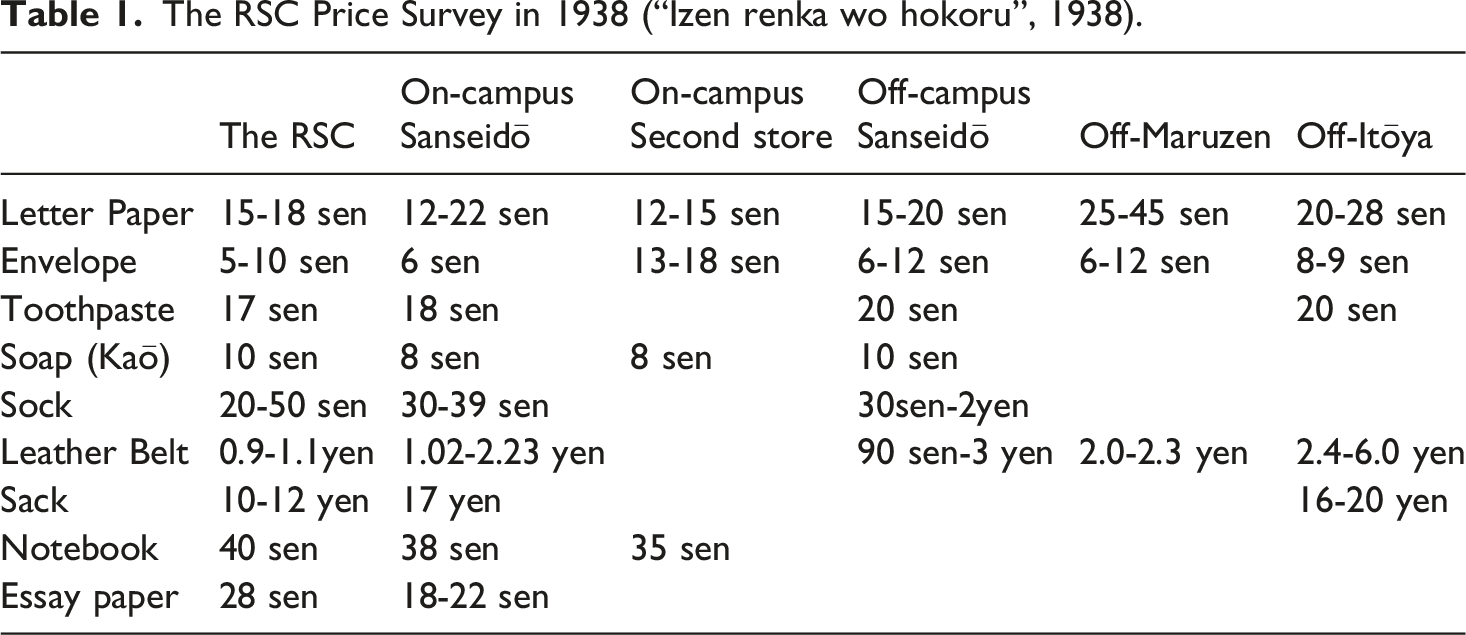
The constant pressure on its price creates a side effect for this welfare enterprise—self-exploitation. As explained earlier, while the leaders of the TSCC and student staff held honorary positions, the executive director was not. The elite leaders of the TSCC and RSC were sometimes unsympathetic toward the executive director’s livelihood. In December 1929, RSC leader Kaku Kōichrō exposed that Matsuura Takeo, then the executive director of the TSCC, received a rebate from one of the TSCC’s suppliers in search of additional income to his modest salary from the TSCC (Mukōyama, 1984:203). Matsuura resigned. This episode occurred within the larger context of radical efforts to expel non-Marxist activists from the TSCC. Shinjinkai radical Kuniya Yōzō managed to hire left-leaning consumer cooperative activists for positions at the TSCC. However, it is noteworthy that Kaku was not a radical, but Hon’iden’s student who became a Mitsui Trading (mitsui bussan) employee after graduation and continued to work as a director of the TSCC (Endō, 1979:3). Still, Kaku could not stand the rebate practice of Matsuura, or took the sacrifice of Matsuura for granted. These educated elites chose to stay as disinterested individuals even while trying to save expenses of their fellow students. In sociologist Pierre Bourdieu’s language, educated elites Kaku and Kuniya distinguished themselves from Matsuura who had to struggle for his livelihood, or failed to maintain “distance from necessity” often associated with the socio-cultural backgrounds of individual citizens (Bourdieu, 1984: 53). TSCC was a welfare institution could only be managed by the elites who did not worry about their livelihoods.
Furthermore, as the RSC sought to provide welfare benefits to its members through market competition, it created pressure on neighborhood merchants. The RSC’s advent in the Hongō Street and its sales of books and lecture notes meant the unprecedented pressure for bookstores in the neighborhood. As a journalist of the Imperial University News noted, the RSC store handled “books as well as fancy goods (zakka)” caused a “headache of the small and medium sized merchants (chūshōshōnin).” When the RSC contracted with the print-shop Keimeisha to sell its members lecture notes 10% more cheaply than other bookstores in 1934, bookstores on the Hongō Street, namely, Ikubundō, Yūshūkaku, Akamon Shoten, Ōhashi Shoten, Morii Shoten, Ikuseidō, Amemiya Shoten, Tanasawa Shoten tentatively discounted lecture notes by 10%, and contracted Keimeisha to exclude the RSC from the lecture note market. (“Gakushō no shinshutsu”, 1934c) But, eventually these bookstores were excluded from the lecture note market. As already documented, in 1936, the RSC organized with a print-shop and note-provider students to sell lecture notes, bypassing the intervention of bookstores on the Hongō Street. (Tōkyō gakusei shōhi kumiai akamonshibu toshobu, 1936:93)
The manager of Ikubundō, in his interview in 1934 with the Imperial University News, articulated the difficulty of managing a bookstore against the challenge of the RSC. “Selling books 10% more cheaply than the nationally determined price,” argued the manager, “pauses a serious insecurity to the livelihood of ordinary shopkeepers (ippan shōka) who rely on modest profits to support their households.” There was also an institutional factor that affected the price competition between the RSC and booksellers on the Hongō Street. “The RSC could lower the price of the books, but, booksellers, as members of the “the bookseller union (shoseki kumiai),” should follow the regulations of the union, which did not allow its members to arbitrarily lower the prices of new books. In short, these bookstores could no longer compete with the RSC for new-book sales. Among the aforementioned bookstores, Ikubundō, Morii Shoten, and Tanasawa Shoten are still operating today, and all of them are now used-bookstores. At the end of the interview, the Ikubundō manager questioned if RSC activists were “aggressive to small- and medium-sized shopkeepers not big capital.” (“Gakushō no shinshutsu”, 1934)
The RSC leaders rejected this accusation. In their interviews with Imperial University News, the RSC activists understood this protest as a challenge to legitimate activism connecting producers and consumers. In their opinion, the RSC was not pressuring small merchants because their calamities were derived from the excessive number of similar traders and the entrance of department stores into the business. (“Gakushō no shinshutsu”, 1934) They repeated this logic in one of the RSC’s in-house publications in 1936. Its author strongly denied the allegation that “the RSC intends to put pressure on retailers (kourishō) who were not capitalist merchants (shihonkateki shōnin).” (Tōkyō gakusei shōhi kumiai akamonshibu toshobu, 1935:88) “Their financial problems,” argued the author, “resulted from economic recessions, the anarchistic overpopulation of merchants, as was revealed in the Tokyo City’s survey result that every six households had one merchant,” and “pressure from the big capitalists, including department stores.” (Tōkyō gakusei shōhi kumiai akamonshibu toshobu, 1935:88)
However, the pressure from the RSC on small and medium-sized shopkeepers was undeniable. Regardless of the purpose of the RSC activists, their activities affected everyone in the neighborhood. Small- and medium-sized enterprises received the shockwave more easily, as they were hardly able to claim an economy of scale by investing a significant amount of money in the production of commodities. RSC activists denigrated the service providers of the First and the Second Dining Halls on campus, namely Sudachō Diner and Fuji Ice Cream respectively, for the “extremely bad quality” of their meals. Pointing out that Sudachō Diner had opened its new franchise store in Shinjuku and Fuji Ice Cream had enlarged its Ginza franchise Store ten times, the author of the pamphlet lamented, “Students grow thinner, whereas merchants take on flesh!” (Tōkyō gakusei shōhikumiai akamon shibu toshobu, 1935:75) However, the RSC’s attempt to open restaurants in 1932 did not actualize due to the insufficiency of capital. The RSC’s attempt to check service providers at on-campus dining halls did not extend beyond protests in 1930 and 1931.
The RSC was effective in preventing shopkeepers in the neighborhood from making too much profit and helping its members save expenses at Tōdai. However, the RSC activists did not control the extent to which they wanted to check among neighborhood merchants, which resulted from the essential quality of the RSC as a welfare institution in the market. The RSC activists’ zeal, even giving up their wages working for the RSC store, expanded the margin of the institution but put pressure on the RSC’s competitors, which brought a significant side effect inside and outside the RSC.
Conclusion
In previous scholarship, the history of the RSC was its ideological clash with university and police authorities. Indeed, RSC leaders bought hostility from Tōdai authorities and the police from the birth of the RSC. They criticized the Student Office at Tōdai for not approving the RSC as an on-campus organization supported by the university budget, and harshly criticized the on-campus diners supervised by the Student Office. RSC leaders suspected that Student Office officials were hostile to student radicals and their suspicion was not ungrounded. The Student Office did not approve of the RSC as a legitimate on-campus organization for financial support. In the 1932 Report on Student Radicalism, a Student Office official articulated that the Student Office did not officially approve the establishment of the RSC in 1928, “since there was a student radical among the RSC’s founders,” and “he will use the RSC for his ideological movement.” (Tōkyō teikoku daigaku gakuseika, 1932:44)
Japan’s political climate was changing in 1928. In March 1928, police authorities initiated a nation-wide arrest of members of the Japanese Communist Party, an illegal party then in Japan. As some members of the Shinjinkai were arrested for joining the party, Tōdai authorities dissolved the Shinjinkai in April 1928. Student radicals went underground and joined and radicalized other on-campus organizations such as the RSC, as Student Office officials anticipated. The RSC leader Kuniya Yōzō approached to Kantō Consumer Cooperative League (kantō shōhikumiai renmei), a league of leftist consumer cooperatives in the Kantō region. In January 1930, Kuniya led the appointment of Kasahara Chizuru, the Kantō Consumer Cooperative League as the TSCC finance manager (kansa). Kuniya and Yamagishi Akira, then the student leader of the Meiji University consumer cooperative, became staff members of the Kantō Consumer Cooperative League after they graduated in 1931. And RSC leaders challenged Tōdai authorities along with Midorikai radicals.
In 1931, university authorities discouraged Tōdai entrants from joining the RSC, which had a tangible impact on RSC sales and membership. Between 1931 and 1933, RSC sales decreased from 42,500 yen to 17,900 yen. In 1932, 496 students joined the RSC; however, this number decreased to 152. The other branches of the TSCC also suffered a decrease in sales. For instance, the cost of the Waseda branch decreased from 3000 yen in 1932 to 1400 yen in 1933. The TSCC branches whose members were not sufficient to endure the discouragement from their university authorities disappeared one by one. The Rikkyō, Meiji Gakuin, and Takushoku branches of the TSCC disappeared in 1932, 1933, and 1935 respectively. Between 1932 and 1936, the stigmatized TSCC lost 2400 members (“Uchitsuzuku appaku”, 1932; Mukōyama, 1984: 320-321). The Waseda branch eventually closed in 1937.
However, what distinguished the RSC from other branches of the TSCC was its resilience, despite its eventual demise in 1940 resulting from the suppression of the state. When executive director of the TSCC Yamagishi Akira was arrested for joining the Japanese Communist Party in 1933 (Mukōyama, 1984: 435), Kagawa Toyohiko, the founder of the TSCC asked TSCC leaders to stop approaching Communists and focus on the management of the cooperatives. Although the small branches disappeared during the early 1930s, the RSC leaders survived and prospered by embracing the help of Kagawa. In 1934, Kawaga helped the TSCC receive a loan of 2000 yen from the Industrial Cooperative Central Association, which facilitated the move of the RSC to the Hongō Street, the main street in front of Tōdai. RSC leaders also introduced new principles of public management. In Reimei (twilight), their in-house publication, an author argued that “the stigma of ‘left-wing’” was “a big river between the RSC and student masses,” but regarding the RSC just as leftist was “unfair.” “Considering the original duty of the RSC to deliver cheap and high-quality goods directly from producers to consumers,” argued the author, “there is no reason to stigmatize the RSC as leftist.” (Yūgen sekinin kōbai kumiai tōkyō gakusei shōhikumiai akamon shibu, 1934: 2-3) The sales and membership of the RSC steadily increased after 1934, until the closure in 1940.
Undeniably, the RSC had many radical members, and Kagawa’s help did not dilute the RSC’s stigma as a radical in the eyes of the university and police authorities. Looking back to student radicalism at Tōdai in 1934, Student Office officials at Tōdai still thought the RSC as “the culture ground of the left (sayoku no onshō),” which was not boundless. Kuniya, the founder of the RSC joined the Japanese Communist Party, was, according to the Student Office, “stretching out his red hands to students through the RSC.” (Tōkyō teikoku daigaku gakuseika, 1935:1, 3) Ministry of Education officials had a similar idea. In a pamphlet published in 1935 by the Thought Bureau (shisōkyoku) of the Ministry of Education, its author acknowledged the line change of the TSCC in 1934, but noted that “almost all of the students assuming the central role at students’ consumer cooperatives are left-leaning.” (Monbushō shisōkyoku, 1935:43) Police officials of the Home Ministry echoed that opinion as well. Student staff Endō Sei graduated from Tōdai and was employed at the TSCC headquarter in 1933, but summoned to the Special Higher Police at the Motofuji Police Station twice. Student staff of the RSC in the mid-1930s were Usami Seijirō, Sugimoto Toshirō, Uesugi Shōichirō, his younger brother Uesugi Jūjirō, and Sasaki Kiichi, all on the left. According to Endō, student staff were exposed to the suppression from the thought police, “often disappearing suddenly,” and used pseudonyms (Endō, 1979:3-4). The RSC was eventually dissolved in 1940 for its radical proclivity by the police authorities.
Despite this history, this article focused not on the conspicuous story of suppression and resistance. Rather, it considered the accomplishments and limitations of elite consumer cooperatives beyond the tentative ideological confrontation in pre-1945 Japan. After the Japanese state lost its war in 1945, the Japanese left resurfaced. So did student consumer cooperative activism. In 1946, Tōdai students restored a consumer cooperative and placed Nanbara Shigeru, the first post-1945 president of this university, as its president of the cooperative. This cooperative, which changed its name to the University of Tokyo Consumer Life Cooperative (Tōkyō daigaku shōhi seikatsu kyōdō kumiai) in 1949, continues to operate until today. This resurgent consumer cooperative took the right to manage on-campus diners, which the RSC activists wanted but to no avail. Consumer cooperatives at other universities swiftly revived after 1945 to organize the National School Cooperative League (zenkoku gakkō kyōdō kumiai rengōkai), which still operates today. Consumer cooperatives blossomed outside of universities. In 2025, half of Japanese populations have been affiliated with consumer cooperatives. In other words, ideological confrontation was not a constant or permanent factor that suffocated Japanese consumer cooperatives. In this sense, the challenges for consumer cooperatives persisting through 1945 were the essential characteristics of the consumer cooperatives as business corporations that had to outcompete other merchants in the neighborhood.
The RSC is a success story from the perspectives of Tōdai students seeking to control the excessive profits of merchants in the neighborhood. Student radicals redefined elite students at the university as the proletariat and cooperated with Hon’iden’s students to create the RSC by capitalizing on Kagawa’s network of consumer cooperative activism. Despite hostility from the Student Office, RSC managers maintained a competitive edge in prices and lured many members. Their contribution to students did not liberate them from financial pressure, but was not insignificant in saving expenses and lowering the prices of the RSC’s competitors.
However, the RSC’s function as a welfare institution was based on the elite background of its members, which modest citizens could not easily follow. Tōdai had a big number of students who could easily organize, and student staff at the RSC were enthusiastic and wealthy enough to work without pay. Furthermore, they were close to experts in consumer cooperatives and did not have difficulty hiring experienced activists. In this sense, the RSC embodied the self-rescue of elite students who challenged the market and earned welfare support through knowledge and networking. Unlike other measures, such as student funding or part-time employment, the RSC was not an institution with which the state distributed benefits to those who qualified as poor. Modest citizens, who were supposed to be the primary beneficiaries of wealth redistribution, had to organize members and manage a business enterprise to enjoy the benefits of cooperatives. In addition, leaders had to lower prices and outcompete the market, sometimes enduring modest salaries.
Of course, if market prices were significantly higher than cooperative activists could sell, management would be easier. However, the huge margin of competitive edge in prices is not usually maintained as competitors lower their prices. In other words, the impact of consumer cooperatives gradually diluted and cooperative leaders were exposed to tougher competition. This was the experience of the RSC. The competitive edge of the RSC decreased slightly during the initial ten years.
Furthermore, successful cooperatives such as the RSC, which integrated the production and distribution of commodities to lower their prices, create another social question. Sometimes, small merchants did not have any measures to counter the cooperative. This plight cannot be addressed in the management of the RSC. When the RSC challenged bookstores in 1934, they expressed their frustration, and RSC managers articulated their mission to challenge big enterprises but did not have solutions to limit their challenges to large merchants. RSC student staff encouraged bookstore managers to join the cooperative but did not discuss how their potential remuneration within the cooperative sought to lower the price, even by sacrificing the proper salaries of its workers, such as Matsuura Takeo. Matsuura’s resignation did not spark debates about activists’ wages at that time. However, this anecdote can also be interpreted as a symptom of employee exploitation in the context of corporate leaders’ intensifying their pursuit of lowering prices. Looking back from 2026, when a big-tech enterprise embodies an impressive competitive edge in prices but does not guarantee the welfare of its every employee, the RSC reveals the necessity of a balance between the welfare of consumers and employees in the market economy.
Although this article presents a case study of an elite student consumer cooperative, its implications point to both the impressive and negative legacies of consumer cooperative activism in modern Japan. Any consumer cooperative such as the RSC embodies the dedication and solidarity of citizens checking business enterprises in pursuit of its members’ welfare. However, consumer cooperatives are limited to market-based welfare enterprises. A consumer cooperative is a business corporation that pressures its workers and competitors to pursue a competitive edge in the market. In this sense, the RSC illustrates heroic citizens’ solidarity and dedication to checking profit-oriented businesses as well as the necessity to envision additional measures to cover the essential limits of welfare enterprises in the market.
Footnotes

Funding
The author received no financial support for the research, authorship, and/or publication of this article.
Declaration of conflicting interests
The author declared no potential conflicts of interest with respect to the research, authorship, and/or publication of this article.