






Abstract
The present paper seeks to substantiate the assertion that the modus operandi of contemporary advertisements in Hindi frequently entails exploiting women’s relational networks to sell products. It thereby intertwines women’s consumption patterns with the desires and expectations of their social milieu, further complicating any simplistic portrayal of women as individualistic consumers. It draws upon French feminist Luce Irigaray’s essay ‘When Goods Get Together’, which discusses the commodification and subjugation of women. This study attempts to discern the recurring tropes in Indian advertisements, their underlying socio-cultural and psychological implications, and their potential influence on shaping consumer values and lifestyles. Additionally, the study leverages the concept of individual and dividual personhood posited by anthropologist Chris Fowler to explicate how these representations in advertisements foster differential behavioral patterns in gendered subjects. By illuminating the subtle ways in which these tropes operate within the broader societal and cultural contexts, this research contributes to a more nuanced understanding of the complex interplay between gender, consumer culture, and social norms in contemporary India. Aligned with Fowler’s framework, this paper also briefly examines how neoliberal tendencies are preferentially reinforced in one gender over the others. The data set comprises advertisements that target predominantly middle-class Hindu households, aired primarily in Hindi, and circulated through television and YouTube.
Keywords
Introduction
Gender is culturally variable, but it is also tenacious. It derives its tenacity from the degree to which culture places emphasizes gender as an organising category. One of the most significant aspects of culture in any capitalist setup is consumer culture, and it heavily relies on gendered imagery. Since identities are partially constructed through purchasing decisions, it is crucial to examine how products are marketed. (Scanlon 2000; Tissier-Desbordes and Visconti 2020). The present study strives to demonstrate that in contemporary Indian society, women are encouraged to invest more in their interpersonal relationships. Conversely, men are better equipped to embrace notions of individualism, independent thinking and self-direction, traits valued under neoliberalism. This dynamic can be observed through the representation of women in Indian advertisements. Advertisements are both discursive and ideological, and shape our patterns of circulation and consumption Journalist Judith Williamson argues that representations in advertisements go beyond merely endorsing products and services, embedding them within specific lifestyles and values (1978, 25). According to a 2019 Kantar report, many brands identify women ‘as the main household purchaser’ (Kantar Group, 2019, 16). The report shows that 98% of ads for laundry products, household cleaners, and baby products were targeted toward women (11). Another study conducted by UNICEF and the Geena Davis Institute of Gender in Media titled ‘Gender Bias and Inclusion in Advertising in India’ shows that women are less likely to be shown in paid occupations and more likely to be depicted as caretakers and parents than male characters. While male characters are more likely to be shown making decisions about their future than female characters (7.3% compared with 4.8%), the latter is twice as likely to make household decisions than male characters (4.9% compared with 2.0%) (Geena Davis Institute on Gender in Media, and UNICEF, 2021). These statistics suggest a tendency in Indian advertisements to position women within relational networks. A thorough analysis of the imagery surrounding women and their roles in various relationships within these advertisements therefore becomes indispensable.
The present paper is a continuation of the advances in qualitative studies of media and consumption culture that have made room for an interpretive analysis since the 1980s (Hirschman and Holbrook 1992; Mick 1986). Advertisements have been recognised as central agents in the production and maintenance of gender ideologies (Gill 2007; MacKay and Covell 1997; Törrönen and Rolando 2017). Although there have been spirited defences of ‘market feminism’ (Scott 2006), the pervasiveness of stereotypes is evident in research that has noted that women are objectified and shown in positions of subordination while men are shown to be in more autonomous positions (Baker 2005; Eisend 2010; Gill 2009; Hatton and Trautner 2013). Researchers have also found that stereotypes are less common in Europe but still widespread in Asia and Africa (Furnham and Mak 1999). The second wave of feminism prompted a critical examination of how women were depicted in magazine advertisements, leading to empirical studies such as Erving Goffman’s seminal work Gender Advertisements (1979), which focused on gender portrayals in North American advertisements. Goffman’s pioneering research sparked extensive further inquiry (Baker 2005; Belknap and Leonard 1991; Bell and Milic 2002; Stole 2003; Willem et al., 2012). While primarily situated in Western contexts, with a few exceptions (McLaughlin and Goulet 1999; Nam et al. 2011), these studies offer valuable analytical frameworks for scrutinizing advertisements in India.
Efforts to specifically study advertisements, particularly on Indian television, have also been undertaken. Within the Indian context, for instance, Munshi (1998) contends that marketers have woven the discourses of liberating feminism and traditional femininity around the discourses of consumerism. However, her primary focus is on advertisements during the 1990s. In the three decades since, significant changes have transformed the Indian market. The intensified influence of globalization and a deeper embrace of neoliberalism have reshaped both the market landscape and consumption patterns (Eckhardt and Mahi 2012). Consequently, while a growing number of advertisements now feature a more empowered representation of women on the surface, a closer look paints a different picture. Bharadwaj and Mehta (2017) conclude that advertisements featuring women in corporate supervisory roles are nothing more than vestiges of patriarchal control, while more recent works continue to establish the stereotypical portrayal of gender in print media (Das and Majhi 2022). Recent studies have also noted the changing portrayal of women in Indian media (Barthwal 2024) and the perspectives of the creative teams and top management across Indian and global advertising agencies (Jethwaney 2024). These works provide a foundation for the current paper, which closely examines the portrayals of women within relationships in contemporary neoliberal India, analysing how conventional norms in advertisements exploit women’s relational networks and reshape tropes to promote different conceptions of personhood across genders.
Further research has suggested that people tend to incorporate stereotypes presented by the media into their own system of values, ideas, and beliefs about the quality of life (Eisend 2010; Gerbner 1998; Zotos and Tsichla 2014). Gender representations are socially constructed, and advertising campaigns create gender identity, based on their images, the stereotyped iconography of masculinity and femininity (Schroeder and Zwick 2004). Advertisements then do not invent meaning. However, they do translate meaning for the product through a familiar sign system (McCracken 1986). To achieve their targets, advertisers rely on the reproduction of sameness (Holt 2004). The culture industry continuously reproduces the present conditions of society and the ideology within which it operates. The observation by German philosophers Max Horkheimer and Theodor W. Adorno remains pertinent, asserting the enduring relevance of their statement that ‘What is new in the phase of mass culture compared to that of late liberalism is the exclusion of the new. The machine is rotating on the spot. While it already determines consumption, it rejects anything untried as a risk. That is why there is incessant talk of ideas, novelty, and surprises of what is both totally familiar and has never existed before’ (1982, 106). In concordance with Horkheimer and Adorno, the comfort of patriarchal familiarity in the Indian household serves as a socially acceptable formula for marketers, fitting a setting that is both familiar and new. Constant repetition of these familiar signs translates cultural norms as common sense, and often an individual’s gendered identity is employed to associate certain products with them, thereby establishing the target consumer.
Methodology
The present paper draws upon the work of French feminist Luce Irigaray, specifically the essay, ‘When Goods Get Together,’ from This Sex Which is Not One (1985). In the essay, Irigaray delves into the economic exploitation of women, referring to them as goods to underscore their commodified status within a patriarchal society, wherein men are the buyers and consumers, revealing the deep entanglement between patriarchal and capitalist systems. Irigaray further critiques the societal prohibition of male homosexual relationships and questions the biases and limitations in Freud’s psychoanalytic theory. The present paper, however, builds on the themes of women’s commodification and subjugation, specifically. In the spirit of Irigarayan inquiry, this study attempts to discern the recurring tropes and their potential influence on shaping consumer values and lifestyles.
Advertisement dataset.
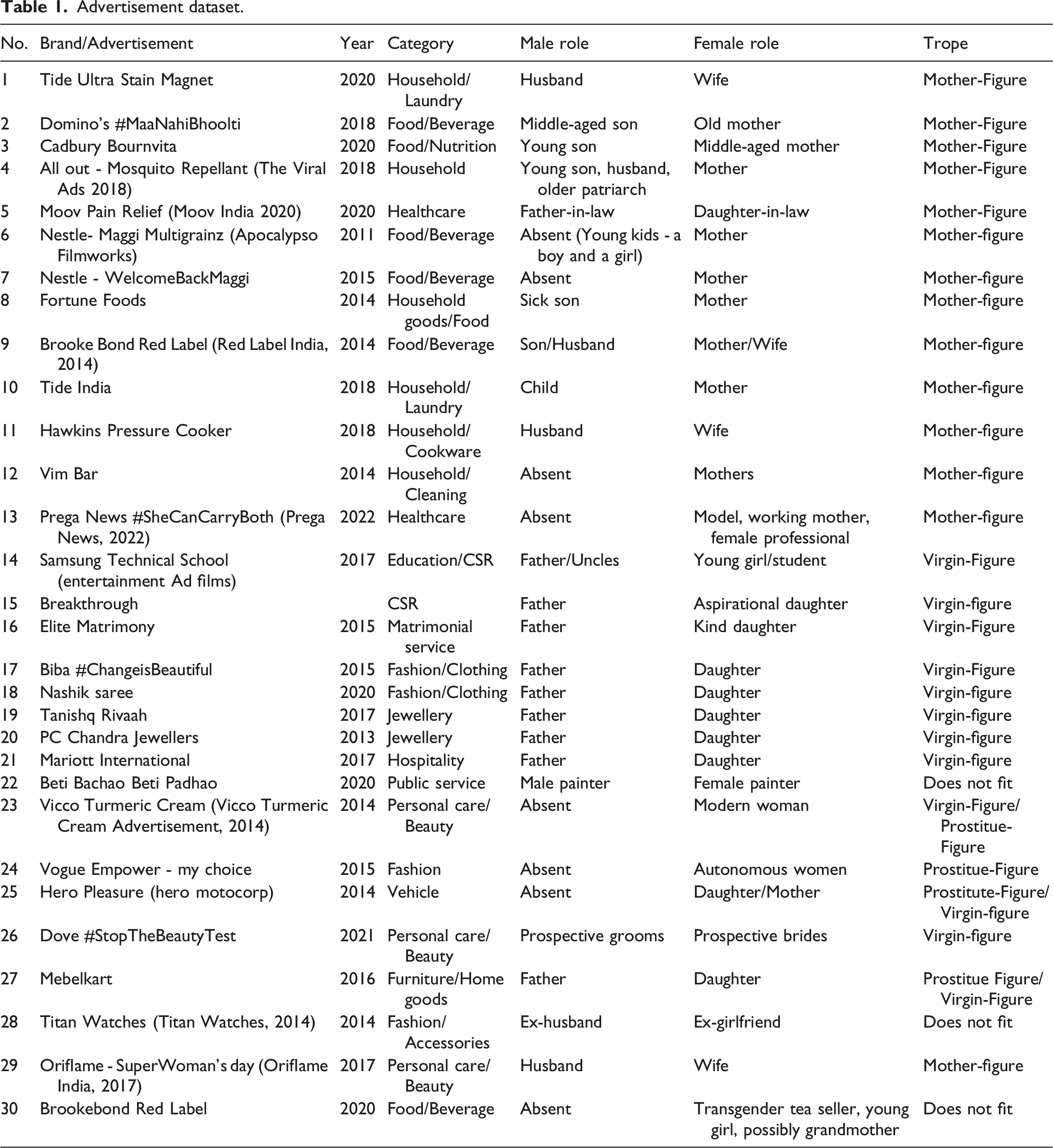
The dataset comprises 30 advertisements selected through purposive, non-random sampling, spanning the first two decades of the twenty-first century since this period captures the intensified influence of globalisation and neoliberalism on Indian advertising, and reflect contemporary representational practices. Of the 30 advertisements, 19 were aired on television and circulated via YouTube, while 11 were published primarily on YouTube. The dataset targets predominantly middle-class Hindu households. Some advertisements from the data set are also available in other languages, with similar interpretations possible across these versions. However, this study focuses on Hindi advertisements to ensure a consistent methodological approach, avoiding discrepancies arising from translation nuances and regional variations. By narrowing the scope to Hindi ads, the research provides a concentrated and in-depth analysis within the given space constraints. 1 Additionally, all advertisements target a middle-class audience, and the majority are marked by urban settings, with only two of these set in a rural area. While the setting influences representation, the audience remains diverse. Caste markers are not explicitly mentioned in the advertisements chosen, but it is important to recognize that patriarchy in India is a blend of the Western English model and Brahmanical culture, constantly reproduced, and caste markers are implicit, even though not thoroughly focused on in this paper. 2 Further, while the study engages with the visual and auditory aspects of the advertisements, and its reception, where relevant, it largely treats them as semiotic texts, focusing on the content rather on the form. The findings of the paper are shaped and limited by these choices. The sample spans nine product categories: household goods; food, beverage, and nutrition; personal care and beauty; jewellery and fashion; education, social initiatives, and public service; vehicles and transport; hospitality and luxury; matrimonial services; and healthcare. This range helps identify the operation of relational logic across both the domestic and commercial sector. Through the sample set the paper aims to identify recurring tropes in Hindi advertisements. The findings should be understood as illustrative rather than exhaustive, and do not make claims about the prevalence of these patterns across the entirety of Indian advertising.
Advertisements were assigned one of the three Irigarayan categories on the basis of the relational positioning of the female subject within each advertisement’s narrative. The mother-figure trope was identified when the female subject’s identity and agency were primarily constituted through caretaking obligations and when the product was positioned as enabling her relational function. The virgin-figure trope was identified when the female subject’s choices and mobility were subject to male guardianship and validated through their contribution to her exchange-value in the marriage market. The prostitute-figure trope was identified when the female subject asserted autonomy over her body or choices in ways that exceeded her relational positioning, and when this provoked social correction or containment. Following this, the figure is traced through Fowler’s concept of personhood to fully explicate the relational networks within which they are situated and how these impact them.
Marketing (through) gendered roles: Essentialist categories of women vis-à-vis men in Indian advertisements
Advertisements rely on gender roles established and promoted by patriarchal practices to create essentialist categories of women (Eisend 2010; Zawisza and Cinnirella 2010). Essentialism categorizes groups based on biological essentialism, which suggests that they possess a ‘true’ nature predating cultural influences. Advertisements borrow from prevailing social norms to create essentialist identites. A recent advertisement for Tide Ultra with Stain Magnets, featuring Hindi film actor Ayushmann Khurrana, illustrates this well (Tide India, 2020). Within the narrative, the actor performs multiple roles — a ‘modern’ husband, his wife, and an older adult male. The husband is positioned in the kitchen, cooking ‘Italian mozzarella cheese ravioli’ on his wife’s birthday, only to stain his white shirt in the process. When the husband insists the kitchen stain can only be removed by dry cleaning, the wife assures him that a machine wash will be enough, and surely, she is proven correct through Tide. The advertisement closes with the wife restating the brand’s famous tagline, ‘Bedaag white ho toh naya Tide ho’ (For an immaculate white, use the new Tide).
The advertisement’s setting is familiar in how the wife performs the household chores on her birthday, as on any other day. The lack of cleanliness on the husband’s part shows his unfamiliarity with the kitchen space. His modernity is indicated by the Italian dish he cooks and established by his ‘thoughtful’ act of cooking for his wife. Modernity as used here, is intended both in terms of an epoch and an attitude. In a patriarchal Indian household, housework is the task of the woman. With newer ideas regarding gender parity, things have been restructured slightly 3 . The woman continues to perform house duties regularly, and perhaps once on her birthday, the ‘modern’ husband cooks her a meal, often increasing her workload in the process. Therefore, while the situation is familiar and acceptable, it is simultaneously new. The gender of the female character holds particular significance in this advertisement, as it is predicated on the assumption that men are not as familiar with domestic tasks as women are. The wife reveals her knowledge of cleaning difficult stains, and is positioned as more competent in the domain of domestic labour. The husband, by contrast, does not have any similar obligations; his presence in the kitchen is voluntary and exceptional. Laundry for the wife is a structural obligation, and ‘wives’ become the target consumer not because she is an autonomous individual exercising purchasing choice, but because the maintenance of domestic order falls within her realm of obligations. This target consumer, who works for the benefit of others, is invited to identify with the imaginary person in the advertisement, a figure Khurrana embodies through cross-dressing. To portray a woman, he wears a medium-length wig, make-up, and a suit, and alters his voice to a higher pitch, standardizing what it is to be a woman and how a woman is supposed to look. To act like a woman, for a man, requires a set of identifiable markers such as appearance, voice, comportment, that reduce womanhood to a recognizable and reproducible performance. Khurrana’s exaggerated cross-dressing reinstates gender norms, concretising domestic competence as an essentially feminine attribute and naturalising the husband-wife roles as inevitable expressions of gendered identity. The advertisement thus showcases how essentialist categories are produced and reproduced in Hindi advertising.
In the realm of Indian advertising, there is a prevailing tendency to depict women within essentialist frameworks, encapsulating them in standardized relationships and, consequently, interpellating 4 them into predefined categories. Through images and representations, the role of the woman in a relationship is defined. Advertising plays a key role as a facilitator, marketing products to be sold in the market. The paper highlights the roles that women are assigned, as discussed by Irigaray, which advertisers use to market their products. According to Irigaray’s categorization, the mother is subjected to the father’s control, barred from the exchange, and has use-value. In contrast, the virgin only has an exchange-value, which men determine. Later, after the loss of her hymen, she is given the position of motherhood. A prostitute has both use-value and exchange-value. Advertisers, the paper argues, exploit these roles of women as mothers and daughters in marketing their products, which reinforce gender stereotypes and perpetuate exploitative roles in relationships.
Over a period, these charges of biological essentialism against French Feminists, including Irigaray herself, have been made by various critics. However, since the paper focuses on advertisements and the essentialist categories they formulate, it will not discuss or defend these charges against Irigaray in detail. Nevertheless, the paper employs her text to further the argument, and it should be briefly stated that an ahistorical female body, here in this text, is put forward by the men in a patriarchal setup. Irigaray’s ‘strategic’ essentialism in her work (to borrow Spivak’s term) offers a helpful framework with which to analyze how advertising constructs and reinforces gendered identities and stereotypes. This paper draws inspiration from the categorical framework of mother-figure and the virgin-figure presented by Irigaray and modifies it to align with the specific objectives of the paper. It must be noted that in the present exchange system, men are also reduced to commodities. However, they benefit in how they derive their identities from a patriarchal system favoring them. The paper asserts that advertisements predominantly target men by promoting products that enhance their personal image and identity. In contrast, when marketing products to women, the emphasis shifts towards their relational networks, highlighting their roles within relationships.
The mother-figure and use-value
A significant number of advertisements employ these essentialist categories, interpellating subjects in terms of these categories. An effective illustration of this is the moving Mother’s Day campaign from Domino’s Pizza India, #MaaNahiBhoolti (A Mother Does Not Forget) (2018). The advertisement depicts a man leaving his mother at a nursing home, his decision justified by his and his wife’s work schedules and the absence of any other means of caretaking. Throughout, the mother constantly inquires whether he has reached out to her, incorporating his likes and dislikes into her daily activities. She sews clothes, using the income generated to order a Domino’s pizza for her son, a gesture that serves to temporarily reunite the family. The advertisement concludes with a sentimental song, emphasizing the mother’s love and understanding for her child. The sad, emotional music that captures the mother’s loneliness in the opening sequence stops precisely at the moment the son acknowledges his mother’s affection, directing the viewer’s emotional response. The song that plays later as the family gets together conveys that a mother’s raison d'être is her child, and her entire world revolves around them. Using the pronoun ‘you’ directly addresses the viewer, establishing a personal connection between the song’s message and the viewer’s relationship with their mother.
A plausible interpretation of the mother’s relocation to a nursing home could be her lack of sufficient domestic contributions 5 . Her position, possibly ‘usurped’ by her son’s spouse. Subsequently, since her use-value had been exhausted, and she had potentially become a liability, the child admitted her to the nursing home. Throughout the mother’s locus of identity remains her son. Notably, even in his absence, she continues to center her actions around him, with Domino’s Pizza becoming a means of reaffirming her usefulness. The advertisement endeavors to reinforce the irreplaceable value of a mother, yet this notion is fallacious, as her value has merely been reinstated temporarily. As in other ads, the sacrificial mother is an old archetype employed here. The sacrificing mother-figure is so prevalent in India, as elsewhere, that the products manufactured for a child are also sold using the trope of a sacrificial mother. For example, in another advertisement for Cadbury Bournvita (2020), a mother running low on funds will not cancel the popular ‘health-drink’ Bournvita from her list, for Bournvita provides the best for her child, and by giving her child what is best for her, she proves herself to be a competent mother. At this point, it is worth noting that the portrayal of the mother-figure in the advertisement does not necessarily depict her as engaged primarily in childcare responsibilities. Instead, she is typically depicted as a household caretaker and manager of domestic chores, with the childcare responsibility coming within that purview. 6
The representation of the mother-figure reinforces the dividuality of the mother-figure’s personhood by firmly situating them within a relational network, where their sense of self is derived from the services they provide to the family. Her identity is multiply-authored, constituted entirely through her caretaking responsibilities and her relationships with others, such as the husband in the Tide Advertisement, child in the Dominos Advertisement, family and the larger house in other advertisements. Her personhood is not self-directed but relationally derived. The commodities being sold are marketed as the means by which she fulfills her use-value within the relational network. She is rewarded for conforming to these roles, but these rewards are depersonalized and derive from the hard work women perform for others 7 . For instance, a husband’s award for best employee of the year or a son’s award for excellent performance in school are also considered achievements for women, establishing their use-value. In this way, advertisements targeting the mother-figure do not interpellate her as a consumer in the neoliberal sense, i.e., as a self-directed individual exercising autonomous choice, but as a dividual whose desires and motivations are determined via their position in the relational network.
The virgin-figure and exchange-value
As with the mother, for the virgin, it is a male who defines boundaries, usually, the immediate male guardian makes decisions about her/their life. An advertisement for the Samsung Technical School (Entertainment Ad Films 2017), set in a rural, patriarchal setup, shows that. The advertisement opens with the birth of a girl-child, Seema, and the disappointment that follows. The father promises the newborn that she is not his daughter but his son, that is she will be provided access to a larger space that is demarcated for the sons. As she grows up, her desire to further her education is met with resistance from the male members of the family. However, her father secretly supports her education by giving her money for a bus pass. As she leaves, the father tells the disgruntled men that ‘Sons should get what they want, right?’ and sends her off. The educated daughter returns for a family wedding. At the wedding, the lights go out, Seema repairs the inverter, sparing her family embarrassment. A member dubs her ‘Madam Engineer’ and says they must now find her a hotshot-gentleman groom. In turn, she states her wish to open her service center in the village. An older male member concedes that her father has three boys. The father, however, proudly states that he has two sons and a lovely daughter.
While this advertisement ends on a seemingly positive note, there are various points for discussion. For instance, the birth of a girl-child is initially met with disappointment. It is only later, when the girl proves herself as competent, above, if not at par with the sons, that the decision of the father to educate her is approved. Often, the girl-child education campaigns are stimulated with the promises that she is no less than a son and that she, too, can make the family proud. This is because, in India, the smallest entity is not an individual but a family. Therefore, when a child is born, its arrival is announced in relation to the parents. Instead of a boy/girl, either a son is born or a daughter. From the outset, they are pushed into these preassigned roles. While the son is seen as a lifelong member of the family who will shoulder the family’s responsibility once he becomes an adult, the daughter is seen as a member who will eventually become a part of another family to which she will ultimately be devoted. While the sons will further the family lineage, the daughters will help contribute to someone else’s lineage. Therefore, the first step to appeal to the masses is to argue that daughters are no less than sons 8 . Education is marketed with the commitment of yielding significant returns within one’s relational network. In an effort to promote the education of girls, a joint initiative by Breakthrough, a global rights organization, and BT, a data protection and licensing organization, showcases a parallel message. The initiative involves delivering letters to various fathers, authored by Olympian wrestler Sakshi Malik’s father, that emphasizes the aspirations of a daughter (IANS TV 2019). The letter suggests that allowing their daughters to pursue their dreams would bring tangible returns such as bearing her own expenses and providing for the family. Finally, the daughter’s marriage is mentioned in both advertisements, with the implication that her education would make her a better partner.
Daughters (virgins) are seen as a responsibility because they are to be protected before they are formally exchanged. There is resistance against Seema’s education because of the looming threat of men in the market. Throughout her education, Seema is seen working hard and not interacting with any boys. The lack of corruption helps make the father’s decision acceptable. The Samsung advertisement, therefore, while championing the cause of girl-child education, maintains that the education will keep the virgin-figure secure for exchange in marriage. In fact, she will only be exchanged with a superior (hotshot-gentleman) person. Similarly, the Breakthrough initiative also ensures the audience that the marriage proposals will only increase after her education. It is also an assurance that education would not destabilize the older patriarchal family structure. Both the advertisements here expand the boundaries of the existing social structure instead of breaking them. It is pertinent to note that both advertisements are set in rural areas where female education rates are lower. Nevertheless, even in urban settings, the question of virgin-figure’s exchange in marriage remains paramount. In many Indian advertisements set within wedding contexts, the father-daughter relationship is emphasized. 9 These advertisements underscore a father’s duty to exchange his daughter within the marriage market. The virgin-figure occupies a dividual position; the entire social apparatus works to ensure that she will be anchored firmly in a relational network through marriage. Fowler states that dividual persons are not isolated origins of action but are emergent from relational networks, always already social, positioned within webs of kinship and obligation. The virgin-figure embodies this condition.
The prostitute-figure: Disciplining of female autonomous subject/individual
The prostitute-figure enjoys considerable independence due to her lack of attachment to a single man at any given time. This absence of direct oversight and her economic self-sufficiency afford her a relative degree of freedom. Within Irigaray’s framework, the prostitute-figure is the only one who simultaneously holds both use-value and exchange-value, and who transacts directly rather than being transacted upon. This capacity for self-directed exchange aligns with Fowler’s concept of individual personhood and positions her as a figure threatening the patriarchal market order. Operating in public spaces, her freedom challenges her direct commodification. The prostitute-figure stakes a claim to self-authorship, challenging the dividual constitution that the system depends upon. It is important to note that in opposition to the generally understood meaning of the word prostitute, here the term does not carry any conventional moral connotations. It is not a position but a description; it describes how the patriarchal culture labels or disciplines women who move outside male control. To maintain control, various means are employed within the socio-political space. The trope of the prostitute illustrates the challenge of safeguarding attempts towards female empowerment from the resultant backlash, with the assertion of her empowerment being constantly checked through shaming, defaming, and boycotting. A notable example is the “My Choice” (Vogue India 2015) video, directed by Homi Adajania, starring Deepika Padukone, for Vogue Empower, which advocates women’s empowerment. It discusses the freedom to choose for oneself and features 98 other women. Throughout the video, various choices are discussed: “To wear the clothes I like…My choice to marry or not to marry, to have sex before marriage, to have sex outside of marriage, to not have sex… my choice to love temporarily or to lust forever… my choice to love a man or a woman or both. Remember you are my choice, I’m not your privilege… My choice to come home when I want…” The video received backlash from various sources. A repeated point made in the YouTube comments is that if the script had been played out by men, it would have received an extremely hostile reaction. The issues discussed in the Vogue Empower video are confined to upper-class, upper-caste, modern women, while the comment section is more diverse. There are many personal comments about Padukone’s life, such as a YouTuber commenting on how it was Ranbir Kapoor’s (Padukone’s alleged ex-boyfriend) choice to leave her. By reducing the actress from the status of an agent making a political statement to that of a woman defined by her relationships with men, the comment section brings in her relational identity over individual personhood. Interestingly, the video is directed by Homi Adajania and based on a poem by Kersi Khambatta. In a video advocating for women’s empowerment, the dialogue and direction are provided by men. However, the backlash is directed specifically at Padukone, which is consistent with studies that show how counter-stereotypic behaviour attracts backlash (Rudman and Fairchild 2004), and disproportionately affects women in prominent positions (Brescoll et al. 2010; Ryan and Haslam 2007).
The nitpicking and focus on one specific issue serve to divert attention from the broader conversation. The prostitute-figure who claims her own use-value and exchange-value and refuses to be transacted within the marriage market and insists on transacting for herself is perceived as a disruption to the system of exchange. The hostile response acts as a structural correction for the female audience. While polyamorous, extramarital, or adulterous relationships are one topic, other important issues such as body size and homosexual relationships are also mentioned but largely ignored. A response to the video uploaded by the YouTube channel Being Indian, titled #VagueManpower, crudely mocks the original advertisement (BeingIndian 2015). The video features various men who justify their actions with lines like “my mind is dirty, deal with it. Our species’ survival and evolution depend on me imagining your best friend while I am doing you… redheads and Japanese girls are my choice… I am not a feminist, I am not a male chauvinist, I am just me…” This video received 17,000 likes and 2700 dislikes. In contrast to the Padukone video, the comment section for #VagueManpower is filled with support, from both men and women. The acceptance of the crude comments in #VagueManpower and the intense scrutiny of the #VogueEmpower advertisement illustrates how difficult conversations are manipulated. 10 The prostitute-figure, asserting her control over her own body, is quickly shown her place by patriarchal society. However, certain sanctions are provided to women in the current, global, modern world. These sanctions are enabled and limited by class. For instance, in the Vogue video, the celebrity presence, the black and white urban aesthetic, and the carefully choreographed visual treatment of women’s bodies situate the video firmly within an upper-class register, which is precisely what makes it legible as empowerment to its intended audience. The visual economy of the video, the calm confident delivery of sentences, the lack of domestic setting and instead the focus on the face against the stark black background, is itself an assertion of individual personhood. It is this visual assertion of self-authorship available to a certain class of women. Advertisers co-opt feminism, promote inclusivity, and situate their products within this evolving narrative, a strategy known as “femvertising” 11 (Akestam et al., 2017; Castillo 2014). The class and caste markers are blanketed, and products only accessible to a certain class are presented as universally feminist, ignoring all intersectionalities. For instance, advertisements for the scooter Hero Pleasure use the tagline “Why Should Boys Have All the Fun?” to sell the idea of fun typically associated with boys (Hero MotorCorp, 2014). Starring popular Bollywood actress Alia Bhatt, the ad shows her embarking on a little adventure on her scooter. However, her idea of fun and freedom aligns with traditionally male behavior. As a song celebrating women’s empowerment plays in the background, Bhatt is shown riding her scooter in a carefree manner. During her ride, she takes an apple without permission from the person transporting them, leaving as the tractor ‘s owner runs after her. She then encounters a hitchhiker in a remote area, offers him a ride with a gesture, but rides away as soon as he approaches the scooter. She reaches home the next morning and evades questions about her whereabouts. These actions define “fun” in a way that mirrors objectionable behavior often attributed to men. The advertisement preaches equality by encouraging women to partake in this rather disagreeable fun, perhaps implicitly asking, “Why should only boys be obnoxious?” More importantly, after a night of fun, Bhatt dutifully returns home and resumes her original position as the virgin-figure 12 . This fun does not lead to the disruption of her status as the virgin-figure. In contrast, campaigns such as the one by Vogue that challenge the status quo more directly, such as those addressing systemic inequalities, pose a genuine threat to the existing system of exchange.
Advertisements like those for Hero Pleasure (Hero MotorCorp, 2014) use bite-sized, easily digestible, upbeat, and cheerful messages that gloss over serious issues like gender inequality. The portrayal of women’s empowerment in these ads often boils down to showing women doing things traditionally associated with men, misinterpreting empowerment as mere imitation rather than genuine liberation. In contrast, the Vogue campaign’s assertion of women’s empowerment is tempered by its audience. Max Horkheimer and Theodor Adorno, in their work “The Culture Industry: Enlightenment as Mass Deception,” discuss how the cultural industry normalizes and standardizes societal roles. They observe that in films, ‘to allow an illicit relationship without due punishment of the culprits is even more strictly tabooed than it is for the future son-in-law of a millionaire to be active in the workers’ movement.’ (1982, 113). The argument highlights how the culture industry promotes conformity to avoid controversy. Patriarchal practices are not eliminated but reshaped, with the rigid boundaries of patriarchy becoming more flexible in the globalised, neoliberalised India. However, these changes often fail to alter the larger systemic picture. In the Hero Pleasure advertisement, Bhatt’s character faces no severe backlash, for she quickly resumes her place in society as the virgin-figure, suggesting that her moment of fun is socially sanctioned (Hero MotorCorp, 2014). The prostitute-figure can potentially gain limited acceptance within societal norms but faces swift retribution if she dares to challenge/exceed those boundaries. While traits like autonomy and individual expression are deemed desirable for men, the corresponding attributes are actively suppressed in women, who are instead urged to prioritize obedience and integrity, to better harness their value. Women assume various roles at different times, and the position of the prostitute-figure becomes accessible when they are removed or remove themselves from male control. This evokes anxieties, particularly when virgin-figures, like Seema pursuing education, step out of traditional roles, raising concerns about them gaining autonomy over their bodies and potentially disrupting the market that Irigaray talks about. By engaging with their own use-value and exchange-value and asserting their need for empowerment, the prostitute-figure claims individual personhood, challenging the carefully structured system.
Conclusion
The paper through an analysis of advertisements in India posited how women are often enmeshed more fully in relational networks compared to men. While women have always been exchanged to establish relationships (Rubin 2006) 13 , in the post-globalized capitalist world, their labor has taken precedence. To achieve maximum output, it is important to exploit domestic labor power and simultaneously invest in the latest technology. Interestingly, it falls on the laboring woman to procure this technology in the form of home appliances. Therefore, advertisements are directed to the ‘new’ women who are independent and free to exploit themselves for the success of their relationships. Therefore, we see how a pressure cooker makes cooking easier for the woman; washing powder makes removing stains easier for her, liquid detergent helps clean utensils easier for her, etc. 14 These products are advertised in a manner that obscures or masks the woman’s important role in making the whole family happy. Moreover, it has been pointed out how India’s attempts to control and establish sovereignty over national culture and identity have manifested themselves by fortifying rigid gender and sexual identities (Oza 2006), therefore, making it even more important to secure control over the cultural identity through the inscription of patriarchal practices onto relational networks. The paper, through an Irigarian framework identified three prevalent tropes in Hindi advertisements: the mother-figure, the virgin-figure, and the prostitute-figure. These tropes, whether implicitly or explicitly illustrated, demonstrate how women are often situated within relational networks. Furthermore, by applying Fowler’s distinction between an individual person and a dividual person, the paper argues that dividuality is emphasized more in women, compared to men. The mother-figure and the virgin-figure “owe parts of themselves to others” (p. 5). Women who seek to challenge traditional gender roles, as exemplified by the prostitute-figure, or exhibit individualist tendencies and strive to assert their own choices, particularly regarding sexuality, face societal pushback and arbitrary boundaries.
The present work neither seeks to advocate for one conception of personhood over the other, nor to assert that dividual and individual traits exist in a strictly binary opposition. Rather, the emphasis on individual or dividual characteristics is contingent on the particular context in which they are being evaluated. Moreover, as Irigaray herself employs these figures strategically, so too does this paper use them to illuminate the representational patterns of Hindi advertising rather than to suggest that women are, or should be, reducible to any one of them. Advertisements are a social technology through which notions of experience and individuality are produced. In an increasingly alienated world, advertisements often help interpellate women in the required role that helps maintain a social order based on exploitation; they symbolically organise women’s desires through family, care, and domestic obligation. As represented in advertisements, their identities help subordinate female desire to the family. According to a Hindustan Times report by Srinivas and Bansal (2018), 76% of the media industry is constituted by men, and men control 81% of Recreation, Travel, and Entertainment. These statistics make it clear that the producers of these images are primarily men. Based on these statistics, it is safe to say that a significant portion of Indian advertisements construct images of women that are more profitable in perpetuating the existing power relations. Since advertisements have only a limited time frame, they often do not dwell on the complexities of the characters. Therefore, it is easy to characterize women as good, respectable, desirable, etc. The viewers should reinforce these images by emulating these roles.
Nevertheless, the paper recognizes evolving discussions in Indian advertisements and a shift in the portrayal of women. While some recent ads offer visibility to marginalized groups like single mothers, sex workers, and queer women, they often conform to heteropatriarchal norms, depicting women as amiable individuals deviating only slightly from societal expectations. Despite bringing visibility, these representations fall short of challenging deep-seated patriarchal structures, and present women within relational networks. However, these conversations, initiated by more socially accepted groups, hold potential for meaningful change, despite their current limited presence in advertising. The majority of Indian ads persist in reinforcing rigid gender roles, presenting women primarily in relation to men thus making their positions as ideal neoliberal subjects weaker.
Footnotes

Ethical considerations
This article does not contain any studies with human or animal participants.
Consent to participate
There are no human participants in this article and informed consent is not required.
Consent for publication
There are no human participants in this article and informed consent is not required.
Funding
The author received no financial support for the research, authorship, and/or publication of this article.
Declaration of conflicting interests
The author declared no potential conflicts of interest with respect to the research, authorship, and/or publication of this article.
Data Availability Statement
The article uses publicly available YouTube video advertisements as its dataset, all of which have been cited in the References.