







Abstract
Archaeologists routinely deal with the remains of everyday life. Yet the significance and dimensions of daily practices are rarely reflected upon. Merging Bourdieu’s theory of practice, recent theories of everyday life and the materiality approach in archaeology, this study addresses the potential importance of daily practices and mundane objects in dealing with a rupture caused by migration. As a case study I use an example of medieval (eleventh century) Western Slavic migration to the island of Bornholm (Denmark) and production and daily handling of ceramic pots, the so-called Baltic ware. I explore the possible background to the introduction of the new pottery style, its significance for the local population of the island and above all the meanings these types of ceramics could have had for the immigrant Slavs.
Introduction
Migration is in many ways a disruption, a break with the familiarity of rules, landscapes and with the comfort of everyday routines. The flow of daily life, when interrupted by relocation, might be partially replaced by the feeling of alienation and unease. If certain routines and artifacts are salvaged in this situation, they may receive a new meaning transcending the ordinariness of the everyday. They may become a point of anchorage for immigrants in their novel environments, ways of expressing identities, and at the same time they may act as reminders of the past (e.g. Bender, 2001: 80; Digby, 2006; Ehn, 1990; Ehrkampf, 2005; Klein, 1990; Kwint, 1999; Naum, 2009a: 197–9; studies in Miller, 2008; Parkin, 1999; Rowlands, 1993; Rushdie, 1991: 12; Tolia-Kelly, 2004; Vertovec, 2004: 974–7). This ambiguity of quotidian objects is a result of the tremendous complexity of everyday life, to which they belong.
Focusing on everyday life is essential in approaching migration because daily practices may play a part in the constitution and negotiation of cultural identity and in forging residence in a new landscape (Clifford, 1994: 314; Ehrkampf, 2005; Tolia-Kelly, 2004; Werbner, 2005). In this article attention is directed towards an aspect of quotidian life – the making and using of pottery, the so-called Baltic ware. Centering my attention on the Baltic ware produced on the island of Bornholm I would like to explore the possible processes standing behind the introduction of this new pottery type, its reception on the island and the potential significance of Baltic ware production and daily usage for the Slavic immigrants.
Polysemy of the quotidian
‘Everyday’, as an analytical term, is synonymous with the habitual, the ordinary, natural and the mundane (Felski, 2000; Highmore, 2002; Sandywell, 2004). It includes domestic activities but also routine forms of work, which are conducted on a daily basis allowing semi-automatism, absent-mindedness and a degree of unconsciousness. This ‘world within our reach’, to paraphrase Alfred Schutz (1944), is immediate, filled with tradition and mastered.
Rita Felski argues that the definition of everyday is grounded in three key facets: time, space and modality. The temporality of everyday is grounded in repetition, its spatial ordering is anchored in a sense of home and the characteristic mode of experiencing the everyday is that of habit and routine (Felski, 2000: 18, see also Attfield, 2000: 153; Hendon, 2007). Everyday is principally a temporal term, conveying the fact of repetition and referring to that which happens ‘day after day’. Repetition pervades the everyday life, being one of the ways in which people arrange the world, make it coherent and ‘stave off the threat of chaos’ (Felski, 2000: 21). Repetition is also the most significant element of quotidian life for Henri Lefebvre. He defined everyday as a cycle of recurrences: ‘gestures of labour and leisure, mechanical movements both human and properly mechanic, hours, days, weeks, months, years, linear and cyclical repetitions, natural and rational time’ (Lefebvre, 1984: 18; cf. Highmore, 2002: 128). Both repetition and the spatial anchoring of everyday within the sphere of home address an essential feature of daily routines: their familiarity. The familiarity epitomizes not only the boredom and the sameness of the ordinary, but also the comfort and knowledge embedded in the quotidian. The repetitiveness of everyday practices links daily conduct with tradition and habitus; however, it does not mean that everyday and tradition are static. In fact, to stress the familiarity of everyday through the deep knowledge of the rules, the ‘do’s and don’ts’, is to envisage how modifications in the quotidian are possible. Adjustments and innovation in daily conduct are made by those who have mastered these practices; by those who possess the skill and practical knowledge of what is possible and will work and what will not.
The dialectic between routine and habitus, and creativity and the human capability to reflect over their actions and material surroundings, also reveals the complexity of everyday. Skills and practices repeated daily are largely naturalized and repetitive, and yet this perfection and mastering of daily actions is an important basis for change. Everyday is the realm of the ordinary but also incipiently extraordinary due to the possibilities lying hidden within it (Gardiner, 2006; Highmore, 2002). The extraordinariness of the everyday is directly linked to the ability of skilled practice to become something other than just routinized action and for material objects resulting from this practice to become more than functional but otherwise meaningless objects. In certain circumstances that provoke attention to otherwise unquestioned and unnoticed routines and materials, everyday objects and practices might become extraordinary tools to accomplish social and political projects (Attfield, 2000: 14; Brown, 2001: 4; Olsen, 2003: 96; Tilley, 2006, 2007: 18–19).
Migration has important implications for the conduct of everyday practices. It may create a troublesome and disruptive break with the familiar rules and comforting rhythms of daily routines (Daciu Ritivoi, 2002; Parkin, 1999; Schutz, 1944; Werbner, 2005). As the unfamiliar creeps into the everyday, the self-evident order of doxa, to again borrow Bourdieu’s terminology, and the naturalness and conspicuousness of practice are revealed as partial. The particularity of the practices and beliefs are brought to the consciousness and inevitably subjected to alteration (Bourdieu, 2003[1977]: 164, 169; also Polanyi, 1983: 89). The alteration might involve the material aspect of the practice (in this case the form and stylistic appearance of the pottery) and also the meaning given to the practice. Migration is undoubtedly a situation that might provoke a shift in attention to the surrounding material world. What was previously obvious and unseen may become comfortingly familiar. What was ordinary may become imbued with extraordinary qualities. Migration thus is one possible context for discovering the hidden qualities and ambiguous meaning of everyday objects and practices.
This attention to objects and practices of everyday life in the wake of movement, as well as the ambiguous meaning that the everyday acquires in the context of dislocation, is documented in a number of studies of diaspora (ancient and modern) and transnational communities. In fact, definitions of diaspora (such as the ones elaborated by Robin Cohen, 1997, and William Safran, 1991, 2005) presuppose that those enclosed in a diaspora:
… wish to survive as a distinct community – in most instances as a minority – by maintaining and transmitting a cultural and/or religious heritage derived from their ancestral home and the symbols based on it. In so doing, they adapt to hostland conditions and experiences to become themselves centers of cultural creation and elaboration. (Safran, 2005: 38)
A similar paradox of clinging to familiar values and practices followed by degrees of transformations (conscious and unconscious) was observed by Pnina Werbner (2005). She noted that immigrants, in order to sink their roots in new settings, set themselves culturally and socially apart from other groups. They transplant and naturalize cultural categories, partly because this is their tradition and the only known way to conduct their daily routines and partly because as active agents they have a stake in particular aspects of their tradition. She observed, furthermore, that the cultural knowledge and practices of the immigrants she studied do not remain static. Instead they are permeable, fluid and changing. Consequently, migration involves more than a transplantation of tradition: ‘it entails acts of cultural and material creativity. Social spaces and symbolic discourses, as well as their material and organizational embodiments, all need to be created from scratch’ (Werbner, 2005: 759; see also Anthias, 1998; Brah, 1996: 180; Hall, 1990). In this ongoing process of forging residence and identities, everyday practice is of central importance as it turns into a potent and extraordinary site of negotiation.
The degrees to which daily practices, habitual knowledge and material culture are transplanted and transformed are context and case specific. For the ancient diasporas, such as Uruk Mesopotamians establishing trading colonies in Anatolia (Stein, 2002), or the Bronze Age Philia Anatolians moving to Cyprus (Frankel, 2000; Webb and Frankel, 1999), complex transplantation of daily practices and material culture seemed to be a matter of fact. The wholesale transplantation of cultural norms was a means of not only domesticating new landscapes but also minimizing potential trauma of movement. For the Africans forcibly moved to the New World, continuity of daily life was not an option. And yet archaeologists and historians studying the Middle Passage, plantation life and maroon communities frequently comment on the longevity of cultural practices, attachment and refashioning of certain objects, which became powerful symbols of displacements and tangible expressions of identity (Handler, 2009; Orser, 1998; Posnansky, 1984).
The same qualities of familiarity and comfort are embedded in everyday practices and mundane objects used by the Turkish Gastarbeiter and their descendants in modern day Germany. In these Turkish communities, acquired imported goods are often perceived as material capsules of the home country (Ehrkampf, 2005: 351–2). The rearticulation of everyday objects from ‘background things’ to potent symbols and shards of memory is also observed in other modern diasporas. Among the Indian women who migrated to the UK and who were interviewed by Divya Tolia-Kelly, household objects such as furniture or tableware became important symbols, material thus tangible points of connection with landscapes and environments from the past:
The diasporic journey imbues them with a heightened significance. After the move they are created anew, in the process of their circulation. (…) Their intrinsic value is limited, but their symbolic value shifts through time, their contexts reconstructed. The activation of these signs and symbols occurs through the processes of remembering this ‘other’ landscape through them. Their earlier value is heightened in their being dislocated along with the owner, but in a social context of recognition and signification. (Tolia-Kelly, 2004: 325)
Migration therefore has profound bearings on everyday life and human–object interactions in bringing them to the attention and equipping them with meanings and associations beyond the mundane. I argue that the making and use of Baltic ware in my case study might have undergone such a shift of meaning.
The migration that I scrutinize in this article had a significant impact on the domestic material world of the local groups. It brought about change in the modes of production and aesthetic qualities of the ceramic vessels, leading to the abandonment of the local pottery tradition. I am interested in exploring the circumstances of this change and its potential political dimension.
By focusing on these two questions I would like to explore the ambiguous character of everyday life as well as identify some of the circumstances that make human beings turn their attention to daily routines and mundane objects and to realize their power and significance.
Baltic ware and Slavic migration to Scandinavia
Baltic ware was a type of pottery with technological and stylistic roots in Slavic pottery-making that was introduced to Scandinavia (above all in Denmark) in the first half of the eleventh century and generally it was produced there until the middle or end of the thirteenth century, (Gebers, 1980: 167; Roslund, 2007: 4, 279). From a technological point of view Baltic ware vessels represented more advanced standards than the Viking Age (AD 800–1050) pottery. Unlike Viking Age pottery, which was handmade, undecorated and of standardized shape and form, Baltic ware vessels were built up by coiling and shaped on a turntable, decorated with a plethora of motifs and fired in a more controlled environment (Figure 1). The introduction of Baltic ware halted or severely diminished production of earlier forms of pottery. In the geographic areas positioned in close proximity to the Slavic coasts, such as the islands of Lolland and Falster, Baltic ware pottery seems to be the only type of ceramics produced locally in the eleventh and twelfth centuries (Anna-Elisabeth Jensen, personal communication). In Scania, Baltic ware clearly dominates pottery production and use from the early eleventh century onwards with the Viking Age pottery tradition disappearing by the middle of the eleventh century (Roslund, 2007: 322–3).
Examples of late Slavic pottery (left) which served as templates for the the Baltic ware. On the right are examples of late Viking Age pottery. After Roslund, 2007 and Schuldt, 1964.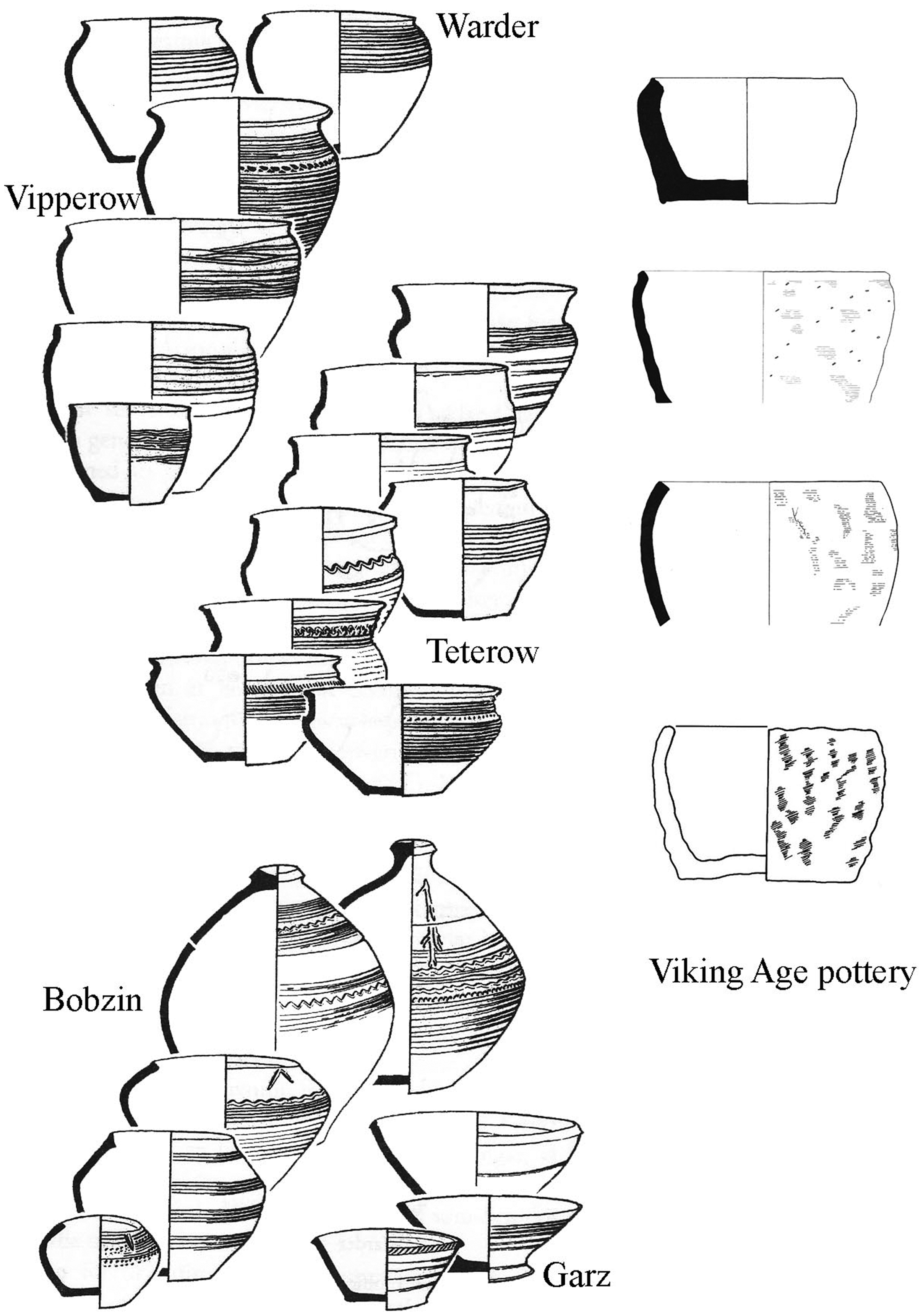
The tradition of linking the origins of Baltic ware and Slavic pottery-making is relatively old in Scandinavia. One of the first to assume this connection was Swedish archaeologist Georg Karlin, who in the 1920s observed similarities between pottery found in the early medieval layers of the town of Lund, the early eleventh-century pottery from the Slavic areas east of the Elbe and late eleventh-century and twelfth-century vessels from the areas around the greater Oder estuary (Karlin, 1923; for recent review of research on Baltic ware, see Kelm, 2000: 11–14; Roslund, 2007: 264–79). The early standard explanation for the occurrence of the vessels was heavily rooted in mercantile theory. It was assumed that the pots appeared as containers for imported perishable goods (such as salt, honey or wax) or as imports as such (e.g. Carlsson, 1982; Ż ak, 1961) (Figure 2).
Geography of the western part of the Baltic Sea showing some of the trading routes.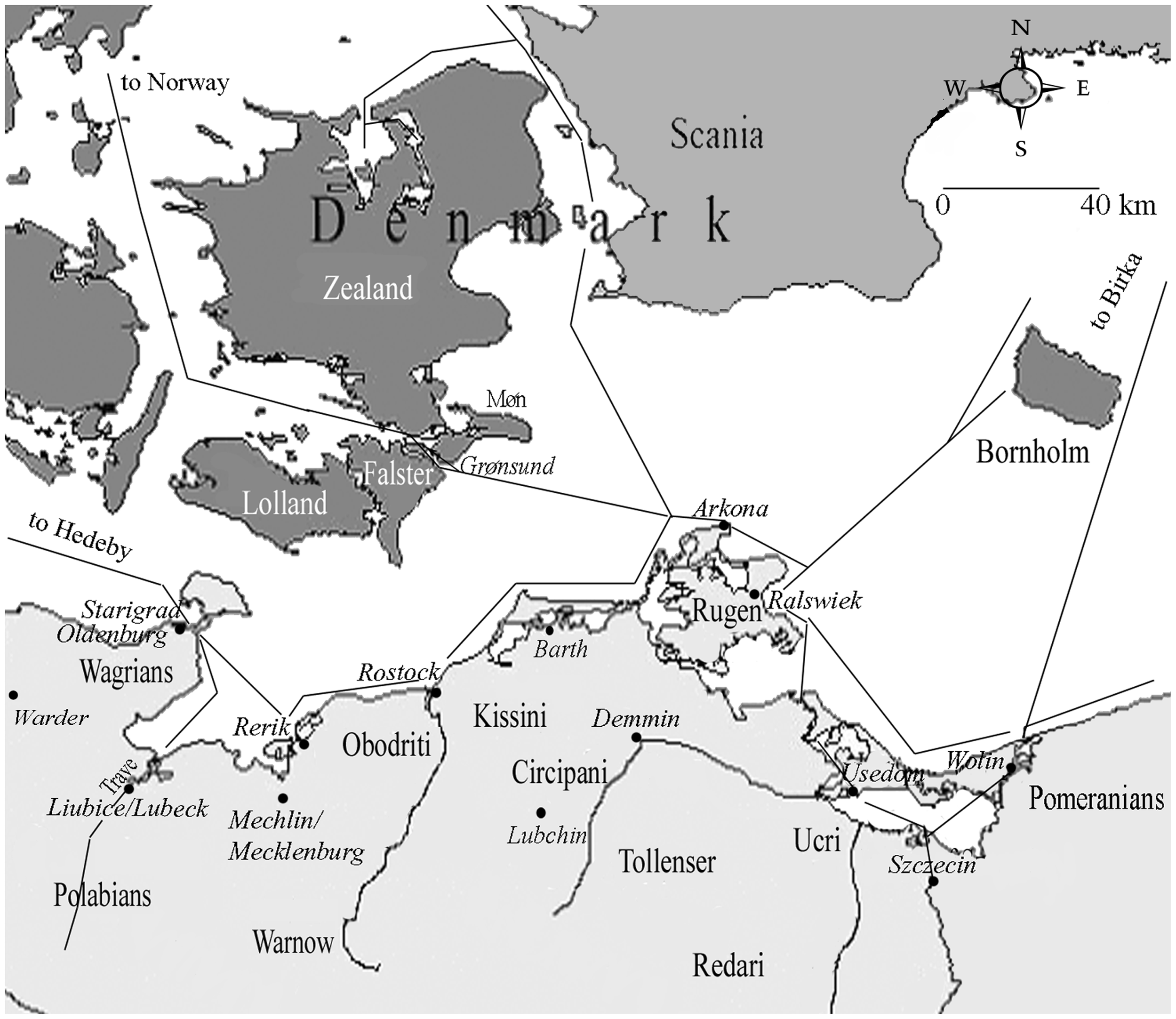
Among the first to reject the mercantile hypothesis as the sole reason for the spread of the Baltic ware were Niels-Knud Liebgott (1979) and Wilhelm Gebers (1980). Both observed that the tradition of black, decorated earthenware originates from the Slavic area and made the astute assumption that its appearance might be associated with the Slavic settlement in medieval Denmark. This conclusion was followed and strengthened by later studies (e.g. Kelm, 2000; Naum, 2009a; Roslund, 2007; Stanisławski, 2000). Pointing out that the novel ceramic tradition made a swift entry in southern Scandinavia, replacing the local handmade vessels in the course of just a few decades, it was concluded that the personal presence of skilled Slavic potters was required for such a quick and overwhelming change in tradition. A theory was put forward that these potters were among Slavs taken hostage in numerous conflicts between Denmark and the Slavic groups living on the southern coast of the Baltic Sea, or immigrants escaping political and fiscal pressure in their homelands (Kelm, 2000; Naum, 2009a: 40–2; Roslund, 2007: 505–11). They were incorporated into structures of farmsteads and produced pottery for the needs of a household with surplus intended for the market. The technological and stylistic solutions typical of Slavic pottery were then developed into new forms diverging from the original patterns and from the pottery tradition in the Slavic territory (Gebers, 1980; Liebgott, 1979; Roslund, 2006: 66–70, 2007: 473, 497–9). To accentuate the Scandinavian settings in which production of the pottery took place, the term Baltic ware was coined (Gebers, 1980: 167; Kelm, 2000: 13–14; Madsen, 1991: 226; Naum, 2009a: 59; Roslund, 2007: 279, but see critique in Filipowiak, 1998; Pedersen, 1989: 38).
Another observation that points towards the Baltic ware as being introduced on Bornholm by the immigrant Slavic potters is the lack of pottery showing experimentation with new technique, shapes and decoration. There are considerable differences between Viking Age pottery tradition and late Slavic pottery-making (Figure 1). Hence, if the Baltic ware was made by the same potters that produced traditional vessels, one could expect to observe potsherds showing early attempts to copy and test new ways of ceramic making. Such potsherds, however, are missing and archaeological material testifies to a swift shift from Viking Age tradition to Baltic ware pottery-making.
Migration then is assumed as a viable alternative in understanding the origins of Baltic ware, and numerous sources, including Slavic-sounding place names in Denmark, short accounts in the medieval chronicles and archaeological finds in the contexts of settlement and burial sites, confirm the possibility of such movements (e.g. Andersen, 1982, 2000; Grinder-Hansen, 1983; Housted, 1994; Kelm, 2000; Naum, 2009a, 2009b, 2010). These resettlements utilized previously established routes and webs of contacts (such as trade, dynastic or familial relationships) and were caused by different factors. Unstable political situations and harsh economic conditions brought by the expansion of the German Empire and the Polish Kingdom, as well as internal struggles between various tribal organizations, might have been strong incentives to move (Helmold of Bosau, 1966: Book 1, chapters 21, 22, 56, 88, Book 2, chapter 101; Naum, 2009a: 34–5). Economic possibilities in Denmark might also have played a part in decision-making about leaving (Andersen, 2000). Finally, some of the Slavic movements to Scandinavia might have had a coercive character. Human trafficking seemed to have been a relatively common and widespread practice in the region throughout the tenth, eleventh and twelfth centuries (mentioned by three major contemporary chroniclers: Adam of Bremen, Helmold of Bosau and Saxo Grammaticus). Taking hostages was also a common practice following organized military raids. Considering the number of such escapades in the region it is quite likely that a considerable number of Slavs and Danes ended up as enslaved labor on the other side of the Baltic Sea (Grinder-Hansen, 1983: 32, 35; Helmold of Bosau, 1966). Both the slave trade and slave labor were important elements in the early medieval economy in the region, and the scale of dependence on the profits accumulated from these two practices was most likely considerable (Henning, 1992; Karras, 1988: 76; Lindkvist, 1979: 66, 129; Nevéus, 1974: 139; papers in Lindkvist T and Myrdal, 2003).
Baltic ware on Bornholm
The appearance of the first Slavic vessels and then the spread of Baltic ware on Bornholm follow a similar chronological pattern to other places in southern Scandinavia. The first vessels made according to the technical and aesthetic principles at work in early Western Slavic ceramic production make a scarce appearance sometime in the ninth to tenth centuries. These are so-called Fresendorf and Feldberg vessels, single fragments of which have been discovered on the farms of southern Bornholm. These ceramics made a peculiar addition in kitchens filled with crude Viking Age pottery. On Bornholm they appear in the tenth-century layers of large farms, whose remains reveal clues about the merchandizing occupation of their inhabitants – silver hoards. Interestingly, most of the hoards dated to the late Viking Age and early Middle Ages contain an extraordinarily high amount of Slavic hacked ornaments, which served as a means of payment (Skovmand, 1942; Von Heijne, 2004). It is reasonable to think, then, that both the early Slavic vessels and the pieces of silver jewelry are material indications of tenth-century trading contacts. These new things brought from overseas journeys might have functioned as objects of fashion attributed to those who undertook those journeys.
The middle Slavic pottery of Menkendorf type appears more evenly on the island and it might be the first type of vessel made locally on Bornholm. At some places it is still accompanied in the kitchen by locally made undecorated pots, while on other farms it represents an addition to the Baltic ware made on a turntable.
However, the real change seemed to have happened in the eleventh century. Households began to be filled with s-shaped decorated vessels of various sizes and forms, most of which resemble late Slavic Vipperow (or G) type. The exclusiveness of Baltic ware is particularly evident in the case of newly established farms, the so-called ‘Østersø-bopladser’ (Baltic Sea settlements) that emerged in the course of the eleventh century. The earlier tradition of simple handmade vessels might have been sustained to a degree in some of the farms that were continuously used since the Viking Age. It seems, however, that these handmade pots were not made to any considerable extent after the middle of the eleventh century.
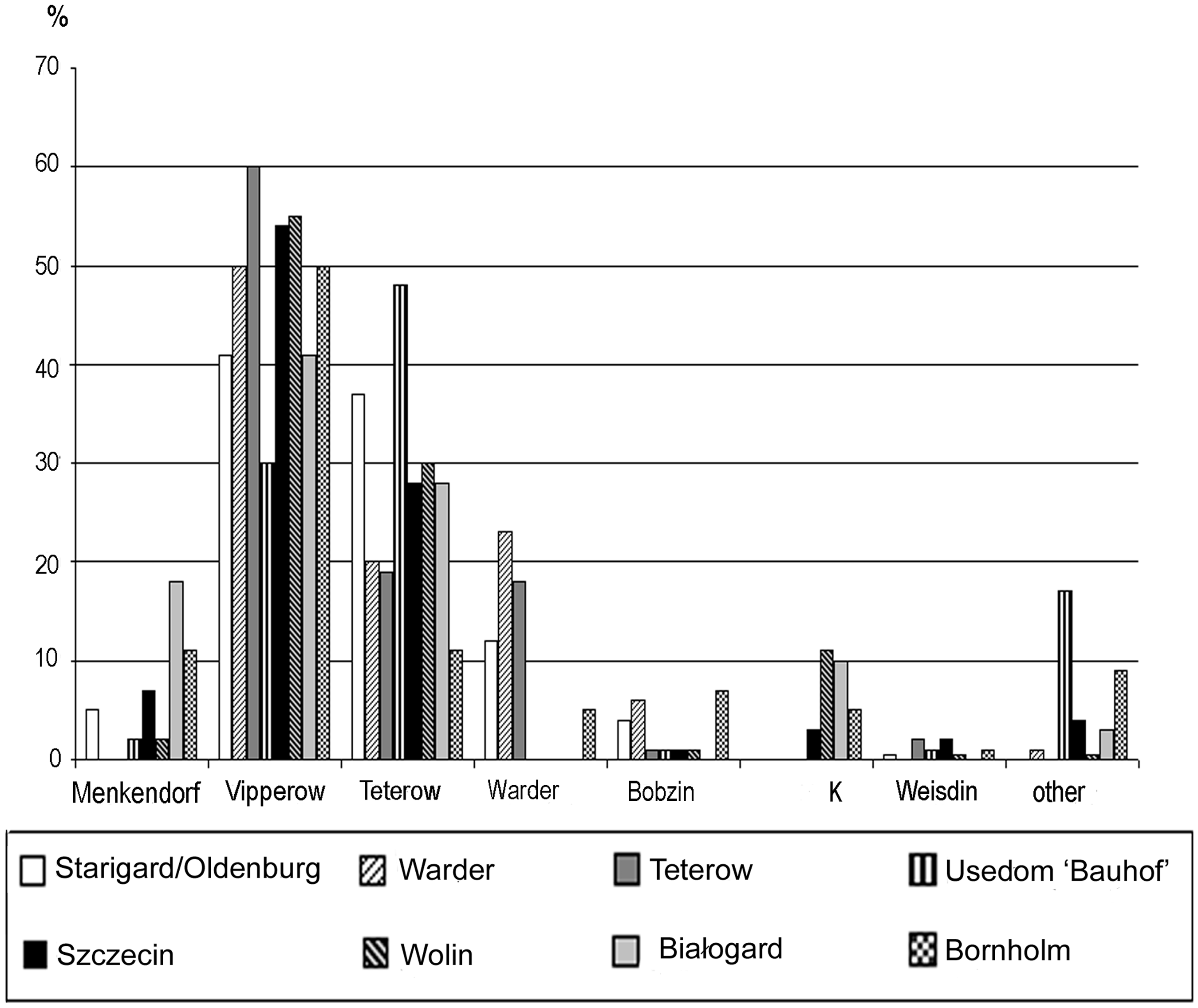
Although the chronology of when Baltic ware was introduced and used on Bornholm corresponds to that of other southern Scandinavian provinces, the vessel forms diverge from the tradition in Scania, southern Denmark and Zealand. Unlike the Scanian Baltic ware, which consists mainly of hemispherical, bowl-like vessels inspired by the pottery made in Rügen and the inland parts of Mecklenburg-Vorpommern (Kelm, 2000; Roslund, 2007), and unlike the pottery on Lolland and Falster, which seems to have closest parallels to the traditions developed in the territories of Holstein and westernmost areas of Mecklenburg-Vorpommern (i.e. medieval territory of the Obodrites; Naum, forthcoming), forms made and used on Bornholm very closely imitate pottery used in parts of Western Pomerania and in eastern areas of Mecklenburg-Vorpommern (i.e. territory of Lutizi settlement or influence). The potters working on Bornholm mainly produced everted, s-shaped vessels of various sizes, meant to be used for cooking and storage. Tableware and bowls as well as pottery with inverted rims occur more scarcely. Furthermore, unlike in Scania and Zealand, the pottery tradition on Bornholm does not diverge strongly from the stylistic and technological choices made by the Western Slavic potters. The Baltic ware produced on the island is generally well made and carefully decorated. These far-reaching similarities are particularly clear in the case of pottery unearthed at the site of Møllebjerg in northwestern Bornholm. The farm, being one of a few thoroughly excavated early medieval sites on the island, also produced a large number of Baltic ware shards. It is remarkable that the pottery collected at Møllebjerg has close analogies to the eleventh to early twelfth-century pattern of pottery-making in the northwestern Slavic settlements. These parallels are apparent not only in the set of forms that co-occur, but also in the shares of particular forms in the whole assemblage (especially the high percentage of s-shaped vessels and the limited number of globular forms). Another feature that strengthens this impression of similarity in the pattern of pottery production between Møllebjerg and Western Slavic settlements is the occurrence of large vessels with a decorative handle-like curb (Weisdin vessels) and ceramics with long and straight necks (type K). These types of vessels were made and used in the areas around the Oder estuary and further west. Their share in the total mass of pottery is always low, which is also the case at Møllebjerg (Figure 3).
Comparison between pottery assemblages from Møllebjerg (Bornholm) and the eleventh-century assemblages from sites located south of the Baltic Sea. Calculated from: Białęcka, 1961; Cnotliwy, 1986; Cnotliwy and Łosiński, 1983; Kempke, 1981.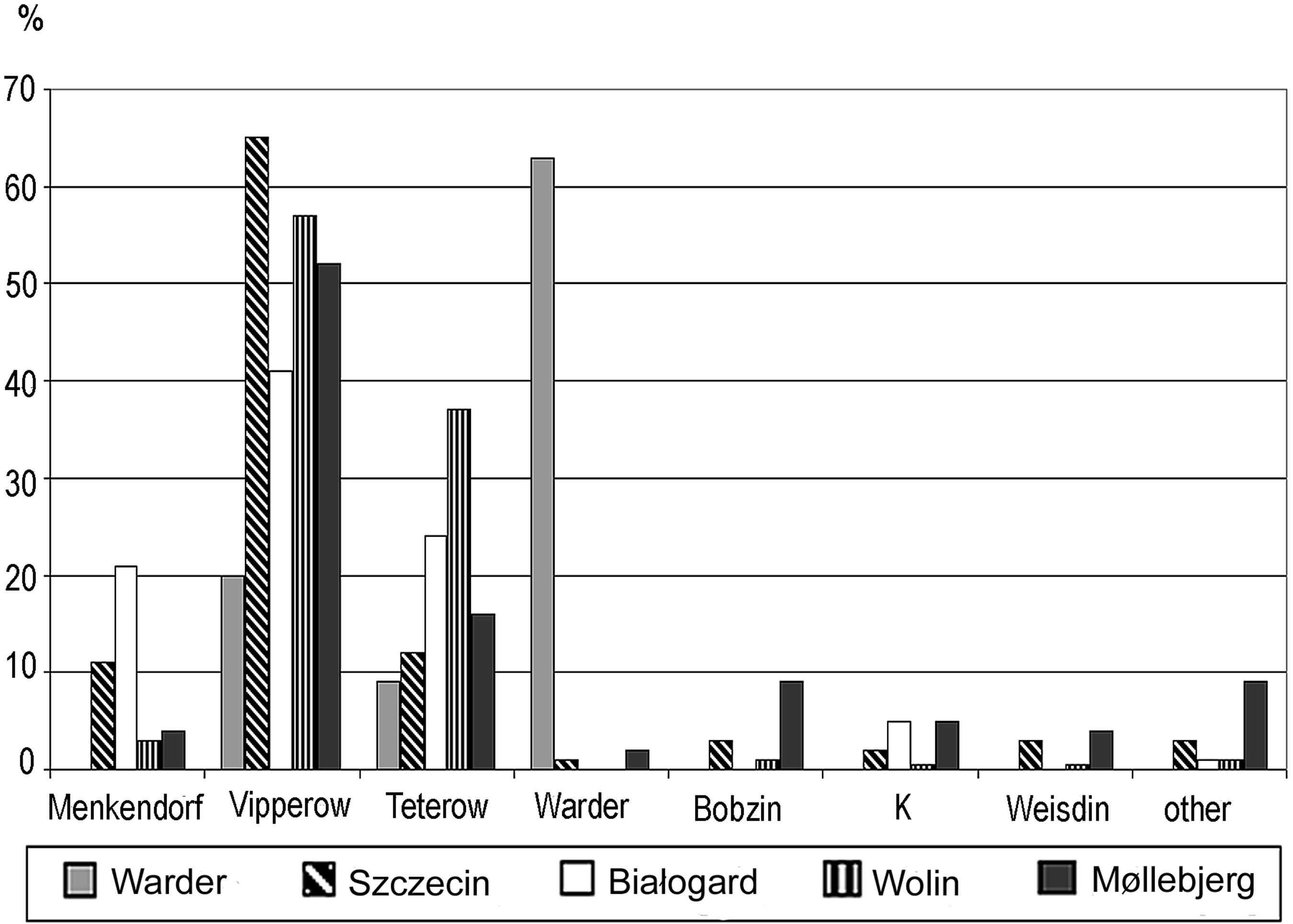
Overall, the closest parallels to the pottery-making from Møllebjerg are to be found in the territory along the mouth of the Oder, in Western Pomerania and northeastern parts of Mecklenburg-Vorpommern (Usedom, areas along the lower Peene and along the Uecker) (Figures 3–5) (Białęcka, 1961; Biermann, 2004; Herrmann and Donat, 1979; Lampe, 1980; Schuldt, 1956; Szczesiak, 1995). Even the sherds collected at other early medieval sites on Bornholm are reminiscent of late Western Slavic pottery, particularly that of the eleventh-century chronology (Figure 6). It seems that the immigration that took place during that time had the most visible impact on the local pottery-making, and the styles of ceramics introduced by the potters became ‘fossilized’ to a certain degree. This process might be visible in the relative unpopularity of Teterow vessels. In Western Pomerania and Mecklenburg-Vorpommern one can notice a considerable increase of Teterow pots in assemblages from the beginning and middle of the twelfth century. Their share rises in the middle of the twelfth century to 50 percent in Szczecin (Cnotliwy and Łosiński, 1983: 235), to 36 percent in Białogard (Cnotliwy, 1986), to over 40 percent in Behren-Lübchin (Schuldt, 1956: 95), and over 60 percent in Teterow (Schuldt, 1967: 27), from being under or slightly more than 20 percent in layers dated to the previous century. The share of Teterow vessels in the Bornholm assemblages remains approximately at the level of the eleventh century in assemblages south of the Baltic Sea.
Most common types of Baltic ware found on Bornholm (upper picture) and in Møllebjerg (lower picture). Not to scale. Drawn by author. Examples of the eleventh and early twelfth-century pottery from sites located along river Peene and from Western Pomerania: (a) Lassan; (b) Anklam; (c) Usedom, (d) Wolin; (e) Szczecin. After Białęcka, 1961; Cnotliwy and Rogosz, 1982: 110; Corpus, 1979: 44/65, 44/117, 49/19 and 49/20; Leciejewicz et al., 1983: 47, 51. Approximate contents of pottery assemblages from Bornholm and the sites in Western Pomerania and Mecklenburg-Vorpommern dated to the eleventh – mid-twelfth century. Calculated from: Białęcka, 1961; Cnotliwy, 1986; Cnotliwy and Łosiński, 1983; Kempke, 1981, 1984; Lampe, 1980; Naum, 2009a; Schuldt, 1967; Szczesiak, 1995.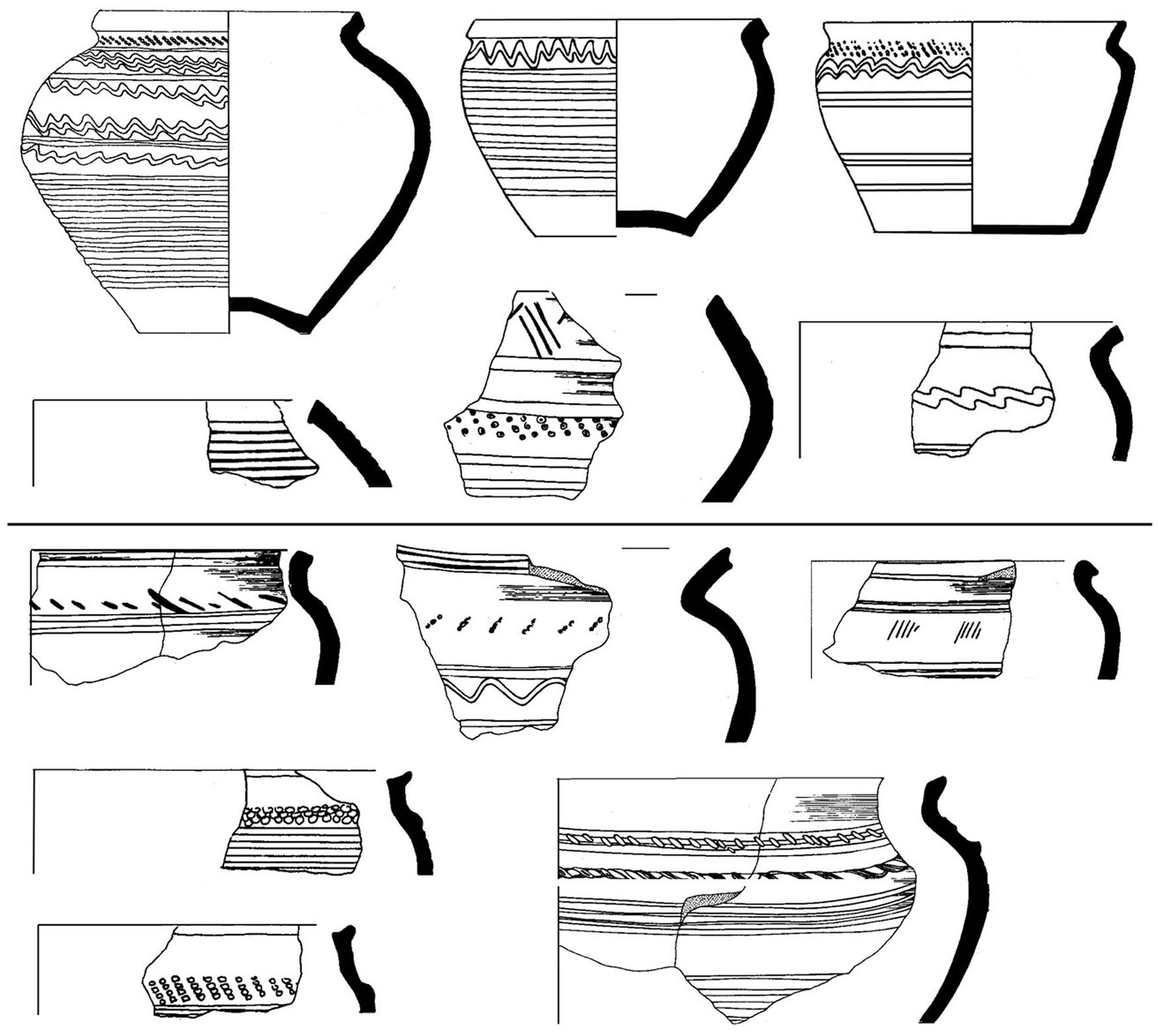
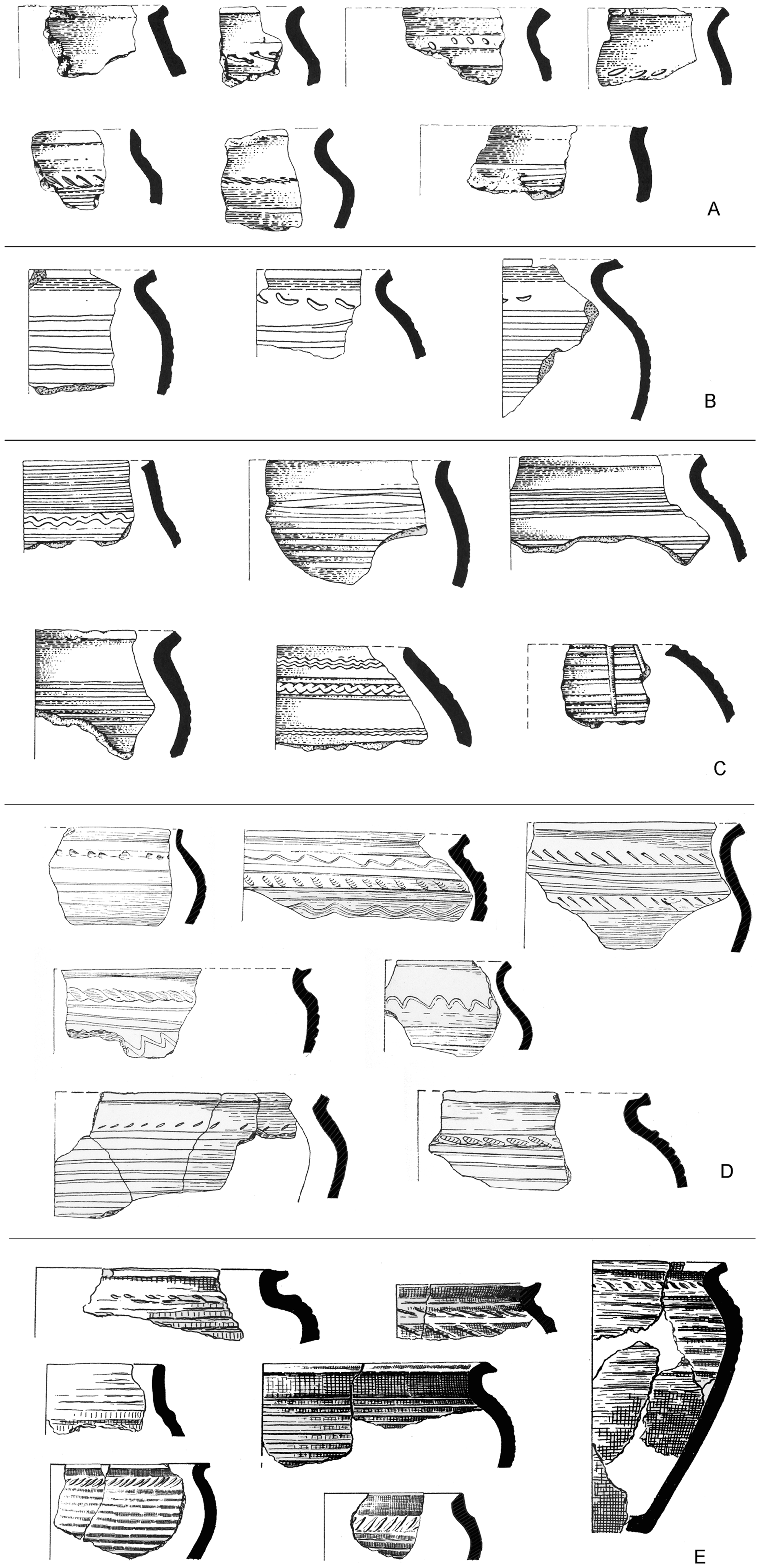
This far-reaching similarity between Bornholm’s Baltic ware and late Slavic pottery, and the effort to reproduce pottery types and forms introduced by the first potters making Baltic ware, is an interesting feature of ceramic production on the island. It differs from developments suggested for other Danish territories, where twelfth- and thirteenth-century makers of Baltic ware created forms clearly diverging from the ones thrown by previous generations of potters (Gebers, 1980; Pedersen, 1989: 128; Roslund, 2007: 485).
Ambiguous pots: Everyday and political projects
The introduction and production of Baltic ware on the island (and in other parts of southern Scandinavia) was important in the daily life of the immigrants but it must have affected the local inhabitants as well. In southern Scandinavia and along the southern coast of the Baltic Sea pottery was an omnipresent household artifact used daily to store, cook and serve food; a mundane object used in largely mechanical and unreflected-upon daily chores.
In the Viking Age, Scandinavian pottery was made by individual members of a household to answer the needs of that household. Pottery-making was not a specialized activity and the vessels made at home were not intended for the market. With the introduction of the Baltic ware the production acquired higher professional standards and required skills to use a turntable, to build a firing pit and to control firing temperatures. Judging from some regional similarities of pottery forms and decoration patterns, it could be concluded that the Baltic ware was manufactured only at certain farms and then distributed (exchanged or sold) to the satellite settlements. Such a model of production and distribution of pottery functioned, for example, in the coastal Slavic areas. There, potters as specialized craftsmen kept their workshops in early urban or tribal centers and villages distributed their wares throughout the micro-region or sold them during market days (Leciejewicz, 1989: 85). It is most probable that pottery-making was a seasonal occupation and that it was combined with agricultural activities or maybe other crafts. This model of early craft specialization was not foreign to Scandinavia either, where craftsmen working with metal, bone or antler combined their market-oriented production with farming and animal husbandry. The introduction of the Baltic ware could have been a way to meet the increased economic demand of specialization even in the sphere of household ceramics.
The replacement of crude Viking Age pottery with the Baltic ware happened very quickly and rather smoothly. Mats Roslund, in his study of the shift in pottery production and consumption in Sweden, put forward a theory that for people living in southern Scandinavia ceramics were mainly of functional importance and were excluded from social and cultural dialogue, hence the introduction of foreign craft practices was not opposed (2007: 493, 499). It is interesting to note that pottery-making in medieval southern Scandinavia was one of the most dynamically changing crafts and very susceptible to foreign influences. It was regionally influenced by Slavic, English, German and Frisian ceramic traditions (Madsen, 1991).
However, the shift in ceramic tradition might have had other roots as well. In the case of Bornholm, farmer-merchants who participated in overseas interactions prior to Slavic migration to the island and who used Slavic vessels before the Baltic ware flourished on the island could have acted as trend setters. Their early acquisition and use of imported vessels (Fresendorf and Feldberg pottery) could have influenced the willingness to adopt a new pottery tradition in two ways. First, because the local peasants could have primarily associated the novel pottery tradition of Baltic ware with the environment of large farms owned by merchants and not with the Slavic potters, it seems probable that behind the wide acceptance of the pottery might have been a desire to emulate the fashion and the material choices of wealthy elites. The will to copy and emulate the fashion of the time is recognized as a potentially powerful principle in introducing technological and material change (Bergatzky, 1989: 19–20; Boyd and Richerson, 1985, 2005; Dobres and Hoffman, 1994: 246). Second, the fact that the early examples of Slavic pottery existed on the island prior to the introduction of the Baltic ware and the fact that at least some Bornholmers would encounter a different material world, including pottery, during their overseas travels must have had a familiarizing effect. In the end, when the Baltic ware started to be produced on the island, the new forms of pottery were not quite so novel or exotic. For many islanders, they could have resembled objects they had used or seen before, objects that could easily fit the referential frames of cultural norms without causing major reorganization of daily tasks.
Precisely these aspects of the Baltic ware – new but not totally unfamiliar, involving material change in the equipment of households and shifts in organization of work but ensuring that these shifts could be easily dealt with – might have been utilized by the eleventh-century kings and elites in their political projects. The introduction of Baltic ware is not only connected with Slavic immigration to the island but also coincides, perhaps not accidentally, with other material, social and political changes on Bornholm. The eleventh century marks the territorial expansion of the Danish realm and a tighter grip on the areas outside of the core (this process is also well documented in Scania; e.g. papers in Anglert and Thomasson, 2003; Lihammer, 2007). As a consequence of this political development the inhabitants of Bornholm witnessed the institutionalization of the Catholic Church, modifications in the administrative division of the island, and most likely a rise of new leadership based on networks between local landowners and the Danish king. During this time a considerable shift in settlement structure took place, which involved the establishment of new farms and restructuring of the older ones (Nielsen, 1994). Abandoning the traditional way of pottery-making in favor of the Baltic ware was perhaps the most visible material transformation in daily life.
Theoreticians of everyday life argue that change can only begin within the daily sphere, and the crucial condition for change is the ability to imagine it and actively shape everyday practices accordingly to one’s goals (Jokinen, 2003; Shils, 1981). In this process, routines, including technologies and craft activities, might become politicized, being legitimized by and used to legitimize other profound changes (Bowser, 2000; Dobres, 2000: 5, 86; Dobres and Hoffman, 1994: 232–4; Lemonnier, 1993). Archaeologist Stephen Silliman, referring to the negotiation of the politics of social position and identity in daily practices, used the term ‘practical politics’ (2001: 194–5). He pointed out that politics do not always infiltrate the sphere of everyday life and they are often implicit, inconsequential and minor in daily conduct. Nevertheless, he stressed that in certain situations the key relevance of daily routines, which constitute the lived experience of individuals, might be recognized and exploited for political maneuvering. The movement of daily practice in and out of a political scope is a part of social negotiation.
Singling out mundane tasks as a way to control routines and reinforce seemingly minor shifts in everyday activities often goes in tandem with other shifts and modifications at different levels of social and political organization. Sometimes, even those appropriations in daily practices and material culture that are introduced without any explicit political agenda in mind have unexpected and unintended consequences in realizing larger political or social goals (Giddens, 1984: 9–14). It is interesting then to consider the potential impact or role of the introduction of Baltic ware in this particular moment of time and its connection with other transformations on the island. The potting skills of Slavic immigrants were utilized, which ultimately led to the abandoning of the traditional designs and methods of pottery-making. This change, which, judging from its quick acceptance, was not opposed and might even have been welcomed by peasants, would have had the unexpected consequence of extending the political project of transformation into the sphere of daily routines. Pottery is an interesting case in this process; as it is embedded in the structure of household and daily chores, it would also be one of the most tangible elements of tradition subjected to change. Paradoxically, however, even if the introduction of the Baltic ware was to a degree steered from above, this most material-in-character change could have been regarded as one of the least problematic and one which caused minimal friction. This is because the shift in production and appearance of household ceramics did not cause major changes in the social structure and conduct of everyday life. Compared with other changes (institutionalizing the Roman Church, reorganization of the landscape, changes in the political structure), which were openly questioning and threatening the existing order of things, the introduction of the Baltic ware could have appeared as having no direct political agenda.
This argument can be pushed further. It could be speculated that perhaps the eleventh-century Slavic immigration to the island was supported and to a degree organized by the Danish kings. Territorial resettlements and internal colonization were exercised in many corners of medieval Europe as a way to optimize economic income or as a tool for reshaping political and social landscapes by means of distorting the fixed order and weakening old traditions (Helmold of Bosau, 1966; Hoerder, 2002; Kara, 2002). It is conceivable, then, that recruiting settlers and employing them as tenants stood on the agenda of the expanding Danish kingdom and was seen as a possible way to exercise political power and to help integrate peripheral areas (such as Bornholm) into the structure of the kingdom. Efforts in that direction were undertaken by the king Sven Estridsen (1047–74). A written testimony of Adam of Bremen accredits him with finalizing the process of Christianization and formation of church organization on the island dependent on the Bishopric of Lund (Adam of Bremen, 2002: Book 4, chapter 8). It is likely that already Sven Estridsen owned some demesnes on the island that relied on the work of landless tenants (according to Flateyjarbók from AD c.1380 there were 20 royal farms on Bornholm in the time of Canute the Holy, 1080–86. Knytlinga saga mentions 12 royal farms). These farms were not only to engage in a large-scale farming and non-agricultural production, but they also constituted nodal points of royal control. It is also known that Sven Estridsen was involved in the politics south of the Baltic Sea and in the 1050s he participated in a civil war among the Lutizi. His support was paid off with gold, silver and captives (Adam of Bremen, 2002: Book 3, chapter 21; Helmold of Bosau, 1966: Book 1, chapter 1). Perhaps some of them ended up on the royal farms on Bornholm and other parts of Estridsen’s realm. Introduction of Baltic ware, abandoning traditional ways of pottery-making and considerable change in kitchen equipment were consequences of migration and new economic and political arrangements.
The question of politics occasionally entering everyday routines and the way politics can alter meanings ascribed to the mundane practices and objects brings me back to the issue of the extraordinariness of the everyday. The political, social and transformative projects seem to always involve practices of everyday life. Seemingly unimportant and mundane material components of the surrounding world can emerge in these processes as tools and symbols used for achieving specific goals. Their power is located in their everydayness and their ever-presence, and their ability to appeal (through their novelty or long pedigree). Before returning to the shelves and becoming again ordinary tools and means of conducting everyday routines, they have an ability to extend human agency by becoming intermediaries between people and the surrounding world (Attfield, 2000: 40; Hodder, 2007: 33; Robb, 2010; Tilley, 2006, 2007).
Ambiguous pots: Everyday experience of the immigrants
The introduction of Baltic ware was a part of larger transformations on the island, revealing how political projects make use of and infiltrate the sphere of the everyday. However, the everyday can emerge as important and meaningful for other reasons. Being the natural way of involvement in the world, immersion in daily routines offers a sense of comfort and control. In the following part I focus on the experience of the Slavic immigrants and scrutinize the effect of migration on the conduct of everyday life by posing the questions: If everyday is that which is most familiar and most recognizable, then what happens when the world is disturbed and disrupted by the unfamiliar, as in the case of migration? What are the possibilities hidden in the most immediate sphere of everyday for defining a sense of self and forging residence after migration?
To resolve these issues, first, I would like to return briefly to Stephen Silliman’s concept of practical politics. He pointed out that mundane practices are selected and politically charged not just by those who are seeking dominance. Quotidian practices may receive significance stretching beyond the functional for those who perform them. Silliman is concerned in his study with the situation of nineteenth-century colonialism in California and with politicizing daily activities as acts of resistance (2001, 2004). Medieval realities on Bornholm were certainly far from the modern colonial situation, but his idea is nonetheless worth exploring, as similar processes are at work in the cases of migration and are documented in the studies of past and modern diaspora and displacement (e.g. Brah, 1996; Clifford, 1994; Orser, 1998; Werbner, 2005). Both circumstances (colonial encounters and migrations) share certain similarities in the confrontation between two different cultural systems (although the range of differences may vary from relatively insignificant to diametric) leading to uncovering the partiality of social rules and norms. These situations may lead to revealing the taken-for-granted, self-evident order of things (Bourdieu’s doxa) as partial, causing reformulation of the beliefs and ‘truths’. Circumstances like this require response, which in turn allows for alteration in the conduct of the practice or in the meaning given to this practice. For my case study, I would like to argue that making and using pottery could have been explicitly used in the process of forging and reworking identity and coping with the discomforts of migration.
When Slavic immigrants arrived on Bornholm they were most likely incorporated into an already existing settlement structure. The lack of Slavic sounding place names on Bornholm and characteristics of archaeological material would suggest that their settlement was largely dispersed. The immigrants might have arrived in relatively small groups. As suggested by what appears to be local production of Menkendorf pottery, some individuals had already arrived in the tenth century, perhaps in connection with unrest caused by the frontier politics of the Ottonian kings or attempts of the Polish duke Mieszko to capture territories along the lower Oder. Other groups of newcomers came in the course of the eleventh century, some possibly as a result of internal conflict among Lutizi Federation described by Adam of Bremen (2002: Book 3, chapter 22) and Helmold of Bosau (1966: Book 1, chapters 21–22).
Judging from the settlement reorganization that took place in the early or middle eleventh century and the fact that Baltic ware is the only pottery used at the newly established farms (‘Østersø-bopladser’ or Baltic Sea settlements), some of the immigrants might have been involved in the colonization and clearing of land and setting up new farms. If immigration was supported by the Danish kings, one could expect the newcomers to be employed at the large farms owned by the kings. Unfortunately, it is hard to determine the social status of the newcomers. Although none of the historical sources specifically describes the situation on Bornholm, through general historical references, such as the eleventh and twelfth-century chronicles describing Baltic Sea area and Scandinavian medieval laws, it could be assumed that some of the immigrants were brought to the island as captives and used as a work force. Archaeological data are rather unhelpful in resolving this issue, as domestic slavery practiced in the medieval Baltic Sea area is hard to detect in material assemblages. The same written sources that describe the menace of human trade report (Helmold of Bosau) or hint (Saxo Grammaticus) at Western Slavic migration to Denmark caused by political and economic changes south of the Baltic Sea. Thus it is very likely that at least some of the newcomers on Bornholm, perhaps also the potters, chose to settle on the island and acquired the status of tenants.
Regardless of their social status, the landscape the immigrants entered was to a degree foreign and alienating. This sudden break with the familiarity of their surroundings, including the most recognizable space of home, and the change in the routines of their everyday chores undoubtedly caused some level of distress. The objects that individuals were able to salvage and the practices they were allowed to conduct (in this case pottery-making and the ability to handle familiar vessels during daily chores) might have gained particular significance in this context. They acted as mind stabilizers, revealing ‘the continuity of the self through time, by providing foci of involvement in the present, mementoes and souvenirs of the past, and signposts to the future goals’ (Csikszentmihalyi, 1993: 23; see also papers in Arvidsson et al., 1990; Ehrkampf, 2005; studies in Miller, 2008; Parkin, 1999; Tolia-Kelly, 2004). The ability to retain known traditions in largely unknown surroundings created the possibility of partially reinstating the comforting quality of everyday life.
The case of Bornholm and medieval potting performed originally by immigrants might then be an example of a practice which has received a new meaning arising from a need to find familiarity after dislocation (one could argue that similar processes also took place in other parts of southern Scandinavia). The Baltic ware that was produced on Bornholm is comparable to the late Slavic pottery used south of the Baltic Sea (Figures 3–6). Shapes, decoration patterns, and clay recipes were duplicated, recreated according to the learnt schemes of pottery-making. However, because of the circumstances of displacement, for the immigrants, making the vessels according to learnt patterns and using familiar-looking ceramics in their daily routines might have become more than an unquestioned habitual practice. The humble ceramic pots had the property of a reminder, bringing comforting familiarity to foreign places. Charging pottery-making and its daily use with particular significance was possible during daily chores involving pottery use by immigrants and their offspring, as well as during the process of teaching or learning the craft. Every episode of teaching novices how to make a pot created an opportunity not only to bring the sedimented practice into consciousness but also to retell stories. The possibility of charging pottery-making and its daily use with meaning arose from the ability to experience and engage with reflexive thinking while glancing back at the project just conducted and the object just fashioned or handled. Michael Polanyi observed that things have a capacity to reveal themselves in unexpected ways and their hidden potentialities can be actualized due to the efforts of human thought (1983: 89). Displacement constituted a viable context for such ‘revealing’.
Initially, the meaning given to the pottery might have been strongly associated with the construction of an image of lost homelands. The immigrants might have regarded the Baltic ware vessels as silent reminders of the homes they had left behind, a material element inseparably related to their identity as immigrants. Hypothetically, a reflection of such an immediate link between identity and material culture might be the relatively unchanged way of making and decorating pottery observed at Møllebjerg. Although it is hard to establish a definite chronology for pottery-making at the farm (German and Danish coins found at the site were struck between the 990s and 1070s), it is likely that the sherds come from pots produced by at least two or three generations of potters. A tendency to reproduce the same forms, shapes and decorative designs is not exclusive to Møllebjerg but it seems to be a general feature of Baltic ware on Bornholm. A high degree of conservatism might be an indication of the will not to forget, as if a close repetition of existing patterns was to assure continuity with the past and perception of self as having roots someplace else. Fossilization of pottery forms and patterns of decoration, and lack of interest to follow development in pottery production south of the Baltic Sea (mirrored in a limited production of Teterow pots on the island), might indicate deliberate attempts to maintain pottery-making and its appearance ‘as remembered’, as if such conservatism was essential for keeping a sense of continuity and particularity. Identity construction would then hinge on a ‘museumization’ of practices. As one of very few material objects that continued in use after relocation and as quintessentially homely artifacts, the daily handled pots might have assumed the symbolic status of heirlooms – material reminiscence of life prior to migration with its idealized comforts and security. This process of attachment to material objects due to their ability to provide recollection, stimulate remembering and form records ‘storing information beyond individual experience. Entering us through the senses’ (Kwint, 1999: 2) is a common thread in migrant and diaspora testimonies (e.g. Bender, 2001; Digby, 2006; Ehn, 1990; Parkin, 1999; Tolia-Kelly, 2004).
Another archaeological pattern that could be explained as a possible indication that pots have acquired special meaning beyond the ordinary is the high quality of the Baltic ware and general care invested in its making and decorating. Compared with the eleventh- and twelfth-century vessels produced south of the Baltic Sea and in other Danish territories, Baltic ware from Bornholm includes a relatively high percentage of pots that are decorated with complex sets of designs. Alongside simpler motifs of horizontal furrows incised by a comb or a stick alone or in combination with a single frieze of a wavy line, diagonal or round incisions, considerable numbers of potsherds recovered from Bornholm bear traces of elaborate decorations consisting of multiple friezes and furrows (22% of sherds; see Figure 4 for examples). Although these complex designs were also a feature of late Slavic pottery (particularly in the case of Bobzin and Weisdin vessels) they seem to be less commonly employed. In eleventh–twelfth century Starigard, vessels decorated with multiple friezes constitute only 8% of decorated pottery (Kempke, 1984: 90). They are equally infrequent in Mecklenburg, Usedom and Szczecin (Biermann, 2004: 146; Cnotliwy et al., 1983; Donat, 1984: 93–5). This investment of time and attention to detail as exercised by the first generations of potters making Baltic ware on the island might be another clue about the importance of retaining familiar practices in dealing with relocation. Exercising learnt and familiar skills had mind-stabilizing qualities and elicited sensory and emotional responses providing yet another opportunity to recall and immerse oneself in thinking as usual. Engagement with pottery-making had the potential to ignite flashes of memory that could prompt a feeling of comfort and a sense of ease. In contrast to the unknown surroundings, whose physical and social topography was difficult to navigate, the ability to conduct a well-known practice offered the possibility of employing confidence and mastery, restoring a sense of self-esteem as a knowledgeable and skillful actor.
Conclusion
The complexity and ambiguity of the everyday means that mundane objects and practices can signify diverse things to different people in different contexts. The values, associations and meanings given to objects and practices are not fixed, but rather subject to alteration. The Baltic Sea vessels could have been a tactile and visual reminder of a lost homeland for the Slavic pottery makers and the immigrant users. The conservatism of pottery styles and the care invested in their making suggest that the ceramics acquired just such a symbolic meaning (at least among the first generations of the immigrants). As one of the practices that continued to be carried out after migration, pottery-making and the daily use of vessels promoted a feeling of comfort and a sense of familiarity in the foreign landscape. In this respect, routines of using and making the vessels, which otherwise would have been regarded as natural, unquestioned and ordinary, in these very settings might have become something else – comforting, meaningful and extraordinary.
These particular meanings and associations were not universally shared or timeless. While for the immigrants, the Baltic ware ceramics epitomized places of origins, for some Bornholmers the same pots might have been no more than a curious novelty, an object associated with a certain lifestyle and a utilitarian element of the household. Furthermore, regarded at one point as a novel object, through use of which one could emulate aspects of someone else’s material choices, or technology that could be an unexpected ally in wholesome transformations, the Baltic ware could rather quickly retreat into the shadows of the ordinary, becoming an unquestioned artifact of daily life. In the same vein, the same pottery tradition and vessels that once materialized a sense of origin and identity among immigrants could lose their connotations just a few generations later. This is because neither identity nor the link between objects and identity is constant or straightforward and, as noted by Divya Tolia-Kelly (2004: 315), ‘signification of identity, ( … ) through material cultures, depends upon the continuing dependence on the past for sustenance in the present’.
The identity of subsequent generations of immigrants might have been considerably transformed, shifted, and with this also the meaning of certain practices and objects could have become largely rearticulated – a point frequently made in studies of transnationalism and diaspora (Brah, 1996: 180–1, 190; Ehrkampf, 2005; Hall, 1990; Malkii, 1992: 37; Rouse, 1995: 370; Vertovec, 2001: 575).
This changeability of meaning is embedded in the characteristics of everyday life and tradition. It is probably correct to regard both as largely inert, habitual, filled with unconscious and repetitive acting, but it is also true that daily acting is pregnant with vast potential. Episodes of migration or resettlement, because of their often abrupt break with the familiarity of landscapes, routines and face-to-face interactions, are interesting cases for studying the multifaceted meanings and significance of everyday life and trajectories of refiguration in human–objects relationships.
Footnotes
Acknowledgements
I would like to thank John Robb and four anonymous readers for their valuable comments on the article in draft forms. I would also like to thank Lynn Meskell for editorial help.