







Abstract
For over 200 years, until the 1960s, a system of haciendas and debt peonage dominated the rural economy of the central Ecuadorian highland province of Chimborazo. Over the last 40 years, with land reform and growing indigenous political and economic power, the hacienda system has declined. The ruins of hacienda architectural complexes now dot the landscape of highland Ecuador, presenting challenges to ideas of heritage representation, management, and visions of the rural past. Through the presentation of three case studies of hacienda complexes outside the town of Colta, Ecuador, I propose that these properties usefully remain in legal limbo, providing community architectural spaces and spaces for the memories of great pain that surround the hacienda era in this region.
‘If we still dwelled among our memories, there would be no need to consecrate sites embodying them’ (Nora, 1996: 1) ‘I cannot go away from here. This is our land for always’ (Anonymous informant, Yanacocha community in 1964, quoted in EARC, 1965: 147)
Early houses
In July of 2009 I carried out archaeological survey work in rural areas to the west of the town of Colta, in the province of Chimborazo in the Ecuadorian Andes (Figure 1). Chimborazo has one of the highest percentages of self-identified indigenous people in Ecuador and is also one of the poorer regions of this Andean nation (PAHO, 1998: 242; Zamosc, 1995). The most obvious heritage resources encountered on the landscape, and the category of resource most often pointed out by local people, are the remains of former hacienda houses, either completely abandoned, or with a few rooms still occupied. These are both visually prominent on the landscape and prominent in the minds of local people as locations where ‘the past’ took place. The owners of the buildings were usually absent, having moved away over the course of the last 30 years. Indigenous people make up the vast majority of those cultivating the land surrounding these buildings today. Three adjacent examples of these hacienda houses provide examples to explore the role these ruins play today as reminders of the past and as buildings used in the present.
Signs on the land: an abandoned hacienda house outside Colta, Ecuador.
The hacienda era as difficult memory
The French historian Pierre Nora created, in his Lieux de Mémoire project, a particular way of looking at important sites of memory. For him, part of modernity is the end of memory as lived repetitive experience and its replacement with history, defined as ‘the reconstruction of what is no longer’. Nora's influential work in France surrounding the past, memory, and landscape takes as an assumption the modern world's profound break with milieux de mémoire—environments of memory—settings in which memory is a real part of daily, lived existence. These are replaced with lieux de mémoire—places where a residual sense of continuity with the past exists, commemorated through the reconstruction of architecture or the construction of commemorative monuments. Nora associates this type of commemorative activity with modernity (Nora, 1996). For Nora, French peasant culture is the ‘quintessential repository of collective memory’, in stark contrast to ‘hopelessly forgetful modern societies’ (Nora, 1989: 7–8). In modern France, a variety of objects, buildings, people, and concepts became the lieux de mémoire that inform French national consciousness. In Ecuador, the hacienda, as place and as concept, has become one of the more important lieux de mémoire in national consciousness. The focus of Jorge Icaza's 1934 brutal realist novel, Huasipungo, the hacienda has come to represent a key factor in the national consciousness of race relations in Ecuador and as such is memorialized in Nora's sense, in literature and in the preservation of many rural hacienda architectural complexes associated with elite families of the colonial and republican periods throughout the highlands (Corral et al., 1996; Guerrero, 1991; Lyons, 2006).
The hacienda was one of the most important categories of large-scale agricultural enterprise in Latin America. Usually not as heavily capitalized as a plantation, haciendas drew from regional sources of capital to accumulate a large land base and then grew products that were sold to regional markets. Their labor was generally drawn from the semi-free ranks of debt peons. This is in contrast to plantations, where capital investment was extensive, markets for products were global in scope, and the majority of labor in the colonial period came from enslaved Africans (Wolf and Mintz, 1957). In Chimborazo, the hacienda system emerged beginning in the late seventeenth century, as many rural indigenous people had died of introduced diseases or had left their home territories to seek wage labor and avoid the tribute costs imposed by the colonizers on their home communities (Powers, 1995). By the 1750s a large proportion of the rural land in Chimborazo had been alienated from indigenous communities through the courts, allowing ethnically Spanish colonizers to amass land bases for large-scale agricultural operations, encouraging indigenous people to enter debt peonage labor relationships (Tyrer, 1988: 250–251). For the next century this hacienda agricultural system dominated the agricultural production of Chimborazo.
The hacienda houses, as iconic ruins, are representative of a time when the owners of these houses, the hacendados or patrones, held considerable power over the local landscape. The work of historians and cultural anthropologists in the rural areas of Chimborazo has given us a picture of the ways local people portray this period (Guerrero, 2010; Lyons, 2006; Thurner, 1993). The local term in Chimborazo is jazinda timpu, a Quechua/Spanish term literally meaning ‘the hacienda era’. Indigenous communities in Chimborazo have very mixed feelings about this time period. On the surface, descriptions are of a dark time when hacienda patrones and priests kept indigenous peasants in deliberate ignorance, a time when indigenous people wasted their money on alcohol and the cargos of the hacienda fiestas honoring the patron saints of each hacienda. This portrayal is one that is tinged with ideas that Protestant missionaries have brought into communities, such as notions of abstinence and anti-Catholicism (Huarcaya, 2003; Muratorio, 1980, 1981; Swanson, 1994). And yet jazinda timpu is also seen as a period when crops were more abundant and lush (under large-scale agricultural control of irrigation systems, etc.), and the fiesta celebrations were beautiful traditions that outshone today's community celebrations (Thurner, 1993: 74). There is thus a strong mix of horror and nostalgia projected by local indigenous people onto the time period when the haciendas were dominant.
This portrayal of the past is embedded in a present in which many indigenous or mestizo (mixed-race) people from both rural areas and small towns in Chimborazo are moving to the larger cities for wage labor. This cyclical absence is combined with a deep commitment to the land on the part of racially conscious indigenous people, who invest urban wages in purchasing larger agricultural plots to make farming economically viable. This too is a time in which indigenous political consciousness has been awakened by 20 years of battles to gain recognition on the Ecuadorian national political stage, a battle in which indigenous people in rural Chimborazo have played a key part (Botero Villegas, 1999; Cervone, 2012; Colloredo-Mansfeld, 2009).
The abandoned hacienda houses are physically and ideologically located in the midst of these conflicts. The central architectural complexes of these haciendas were generally built or heavily remodeled in the 1870s to 1910s, as demonstrated by the modern hardware used in various features of the standing buildings and in the modernist styles creeping into their facades. These rebuilding events coincide with the economic boom in regional hacienda agriculture from 1870 to 1918. In this period, management practices were modernized, the national road system improved, many workers were brought in from outside the region, and a lot of haciendas consolidated into larger multi-property operations. Yet the buildings often stand on foundations from the colonial period, with river cobble patios, and often with colonial-era decorative masonry reused in various locations in the construction. Historical records, combined with the toponyms on the land surrounding them, define the territory these haciendas controlled going back to their founding in the eighteenth century. As such, they represent a particular period in the history of the area, as monuments standing in the wider palimpsest of the Andean cultural heritage landscape (Abercrombie, 1998; Lyons, 1999; Wernke, 2007).
Over the past 20 years, the physical remains of haciendas have become the topic of research by historical archaeologists in many parts of Latin America. The emphasis in this research has been on the built landscape as a means of control of workers, spatial relationships, architecture, and the use of excavated collections to speak to the everyday lives of those who toiled on these large-scale enterprises (Alexander, 2004; Martín, 2008; Meyers, 2012; Newman, 2010). Elizabeth Newman and Harold Juli (2008), in their work at a hacienda in Puebla (Newman and Juli, 2008; Newman, 2014), and Allen Meyers (2012), in the Yucatan, have undertaken ethnoarchaeological interviews, gaining knowledge of the hacienda period from those still-living members of the community who were workers on the haciendas. As part of both of these projects, the researchers have advocated the creation of living museums to recreate how life was lived on haciendas. Archaeologists have not, however, engaged with the role that hacienda ruins may play in living communities today and the role of such standing ruins in the creation of community identity (Juli, 2003: 24; Meyers, 2012: 17–18).
The standing architecture of hacienda complexes throughout Latin America has been reused in myriad ways, reflecting their often robust construction but with a clear emphasis on the largest hacienda complexes and the romance of living in such architecture for the elite families who have inherited many of these properties (Corral et al., 1996; Nierman et al., 2003; Téllez et al., 1997). These lovingly restored and maintained properties contrast with the smaller abandoned estates in rural Chimborazo. We immediately confront the idea of a heritage made up of ‘difficult memories’. The Chimborazo houses are sites of negative heritage (Meskell, 2002), where memories of a difficult past are still to be reconciled with the future of Ecuador.
Scholars of heritage struggle on a global scale to understand how to commemorate landscapes in which massacres, genocide, imprisonment, and death are the memories most closely associated with locations (Gordillo, 2011; Logan and Reeves, 2009; Meskell, 2012; Myers and Moshenska, 2011). The ruins of modernity, and the abandonment of twentieth century buildings and landscapes, is a topic that heritage practitioners have begun to explore globally in the context of urban decay, from abandoned British (Edensor, 2005) and German (Barndt, 2010) factories to abandoned New Orleans (Dawdy, 2010) or Detroit (Steinmetz, 2010) neighborhoods. Such remains push archaeologists and urban planners to confront endless blocks of ruins in the sense that Walter Benjamin (1999) confronted the items in the dusty window displays of 1920s Paris—items abandoned in the headlong rush of innovation in capitalism; obsolete waste that confronts the idea of progress. The hacienda ruins of Chimborazo are imbued with a similar sense of abandonment in a headlong rush toward somewhere else.
The Chimborazo hacienda
The hacienda system in Chimborazo became entrenched in the mid-eighteenth century, after 200 years of Spanish colonial administration in the area. By the 1750s, many native Andeans in the region had left their original communities because of the high burden that colonial tax regimes put on them. Privately held haciendas provided their workers, or concertados, with protection from such taxation, and by the mid-eighteenth century the area around Riobamba was one of the most heavily privatized agricultural zones in the colony, with the majority of male native Andeans in the region serving as laborers on either a hacienda or in rural cloth-making facilities (Tyrer, 1988: 250–251).
Religious fiestas, many of them surrounding the patron saints of each hacienda, an image of which would have been held in a chapel adjoining the main hacienda house, were an integral part of the religious justification for hacienda labor relations in the Andes. This system of hacienda patron saints and Catholic religious observance by hacienda workers emerged with the haciendas in the colonial Andes and continued until their disillusion over the past 50 years (Sallnow, 1983). In Chimborazo, predawn prayers overseen by the patron's wife were common. The feast days of the patron saint were the focus of important ritual activities in which all hacienda members participated, with individual laborers appointed to particular offices in order to prepare for such events. Thus, for a period of almost two centuries, the core architectural complexes of the haciendas were both economic and religious hubs for the indigenous communities tied to the hacienda system (Lyons, 2006: 102–141; Thurner 1993: 53–60).
The breakdown in hacienda labor relations began with the increasing secularization of Ecuador after the Liberal Revolution of 1895. The 1918 abolition of imprisonment for debtors and the construction of state elementary schools in rural areas after 1912 were both key factors in liberating peons. In this same period, the completion of the national railway system and a boom in coastal plantations allowed peons to leave highland haciendas for wage labor on the coast much more easily (Casagrande and Piper, 1969: 1053; Lyons, 2006: 58). In the 1930s, the pace of change increased. The 1937 Ley de Comunas (Law of Communities) encouraged rural indigenous communities to incorporate as legal entities. The rise of the communist Federación Ecuatoriana de Indios began to provide these communities with a national political voice advocating wage increases and agricultural unions (Lucero, 2008: 97; Sylva, 1986). In 1964 the military government passed land reform laws that abolished debt peonage and allowed communities to sue large landowners to take over underutilized land on haciendas (Colloredo-Mansfeld, 2009: 11; Korovkin, 1997: 28–29). An older indigenous leadership, largely put in place by hacendados, was replaced after the 1960s by younger, more educated leaders brought up in the atmosphere of comuna agriculture less dependent on the whims of the patron. These political changes were combined with very serious religious changes in Chimborazo. Within the local Catholic church the liberation theology movement from the 1960s onward has focused on returning church lands to indigenous communities, promoting Quichua language and literacy, and the human rights of indigenous people in Chimborazo (Illicachi Guzñay, 2006; Lernoux, 1991). Over this same period, Protestant mission churches from North America worked hard to gain converts among rural indigenous people. This provided an alternative religious philosophy emphasizing individual achievement, questioning the ritualized fiestas tied to hacienda patron saints, and giving religious backing to the new comuna structure through Quichua-language radio, schools, healthcare, and other community support programs (Andrade, 2004; Muratorio, 1980; Thurner, 1993: 61).
From the 1970s forward, indigenous comunas became more radical in their tactics. Peasant communities undertook many land seizures, cultivated crops and grazed animals on hacienda lands without permission, put pressure on hacienda owners to sell land to them, and made demands for land through the court system. The invasion of 11 regional haciendas by peasants in November 1976 is seen as a watershed moment. Hacienda owners responded by hiring armed gangs to raid more radical communities and confiscate indigenous peoples' livestock. At times this escalated into death threats, the burning of peasant houses, and shootings (Korovkin, 1997: 37; Lucero, 2008; Lyons, 2006).
Activities in Chimborazo have kept pace with national movements toward indigenous rights. In 1986 this culminated in the formation of the Confederación de Nacionalidades Indígenas del Ecuador (CONAIE), the first national organization of indigenous groups in the country, fighting for land rights, indigenous rights, an end to neoliberal economic policies, and better national government (Pallares, 2002; Selverston-Scher, 2001). In 1990 CONAIE staged the first of an ongoing series of uprisings, in which perhaps 70 percent of rural peasants in the country participated in roadblocks, demonstrations, and takeovers of government buildings. In Riobamba between 20,000 and 60,000 rural peasants marched into the city, cutting off outside contact by road for seven days (Korovkin, 1997: 43).
Indigenous politics since the 1980s in Ecuador has been symbolically tied to the issue of access to land. Most Ecuadorians, including most indigenous people themselves, see the idea of being indigenous as defined by having origins and ongoing ties to a rural community and having worked the soil there at some point in their life. Such an ideal is often brought up in the rhetoric of authenticity used by current indigenous political leaders to justify their own claims to authority (Colloredo-Mansfeld, 2009: 31). Yet the growing political power of indigenous people in the country has come in parallel to a growing diversity of economic paths, as educational and political change has allowed movement into urban careers, temporary migration for cash wages, and the growth of native-owned non-agricultural businesses (Colloredo-Mansfeld, 2009: xiii). This is not to deny, however, the important symbolic role that ties to the land still hold for almost all indigenous people in the country and the very real struggles of rural communities attempting to subsist from agricultural plots too small to give economic success to families.
The houses visited
As for the former hacienda houses themselves, some are still occupied by families that owned them 40 years ago, but in many cases in Chimborazo the ownership has become contested through court cases, and elite property owners have migrated to large cities. The economic breakdown of the hacienda agricultural system has left the architecture at the core of the hacienda complexes largely abandoned. These are agglomerations of domestic and agricultural buildings surrounding a series of patios, many occupied since the mid-colonial period but generally with standing architecture dating from the mid-nineteenth through early twentieth centuries. In almost all cases, some of the rooms or buildings have been repurposed by local community members, but the majority of the architecture has been left to decay. Located in the midst of increasingly confident indigenous farming communities and falling into a netherworld of legal doldrums, the empty properties provide a challenge in heritage management for the communities of which they have become, or perhaps were always, part (Figure 2).
Location of haciendas studied, to the west of Colta, Ecuador (Source: author).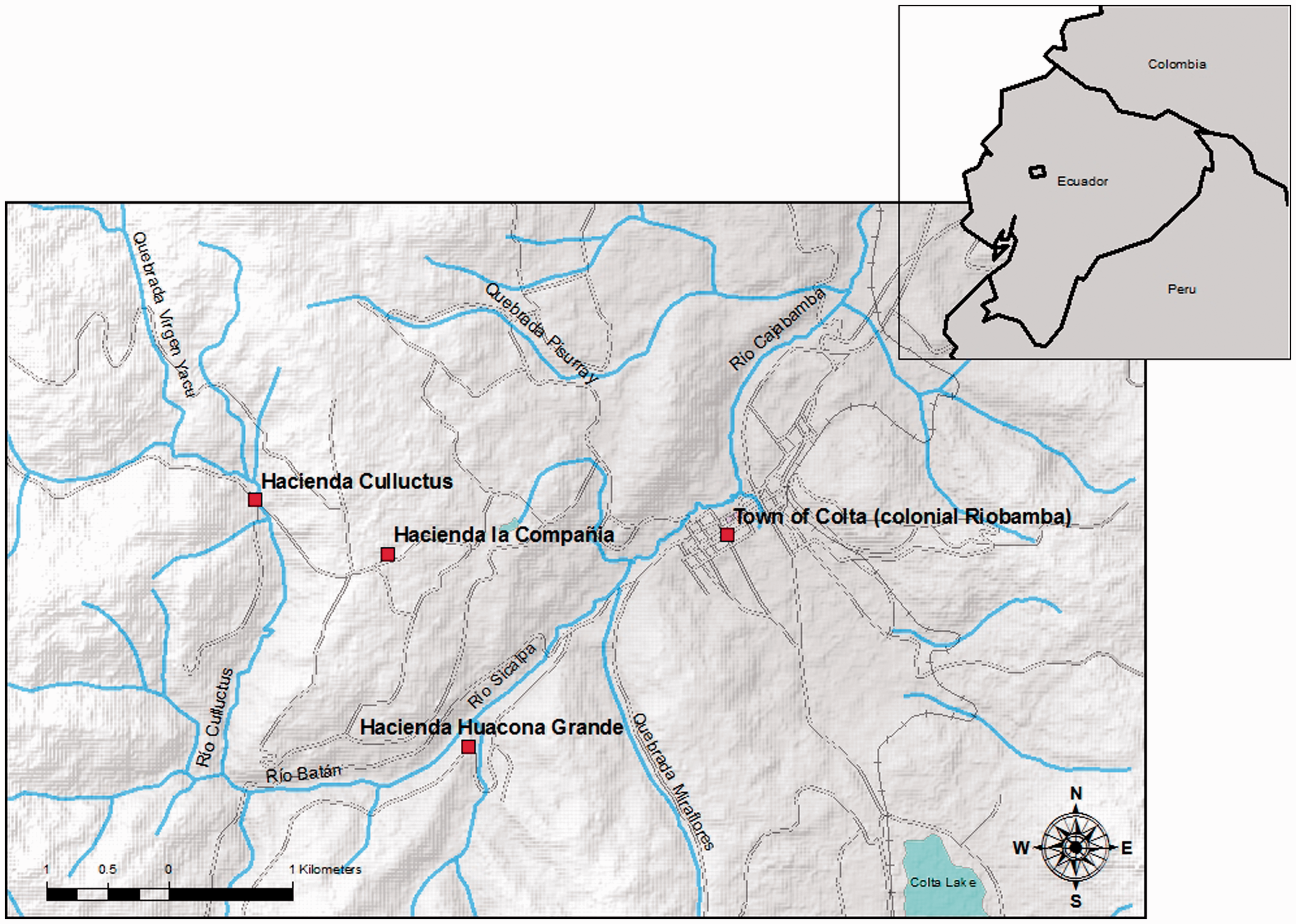
Hacienda Huacona Grande
The small rural set of communities known today as the Huaconas represent an ethnic designation with deep roots, described in the eighteenth century as ‘one of the 30 tribes of the Puruhá’ (Velasco, 1998 [1789]: 84). The labor of the people of the community of Huacona was granted in encomienda to Lorenzo de Cepeda in 1583, 40 years after the Spanish conquest, at which point the land in the region was already largely planted in wheat (Borchart de Moreno, 1998: 79). Part or all of the Huacona communities were held as haciendas at least from 1732, when the ‘Hacienda Guacona’ is listed in the hands of Francisco Silverio de Orozco (Guerra, 2008: 268–269), and remained as a large hacienda complex until the 1970s.
The case of the Hacienda Huacona Grande is one of erasure. At the time of our 2009 visit, the municipality had received funding for road improvement and the hacienda buildings that stood at the center of the old agricultural property happened to be standing beside the road scheduled for upgrade, along a steep embankment on the south side of the Sicalpa River. This provided the nine current Huacona communities, who jointly control the property as a community center, the opportunity to have the heavy equipment for road building simply bulldoze the hacienda house into oblivion (Figure 3). At the time of our arrival, this task had been accomplished quite recently. Interestingly, a series of outbuildings adjacent to the former house site were kept, continuing in their role as a community meeting hall and primary school. Community members feel that the site holds religious significance as the Virgin of Belen was seen near the house many years ago and presumably became the patroness of the hacienda. This religious significance is important to Catholic members of the Huacona communities, and yet there seemed to be no contradiction in bulldozing the house, where presumably the hacienda virgin had at one time had a chapel with obligatory church services for hacienda workers. Members of the Huacona community are proud of their renovated meeting hall and primary school.
Erasure: the empty space where the Hacienda Huacona Grande formerly stood (Source: author).
Hacienda la Compañia
Directly north of the former Huacona Hacienda are several communities with the prefix ‘Compañia’, representing the extent of the former Hacienda la Compañia. Several former hacienda houses are scattered throughout these communities, including the main complex (Figure 4), still known locally as the Hacienda la Compañia but listed in the Ecuadorian national patrimony inventory as the ‘Casa de Hacienda Herederos Erazo’ (the Erazo family hacienda) (INPC, 2013).
The exterior of the Hacienda la Compañia complex, abandoned but maintained by a caretaker (Source: author).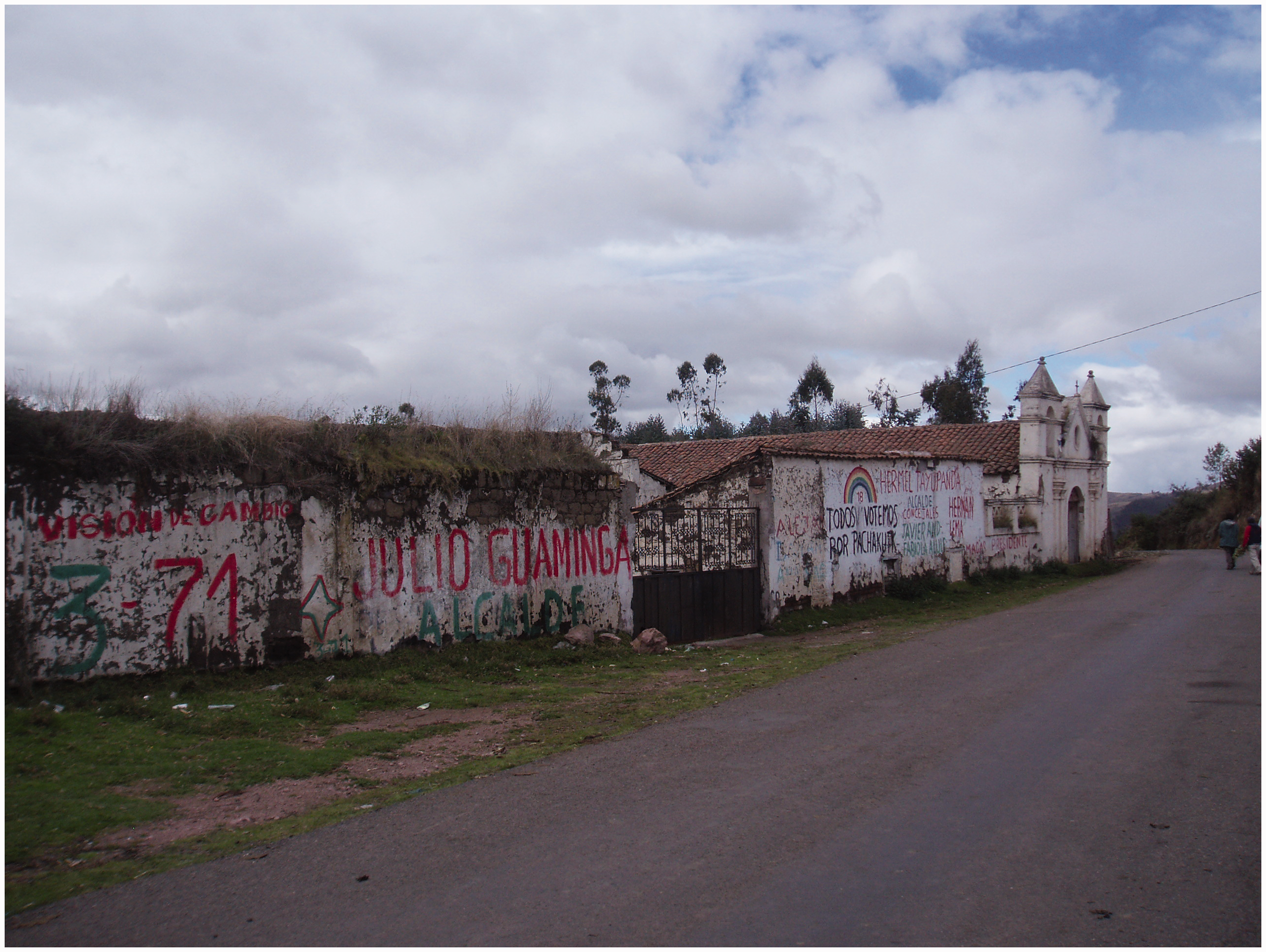
By its name, and local tradition, it is clear that this is the core architectural complex of the main Jesuit hacienda in the region during the colonial period. This property first enters the published historical record when it was purchased by the Jesuits from Pedro de Villagas Pallón in 1669, in a transaction that included the transfer of the labor of 23 local people (Cushner, 1982: 122). The Jesuits called it their Sicalpa property, which was focused on barley production (Cushner, 1982: 81). All Jesuit holdings were sold back into private hands at the time of their expulsion from the Audiencia of Quito in 1767. During our visit in 2009, the caretakers stated that the architectural complex is currently owned by the Leon Borja family, who now live in the city of Riobamba. Daniel Leon Borja served as both mayor of Riobamba and a provincial councilor until his death in 1973. The inheritance of the surrounding property has been in dispute for a number of years. Thus, the residential buildings, agricultural outbuildings, and large Republican period chapel on the property are rarely used and are not accessible to the local community. The caretaker and his family are the only occupants, and they maintain the fabric of the buildings and secure them from intruders, while the property sits in legal limbo.
Hacienda Culluctus
The Hacienda Culluctus was located to the west of the Huacona and Compañia properties, at a somewhat higher elevation range (3400–4200 m above sea level). The core buildings of the Hacienda Culluctus are in a state of disrepair but during our 2009 visit were occupied by a family from the local community. They are one of the 15 local families who had come together to form a private cooperative venture, the Cooperativa 20 de Agosto (20th of August Cooperative). This venture was made up of people from families who had formerly worked on the hacienda lands (Figures 5 and 6). With pooled resources, they were able to purchase the core hacienda buildings. Their intention is to turn the buildings into something that would draw tourists, such as a café, or small hotel, trading on the heritage value of the complex. The 20th of August date marks the time on the ritual calendar when the hacienda owners sponsored a bullfight and celebration each year in the courtyard of the property, for local community members. A major goal of the cooperativa is to revive this past practice and build it into some kind of tourist/community/festival event, both to make money for the investors and to honor the people of the local community through continuing their traditions.
The former Hacienda Culluctus, with main architectural complex in center of valley. The occupied former Hacienda Culluctus house (Source: author).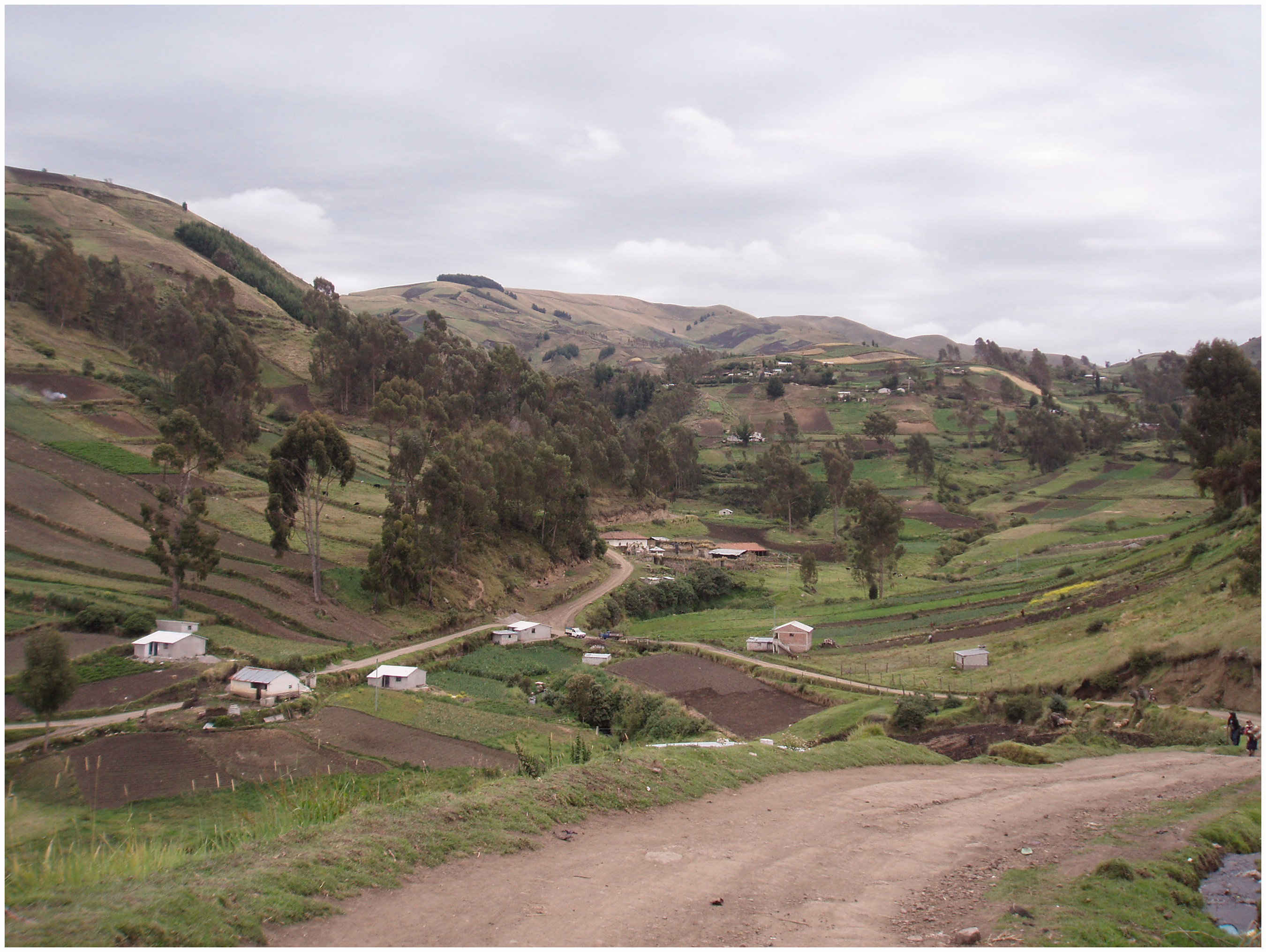

The Hacienda Culluctus has considerable local fame as a focus for the liberation of hacienda workers in the twentieth century. The Zambrano family acquired six regional haciendas, including Culluctus, in the late 1800s, purchasing them with money from a Guayaquil commercial empire (Thurner, 1993: 48–50). Since the 1930s, the owners have divided the property and sold small pieces to former workers as part of the land reform. In the 1970s, attempts to bring in outside wage laborers and denial of traditional access to hacienda resources, like pasturage and firewood for local families, led to increasing tensions (Thurner, 1989, 1993).
In 1983 a confrontation between the Comuna Culluctus and the landowners resulted in the death of two indigenous community members, shot dead by hired guns of the hacienda owners. Confrontation also took place in the court system in the 1980s, leading to local herders gaining legal rights to half of the hacienda's traditional pasture areas under agrarian reform laws. The end result has been the strengthening of the former hacienda workers' rights to land and the formation of the Cooperativa 20 de Agosto, which purchased the former hacienda core architectural complex (Thurner, 1989: 25, 1993: 49, 63).
What do the houses mean?
These are just three examples of the many ‘abandoned’ hacienda houses scattered across the region. We have encountered a number of houses completely disused, but in many cases the former owners' absence has led to parts of the building complexes being re-purposed by members of the local community, often for crop storage. In other cases, uses are as diverse as daycare centers, sawmills, and evangelical church halls.
In many parts of Latin America there are abandoned rural buildings in various states of decay, dating from the seventeenth to early twentieth centuries (Gordillo, 2009). Many of these ruins, including the hacienda houses of Chimborazo, are parts of an existing milieu de mémoire in Nora's sense—a landscape of heritage still in active use by local people in remembering what took place in the abandoned buildings. The hacienda houses of Chimborazo can be seen as part of the broader archaeological heritage of Ecuador, which has been used in a wide variety of ways by rural communities to reinforce their own claims to authority over, and intimate relations with, local places (Bauer, 2012; Benavides, 2009, 2011; McEwan et al., 1994). In contrast to prehispanic ruins, however, the remains of hacienda houses are tangible ‘imperial debris’, in the sense that Ann Stoler uses this term. As a colonial legacy they are not simply grim reminders but features that represent the ways in which local community members remain ‘vividly and imperceptibly bound’ to social formations that emerged in the colonial past (Stoler, 2008: 193).
Rural peasant culture still exists in Chimborazo, but it is changing very rapidly. The ruins of hacienda houses are, as with all places of historical significance, locations where a multivocality of memories can exist. The houses are, in some senses, abandoned, and yet the ongoing occupation of parts of them, and their role as living memorials to jazinda timpu, problematizes our impression of these as cases of abandonment (Colwell-Chanthaphonh and Ferguson, 2006). Similar partially abandoned buildings were recognized a century ago by the sociologist Georg Simmel in the Italian countryside, where buildings were ‘… sinking from life, [but] still strike us as settings of a life’ (1959 [1911]: 261).
For the Chimborazo haciendas, there are three groups of people who interact with the buildings as part of their own personal heritage. The first are the owners of the properties, most of whom are descendants of previous hacienda owners, now living in urban areas and only occasionally visiting these locations. The attitudes of these individuals toward the past varies considerably, from those who are still very angry at indigenous people for destroying a way of life of great nostalgia to them, to those who feel great guilt at the deeds that their families may have carried out against indigenous communities during the hacienda era. In most cases there is a frustration about the ruins themselves and the hacienda property surrounding them, in the sense that agricultural enterprises are no longer possible for the family. The properties are seen as valuable, but they are difficult to sell for their perceived value because of the politics surrounding the legacy of the hacienda period.
The second group is former hacienda workers who directly experienced the (pre-1970s) era of hacienda management. Although variable according to the history of each property, it is really those who are now over 50 years old who personally experienced jazinda timpu and all that that encompasses in terms of traditional labor and ethnic relations. Finally, the younger generation of rural indigenous people forms a third group for whom the ruins are an important site of memory. Generally more politicized, literate, and aware of indigenous rights, they did not directly experience the haciendas as operational entities, but the social memory of the hacienda era is of great importance to the construction of current realities in rural comunas throughout Chimborazo.
The memories of jazinda timpu that community members express today are focused on the first half of the twentieth century when the haciendas still embodied a system of patriarchal rule through the patron, a system of fiestas reinforced the relationship between the owners and the workers on the properties, and the images and chapels of the patron saints, located in each hacienda complex, embodied these fiesta relationships. These are difficult memories expressed through descriptions of past members of the community as ignorant, drunk, and ‘kept down’, while simultaneously contrasting these ideas of abuse and mistreatment with the memories of colorful fiestas sponsored by the patrones, and productive land managed well to produce abundant crops, before the time that land reform broke up properties into small individual family plots and put more pressure on the land.
What should the buildings be used for?
The abandoned hacienda houses of Chimborazo do not seem like places where people, be they rural agricultural workers or former landowners, feel playful or relaxed. Instead, these seem like places that are uncanny, places that haunt people as partial snapshots of a vivid past that remains in many ways unsayable, and unconstituted, for local communities (González-Ruibal, 2008: 251). In the silence of not explicitly dealing with the ruins, local communities are caught in what Ann Stoler characterizes as a common postcolonial dilemma of attempting to ‘gloss over’, in creative and sometimes costly ways, previous imperial formations in order to become less entangled with them (Stoler, 2008: 193).
The bulldozing of the main complex of buildings at the Huacona Hacienda reminds us that many of these ruins may disappear. This may bring with it an urge to preserve them, making lieux de mémoire of them by their induction into a system of heritage management tied to national goals and state intervention (Kohl et al., 2007; Patterson, 1995). Fencing off these abandoned buildings and deliberately maintaining them in a state of arrested decay would create a frame around them, while simultaneously elevating these buildings into a more exalted state, as monuments (Roth, 1997). This would be a form of ‘symbolic antiquation’ that creates a simulacrum, an imagined former state of the building (Sutton, 1998). Unmanaged ruins are, for González-Ruibal (in Gordillo, 2011: 163), ‘difficult to domesticate. They are too uncanny and ambiguous…’, and yet, for him, it is in this ambiguity that an unmanaged ruin remains directly a part of past events. It is thus important to consider whether the transition of these buildings from Nora's milieux de mémoire into lieux de mémoire is necessarily something to be wished for.
Such transitions have already begun in many places in Ecuador. In Quito, heritage management is a key government priority. The colonial core of the city is a UNESCO World Heritage Site with colonial churches and plazas that form one of the major draws for international tourism in Ecuador. Street vendors and political protests, both activities previously dominated by indigenous people, have become heavily controlled in the historic core, replacing such activities with more tourist-friendly music shows, ‘traditional’ religious processions, and the sale of traditional handicrafts. The modern social tensions of the capital are thus removed from the core colonial plazas of the city, sanitizing the streetscape in the name of historic preservation and the promotion of international tourism (Middleton, 2003). The Quito case is parallel to that of Bahia, Brazil, and a host of other historic Latin American cities, where restoration of poor neighborhoods can be seen as a form of national regeneration, and the replacement of ‘ostensible degeneracy has been overcome through an account of national hybridity’ (Collins, 2008: 286).
The larger haciendas of the Ecuadorian highlands have, in a number of cases, also turned since the 1960s toward a tourism-oriented future, with conversion into boutique hotels (Crain, 1996: 127). These are today key properties for the promotion of elite international tourism in Ecuador, such as the Hacienda Guachala (www.guachala.com), San Agustín de Callo (www.incahacienda.com), and Hacienda Pinsaqui (www.haciendapinsaqui.com). This gentrification of a difficult past is not restricted to Ecuador, as the difficult heritage embodied in the ruins of former plantation and hacienda complexes become framed as resources for the international tourist throughout Latin America and the Caribbean. This repackaging of the ‘colonial’ into a romantic aesthetic of a belle époque emphasizing beautiful antique furnishings and tropical hardwoods interspersed with flat-screen televisions and private plunge pools is typified by the 1990s Starwood Hotel purchase of 30 ruined hennequin haciendas in the Yucatan; subsequently five were developed as luxury boutique hotels (Breglia, 2009; http://www.haciendasmundomaya.com/). The balance of heritage and social questions surrounding ethical tourism and heritage tourism are too complex to discuss here (Dann and Potter, 2001; Lansing and Vries, 2007), but two aspects of the Starwood Hotels development bear direct comparison to our Chimborazo architecture. The first is that the reuse of these buildings with the incorporation of swimming pools and spa complexes within the historic architecture entirely sanitizes them, removing any commemoration of the ‘difficult memories’ that their original use as hacienda complexes might bring forward. The second is that prior to the purchase of the Yucatan haciendas by the hotel chain, many of the ruins were being used by local communities in similar ways to the ruins in Chimborazo. Hotel development ended community control over the use of the buildings, reprivatizing these spaces for the use of an international elite (Breglia, 2009: 261). In this sense, the conversion of the buildings from milieux de mémoire into lieux de mémoire is also one through which the neoliberal market has placed them into a whole new, contradictory, set of demands. In parallel to Meskell's (2012) study of South Africa, Herzfeld's (2010) study of the historic urban neighborhoods in Rome and Bangkok, and Di Giovine's (2009) study of Vietnam, there is a grave concern that in Chimborazo the competing pressures to designate new heritage through haciendas, in order to fulfill promises of economic renaissance, social reconciliation, and entry onto the world stage through global tourism, will result in a private appropriation of these resources as playgrounds for the wealthy.
Conclusion
Archaeologists and architectural historians traditionally see preservation as a good idea when heritage is threatened, but the small hacienda complexes in rural Chimborazo may be better off without the intervention of professionals. Heritage experts regulate heritage, thus reinforcing a power dynamic between experts and the community (Waterton and Smith, 2010)—a power dynamic that has interesting parallels to the previous relationship between workers and patron on the hacienda. If heritage management leads to a form of preservation of these buildings that becomes a way of fossilizing them, this can be seen as a movement in direct opposition to the process of community development (Herzfeld, 2010; Waterton and Smith, 2010: 12). These are active milieux de mémoire, reminders of jazinda timpu, and ‘…unfinished histories, not of victimized pasts but consequential histories that open to differential futures’ (Stoler, 2008: 195). Their use as community centers, whether daycares, meeting rooms, or storage for crops, appears as a particularly appropriate conclusion to a period of great pain in rural Chimborazo.
Heritage commemoration is tied to property ownership and the decisions of owners to maintain, or alter, their property in particular ways. In the case of the hacienda house ruins of Chimborazo, legal ownership is an important part of what local communities and absentee landlords are disputing. Until such ownership is clarified and local political and race relations are healed, the houses will remain as difficult heritage on the landscape. And yet they currently do serve many purposes, not only as spaces for community initiatives but also as memories of a time recently past. As such they are part of a living context of cultural use, in which tense social relations ensure that the preservation of these buildings will remain controversial for some time to come.
Preservation professionals are beginning to confront the idea that allowing buildings to deteriorate is not necessarily a negative act, as Caitlin DeSilvey (2006) so effectively argues from a decaying abandoned ranch in Montana. The idea of observed decay, rather than the attempt at stasis implied by traditional historic preservation (DeSilvey, 2006: 335), may be appropriate in the case of the Chimborazo haciendas. It could be characterized as cathartic. Rather than preserving, or interpreting, these objects on the landscape, it may be more appropriate to maintain, as Pétursdóttir (2013: 47) advocates for abandoned herring processing factories in Iceland, their ‘right to remain silent’.
Footnotes
Funding
This work was supported by the Social Sciences and Humanities Research of Council of Canada through Simon Fraser University (grant #873633).