







Abstract
Pilgrimage instigates relationships between phenomena that produce hierophanies, or sacred, enchanting experiences. In this paper I argue that pilgrimage scholars should focus on the relational qualities of pilgrimage in order to rethink and produce more detailed, sensuous descriptions and analyses of this practice. This can be done by employing “relational approaches,” seen here as perspectives that recognize and prioritize the interconnections among persons, places, things, and substances. I further suggest that focusing on movement, the vitality of places and materials, and the senses is useful in thinking about the relational aspects of pilgrimage. Moreover, archaeologists are well-situated to investigate these phenomena and thus can and should push pilgrimage studies in new directions. I provide a case study of the Emerald Acropolis, an 11th-century Cahokian pilgrimage center. Cahokians traveled to Emerald on certain occasions and, while there, manipulated particular substances—earth and water—in ways that gathered otherworldly powers in affective ways.
Two themes in the archaeological literature have surged in the past decade. The first is pilgrimage. A wealth of evidence shows that pilgrimages took place all over the ancient world and were a crucial part of social, political, and religious life (e.g., Bauer and Stanish, 2001; Drennen et al., 2017; McCorriston, 2011; Palka, 2014). The second theme, “relationality,” is a catchall phrase referring to approaches that aim to break down the dichotomies of modernist ontologies, deconstruct the primacy of human rationality and agency, and trace the interstices between various entities in the world (Alberti and Bray, 2009; Jones and Alberti, 2013; Skousen and Buchanan, 2015; Watts, 2013). The fundamental idea of these approaches, which I broadly label as “relational approaches,” is that the ability of any phenomenon to be in and alter the social world stems from the relationships constituting it. Although these themes have developed independent of each other, it is easy to see how they are connected. Pilgrimages instigate relationships—they entangle humans, places, deities, spirits, practices, objects, monuments, and more in efficacious ways.
The premise underlying this and the other articles in this special issue is that pilgrimage is a specific form of movement that gathers all kinds of phenomena in unique ways, and the subsequent assemblages have powerful affects. Thus, I argue that relational ideas and approaches can shed light on the importance of pilgrimages through time and space. Moreover, archaeologists are uniquely situated to investigate the connections between non-human phenomena involved in pilgrimage (e.g., landscapes, places, shrines, tokens, deities, myths, memories) and, because of this, archaeologists can and should push pilgrimage studies in new and productive directions. I begin by briefly reviewing the history of pilgrimage scholarship in cultural anthropology and archaeology. I then discuss relational approaches and three themes that I believe can help us rethink pilgrimage: movement, vital places and materials, and the senses. I conclude with an example from the Emerald Acropolis, a thousand-year-old Cahokian pilgrimage center in the heart of the North American Midwest. Traveling to and mixing soil and water in particular ways at particular times at this place forged sensuous, affective relationships between pilgrims and otherworldly powers and forces that were key to Cahokia’s emergence.
Defining pilgrimage
There are many definitions of pilgrimage, and I doubt my adding a new one to the list will be fruitful. Following others, I view pilgrimages simply as religiously motivated journeys to special places (see Coleman and Elsner, 1995; Stoddard, 1997). Additionally, many of those participating in these journeys have experiences that Eliade (1959) called a “hierophany,” or a sacred manifestation that is powerful, mysterious, and distinct from everyday experience. Importantly, hierophanies, and particularly those that occur during pilgrimages, are the result of assembling phenomena in unique ways that rarely occur in other contexts (Pauketat, 2013). In a way, hierophanies mimic Bennett’s (2001) and Gell’s (1992) notion of “enchantment.” According to Gell, enchantment is a sense of amazement that comes from beholding or making an art object (Gell, 1992). Similarly, Bennett sees enchantment as a feeling of awe and wonder that occurs during a “lively and intense engagement with the world” (Bennett, 2001: 111). For Bennett, these moments of enchantment occur during “crossings,” or when phenomena converge or become related; when this occurs, the integrated phenomena demand attention and generate powerful, emotive experiences (Bennett, 2001: 31). During pilgrimage, it is during these moments of relating or crossing that participants experience a hierophany or sense of enchantment, and these instances are meaningful in both religious and non-religious ways (Badone and Roseman, 2004; Coleman, 2013). It is important to understand that the enchanting, affective nature of a pilgrimage is not dependent on religious conviction or belief (though it can be), nor do these experiences necessarily unify participants (compare Turner, 1974; Turner and Turner, 1978 with Eade and Sallnow, 1991). These moments are all about the relationships between or convergences of certain phenomena and the affective capabilities of these relationships.
Pilgrimage studies in archaeology
Pilgrimage has long been a prominent theme in social anthropology and archaeology. Many pilgrimage studies in social anthropology can be divided into what scholars have called the integrative, Turnerian, and contestation paradigms, each of which is based on particular assumptions and perspectives (see Coleman, 2002; Gray, 2001; Kantner and Vaughn, 2012; Winkelman and Dubisch, 2005 for reviews). Today, however, social anthropologists studying pilgrimage are moving beyond these paradigms; they view pilgrimage as diverse and complex, a practice that cannot be captured by any one perspective (Coleman, 2002, 2013).
Archaeological studies of pilgrimage have a different history. In the first studies, published in the 1980s, scholars constructed pilgrimage fair models from ethnohistoric and colonial accounts and applied them to ancient Maya cities and the sites of Chaco Canyon and Poverty Point in North America (Freidel, 1981; Freidel and Sabloff, 1984; Hammond, 1983; Jackson, 1991; Judge, 1989; Kubler, 1985; Toll, 1985; Windes, 1987). Pilgrimage scholarship in archaeology has proliferated since these initial studies (Bradley, 1999; Candy, 2009; Coleman and Elsner, 1994; Drennen et al., 2017; Gray, 2001; Hammond and Bobo, 1994; Harbison, 1994; Kelly and Brown, 2012; Kristensen and Friese, 2017; Lepper, 2006; Locker, 2015; Lucero and Kinkella, 2015; Lymer, 2004; McCorriston, 2011, 2013; Mack, 2002; Malville and Malville, 2001; Oetelaar, 2012; Patel, 2005; Petersen, 1994; Plog and Watson, 2012; Ray, 1994; Scarre, 2001; Schachner, 2011; Sheets, 2011; Silverman, 1991, 1994; Skousen, 2016; Spivey et al., 2015; Stopford, 1994; Wells and Nelson, 2007). The goal of many of them is to identify the archaeological signatures of pilgrimage centers by envisioning what material remains pilgrimage activities might leave behind (see Silverman, 1994 for a good example). Interpretations of pilgrimage’s role in the ancient world vary from pilgrimage being a “costly symbol” of individuals’ commitment to a particular belief system (Kantner and Vaughn, 2012), a way to establish and legitimize political orders and systems (Bauer and Stanish, 2001; McCorriston, 2013), necessary for the development of sacred landscapes (Palka, 2014), or as a metastructure or fundamental aspect of social life that transcends time and space (McCorriston, 2011; Palka, 2014). Some scholars draw from the anthropologically-based paradigms of pilgrimage discussed above, particularly the integrative and Turnerian perspectives (Hammond and Bobo, 1994; Lucero and Kinkella, 2015; Malville and Malville, 2001).
Despite the diversity of archaeological studies of pilgrimage, most differ from what I propose here—few engage with relational ideas and theories (see next section), provide detailed descriptions of the relationships evident during pilgrimages (particularly with other-than-human phenomena), or discuss the affective experiences that stem from these relationships (but see Candy, 2009; Coleman and Elsner, 1994; Lymer, 2004; Van Dyke, 2007, 2013; Weismantel, 2013). An excellent non-archaeological example of the approach I envision is Van Vlack’s description of pilgrimage among the Southern Paiute of North America—the power, meanings, and importance of these pilgrimages comes from the relationships made not only between people, but also among special places and objects (Van Vlack, 2012). By concentrating on the relational qualities of pilgrimage, scholars could generate more rigorous, comprehensive, and detailed analyses and interpretations of pilgrimage practices and their affects in both the ancient and modern world. And, since religious practices, including pilgrimage, are embodied, material, spatial, and historical, archaeologists are specially situated to examine such things (Joyce, 2012).
Relational approaches and pilgrimage
Over the last few decades, theories regarding the interconnections among various phenomena, mentioned earlier and which I broadly label relational approaches, have surfaced in the fields of material science, political science, archaeology, and others. In archaeology, these approaches are associated with the “ontological turn,” though they vary widely in their names, aims, frameworks, and scope (Alberti, 2016; Alberti and Bray, 2009; Fowler, 2013; Hamilakis, 2013; Hodder, 2012; Jones and Alberti, 2013; Pauketat, 2013; Watts, 2013; see also Bennett, 2010; Ingold, 2007, 2011, 2015; Latour, 1993, 2005). Detailing the intricacies of these approaches, let alone their strengths and weaknesses, is beyond the breadth of this paper. However, in this section I briefly outline three closely interrelated themes in the relational literature—movement, the vitality of places and things, and the senses—that I believe are crucial to this particular view of pilgrimage.
Human movement is a key aspect of life and being in the world, and journeys to particularly destinations are vital to pilgrimage (Farnell, 1996; Heidegger, 1996; Ingold, 2011; Merleau-Ponty, 1962; Sheets-Johnstone, 2011). Movement, however, is more than just physical locomotion. Movement creates relationships—it is the mechanism or quality through which phenomena of all kinds continually align or position themselves in relation to others (Baires et al., 2013; Ingold, 2007, 2011, 2015; Pauketat, 2013; Skousen, 2016; Skousen and Buchanan, 2015). In additional to the journey, ceremonies, processions, and other activities, all with unique bodily movements, also occur during pilgrimages, and these movements often coincide with the movements of celestial bodies and the passing of time (e.g., specific dates or holidays) (see Bell, 1992; Coleman and Elsner, 1995; Janusek, 2008; Pauketat, 2013; Tilley, 1994; Van Dyke, 2007; Weismantel, 2013). Pilgrimages, then, inevitably instigate relationships of all kinds. But because pilgrimage is a unique kind of journey, it affords unique intersections between phenomena that are different from everyday experience. Coleman and Elsner (1995: 206), for instance, argue that “it is the experience of travel and the constant possibility of encountering the new which makes pilgrimage distinct from other forms of ritual” (italics mine, see also Coleman, 2004).
Places, objects, and materials are more than simply the backdrop of a pilgrimage experience (cf. Alberti et al., 2013; Appadurai, 1986; Basso, 1996; Bradley, 2000; Conneller, 2011; Gell, 1998; Gosden, 2005; Gosden and Marshall, 1999; Hodder, 2012; Hodder and Lucas, 2017; Jones, 2012; Knappett and Malafouris, 2008; Meskell, 2004; Olsen, 2007, 2010; Richards, 1996; Witmore, 2007). Indeed, objects, materials, places, and landscapes are often the “focus of worship” (Silverman, 1994) and the source of what Preston (1992) calls “spiritual magnetism,” or the emotional or spiritual draw of a particular pilgrimage shine or place. This pull is undoubtedly the product of the affective, animate, and historical qualities of things and places. Bennett’s (2001) work on vital materials best explains this phenomenon. She argues that materials and objects not only have the capacity “to impede or block the will and designs of humans,” but are buzzing with energy and activity (Bennett, 2010: viii; see also Barad, 2007; Bennett, 2001; Conneller, 2011; Jones, 2012; Lucas, 2012; Witmore, 2014). Due to its liveliness, matter—and, by extension, all material and spatial phenomena—provokes humans to acknowledge its power or connection with and effects on other humans and things (Barad, 2007; Bennett, 2010). A good example of the power and livelihood of objects in Christian pilgrimage is the veneration of relics, which began in Medieval Europe and continues in various forms to the present day. These relics, either the saints’ bodies or objects closely associated with them, were and are believed to be imbued with mystical powers and abilities (Dyas, 2001). Even simple tokens and souvenirs sold or obtained at pilgrimage shrines heal, channel sacred power, and evoke memories of the journey (Coleman and Elsner, 1995: 100–103).
Of course, the bodily senses are entwined with the movements of pilgrims and their encounters with sacred landscapes, objects, and materials (Day, 2013a; Hamilakis, 2013). The senses are integral to experience; they create affects that, as defined here, are embodied, subjective emotions, feelings, dispositions, and states of consciousness that changes the way humans perceive the world and give meaning to their experiences (Bennett, 2010; Day, 2013b; Hamilakis, 2013, 2017; Skeates, 2010; Spinoza, 1996 [1677]; Tarlow, 2012). Because the senses are always intertwined with movements, things, and places and produce affects, all parts of a pilgrimage (the journey, shrines, rituals, and so on) make pilgrims feel, think, and act in ways that are different from regular experience. In fact, a sensory-rich, affective, poignant experience—whether it be a vision of a deity or simply a sense of contentment, comfort, or strength—is the goal of many pilgrims and the reason pilgrimage shrines and pathways are constructed in certain ways. These complex, embodied, sensory experiences often have far-reaching consequences and can provoke hierophanies or feelings of enchantment.
Case study
My contention is that relational ideas and approaches are vital to studies of pilgrimage, and that archaeologists in particular are well-suited to investigate connections between places, materials, and other phenomena in ways that can push pilgrimage scholarship in new directions. I specifically argue that a focus on movement, vital places and materials, and the senses can instigate more fruitful explorations of pilgrimage. In reality, of course, these themes are interconnected and always experienced simultaneously; however, they serve as a starting point to help think through the nuances of relationality and rethink how we study pilgrimage. The challenge for archaeologists, and indeed any pilgrimage scholar, is to work out how movements, vital places and materials, the senses, and whatever else intertwine to create unique, enchanting occurrences. In the following section, I discuss how traveling to a Cahokian pilgrimage center at special times and combining and depositing certain vital materials—earth and water—during mound construction events entangled pilgrims with otherworldly places and powers that invoked hierophanies.
Cahokia, Emerald, and pilgrimage
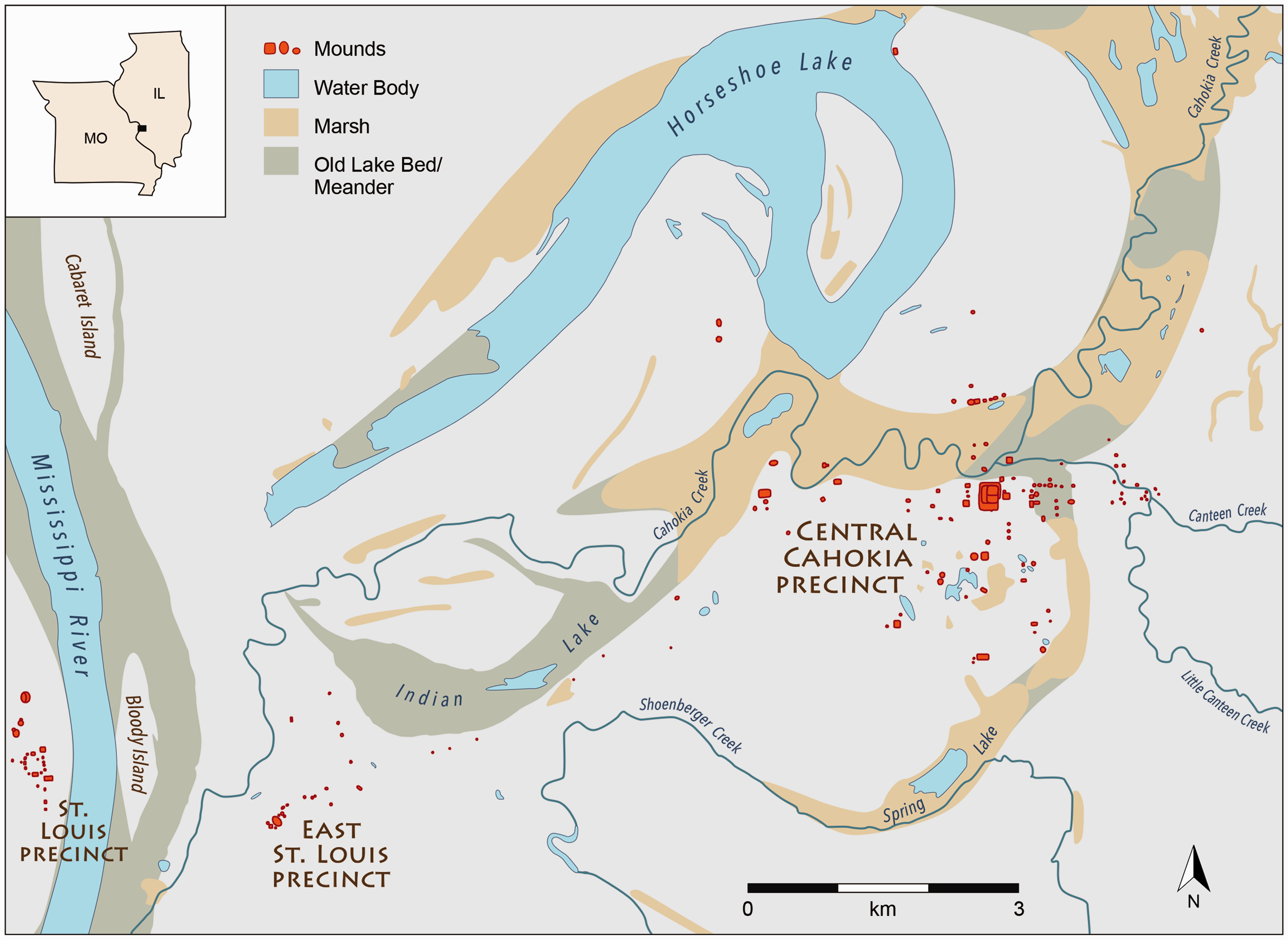
Around 1050 C.E., a 14 km2 area in the American Bottom floodplain was transformed into a sprawling urban zone that we now call Cahokia, opposite of the modern city of St Louis (Figure 1). The “central administrative zone” of this ancient urban area, consisting of Cahokia and the nearby pre-Columbian sites of East St Louis and St Louis, housed at least 20,000 inhabitants and exhibited over 200 earthen mounds and thousands of wood and thatch buildings (Figure 2) (Emerson, 2002; Pauketat et al., 2015). Recent research suggests that the location, construction, and organization of Cahokia itself were based on alignments with the moon (Romain, 2015). This transformation of the landscape was coupled with new ways of making pottery, building houses, and obtaining and consuming food (Pauketat, 2004). A new religion—consisting of a suite of interrelated beliefs and practices involving a distinct cosmic structure, feminine powers, celestial bodies, other-worldly beings, and notions of balance, purity, and renewal—constituted the construction of Cahokia and this new way of life (Alt and Pauketat, 2018; Baires, 2017; Emerson, 1997; Hall, 2006; Pauketat, 2013; Pauketat and Alt, 2017).
Cahokia and Emerald location. Cahokia’s precincts: Cahokia, East St Louis, and St Louis. Courtesy: Illinois State Archaeological Survey, University of Illinois, Champaign-Urbana.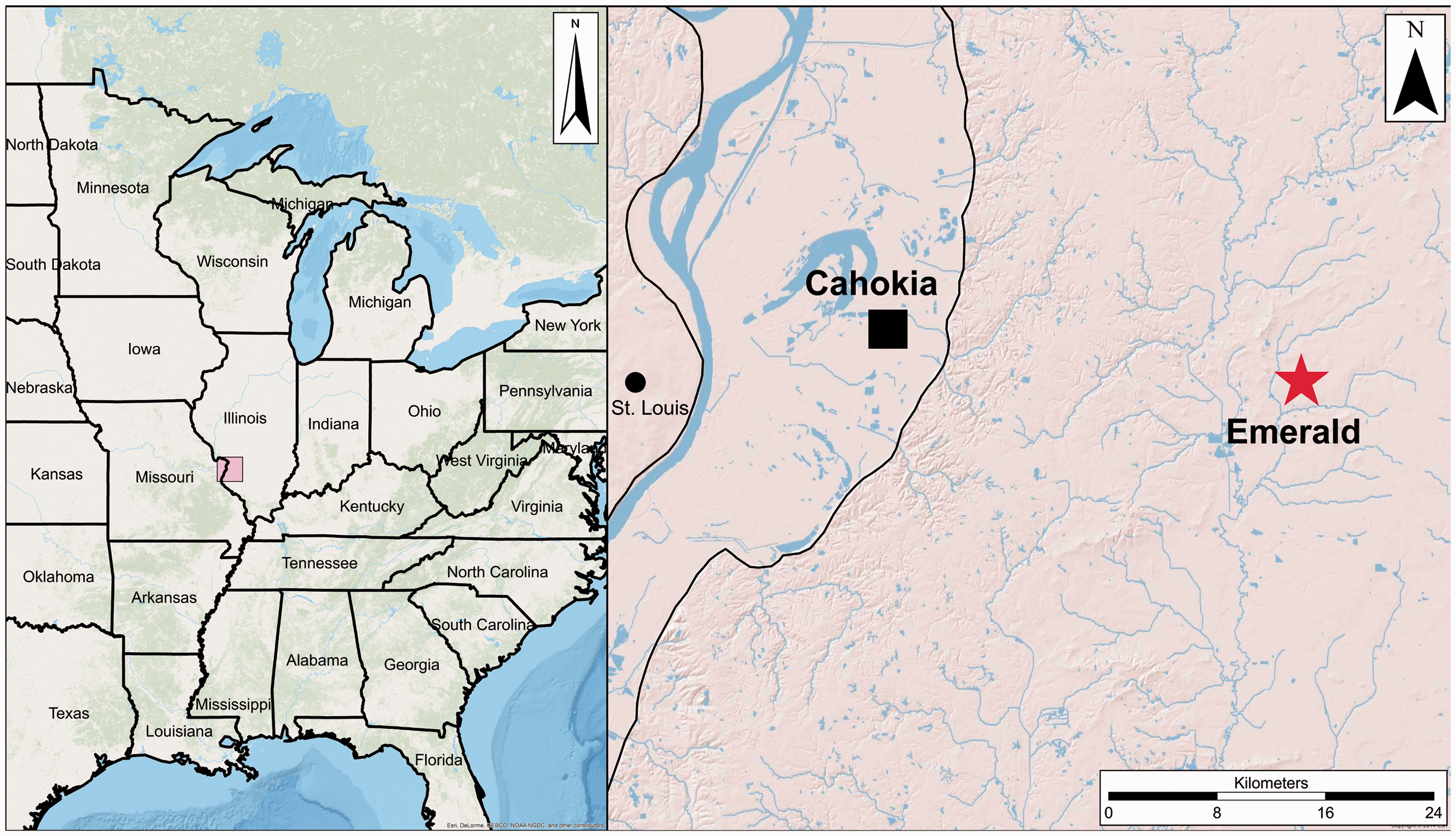
Pilgrimage to special places was a vital part of this new religion and thus critical to Cahokia’s formation. The Emerald Acropolis, situated on a 12 -m high ridge 24 km east of Cahokia, was one of these places (Alt, 2017; Pauketat, 2013; Pauketat et al., 2017; Skousen, 2015, 2016) (Figure 3). The site was built in a unique natural setting. The ridge on which the Acropolis was constructed aligns to lunar standstill events that occurred every 9.3 years, and a now-defunct spring emanated from the base of the ridge (Pauketat, 2013; Snyder, 1962: 259). Emerald was first occupied around 1000 C.E., when small groups of pre-Cahokian religious practitioners constructed small pole-and-thatch shrine buildings aligned to lunar standstill events (Alt, 2017; Pauketat, 2013). Fifty years later, Cahokians coopted and reconstructed the entire site, using the natural orientation of the ridge as the organizing principle (Pauketat, 2013; Pauketat et al., 2017; Skousen, 2016). Thereafter, the Acropolis consisted of 12 mounds, a central plaza, over 100 structures of various kinds and shapes, and a processional avenue connecting Emerald to Cahokia (Finney, 2000; Pauketat, 2013; Pauketat and Alt, 2017; Pauketat et al., 2017; Skousen, 2016). Archaeological evidence (e.g., sporadic and short-term occupation, the remains of special-use shrines and ephemeral pilgrim houses, earthen monuments built in spurts, non-local visitors, the processional avenue, the relative lack of storage pits and domestic debris) indicates that Emerald was a pilgrimage center frequented primarily by particular families or social groups from Cahokia (Skousen, 2016; see also Alt, 2017; Pauketat, 2013; Pauketat and Alt, 2017). Perhaps most importantly, pilgrimages to the Emerald Acropolis instigated the convergence of pilgrims with special substances and otherworldly powers that instigated the renewal of the world (Alt and Pauketat, 2018; Pauketat, 2013; Pauketat and Alt, 2017; Skousen, 2015, 2016).
Overview of the Emerald Acropolis (Pauketat et al., 2017). LiDAR image courtesy of the Illinois State Archaeological Survey.
Journeying to the Acropolis
The construction history of Emerald’s mounds, the number of buildings present, and the rate of structure rebuilds suggests that hundreds, if not thousands, of people traveled to the Acropolis for certain events (Pauketat et al., 2017; Skousen, 2016). It is likely that at least some of these events happened during lunar standstills (Pauketat, 2013; Pauketat et al., 2017; Skousen, 2016). As mentioned earlier, a large portion of Emerald’s pilgrims traveled from Cahokia, about a day’s walk to the west (though some pilgrims came from more distant locales). However, these journeys were not simply casual forays taken on a whim. A lunar standstill was a once-in-a-lifetime event, and many, if not most, Cahokians would have known when these events were going to occur and prepared accordingly (Pauketat, 2013; Romain, 2015). These preparations may have included performing unique ceremonies; fasting; gathering supplies, food, and religious accoutrements; and handling and/or manipulating sacred objects and substances (for examples see Deloria, 2006; Oetelaar, 2012; Van Vlack, 2012).
The journey to Emerald itself probably consisted of a series of formal, interconnected movements and ritual performances. Most pilgrims from Cahokia almost certainly traveled to the Acropolis via the Emerald Avenue, a special processional route (mentioned earlier) that was still noticeable as a “well-worn trail, or road” in the early 19th century (Snyder, 1962: 259). Although largely destroyed in modern times, recent investigations on remnants of the Avenue near the Acropolis indicate that, at least in some places, the roadway was straight and nearly 100 meters wide (Skousen, 2016). Undoubtedly, the size and formality of the Avenue, particularly as it neared the Emerald Acropolis, facilitated large processions of pilgrims and, perhaps most importantly, structured and focused pilgrims’ bodily movements and sensory attention on the approaching Acropolis and the powers manifest there.
Moreover, the journey along the Emerald Avenue likely involved a series of waystations or stopping points, all locales where special rituals and performances took place (Pauketat, 2013). One of these stopping points was a pair of conical mounds, called “sugarloaf” mounds, situated on the edge of the eastern bluffs and on either side of the Avenue (Pauketat, 2013). Reaching these mounds was an important point in the journey, as they marked the threshold between the floodplain and uplands, the latter being a more open landscape that afforded pilgrims with an unobstructed view of the horizon, lunar occurrences, and the Emerald Acropolis (Pauketat, 2013; Skousen, 2016). Furthermore, the sugarloaf mounds themselves were places where important individuals were buried, and the surrounding bluff edge where the mounds are situated had been sculpted into “an elevated viewing platform or performance space” (Pauketat, 2013: 110). Other potential stopping points were natural features associated with the Avenue. For example, once in the uplands, the Avenue was deliberately constructed to pass through several pairs of glacial knolls and ridges, many of which mimicked the conical sugarloaf mounds on the bluff edges (Figure 4) (Kruchten, 2012). Passing through the paired sugarloaf mounds and pairs of natural knolls would have been a critical part of the pilgrimages, and were perhaps viewed as portals or liminal areas that transformed pilgrims as they made their way to Emerald (see Hall, 1997). Another potential stopping point was the Pfeffer site, a lunar shrine site contemporaneous with and situated about five kilometers southwest of the Emerald Acropolis. Similarities between Emerald and Pfeffer—such as a sporadic occupation history, specially-oriented lines of mounds, and special shrine or temple structures—suggest that they were related and perhaps connected by a branch of the Emerald Avenue (Pauketat, 2013). Kruchten, in fact, argues that a potential branch of the Avenue passed through another set of ridges on the way to Pfeffer (Figure 4) (Kruchten, 2012). It is also likely, based on recent surveys of the surrounding landscape, that single buildings or small clusters of buildings were constructed at certain points along the Avenue and near the Emerald Acropolis; these may have been additional stopping points along the route (Kruchten, 2015).
The Emerald Avenue and possible branch to the Pfeffer site, with projected route marked by dotted line (Kruchten, 2012).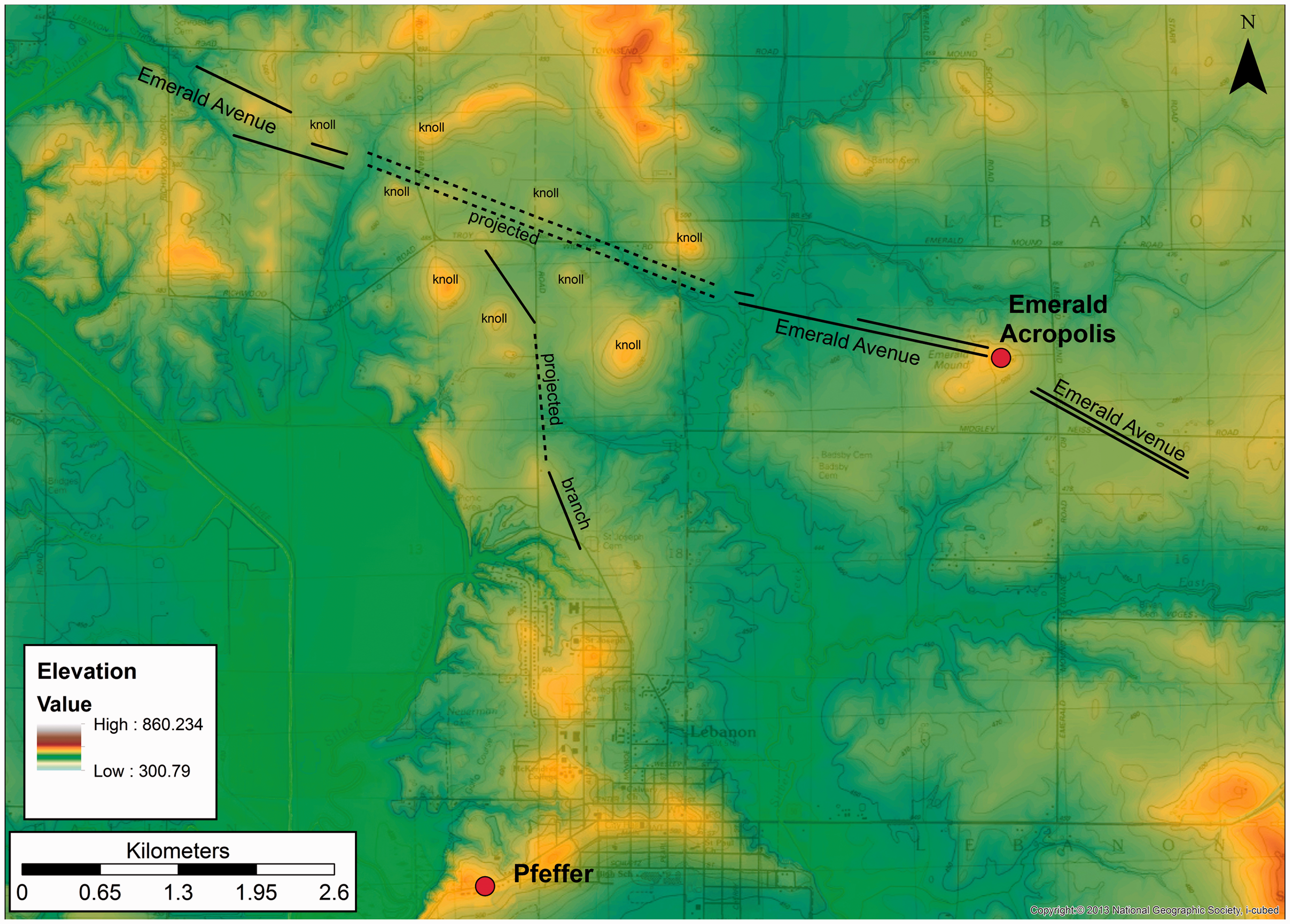
Although the timing, importance, and relationship between the Emerald Avenue, Emerald Acropolis, Pfeffer, and other potential waystations is not fully understood, these places and routes of movement were probably interconnected, forming a kind of ceremonial circuit (Pauketat, 2013). If so, traveling to these places in a specific order, remembering and retracing the movements of previous pilgrims, performing fertility and renewal rituals, and observing lunar movements was as important as reaching the Acropolis itself. Moreover, pilgrimages to the Acropolis and these other places were intertwined, at least in part, with the movements of the moon. In a way, the movements of pilgrims would have mimicked the movement of the moon and/or connected Cahokians with celestial bodies and powers (Pauketat, 2013). These relationships would have been emphasized and strengthened by pilgrims’ perceptions of the celestial movements, memories of past pilgrimages, and hope for future fertility and cosmic balance. These experiences, and undoubtedly many others, prepared pilgrims for the activities and experiences that only occurred at Emerald. Thus, journeys to the Emerald Acropolis instigated relationships not only between pilgrims and the Acropolis, but also between other places, people, religious buildings, ceremonial objects, substances, and powers.
Constructing Mound 12
Of the many activities that occurred at the Acropolis during pilgrimages, building earthen monuments was one of the most significant (Skousen, 2016). Though evidence points to an intense flurry of construction activity at Emerald around 1050 C.E., Mound 12—a 7-meter-high, two-tiered platform mound and the centerpiece of the Acropolis—was built sporadically throughout Emerald’s history (Pauketat, 2013; Skousen, 2016). As currently understood, construction of Mound 12 began at 1050 C.E. and proceeded in distinct stages. The stages of the first terrace consisted of thick layers of basketloaded fill topped with multiple pairs of thin (≤1 cm), alternating light-dark soil layers or “blanket mantles” (Pauketat, 2013; Skousen, 2016). To create these blanket layers, the soil was likely mixed with water into a plaster or slurry that was applied to the mound surface on hands and knees, much like the way plaster was applied to shrine and temple floors (Alt, 2017; Pauketat, 1993: 141, 2008; Pauketat et al., 2017). In contrast, the stages on the second terrace were built by packing alternating light and dark layers of soil between 1 and 10 cm thick into place by foot or with some tool, what Pauketat et al. (2010) call “packed earth construction.” Importantly, these alternating bands of light-dark fill are occasionally interrupted by layers of water-washed silt, the result of rainstorms washing silt onto the mound surface (or possibly individuals manually pouring water onto the mound surface). I previously interpreted two clusters of laminated layers as evidence of lulls in the mound’s construction between pilgrimage events (Skousen, 2016). Around 1200 C.E., Mound 12 was capped and construction ceased (Skousen, 2016).
While the construction of Mound 12 was far more than just piling soil, it was not particularly unique. Other mounds in the Cahokia region were built using similar techniques (e.g., major stage enlargements and series of alternating light and dark soil layers, see Baires and Baltus, 2017; Pauketat, 1993; Pauketat et al., 2010; Sullivan and Pauketat, 2007). Additionally, constructing mounds at this time in the Cahokia region likely involved notions of renewal and purification, references to mythical events, and connections to other-worldly places (Baires et al., 2013; Hall, 1997; Knight, 1986, 1989; Pauketat, 1993). Building Mound 12 at the Acropolis during pilgrimage events was particularly affective because it involved, among other things (1) mixing powerful substances, earth and water, obtained from special sources; and (2) aligning these substances with the moon. Handling and depositing these vital substances during Mound 12’s construction allowed pilgrims to engage with otherworldly powers in intimate, sensuous ways that could not be achieved elsewhere in the Cahokia region. Such embodied experiences and the relationships that ensued were likely the reason for undertaking pilgrimages to Emerald in the first place.
The primary substances used to construct Mound 12—earth and water—were obtained from unique sources and therefore imbued with special power. The silty texture and the presence of natural manganese concretions in the soils from Mound 12’s fill and the surrounding area’s subsoil indicate that the earth was obtained from a nearby source, and a carved-out area, the remnants of which can still be seen today, indicates that the fill was borrowed from the north side of Emerald’s ridge (Skousen, 2016; Winters and Struever, 1962: 86). Incidentally, the now-defunct spring was once inside this borrow area (Figure 5) (see Pauketat et al., 2017). This is no coincidence. Many southeastern Native American groups considered springs, rivers, and caves as portals to the underworld, a place of danger and power (Hudson, 1976). Such portals provided access to underworld beings and creatures and were sources of life, death, fertility, and renewal (Emerson, 1997; Langford, 2007). Though the beliefs of Cahokians and historic-era southeastern native groups were undoubtedly different in many respects, it is likely that Cahokians viewed this spring as a powerful place, if not as a conduit to powers of fertility and renewal (see Hall, 1997; Hudson, 1976). I contend that the earth used to build Mound 12 was chosen because of its proximity to this watery opening.
LiDAR image of Emerald Acropolis with borrow area and now-defunct spring designated. Courtesy of the Illinois State Archaeological Survey.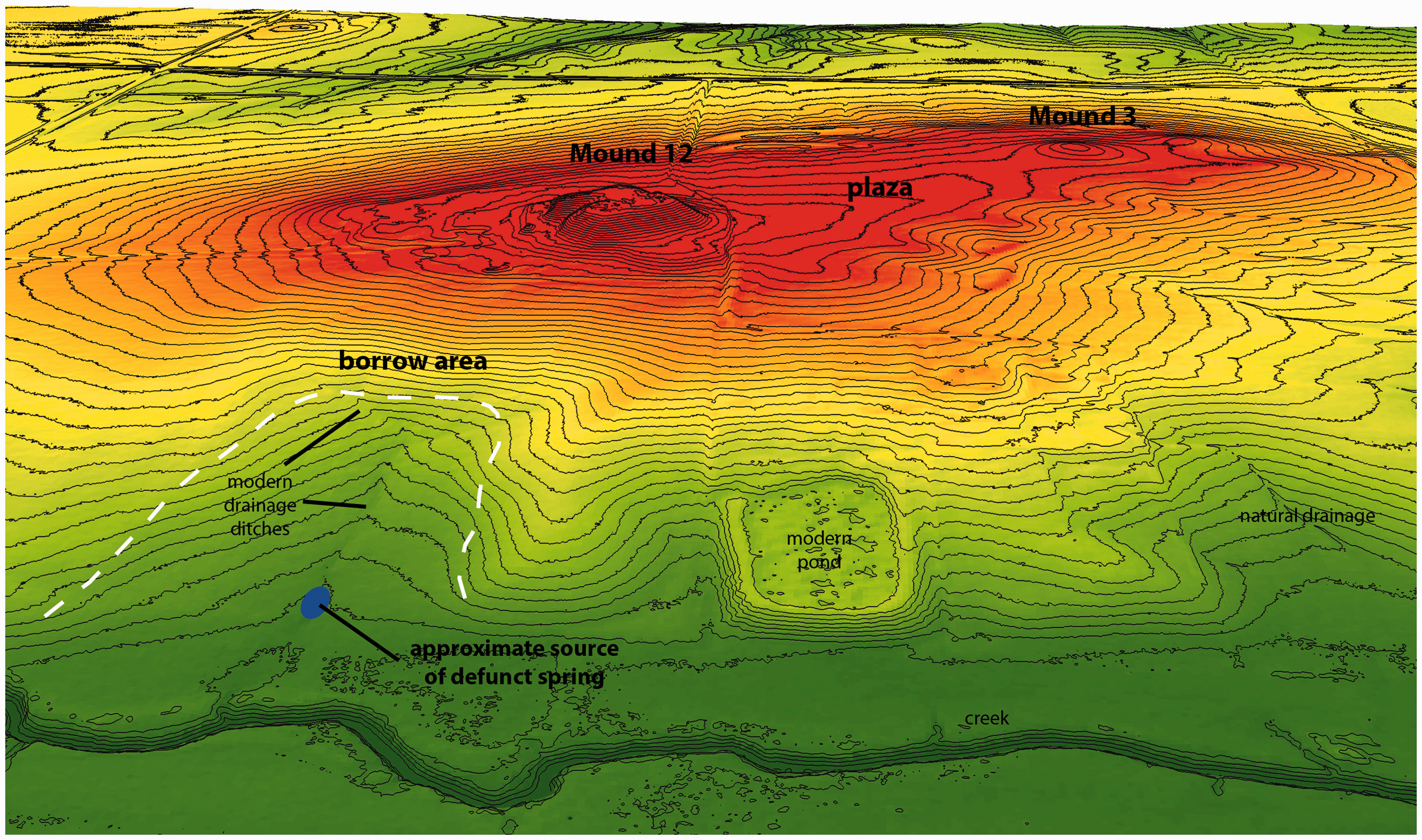
Water was the second vital substance used to build Mound 12 but, unlike the soil, it was obtained from two seemingly opposing sources. The most important source likely came from the spring itself. It was the closest supply of water for the Acropolis, and was probably used by pilgrims and caretakers for drinking and other needs. Due to its close proximity to the borrow area, this water was almost certainly mixed with the silty earth to produce the plaster or slurry that was then smeared on mound surfaces (see above). The second source of water, in contrast, came from the sky. As mentioned earlier, rainstorms washed water and fine particles of silt onto extant surfaces of the second terrace (Figure 6). It is possible that construction stages of Mound 12 were ritually closed or terminated through these rain events, much like rainstorms were used to decommission nearby shrine structures (Alt, 2017; Pauketat et al., 2017). The otherworldly associations of both sources of water are obvious. Like the earth, the water from the spring was charged with underworld powers, while the rainwater came from the upperworld, a place with its own spirits, deities, and powers (Langford, 2007).
Mound 12 second terrace profile. Arrows indicate laminated layers.
In addition to obtaining and mixing earth and water into mound fill, pilgrims also piled and aligned this fill in reference to lunar standstill events, perhaps as one of the final acts on the ritual circuit. While constructing mounds in this way was undoubtedly at times a labor-intensive, repetitive, and tiresome process, it was certainly not meaningless. The importance of these lunar events had been realized nearly 50 years prior to the site’s transformation by Cahokians in the mid-11th century, and Cahokian pilgrims would have been well aware of Emerald’s connection to these rare celestial occurrences from the orientation of the landscape and pre-Cahokian buildings (Alt, 2017; Pauketat, 2013; Pauketat et al., 2017; Skousen, 2016). But the act of digging and processing this special fill, carrying it up and down the ridge, and dumping, spreading, and packing it during an actual standstill event would have been far more efficacious than doing it at another time. Performing these activities, while taking particular care to maintain and replicate the mound’s orientation under the direction of ritual specialists or engineers, directed pilgrims’ attention to the moon and its otherworldly powers. Pilgrims surely noticed the play of moonlight across the ridge, mounds, and buildings, and that affected their perceptions of and feelings about the place. They were almost certainly reminded of stories of the earth diver, who dove to the bottom of the primordial sea to retrieve a bit of mud in order to create the world (Hall, 1997), or the “Earth Mother,” a mythical being embodied by the moon and notions of birth, renewal, and the underworld (Emerson, 1997). Perhaps pilgrims were suffused with the moon’s special power as they built the mound and, in some way, felt as if they controlled these powers themselves.
Pilgrimages to Emerald, then, involved tracing prescribed routes of travel, visiting and performing ceremonies at particular places along the way, and combining powerful substances at the Acropolis itself. While any pilgrimage experience involved innumerable activities, people, beings, substances, materials, and so on, these activities formed discrete bundles of relationships that had particular affects. Pilgrims mimicked and manipulated powers and beings, even if only minimally, through traveling at certain times and in certain ways and handling and combining earth and water from special sources. These activities linked pilgrims to the moon and perhaps allowed them to align themselves or commune with the forces and beings that they relied on daily (cf. Baires and Baltus, 2017). Perhaps most importantly, pilgrims’ embodied, sensuous participation in journeying to and experiencing the Acropolis as well as assembling substances along its specially aligned ridge during rare lunar events produced hierophanies or a sense of enchantment that could not be matched elsewhere.
Conclusion
Pilgrimage is relational—it is a complex, affective gathering of people, places, things, substances, emotions, beliefs, memories, and more. These convergences provoke hierophanies or what Bennett (2001) and Gell (1992) call a sense of enchantment due to complex entanglements of phenomena. I argue that any study of pilgrimage must consider the myriad relationships that constitute and coalesce during a pilgrimage. I believe that this is best done by evoking relational approaches, and in particular focusing on movement, vital places and materials, and the senses. The contributors in this special issue share these sentiments. Each article focuses on the relational qualities of pilgrimage and their affective capabilities using relational theories and approaches. However, the ways these ideas are applied vary, which is good—I am not advocating for a singular theory or approach to studying pilgrimage, only that a focus on relationships is paramount to the endeavor. Moreover, each article shows that the relationships between phenomena—stones, animals, celestial bodies, fires, blood, deities, shell, and yearly ceremonies, to name a few—are the source of pilgrimages’ efficacy through time and space. Given the variety of phenomena that are entangled in these journeys, I believe that archaeologists, with their focus on all things material and spatial, are best situated to rethink and reexamine these journeys; in short, they are the ones to push pilgrimage scholarship to new levels.
However, adopting such a perspective does more than simply enrich our analyses and narratives of past pilgrimages. Ideally, this perspective can encourage us as archaeologists, heritage professionals, curators, and teachers to recognize and appreciate the affectual power of landscapes, places, monuments, objects, and more. This power is realized through feelings of awe and wonder—a hierophany or sense of enchantment—that stem from the rich and complex relationships between these phenomena. Such an understanding can change the way we present the past and take care of places and landscapes – at the very least, our portrayals, should include and emphasize the vital movements, materials, objects, places, and substances that constitute the world and, by extension, us. As we do so, perhaps members of the public who come on their own pilgrimages to heritage sites can also be surprised or awed, or to borrow Bennett’s (2001) and Gell’s (1992) term, enchanted, as they experience and forge connections with places, landscapes, monuments, objects, and the memories embedded within them. Such a perspective, I believe, can instigate a deeper awareness of the past and interest in preserving it for future generations.
Footnotes
Acknowledgements
An early version of this paper was presented as an introduction to a 2017 SAA symposium I organized entitled “Rethinking Archaeologies of Pilgrimage.” I appreciate the participants for their excellent papers, though only some were able to contribute to this special issue. Also, many thanks to Tim Pauketat and several anonymous reviewers for their comments on this manuscript and Matt Adamson for discussions on many of the underlying ideas. Also, thanks to Tom Emerson and the Illinois State Archaeological Survey for their support and use of Figure 2, and John Lambert and Mike Farkas for helping create Figures 4 and  . Tim Pauketat and Susan Alt provided encouragement and support during my research at the Emerald site. I alone am responsible for any errors.
Declaration of Conflicting Interests
The author(s) declared no potential conflicts of interest with respect to the research, authorship, and/or publication of this article.
Funding
The author(s) disclosed receipt of the following financial support for the research, authorship, and/or publication of this article: The Emerald site was provided by a National Science Foundation Doctoral Dissertation Improvement Grant (1349157).