







Abstract
The materiality of performative ritual is a growing focus for archaeologists. In Europe, collective ritual performance is expected to be highly structured with ritual often resulting in a loud archaeological signature. In Australia and Papua New Guinea, ritual (and collective ritual movement) is also highly structured; however, materiality and permanence are frequently secondary to intangible and/or impermanent considerations. In this paper, we apply the framework of public memory to places and objects associated with the Waiet cult in Eastern Torres Strait. We explore the extent to which ritual performance spanning multiple islands can survive through archaeology, as well as whether ethno-archaeology and history provide insight into the structured and highly political process by which rituals were remembered, celebrated and forgotten.
Introduction
The materiality of ritual and religion is a topic that has long fascinated scholars (e.g. Bell, 1992; Turner and Turner, 1978). Within the past 20 years archaeologists have increasingly interrogated performative and experiential aspects of ritual, including variation, dynamism and collective movement (Bell, 1992; Bradley, 2002; Friese and Troels, 2017; Insoll, 2009; Kyriakidis, 2007; Tilley, 1994). Studies of ritual, defined here as ‘an etic category that refers to set activities with a special (not-normal) intention-in-action, and which are specific to a group of people’ (Kyriakidis, 2007) become powerful when they ‘integrate all available sources of evidence, archaeology, anthropology, ethnography, and historical ethnography’ (Insoll, 2009: 294). Performative notions of ritual further suggest the need to explore ‘the full ritual process, and how it is structured spatially’, also how it changes over time (Garwood, 2011: 272; see also Bradley, 2002).
One development in this space, particularly powerful in Indigenous contexts where oral narratives may survive, is the archaeology of collective (or public) memory. Public memory refers to the construction of a collective notion about the ways things were in the past; remembering a ‘form of mediated action, which entails the involvement of active agents and cultural tools’ (Wertsch, 2002: 13; see also Connerton, 1989; Houdek and Phillips, 2017). These were not necessarily perfect records, with memory expected to be ‘subjective and immediate’, socio-political processes whereby ‘people remember or forget the past according to the needs of the present’ (Van Dyke and Alcock, 2003: 3; also Collingwood, 2005: 366; Lowenthal, 1985: 210; Wertsch, 2002).
Memory demonstrates time–distance deterioration (or adjustment) between short-term recollections (direct connections with known ancestors) to long-term memorialisation of distant/mythological pasts (Gosden and Lock, 1998; Lowenthal, 1985; Meskell, 2003: 34). To that end, explicit attention has been paid to correlations between oral narratives and archaeology with the expectation that ‘the contradictions arising from different oral texts and the congruence between the materialities and dissonant testimonies are at the crux of history making’ (Schmidt and Walz, 2007: 142).
Recollection of recent pasts may be celebrated through shared, repeated public rituals: ‘feasts or fasts, celebrations or days of mourning, parades or vigils’ (Houdek and Phillips, 2017: 3). These celebrations and processions may be preserved in oral and written histories, songs and dances (Aboriginal Australian ‘dreaming trackways’ and ‘songlines’ provide an example of this, e.g. Berndt, 1948; Kelly, 2016; Neale, 2018). Alternatively, performance may be preserved by physical tracks, shrines and memory places (Meskell, 2003: 35) or within art and iconography (including rock art), heirlooms and votive offerings (Neale, 2018; Taçon, 1994; Van Dyke and Alcock, 2003: 2). The remains of ancestor may be particularly vivid anchors to the immediate past (Devlin, 2007; McEnany, 1995). At Catalhoyuk, in Central Turkey, human skeletal remains were found in rubble layers between house construction events. Human remains and ancient relics were acquired from ‘retrieval pits’ dug in to house foundations, then curated and displayed as ‘social memory markers’ (Hodder and Cessford, 2004: 31; see also Hodder and Pels, 2010).
The shift between short- and long-term memory spaces might involve phases of abandonment and/or obliteration of features and objects (Van Dyke and Alcock, 2003) and/or appropriation/reuse of ruins (e.g. Bradley, 1998). The latter may result in additional or disjunctive associations as communities attempt to interpret a long forgotten past or memorialise a place they do not remember. At Deir el Medina in Egypt, for example, a cemetery (with evidence for complex sacred and secular activities associated with low and high status deceased) was reappropriated, centuries later, to bury community elites (Meskell, 2003). It was argued that later occupants attempted to create links with an unknown, glorious past but had lost the ‘mechanisms by which earlier ceremonies were activated’ (Meskell, 2003: 50).
Kratophanous violence against (or burial of) structures, features and objects may also represent societal attempts to ‘forget’ or ‘silence’ the past (e.g. Novak and Rodseth, 2006). Contemporary case studies (e.g. destruction of Confederate monuments in the United States of America and those by ISIS in Iraq) identify construction of close links between objects and pasts considered traumatic/violent or unjust (Harmansah, 2015). Parallels in the treatment of prehistoric sites and objects have also been made, although motivation is far harder to establish (Hodder and Pels, 2010).
An important, and frequently underestimated, aspect of public memory is the important role that outsiders (including archaeologists) play within the ritual process (Pearson and Shanks, 2001). Archaeological excavation is destructive with removal of materials confronting for communities (Aboriginal or non-Aboriginal) who maintain strong connections with place. Site custodians ensure projects follow strict cultural protocols to prevent risks for all stakeholders. Conversely, new archaeological information may initiate a process whereby site custodians expand, reinterpret and celebrate past rituals (see David et al., 2004 for a good example).
Archaeology of Torres Strait ritual and collective memory
Torres Strait is a group of islands located between mainland Australia and New Guinea. This area has experienced considerable anthropological research into the materiality of ritual, assisted by the survival of an array of impressive ethnographically significant ceremonial installations and detailed 19th- and 20th-century written and oral histories (e.g. Haddon, 1904: 3, 1935: 56; Laade, 1971: xxv; Lawrie, 1970).
The majority of archaeological research has targeted Central and Western Torres Strait (CTS and WTS, e.g. David et al., 2009; David and Mura Badulgal, 2006; McNiven, 2013, 2016; McNiven et al., 2009; McNiven and Feldman, 2003; Wright et al., 2016). This includes research in to ethnographically significant kods (men’s meeting places) on Pulu, Tudu and Mabuiag (McNiven et al., 2009; McNiven and Feldman, 2003; Wright et al., 2016). On Pulu, archaeology demonstrated site succession from village to ritual centre, followed by phased construction and ‘generational use’ of dugong bone mounds and bu shell arrangements (McNiven et al., 2009: 310). Echoes of collective memory relating to ritual activities resonate through rebuilding events, also persistent use of the kod for Chiefly elections. The Wagedoegam kod, on Mabuiag, provides further insight into complex and dynamic site histories and the commemoration of collective memory. Like the Pulu kod, archaeology suggests site succession from village to totemic ritual centre after 400 BP (Wright et al., 2016: 735). Performance may have been channelled within natural and cultural features/installations including a dugong bone mound, stone and shell arrangements, stone-lined pathways/structures and rock art. Discrete ritual performance may also survive through X-ray style rock art depicting life size figures wearing distinctive ‘doeri’ headdresses (Wright et al., 2016: 735).
Archaeological research suggests a major expansion in ritual activity (incorporating dugong bone mounds, shell/stone arrangements and possibly also rock art) occurred in Torres Strait within the past 400 years (David and Mura Badulgal, 2006; McNiven, 2013). This may have involved increased connectivity with Papua New Guinea (David and Mura Badulgal, 2006; Haddon, 1935: 37; Wright et al., 2016) and/or Cape York, mainland Australia (Greer et al., 2015). Dugong bone mounds have been described as structured and structuring symbolic systems, ‘visual anchors to the past and social beacons for normative behaviour’ (McNiven, 2013; see also McNiven and Wright, 2008). Multiple stages of memory were present with food products transitioning between ‘short-term tactile engagement by hands and mouths during procurement at sea and sharing and consumption on land to depositional inclusion into the ground surface and floor architecture of the village’ (McNiven, 2013: 577).
What remains unclear, and constitutes the theme of this paper, is how remote Eastern Torres Strait (ETS) fits within the narrative of Torres Strait ritual and whether performances spanning across a number of islands and many centuries can be observed through archaeology and ethnography. We now turn to ritual performances associated with the Waiet cultural hero in ETS.
Following the footsteps of Waiet in ETS
In ETS two Culture Heroes (Waiet and Bomai Malo) are central to Murray Island (otherwise known as Meriam) cosmologies. Both are reputed to have arrived from the west, bringing with them important new rituals that were adopted into existing systems of zogo and kop (sacred/ritualised meetings) (Alo Tapim, personal communication, 2016; Haddon, 1908: 279–280, 1935: 398). In this section we focus on ETS Islander accounts of Waiet provided by Passi (a Christian convert but also member of the Waiet fraternity); Mopwali, Pitt, Balaga Zaro, James Zaro, Alo Tapim, Segar Passi, Ron Day and James Rice. In line with previous research into collective memory, we examine key moments in the Waiet narrative, from cult hero arrival to a recent phase of archaeological research.
Passi (cited in Davies (1924–1925)) suggested Waiet travelled from Mabuiag (WTS), arriving at Kopac (near Werbadu) on Mer (otherwise known as Murray). Waiet then visited (and left standing stones) at Werbadu, Teker, Areb, Kaipi Pat and a spot between Boged and Akitir (Mopwali and Pitt cited in Lawrie (1970); Figure 1). Moving to Dauar, Waiet capsized on Akesakes Reef and swam to shore at Giar Pit, clinging to a canoe platform (or sal) (Mopwali and Pitt cited in Lawrie (1970)). He then visited Giz, Euziz, Eg and Teg, leaving behind sacred stones (Passi cited in Davies (1924–1925)). According to Balaga Zaro (personal communication, 2016), Waiet ‘first stopped at Teg where he stayed for a while’ and buried ‘sorcery things [including a bird made from pumice] under the sand’. Waiet then crossed over to Waier, travelled around the north coast, before settling in a cave at Ne (Passi cited in Davies (1924–1925); Mopwali and Pitt cited in Lawrie (1970); Alo Tapim, Segar Passi, Ron Day and James Zaro, personal communication, 2016). At Ne, Waiet sat on coconut leaves in a cave and found that ‘when he beat that drum it echo. This is the spot he’s looking for’ (Alo Tapim, personal communication, 2016 based on stories from his uncle, James Rice). Waiet urinated, thereby creating a large lagoon filled with fish, and devised songs that would later become part of the Waiet initiation ritual (Alo Tapim, personal communication, 2016; Davies cited in Haddon (1928: 128)). Finally, Waiet ‘changed himself into the kisur (turtle-shell) image’ (Haddon, 1904: 370).
The pathway of two significant culture heroes around ETS (based on oral histories collected by Passi (cited in Davies (1924–1925)), Mopwali and Pitt (cited in Lawrie (1970)) and Alo Tapim (personal communication, 2016).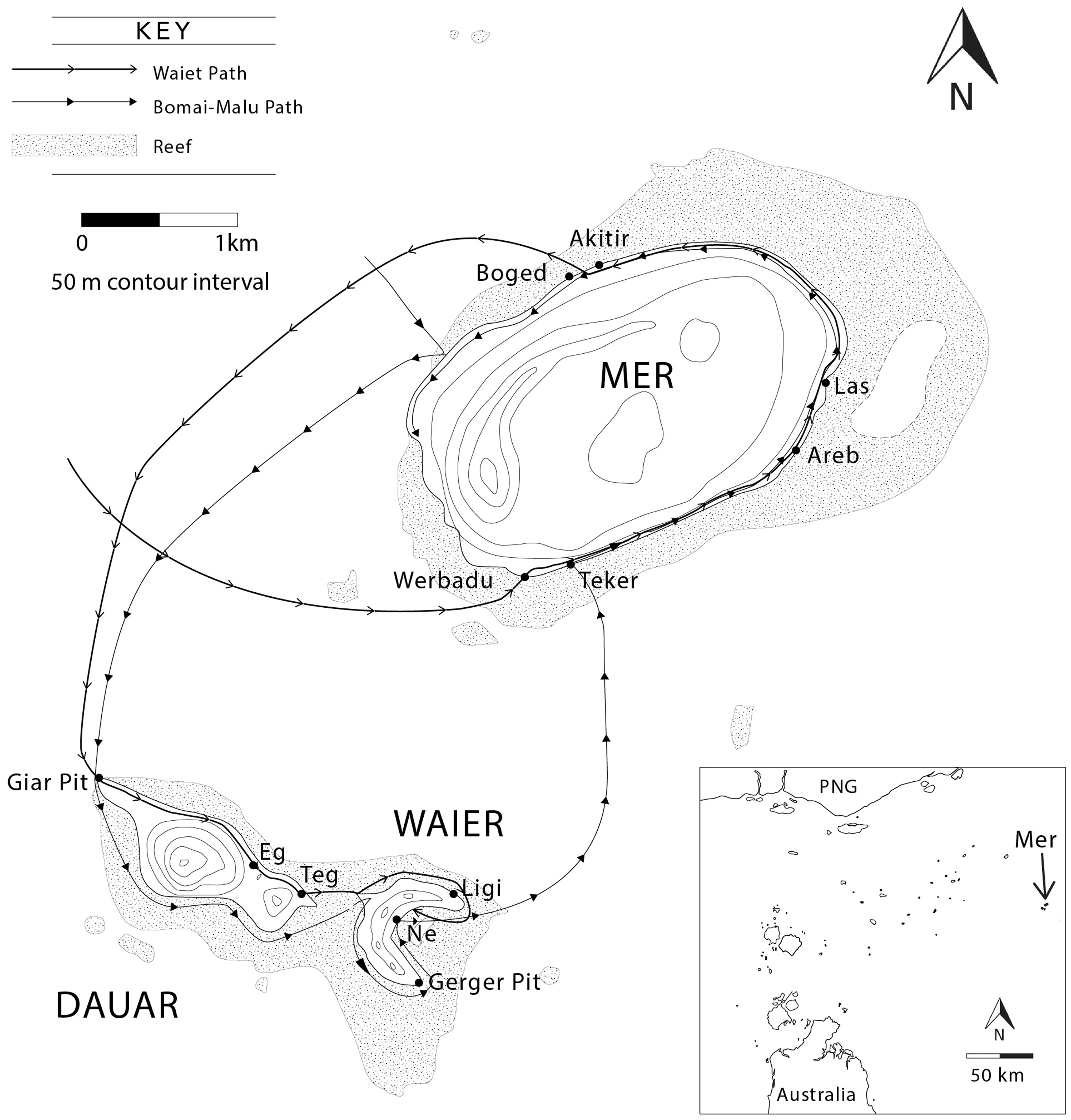
Waiet was (and to an extent still is) a much-feared figure, known to fly between islands in search of women. According to oral narratives, Waiet also brought new dances/rituals associated with treatment of (and communication with) the unburied dead (called zera markai keber and baur siriam keber) (Figure 2). He instructed Madub le (ritual specialists associated with treatment of the recently deceased) in processes including placement of corpse on platforms (known as zera/sara/paer) and mummification. These rituals were still practiced when Alfred Haddon (1908: 129–133, 1935: 120) visited Mer in 1898.
Drawings collected by Mr. J. S. Bruce (Haddon’s principal European informant on Mer). Haddon (1935: 132, 400–401) described these as: ‘dancers shaking goa nut rattles during the funeral ceremony’ (top left); ‘kolap atimedele Waiet zogo Le’ (top right), ‘Waiet Siriam with poles marked “Baur”’ (bottom left) and ‘Waiet sitting on the canoe platform (sal) in his shrine on Waier’ (bottom right; reproduction courtesy of Cambridge Museum of Archaeology and Anthropology, Universrity of Cambridge. Accession numbers 2010, 474; 475; 476 and 478).
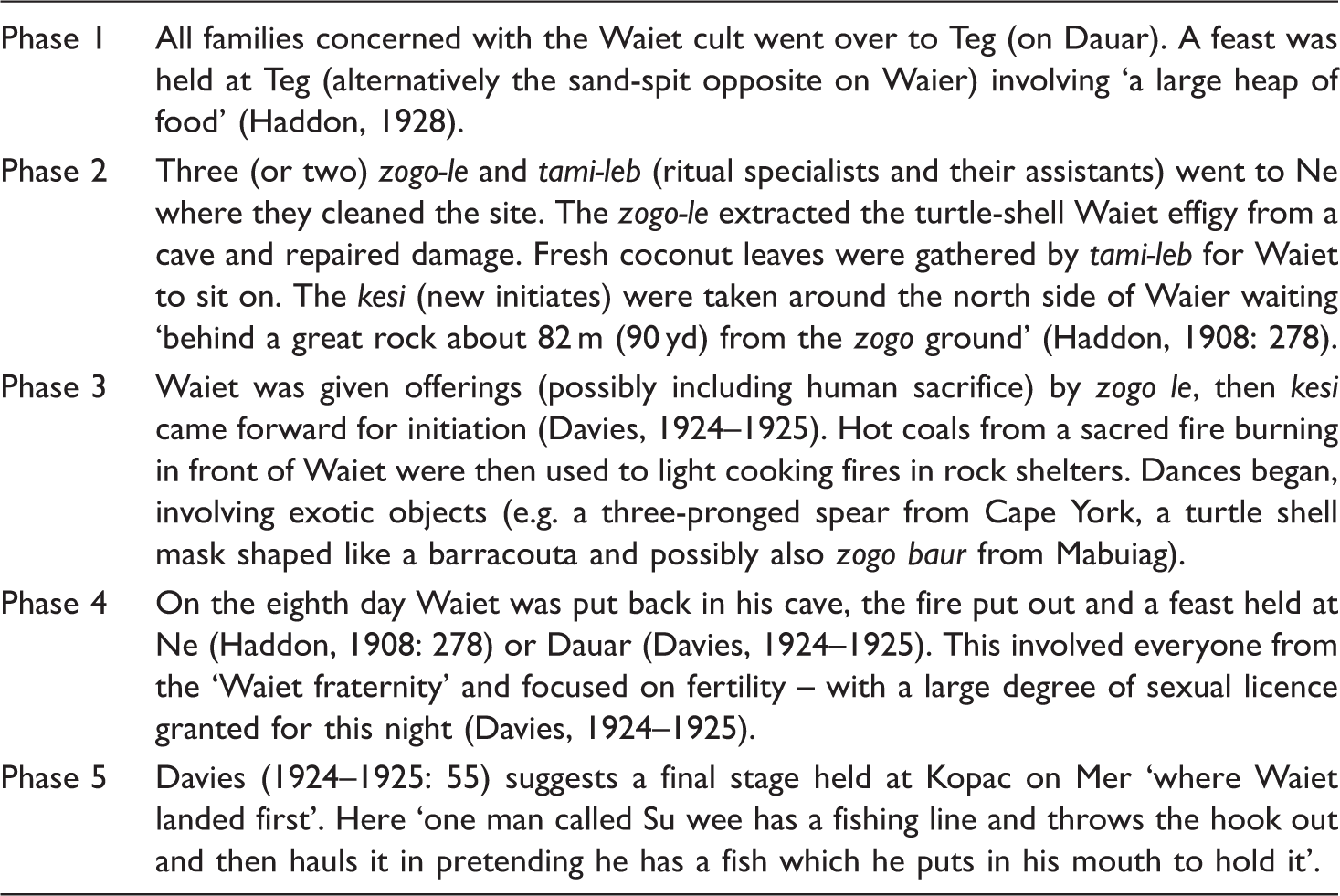
Waiet is further associated with annual initiation rituals, involving individuals from Waier, Dauar and the area between Ulag and Werbadu (East and South Mer) (Haddon, 1908: 278). This lasted for eight days involving a five-phase process incorporating unrestricted and restricted spaces.
Discrepancies exist between accounts provided by Passi to J.S. Bruce (cited in Haddon (1908: 278–279)) and Davies (1924–1925; Haddon, 1928, 1935). Davies (1924–1925) was informed that Passi and Debiwali were the ‘only two men alive who had attended the last rites of Waiet’, while J.S. Bruce (cited in Haddon (1935: 399)) suggested that the most recent officiators of this initiation ritual (zogo le) were Kriba of Waier and Sagiba of Areb on Mer. In addition, accounts by Davies suggest human sacrifice and ritual cannibalism took place during the Waiet ceremony. MacFarlane and J.S Bruce suggested Davies was mistaken, with Passi describing preparation of dead bodies on paier (platform) by Madub le (of whom Passi was one) rather than describing sacrifice of prisoners during the initiation (MacFarlane 14 August 1928; see also Haddon 1935: 402). Davies (1924–1925) believed Passi had granted information in an unguarded moment (due to a close personal relationship) but then was embarrassed to confirm this with other people.
A key dimension in the narrative of Waiet involved removal of paraphernalia associated with the Waiet rituals. This included transportation of zogo baur (sacred posts) associated with the baur siriam keber from Komet on Mer to England (Reverend S. McFarlane cited in Haddon (1904: 253, fig. 249, 1935: 155); Figure 2). Additional baur, depicting carved faces of ‘people [turtle hunters] who had died’, were found ‘hidden in a cave in Waier’ in 1889 and sent to Kelvingrove Museum in Glasgow (R. Bruce cited in Haddon (1908: 214)). Passi suggested these were associated with a ‘turtle ceremony’ conducted at Giar Pit on Dauar; however, their discovery on Waier and drawings of similar posts illustrating the Waiet rituals suggests a link with Waiet (Speirs and Allan, 2012; Figure 2). Davies (cited in Haddon (1904: 158)) also obtained a carved stone ‘turtle head used in Waiet ceremony’ and sent this to the Queensland Museum. Haddon (1904: 158) suggested this association was incorrect and that these objects belonged to turtle hunting rituals held at Giar Pit.
The Waiet effigy itself was removed from Waier in 1925, described in great detail in diaries of the perpetrator (Davies, 1924–1925). This caused great shock amongst the Meriam, who lined the beach when Davies returned to Mer with Waiet (Davies, 1924–1925). MacFarlane (14 August 1928) recorded how ‘a couple of days after Davies procured it, I was at Murray, and was awakened very early by an old woman crying outside my door (at the mission house), “my Waiet, no man, he take my Waiet”’.
According to Davies (1924–1925), ‘the old men sat in a circle and discussed the matter. Later one of the elders came and told me that I would have to die that night’. In a letter to Haddon, Davies (1928) describes how this ‘caused considerable consternation and for three nights I was apprehensive of my own safety’. Davies (1924–1925) described sleeping under the bed with a loaded revolver and the next day heard ‘a big meeting, some arguing that if Waiet wanted me to be killed, let him do the job himself’. Surviving the second night, Davies (cited in Orrell (1969: 42)) joined the Mer Island council where he found that Modi and Passi (the only surviving members of the Waiet cult) were unsure how to proceed. Passi addressed the meeting saying Waiet would attend to the Baba [creole word for father] in his own way – unless the Baba had more powerful magic than Waiet … If the Baba was not killed by Waiet – without any outside assistance then it must be admitted that his god’s magic was stronger than Waiet’s.
Passi then demanded return of the effigy to Waier. Davies agreed to this, but instead sent Waiet to Queensland Museum, Brisbane (Davies, 1924–1925; Orrell, 1969; MacFarlane, 14 August 1928).
In early 2014, Cygnet Repu (Head of the Goemulgaw kod, the cultural heritage organisation on Mabuiag in WTS) initiated The Waiet Project. This involved communities residing on islands associated with Waiet, an opportunity to celebrate shared heritage and reawaken (through archaeology, oral histories, song and contemporary art) stories relating to this figure. Cygnet Repu (personal communication, 2017) declared, ‘it’s time to talk about Waiet… this study is important. It brings together all Torres Strait Islanders. We are custodians of these stories and songs. It is our responsibility to pass these on to future generations’ (a statement echoed by Dauareb [Dauar Island] custodian, Alo Tapim in 2017). In the same year he approached Doug Passi (Prescribed Body Corporate Chair for Mer) and three months later one of the authors (DW).
After project inception, the following two years involved extensive consultation and formal introduction of the project and its personnel (by Cygnet Repu and Doug Passi) to the turtle shell Waiet effigy at the Queensland Museum. In 2016, it was decided that archaeological excavations would start in ETS, whereby a small archaeology team travelled to Mer. At the request of James Zaro and other Dauareb representatives, a base camp was set up at Teg on Dauar. This decision made it easier to access Ne, while also meaning the field team were camping at the same site used by zogo le and kesi, more than a century earlier. The route, navigating the east coast of Waier past Tikor and into Ne, also approximated that undertaken by the kesi.
The following section describes archaeological results conducted on Dauar and Waier.
The archaeology of Waiet zogo in ETS
Ne
Overview of Waiet ritual based on Davies 1924–1925; Haddon, 1908, 1928, 1935). Davies (1924–1925: 54) admitted that phase 5 ‘seems disjointed’ when compared with the subsequent account he obtained from Passi.

Ne (with Sunny Passi and location of sites/excavations) viewed from the sea (August 2016).
Waiet zogo features (1925 and 2001)
In 1925, Davies describes climbing up to Waiet’s place. On the first ledge (reputed to be where the Tamilils stood during the ritual) he observed recesses containing fire-blackened clamshells, interpreted as residue of cooking activities. Several small clam shells had been painted with red earth, likewise a number of ‘shells which are used by the natives for scarping coconuts’ (possibly cowries) (Davies, 1924–1925). The upper ledge (used only by zogo le) contained two clam shells under vines and bushes, behind which was a small cave. In the cave it was still possible to see the collapsed ‘trunk of a man’ made from turtle shell. Waiet wore a dari (doeri) headdress of ‘tern feathers dipped in a mixture of blood and red earth’, also suspended human bones and red, cowrie shells (Davies, 1924–1925; see also Haddon, 1928). Human bones associated with this figure included ribs belonging to ‘a white boy’, leg bones and a jawbone ‘apparently that of a young person’ (Passi cited in Davies (1924–1925)). Subsequent examination of human bone associated with this figure corroborate this – a child’s mandible (>6 <12 years), an unfused proximal epiphysis and fused distal epiphysis (age estimate = >14 <25 years) and an adult ulna with a healed distal fracture (Mark Oxenham, personal communication, 2017). No reference was made to a sal which reputedly ‘formed the shrine of Waiet’ on Waier and was associated with the original canoe brought from WTS by Waiet (J.S. Bruce cited in Haddon (1928: 130); Anita Herle, personal communication, 2016).
In 2016, similar features were observed. The first ledge contained large clam, trumpet and baler shells. Site disturbance (possibly through monsoon rainwater) appears to have occurred, with no clear pattern in shellfish distribution or orientation. The exception was a large upturned clamshell (‘Waiet’s drinking vessel’) located in a south-east facing alcove, in front of which was an area reputed to be ‘Waiet’s lookout’ (James Zaro, personal communication, 2016). Multiple alcoves were noted on the upper ledge, one of which contained a stone circle filled with earth and shells (‘Waiet’s fireplace’; Figure 4). It was here that Waiet was brought during initiation rituals (James Zaro, personal communication, 2016). Shell samples from Waiet’s fireplace dated between 134 and 292 cal. BP (at 2 σ), suggesting these were either deposited in a single or multiple events during a 138-year period.
Dauareb coordinator for 2016 excavations, James Zaro, at ‘Waiet’s fireplace’.
Use of rock shelters for dancing, cooking and camping (Davies, 1924–1925) is supported by significant quantities of cultural materials (mainly human remains and shellfish, including three large clam ‘water containers’) found in these areas during 2016. This differed from rock shelters north of the rocky promontory, which contained far fewer cultural materials and no visible human remains. A major cluster of cultural materials occurred in the most substantive rock shelter, 11 m south of the fissure (Figures 3 and 5). To test the age of mortuary activity at Ne three excavations were completed at various locations around the embayment.
The main excavation area (James Zaro, Glenn Van Der Kolk and Sunny Passi – bottom to top and left to right).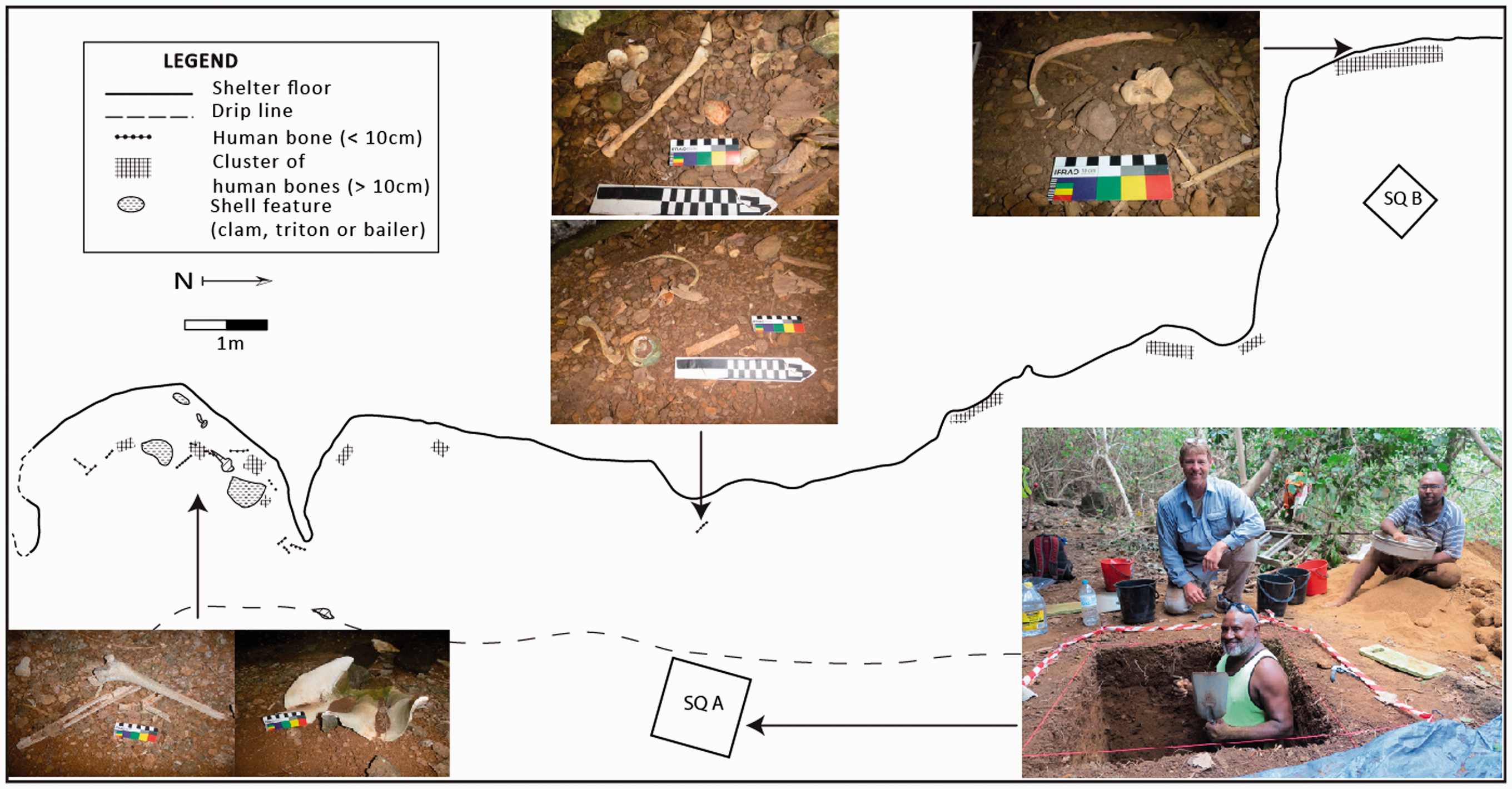
Ne excavations
Square A and B targeted an area south-east of the fissure and towards the middle of the southern embayment (Figure 3). This shelter contained a large upturned Tridacna sp. valve, ‘water container’ (James Zaro, personal communication, 2016), large trumpet (Syrinx aruanus), baler (Melo sp.) and conch (Stromboidai sp.) shells and many smaller shellfish preserving marks of human predation (Lambis lambis, Cypraeidae sp., Tectus niloticus). A surface scatter of human long bones, vertebrae, ribs and scapula were also observed (Figure 5). The largest unit (1 m × 1 m; Square A) was excavated 3.5 m from the back wall, outside the rock shelter drip line and 24 m from the high tide line. Square B (50 cm × 50 cm) was dug 8 m to the north-west, inside the drip line but was discontinued at 7 cmbs (centimetres below surface) at the request of James Zaro following discovery of articulated human remains. Square C (70 cm × 70 cm) was located 52 m north-east of Square A in a south-east facing rock shelter adjacent to the central rock outcrop. All excavations revealed shellfish and human bones in the upper 15–20 cm of deposit, with little evidence for cultural activity below this. Here we focus on comprehensively dated excavations (Squares A and B; for further results see Wright et al., In prep).
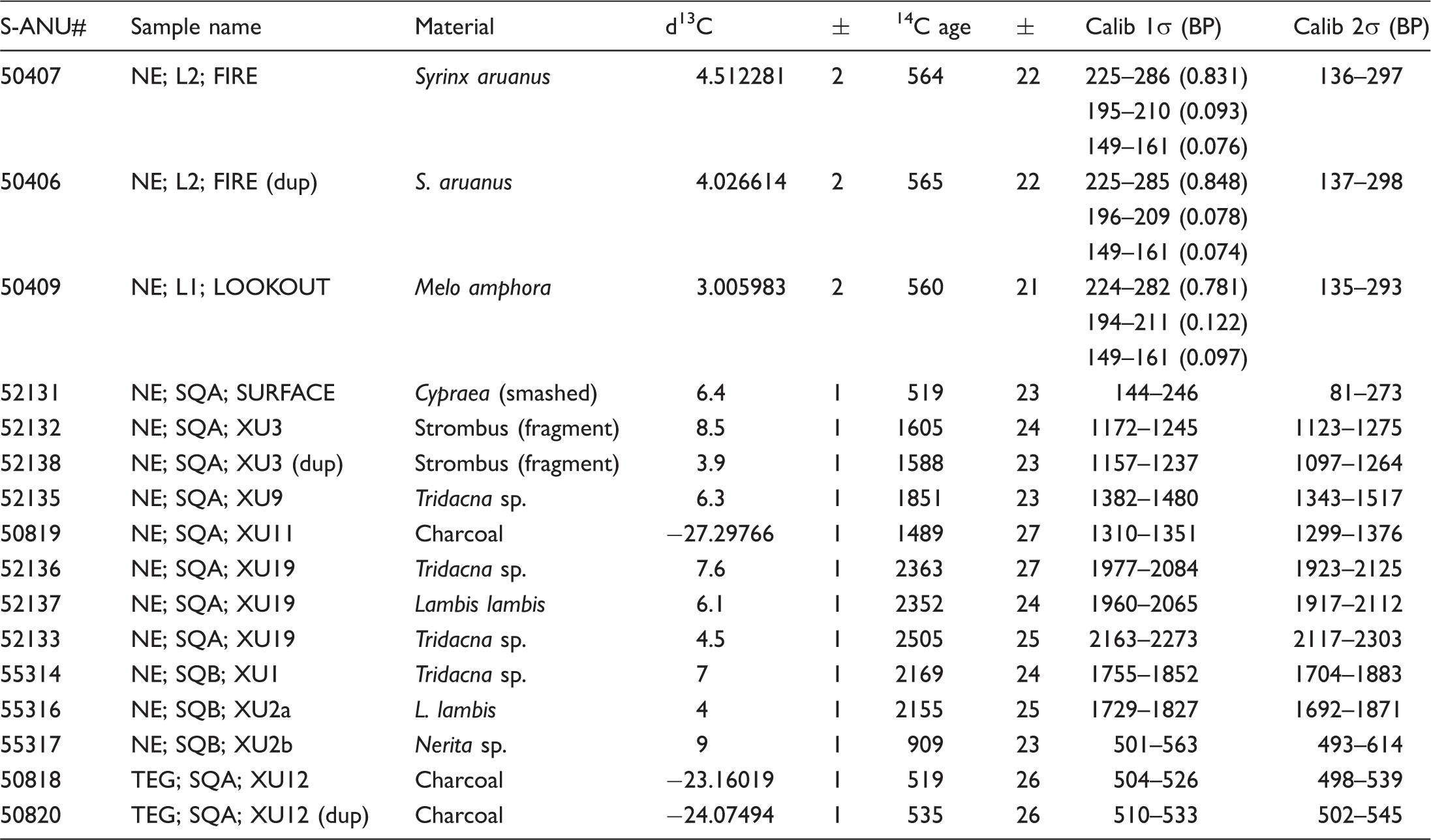
Cultural materials from Square A suggest altered human activity throughout the site’s history. SU1 consisted of fine-grained loamy sand, containing five human bone fragments and 15 small marine vertebrate bones. These clustered in the upper 5 cm (13 marine vertebrate and three human); however, an intact, horizontally oriented long bone was recorded in the stratigraphic section at a depth of 17–19 cmbs. The top 12–15 cm was also associated with shellfish including a surface cowrie with dorsum smashed. A single, small (1 cm × 1 cm and with a thickness of 5 mm) fragment of low-fired pottery was recovered from XU4 (between 15 and 17 cmbs). Geochemical analyses suggest that this was not manufactured in ETS, most likely coming from Papua New Guinea (but potentially also mainland Australia or western Torres Strait; Wright et al., In prep). SU1 was bracketed by two shell samples (a surface cowrie with smashed hump = 81–273 BP, and a single, Strombus fragment in XU3 (at a depth of 12–15 cmbs) which dated to 1123–1275 cal. BP.
The subsequent 40 cm (SU2) saw increase in sand content, coincident with decrease in cultural materials. A single, bipolar quartz artefact was recovered from 50 cmbs, in the same context as two large Tridacna valves, fragments of charcoal and an unidentified fragment of small vertebrate (probably fish) bone. A Strombidae fragment immediately below this (50–58 cmbs) dated to 1343–1517 cal. BP. The top of this layer provided evidence for localised disturbance (associated with insect disturbance) in the north-west corner.
SU 3 (76–108 cm) incorporated very fine-grained sand with a mixture of rounded and angular grains. This was observed to be consistent with the present-day sublittoral zone at Ne. Excavation units between 66 and 118 cm below the surface (SU3 and upper margins of SU2) provide evidence for sporadic cultural activity (sparse charcoal fragments, charred rock, a single quartz artefact and four L. lambis shells with smashed dorsa). A charcoal fragment from 75 cm depth was dated to 1299–1376 cal. BP.
SU4 (109–128 cm) was marked by a colour change from brown to dark yellowish brown, a shift towards calcareous, water-rolled sand and an increase in pumice. Evidence for cultural activity was equivocal; however, sparse charcoal was collected to 128 cm depth.
The final layer (SU5) was consistent with littoral zone deposits in rock shelters on Waier. Deposits included fine-grained, calcareous sand with what appears to be coral rubble (five coral heads, three water rolled rocks and 39 highly eroded and water rolled Tridacna valves and one L. lambis). None of the shells have breakage marks suggestive of human predation. Three overlapping radiocarbon ages (1917–2303 cal. BP) were obtained from shell sampled from excavation base (XU19; 145–150 cm depth).
Radiocarbon dates from the Waiet sites in ETS processed at the radiocarbon laboratory at ANU. Microscopic analysis of charcoal was completed to remove non-tree species which were then pretreated using ABA. Shells were mechanically and chemically cleaned in 0.1 M HCl to remove contaminants, with samples obtained from the youngest growth layers. Calibration used Calib 7.1; SHcal13 (charcoal) and Marine13 (shell) with the Torres Strait ΔR value of −32 ± 20 (Ulm 2010).
Teg excavations
A final 100 cm × 70 cm excavation took place in a thicket of coconut palms in the south-east recesses of Teg (Figure 6). This was located adjacent to an ‘old well’, at the bottom of a stone-lined pathway connecting Teg with villages (and cemetery) to the south-west. A village had occupied this site within living memory (James Zaro, Alo Tapim and Ron Day, personal communication, 2016) and it was the location of sacred pumice-stone objects buried by Waiet (Balaga Zaro, personal communication, 2016).
James Zaro helping to backfill the Teg excavation.
The upper 47 cm of deposit was associated with European materials (rusted fragments of sheet metal) suggesting disturbance, or perhaps more likely rapid sedimentation during the recent period. These layers contained 138 g of turtle and fish bone (including six fragments of charred turtle and one charred fish vertebrae), charcoal (2.8 g), a charred seed and four stone artefacts. This layer was further associated with 27 (by MNI) shellfish (pearl shell, Cypraea sp., Trochus sp., Conomurex (formerly Strombus) luhuanus, Nerita sp., L. lambis, Cardiidae sp., Planaxis sp., Asaphis sp., Tridacna sp., Haminoeidae sp., Turbo sp.), three of which had breakage marks consistent with human predation.
Basal layers revealed substantial quantities of marine vertebrate (turtle/fish) bone (103.7 g) but no stone artefacts. Burnt bone, charcoal and humanly predated shellfish were recorded to a depth of 95 cmbs with a charcoal fragment from 95 cmbs dated to 498–539 cal. BP (at 2σ). Excavated materials between 48 and 101 cm depth included a variety of marine shells (pearl shell, Cypraea sp., Trochus sp., Conomurex luhuanus, Nerita sp., L. lambis, Asaphis sp., Tridacna sp., Haminoeidae sp., Turbo sp., T. niloticus). Many had fracture marks consistent with human predation. Between 80 and 101 cm depth large numbers of water rolled Tridacna, L. lambis, coral and rock suggested an active beach deposit.
Discussion
Archaeological investigations on Waier suggest installations directly associated with Waiet date within the past 300 years (and possibly closer to the past 135 years only). This corresponds with the age (77–271 cal. BP) for a smashed Cypraeidae shell collected from the rock shelter surface. It appears also to be associated with mortuary activities involving adult interment at multiple locations around the Ne embayment and suspension of painted bones (primarily from children) around the Waiet effigy. Funerary activities appear to have a much greater antiquity (i.e. 1692–1883 cal. BP from SQ B and 1123–1517 cal. BP from SQ A), coincident with ephemeral human visits (evident through small quantities of lithic artefacts and a single fragment of pottery). Before assessing the implications of this early date, it is worth addressing the possibility that shells chosen for dating may have been contaminated with old carbon, were curated or that shell/human bone was intrusive.
The potential for contamination is unlikely. Intake of old carbon is improbable due to the local geology (basalt volcanics), absence of large local river systems and choice of non-ground-feeding species (Rachel Wood, personal communication, 2018). Recent ages obtained from four surface shell samples suggest reservoir effect is negligible. Different species can have different inbuilt ages (reservoir effects); however, with multiple dates per layer, a scattered chronology would be expected if inbuilt ages were at stake. Radiocarbon determinations on shell samples appear consistent within and between XUs, and correspond to a charcoal date from the same level.
The presence of old shells (brought to the site long after death) is unlikely. Samples were taken from youngest growth layers and chrono-stratigraphic consistency of shell/charcoal ages does not fit this scenario. A slight inbuilt age may occur for SANU-52133 (Tridacna), which at 1σ falls outside the range of the other two XU19 samples.
Without radiocarbon dating human bone directly site disturbance remains possible. It is unlikely, however, that dated shellfish moved up into layers containing human bone. This does not explain chrono-stratigraphic integrity of dated samples, clear stratigraphic layering (including sediment size/composition and lenses of pumice) and absence of any shellfish (or other cultural deposits) in the 56 cm’s between XUs 4–10 in Square A. It is difficult to see how articulated human bones could have migrated through Layer 1 without the same thing happening to dated shell collected immediately adjacent to and above human bone in Square B. Such a scenario is also hard to reconcile with broad age agreement between human bone layers in Squares A and B. Some disturbance occurred at the interface between SU1 and SU2 in Square A; however, this was contained (as SUB) during excavation. A single radiocarbon sample tested SUB deposit, suggesting disturbance prior to 500 BP.
Reassessing Torres Strait ritual connectivity
Results provide evidence for the earliest known archaeological funerary activity found in Torres Strait (up to 1883 cal. BP). This may represent an ETS-specific phenomenon (no comparable sites have been excavated in WTS or CTS), followed by increased ritual connectivity within the late Holocene. It is recognised that absence of comparable records in CTS and WTS does not mean they did not exist (with site taphonomy and sampling issues potentially responsible for this pattern). Some level of connectivity during this early period is attested by presence of an exotic pottery sherd.
Research examining the archaeology of ritual sites in WTS and CTS demonstrates commencement and proliferation of ethnographically recognisable forms of ritual activity during the past 400 years (David and Mura Badulgal, 2006; McNiven, 2013; McNiven et al., 2009). It is now possible to provide a comparable (or slightly more recent) age for ritual installations associated with the Waiet culture hero in ETS. Late Holocene connections with PNG and WTS are supported by numerous 19th-, 20th- and 21st-century ethnographic records (including songs in the WTS language and stories about wandering cultural heroes) (Alo Tapim, personal communication, 2016; Haddon, 1908: 409). Ethnography suggests material connections in the form of ‘exotic’ (i.e. with WTS origins) ritual paraphernalia associated with Waiet (e.g. zogo baur, sacred stones). While geochemical testing might be applied to these objects, it has so far been impossible to locate (or obtain samples from) suitable objects. Should this situation change (and once excavations at related sites in WTS are completed) it may be possible to return to this question.
Material connections between the various stages of Waiet ritual in ETS have been equally problematic. From an ethnographic perspective Waiet rituals existed, spanning restricted and unrestricted places on multiple islands. However, canoes transported zogo le and kesi to ritual places, excluding the need for physical trackways and no distinctive cultural features or iconographies were observed that might directly relate sites to Waiet. Significant quantities of turtle bone and cultural shell may support feasting events at Teg (as predicted by oral histories); however, they could equally represent unrelated human activity roughly coincident with the Waiet rituals.
Understanding the quantity and layered nature of the Waiet rituals has, however, been important for interpreting curation of sacred objects. For example, debate has surrounded discovery of zogo baur on Waier and the role that these objects played within Waiet rituals (Haddon, 1904; Speirs and Allan, 2012). Clear ethnographic links have been established between baur and Waiet’s baur siriam keber funerary rituals; however, association with a turtle ritual at Giar Pit (reputed to also incorporate WTS words and objects) has complicated the matter. We suggest Ne, as Waiet’s undisputed home and a long-time nexus of funerary activity, became a repository for paraphernalia associated with rituals associated with Waiet. As the first place Waiet visited on Dauar (and home to Passi, the chief zogo le for this cult), Giar Pit was also intimately associated with this figure. Like Kopec (Waiet’s first landing place on Mer) it is plausible that rituals connected with fishing/turtle hunting took place during an early stage of the Waiet initiation or indeed represented a separate ritual bound up in the wider corpus of Waiet. This may explain curation of zogo baur, along with ‘a stone shaped like a turtle’, on Waier; illustration of these posts in connection with Waiet rituals (Figure 2) and perhaps most dramatically, Waiet’s eventual transformation into a turtle shell effigy. Waiet has become a powerful symbol of fertility, rebirth and death, elements now inexorably linked with key places, paraphernalia and people.
Memories of Waiet
Earlier in this paper we explored temporal aspects of ritual performance, specifically the role that memory plays in archaeological and ethnographic research (Van Dyke and Alcock, 2003: 3). Results indicate that Waiet rituals (in the form recounted by Passi and remembered by contemporary Meriam) are likely to date within a 300-year period, culminating as communities adopted Christianity (after AD 1870). An earlier period of mortuary activity indicates staged development of Torres Strait mortuary rituals. This scenario broadly corresponds with ethnographic accounts which identify Waiet (and Bomai Malo) as recent influences adopted within an existing corpus of Meriam ritual (Alo Tapim, personal communication, 2016; Bruce cited in Haddon (1928: 130, 1935: xix)).
A long-term association with the unburied dead suggests Ne became an important memory place (see Kelly, 2016). In keeping with kod and village sites in WTS and CTS, this site occupies a distinctive natural environment to which powerful visual reminders to the past (in this case funerary remains) had been added (see comparable studies by Hodder and Pels (2010) and McEnany (1995)). The merger of human remains belonging to familiar and unfamiliar ancestors over hundreds (perhaps thousands) of years can only have increased socio-ceremonial affiliation and potency of Ne for the Waiet cult. The decision to place human bones (ancestors or potentially captives) around the Waiet effigy may have been attempts to develop a much older corpus of rituals associated with the unburied dead.
Following expectation that memory changes over time (between mythological and recent pasts; Gosden and Lock, 1998; Meskell, 2003: 34) it is worth reassessing the format of oral narratives. There is general consensus from ETS informants (see ‘Introduction’ for details) that Waiet arrived on Mer, then travelled to Dauar and settled at Ne, beating the sacred drum as he went. Oral histories are frequently highly symbolic, involving creation stories that depict Waiet’s supernatural powers (including flight and ability to transform into a turtle shell effigy). Haddon (1928) observed major discrepancies between iconographic representations of Waiet, further suggesting adoption of this figure as illustrative symbol rather than known ancestor.
Oral histories, drawings and songs provide great detail about the subsequent phase of Waiet rituals. Actors in these initiations were known ancestors who conducted well-remembered activities and oral narratives appear linear and literal. At the same time contradictions exist (including the names of zogo le; presence/absence of human sacrifice, ritual cannibalism and sexual license). Curiously, both accounts were provided by the same individual (Passi), suggesting deliberate restrictions/provisions for sensitive information (as suggested by Davies (1924–1925)) or misinterpretation of stories (MacFarlane 14 August 1928). Based on the metaphysical nature of ethnography and the potential for long-term mortuary activity at Ne we suggest variation might also reflect long term, cross cutting and complex nature of Waiet rituals (see comparable argument by Kyriakidis (2007)). Passi was able to recount stories about rituals experienced (as Madub le Passi would be intimately acquainted with zera markai keber), but also fragmented memories about those passed down to him by ancestors.
Based on a dialectical understanding of remembering and forgetting, abandonment, replacement or obliteration of sites/features may occur. Archaeology provides little support for this in ETS (other than apparent site abandonment within the past century); however, historical records provide insight into the process by which one set of religious practices subsumed another. The removal of the Waiet effigy represents one of a number of attacks by visitors on important ceremonial objects during a period of social and religious transition. This included the burning of the Bomai-Malu drum, ‘nemau’, by the crew of the Woodlark in the 1860s (Haddon, 1935: 43) and collection of important objects by Bruce, Davies, MacFarlane and Haddon. Davies’s (1924–1925) narrative provides insights into active responses by communities to traumatic events as they attempted to mitigate the damage collecting had on community memory (cf. Novak and Rodseth, 2006).
An important aspect of public memory is recognition that echoes of the past may survive in the present (Connerton, 1989). The Waiet Project is testament to this with fieldwork providing location-specific experiences including formal introduction to the Waiet effigy and an unnerving journey from Teg to Ne that parallels actions taken by uninitiated kesi (and indeed Waiet). The layered, continuing nature of ritual is evident when we observe that key stakeholders in ceremonies (from Kriba, Sagiba and Passi to James Zaro) are also traditional custodians of key sites visited by Waiet (Ne; Areb; Teg and Giar Pit). It is worth contemplating whether spatial parallels provide echoes of the staged processes by which ancestral Meriam and Dauareb emplaced new knowledge systems and rituals within existing cosmologies. Furthermore, research provides insight into the role archaeologists play in the process by which the past is forgotten (through removal or destruction of memory places) and remembered/reinterpreted. As this project draws to a close the Goemulgal and Meriam have initiated an exhibition (scheduled for 2019) which formalises this process of remembering, bringing together all aspects of the Waiet mythology – stories, songs, dances, art and archaeology.
Conclusions
This study provides the first archaeological evidence for ritual activity in ETS, suggesting mortuary activities in this region date back 1120–1880 years. Many centuries later, altered funerary rituals occur at the same important place. Research joins a growing body of knowledge exploring the materiality of ritual performance. Ephemerality of ritual sites/trackways and the subjectivity of oral narratives within an Australian Indigenous context provide challenges for research. Through the lens of archaeology of memory the reverse may also be true with echoes of various stages of past rituals surviving in contemporary oral histories and archaeologies. The process by which ethnographies transition across space and through time and discrepancies they have with archaeological results provides information about the complex and staged process of generational change. Conceived this way, ritual can be viewed as a continuum with archaeology interacting directly with memory as communities attempt to remember and forget the past.
Footnotes
Acknowledgements
Our heartfelt thanks to the Meriam, Dauareb and Goemulgal for initiating and involving us in this project. In particular, James Zaro, Sunny Pasi, Cygnet Repu, Doug Passi, Alo Tapim, Segar Passi and Ron Day. Thanks to Anita Herle (Curator, Museum of Archaeology and Anthropology, Cambridge); Patricia Allen (Curator, Kelvingrove Museum, Glasgow); Jude Philp (Curator, Macleay Museum, Sydney University) and staff at AIATSIS and Queensland Museum for providing archive access and advice. We appreciate comments on paper drafts by Laurajane Smith, Ian McNiven, Mirani Litster, Pamela Ricardi and Guillaume Molle. We thank Marc Oxenham for examining human bones and Glenn Summerhayes and Dylan Gaffney for analysis of pottery. Thanks to Meg Walker for Figures 1 and  .
.
Declaration of Conflicting Interests
The author(s) declared no potential conflicts of interest with respect to the research, authorship, and/or publication of this article.
Funding
The author(s) disclosed receipt of the following financial support for the research, authorship, and/or publication of this article: We thank the Australian Research Council (LP140100387) for project funding.