







Abstract
This article examines Huaca La Capilla in the Jequetepeque Valley, Peru, as a dynamic locus within a mythologized Moche mortuary landscape. Huaca La Capilla is a Late Moche (AD 650–740) monumental adobe construction located within the elite Moche cemetery of San José de Moro. This huaca was subject to constant architectural renovations and the intricate design of its interior plazas and patios suggests the orchestration of symbolic and collective social gatherings. The striking resemblances between this huaca’s enclosures and those depicted in the Moche iconographic scene of the Burial Theme are intriguing, suggesting that Huaca La Capilla was the locus of body-centered performances that preceded the burial of Moche elite individuals. This study draws on the notion of deathscape, incorporating a multi-scalar approach to the study of landscapes of death and their diverse spatial and material practices. It contributes to broader discussions of how mortuary landscapes and their monuments were involved in the (re)production of myths of ancestrality and particular notions of time, history, and construction of the being that gave political legitimacy to ruling groups in times of crisis.
Keywords
Introduction
Ethnohistorical accounts written by Spanish chroniclers narrate how ancestor worship constituted a quintessential aspect of religious and social life for the Andean population (e.g., Guamán Poma De Ayala, 1936: [1615]). The ancestrality rituals, in particular, were seen as catalyzing forces that reestablished relationships between the natural and social world, and also the divine and cosmic world (Kaulicke, 2000, Kaulicke et al., 2003). In these same accounts, some Andean landscapes are presented as places of ancestral origin and cosmogonic events. They are the residence of metaphysical beings, including the ancestors (aukis or machulas in the Quechua language).
Despite the rich textual information available, Andean archaeologists have often failed to materially define the “presence” of the ancestors in the landscapes or trace the mortuary and spatial practices through which their existence was guaranteed (although see Kaulicke et al., 2003; Lau, 2002). In Andean archaeology, prevailing object-centered perspectives on death and landscapes have eclipsed archaeologists' capacity to explore Andean notions of the afterlife, immortality, and embodiment, and how these were coproduced in relation to social space. The role of death as an articulator of life-regeneration and a dynamic force for the restitution of political relationships has consequently been overlooked.
Only recently have Andean landscapes become a category for deep analysis in scholarship (e.g., Bray, 2015; Jennings and Swenson, 2018; Kosiba and Bauer, 2013; Swenson, 2012); however, how death and ancestors were constructed, conceptually and materially, in relationships with sacred elements of the landscape is still rarely discussed archaeologically. Moving away from representationist and semiotic understandings of space, this paper draws on a performative and relational approach to the study of mortuary landscapes, one that enables a fuller appreciation of how diverse spatial elements of the landscape, when interconnected, deployed experiences on different planes of ontological reality. This study employs the term deathscape, which incorporates a multi-scalar understanding of space, to consider the diverse spatial, material, and social practices orchestrated around ancestrality rituals: those that aimed to convert specific individuals into ancestors. The application of the notion of deathscape to Huaca La Capilla–San José de Moro in the Jequetepeque Valley reveals how Moche funerary performances, in general, mobilized the landscape as a whole, and how the monumental constructions present in the site became a backdrop for the orchestration of powerful ancestral mythologies. This study ultimately aims to reposition the role of the mortuary landscape in the making of ancestors, power relationships, and political subjectivities in the Moche world.
Deathscapes and mythologized landscapes
The concept of deathscape was first introduced by cultural geographers in the 1950s in an attempt to retheorize the relationship between culture and landscape and, specifically, the processes of domination, hegemony, and resistance that are expressed even after death (Kong, 1999: 2). Since then, the concept has had diverse trajectories of application in geography and urban studies, but its presence in archaeological debates is still limited (although, see examples in Dakouri-Hild and Boyd, 2016; Semple and Brookes, 2020). With the advent of postprocessual approaches to landscape (Knapp and Ashmore, 1999; Tilley, 1994), studies of funerary landscapes and architecture began to acknowledge the potent “spatial domains” of death. Drawing on phenomenology and performance and practice theories, postprocessual archaeologists placed a new emphasis on the multisensorial, somatic, and intersubjective nature of the mortuary place, which also constituted a point of reference for the construction of the being. As Boyd and Dakouri-Hild (2016: 2) point out, an “archaeology of funerary place” now considers deathscapes not as the outcome of funerary actions frozen in time, or mere events for the deposition of corpses. They are spaces “inherently mutable and performative: continuously reworked, revamped, rebuilt, remembered, or turned to ruins, obliterated, abandoned, forgotten, and rediscovered.”
In recent years, deathscapes have been considered in relationship to theories of space-making and ontological proxies for humans. Dimakis (2015: 27) has defined deathscapes as discursive spaces: “mental constructs comprised of ideas about, and representations of, death in the landscape”; but they are also produced through diverse social and material practices that are historically constituted. Deathscapes are spaces of deep significance both personal and collective, imbued with experiences, memories, and emotions that are constructed while death is staged. Deathscapes are, hence, a form of physical citation in the landscape (Semple and Brookes, 2020: 4), and the repetition of diverse rituals and funerals makes them multi-temporal loci of cumulative commemoration and memory making (Van Dyke and Alcock, 2003).
As lived spaces of accumulated experience, deathscapes can be studied in relation to processes of mythmaking (Burkert, 1983). This is an aspect of particular relevance for this study. Through the act of revisiting the dead, the living make and inscribe microhistories (Handelman, 2005) on landscapes that are often transmitted in the form of myths. These are collective narratives that, because of the fantastic nature of the facts and personages they describe, explain primary principles and values of the society, as well as the order of the known universe (Lévi-Strauss, 1955). In some cases, myths associated with landscapes grant them qualities that make them deathscapes. For instance, as described by Santos-Granero (1998), the forest of the Yanesha from the Amazon was inscribed with powerful myths, enabling them to re-create heroic sagas of powerful deities, including their death and rebirth as ancestors. Interestingly, spatial markers in the forest, or topograms (Santos-Granero, 1998: 140), allowed these sagas to be remembered, re-created, and performed at special occasions. This represents a process of making “myth-histories.” Topograms are markers of both spaces and time that can constitute a semiotic system; they can be (re)combined in order to generate new associations and sub-stories to illustrate, explain, legitimize, or question new historical situations, and with that, new perceptions of time, both cosmic and mundane.
Deathscapes, therefore, can be involved in the making of myths, history, and alternative perceptions of space-time. They can act as, following Bakhtin (1981), intense chronotopes, where time and space are mutually coproduced. Similar to Foucault’s cimetières, deathscapes are examples of “fully functioning” and “highly heterotopian” sites in their enclosures of temporal discontinuities (Foucault, 1984; see also Johnson, 2006). Deathscapes can encapsulate multiple temporalities because of their topological nature (see Swenson, 2018). But, the potential of deathscapes also lies in their liminal nature, as they can constitute portals between life and death, and other diverse planes of ontological existence. They can be considered spaces inhabited by nonhuman entities and spiritual forces (“meta-persons,” according to Sahlins, 2022: 65) that, at certain occasions, facilitate communication between the world of the living and of the dead, as well as the transition from the former to the latter.
This paper draws on this particular conception, considering deathscapes as animated landscapes charged with nonhuman supra-agencies whose power is reinvigorated when invoked through rites, funerals, and diverse performances. In deathscapes, these entities are brought into the plane of human reality; while new entities can also be produced, materialized, and then memorialized. Deathscapes are, using Sahlins’ words, enchanted universes: “realities filled with other-than-human persons endowed with greater-than-human powers” (Sahlins, 2022: 70). The threshold of death allows the existence of these meta-persons who many times exert influence on the living through rituals that produce an absolute disruption of traditional time and mundane reality (Bell, 1992). Deathscapes are spaces of immanence and metamorphosis where both human and nonhuman entities can radically transform their sociopolitical identity and individual subjectivity, and even reinvent their ontological status.
These particular features have made deathscapes arenas for political negotiation and controversy in the past (Rainville, 1999). For Foucault, they are technical-political objects that helped sustain forms of management and governance in history (Foucault, 1984). These notions of deathscapes constitute a pertinent theoretical framework to reevaluate the nature of Andean mortuary spaces in association with their multiple temporalities, the rhythmical resonance of domestic life, and the materiality and immanence of the dead bodies. It has been widely acknowledged that, in the ancient Andes, people forged understandings of social reality through daily dwelling with death and the dead (Kaulicke, 2000) and a deep engagement with animated landscapes (Allen, 2002). Ancestrality and the reproduction of political power directly involved the participation and manipulation of landscapes and the cosmological and cosmogonic elements within them. As previously argued, to rule in the ancient Andes it was necessary to die first (Bourget, 2008), and the conversion of prominent leaders into ancestors first required death to be “staged” in sacred landscapes, so that the power of the ancestors was memorialized, and the restructuring of social and political order guaranteed.
This paper argues that specific monumental constructions, such as Huaca La Capilla, can be interpreted as loci of sacrality within powerful Moche deathscapes. Here, mythological narratives associated with ancestrality and life-regeneration were periodically enacted. Examining Huaca La Capilla as part of a dynamic Moche deathscape ultimately offers perspectives on how perceptions of Andean immortality and political power were intertwined with cultural understandings of space-time and its constant and perpetual renovation.
Death in the Moche world and San José de Moro
Thriving on the north coast of Peru between AD 200
Perhaps no other society from the pre-Columbian Andes has produced a greater fascination with (and fetishization of) death than the Moche, in part due to the large amount of funerary evidence of this society to which archaeologists have long had access. The study of death in Moche archaeology has, however, relied on limited, and partially selective, types of evidence. Grand narratives about Moche death, based on the discovery of magnificent elite burials (for instance, Alva, 2016), have predominately highlighted object- and power-centered discourses that have placed exacerbated attention on issues of status, hierarchy, and sociopolitical power. For Kaulicke (2000: 76), death in the Moche world was envisioned as a singular opportunity for transformation and reconstitution of the human body into alternative forms of existence, and Moche archaeologists are particularly well equipped to contextually trace these body-centered processes, their change across time and space, and their effects in the social and political arenas. This, however, requires heavily relying on a granular contextual approach to the mortuary evidence, large- and small-scale, that enables integrating spatial, artifactual, and bio-archaeological evidence.
In very few sites of Moche territory, death and death-related performances can be archaeologically examined and placed within their own historical and cultural context. San José de Moro, a Late Moche (AD 650–850) elite cemetery and ceremonial center located in the northern bank of the Jequetepeque-Chamán Valley in northern Peru, is one such site (Figure 1). San José de Moro has been systematically excavated throughout the last three decades by the San José de Moro Archaeological Program (Castillo, 2001, 2012; Castillo and Muro, 2017). During the Late Moche period the site acquired particular relevance, among other regional centers in the valley (e.g., Huaca Colorada; Swenson, 2012), as a religious center for the celebration of funerary feasting that gathered populations from all the Jequetepeque Valley and beyond (Castillo, 2000). Complex chamber tombs have been documented in various sectors of San José de Moro, the most distinctive being the tombs of Moche priestesses: prominent women interred with ritual ornaments similar to those of the Moche female deity, as represented in Moche iconographic art (Castillo and Rengifo, 2008; Donnan and Castillo, 1992). Whereas tombs of powerful male individuals personifying Moche male gods have also been documented in the site (Muro Ynoñán, 2010), the evidence points to an exceptionally female-figure-centered cult. (a) Map of San José de Moro with the location of Huaca La Capilla; (b) Digital Elevation Model; and (c) orthophoto of Huaca La Capilla produced in Agisoft Metashape.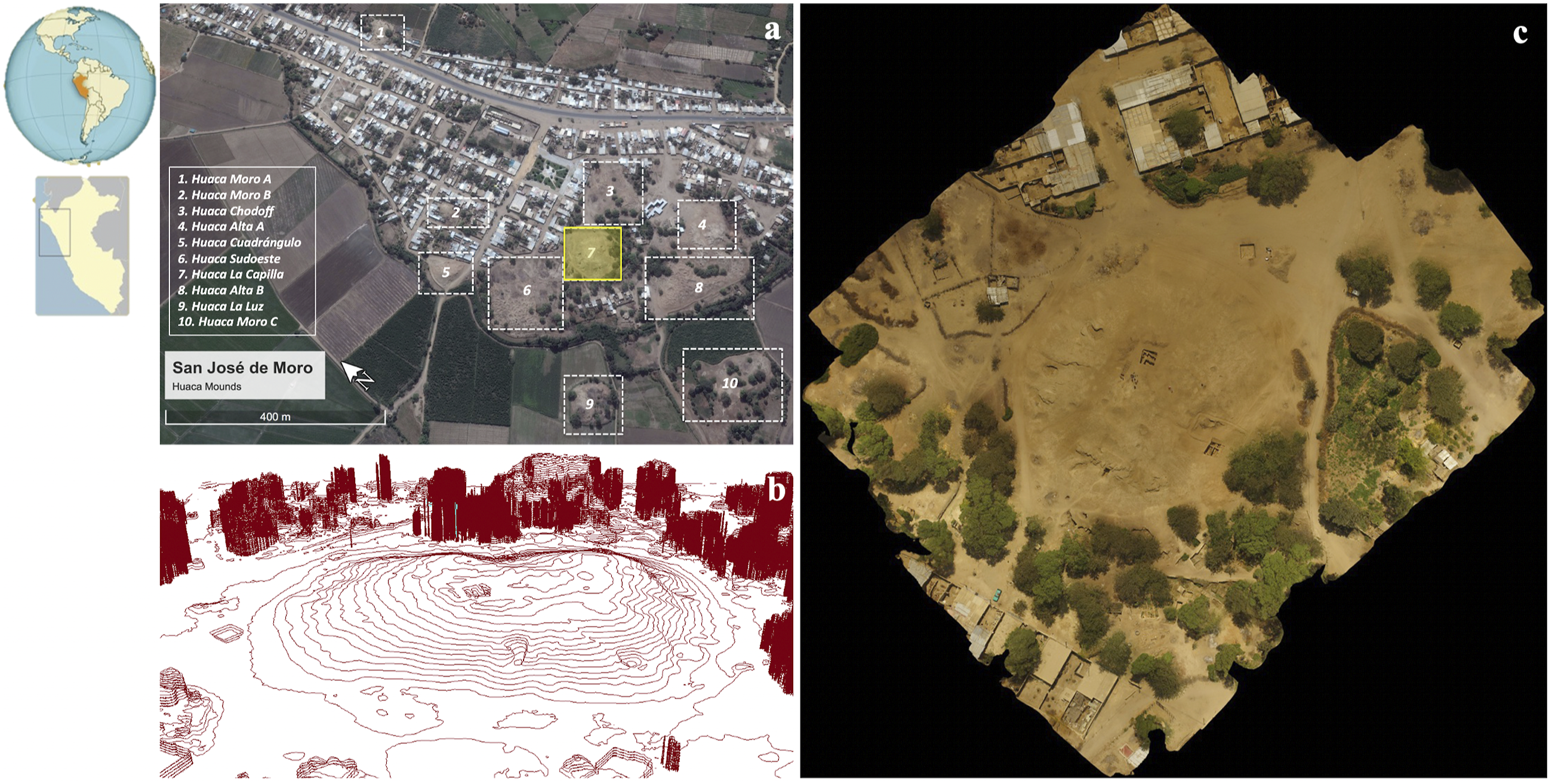
Refined stirrup spout bottles decorated with complex narrative scenes (Figure 2) often accompany the bodies of elite individuals in the tombs of San José de Moro. Full or partial representations, or evocations, of the famed Burial Theme are particularly ubiquitous in the funerary material culture of the site. Depicting a large number of characters (from individuals impersonating Moche deities and hybrid creatures manipulating ornaments to animated objects interacting with, and subjugating, other nonhuman entities), the Burial Theme has been a matter of multiple interpretations. For many, the scene develops around what seems to be an ornamented coffin descending into an underground structure. However, the burial (or “awakening,” for Bourget, 2006: 191) of the deceased is only one out of many actions in the scene, and it is likely that the diverse planes of action in it are sequentially linked. Whether based on the depiction of a real performance or a fictitious narrative, the supernatural features of the characters indicate the mythological nature of the scene that takes place in a highly ornamented space: a true mortuary spectacle. Late Moche elite burials containing these bottles were not isolated in the mortuary landscape of San José de Moro. Instead, they were loci of intense postmortuary activity (Castillo, 2000), including feasting events where large amounts of maize-based beer (chicha) and foodstuffs were processed and consumed (Muro Ynoñán, 2009). Moche iconographic scene of the “Burial Theme,” taken from Donnan and McClelland (1999).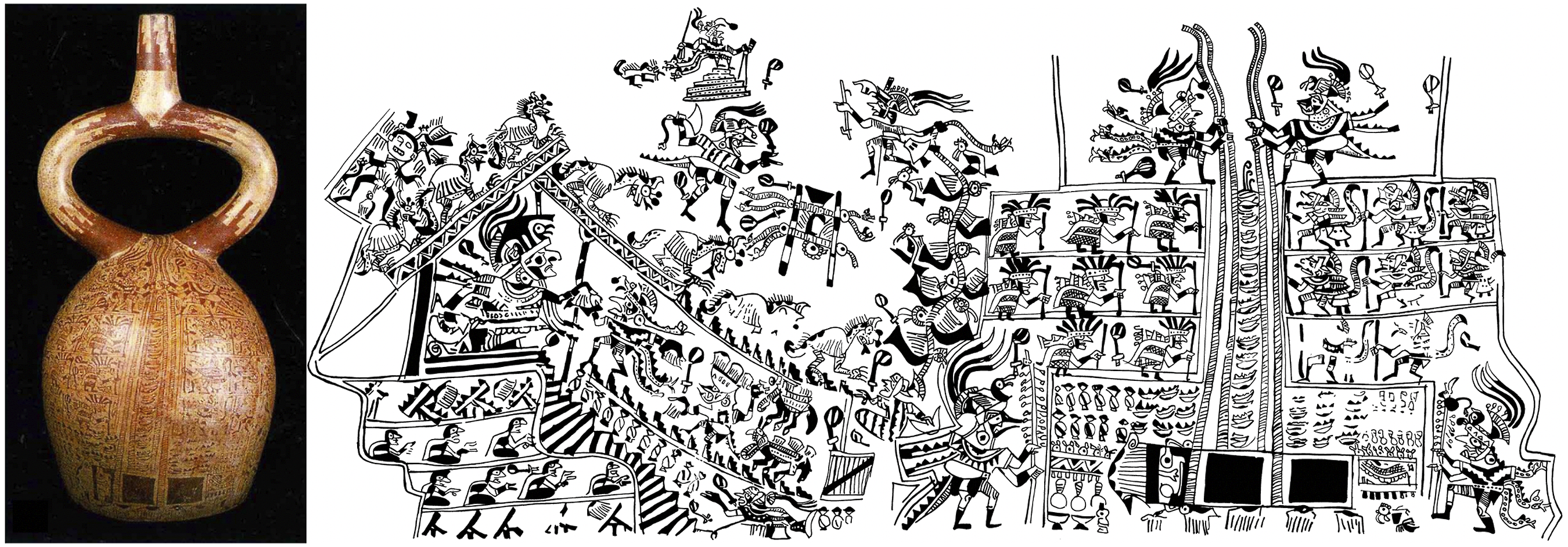
New evidence gathered at the site by the author, as part of four excavation campaigns conducted between 2014 and 2017, provides clues that complement previous archaeological interpretations of San José de Moro. Excavations in the monumental zone of the site have revealed intriguing connections between the Late Moche mounds, elite burials, and feasting areas in the cemetery, suggesting that the site presented an architectural layout that possibly facilitated the movement of bodies, pilgrims, and ritual items across the landscape of the site. Monumental constructions such as Huaca La Capilla were likely directly involved in the celebration of mortuary spectacles that re-created mythological narratives similar to the ones depicted in the Burial Theme.
Huaca La Capilla–San José de Moro: buildings and multiple renovations
Huaca La Capilla is located on the western side of San José de Moro, and it is one out of at least 10 nonexcavated mounds at the site. The structure presents a dimension of approximately 100 × 120 × 9 m (see Figure 1). The excavations led by the author have determined that this huaca was the result of a complex, although relatively short, construction process. At least five major construction phases or buildings (A, B, C, D, and E, from the earliest to the latest) have been documented. Extensive architectural fills (of up to 3 m high), containing abundant organic and ceramic waste and informally built retaining walls, separate the buildings from one another. The five buildings of Huaca La Capilla present remarkable similarities in their architectural layouts. They are composed of plazas and patios containing stage-like platforms and connected to each other through corridors and hallways, which, in some cases, lead to more private enclosures. Most of the spaces are decorated with multicolor mural painting and other decorative architectural features. For example, Building A contained a large open plaza (Plaza A) whose eastern side was enclosed by a 30 m adobe wall decorated with black paint and 44 niches. They were equally distributed in two rows of 22 each (Figure 3). The content of the interior of the niches is still unknown. The central axis of Plaza A was defined by a one-step platform with a back wall (Platform A), which was decorated with high-relief designs of triangles and waves and black painting (see Figure 4). Photo and isometry of Plaza A (Building A) of Huaca La Capilla. Decorated platforms in Buildings A, B, and C of Huaca La Capilla, indicating parallels with diverse scenes of Moche iconography. Drawings taken from Donnan and McClelland (1999; Figures 5.46d, 5.41, and 1.15, from top to bottom).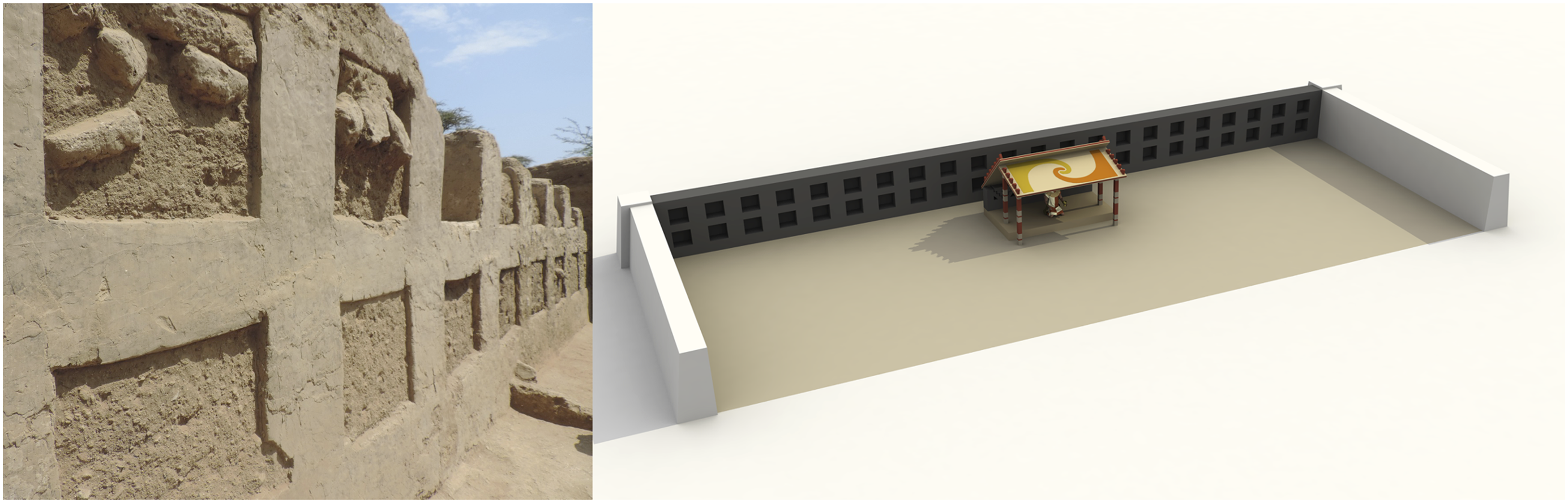

In a similar manner, Building B and Building C contained plazas (Plazas B and C, respectively) enclosed by niched walls. Similar to Plaza A, the spatial axis of each was defined by a decorated platform, each of which shared the same position and orientation as Platform A. Platform B (in Plaza B) was a one-step platform with a back wall. Its lower perimeter was decorated with geometric designs of waves and steps in yellow, red, and black colors, and its back wall with horizontal bands of red and yellow colors. Platform C (in Plaza C) was a double-step platform whose lateral and frontal sides were decorated with yellow painting (see Figure 4).
Building E extends across the summit of the huaca and was composed of a set of patios interconnected by corridors and multiple doorways. Patio E1, on its northern side, was a quadrangular-shaped structure decorated with 19 windows aligned and distributed on the upper section of its eastern wall (Figure 5). To the south, a three-step stairway leads to a stage-like platform elegantly plastered with a fine stucco. Isometry and photos of details of Patios E1-E2 of Building E of Huaca La Capilla. (1) Patio E1 decorated with 19 windows; (2) C-shaped corridor; (3) private enclosure decorated with three niches; and, (4) ceramic container embedded into one of the patio’s walls.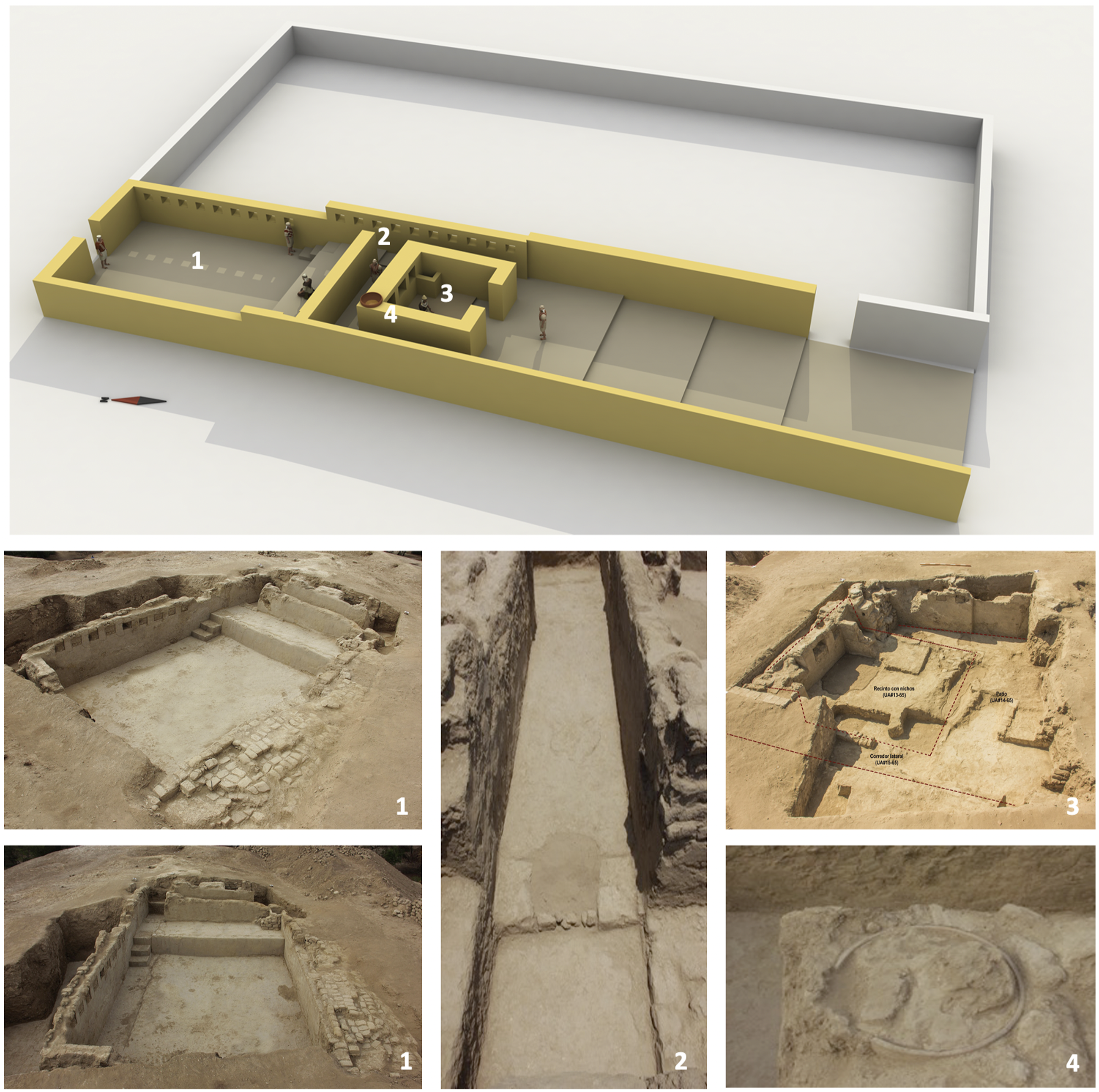
Attached to this stage-like platform, an elongated, C-shaped corridor was also excavated. It is likely that this had served as a sort of backstage for public appearances on the adjacent platform (see details in Figure 5). The existence of a large ceramic container embedded into one of the corridor’s walls reinforces this idea. The C-shaped corridor led to a more private structure (Patio E2), whose northern wall was decorated with three niches.
Particularly intriguing about Huaca La Capilla and its five buildings is the abundant evidence of repairs of walls and floors, suggesting a constant and active use of the spaces. The niched walls of Plaza A, for instance, presented evidence of at least 10 layers of re-plastering and repainting. The structures of Huaca La Capilla were also subject to differentiated treatments of “care” and maintenance. Some architectural elements were left unrepaired or even violently dismantled at the end of their use, with the debris left in situ. That is the case with Platforms A, B, and C, presenting clear-cut signs of having been knocked down and then covered with coarse architectural fills. Other evidence of the abandonment of the buildings includes around 220 graffiti inscribed on various walls of the huaca as well as the remains of 11 young female individuals, presumably sacrificed, amidst the architectural fills of Buildings A and E (see Figure 6). The degree of disarticulation of many of these bodies indicates that they were in an advanced state of decomposition when placed in the fills. Evidence of rope around their necks and hands indicates that they were likely killed by strangulation, stored for a long period of time, and then dispatched in the construction fills. (above) Resemblances noted between plazas and patios of Huaca La Capilla and architectural models (McClelland, 2010) from elite burials of San José de Moro; (below) conch-shells recovered in chamber tomb MU1727; and, (right) sacrificed female individual (15–18 years-old) documented in the construction fill of Building A.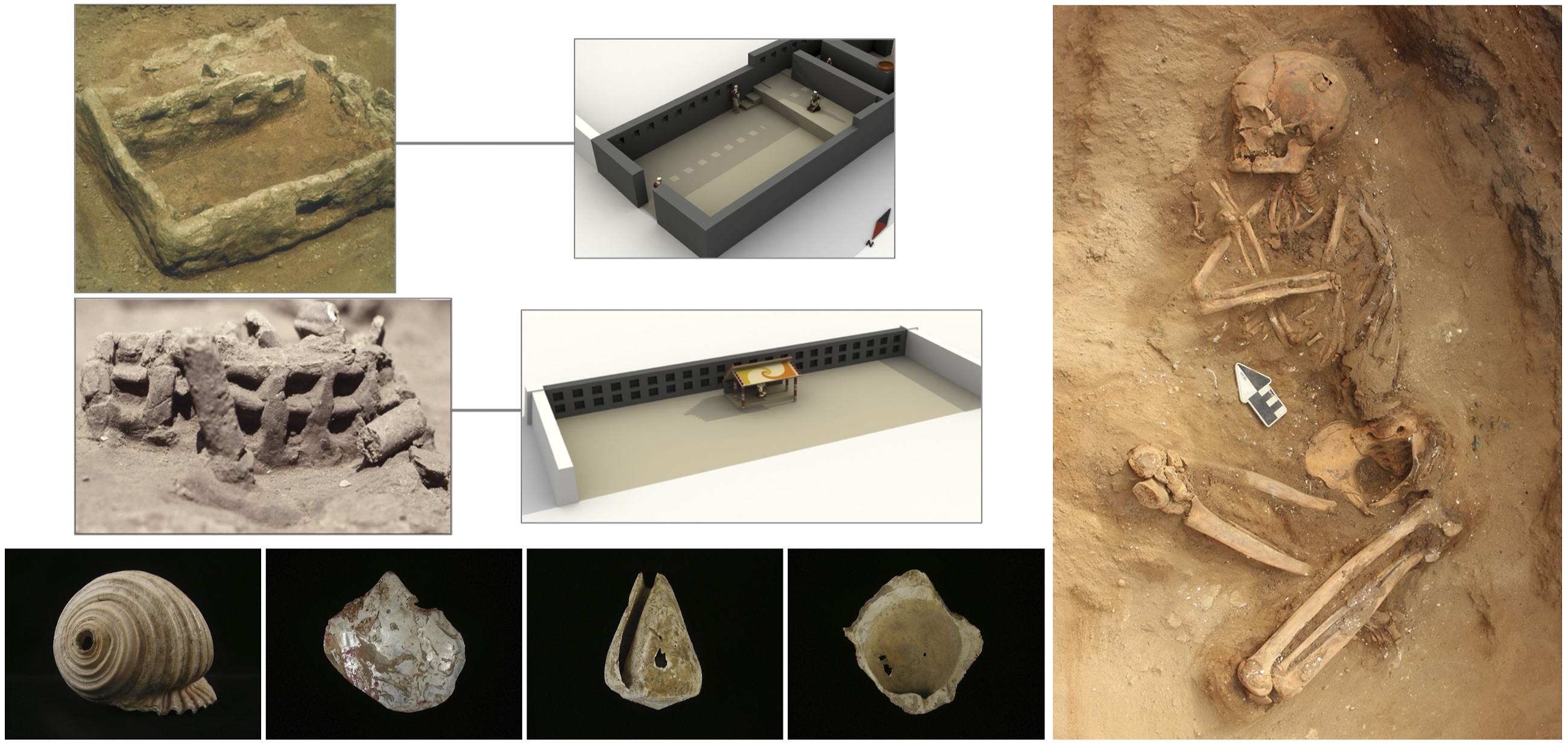
Thirty-five radiocarbon dates obtained from the floors and walls of the buildings of Huaca La Capilla indicate that they were built, used, and dismantled in relatively short periods of time, probably between cal 650–740 AD. A Bayesian statistical analysis of these dates has confirmed that major construction episodes are relatively close in time, with the construction of new buildings occurring every 20 or 30 years, and with some structures from different buildings likely functioning in a simultaneous way (Muro Ynoñán, 2019). Huaca La Capilla was, therefore, contemporary with the most complex Late Moche tombs documented in San José de Moro, as well as the times when mortuary and celebratory activity and the production of lavish funerary items were overwhelmingly taking place at the site.
Interpreting Huaca La Capilla: function, design, and iconographic narrative
A detailed spatial analysis of the architectural contexts of Huaca La Capilla and comparison with sources of iconographic information reveal interesting aspects of the accessibility and function of the buildings documented, and possible meanings of their design. First, it is important to note that the accessways of each of the enclosures of the huaca are narrow and restricted, indicating control of its accessibility and the movement of the users. This contrasts with the actual dimensions of the plazas and patios where the accessways lead: they are open, wide, and evoke large gatherings. For example, Plaza A is 180 square meters and Patio E1, 77 m2. They could have hosted relatively large audiences, with a maximum carrying capacity, according to Moore’s criteria (Moore, 1996: 791), of 90 and 50 people, respectively. However, the size of the space does not necessarily equate with the actual number of attendees, and many of these spaces could have been meant to be a receptacle for nonhuman entities (without a material manifestation), or simply not to be accessible at all.
The design of the set of Patios E1-E2 is especially intriguing. The design of the C-shaped corridor that interconnects the two patios seems to provide a sort of “spatial script” for movement. It is likely that this corridor served as a space of preparation prior to acts of symbolic presentation orchestrated either on the stage-like platform (in front of many) or at the private niched room (in front of a very few). The interplay between sequential acts of preparation and presentation seems to be evident here, and the corridor likely served then as a backstage of preparation, where acts of libation could have taken place, judging by the presence of the large ceramic container embedded in one of the corridor’s walls. Whether all these actions were performed simultaneously or consecutively, following a sort of script, is still unknown.
A micro-stratigraphic examination of the floors provides relevant clues about the actions possibly orchestrated in the buildings and their subsequent treatment. While clean and compact in appearance, the floors of Huaca La Capilla are actually composed of successive layers of yellowish mud applied to repair and re-plaster the surface of use. The segments of floor in areas surrounding the three platforms are the ones showing the most signs of use and wear. For instance, the segments of floor around Platform A present evidence of an intensified use: from burning areas and whitish concretions to fractures and cracks poorly repaired. The identification of fungi-like blackish concretions on various segments of floor indicates their long exposure to moisture, suggesting that Plaza A may have remained open for long periods of time before being buried, or exposed to rainfall. In contrast, evidence of postholes in immediate proximity to Platforms B and C indicates that these platforms were partially roofed and protected from the environment.
In addition, the evidence documented on the floor of Building E points to actions that entailed the manipulation of diverse symbolic items, including: an incomplete ceramic mask possibly used for theatrical performances, a bone spatula decorated with the Moche half-fist sign, and various fragments of human figurines (see Figure 9 in Muro Ynoñán, 2018). Whereas the identification of these items on the floors suggests the orchestration of certain types of performances, the similarities between the spaces of Huaca La Capilla and those represented in the iconographic scenes rendered on the Moche fine-line bottles from San José de Moro are striking and worth discussing.
For example, two-step platforms with back support and gabled roofs, similar to Platform A of Huaca La Capilla, are shown in the iconographic scenes of the Burial Theme (see Figures 2 and 4). In these scenes, the platforms are the loci of the exchange of conch shells. Conch shells have rarely been found in Moche archaeological deposits, with only the exception of San José de Moro. An exceptional number of six conch shells was discovered in the chamber tomb MU1727, containing a male individual personified as a Moche male deity (Muro Ynoñán, 2010), confirming that these items were, in fact, circulated across the cemetery and placed in elite burials (Figure 6).
In a similar way, one-step platforms with gabled roofs appear in iconographic representations of the famed Moche Presentation Ceremony. They are the locus of the giving of a sacrificial goblet as well as of humanized ceramic containers, architectural models, and warfare paraphernalia, all of which seem to have been stored at in-built deposits. In one particular scene (see Figure 5.67 in Donnan and McClelland, 1999), this type of platform is connected to what seems to be a niched structure standing behind, where the items exchanged or presented are stored. The focus in this scene is on not only the presentation of offerings, but also, and clearly, their temporal storing prior to their possible use in other types of performances. The spatial layout of these particular scenes is reminiscent of the plazas and patios from Huaca La Capilla. When observed laterally, the decorated platforms of Plaza A and Patio E2, with their niched walls behind, are unquestionably similar to the gabled roof platforms of both the Burial Theme and Presentation Theme. The same can be said for the stage-like platform of Patio E1 and Platform B. The decorative elements of this latter (triangles and waves) appear in scenes associated with the manipulation and preparation of corpses by nonhuman entities (see Figure 5.2 in Muro Ynoñán et al., 2019) and sexual activities involving skeletal individuals.
In sum, and considering that the Burial Theme is a distinctive theme in San José de Moro’s iconographic repertoire, the decorated platforms in the buildings of Huaca La Capilla likely served to perform a variety of actions, including the exchange, public presentation, and then storage, in in-built niches, of conch shells, architectural models, and ceramic containers (with humanized features in the iconography). Other performances on the platforms likely included sex-related rites involving the theatrical and sexual manipulation of the corpses of certain individuals, as documented in other Moche religious centers (Verano, 2008). All these actions likely occurred prior to these items being placed within elite burials located in various parts of the site. As shown in the iconography, the actions on the platforms seem to have constituted attempts to invoke or bring into reality specific nonhuman entities, who perhaps facilitated the interconnection between the various elements of the sacred mortuary landscape, as well the divine transformation of specific individuals into ancestors.
Huaca La Capilla and the deathscape of San José de Moro: the making of time, ancestors, and political power
In order to interpret Huaca La Capilla as an important element of San José de Moro’s deathscape, it is necessary to adjust the resolution and scale of spatial analysis, from the micro to the macro, and temporal resonance, from single to multiple, so the qualities of the deathscape can be examined in detail. In general, a multi-scalar perspective on landscapes of death can better illuminate the historical particularities of funerary areas, repositioning their role in sociopolitical dynamics specific to the Andean deep past. A theoretical examination of the Moche funerary landscape as a deathscape historicizes and humanizes the experience of death, as well as the immanent power and materiality of Moche corpses (skeletons and their parts), when theatrically manipulated in contexts of power negotiation (the body-as-spectacle; Foucault, 1977).
For the specific case of Huaca La Capilla, the successive architectural transformations of its buildings are evocative of a particular notion of time that can be understood in relation to the built space, but also the dead and their manipulation/use in San José de Moro. As Swenson (2018: 192) has suggested, time and space are two inseparable dimensions in the Moche world, and the “lived experience,” which is forged in the Moche ceremonial precincts, emanates from a spatially constituted temporality in cycles of growth, destruction, and renewal of the space. This idea is well expressed in Huaca La Capilla, and the fact that each new building of this huaca is a similar replica of the earlier one shows a conspicuous necessity for the symbolic reinvention of the structure, more than a redesign destined for functional purposes. This pattern that characterizes many other Moche huacas constitutes what Swenson (2018) calls a topological perception of reality, in which time is fixed, and thus performed, in the ceremonial space, producing particular ideologies of change, continuity, and history.
This study has been able to radiometrically estimate the “rhythmic temporality” of the transformation of the monumental space of Huaca La Capilla. As explained earlier, Bayesian analyses indicate progressive periods of reconstruction of the buildings likely occurring every 20 or 30 years. The buildings of Huaca La Capilla were, hence, unigenerational; that is, associated with the life cycle of one individual or various coeval individuals (Uceda, 2000). Unpublished dates obtained from the above-mentioned chamber tomb MU1727 (Castillo, personal communication) have revealed possible chronological correspondences between this specific burial event (cal 730+/−40) and the construction event of Building E of Huaca La Capilla (cal 720+/−40), both of them occurring close in time. While more absolute dates of elite burials are necessary to establish more robust correspondences, it is plausible that the huacas in San José de Moro were unigenerationally renewed as a consequence of the death and lavish inhumation of prominent elite individuals. Feasting areas, in direct proximity to burials, were possibly remodeled in conjunction with the huacas (see Muro Ynoñán, 2009).
If buildings in Huaca La Capilla, and possibly other unexplored huacas at the site, were being transformed in relation to the life cycles of human entities, then an important correlation can be suggested between the transformations of the body and ceremonial spaces contained in the deathscape. Graham (2009: 64) has suggested that the intimate relation between the body and mortuary landscape coalesces through processional movements along familiar pathways, “stressing the extent to which the dividuality [of the dead’s personhood] permeates the urban fabric of the town and consequently the lives of the inhabitants.” Funerary processions in San José de Moro might have operated in exactly this way, as graphically depicted in Moche art (see Figure 3.125 in McClelland et al., 2007): bodies in progressive transformation, being dramatically manipulated through a structured sequence of movement along the space. This could have impregnated landscapes with specific personhoods, identities, and meanings of memory in contexts of community integration and mourning.
Particular notions of time and corporeality seem, therefore, to be similarly encrypted in the Moche deathscape and its dynamic management. San José de Moro was an enlivened and somatically renovated (Swenson, 2018) landscape whose transformation possibly paralleled diverse cycles of alteration of the corporeality of specific elite individuals. Human sacrificial offerings, such as those documented in the construction fills that cover up Buildings A and E, reinforce the idea that the human body and its malleability and fractality was considered a sort of device for the opening and closing of cycles of rituality and mortuary time in the site. The bio-archaeological data even suggests that corpses, or part of them, were likely “guarded” in their communities of origin or charnel houses, waiting to be publicly used and manipulated in diverse corporeal performances in San José de Moro. Also, body parts of important individuals are found as accoutrements or props in specific burials and surely circulated in the same way around the communities and landscapes of the valley.
But the renovation of the spatial elements of the deathscape occurred within diverse scales of time and action. Whereas mounds, feasting areas, and possible processional pathways involved great amounts of planning, intervention, and work, the floors and walls of Huaca La Capilla were also shaped through quick, punctuated events of repair. Both quotidian and extraordinary acts of remodeling and space renewal occurred simultaneously. Key architectural elements were purposefully left intact or only slightly modified, indicating a continuum in the use of the space: a reminder of the multi-temporal constitution of the deathscapes, a palimpsest of deathscapes. For example, the recurring location, position, and orientation of the decorated platforms in each of the successive buildings reinforce a sense of sacred permanence and ubiquity. As Bourget (2006) has indicated, Moche platforms could themselves embody ancestral entities or be the portals through which it was possible to communicate with them. The step designs that decorate Platform B are evocative of this idea. The steps have been interpreted by some as ritual symbols of transit toward the world of the spirits (Dean, 2010).
Steve Bourget’s (2008) metaphor “morir para gobernar” (die in order to rule) could not be more apt for illustrating the complexities of Moche politics and ancestrality. The conversion of prominent individuals from diverse Moche communities in the valley into powerful ancestors, through lavish mortuary spectacles celebrated in San José de Moro, seemed to be sine qua non for these communities to enter into arenas of political competition and power negotiation. Each community of the Jequetepeque Valley, whose religious affinity and community identity were linked to a specific group of ancestors, could have actively sought the production of new, or empowerment of preexisting, ancestors, in order to increase the power of their own lineage. It is still unclear how the privilege of being buried in San José de Moro was assigned. Competence at an intra- and inter-community level could have been at stake or hereditary mortuary rights passed on from parents to children guaranteed access to this type of Moche terra santa. In San José de Moro, ancestors were made by invoking, and then imposing, divine personhoods over the mortal body of specific individuals, transforming their human corporeality into an ancestral corporeality: a relational and fractal body, in perpetual change, and with the capacity of transmuting its essence (or camaquen) in landscapes, huacas, and things (Bray, 2015). It is likely that only through the agency of these powerful meta-beings could Moche communities guarantee improved rights of access to resources (agricultural lands, crops, and irrigation channels) in a valley with the constant disputes and conflict characterizing the Jequetepeque Valley during Middle and Late Moche times.
In the context of the documented construction of fortified domestic settlements in this time in the valley (Castillo, 2010; Dillehay, 2001), San José de Moro likely played a key role in the reestablishment of political relationships and intercommunity negotiations. Whereas no evidence of domestic occupation has yet been documented in the site, it is likely that San José de Moro was ruled by a priestly caste of mortuary specialists: powerful oracular agents who controlled both funerary space and time. Similar to other Andean “powerful places” (Jennings and Swenson, 2018), San José de Moro and its monumental constructions could have been envisioned as cosmic loci for the revelation and transformation, as well as reinvention, of Moche time-space in specific moments of heated crisis. In fact, specific perceptions of time and its tracking seem to be reflected in the religious topography of the site and, in particular, the architectural layout of Huaca La Capilla. The redundancy in the frequency of the number of niches and windows in Buildings A and E is likely indicative of activities of timekeeping and astronomical observation in the site. Numbers such as 44 (the total number of niches in Plaza A), 22 (the number of niches per row), and 19 (the number of windows that decorate Patio E1) were possibly related to accounts of the phases of ritual and funerary time. It is highly likely that Moche time was defined by moon-phase-based calendars, as suggested by the preponderance of moon representations in the Moche iconographic repertoire. The black color that once decorated Building A could have been reminiscent of the transformative properties of night or a mimesis of the site’s nightscape.
The reenactment of mythological narratives in the site made possible the opening up of the mythic threshold between the world of the living and that of the nonhuman forces that ruled the world, the production and control of time, and, with that, the regeneration of Moche reality. Beyond the discussion of whether or not Moche iconographic scenes are representing true myths (see Quilter, 1990), these scenes are built in relation to the supernatural, animism, and a reversed notion of reality. The scenes are, therefore, mythological in the sense that they make up an extraordinary reality of events and characters whose agency articulates the Moche known world. San José de Moro can be examined in mythical-spatial terms in the sense that the objects, spaces, and gods-ancestors that construct these extraordinary realities are present in the site in intimate contextual association with the burials and funerary spaces around them.
The affordance of the deathscape of San José de Moro can also be examined based on its synecdochal capacity (Spencer-Morrow, 2018): the capacity of one part to represent and/or evoke the whole. Portable items placed in specific locations in San José de Moro seem to be potent reminiscences of past performance and thus other deathscapes. This is the case, for example, with the architectural models that have been documented in elite burials of the site. Some of them present striking resemblance to the spaces of Huaca La Capilla. For instance, Maquette #13, found in the tomb of the First Priestess (Donnan and Castillo, 1992), represents a space similar to Patios E1 and E2 of Huaca La Capilla: a quadrangular patio decorated with small windows, a restrictive accessway, and an ascending ramp leading to an upper platform (see Figure 6). Maquette #14 from said burial (McClelland, 2010) also represents a structure decorated with niches similar to the ones decorating Plaza A of Huaca La Capilla. Whereas these mimetic relationships between the real world and represented architecture raise issues about scale and the ephemeral nature of matter-space in the Moche world (Castillo, 2020), the architectural models seem to be tempo-spatial articulators of the diverse planes of reality that came to life through the deathscape. For Spencer-Morrow (2018: 302), “the miniatures functioned not simply to memorialize a space but to store and reactivate a ‘time’ that was understood as inseparable from the space in question.” If the spaces of Huaca La Capilla were receptacles for rites of ancestrality, then their miniaturization and then introduction into specific burials were ways to keep “alive” their transformative agency, which acted in a punctuated moment of time seen as inseparable from the body of the newly created ancestor. Models surely activated associated networks of mythic beings and animated things present in the multiple deathscapes. Conch shells, above discussed, architectural models, and even Huaca La Capilla itself acted, ultimately, as topograms (Santos-Granero, 1998). They were reminiscent of past burial events, but also markers of space and time through which myth and history were semiotically inscribed, reordered in the space, memorialized, and then replicated in new funerals and performances.
For the Moche world of Jequetepeque Valley, power seemed to rely on the capacity to control, or be part of, the renovation of cycles of ritual and funerary times, and thus the production of history—history that, following Johnson (2015: 40), is embodied, somatic, and performative. Similar to the imperial body of Inka sovereigns (Wilkinson, 2013), the transformation and dramatic manipulation of the Moche body and its parts produced and defined cycles of history. In the Jequetepeque Valley, San José de Moro and Huaca La Capilla were probably considered the zero point, from which Moche space-time was regenerated and reinvented. The death and lavish burial of prominent Moche individuals prompted the restructuring of the deathscape as a whole (preceded by its symbolic destruction). Similar to the human body that is transformed and honored in San José de Moro, there was an ontological understanding of the deathscape in which it was required to die first, and then rebirth—and the renovation of its elements (mounds, tombs, and feasting arenas) facilitated passage through the threshold of death as well as the ontological-cosmic transformations of the mortal individual so that he/she reaches a status of immortality and transcendence. Huaca La Capilla and San José de Moro, in sum, exemplify a deathscape, defined as a place of orchestration of mythic enactments that assembled together places, bodies, and things at different scales, forms, and states, as a means to exert control over time, power, and the passage of important living persons into alternative modes of existence.
Conclusion
In this paper, the notion of deathscape has been used to explore how ancient mortuary spaces were directly implicated in the restructuring or perpetuation of social and political orders. The examination of Huaca La Capilla as part of a dynamic deathscape has attempted to reposition the role of Moche space as an active agent in the production of political subjectivity and identity (Swenson, 2012). Reexamining how power relationships were ultimately constructed through death and the spaces around it offers new theoretical tools for prehistoric archaeologists to explore multi-scalar material and spatial practices in ancient cemeteries where diverse planes of ontological existence were unified through ritual. For the ancient Andes, deathscapes could conceptually qualify within the original definition of huaca (Zuidema, 1995): articulators of social space; providers of order; and delimiters of the known world of the living. They also need to be examined in relation to nature, its sacred elements, and the potent metaphors that they represent. The projection and orientation of architectural elements of deathscapes toward specific natural features (e.g., the decorated platforms of Huaca La Capilla facing toward the sea) could reveal a particular aesthetic symbolism of design. For example, rivers, canals, and water sources in the deathscape could mimic the fertilizing blood and semen of the ancestors or liquid manifestation of its generative power—illa. Thinking through deathscapes facilitates, therefore, a holistic, culturally sensitive, and ontologically coherent perception of the landscapes of death in the past.
Finally, the political power of the deathscapes in Andean prehistory cannot be neglected. The access to, and “control” of, the elements in such spaces could have been critical in the mechanisms of (re)distribution of power in moments of crisis, chaos, and upheaval. In fact, the evidence indicates that, near their political collapse, the Moche infused more complexity into their mortuary narratives, just as the tensions among the Moche polities, specifically in the Jequetepeque Valley, were becoming more complex and palpable (Castillo, 2001, 2010). Moche deathscapes need thus to be understood as spaces of confluence of diverse worlds, where time and history were renovated in relationship to death and its staging. Some have even pointed out that Moche ceremonial centers might have purposely been spatially arranged according to the diverse scenes narrated in the myths (Rucabado, 2021). This means that the Moche deathscape is not only a stage for mythmaking and performances associated with death, but can actually be the myth itself.
Footnotes
Acknowledgements
I thank Luis Jaime Castillo for his support to this research, giving me continuous access to the database and materials of the San José de Moro Archaeological Program. My special thanks to my excavation teams, especially Renata Verdun and Hoover Rojas, and Francesca Fernandini, Maria Fernanda Boza, Richard Sutter, and three anonymous reviewers for providing useful feedback to improve the quality of this manuscript.
Declaration of conflicting interests
The author(s) declared no potential conflicts of interest with respect to the research, authorship, and/or publication of this article.
Funding
The author(s) disclosed receipt of the following financial support for the research, authorship, and/or publication of this article: This work was supported by the Stanford Archaeology Center, Center for Latin American Studies, and Institute for Research in the Social Sciences, as well as the Pontificia Universidad Católica del Perú and Dumbarton Oaks Research Library and Collection. Part of this paper was produced thanks to the “Beca de Apoyo a la Investigación 2021” from the PUCP Department of Humanities.
