







Abstract
There is variation in the university student experience of learning. Prior research has shown that factors that shape this include student characteristics, the learning context, student perceptions of that context and approaches to learning and their learning outcomes. In blended contexts, there is a need to identify variables which can explain why some students are more successful than others in order to shed light on why students in the same course completing the same activities in the same teaching environment experience these perhaps very differently and also achieve different outcomes. To address these issues, this study looks at first-year university students who were required to engage in online inquiry as a key part of their learning experience. This study offers a way of revealing qualitative differences in the student experience of learning in the students’ blended course. It suggests that differences in the quality of the experience can be revealed by variation in the quality of approaches to inquiry and learning technologies, differences in student perceptions of online workload and the integration of the class and online contexts. These differences were found to be logically and positively related to student achievement indicated by course marks, which provide implications for the design and teaching of courses in blended contexts.
Qualitative variation in the university student experience of learning
Investigating reasons for qualitative variation in the university student experience of learning is a key goal of Relational Student Learning research (Biggs and Tang, 2007; Entwistle and Ramsden, 1983; Laurillard, 2013; Marton and Säljö, 1976; Prosser and Trigwell, 1999; Ramsden, 2002). This research seeks to identify variables which can explain why some students are more successful than others. Key variables which guide the research are shown in Figure 1.
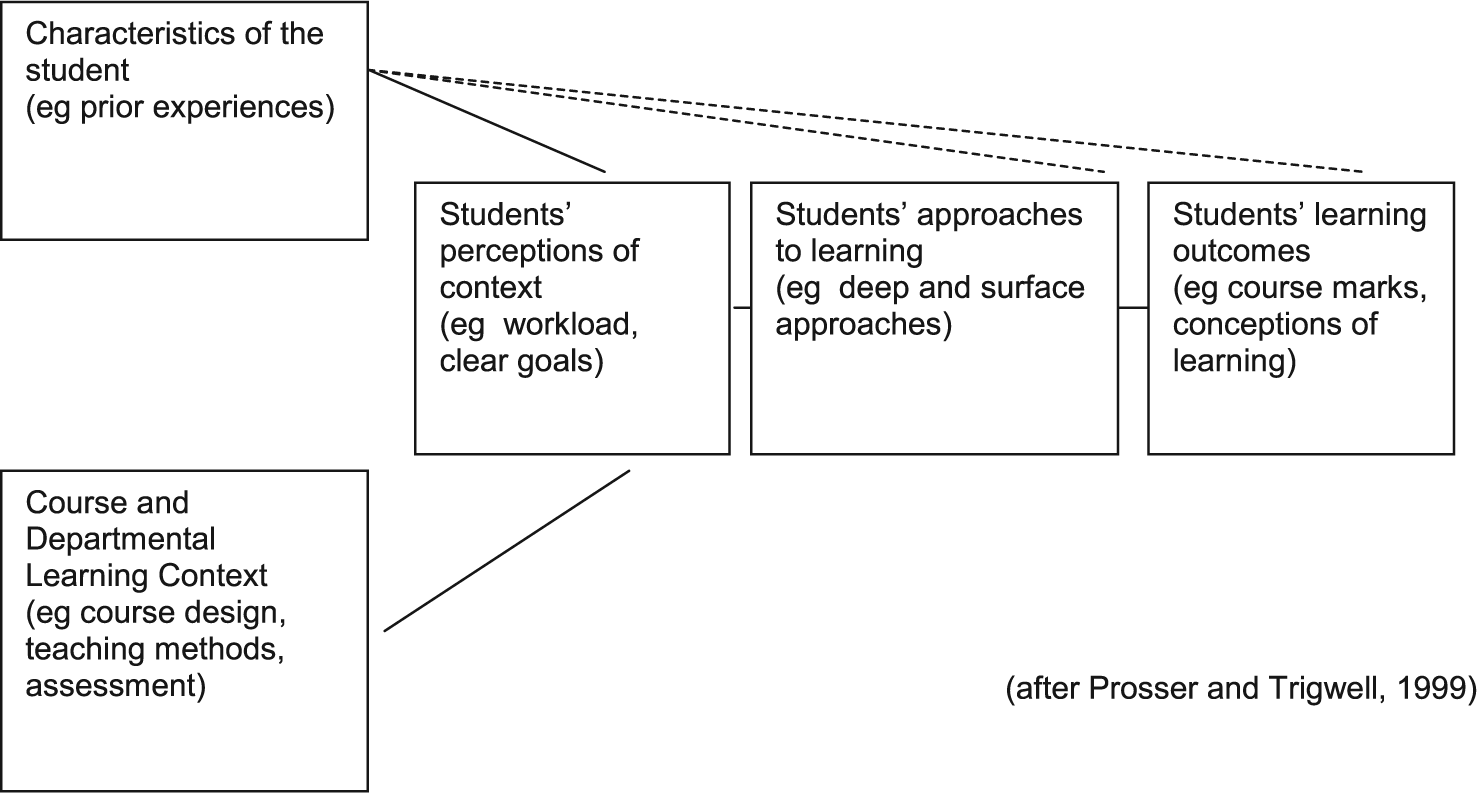
The student experience of learning.
Figure 1 shows areas of research in Relational Student Learning research, including student characteristics, the course and departmental learning context, student perceptions of context, student approaches to learning and their learning outcomes (Biggs et al., 2001; Prosser and Trigwell, 1999). At a high level of description, it is the qualitative differences in the student experience in each of these areas which can offer some insight into why students in the same course completing the same activities and receiving the same teaching can end up with remarkably different experiences and outcomes. In this study, student approaches to inquiry and technologies and their perceptions of some key aspects of the blended learning environment are focused on.
Research into student approaches to learning has found that the quality of the approach adopted is one of the key delineators of qualitatively different experiences. A number of studies have identified how deep and surface approaches to learning account for many of the reasons why some students are more successful than others. This has been found in student experiences of reading academic texts (Marton and Säljö, 1976), studying physics (Prosser and Millar, 1989), studying mathematics (Crawford et al., 1998), writing processes and products (Prosser and Webb, 1994) and studying management (Duff, 2004). Deep approaches to learning are those which actively seek meaning from the experience and use strategies to further this goal, whether it be rereading passages of a text sufficiently to really understand the meaning of the author, or whether it be rewriting a paragraph in an essay enough times to really get across the idea intended by the student. In contrast, surface approaches to learning are those which are reproductive in nature, such as mechanistically following instructions for learning tasks with little reflection and reproducing content from a number of sources with little attempt at synthesis. Emphasising the usefulness of understanding approaches in the student experience, relatively more recent studies have investigated how approaches to learning are significantly related to outcomes in combination with other variables such as levels of intellectual engagement (Von Stumm and Furnham, 2012), learning environment variables in cross cultural contexts (Parpala et al., 2013) and face-to-face and online variables in activities such as discussion (Bliuc et al., 2010).
Another area which has provided some insight into qualitative variation in student learning is student perceptions of their learning environment. Studies have shown that differences in student perceptions of aspects such as the quality of teaching, how appropriate the workload is, the students understanding of course goals and standards are an indicator of qualitatively different experiences (Ramsden, 1991, 2002). The significance of student perceptions is not limited to whether they are positive or negative, but rather to how they relate to the quality of approaches and the outcomes of students. In blended environments, some studies have investigated links between positive student perceptions and relatively higher outcomes (López-Pérez et al., 2011), while others have focused on the replicability of the findings in a number of studies investigating links between student perceptions and approaches (Baeten et al., 2010). The outcomes of such studies suggest that deep approaches to learning will be related to positive perceptions and relatively higher levels of achievement.
Within research into qualitative variation in student learning, some studies have looked at task design such as problem-based learning (Bereby-Meyer and Kaplan, 2005; Hmelo, 1998; Hmelo-Silver, 2004; Savin-Baden and Major, 2004) and critical thinking (Pithers, 2000). In such studies, a common challenge is identifying methodologies which are sufficiently close to the student experience of learning than they produce evidence which can be objectively judged to provide some indication of why some students are relatively more successful than others. If the designs of such studies are conducted carefully, then the results provide some evidence for course designers and teaching staff who are looking for student-centred ideas to improve both the design of tasks and accompanying materials and the approaches to teaching involved. These are some of the motivations behind research questions in this study.
The student experience of learning emphasises inquiry-based strategies involving the formulation of questions, searching for ideas, reflecting on evidence and synthesising arguments. Inquiry-based learning is relatively common in universities and increasingly involves use of online technologies (Aditomo et al., 2013). While inquiry-based learning can potentially engage students to be more active, simply using inquiry-based learning does not ensure an engaged and meaningful experience. One study identified qualitative differences in student approaches to inquiry (Ellis et al., 2012). More successful approaches to inquiry were identified as being continuously proactive and engaged, in which a critical analysis of the focus of study was a prerequisite to being able to apply new understandings from the experience successfully in different and unforeseen contexts later on. Less successful approaches to inquiry were identified as disconnected experiences in which participation may have involved asking questions, but rarely went beyond that stage of the process and consequently did not enable a meaningful engagement with the purpose of their learning tasks.
This study complements and extends the previous research by focusing on the student experience of inquiry using online learning technologies and investigates reasons for why some students seem to have a relatively higher quality experience of learning than others. Drawing on the ideas above and the learning context of the students, the main research question used to guide this study is why do some first-year students seem to have a higher quality experience of learning in their blended course design than others as measured by their academic achievement? This main question can be broken down into a number of supporting questions. To what extent is there a qualitative difference in student approaches to inquiry and learning technologies in their studies? To what extent is there a qualitative difference in student perceptions of their blended learning context? To what extent do the associations among their approaches and perceptions explain qualitative variation in the student experience of learning?
Methodology
Students in a first-year university course in a metropolitan university. Lectures were designed to help students apprehend key concepts underpinning the science, and laboratory classes were designed to develop an understanding of the scientific method, including standard research techniques and experimental methodology.
The online tasks were designed to integrate with the class tasks and outcomes. In addition to exploring the online databases and research indicated by the lecturer each week, students were required to engage in significant online inquiry on key topics. One task, for example, drew on the student experience and discussion in tutorials and required them to search specialist online resources to solve problems. Other online research tasks regularly included reviewing existing research on the topic in the key journals, looking for experiment designs which shed light on similar design issues to those being considered in class and finding results from experiments which confirmed or contradicted the results discovered in the laboratory sessions. Students were expected to share their ideas through a compulsory discussion posting each week and were required to review the postings of their colleagues.
In addition to the final examination worth 60%, the quizzes and online research tasks were worth 28%, with the remainder 12% assessing the students work in the laboratory. The online research tasks involved completing quizzes before class to indicate which concepts were well understood and which were not yet fully apprehended. They also involved problem resolution tasks such as identifying the structure of organic and inorganic chemistry compounds. These activities were built into the assessment framework to motivate the students to complete the work on a weekly basis throughout the semester which prepared them for their chemistry experiments in the laboratory. The students used online technologies provided to them through the University Learning Management system (blackboard.com).
Participants and instruments
A cohort of 103 first-year undergraduates enrolled in a university course participated in the study conducted during semester 2 in 2012. The participants’ ages ranged between 18 and 33 years, with a mean age of 20.32 years.
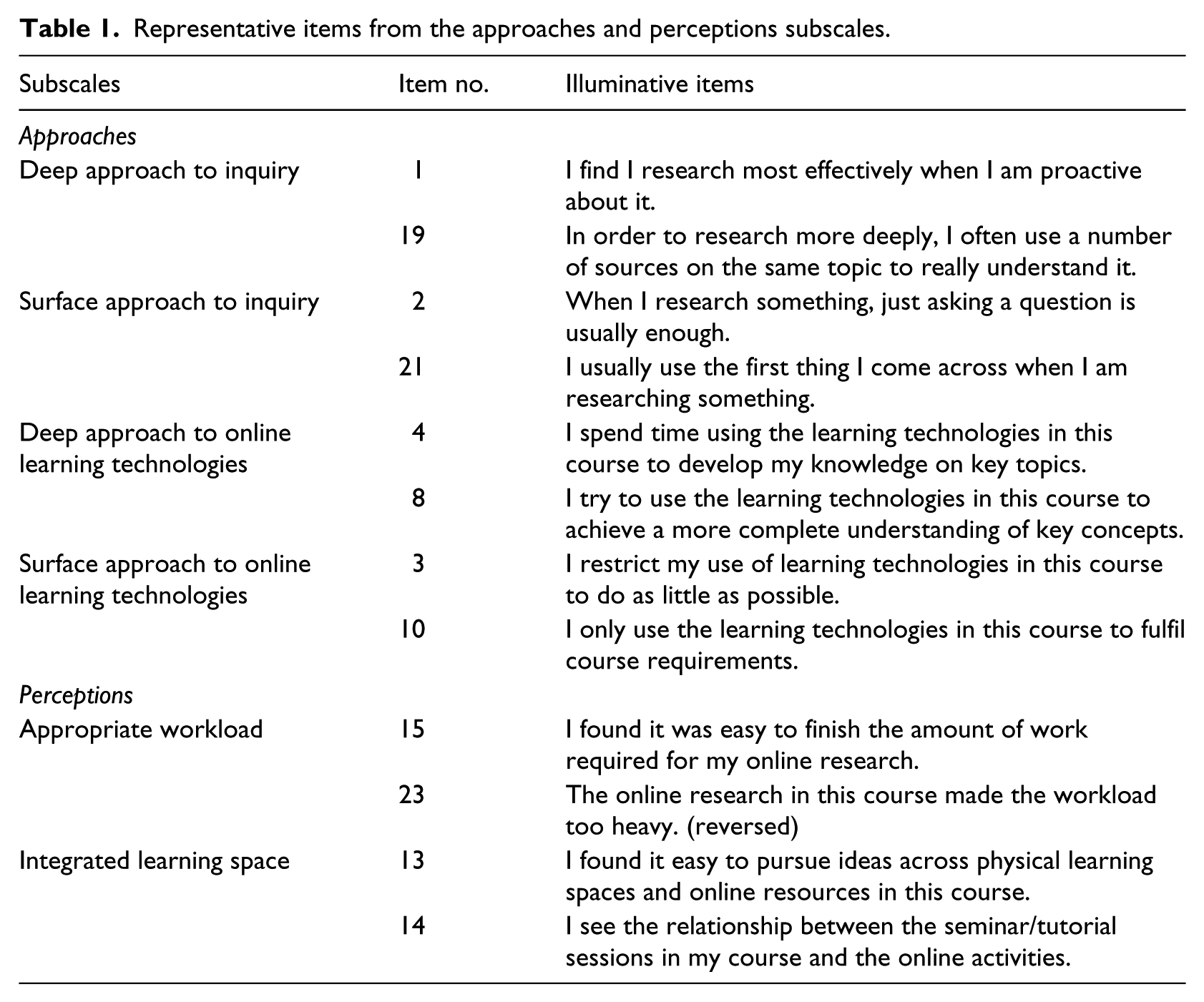
Two questionnaires and two scales were used to collect information on students’ approaches and perceptions variables in learning through inquiry in a blended context. The questionnaires were the ‘Approaches to Learning through Inquiry’ and the ‘Approaches to Learning Technologies’. The approaches questionnaires were informed by closely related studies (Biggs et. al, 2001; Ellis et al., 2012). Each questionnaire is divided into two scales.
In the ‘Approaches to Learning through Inquiry’ questionnaire, the deep approach scale investigates approaches to inquiry which are proactive, take the initiative and take sufficient time to formulate revealing questions likely to lead to deeper understanding. The surface approach scale investigates approaches to inquiry which are formulaic, mechanistic and completed without much reflection. In the ‘Approaches to Learning Technologies’ questionnaire, the deep scale investigates approaches which use the technology to review and cross reference ideas between different sources, to stimulate critical thinking and new research pathways while trying to connect the ideas in the course to the real-world experiences of students. The surface scale investigates approaches which restrict the use of online learning technologies to minimise work, tending only to use them to fulfil course requirements, trying to avoid developing an online presence. Example items and the Cronbach’s alphas of the scales are presented in Tables 1 and 2.
Representative items from the approaches and perceptions subscales.
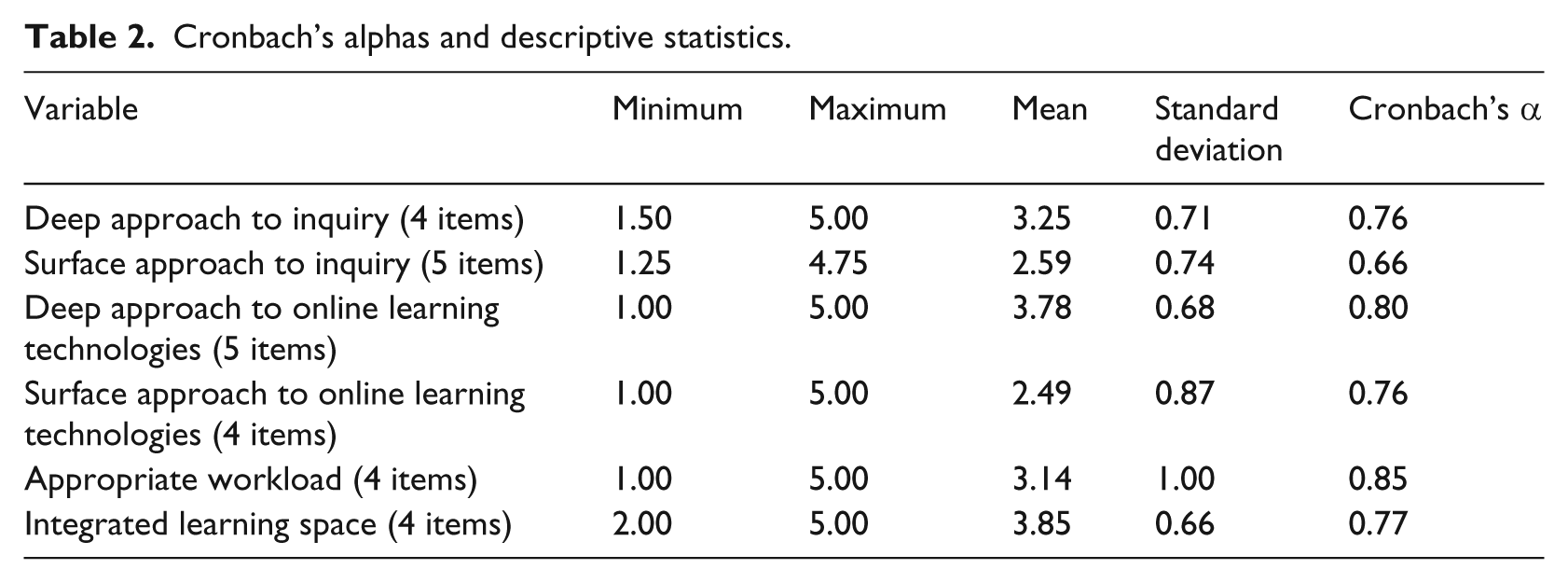
Cronbach’s alphas and descriptive statistics.
The choice of the two perceptions scales was made after a number of informal interviews with students about their experience of learning in the course. While students were generally positive about the inclusion of the online part of their experience, many sought a careful consideration of issues that arose, such as workload and how easy or difficult it was to engage in a task both in class and online, which were common problems in the discussions with students. Informed by ideas raised by the students, the items in this study investigating ‘Appropriate workload’ and ‘Integrated Learning Space’ were also informed by perceptions work into the student experience (Ramsden, 1991, 2002). The workload scale investigates whether the students perceive the amount of online research to be sustainable in relation to the whole course and the integrated learning space scale investigates how seamless the students experienced moving back and forth between their classroom and online contexts as they engaged in their learning tasks. Example items and the Cronbach’s alphas of the scales are presented in Tables 1 and 2.
Procedure
The questionnaires were administered to the participants at the end of the semester. The researcher explained to the participants that they should answer the questionnaires in the context of their learning experience in the course.
The procedure involved descriptive analyses of the data and then the main analyses involving correlation and cluster analyses of subscales. Exploratory Factor Analysis was used to examine subscales of the each questionnaire and scale analysis was conducted to check reliability of retained subscales. The Cronbach’s alphas of the subscales provided an acceptable range of values compared with the range of alphas used in previous studies (Biggs et al., 2001; Ellis and Calvo, 2006). The descriptive statistics arising from the first stage are shown in Table 2.
Results
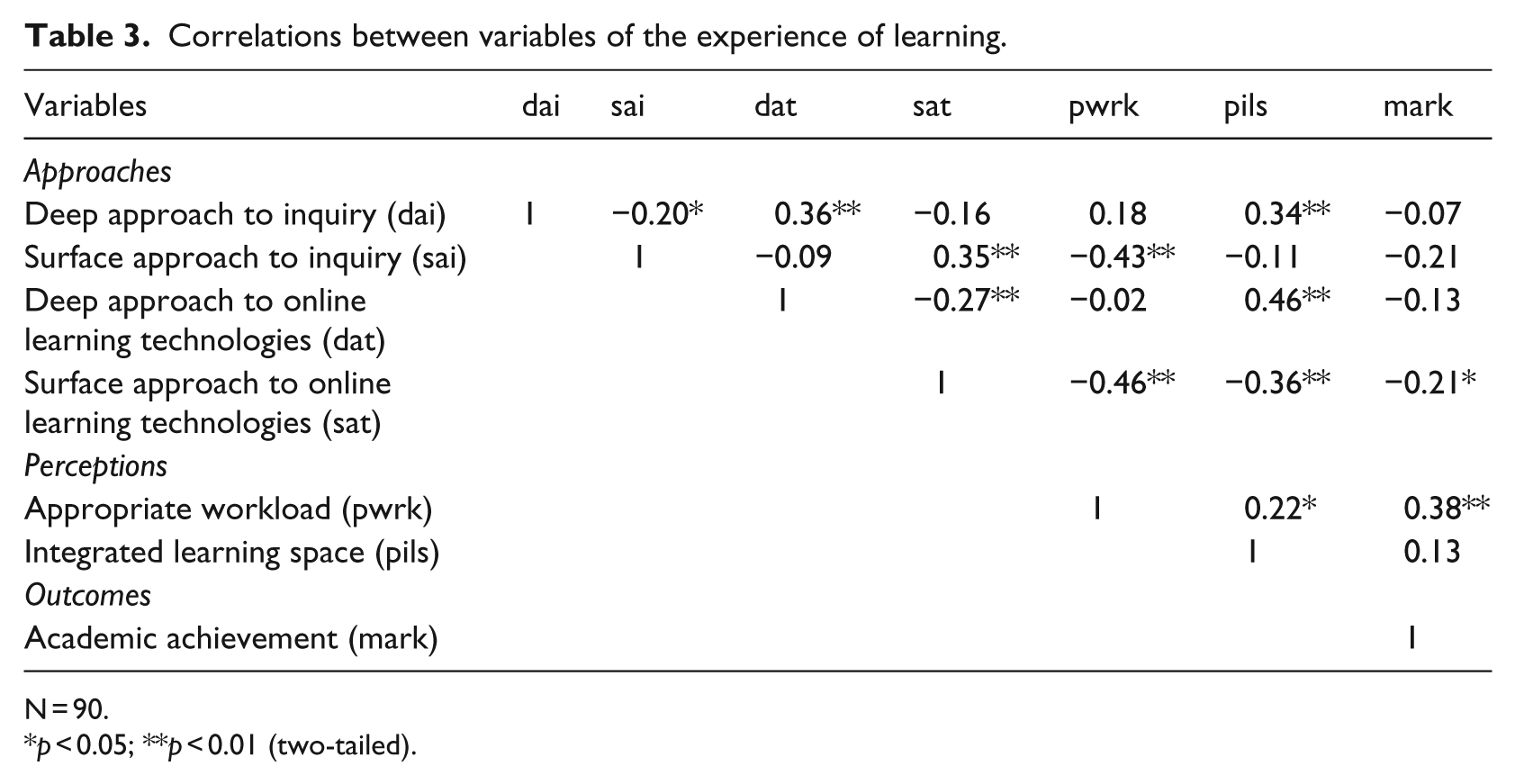
To examine the interrelationship among the subscales in the second stages of analysis, a correlation analysis was used to look at associations between pairs of variables (Table 3) and a cluster analysis at the level of students was carried out to identify subgroups within the population sample (Table 4). The purpose of using different methods of data analysis provides a type of triangulation of the data (Cohen, 1977; Prosser and Trigwell, 1999) and enables interpretations to consider the significance of the different variables in explaining qualitative variation in the experience and distributions within the population sample.
Correlations between variables of the experience of learning.
N = 90.
p < 0.05; **p < 0.01 (two-tailed).
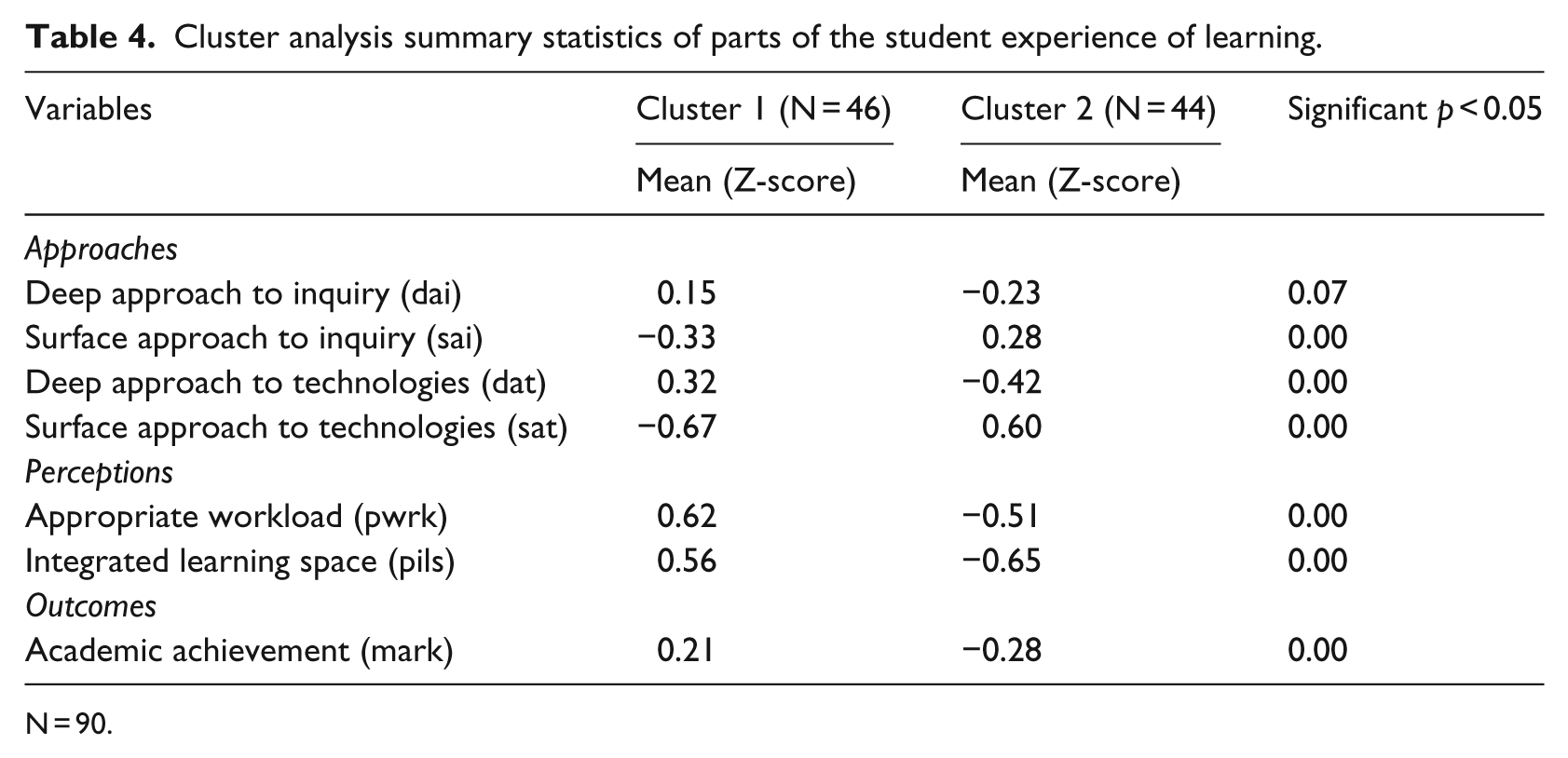
Cluster analysis summary statistics of parts of the student experience of learning.
N = 90.
A series of Pearson Product Moment correlation analyses were performed and the results are displayed in Table 3. To interpret the results, Cohen’s (1977) guidelines were followed: values of r at 0.10, 0.30 and 0.50 indicate small, medium and large effects.
Table 3 displays the strength of bivariate correlations among the variables of the student’s experience of learning in the blended context. It shows that the deep approach to inquiry subscale has positive correlations with the deep approach to technologies (r = 0.36, p < 0.01). It also has positive correlations with the perceptions of integrated learning space (r = 0.34, p < 0.01). The deep approach to inquiry subscale is also found to negatively correlate with the surface approach to technologies (r = −0.20, p < 0.05). The surface approach to inquiry variable has a positive correlation with the surface approach to technologies (r = 0.35, p < 0.01). It also has a negative association with the perceptions of online workload (r = −0.43, p < 0.01).
The deep approach to technologies subscale shows a significant positive correlation with perceptions of integrated learning space (r = 0.46, p < 0.01), and a negative correlation with the surface approach to technologies (r = −0.27, p < 0.01). The surface approach to technologies has a negative correlation with the perceptions of online workload (r = −0.46, p < 0.01), a negative association with the perceptions of integrated learning space (r = −0.36, p < 0.01) and a negative correlation with academic achievement as indicated by mark (r = −0.21, p < 0.05).
The perceptions of (appropriate) online workload variable have a positive correlation with the perceptions of integrated learning space (r = 0.22, p < 0.05) and academic achievement (r = 0.38, p < 0.01). All other correlations, while not statistically significant, are consistent with the logical relations suggested by the significant bivariate correlations.
Cluster analysis
While the correlation analysis provides useful evidence of associations among the variables, it does not reveal the distributions of approaches and perceptions across the population sample. To investigate this, a cluster analysis was used. A hierarchical cluster analysis was performed to identify how subgroups of students may have had similar experiences of learning. Using Ward’s technique of the increasing value of the Squared Euclidean Distance between the clusters (Prosser et al., 2003), two clusters were identified with values ranging between 0.01, 0.06 and 0.14 representing small, medium and large effect respectively. The standardised scores reduced the original scores to a mean of 0 and a standard deviation of 1 so that the comparison can be more interpretable.
The cluster analysis shows that one group of students experienced learning in class and online in a qualitatively better way as judged by positive scores on deep approaches to technologies, positive scores on perceptions of appropriate workload and integrated learning space, negative scores on surface approaches to inquiry and learning technologies and positive score on academic achievement; and a second group of students experienced learning in class and online in a qualitatively poorer way as judged by negative scores on deep approaches to technologies, negative scores on perceptions of technologies and integrated learning space, positive scores on surface approaches to inquiry and learning technologies and a negative score on academic achievement.
Table 4 shows a cluster of 46 students with a positive score on the deep approach to technologies variable (0.32, p < 0.00), a negative score on the surface approach to inquiry variable (−0.33, p < 0.00) and the surface approach to technologies variable (−0.67, p < 0.00) and positive scores on the appropriate workload variable (0.62, p < 0.00), the integrated learning space variable (0.56, p < 0.00) and academic achievement (0.21, p < 0.00).
Table 4 also shows a cluster of 44 students with a positive score on the surface approach to inquiry variable (0.28, p < 0.00) and the surface approach to technologies variable (0.60, p < 0.00), a negative score on the deep approach to technologies variable (−0.42, p < 0.00) and negative scores on the appropriate workload variable (−0.51, p < 0.00), the integrated learning space variable (−0.65, p < 0.00) and academic achievement (−0.28, p < 0.00).
Discussion and conclusion
This study set out to identify reasons for qualitative variation in the blended learning experience of a first-year group of students. The design of the course required students to engage in significant online research related to their in-class activities as students inquired into the key concepts and issues they were studying. To interrogate the students’ experience, closed-ended questionnaires were used to investigate differences in how students approached inquiry, how they approached learning technologies, what their perceptions were of the workload and how integrated the experience of learning across class and online environments was.
Before summarising the main outcomes and conclusions, it is worthwhile noting limitations. The study uses students’ self-report data to describe the experience which could be complemented in later studies with observational data of how they went about their studies. It is a relatively small population sample in one discipline, which limits the analyses and claims about transferability of findings. In addition, the ‘deep approach to inquiry’ variable in the cluster analysis fell just outside of a statistically significant range. Later studies should seek to increase the population sample and involve a variety of disciplinary contexts to investigate the transferability of the associations identified here. Despite these limitations, the outcomes provide significant insight into the complexity of relations of key variables which offer some reasons for why some students seemed to have a higher quality experience of learning than others.
The results of this study suggest that the quality of the student experience in a blended context cannot be ascribed to just one aspect. At the level of variables, successful learning in this study involved a deep approach to inquiry characterised by initiative and thorough research, complemented by a deep approach to technologies which involved an intention to spend time investigating the issues. It was also shaped by a perception that the workload was not overwhelming and that the experience of learning across class and online contexts was integrated. This echoes previous studies which identified positive perceptions being related with satisfaction with issues such as workload (So and Brush, 2008), and extends it by demonstrating the associations with approaches to inquiry and technologies.
The cluster analysis provides evidence of the distribution of qualitative variation in the students’ experience of learning in class and online. In summary, approximately half the students had a qualitatively better experience of learning as measured by positive scores on their approaches. They tend to approach their inquiry tasks using technologies in a more meaningful way and performed at a relatively higher level. They also reported positive perceptions of the workload involved in the online research and perceived that it was easy to integrate their learning experience across online and class contexts. The other half of the students in the sample population reported a relatively poorer experience of learning, indicated by their positive scores on the surface variables and that they performed at a lower level. They also reported negative perceptions of the workload involved in the online research and perceived the online and class contexts to be fragmented. These outcomes are in line with previous studies into the student experience of blended learning (Aspden and Helm, 2004; Bernard et al., 2014) and extend them to give some explanation for how poorer approaches can explain why not all students benefit in the same way from experiencing learning in blended contexts.
In the following, the implications of these outcomes are considered from the perspective of what it might take to get learners to move from less successful to more successful experiences of learning in the blended context, and what they suggest for other blended contexts supporting university student learning. A key implication for teaching is the relatedness of the quality of approaches to inquiry and approaches to learning technologies. The results indicate that the provision of inquiry-based activities and learning technologies in the student experience is insufficient alone to ensure effective and meaningful learning. More support to enable quality student learning needs to occur in the experience if teachers are to help students succeed. The symbiotic association between inquiry and technology in the results (the fact that deep/surface approaches to inquiry were logically related to deep/surface approaches to learning technologies) offers a way into the structure of the student experience of learning for teachers. By focusing on both approach variables, the relatedness between the two means that an improvement in one is likely to produce positive outcomes for the quality of the approach in the other.
In terms of the implications for curriculum development and the learning environment, when online tasks are included in a face-to-face experience, there is a danger that the workload for students can become unsustainable if the online part of the experience is added to pre-existing workloads without any consideration for the total impact. Some of this relationship seems to be related to the quality of their approaches. In other words, if their approach to inquiry did not have an intent which was aligned to the outcome of the task, one could imagine significant time used for no real purpose, which would add to perception of onerous workloads. Careful integration of the online tasks with clear articulation of purpose and suggested approaches to engaging in the task using the technology within the curriculum design will help address real and perceived workload issues.
In this study, students were expected to move back and forth between the class and online contexts. The students’ perceptions of the integration of these contexts are shaped by how seamless they experienced moving back and forth between them during task completion. If the process of following up, finding and pursing an idea across their class and online contexts inhibited them completing a task, it is reasonable to assume their perception of the experience could be negative. In this study, students who perceived the movement between class and online contexts to be relatively seamless in the context of their tasks tended to perform at a higher level than those who perceived the contexts to be more fragmented as indicated by the academic achievement variable. This outcome suggests implications at the level of the individual course, and at the level of the university.
At the level of the course design, the students’ perception of the extent of integration of the physical and virtual learning space can be addressed in part by how the teacher designs the learning activities. If the experience is fragmented, the choice of online tools may have created some disconnect with the task, the instructions for the task may have been insufficiently transparent for all students and/or the relationship between what the students thought they were expected to do online in relation to class may have been obscured. These types of issues can be addressed in part by a rethink of the design of the tasks using ideas for improvement such as those suggested by the results in this study.
At the level of the university, there may be more systemic issues that can only be remedied in the medium term through proper capital investment. These issues include insufficient network capacity to provide appropriate connectivity through wireless and wired solutions; poorly designed seminar, studio, laboratory or similar spaces which do not really enable students to work effectively in blended task design; or technology solutions thrown into pre-existing teaching spaces which little thought for the student experience. Such campus and infrastructure planning would benefit from understanding the student experience of blended task design in detail so that the solutions are more likely to align to the needs and outcomes of students who are expected to complete learning tasks across class and online contexts.
Footnotes
Acknowledgements
The author would like to acknowledge and thank Associate Professor Bridgeman for his support and advice regarding the research site and Ms Hahn for her research assistance.
Declaration of Conflicting Interests
The author(s) declared no potential conflicts of interest with respect to the research, authorship, and/or publication of this article.
Funding
The author(s) disclosed receipt of the following financial support for the research, authorship, and/or publication of this article: The author would like to acknowledge the financial support of the Australian Research Council through grant DP150104163.