






Abstract
Accessing social media is common and although concerns have been raised regarding the impact of social media on academic success, research in this area is sparse and inconsistent. Survey responses were collected from 659 undergraduate and graduate students to determine the relationship between social media usage and overall academic performance, as well as explore if this relationship is moderated by attention (regulation of time/study environment) and motivation (effort regulation). Both predictors, social media usage and attention, significantly predicted academic performance. Likewise, when motivation was considered as a predictor, it significantly predicted academic performance above and beyond social media usage. No moderation was found between the three variables. Implications of these relationships are discussed.
Social media use
For many young adults, accessing social media has become a normal part of their daily lives (Park and Lee, 2014). As of 2015, 90% of young adults regularly used social media sites such as Facebook, Instagram, and Twitter (Perrin, 2015). Researchers estimate that university students spend about 8–10 hours per day browsing, liking posts, and posting on social media sites (Wood, 2015). Social media and its impact on academic success have received increased research attention in part due to the pervasive use of social media among students.
When surveyed, a majority of students reported that because they were raised with technology, they could simultaneously focus their attention on multiple tasks (e.g. Facebook and university work) without any negative academic consequences (Henderson et al., 2016; Karpinski et al., 2012; Kirschner and Karpinski, 2010; Mehmood and Taswir, 2013). However, research indicates that individuals are actually task switching (switching between tasks) as opposed to multitasking (performing and executing two or more cognitive activities at one time; Karpinski et al., 2012; Ophir et al., 2009). Furthermore, task switching is associated with improper learning of information and poor performance on tasks (Karpinski et al., 2012). Most studies on social media usage, the ability to multitask, and students’ subsequent grades found a negative correlation between social media usage and academic performance (Camilia et al., 2013; Jacobsen and Forste, 2011; Karpinski et al., 2012; Mehmood and Taswir, 2013; Park and Lee, 2014; Stollak et al., 2011), but other studies found no correlation (Martin, n.d.; Stollak et al., 2011).
Yet other literature suggests electronic media usage is beneficial and does not have a negative impact on academic success (Kirkorian et al., 2008). Results indicate improvements in student learning potential with increased availability and accessibility of electronic media (Kirkorian et al., 2008). Yet, this research has mainly been conducted with children in the early stages of development (i.e. elementary school students), and is sparse in comparison to the literature concluding that electronic media has negative consequences on academic success.
While there is disagreement about the implications of electronic media use, there is agreement that students must possess the study skills and learning strategies needed to attain academic success. The strategic behaviors and attitudes associated with academic success are often referred to as self-regulated learning. According to Zimmerman (1989), self-regulated learning is the degree to which students are “metacognitively, motivationally, and behaviorally active in their own learning process,” such that these students plan ahead, put forth effort and persist in their work, and employ the necessary skills to effectively acquire knowledge, respectively (p. 22). Thus far, there has been little research conducted to determine if self-regulating strategies may influence or help regulate student social media use. Of the research, some studies found that skills needed to achieve academic success were not related to social media usage (Martin, n.d.; Stollak et al., 2011), but other studies elicited differing results (Mehmood and Taswir, 2013; Remón et al., 2017; Thompson, 2017). Two self-regulating strategies shown in the research to be important to academic success are attention and motivation (De Bruijn-Smolders et al., 2016; Schunk and Usher, 2018).
Attention
Being able to attend to and concentrate on the assignment at hand is an important aspect of academic success (Anastopoulos and King, 2015; Fleming and McMahon, 2012). The inability to sustain attention can hinder academic functioning as it leads to impaired learning of necessary knowledge and skills, difficulty organizing, and poor time management (Anastopoulos and King, 2015; Fleming and McMahon, 2012). Attention is defined as it relates to regulating time and study environment. Regulating time and study environment is characterized by an individual’s ability to attend to the academic task at hand, not paying attention to other distractions during the task, and eliminating distractions. It includes students’ ability to effectively manage their time and the surrounding environment to reach their academic goals (Kwon et al., 2018; Richardson et al., 2012).
Research in this area found a significant correlation between high social media use and attention problems (Karpinski et al., 2012). High multimedia users had more difficulty filtering out unwanted distractions, such as notifications, when they were engaged in productive tasks (Ophir et al., 2009). The ease of access to these “technologies” impacted students’ ability to adequately sustain their attention and process the information at a deeper level, as evidenced by participants’ grade point average (GPA; Junco, 2012; Junco and Cotten, 2012). Research suggests that having an environment conducive to studying without excessive use of social media sites is needed (McCardle et al., 2017; Nasrullah and Saqib Khan, 2015; Ophir et al., 2009). Students who were able to effectively manage their time and create an environment that was conducive to learning and did not allow for distractions, had higher GPAs than students who did not (Kitsantas et al., 2008).
As implicated in the research, managing your study time in an environment with limited to no distractions affects overall academic performance. In addition, given the increasing popularity and accessibility of social media sites, students are likely to utilize social media while completing academic work. Therefore, students may be less likely to sustain their attention on the task at hand due to the distractions caused by social media.
Motivation
Motivation is important for academic success and can be affected by social media usage. Motivation involves students’ abilities to set goals for academic tasks, and their effort to complete the task even when it does not interest them (Pintrich and De Groot, 1990; Zusho, 2017). Motivation leads to increased effort, initiation, and continuance in productive activities, such as school work (Nguyen and Ikeda, 2015; Ormrod, 2008). Motivation is defined as it relates to effort regulation. Effort regulation is characterized by an individual’s ability to persist during difficult tasks, putting forth the effort needed to complete the task, and not engaging in a more favorable task (Richardson et al., 2012). Effort regulation also considers how people self-manage their motivation to elicit positive outcomes when academically challenged. Effort regulation is the strongest predictor of academic performance because it requires action. Other strategies such as management of time and study environment require action, however, a conducive environment is not beneficial unless the person puts forth the effort to regulate their environment and then completes the task.
Studies examining the effects of social media usage on student academic performance, demonstrated student difficulties with effort regulation (Camilia et al., 2013; Stollak et al., 2011; Wang et al., 2011). For example, Karpinski et al. (2012) studied how often students used social media sites in general, while completing work, and instead of completing work. In this case, effort regulation included the ability to complete work even when there was a more desirable task such as social media, or the individual was uninterested in the work. The results showed that most students spent time meant for studying, on social media because it was available and more favorable than the work they were to complete. This suggests that social media impacts the students’ ability and motivation to control their effort in completing tasks, which then may impact their overall academic performance.
Academic performance as measured by GPA
Unlike the variables of regulation of time and study environment (attention) and effort regulation (motivation), there have been studies conducted on the impact social media usage has on academic performance, specifically cumulative GPA. Several studies investigating the impact of social media on academic performance were conducted (Apuke and Iyendo, 2017; Peter, 2015; Waqas et al., 2016). In one study, the students were given surveys that inquired about their daily social media usage, whether they used social media sites while completing university work, which sites they used more often, and their GPA (Peter, 2015). The results indicated that students spent a large amount of time in their day on social media, and used social media while working on classroom assignments. The results also indicated that high-frequency social media usage is correlated with lower overall academic performance. However, results also suggested that when social media is used for academic purposes, there was not a negative correlation between social media usage and academic performance. Students in other studies seldom reported using social media for academic purposes (Apuke and Iyendo, 2017; Waqas et al., 2016).
These findings were consistent with another study (Abdulahi et al., 2014) in which students were asked similar questions about their social media usage and their overall academic performance. The results indicated that a majority of the students reported spending much of their time using social media sites (i.e. checking or posting on social media). Furthermore, students spent time on social media while or instead of engaging in academic assignments and academic performance was negatively affected.
Students who frequently engage in social media may not see the impact of their use on overall academic performance, or the relationships between key strategies and skills important for academic success and social media use. Engaging with social media implies that students are not removing the distractions from their environment to allow them to focus their attention (regulation of time and study environment). Also, choosing a more favorable task such as social media may mean they are not persisting in the primary, study-related task when it becomes difficult or they are not motivated (effort regulation).
Research suggests relationships between these variables; however, there has not been research conducted that explicitly examines the juncture between social media usage, regulation of time and study environment, effort regulation, and academic performance. The study described here addresses these gaps. The purpose of this study was to first explore the predictive relationship between social media usage and academic performance. Second, the purpose was to determine whether regulation of time and study environment (attention) and effort regulation moderate the relationship between social media usage and academic performance.
Method
Participants
There were 717 undergraduate and graduate students, but due to incomplete survey responses, only 659 participants were included in the analyses (18.1% freshman, 16.7% sophomores, 22.5% juniors, 23.1% seniors, and 19.0% graduate students). Students from a Southeastern, public university completed the survey from mid-January to mid-March of 2017. The sample included 514 females (78%) and 143 males (22%) of which 355 were Caucasian (53.9%); 253 African American (38.4%); 35 Latinos (5.3%); 11 Asian American (1.7%); and 5 Native American (0.8%). The participant ages ranged from 18 to 69 years, with a mean age of 24 years. Also, 78.6% of participants were traditional students (aged 18–35) and 20.9% were non-traditional students (35 and above). On average, participants reported that 56.59% of their social media use was for entertainment purposes, 37.49% of use was to chat with friends/followers, and 31.92% of use was for academic purposes. Finally, of the 659 participants, 67 (10.2%) reported being diagnosed with attention-deficit/hyperactivity disorder (ADHD).
Measures
Motivational Strategies for Learning Questionnaire
The Motivational Strategies for Learning Questionnaire (MSLQ; Pintrich et al., 1991) is a questionnaire comprising 81 questions. Each question assesses the learning strategies and motivation used by college students. Each participant rated how accurate the statements were on a 7-point Likert-type scale ranging from not at all true of me to very true of me (e.g. “I usually study in a place when I can concentrate on my coursework”). Only the effort regulation and regulating time and study environment scales were used, which totaled 12 questions (5 of which are reversed scored). The effort regulation scale had four questions, while the time and study environment scale had eight questions. On the effort regulation scale, the minimum score was 4 and the maximum score was 28. On the time and study environment scale, the minimum score was 8 and the maximum score 56. According to Pintrich et al. (1991), the average alpha coefficient (internal consistency) for the MSLQ ranged from 0.52 to 0.93 (effort regulation was 0.69 and time and study environment was 0.76). Overall, the MSLQ demonstrated acceptable reliability and validity (Pintrich et al., 1991). The alpha coefficient for the effort regulation and time and study environment subscales were 0.69 and 0.80, respectively.
Media and Technology Usage and Attitude Scale
The Media and Technology Usage and Attitude Scale (MTUAS; Rosen et al., 2013) is a questionnaire comprising 60 questions that measures technology and media usage as well as attitudes toward technology. Each question assesses 1 of 11 usage subscales measured by the questionnaire, and the subscales can be used together or separately. Only the general social media usage scale was used, which consisted of nine questions (e.g. “How often do you do each of the following activities on social media sites … Check your social media page(s)”]. The minimum possible score was 9, and the maximum possible score that can be achieved was 90. Each participant rated how accurate the statements were on a 10-point frequency scale ranging from never to all the time. According to Rosen et al. (2013), the average alpha coefficient (internal consistency) for the MTUAS ranged from 0.61 to 0.97. The alpha coefficient for the general social media usage scale was 0.97. Overall, the MTUAS demonstrated good reliability and validity (Rosen et al., 2013); the alpha coefficient for the general social media scale was 0.90.
Demographic profile
A demographic questionnaire that consisted of 15 questions was used to determine the participants’ class year, major, age, race/ethnicity, GPA, study habits, and diagnosis of ADHD (e.g. “What is your major/or “college” that you are associated with? (Select all that apply)).” This survey also asked questions regarding the nature of their social media usage (academic or recreational).
Procedure
This study was IRB approved, and undergraduate and graduate students from a public university in the Southeastern region of the United States were recruited through convenience sampling. The participants were solicited through the university’s psychology and law departments as well as the university’s student announcements. If extra credit was offered by an instructor, an alternative opportunity for extra credit was also provided to students. The confidentiality and privacy of the participants were ensured as no identifying information (i.e. name, student I.D. number, etc.) was solicited. The survey was completed via Qualtrics, an online survey tool, and took the participants about 5–10 minutes to complete. The survey questions were distributed in a counterbalanced manner, which included randomization of blocks and items within blocks, so as to control for order effects.
Analyses
The purpose of this study was to determine the relationship between social media usage (MTUAS) and academic performance (GPA), and if this relationship was moderated by regulation of time/study environment (attention) and/or effort regulation (motivation). Before analyzing any data, we examined the data for outliers and removed them from the data set. Due to the extent of missing data, a list-wise deletion was used in data analysis, meaning that if the participant left out any information needed for the analysis, the participants’ data were removed. Also, we computed the subscales and descriptive statistics (see Table 1).
Mean and standard deviation scores for the predictor variable (MTUAS), moderators (effort and attention), and outcome variable (GPA) for overall sample.
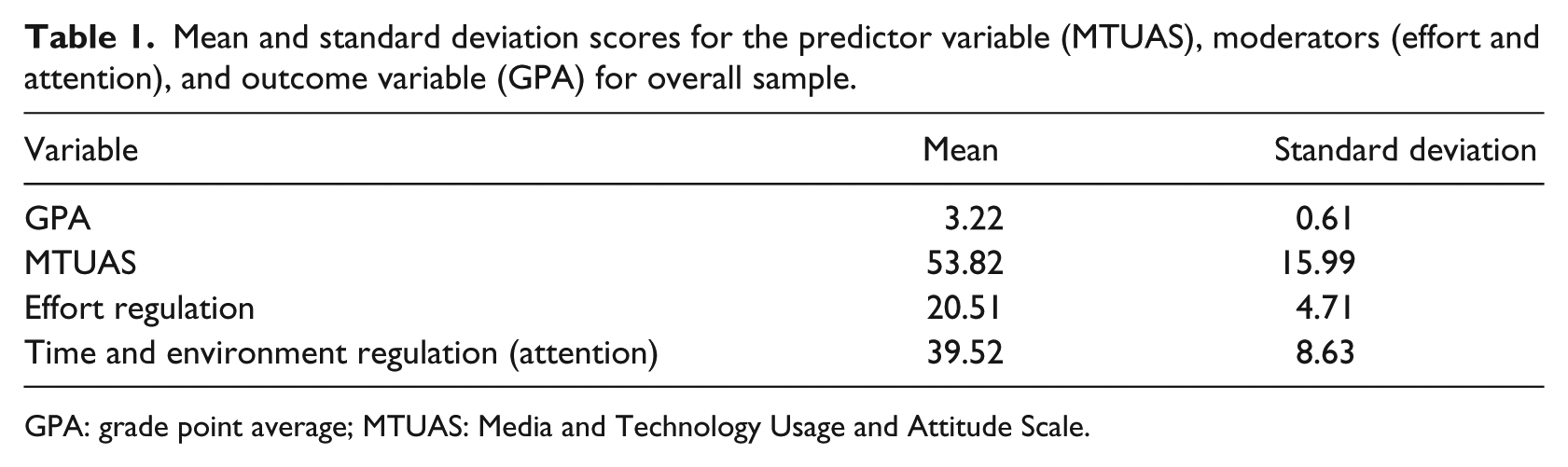
GPA: grade point average; MTUAS: Media and Technology Usage and Attitude Scale.
Next, we wanted to better understand how time and study environment (attention) and effort regulation (motivation) affected the relationship between social media and GPA. To find out, we conducted two moderated multiple regression analyses with social media usage as the predictor and GPA as the outcome. To make sure this analysis was appropriate for the data, we checked the basic assumptions of linear regression. There was no evidence of multicollinearity, as the average variation inflation factor (VIF) for models one and two was 1.03 and 1.05, respectively, meaning our predictors are not highly correlated.
The first model tested for the interaction effect of regulation of time and study environment (attention) and social media usage. This model enabled us to examine whether the relationship between social media usage and GPA was similar for those with high and low scores for attention. After centering social media usage and regulation of time/study environment and computing the social media usage-by-regulation of time/study environment interaction term (Aiken and West, 1991), the two predictors were entered into a regression model without the interaction term, and then the two predictors and interaction were entered into a simultaneous regression model.
The second model tested for similar possible interactions with the other moderator, effort regulation (motivation). Running the second model enabled us to test whether the relationship between social media usage and GPA was similar for those with strong or weak effort regulation. After centering social media usage and effort regulation and computing the social media usage-by-effort regulation interaction term (Aiken and West, 1991), the two predictors were entered into a regression model without the interaction term, and then the two predictors and interaction were entered into a simultaneous regression model.
Results
There was a significant, negative relationship between social media usage and GPA. Students with lower levels of social media usage were associated with higher reported GPAs. In addition, there was a significant, positive relationship between attention and reported GPA. However, the interaction was not significant. This suggests that although social media usage and attention are related to GPA, attention does not affect the relationship between social media usage and GPA significantly (and vice versa). On average, the more a student reported using social media, the lower was their GPA regardless of their reported control of time and study environment (attention). Likewise, students with poor attention were more likely to report lower GPA regardless of social media use. See Table 2 for model statistics.
Summary of moderated multiple regression analysis for variables predicting GPA (N = 616).
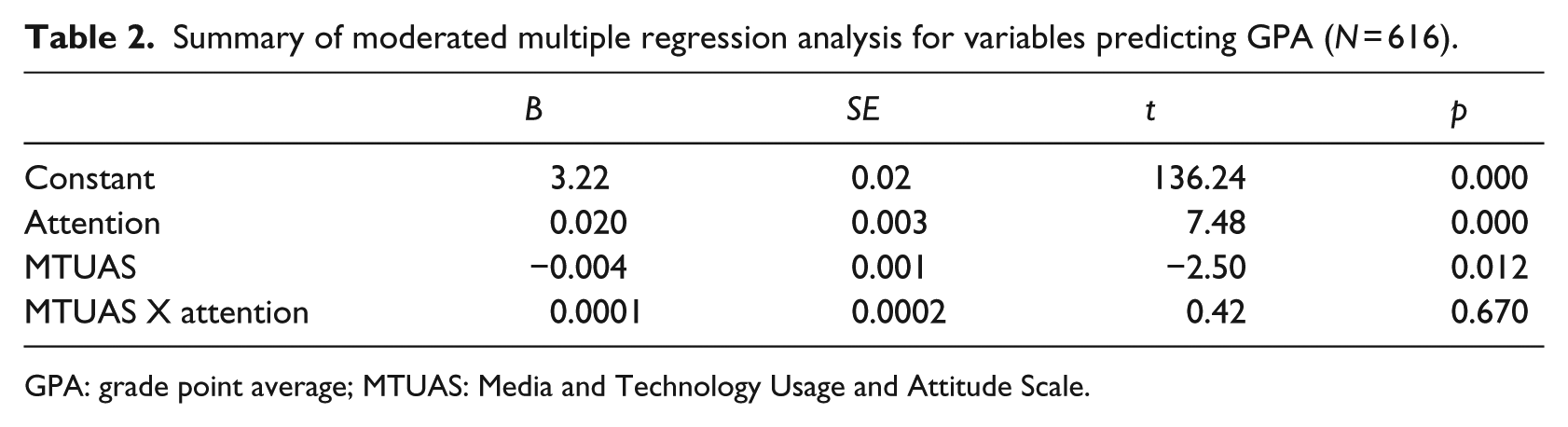
GPA: grade point average; MTUAS: Media and Technology Usage and Attitude Scale.
The second model considered the role of effort regulation in the relationship between social media usage and GPA. The findings differed from the first model that considered attention in one important way. When taking effort regulation into consideration, the relationship between social media usage and GPA was no longer significant. Greater effort regulation, however, was associated with higher reported GPAs. In other words, students who scored higher in effort regulation were more likely to have higher GPAs. See Table 3 for model statistics.
Summary of moderated multiple regression analysis for variables predicting GPA (N = 627).
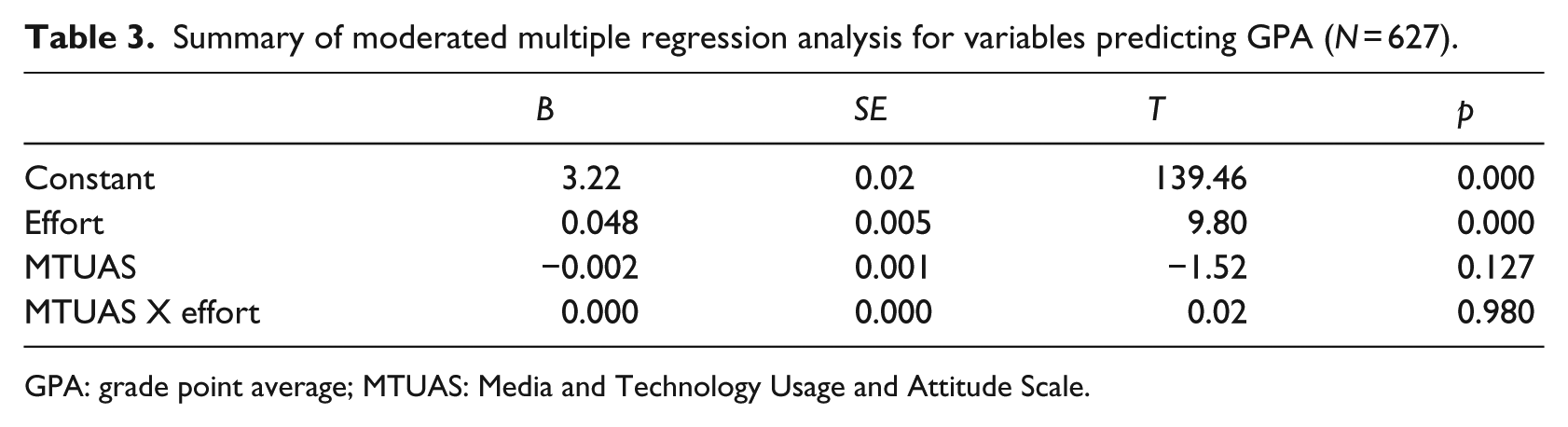
GPA: grade point average; MTUAS: Media and Technology Usage and Attitude Scale.
Discussion
The overall model of social media usage and attention in prediction of GPA was significant. Both predictors significantly contributed to the prediction of GPA, but there was no interaction between social media usage and attention. Likewise, the model that included social media usage and motivation in prediction of GPA was significant. In this model, only motivation was significant and there was no interaction between social media usage and motivation.
Social media usage
Research investigating the relationship between social media use and academic performance yielded mixed results. Many studies reported that greater electronic media use and accessibility led to a decrease in academic achievement (Jacobsen and Forste, 2011; Karpinski et al., 2012; Kirschner and Karpinski, 2010). However, other research reported no correlation between social media usage and academic performance (Martin, n.d.; Stollak et al., 2011). Therefore, one purpose of this study was to clarify research results in determining whether there was a relationship between social media usage and academic success.
Similar to other research, the results within the study described here are mixed. Social media usage was a significant predictor of GPA in one model, which like other research suggested, as social media use increased, GPA decreased (Jacobsen and Forste, 2011; Karpinski et al., 2012; Mehmood and Taswir, 2013; Stollak et al., 2011). However, social media usage was not a significant predictor of GPA in the second model, which coincides with the research suggesting no relationship between these variables exist (Martin, n.d.; Stollak et al., 2011). Mixed findings may be due in part to the variance accounted for by the combination of predictor variables included in each model. Attention and motivation were included because they have been proven to be strong predictors of GPA, and the literature suggested that frequent engagement in social media could be related to these key strategies and skills (Kirschner and Karpinski, 2010; Onoda, 2014; Richardson et al., 2012; Schunk and Usher, 2018; Zimmerman, 1989, 1990).
Attention
Research suggests that regulation of attention is important for academic success (Fleming and McMahon, 2012; Karpinski et al., 2012), but little research has been conducted to determine the relationship between social media usage and attention. The research suggested that social media usage impacts one’s attention and causes a decline in GPA (Camilia et al., 2013; Mehmood and Taswir, 2013; Thompson, 2017).
The findings reported here supported the literature (Plant et al., 2005) indicating that a student’s ability to regulate their time/study environment is instrumental in academic success as attention was found to be a significant predictor of GPA. Effective learning requires the capacity to focus and sustain attention to the task at hand. However, unlike other research, our study did not find a significant interaction between social media usage and attention in the prediction of GPA (Karpinski et al., 2012; Stollak et al., 2011; Wang et al., 2011). This suggests that the predictive power of attention (regulation of time/study environment) for GPA is separate and distinct from that of social media usage.
Motivation
Motivation is the ability to put forth effort to initiate and complete a task even when the task does not interest the individual (Nguyen and Ikeda, 2015; Ormrod, 2008; Pintrich and De Groot, 1990). Volition involves translating the motivation into action using learning strategies such as effort regulation to achieve academic goals (Onoda, 2014; Richardson et al., 2012). Research indicated the active strategy of effort regulation (motivation) was the strongest predictor of GPA (Pintrich and De Groot, 1990; Richardson et al., 2012); however, no research exists to suggest a relationship between effort regulation (or overall motivation) and social media use.
The findings described in this study support research, as motivation was a significant predictor of GPA. However, there was no interaction between social media usage and motivation in the prediction of GPA. This suggests that the predictive power of motivation (effort regulation) for GPA is separate and distinct from that of social media usage.
Based on the results, students should focus on strengthening attention and motivational strategies to increase GPA, as these appear to be consistently stronger predictors of GPA compared to social media usage. Research examining the importance of attentional and motivational strategies concludes these strategies are needed for academic success (Kirschner and Karpinski, 2010; Onoda, 2014; Richardson et al., 2012; Zimmerman, 1989, 1990). Learning strategies such as regulation of time/study environment and effort regulation are vital to academic success as evidenced by their predictive power of GPA (in this study and various others). These findings align with self-regulated learning theory and social cognitive theory, as these theories state the degree to which students are behaviorally and motivationally active in their learning process, and contributes to their academic performance (Kirschner and Karpinski, 2010; via Zimmerman, 1989). Armed with this information, students and parents, professors, and academic success centers should strive to incorporate new ways of building these strategies into their curriculum to help their students.
As these students enter college/university, it may be beneficial to identify academically at-risk students who are weak in their attentional and motivational skills and remediate their study skills and learning strategies through tutoring, workshops, or coursework. Remediation may stress the importance of a regular study schedule so as to not make the student feel overwhelmed and help develop external (and later intrinsic) motivators the students can implement when their work is not of interest to them. In doing so, professors and centers which support students are providing students that struggle with self-regulated learning with study skills and learning strategies to succeed academically.
The influence of social media usage on academic success remains largely unknown as evidenced by the mixed results of this study and research. Therefore, students should be mindful of the potential impact high social media use could have on their overall academic success and learning skills. Educators should also be mindful of the impact social media can have on students when incorporating it into their curriculum. Until further research is conducted or a consensus is achieved, prudent use of social media is suggested.
As with all research, there were limitations. First, a correlational study was conducted to test the interaction hypotheses between variables of interest. Significant interactions were not found and are less likely to occur in nonexperimental research when considering sample size, variation differences, and/or measurement error (Aiken and West, 1991). Future researchers may wish to investigate potential interactions between social media usage and learning strategies using an experimental design, so as to avoid the limitations of nonexperimental studies. Second, there may be limitations pertaining to the research sample. The sample consisted of students from the Southeastern region of the United States. Also, the sample was disproportionately Caucasian, African American, and female with a majority of the students considered to be traditional students (18–35 years of age). Therefore, due to the convenience sample and disproportionality, generalization to other areas of the United States, other countries, smaller minority groups, males, and nontraditional students may be limited. Third, the participants’ GPA was self-reported and accuracy of the self-report was not verified.
In the study, the researcher gathered information to discern the percentage of time participants used social media for entertainment (56.59% on average) compared with for academics (31.92% on average). However, the distinction between academic and nonacademic social media use was not specifically made on the social media usage measure (MTUAS); therefore, the participants in this study may have reported the use of social media for both purposes on the scale. As in research (Jacobsen and Forste, 2011), this study examined “general” social media use, but future researchers may wish to include questions that parcel out whether social media use reported on the MTUAS was used to complete academic work, used instead of completing academic work, or used after academic work was completed.
Future research may include question(s) to determine whether social media is used for academic or recreational purposes. By including these questions in the survey or as part of an experimental study (if applicable), the researcher would be able to better determine which type of social media use may negatively impact GPA. Future studies may also determine if incorporating social media into academic curriculums at the elementary, secondary, or post-secondary levels may actually serve to enhance attention and motivation among students due to the popularity and relevance of social media (Cavanagh et al., 2016; Dame, 2013; Public Broadcasting Service, 2012).
In summary, due to the mixed results of this study and previous research, students, educators, and parents should be cognizant of the potential negative effects high social media usage may have on students’ academic performance. Given the lack of consensus, focused attention should remain on strengthening attentional and motivational strategies to facilitate academic success. Effort regulation and regulation of time/study environment are proven predictors of GPA. Researchers should continue to examine the relationships between these variables as social media usage is steadily increasing and is a major part of students’ everyday lives.
Footnotes
Declaration of Conflicting Interests
The author(s) declared no potential conflicts of interest with respect to the research, authorship, and/or publication of this article.
Funding
The author(s) received no financial support for the research, authorship, and/or publication of this article.