







Abstract
The marketization of higher education and focus on graduate employability and earnings data has raised questions about how students perceive their roles and responsibilities while studying for their degree. Of particular concern is the extent to which students identify themselves as consumers of their higher education, for example, whether they view their degree as a purchasable commodity to improve future earnings. This is because research has found that a stronger consumer identity is related to lower academic performance. This study examined whether this relation could be explained by the impact of a consumer identity on the extent to which students adopt deep, surface or strategic approaches to learning. The hypotheses were that the relation between consumer identity and academic performance would be mediated by approaches to learning, whereby a consumer identity would be related to adopting a more surface approach, a less deep approach and less strategic approach. Undergraduates completed an online questionnaire that assessed the extent to which they identified as a consumer, their approaches to learning and academic performance. The analysis partly supported the hypotheses: a stronger consumer identity was related to a more surface approach to learning. However, a surface approach to learning did not mediate the relation between consumer identity and academic performance. Conversely, a deep approach to learning mediated the relation between consumer identity and academic performance, whereby a stronger consumer identity was related to lower academic performance through its negative impact on a deep approach to learning. There was no relation between consumer identity and strategic approach to learning. Implications of students identifying themselves as consumers of their higher education are discussed.
The marketization of higher education and its impact on students
In several countries across the world, students wishing to receive a higher education are increasingly expected to pay for it out of their own pocket as opposed to being funded by the state. Correspondingly, higher education in such countries has undergone a process of marketization, in which the individual student is defined as a customer and their university as a service provider (Dearing, 1997; Tomlinson, 2018). This process has elevated the economic value placed on education for the individual student, whereby students are now encouraged to regard employment and earnings data, and satisfaction levels of former students, as key indicators of educational quality (Molesworth et al., 2011; Tomlinson, 2018; Williams, 2013). While marketisation has increased the emphasis on teaching quality and provided students with greater control of their learning environment, it has had a negative impact on pedagogic processes and students’ performance (Bunce et al., 2017; Williams, 2013).
Many have argued that defining students as customers or ‘consumers’ undermines the historical purpose of university as nurturing students’ intrinsic motivation for engaging in critical and creative thought (Newman, 1852), and instead emphasises extrinsic motivations for attending, such as obtaining a well-paid job (Molesworth et al., 2009; Naidoo and Williams, 2015; Tomlinson, 2017). One study found that students who believed their role to be that of a customer were more likely to complain about their course and feel that they owed a particular outcome from their university (Finney and Finney, 2010). Other studies have similarly found that some students felt entitled to receive a degree as a result of paying for their education (Delucchi and Korgen, 2002; Peirone and Maticka-Tyndale, 2017). This passive approach was also seen in studies (e.g. Todd et al., 2017; Tomlinson, 2014, 2016; White, 2007) showing that some students positioned themselves as paying customers and adopted instrumental approaches to studying. In Tomlinson (2014), some students perceived lectures as a form of entertainment: ‘sometimes you do come out of a lecture and think “well that wasn’t very good” and like if you went to see a show, you’d be asking for your money back’ (p. 29). Other studies have further shown that although the majority of students do not identify strongly as consumers (Bunce et al., 2017; Saunders, 2014), those who do achieve a lower level of academic performance (Bunce et al., 2017).
Approaches to learning
The above research suggests that students who identify as consumers of their education may lack inherent interest in the subject itself and feel entitled to pass their course with minimal investment of time and effort. These characteristics mirror those reflected in the concept of a surface approach to learning and stand in contrast to study behaviours described by the concepts of deep and strategic approaches to learning (Biggs, 1987; Entwistle and Ramsden, 1983; Entwistle and Tait, 1995; Marton and Säljö, 1976). The concept of approaches to learning concerns differences among students in a learning situation in their intentions, motivations and processing strategies. A surface approach involves using reproductive strategies and rote learning and is motivated by a desire to avoid failure by putting in the minimum amount of effort thought necessary to meet task requirements. In contrast, a deep approach describes studying with an intention to understand, synthesise and critically evaluate the material in order to make meaning, due to an inherent interest in the subject. A strategic approach is motivated by an intention to achieve the best grades possible and is associated with being highly organised, demonstrating good study skills and being acutely aware of assessment demands. Although highly criticised (Haggis, 2003; Lindblom-Ylänne et al., 2018), approaches to learning remains a dominant model of student learning in higher education today (Howie and Bagnall, 2013). Exploring how approaches to learning vary according to the extent to which students identify as a consumer may help to explain why a consumer identity has a negative impact on academic performance (Bunce et al., 2017).
The nature of the relation between approaches to learning and academic performance is not clear cut. This may be because learning cannot be categorised purely by way of these three distinct approaches and because individual students may adopt different approaches at different times (Lindblom-Ylänne et al., 2018). This may be dependent on factors such as teachers’ approaches to teaching (Postareff et al., 2018; Prosser and Trigwell, 2014), the discipline (Päuler-Kuppinger and Jucks, 2017), and assessment load, type and structure (Eley, 1992; Tomas and Jessop, 2019). Nonetheless, studies have generally found that deep and strategic approaches to learning are related to improved academic performance, and a surface approach to learning is related to lower academic performance (Crawford et al., 1998; Diseth and Martinsen, 2003; Duff et al., 2004; Eley, 1992; Entwistle, 1998; Marton and Säljö, 1984; Richardson et al., 2012; Watkins, 2001; Zeegers, 2004).
There is already some evidence to suggest that approaches to learning and subsequent academic performance can be influenced by student identity (Bliuc et al., 2011; Smyth et al., 2015). Students’ identification with social categories, such as ‘student of my discipline’ or ‘consumer’ may impact on the way that they think of themselves as students and the behaviours they are likely to adopt in the context of learning. Smyth et al. (2015) found that students with a stronger discipline identity were more likely to perceive the group norm to favour a deep approach to learning and to subsequently adopt a deep approach themselves. However, there was no relation between discipline identity and surface approach to learning, and it was not clear why not when one was expected. Similarly, Bliuc et al. (2011) found that students with a stronger identity as a ‘psychology student’ were more likely to adopt a deep approach to learning and subsequently achieve higher academic performance. However, they also found no relation between discipline identity and surface approach. Together, these studies showed that student identity had an indirect impact on academic performance because it influenced approaches to learning, particularly the extent to which students adopted a deep approach. Therefore, this study examines whether the extent to which students identify with the category ‘consumer’ is related to students’ approaches to learning and subsequent academic performance.
Theoretically, one reason why a student consumer identity could be related to approaches to learning and academic performance is motivation, given that there are marked differences in motivation for adopting deep, surface and strategic approaches to learning (Entwistle and Ramsden, 1983; Prat-Sala and Redford, 2010). There are two broad types of motivation: intrinsic and extrinsic (Ryan and Deci, 2000). People who find a task intrinsically motivating engage in it for its own sake because they find it inherently satisfying and interesting in itself. In contrast, people who are extrinsically motivated to engage in a task do so because they desire a particular outcome or reward, or because they expect external recognition from others. A deep approach to learning can be characterised by intrinsic motivation because it involves an inherent interest in the subject. In contrast, a surface approach to learning can be characterised by extrinsic motivation because it involves fulfilling essential task requirements to meet a particular outcome (Entwistle, 1988). The research discussed above on the impact of the marketization of higher education on students suggests that student consumers feel entitled to their degree as a result of paying for it, and do not expect to be challenged or expend effort to receive it. Thus, a stronger consumer identity may be related to experiencing less intrinsic motivation and more extrinsic motivation, and therefore be related to a less deep approach to learning and a more surface approach to learning.
The form of motivation experienced by students adopting a strategic approach to learning seems less clear cut. On one hand, these students may be thought to experience extrinsic motivation because adopting a strategic approach is about desiring a particular outcome (Entwistle et al., 2013). However, the behaviours associated with a strategic approach suggest that these students have internalised and assimilated the learning demands and are more intrinsically motivated (Ryan and Deci, 2000). Given that a strategic approach, as with a deep approach, is generally related to higher levels of academic performance, a stronger consumer identity may be related to a less strategic approach to learning because student consumers are more likely to be extrinsically motivated.
In summary, the marketisation of higher education may be associated with students being more likely to identify themselves as consumers, which is related to lower academic performance (Bunce et al., 2017). One explanation for this may be because a consumer identity undermines an intrinsic interest in education and emphasises extrinsic reasons for studying, which manifests through the adoption of a more surface approach to learning and less deep and strategic approaches to learning. The goal of this study is to examine whether the negative association between consumer identity and academic performance can be explained by the extent to which students adopt deep, surface or strategic approaches to learning. A number of practical and theoretical factors are controlled for that have previously been found to influence the extent to which students identified as consumers, namely year of study, subject, institution type, tuition fee responsibility, grade goal and whether the student is in paid employment or has a volunteer position (Bunce et al., 2017). The hypotheses are that
A stronger consumer identity will be related to a more surface approach to learning, a more surface approach to learning will be related to lower academic performance, and the relation between consumer identity and academic performance will be mediated by a surface approach to learning
A stronger consumer identity will be related to a less deep approach to learning, a more deep approach to learning will be related to higher academic performance, and the relation between consumer identity and academic performance will be mediated by a deep approach to learning
A stronger consumer identity will be related to a less strategic approach to learning, a more strategic approach to learning will be related to higher academic performance, and the relation between consumer identity and academic performance will be mediated by a strategic approach to learning
Method
Participants
The questionnaire was completed by 689 undergraduates studying in England, United Kingdom, who were liable for up to £9250 per year in tuition fees. This sample included students from the European Union but excluded international students. Usable data was obtained from 587 students after screening for outliers and missing values. The average age of students was 21.10 years (standard deviation= 5.48 years), and 19% were classed as mature students (i.e. they began university over the age of 21 years). There were 368 females (63%), 216 males (37%), 2 transgender and 1 who preferred not to answer. The majority of students described themselves as White (81%).
There were approximately equal numbers of first year (33%), second year (30%) and final year (37%) students. Students were studying 91 different subjects (44% were studying a Science, Technology, Engineering or Mathematics subject) at 88 different higher education institutions (15% of students studied at a research intense university). Nearly half of students (48%) regularly undertook paid work during term time, and 20% regularly volunteered during term time. Forty-one percent of students had a grade goal of first class (equivalent to an A grade in the US system or a 3.7/4 grade point average), and 17% received course credit for taking part. Most students (89%) were personally responsible for their tuition fees.
Measures
Students were asked to provide details of a number of theoretical and practical factors that may have influenced consumer identity or academic performance. These included age, gender, ethnicity, university, course, year of study, whether they were responsible for paying their tuition fees, their level of extracurricular involvement in university (such as being a course representative or student union officer), their grade goal measured as the degree classification with which they were aiming to graduate, whether they undertook paid employment and whether they volunteered during term time. Students then reported their most recent grade in percent for an assessed piece of work. Next, students completed the Customer Orientation Scale (Saunders, 2014) by rating their level of agreement on a 5-point scale (1 = strongly disagree, 5 = strongly agree) with 18 statements. Minor adaptations to the wording of the statements were made so that they were appropriate for the British higher education system as opposed to the US system.
The 20-item revised two-factor Study Process Questionnaire (Biggs et al., 2001) was used to assess deep and surface approaches to learning. Example items include ‘I find that at times studying gives me a feeling of deep personal satisfaction’ (deep), and ‘My aim is to pass the course while doing as little work as possible’ (surface). Students had to rate their level of agreement on a 5-point scale (1 = never or rarely true of me, 5 = always or almost always true of me). To assess strategic approach to learning, students rated their level of agreement with 12 strategic items from the Revised Approaches to Studying Inventory on a 5-point scale (1 = disagree, 5 = agree) (Entwistle et al., 2013; Entwistle and Tait, 1995), e.g. ‘I organise my study time carefully to make the best use of it’.
To check the internal consistency of the scales, reliability analyses were conducted using Cronbach’s alpha. For customer orientation, the alpha was 0.81, for surface approach to learning it was 0.69, for deep approach to learning it was 0.78 and for strategic approach to learning it was 0.74. These are similar to other studies (Duff et al., 2004; Saunders, 2014). The mean score for each participant on each scale was calculated and used in the analysis.
Procedure
After gaining ethical approval from the first author’s institution, the questionnaire was completed by students during the spring semester, 2016. Adverts were placed on internal websites of higher education institutions and on social media. The study was described as assessing students’ attitudes towards their university education, and students who were interested in taking part could click on a link to take them to the questionnaire. After giving informed consent, they completed the questionnaire as described above, with each set of questions presented on a new page. When they had completed it, they were thanked for taking part.
Analyses
Using PROCESS Model 4 (Hayes, 2013), a mediation analysis was conducted to test the following: (1) there will be a negative direct effect of consumer identity on academic performance whereby a stronger consumer identity will be related to lower academic performance; (2) there will be a positive direct effect of consumer identity on surface approach to learning and negative direct effects of consumer identity on deep and strategic approaches to learning, whereby a stronger consumer identity will be related to a more surface approach, and less deep and strategic approaches; (3) there will be a negative direct effect of surface approach to learning on academic performance and positive direct effects of deep and strategic approaches to learning on academic performance, whereby surface approach will be related to lower academic performance, and deep and strategic approaches will be related to higher academic performance; (4) there will be an indirect effect of consumer identity on academic performance mediated by approaches to learning, whereby a stronger consumer identity will be related to students taking a more surface approach, a less deep approach and a less strategic approach. Consumer identity was the predictor variable, deep, surface and strategic approaches to learning were the mediators, and academic performance was the outcome variable. As recommended by Aiken and West (1991), mean-centred scores were used for the mediators and the predictor variable. Descriptive statistics and bivariate correlations among the key variables are presented in Table 1.
Means and correlations among core variables in the final model (n = 587).
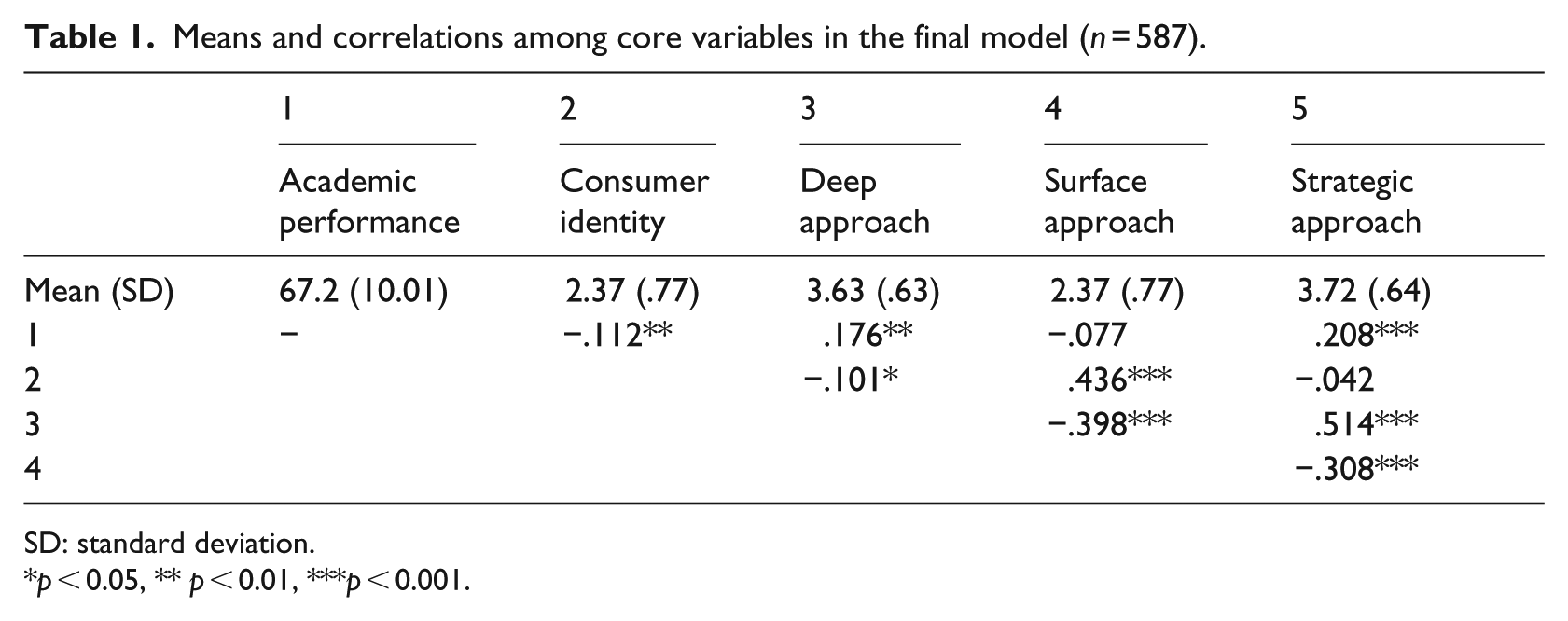
SD: standard deviation.
p < 0.05, ** p < 0.01, ***p < 0.001.
Ten covariates were added because they had significant effects either on the mediator variables or outcome variable. These were: gender (female vs other), age (mature student over the age of 21 years vs under 21 years), ethnicity (White vs Black or minority ethnic), university type (research intensive vs other), year of study (year 1 vs other), grade goal (first class s. other), extracurricular involvement (involved vs not involved), receiving course credit (received vs did not receive), voluntary employment (volunteer vs not a volunteer) and being in employment (employed vs not employed).
The variables in the final model were consumer identity (the predictor), deep, surface, and strategic approaches to learning (the mediators), academic performance (the outcome) and 10 covariates, meaning that there were 15 variables in total in the final model (see Figure 1). Together, these variables accounted for 55% of the variance in surface approach to learning (Adj. R2 = 0.30), 25% of the variance in deep approach to learning (Adj. R2 = 0.08), 25% of the variance in strategic approach to learning (Adj. R2 = 0.06), and 46% of the variance in academic performance (Adj. R2 = 0.21).
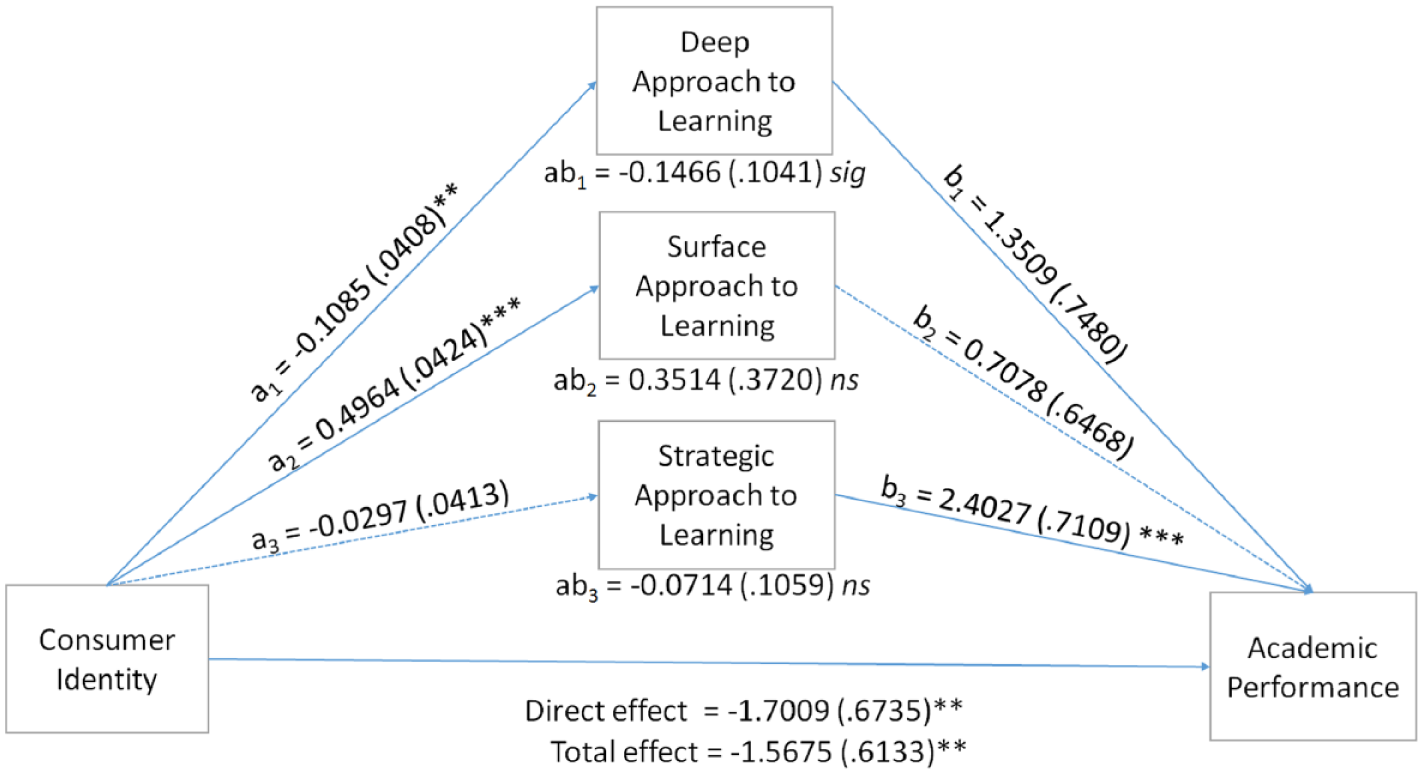
A mediation model of deep, surface and strategic approaches to learning on the relations between consumer identity and academic performance.
To explore the indirect effects of each of the three approaches to learning on the relation between consumer identity and academic performance, bias-corrected confidence intervals for the indirect effects, based on 5000 bootstrap samples, were examined. If these confidence intervals were entirely above or below zero, the indirect effect was interpreted as being significant.
Results
Relations between the covariates, approaches to learning and academic performance
The covariates related to significantly higher scores for surface approach to learning were age (not a mature student), p < 0.01, gender (non-female), p < 0.01, grade goal (not a first-class grade goal), p < 0.001, extra-curricular involvement (not involved), p < 0.05, university (research intensive), p < 0.001 and course credit (receiving credit), p < 0.001. In other words, not being a mature student, not being female, not having a first-class grade goal, not being involved in extra-curricular activities, attending a research intensive university and receiving course credit for taking part in the study were related to taking a more surface approach to learning.
The covariates related to significantly higher scores for deep approach to learning were age (being a mature student), p < 0.01, grade goal (first-class grade goal), p < 0.05 and extra-curricular involvement (being involved), p < 0.01. In other words, being a mature student, having a first-class grade goal and being involved in extra-curricular activities were related to taking a more deep approach to learning.
The covariates related to significantly higher scores for strategic approach to learning were grade goal (first-class goal), p < 0.05, gender (female), p < 0.05 and extra-curricular involvement (extra-curricular involvement), p < 0.001. In other words, having a first-class grade goal, being female and being involved in extra-curricular activities were related to taking a more strategic approach to learning.
Finally, the covariates related to significantly higher levels of academic performance were grade goal (first-class grade goal), p < 0.001, ethnicity (White), p < 0.05, gender (non-female), p < 0.01, type of university (research intensive), p < 0.05 and year of study (not first year), p < 001. In other words, having a first-class grade goal, being White, being non-female, attending a research intensive university and not being in the first year of study were related to higher levels of academic performance.
Direct effect of consumer identity on academic performance
There was a significant negative direct effect of consumer identity on academic performance: a stronger consumer identity was related to lower academic performance (see Figure 1).
Direct effects of consumer identity on approaches to learning
There was a significant positive direct effect of consumer identity on surface approach to learning as predicted in hypothesis 1, meaning that a stronger consumer identity was related to a more surface approach. There was also a significant negative direct effect of consumer identity on deep approach to learning as predicted in hypothesis 2, meaning that a stronger consumer identity was related to a less deep approach. However, there was no negative direct effect of consumer identity on strategic approach learning, which was in contrast to hypothesis 3: a stronger consumer identity was not related to adopting a less strategic approach.
Direct effects of approaches to learning on academic performance
There was no negative direct effect of surface approach to learning on academic performance, which is in contrast to hypothesis 1: a more surface approach was not related to lower academic performance. There was, however, a positive direct effect of deep approach to learning on academic performance that approached significance, which was predicted in hypothesis 2: a more deep approach was related to higher academic performance. Finally, there was a significant and positive direct effect of strategic approach to learning on academic performance as predicted in hypothesis 3: a more strategic approach was related to higher academic performance.
Indirect (mediating) effects of approaches to learning on the relation between consumer identity and academic performance
In contrast to hypothesis 1, there was no indirect effect of surface approach to learning on the relation between consumer identity and academic performance (the lower level and upper level confidence interval was between −0.3639 and 1.1119). In other words, the extent to which students adopted a surface approach did not explain the relation between consumer identity and academic performance.
The indirect effect of deep approach to learning on the relation between consumer identity and academic performance was significant and supported hypothesis 2 (the lower level and upper level confidence interval was between −0.4458 and −0.0022). In other words, deep approach mediated the relation between consumer identity and academic performance whereby a stronger consumer identity was related to lower academic performance because students were less likely to take a deep approach.
In contrast to hypothesis 3, there was no indirect effect of strategic approach to learning on the relation between consumer identity and academic performance (the lower level and upper level confidence interval was between −0.3178 and 0.1111). In other words, the extent to which students adopted a strategic approach did not explain the relation between consumer identity and academic performance.
A summary of all of these results shows that a stronger consumer identity was related to lower academic performance, a more surface approach to learning, and a less deep approach to learning, but it was not related to strategic approach to learning. A surface approach was not related to academic performance whereas both deep and strategic approaches were related to higher academic performance. Finally, the relation between consumer identity and academic performance was mediated by a deep approach, meaning that consumer identity was related to lower academic performance because it had a negative impact on the extent to which students adopted a deep approach to learning.
Discussion
Recent evidence suggests that some students have adopted a consumer identity in relation to their higher education, suggesting that their motivation for studying is based more on an extrinsic desire to obtain well-paid employment after their education than on an intrinsic desire to learn about a particular subject (Molesworth et al., 2011; Tomlinson, 2018; Williams, 2013). Students who identify more strongly as consumers are more likely to position themselves as paying customers, see their universities as service providers, complain about difficult content, feel entitled to a particular outcome as a result of paying for their degree and choose courses that, in their view, would, require minimal effort (Delucchi and Korgen, 2002; Finney and Finney, 2010; Saunders, 2014; Todd et al., 2017; Tomlinson, 2016; White, 2007). Of particular concern is the finding that the more the students identify as consumers of their education, the lower their academic performance (Bunce et al., 2017). This study tested the hypotheses that the negative relation between consumer identity and academic performance could be explained by the extent to which students adopted surface, deep or strategic approaches to learning.
First, this study replicated Bunce et al.’s (2017) finding that the more the students identified as a consumer, the lower their level of academic performance. Second, the data revealed that this relation was, in part, influenced by approaches to learning: the more the students identified as consumers, the more likely they were to adopt a surface approach to learning and the less likely they were to adopt a deep approach to learning. This means that students who identified more strongly as consumers were more likely to use study strategies such as memorising information or rote-learning, and be motivated by the aim of avoiding failure and meeting minimum task requirements. They were also less likely to seek meaning by relating ideas and using evidence, and less likely to be motivated by an intrinsic interest in the material being studied. However, there was no relation between consumer identity and strategic approach to learning. This was surprising because a strategic approach, like a deep approach, requires the student to be an active rather than passive learner, and this active approach would seem to conflict with a consumer identity. Further research is required to consider further the potential relation between a strategic approach to learning and consumer identity to determine the robustness of this finding.
Subsequently, there was inconsistent evidence regarding the relations between approaches to learning and academic performance. Research has generally shown that students who adopt a deep or strategic approach to learning perform better in assessments than students who adopt a surface approach (e.g. Diseth and Martinsen, 2003; Duff et al., 2004; Marton and Säljö, 1984). In this study, both deep and strategic approaches to learning were related to higher academic performance (the former approached significance and the latter was significant). In contrast, a surface approach to learning was not related to lower academic performance. While this was surprising, there has been much debate about the links between approaches to learning and academic performance, with some studies failing to find evidence of a link. This may be because approaches to learning are influenced by many other factors including assessment load and type, discipline and teachers’ approach to teaching. Future work could take into account these factors when exploring the links between consumer identity, approaches to learning and academic performance. For example, a further study could examine a specific cohort of students within a specific assessment context to control for the effects of these variables on the relations between consumer identity and academic performance.
Finally, this study explored the potential mediating impact of approaches to learning on the relation between consumer identity and academic performance, to examine whether consumer identity had a negative relation to academic performance because it impacted on approaches to learning. Only a deep approach to learning, but not surface or strategic approaches to learning, mediated the relation between consumer identity and academic performance: a stronger consumer identity was related to taking a less deep approach to learning, which was subsequently related to lower academic performance. Furthermore, these relations held after controlling for a number of factors that were related to consumer identity and approaches to learning. There was no indirect effect of a surface approach, in part because a surface approach was not significantly correlated with academic performance (as discussed above). These findings mirror and extend those obtained by Smyth et al. (2015) and Bliuc et al. (2011), whereby a deep approach, but not a surface approach, mediated the relation between a stronger student identity and academic performance. They also demonstrate the importance of examining how students’ social identities impact on their motivations for studying, as expressed through approaches to learning, and how these subsequently impact academic performance.
When interpreting these findings, there are some limitations. First, the study relied on self-report measures, which are known to be subject to socially desirable responding, memory distortions or exaggerations. Future research could seek to measure academic performance by obtaining assessment details from official university record systems. Second, this study could not control when students completed the survey in relation to their course progress or course commitments. It is possible that strength of consumer identity and the way students approach their learning will fluctuate over time and vary in response to external demands such as assessment requirements or feedback on their progress on their course and academic performance. Relatedly, the measures of approaches to learning were problematic because they assumed that individual students have a fixed approach to learning, which fails to take into account that learners may take different approaches at different times. Future research could explore how external demands impact on the extent to which a student identifies as a consumer and their approaches to learning, and how these two variables influence academic performance. Another limitation was that the data were correlational, meaning that it was not possible to determine cause and effect: the variables in this study may influence each other in a bi-directional manner, for example, unexpectedly receiving a poor grade may lead to identifying more strongly as a consumer if the student feels that their effort has not been appropriately rewarded. A longitudinal examination of these issues would be fruitful. Finally, this study was conducted with students studying for an undergraduate degree in one country, England, meaning that there are still gaps in our understanding of the extent to which a consumer identity may be internalized by postgraduates or students in other countries.
The findings from this study begin to shed light on the potential ways in which a consumer identity may be impacting on students in terms of their approaches to learning and academic performance: the more students identified as consumers, the less likely they were to adopt a deep approach to learning, which subsequently had a negative impact on their academic performance. Against a global context of increasing marketization of higher education, the challenge for lecturers thus remains one of fostering a deep and meaningful engagement in learning among students, for example, through careful course design and assessment strategies to support students’ intrinsic motivation for learning. Higher education institutions need to avoid positioning themselves as service providers and treating students as consumers, so that students do not purely see their university degree as a commodity that they are entitled to in exchange for tuition fees. Instead higher education institutions should position themselves as offering students a vital opportunity for lifelong learning for personal growth and the benefit of society.
Footnotes
Declaration of Conflicting Interests
The author(s) declared no potential conflicts of interest with respect to the research, authorship, and/or publication of this article.
Funding
The author(s) received no financial support for the research, authorship and/or publication of this article.
