







Abstract
Effective time management is essential for us all, whether students or anyone else. There are many factors which affect how well students manage their time and in what ways. As with everything, some are excellent at managing their time and others are not. As faculty, we can assist our learners to better manage their time, whether this is in the online learning environment or any other. However, studies reveal that the effect of time management training on time management practices varies, and there is therefore a need to explore this further. This study investigates how the practice of time management, an important self-regulated learning enabler, affects learning in the online learning environment. An automated adaptive time management enabling system was used to guide students in managing their time more effectively. The system assisted students in their time management through visual reinforcement, adaptive release, learning monitors and learning motivators. The findings showed that the use of the time management enabling system facilitated and guided the students in studying the course in a consistent manner and aided students in practising more effective time management thus impacting performance. In summary, positive changes were made to their time management behaviours and these subsequently improved their self-regulation.
Keywords
Self-regulated learning
Self-regulated learning is the self-directed process in which learners plan, monitor, evaluate and reflect on their learning using relevant enablers and strategies. Self-regulated learning enablers include goal setting (Schunk, 2001; Zimmerman, 2008), planning the strategies and timelines to achieve the goals (Ambrose et al., 2010; Schunk, 2001; Zimmerman, 2008), procrastination, stress and emotional management and flexibly implementing learning strategies (Ambrose et al., 2010; Paris and Paris, 2001; Zimmerman, 2008). However, self-regulated learning strategies used to achieve the learning goals are also important, and they include (among others) reading, writing, listening, asking, note-taking, memorisation techniques and collaborating with peers (Ambrose et al., 2010; Doyle, 2008; Newman, 2008). As such, such individual or group-based activities serve as indicators of self-regulated learning present in students (Candy, 1991; Knox, 1986). The practice of self-regulated learning enablers and strategies is strongly grounded metacognitively, involving a series of components, proposed by Ambrose et al. (2010: 192–193):
Assess the task at hand, taking into consideration the task’s goals and constraints.
Evaluate their own knowledge and skills, identifying strengths and weaknesses.
Plan their approach in a way that accounts for the current situation.
Apply various strategies to enact their plan, monitoring their progress along the way.
Reflect on the degree to which their current approach is working so that they can adjust and restart the cycle as needed.
Research shows that self-regulated learning is strongly associated with academic performance and course attrition (Baker et al., 2009; Clear et al., 2008; Schunk, 1996). Poor self-regulated learning leads to lower academic performance and higher course attrition. Self-regulated learning is especially important at university level where the study load becomes heavier and more academically difficult (Byrd and McDonald, 2005; Peverly et al., 2003) and in online and blended courses where learning is more self-directed.
The sustainability of self-regulated learning depends significantly on the motivation of the student (Pintrich, 2000; Wang and Holcombe, 2010; Zimmerman, 2008). Motivation guides their value perception of the learning tasks and the level of persistence and effort they devote to achieving them. Together with motivation, the various self-regulated learning enablers and strategies work together to ensure optimal effect on their learning. To help students to practise self-regulated learning, students can be taught self-regulated learning strategies through courses, workshops or other learning resources (Claessens et al., 2007; Häfner and Stock, 2012; MacCann et al., 2012). Alternatively, forms of self-regulated learning enablers and strategies can be embedded within courses through direct instruction (Zimmerman, 2008), guided and independent practice (Lee et al., 2010), instructor feedback (Duijnhouwer et al., 2010; Labuhn et al., 2010), peer support (Patrick et al., 2007), group learning (Warburton and Volet, 2013) and e-portfolio (Nguyen and Ikeda, 2015). Teaching self-regulated learning to students and pedagogical adaptation of self-regulated learning into the learning contexts can help to support different outcomes related to self-regulated learning (Gibson et al., 2011; Graham and Harris, 2005; Stefanou et al., 2013).
Time management and self-regulated learning
Time management is commonly depicted as an essential element in self-regulated learning models (Boekaerts, 1988, 1991, 2011; Pintrich, 2000; Winne and Hadwin, 2013; Zimmerman, 2002, 2008). Good time management broadly entails the process of scheduling sufficient time, spread consistently throughout the designated learning duration, to complete the learning tasks that are tied to the learning goals set (Claessens et al., 2007; Orpen, 1994; Sabelis, 2001). Van Den Hurk (2006) regarded time management as one of three components of time planning which also included scheduling and planning one’s study time.
Students who practise effective time management tend to estimate the time duration needed to complete their learning more accurately and engage in actions in saving time (Barkas, 1984; Claessens et al., 2009; Francis-Smythe and Robertson, 1999; Hellsten and Rogers, 2009; Landy et al., 1991). Thus, they generally finish their work faster as compared to others and spread their learning evenly over the whole study duration. Students were more likely to complete these readings if they allocated time earlier than the day of class (Sharma et al., 2019) and students generally spent more time studying if they have scheduled their learning earlier (Lahmers and Zulauf, 2000). Knight (2010) reported that surface learners focused their online activity at the beginning or end of the module while deep learners planned their access to learning materials consistently throughout the course. However, learner perception of course workload can affect the amount of time planned to do the learning tasks (Kyndt et al., 2013).
There are significant correlations between the management of time, goal and procrastination in learning (Khiat, 2015; Lay and Schouwenburg, 1993; Macan, 1994; Van Eerde, 2003). In addition, time management is an anticipatory precursor that motivates the use of other self-regulated learning enablers and time management mechanisms could be incorporated in courses where their constant application is organised (Zimmerman et al., 1994). Consequently, students’ goal and procrastination management might be indirectly and positively influenced by the effective practice of time management. Therefore, time management is an important component of self-regulated learning as it also serves as the basis or an enabler to create the time space and motivation for a student to implement other self-regulated learning strategies. In summary, focusing on improving students’ time management skill can have wider implications on the practice of self-regulated learning as a whole.
Time management and learning
Proper time management is shown to have influence on effective learning in that there is a positive relationship between time management practice and academic performance (Adams and Blair, 2019; Alsalem et al., 2017; Britton and Tesser, 1991; Claessens et al., 2007; De Jager, 2014; Lahmers and Zulauf, 2000; MacCann et al., 2012; Mercanlioglu, 2010). Effective time management is one of the many significant factors that determines the self-regulated learning competence of a student. Other factors may impact learning performance more directly, and these include self-regulated learning strategies such as (among others) reading, writing, listening, asking, note-taking, memorisation techniques and collaborating with peers. Effective time management could be perceived as the basis or an enabler to create the time space and motivation for a student to implement these self-regulated learning strategies (Lay and Schouwenburg, 1993; Van Eerde, 2003). As such, effective time management has potential to improve the practice of other self-regulated learning strategies and indirectly further enhances student learning.
While time management is important in academic success, students may not be consciously practising time management in their learning (Dignath-Van Ewijk and Van der Werf, 2012; Wang and Holcombe, 2010; Zimmerman, 2008). They also tend to underestimate the time need to complete their tasks (König and Kleinmann, 2007) or lack effective time management strategies. Time management training can be implemented to help manage their time better. However, the results of the effect of time management training on the time management practices were mixed as shown in the studies done by Claessens et al. (2007), Häfner and Stock (2012), MacCann et al. (2012) and Van Eerde (2003).
Practices on incorporating self-regulated scaffolders or specifically, time management enablers in courses are scarce. In addition, researchers have not examined if such scaffolders help students practise time management while learning. Most learning environments incorporate the use of a learning management system, for example, Blackboard. Given that much is done via a learning management system, there is a need to explore the potential of incorporating a formal automated time management system in courses which use a learning management system and to see whether or not a time management enabling system improves time management behaviours. This translates to the hypothesis:
Hypothesis 1: There is a positive relationship between the use of a time management enabling system and the practice of time management.
While time management is deemed as an important self-regulated learning enabler, it is generally expected that students practise it in their own ways. As such, most of the studies on time management are contextualised within students practising time management on their own accord using their own methods or time management skills imparted to them. To date there have been no studies which have examined the effectiveness of time management scaffolders that are embedded in the courses in the context of a learning management system. Thus, to fill this gap in this body of knowledge, it would to useful to investigate if time management also improves learning in the context of time management scaffolders that are incorporated in such courses. Therefore, the research question is conceptualised as looking at whether or not a time management enabling system embedded into a learning management system improves academic performance. From this, the following hypotheses are formulated:
Hypothesis 2: There is a positive relationship between the use of a time management enabling system and assessment results.
Hypothesis 3: There is a positive relationship between the use of a time management enabling system and course completion rate.
Methodology
Participants
One online course related to clinical research was selected. Students signed up for this course as part of their continuing and professional healthcare education. From the launch of the course in the year 2017 until the time of analysing the data used in this study, there were about 60 students who had completed or were still doing it. They generally had at least a bachelor’s degree and were studying or working in the professional fields related to healthcare. Students could pay to enrol in the course throughout the year and were given 8 months to complete it. To be awarded a certificate of completion, the students were required to view video annotated lectures and pass their summative assessments. The students were given unlimited attempts to achieve a pass score of 70% for each summative assessment that was made up of multiple-choice questions. Learning in the course is self-paced and no instructor intervention is present throughout the course duration.
Through convenience sampling, data from 36 students were collected and analysed in consideration of their course enrolment period. Moreover, 17 students were assigned to be in the intervention group where the time management enabling system within their learning management system was implemented for use. They started the course in September 2017 to November 2017 and all were expected to finish the course by end of June 2018. The first 19 enrolees of this course (before September 2017) when it was first launched were not accorded the intervention and thus were assigned to be in the control group, that is, they did not use the time management enabling system. The remaining enrolees were not included as they were given completion dates beyond June 2018.
Design/implementation
The automated time management enabling system made use of the functions available within the learning management system. The system consisted of four components, which are given in the following:
Visual Reinforcement. The course study plan recommended a schedule that provided a realistic and clear picture of the amount of learning materials to be covered each week/month to complete the course within the timeframe. The whole of the study plan was situated prominently at the course main page, which was the only access point to the learning resources and assessment. The visual presentation of the study plan served as a continual reminder to students of the various learning timelines and deadlines.
Adaptive Release. The course resources were adaptively released in a sequential manner. To access a new topic, a student would need to complete the latest released pre-requisite topic and its assessment. The adaptive release of resources served to break up study into manageable time chunks for learning. At the same time, it aimed to reduce the psychological effect of students feeling overwhelmed with too much content if all learning resources were visible to them at all times.
Learning Monitor. Learning prompts were sent out as personalised email notifications to inform the students of the learning objectives to be achieved each week and to remind them when they failed to complete any studying or assessment within a reasonable set timeline. A student would receive no more than two email notifications per week. Such restriction was set to prevent excessive external regulation on students. Too many learning prompts sent could be intrusive and annoying to the students who needed no such prompting/reminders given their already effective time management abilities.
Learning Motivator. As student learning motivation could affect the practice of effective time management, learning motivators in the form of personalised emails were sent to compliment the student for achieving good learning progress or assessment results. However, it also helped to arrest poor time management through personalised emails to encourage the student if they were not meeting learning deadline constantly and when they did not do well in their assessment.
The automated functions in the time management enabling system were designed to be light-handed and non-intrusive but yet to be sufficiently useful to effect changes in time management behaviours. Through the time management enabling system, it was envisaged that the students who needed it would eventually be ‘nudged’ to practise some effective level of time management in their learning.
Measures and analysis
Data related to time management, course assessment results and course completion rate were collected. Statistical methods were used to analyse the data. The testing of the first two hypotheses was based only on students in both groups successfully completing the course.
To characterise the practice of time management, two indicators were used. They were learning efficiency and learning consistency. Learning efficiency is defined as the speed (in days) at which a student takes to complete the course. The number of days, from course enrolment to course completion was used as the proxy indicator. Learning consistency is defined as the level of spread of the learning activities throughout the study duration. The time distribution in watching the video annotated lectures and passing the nine summative tests was used as the proxy indicator.
To measure academic performance, assessment results and course completion rate were used. Assessment results included the mean score of the nine summative assessments and the number of attempts to pass each summative assessment. For course completion rate, a student was deemed to have completed the course if they viewed all the video annotated lectures and passed all the summative assessments for the nine topics in the course.
To ensure the appropriateness of statistical tests used, the Shapiro–Wilk statistic (for sample size less than 50) was used to check normality of the relevant dependent variables above. The test results showed that one of the dependent variables (number of attempts to pass assessment, p = 0.023 < 0.05), normality could not be assumed. In this case, for the sake of the consistency in the use of statistical tests, non-parametric tests were used throughout the analysis.
Mann–Whitney Test was used to investigate if there was any significant difference between the control group and intervention group in terms of the total number of days, from enrolment till the award of the certificate (learning efficiency). Kruskal–Wallis analysis test was used to check if the students in each group consistently learnt their course materials throughout the course duration till completion (learning consistency).
The duration used by each individual student to complete the course was divided into three equal time segments. For each time segment, the percentage of time used to learn the course was calculated. Kruskal–Wallis analysis was then conducted separately on each group to evaluate if equal amount of learning was used in each time segment (first 1/3, middle 1/3 and last 1/3).
The independent variables used to test the first hypothesis were learning efficiency and learning consistency, with the Mann–Whitney Test and Kruskal-Wallis being used. The independent variables used to test the second were mean test score and mean tries per assessment, with the Mann-Whitney Test used. The independent variable used to test the final hypothesis was the number of students who completed the course, with the Chi-Square Test of Independence used.
Findings
Hypothesis 1: there is a positive relationship between the use of a time management enabling system and the practice of time management
Time management – efficiency
Comparing the total number of days, from enrolment till the award of the certificate used by the students in both groups, the obtained Mann–Whitney U statistic was 30.5, p < 0.05 (Table 1). Its Eta squared (η2) was 0.182. Thus, there were both statistical and practical significance of the difference in the total number of days, from enrolment till the award of the certificate, between the two groups. Students in the intervention group, that is, those who used the time management enabling system, used a significantly shorter number of days than students in the control group, that is, those who did not use the time management enabling system.
Mann–Whitney Test.

The above analysis clearly showed that the students who used the time management enabling system studied over a shorter period of time, as measured by the number of days from their first to last session as compared to the students who did not use this system. Thus, the interventions that were incorporated in the learning process of the students who used the time management enabling system had enabled these students to defer their studying less than the students who did not use this system.
Time management – consistency
For the students who did not use this system, the Kruskal–Wallis statistic was χ2 (df = 2) = 17.566, p < 0.05 (Table 2). Its Eta squared (η2) is 0.649. Therefore, it could be concluded that students who did not use this system did not invest an equal amount of learning hours in the three time segments that stretched from the moment they started their studies to the day that they passed all the mandatory assessments to complete the course. Most of the learning was done in the last time segment (last 1/3) of the course.
Kruskal–Wallis test.
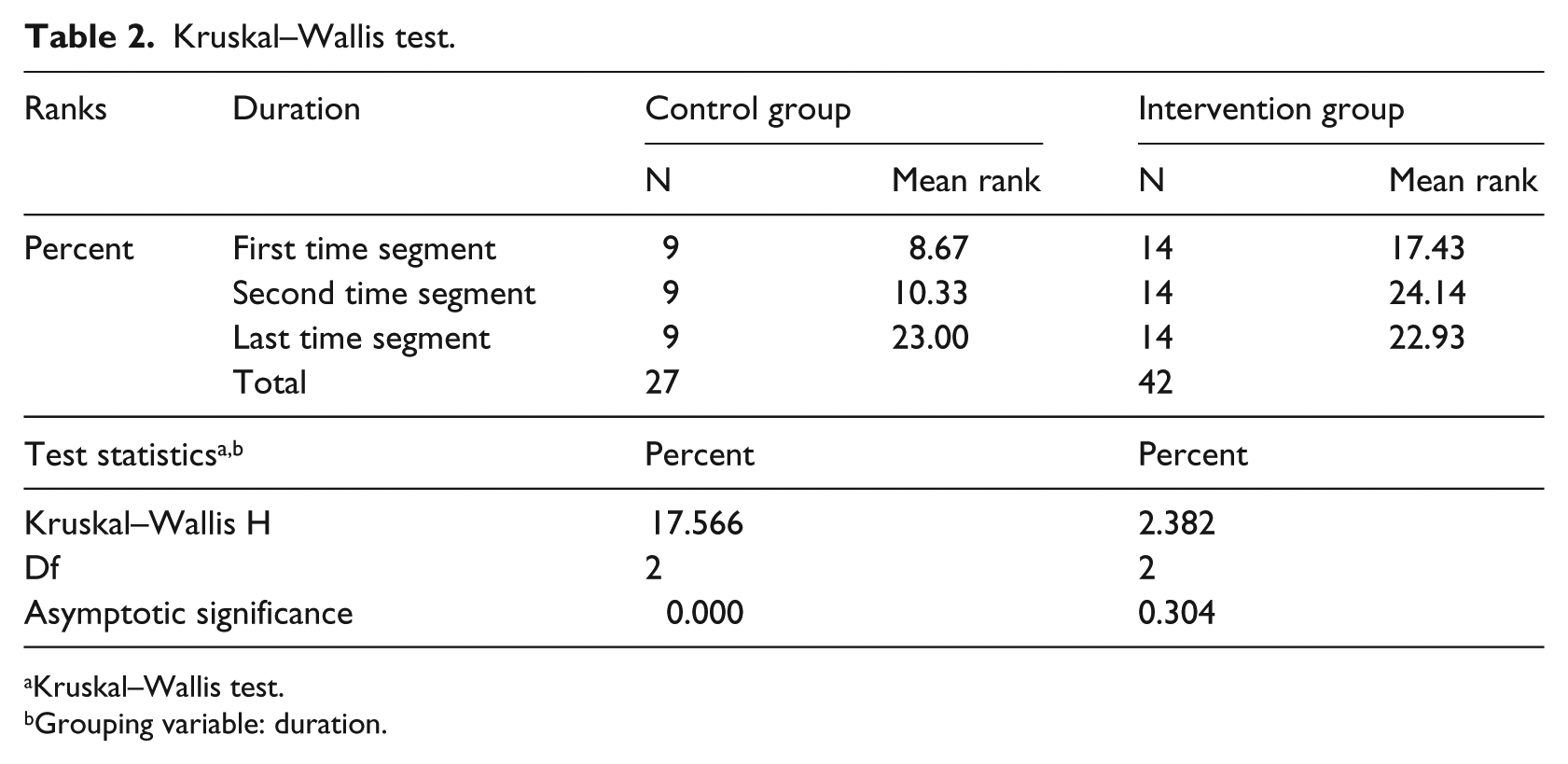
Kruskal–Wallis test.
Grouping variable: duration.
For the students who used the time management enabling system, the Kruskal–Wallis statistic was shown to be not significant, χ2 (df = 2) = 2.382, p > 0.05 (Table 2). Therefore, students who used the time management enabling system invested the same amount of learning hours equally in all three time segments throughout the study period that stretched from the moment they started their studies to the day that they passed all the requested tests to complete the course.
Based on the above analyses, students who used the time management enabling system distributed their time spent on learning equally in the three time segments. This was a strong indication of consistency. However, the students who did not use the time management enabling system cramped their learning in the last time segment of their course duration, confirming a different pattern of time management in terms of consistency. Therefore, the data showed that there was a positive relationship between the use of a time management enabling system and the practice of time management. In summary, students who used a time management enabling system in their course practised different time management as compared to students who did not use the system.
Hypothesis 2: there is a positive relationship between the use of a time management enabling system and assessment results
Course assessment – mean test score
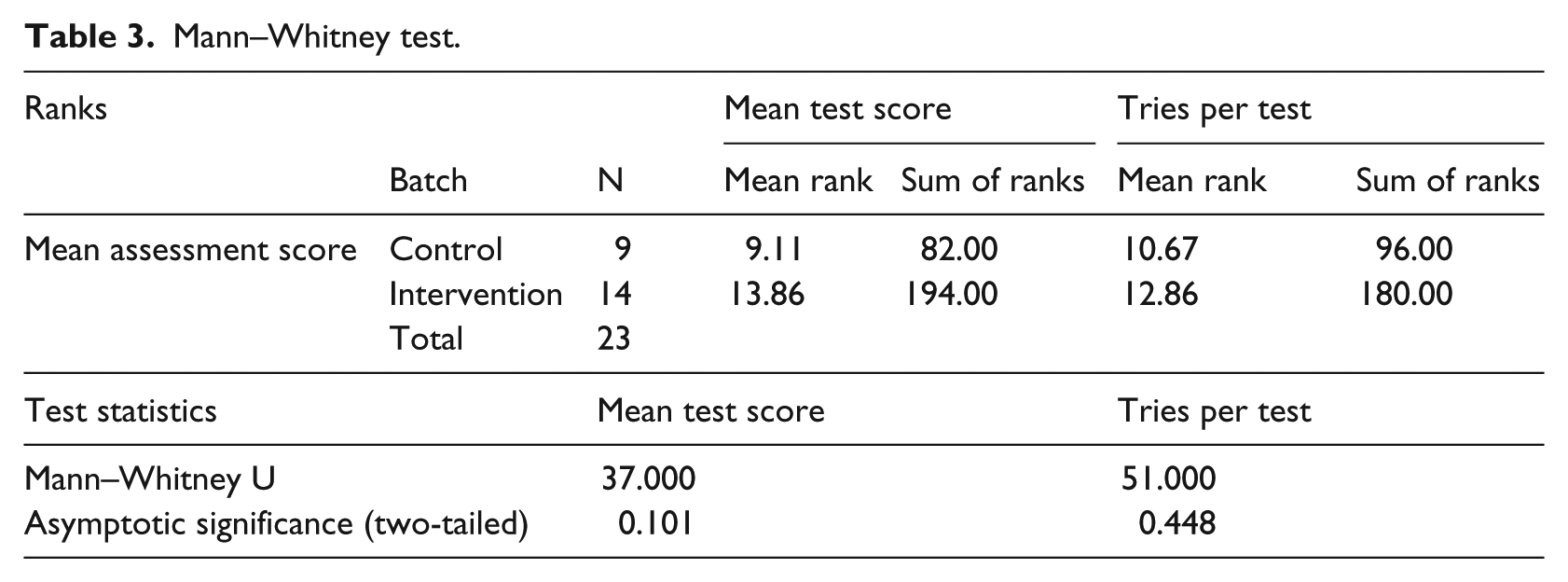
The Mann–Whitney U statistic was not statistically significant with the value of 37.000, p > 0.05 (Table 3). Thus, it could be concluded that there was no significant difference in the performance between those who used the time management enabling system and those who did not.
Mann–Whitney test.
Course assessment – mean tries per assessment
The Mann–Whitney U statistic was not statistically significant with the value of 51.000, p > 0.05 (Table 3). Thus, it could be concluded that there was no significant difference in the performance between those who used the time management enabling system and those who did not.
The data related to mean assessment score and mean tries per assessment showed that there was no indication of a significant positive relationship between the use of a time management enabling system and performance. In summary, students who used a time management enabling system in their course performed equally/no differently in their assessment as compared to students who did not use the system.
Hypothesis 3: there is a positive relationship between the use of a time management enabling system and course completion rate
The completion rate between the students who used the time management enabling system and those who did not was statistically significant, χ2 (df = 1) = 4.760, p < 0.05 (Table 4). This showed that course completion varied as a function of the group type. Looking at the table, it could be seen that the proportion of students who completed the course is significantly higher in the group of students who used the time management enabling system as compared to the students who did not use it. Completion rate for the students who did not use the time management enabling system and those who used it are 47.4% and 82.4%, respectively. In the context of this course, a student was considered as not completing the course if they did not finish the course within the stipulated 8 months.
Chi-square output for test of independence between two variables.
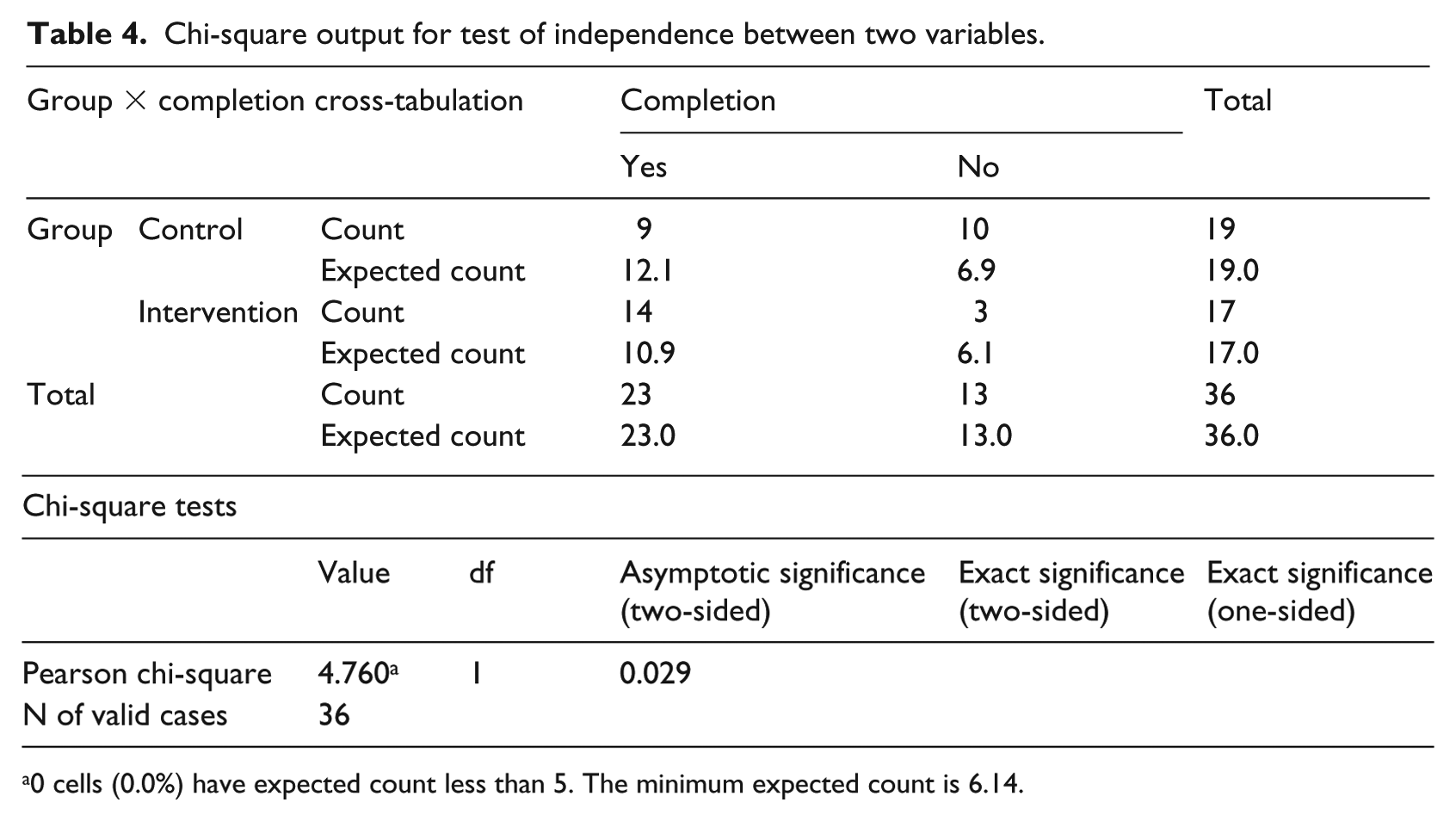
0 cells (0.0%) have expected count less than 5. The minimum expected count is 6.14.
The data showed that there was a significant positive relationship between the between the use of a time management enabling system and course completion rate. In summary, students who used a time management enabling system in their course had a higher probability of completing the course as compared to students who did not use the system.
Discussion and conclusion
There are two key findings in the study. First, it shows that the use of an automated time management enabling system within a course promotes a particular pattern/practice of time management. No previous study had specifically explored the use of a time management system within a course to promote good time management and to train students in practising it at the same time as the students are studying/working in a learning management system. The students who used the time management enabling system spread their learning more evenly throughout the study duration and procrastinated less as compared to the students who did not. The use of a time management enabling system clearly facilitated and guided the students in studying the course in a consistent manner. This finding shows that the incorporation of a time management enabling system helps students to practise time management and is consistent with studies done by Claessens et al. (2007), Häfner and Stock (2012), Khiat (2017), MacCann et al. (2012) and Van Eerde (2003). These studies reported training students in time management before students began their courses could promote the use of appropriate time management practices during their learning. The findings from the study reported in this article show us that the use of the time management enabling system while that studying is taking place is equally effective in promoting the practice of time management as compared to conducting that training before the course begins. The use of an automated time management enabling system is especially important in online courses where there is less and/or different instructor intervention and student interaction as compared to the normal classroom.
Second, it might be expected that the use of a time management enabling system would improve academic performance given that leaving any task, whether related to learning and assessment or not, until the latter stages is considered to be procrastination and therefore not a good thing to do (Adams and Blair, 2019; Alsalem et al., 2017; Britton and Tesser, 1991; Claessens et al., 2007; De Jager, 2014; Lahmers and Zulauf, 2000; MacCann et al., 2012; Mercanlioglu, 2010). However, the results on academic performance (measured through the proxies of the scores of summative quizzes and the number of attempts per assessment) did not indicate any significant relationship between them and the use of a time management enabling system. On the matter of whether or not the use of a time management enabling system would improve course completion rate, the results were different; the use of a learning management system improved the completion rate. One possible explanation for the mixed results might be related to the structure of the assessment, as they were MCQ-based, allowed unlimited attempts and were open-book in nature, so there existed the possibility of some students ‘gaming’ the assessment system, that is guessing the answers. Future work is needed in exploring this in contexts where the assessment is one attempt, time-limited and assesses higher-ordered thinking.
In considering the results, however, limitations should be noted. First, the participants in this study were professionals (with at least a bachelor’s degree) in the domain of continuing and professional healthcare education in Singapore. As such, future studies should be conducted to investigate the use of a time management enabling system on learners with different level of academic qualifications, from other fields/disciplines and from different countries. Second, this study did not investigate specifically each component (being visual reinforcement, adaptive release, learning monitors and learning motivators) that made up the time management enabling system. Thus, the significance of each component in effecting changes in time management behaviours was not known. Further investigation should be conducted to better understand the effectiveness of each component of such a time management enabling system and how they interact with one another in assisting students to regulate their learning. Third, the data analysed were retrieved from the Learning Management System that hosted the course. Thus, triangulation of data was not robust. Future study of time management systems should also include the collection of data related to the perspectives of students, course developers and tutors to strengthen the data triangulation process. Other limitations are that the sample size was very small, from only one subject area within a single institution, the participants were from different annual cohorts, and the two sets of students were not matched for variables such age, gender, qualifications and ability. Only non-parametric statistical tests were used. The distance-learning programme may not have presented the same level of challenge and difficulty to students through the use of identical summative assessments across cohorts. It should be noted that this particular cohort of students had limited instruction/support from academic staff and no opportunity for student interaction, so future work is needed in contexts where this is interaction is present. Furthermore, it should be noted that time management is only one of the important components of self-regulated learning. Future work is needed which could include qualitative observations based on student perceptions of their learning, and feedback from faculty about the impact of a time management system.
The findings may have implications on future directions of practice. Generally, students who are enrolled in online courses are expected to manage their study time on their own or may be given some training or advice on self-regulated learning (which includes time management) before the start of the course. The findings have shown that the incorporation of a time management enabling system within such courses can assist students in practising time management. Therefore, it would be worthwhile for instructors/faculty to consider incorporating time management scaffolders within courses. Since the findings showed that the use of a time management system such as the one described could be incorporated within courses, future research should be considered to incorporate other components associated with self-regulation within courses to promote its practice.
In conclusion, the study showed that the use of a time management enabling system is able to affect time management behaviours and to significantly improve course completion rates. It contributes to the literature in relation to the incorporation of time management scaffolders within online courses, an area which is seldom investigated. Importantly, the findings imply the benefit to learning if time management or other self-regulated learning components are incorporated in courses.
Footnotes
Declaration of Conflicting Interests
The author(s) declared no potential conflicts of interest with respect to the research, authorship, and/or publication of this article.
Funding
The author(s) received no financial support for the research, authorship, and/or publication of this article.
