







Abstract
Reflection has been increasingly used to enhance student development in higher education, in both undergraduate and postgraduate studies. Learner autonomy is essential on reflection, particularly on how learners interpret their learning experiences. The learner has to take initiatives in making meaning of their learning by examining their experiences, and purposefully exploring their learning. Reflection is a key component in active learning as students actively engage in the process of thinking about what they have learnt or experienced. Mezirow highlighted how reflection can mean many things, including awareness of a perception, thought, feeling, intention and action, taking something into consideration or simply imagining alternatives. And there are also multiple approaches to embracing reflection today, such as reflective essays, videos and online blogs, where reflective processes and approaches may differ particularly in relation to technological adoption. In a learning environment, reflective approaches are adopted with the aim for learners to transfer knowledge and experiences to practice. However, there is scarce literature on student perception of the different reflective approaches. The present paper therefore examines student perspectives on four different reflective approaches and how these different approaches are applied within the context of higher education. The four approaches chosen are written, audio, video and face-to-face based on current literature on how reflection is documented or presented in education) and the integration of the concept of multimodality.
Keywords
Literature review
Reflective learning and its outcomes
According to Boyd and Fales (1983), reflective learning occurs when an individual’s internal exploration of an issue or experience helps them to create or clarify its meaning. Reflection enables learning through critical evaluation, a transformation of theory and knowledge to practice and new ideas (Quinton and Smallbone, 2010). As reflection is embraced by teachers ‘in formal, explicit ways or . . . [used] more fluidly in ongoing, tacit ways’ (Finlay, 2008: 2), reflective approaches and their outcomes in education vary. Boud et al. (1985) pointed out that outcomes of reflection include new perspectives, behaviour change, readiness for application and commitment to action. Moon (2006) highlighted how reflection involves spiritual growth and self-exploration. Self-growth is attained when learners constantly examine and make sense of their experiences in response to an event. Reflective learning improves learners’ lifelong learning and professional practice (Rogers, 2001; Trede and Jackson, 2021).
Reflection enables learners to gain a diverse range of competencies that facilitate them to implement and apply knowledge appropriately in different situations in life. Harvey et al. (2010) suggested that holistic competencies can be developed through reflective practice. Holistic competency is an umbrella term inclusive of different types of generic skills (e.g. critical thinking, communication skills, global competency, information literacy, resilience), positive values (e.g. professional ethics) and attitudes (e.g. lifelong learning) which are essential for students’ whole-person development (Chan and Yeung, 2020). Research has shown the potential of reflection for competency development. Based on the analysis of student and staff interviews, students’ reflective assignments and a focus group discussion with students a year after completing work-based experiences modules, Smith et al. (2007) found that the reflective element of the modules allowed students to ‘reflect on broader generic skills’ (p. 139). In addition, Brown’s (2009) study of the reflective journals of music students in an Australian university shows that reflective journals contributed to the development of critical, creative and self-regulated learning. These studies highlight the importance of reflection on competency acquisition, particularly lifelong learning competency which is essential for learners’ futures.
Reflection is an important part of a learning process as described in Kolb’s (1984) learning cycle. It can be perceived as a means to facilitate meaningful learning. As Higgins (2011) explains, reflection is ‘the action of turning (back) or fixing the thoughts on some subject, in order to learn’ (p. 583), which is lacking in traditional teaching approaches. Different reflective approaches may allow learners to gain and develop different learning outcomes including competencies. However, most studies and development in higher education seem to focus on written reflection (McCarthy, 2011), such as reflective journals and diaries, while other less traditional reflective approaches have often been overlooked. Chan and Lee (2021)’s literature review paper highlighted that students’ ability to ‘express their thoughts and emotions through different means’ is an important part of being reflection literate (p. 14). Few studies have compared reflective approaches, but such comparison is important for understanding how different reflection approaches might best be applied in education settings. To address the gap in literature, this article examines different approaches of reflection, to provide better understanding of how students develop through reflection and their views on the effectiveness of each approach.
Reflective approaches in higher education
Literature on reflective learning is mostly concerned with ‘how, and at what level, learners reflect’ (Ryan and Ryan, 2013: 246). With reflection being personal, individuals may have specific preferences for specific approaches, particularly in education settings where reflection may be shared with or assessed by others. In response, teachers and researchers have been introducing diverse approaches to reflection. Burnard (2006) highlighted how there are numerous characterisations of reflection, with various lenses from different fields, and different shades of meaning under different contexts. Moon (2004) suggested that reflection can be represented in written, visual, oral or performance forms. Reflection involves varying processes such as listening, telling and demonstrating (Schön, 1987) and goes beyond thinking processes to include feeling, instincts and spirituality (Mezirow, 1991; Bulpitt and Martin, 2005). This shows the diversity in which reflection can be applied in education and how reflection can be an individual or group effort. There has also been an increasing interest in multimodality in reflection using various representational modes such as images and spoken words to encourage reflective practice that can accommodate different learning styles and preferences (Barton and Ryan, 2014; Koole et al., 2011; Yuan and Mak, 2018).
Written reflection
The most common form of reflective approach is written reflection. Kottkamp (1990) believed that ‘writing is often a reflective process in itself’ (p. 185). Thoughts and emotions can be put into words, which can be reread and reorganised. Rolfe (1997) indicated that writing down thoughts and knowledge is the only way to access such memories and make them coherent. Reflective writing is a presentation of the writer, to acknowledge in a physical form what is in his/her mind. There are different types of written reflections adopted across disciplines in educational settings, for example: reflective blogs in science programmes (Hall and Davison, 2007), journals in nursing education (Epp, 2008) and web-based reflective diaries in computer science (Fekete et al., 2000). With technology, written reflection can be produced electronically and documented online. On the other hand, there are issues concerning the use of written reflection, for example the tendency of reflection tasks to favour students who are adept at writing (McCarthy, 2011), students’ inability to display high levels of reflection in writing (Brodie, 2007) and the difficulty of assessing written reflections (Chan and Luo, 2020; Chan et al., 2021).
Audio reflection
The adoption of audio as a medium for reflection had been taken mostly as electronic records of reflection, considered less demanding and less intrusive than videotaping (Bergman, 2015). Some of the methods of producing audio reflection reported in previous research include the use of mobile telephones (Myers et al., 2017) and digital voice recorders (Knill and Samuels, 2011) to create audio files which could be shared as podcasts in a discussion forum (Bolliger and Armier, 2013). Myers et al. (2017) wrote that audio reflection is vulnerable, urgent and not carefully planned, whereas in Bolliger and Armier’s (2013) study producing audio files was perceived as time-consuming by the students. On the other hand, audio recording was found to be more mobile while facilitating expressions and emotions than written diaries (Fitt, 2018) and flexible, allowing learners to express thoughts and feelings genuinely without the discomfort of being on camera. Audio recording lessons and reflecting on the recordings had increased self-observation and self-awareness of learners in teacher education (Knill and Samuels, 2011). However, few studies have focussed on audio recordings as a reflective practice in the classroom, instead focussing on audio-visual reflective approaches. Bergman (2015) pointed out how audio-recording’s impact is relatively unknown, compared to video-recording.
Video reflection
In video reflection, audio and visual elements are both essential as tools of reflection. Rich and Hannafin’s (2009) review of video annotation studies in teachers’ reflective practice shows that tools such as VideoTraces, MediaNotes and Video Analysis Tool can help to extend and augment self-reflection. With visual and audio content, video reflections allow more dimensions to be recorded, such as body language and facial expressions. In a study on the use of flip camcorders in classroom reflection, Hargis and Marotta (2011) found that video recording has great potential for enhancing student metacognitive reflection and encouraging teacher reflection about teaching and learning. Particularly in teacher education, teachers can observe and reflect on recorded videos of classrooms, whether it be authentic classroom situational recordings (Blomberg et al., 2014) or the learners’ own classrooms (Welsch and Devlin, 2007). However, such use of videos for reflection is rather second-hand, where learners reflect on video segments by using video as a recording medium. There is a lack of research into the use of video recordings for learners’ own reflections, which could provide a more holistic experience as learners video record their reflections, review and reflect again. Furthermore, video reflections enable articulation of thoughts and feelings using non-verbal cues such as tone of voice, gestures and facial expressions, which written and audio reflection cannot offer. This may also be a disadvantage, as Fakazli and Gönen (2017) pointed out how learners behaved unnaturally in front of the camera, being anxious and stressed to record themselves.
Face-to-face reflection
Face-to-face conversation as reflection differs from written, audio and video reflection in terms of immediacy of response, where learners could build on each others’ contributions and reflect on learning experiences. Logren et al. (2017) showed how reflective talk offered sharing of experiences between people and led to cognitive processing. Interaction is crucial in face-to-face reflections where meaning is co-constructed either between peers or between learners and teachers. Meyer (2003) discussed how the face-to-face method had more speed and energy than asynchronous online discussions, that learners could build on each other, collaborate and benefit from the enthusiasm of others. On the other hand, learners who value privacy in personal reflections or those who lack communication competencies may have difficulties with the face-to-face mode. Blunk and Prilla (2017) pointed out how learners nowadays ‘have no practice in systematically reflecting together’ (p. 367). In current literature, face-to-face conversation tends to be treated as a part of collaborative reflection, which includes different types of collaboration between learners (Epler et al., 2013; McKenna et al., 2009). Hence, little is known about how the face-to-face aspect of interaction impacts learner reflection.
The importance of student perception
Educational research has shown that students’ attitudes influence their motivation to engage in learning (Gardner, 1988). Scholars have argued that how students perceive the importance of holistic competency development could affect their motivation to enhance these competencies (Chan et al., 2017). Students with more positive attitudes (e.g. enjoyment) tend to demonstrate a higher level of engagement in activities that lead to holistic competency development (Chan and Yeung, 2020). Nevertheless, students’ attitudes and perceptions towards these competencies are often overlooked (Tymon, 2013).
According to Vaessen et al. (2017), students’ perceptions of assessment practices influence their preparedness to learn and their motivations, which in turn influence their achievement. Abundant research findings have suggested that students’ perceptions of assessment significantly predict their approaches to learning and their performance (for a review see Brown, 2013; Chen and Brown, 2018; Struyven et al., 2005). Fredrickson’s (2001) Broaden-and-Build Theory also posits those positive emotions such as interest and contentment arising from favourable perceptions are associated with learners’ positive attitudes, which create motivation to develop new competencies.
At present, it is a common practice of tertiary educational institutions to take into consideration student views in decision and policy making and to engage them as student partners (Bovill et al., 2011; Cook-Sather and Luz, 2015; Mercer-Mapstone et al., 2017). Therefore, in view of the different needs and expectations across disciplines and student populations, consulting students’ views and preferences on reflection approaches is urgently needed in order to inform institutional policies on teaching and learning.
Current study
Research on reflection has provided a broad view of how reflection can be applied across disciplines in education settings, for example nursing (Epp, 2008; Pierson, 1998) and teacher education (Rich and Hannafin, 2009; Welsch and Devlin, 2007). However, there has been limited literature on certain reflective approaches, such as video reflection or face-to-face reflection. Much has been written about the facilitation of reflection (Kottkamp, 1990; McIntosh, 2010), assessments of reflection (Cheng and Chan, 2019; Fund et al., 2002; Sumsion and Fleet, 1996), benefits of reflection (Boud et al., 1996; Collier and Williams, 2005) and competencies developed by reflection (Bennett et al., 2016; Husu et al., 2008). Yet comparisons across reflective approaches are lacking in the literature. Bye et al. (2009) reported on younger students preferring technology-based reflection over written reflection and a feeling that they gain knowledge and understanding by using this method. As explained, reflection is highly subjective and personal, so learners may have personal preferences in terms of reflective approaches. The approach taken to facilitate reflection is vital, and learners’ preferences affect their learning through reflection.
Given the importance of student perspectives, the current study attempts to gain a better understanding of student preferences for different reflective approaches. This study aims to investigate students’ preferences for the use of written, audio, video and face-to-face reflective approaches in whole-person development. It is driven by the following questions:
Research Question 1: What are student perceptions of the four different reflective approaches?
Research Question 2: Why do students find certain approaches more effective for their personal development than others?
This study provides insights into how students perceive the four reflection approaches and their tendency to engage with each of the approaches. Since there is a lack of research into this area at present, this study contributes to current understanding of the relative effectiveness of these approaches from the perspective of students, who are essentially the end-users of various educational programmes and initiatives. The findings can inform the design and implementation of programmes that incorporate reflection as a core component to enhance student learning.
Methodology
Research design
The study adopted a mixed-method design which helps to provide generalisable findings supplemented with in-depth details (Bryman, 2004). The quantitative component of the study utilised Likert scale questions to examine students’ preferences for the type of reflection approaches presented. An open-ended question formed the qualitative part and was utilised to elaborate, refine and enrich the quantitative data.
Prior to data collection, written consent was obtained from the mentors, the students and their parents. Ethical approval was also obtained from the Human Research Ethics Committee in a research-intensive university in Hong Kong.
Designed to facilitate the holistic competency development of students
This study is based on a 5-day experiential learning programme for undergraduates from six universities in Hong Kong designed to facilitate their holistic competencies development. Most students were in first and second years from different disciplines. The intended programme outcomes focussed on competencies, such as creativity, teamwork, leadership, communication competencies, professionalism and resilience. This programme was developed by a teaching team using Chan and Yeung’s (2020) Holistic Competency Development Framework (HCDF). It was part of a government-funded project that specifically targeted students’ holistic competency development. The programme was mainly activity based, and students were given opportunities to reflect using an online mobile application including a written learning contract at the beginning of the programme and an online reflection diary ‘Think Think Ponder Ponder’ guided by prompt questions such as:
In the last few days, we believe that you should have developed the above competencies. Can you tell us how you developed these competencies?
Now that you have had time to reflect, would you have done things differently to improve these competencies? And how would you use these competencies to help you to achieve your goals?
Were there any events that helped you realise your own weaknesses? How did you overcome your weaknesses? Or how will you overcome your weaknesses in the future?
There were also questions which asked students to reflect on the challenges they experienced in developing the competencies. Based on the responses gathered, all the students reported having developed the competencies to a certain extent. A workshop was also conducted to help students with reflection. In the online platform, a private area called ‘Tell me if you wish’ was set up, in which participants could share their thoughts and their reflection any time they wanted using the modes of their choice. Students’ audio and video reflections were created using the recording function on a software platform called YOCLE (Chan, 2019). Students were also encouraged to have face-to-face discussions with their mentors and coordinators (Mentors were senior student volunteers from the six universities, they have been provided clear guidelines and training prior to the programme.)
Participants
A total of 151 students (53 male, 98 female) from the six public universities in Hong Kong took part in the holistic competencies programme. Participants were all undergraduate students ranging from those in Year 1 to Year 4, although most were in their first (n = 96) or second (n = 48) year. Students were predominantly from Hong Kong, and all but two students were from East Asia. Students enrolled on the programme voluntarily via promotional bulk emails and campus posters.
Post-programme questionnaire
Data for this study was collected using a post-programme questionnaire with two parts. The first part consists of four 5-likert scale (1 = ‘very unhelpful’, 5 = ‘very helpful’) questions on participants’ preference for the four different reflection approaches. The second part contains a qualitative open-ended question asking the participants to indicate why certain reflection approach was preferred and was more effective.
Data analysis
The quantitative data were put into SPSS (version 24.0) for analysis. Descriptive statistics (means and standard deviations) was used to explore the perceived helpfulness of the four reflective approaches and Cronbach’s alpha was calculated for the internal consistency for the items. The findings from the quantitative data addressed the first research question: What are student perceptions of the four different reflective approaches?
As the qualitative part of the questionnaire serves to supplement the quantitative data, the qualitative data went through inductive content analysis in order to address the second research question. Inductive thematic content analysis was used to explore the emergent themes from the textual data (Cho and Lee, 2014; Elo and Kyngäs, 2008), and explore the reasons why students preferred a particular reflection approach and the reasons for, and effectiveness of such approach. Students were free to complete the second part in either English or Chinese, the latter which was translated by bilingual researchers into English for analysis. To maintain anonymity, participants were coded as S1–S151.
The open-ended responses were analysed using inductive qualitative analysis to code and categorise. In this process, two coders systematically classified textual data in three stages: open coding, axial coding and abstraction (Chan et al., 2017; Cho and Lee, 2014; Elo and Kyngäs, 2008). Students’ responses were broken down into small segments of text and labelled with an open code that served to summarise the key idea of each segment. After generating this first set of codes, axial coding was then carried out to group related open codes into common categories, and finally, the resulting categories were sorted into overarching themes through abstraction. Disagreements between the two coders were revisited and addressed, and an inter-rater agreement was calculated for the categories using Krippendorff’s alpha (α) coefficient (Hayes and Krippendorff, 2007; Moretti et al., 2011). A total of 498 text segments were coded, with an inter-rater reliability of α = 0.85, which reaches the α ⩾ 0.80 threshold for an acceptable degree of agreeability.
The results from the qualitative and quantitative analysis were compared at the data interpretation stage to examine whether they were consistent, and to provide more in-depth understanding of the issue at hand. Both the quantitative and qualitative data informed the second research question: Why do students find certain approaches more effective for their personal development than others? The findings are reported according to the four reflection approaches.
Findings
Quantitative findings
Out of the 151 participants, 138 of them with an average age of 21 (SD = 1.392) responded to the questionnaire of reflection approaches. Within those, 47 students were male, while 89 were female. Two participants did not reveal their gender. The first part of the questionnaire contained four Likert-scale items on student preferences for written, audio, video and face-to-face reflection respectively. The value of Cronbach’s alpha (0.843) implies a high internal consistency of the results from the four items.
According to the results (Table 1), students considered written and face-to-face reflection more helpful than reflection by audio and video. Meanwhile, face-to-face reflection (M = 3.91, SD = 0.856) was perceived to be the most helpful among these four approaches. Eighty students rated in-person conversation (i.e. face-to-face) as helpful, and 28 participants rated it as very helpful. More than 60% of participants thought that written reflection (M = 3.59, SD = 0.834) was helpful, while 19.6% of them felt unsure about the approach. In contrast, 61 students could not tell whether reflection via audio (M = 3.07, SD = 0.906) was helpful or not. The number of students who thought reflection by audio was helpful was approximately 10% more than those who thought it was unhelpful. The distribution of responses to reflection via video (M = 3.04, SD = 0.958) shares a similar pattern to that of reflection by audio. Fifty-seven participants were unsure about the helpfulness of video reflection. Forty-five students thought it helpful or very helpful, while 36 students disagreed with that.
Descriptive statistics of the helpfulness of reflection approaches.
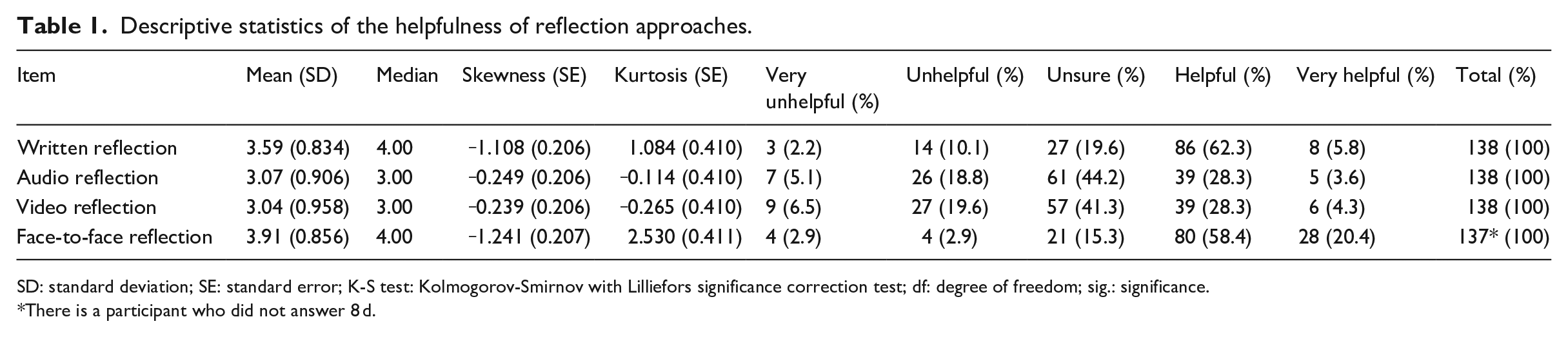
SD: standard deviation; SE: standard error; K-S test: Kolmogorov-Smirnov with Lilliefors significance correction test; df: degree of freedom; sig.: significance.
There is a participant who did not answer 8 d.
Before exploring the correlations between items, a normality estimation was analysed. If the absolute values of skewness and kurtosis are less than 2 and 7, respectively, it is acceptable to consider data to be normal (Kim, 2013; Zaremohzzabieh et al., 2015). The skewness and kurtosis in Table 1 fell into the ranges. Accordingly, the results of the four items were normally distributed. Then, Pearson’s correlation was adopted for a moderate sample size (n = 138). Mukaka (2012) cited a rule of thumbs for interpreting correlation coefficients in behavioural sciences: a low correlation has a value of coefficients between 0.3 and 0.5, a moderate correlation between 0.5 and 0.7 and a high correlation between 0.7 and 0.9. In Table 2, six coefficients are greater than 0.3 and statistically significant. The highest value of Pearson’s coefficient (0.871) suggests a significant positive linear correlation between audio and video reflection. In contrast, face-to-face’s coefficients are all lower than 0.5, which indicates that how participants valued reflection via face-to-face talking was weakly correlated with other reflection approaches. The coefficient values of 0.615 and 0.570 imply that students’ opinion on the helpfulness of written reflection was moderately correlated with that of audio and visual methods.
Pearson’s correlation coefficients of the four Likert items.
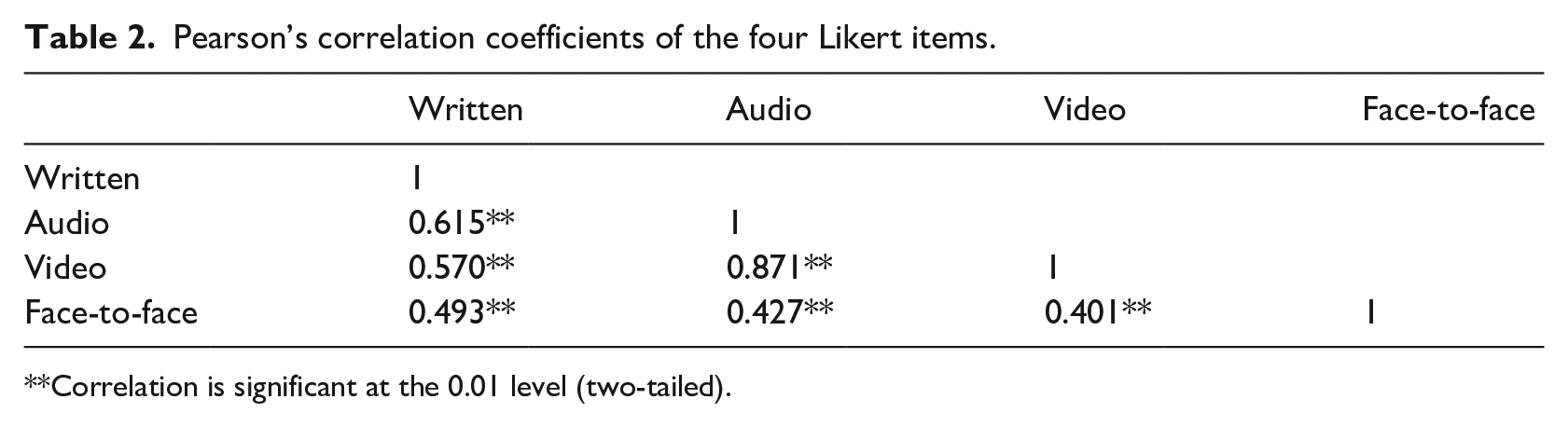
Correlation is significant at the 0.01 level (two-tailed).
Qualitative findings
Out of the 151 participants, 102 offered open-ended responses on reasons for their preferences of reflective approaches. Fifty-two students expressed their specific preference for face-to-face reflections. For instance, S70 found face-to-face reflection preferable as it was interactive, while S63 stated how sharing reflections face-to-face may stimulate thoughts. Twenty-four students explained that writing was an effective approach, such as S39 reporting the reason for preferring written reflection was because writing words made students think carefully about the content. Five students were for video reflection, one preferred audio reflection and four indicated preferences for more than one reflective approach. The remaining students did not specify their preferred approaches or provide any suggestions. Among those having preferences other than the four stated approaches, activities from the programme were viewed as effective reflective methods. For example, Letter to the Future Me, which involved participants writing a letter addressed to themselves 1 year later, was suggested by four students as an effective approach to encouraging self-reflection. Another example was writing thank you cards to others as reported by S81. Six students did not specify any activity or reflective method as effective.
Discussion
From the findings, three type of reflections based on the approaches employed are deduced. These reflection types are discussed in detail below, and Figure 1 shows the reflection types and how environmental and personal factors may affect the student perception of the type of reflection preferred for holistic competency development.
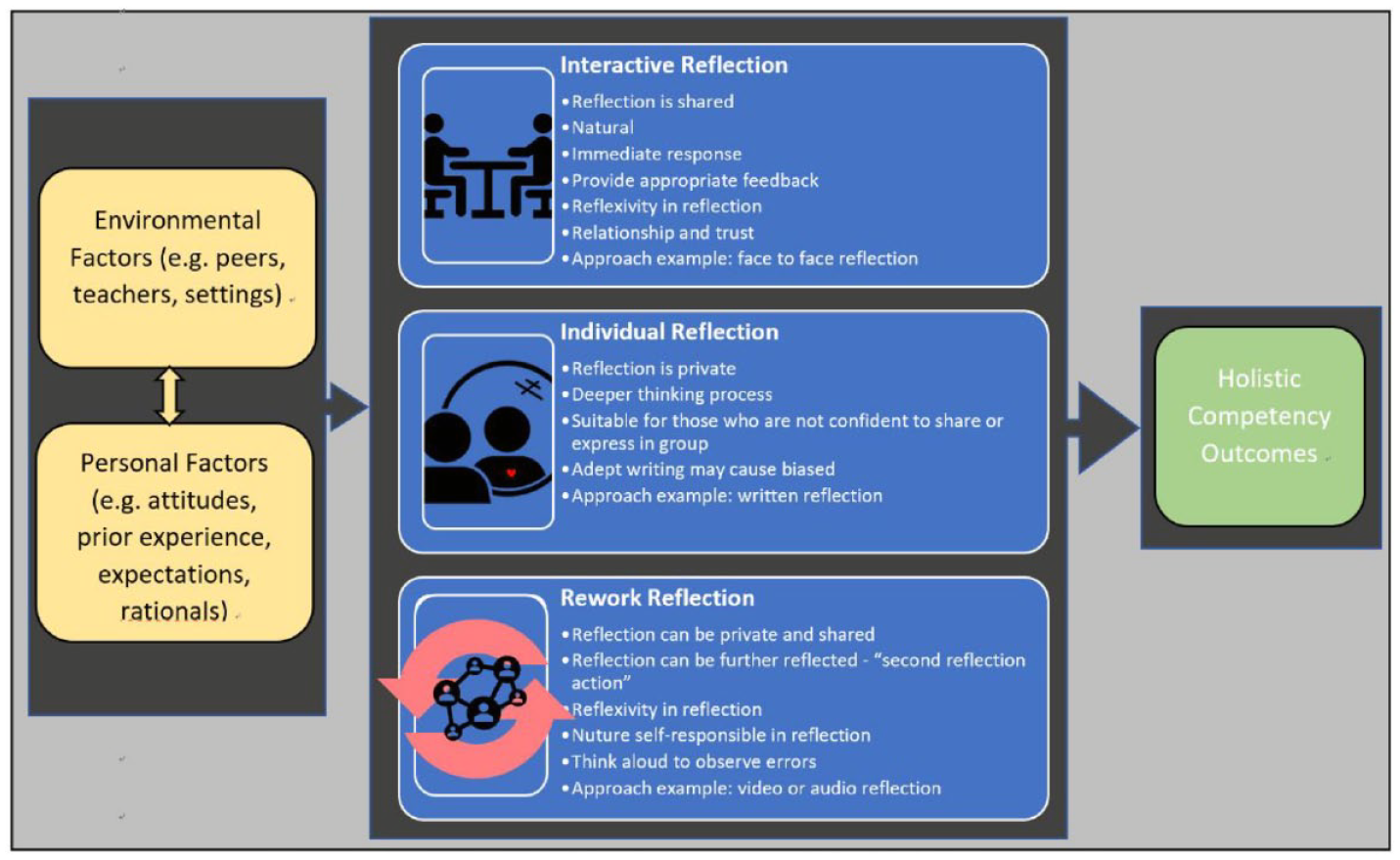
Interactive, individual and rework reflection framework.
Interactive reflections
Face-to-face reflection was selected as the most helpful among the four approaches, and 52 participants provided explanations for face-to-face reflection as their preferred approach. The explanations were mainly associated with the interactive aspect of the approach, as students particularly enjoyed deliberating to their group members. Reflection via interaction with others ‘enables individuals to share and learn from their experiences and ideas from the perspective of others, which will in turn lay the foundation for re(interpreting) and developing their own perspectives further’ (Allas et al., 2017: 611). In the current study, a majority of students who preferred face-to-face reflection mentioned communication as a very important part of the approach.
[I prefer to] Reflect by communicating with others, because there is a comparison, so I can clearly recognize what I didn’t do well. – S15
[I prefer] Talking to others, because it can create resonation, which enables introspection and improvement. – S64
Talking is more effective, because you can get opinions from more people. – S84
Students appreciated getting opinions from more people, claiming that by talking with others, they would receive ideas and advice which enabled them to reflect on their competencies. Receiving response from others was valued. Petsilas et al. (2019) wrote on how interacting with peers in reflection encouraged exchange of ideas. Communication and exchange of opinions allowed students to be more aware of their experiences and to understand more about themselves. The feedback from others helps students to self-reflect, and the two-way communication brought both sides to scrutinise themselves, like an exchange of reflections. Moreover, students mentioned being inspired by others while they were conversing. This showed that in face-to-face reflection, students were not only reflecting on themselves but also on those around them.
While expressing their preference for face-to-face reflection, students recognised how interacting with others made reflection easier. Two students believed that reflecting face-to-face was more straightforward and direct, thus more effective. This approach was found to be more relaxing for students who preferred talking to others. As S43 wrote, face-to-face reflection ‘is more natural and interaction is immediate’, highlighting how conversations encourage students to act naturally during reflection. A good reflective approach should shape in reflectivity and reflexivity. Kornblith (2012) believed that there is unreliability in reflection, and there will always be some belief unscrutinised in reflection. While one may never achieve fully reliable reflections, being more relaxed and natural in reflections allows for more reliability, in the sense that there is less screening of thoughts and beliefs. From the findings, a student pointed out the importance of building a relationship with others through face-to-face approach. Relationships with those in interaction would affect the experience of face-to-face reflection: The closer the relationship is, the more comfortable and natural they feel. As S65 raised the idea that ‘worries can only be shared with trusted ones’, trust is important in reflections that incorporate interactions with others. According to Benade (2018), reflection that involved collaboration with others called for high levels of interpersonal trust and willingness to be vulnerable to betrayal. Trust is a necessary condition for effective face-to-face reflections as the depth of interactions can be affected by how much the speakers trust each other. This is particularly true in competency development. The most beneficial discussions occur when students are divided into smaller groups (Petsilas et al., 2019), this echoes Aristotle quote, that ‘Man is by nature a social animal’. The students in this study were divided into groups of seven, and such a small group setting may be beneficial as students were able to bond with their mentors and form a closer relationship with specific individuals to construct mutual trust.
In literature, reflection has always been assumed as an individual, private journey. Words associated with reflection such as our thoughts, our experiences, our feelings and our emotions are often intertwined with personal diary, individual journal and self-reflective writing, emphasising reflection should be secluded and isolated. This study has shown reflective approach such as face-to-face can be interactive and communal if the learning environment is built properly.
Individual reflections
More than 60% of participants reported written reflection as helpful, and 24 students emphasised written reflections as effective. Some students who preferred the written reflective approaches had also recommended Letter to the Future Me or thank you cards. Written reflection may be a dominant practice in education, but the results showed that students did not consider it as the most effective. It was also found that students preferred to choose different formats of written reflections. Brockbank and McGill (2007) wrote on how writing down elements of an experience, such as events and outcomes, assisted in reflective analysis and interpretation. In this study, students who preferred written reflections appreciated how they could write down their thoughts, but they had different opinions as to how written reflections assisted in their thinking processes. Some students found that writing left them with deeper reflections, others indicated how written reflections made them give more thought to the content. S45 believed that writing a Letter to the Future Me was effective for reflection and allowed goals to be visualised and understood in a personal context. Interestingly, a number of students associated written reflections with privacy:
[I prefer] Writing reflections, to think about it quietly in private. – S1
[I prefer] writing privately, I value privacy. – S76
[I prefer] Reflecting alone quietly. – S90
Five students specifically mentioned that reflections should be done alone, as opposed to those who perceived interactions as helpful for reflections. Different ways of reflection may acknowledge students’ different learning styles and needs (Anne Sen, 2010). A balance or a choice should be given regarding reflective practices to accommodate students who are reserved and students preferring open reflections.
McCarthy (2011) suggested that ‘reflective writing favours those who are adept specifically at this task’ (p. 32). Students may be punished for their inability to fully express themselves in written form. An explanation for students preferring a face-to-face approach over writing may be that students are more confident in talking, particularly that face-to-face reflections in the current study are conducted through informal conversations. However, S51 posed a different belief, saying ‘[I prefer] writing up reflection. I believe words can express myself better as I am not good at presenting myself. My speaking skills need to be improved’. Similarly, S13 preferred writing because it was ‘not that awkward’. This demonstrated how written reflections are preferred by students who may be less adept in interpersonal competencies. Some students found it easier to talk; some students are more comfortable with writing. In a similar sense, some found it easier to write in journals, others in letters addressed to themselves. The findings demonstrated how students may not see themselves as competent in writing, but compared to talking to others, they may find still find comfort in reflective writing. S86 expressed how writing allows for more time, resulting in more carefully planned reflections, while S42 liked writing down reflections because ‘you can give more thought to it’. In contrast to Brodie’s (2007) study that reported students displaying low levels of deep reflection in writing, this study supported how students perceived written reflection as effective for accessing personal thoughts and carefully analysing their learning experiences. However, it is worthwhile to note the various forms of reflective writings students may engage in, ranging from short writings such as cards to relatively long journals.
Rework reflections
Rework reflection, based on our findings, rework reflection is defined as the type of reflection approach which allows students the opportunity to perform ‘at least’ a ‘second reflection action’, allowing the students to rework on their reflection from their initial reflection. The rework reflection may be from their own reflection or from reflecting on peers’ reflection. This can be a very powerful reflective approach if teachers provide a suitable environment. Students can become responsible for their own learning or in reflective terminologies, reflexivity in reflection.
Most students could not tell whether reflection in audio and video was helpful or not. This may be due to the unaccustomed used of audio or video for reflection purposes. Although most students will be familiar with audio and video recording for leisure or even for educational purposes, they will be unacquainted using these approaches for reflection while most students will have reasonable amount of experience in written reflections. This was explained by S18 who wrote that it was a rare chance to do video reflections. Only eight students indicated their preference for audio or video reflections, with one student opting for the audio approach, two opted for either audio or video, with the rest selecting the video approach. Students also saw these methods as effective ways to generate artefacts for future action:
[I prefer] Audio or video recording because I can see the record from time to time. – S30
[I prefer] recording your voicing of reflections. – S69
Those who found video or audio reflections effective saw the importance of going back to those recordings in the future to evaluate their reflections. In a study (Welsch and Devlin, 2007), pre-service teachers prefer video-based reflection over memory-based reflection as they could examine both teacher and student performances in a classroom, as well as notice behaviours that they would not have noticed without videotaping. In this study, students proposed a similar idea that they could reflect on more specific aspects of their videotaped reflections later. Video reflection allows critique of actual performances such as behaviour and communication competencies (Carson, 2008) which may not be evident in written reflections. Such behaviour, emotions and actions may be the type of details students would like to document for future reference. Thus, using video or audio as reflections will allow them to rework, performing a ‘second reflection action’. It should be noted that from the qualitative data, one student who preferred face-to-face reflection indicated that he ‘would not go back and listen to the recordings’. Thus, it is important to be aware of the different learning styles and behaviours.
Nevertheless, the findings demonstrated that students did not prefer audio or video reflections over face-to-face and written reflections. Recording is an important element of audio and video reflection, where students tape themselves speaking about their thoughts and experiences. Benson et al. (2012) indicated the value of students thinking aloud during reflections to promote metacognition. Students may realise their own errors when thinking aloud, which they are not aware of when writing. Spontaneous reflections may simulate further reflection. S72 explained that audio or video reflections were helpful in how ‘It forces me to think what to say’. This differed from Myers et al.’s (2017) study which suggested that audio reflection is less carefully planned than written reflection and tends to make students feel vulnerable as they allow their emotions to be made explicit through their own voices and acoustic cues. While audio and video reflections may be a casual conversation with the self, the students in our study was overly aware of recording themselves and their recordings were carefully thought over and planned, thus losing spontaneity. Reflection involves ‘paying critical attention to the practical values and theories which inform everyday actions, by examining practice reflectively and reflexively’ (Bolton, 2010); as such, recording became problematic, as students were too self-conscious of what they were saying. Cheng and Chau (2009) reported a surprisingly low number of university students (4 out of 15) lacking confidence in creating video for reflection, while 8 out of 15 students admitted that expressing themselves by video was more difficult than by text. Similarly, the students in our study was challenged. They might not have had experience in these reflective approaches, and they might also be reluctant to record themselves voicing thoughts aloud.
Limitations and future research
The current study involved students from local universities in Hong Kong, and thus the study would have been more representative had students from other developed countries been involved. The study investigated preferences for reflective approaches in HK universities’ extracurricular programmes. Hence, the findings may not be readily transferable to a pure academic curriculum context. Another limitation is students’ unfamiliarity with recording reflections using audio or video. The open-ended responses gathered were mostly short phrases stating their preferences without much explanation, thus, future studies may focus on reflective approaches with which students are less familiar, namely, audio and video reflections. In addition, more opportunities need to be given to students to try out these recording approaches before we can really provide accurate evidence if these reflection approaches are preferred. Another possibility is to include interventions in different types of reflections for students and compare individual students’ perspectives. Future research will benefit from exploring students’ qualitative experience with different types of reflective approaches and quantitatively comparing groups receiving different reflection type assignments. This study focussed on four approaches only. Future studies may also consider different forms of reflective approaches, for example, web-based reflections or even chat-bot reflection. In addition, focus group interviews could be conducted to obtain more in-depth data on students’ perceptions. Despite such limitations, this study to a certain extent has provided a new perspective on the issue for comparing reflective practices in Asian higher education institutions in future research.
Conclusion
This study investigated students’ perspectives towards four different reflective approaches in the context of Hong Kong higher education. Some implications can be drawn from this study. Firstly, students predominantly valued interactive reflection. Talking to others was reported to be the most effective approach, thus suggesting that face-to-face reflection should be increasingly implemented to encourage learning. To achieve effective face-to-face reflections, it is important to build trust and good relationships, and smaller reflective groups are recommended. Secondly, when designing reflective practices, it is important to focus on students’ needs. Students may be uncomfortable if they feel their privacy is invaded. Moreover, students may be reluctant to record themselves or prefer other formats of reflection. One suggestion may be to allow students to choose their preferred approaches to reflect as a way to foster learner autonomy and active learning. While allowing more flexibility, teachers should assure students that their reflections will be respected and not judged, to make them less conscious of voicing their thoughts whether on paper or in conversations. Thirdly, higher education institutions should encourage the integration of different reflective approaches in teaching and learning. As students are uncertain about audio and video reflections, this highlighted how reflective methods may be restricted particularly in Hong Kong tertiary learning environments. There is a need to not only promote varying reflective practices, but also to equip teachers with knowledge and competence to implement such practices and that teachers are assessment literate in reflection (Chan and Lee, 2021), while taking into consideration student needs and preferences.
Footnotes
Declaration of conflicting interests
The author(s) declared no potential conflicts of interest with respect to the research, authorship, and/or publication of this article.
Funding
The author(s) disclosed receipt of the following financial support for the research, authorship, and/or publication of this article: The research described in this article was funded through the General Research Fund (No. 17200720) of the Hong Kong Research Grants Council and the University Grants Committee of Hong Kong.
