







Abstract
Multitasking activities among students using various technological devices is common during lectures, and many studies have demonstrated their deleterious effects on various learning outcomes. In contrast, fewer studies have examined ways to reduce multitasking and stimulate engagement in learning. The present study provides an educational strategy to reduce student multitasking during lectures by displaying the teacher’s slideshow on the students’ devices. In the control condition, students visualized the teacher’s slideshow only on the lecture hall screen by means of a video projector. In the experimental condition they also had the possibility to visualize the teacher’s slideshow on their own device in real time. Independently of the students’ level of knowledge and their location in the lecture hall, results revealed that fewer multitasking activities were performed and affective engagement was higher in the experimental than in the control condition. Furthermore, the relationship between slideshow display and affective engagement was mediated by the number of multitasking activities. These findings demonstrate a useful strategy to prevent multitasking during lectures and to promote engagement in learning among students using a digital environment in which the teacher’s slideshow is synchronized on the students’ devices.
Introduction
For more than a decade, a “mobile culture” has invaded places of learning, and students consider it legitimate to use laptops and/or smartphones for non-academic reasons during lectures (Hammer et al., 2010). This phenomenon, known as multitasking, is commonplace at university (Burak, 2012; Coulter-Smith, 2018; Junco, 2012; Wammes et al., 2019). Multitasking refers to a distinction between on- and off-task activities and it is functionally equivalent to distraction (Aagaard, 2019). In-person classes, this construct commonly “refers to engaging in multiple tasks or activities simultaneously during the instruction” (Demirbilek and Talan, 2018: 1). Lectures and peer presentations have been reported as the learning activities during which students felt the least engaged and were inclined to multitask (Deng et al., 2022). In this context, the primary undesired effects of laptop use during lectures are distraction and multitasking (Fried, 2008; Ravizza et al., 2014), and this use interferes with learning (Kuznekoff and Titsworth, 2013; Rosen et al., 2011).
Extensive literature about the negative effects of multitasking on students learning and academic behaviors have been published, and the deleterious impact of multitasking has been observed on a large diversity of academic outcomes (Chen and Yan, 2016; Jamet et al., 2020; May and Elder, 2018; Wang and Tahir, 2020; Zhou and Deng, 2022). Less research has aimed to test educational strategies or interventions to reduce or prevent multitasking and stimulate student engagement during lectures.
Nevertheless, some attempts have been made to find educational strategies or interventions aiming to prevent multitasking and its deleterious effects on learning such as requiring students to turn off their smartphones or put them on vibrate mode (Carrier et al., 2015), banning technologies during in-person classes (Elliott-Dorans, 2018; Hutcheon et al., 2019; Vahedi et al., 2019), informing students about the deleterious effects of multitasking (Tassone et al., 2020), or introducing “technology breaks” during lectures (Guinness et al., 2018). Although some of these appear to be useful strategies, those based on prohibition are without any effects or are counter-productive.
In the present research we examined another educational strategy based on the use of a digital environment to prevent multitasking and engage students in learning during lectures. Our aim was to test the efficacy of an intervention consisting of delivering the teacher’s slideshow on the students’ devices in real time as a means to prevent multitasking and increase student engagement in learning by focusing students on the course contents.
The literature review will: (1) present the negative impact of multitasking activities during lectures on different academic outcomes, (2) identify some educational strategies or interventions aiming to reduce multitasking and its deleterious effects, (3) propose a new intervention based on the use of a digital environment during which the teacher’s slideshow is also displayed on the students’ devices in real time, and to compare this intervention to a standard situation in which the teacher’s slideshow is only displayed on the main screen of the lecture hall.
Multitasking activities during lectures
Many experimental and field studies, gathered in literature reviews, have demonstrated the prevalence of multitasking during lectures and its deleterious effects on a wide diversity of outcomes such as learning, academic performance, grades, retention of course content, comprehension, etc. (Bellur et al., 2015; Chen and Yan, 2016; Demirbilek and Talan, 2018; Glass and Kang, 2019; Hembrooke and Gay, 2003; Jamet et al., 2020; Judd, 2014; Junco and Cotten, 2012; Kokoç, 2021; May and Elder, 2018; Sana et al., 2013; Waite et al., 2018; Wood et al., 2012; Zhou and Deng, 2022). Some studies have shown that sending messages on one’s smartphone during lectures negatively influences academic performance (Dietz and Henrich, 2014; Rosen et al., 2011), while in other studies using laptops has demonstrated similar effects (Downs et al., 2015; Gupta and Irwin, 2016; Sana et al., 2013; Wood et al., 2012). For example, Wood et al. (2012) conducted an experiment requiring college students to use Facebook, Instant Messaging, or email on their laptop, or texting on their mobile phone during a series of lectures. Paper-and-pencil note-taking was used as a control condition. Their results revealed that students assigned to the Facebook and Instant Messaging conditions performed less well on memory tests based on lecture content than those assigned to the control condition, contrary to texting and e-mailing which did not lead to worse performance. Demirbilek and Talan (2018) showed that when students had the opportunity of non-lecture-related multitasking using their mobile phones during the lecture, their grade performance was hindered in comparison to traditional pen and paper note-taking. Thus, different multitasking activities can be used by students either on their laptop or smartphone, and certain may have a negative impact on (academic) performance, while others have no effect. In order to reduce the potential negative consequences of multitasking, some educational strategies have been explored to block students multitasking activities during lectures.
Strategies to reduce multitasking during lectures
Unlike the abundant literature examining the effects of multitasking on various academic outcomes, fewer studies have examined the educational strategies able to reduce multitasking activities during lectures (Tassone et al., 2020). Among the most usual strategies, teachers can require students to delay their response to a message, turn off their smartphones, or put them on the vibrate mode (Carrier et al., 2015; see also Rosen et al., 2011 for a review). Although these strategies to prevent multitasking with smartphones are well-founded, students may have difficulties in adopting them being reluctant to put their smartphone aside. Moreover, recent findings suggested a higher usage of smartphones when they are in silent mode, notably for checking messages (Liao and Sundar, 2022). Beyond smartphones, students often use their laptops to take notes during lectures, offering them many opportunities to multitask. A radical strategy has also been used, consisting in preventing students from using their devices during lectures by banning technologies during in-person classes. However, findings suggest that banning technologies during lectures in the absence of complementary efforts to increase engagement can be counter-productive, including on learning performance (Elliott-Dorans, 2018; Hutcheon et al., 2019; Vahedi et al., 2019). Other educational strategies have been examined to reduce multitasking activities during in-person classes. In one of them, students were informed about the deleterious effects of multitasking through a slideshow (Tassone et al., 2020). Unfortunately, such an intervention based on prevention did not reduce student multitasking or increase student attention, compared to more traditional learning conditions. Another strategy examined consisted in introducing “technology breaks” during lectures, to allow students to carry out multitasking activities at different moments, and notably to check their text messages, e-mails, or social media (Guinness et al., 2018). Results revealed that these breaks contributed to decreasing multitasking. Despite the interest of these strategies, examples of using the students’ devices and integrating them into lectures remain scarce to date. One of the reasons for this lack of research may be explained by the paradox of aiming to engage students to use their own devices to follow the teacher’s slideshow as a means to prevent multitasking during lectures.
An intervention based on the use of students’ devices to prevent multitasking
As multitasking depends on the presence of technologies in class (Deng et al., 2022), it would be fruitful to examine how technologies, such as smartphones and laptops, can be usefully integrated to reduce multitasking during lectures, and improving engagement in learning and academic performance. Such an approach would be important for the future of university teaching as methods that integrate technologies in lectures represent a new challenge for teachers in higher education. Many web-based Audience Response Systems developed by EdTech companies (e.g. Kahoot!, PollEverywhere, Mentimeter, Socrative, Quizlet, Wooclap) are mainly used for administering quizzes to engage students in learning (Oulaich, 2020; Wang and Tahir, 2020). Integrating certain available functionalities of these technologies in lectures can be useful to determine how to reduce multitasking and enhance student engagement during in-person classes. A recent study using the digital learning environment Wooclap found that simply adding the teacher slideshow on students’ devices contributed to increasing affective engagement that is, expressions of interest in and attention to the course (Hutain and Michinov, 2022). Although this positive impact on affective engagement is supposedly due to the reduction of multitasking because of greater attention paid to the teacher’s slideshow and activities such as answering quizzes on the students’ devices, no empirical evidence about the deleterious role of multitasking was provided in the Hutain and Michinov’s (2022) study. As some studies suggest that student engagement in learning might depend on decreasing multitasking activities during lectures (May and Elder, 2018; Patterson, 2017; Tassone et al., 2020), seeing the slideshow on their own device in real time could help students to focus on the lectures and prevent external distractions at play in multitasking.
Objective of the study and hypotheses
The purpose of this study was to examine whether displaying the teacher’s slideshow on the students’ devices, in addition to the lecture hall screen via a video projector, might contribute to reducing students multitasking activities compared to a condition in which only the lecture hall screen would be used. Some variables were also controlled to be sure that there were no differences between the two conditions based on the means of displaying the teacher’s slideshow, such as the level of knowledge in the discipline, the type of device used by students, and the location of students in the lecture hall.
Based on the findings of Hutain and Michinov’s (2022) study, two hypotheses were tested: Hypothesis 1. A lower number of multitasking activities should be observed in the experimental condition, in which the teacher’s slideshow is displayed on the students’ devices in addition to the lecture hall screen, than in the control condition in which only the lecture hall screen is used to display the slideshow. Hypothesis 2. Displaying the teacher’s slideshow on the students’ devices should have a more positive influence on students’ affective engagement in the lectures than displaying the same slideshow only on the lecture hall screen.
Method
The study was conducted in accordance with the ethical standards of the institutional and/or national research committees for studies involving human participants, and with the Declaration of Helsinki. Participants gave their consent for their data to be analyzed statistically.
Participants
The study sample consisted of 125 undergraduate students in their second year of a psychology degree (106 females and 19 males) at a medium-sized university in France. They were between 18 and 46 years old (M = 20.3 and SD = 2.87) and followed a mandatory course on “group dynamics and group processes” in social psychology. Based on the data collected from a self-report questionnaire after the last of a series of four lectures, it appeared that a large majority of the students who answered this question reported using their laptops for note-taking during lectures (72%), while others used paper-and-pencil (20%), tablets (4.8%), or combined means (3.2%).
Materials and instruments
The digital learning environment Wooclap was used in this study. It is a web-based Audience Response System specifically designed for (higher) education providing a pallet of functionalities such as completing various types of quizzes (multiple-choice questions, fill in the blanks, find on an image, rating, open questions, word cloud, etc.). The system also provides other functionalities and notably the possibility for students to visualize the teacher’s slideshow on their own device in real time (Oulaich, 2020). This functionality was used in the present study as a means to prevent the multitasking activities on the students’ devices, and to promote engagement in learning during the lectures.
Procedure
The students were divided alphabetically between two lecture halls to take the same 8-hour social psychology course. Each of the lecture halls corresponded to one of the two conditions, and in which a 2-hour lecture was given by the same female social psychology teacher each week over a 4-week period. Two days before the first lecture, the teacher informed the students by e-mail that an innovative digital teaching platform would be used during the lectures to promote active learning using a series of quizzes. To use this platform, students were invited to come to the course with a personal device, laptop, smartphone or tablet. It was also mentioned that if they did not have a device, they could follow the course as usually, and could answer the quizzes using paper-and-pencil but without, their answers being recorded.
In the control condition, the students followed the teacher’s course using a slideshow during four 2-hour lectures distributed over a month. One lecture was delivered each week on the same day and at the same time. In each 2-hour lecture, a brief break was scheduled in the middle of the lecture. As in traditional lectures, students could visualize the teacher’s slideshow projected on the lecture hall screen by means of a video projector. They had to take notes during the lectures.
In the experimental condition, the same course was delivered by the same teacher on the same day of each week but at a different time. The only difference with the control condition was that in the procedure of the experimental condition, during the lectures, in addition to visualizing the teacher’s slideshow on the lecture hall screen, the students could also visualize it on their own device in real time. The teacher’s slides were synchronized with the students’ devices, and the students could not move forward or backward in the slideshow on their own device.
In both conditions, the students had the opportunity to download the course slideshow at the end of each lecture, and, during the lectures, a series of quizzes (from 3 to 5 per lecture) illustrating some notions of the course was administered by the teacher. Each quiz was displayed on the students’ devices and feedback indicated the distribution of responses among the different options and the correct answer was highlighted when the teacher decided. The feedback could be visualized by all the students on a screen in the lecture hall, but their personal responses (correct or incorrect) only appeared on their own device in a private mode.
After the fourth and last lecture, the students filled in a web-questionnaire containing the different measures of interest.
Measures
Two categories of measures were used, the first concerned four control variables aiming to verify the efficacy of the intervention, the type of device students used for note-taking and answering the quizzes, the students’ level of knowledge in social psychology, and the location of students in the lecture hall. The second concerned the two main dependent variables at the core of the research, multitasking and engagement in learning.
Control variables
Efficacy of the intervention
Students had to answer the following question in the web-questionnaire: Could you follow the teacher’s slideshow on your own device during the lectures? A score of 1 was given for an affirmative answer, and 0 for a negative response.
Devices used by students during the lectures
This measure was used to know what type of device or technique students used both for note-taking and answering quizzes administered during the lectures. The students had to select the device they had used the most often to answer quizzes (laptop, smartphone, tablet, or no device). They had also to select the technique they had used for note-taking during the lectures (laptop, paper-and-pencil, tablet, or combined means).
Level of knowledge
Although we used a randomization procedure based on alphabetical order to assign students to one of the two conditions, this measure was used to verify that there was no significant difference in the level of knowledge in social psychology between the conditions at the beginning of the series of lectures. It was measured using a grade obtained from a previous examination in social psychology administered in the middle of the semester 1 month before the lectures. The grade ranged from 0 to 6.
Location of students in the lecture hall
This measure was used to verify whether the student’s location in the lecture hall did not lead to differences in multitasking activities and engagement in learning between the conditions. Based on a previous study (Shernoff et al., 2017) the measure consisted in localizing students in the lecture hall by asking them in the post-experimental questionnaire: “Where were you most often seated in the lecture hall during lectures?.” Response categories were: (a) At the front of the lecture hall, (b) In the middle of the lecture hall, or (c) At the back of the lecture hall.
Dependent variables
Multitasking activities
The measures of multitasking were collected through a web-questionnaire administered after the fourth and last lecture. The instrument was adapted from previous studies on multitasking (Jamet et al., 2020; Junco, 2012). Students had to select the activities they had carried out, even if only occasionally, during the four lectures in social psychology among 14 activities with no relation to the course. The multitasking activities were taken from other research and classified into four categories: (1) Online communication: Using social networks (Twitter, TikTok, Facebook, etc.), reading or sending emails, using instant messaging (WhatsApp, Slack, Snapchat, Facebook Messenger, Instagram Direct, etc.), reading or sending SMSs from your mobile phone; (2) Multimedia: Watching videos or movies, playing a video game, listening to music, searching for information on the Internet not related to the course, buying or selling something on an e-commerce site; (3) Social activities: Chatting with his or her neighbor, watching what other students were doing nearby; (4) Non-multimedia: Reading a newspaper, magazine, etc., looking outside through the window, doodling on a sheet of paper. The number of activities selected by the students was used as a measure of multitasking, and the scores ranged from 0 to 14.
Engagement in learning
The Engaged Learning Index (ELI) was used to evaluate the students’ engagement in learning (Schreiner and Louis, 2011; see also Bolden et al., 2019), and its 10 items were translated into French and adapted to the context (Hutain and Michinov, 2022). The Engaged Learning Index takes into account the psychological dimensions of engagement in learning: meaningful processing of information (cognitive engagement), focused attention on the course (affective engagement), and active participation during the course (behavioral engagement). The student responds to each item on a six-point Likert-type scale ranging from 1 (strongly disagree) to 6 (strongly agree). Although the psychometric proprieties of the scale had been verified on a larger sample in a previous study (Hutain and Michinov, 2022), similar factorial analyses were conducted in the present study on the data gathered at the end of the lectures. The fit of the three-factor model was assessed with classical indices: the Comparative Fit Index (CFI), the Tucker-Lewis Index (TLI), the Root Mean Squared Error of Approximation (RMSEA), and the Standardized Root Mean Squared Residual (SRMR). The fit indices were interpreted using Hu and Bentler's (1999) suggested values, which should be close to 0.95 for CFI and TLI, close to 0.06 for RMSEA, and close to 0.08 for SRMR. An Exploratory Factor Analysis using the “Maximum likelihood” extraction method in combination with a “varimax” rotation confirmed the three-factor structure of the Engaged Learning Index, χ2(45) = 401, p < 0.001, TLI = 0.92, RMSEA = 0.06. A Confirmatory Factor Analysis (“Maximum-likelihood” method) indicated satisfactory fit indices for a three-factor structure, χ2(32) = 53.2, p < 0.01, TLI = 0.92, CFI = 0.94, SRMR = 0.06, RMSEA = 0.07, AIC = 3834, BIC = 3928. As in the Hutain and Michinov’s (2022) study, reliability analysis for two dimensions of the scale gave acceptable values (Cronbach’s alpha = 0.80 for cognitive engagement; Cronbach’s alpha = 0.79 for affective engagement). The reliability analysis on the behavioral dimension of engagement was low in the present study (Cronbach’s alpha = 0.35). This was probably because there was a very small number of items in this dimension and, according to Eisinga et al. (2013), it is impossible to test assumptions based on unidimensionality, uncorrelated errors and tau-equivalence with only two items.
Results
All the data analyses were performed using Jamovi (The Jamovi project (1.1.9), 2020). Jamovi is a free and open-source statistical platform with a user-friendly interface, based on the powerful analytics capacity of R-programing language, particularly useful for measurements in education (Şahin and Aybek, 2019). In providing a large pallet of statistical procedures available in a library, Jamovi can be considered as a serious alternative to commercial statistical software, notably because of its compatibility with several main Operating Systems (Windows, MacOS, and Linux).
Effects on the control variables
Efficacy of the intervention
A Chi-square test revealed that 96.15% of the students in the experimental condition reported that they could follow the teacher’s slideshow on their own device, in comparison to 4.28% of the students of the control condition who did not have this possibility, χ2(1, N = 125) = 105, p < 0.001. This result demonstrated the efficacy of the educational intervention consisting in activating or not the teacher’s synchronized slideshow during the lectures using the Wooclap digital learning environment.
Device students used for answering quizzes
During lectures, all the students reported having at least one device, laptop and/or smartphone to connect to the digital learning environment and to answer the quizzes. The number of students using a tablet to answer quizzes during the lectures was less than 10% (11 out of 125), and it prevent us from performing a chi-squared analysis. Thus, we conducted this analysis only on students using a laptop or smartphone, and a significant difference appeared between the two conditions, χ2(3, N = 125) = 13.6, p < 0.003. In the experimental condition, 71.2% of students used a laptop to answer quizzes during the lectures, while a minority of students used the smartphone (23.1%). In the control condition, students used a laptop (45.2%) or a smartphone (43.8%) equally to answer the quizzes.
Level of knowledge
A Welch’s t-test (two-tailed) revealed no significant difference between the conditions on the level of knowledge assessed with a previous examination which showed that students had similar grades in the experimental condition (M = 4.03, SD = 1.28) and the control condition (M = 4.23, SD = 1.42; mean difference = 0.206, 95% confidence interval, or CI = [−0.288, 0.700]), t (114) = 0.825, p = 0.41, Cohen’s d = 0.15). Moreover, linear regression analyses were performed with the level of knowledge treated as the continuous variable, and the educational intervention as the between-subject variable. They revealed that the level of knowledge had no significant impact on the number of multitasking activities (p = 0.70), affective engagement (p = 0.35), cognitive engagement (p = 0.31), and behavioral engagement (p = 0.31).
Location of students in the lecture hall
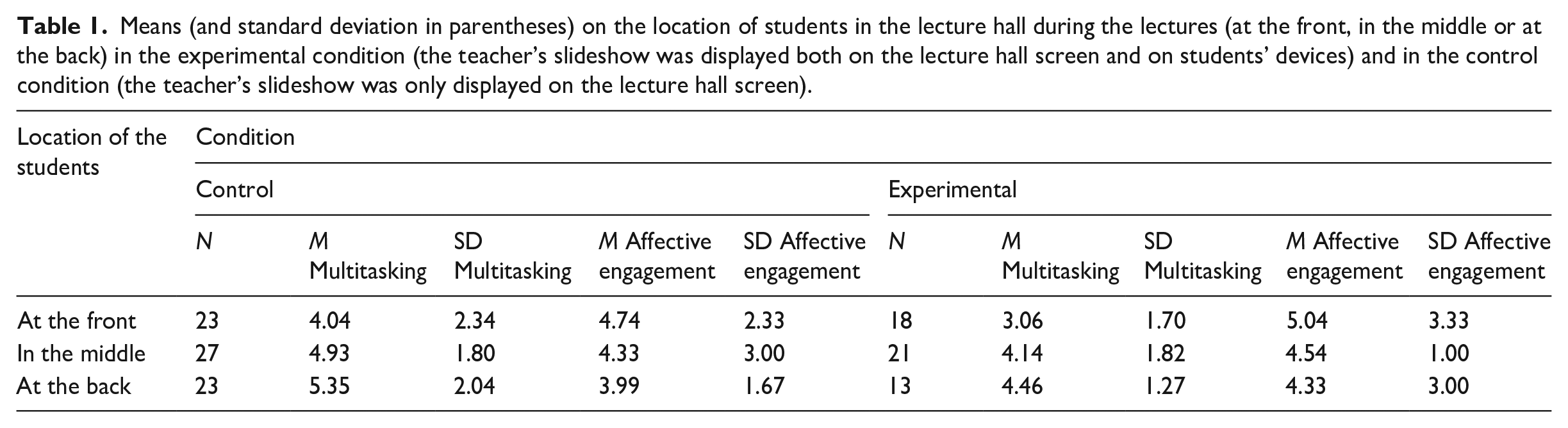
The location of students in the three areas of the lecture hall during the lectures was balanced, and no significant difference was observed in the location of students between the two conditions, χ2 (2, N = 125) = 0.627, p = 0.73. On examining the effects of the location on the main dependent variables using an ANOVA, a significant effect appeared for the location of students in the lecture hall both on the number of multitasking activities carried out, F (2, 119) = 5.17, p = 0.007, η2 = 0.07, and on students’ affective engagement in the lectures, F (2, 119) = 5.17, p = 0.007, η2 = 0.07. Specifically, students did more multitasking activities when they were seated at the back of the lecture hall than in the middle, t (119) = −2.42, p = 0.045, or at the front, t (119) = −3.04, p = 0.008. There was no difference between students seated in the middle and at the back, t (119) = −0.86, p = 0.67. On the other hand, students were more affectively engaged in the course when seated at the front than in the middle, t (119) = 2.19, p = 0.07, or at the back of the lecture hall, t (119) = 3.24, p = 0.004. There was no difference between students seated in the middle and at the back, t (119) = 1.27, p = 0.41 (see Table 1 and Figure 1). No significant effects were observed on the other two dimensions of engagement (cognitive and behavioral), and the interaction effects were not significant either on the number of multitasking activities or on affective engagement, Fs <1.0.
Means (and standard deviation in parentheses) on the location of students in the lecture hall during the lectures (at the front, in the middle or at the back) in the experimental condition (the teacher’s slideshow was displayed both on the lecture hall screen and on students’ devices) and in the control condition (the teacher’s slideshow was only displayed on the lecture hall screen).
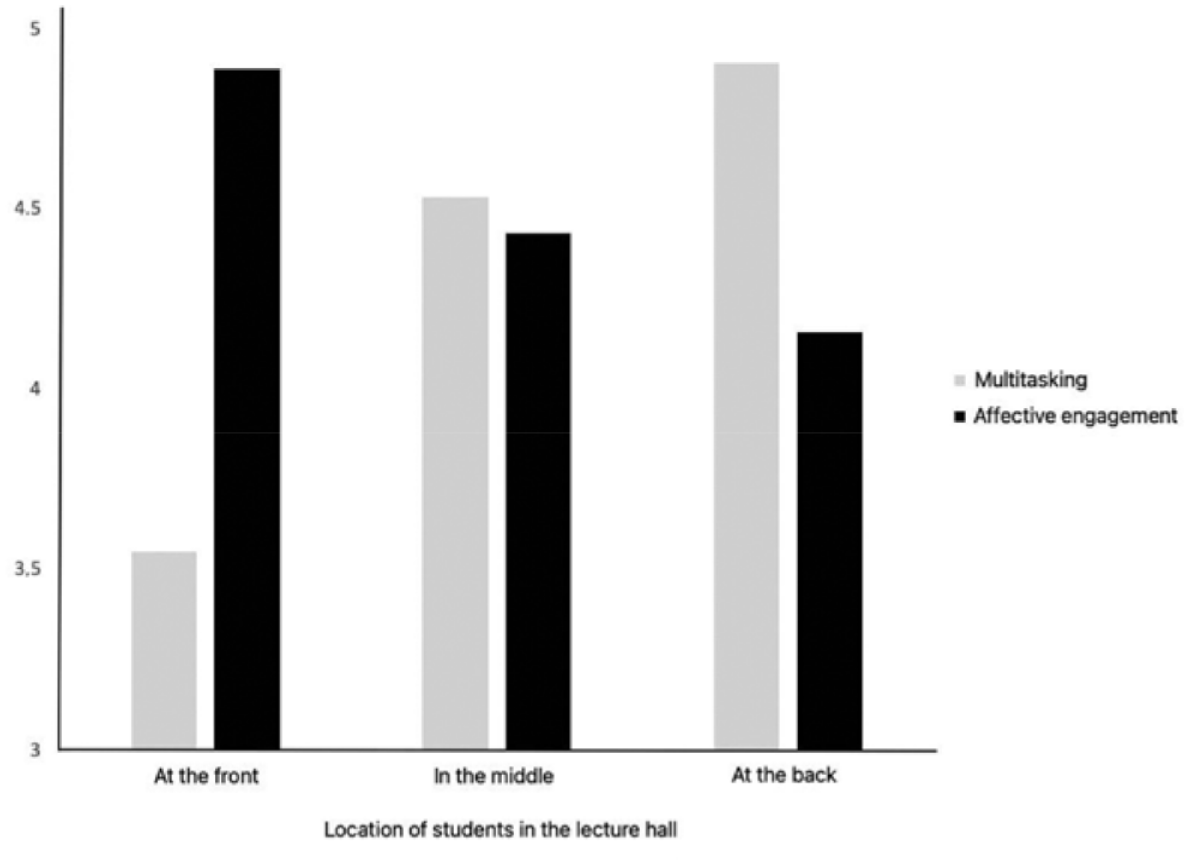
Mean number of multitasking activities and affective engagement of students according to their location in the lecture hall during the courses.
Effects on multitasking and engagement in learning
Multitasking activities
As predicted in Hypothesis 1, a Welch’s t-test (one-tailed) revealed that the number of multitasking activities students reported to have been used was lower in the experimental condition (M = 3.85, SD = 1.73) than in the control condition (M = 4.78, SD = 2.09; mean difference = 0.935, 95% confidence interval, or CI = [0.366, + ∞]), t (120) = 2.72, p < 0.004, Cohen’s d = 0.48). Students were less inclined to multitask when they could follow the teacher’s slideshow on their own device rather than only on the lecture hall screen.
Additional analyses were performed on each category of multitasking, and revealed that the difference between the two conditions was mainly due to social and multimedia activities during lectures. Indeed, students reported less chatting with neighbors or looking at what students were doing nearby in the experimental condition (M = 1.04, SD = 0.65) than in the control condition (M = 1.36, SD = 0.67; mean difference = 0.318, 95% confidence interval, or CI = [0.118, + ∞]), t (112) = 2.64, p < 0.005, Cohen’s d = 0.48). Similarly, students reported using less multimedia activities in the experimental condition (M = 0.29, SD = 0.57) than in the control condition (M = 0.48, SD = 0.60; mean difference = 0.191, 95% confidence interval, or CI = [0.015, + ∞]), t (113) = 1.80, p < 0.037, Cohen’s d = 0.32).
For a fine-grained description of the results, a series of chi-squared tests was performed on each multitasking activity separately (see Table 2). It appeared that only one significant difference was observed in which a lower proportion of students used instant messaging during the lectures in the experimental condition (59.6%) than in the control condition (76.7%), χ2(1, N = 125) = 4.20, p < 0.04. Three other behaviors were only marginally significant: Searching for information on the Internet not related to the course (p = 0.06), chatting with his or her neighbor (p = 0.06), and watching what other students were doing nearby (p = 0.08). Taken together, these results demonstrated that there was less multitasking when students could follow the teacher’s slideshow on the screen of their own device.
Number of students (and percent in parentheses) reported having performed each of the multitasking activities during the lectures in the experimental condition (the teacher’s slideshow was displayed both on the lecture hall screen and on students’ devices) and in the control condition (the teacher’s slideshow was only displayed on the lecture hall screen).

Engagement in learning
As predicted in Hypothesis 2, a Welch’s t-test (one-tailed) revealed a significant difference in affective engagement between the experimental condition (M = 4.66, SD = 1.03) and the control condition (M = 4.35, SD = 0.96; mean difference
Additional analyses
The goal of additional analyses was to verify whether students who followed the teacher’s slideshow on their own device were more engaged in the course because they were less inclined to do off-task activities during the lectures. To achieve this, a mediation analysis was performed using the teacher’s slideshow display as a predicting variable, multitasking as the mediating variable, and affective engagement as the outcome. Results revealed that the slideshow display had an indirect effect on affective engagement (Z = 2.12, p = 0.034), while the direct effect was not significant (Z = 0.95, p = 0.34). The indirect effect demonstrates that when the teacher’s slideshow was displayed in real time on the students’ device in addition to the screen of the lecture hall, it led to greater affective engagement because students were less likely to engage in multitasking (see Figure 2). In order to verify the direction of the relationship, a reverse mediation analysis was performed using the teacher’s slideshow display as a predicting variable, affective engagement as the mediating variable, and multitasking as the outcome. Only a direct effect of the slideshow display on multitasking activities was observed (Z = −2.22, p = 0.027), but it was not mediated by affective engagement (Z = −1.55, p = 0.12).
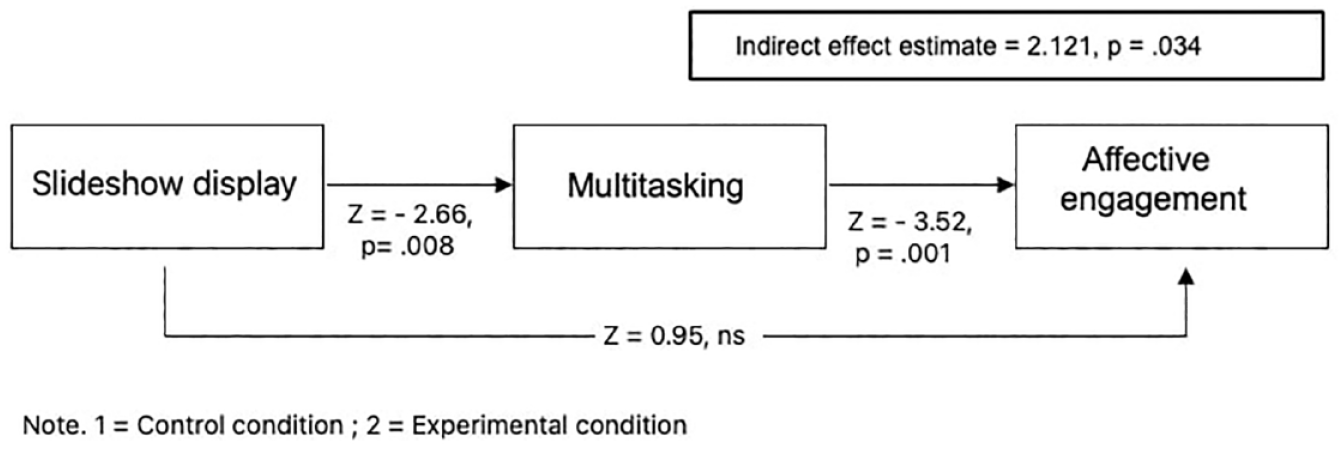
Mediating effect of multitasking activities in the relationship between slideshow display and affective engagement.
Discussion
A number of studies have demonstrated the prevalence of multitasking behaviors during lectures and their deleterious effects on learning outcomes (Bellur et al., 2015; Chen and Yan, 2016; Hembrooke and Gay, 2003; Jamet et al., 2020; May and Elder, 2018; Sana et al., 2013; Waite et al., 2018; Wood et al., 2012). To counter these behaviors, more or less effective strategies have been examined (Carrier et al., 2015; Guinness et al., 2018; Tassone et al., 2020), including one consisting in giving students the possibility to follow the teacher’s slideshow in real time on their own device during lectures to prevent them from doing other things than following the course (Hutain and Michinov, 2022). This latter study revealed that when the teacher’s slideshow was displayed on the students’ device, affective engagement in learning (i.e. attention directed at the course) increased between the beginning and the end of a series of lectures. To explain their findings, the authors speculated that a potential decrease in multitasking activities might have an effect on affective engagement without providing any empirical evidence. It was the goal of the present study to go further and examine whether displaying the teacher’s slideshow on students’ devices, in addition to the lecture hall screen via a video projector, might prevent students multitasking and improve engagement in learning. Such an intervention was compared to a control condition in which only the lecture hall screen was used.
The results of the present study revealed fewer multitasking activities when students had the possibility to follow the teacher’s slideshow on their own device than when they did not have this possibility. In examining in more detail the type of multitasking activities students reported to have carried out during the lectures, it appeared that the difference between the two conditions was mainly due to social activities. Indeed, students reported less chatting with neighbors and looking at what students nearby were doing when they had the possibility to follow the teacher’s slideshow on their own device than when they could not do this. The same difference was also observed on multimedia activities, mainly because students searched less on the Internet for information not related to the course. In examining the multitasking activities separately, results also revealed that a lower proportion of students used instant messaging during the lectures when they had the possibility to follow the teacher’s slideshow on their own device. These results may be explained by referring to additional analyses concerning the use of students’ devices to answer quizzes administered during the lectures. These analyses showed that when students could follow the course on their own device, in a large majority of cases they reported having used their laptop (and less often their smartphone) to answer the quizzes. When students used their laptop to follow the teacher’s slideshow on their own device, their smartphone remained available for multitasking activities. However, students did not seem to use the latter, notably to send messages by instant messaging and/or to search for information unrelated to the course. Thus, because students used their laptop to follow the teacher’s slideshow and answer quizzes, they did not perform multitasking activities using their device. It is reasonable to consider that their attention was absorbed by what was happening on the screen of their own laptop, preventing them from doing other things unrelated to the course, and reducing potential switching between their laptop and their smartphone to multitask during the lectures. By contrast, in the control condition, when students followed the teacher’s slideshow only on the lecture hall screen, they used laptop and smartphone equally, maybe to multitask with one of them. It seemed that when students looked at the slideshow only on the lecture hall screen, their device was only used to answer the quizzes and it remained available for other multitasking activities for a large part of the course.
In addition to the beneficial impact of the strategy of displaying the teacher’s slideshow on the students’ devices which reduced multitasking activities, a positive effect was also observed on affective engagement in learning. This effect revealed that affective engagement was higher for students who could follow the teacher’s slideshow on their own device. Moreover, a mediation analysis demonstrated an indirect effect on affective engagement in learning when following the teacher’s slideshow on their own device. It was because students reduced their multitasking activities that they were more engaged during the lectures, and not the reverse.
It is important to note that these results are observed independently of control variables such as the level of knowledge of students and their location in the lecture hall. While the first variable had no effect in itself on multitasking and engagement, the second variable had an impact on each of them, but independently of the educational intervention based on the means of displaying the teacher’s slideshow on the students’ devices. Indeed, it appeared that students multitasked more when they were seated at the back of the lecture hall than in the middle or at the front. On the other hand, they were more affectively engaged in the course when they were seated at the front than in other locations of the lecture hall. These additional findings extend those of a number of studies that have demonstrated that the location of students in a lecture hall has a powerful effect on various academic outcomes such as academic performance, participation, satisfaction and motivation (Benedict and Hoag, 2004; Levine et al., 1980; Millard and Stimpson, 1980; Parker et al., 2011; Shernoff et al., 2017). In the present study, the closer students were to the front of the lecture hall, the less they multitasked and the more they engaged, focusing their attention on the course, and this independently of the mode of display screen.
Taken together, the results of this study demonstrate the positive impact of an educational intervention consisting of displaying the teacher’s slideshow on the students’ devices to counter multitasking behaviors during lectures. These findings can be considered a priori as relatively paradoxical in relation to the potential distraction caused by the presence of two display screens to follow the teacher’s slideshow. Indeed, when students have to choose where to follow the teacher’s slideshow, their attention can switch between the lecture hall screen and the screen of their own device. However, as they answered the quizzes during the lectures using their laptop in the experimental condition more than in the control condition, they should also use their laptop to follow the teacher’s slideshow.
Limitations and perspectives
As for all research, the present study has a number of limitations. One is that multitasking activities were only self-reported, and not directly observed due to the difficulty in carrying out rigorous observation measures of students’ behaviors in a lecture hall. Similarly, we did not gather any data, whether self-report or other measures, verifying via which means students followed the slideshow during the lectures. Future research should be conducted to measure more accurately whether students follow the teacher’s slideshow on the lecture hall screen or their own device. In this perspective, using sophisticated measures of classroom attention based on analysis of student gaze direction from video recordings could provide a fruitful strategy to examine whether students look at their own device screen or the classroom screen (Raca, 2015; Raca and Dillenbourg, 2013). As such a measure is more difficult to collect in a lecture hall than in a classroom situation because of the greater number of students involved in the former, studies at a smaller scale should be conducted. Similarly, we ignore how many times the students switched between their laptop and smartphone during the lectures, and how such a behavior may have an impact on multitasking and engagement.
Another limitation of the present study is that we were not able to measure academic performance on the final examination because other teachers delivered their lectures on other social psychology topics during the semester without using a digital learning environment. Moreover, as the final examination concerned the course contents of all the teachers, it was not possible to determine the impact on grades of our educational intervention. Instead of measuring academic performance, it could be interesting to measure the quality of comprehension and retention of course contents after the lectures. Indeed, it has been shown that dividing attention between a device and a lecture reduced long-term retention (but not comprehension) and, consequently, impaired academic performance (Glass and Kang, 2019). These findings provide stimulating perspectives for future research in which a measure of comprehension and retention could be introduced after the lectures.
Conclusion
There is growing evidence of overuse of the Internet as a distraction during lectures with a detriment to student learning (O’Brien et al., 2022), but the results of the present study suggest that a beneficial solution based on the integration of a digital learning environment during lectures may prevent multitasking and promote student engagement during lectures. This solution is based on displaying the teacher’s slideshow in real time on the students’ devices, and not only on the lecture hall screen. Although the integration of students’ technological devices during lectures is debatable in higher education (Vahedi et al., 2019), notably because preponderant multitasking activities potentially have deleterious effects on academic outcomes, it has become important to think about ways of delivering lectures to prevent multitasking and promote engagement in learning. The present findings suggest that an educational intervention in which the teacher’s slideshow was displayed on the students’ devices may contribute to blocking multitasking and improving students’ affective engagement compared to a standard condition in which only the lecture hall screen was used during lectures. Using digital environments for answering quizzes and following the teacher’s slideshow directly on the students’ devices may help teachers in their educational mission, leading students to focus on their courses and preventing them from multitasking. Thus, this very simple solution could encourage teachers to consider technologies in class as “partners” to the learning process, and not “opponents.”
Footnotes
Acknowledgements
Special thanks to Estelle Michinov for her participation in the collect of data during her lectures.
Declaration of conflicting interests
The author(s) declared no potential conflicts of interest with respect to the research, authorship, and/or publication of this article.
Funding
The author(s) received no financial support for the research, authorship, and/or publication of this article.
