







Abstract
Research shows that active-learning methods (e.g. discussion) are often superior to passive methods (e.g. lecture) with respect to learning outcomes. However, students sometimes report preferring and learning more in lecture-style classes compared to those in which they play an active role. These and related findings suggest students may lack awareness about the relative effectiveness of passive versus active teaching methods on their own learning. Here, we used a mixed methods approach to assess college students’ beliefs, attitudes, and feelings about lecture-style courses (n = 246). One primary goal was to assess if, and to what extent, students would express an unprompted desire for interaction in lecture-style classes when reflecting, in an open-ended format, upon their real-world educational experiences. Respondents reported that the majority of their classes were lecture style, in accordance with previous research, and noted that they view lecture as a mostly effective form of pedagogy. While respondents described high-level knowledge and compelling delivery of the subject matter, effective class design and use of technology, and good stagecraft on behalf of the instructor as important aspects of effective lecture-style teaching, a substantial proportion of students mentioned interaction as the most important component of an effective lecture style class, suggesting that student preferences for passive classrooms is far from universal. Implications of these findings are discussed.
Introduction
The traditional college lecture has a long history, dating back to the fifth century BC (Brockliss, 1996). With mass production of printed material still centuries away, instructors would read from a piece of text or book and students would transcribe their own copies by hand. Thus, didactic forms of instruction were born as a solution to a problem that would later be solved by the printing press. Contemporary instructors in some European countries are still referred to as “readers” in deference to this tradition. And although technology has enabled ubiquitous, cheap distribution of written material, lecturing remains a popular teaching method. However, substantial evidence shows student-centered methods, such as discussion, debate, and group work, lead to better learning outcomes (Crouch & Mazur, 2001; Deslauriers & Wieman, 2011; Fraser et al., 2014; Freeman et al., 2014; Hake, 1998; Omelicheva & Avdeyeva, 2008; Stainset al., 2018), more positive attitudes (Brewe et al., 2009), and higher student retention (Watkins & Mazur, 2013). Nonetheless, the prevalence of the traditional lecture-style class remains high among college faculty, with one recent study (the largest observational study ever of undergraduate STEM education) showing that 55% of STEM classes used traditional lecturing as the primary mode of instruction (Stains et al., 2018).
One reason why lecturing persists in colleges and universities is faculty resistance to alternatives. This is likely based on a number of factors including large class size (Dancy & Henderson, 2007; Macdonald et al., 2005; Prosser & Trigwell, 1999; Walczyk & Ramsey, 2003), concerns that active methods lead to insufficient content coverage (Dancy & Henderson, 2007; Felder & Brent, 1996), insufficient time or knowledge about how to prepare new learning activities and assessments (Fagen et al., 2002; Silverthorn et al., 2006), and lack of departmental support (Silverthorn et al., 2006). Another factor is student resistance (Fagen et al., 2002). Many students have spent a majority of their academic lives taking notes during lectures and are comfortable with this method of instruction (Felder & Brent, 1996). Active methods shift some of the responsibility for learning from the instructor to the student, and some students perceive active teaching methods to be too much work or ineffective (Deslauriers et al., 2019). So, both instructors and students might derive a level of comfort from didactic teaching methods that make them resistant to move from the “sage-on-the-stage” approach to student-centered classrooms.
Another reason that lecturing persists is that instructors are incentivized to care about students’ beliefs and opinions about the kind of instruction they receive. Simply put, students, on average, seem to like the lecture format (Deslauriers et al., 2019). Continued employment for untenured and contract faculty and promotion and special recognition for tenured faculty at most academic institutions is based, in part, on student evaluations of their teaching. If students prefer passive to active classrooms, then active teaching practices could result in negative evaluations. For example, Silverthorn et al. (2006) provided modules and assessments to volunteer instructors who expressed a strong interest in implementing active learning. Of the 36 instructors recruited for the project, almost half ended up withdrawing from participation (for a variety of reasons, including student resistance). One instructor described how merely announcing he would use active learning in his class led half of his students to drop the class in favor of a section taught by an instructor using a more traditional, lecture-based approach. He reported, “I was called before my Division Chair and the Academic Vice President who perceived that there must be something wrong with my teaching if so many of my students were fleeing. Interestingly, I had thought that the current administration had prioritized student learning . . . but it turns out that their primary interest is in keeping students contented . . . ‘student satisfaction’ they called it.” This anecdotal report is a single, extreme example, and is not meant to suggest that instructors commonly cause student revolt through the implementation of active teaching practices. However, while many academics might bristle at the thought of prioritizing their students’ feelings over their actual learning, contemporary incentive structures often favor the former over the latter.
Results from the aforementioned study by Deslauriers et al. (2019) suggest students struggle to accurately assess their own learning. In this study, students were randomly assigned to strong versions of either a passive or active learning class. Results showed students preferring the passive, lecture-style class and feeling like they learned more from it, while actually learning more from the active-learning class even though they perceived it as less effective. The research team also conducted structured interviews and showed students reporting that active instruction was more “disjointed” and “lacking in flow” compared to lecture. While this data shows students not only preferring passive to active classrooms, it also suggests the possibility that given a choice, students might prefer lecture to constitute the majority of classroom time, assuming a competent, personable, and fluent lecturer. While this interpretation imposes a false binary framework on student attitudes (an absolute preference for active or passive teaching), it is to some extent a product of the experimental approach taken in Deslauriers et al. (2019) study, which used random assignment to extreme versions of the active versus passive classroom to test the a priori hypothesis that beliefs about learning and actual learning in active vs passive classrooms are anti-correlated. This approach would be not be optimal, however, if the goal was to capture a more holistic and unconstrained view of students’ pedagogical preferences based on their in vivo classroom experiences. We posited that unguided, open-ended queries might provide a more nuanced view of students’ beliefs, attitudes, and feelings about active versus passive teaching methods. What proportion of students would describe an unprompted preference for at least some active methods? And what types of active teaching methods, if any, would they call for?
Another issue relevant to research on students’ pedagogical preferences and their beliefs and attitudes about learning is a relative lack of population diversity. Much of the research on active learning has been done at selective, research-intensive universities, with less research coming from less selective, non-R1 institutions (e.g. smaller public, regional and private colleges, and community colleges; Downing et al., 2020). The non-R1 student population is likely to be distinct in several ways. For one, these students are more likely to be of lower socioeconomic status, have work responsibilities outside of class, commute to school, and be first-generation students. Non-R1 schools are also likely to have a higher proportion of nontraditional students and students of color, and their students experience more mental health issues (Trenz et al., 2015). Beliefs, attitudes, and opinions about what constitutes effective teaching could be distinct for this population, who make up a large percentage of US college students but whose voices are relatively underrepresented in studies of teaching and learning practices in higher education.
Here, we used a mixed-methods approach to solicit opinions about lecture-style classes from students at a medium-sized, urban, public college. Distinct from Deslauriers et al. (2019) our main objective was not to test an explicitly defined a priori hypotheses, obtain any measure of actual learning or test the relationship between feeling of learning and actual learning. We used both closed- and open-ended questions that asked students to reflect upon their experiences in lecture-style classes across their entire college careers. Open-ended questions with no explicit language about active learning were used to minimize the potential influence of question wording on responses. Rather, we hoped the open-ended questions would facilitate authentic, experience-driven responses from respondents. The primary aims of this project were to assess (1) the proportion of lecture style classes students report having taken across their college careers, (2) students’ perception of the effectiveness of lecture-style courses, (3) reasons why students attend (or don’t attend) lecture-style courses, and (4) student’s attitudes, beliefs, and feelings about what constitutes effective and non-effective lecture-style teaching. For aims one, two and three, we used a quantitative approach (e.g. close-ended questions). For aim four, we used a qualitative approach, applying an inductive analytic method described by Gioia et al. (2013) to identify emergent themes. Relevant to aim four, we wanted to know if students would express an unprompted desire or preference for some active teaching methods when considering what constitutes effective lecture-style teaching.
Method
Participants
Participants in this study were undergraduate students at a medium-sized, urban, public university (n = 246). Potential participants read that they would “answer a series of questions regarding their attitudes and feelings about lecture-style courses.” The study was conducted during the spring and fall of 2019. Only students who were currently taking a class in which there was a research participation requirement took part in the study. For this reason, the sample was heavily skewed toward first-year students, with decreasing number of students across the second, third, and fourth years. By year of school, the sample consisted of 45.1% first years, 18.7% sophomores, 25.2% juniors, and 11.1% seniors. Students were from a wide variety of majors: social work (21.2%), psychology (11.8%), undeclared (11.8%), biology (8.9%), nursing (8.5%), sociology (6.1%), business (5.3%), and other majors (26.4%). Distribution of the sample by self-reported overall GPA, with possible GPA scores ranging from 0 to 4.0, was less than 1.5 (6.9%), 1.51 to 1.8 (3.7%), 1.81 to 2.1 (4.1%), 2.11 to 2.4 (11.4%), 2.41 to 2.7 (13%), 2.71 to 3.0 (17.5%), 3.01 to 3.3 (18.3%), 3.31 to 3.6 (10.6%), and 3.6 or greater (14.6%). All methods were approved by the institutional review board of York College, City University of New York.
Electronic Survey
The survey was conducted online and all students participated for class credit. The survey began by asking respondents to report their year in school, major, and GPA. Then, respondents were asked to report the % of classes they’d taken in their college careers that were “lecture-style” (defined as classes in which the majority of the time is spent listening to the instructor), “hybrid” (those in which class time was split between lecture-style and non-lecture-style activities), and “non-lecture-style” (those in which the majority of the time is spent on non-lecture-style activities). The closed-ended questions came next. First, respondents were presented with a set (five) of Likert-style questions asking the extent to which they agreed/disagreed with statements about lecture-style classes (e.g. “I think lectures are as beneficial to my learning as other styles”). Respondents were then prompted to select all the responses that applied to two statements. The first statement prompted respondents to select all of the reasons why they would regularly skip lecture-style classes (if they ever did regularly skip); the second prompted respondents to select reasons why they would regularly attend such classes (if they did attend regularly). The last part of the survey contained the open-ended questions, of which there were three: 1. “In your opinion, what does a really good lecture consist of (e.g. format, delivery or style”)? 2. “In your opinion, what does a poor lecture consist of?” and 3. “In your opinion, how can lectures be made more worthwhile to attend?” A substantial proportion of the survey was adopted from Fitzpatrick et al. (2011). We used many of the same items in Fitzpatrick et al. (2011) because they were deemed appropriate for the goals of the present study. Furthermore, using many of the same items would facilitate comparative analysis, although we do not perform or report such analysis here.
Qualitative data analysis
Initial coding of the qualitative data was carried out independently by the two authors of this manuscript. Based on Gioia et al. (2013), each coder used a two-stage inductive approach. First, initial codes were generated by systematically identifying and labeling meaningful text from the responses. The process involved highlighting words, phrases, or sentences that captured key ideas, concepts or themes. In this stage 1 analysis, the coders did not yet attempt to distill categories into higher level concepts. In the stage 2 analysis, each coder examined the words, phrases, or sentences they’d identified in stage 1, seeking similarities and differences among the coded segments and grouping similar segments together. Themes began to emerge through this process, representing recurring ideas or concepts. At this point, a discussion was had between the two coders to review and refine the themes. The coders looked for common themes as well as differences. When variations were found in the themes, the coders went back to the original data and reexamined the areas of disagreement. They continued this process of revising themes and looking for areas of disagreement until they reached an acceptable level of convergence. The final step involved organizing the data according to the identified themes and computing the proportion of the sample that mentioned each theme.
The survey we administered had three qualitative questions: (1) “In your opinion, what does a really good lecture consist of?”, (2) “In your opinion, what does a poor lecture consist of?” and (3) “In your opinion, how can lectures be made more worthwhile to attend?” During the discussion between the two authors, it was observed that the results for questions 1 and 3 were very similar, with the same emergent themes, similar prevalence of these themes in the sample and, in many cases, similar responses within participants. The responses suggested that respondents were treating these two questions as very similar, if not identical. Thus, as the results for these two questions were redundant, we only present data from questions 1 and 2 here.
Results
The results section is divided into four sub-sections: First, we report students’ estimates of the proportion of lecture-style classes they experienced during their college careers. We instructed participants to define a lecture-style course as one in which “the instructor spends the majority of the time speaking.” Second, we report students’ responses to some general questions about the effectiveness of lecture-style courses. Third, we report students’ responses about why they might or might not attend a lecture-style course. And finally, we report students’ responses to two open-ended questions about what constitutes a “good” and “bad” lecture-style class. For the quantitative data, we explored main findings across the entire sample, as well as conducting some additional subgroup analyses by major, year in school, number of classes taken, reported major GPA, and reported overall GPA.
Proportion of all classes taken that were lecture-style
Survey participants (n = 235; 11 participants did not provide a response to this item) reported that almost three out of four of their classes could be characterized as lecture-style (mean = 73%; boot strapped 95% CI [69.2%, 76.1%]). These results are consistent with a recent large-scale, nationwide study showing the most common instructor behavior is lecture (Stains et al., 2018). Stains et al (2018) used the COPUS protocol (Hora et al., 2013), in which instructors’ and students’ behavior in the classroom is categorized by trained observers. This study showed instructors lecture for approximately 75% of class time, on average. While this metric (proportion of time spent lecturing) is distinct from what was measured in the present study (proportion of classes that are lecture style), the values are close to equivalent and the findings in the present study are consistent with the notion that lecture-style teaching continues to be the dominant pedagogical approach in contemporary college classrooms.
For the subgroup exploratory analyses, proportion of lecture-style classes taken did not vary statistically by major, major GPA, or overall GPA. We did test a directionally specific, a priori hypothesis that the proportion of lecture-style classes would decrease with increasing years in school. This was based on the observation that lower-level courses are more likely to be large, survey-style courses where active learning exercises are difficult to implement, whereas higher level courses (e.g. seminars and special topic classes) would tend to be smaller in size and presumably more likely to involve less lecturing and more student-centered activity (e.g. discussion). Because lower-level courses are generally taken earlier, and higher-level courses later in students’ academic careers, we could indirectly test for a relationship between course level and mode of instruction by examining the relationship between year in school and teaching mode. However, a one-way ANOVA with a between-subjects factor of year in school (first, second, third, and fourth year) and a DV of “proportion of classes that have been lecture style” showed no statistically significant relationship (F (3, 231) = 1.07, p = .36), consistent with Stains et al. (2018). We conducted a similar analysis using a between-subject factor of “number of classes taken in college career,” also showing no statistically significant relationship (F (6, 228) = 1.42, p = .21). Thus, the evidence does not support the hypothesis that students experience a decrease in exposure to didactic teaching methods as they move to more advanced levels of their college education.
Self-reported effectiveness of lecture-style methods of teaching
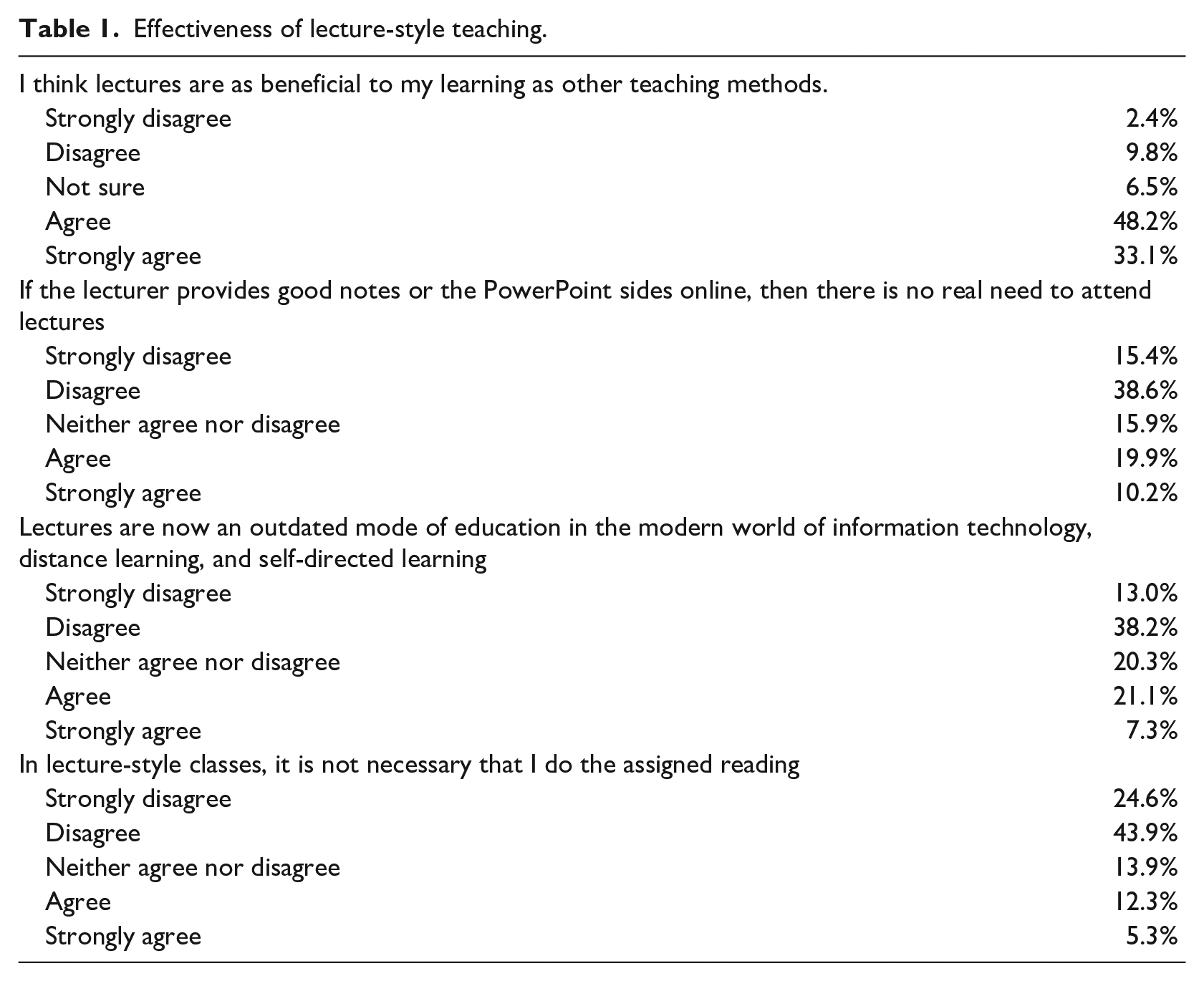
Participants reported generally positive attitudes about lecture-style classes (Table 1), in accordance with Deslauriers et al. (2019). About 81% said lectures are just as beneficial as other methods. About 53% said that even with good notes provided by the instructor or access to power point slides, it’s still worth attending lecture-style courses. Only 28% said that lectures are outdated and just 18% reported that going to class means it’s OK to skip the assigned reading. The data suggest that a majority of students hold positive attitudes about the lecture format. This pattern of results was consistent across year in school, GPA, and major.
Effectiveness of lecture-style teaching.
Factors associated with students deciding not to attend a specific lecture-style class
Participants were asked to select reasons from a pre-determined list in response to the question, “When you don’t regularly attend a lecture-style course, why don’t you attend?” (Figure 1). One-third of respondents did not select any reasons, suggesting they either always attend or there was another reason or reasons for their non-attendance.
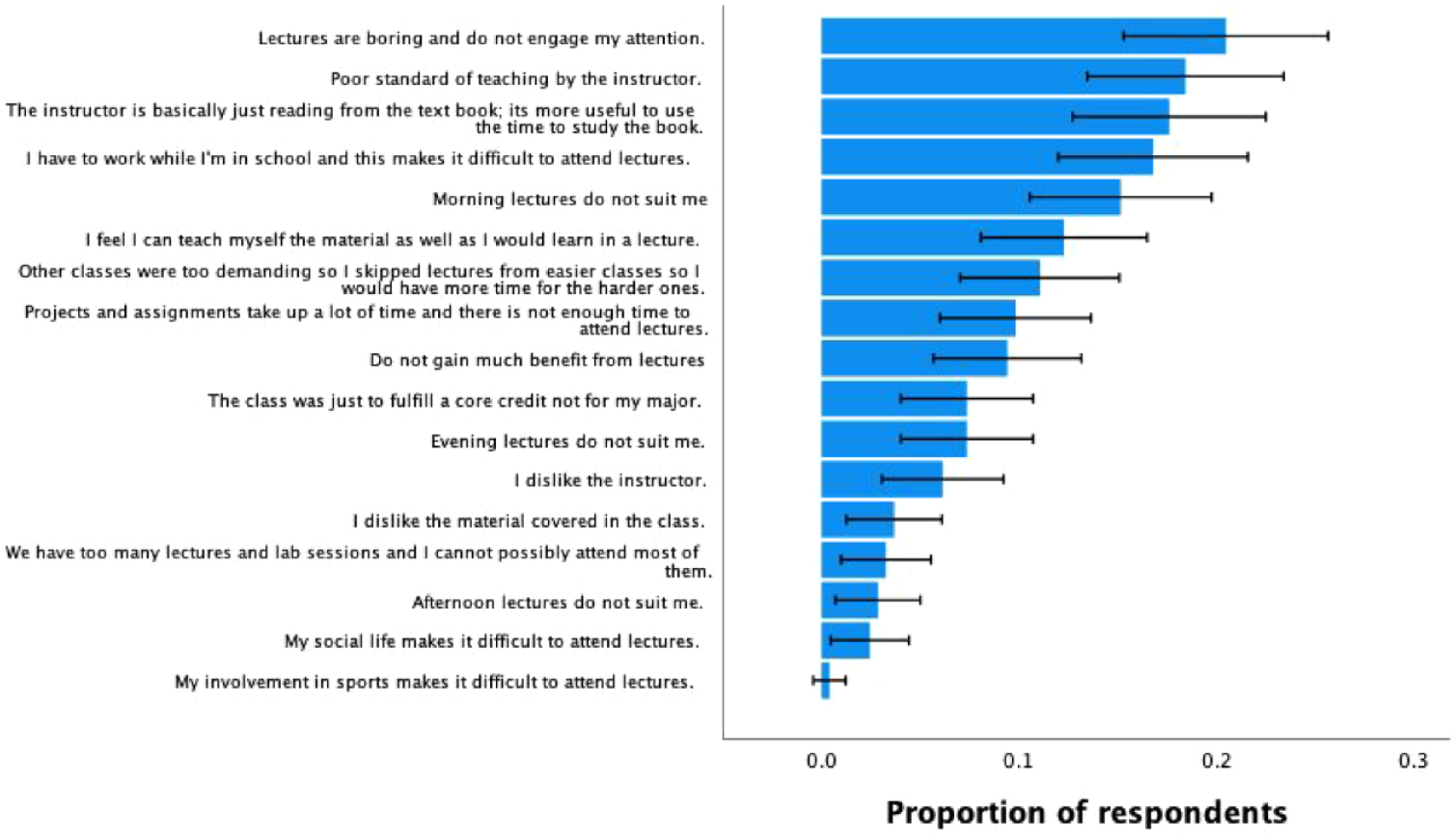
Factors associated with not attending a lecture-style class. Participants were instructed to pick as many reasons as were relevant for missing a lecture-style class (if they ever missed such classes).
When students didn’t attend a lecture class regularly, the top five reasons they indicated for their absence were*:
“Lectures are boring and do not engage my attention.” (20% ± 5%)
“Poor standard of teaching by the instructor.” (18 ± 4%)
“The instructor is just reading from the text book; it’s more useful to use the time to study the book.” (18 ± 5%)
“I have to work while in school and this makes it difficult to attend lectures.” (17 ± 4%)
“Morning lectures do not suit me.” (15% ± 5%)
*Intervals are bootstrapped 95% CIs.
Although the top three reasons for choosing not to attend class were related to the perceived quality of the lecture (“lectures are boring. . ., “poor standard of teaching by the instructor,” and “the instructor is basically reading from the textbook”), the proportion of respondents reporting these reasons for non-attendance were relatively low (all equal to or <20%). About 17% of respondents cited conflicts with work as a reason they might miss class. About 15% of respondents indicated a morning schedule as a possible reason for skipping class, while fewer indicated afternoon (3%) or evening (7%) schedules as reasons not to attend. Other reasons for skipping class included: to dedicate time to more challenging classes (11%), projects and assignments taking up too much time (10%), a class not being part of the student’s major (7%), disliking the instructor (6%), disliking the material (4%), too many classes to attend (3%), and conflicts with social life (2%).
Reasons to attend lecture-style courses
Participants were asked, “for lecture-style classes that you attend regularly, select all of the reasons why you would attend.” 97.2% of respondents selected at least one reason (Figure 2).
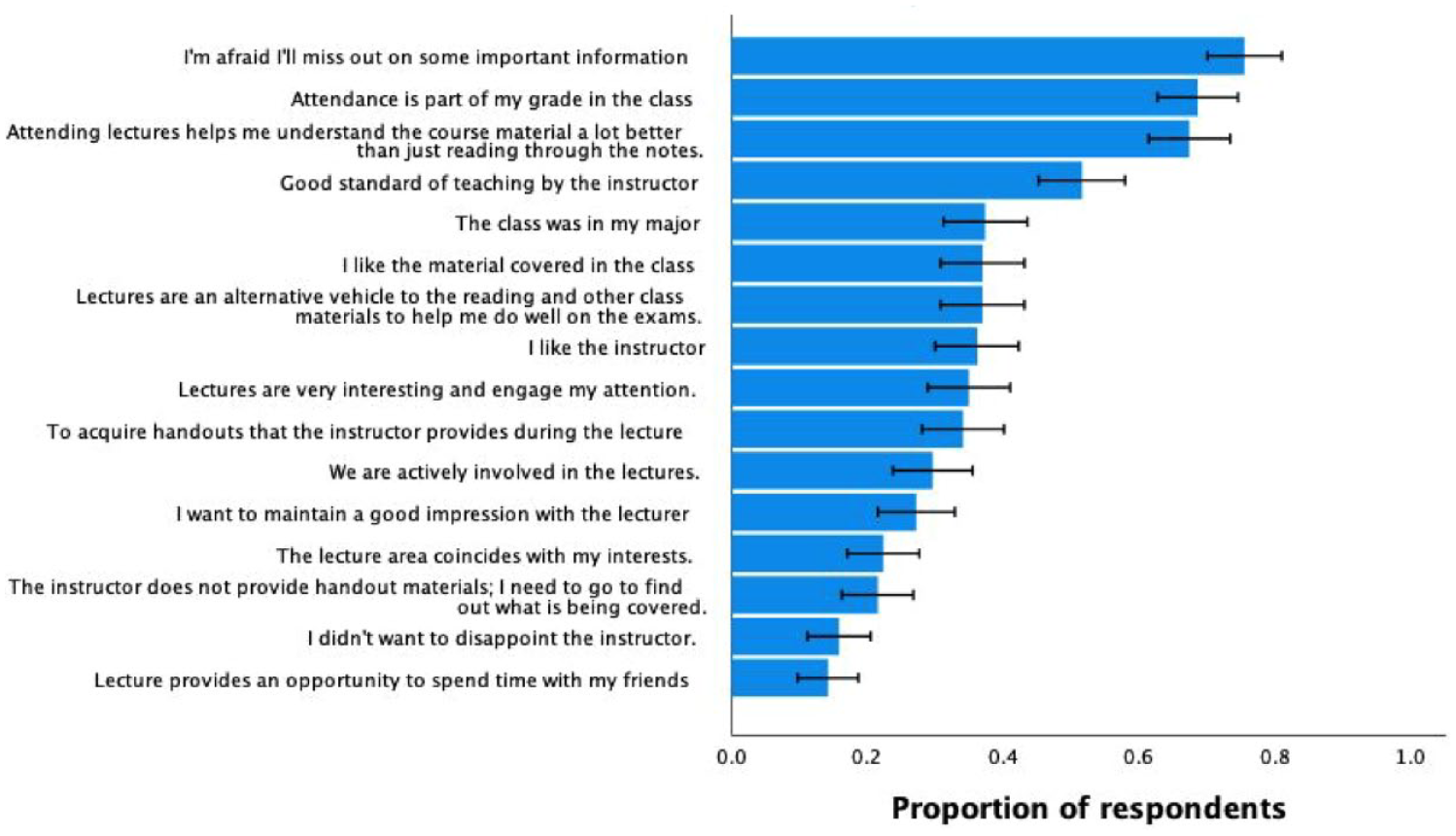
Factors associated with attending a lecture-style class. Participants were instructed to pick as many reasons as were relevant for attending a lecture-style class (when they attend regularly).
Of the reasons students selected for regularly attending lecture-style classes, four were chosen by more than half the sample:
“I’m afraid I’ll miss out on some important information.”(76%)
While this could refer to missing out on the opportunity to ask questions and get clarification on content, it could also be that students feel their presence in class is important not just for asking questions, but for having access to information. Some students might view information communicated during lectures as a scarce commodity, which can only be obtained in person by showing up and recording the things the instructor says, harkening back to what Ancient Greek students might have experienced (fear of missing out on obtaining a personal copy of class readings).
“Attendance is part of my grade in the class.” (69%)
It should be noted that the school at which the present survey was conducted is officially designated a “non-attendance taking” institution. However, this could be related to “participation” grades, where attendance is not graded, but class participation is, which is dependent upon attendance.
“Attending lecture helps me understand the material a lot better than reading through the notes.” (67%)
The high proportion of students selecting this item support the notion that students perceive lectures as providing educational value beyond what might be obtained on their own through reading. While it’s also possible that some of the educational benefits of attending lectures vs reading can be attributed to opportunities for interaction, such as asking questions of the instructor or engaging in discussion of the content, this is a speculative claim that goes beyond the data collected here.
“Good standard of teaching by the instructor.” (52%)
Notably, of the 52% of students who selected “good standard of teaching by the instructor,” 43% also selected “the instructor gets the students to do things during the lectures, and “we are actively involved during the lecture” as a reason to attend class, providing indirect evidence that a proportion of respondents (albeit a minority) desire interaction during lecture classes and consider them to be a part of an effective teaching approach.
Qualitative Data: Analysis
For the open-ended/qualitative portion of the survey, we present results from the following two open-ended questions (1) “In your opinion, what does a poor lecture-style class consist of?” (2) “In your opinion, what does a really good lecture-style class consist of?”
What does a poor lecture-style class consist of?
In response to this question, five themes emerged from the qualitative data. The emerging themes, sub-themes, and some examples are presented below.
No/low interaction between instructor and student (33.8%)
While this was the most common emergent theme, only around one-third of respondents mentioned lack of interaction between instructor and students as a hallmark of a bad lecture-style class. Thus, the data suggests the majority of respondents might not mind a class in which they are mostly passive, and there is not substantial interaction with the instructor, discussion, debate, etc. This could explain in part why the didactic style remains popular. Nonetheless, insufficient student-instructor interaction did emerge as the most common response to this prompt, highlighting that a moderate proportion of the sample reported a desire for an active role in the classroom.
Of those respondents who indicated no/low interaction as a hallmark of a bad lecture class, the following specific sub-themes emerged (percentages indicated here are the proportion of respondents who mentioned no/low interaction and the specific sub-theme): Lack of class discussion (16.8%), no or minimal understanding checks, such as quizzes (6.7%), no student participation in class (4.2%), no activities (4.2%), no time for questions (2.5%), and no group work (1%). For example: “It’s really important for professors to engage students and have two-way communication,” “[A poor lecture is one in which] an instructor refuses engaging activities such as questioning to allow for clarification that the students understand the material” and “[A poor lecture consists of] zero class discussions.”
Instructor is reading notes and slides too much (32.3%)
Most responses comprising this theme involved descriptions of instructors reading their lectures verbatim from some source material. Of those who mentioned this topic, 45% referred specifically to instructors reading directly from PowerPoint slides and 29% mentioned reading directly from books. For example: “Just reading from the textbook is very boring,” “A poor lecture is where all you do is look at slides,” and “For me it is mostly if the professor reads straight from the PowerPoint because that just makes it boring.”
Instructor is deficient in mastery or presentation of content/information (24.7%)
Just under 25% of students described the instructor’s deficient mastery or presentation of content and/or information as a feature of a poor lecture-style class. The following sub-themes/keywords emerged: Not enough examples, real-life applications or anecdotes (24.5%), information not explained clearly (22.6%), information is not compelling or interesting (21.7%), information is inaccurate, low quality, and/or biased (14.1%), information is not presented concisely (5.6%), information is too complex and not simple enough (4.7%), information is not thorough (4.7%), information is irrelevant (4.7%); information is not on exam (4.7%); and information is not meaningful (1.8%). For example: “The instructor is confused about the topic,” “The instructor is not able to explain things properly,” and “The examples are not vivid; just dull and stale.”
Weak stagecraft/personality (19.4%)
We use the term “stagecraft” to refer to skills related to the instructor’s performance in the classroom. The following subthemes emerged from this category: Delivery is not compelling/interesting (56%), poor quality of voice (14%), lack of enthusiasm/excitement (12%), low entertainment value (8%), no energy (6%), no sense of humor (6%), being disrespectful (2%), no confidence (2%), no charisma (2%), and being overly negative (2%). For example: “Not having any emotion,” “Going too fast,” “Monotone voice,” “Negative attitude,” and “Bland.”
Ineffective class design/bad use of technology (18.2%)
Subthemes that emerged were: too much reliance upon PowerPoint (36%), lack of organization (28%), no compelling visuals or videos (13%), not staying on topic (4%), not scheduling breaks during class (4%), and lecture segments being too long (2%).
What does a good lecture-style class consist of?
Four themes emerged in response to this query:
Students play an active role in classroom (52%)
This was the most common emergent theme for this question, with over half of the sample replying that a good lecture-style class is one in which students are actively involved. This result is in accordance with the top (most common) emergent theme for “What does a bad lecture-style class consist of?”
Of the 52%, 55% mentioned the term “engagement” as crucial to a good lecture style class, 31% referred directly to student participation in class or interaction between instructor and student. Other subthemes that emerged were: class or group discussion (18%), instructor asking questions of class (8%), structured learning activities (5%), in-class assessments/quizzes to assess learning in real time (5%), and group work (1%). For example: “[a good class involves] having students participate,” “A good lecture consists of communication between instructor and students,” “A really good lecture consists of . . . participation” and “[a good class] has everyone speak their mind rather than just sitting and listening to the professor.”
Information/content is high quality and appropriately delivered (46%)
Almost half of the students referred to the instructor’s mastery and delivery of the content as being an important aspect of a good lecture-style class. Subthemes that emerged: Information is clearly expressed/concise (31%), examples and analogies are used (27%), information is interesting/compelling (20%), high level of knowledge mastery by instructor (14%), info is exam relevant (7%), info presented in class goes beyond what’s in the textbook (5%), and info is presented at appropriate level of difficulty (4%). For example: “Makes the material accessible and meaningful,” “understandable explanations,” and “a good lecture consists of quality information.”
Effective class design and use of technology (33.6%)
About a third of the respondents mentioned an effective class design and skillful use of technology as important to a good lecture-style class. Subthemes that emerged were: uses PowerPoint well/nice slides (50%), uses videos/visual aids (17%), and provides handouts, notes, and slides (8%). For example: “A great power point that can explain certain things,” “Videos and computer lab,” and “A good lecture should have a type of visual content for the student. Simple face to face lectures can lead to a student losing interest.”
Good stagecraft/personality (23.9%)
Just under a quarter of respondents referred to aspects of the instructor’s personality and their performance as important to a good lecture-style class. As per section 3.4.1, we use the term “stagecraft” to refer to performative aspects of teaching. Subthemes that emerged were: compelling delivery (43%), good style (28%), tone/volume/sound of instructor’s voice (15%), being fun/entertaining (15%), showing positive energy/emotion/passion (13%), having a sense of humor (8%), demonstrating love for topic (6%), and not creating stress/anxiety (2%). For example: “Presenter should be charismatic,” “Strong voice,” “Entertaining,” “If the professor is speaking in a monotone voice then the students will tend to lose interest within minutes,” and “Mostly delivery and style.”
Discussion
In this study, we assessed (1) the proportion of classes college students took in which lecture was the dominant mode of teaching, (2) the extent to which students view this form of teaching as effective, (3) why or why not students attend lecture-style classes when they do or do not attend, and (4) students’ attitudes, beliefs, and feelings about what constitutes non-effective and effective lecture-style teaching. Our primary objective in this study was to test whether, and to what extent, students would describe active teaching methods as important components of effective lecture-style instruction, despite not being explicitly asked about active teaching.
Respondents characterized three out of four of classes they had taken in their college careers as “lecture-style” courses, with this value remaining constant regardless of year in school. This is concordant with previous research showing lecture is the dominant mode of college instruction. Around two-thirds of students reported sometimes skipping lecture-style courses, with the most common reasons being poor teaching on behalf of the instructor, while just over half of students report that they attend lecture-style courses because it helps them understand the material better. These data suggest that students, in general, perceive lecture as an effective teaching method. However, learning was not the most common reason why respondents reported attending lecture when they do; an even larger majority reported they attend because they fear missing out on important information and/or their grade is dependent upon attendance. Finally, students were asked, in open-ended fashion, to describe what effective lecture-style teaching consists of. While they pointed to mastery and appropriate delivery of the course material, well-organized classes, use of technology, going beyond just reading from slides or textbooks and good stagecraft and personality as important, the most commonly mentioned aspect of effective lecture-style teaching was interaction. These findings are counter to the notion that students prefer to play largely passive roles in the classroom. Approximately one-quarter of the students in the sample said they wanted to be “engaged” by their instructor, which included instructor-student interaction, class or group discussions, in-class quizzes, and questions from the instructor to gauge student understanding, structured group activities, and other group work. The relatively small proportion of students that indicated a desire for these activities, however, perhaps justifies concerns of instructors who avoid such activities for fear of “losing the classroom” or receiving negative evaluations.
One possible explanation for the small proportion of students who desire interaction and activity in the classroom is simply that many students lack experience in and may be unfamiliar with active learning methods. In the present study, we did not collect data sufficient to test this possibility, but previous research provides some indirect support for this notion. If a learning activity is unfamiliar, this can create the false impression that it’s not working (Hattie, 2013). These false beliefs about low efficacy can hurt motivation (Chang & Brickman, 2018) and cause students not to put in the effort required to benefit from them (Joo et al., 2013; Wigfield & Eccles, 2000). Deslauriers et al. (2019) proposed that the increased cognitive struggle often associated with active learning is misread by students as a sign of ineffective learning when in fact it signals the opposite (i.e., effective learning is occurring). Active teaching methods can also lead to increased student anxiety (Downing et al., 2020), especially when students feel they do not have a lot of control over their performance in the classroom or feel uncertain about their interactions with fellow classmates or their instructor. Downing et al. (2020) identified fear of negative evaluations by others (fellow students and/or the instructor) as a primary factory driving anxiety related to active teaching methods.
All of this suggests instructors may need to implement deliberate strategies to mitigate student resistance to active teaching (DeMonbrun et al., 2017; Nguyen et al., 2021; Tharayil et al., 2018). One conceptual framework separates mitigation strategies into two categories: explanation and facilitation (Tharayil et al., 2018). Explanation involves instructors providing reasons and setting expectations for the learning activities, typically occurring before class has begun. Facilitation involves using specific techniques to keep the activity moving once it is underway and includes approaching non-participants, having an encouraging attitude, creating a supportive classroom environment, walking around the room, inviting questions, and providing opportunities for student feedback (DeMonbrun et al., 2017; Nguyen et al., 2021; Tharayil et al., 2018). While a minority of students in the present study expressed unsolicited preferences for interaction in the classroom, the majority did not. However, it may be the case that these students have simply not been exposed to much of this kind of teaching or had the educational benefits explained to them. Utilizing empirically-grounded techniques to increase student awareness of the learning benefits associated with active, student-centered teaching methods may increase students’ interest in embracing a more active role in the classroom.
Limitations
There are some limitations to this research. First, the data was collected between September 2018 and May 2019, prior to the COVID pandemic. Due to an almost universal shift in modality from in-person to online teaching starting in March 2020, some proportion of the educational experience for recent cohorts of college students has been online. It is not clear what effect this might have had on attitudes and beliefs about active versus passive learning or on students’ desire for interactive classrooms. Research shows students reporting decreased engagement during online lectures (Hollister et al., 2022). Awareness of the benefits of or desire for engagement and interaction may have changed. However, some students also reported feeling more comfortable interacting with their instructors and peers in online classes (Hollister et al., 2022). Thus, there may be ways in which engagement can be enhanced in the online modality and/or methods that are typically used in online courses can be used to increase engagement for in-person classes (e.g., the chat function). There is a substantial need for more research focused on how COVID-19 may have changed students’ attitudes, beliefs, and feelings about what constitutes effective learning, as well as to inform more effective pedagogical approaches in the higher education classroom, regardless of teaching modality. Follow-up research could provide a compelling opportunity to explore if and how students’ beliefs about effective lecture-style teaching have changed post-COVID.
Another potential limitation of this study has to do with the modality in which data was collected. These surveys were conducted online, and responses to the open-ended questions were relatively brief. It’s possible that in-person, semi-structured interviews, in either individual or group settings, could yield more in-depth responses that could produce different results.
Conclusion
In conclusion, this study showed that while lecture continues to be the dominant form of teaching in college classrooms, some students express an unprompted desire for interaction and activity during lecture-style classes. This is not meant to suggest that lecture-style classes were perceived as undesirable by respondents, as the majority of them in this study rated lecture as highly beneficial to their learning and were motivated to attend. We propose two possible interpretations of these findings.
On one hand, there is the perspective that evidence for superior learning outcomes should not be the only factor driving pedagogical choices. As mentioned above, instructors are incentivized to give students the kind of instruction they want, and our data show they indicate a strong desire for lecture-style teaching. Given declining student enrollment and hyper-competition among colleges and universities for students, student preferences cannot be ignored, and, in fact, may need to be prioritized. Colleges and universities are businesses after all, and, by some metrics (e.g. revenue), students can rightly be considered customers. Furthermore, many colleges and universities are presently cutting low-enrollment classes and programs. This puts pressure on individual instructors and departments to create educational experiences that students find desirable.
On the other hand, instructors focused on the superior learning outcomes associated with active learning methods might view students’ overwhelming desire for lecture as unfortunate, and focus on ways to “wean” them off of these existing, but ultimately maladaptive, preferences. Such individuals might view many faculty and students as resistant to active learning approaches, and argue that decades of research have yielded minimal change in baseline teaching practices in higher education despite the abundance of evidence showing active learning can lead to improved learning outcomes. Our data show moderate, but not overwhelming, student interest for interactive learning experiences. Exposing students to active learning methods, explaining why these activities are beneficial to their learning and actively facilitating their successful implementation could potentially grow this interest. It could also be argued that faculty need support, training, and incentive structures that allow them more comfort to implement these practices. Enhanced support for faculty and clear communication of the merits of active learning to students might serve as catalysts for a long-overdue and transformative shift away from lecture and toward active learning as a standard practice.
While the superior learning outcomes yielded by active learning approaches need to be acknowledged, the data presented here, and in other studies, shows students clearly find traditional lecture experiences appealing. It should be emphasized that passive and active learning strategies are typically integrated in educational practices, rather than being mutually exclusive. Thus, portraying these teaching approaches as diametrically opposed is an oversimplification. One potential insight to draw from this research is the importance of instructors to balance targeted learning objectives along with learners’ preferences in their pedagogical practices.
Footnotes
Author contributions
DCJ developed and created the study, collected, coded and analyzed data, and wrote the manuscript. MCK coded and analyzed the data and provided crucial manuscript edits.
Declaration of conflicting interests
The author(s) declared no potential conflicts of interest with respect to the research, authorship, and/or publication of this article.
Funding
The author(s) received no financial support for the research, authorship, and/or publication of this article.
