







Abstract
Educational engagement is defined as the level of involvement, effort, and dedication that students show toward their academic activities, which is reflected in their willingness to become actively involved in the learning process. The purpose of this study was to determine the role of emotions in mediating between cognitive factors, such as motivation and personal values, and engagement. It also aimed to examine how emotions influence dropout intentions in higher education. The Mixed Multifactorial Scale of Educational Engagement (EMMEE) was administered to a sample of 692 students. The results were analyzed using Partial Least Squares Modeling (PLS-SEM) with Smart PLS 4 software. The findings show how motivation and personal values affect emotions, especially positive emotions, and how these emotions affect educational engagement, which reduces dropout intentions. The findings contribute to extending the theoretical framework of the academic engagement construct, contextualizing it within the university setting. They also highlight the central role of positive emotions as a particularly important dimension through which motivation and personal values influence engagement. The results underscore the need to implement methods, resources, and diverse approaches that foster motivation in higher education institutions. This study suggests strategies that should be considered in both dropout prevention plans and student retention policies.
Introduction
Educational engagement is one of the most important constructs for understanding student behavior, motivation, and ultimately, academic success (Doctoroff & Arnold, 2017). Research on educational engagement is a novel approach that focuses on teaching and learning processes to create positive, successful educational experiences (Colás-Bravo et al., 2021). Engagement has become particularly significant in higher education, where understanding the level of student engagement is not only important for assessing academic success but also for addressing issues related to retention, motivation, and persistence (Liu et al., 2018). Numerous studies underscore engagement’s importance as a critical factor in enhancing both the quality of academic life and the potential for students to thrive within the university environment (Puiu et al., 2024).
In general terms, engagement is defined as the level of a student’s involvement, effort, and dedication toward their academic activities, and that is reflected in their motivation, persistence, and willingness to be actively involved in the learning process (Fredricks et al., 2004). Engagement’s multidimensional nature, affective, behavioral, and cognitive, makes it a complex construct. It is shaped by intrinsic and extrinsic factors that directly impact the student experience. Factors such as interest in academic tasks, enjoyment in learning, and a sense of belonging to the educational community combine to form a complete and meaningful educational experience (Pham, et al., 2024; Wang & Eccles, 2013).
Research has shown that engagement plays a crucial role in influencing students’ academic achievements, shaping their educational pathways, and affecting their overall satisfaction with learning (Sharif et al., 2023). To understand this dynamic, researchers have defined engagement as a goal and a means of enhancing academic success and reducing dropout rates (Álvarez-Pérez et al., 2021). These frameworks describe engagement as highly adaptable, meaning that by identifying and enhancing its predictors, educators can improve student engagement. Engagement improves academic performance. It also fosters a collaborative learning environment, which supports students’ personal and professional growth.
In this context, the overall aim of this study is to determine the role of emotions as mediating elements between cognitive aspects, such as motivation and personal values, and engagement itself, and to analyze how this in turn influences university dropout intentions. The study poses two research questions to examine the relationship between engagement and academic success, as well as the strategies that institutions can use to reduce dropout:
Answering these questions will help provide educational institutions with tools for developing programs and policies that meet students’ needs and promote meaningful, sustainable learning. This will allow institutions to anticipate the risk of dropout and establish support systems that help students adjust, especially those facing greater difficulties.
The study takes an innovative approach. Traditionally, engagement has been viewed as a global construct, with its factors integrated into a unified framework. By analyzing how other psychological processes and elements, such as motivation and personal values, influence engagement through emotional aspects, we can establish the emotional component as a key pillar in the construct. This approach also allows us to examine engagement as a process constructed from various psychological variables of the individual. In this field of study, emotional aspects have generally been considered together. However, this research considers positive and negative emotions as distinct factors with independent mediating functions. This approach may open up a new avenue that highlights the importance of not viewing emotional aspects as a whole or considering their positive and negative poles as two opposing sides of the same dimension with similar effects.
Theoretical Framework
The engagement model was applied in the academic context based on the study by Schaufeli et al. (2002), which examined the concept of burnout outside the original work-based context. That allowed the authors to establish a series of dimensions tailored to the educational process.
In order to understand how engagement influences academic success, reducing students’ intention to dropout, its component factors need to be analyzed. Kahn (2014) points out that the notion itself of “student engagement” remains weakly theorized.
Recent influential frameworks have conceptualized student engagement as a multidimensional construct comprising behavioral, cognitive, and affective dimensions. A fourth dimension has been introduced in Fredrericks et al. (2016), the social one, which is important for collaborative learning contexts. Affective engagement refers to feelings of enjoyment and belonging in the educational setting, which is one of the aspects that can encourage students to persevere in their education, even through difficult times. Similarly, behavioral engagement requires active participation (Sharif-Nia et al., 2024) in academic activities and regular class attendance, which are tangible indicators of students’ involvement in their learning process. Cognitive engagement, related to mental effort and intellectual engagement, reflects a deep level of involvement with academic content and goals (Fredricks et al., 2004). The interaction of these dimensions encourages a comprehensive, positive learning environment, which may significantly contribute to reducing university dropout.
Other current trends, however, understand engagement in terms of five new key dimensions (Colás-Bravo et al., 2021): motivation, values, emotional state, learning contexts, and management strategies. The first three are part of the psychological structure of the individual, while the remaining two are part of the educational environment and surroundings and therefore are external to the individual.
Hypothesis Development
Motivation
In this theoretical framework, motivation is essential as it defines the level of effort that students put into their learning in order to achieve successful results (Saeed & Zyngier, 2012). However, motivation is also significantly related to the emotional domain, which sometimes mediates between this motivation and performance. For example, Zhu et al. (2022) found that motivation positively influenced performance in online learning, but also positive emotions, which in turn mediated performance. They also noted that the mediating influence of these positive emotions was greater in face-to-face learning. Along similar lines, Park et al. (2019) found that when the desire for motivation to learn mathematics was satisfied, positive emotions focused on that learning emerged. Furthermore, Membiela et al. (2022) demonstrated that emotional variables, specifically boredom and enjoyment, mediated the impact of motivational variables on engagement in science learning. Thus, considering the mediating nature of emotions as a derived product of motivation, which has an impact on other psychological and educational aspects, the following hypotheses are proposed.
Personal Values
In addition to motivation, values acquired through interactions with family, friends, and educators are determinants in academic engagement (Vickers et al., 2014). In fact, students who integrate values of responsibility and collaboration into their academic lives often develop a deeper, more meaningful connection to their studies. In this regard, Shernoff et al. (2014) emphasized the importance of designing learning processes that promote students’ academic and socio-emotional development. This is because inclusive classroom environments and opportunities for active participation increase student engagement and reduce dropout rates, as well as reinforcing a sense of belonging to an academic community.
Emotions will be rather influenced by personal values and academic context. Zheng et al. (2023) examined the temporal and dynamic nature of emotions in problem-solving, considering the phases of self-regulation processes. They demonstrated that initial levels of curiosity were linked to enjoyment, which in turn predicted academic performance. In view of this capacity of values to influence the emotional aspect, the following hypotheses are proposed.
Positive and Negative Emotions
Students’ emotional states play a crucial role in engagement. Indeed, the ability to regulate emotions effectively and adapt to academic demands enables students to maintain a balance that strengthens their interest and effort in the learning process (Namaziandost & Rezai, 2024). Studies such as Oriol et al. (2017) indicate that emotional stability and the ability to adjust expectations in the face of academic reality contribute significantly to engagement with studies. Similarly, Hu et al. (2024) concluded that positive emotions improved engagement in the classroom while negative emotions reduced it, although the role of positive emotions was much greater. It is worth noting that the study by Montano (2023) demonstrated the significance of low activation positive emotions, such as peace of mind, in the context of East Asia. These emotions were found to be more influential than more intense emotions and were identified as a reliable predictor of academic engagement. Therefore, assuming that both positive and negative emotions are related to the process of adjustment and students’ academic engagement, the following hypotheses are proposed.
University Dropout
University dropout is one of the most persistent and complex problems in the academic field. The relationship between engagement and abandonment has been widely documented in various studies. According to Álvarez-Pérez et al. (2021), undergraduate students who were considering dropping out of school scored lower on the commitment scale. In this context, studying engagement is essential for identifying risk factors and deploying early intervention strategies that can reduce dropout rates, especially in students’ initial academic years, when they tend to be more vulnerable to it (Kuh, 2016). Sinval et al. (2024) corroborated these findings in studies with medical students, demonstrating that academic engagement was associated with lower intention to dropout. Therefore, based on the consistency of the inverse relationship between engagement and university dropout, the following hypothesis is proposed.
Research Model
Based on a review of the scientific literature, we propose an evaluation model that will allow us to observe the expected relationships between the dimensions being analyzed and the presence of educational engagement, as well as the relationship between engagement and the intention to drop out. The proposed research model is presented in Figure 1.
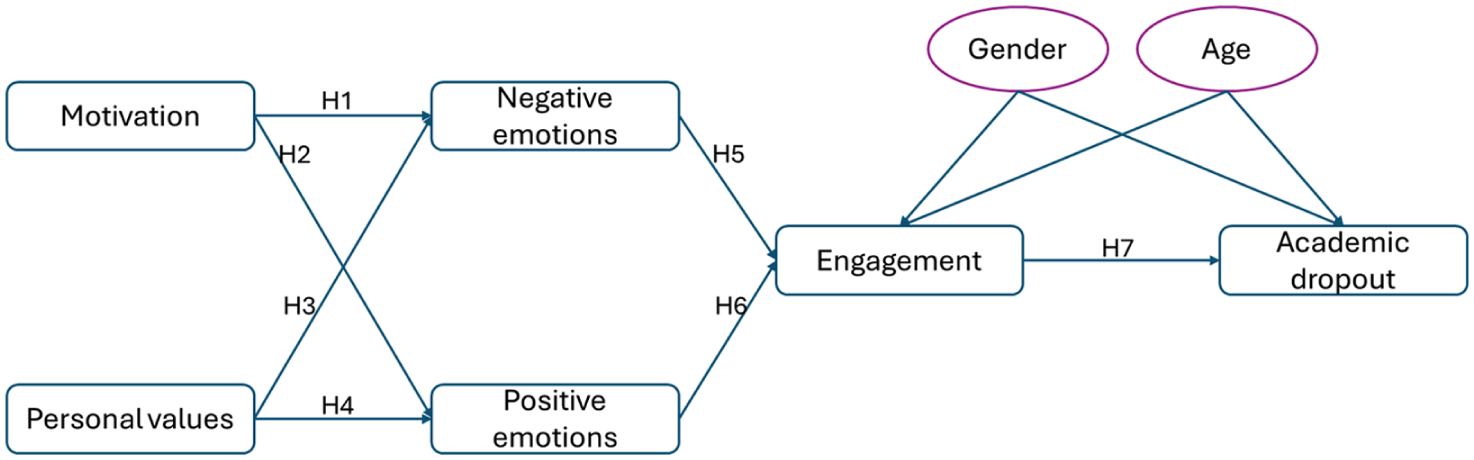
Research model.
Method
Research Design
The study used an ex post facto design. More specifically, it was an ex post facto retrospective study (Cargan, 2007). In this type of design, the object study has already occurred, and the aim is to identify the potential causes that influenced it, without the constraints of an experimental design. Due to its non-experimental nature, this design has limitations when it comes to establishing causal inferences. Furthermore, the study uses the survey method, one of the most widely used data collection techniques in this type of research. In this case, data were gathered from participants via a structured questionnaire.
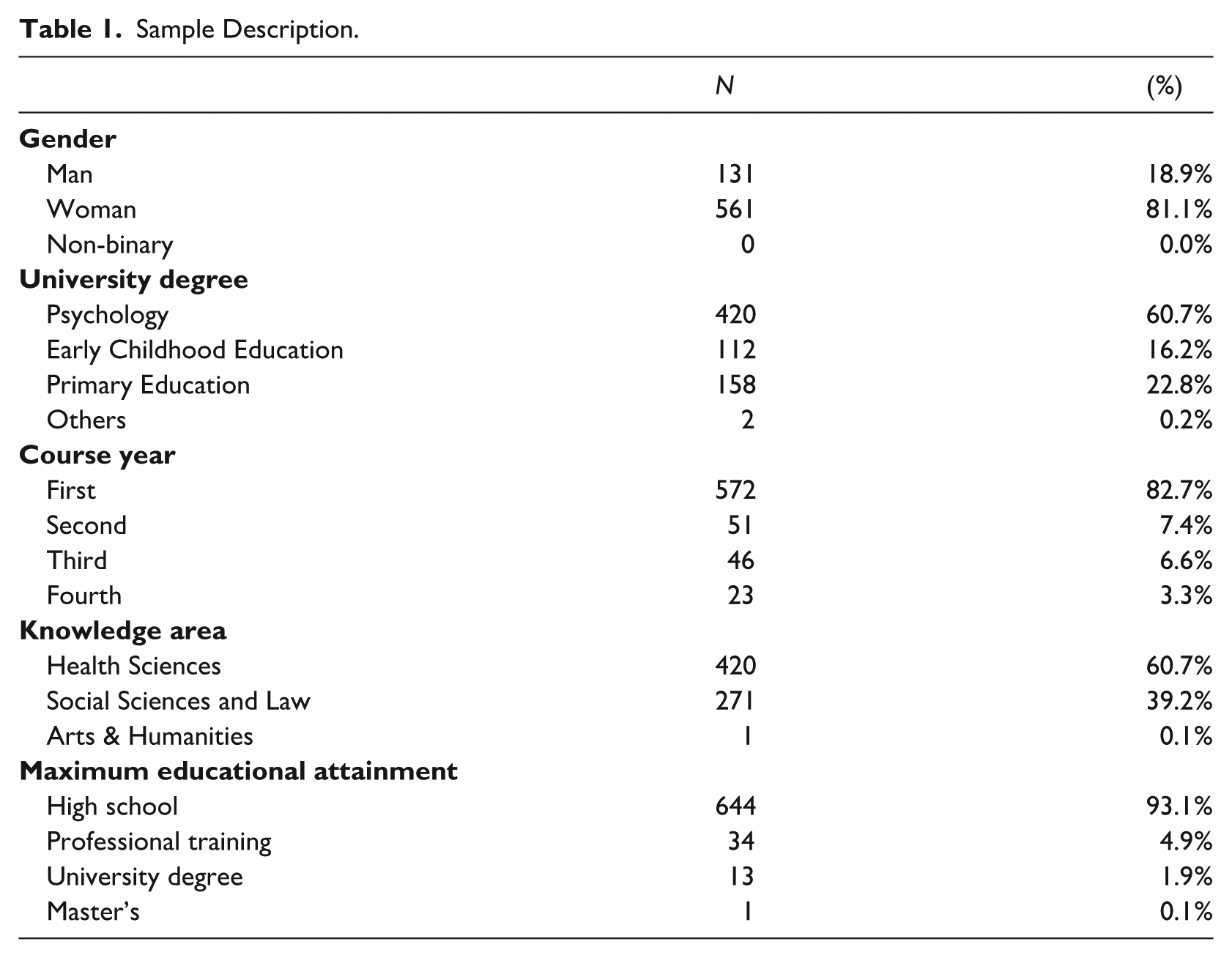
The sample was selected using non-probabilistic random sampling (Khan, 2008). It should be noted that this type of non-probabilistic sampling is common in social science research because it saves time and money (Howarth et al., 2024). In this case, convenience sampling was selected. The significantly higher percentage of women compared to men is also related to the fields of study analyzed and is a trend in some social science degrees. For instance, in many countries, degrees in psychology, sociology, anthropology, and teacher training tend to have a much higher percentage of women, sometimes reaching 75% or more (Casad et al., 2022; Lessky et al., 2022).
Participants
The sample consisted of 692 university students from a public university in the northern Spain. The majority of those students (81.1%) were women. This is due to the student population of the participating degree programs being heavily skewed toward women. The mean age of the participants was 19.20 years old (SD = 3.594), with a mode of 18 years, because they were mainly (82.7%) first-year students. The sociodemographic profile of the study sample is given in Table 1.
Sample Description.
Measurement Instrument
The Mixed Multifactorial Scale of Educational Engagement (EMMEE) was used to collect information. This instrument approaches to educational engagement by combining a series of factors that include the main variables of both lines of research (Colás-Bravo et al., 2021). Those authors developed the tool based on findings in the scientific literature to measure engagement in a university context. Five specialists from various Spanish universities provided expert judgment for its design, followed by a pilot test on a sample of 100 students, which guaranteed the instrument’s validity.
The full instrument is made up of 51 items divided into seven dimensions, which includes an initial block of personal and socio-demographic data. This initial block has nine items that request information on the participant’s gender, age, university, type of degree (bachelor’s or master’s), degree subject, course year, educational attainment, intention to dropout of the current course of study, and intention to dropout of university. The last two items are particularly important because they measure intention to drop out using dichotomous responses (1—Yes and 2—No) to the following questions “Have you ever thought about dropping out of your current degree course?” and “Have you ever thought about dropping out of university altogether?”
The remaining items use a 5-point Likert-type response scale (1—Not at all, 2—A little, 3—Somewhat, 4—Quite a lot, and 5—A lot). The dimensions are composed of varying numbers of items: motivations (5 items), values (6 items), learning context (10 items), emotions (16 items: 8 for the negative emotions subdimension and 8 for the positive emotions subdimension), management strategies (4 items), and engagement to studies has only one item.
The emotional dimension was modified slightly from the original. The instrument created by Colás-Bravo et al. (2021) used a response scale corresponding to a semantic differential of opposing adjectives: “frustrated-realized,” “dissatisfied-satisfied,” “insecure-secure,” “pessimistic-optimistic,” “worried-confident,” “with discomfort-well-being,” “unmotivated-motivated,” and “disillusioned-hopeful.” We decided to construct two subdimensions, one of negative emotions and the other of positive emotions. Respondents were asked to rate the adjectives from the semantic differential using the same Likert-type response scale as the other items.
Data Collection Procedure
The questionnaire was administered between the second semester of academic year 2021 to 2022 and the first semester of academic year 2024 to 2025. Lecturers in each course were contacted, and the aim of the study was explained to them. They were asked to allow a member of the research team to go to their classrooms to present the questionnaire to students at the beginning of the course.
After explaining the aim of the study and how to complete the instrument, the students were given a link to access the online version of the questionnaire, which was published using the Google Forms tool. This allowed the students to respond using their mobile phones or computers, ensuring data collection.
The students were informed that the study was anonymous, their data was confidential, and that data protection legislation was followed. They were asked to sign their informed consent in a clause added to the questionnaire. By doing so, they acknowledged having been informed about these aspects and agreed to participate in the study. This ensured compliance with the ethical principles inherent to this type of study, in accordance with the Declaration of Helsinki.
Data Analysis
To evaluate the results, the methodology of Partial Least Squares Modeling (PLS-SEM) was applied through the use of Smart PLS 4 software. In particular, we follow the two-step approach proposed by Hair et al. (2011). First, we measured the inter-item reliability, internal consistency reliability, and convergent validity of the proposed model. Reliability testing is crucial for assessing the consistency and stability of measurement instruments (Sekaran & Bougie, 2016). Cronbach’s alpha coefficient was applied to verify the reliability of the data set. Composite reliability (CR) is an appropriate technique for measuring internal consistency in PLS-SEM studies (Fornell & Larcker, 1981; Jöreskog, 1971). CR values should ideally be higher than 0.70, indicating that total error variance is less than 30% of latent variable variance (Cheung et al., 2024). Convergent validity is the positive correlation of an item with alternative items of the same construct (Haji-Othman & Yusuff, 2022). Hair et al. (2013) recommend assessing loading factors and the average variance extracted (AVE) to measure this validity. AVE should be at least 0.5 to be considered valid (Hair et al., 2014, Ahmad et al., 2016).
Second, we tested the hypotheses and predictive ability of the proposed structural equation model. Partial Least Squares Structural Equation Modeling (PLS-SEM) is a modern multivariate analysis technique with a demonstrated ability to estimate theoretically established cause-effect relationship models (Zeng et al., 2021). This method is well-suited for estimating complex models involving numerous variables. As a predictive and causal modeling technique, PLS-SEM focuses on forecasting outcomes while explaining causal relationships (Hair et al., 2022). It is particularly advantageous for studies with small sample sizes and intricate models because it offers high statistical power and enhances the detection of significant relationships. The PLS-SEM method has recently become more prominent in higher education research, especially in exploratory and confirmatory research contexts (Ghasemy et al., 2020; Hair et al., 2019). In this paper, we applied this technique using SmartPLS 4 software (Ringle et al., 2024).
Results
Reliability and Discriminant Validity
Reliability testing is crucial for assessing the consistency and stability of measurement instruments (Sekaran & Bougie, 2016). The study analyzed the internal consistency, convergent validity, and discriminant validity of latent constructs, except of and engagement to studies due it has only one item.
Cronbach’s coefficient alpha was applied to verify the reliability of the data set. In this study, all constructs had Cronbach’s alpha values greater than 0.65, indicating no reliability issues (Ahmad et al., 2016; Lin & Huang, 2014; Taber, 2018; Wang et al., 2025). CR values ranged from 0.829 to 0.945, meeting the criteria for internal consistency.
Convergent validity is the positive correlation of an item with alternative items of the same construct (Haji-Othman & Yusuff, 2022). Hair et al. (2013) recommend assessing loading factors and the average variance extracted (AVE) to measure this validity. AVE should be at least 0.5 to be considered valid (Hair et al., 2014, Ahmad et al., 2016). In this study, AVE values ranged from 0.590 to 0.919, meeting the criteria for convergent validity. Table 2 shows the main results.
Psychometric Properties.
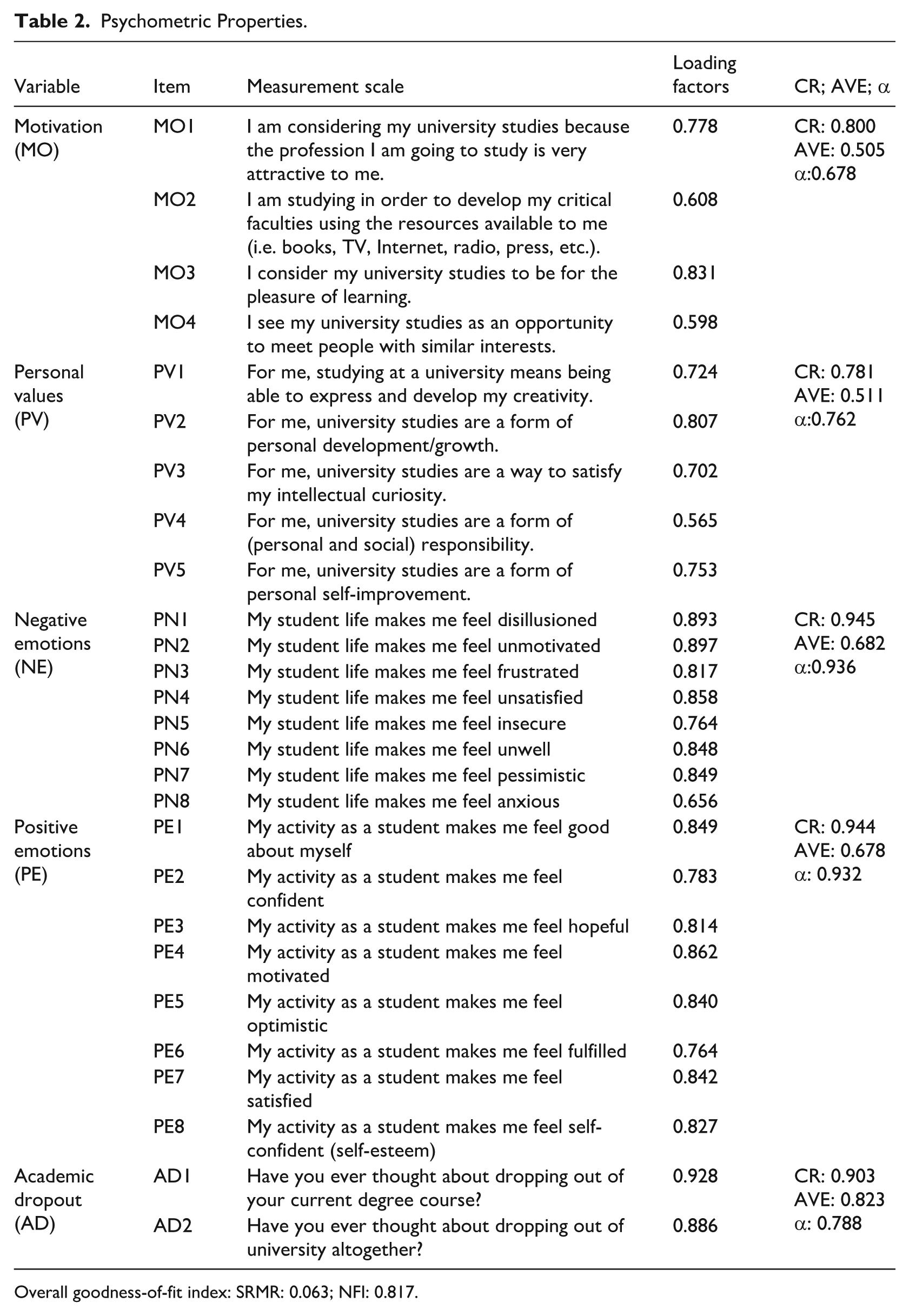
Overall goodness-of-fit index: SRMR: 0.063; NFI: 0.817.
Discriminant validity was assessed by using the Fornell-Larcker criterion and the Heterotrait to Monotrait correlation coefficient (HTMT). The results confirmed that the square root of the AVE for each construct exceeded the cross-correlations with other constructs and was not less than 0.50. In addition, HTMT values for conceptually similar constructs were less than 0.90. Table 3 shows the main discriminant validity results.
Discriminant Validity.
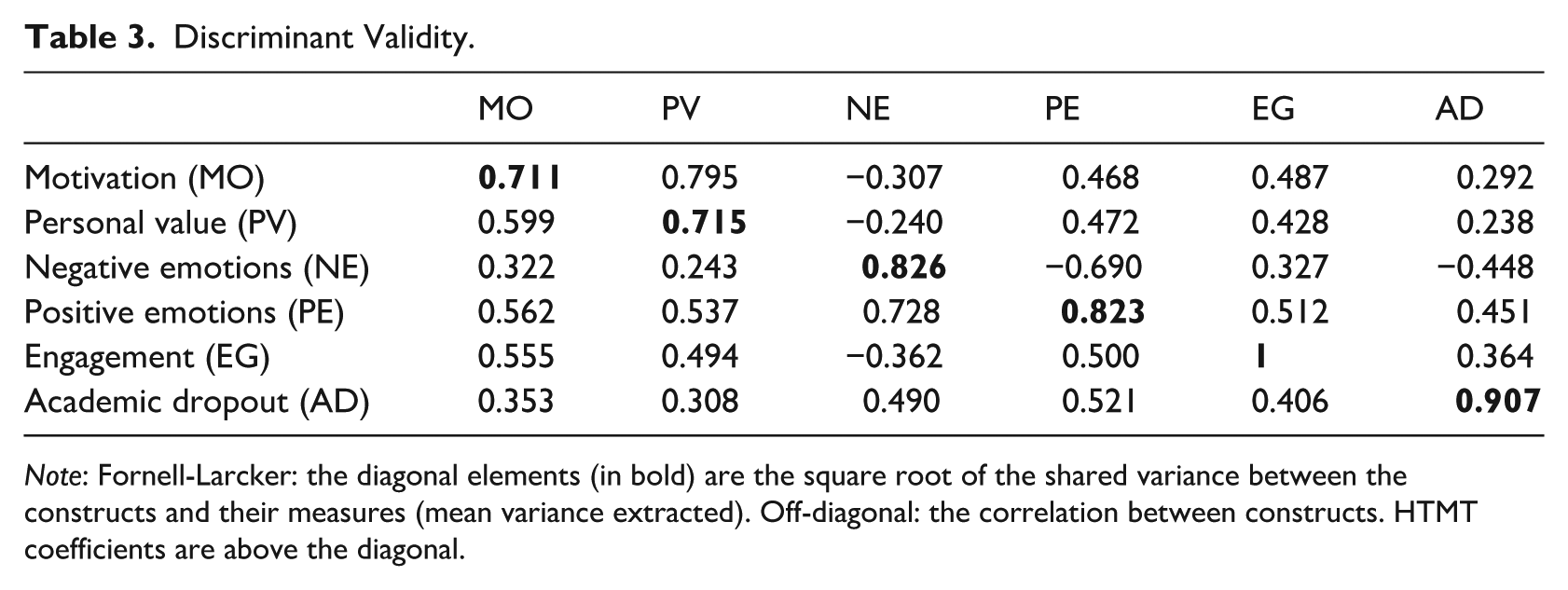
Note: Fornell-Larcker: the diagonal elements (in bold) are the square root of the shared variance between the constructs and their measures (mean variance extracted). Off-diagonal: the correlation between constructs. HTMT coefficients are above the diagonal.
Finally, multicollinearity was confirmed to not be an issue in this study, as the Variance Inflation Factor (VIF) values ranged from 1 to 4.29, well below the usual threshold of 5, meaning that the structural model had no multicollinearity and no negative effect between items or predictors (Hair et al., 2017).
Partial Least Squares Structural Equation Modeling
The structural model is the second step in the PLS process. It is used to evaluate the test hypotheses (Nekmahmud et al., 2022). Table 4 includes the standardized coefficients of the individual causal relationships and the associated t-statistics, as well as the Cross-validated redundancy (Q2) coefficient. The values of criterion Q2 were greater than 0 and ranged between 0.094 and 0.293, confirming the predictive ability of the PLS model (Falk and Miller, 1992; Hair et al., 2014).
Results of the Structural Model (Bootstrapping).
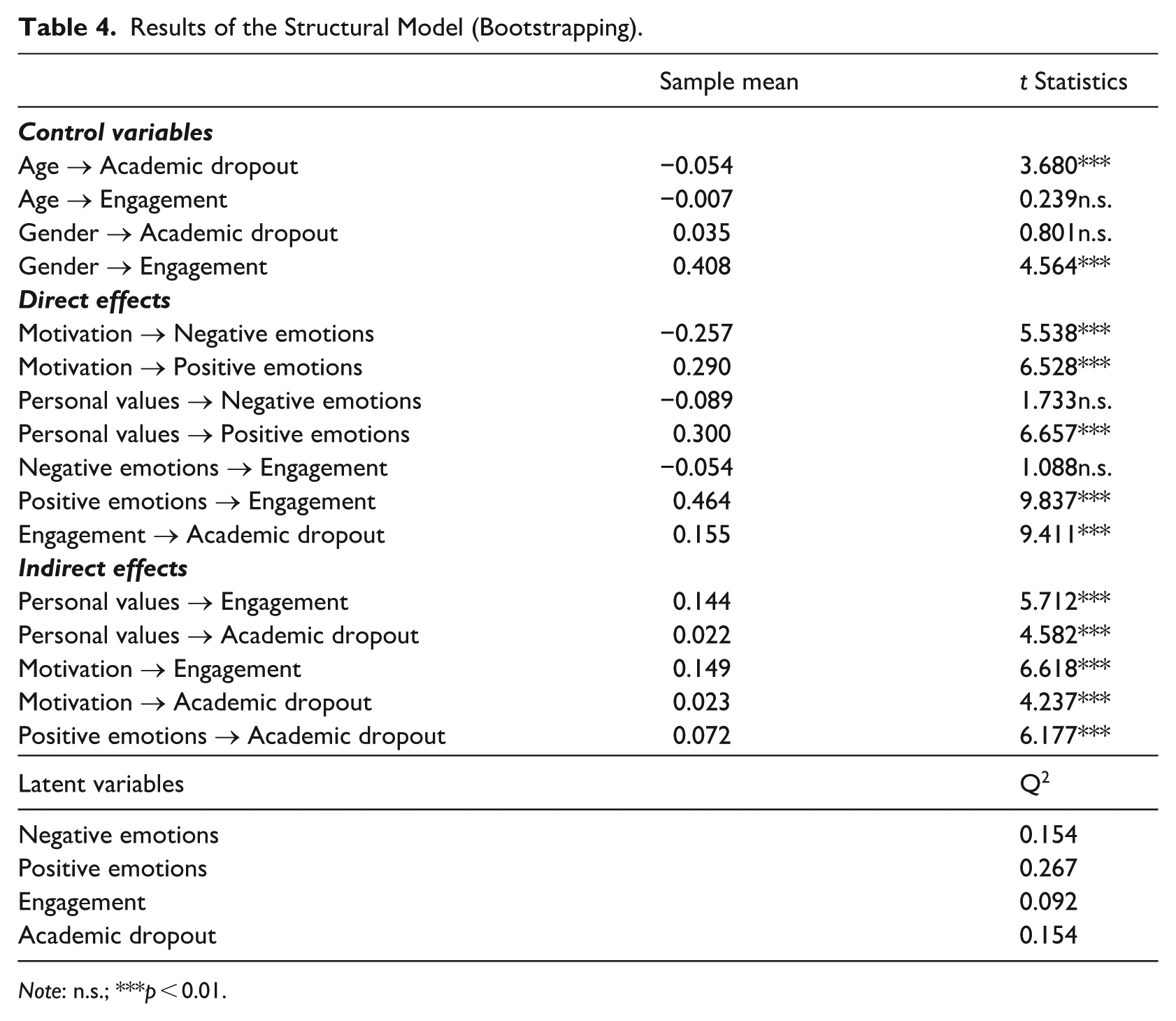
Note: n.s.; ***p < 0.01.
The results show some significant direct effects. For example, motivation had a relationship with negative emotions (β = −0.257; p < 0.01) and positive emotions (β = −0.290; p < 0.01). However, the relationship between personal values and emotions was significant only in the case of positive emotions (β = 0.300; p < 0.01). There was a similar occurrence between emotions and engagement, where the relationship was only significant in the case of positive emotions (β = .464; p < .01). Therefore, hypotheses
There were also some significant indirect effects between variables. For example, the personal values variable demonstrated a significant relationship with engagement (β = 0.144; p < 0.01) and academic dropout (β = 0.022; p < 0.01). In addition, the motivation variable also had a significant relationship with engagement (β = 0.149; p < 0.01) and academic dropout (β = 0.023; p < 0.01).
Finally, there was an indirect effect between positive emotions and academic dropout (β = 0.144; p < 0.01).
Discussion and Conclusion
This study attempted to determine the influence of psychological dimensions such as motivation and personal values on the development of the students’ emotions, and how this influences engagement, which seems to reduce the intention to drop out.
The first factor analyzed was motivation, which seems to have a direct influence on the generation of positive emotions, just as it limits the development of negative emotions, confirming the first (
Looking at the relationship between personal values relevant to the academic environment and emotions, we also found a direct influence, although it was limited to the domain of positive emotions and there was no significant relationship with negative emotions. However, it should be noted that there is a larger research base on the different specific personal values than on the construct as a whole. In any case, our results lead us to reject our third hypothesis (
Furthermore, our results regarding the relationship between present emotions and engagement show a significant influence in the case of positive emotions, but not in the case of negative emotions. Therefore, the fifth hypothesis (
Finally, our observations show the effects of engagement reducing the intention to drop out, which confirms the seventh hypothesis (
Theoretical Implications
This study contributes to the theoretical debate on engagement (Tight, 2019) by strengthening the connection between its fundamental components and individuals’ psychological processes. Specifically, it expands on the theoretical framework proposed by Colás-Bravo et al. (2021) by examining motivation and personal values, understood here as multidimensional constructs, as well as the mediating role of positive and negative emotions.
In this context, the theoretical framework being discussed refers to the evolving conceptual understanding of engagement, which is still under debate in the academic literature. Engagement has been approached from behavioral, emotional, and cognitive perspectives, and our study aligns with recent trends that emphasize the emotional and motivational dimensions as key to understanding students’ academic trajectories.
Learning contexts and self-regulation strategies also play a role in engagement. However, they are often shaped by cultural or institutional factors. This is the reason for our focus on psychological mechanisms that are more universal and can be generalized to other contexts. This approach allowed us to propose a coherent sequence linking motivation, personal values, emotional experience, and student engagement, helping to clarify how these components interact to influence academic engagement.
Practical Applications
This study shows the need to consider different areas when designing strategies for student retention policies and dropout prevention programs. For example, analysis of the factors that determine academic engagement allows goals to be set that should have an impact on cognitive, emotional, social, and behavioral aspects (Fredricks et al., 2004). It seems appropriate to implement methodologies, technologies, resources, pedagogical styles, approaches and diverse educational materials that foster student motivation (Temel et al., 2023) and to set learning goals that allow students to satisfy personal values such as intellectual curiosity, creativity, desire for self-improvement, and personal development. The emotional aspect must also be reinforced, given the essential role played by emotional control, especially in encouraging feelings such as satisfaction, safety, confidence, and well-being, which generate positive emotions. In light of this framework, higher education institutions can consider the following strategies: (a) provide psychological and personal counseling services (Dumitru et al., 2024) and academic guidance (Korhonen, 2024); (b) design mentoring and academic support programs; (c) improve student service centers and organize workshops on communication, emotional intelligence, and social skills; and (d) manage diversity services and personalized support (Baulke et al., 2022; De la Cruz et al., 2023).
Finally, it is important to highlight the contextual implications that stem from conceiving the university environment as a space that transcends its educational function. The university should be understood as a setting where students are encouraged to grow holistically as individuals within a broader social framework. This perspective is particularly relevant to the present research given that numerous studies have demonstrated the significant impact of support, integration, and social adaptation on positive emotional development, emotional well-being, and life satisfaction (Akanni & Oduaran, 2018; Hagenauer et al., 2017). Therefore, it is crucial to develop environments that promote interaction and personal growth, strengthen student networks that facilitate integration, and expand social and cultural activities that encourage meaningful interaction among all members of the educational community.
Limitations and Future Research
Despite its contribution and relevance, our research has limitations that provide opportunities for future studies. On the one hand, there are aspects related to sample size and diversity. Larger, more diverse samples would be useful, allowing stratified, more representative samples, considering variables such as gender, age, course, and field of knowledge. Specifically, the greater presence of women than men, although, as mentioned, consistent with existing trends in certain degrees, should also be taken into account when generalizing the results (Casad et al., 2022). This would allow more control variables to be used, along with analysis of differential aspects based on different student profiles. On the other hand, the construct of engagement could be analyzed from a broader perspective that integrates its different dimensions: cognitive, behavioral, and emotional.
In terms of future research lines, there is the possibility of studying actual dropout and not only the intention to drop out, which would require access to students’ academic data, in order to determine those who have enrolled on a degree program and not returned for two consecutive academic years despite not having completed it. In addition, it would be interesting to include academic performance in the research, interposing this aspect as a mediating dimension between engagement and intention to drop out or actual dropout.
In summary, the findings confirm a positive relationship between motivation and positive emotions, as well as an inverse relationship between motivation and negative emotions. Similarly, personal values are directly associated with positive emotions, though no significant link was found with negative ones. Negative emotions do not appear to be meaningfully connected to academic engagement, whereas positive emotions are, as they enhance engagement and reduce the likelihood of students dropping out of university. Overall, this study emphasizes the vital role of positive emotions in mediating the relationship between cognitive factors (motivation and personal values) and academic engagement, thereby reducing the likelihood of students dropping out of university.
In sum, these findings underscore the pivotal function of students’ emotional well-being in their capacity to engage with and complete their academic studies. Therefore, universities must acknowledge that the teaching-learning process involves more than just academic instruction. In addition to delivering educational content, institutions should actively promote emotional support and well-being. By doing so, they can foster a more holistic and supportive environment that enhances student success and retention.
Footnotes

Ethical Considerations
This study was conducted in accordance with the ethical principles outlined in the Declaration of Helsinki. All procedures involving human participants were designed to ensure anonymity, confidentiality, and the protection of participants’ rights and well-being.
Consent to Participate
All participants provided informed consent prior to their involvement in the study. They confirmed that they had been fully informed about the purpose of the research, the procedures involved, and the ethical safeguards in place, including confidentiality and anonymity.
Funding
The authors disclosed receipt of the following financial support for the research, authorship, and/or publication of this article: The project was funded in accordance with the call for KNOWLEDGE GENERATION PROJECTS, as part of the State Program to Promote Scientific-Technical Research and its Transfer, which is part of the State Plan for Scientific, Technical and Innovation Research 2021-2023 of the Ministry of Science and Innovation. REF. PID2022-141290NB-I00. Moreover, the organization has been granted financial support from the European Union on behalf of the Principality of Asturias (GRUPIN: ID2024000713).
Declaration of Conflicting Interests
The authors declared no potential conflicts of interest with respect to the research, authorship, and/or publication of this article.
Data Availability Statement
Data will be available to interested researchers upon justified request to the authors.