







Abstract
The aim of this study was to explore the relationship between student engagement, critical thinking disposition, and creative self-concept. Participants were 569 Spanish undergraduates (52.7% female, 46.9% male, and 0.4% non-binary) aged between 19 and 37 years (M = 21.90, SD = 1.61). They were currently in the final year of a degree program in either social and legal sciences (71.6%) or engineering and architecture (28.4%). Behavioral, cognitive, and socio-affective engagement were found to be positively related with a stronger critical thinking disposition. In addition, cognitive engagement and behavioral facets of engagement connected with deep learning were associated with student creative self-concept. Notably, gender differences emerged, with men reporting higher creative self-concept compared to women. These results emphasize the need to examine how different facets of engagement contribute to various aspects of students’ development. In terms of practical implications, we conclude that a model of student engagement that takes into account its behavioral, socio-affective, and cognitive dimensions could help educational institutions to become more effective in promoting their students’ academic and professional development.
Introduction
Engagement, in the broadest sense, refers to the ties that are established between an educational institution and its students (Kuh, 2009). It is a complex construct that has been widely studied, not least because it has been shown to be closely associated with certain practices that lead to personal and academic success among students. Furthermore, because engagement is susceptible to change, development, and improvement (Fredricks et al., 2019), it has become a focus of growing interest among researchers in higher education.
There is considerable evidence that engagement is an important factor contributing to student retention and success (Kahu & Nelson, 2018; Zepke, 2021). Student engagement, both in and outside the classroom, has been shown to be closely associated with learning and the quality of teaching (Zepke, 2018). For example, students who feel more engaged report a stronger sense of belonging to the institution, and they perceive greater support from and establish more relationships with different agents within the educational community (Zepke, 2021). However, as various authors have pointed out (Kahu, 2013; Payne, 2017; Trowler & Trowler, 2010), it is a complex construct that requires further refinement from both a theoretical and an applied perspective. The main criticism relates to the fragmented way in which student engagement has usually been investigated, hence the need to explore the multidimensional nature of the concept, and also to examine how these dimensions relate to other variables associated with student success (Bond et al., 2020). In addition to these critiques, more recent perspectives emphasize that student engagement is a relational, multidimensional, and dynamic phenomenon that reflects the interplay between students’ own agency and the institutional context, consistent with a social network paradigm for understanding engagement (Smith & Tinto, 2022).
Three Facets of Student Engagement: Behavioral, Socio-Affective, and Cognitive
In higher education, behavioral engagement is based on Kuh’s (2009) characterization of engagement and focuses on the amount of time and effort that students dedicate to activities associated with positive academic outcomes. It also considers what institutions do to encourage students to participate in these activities. Indeed, the learning environment is seen as playing a key role in creating opportunities for students to engage in significant and transformative learning experiences, both in and outside the classroom (Patton et al., 2016).
The National Survey of Student Engagement (NSSE), administered and assessed by the University of Indiana, is a prime example of the behavioral perspective on engagement. The survey is based on the behavioral approach described by Kuh (2009), and it was created with the aim of learning more about the educational practices and contexts that many years of research have associated with students’ learning and development (Kuh, 2001, 2009). Accordingly, it assesses student engagement in relation to learning strategies, collaborative learning with peers, high-impact practices, interactions with faculty, and the campus environment (Kuh, 2009). There is evidence that student engagement, understood in behavioral terms, is associated with the use of reasoning, intercultural effectiveness, personal well-being, and a positive orientation toward literacy activities (Pascarella et al., 2010), as well as with students’ creative self-concept (Álvarez-Huerta et al., 2021) and disposition to critical thinking (Álvarez-Huerta et al., 2023b).
Social and affective engagement in higher education refers to the interpersonal and emotional dimensions of a student’s academic experience (Christenson et al., 2012). Socio-affective variables have been related to more efficient coping strategies and greater adaptation and well-being (Neely-Prado et al., 2019). However, the role played by the socio-affective facet of learning has not been sufficiently recognized within higher education (Bowden et al., 2019), despite evidence that social and emotional variables can have a strong influence on students’ learning (Plass & Kalyuga, 2019), engagement, and academic achievement (Pekrun & Linnenbrick-Garcia, 2012). This relationship between positive emotions and increased engagement has also been observed in virtual learning environments (D’Errico et al., 2016).
Socio-affective engagement refers to the sense of belonging and connection that students feel in relation to different agents within the educational community (Maguire et al., 2016). The scope and type of social interactions that are afforded by a higher education institution are major factors determining its impact on students (Alsubaie et al., 2019; Pascarella & Terenzini, 1991). Research suggests that social connectedness leads to greater motivation, confidence, and deeper learning among students (Dyer et al., 2018). In addition, strong social ties have been shown to be predictors of better mental health and quality of life (McIntyre et al., 2018). This relationship became apparent during the recent COVID-19 pandemic, which severely limited students’ opportunities for socialization and impacted negatively their emotional well-being (Batra et al., 2021). Social connectedness has also been found to be particularly important for the development of leadership and decision-making skills (Sá, 2023), as well as for promoting critical thinking (Dekker, 2020) and creativity (Perry-Smith, 2014) among students. Research suggests that this type of engagement influences students’ interpersonal and communication skills (Evans et al., 2013). This is supported by other studies showing that positive emotion regulation strategies are associated with students’ creative development (Álvarez-Huerta et al., 2023a) and critical thinking disposition (Sk & Halder, 2020). Consequently, learning and both behavioral and socio-affective engagement are interconnected processes that impact students’ overall educational experience (Kahu, 2013).
Closely related to the behavioral and socio-affective dimensions of engagement is cognitive engagement, which refers to a willingness to expend effort in understanding complex ideas and to go beyond minimum academic requirements (Zhoc et al., 2019). Accordingly, students who are engaged cognitively show a propensity to invest time and effort in their studies and to persist with learning tasks (Wang & Eccles, 2012). Research also suggests that cognitive engagement can act as a buffer against academic anxiety, and it has been linked to students’ well-being and achievement (Pietarinen et al., 2014). In addition, the performance of cognitive tasks that imply higher-order learning has been shown to be influenced by students’ creative self-concept and critical thinking disposition (Álvarez-Huerta et al., 2022).
Creative Self-Concept
In recent years, increasing attention has been paid to the study of creative confidence beliefs (Puente-Diaz & Cavazos-Arroyo, 2020), as they are known to influence students’ creative development (R. Beghetto, 2006; Karwowski et al., 2018; Royston & Reiter-Palmon, 2019). A particular focus of this research has been on creative self-concept, which reflects the degree of confidence a person has in their ability to act or think creatively (Karwowski & Beghetto, 2019). In addition, various studies (Karwowski et al., 2019; Puente-Díaz, 2016) have shown that students’ creative confidence beliefs are influenced by both socio-cognitive factors (goal achievement and emotions) and contextual factors (previous experience, interactions with peers or faculty). Regarding the latter, research indicates that higher education institutions can play a key role in promoting creative self-beliefs among students (Mathisen & Bronnick, 2009; Robbins & Kegley, 2010; Vally et al., 2019). Although the need to further study this relationship has been highlighted, there is also evidence to suggest that students’ creative development is influenced by their level of engagement (Álvarez-Huerta et al., 2021; Miller & Dumford, 2016).
Critical Thinking Disposition
As regards critical thinking, this appears to be a key factor in the ability to solve problems (Snyder & Snyder, 2008) and make decisions (Shirazi & Heidari, 2019), and it has been linked to academic achievement (Akpur, 2020). Critical thinking is also associated with other skills such as metacognition and creativity (Qiang et al., 2020). Notably, a recent book published by the OECD (Van Damme & Zahner, 2022), while underscoring the importance of critical thinking for problem-solving, analytical reasoning, and communication, also reports that only 45% of university students achieve competence in this respect.
There are various definitions of critical thinking, although it is generally considered to encompass both cognitive abilities and the disposition to think critically (Facione et al., 1995; Sosu, 2013). The cognitive dimension implies the ability to understand a problem and find reasoned solutions to it (Sosu, 2013), which requires not only analytical and argumentative skills but also the capacity to draw productive conclusions (Chan, 2019). Critical thinking disposition has been defined as a willingness or motivation to address problems and make decisions (Facione et al., 1995; Giancarlo & Facione, 2001), both of which are fundamental to the emergence of critical thinking (Chen et al., 2020).
Although critical thinking disposition has been linked to the use of higher-order thinking skills when solving problems (Darby & Rashid, 2017), as well as to academic success among doctoral students (Comer et al., 2019), there has been relatively little research on its relationship to the learning context. However, a recent study involving higher education students suggests that critical thinking disposition is associated with behavioral engagement (Álvarez-Huerta et al., 2023b).
The Present Study
This study aims to explore the relationship between student engagement and two factors that are closely linked to student inclination to consider alternative perspectives, think divergently, and engage in innovative problem-solving: creative self-concept and critical thinking disposition. To investigate this, students from various degree programs completed a survey assessing their levels of engagement, alongside instruments measuring their critical thinking disposition and creative self-concept. We hypothesized a positive relationship between student engagement, critical thinking disposition, and creative self-concept. Additionally, the study sought to identify which specific dimensions of student engagement most strongly influence student critical thinking disposition and creative self-concept.
Based on the above, the study hypotheses were as follows:
Another exploratory aim of the study was to explore the possible influence of gender and age on students’ disposition to critical thinking and creative self-concept.
Method
Participants
Participants in this study were 569 final-year undergraduates (52.7% female, 46.9% male, and 0.4% non-binary) from a university in northern Spain. They were aged between 19 and 37 years (M = 21.90, SD = 1.61) and were enrolled in degree programs in either social and legal sciences (71.6%) or engineering and architecture (28.4%). Final-year students were specifically selected because this stage represents a critical point in higher education, when dispositions such as engagement, critical thinking, and creative self-concept are expected to be more consolidated after several years of academic and personal development. By focusing on students at the end of their degree programs, we aimed to capture the cumulative effect of the higher education experience on these constructs and to obtain a more accurate reflection of how engagement relates to creativity and critical thinking in mature university learners.
Procedure
All students enrolled in the final year of degree programs offered by the university were invited to participate. They were given information about the nature of the study, and it was made clear that participation was entirely voluntary, and that all information collected would remain confidential, in accordance with current data protection legislation in Spain. Those students who agreed to participate signed informed consent prior to any data collection, which took place during the 2023 to 2024 academic year. The study protocol was reviewed and approved by the Research Ethics Committee of Mondragon Unibertsitatea.
Instruments
Creative Self-Concept
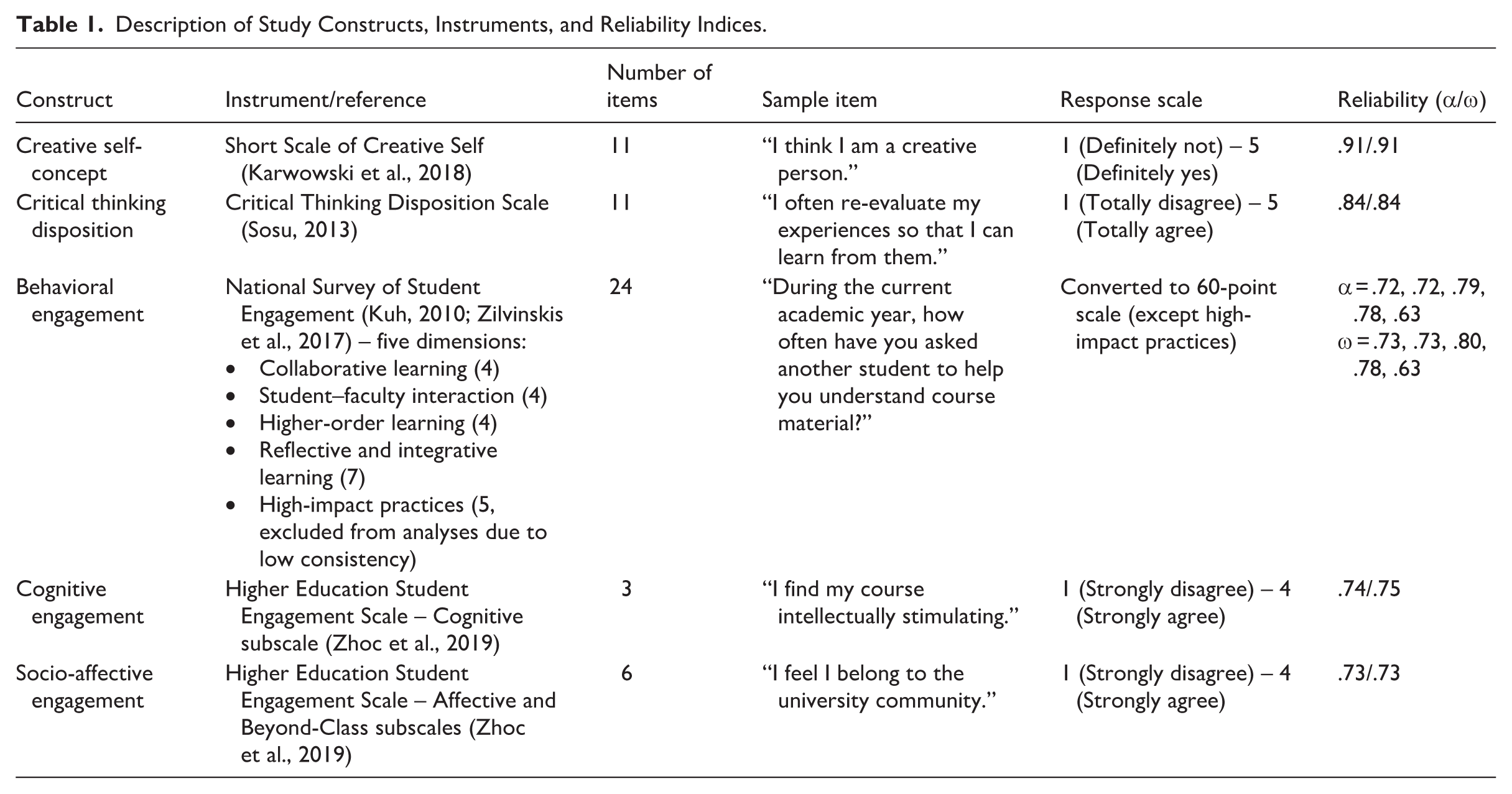
This was assessed using the Short Scale of Creative Self (SSCS; Karwowski et al., 2018), an 11-item scale that explores people’s beliefs about their ability to be creative (e.g. “I think I am a creative person”). Each item is rated on a 5-point Likert-type scale, ranging from 1 (Definitely not) to 5 (Definitely yes). Internal consistency of scale scores in the present sample was .91. (value for both McDonald’s omega and Cronbach’s alpha).
Critical Thinking Disposition
This was measured using the Critical Thinking Disposition Scale (CTDS; Sosu, 2013; Spanish adaptation by Bravo et al., 2020). The CTDS consists of 11 items that assess critical openness (e.g. I usually try to think about the bigger picture during a discussion) and reflective skepticism (e.g. I often re-evaluate my experiences so that I can learn from them). Each item is rated on a 5-point Likert-type scale anchored by 1 (Totally disagree) and 5 (Totally agree). Internal consistency of scale scores in the present sample was .84. (value for both McDonald’s omega and Cronbach’s alpha).
Behavioral Engagement
Behavioral engagement was measured using selected items from the National Survey of Student Engagement (NSSE; Kuh, 2010; Zilvinskis et al., 2017), a well-established instrument designed to capture the extent to which students participate in learning activities known to foster academic success. Drawing on Kuh’s (2009) behavioral framework, the NSSE conceptualizes engagement as the time and effort students invest in educationally purposeful practices, as well as the degree to which institutions encourage such participation.
For this study, five dimensions of behavioral engagement were considered: Collaborative learning (four items; range = 0–240), Student–faculty interaction (four items; range = 0–240), Higher-order learning (four items; range = 0–240), Reflective and integrative learning (seven items; range = 0–420), and participation in High-impact practices (five items; range = 0–20). The first four dimensions comprised items rated on a 60-point scale, with higher scores indicating greater engagement in the corresponding domain. High-impact practices (e.g. internships, study abroad, or research experiences with faculty) were rated on a 4-point categorical scale ranging from Have not decided to Have done or plan to do. With the exception of high-impact practices, item scores are converted to a 60-point scale, with higher scores indicating greater engagement on the corresponding indicator. For high-impact practices, students must indicate whether they have yet to decide, do not plan to, are planning to, or have already participated in a given practice. In the present sample, internal consistency of scores on the five dimensions (McDonald’s ω) was .73, .73, .80, .78, and .63, and .72, .72, .79, .78, and .63 (Cronbach’s alpha) for behavioral engagement. The high-impact practices variable was not entered into the data analysis because scores on the corresponding measurement scale showed low internal consistency in the present sample.
Cognitive Engagement
This was assessed using three items from the Cognitive Engagement subscale of the Higher Education Student Engagement Scale (HESES; Zhoc et al., 2019), those considered pertinent to the study context. Each of the three items (“I get a lot of satisfaction from studying”; “I find my course intellectually stimulating”; “I am usually motivated to study”) is rated on a 4-point Likert-type scale (1 = Strongly disagree; 4 = Strongly agree). Internal consistency of scale scores in the present sample was .75 (McDonald’s omega) and .74 (Cronbach’s alpha).
Socio-Affective Engagement
This was measured using the Affective and Beyond-Class Engagement subscales from the Higher Education Student Engagement Scale (HESES; Zhoc et al., 2019). This subscale comprises six items (e.g. “I feel I belong to the university community”; “I tend to mix with other students at university”), each rated on a 4-point Likert-type scale (1 = Strongly disagree; 4 = Strongly agree). Internal consistency of scale scores in the present sample was .73. (value for both McDonald’s omega and Cronbach’s alpha).
To provide a clearer overview of the measures used, Table 1 summarizes the key characteristics of each instrument, including the number of items, a sample item, response scale, and internal consistency indices (Cronbach’s α and McDonald’s ω).
Description of Study Constructs, Instruments, and Reliability Indices.
Data Analysis
We began by conducting a bivariate correlation analysis, calculating Pearson coefficients to explore relationships between the different study variables. Next, and in order to examine the relationship between engagement and both critical thinking disposition and creative self-concept, we performed multiple linear regression analysis, with gender and age included as covariates. To address missing data, multiple imputation was performed using the Mice (Multiple Imputation by Chained Equations) package in R. This approach allows for the handling of missing values by generating multiple complete datasets through an iterative process that predicts missing values based on observed data patterns. A total of 20 imputations were generated, and the results were pooled to obtain final estimates, ensuring that all available data were utilized without introducing biases from listwise deletion. Adjusted R2 values were calculated to assess the proportion of variance explained by the predictors in the context of multiple imputation, ensuring a robust evaluation of model fit while accounting for the complexity of missing data. All these analyses were performed using R 4.4.1 (R Core Team, 2024).
Results
Descriptive Statistics and Bivariate Correlation Analysis
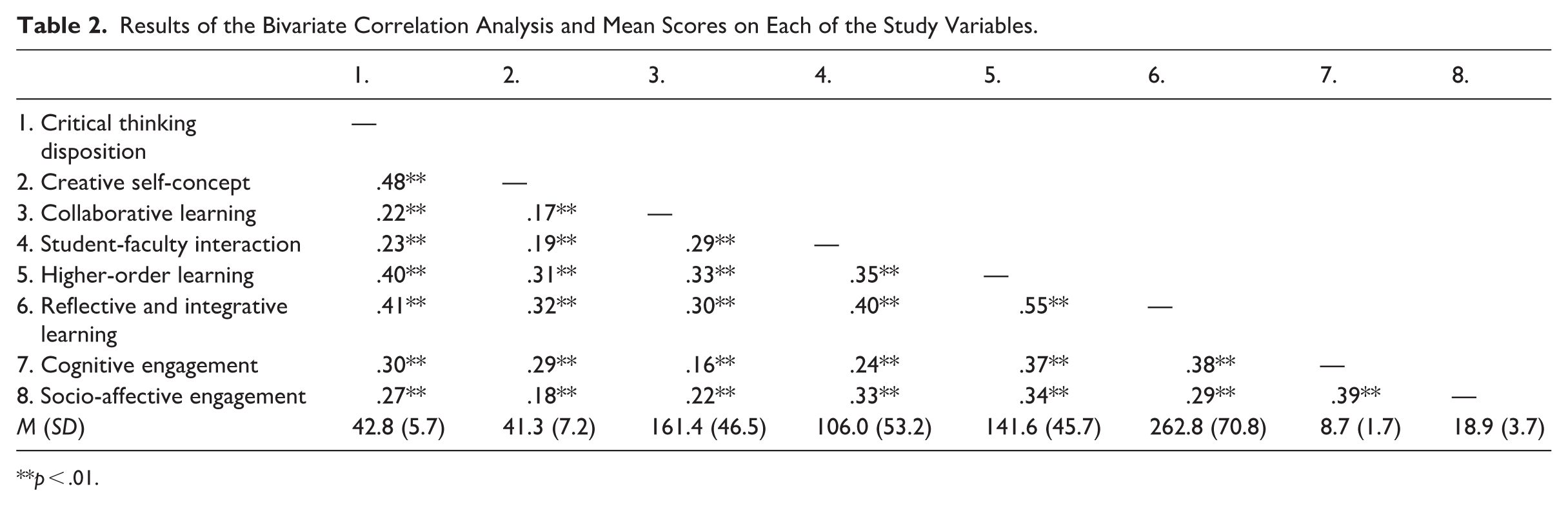
Critical thinking disposition was positively and significantly correlated with all other variables in the study, suggesting that higher levels of critical thinking are associated with increased engagement across multiple dimensions. The strongest correlation was observed between critical thinking and reflective and integrative learning (r = .41, p < .01), indicating that students who engage more in reflective practices tend to have higher levels of critical thinking disposition. Additional significant correlations were found with higher-order learning (r = .40, p < .01) and cognitive engagement (r = .30, p < .01; Table 2).
Results of the Bivariate Correlation Analysis and Mean Scores on Each of the Study Variables.
p < .01.
Creative self-concept was significantly associated with all engagement dimensions, reflecting its positive connection with various engagement behaviors. The strongest correlation for creative self-concept was also with reflective and integrative learning (r = .32, p < .01), suggesting that students who see themselves as creative are more likely to engage in reflective learning activities. Creative self-concept was also significantly correlated with higher-order learning (r = .31, p < .01) and cognitive engagement (r = .29, p < .01), indicating that students who perceive themselves as creative are more engaged cognitively and utilize complex learning strategies.
Multiple Regression Analysis
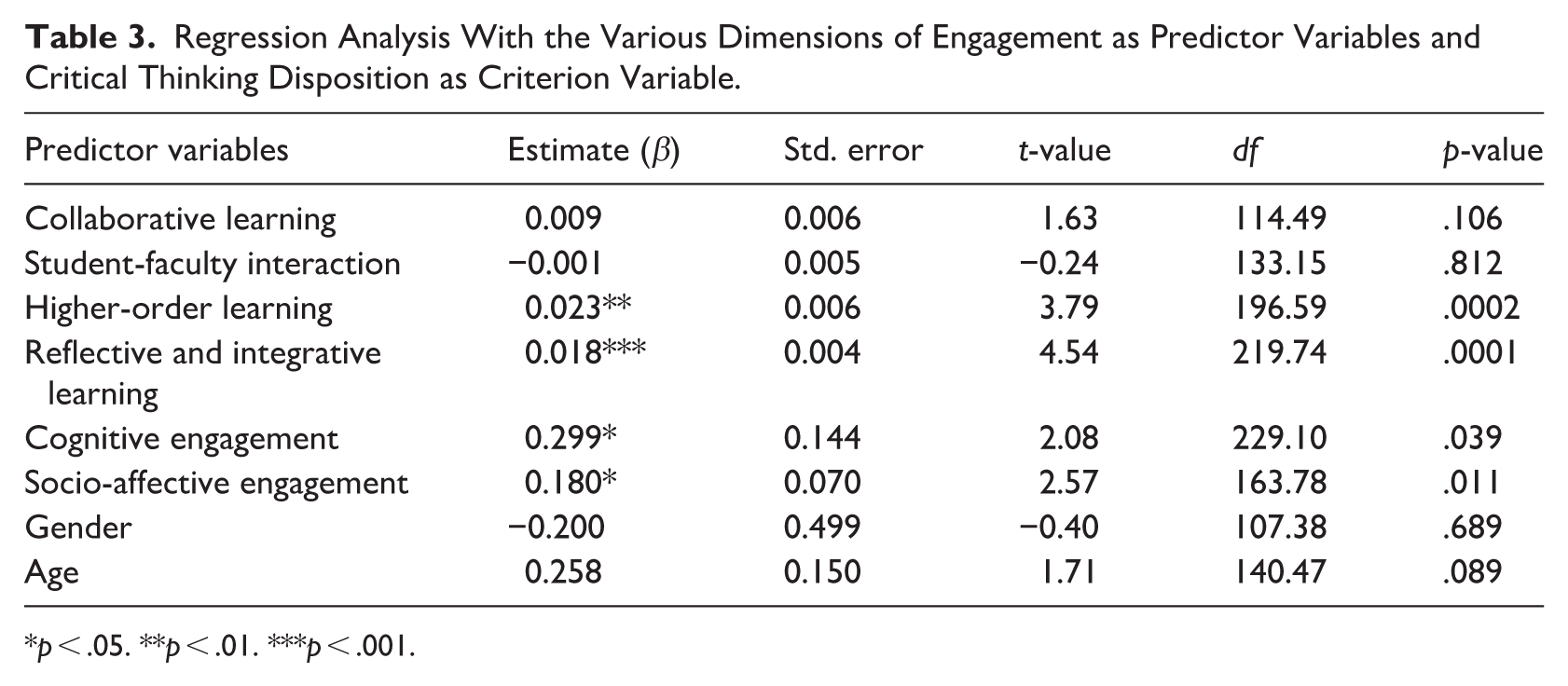
To examine the effect of engagement on critical thinking disposition, we performed a linear regression analysis with behavioral engagement (four dimensions), cognitive engagement, socio-affective engagement, gender, and age as predictor variables, and critical thinking disposition as the criterion variable. The results are shown in Table 3.
Regression Analysis With the Various Dimensions of Engagement as Predictor Variables and Critical Thinking Disposition as Criterion Variable.
p < .05. **p < .01. ***p < .001.
The multiple regression analysis revealed that several dimensions of engagement are significant predictors of critical thinking disposition. The average adjusted R2 was .239, indicating that the model explains approximately 23.9% of the variance in critical thinking disposition after adjusting for the number of predictors. This suggests that the types of engagement included in the analysis contribute significantly to understanding the factors associated with critical thinking. Higher-order learning showed a positive and significant effect on critical thinking disposition (β = .023, p = .0002), suggesting that participation in this type of learning promotes the development of critical thinking skills. Reflective and integrative learning was also a significant predictor (β = .018, p = .0001), highlighting the importance of reflection and knowledge integration activities in fostering critical thinking. In addition, cognitive engagement showed a positive and significant effect (β = .299, p = .039), implying that higher cognitive engagement is associated with an increased disposition toward critical thinking. Furthermore, socio-affective engagement had a positive and significant effect (β = .180, p = .011), suggesting that emotional and social interactions in the educational environment are important for the development of critical thinking.
Other predictors, such as collaborative learning and student-faculty interaction, were not statistically significant, indicating limited influence on critical thinking disposition in this model. Demographic variables, such as gender and age, did not show significant effects, suggesting that the impact of engagement is consistent across different demographic groups.
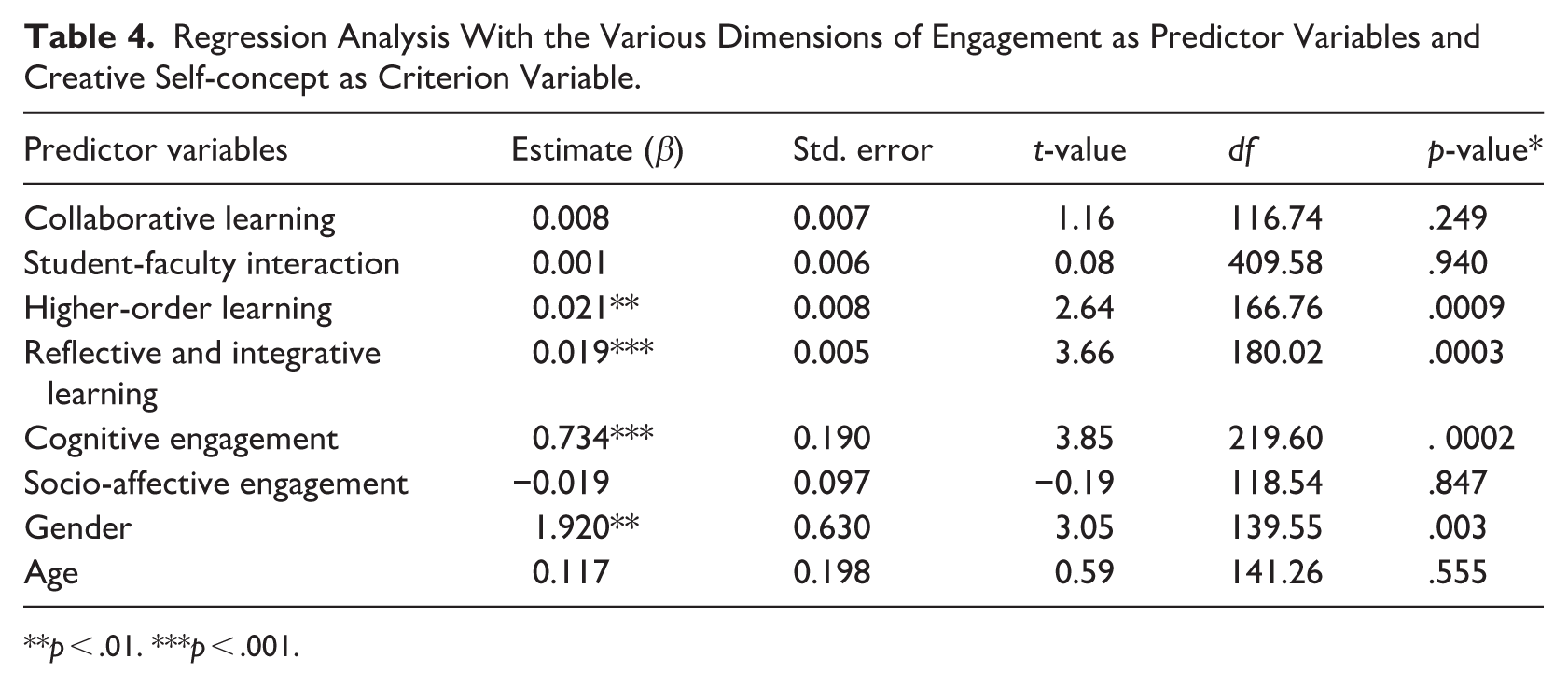
To examine the effect of engagement on creative self-concept, we performed a new linear regression analysis with behavioral engagement (four dimensions), cognitive engagement, socio-affective engagement, gender, and age as predictor variables, and creative self-concept as the criterion variable. The results are shown in Table 4.
Regression Analysis With the Various Dimensions of Engagement as Predictor Variables and Creative Self-concept as Criterion Variable.
p < .01. ***p < .001.
The average adjusted R2 for the model was .167, indicating that approximately 16.7% of the variability in creative self-concept is explained by the included predictors. While the model’s fit is moderate, the significant types of engagement provide relevant insights into the factors influencing creative self-concept.
Higher-order learning showed a positive and significant effect on creative self-concept (β = .021, p = .009), suggesting that engagement in higher-order learning activities fosters a greater sense of creativity among students. In addition, reflective and integrative learning was a significant predictor (β = .019, p = .0001), indicating that reflective and integrative learning processes are crucial for developing a stronger creative self-concept. Furthermore, cognitive Engagement displayed a positive and highly significant effect (β = .734, p = .0001), implying that higher cognitive engagement is strongly associated with increased creative self-concept.
The regression analysis revealed that gender had a significant effect on creative self-concept (β = 1.920, p = .003), indicating notable gender differences. Specifically, males showed a greater positive impact on creative self-concept compared to females. The average creative self-concept score was higher for males (M = 41.72) than for females (M = 40.81), based on the mean scores calculated across multiple imputations. This finding suggests that males generally perceive themselves as more creative than females, aligning with the significant gender effect observed in the regression model.
Finally, collaborative learning, student-faculty interaction, and socio-affective engagement did not reach statistical significance, suggesting that their influence on creative self-concept is limited in this context. Age was also not a significant predictor, indicating that age differences do not substantially affect creative self-concept.
Discussion
The aim of this study was to examine the relationship between student engagement, critical thinking disposition, and creative self-concept. Student engagement extends beyond the classroom, hence the need for an integrative proposal that takes into account students’ social connectedness, and interpersonal skills, as well as their willingness to expend effort in understanding complex ideas and to go beyond minimum academic requirements. It is worth noting that the sample consisted of final-year undergraduate students, a stage at which academic and personal competencies are typically more consolidated. This provides a valuable perspective on how sustained engagement throughout the degree program may relate to the development of critical thinking and creative confidence at the point of transition to professional life.
The facets of engagement that were shown to be positively associated with critical thinking disposition were higher-order learning, reflective and integrative learning, cognitive engagement, and socio-affective engagement.
Deep approaches to learning go beyond memorization to focus on connecting learning and meaning (Dolmans et al., 2015), and include both higher-order learning through a process of integrating new knowledge with existing knowledge or practical issues, and reflecting on one’s own views while considering the views of others. NSSE (2013) found that students who engage in deep approaches to learning are able to critically evaluate information and new ideas from multiple sources. Our result is also in line with previous studies reporting a positive relationship between students’ critical thinking abilities and the use of teaching strategies that encourage them to reflect on their own learning (Akpur, 2020; Álvarez-Huerta et al., 2023b).
This study also found that cognitive engagement, defined as the willingness to invest effort in understanding complex ideas and exceeding basic academic requirements (Zhoc et al., 2019), is positively associated with the inclination to engage in critical thinking processes. While further research is needed in this area, these findings suggest that cognitively engaged individuals are more likely to exhibit curiosity and a readiness to confront challenging or unfamiliar concepts. Such curiosity may serve as a key driver of critical thinking, encouraging individuals to question assumptions, consider multiple perspectives, and seek out evidence.
The connection between socio-affective engagement and the disposition toward critical thinking can be interpreted in light of evidence showing that university environments that foster student interaction and the exchange of perspectives beyond the classroom tend to promote critical thinking (Dekker, 2020). Additionally, Sk and Halder (2020) found that when university students are more inclined to consider the opinions of others and explore various possibilities in situations or problems, often demonstrating higher emotional intelligence, they also display a stronger disposition toward critical thinking.
With regard to creative self-concept, it was found to be positively associated with higher-order learning, reflective and integrative learning, and cognitive engagement. Previous research has established a link between deep and personally meaningful learning and the willingness to acquire knowledge that challenges prior assumptions, which is central to the creative process (R. A. Beghetto & Schreiber, 2017). One of the key conclusions of the study by Álvarez-Huerta et al. (2021) is that deep learning should play a critical role in educational initiatives aimed at enhancing higher education students’ beliefs in their creative abilities. Additionally, research suggests that cognitive engagement, alongside the use of cognitive strategies that enable students to identify patterns, establish relationships, and solve problems, can further strengthen their creative self-concept (Álvarez-Huerta et al., 2021; Zhoc et al., 2019).
Contrary to our initial expectations, no significant relationship was found between creative self-concept and socio-affective engagement. Because creativity is often a process that requires introspection, it may rely more on an individual’s ability to regulate internal emotions than on social interaction or engagement with others. Additionally, it is possible that the instruments used to assess socio-affective engagement in this study may not fully capture aspects of social interaction that may influence creative self-concept. Therefore, future research in this area would be valuable in further exploring these relationships.
While no significant differences were observed in students’ disposition toward critical thinking, gender differences in creative self-concept were evident, with males exhibiting a higher creative self-concept compared to females. Research on gender differences in creative confidence has produced mixed results (He & Wong, 2021; Zhang & Zhou, 2014; Zhou et al., 2012). These inconsistencies may be attributed to insufficient consideration of contextual factors (Farmer & Tierney, 2017). Gender differences in creative self-concept may be influenced by cultural and social factors that shape stereotypes about gender and creativity, leading to varying expectations and pressures. These dynamics can hinder the creative potential of underrepresented groups and affect their self-perception of creativity. These findings highlight the importance of addressing gender-related beliefs about creativity within educational contexts, taking into account these gender dynamics, and working to reduce biases that may impede the development of creative self-concept.
Overall, the results of this study provide support for the idea that student engagement, explored in a multidimensional way, is a concept related to creativity and critical thinking. Our results also show that critical thinking disposition is influenced by the behavioral, cognitive, and socio-affective facets of engagement, and that students’ creative self-concept appears to be shaped more by its cognitive and behavioral dimensions associated with deep learning. In this respect, the results may be interpreted as underlining the importance of studying the different ways in which different variables interact with students’ development.
In summary, a holistic view of engagement that takes into account its various dimensions (behavioral, socio-affective, and cognitive) can help to understand and promote students’ development in relation to other variables known to have a positive influence on their personal and academic success.
Limitations
This study has a number of limitations. While this study provides valuable insights, its cross-sectional nature limits the ability to infer causal relationships. Further longitudinal studies with a larger sample of students are therefore needed to provide more detailed information about the relationship between different facets of engagement and students’ development during university. It is important to note that student engagement may also be influenced by external factors such as socioeconomic status or the degree of family support, which are particularly relevant to certain minorities. In this respect, intersectional studies could help to shed light on the kinds of barriers that some students face, providing important information for the design of interventions aimed at improving their level of engagement. Another task for future research would be to identify the specific dimensions of engagement that are associated with other key factors in students’ development, for example, perseverance or a cooperative mindset. Finally, although it is generally accepted that student engagement has a behavioral, cognitive, and socio-affective dimension (Bowden et al., 2019; Kahu, 2013; Ketonen et al., 2019), some authors have argued that an overly reductionist view of the concept persists (Zepke, 2018). Exploring the extent to which students engage with the educational context and feel themselves to be active members of the educational community could provide relevant information about their future development (Zepke, 2015). Another limitation concerns the exclusive use of self-report questionnaires. Although this approach allows for the efficient assessment of students’ perceived dispositions, it may inflate the observed associations between constructs due to shared method variance. It is also plausible that a broader underlying factor, such as emotional intelligence, contributes to the intercorrelations found among engagement, creativity, and critical thinking. Previous research has shown that emotional intelligence is conceptually and empirically related to these variables (e.g. Maguire et al., 2016; Sk & Halder, 2020). Future studies should therefore consider including objective or performance-based measures of emotional intelligence to better disentangle its influence and to provide a more comprehensive understanding of how emotional and cognitive factors interact in higher education learning processes.
Conclusion
This study highlights the multidimensional nature of student engagement and its critical role in fostering creative self-concept and critical thinking disposition. Educational practices that target cognitive, behavioral, and socio-affective dimensions of engagement should be prioritized. Universities and educators can use these findings to develop targeted interventions that not only enhance academic success but also prepare students for complex, real-world challenges.
Footnotes

Ethical Considerations
The study protocol was reviewed and approved by the Research Ethics Committee of Mondragon Unibertsitatea.
Informed Consent
Informed consent was obtained from all participants prior to their involvement in the study.
Funding
The authors disclosed receipt of the following financial support for the research, authorship, and/or publication of this article: This research was supported by a grant from the Excellent Provincial Council of Gipuzkoa to the Faculty of Humanities and Education Sciences of Mondragon Unibertsitatea. The research has been carried out within the framework of the IKERHEZI Consolidated Research Group (MU), recognized and funded by the Basque Government (IT1664-22).
Declaration of Conflicting Interests
The authors declared no potential conflicts of interest with respect to the research, authorship, and/or publication of this article.
Data Availability Statement
The data that support the findings of this study are available on request from the corresponding author*. The data is not publicly available due to privacy or ethical restrictions.