







Abstract
Studies into affective publics often involve textual communication. However, emotive communication is increasingly visual. This study zooms in on the representation of the suffering other in seven re-workings of the Alan Kurdi photographs that resonated significantly on Instagram. Chouliaraki’s concept of post-humanitarian solidarity in The Ironic Spectator (2013) is used as a theoretical framework to analyse the content of re-worked images and their post captions. Her concept outlines how distant sufferers tend to be rendered invisible due to the self-reflexive nature of contemporary solidarity. This self-reflexivity gets in the way of solidarity for others unlike us. The study found that, although the sufferer is visually present in almost all re-worked images, the suffering is ‘replaced’ by emotions or political views of the creators. Both Chouliaraki’s ‘distant other’ as well as Markham’s similar other are ways to visually (re)construct the tragedy of Alan Kurdi and the refugee crisis in general. This study adds to this an understanding of how Instagram users, while visually constructing a similar or distant other, also write themselves – often their personal feelings – into such images. Their public, other Instagram users, engages in self-reflexivity by liking such re-workings, aligning with the communicated emotions or political views conveyed. In this way, the platform ‘like feature’ intensifies the self-reflexive nature of contemporary solidarity.
Introduction
Four years into the Syrian war, one of many families that fled the troubled region boarded an inflatable boat that should have taken them from Turkey to the Greek island of Kos. Mere moments after the Kurdi family, father, mother and two sons aged 5 and 3, had set off, the boat capsized. Rehana Kurdi and her sons Galip (5) and Alan (3) drowned, leaving behind their father Abdullah Kurdi. Shortly after this tragedy, on 2 September 2015, a photographer of the Dogan News Agency – Nilufer Demir – came across the body of Alan, washed ashore on a beach in Bodrum. 1 Demir’s photographs of Alan went viral within hours (Vis and Goriunova, 2015). Almost simultaneously, visual re-workings of the photographs, produced and distributed by users, followed.
Although social platforms such as Instagram initially were associated with enhancing predominantly positive, quirky and remarkable content (Highfield and Leaver, 2016), these platforms have evolved into discursive spaces for both positive as well as negative stories. Facebook’s move to providing emoji that communicate negative emotions such as sadness is exemplary. This evolution of platforms shows that visual content on social media is, as Highfield and Leaver argue: ‘not necessarily a set of selfies, food porn, memes, and GIFs, marked in narcissism or frivolousness. They highlight affect, political views, reactions, key information, and scenes of importance’ (p. 48). This clearly illustrates the relevance of studying visual social media.
This article presents research that zooms in on re-worked images posted to Instagram in the aftermath of the publishing of Demir’s photographs of Alan Kurdi. Olesen (2018) argues that these photographs have several characteristics that make them especially ‘open’ towards re-appropriation, re-contextualization, and other ways of re-working images. Most interesting for the objectives of this study is that the photographs allow for ideological diversity and thus are open to adopt diverging layers of meaning (Bayerl and Stoynov, 2016; Bennett and Segerberg, 2012; Olesen, 2018; Shifman, 2014).
It is hypothesized that different ways of observing suffering – emotional, critical or self-reflexive (Mortensen and Trenz, 2016) – are reflected in the narratives that these re-worked images communicate. Observing the suffering of others is affected by the logic of social platforms. Social media made possible a temporal, spatial and social expansion of grief (Brubaker et al., 2013). The relationship between the one seeing suffering and the sufferer has also expanded due to the affordances of social platforms (Christensen and Sandvik, 2016). In the case of the Alan Kurdi images, the sufferer is constructed as ‘the suffering other’. In depictions of otherness, the other can be represented as similar to us (Markham, 2013), offering reassurance and validation for felt solidarity. It is also common to construct the other as a distant, suffering other who might or might not be able to evoke empathetic alignment in the public (Döveling and Wasgien, 2015). Chouliaraki (2013) argues that in contemporary post-humanitarian communicative practices, the distant other tends to be rendered invisible, due to ‘sanitized, consumer-focused images’ that construct others like us. That is others unlike us – those that do not align with our personal lifestyle – cannot count on solidarity.
The suffering other reappears in re-workings in which new layers of meaning are added to existing artifacts (Milner, 2016; Shifman, 2014). Important to note is that, although re-working images provides for a way to engage with tragedy, Boudana et al. (2017) and Zelizer (2006) critique such practices of reproduction as leading to a dilution or distortion of meaning. Mielczarek’s (2018) recent study on memes as expressions of grief and atonement suggests how the rhetorical power of iconic images might be eroding due to these digital re-appropriations. As a large part of re-workings of the Kurdi images were illustrations repairing or reversing the tragedy itself, it is also important to refer to scholars such as Boltanski (1999) who argued that the aestheticization of what we see in the media emotionally and morally insulates viewers from the suffering of others. This gave rise to critically applying the framework of post-humanitarian solidarity that builds on Boltanski and is further developed by Chouliaraki (2013).
Through a more recent rhetorical analysis of user produced and distributed re-workings of the Kurdi images, Mielczarek (2018) demonstrates how memes are deployed to subvert and renegotiate reality, often seeking reparations for Alan’s death by people who are ‘moved enough by Alan’s ordeal to create re-workings in the first place’ (p. 3). This study seeks to critically build on this ‘participatory labor’. The research does not so much focus on the act of memorializing Alan Kurdi but, instead, attention is paid to (1) the construction of otherness, and (2) the modes of observing suffering in re-workings on Instagram. Mortensen and Trenz (2016) set out a model of three modes of spectatorship that builds on Chouliaraki’s (2013) theoretical framework: emotional, critical and self-reflexive. These three modes are applied to resonating re-workings.
Moreover, the resonance of post images themselves – operationalized through likes metrics and spreadability – is taken into account as signifiers of affective alignment of the public (Döveling et al., 2018), reinforcing the visual narrative of the re-worked visual message that is liked and that showed a capacity to spread outside users’ followers networks.
This gives rise to the following research questions:
RQ1: What visual re-workings of the Alan Kurdi photographs resonated on Instagram in terms of likes and spreadability?
RQ2: How is the victim’s otherness constructed in resonating re-workings of the Alan Kurdi photographs on Instagram?
RQ3: What modes of spectatorship – emotional, critical, self-reflexive – can be derived from visual narratives in resonating re-workings on Instagram?
Instagram posts were qualitatively studied, taking into account their textual elements. However, the technological features of the platform in question, Instagram, steer attention to the images, the latter being our main objects of analysis. The power of images (Dahmen et al., 2018) in both instigating action as well as in emotional impact is shown in earlier research (Ewbank et al., 2009). Pfau et al. (2006) argue that ‘photographs compel greater attention, are more credible and are more memorable’ p. 152. They found that images of Iraq war casualties accompanied by captions elicited greater emotional response of negative emotions than written stories alone.
Earlier research by Mortensen and Trenz (2016) focused on how transnational solidarity is mobilized by analysing the conditions under which social media publics take on a performative role; that is, engage in the production of meaning in the form of user comments and/or the sharing of user-created content. Although the starting point for their research is similar to this article – they too focus on the iconography of the Kurdi images – their objects of analysis differ as these were textual in nature. Reddit user discussions and sharing behavior were analysed to determine how users react – through text or through the act of sharing – to the image and its re-workings. In contrast, this study takes the re-worked images as objects of analysis.
Literature Review
To assess the construction of the suffering other in the re-workings of the Alan Kurdi images, we need to understand such constructions of otherness fully. In this section, notions of otherness, present in the literature on the spectatorship of suffering, will be outlined. Drawing on the outstanding work of Mortensen and Trenz (2016), the theoretical framework of moral spectatorship is then extended to encompass social platforms so as to gain an understanding of platform logics and their consequences for different modes of spectatorship. The section concludes with reviewing literature on Instagram more specifically.
Otherness and solidarity
The ways in which suffering of (distant) others gets constructed through media requires, first and foremost, understanding of what otherness means. From such notions I will move on to the causes and incentives for solidarity with others and how this has historically changed, partly under the influence of technological affordances of social platforms. Silverstone (2006) puts forward an ethics of care – an ethical proposal that begins by recognizing unfamiliar others as others with humanity. This ethics of care, Silverstone argues, is based on a particular politics of representation of otherness which he calls ‘proper distance’. It is grounded in two ethical approaches to otherness. The first is the ethics of a ‘common humanity’ that states that moral imagination is a universally shared capacity: ‘we’, the self and the other share a space of proximity which is the all-inclusive space of the human species. In contrast, the symbolic ethics of ‘strangeness’ exists by virtue of the fact that both self and other always emerge as effects of representation which is why the other can never be fully transparent and intelligible to ‘us’. It is only by acknowledging this distance that we can ever begin to form moral bonds with the other (Eagleton, 2009).
Despite its profound influence, the notion of a ‘common humanity’ fails to recognize, many have argued, that the proximity it celebrates is grounded in a Western view of the human. The plurality of world histories and cultures are ignored and therefore non-Western others are ultimately excluded. Markham (2013) describes this process as representing the other as similar in order to provide validation for solidarity. It is a practice of inviting solidarity on the basis of being like us. Chouliaraki (2013) demonstrates how proximity and distance are articulated in contemporary practices of solidarity. Inspired by a quiz from Action Aid, she sets out how a new emotionality in which the way one feels is steering contemporary solidarity: ‘There is no doubt that emotion has always played a central role in the communication of solidarity, yet, there is something distinct about the ways in which the self figures in contemporary humanitarianism’ (p. 1).
The consequences of Chouliaraki’s post-humanitarian solidarity and the sanitized aesthetics that goes with this, making victims invisible as they give way to the emotions of the spectator(s), are twofold: it becomes impossible to connect with those who suffer as they remain ‘out of sight’ and these appeals do not provide us with a reason why we should be acting. It is no longer about common values but about making an individual choice. Chouliaraki’s proposed alternative of agonistic solidarity can thus be seen as an attempt to reach a cosmopolis: a space wherein we can imagine ourselves caring for others, not because they are reflections of ourselves but because they are different from us.
Witnessing suffering through social platforms
The extent to which a politics of pity (Arendt, 1990; Boltanksi, 1999) is present in news media imagery has been studied, amongst others, by Hutchison (2014). She takes the December 2004 tsunami and subsequent front-page images of The New York Times as a case study. Indeed, it was found that these images ‘show’ a global politics of pity. However, witnessing suffering on and through social media is different. Mortensen and Trenz (2016) identify four features that set the social media realm apart, three of which are especially relevant to this study. The first is about the relationship with sufferers. This relationship is more immediate; ‘there is only the brutal realism of the photograph’ p. 347 as Mortensen and Trenz describe it. Secondly, user’s responses to tragedy are part of the moral spectacle. Users enter into a collective interpretative work and exchange opinions and emotions in the form of sharing text (and images, the objects of this study). Thirdly, moral spectatorship mostly takes place in a public space and therefore it is observed and scrutinized by others. The spectator is no longer the one who ‘sees without being seen’. This results in users monitoring emotions shared by others which in turn could result in users ‘staging’ their own reactions so as to align or divert from the general emotions shared.
Mortensen and Trenz argue that it is the impromptu character of social media publics that might affect the conditions of a global politics of pity (Arendt, 1990; Boltanski, 1999). The politics of pity evolves out of the spectacle of suffering: unfortunate people are observed – through the technological possibilities of modern day media – by those who do not share their suffering, who do not experience it directly and who, as such, may be regarded as fortunate people. This distinction is creating distance between observer and sufferer (Arendt, 1990).
Contemporary social media facilitate a global politics of pity by mediating emotions and collective expressions of sentiment. The many visual re-workings of the iconic Alan Kurdi images that were circulating on varying platforms can be seen as such expressions of sentiment.
Drawing on Boltanksi (1999), Mortensen and Trenz (2016) describe three modes of spectatorship that I apply in analysing the images on Instagram: emotional, critical and self-reflexive observers. Emotional observers, through introspection, position themselves and their feelings in relation to other observers of the same misfortune. The suffering of the victim is internalized and turned into the spectators’ own suffering by proxy, which they describe to other users on, in this case, Instagram. The critical spectator is located in the realm of opinion, where they are expressing political attitudes and preferences, typically resulting in accusing, denouncing or calling for action. Reflexive social media users monitor how news media and online communities convey and discuss facts, emotions and opinions – and their potential effects.
Instagram as affective space and engaging with suffering ‘visually’
This study builds on the outlined theoretical model of spectatorship of suffering in a social media context (Mortensen and Trenz, 2016) by taking into account the networkedness of images circulating on a platform such as Instagram. The platform’s technical affordances result in images – and their narratives – getting tagged, re-worked, liked and otherwise re-contextualized. Barthes (1977) claims that since the (news) photograph is a message, the photograph asks to be read. On a social platform like Instagram, the visuals that are to be read incorporate the original, the edited and the appropriated visual. The latter includes the use of pre-existing media items, applied in new and unrelated contexts as signifiers of particular emotions, opinions, punch lines, and reactions of users (Highfield and Leaver, 2016). Just as news photographs should be read, according to Barthes, these signifiers of particular emotions, opinions and reactions provide us with essential clues as to how people emotionally connect with tragedies through the means provided by a social platform. Re-worked visual narratives can thus, I argue, be used to identify different ways of observing suffering.
The users that create, disseminate and engage with the studied Instagram posts constitute a networked affective public (Papacharissi, 2014) that is rendered through expressions of shared solidarity. danah boyd (2010) presents four properties of networked publics in social media: persistence, replicability, scalability and searchability. Instagram is a platform where all four are in evidence; however, this study zooms in particularly on the replicability of discursive material and adds to this the re-appropriation of images as a user practice to connect with an online public that collectively shares sentiment.
The digital realm constitutes a unique space for emotional discourses. Commemorative hashtags such as #PrayForSyria on Twitter serve as examples of ‘established solidarity symbols’ (Collins, 2004). Social sharing forms an integral component of online discourse leading to a digital affect culture: a concept that was recently developed by Döveling et al. (2018). They built on the notion of ‘affective publics’ (Papacharissi, 2014). Digital affect cultures come into being when emotional alignment and resonance construct atmospheres of emotional and cultural belonging (Döveling et al., 2018). As emotions within divergent discourses (such as love, fear and anger) construct subject positions that are mobilized in digital contexts, a discursive arrangement is engendered that gains traction within online circulation (see also Kuntsman, 2012).
For users engaging in the creation of visuals regarding tragedies, a sense of participation is achieved that, according to Susan Sontag (2003), makes us feel sympathetic towards the portrayed victim(s). Sontag says that we ‘switch off’ or turn away from terrible images when looking at photographs of war. That is because a war does not seem as if it can be stopped; it is where people become less responsive to the horrors. If one feels that there is nothing ‘we’ can do, and nothing ‘they’ can do either, one starts to get bored, cynical, apathetic. Digital affect cultures offer remix spaces where the borrowing, imitation and adaptation of existing cultural artifacts demonstrate personally felt connections to wider social meanings (Kanai, 2015; Lessig, 2008).
The objects of analyses are user-created re-workings of a set of photographs, taken by Nilufer Demir, that are arguably known as iconic. Hariman and Lucaites (2007) define photojournalistic icons as images that are widely recognized and remembered, understood to be representations of historically significant events that activate strong emotional identification or response and are reproduced across a range of media, genres and topics. Icons in the digital era do not just get reproduced on a large scale, but they communicate the audience’s emotional responses. The illustration in which Alan Kurdi is depicted as a toddler asleep in his bed is exemplary: it carries the maker’s emotional response to the original images, but it also creates a way for users on platforms to emotionally connect to a shared sentiment, in that way becoming part of a networked affective public.
Engaging with the Alan Kurdi photographs, Instagram users can become part of a networked affective public in three ways:
(1) diffusing the original images;
(2) creating and diffusing their own reworking(s) of the original image(s); and
(3) through the technological affordances Instagram provides, in this case liking or commenting on other users’ re-workings or posts of original Kurdi photographs, which influences the visibility of these images.
It is clear that the Alan Kurdi photographs lend themselves to re-appropriation and resonance in the public. No clear features of death are overly apparent, which is why the viewer can be confronted by death without directly turning away the gaze (Zelizer, 2010). The body is in a position that is familiar to parents of toddlers who tend to sleep this way which cuts through ideological groups, making connective connection with the tragedy easy (Bennett and Segerberg, 2012). Furthermore, images provided by relatives of Alan after his death made possible the creation of juxtaposing images. Olesen (2018: 665) describes the power of juxtaposition as an amplification of moral shock: While a photograph depicting death can be shocking in and of itself, its combination with a ‘normal’ photograph creates a chasm, an unbearable distance between normalcy and horror, openness and finality that exacerbates emotional responses of indignation, shame and anger.
Aesthetics are a key part of the technical affordances of Instagram. As the platform steers users to be eminently personal, it invites them to take on a self-reflexive stance towards news events in a way that is aesthetically appealing to other users. As set out above, this self-reflexivity plays a dominant role in Chouliaraki’s critique on contemporary humanitarian communication, in which the distant suffering other is becoming invisible due to a focus on ‘consumers’ who are busy communicating their own position in relation to the other.
The emotional atmospheres, or digital affect cultures (Döveling et al., 2018) that were apparent in the direct aftermath of the Alan Kurdi case are extremely intertwined with solidarity. Solidarity has a strong emotional component as it encompasses sympathy (and justice) for the unknown other. Communicating emotions and political views constitutes the majority of user-created content that circulated on Instagram in the first week after the publication of the images. Hutchison (2014) identifies three particular reasons for studying (visual) representations in order to examine emotions: representations are, according to her, as close as one can get to conceiving of emotions. According to Hutchison, there is no other way of getting to know emotions than through their instrumental display. Emotions, being internal and ephemeral in nature, become manifest only through the media – that is words, visual images and gestures – in which they are expressed.
The user-created and user-modified visuals circulating in the Alan Kurdi hashtag space on Instagram are thus representations of individual and collectively felt empathy. Instagram is therefore a highly emotional discursive space and the designated place in wanting to make sense of what communicated solidarity means in a platformized web era in which affective publics are constructed ad hoc on the basis of highly emotionally charged content.
Method
The research questions were addressed in roughly three stages: the gathering of data, selecting highly resonating visual re-workings (most liked and most spread, RQ1), the analysis of selected re-workings to assess both constructions of otherness (RQ2) and modes of observing suffering, as outlined by Mortensen and Trenz (2016) (RQ3).
The methodology is mixed. In gathering and selecting the images, I have followed a digital methods approach (Rogers, 2013), operationalizing resonance of content through like and followers metrics. I have tried to locate or identify the three modes of spectatorship of suffering as outlined by Mortensen and Trenz (2016) – emotional, critical and self-reflexive – through qualitatively analysing seven images that were most visible and most engaged with and can therefore be seen as exemplary for the discourse of solidarity that was present on Instagram in the week following the publication of the Kurdi photographs.
Scraping and tag-based querying
This study uses digital methods, the employment of online tools to extract and analyse data for social research (Sánchez-Querubín and Rogers, 2018), in multiple ways. Instagram data was extracted using the Instagram Scraper, a tool developed by the Digital Methods Initiative (DMI) at the University of Amsterdam. The most frequent hashtags associated with Alan were identified by checking interface search counts. The most used tags were: #aylan, #kiyiyavuraninsanlik and #humanitywashedashore. These were then used to query the Instagram Scraper. The tool retrieves posts and metadata such as likes and comments. Images connected to posts could be viewed and (bulk)downloaded following the retrieved image URLs. Hashtags are a valid point of departure as they connect to, demarcate and emphasize solidarity.
The time frame for scraping data consists of the day of and the week following the publication of the Alan Kurdi photographs since online user activity was significantly high in that time frame, derived from Google Trends. This resulted in 6,324 scraped posts, including images, captions, tags and engagement metrics. Note that at the time of scraping the data, the API of Instagram allowed the tool to scrape as many posts and data as it could technically muster. As of mid-2016, the API does not allow the tool to do this any longer.
Selecting the visual re-workings to analyse
Using social buttons for expressing solidarity is an important part of the contemporary practice of mediated solidarity. The connective practices of liking and sharing also provided for a methodological approach towards the selection of posts for visual analysis. For each day between 2 September 2015 and 9 September 2015, the top five most liked images were selected to zoom into qualitatively.
One has to keep in mind that social platforms are not mere providers of information flows between users, but also curators of what users see and say (Gillespie, 2010). Through their algorithms, one story becomes visible while another is silenced. Instagram has an algorithmic infrastructure that facilitates specific modes of attention based on users’ actions. Attention is measured as user participation, which can take on the form of explicitly clicking the ‘Like’ button, but also through passively-created activity data (Bucher, 2012). In fact, one of the most explicit ways in which users let an algorithm know what moves them is through the use of the heart-shaped Like button. Using like metrics for the selection of highly visible and emotionally appealing images is, therefore, a valid route to take for a study of solidarity practices on a platform that steers users’ attention.
Users with high follower numbers were logically dominant in the top liked images. In order to limit the influencing factor of large follower numbers that account for high numbers of likes, a like-followers ratio was made in which the number of likes was divided by the number of followers as an indication of the level of spreadability, which means the extent to which images were able to travel ‘outside’ their own followers network.
The visual analysis of selected re-workings
An overview of the top five most liked images per day provides for a quick overview of 40 post images. The images that accompanied these posts were then represented in a visualization that made it possible to see how the visual language of user derivatives developed over time and to analyse how ways of observing – emotional, critical or self-reflexive – change over the course of a week.
Two criteria were then employed to further narrow down the dataset so as to be able to qualitatively analyse images. As this study aims to zoom in on user-created or user-modified derivatives of the original iconic photographs, I discarded depictions of the original image(s), which includes all the images that were taken at the scene (e.g. the image of the coastguard who carried the boy). Then I selected only the top liked image of each day plus the images that kept on resonating in the top five for three days after the day of the publishing of the originals. The latter are two illustrations that are also in the top three of most spread images (see Results section). This narrowing down resulted in seven images to be qualitatively analysed. They were all top liked at some point in the immediate aftermath. Two of these resonated for some time by appearing in the top five on multiple days and these two also spread outside followers’ networks.
The role like activity plays is that it is, at least in part, indicative of user concern. Studying engagement of the public in a digital methods way can be executed in varying ways, two of which are (i) studying user concern and (ii) user commitment. Concern relates to the presence (or absence) of users in a digital issue space and commitment relates to the longevity of this presence (Rogers, 2013). In the analysis, I used like metrics and data on the spreadability of the re-workings as operationalizations of user concern and commitment that are indicative of the visibility and resonance of the images. Through selecting images by making use of likeability and spreadability metadata, at least it can be said that this sample is part of the most resonating images of that particular period in time on that particular platform and in this way it also takes into account how the re-workings were audienced and networked. Being the most resonating posts, it can be assumed that the top seven posts represent a certain (visual) discourse that dominated the visual language in the immediate aftermath of the publishing of the Kurdi images.
As the research questions are about the representation of a victim (as a distant or similar other), the interpretation process needed to focus on how the discourse on Instagram was structured. Part of applying the modes of spectatorship (Mortensen and Trenz, 2016) to the re-workings and caption texts is the studying of the discursive construction of ‘the victim’. An example of rhetorical discourse analysis is Nead’s (1988) study (see also Rose, 2016) on the way ‘the prostitute’ is discursively constructed as either evil or as a victim in Victorian art. Quite similar to Nead’s (1988) identification of key visual themes in imagery of prostitutes (dress, bodily condition, location and looks), in this analysis such themes were identified for the victim, as either a distant or a similar other. Key visual elements (clothing, childhood symbols, religious references, among others) were then interpreted using the theoretical framework of post-humanitarian solidarity and the modes of spectatorship following from this framework, all the while asking what the visual themes in re-workings tell us about constructions of otherness and modes of spectatorship of suffering in a social media realm.
Due to the highly personalized nature of user-created content on social media, it is in this way possible to identify ways in which the makers of the visuals observed the suffering of the other.
Results
Results are outlined, starting with addressing the question of what visual re-workings of the Alan Kurdi photographs resonated on Instagram in terms of likes and spreadability (RQ1). As constructions of otherness (RQ2) are deeply entangled with the modes of spectatorship (RQ3) drawn up by Mortensen and Trenz (2016) – who follow Chouliaraki’s (2013) ironic solidarity as a self-reflexive practice reinforced by constructions of similar others – I will outline both RQ2 and RQ3 for each analysed post.
Re-workings and resonance over time
Although the absence of algorithmic transparency prevents a definitive answer to which images and re-workings of the Kurdi photographs reached most people, it is possible to infer from likes and spreadability analyses what re-workings resonated in particular hashtag spaces (#aylan, #kiyiyavuraninsanlik and #humanitywashedashore) on Instagram. In the visual overview of images in top liked posts (see Figure 1) we can see how rapidly user-created derivatives (often illustrations) ‘take over’ from the original photographs. Although the original images – most often the photograph of Alan in the surf – remain present in the top five most liked posts during the first six days, they give way to users’ visual responses fast. Even on the day of publication, 2 September, the top liked post is not depicting one of the original images taken by Nilufer Demir, but an image that is partly re-worked so as to include a visual symbol of grief. I will come back to this image later.

Top five most liked images per day (2 to 9 September 2015). © Visualized by Gabriele Colombo, reproduced with permission.
Following the range of colourization, one can see at which date the debate got most ‘heated’, through overall like counts, pointing to heightened user activity surrounding this topic. On Instagram, Alan was most engaged with on 3 September 2015. Three days later, a strong decrease in user activity set in.
The majority of posts that resonated on Instagram depict re-workings, which can be cartoonlike illustrations but also photographic collages often depicting a ‘before and after death’ situation. This is not surprising for a platform that invites users to be creative and share creative expressions of sentiment or political views; however, it is interesting that the images communicating personal feelings of users also gain traction in terms of engagement metrics (likes in this case), meaning that they resonate in the audience of the post and are therefore most visible.
It can be assumed that the followers’ count by the user that posted affects likes counts. However, when correcting for this through the likes–followers ratio (see Figure 2), it is still a re-worked image (Figure 3) that ranks first with a ratio of 176.28 percent, leaving the subsequent posts way behind: the second most spread image gets 40.41 percent and is also a user-created illustration depicting mourning sea animals and Alan (Figure 4). At 14.29 percent, we see the original image coming in.
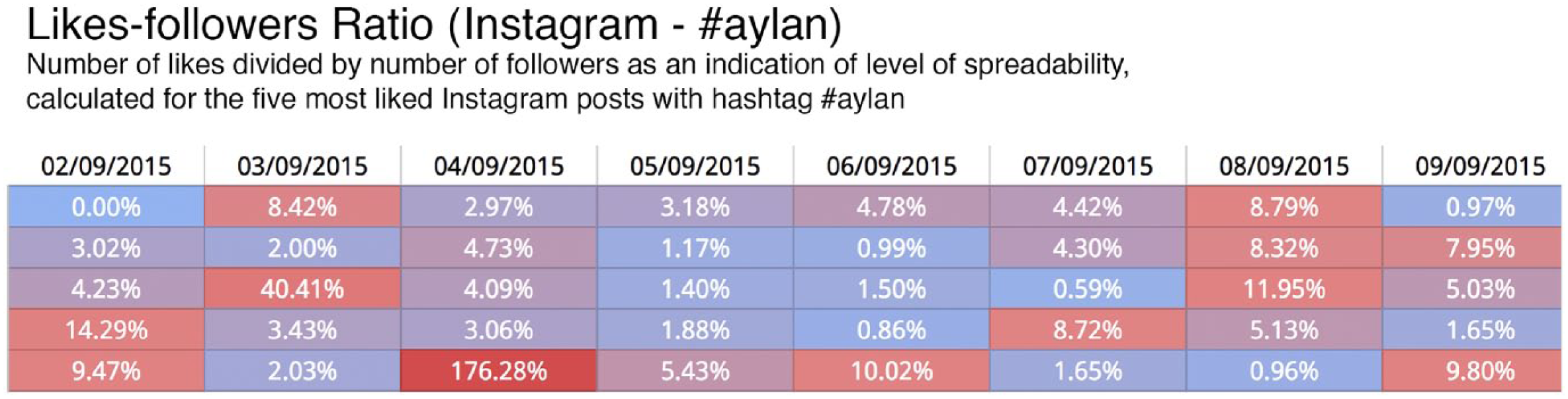
This ratio indicates how well posts travelled outside the poster’s followers network. © Marloes Geboers.
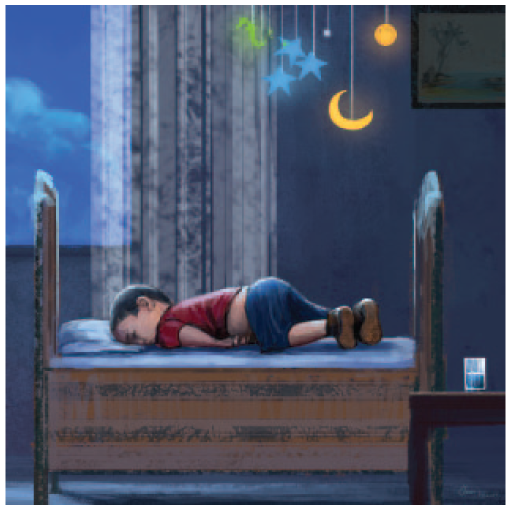
The most liked post in the seven-day time frame and the post with the highest likes–followers ratio. © Ömer Tosun, reproduced with permission.
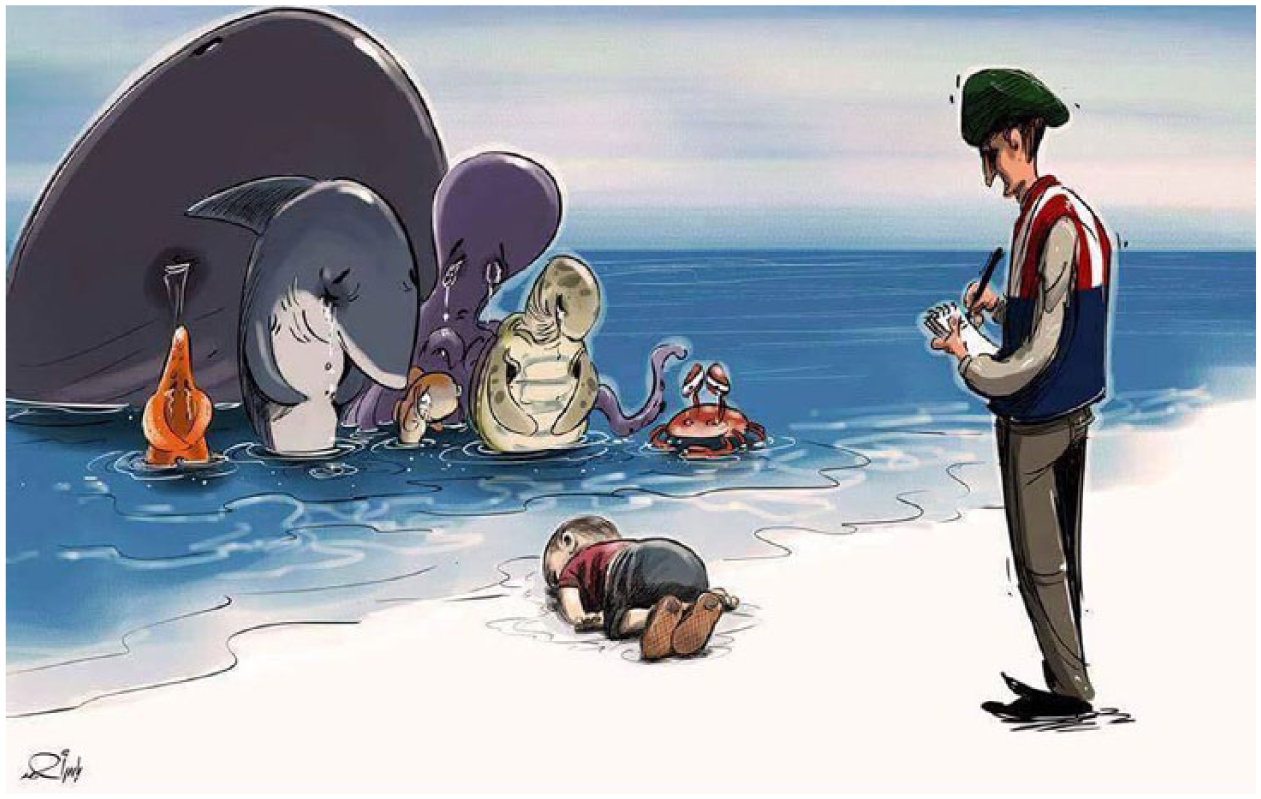
Day three most liked post and ranking second in the likes–followers ratio. © Azzam Daaboul, reproduced with permission.
Constructions of otherness and ways of observing suffering
The most liked post in the time frame 2 to 9 September is the same as the image with the highest likes–followers ratio (Figure 3). It is a work by Ömer Tosun, a Turkish artist who tweeted it a couple of hours after the publishing of the original photographs. The illustration ‘repairs’ the tragedy of Alan Kurdi from being dead to being asleep by re-contextualizing the background of the original image. Alan is not lying in the cold surf, but asleep in a typical child’s bedroom which could be anywhere in the world. A mobile sheds soft light in the calm serene room. His posture adopts that of a common sleeping position in toddlers across the world. The audience sees a sleeping child. However, it reads the illustration in another way thanks to two textual hooks that connect the illustration to the iconic image of the deceased Alan: his clothing and his posture (Mielczarek, 2018). The red shirt, shorts and shoes, as well as the pose of the boy, keep the meme tethered to the original photograph, creating the possibility for the audience to read this message as: ‘this is what should’ve been’. In this way, we may rightly recognize a meme, as the image’s message can merely be read by commonly shared cultural phenomena (Shifman, 2014). This message constructs the suffering other as similar along the lines of ‘this can be your own or anyone’s child, nephew, etc.’
The artist tagged his tweet with #KiyiyaVuranInsanlik and the tweet text: ‘I am only dreaming of what could have been, I think this expresses what a shame it is’ (available at: https://www.huffingtonpost.ca/2015/09/04/syrian-boy-illustration_n_8089122.html). Very literally, the text in the tweet tells us how observers of suffering are emotional observers as Boltanski (1999) and Mortensen and Trenz (2016) understand it. Through introspection, they position themselves and their feelings in relation to other observers of the same misfortune. The suffering of the victim is internalized and turned into the spectators’ own suffering by proxy, which they describe to other users on, in this case, Instagram. The users that hit the like button, engage in self-reflexive observing. They’ve encountered the post – or monitored it, in the words of Boltanski (1999) and Mortensen and Trenz (2016) – and express themselves by aligning or diverting from the image’s message through liking (or not liking) the re-working that in itself portrays self-reflection and even, according to Mielczarek (2018), atonement.
The top liked image on the day of the publishing of the originals (2 September) is, as earlier mentioned, already a modified image with 901 likes. It depicts a photograph by Nilufer Demir that went viral. It is modified by adding a crying emoji and the Arabic text for ‘Toz’. Toz can have multiple meanings, ranging from ‘whatever’, ‘pffff’ to ‘f*cked’. Freely translated, the post caption reads: ‘your fate is to run from death to end up dead’. We might assume, going from the emoji and the caption text, that this ‘toz’ is meant sarcastically, stating that this should not be something that we can say toz to. In this sense, the emoji and the toz are deliberately juxtaposed to enhance the message of grief and atonement. Unfortunately, the post and accompanying image could not be retrieved at the time of the visual analysis as it was taken offline. The image is still visible in Figure 1, albeit small. The caption could be found in retrieved metadata that was generated through the scraping tool. An emotional mode of spectatorship is most explicit in the use of the emoji and the word ‘toz’ that communicated the emotion of the person who made and disseminated this image and, again, all the people who engaged in liking the image. The act of aligning with this emotion also pertains to self-reflexivity, showing how multiple modes of spectatorship can be present, or evoked by, one image.
On the second day, when the Kurdi images were highly debated in news media, an original photograph of Demir is most liked with 31,088 likes. As this study focuses on user created or modified images, I discard it for analysis. Note that there is a user-created image coming in second: the illustration of Ömer Tosun, which is analysed above, as top liked and most widely spread image.
On the third day, an illustration (see Figure 4) ranks first with 29,299 likes. This is also the second most spread image with a likes–followers ratio of 40.41 percent, as mentioned earlier (see Figure 2). The illustration of mourning sea animals and Alan was first tweeted on 3 September by graphic designer Azzam Daaboul. Again, the clothes and the posture of the boy link this illustration to the original photograph. Daaboul tweeted this illustration with the text: ‘We are losing ourselves as humans, and the people will die around the borders’ (available at: https://twitter.com/AzzamDaaboul/status/639358232687980548). Going from the accompanying caption, the visual message can be read as depicting animals in shared grief, almost representing the animal kingdom as a community grieving together, despite their own differences. The human world is accused of a lack thereof, hinting that humans are no better or even less moral than animals.
Through using different animals, united in solidarity for a victim that is of another species, emphasis on solidarity while also referring to differences can be interpreted as, what Chouliaraki (2013) would call a more cosmopolitan solidarity, in which solidarity should be something that can be called for without having to refer to commonalities or other notions of others being like us.
Both emotional as well as critical ways of observing the suffering of Alan can be read in the visual narrative of the illustration as it shows emotion but also critique. The Instagram post using this image is accompanied by a text that is quite different from the tweet text, translated:
2
You were so little. That fish. Couldn’t shred your cheek. And so great that the sea dedicated you to the shore with respect. Kurds die splendid.
Two hashtags follow and then the text continues: Dear friends, Kurds live in Syria and many other countries. Be informed that this little innocent kid was Kubani Kurd. Just it. All children in the world are innocent. We as Kurds are annoyed to hear that this Kurd kid has been found in this terrible situation. How could you ignore this big matter and accuse us as racist! What can I tell you?! Please don’t involve in nonsense matter.
This caption is critical in its mode of observing suffering as it tries to connect the tragedy of Alan to the larger tragedy that caused his death: the Syrian war and resulting refugee crisis. In this way, both the illustration and the caption set themselves apart from messages in other resonating posts in the first days that are more about emotions of the audience and thus self-reflexive.
On the fourth day, again an illustration is the top liked image with 27,389 likes (see Figure 1, day 4, top image). It depicts Alan with, in the background, a paper boat. This is a powerful symbol in that it refers to Alan’s childhood and it is an ephemeral object, referring both to the lost life and the vulnerability of children in general. Childhood is often the vehicle to visually communicate and cut through cultural and ideological barriers. It is, therefore, adhering to what Markham (2013) describes as depicting the other as a similar other.
The critique on this ‘common humanity’ attempt is that it ignores the plurality of world histories and cultures and therefore non-Western others are ultimately excluded from our solidarity. Here, the other is non-Western but it is childhood that is used to appeal to the audience. This childhood is, as such, used to cut through cultural and ideological differences. Markham describes this as a practice of inviting solidarity on the basis of being like us. This symbolic referral to childhood is also happening in the already described most liked and most spread image, the illustration of Alan sleeping in bed with a mobile above his bed as the symbol of childhood.
Also similar to the depiction of Alan asleep is the emphasis of this illustration on emotional and self-reflexive observing of suffering: a vulnerable life is lost and the shared grief of the audience is depicted in the visual narrative. The audience, through the ‘act of liking’, engages in a self-reflexive act that signifies shared sentiment.
On day five we see a collage of two photographs and one illustration, receiving 9,994 likes (Figure 1, day 5, top image). It contains one of the original images alongside an image of Alan being alive and playing football. Playing football is a way of cutting through cultural and ideological barriers in order to be able to construct the other as similar to the western audience. The juxtaposition between an image of Alan alive and the depictions of him dead amplifies the emotional impact of this collage in much the same way that Olesen (2018: 665) described: a ‘normal’ photograph creates a chasm, an unbearable distance between what should have been and the tragedy that is. According to Olesen, this exacerbates emotions such as shame and anger. But, interestingly, it might also be part of a strategy that Mielczarek (2018) calls the reduction of the ‘burden (and maybe even guilt) of witnessing and even allowing this death to happen’ p. 14.
The collage also depicts an illustration that is a re-working of the original photograph of the body of Alan showing mourning fish, telling a story about humanity in a somewhat similar vein to the illustration with the mourning sea animals. If fish are the ones mourning, then where is our human morality, it seems to ask. Alan is depicted having angel’s wings, something seen in more re-workings that circulated online and that can be seen as funerary memes, sending Alan into a heavenly realm, commemorating his death but also revering the child in a sacred way. Despite this visually powerful collage, it is also the day on which we see a sharp decline in user like activity.
On the sixth day, the decline in user activity is accelerating. That day, a video is most liked with merely 1,378 likes (Figure 1, day 6, top image shows a still). The video is accompanied by an explanatory caption about who made the clip. It is based on the original composition but then the clip proceeds with an illustrated boy ‘standing up from death’ – in this way visually resurrecting and reversing the tragedy, a common strategy in funerary memes – and proclaiming the following text: My name is Aylan, I am a Syrian Child, can someone say to me: what was my guilt in this war?
This is the first re-working that is not depicting the emotions felt by its creator (observer) and it is also not using visual symbols of childhood in order to stress a common humanity. It does, textually, refer to the innocence of the child and his non-existent guilt in this particular war. This message, although referring to childhood innocence, also allows for a more critical positioning when witnessing suffering as it leaves room for referral to the Syrian war in general as the underlying cause for this tragedy.
Then, on 8 September, the most liked and most spread illustration of Alan asleep in a bed safely is ranked first with 1,152 likes (Figure 3) and a short caption stating #aylan and three ‘broken hearts emoji’, the latter conveying the emotionality of the person posting the image, this way depicting behaviour that is the result of emotionally observing suffering.
On 9 September, an interesting image ranks first with 953 likes (Figure 1, day 8, top image). It is a combination of an original photograph of Alan and an image of multiple people saving stranded whales. It aims to be critical towards the inaction of people regarding the refugee crisis by addressing the condition of privileged Western actors who live in a world where whales are saved and human toddlers are not. This fits the self-reflexive mode of solidarity that Chouliaraki (2013) describes, portraying the absurdity of the Western lifestyle when compared to the condition of vulnerable others. Note that while this image collage is described as a typical example of using the absurd Western lifestyle in comparison to the hardship of others, at the same time it is also the result of observing suffering critically: it accuses Western people of not having their humanitarian priorities in order. This somewhat more critical reworking, which is also exemplary for other images in the top five most liked images after the first four days in the studied time frame, also coincides with dropping numbers of like activity.
Although the image of saving whales is also present in an earlier stage with higher like numbers – day three (September 4) – ranking second, in absolute numbers it falls way behind the number one of that day: the illustration with sea animals mourning.
Interestingly, the first image in which other victims of the refugee crisis become visible, comes second on the last day that was studied (9 September). That day, ranking fifth, evil personas, such as the devil, are playing cards while a drowned Alan is depicted on a TV screen in the background. Another interesting image is number five on day six (7 September) depicting (and mocking) a ‘typical Instagram style’: that of a cappuccino topping, but this time the topping depicts a call-out to stop the war, including a military tank as a symbol of war, portraying a more critical way of positioning the self.
Discussion
In the results, answers to three questions on resonance, otherness and modes of spectatorship provide an insight in what the audiencing of images – the way visual post content gets diffused and reacted upon by the public – reveals about observing suffering in the context of Instagram. In this section, the outlined constructions of otherness and modes of spectatorship of suffering will be connected to the fluctuating user attention – in term of like activity – over the studied time span. This allows for a critical approach towards observing suffering in a social media context.
Dynamics of resonance
The likes and spreadability analyses have provided a day by day visualization (Figure 1) that shows not only which re-workings of the Kurdi photographs resonated, but also how user attention sharply declines after three days. This decline, interestingly, co-occurs with a change in the depicted constructions of otherness and modes of spectatorship. Symbols of war or refugees other than Alan Kurdi are all invisible or less visible (significantly less liked) when like activity is high in the first three to four days where most images emphasize felt emotions of the audience. Note that emotionality does not exclude a critical way of observing others, as spectators are also expressing political attitudes and preferences by accusing, denouncing or calling for action. Namely, through depicting a lost humanity, humanity itself is also accused of precisely that. However, such re-workings are only visible after four days, when user attention is already somewhere else.
More critical re-workings that move away from ‘mere’ emotional or self-reflexive depictions surface only from 9 September, seven days after publication of the original photographs. It is also a time when user attention has already dropped, observed from the sharp decline in like numbers. Obviously this is also an important limitation of the methodology: a sharp decline in like numbers may point to low user attention in this particular Instagram space; however, we cannot be certain that a decline in likes is also a decline in actual user attention for the Alan Kurdi case in general. For this, we would need an ethnographic approach.
It is also likely that the audience that persists in following and liking the case on Instagram is an entirely different community in terms of demographics. It is known from extant literature how demographics inform people’s behaviour and actions when confronted with proximal and distant suffering: one such factor is geographical distance, but also class moralities (Ong, 2015). Having a migrant background can get in the way of feeling ‘a fuller solidarity’ as settled migrants, although feeling empathic, also question what new arrivals mean for their own social status as settled migrants (Cabañes, 2019).
Constructions of otherness and modes of observing suffering
As shown earlier, most images in posts that are highly engaged with can be seen as expressions of emotional and self-reflexive ways of observing suffering. They depict how users position themselves and their feelings in relation to other observers on the Instagram platform. The suffering of the victim is internalized and turned by proxy into the spectators’ own suffering, which they describe to other users on Instagram. In turn, other users are engaging in a self-reflexive mode of observing (Boltanski, 1999; Mortensen and Trenz, 2016) as they like and comment on visual expressions of (self-reflexive and emotional) solidarity. This ‘internalization of tragedy’ obviously does not exclude ensuing action by, for example, contributing to charity, but rather it shows how tragic content needs to adhere to a certain logic of personalization and internalization of suffering in order to gain traction. This personalization is made easier when a victim is constructed as similar to us.
When zooming in on most liked and most spread images, the latter also successfully escaping the follower networks of posting users, we can see how symbols of childhood – the mobile hanging on the bedroom ceiling (Figure 3) and the paper boat (Figure 1, day 4) – are present and cut through ideological and cultural barriers, trying to appeal to the audience by using the notion of a common humanity and constructing the other as similar. Such re-workings construct the suffering other as similar along the lines of ‘this can be your own or anyone’s child, nephew etc.’, asleep in a crib or playing football (Figure 1). In contrast, the depiction of sea animals (Figure 4) might point to the importance of acknowledging differences while at the same time upholding solidarity. Apart from the latter illustration, the other re-workings in the days of intense user attention, construct the victim as being like us.
Most resonating posts thus contain re-workings that relate to others, ‘merely’ by an imagination of ourselves. The danger of this, according to Chouliaraki (2013), lies in the fact that commitment and justification for solidarity remain vague and a matter of personal lifestyle choice. It can be assumed that the reach of re-workings of the Alan Kurdi images was significant only in the first three to four days of the studied time span. From this, I derive that self-reflexive re-workings and their likes counts facilitated by Instagram put ironic solidarity to the fore in the realm of Instagram, obscuring the larger causes of Alan’s death – the Syrian war and its refugee crisis.
Conclusion
This study provided an insight into the potential of user-created re-workings of iconic photographs as visual signifiers of different ways of observing suffering others. By following a digital methods approach, that is by repurposing platform native features – in this case the Instagram like feature, this study could also assess what visual content resonated in the Instagram space. The sharp decline in like activity four days after the publishing of the Kurdi photographs more or less coincides with the appearance of re-workings that are somewhat more critical in that there is more ‘visual’ space for the actual causes of Alan’s death: the Syrian war and the refugee crisis in general.
This points to an increase in visibility of political and critical re-workings but this happens when users’ attention is already elsewhere. In times of spikes in user attention, emotionality and self-reflexivity make up the majority of resonating images. This self-reflexivity is also present in the consumer-focused appeal imagery of contemporary humanitarian campaigns, where the suffering of victims gets sanitized and victims are either themselves invisible or their voice is absent (Chouliaraki, 2013).
In the Instagram images tagged with #aylan, the victim is very much visible. However, while the sufferer is present in the images, the suffering makes way for the emotions of the creators of the visual who write themselves into the visual narrative, adding their own feelings to the iconography of the originals. Through liking these re-workings, the audience engages in internalization of the suffering of the other. In so doing, the voice of sufferers is replaced by the voices of emotional spectators. The large volumes of users that ‘like’ the visual messages of these emotional and self-reflexive spectators tend to ‘crowd out’ the critical re-workings and confrontations with disturbing photographs. The latter still need to be seen as they are.
In her recent study, Mielczarek (2018) outlines how the rhetorical power of iconic images might be eroding due to re-mix culture and digital re-appropriation. This study shows how such re-workings crowd out both the original photographs, as well as more critical re-workings, through the affordances of re-mix culture and the ‘like’ logic of social platforms. People align or divert from visual narratives and through the act of liking amplify these self-reflexive visual messages. I argue that the personalized logic of social platforms intensifies the focus on the self, making victims only visible when they can be re-appropriated in a scene that is recognizable and identifiable. This, in turn, leads to a solidarity restricted to people like us.
Footnotes
Funding
The author received no financial support for the research, authorship, and/or publication of this article and there is no conflict of interest.
Notes

Biographical Note
MARLOES GEBOERS is a PhD student and member of the Digital Methods Initiative at the University of Amsterdam. She is also a member of the Visual Methodologies Collective, a research group affiliated to the Amsterdam University of Applied Sciences. Her research blends traditional visual methodologies with digital methods approaches in order to develop novel methods that take into account both image content as well as the ways such content is audienced within networked spaces. Her work focuses on the visual communication of solidarity with Syria across social platforms.
Address: Faculty of Digital Media and Creative Industries, Amsterdam University of Applied Sciences, Rhijnspoorplein 1, Amsterdam, 1000 BA, The Netherlands. [ email: