







Abstract
This article reviews Zhuangzi’s N Generations, a modern dance performance, directed and choreographed by Qi Liu at the Guangdong Art Theatre in Guangzhou, China, on 17 December 2019.
In the sound and fury of a modern city, how can we achieve peace of mind? Zhuangzi’s N Generations, performed by the internationally well-known Guangdong Modern Dance Company and premiered in Guangdong Art Theatre on 17 December 2019, explored a philosophical idea from the perspective of Daoism. This 70-minute performance, a polyphonic dialogue between body language and new media art and music experiments, attempts to enact the elusive principles of Zhuangzi (369–286 BC), a leading philosopher in the Daoist tradition, and offer the audience a spiritual exercise and a way of rethinking their contemporary lifestyle.
The director and choreographer Qi Liu places her effort to reclaim Chinese traditional cultural heritage in a cosmopolitan setting, ingeniously blending various art forms to reconfigure a surreal theatrical space that allows for a certain degree of interpretive ambiguity. The highly symbolic interactions unapologetically explore the condition of being, registering a spiritual trajectory from mounting anxiety to eternal serenity. In the first scene, the deep blue sea that represents Zhuangzi is replaced and disrupted by the blue jungle of the Central Business District, alluding to a deeply-grounded tradition that sees a stormy metropolis as somewhere that is pernicious and threatening. With ominous chords and threatening overtones, buildings shake vigorously and are turned upside down, representing their residents’ inner turmoil. Towering skyscrapers loom over their inhabitants, who struggle with gratuitous brutality. The horror of the city with its rapid onrush of crowded impressions and noise of train engines is blaringly vivid (see Figure 1).
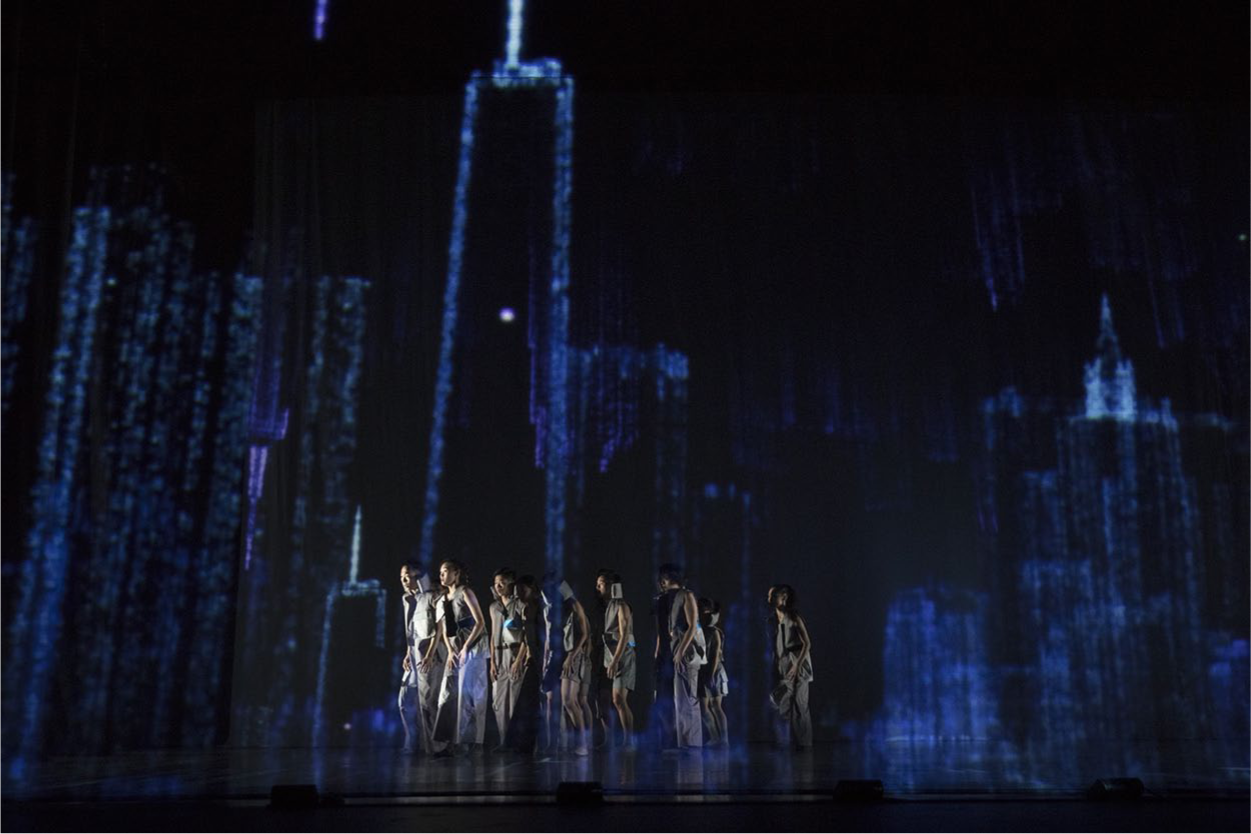
‘The grander the city, the more cramped its creatures.’ Zhuangzi’s N Generations: a modern dance performance, directed and choreographed by Qi Liu; composer Chuyuan Huang, clothing designer Xiaochun He, new media art designer Yong’en Ke, stage and lighting designer Shihao Liu. Performed by Guangdong Modern Dance Troupe, Guangdong Art Theatre, in Guangzhou, China, on 17 December 2019. © Photograph: Xiaoyi Lin, 2019. Reproduced with permission.
Yet, the performance does not easily ascribe the plight of existence to the city, but rather follows Zhuangzi’s eyes in exploring the wisdom that enables one to defuse, counteract and dissolve these external threats. The next scene initially presents a scenario of people crawling in mud, featuring a first pair of dancers who demonstrate how people support each other in tough conditions. This part reenacts Zhuangzi’s parable of how fish stranded on land cling to each other, breathing humid air and slobbering over each other. However, this symbiotic relationship turns into a heavy burden as indicated by a second pair who take turns to put each other on their backs and can hardly bear such a weight. And then the stage is dotted by a succession of dancers, all writhing in their own ways, symbolizing different varieties of existential struggles. Echoing through the whole theatre is a litany that ‘desire is a train, marching onwards; desire is the skin, getting older.’ In this pandemonium, a female dancer teeters shakily on tiptoe, as if she is under the control of something. Also taking central stage is a dancer moving forward on his knees, his head thrown back, face upward, both hands stretching upward, as if grasping or begging for something, yet falling to the ground, compelled to crawl along slowly. Generally, the dancers’ gestures or actions are strange, shaky or spasmodic, choreographic choices that radically subvert prevailing codes of the acceptable form.
Celebrating Zhuangzi’s detachment from the whole predicament, the performance switches to dramatize this wretched condition on a hilariously comic, slightly absurdist note. Cheerful music, occasionally punctuated with birdsong and running water in a festive setting, contrasts sharply with painful gestures, teetering postures and fear of falling. Among the other dancers, a trio cling to each other, moving in unison and screeching, yet talking gibberish and thus offering a provocative and scathing socio-political satire. The more nuanced examination of women’s lack of agency is made in the following scene when a female dancer is confined in a narrow space and a succession of dancers, mostly male, come forward and inadvertently or peremptorily toy with her body, twisting it or putting it in various postures, including on her knees and even standing on her head. The audience is made to realize the ubiquitous manipulations the female body encounters in a patriarchal society. Strikingly, the female dancer manages to maintain a delicate balance; her graceful body language symbolizes Yin qualities of fluidity and flexibility rather than passivity and pathos, suggesting a Zhuangzian way of surviving intact by following the Dao of nature. A large mirror as a backdrop calmly reflects what is happening on stage, urging us to adopt a higher perspective in order to perceive the world. As Zhuangzi indicates, a perfect mind resembles a mirror, not denying or embracing, reflecting but not storing, and therefore avoiding victimization, whatever the situation.
Zhuangzi’s mirror/mind posits that one is ensnared, imprisoned and oppressed by one’s own desires, an idea eloquently visualized through a dancer chasing dots of light, accompanied by the cacophony of a train engine. The myriads of desire symbolized by the dots of light allure or drive us hither and thither, reducing us to a frenetic state; eventually the twirling light dots form a tightly closed ball-like space, and the eager hunter is enveloped and immobilized by it. Then the scene opportunely changes to an arduous process of self-emancipation enacted by a group dance – in tune with the stronger music, dancers interact with the violent pull of the enormous light columns that form a gigantic web. When the web of desire disintegrates, the audience feels a corporeal release, a calm further reinforced by Zhuangzi’s equalizing vision – in the undulating sea of sands that conveys a sublime grandeur, dancers and later their virtual images gradually mingle with the sand particles and disappear, a whole civilization in the process of quiet weathering.
This performance also provides an insight into the common ground of East and Western philosophies. The director Qi Liu is not acquainted with American Transcendentalist Ralph Waldo Emerson, yet her visualizing of Zhuangzi’s free and easy wandering is intriguingly reminiscent of Emerson’s vision about self-reliance and the transparent self. Zhuangzi exhorts us to stop our desire to chase after things, which analogically resembles facing outwards, marching onwards; similarly, Emerson urges us to stand upright, to explore within, to concentrate rather than to lean, to beg or to wander. For both, an inner utopia provides a sense of invigoration and an enrapturing epiphany, enabling us to perform with freedom and abandonment. The meditation scene marked by splendid magnificence is both Zhuangzian and Emersonian. Accompanied by soothing music, a stream of soft, white light pours down and washes the world (see Figure 2). Under this overarching bright beam, the prostrate or supine figures in the white diaphanous gossamer emblematic of a clear mind, slowly rise up and stand erect, as if they are bright galaxies of immutable lights. They no longer get entangled with each other, begging, reeling or moving frantically, but they stand alone, disengaged, turning placidly in their own orbits, as if they are concentrating upon their own individual universes or wandering in the far distance. Such rapt contemplation in the fading somatic experience of the here and now suggests Zhuangzi’s self-forgetting, but also visually features Emerson’s ultimate state.
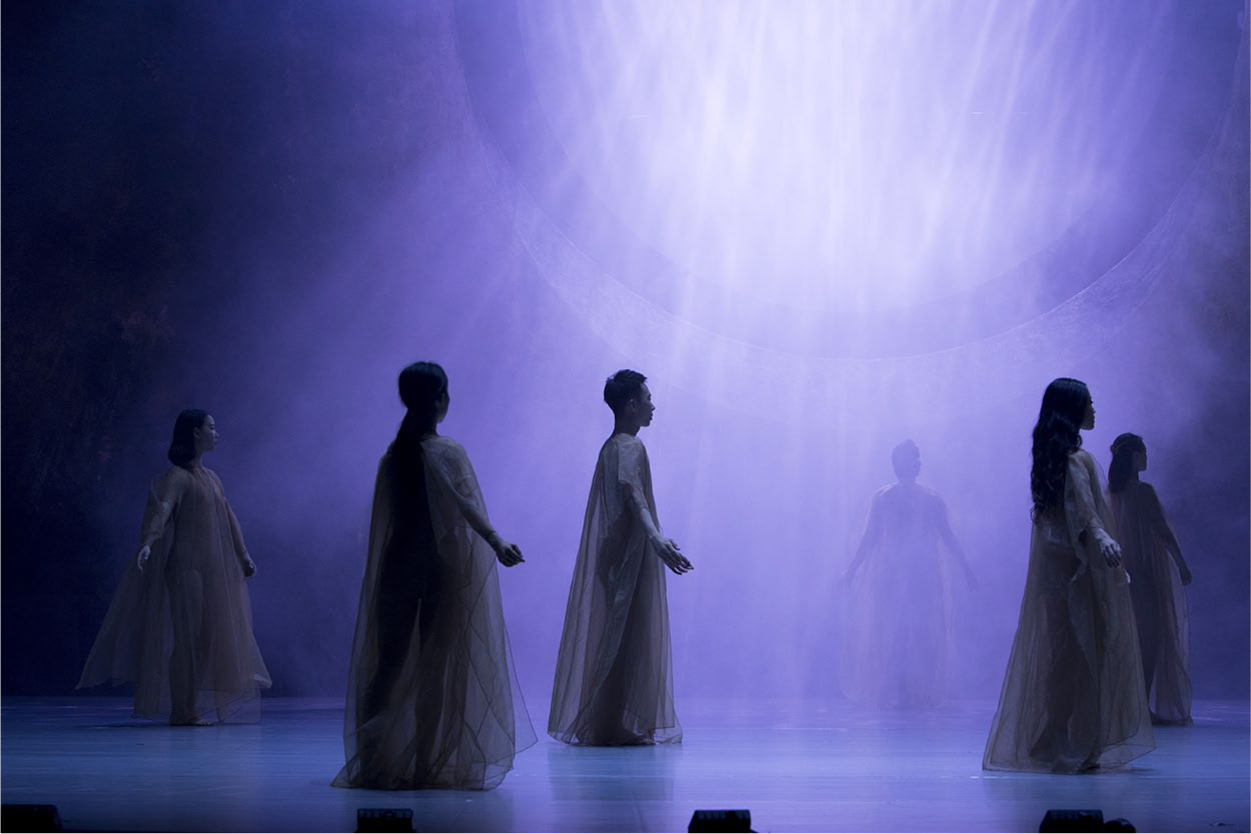
‘Meditation’. Zhuangzi’s N Generations: a modern dance performance, directed and choreographed by Qi Liu; composer Chuyuan Huang, clothing designer Xiaochun He, new media art designer Yong’en Ke, stage and lighting designer Shihao Liu. Performed by Guangdong Modern Dance Troupe in Guangdong Art Theatre, Guangzhou, China, on 17 December 2019. © Photograph: Xiaoyi Lin, 2019. Reproduced with permission.
Footnotes
Acknowledgements
I would like to thank Tom Patterson for his comments and editing.
Funding
This work is supported by the National Office for Philosophy and Social Sciences under Grant Number 17BWW002, and there is no conflict of interest.

Biographical Note
YANBIN KANG is a Professor of English at Jinan University. Her project explores English writers from the perspective of Daoism and Chan Buddhism and the visual expressions of Dao in a cross-cultural context. She has contributed to journals such as Style, Orbis Litterarum, Renascence, English Studies in Africa, The Emily Dickinson Journal and English Studies.
Address: Jinan University, Room 121, 2nd Building for Social Sciences, 601 Huangpu Avenue West, Guangzhou 510632, China. [emails: