






Abstract
This article examines the public art practice of the Chinese performance artist Zhao Bandi, aka the ‘Panda Man’, and situates it in relation to the social activism of the Chinese consumer rights campaigner Wang Hai, aka the ‘Anti-Counterfeiting Hero’. Contextualizing the appropriation strategies of these two unlikely figures within contemporary China’s changing legal, market, and media spheres, this article places global contemporary concerns with authenticity, copyright, counterfeits, and fakes in relation to notions of performativity and behavior. Challenging the expectation that appropriation need resemble oppositional or antagonistic strategies of Western precedent, it argues that Chinese figures like Zhao and Wang presented transformative models for consumption and citizenship in 1990s China, laying the groundwork for today’s public discourse of ‘shanzhai’ − a distinctly self-conscious Chinese claim on appropriation.
In 1999, a cute and colorful series of posters was seen throughout Beijing’s underground subway system, and soon after, in international art venues from the Guangzhou Triennial to the Venice Biennale. One of the posters depicted the Chinese performance artist, Zhao Bandi, cartoonishly dressed as a detective and protectively clutching a stuffed panda doll (Figure 1). It featured comic-strip style speech bubbles, through which the Little Panda asks, ‘Are they clones of me?’ The detective, gazing wide-eyed through a large magnifying glass, answers, ‘No, they are fakes!’
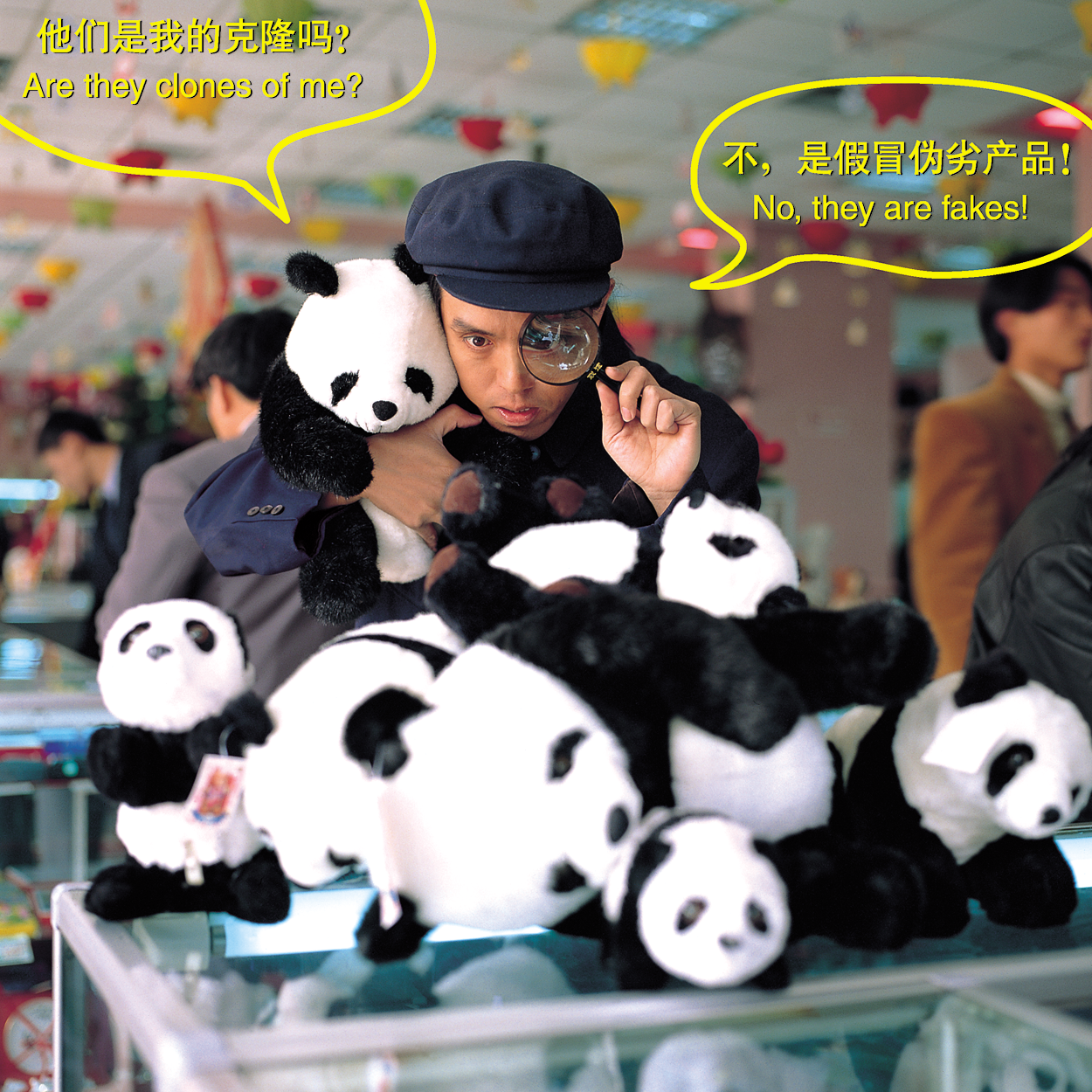
Zhao Bandi and Little Panda, Are They Clones of Me? poster, 1999. Image courtesy of the artist.
Since the onset of China’s economic liberalization in 1978, problems with the quality and authenticity of consumer products have scandalized the Chinese public and generated global distrust of Chinese-made products. Chinese ‘fakes’ have been said to represent the rampant evils of global capitalism, the corruption of Chinese officials and entrepreneurs, and even the moral failings of the Chinese people as a whole. In the childish dress-up and charming repartee of this poster, Zhao’s exaggerated fear of a pile of ‘counterfeit’ panda dolls poked fun at such hysteria, and at the purist distinctions upon which claims of authenticity are often based. As a work of art, the poster itself parsed multiple layers of truth-value by humorously distinguishing the popular and ubiquitous counterfeit from the officially-sanctioned product; the high-tech clone from the ‘natural’ specimen (which, in this case, is a toy doll); and the staged conceptual performance from the true photographic record. Made at a time when all-out consumption was still new in China, Zhao’s graphic poster also recalls a particularly unique Chinese social activist, the ‘Anti-Counterfeiting Hero’, Wang Hai. Together, the two figures speak to the emergence of a legalistic and consumerist civil society of 1990s China, laying the groundwork for the consciously appropriationist culture of consumption of today.
In the mid-1990s, Wang Hai was hailed as a new model Chinese citizen, a consumer rights activist who searched out substandard and counterfeit products in the Chinese marketplace and, taking advantage of a newly-minted consumer protection law, sued the offending companies for financial compensation. His immediate rise to fame was part of the national embrace of ‘rights-defending’ (weiquan) activism, and the ‘Wang Hai phenomenon’ became a popular movement in which thousands of Chinese citizens, following in his example, scoured the market searching for consumer rights violations in the form of ‘fake’ products. Zhao Bandi’s poster deftly portrayed these kinds of new consumer anxieties and behaviors, and called attention to the sweeping changes brought about by the new legal and regulatory regime constructed in preparation for China’s ascension to the World Trade Organization in 2001. Already an internationally-exhibited artist at the time, Zhao approached these complex subjects through the strategy of artistic appropriation, demonstrating his ease with an international language of conceptual, performance and lens-based art practices, but using it to assume a public persona that would address these social issues in popular fashion.
In this article, I first look at Zhao’s eclectic public art practice, which consistently appropriated each new development of China’s burgeoning new media landscape while engaging with topical social issues from the 1990s to the present. I then examine the activist practice of Wang, who would turn the model status granted to him by official Chinese policy and the Chinese news media into opportunities for political, social, and entrepreneurial self-styling. I place Zhao’s distinctly cute practice in direct relation to the distinctly serious practice of the activist Wang, contextualizing their respective uses of ‘appropriation’, both made possible by dramatic developments in the media and legal culture of contemporary China. In sketching out a comparative account of Zhao’s art and Wang’s activism, my goal is furthermore to read the political intents and functions of these two unlikely Chinese figures against the theoretical frameworks for appropriative practices set by Western precedents. Finally, I place the late 1990s and early 2000s art and activism of Zhao and Wang at the root of the more recent Chinese cultural discourse of shanzhai – a popular phenomenon which builds on the mix of humor, consumption, and citizenship that Zhao and Wang introduced into the public sphere.
Appropriation as an artistic strategy in contemporary art has been historically framed by the critical engagement of American artists with US copyright law since the 1980s. In this art-historical discourse, the law is often prefigured as a hegemonic state apparatus, and artistic agency is voiced through appropriation, which seemingly renders any simple transfer of property into an aesthetically meaningful act (see, for example, Crimp, 1993; Owens, 1980; Welchman, 2001). In cultural studies scholarship rooted in the Birmingham School, the use and abuse of commercial objects and imagery have also been privileged as productive forms of consumption that assert countercultural, subcultural, or resistant citizenship (see De Certeau, 1984; Fiske, 1989; Garcia Canclini, 2001; McCracken, 1988). As the legal cultural historian Rosemary Coombe argues in The Cultural Life of Intellectual Properties (1998: 57–8): ‘The consumption of commodified representational forms is productive activity … These practices of appropriation, or “recoding” cultural forms, are the essence of popular culture.’ Tellingly, Coombe’s use of the term ‘recoding’, is footnoted to the art historian Hal Foster, who, in his Recodings: Art, Spectacle, Cultural Politics (1985: n. 32), in turn relies on the cultural studies scholar Dick Hebdige’s Subculture (1979: 170) in order to describe a practice that ‘performs’ resistance. The term ‘appropriation’ thus invokes two intellectual traditions concerned with postmodern consumer culture; it operates in both high aesthetic and popular cultural registers, and allows for the conflation of artistic references to mass culture with creative consumption in everyday life. In other words, whether addressed towards the domain of high art or to that of prosaic consumption, the term ‘appropriation’ raises the same political stakes.
This combined intellectual pedigree results in two key problems for contemporary scholarship, particularly of non-Western contexts. First, it risks reducing a broad range of imitative and referential activities into a single notion of ‘appropriation’ and a concommittantly homogenized politics. This obscures an ever-expanding range of artistic and activist strategies that seek to engage not only with copyright laws, but with other regimes of legal, market, and social authority. Second, although harmonization with US law is an avowed political goal of many non-Western governments, artists and activists who consider themselves agents of political change operate in juridical situations that are vastly distinct from the American copyright context from which the term ‘appropriation’ is borrowed. Over-emphasis on American copyright law, and for example, on the privileged ‘free speech’ it grants to parody and satire, furthermore limits our understanding of appropriative practices outside the American context (Buskirk, 1992).
Artistic and activist ‘appropriations’ of consumer or capitalist culture resulting in encounters with the apparatuses of the state outside the American copyright legal regime are neither new nor unique to contemporary China. The Japanese conceptual artist Akasegawa Genpei’s Model 1,000-Yen Note Incident (1963–73), in which the artist was convicted of currency counterfeiting and had no legal recourse to satire – or indeed any privileged form of art or ‘anti-art’ speech – is one complex and prescient case. Wary of reducing artists’ success or failure in the legal sphere to their influence upon the culture at large, my contention is that there is much to be gained by broadening the examination of artists’ engagements with legal culture beyond the contours provided by the legal regime itself.
If the court of law is not sufficient as a court of art, neither, I submit, are canonical American artists’ victories or strategies sufficient measures of non-Western artists’ social or political relevance. In the 1990s, for example, Chinese contemporary artists who made skillful visual references to 1960s American pop art were regarded in the international art market as harbingers of an emerging Chinese consumer consciousness. Famously, Wang Guangyi’s Great Criticism paintings of that decade, which juxtaposed socialist realist imagery with global luxury logos, were declared to be ‘Warholian’ and hence assumed to approximate the subversive positionality assigned to Andy Warhol’s appropriation of consumer products and logos. The global recognizability of Wang’s visual aesthetic led to the even broader presumption that 1990s Chinese consumer culture was belatedly repeating an earlier Western period, one in which commodification could similarly be challenged through the visual juxtaposition of consumer culture imagery with localized ‘Chinese’ icons. This all too simple game of mistaking stylistic resemblances for political ones belied the complexity of China’s 1990s political landscape and flattened varied artistic expressions into global shorthands for difference (‘socialist’ or ‘capitalist’). More significantly, and ironically, it muted individual Chinese artists’ political speech acts by homogenizing their positions into a single stylistic gesture called ‘appropriation’, framed by its attendant (and passé) oppositional politics. In re-examining the cultural and legal valances of appropriation, we need to both question the way cultural studies looks to artistic or creative expression romantically (as essentially political), and at the same time be wary of the transnationalization of the artistic appropriation of consumption imagery, as if it were always political and in the same manner. This article thus aims to rethink the aesthetic and political burdens subsumed under the term ‘appropriation’ within a late 1990s and early 2000s Chinese legal and artistic context, to offer a reconsideration of Chinese appropriation practices that, surpassing the narrow fault lines defined by the canonical American framework, specifically engage with contemporary China’s legal and media culture.
The Chinese party-state’s construction of a ‘legalizing economy’ (jingji lifa) in the 1990s signalled the creation of a new legal regime within a socialist market economy, and restructured the incentives and permissible limits of consumer and citizen action (Wang, 2001: 92). New consumer and citizen xingwei, or ‘behaviors’, became visible, diverse and contestable. Semantically, the Chinese term ‘xingwei’ encompasses both the idea of ‘daily conduct’ in its quotidian sense, and that of ‘action’ in all its socio-political potential. Thus, the new ‘behavior’ demonstrated by the consumer rights’ activist Wang Hai was approvingly recognized as ‘individual xingwei’ by some Chinese officials, who hoped that such a model example of activism would bring about broader social change and raise citizens’ awareness and desire to exercise their rights. As ‘performance art’ in mainland China is similarly referred to as xingwei art, performance artists like Zhao Bandi may well be considered – both officially and by the culture at large – to inhabit a political position closely equivalent to Chinese activists like Wang. In a sense, both performance art and activism can be seen as new consumer-citizen behaviors, made visible by the construction of China’s new legal and market regime. By performing, reinventing and appropriating normative behaviors, however, Zhao’s art and Wang’s activism gradually came to reveal how performativity vis à vis the law and the market registered new and emergent political stakes, as well as their limitations.
The Panda Man
In 2003, at the height of the SARS public health crisis, Zhao joined the surge of civil participation pouring forth from Hong Kong and the affected cities with his personal brand of sentimentality and humor. In one of his by-then well-recognized public posters, Zhao depicted himself and his stuffed toy panda dressed as children playing at soldiers, crouching behind a little barricade of household garbage bags and brandishing plastic machine guns (Figure 2). Both are wearing the paper facemasks made poignantly ubiquitous by the fast-spreading virus, and a red-on-white slogan on the poster declares in Chinese and English, ‘BLOCK SARS, DEFEND THE HOMELAND’. The image and its call to action gave form to the palpable sense that the medical crisis had grown into an invasion of the political body of a vulnerable nation and, in the surging civic ethos of the SARS period, it captured the popular mood of familial nationalism and soft militarism, in sweet and accessible humor.
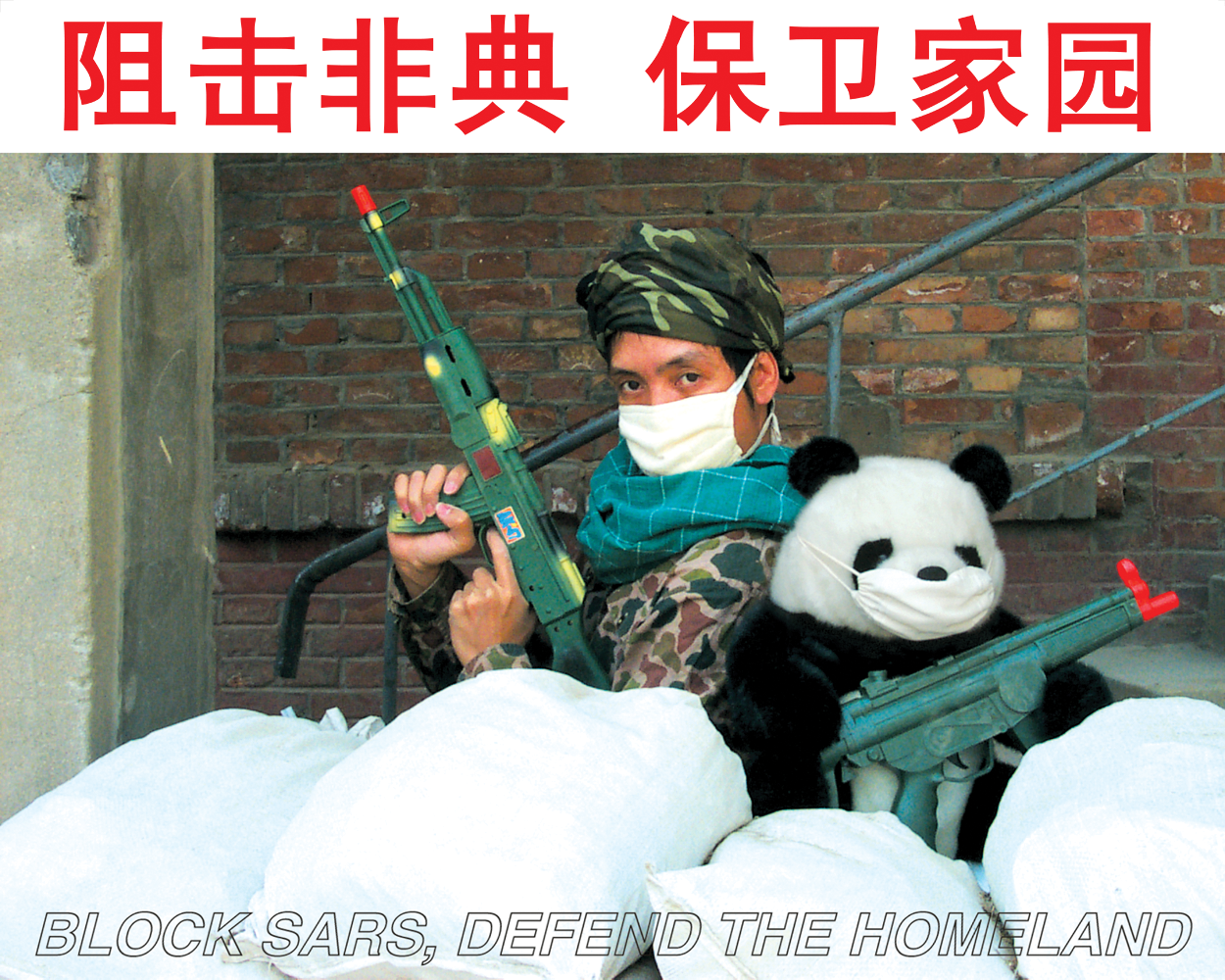
Zhao Bandi and Little Panda, BLOCK SARS, DEFEND THE HOMELAND poster, 2002. Image courtesy of the artist.
The SARS poster belonged to a form of public art that Zhao used often after he abandoned oil painting, his core academic training at the Central Academy of Fine Arts. In 1999, he rose to prominence with a series of single-sheet posters to which the counterfeit detective poster belonged. In that series, he staged himself and the Little Panda doll in a range of roles and situations that dealt with new and widely-shared social concerns. Through the posters, the Panda Man and Little Panda encouraged each other to get AIDS testing, counselled each other with empathy and hope after a job lay-off, and chastised each other for smoking in public. These images were each modified with graphic speech bubbles, and borrowed their formal strategies from the comic strip, the cartoon, the advertisement, and the propaganda poster. In exhibition strategy, Zhao blurred high and low as well; he showed the 1999 posters in major art events such as the Venice Biennale, but also displayed hundreds of multiples in the lightboxes of the Beijing subway stations, a public project facilitated by a local advertising agency and the corporate sponsorship of Kodak (Goldkorn, 2002). Thus, outside the art world, Zhao is known to the Chinese public not as an artist, but as a celebrity called the Panda Man (Xiongmao ren).
Because Zhao’s posters crisscrossed the art world and the public sphere in both distribution and visual strategies, they can be read in many registers – propagandistic, consumerist, informational and artistic. His role-playing in these posters can also be distinguished from the performances of other Chinese performance artists, especially those who emerged contemporaneously from Beijing’s famous East Village. Where their furtive, strenuous, and illicit performances were conducted in secret or to private audiences, Zhao’s contrasting practice saw the artist adopting the posture of a social agent operating in the public realm, a cultural figure acting as though he were invested in public service, civil society, and broadly unifying messages. In the heyday of the effusive SARS press coverage, Zhao’s image was thus widely reproduced in the domestic and foreign media as an expression of Chinese national unity and civic engagement, and any discussion as to the aesthetics of his practice was entirely overshadowed by the Panda Man’s visible popularity.
There was, however, one major difference between the SARS poster of 2003 and Zhao’s earlier posters. This was the artist’s printed ‘signature’ in the bottom left corner, which was never seen on the other images. Though its authorship was thus marked, two Beijing news platforms – a magazine and a television program – reproduced the image without Zhao’s permission, and cropped it so as to remove this signature (interview with author, 19 June 2006, Beijing). When Zhao discovered this, he telephoned the two companies, and, as he recalled in 2006, they were ‘so rude’ to him that he decided to sue for copyright infringement (interview with author, 21 June 2006, Beijing).
Zhao’s lawsuit was heard by the Second Circuit of the Beijing People’s Court. Filmed by a television crew for a future television broadcast, Zhao conducted the entire legal proceedings in the persona of the Panda Man, with the Little Panda doll perched on his lap or held in childish embrace (Figure 3). When the proceedings and performance failed to air on television, Zhao obtained the footage, and with the collaboration of the filmmaker Zhu Wen, produced a 30-minute video entitled A Tale of Love Gone Wrong (2003). This film was screened in art venues in China and abroad, and opened up yet another mediated venue for Zhao’s performative practice.
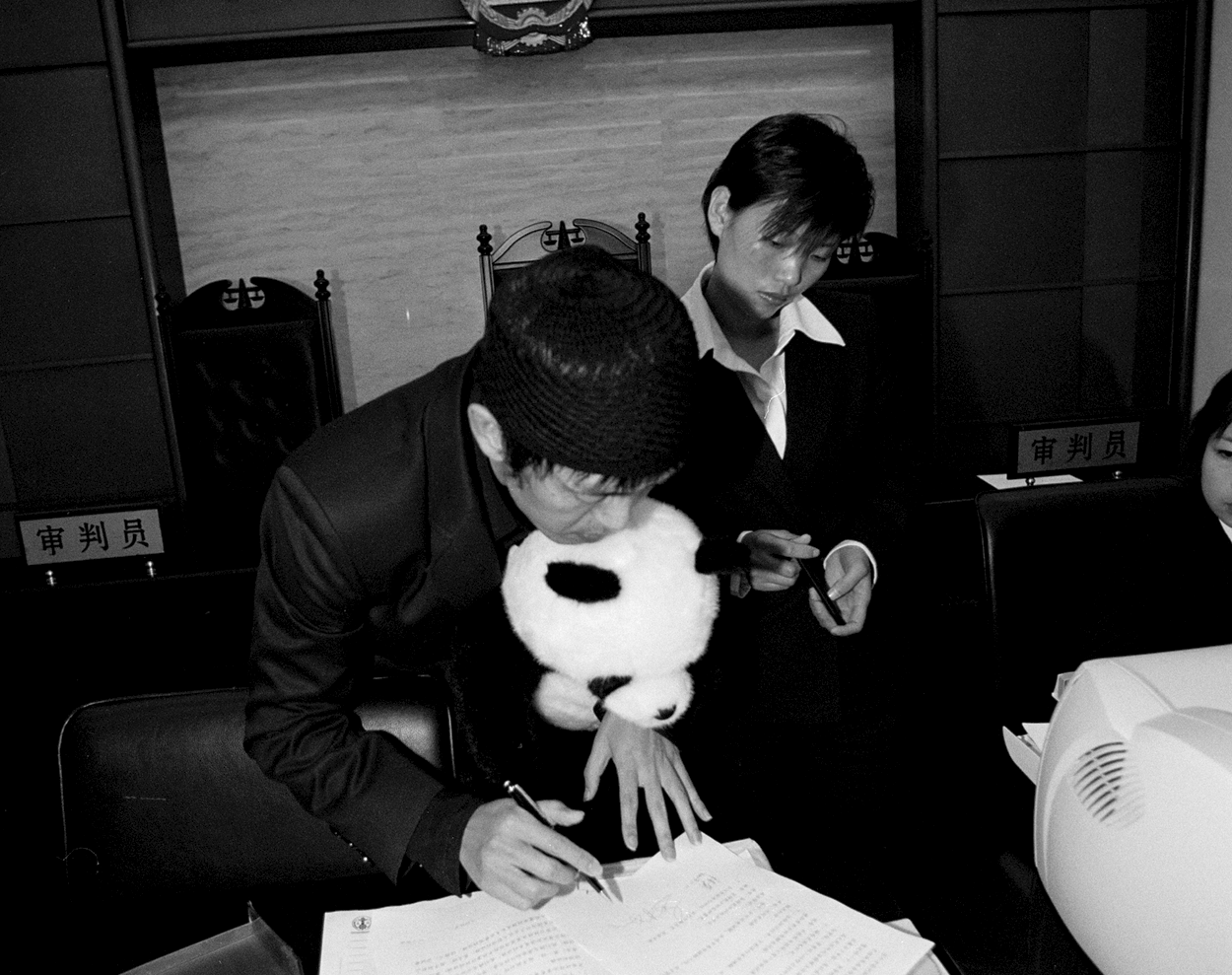
Zhao Bandi and Little Panda, ‘The artist signs his name on the court register’, photograph from A Tale of Love Gone Wrong, 2003. Image courtesy of the artist.
In its opening sequence, set to the popular and sappy Butterfly Lovers Violin Concerto from 1958, and rendered in the sepia-tinted aesthetic of aged film, Zhao is shown entering the courtroom dressed in de rigeur artist-black and with the stuffed panda doll riding atop his shoulders. Then, an a onscreen intertitle displays the judge’s words, printed in retro typeface on faded brown background: ‘The hearing begins!’ It soon becomes clear that, whatever importance he had attached to his legal claims of authorship, Zhao has chosen the silent film form to literally erase the legal discourse of the courtroom. Instead, the melodramatic operetta soundtrack supplants the back-and-forth between plaintiff and defense counsel, rendering Zhao’s own legal claims, the case of copyright violation, the defense, and its ajudication, comically mute. Meanwhile, the lawyers’ fast-paced and expert verbal wrangling is intercut with long, slow-motion sequences of the Panda Man stroking and hugging his panda doll, feigning both exaggerated sorrow and emphatic detachment (Figure 4). Our hero, an everyman lost in a web of legalese, makes melodramatic show of the hurt artistic pride that was the precondition for bringing forth his claim of copyright violation.
Zhao Bandi and Little Panda, ‘The artist reads out a letter from his girlfriend’, photograph from A Tale of Love Gone Wrong, 2003. Image courtesy of the artist.
If his earlier work was about the freedom to play new social roles, the 2003 courtroom performance and video shifted Zhao’s practice to a multimedia examination of the public implications of perfomativity itself. Soon after, he would begin writing one of the celebrity blogs on Sina.com , which at first supplemented, but later overtook, journalistic coverage of the Panda Man. In 2005, he staged a city-wide ‘One-Man Olympics’ in Bern, Switzerland, in which he was the only competitor. In 2006, he produced a reality-television styled competition ostensibly in search of the Chinese person who most resembled a panda. In 2007, following online accusations that he was a male chauvinist, Zhao made outlandish Panda-themed haute couture that was presented on the catwalks of Shanghai Fashion Night and Fashion Week in Scottsdale, Arizona, distributing images of himself as a sleazy fashion designer cavorting with sexy models, dressed as pandas. In 2008, using traditional news media and online social networks, Zhao staged a public boycott of the Spielberg film Kung Fu Panda that mirrored the spate of grassroots activities surrounding the controversial Western media coverage of the Tibet uprisings and the Olympic torch relay. Later that year, he was seen personally delivering toy pandas – miniatures of his own doll – to children in the Sichuan earthquake disaster areas. In 2011, Zhao was at work producing a feature-length film about the Panda Man’s efforts to construct an old folks’ home for childless senior citizens. Over this time, Zhao has strictly maintained the performative persona of the Panda Man, pitched steadily between earnest sentimentality and hyper-mediated self-caricature.
Zhao once described his practice as one by which he ‘kidnaps’ the ‘brand’ of the Chinese nation – the panda – for his own ‘individual purposes’ (interview with author, 19 June 2006). In other words, Zhao sees his appropriative gesture as akin to both a crime and a marketing strategy. As a public and publicized theft, then, it is a perfect re-enactment of ‘counterfeiting’ – an open appropriation of an authorized trademark for an artist’s self-promotion, albeit not without a sense of ineffectual silliness. His consistent adoption of faddish behaviors with the gently-mocking tone of political activism is matched only by his savvy use of the changing media landscape, one in which he has carved out a peculiar social position distinct from that expected of radical or antagonistic performance artists. In this respect, the strongest precedent for Zhao’s performance of role-playing in the public sphere is not to be found in Chinese or Western performance art history, but rather, in the figure of the social activist Wang Hai.
The Anti-Counterfeiting Hero
In 1995, two years after China’s adoption of a newly-written Consumer Rights and Interests Protection Law, the unemployed high school graduate Wang Hai learned of a little-known article in it that compensates any consumer who purchases a fake or substandard product with a double refund from the vendor. 1 In other words, a consumer could legally double his money if he purchased a counterfeit product. Wang first tested this law by identifying a pair of suspicious ‘Sony’ headphones on sale at an electronics shop in a Beijing shopping mall. He then purchased 12 pairs and demanded to double his money from the vendor, ‘damages’ which he ultimately obtained after months of legal battle. His successful and well-publicized lawsuit inspired thousands of copycats throughout China, igniting significant policy debate on the newly legalized sphere of consumer rights (Yap and Lau, 2011: 12).
By knowingly purchasing counterfeit products and going through the opaque legal process necessary to claim compensation, Wang’s activities seemed to exceed the expectations of a law intended to protect unknowing victims of vendor fraud (Song and Hu, 2003: 89–91). Taking on the legal figure of the ‘consumer victim’ and turning himself into a knowing and savvy consumer activist instead, Wang appropriated the law through an act of legal activism, and meanwhile effectively put forth a critique of governmental and judicial efficacy (Liang, 2001). Although this merely placed him on a par with thousands of Chinese citizens and consumers in the 1990s who were all testing their government’s ability to guarantee their newly promulgated legal rights, Wang was set apart from the masses of litigious citizens by certain officials who wanted to promote individual action in consumer rights and protection. In particular, He Shan, a member of the PRC Constitutional Law Working Committee that drafted the Consumer Protection Law, lent his support by personally copying Wang’s activism and bringing the first compensation claim to court in order to set a precedent that would go on to resolve Wang’s own case (Liu, 2004; Yang et al., 2004). He then donated his winnings to the newly-formed Chinese Consumer Association with the stipulation that it establish a fund for an annual anti-counterfeiting award – the first of which went to Wang.
At the same time, a liberalizing news media eager to cover entertaining but censorship-safe stories anointed Wang Hai with national celebrity status, dubbing him the ‘Anti-Counterfeiting Hero’ (dajia yingxiong), and the ‘First Citizen of Anti-Counterfeiting’ (dajia diyiren). He went on to serve as the model consumer for official events marking the newly-created annual Consumer Rights Day on every 15th March, gave countless interviews on television shows, news conferences and public internet chats, and by 2006 had published three autobiographical books. In 1998, CCTV (China Central Television) even named him one of the 20 most important personages of China’s reform era (see Lynch, 1999). For a few years, a press conference by Wang could bring down a company or threaten a whole product category. Persistently wearing sunglasses to maintain his ‘secret identity’, Wang cultivated the image of an anonymous public servant trawling the marketplace to protect Chinese consumers, a vigilante hero such as the wild new China would need (Chen, 2009: 111–12). Even the artist Zhao Bandi, following the Wang Hai phenomenon on television, was captivated (interview with author, 21 June 2006, Beijing).
Soon however, Wang began to leverage his celebrity to create new social roles and forms of activism and entrepreneurship. In 1998, he created a for-profit consulting firm that investigates substandard and illegimate products in the Chinese marketplace for multinational organizations. The firm, he argued, would lead the way in professionalizing the new role of the ‘counterfeit detective’ (dajiaren), and promoting ‘corporate behavior’ (jiti xingwei) in the national anti-counterfeiting campaign. 2 In 2001, he founded a non-governmental organization, noted by The Economist as China’s first, whose mission is to disseminate consumer protection information, raise consumer awareness, and promote individual activism. In 2003, he stood for elections to the People’s Congress of Beijing’s Chaoyang District and, although he was not elected, stated that he intended to run again until he was successful (Yap and Lau, 2011). In all of these roles, Wang has continually proclaimed his faith in the construction of a legally-regulated, rights-based Chinese market economy and civil society (interview with author, 28 June 2006, Beijing).
Perhaps unsurprisingly, the construction of Wang as a national folk hero was soon followed by a notorious scandal in which his true intentions were called into question by a series of dramatic real-time media events. In 2000, the Jincheng Electronic Wire and Cable Manufacturing Company alleged that Wang had agreed to accept payment from counterfeit manufacturers and vendors in exchange for attacking their competitors. In essence, they claimed that Wang was merely using his celebrity status to blackmail businesses for profit, since Wang’s decision to ‘attack’ any particular company or product was his alone. In the words of his accusers, the hero famous for ‘fighting fakes’ (dajia) was in fact ‘fake fighting’ (jia da) (see Liaoshen Wanbao, 2000; Zhao, Y., 2000; Zheng, L., 2002). But, in the spectacular and amusing series of news events that followed, the Jincheng allegations were themselves revealed to be a faked plot. It even had a code-name, ‘Overturn Wang’ (Dao Wang), and was apparently masterminded by the Jincheng company to entrap Wang, who in turn claimed to be merely playing along with the ‘plot-within-a-plot’ in order to finally expose them. Unfolding like a formulaic spy movie, complete with plot twists involving cash in paper bags, secret identities, and tell-all press conferences, the drama culminated with Wang descending into a nervous breakdown and checking into a hospital – which some suggested was merely further play-acting on his part. 3 Lawsuits and countersuits were filed, not only against the individuals involved but also against the newspapers that had published stories and editorials on the matter. Wang lost these lawsuits and appeals, and paid 30,000 RMB in damages. The incident displaced the image of Wang as a ‘folk hero’ acting solely for the benefit of society with that of a celebrity colluding with the media and theatrically manipulating the legal apparatus and media for personal profit (Ye et al., 2006: 143–44).
The rise and fall of the Anti-Counterfeiting Hero and, by extension, the questionable authenticity of officially-sanctioned model citizens in the new China, were neatly referenced in Zhao’s 1999 poster depicting that Wang Hai-esque detective figure. Performing the role of one of Wang Hai’s anti-counterfeiting vigilantes, Zhao presciently put the conspicuous products of official propaganda under public inspection, just as the counterfeit vigilantes sought to scrutinize each product of the new market economy. After the Jincheng scandal, Wang continued to serve as the model representative in all the major official anti-counterfeiting events, but his novelty had clearly worn off. Yet, as his resonance in Zhao’s work reveals, the visibility of such a new-fangled ‘hero’ and his downfall makes transparent the continuing importance of role-playing in the Chinese public sphere, exposing the conventionalizing narratives of the party-state, as well as the interest of the news media in maintaining them. What role does the rights-defending social activist really have in China’s socialist market economy and its new legal and media culture?
In 2006, in a darkened corner of a Starbucks in Beijing that he designated for our interview, I asked the sunglasses-wearing Wang how he then conceptualized his activities within contemporary Chinese society (interview with author, 28 June 2006). In the course of answering my question, Wang jotted down 10 pages of notes detailing the various domains of his activism: individual behavior, corporate behavior, non-governmental organization, political representation, policy participation, media spokesperson, professionalization of anti-counterfeiting, and so on, each divided into two categories of individual and social ‘benefit’ (liyi). Since his celebrity status is dependent upon the normative narratives of self-sacrifice for the social good, it was thus in these binary terms that he conceived of his activism, his livelihood, and his very existence as a socially-active citizen. Yet as the constructedness of his model identity reveals, the figure of a model activist is always already based on the overlapping of personal and official incentives. Moreover, in the shifting sands of China’s ‘marketizing’ media, ‘legalizing’ economy and emerging civil society, the legitimacy of social and public figures are constantly open to criticism. Given the larger discursive limits to which his identity and social function are subject, it is perhaps not unsurprising that Wang personally offers few ideas as to how his proliferating grassroots activities might be strategically harnessed. Instead, he repeatedly invokes utopian notions of social change and consistently reiterates the familiar and official line, that China must continue working towards a legal, rights-based society. Inventing yet another metaphor for his existence, Wang once issued a public statement, cryptically entitled, ‘I am a woodpecker.’ 4
Appropriation, in Chinese
Like Wang Hai, Zhao Bandi also attempts to escape the simulacra of the news media and the constructs of celebrity heroism through the layering of other voices over his own. In the artist’s interviews, the presence of the mute Panda toy is an unreliable clue as to whether Zhao is acting in or out of character as a ‘performance artist’. His refusal to draw clear lines between artistic performances and everyday behaviors suggests that, for Zhao, the key question of contemporary Chinese life lies in the uncertain distinction between the ‘authentic’ self and its strategic social deployment. Together, both Wang’s and Zhao’s continued attempts to structure the reception of their behavior as activist or artist ask more telling questions: Can we ever really escape the fictions of the nation or of the market? Is the courtroom not just another drama in which our parts are already determined?
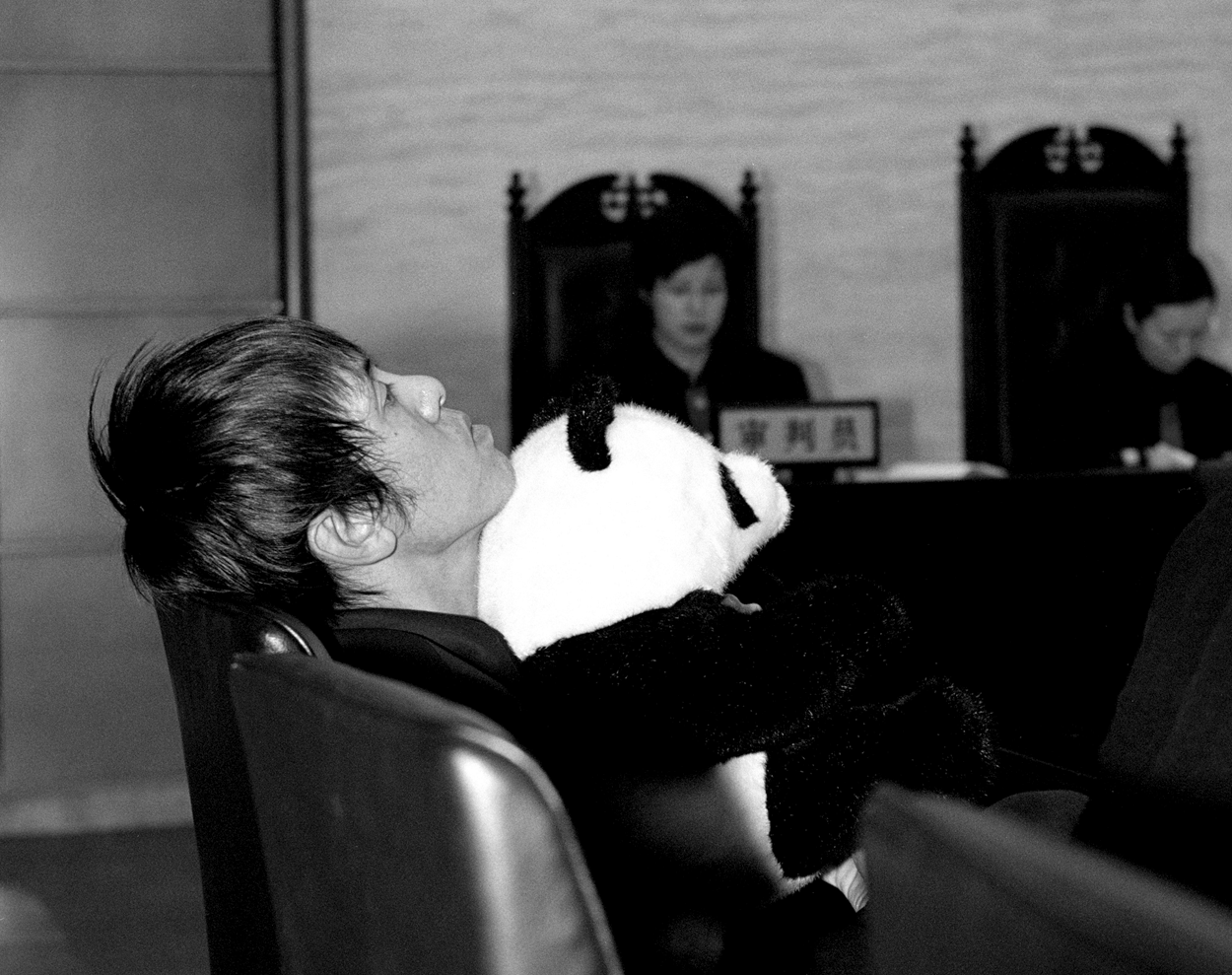
To these questions Zhao, like Wang, offers still more deferred answers. In the final scene of the courtroom video, A Tale of Love Gone Wrong, he is asked by the judge, through an intertitle, whether he has a statement to make. The musical soundtrack of the silent film is then interrupted, and the voice of the artist is finally heard. But, instead of making a statement about his authorial copyrights, Zhao unexpectedly reads out a ‘Dear John’ letter, supposedly written to him by his departed girlfriend (Figure 5). In the letter, this ex-girlfriend, supposedly a former law student, scoffs at his claim that he is the artist who produced the SARS poster, or that he is the man pictured in it. It is not possible, she reasons, because Zhao is too cowardly to have gone outdoors to make posters during the SARS crisis, too ugly to be the handsome man in the picture and, anyway, his toy panda is by ‘no means unique’.
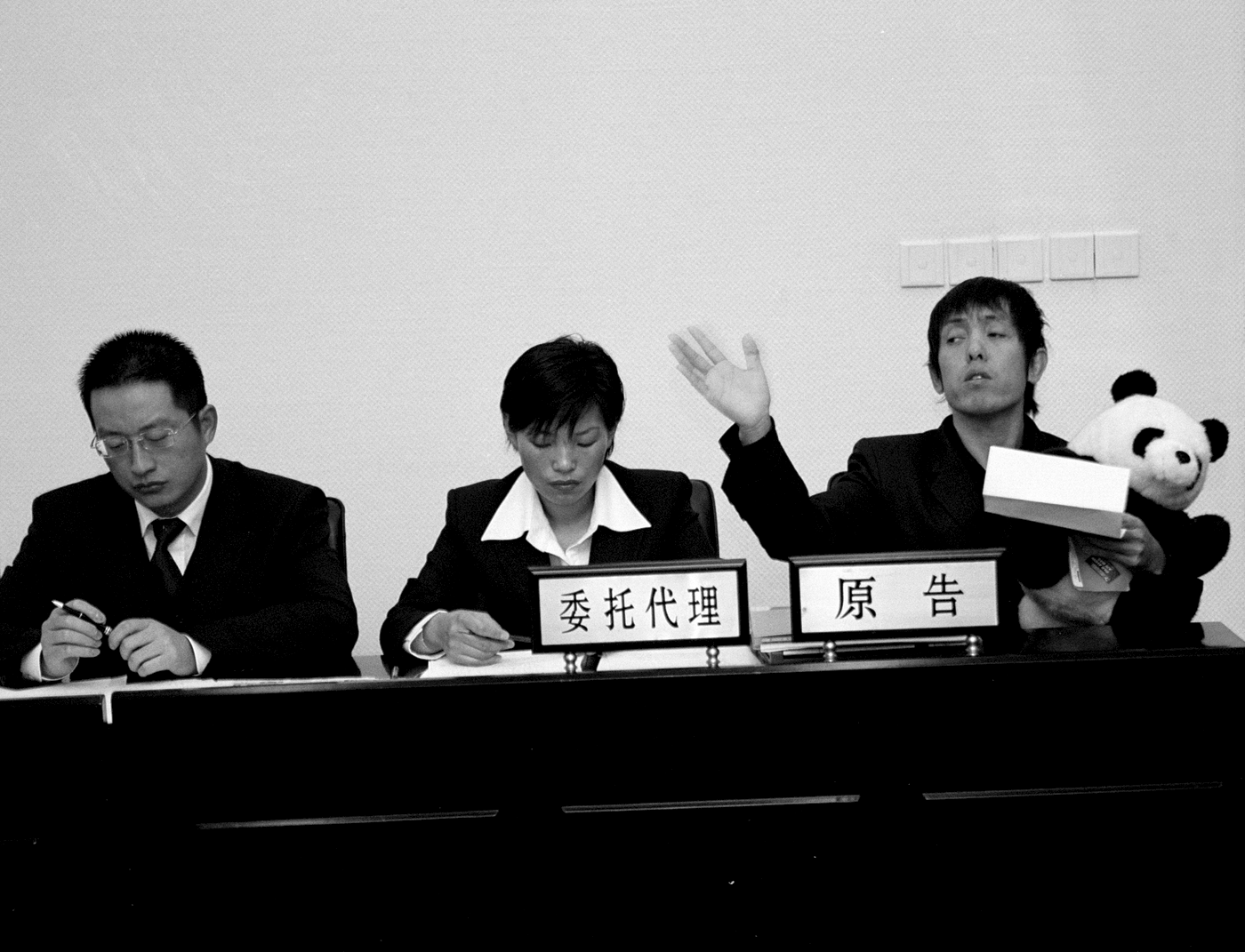
Zhao Bandi and Little Panda, ‘The artist sits in silence’, photograph from A Tale of Love Gone Wrong, 2003. Image courtesy of the artist.
By foreclosing the adjudication of his grievance by an impartial judge and displacing it to a farcically insensitive ex-girlfriend, the ‘letter’ doubly satirizes Zhao’s performance of the harm and suffering that was the precondition for bringing his claim to court. The letter ends with two poignant pieces of advice she touchingly gives to Zhao: either, she urges him, he must cure his madness, or he must start being an ‘honest’ person. Satirizing his own courtroom performance with her admonishment, Zhao’s reading of the letter jars the theatre of legal discourse into the theatre of the ‘personal’ life. Dislocating the court of law to the court of melodramatic love, Zhao’s performance of performing is hence a simultaneous undoing of it, an act that reveals how truth-value – the value of ‘honest’ behavior – has been rendered meaningless and formulaic in ‘real’ life, in the legal life and in the performed life.
If the Anti-Counterfeiting Hero had played his part in a national melodrama of correct behavior, scandal and rehabilitation, then the Panda Man picked up here where Wang left off, showing how conventionalized roles and narratives condition the courtroom, the media, and whatever private life is imagined as the corollary to the public sphere. Ending his film with a sentimental sequence of the Panda Man returning to a sea of Beijing bicycles and cars, Zhao’s multiple silent roles seem to ask: in the ongoing drama of the legalizing economy, why should we still expect to find a singularly authentic person behind this avatar and all of its behaviors, roles and performances?
From the outset, the popularity of the Anti-Counterfeiting Hero and the Panda Man were products of Wang’s and Zhao’s knowing performances of normativity, initially appealing to a wide audience and later inspiring intense media interest. Each, importantly, made intentional claims upon the representational function of the ‘folk’. In Wang’s case, this was as a consumer victim whose private identity, ‘hidden’ behind sunglasses, was sacrificed for the greater good. In Zhao’s case, this was as a cartoon figure identified through a loveable national symbol, represented in toy form, with whom he would muddle through the conundrums of modernization. That is, both artist and activist created public personas that performed a new ‘everyman’. Both, however, did so through strategies of affected normativity that worked from a shared history of China’s socialist models while nevertheless distancing themselves from them (Cheng, 2009: 48–126). Zhao made his affectations clear with his use of humour and absurdity, while Wang made his contestable through his aggressive expansion into corporate and entrepreneurial domains. Unlike the officially constructed heros of the past, Zhao and Wang thus developed and negotiated their performative conformity with unparalleled skill, ultimately destabilizing their own ‘folk hero’ status. Neither absolutely conformist nor absolutely critical of the legal and media apparatuses through which their actions took shape, their appropriative practices point to the impotence of the official sphere of authenticity and its aggrandizement of ideal roles and behaviors, while pointing out the performativity that conditions it.
Let us return to the Western theoretical framework and, specifically, to Coombe’s (1998: 57–8) argument that the appropriation of intellectual properties can be seen as a ‘recoding’ of power from positions of marginality. Such a formulation demands that the relationship between art/activism and the law be oppositional, and forwards the claim that, through parasitic, appropriative codes of practice, marginality can be made visible in the legal or cultural spheres and momentarily subvert its power. Such a framework is inadequate to the task of reading strategies of appropriation in contemporary China such as Wang’s and Zhao’s. For Wang structured his practice not by acting within a social sphere pre-ordered by a stable legal regime, but by attempting to constitute a social sphere de novo in which the law is a point of mediation with official policy and political action. In Zhao’s case, the court was initially positioned as a public adjudicator of the media’s appropriation of his authorial signature, but ultimately he opted to silence its authority through a mediated sociality conditioned by the melodramatic. In their appropriations, Wang and Zhao used the law not to perform a radical oppositionality but rather, ultimately, to stage the affectations of political and emotional normativity itself. Activists who behave as if they were performance artists, and artists who behave as if they were political activists share the same stage: Wang, hailed for his activist appropriation of legal codes, finds himself an anti-heroic advocate for a strengthening legal regime. Zhao won his copyright case, but found the victory entirely hollow. His tale of unreciprocated consumption and citizenship was aptly told, then, as a tale of unrequited love.
Although the Anti-Counterfeiting Hero has never claimed to be a cultural producer, and the Panda Man has never articulated a serious social agenda, both activist and artist thus shared a momentary public platform transformed by the party-state’s promulgated legal reforms. Critical to the emergence of this public space was the concurrent liberalization of the Chinese media sectors, which, grappling with privatization but still restricted by censorship, turned to the quasi-propagandistic construction of ‘heroes’ and a new visual economy of quasi-official celebrity. Both Zhao the artist and Wang the activist are thus figures indicative of a much broader and diverse range of popular negotiations of the mediated public space of contemporary China, one that has grown only more bewildering and sensationalist since the appearance of the Panda Man and the Anti-Counterfeiting Hero.
A few years after their heyday, the Chinese public discourse would be consumed with the culture of shanzhai, a figuration of counterfeiture which borrows from the heroic image of the rebellious mountain stronghold, and advances the claim that Chinese versions of internationally-trademarked goods serve the particular national and local needs of China’s now-savvy consumers. Dual SIM-card ‘iPhones’ and ‘Harry Potter’ sequels have replaced the stigma of the Chinese fake with a guerilla rebelliousness that is no more threatening than a counterfeit stuffed panda doll. Today’s Chinese consumers find the shanzhai version more ‘cute, creative, and interesting’ than its WTO-approved, IPR regime-protected, internationally-authenticated original, and its fakes (Gerth, 2010). Embraced by officials, activists, academics, and consumers alike, this brand new discourse of shanzhai for the not-so-new practice of counterfeiting might best be described, then, as ‘appropriation’ tout court: an acknowledgement that the savviest of consumers, at home and abroad, love to fool themselves. Remembering the heroism of the anti-counterfeiting vigilante and the panda doll celebrity, we might see how the distinctly Chinese alternative of shanzhai became safe and cute, socially creative, and effectual through figures like Zhao and Wang, who redrew the boundaries of consumption and citizenship in ways that were appropriationist, but far from oppositional or antagonistic. Rather, after their art and activism, we might say that this newly nationalistic term for ‘appropriation’ in the Chinese homeland is rooted in that gradual awareness of the performativity of consumption and citizenship, made conspicuous by the Panda Man’s performance of performing, and by the Anti-Counterfeiting Hero’s imitation of preconditioned behavior.
Footnotes
Acknowledgements
A version of this article was presented at ‘Rethinking Copyright and Appropriation’, College Art Association, 2007. I am grateful for the comments made by the participants, as well as the generous feedback of Martha Buskirk, Arindam Dutta, Gu Yi, Pamela Karimi, Jing Wang, Henrietta Harrison, susan pui san lok, and two anonymous reviewers.