






Abstract

Having closely followed Giorgio Agamben’s writings for some years, I welcomed the chance to critically evaluate his Creation and Anarchy for this journal. For art historians and others concerned with visual and material culture today this work seemed an irresistible challenge. So it is with some regret that I must report, after closely reading these essays, that I find the author’s perspectives on the history and theory of the visual arts in these essays embarrassingly parochial and ill-informed (see Emerling, 2019). The five texts published in Creation and Anarchy reproduce, with minor variations, lectures presented between 2012 and 2013 at the Mendrisio Academy of Architecture in the Italian-speaking Swiss canton of Ticino. The texts are ‘Archaeology of the Work of Art’, ‘What Is the Act of Creation?’, ‘The Inappropriable’, ‘What Is a Command?’, and ‘Capitalism as a Religion’. My disappointment with Agamben’s thoughts on art, philosophy, and Walter Benjamin’s insight about ‘capitalism as religion’ is best conveyed by Agamben’s own coy absence of a conclusion about these pressing issues: ‘interrupting my brief archaeology of the capitalist religion. There will not be a conclusion. I think, in fact, that in philosophy as in art, we cannot “conclude” a work: we can only abandon it, as Giacometti said of his canvases’ (p. 77).
In an interview with Ulrich Raulff (2004), Agamben explains that: I am not an historian; I work with paradigms. A paradigm [Greek παράδειγμα] is something like an example, an exemplar, an historically singular phenomenon. As it was with the panopticon for Foucault, so is the Homo Sacer or the Muselmann or the state of exception for me. And then I use this paradigm to construct a large group of phenomena [and] in order to understand an historical structure, again analogous with Foucault, who developed his ‘panopticism’ from the panopticon. But this kind of analysis should not be confused with a sociological investigation. (p. 610)
It should be noted, as Agamben (2009) himself makes clear, that paradigm comes from ancient Greek παράδειγμα (paradeigma), meaning ‘pattern, example, sample’ as it stems from the verb παραδείκνυμι (paradeiknumi) signifying ‘to exhibit, represent, expose’ and from παρά (para) ‘beside, beyond’ and δείκνυμι (deiknumi) ‘to show, to point out’. But while paradigms are instances of historical or sociological investigation, they are also, as Agamben implies, a method of philosophical thought, and, more specifically for our concerns perhaps, instances of artistic or art historical investigation.
Agamben opens the first lecture (‘Archaeology of the Work of Art’) by asserting that ‘archaeology is the sole means of access to the present’ and proceeds by developing Michel Foucault’s suggestion that the investigation of the past is ‘nothing but the shadow cast by an interrogation directed at the present’ (p. 1). It is in seeking to comprehend the present that ‘we Europeans, unlike Asians and Americans [for whom Agamben says that history and the past have a completely different significance], can gain access to their truth only by means of a confrontation with the past, only by settling accounts with their history’ (p. 1, emphasis added). He then cites Alexandre Kojève (‘a philosopher who was also a high functionary of the emergent Europe’) who, Agamben claims, maintained that ‘Homo sapiens had arrived at the end of its history and at this point had before it only two possibilities: access to a post-historical animality (incarnated by the ‘American Way of Life’) or snobbism (incarnated by the Japanese, who continued to celebrate their tea ceremonies, devoid though they were of any historical meaning’ (p. 1). (It is unclear whether or not this idea being ascribed to Kojève is accurate.) Perhaps Agamben’s uncited reference here alludes also to the insights of Roland Barthes’ Empire of Signs (1983[1970]), one paradigm of Eurocentrist fascination with a non-European culture (Japan)? As it reads, Agamben’s premise is yet another instance of ‘Europe’ defining itself by imaginary/imagined antitheses with its supposed ‘Others’. This seems far from the specificities of Foucault’s methodology, which the title of the lecture presents as the primary critical framework.
This opening chapter is also problematic in that the ‘non-historian’ Agamben presents a ‘summary archaeology’ (p. 12) comprised of three historical ‘moments’: (1) 4th-century BCE classical Greece that entails a close reading of the passage from Book Theta of Aristotle’s Metaphysics that grounds the entirety of Agamben’s philosophy; (2) Germany in 1923, where the ‘obscure monk’ Odo Casel publishes Die Liturgie als Misterienfeier (Liturgy as Mystical Feast) at the Benedictine monastery of Maria Laach, a manifesto for what later became the Liturgical Movement); and (3) New York around 1916, where Duchamp invents the ‘ready-made’, thereby deeply problematizing aesthetics as an autonomous reality. Agamben insists that the ‘juxtaposition between the practice of the avant-garde and the liturgy’ is ‘not preposterous’ (p. 9). Nonetheless, the material he addresses in this putative aesthetic history is a longstanding interest of his. He has dealt with them throughout his work, most fully in his The Man Without Content (1999). In this earlier work, he interrogates ‘the entrance of art into the aesthetic dimension and the understanding of it starting from the aesthesis (the feelings and senses) of the spectator’, emphasizing that this shift to the spectator/viewer ‘is not as innocent and natural a phenomenon as we commonly think’ (p. 6). Thus, it is not until the chapter ‘What is the Act of Creation?’ that we might get a clearer sense of where and how Agamben’s paradigmatic enterprise of circling around the conundrum of ‘art’ as a kind of entity unfolds.
Simply put, he desires to shift our focus from the aesthesis of the spectator/viewer to the production inherent in a creative poetic (poiesis) act. Agamben admits that the title of this chapter is taken exactly from Gilles Deleuze, who presented a famous lecture with the same title in March 1987. While Agamben begins his chapter by acknowledging Deleuze, he ends this encounter by stating: I will therefore try to question what has remained unsaid in the Deleuzian idea of the act of creation as an act of resistance, and in this way, I will endeavor to continue and carry on, obviously under my full responsibility, the thought of an author I love. (p. 15)
For his act of ‘carrying on’ this Deleuzian thought, Agamben posits that a ‘creative’ or poietic act reserves its own potentiality via how it ‘deactivates and renders inoperative its communicative and informative functions in order to open them to a new possible use’ (p. 27). Or, in Spinoza’s terms, according to Agamben, there is a point at which language, having ‘deactivated its utilitarian functions, rests in itself and contemplates its potential to say’ (p. 27).
We must challenge Agamben’s metaphysical philosophy of language here. Semiotics has been a focal point of my work over the years, especially as it relates to ‘the art of art history’ (see Preziosi, 1989: 149–152). The idea that speech has, apart from other uses, a self-reflexive function, a meta-linguistic domain, in fact, brings up the necessity of critically attending to the nexus of multifunctional, multimodal, and multidimensional relationships characterizing semiotic practice construed holistically. Among various models, Roman Jakobson’s diagrammatic and relational paradigm of communicative praxis is perhaps the most pertinent here for gaining a critical perspective on Agamben’s notion of art and creativity. In Jakobson’s model, six elements are co-present in varying degrees of dominance in any act.
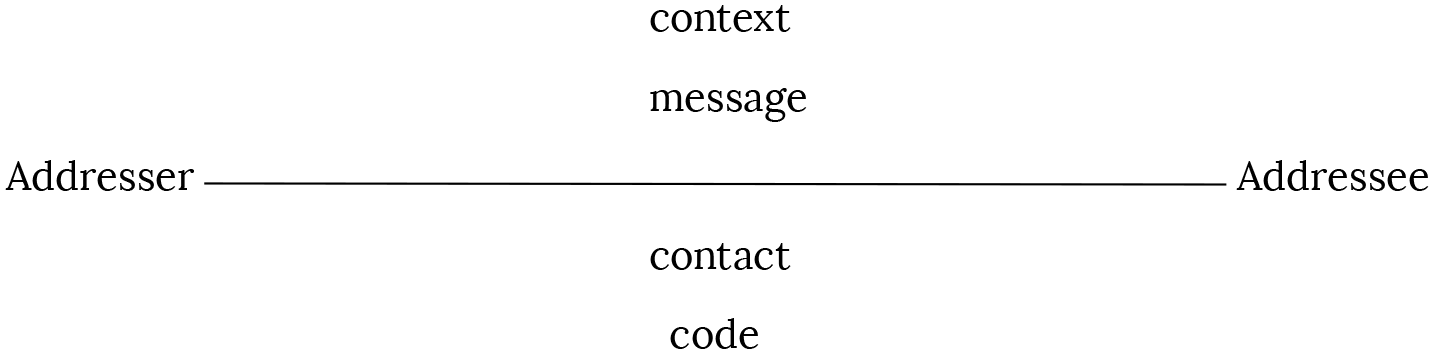
Within this perspective, the message does not and cannot supply all of the significance of the interaction; a significant portion of what is communicated derives from the specific contextual situation, the code itself within which the individual articulation arises, and the means and circumstances of contact between maker and user/beholder. Meaning is thereby not essentially a stable, predetermined entity that is simply ‘conveyed’, like the contents of a delivery van, to a customer. In addition, the six elements of the act are not necessarily in any perfect balance: any one (or several) may be in dominance over any others. The nature of the resultant articulation is a function of degrees of dominance and subordination given any of these elements. For Jakobson, these elements were seen as specifying the following functional perspectives:
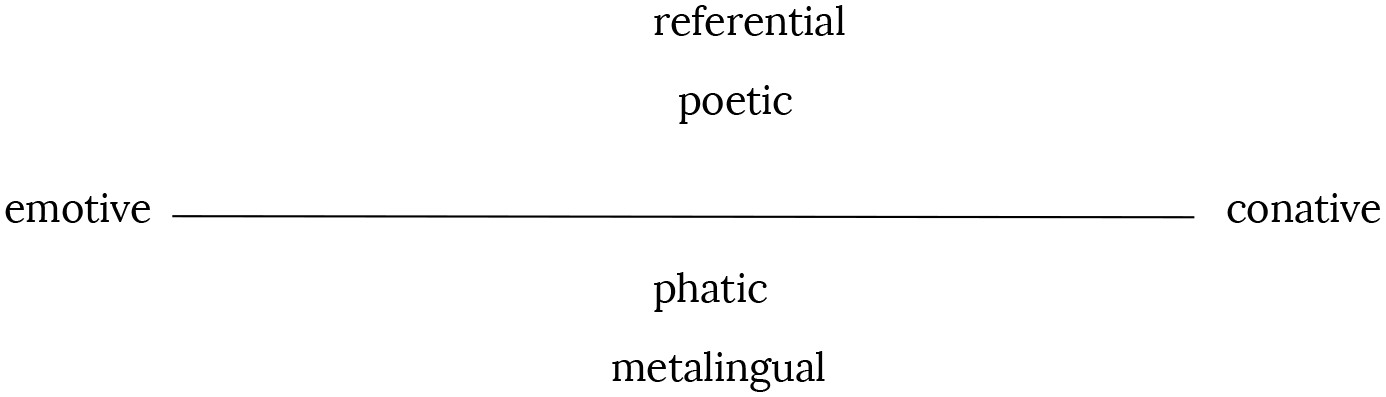
All of these are necessarily co-present as varying functions of a given articulation. Thus, in Jakobson’s view, if the communication is oriented toward the context, then a referential function is dominant; if the communication is oriented toward the maker or speaker, then the emotive function of the message is foregrounded, and the speaker’s perspective on the content of the message becomes as prominent as the referential content, and so forth (Preziosi, 1989: 150–151). Recall Agamben’s assertion above that ‘terminology is the poetic element of thought’: it is a metalingual assertion, focused upon the code itself. That Agamben avoids these material semiotic nuances in favor of Heidegger’s onto-poetic ‘way to language’ is telling.
In the end, Agamben’s work may provide us with ‘the unfolding of a space in which it is once more possible to think’ pace Michel Foucault, who noted that through our ‘aesthetic life’ we reckon with the terrifying anarchy and fragility of power relations in all social interactions. I explicitly use the verb to reckon with in order to call attention to its double valence in English: to simultaneously think with and to grapple with or against the fluid, changing, and continually challenging agonies: the paradigmatics of social life. But what Agamben gives us in place of the ontological, social, and political efficacy of the work of art in our contemporary lives is a ‘Borromean Knot’, a paradigm that he uses ‘to construct a large group of phenomena [and] in order to understand an historical structure’. He writes: The place of the work of art has fallen to pieces . . . ergon and energeia, work and creative operation, are complementary yet incommunicable notions, which form, with the artist as their middle term, what I propose to call the ‘artistic machine’ of modernity. And it is not possible, even if it is always attempted, either to separate them or make them coincide, or, even less, to play one off against the other. We are dealing, then, with something like a Borromean Knot, which binds together the work, the artist, and the operation; and as in every Borromean Knot, it is not possible to release one of the three elements that compose it without irrevocably breaking the entire knot. (pp. 8–9)
Agamben’s terminology here derives from the emblem of the powerful Borromeo family of Milan, whose most famous member was Carlo Borromeo, Archbishop of Milan from 1564–1584, who was responsible for significant reforms in the Catholic Church, and a leading figure of the Counter-Reformation. The family coat of arms included the Borromean rings, said to be an emblem of the divine trinity. As a family emblem, it symbolized the indissoluble links between branches of the family: break any one link, and all three separate. Agamben’s ‘Borromean Knot’ is one pointer toward the delineation of a richly diverse historiography of epistemological technologies largely forgotten (or erased by design) in our several modernities. Nonetheless, the question remains if Agamben’s ‘non-historian’s’ method is capable of delimiting the inextricability of the symbolic, imaginary, and the real as we confront them in contemporary visual culture, let alone art history.
What Agamben does not mention, and perhaps should have brought to the foreground, are the very striking parallels in his text with the work of Jacques Lacan, for whom the Borromean Knot was more than an analogue of the constitution of the self, but a figure of its very ongoing constitution. For me, Agamben must always be read in the light of not only Foucault but of Lacan as well because the latter’s ontological and ethical topologies complicate what Agamben has called a paradigm and ‘the return of the repressed’ that he deploys here: note Agamben’s claim concerning ‘contemporary art as a return in pathological forms of the repressed “work” [ergon]’ (p. 4). For Lacan, each ring of the Borromean knot represented a fundamental concept of reality: the ‘real’, the ‘imaginary’, and the ‘symbolic’ or, put otherwise, the components of the self, its actions in the world, its signifiers, and the object–cause of its desire. As Lacan (1998) intimated: ‘Hence you see that the question arises of knowing how to set a limit to the solutions of the Borromean problem. I will leave the question open’ (p. 130). Thus it may be fitting to close this review on the threshold or at the windowsill of all that must remain open (see Preziosi and Farago, 2012: 74–93).